


IEC 60601-2-51:2003
(Main)Medical electrical equipment - Part 2-51: Particular requirements for safety, including essential performance, of recording and analysing single channel and multichannel electrocardiographs
General Information
- Abstract
Establishes particular requirements, in addition to the requirements of IEC 60601-2-25, for the safety, including essential performance of recording and analysing single channel and multichannel electrocardiographs. These requirements shall apply particularly to - recording electrocardiographs; - electrocardiographs which are part of other medical electrical equipment, for example exercise testing systems, if this equipment is used to record ECGs for diagnostic purposes; - electrocardiographs which are used as output units for ECG data base management systems or electrocardiographs which are used as output units located at other places than the recording unit; - analyzing electrocardiographs, systems, and computing devices which by means of electronic data processing and pattern recognition derive measurements (e.g. intervals and amplitudes) and diagnostic statements from the ECG; - those parts of patient monitors or other specialised electrocardiographs that are capable of performing the functions of the analyzing electrocardiographs.
- Status
- Replaced
- Publication Date
- 26-Feb-2003
- Technical Committee
- SC 62D - Particular medical equipment, software, and systems
- Current Stage
- DELPUB - Deleted Publication
- Start Date
- 19-Oct-2011
- Completion Date
- 28-Aug-2026
Buy Documents

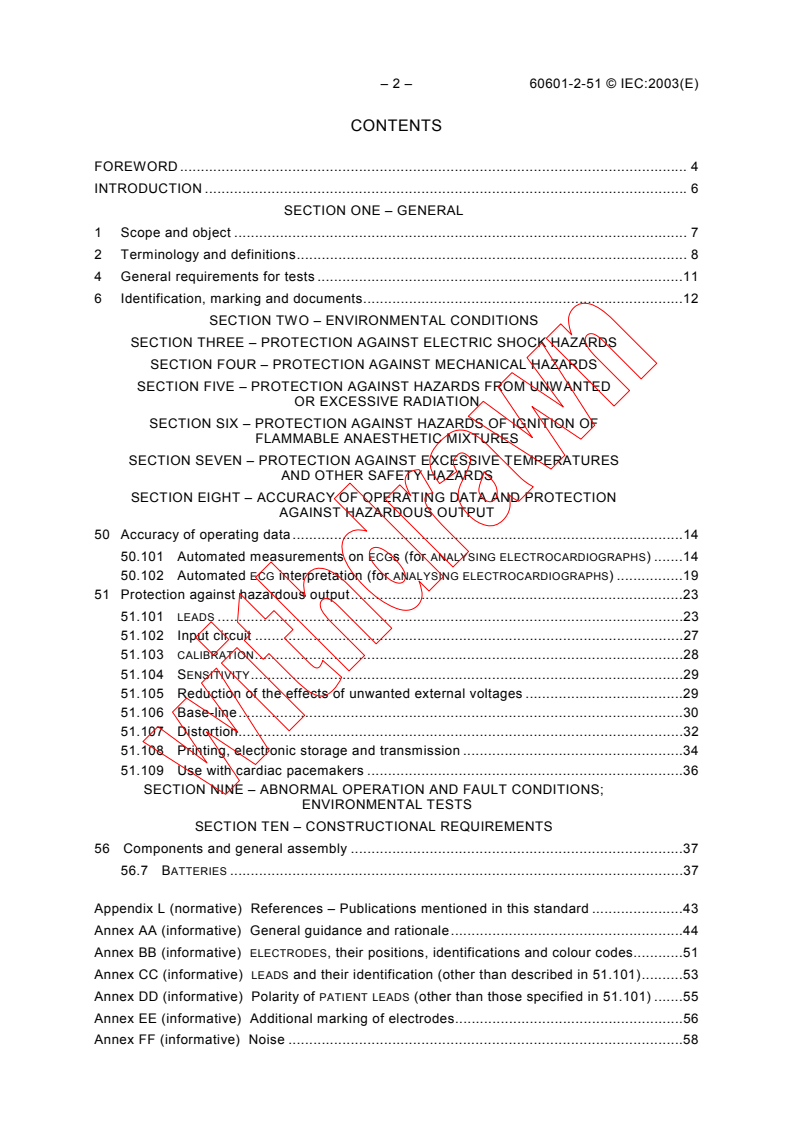
IEC 60601-2-51:2003 - Medical electrical equipment - Part 2-51: Particular requirements for safety, including essential performance, of recording and analysing single channel and multichannel electrocardiographs Released:2/27/2003


IEC 60601-2-51:2003 - Medical electrical equipment - Part 2-51: Particular requirements for safety, including essential performance, of recording and analysing single channel and multichannel electrocardiographs Released:2/27/2003
Relations
- Effective Date
- 05-Sep-2023
Buy Documents
IEC 60601-2-51:2003 - Medical electrical equipment - Part 2-51: Particular requirements for safety, including essential performance, of recording and analysing single channel and multichannel electrocardiographs Released:2/27/2003
IEC 60601-2-51:2003 - Medical electrical equipment - Part 2-51: Particular requirements for safety, including essential performance, of recording and analysing single channel and multichannel electrocardiographs Released:2/27/2003
Get Certified
Connect with accredited certification bodies for this standard

BSI Group
BSI (British Standards Institution) is the business standards company that helps organizations make excellence a habit.

TÜV Rheinland
TÜV Rheinland is a leading international provider of technical services.

TÜV SÜD
TÜV SÜD is a trusted partner of choice for safety, security and sustainability solutions.
Sponsored listings
Frequently Asked Questions
IEC 60601-2-51:2003 is a standard published by the International Electrotechnical Commission (IEC). Its full title is "Medical electrical equipment - Part 2-51: Particular requirements for safety, including essential performance, of recording and analysing single channel and multichannel electrocardiographs". This standard covers: Establishes particular requirements, in addition to the requirements of IEC 60601-2-25, for the safety, including essential performance of recording and analysing single channel and multichannel electrocardiographs. These requirements shall apply particularly to - recording electrocardiographs; - electrocardiographs which are part of other medical electrical equipment, for example exercise testing systems, if this equipment is used to record ECGs for diagnostic purposes; - electrocardiographs which are used as output units for ECG data base management systems or electrocardiographs which are used as output units located at other places than the recording unit; - analyzing electrocardiographs, systems, and computing devices which by means of electronic data processing and pattern recognition derive measurements (e.g. intervals and amplitudes) and diagnostic statements from the ECG; - those parts of patient monitors or other specialised electrocardiographs that are capable of performing the functions of the analyzing electrocardiographs.
Establishes particular requirements, in addition to the requirements of IEC 60601-2-25, for the safety, including essential performance of recording and analysing single channel and multichannel electrocardiographs. These requirements shall apply particularly to - recording electrocardiographs; - electrocardiographs which are part of other medical electrical equipment, for example exercise testing systems, if this equipment is used to record ECGs for diagnostic purposes; - electrocardiographs which are used as output units for ECG data base management systems or electrocardiographs which are used as output units located at other places than the recording unit; - analyzing electrocardiographs, systems, and computing devices which by means of electronic data processing and pattern recognition derive measurements (e.g. intervals and amplitudes) and diagnostic statements from the ECG; - those parts of patient monitors or other specialised electrocardiographs that are capable of performing the functions of the analyzing electrocardiographs.
IEC 60601-2-51:2003 is classified under the following ICS (International Classification for Standards) categories: 11.040.60 - Therapy equipment. The ICS classification helps identify the subject area and facilitates finding related standards.
IEC 60601-2-51:2003 has the following relationships with other standards: It is inter standard links to IEC 60601-2-25:2011. Understanding these relationships helps ensure you are using the most current and applicable version of the standard.
IEC 60601-2-51:2003 is available in PDF format for immediate download after purchase. The document can be added to your cart and obtained through the secure checkout process. Digital delivery ensures instant access to the complete standard document.
Standards Content (Sample)
INTERNATIONAL IEC
STANDARD
60601-2-51
First edition
2003-02
Medical electrical equipment –
Part 2-51:
Particular requirements for safety,
including essential performance,
of recording and analysing single channel
and multichannel electrocardiographs
Appareils électromédicaux –
Partie 2-51:
Règles particulières de sécurité et
performances essentielles des électrocardiographes
enregistreurs et analyseurs mono et multi-canaux
Reference number
Publication numbering
As from 1 January 1997 all IEC publications are issued with a designation in the
60000 series. For example, IEC 34-1 is now referred to as IEC 60034-1.
Consolidated editions
The IEC is now publishing consolidated versions of its publications. For example,
edition numbers 1.0, 1.1 and 1.2 refer, respectively, to the base publication, the
base publication incorporating amendment 1 and the base publication incorporating
amendments 1 and 2.
Further information on IEC publications
The technical content of IEC publications is kept under constant review by the IEC,
thus ensuring that the content reflects current technology. Information relating to
this publication, including its validity, is available in the IEC Catalogue of
publications (see below) in addition to new editions, amendments and corrigenda.
Information on the subjects under consideration and work in progress undertaken
by the technical committee which has prepared this publication, as well as the list
of publications issued, is also available from the following:
• IEC Web Site (www.iec.ch)
• Catalogue of IEC publications
The on-line catalogue on the IEC web site (http://www.iec.ch/searchpub/cur_fut.htm)
enables you to search by a variety of criteria including text searches, technical
committees and date of publication. On-line information is also available on
recently issued publications, withdrawn and replaced publications, as well as
corrigenda.
• IEC Just Published
This summary of recently issued publications (http://www.iec.ch/online_news/
justpub/jp_entry.htm) is also available by email. Please contact the Customer
Service Centre (see below) for further information.
• Customer Service Centre
If you have any questions regarding this publication or need further assistance,
please contact the Customer Service Centre:
Email: custserv@iec.ch
Tel: +41 22 919 02 11
Fax: +41 22 919 03 00
INTERNATIONAL IEC
STANDARD
60601-2-51
First edition
2003-02
Medical electrical equipment –
Part 2-51:
Particular requirements for safety,
including essential performance,
of recording and analysing single channel
and multichannel electrocardiographs
Appareils électromédicaux –
Partie 2-51:
Règles particulières de sécurité et
performances essentielles des électrocardiographes
enregistreurs et analyseurs mono et multi-canaux
IEC 2003 Copyright - all rights reserved
No part of this publication may be reproduced or utilized in any form or by any means, electronic or
mechanical, including photocopying and microfilm, without permission in writing from the publisher.
International Electrotechnical Commission, 3, rue de Varembé, PO Box 131, CH-1211 Geneva 20, Switzerland
Telephone: +41 22 919 02 11 Telefax: +41 22 919 03 00 E-mail: inmail@iec.ch Web: www.iec.ch
PRICE CODE
Commission Electrotechnique Internationale
XC
International Electrotechnical Commission
Международная Электротехническая Комиссия
For price, see current catalogue
– 2 – 60601-2-51 © IEC:2003(E)
CONTENTS
FOREWORD . 4
INTRODUCTION .6
SECTION ONE – GENERAL
1 Scope and object . 7
2 Terminology and definitions. 8
4 General requirements for tests .11
6 Identification, marking and documents.12
SECTION TWO – ENVIRONMENTAL CONDITIONS
SECTION THREE – PROTECTION AGAINST ELECTRIC SHOCK HAZARDS
SECTION FOUR – PROTECTION AGAINST MECHANICAL HAZARDS
SECTION FIVE – PROTECTION AGAINST HAZARDS FROM UNWANTED
OR EXCESSIVE RADIATION
SECTION SIX – PROTECTION AGAINST HAZARDS OF IGNITION OF
FLAMMABLE ANAESTHETIC MIXTURES
SECTION SEVEN – PROTECTION AGAINST EXCESSIVE TEMPERATURES
AND OTHER SAFETY HAZARDS
SECTION EIGHT – ACCURACY OF OPERATING DATA AND PROTECTION
AGAINST HAZARDOUS OUTPUT
50 Accuracy of operating data.14
50.101 Automated measurements on ECGs (for ANALYSING ELECTROCARDIOGRAPHS) .14
50.102 Automated ECG interpretation (for ANALYSING ELECTROCARDIOGRAPHS) .19
51 Protection against hazardous output.23
51.101 LEADS .23
51.102 Input circuit .27
51.103 CALIBRATION.28
51.104 SENSITIVITY.29
51.105 Reduction of the effects of unwanted external voltages .29
51.106 Base-line .30
51.107 Distortion.32
51.108 Printing, electronic storage and transmission .34
51.109 Use with cardiac pacemakers .36
SECTION NINE – ABNORMAL OPERATION AND FAULT CONDITIONS;
ENVIRONMENTAL TESTS
SECTION TEN – CONSTRUCTIONAL REQUIREMENTS
56 Components and general assembly .37
56.7 BATTERIES .37
Appendix L (normative) References – Publications mentioned in this standard .43
Annex AA (informative) General guidance and rationale.44
Annex BB (informative) ELECTRODES, their positions, identifications and colour codes.51
Annex CC (informative) LEADS and their identification (other than described in 51.101).53
Annex DD (informative) Polarity of PATIENT LEADS (other than those specified in 51.101) .55
Annex EE (informative) Additional marking of electrodes.56
Annex FF (informative) Noise .58
60601-2-51 © IEC:2003(E) – 3 –
Annex GG (normative) Definitions and rules for the measurement
of ELECTROCARDIOGRAMS.60
Annex HH (normative) Calibration and test data sets .66
Annex II (informative) CTS test atlas .69
Bibliography .81
INDEX OF DEFINED TERMS .82
Figure 101 – Electrode position according to Frank (see Table 101).38
Figure 102 – Polarity of patient leads (see 51.101.1).38
Figure 103 – Test of weighting networks and input impedance (see 51.101.2.2 and 51.102.1) . 38
Figure 104 – Test of common mode rejection (see 51.105.1 and 51.106.4) .39
Figure 105 – Triangular waveforms for test E of Table 114 (see 51.107.1.1.1).40
Figure 106 – Input impulse signal (dashed trace) and cardiograph response
(continuous trace) (see 51.107.1.1.2) .40
Figure 107 – Circuit for test of linearity (see 51.107.2) .41
Figure 108 – Result of linearity test (see 51.107.2) .41
Figure 109 – Test of rectangular coordinates (see 51.108.4.1) .42
Table 101 – ELECTRODES and NEUTRAL ELECTRODES, their position, identification and
colour code .13
Table 102 – Offset voltage for ST and T amplitude reference values if the signals are
fed through a first order high pass FILTER with a TIME CONSTANT of 3,2 s.16
Table 103 – Acceptable mean differences and standard deviations for global intervals
and Q-, R-, S-durations on calibration and analytical ECGs .17
Table 104 – Acceptable mean differences and standard deviations for global durations
and intervals for biological ECGs .18
Table 105 – Disclosed changes of measurements caused by NOISE on ECGs according
to Table HH.3.18
Table 106 – Tabulation of test results .19
Table 107 – Format for disclosure of accuracy measures for diagnostic
interpretative statements .22
Table 108 – Format for disclosure of accuracy measures for rhythm interpretative statements. 23
Table 109 – Connection of ELECTRODES for a particular LEAD.24
Table 110 – LEADS and their identification (nomenclature and definition).24
Table 111 – LEAD networks for Goldberger and Wilson LEADS.26
Table 112 – LEAD network for Frank LEADS.27
Table 113 – Test of input impedance – Positions of LEAD SELECTOR, connection of LEAD
ELECTRODES and peak to valley deflection in mm with S1 open.28
Table 114 – Frequency response.32
Table HH.1 – Calibration and analytical ECGs.66
Table HH.2 – Data set for testing of measurement and wave recognition accuracy of
biological data – 100 ECGs of the CSE-study. .67
Table HH.3 – Data set for testing NOISE stability.67
– 4 – 60601-2-51 © IEC:2003(E)
INTERNATIONAL ELECTROTECHNICAL COMMISSION
____________
MEDICAL ELECTRICAL EQUIPMENT –
Part 2-51: Particular requirements for safety, including essential
performance, of recording and analysing single channel
and multichannel electrocardiographs
FOREWORD
1) The IEC (International Electrotechnical Commission) is a worldwide organization for standardization comprising
all national electrotechnical committees (IEC National Committees). The object of the IEC is to promote
international co-operation on all questions concerning standardization in the electrical and electronic fields. To
this end and in addition to other activities, the IEC publishes International Standards. Their preparation is
entrusted to technical committees; any IEC National Committee interested in the subject dealt with may
participate in this preparatory work. International, governmental and non-governmental organizations liaising
with the IEC also participate in this preparation. The IEC collaborates closely with the International Organization
for Standardization (ISO) in accordance with conditions determined by agreement between the two
organizations.
2) The formal decisions or agreements of the IEC on technical matters express, as nearly as possible, an
international consensus of opinion on the relevant subjects since each technical committee has representation
from all interested National Committees.
3) The documents produced have the form of recommendations for international use and are published in the form
of standards, technical specifications, technical reports or guides and they are accepted by the National
Committees in that sense.
4) In order to promote international unification, IEC National Committees undertake to apply IEC International
Standards transparently to the maximum extent possible in their national and regional standards. Any
divergence between the IEC Standard and the corresponding national or regional standard shall be clearly
indicated in the latter.
5) The IEC provides no marking procedure to indicate its approval and cannot be rendered responsible for any
equipment declared to be in conformity with one of its standards.
6) Attention is drawn to the possibility that some of the elements of this International Standard may be the subject
of patent rights. The IEC shall not be held responsible for identifying any or all such patent rights.
International Standard IEC 60601-2-51 has been prepared by subcommittee 62D: Electro-
medical equipment, of IEC technical committee 62: Electrical equipment in medical practice.
The text of this standard is based on the following documents:
FDIS Report on voting
62D/469/FDIS 62D/473/RVD
Full information on the voting for the approval of this standard can be found in the report on
voting indicated in the above table.
In this Particular Standard, the following print types are used:
• requirements, compliance with which can be tested, and definitions: roman type;
• notes, explanations, advice, introductions, general statements, exceptions and references: small roman type;
• test specifications: italic type;
•TERMS DEFINED IN CLAUSE 2 OF THE GENERAL STANDARD OR THIS PARTICULAR STANDARD:
SMALL CAPITALS.
60601-2-51 © IEC:2003(E) – 5 –
The committee has decided that the contents of this publication will remain unchanged until 2007.
At this date, the publication will be
• reconfirmed;
• withdrawn;
• replaced by a revised edition, or
• amended.
A bilingual version of this standard may be issued at a later date.
– 6 – 60601-2-51 © IEC:2003(E)
INTRODUCTION
This Particular Standard concerns additional safety of recording and analysing single
channel and multichannel electrocardiographic equipment. It amends and supplements
IEC 60601-1 (second edition, 1988), including its amendments 1 (1991) and 2 (1995)
hereinafter referred to as the General Standard. The requirements of this Particular Standard
take priority over those of the General Standard, entitled Medical electrical equipment – Part 1:
General requirements for safety.
A “General guidance and rationale” for the requirements of this Particular Standard is included
in Annex AA.
It is considered that a knowledge of the reasons for these requirements will not only facilitate
the proper application of the standard but will, in due course, expedite any revision
necessitated by changes in clinical practice or as a result of developments in technology.
However, this annex does not form part of the requirements of this Standard.
An asterisk (*) by a clause or subclause number indicates that some explanatory notes are
given in Annex AA.
60601-2-51 © IEC:2003(E) – 7 –
MEDICAL ELECTRICAL EQUIPMENT –
Part 2-51: Particular requirements for safety, including essential
performance, of recording and analysing single channel
and multichannel electrocardiographs
SECTION ONE – GENERAL
The clauses and subclauses of this section of the General Standard apply except as follows:
1 Scope and object
This clause of the General Standard applies except as follows:
*1.1 Scope
Addition:
This Particular Standard specifies requirements for the safety, including essential performance,
of RECORDING AND ANALYSING SINGLE CHANNEL AND MULTICHANNEL ELECTROCARDIOGRAPHS as
defined in 2.101, 2.111, 2.117, 2.123, 2.126, hereinafter referred to as EQUIPMENT. The
EQUIPMENT may be attended or unattended.
This Particular Standard complements IEC 60601-2-25 and its Amendment 1 (1999).
1.2 Object
Replacement:
The object of this Particular Standard is to establish particular requirements, in addition to the
requirements of IEC 60601-2-25, for the safety, including essential performance of RECORDING
AND ANALYSING SINGLE CHANNEL AND MULTICHANNEL ELECTROCARDIOGRAPHS.
These requirements shall apply particularly to
− RECORDING ELECTROCARDIOGRAPHS;
− ELECTROCARDIOGRAPHS which are part of other MEDICAL ELECTRICAL EQUIPMENT, for example
exercise testing systems, if this EQUIPMENT is used to record ECGs for diagnostic purposes;
− ELECTROCARDIOGRAPHS which are used as output units for ECG data base management
systems or ELECTROCARDIOGRAPHS which are used as output units located at other places
than the recording unit;
− ANALYSING ELECTROCARDIOGRAPHS, systems, and computing devices which by means of
electronic data processing and pattern recognition derive measurements (e.g. intervals and
amplitudes) and diagnostic statements from the ECG;
− those parts of PATIENT monitors or other specialised ELECTROCARDIOGRAPHS that are
capable of performing the functions of the ANALYSING ELECTROCARDIOGRAPHS.
This standard shall not apply to Holter ELECTROCARDIOGRAPHS, invasive electrocardiography,
PATIENT monitoring systems and high-resolution ELECTROCARDIOGRAPHS (e.g. HIS bundle
ELECTROCARDIOGRAPHS, ELECTROCARDIOGRAPHS for late potential detection) other than
stated above.
– 8 – 60601-2-51 © IEC:2003(E)
1.3 Particular Standards
Addition:
This Particular Standard refers to IEC 60601-1:1988, Medical electrical equipment – Part 1:
General requirements for safety, as amended by its Amendment 1 (1991) and Amendment 2
(1995), hereafter referred to as the General Standard, and to IEC 60601-2-25:1993, Medical
electrical equipment – Part 2-25: Particular requirements for the safety of electrocardiographs
and its Amendment 1 (1999).
The General Standard also takes into account IEC 60601-1-2:1993, Medical electrical
equipment – Part 1: General requirements for safety – 2. Collateral Standard: Electromagnetic
compatibility – Requirements and tests, and IEC 60601-1-4:1996, Medical electrical equipment
– Part 1: General requirements for safety – 4. Collateral Standard: Programmable electrical
medical systems.
The term “this Standard” is used to make reference to the General Standard and this Particular
Standard taken together.
The numbering of sections, clauses or subclauses of this Particular Standard corresponds with
that of the General Standard. The changes to the text of the General Standard are specified by
the use of the following words:
“Replacement” means that the clause or subclause of the General Standard is replaced
completely by the text of this Particular Standard.
“Addition” means that the text of this Particular Standard is additional to the requirements of
the General Standard.
“Amendment” means that the clause or subclause of the General Standard is amended as
indicated by the text of this Particular Standard.
Subclauses or figures which are additional to those of the General Standard are numbered
starting from 101, additional annexes are lettered AA, BB, etc., and additional items aa), bb), etc.
Where there is no corresponding section, clause or subclause in this Particular Standard, the
section, clause or subclause of the General Standard, although possibly not relevant, applies
without modification.
Where it is intended that any part of the General Standard, although possibly relevant, is not to be
applied, a statement to that effect is given in this Particular Standard.
The requirements of this Particular Standard take priority over those of the General Standard
and Collateral Standard mentioned above.
2 Terminology and definitions
This clause of the General Standard applies except as follows:
Additional definitions:
2.101
ANALYSING ELECTROCARDIOGRAPH
ELECTROCARDIOGRAPH capable of analysing heart action potentials, deriving measurements
from them and/or making interpretative statements. These may be also capable of
communicating ECGs and/or analysis results
60601-2-51 © IEC:2003(E) – 9 –
2.102
CALIBRATION (“CAL”)
facility enabling the CALIBRATION VOLTAGE and zero voltage to be recorded in place of the
ELECTROCARDIOGRAM
2.103
CALIBRATION VOLTAGE
voltage step recorded for amplitude CALIBRATION purposes
2.104
CENTRAL TERMINAL ACCORDING TO WILSON (CT)
terminal at the average potential of the R, L and F potentials
2.105
CHANNEL
hardware and/or software selection of a particular electrocardiographic LEAD for purposes of
display, recording, or transmission
2.106
COMMON MODE REJECTION
ability of the ELECTROCARDIOGRAPH including the PATIENT CABLE and LEAD ELECTRODES, high
frequency FILTERS, protection networks, LEAD networks, amplifier input, etc., to discriminate
between signals with differences between amplifier inputs (differential signal) and signals
common to amplifier inputs (common signal), in the presence of LEAD ELECTRODE impedance
imbalance
2.107
COMMON MODE DC OFFSET VOLTAGE
DC voltage appearing on LEAD ELECTRODES with respect to the NEUTRAL ELECTRODE resulting
from ELECTRODE-skin voltages
2.108
ECG RECORD
a registration (e.g. a hard copy write-out or a display) of an ECG signal including the associated
data such as date and time of the registration, name and identification of the PATIENT, etc.
2.109
EFFECTIVE RECORDING WIDTH
width of the recording paper within which the signal of a CHANNEL can be recorded according to
this performance standard
2.110
ELECTROCARDIOGRAM (ECG)
visible recording of heart action potentials as measured at the body surface (see also definition
2.108 ‘ECG RECORD’)
2.111
ELECTROCARDIOGRAPH (ecg)
MEDICAL ELECTRICAL EQUIPMENT and associated ELECTRODES intended for the production of
ELECTROCARDIOGRAMS for diagnostic purposes
2.112
ELECTRODE(S)
means (typically, an electrical sensor) in contact with a specified part of the body to detect
heart action voltage in combination with another means (see also Table 109). Both means
(electrical sensors) are connected to the ELECTROCARDIOGRAPH via a PATIENT CABLE
– 10 – 60601-2-51 © IEC:2003(E)
2.113
FILTER(S)
means, realized in hardware, firmware or software, to attenuate unwanted components in the
signal being recorded, e.g. muscle action voltages in ECG signal
2.114
LEAD WIRE(S)
cable(s) connected between ELECTRODE(s) and the ELECTROCARDIOGRAPH
2.115
LEAD(S)
Combination(s) of ELECTRODES and LEAD WIRES used for a certain ECG recording (see also
Table 110)
2.116
LEAD SELECTOR
system to select certain LEADS and CAL
2.117
MULTICHANNEL ELECTROCARDIOGRAPH
EQUIPMENT for the simultaneous recording of two or more ECG LEADS. This EQUIPMENT may also
provide facilities for phonocardiography and pulse recording, etc.
2.118
NEUTRAL ELECTRODE
reference point for differential amplifiers and/or interference suppression circuits. Any electro-
cardiographic LEAD is independent of the potential of this reference point
2.119
NOISE
unwanted signals of any frequency present in the ELECTROCARDIOGRAM
2.120
NORMAL SENSITIVITY
SENSITIVITY of 10 mm/mV
2.121
OVERLOAD TOLERANCE
maximum input-circuit voltage which does not alter the functioning of the ELECTROCARDIOGRAPH
2.122
PATIENT CABLE
multiwire cable and associated connector(s) to connect the ELECTRODES to the
ELECTROCARDIOGRAPH
2.123
RECORDING ELECTROCARDIOGRAPH
MEDICAL ELECTRICAL EQUIPMENT intended for the production of ECG RECORDS
2.124
REFERENCE POINT ACCORDING TO GOLDBERGER
reference point at an average potential of two limbs (e.g. average of L and F)
2.125
SENSITIVITY
ratio of the amplitude of a recording to the amplitude of the signal producing it, expressed
in mm/mV
60601-2-51 © IEC:2003(E) – 11 –
2.126
SINGLE CHANNEL ELECTROCARDIOGRAPH
EQUIPMENT for the recording of one ECG LEAD at a time
2.127
TEST
other designation for CAL
2.128
TIME CONSTANT
time taken for the output waveform step to decay to (37 %) of the initial amplitude. It is used
e
to define the low frequency response of an a.c. coupled amplifier to a d.c. step input
NOTE This definition is derived from a first order network.
2.129
WAVE RECOGNITION POINTS
reference points on the time axis of the ECG waveform for interval and amplitude measure-
ments on an ECG cycle:
• P-ONSET: beginning of the P-wave (atrial depolarisation);
• P-OFFSET: end of the P-wave;
• QRS-ONSET: beginning of the QRS-complex (ventricular depolarisation);
• QRS-OFFSET: end of the QRS-complex;
• T-OFFSET: end of the T-wave (end of ventricular repolarisation).
4 General requirements for tests
This clause of the General Standard applies except as follows:
4.6 Other conditions
Addition:
aa) Unless otherwise stated, tests shall be carried out with the accessories and the recording
materials specified by the manufacturer.
bb) EQUIPMENT with an INTERNAL ELECTRICAL POWER SOURCE shall be tested with the maximum
and minimum INTERNAL ELECTRICAL POWER SOURCE voltages specified by the manufacturer.
If necessary for the purpose of conducting this test, an external battery of specified
minimum or maximum voltage may be connected.
cc) The values used in test circuits shall have at least an accuracy as given below:
– resistors ±2 %
– capacitors ±10 %
– inductors ±10 %
– test voltages ±1 %
– 12 – 60601-2-51 © IEC:2003(E)
4.11 Sequence
Addition:
Tests called for in this Particular Standard shall be performed after the tests of the General
Standard and the tests of IEC 60601-2-25 and its Amendment 1 (1999).
6 Identification, marking and documents
This clause of the General Standard applies except as follows:
*6.1 Marking on the outside of EQUIPMENT or EQUIPMENT parts
Addition:
aa) In order to minimize the possibility of incorrect connections, the PATIENT CABLE shall be
permanently marked with one of the identifiers (ELECTRODE identifier and/or colour code)
specified in Table 101;
bb) The PATIENT CABLE to EQUIPMENT connector shall be so constructed or marked as to enable
the USER to identify the EQUIPMENT to which the PATIENT CABLE is intended to be connected.
6.8.2 Instructions for use
Addition:
aa) Manufacturer shall disclose the following in the ACCOMPANYING DOCUMENTS:
– the way amplitude values for the P-, QRS-, ST- and T-waves are determined as required in
50.101.2;
– the way isoelectric segments within the QRS complex are treated as required in 50.101.3;
– the criteria applied in the EQUIPMENT for acceptance of minimum waves and stability of the
measurements in the presence of NOISE as required in 50.101.4;
– the intended use of the analysing electrocardiograph as required in 50.102.2;
– the cardiac abnormalities of low prevalence that were not included in the test contour
diagnostic data base as required in 50.102.3.1;
– the ECG categories and the number of ECGs tested in these categories as required in
50.102.3.2 (see also 50.102.3.1);
– accuracy measures for diagnostic interpretative statements, non-ECG means for validation
of cardiac diagnosis and the group statistics of patient demographics (such as age, gender,
race etc.) as required in 50.102.3.2;
– the cardiac rhythms of low prevalence that were not included in the test rhythm ECG
database as required in 50.102.4.1;
– the ECG categories and the number of ECGs tested in these categories as required in
50.102.4.2 (see also 50.102.4.1);
– accuracy measures for rhythm interpretative statements and the group statistics of patient
demographics (such as age, gender, race etc.) as required in 50.102.4.2;
– the instructions for regular testing of the SENSITIVITY, when the CALIBRATION does not check
the overall SENSITIVITY as required in 51.103.2;
– if the ELECTROCARDIOGRAPH must have FILTERS set, the arrangements to pass the distortion
test, and the effect of these FILTER settings on ECG signal distortion as required in 51.109.1;
– the minimum length of time that the ELECTROCARDIOGRAPH will conform to the requirements
of this Particular Standard under the conditions required in Clause 56.
60601-2-51 IEC:2003(E) – 13 –
Table 101 – ELECTRODES and NEUTRAL ELECTRODES, their position, identification and colour code
CODE 1 (usually European) CODE 2 (usually American)
System Position on body surface
ELECTRODE Colour code ELECTRODE Colour code
identifier identifier
R Red RA White Right arm
L Yellow LA Black Left arm
Limb
F Green LL Red Left leg
C White V Brown Single movable chest ELECTRODE
C1 White/red V1 Brown/red Fourth intercostal space at right border of sternum
C2 White/yellow V2 Brown/yellow Fourth intercostal space at left border of sternum
Chest
C3 White/green V3 Brown/green Fifth rib between C2 and C4
according to
C4 White/brown V4 Brown/blue Fifth intercostal space on left midclavicular line
Wilson
C5 White/black V5 Brown/orange Left anterior axillary line at the horizontal level of C4
C6 White/violet V6 Brown/violet Left midaxillary line at the horizontal level of C4
I Orange/red At the right midaxillary line a)
I Light blue/red
E Light blue/yellow E Orange/yellow At the front midline a)
C Light blue/green C Orange/green Between front midline and left midaxillary
Position
line at an angle of 45 degrees a)
according to
A Light blue/brown A Orange/brown At the left midaxillary line a)
Frank (see
a
M Light blue/black M Orange/black At the back midline a)
Figure 1)
H Light blue/violet H Orange/violet On the back of the neck
F Green F Red On the left leg
N Black RL Green Right leg (NEUTRAL)
NOTE Additional recommendations are given in Annex BB and Annex EE.
a
Located at the transverse level of the ventricles, if known, or otherwise at the fifth intercostal space
– 14 – 60601-2-51 © IEC:2003(E)
SECTION TWO – ENVIRONMENTAL CONDITIONS
The clauses and subclauses of this section of the General Standard (and of IEC 60601-2-25
including its Amendment 1 (1999)) apply.
SECTION THREE – PROTECTION AGAINST ELECTRIC SHOCK HAZARDS
The clauses and subclauses of this section of the General Standard (and of IEC 60601-2-25
including its Amendment 1 (1999)) apply.
SECTION FOUR – PROTECTION AGAINST MECHANICAL HAZARDS
The clauses and subclauses of this section of the General Standard (and of IEC 60601-2-25
including its Amendment 1 (1999)) apply.
SECTION FIVE – PROTECTION AGAINST HAZARDS FROM UNWANTED
OR EXCESSIVE RADIATION
The clauses and subclauses of this section of the General Standard (and of IEC 60601-2-25
including its Amendment 1 (1999)) apply.
SECTION SIX – PROTECTION AGAINST HAZARDS OF IGNITION OF FLAMMABLE
ANAESTHETIC MIXTURES
The clauses and subclauses of this section of the General Standard (and of IEC 60601-2-25
including its Amendment 1 (1999)) apply.
SECTION SEVEN – PROTECTION AGAINST EXCESSIVE TEMPERATURES AND
OTHER SAFETY HAZARDS
The clauses and subclauses of this section of the General Standard (and of IEC 60601-2-25
including its Amendment 1 (1999)) apply.
SECTION EIGHT – ACCURACY OF OPERATING DATA AND PROTECTION
AGAINST HAZARDOUS OUTPUT
The clauses and subclauses of this section of the General Standard apply except as follows:
50 Accuracy of operating data
Addition:
*50.101 Automated measurements on ECGs (for ANALYSING ELECTROCARDIOGRAPHS)
If automated measurements are provided by the ELECTROCARDIOGRAPH, their accuracy shall
meet the requirements as stated in this section. If the stated requirement(s) is (are) only for
disclosure, the manufacturer shall disclose the required performance accuracy in the
ACCOMPANYING DOCUMENTS.
50.101.1 Standard databases to evaluate accuracy of automated ECG measurements
50.101.1.1 Standard databases to evaluate accuracy of amplitude measurements
Calibration and analytical ECGs of Table HH.1 of Annex HH shall be used to evaluate the
accuracy of amplitude measurements (see 50.101.2).
60601-2-51 © IEC:2003(E) – 15 –
50.101.1.2 Standard databases to evaluate the accuracy of absolute interval and wave
duration measurements
Calibration and analytical ECGs of Table HH.1 of Annex HH shall be used to evaluate the
accuracy of absolute interval and wave duration measurements (see 50.101.3.1).
50.101.1.3 Standard databases to evaluate the accuracy of interval measurements on
biological ECGs
ECGs of Table HH.2 of Annex HH shall be used to evaluate the accuracy of interval
measurements on biological ECGs (see 50.101.3.2).
50.101.1.4 Standard databases to evaluate stability of measurements against NOISE
ECGs of Table HH.3 of Annex HH shall be used to evaluate the stability of measurements
against NOISE (see 50.101.4).
*50.101.2 Requirements for amplitude measurements
The manufacturer shall disclose in the ACCOMPANYING DOCUMENTS in which way amplitude
values for the P-, QRS-, ST- and T-waves are determined.
If an ANALYSING ELECTROCARDIOGRAPH provides measurements, their accuracy shall be tested.
Amplitude measurements given for P, Q, R, S, ST and T shall not deviate from the reference
values by more than ±25 µV for amplitudes ≤500 µV or by more than 5 % for amplitudes
>500 µV.
The calibration and analytical ECGs listed in Table HH.1 of Annex HH shall be fed into the
ELECTROCARDIOGRAPH under test and shall be recorded for at least 8 s (see guidelines at the
end of Annex AA for inputting ECGs). The differences between the amplitude measurements
and the reference values for LEADS I, II, V1, ., V6 shall be determined for all provided P-, Q-,
R-, S-, ST- and T-waveforms.
ECGs are fed into the system after digital to analogue
If the calibration and analytical
conversion via the ELECTRODE cables (see guidelines at the end of Annex AA for inputting
ECGs), the tests shall be performed five times. If the ELECTROCARDIOGRAPH can be tested with
digital input of calibration and analytical ECGs, the test needs to be performed only once. The
differences between measurements and reference values shall be calculated either from the
single test or from the mean values of the five tests.
If there are obvious fiducial point (P-, QRS-ONSET/OFFSET and T-OFFSET) errors, exclude the
differences in the affected amplitude measurements. Exclusion of differences resulting from not
more than two fiducial point errors shall be allowed. The difference for each remaining
amplitude measurement shall not deviate from the reference value by more than ±25 µV for
reference values ≤500 µV, or by more than 5 % or ±40 µV (whichever is greater) for reference
values >500 µV.
NOTE For the calibration ECGs CAL20100, CAL20200, and CAL20260, an offset voltage for ST and T amplitudes
of approximately 20 µV is to be considered if the signals are fed through a first order high pass FILTER (e.g. an
analogue amplifier) with a TIME CONSTANT of 3,2 s as shown in Table 102.
– 16 – 60601-2-51 © IEC:2003(E)
Table 102 – Offset voltage for ST and T amplitude reference values if the signals are fed
through a first order high pass FILTER with a TIME CONSTANT of 3,2 s
Offset voltages
µV
Calibration ECG
LEADS I, II, V1 . V6 LEAD III LEAD aVR LEADS aVL, aVF
CAL05000 0 0 0 0
CAL10000 0 0 0 0
CAL15000 0 0 0 0
CAL20000 0 0 0 0
CAL20002 0 0 0 0
CAL30000 0 0 0 0
CAL20100 −−−−20 0 +20 −−−−10
CAL20200 20 0 −−−−20 10
CAL20260 20 0 −−−−20 10
ANE20000
ANE20001
ANE20002
NOTE If, due to the artificial nature of the CAL ECGs, the ELECTROCARDIOGRAPH suppresses printing of
measurements, then the measurement values that are obtained but not printed shall be used for these tests.
50.101.3 Requirements for interval measurements
The manufacturer shall disclose in the ACCOMPANYING DOCUMENTS in which way the isoelectric
segments within the QRS complex are treated: whether they are included into or excluded from
the Q-, R- or S-waves. He shall specifically explain whether isoelectric parts (I-wave) after
global QRS-ONSET or before global QRS-OFFSET (K-wave) are included in the duration
measurement of the respective adjacent waveform.
If the measurements are provided for the ECG RECORD, their accuracy shall be tested as
follows.
*50.101.3.1 Requirements for absolute interval and wave duration measurements
These measurements shall be derived from the global interval and the wave duration
measurements (see Table HH.1) on the calibration and analytical ECGs. Acceptable tolerances
for the mean differences of global durations and intervals and Q-, R- and S-duration
measurements are given in Table 103.
60601-2-51 © IEC:2003(E) – 17 –
Table 103 – Acceptable mean differences and standard deviations for
global intervals and Q-, R-, S-durations on calibration and analytical ECGs
All dimensions in ms
Acceptable Acceptable
Measurement
mean difference standard deviation
P-duration ±10 8
PQ-interval ±10 8
QRS-duration ±65
QT-interval ±12 10
Q-duration ±65
R-duration ±65
S-duration ±65
The calibration and analytical ECGs listed in Table HH.1 shall be fed into the electrocardiograph
under test; simultaneous acquisition of all LEADS is assumed.
If the calibration and analytical ECGs are fed into the system after digital to analogue
conversion via the ELECTRODE cables (see guidelines at the end of Annex AA for inputting
ECGs), the tests shall be performed five times. If the ELECTROCARDIOGRAPH can be tested with
digital input of the test ECGs, the test need be performed only once. The differences between
measurements and reference values shall be calculated either from the single test or from the
mean values of the five tests.
For each of the global measurements (P-duration, PQ-interval, QRS-duration, and QT-interval)
there will be 16 difference numbers. If there are obvious fiducial point (P-, QRS-ONSET/OFFSET
and T-OFFSET) errors, exclude the differences in the affected global and individual LEAD
intervals. Exclusion of differences resulting from not more than two fiducial point errors shall be
allowed. From the remaining differences, remove the two largest deviations from the mean
(outliers) for each measurement. The means and standard deviations of the remaining
differences are computed and shall not exceed the tolerances given in Table 103.
For each of the individual LEAD measurements (Q-, R-, and S-durations) compute the
differences for LEADS I, II, V1 . V6 (if the wave is present) for all the calibration and analytical
ECGs listed in Table HH.1. Exclude differences resulting from fiducial point errors as described
above. From the remaining differences remove the two largest deviations from the mean
(outliers) for each measurement. The means and standard deviations of the remaining
differences are computed and shall not exceed the tolerances given in Table 103.
*50.101.3.2 Requirements for interval measurements on biological ECGs
One hundred (100) real test ECGs (MA1_ or MO1_ series from the CSE study, listed in Table
HH.2) shall be fed into the ELECTROCARDIOGRAPH (either digitally or after D/A-conversion) and
analysed by the system under test (see guidelines at the end of Annex AA for inputting ECGs).
Measurement results shall be analysed according to the following rules.
If there are obvious fiducial point (P-, QRS-ONSET/OFFSET and T-OFFSET) errors, exclude the
differences in the affected global intervals. Exclusion of differences resulting from not more
than four fiducial point errors shall be allowed. From the remaining differences, remove the four
largest deviations from the mean (outliers) for each measurement. The means and standard
deviations of the remaining differences are computed and shall not exceed the tolerances given
in Table 104.
– 18 – 60601-2-51 © IEC:2003(E)
Table 104 – Acceptable mean differences and standard deviations
for global durations and intervals for biological ECGs
Dimensions in ms
Acceptable Acceptable
Global measurement
mean difference standard deviation
P-duration ±10 15
PQ-interval 10
±10
QRS-duration ±10 10
QT-interval 30
±25
*50.101.4 Disclosure requirements for stability of measurements against NOISE
The manufacturer shall disclose in the ACCOMPANYING DOCUMENTS the criteria applied in the
EQUIPMENT for acceptance of minimum waveforms.
If measurements are provided, the stability of the measurements in the presence of NOISE shall
be disclosed in the ACCOMPANYING DOCUMENTS according to Table 105.
Table 105 – Disclosed changes of measurements caused by
NOISE on ECGs according to Table HH.3
Disclosed differences
Global Type of added
Standard
Mean
measurement NOISE
deviation
ms ms
P-duration High frequency
P-duration Line frequency
P-duration Base-line
QRS-duration High frequency
QRS-duration Line frequency
QRS-duration Base-line
QT-interval High frequency
QT-interval Line frequency
QT-interval Base-line
The ten ELECTROCARDIOGRAMS listed in Table HH.3, shall be fed into the ELECTROCARDIOGRAPH
under test:
a) without NOISE;
b) with 25 µV r.m.s. high frequency NOISE generated as specified in Clause HH.3;
c) with 50 µV peak to valley 50/60 Hz sinusoidal line frequency NOISE;
d) with 1 mV peak to valley 0,3 Hz sinusoidal base-line NOISE.
If the biological ECGs are fed into the system after digital to analogue conversion via the
ELECTRODE cables, the tests shall be performed five times (see guidelines at the end
of Annex AA for inputting ECGs). If the ELECTROCARDIOGRAPH can be tested with digital input of
biological ECGs the test need be performed only once. The differences between measurements
and reference values shall be calculated either from the single test or from the mean values of
the five tests.
60601-2-51 © IEC:2003(E) – 19 –
For each NOISE level the differences of measurements according to Table 105 between the
NOISE-free ECGs and the ECGs with NOISE shall be determined and their mean value and
standard deviation shall be calculated. The two largest deviations from the mean (outliers) shall
be eliminated before calculation of mean and standard deviation of differences.
*50.102 Automated ECG interpretation (for ANALYSING ELECTROCARDIOGRAPHS)
If automated ECG interpretation is provided by the ELECTROCARDIOGRAPH, the manufacturer
shall disclose the required interpretation accuracy measures in the ACCOMPANYING DOCUMENTS
as stated in this subclause.
50.102.1 Definition of accuracy measures for automated ECG interpretation
For the purpose of this document, four key accuracy measures are explained below.
It is assumed that the true diagnosis for a PATIENT is known (“truth”). The ECG interpretation
(classification) is called “Test”. The following designations are applied to characterise the
performance of a test (respectively of an ECG interpretation system), see Table 106:
a) a “Normal” correctly classified as “Normal” is called “True normal” (TN);
b) a “Normal” incorrectly classified as “Pathologic” is called “False pathologic” (FP);
c) a “Pathologic” incorrectly classified ’as “Normal” is called “False normal” (FN);
d) a “Pathologic”
...
IEC 60601-2-51
Edition 1.0 2003-02
INTERNATIONAL
STANDARD
NORME
INTERNATIONALE
Medical electrical equipment –
Part 2-51: Particular requirements for the safety, including essential
performance, of recording and analysing single channel and multichannel
electrocardiographs
Appareils électromédicaux –
Partie 2-51: Règles particulières de sécurité et performances essentielles des
électrocardiographes enregistreurs et analyseurs mono et multi-canaux
All rights reserved. Unless otherwise specified, no part of this publication may be reproduced or utilized in any form or by
any means, electronic or mechanical, including photocopying and microfilm, without permission in writing from either IEC or
IEC's member National Committee in the country of the requester.
If you have any questions about IEC copyright or have an enquiry about obtaining additional rights to this publication,
please contact the address below or your local IEC member National Committee for further information.
Droits de reproduction réservés. Sauf indication contraire, aucune partie de cette publication ne peut être reproduite
ni utilisée sous quelque forme que ce soit et par aucun procédé, électronique ou mécanique, y compris la photocopie
et les microfilms, sans l'accord écrit de la CEI ou du Comité national de la CEI du pays du demandeur.
Si vous avez des questions sur le copyright de la CEI ou si vous désirez obtenir des droits supplémentaires sur cette
publication, utilisez les coordonnées ci-après ou contactez le Comité national de la CEI de votre pays de résidence.
IEC Central Office
3, rue de Varembé
CH-1211 Geneva 20
Switzerland
Email: inmail@iec.ch
Web: www.iec.ch
About the IEC
The International Electrotechnical Commission (IEC) is the leading global organization that prepares and publishes
International Standards for all electrical, electronic and related technologies.
About IEC publications
The technical content of IEC publications is kept under constant review by the IEC. Please make sure that you have the
latest edition, a corrigenda or an amendment might have been published.
ƒ Catalogue of IEC publications: www.iec.ch/searchpub
The IEC on-line Catalogue enables you to search by a variety of criteria (reference number, text, technical committee,…).
It also gives information on projects, withdrawn and replaced publications.
ƒ IEC Just Published: www.iec.ch/online_news/justpub
Stay up to date on all new IEC publications. Just Published details twice a month all new publications released. Available
on-line and also by email.
ƒ Electropedia: www.electropedia.org
The world's leading online dictionary of electronic and electrical terms containing more than 20 000 terms and definitions
in English and French, with equivalent terms in additional languages. Also known as the International Electrotechnical
Vocabulary online.
ƒ Customer Service Centre: www.iec.ch/webstore/custserv
If you wish to give us your feedback on this publication or need further assistance, please visit the Customer Service
Centre FAQ or contact us:
Email: csc@iec.ch
Tel.: +41 22 919 02 11
Fax: +41 22 919 03 00
A propos de la CEI
La Commission Electrotechnique Internationale (CEI) est la première organisation mondiale qui élabore et publie des
normes internationales pour tout ce qui a trait à l'électricité, à l'électronique et aux technologies apparentées.
A propos des publications CEI
Le contenu technique des publications de la CEI est constamment revu. Veuillez vous assurer que vous possédez
l’édition la plus récente, un corrigendum ou amendement peut avoir été publié.
ƒ Catalogue des publications de la CEI: www.iec.ch/searchpub/cur_fut-f.htm
Le Catalogue en-ligne de la CEI vous permet d’effectuer des recherches en utilisant différents critères (numéro de référence,
texte, comité d’études,…). Il donne aussi des informations sur les projets et les publications retirées ou remplacées.
ƒ Just Published CEI: www.iec.ch/online_news/justpub
Restez informé sur les nouvelles publications de la CEI. Just Published détaille deux fois par mois les nouvelles
publications parues. Disponible en-ligne et aussi par email.
ƒ Electropedia: www.electropedia.org
Le premier dictionnaire en ligne au monde de termes électroniques et électriques. Il contient plus de 20 000 termes et
définitions en anglais et en français, ainsi que les termes équivalents dans les langues additionnelles. Egalement appelé
Vocabulaire Electrotechnique International en ligne.
ƒ Service Clients: www.iec.ch/webstore/custserv/custserv_entry-f.htm
Si vous désirez nous donner des commentaires sur cette publication ou si vous avez des questions, visitez le FAQ du
Service clients ou contactez-nous:
Email: csc@iec.ch
Tél.: +41 22 919 02 11
Fax: +41 22 919 03 00
IEC 60601-2-51
Edition 1.0 2003-02
INTERNATIONAL
STANDARD
NORME
INTERNATIONALE
Medical electrical equipment –
Part 2-51: Particular requirements for the safety, including essential
performance, of recording and analysing single channel and multichannel
electrocardiographs
Appareils électromédicaux –
Partie 2-51: Règles particulières de sécurité et performances essentielles des
électrocardiographes enregistreurs et analyseurs mono et multi-canaux
INTERNATIONAL
ELECTROTECHNICAL
COMMISSION
COMMISSION
ELECTROTECHNIQUE
PRICE CODE
INTERNATIONALE
XC
CODE PRIX
ICS 11.040.55 ISBN 2-8318-8311-3
– 2 – 60601-2-51 © CEI:2003
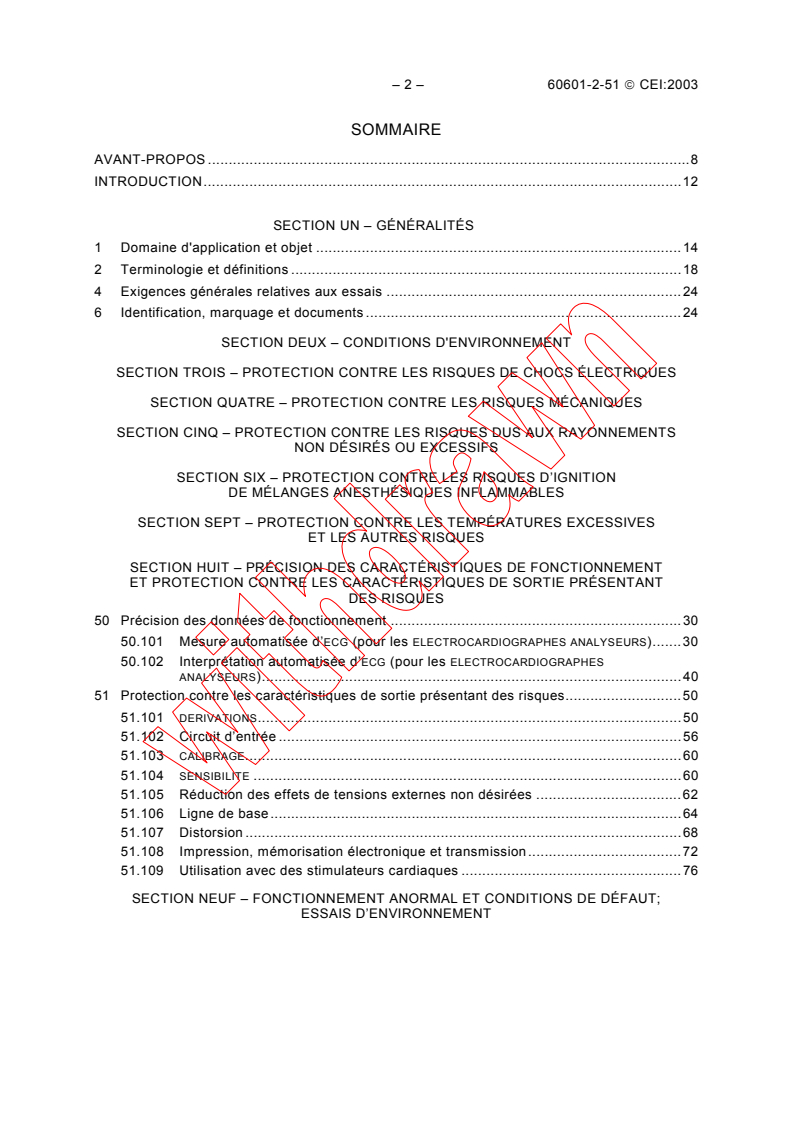
SOMMAIRE
AVANT-PROPOS .8
INTRODUCTION.12
SECTION UN – GÉNÉRALITÉS
1 Domaine d'application et objet .14
2 Terminologie et définitions .18
4 Exigences générales relatives aux essais .24
6 Identification, marquage et documents .24
SECTION DEUX – CONDITIONS D'ENVIRONNEMENT
SECTION TROIS – PROTECTION CONTRE LES RISQUES DE CHOCS ÉLECTRIQUES
SECTION QUATRE – PROTECTION CONTRE LES RISQUES MÉCANIQUES
SECTION CINQ – PROTECTION CONTRE LES RISQUES DUS AUX RAYONNEMENTS
NON DÉSIRÉS OU EXCESSIFS
SECTION SIX – PROTECTION CONTRE LES RISQUES D’IGNITION
DE MÉLANGES ANESTHÉSIQUES INFLAMMABLES
SECTION SEPT – PROTECTION CONTRE LES TEMPÉRATURES EXCESSIVES
ET LES AUTRES RISQUES
SECTION HUIT – PRÉCISION DES CARACTÉRISTIQUES DE FONCTIONNEMENT
ET PROTECTION CONTRE LES CARACTÉRISTIQUES DE SORTIE PRÉSENTANT
DES RISQUES
50 Précision des données de fonctionnement .30
50.101 Mesure automatisée d’ECG (pour les ELECTROCARDIOGRAPHES ANALYSEURS).30
50.102 Interprétation automatisée d’ECG (pour les ELECTROCARDIOGRAPHES
ANALYSEURS).40
51 Protection contre les caractéristiques de sortie présentant des risques.50
51.101 DERIVATIONS.50
51.102 Circuit d’entrée.56
51.103 CALIBRAGE.60
51.104 SENSIBILITE .60
51.105 Réduction des effets de tensions externes non désirées .62
51.106 Ligne de base.64
51.107 Distorsion.68
51.108 Impression, mémorisation électronique et transmission.72
51.109 Utilisation avec des stimulateurs cardiaques .76
SECTION NEUF – FONCTIONNEMENT ANORMAL ET CONDITIONS DE DÉFAUT;
ESSAIS D’ENVIRONNEMENT
60601-2-51 © IEC:2003 – 3 –
CONTENTS
FOREWORD.9
INTRODUCTION.13
SECTION ONE – GENERAL
1 Scope and object .15
2 Terminology and definitions .19
4 General requirements for tests.25
6 Identification, marking and documents .25
SECTION TWO – ENVIRONMENTAL CONDITIONS
SECTION THREE – PROTECTION AGAINST ELECTRIC SHOCK HAZARDS
SECTION FOUR – PROTECTION AGAINST MECHANICAL HAZARDS
SECTION FIVE – PROTECTION AGAINST HAZARDS FROM UNWANTED
OR EXCESSIVE RADIATION
SECTION SIX – PROTECTION AGAINST HAZARDS OF IGNITION OF
FLAMMABLE ANAESTHETIC MIXTURES
SECTION SEVEN – PROTECTION AGAINST EXCESSIVE TEMPERATURES
AND OTHER SAFETY HAZARDS
SECTION EIGHT – ACCURACY OF OPERATING DATA AND PROTECTION
AGAINST HAZARDOUS OUTPUT
50 Accuracy of operating data.31
50.101 Automated measurements on ECGs (for ANALYSING ELECTROCARDIOGRAPHS).31
50.102 Automated ECG interpretation (for ANALYSING ELECTROCARDIOGRAPHS).41
51 Protection against hazardous output .51
51.101 LEADS.51
51.102 Input circuit .57
51.103 CALIBRATION .61
51.104 SENSITIVITY .61
51.105 Reduction of the effects of unwanted external voltages.63
51.106 Base-line.65
51.107 Distortion .69
51.108 Printing, electronic storage and transmission.73
51.109 Use with cardiac pacemakers .77
SECTION NINE – ABNORMAL OPERATION AND FAULT CONDITIONS;
ENVIRONMENTAL TESTS
– 4 – 60601-2-51 © CEI:2003
SECTION DIX – RÈGLES DE CONSTRUCTION
56 Composants et ensembles.78
56.7 BATTERIES .78
Appendice L (normative) Références – Publications mentionnées dans cette norme .90
Annexe AA (informative) Directives générales et justificatifs .92
Annexe BB (informative) ELECTRODES: positions, identification et codes de couleur . 108
Annexe CC (informative) DERIVATIONS et leur identification (autres que celles décrites
en 51.101) . 112
Annexe DD (informative) Polarité des DERIVATIONS PATIENTS (autres que celles décrites
en 51.101) . 116
Annexe EE (informative) Marquage supplémentaire d’ELECTRODES . 118
Annexe FF (informative) BRUIT. 122
Annexe GG (normative) Définitions et règles de mesure d’ELECTROCARDIOGRAMMES. 126
Annexe HH (normative) Jeu de données de calibrage et d’essai . 138
Annexe II (informative) Atlas d’essai CTS. 144
Bibliographie . 170
INDEX DES TERMES DÉFINIS . 172
Figure 101 – Position d’électrodes selon Frank (voir le tableau 101) .80
Figure 102 – Polarité des dérivations du patient (voir 51.101.1) .80
Figure 103 – Essai de pondération des systèmes et de l‘impédance d’entrée (voir
51.101.2.2 et 51.102.1) .80
Figure 104 – Essai de rejet de mode commun (voir 51.105.1 et 51.106.4).82
Figure 105 – Formes d’ondes triangulaires pour l’essai E du tableau 114 (voir
51.107.1.1.1).84
Figure 106 – Signal d’impulsion d’entrée (tracé en tirets) et réponse du cardiographe
(tracé continu) (voir 51.107.1.1.2).84
Figure 107 – Circuit d’essai de linéarité (voir 51.107.2).86
Figure 108 – Résultat de l’essai de linéarité (voir 51.107.2) .86
Figure 109 – Essai de coordonnées rectangulaires (voir 51.108.4.1).88
Figure BB.1a – DERIVATIONS et couleurs pour les ECG fœtaux (voir 6.1, tableau BB.1). 110
Figure BB.1b – Positions des ELECTRODES sur le fœtus pour les ECG fœtaux (voir 6.1,
tableau BB.1) . 110
Figure BB.2 – Positions de DERIVATIONS et couleurs pour les ECG de l’épicrâne fœtal
(voir 6.1, tableau BB.1) .110
Figure CC.1 – Système de DERIVATIONS selon Frank. 114
Figure EE.1 – Électrodes et leurs couleurs pour le code 1 . 118
Figure FF.1 – Circuit simulé d’un PATIENT relié à un ELECTROCARDIOGRAPHE. 122
Figure FF.2 – Configurations typiques de circuits d'entrée d'ELECTROCARDIOGRAPHES et
circuits équivalents. 124
Figure GG.1 – ÉLECTROCARDIOGRAMME normal . 126
Figure GG.2 – Détermination d’intervalles globaux (exemple) . 128
60601-2-51 © IEC:2003 – 5 –
SECTION TEN – CONSTRUCTIONAL REQUIREMENTS
56 Components and general assembly .79
56.7 BATTERIES.79
Appendix L (normative) References – Publications mentioned in this standard.91
Annex AA (informative) General guidance and rationale.93
Annex BB (informative) ELECTRODES, their positions, identifications and colour codes . 109
Annex CC (informative) LEADS and their identification (other than described in 51.101) . 113
Annex DD (informative) Polarity of PATIENT LEADS (other than those specified in 51.101). 117
Annex EE (informative) Additional marking of electrodes . 119
Annex FF (informative) Noise . 123
Annex GG (normative) Definitions and rules for the measurement of ELECTROCARDIOGRAMS 127
Annex HH (normative) Calibration and test data sets . 139
Annex II (informative) CTS test atlas . 145
Bibliography . 171
INDEX OF DEFINED TERMS . 173
Figure 101 – Electrode position according to Frank (see Table 101) .81
Figure 102 – Polarity of patient leads (see 51.101.1) .81
Figure 103 – Test of weighting networks and input impedance (see 51.101.2.2 and
51.102.1) .81
Figure 104 – Test of common mode rejection (see 51.105.1 and 51.106.4) .83
Figure 105 – Triangular waveforms for test E of Table 114 (see 51.107.1.1.1) .85
Figure 106 – Input impulse signal (dashed trace) and cardiograph response
(continuous trace) (see 51.107.1.1.2) .85
Figure 107 – Circuit for test of linearity (see 51.107.2) .87
Figure 108 – Result of linearity test (see 51.107.2) .87
Figure 109 – Test of rectangular coordinates (see 51.108.4.1).89
Figure BB.1a – LEADS and colours for fetal ECG (see 6.1, Table BB.1). 111
Figure BB.1b – Positions of the ELECTRODES on the fetus for fetal ECG (6.1, Table BB.1) . 111
Figure BB.2 – LEAD positions and colours for fetal scalp ECG (see 6.1, Table BB.1). 111
Figure CC.1 – Network for Frank LEAD system . 115
Figure EE.1 – Electrodes and their colour for code 1 . 119
Figure FF.1 – Simulated circuit of PATIENT connected to an ELECTROCARDIOGRAPH . 123
Figure FF.2 – Typical ELECTROCARDIOGRAPH input circuit configurations and equivalent
circuits . 125
Figure GG.1 – Normal ELECTROCARDIOGRAM . 127
Figure GG.2 – Determination of global intervals (example) . 129
– 6 – 60601-2-51 © CEI:2003
Figure GG.3 – Durées de formes d’ondes, segments isoélectriques. 130
Figure GG.4 – Complexe QRS avec petite(s) onde(s) R acceptée(s) (voir la figure
GG.7) . 134
Figure GG.5 – Complexe QRS avec petite(s) onde(s) R refusée(s) (voir la figure GG.8). 134
Figure GG.6 – Détail d’une petite onde R acceptée. 136
Figure GG.7 – Détail d’une petite onde R refusée . 136
Figure II.1 – Système d’essai CTS. 148
Figure II.2 – Exemple de schéma de circuit de conditionnement de signaux. 150
Figure II.3 – Nomenclature d’ECG de calibrage. 156
Figure II.4 – Nomenclature d’ECG analytiques . 162
Figure II.5 – Caractéristiques de BRUIT . 166
Tableau 101 – ÉLECTRODES et ELECTRODES NEUTRES, position, identification et code de
couleur.28
Tableau 102 – Tension résiduelle de valeurs de référence d’amplitude ST et T lors
d’une alimentation en signaux par un FILTRE passe-haut de premier ordre avec une
CONSTANTE DE TEMPS de 3,2 s.34
Tableau 103 – Différences moyennes et écarts-types acceptables d’intervalles et de
ECG de calibrage et analytiques .36
durées Q, R, S globaux sur les
Tableau 104 –Différences moyennes et écarts-types acceptables pour les durées et
intervalles globaux d'ECG biologiques.38
Tableau 105 – Changements de mesures indiqués en présence de BRUIT sur les ECG
conformément au tableau HH.3 .38
Tableau 106 – Résultat d’essai sous forme de tableau .40
Tableau 107 – Format d’indication des mesures de précision d’interprétations de
diagnostics.46
Tableau 108 – Format de l’indication des mesures de précision d’interprétations de
rythmes.48
Tableau 109 – Connexion d’ELECTRODES pour une DERIVATION donnée.50
Tableau 110 – DERIVATIONS et leur identification (nomenclature et définition) .50
Tableau 111 – Réseau de DERIVATIONS pour DERIVATIONS selon Goldberger et Wilson.54
Tableau 112 – RESEAU de DERIVATIONS selon Frank .56
Tableau 113 – Essai d’impédance d’entrée, position du SELECTEUR DE DERIVATION,
connexion des ELECTRODES DE DERIVATIONS et déflection crête à creux en mm avec S1
ouvert .58
Tableau 114 – Réponse en fréquence .68
Tableau BB.1 – ELECTRODES: position, identification et codes de couleur (autres que
ceux décrits sous 6.1, tableau 101) . 108
Tableau DD.1 – Polarités des ELECTRODES . 116
Tableau EE.1 – Identification recommandée et code de couleur d'un CABLE PATIENT
à 14 fils. 120
Tableau HH.1 – ECG de calibrage et analytiques . 138
Tableau HH.2 – Jeu de données pour l'essai de mesure et de précision de
reconnaissance d’ondes de données biologiques – 100 ECG de l’étude du CSE. 140
Tableau HH.3 – Jeu de données pour l'essai de stabilité en présence de BRUIT. 140
Tableau II.1 – Désignation de signaux (ECG de calibrage) . 158
Tableau II.2 – Désignation des signaux (ECG analytiques). 162
60601-2-51 © IEC:2003 – 7 –
Figure GG.3 – Waveform durations, isolectric segments. 131
Figure GG.4 – QRS complex with small R-wave(s) accepted (see Figure GG.7). 135
Figure GG.5 – QRS Complex with small R-wave(s) rejected (see Figure GG.8). 135
Figure GG.6 – Detail of small accepted R-wave. 137
Figure GG.7 – Detail of small rejected R-wave . 137
Figure II.1 – CTS test system . 149
Figure II.2 – Example circuit diagram for signal conditioning . 151
Figure II.3 – Nomenclature of calibration ECGs. 157
Figure II.4 – Nomenclature of Analytical ECGs. 163
Figure II.5 – NOISE characteristics . 167
Table 101 – ELECTRODES and NEUTRAL ELECTRODES, their position, identification and
colour code .29
Table 102 – Offset voltage for ST and T amplitude reference values if the signals are
fed through a first order high pass FILTER with a TIME CONSTANT of 3,2 s .35
Table 103 – Acceptable mean differences and standard deviations for global intervals
and Q-, R-, S-durations on calibration and analytical ECGs .37
Table 104 – Acceptable mean differences and standard deviations for global durations
and intervals for biological ECGs .39
Table 105 – Disclosed changes of measurements caused by NOISE on ECGs according
to Table HH.3.39
Table 106 – Tabulation of test results.41
Table 107 – Format for disclosure of accuracy measures for diagnostic interpretative
statements .47
Table 108 – Format for disclosure of accuracy measures for rhythm interpretative
statements .49
Table 109 – Connection of ELECTRODES for a particular LEAD .51
Table 110 – LEADS and their identification (nomenclature and definition) .51
Table 111 – LEAD networks for Goldberger and Wilson LEADS .55
Table 112 – LEAD network for Frank LEADS.57
Table 113 – Test of input impedance – Positions of LEAD SELECTOR, connection of LEAD
ELECTRODES and peak to valley deflection in mm with S1 open.59
Table 114 – Frequency response.69
Table BB.1 – ELECTRODES, their positions, identifications and colour codes (other than
described in 6.1, Table 101) . 109
Table DD.1 – ELECTRODE polarities . 117
Table EE.1 – Recommended identification and colour code for a 14-wire PATIENT CABLE . 121
Table HH.1 – Calibration and analytical ECGs. 139
Table HH.2 – Data set for testing of measurement and wave recognition accuracy of
biological data – 100 ECGs of the CSE-study. 141
Table HH.3 – Data set for testing NOISE stability . 141
Table II.1 – Naming of signals (calibration ECGs) . 159
Table II.2 – Naming of signals (analytical ECGs). 163
– 8 – 60601-2-51 © CEI:2003
COMMISSION ÉLECTROTECHNIQUE INTERNATIONALE
____________
APPAREILS ÉLECTROMÉDICAUX –
Partie 2-51: Règles particulières de sécurité et performances essentielles
des électrocardiographes enregistreurs et analyseurs
mono et multi-canaux
AVANT-PROPOS
1) La Commission Electrotechnique Internationale (CEI) est une organisation mondiale de normalisation composée
de l'ensemble des comités électrotechniques nationaux (Comités nationaux de la CEI). La CEI a pour objet de
favoriser la coopération internationale pour toutes les questions de normalisation dans les domaines de
l'électricité et de l'électronique. A cet effet, la CEI – entre autres activités – publie des Normes internationales,
des Spécifications techniques, des Rapports techniques, des Spécifications accessibles au public (PAS) et des
Guides (ci-après dénommés "Publication(s) de la CEI"). Leur élaboration est confiée à des comités d'études,
aux travaux desquels tout Comité national intéressé par le sujet traité peut participer. Les organisations
internationales, gouvernementales et non gouvernementales, en liaison avec la CEI, participent également aux
travaux. La CEI collabore étroitement avec l'Organisation Internationale de Normalisation (ISO), selon des
conditions fixées par accord entre les deux organisations.
2) Les décisions ou accords officiels de la CEI concernant les questions techniques représentent, dans la mesure
du possible, un accord international sur les sujets étudiés, étant donné que les Comités nationaux de la CEI
intéressés sont représentés dans chaque comité d’études.
3) Les Publications de la CEI se présentent sous la forme de recommandations internationales et sont agréées
comme telles par les Comités nationaux de la CEI. Tous les efforts raisonnables sont entrepris afin que la CEI
s'assure de l'exactitude du contenu technique de ses publications; la CEI ne peut pas être tenue responsable de
l'éventuelle mauvaise utilisation ou interprétation qui en est faite par un quelconque utilisateur final.
4) Dans le but d'encourager l'uniformité internationale, les Comités nationaux de la CEI s'engagent, dans toute la
mesure possible, à appliquer de façon transparente les Publications de la CEI dans leurs publications
nationales et régionales. Toutes divergences entre toutes Publications de la CEI et toutes publications
nationales ou régionales correspondantes doivent être indiquées en termes clairs dans ces dernières.
5) La CEI n’a prévu aucune procédure de marquage valant indication d’approbation et n'engage pas sa
responsabilité pour les équipements déclarés conformes à une de ses Publications.
6) Tous les utilisateurs doivent s'assurer qu'ils sont en possession de la dernière édition de cette publication.
7) Aucune responsabilité ne doit être imputée à la CEI, à ses administrateurs, employés, auxiliaires ou
mandataires, y compris ses experts particuliers et les membres de ses comités d'études et des Comités
nationaux de la CEI, pour tout préjudice causé en cas de dommages corporels et matériels, ou de tout autre
dommage de quelque nature que ce soit, directe ou indirecte, ou pour supporter les coûts (y compris les frais
de justice) et les dépenses découlant de la publication ou de l'utilisation de cette Publication de la CEI ou de
toute autre Publication de la CEI, ou au crédit qui lui est accordé.
8) L'attention est attirée sur les références normatives citées dans cette publication. L'utilisation de publications
référencées est obligatoire pour une application correcte de la présente publication.
9) L’attention est attirée sur le fait que certains des éléments de la présente Publication de la CEI peuvent faire
l’objet de droits de propriété intellectuelle ou de droits analogues. La CEI ne saurait être tenue pour
responsable de ne pas avoir identifié de tels droits de propriété et de ne pas avoir signalé leur existence.
La Norme internationale CEI 60601-2-51 a été établie par le sous-comité 62D: Appareils
électromédicaux, du comité d'études 62 de la CEI: Équipements électriques dans la pratique
médicale.
Cette version bilingue, publiée en 2005-12, correspond à la version anglaise.
Le texte anglais de cette norme est issu des documents 62D/469/FDIS et 62D/473/RVD. Le
rapport de vote 62D/473/RVD donne toute information sur le vote ayant abouti à l'approbation
de cette norme.
60601-2-51 © IEC:2003 – 9 –
INTERNATIONAL ELECTROTECHNICAL COMMISSION
____________
MEDICAL ELECTRICAL EQUIPMENT –
Part 2-51: Particular requirements for safety, including essential
performance, of recording and analysing single channel
and multichannel electrocardiographs
FOREWORD
1) The International Electrotechnical Commission (IEC) is a worldwide organization for standardization comprising
all national electrotechnical committees (IEC National Committees). The object of IEC is to promote
international co-operation on all questions concerning standardization in the electrical and electronic fields. To
this end and in addition to other activities, IEC publishes International Standards, Technical Specifications,
Technical Reports, Publicly Available Specifications (PAS) and Guides (hereafter referred to as “IEC
Publication(s)”). Their preparation is entrusted to technical committees; any IEC National Committee interested
in the subject dealt with may participate in this preparatory work. International, governmental and non-
governmental organizations liaising with the IEC also participate in this preparation. IEC collaborates closely
with the International Organization for Standardization (ISO) in accordance with conditions determined by
agreement between the two organizations.
2) The formal decisions or agreements of IEC on technical matters express, as nearly as possible, an international
consensus of opinion on the relevant subjects since each technical committee has representation from all
interested IEC National Committees.
3) IEC Publications have the form of recommendations for international use and are accepted by IEC National
Committees in that sense. While all reasonable efforts are made to ensure that the technical content of IEC
Publications is accurate, IEC cannot be held responsible for the way in which they are used or for any
misinterpretation by any end user.
4) In order to promote international uniformity, IEC National Committees undertake to apply IEC Publications
transparently to the maximum extent possible in their national and regional publications. Any divergence
between any IEC Publication and the corresponding national or regional publication shall be clearly indicated in
the latter.
5) IEC provides no marking procedure to indicate its approval and cannot be rendered responsible for any
equipment declared to be in conformity with an IEC Publication.
6) All users should ensure that they have the latest edition of this publication.
7) No liability shall attach to IEC or its directors, employees, servants or agents including individual experts and
members of its technical committees and IEC National Committees for any personal injury, property damage or
other damage of any nature whatsoever, whether direct or indirect, or for costs (including legal fees) and
expenses arising out of the publication, use of, or reliance upon, this IEC Publication or any other IEC
Publications.
8) Attention is drawn to the Normative references cited in this publication. Use of the referenced publications is
indispensable for the correct application of this publication.
9) Attention is drawn to the possibility that some of the elements of this IEC Publication may be the subject of
patent rights. IEC shall not be held responsible for identifying any or all such patent rights.
International Standard IEC 60601-2-51 has been prepared by subcommittee 62D: Electro-
medical equipment, of IEC technical committee 62: Electrical equipment in medical practice.
This bilingual version, published in 2005-12, corresponds to the English version.
The text of this standard is based on the following documents:
FDIS Report on voting
62D/469/FDIS 62D/473/RVD
Full information on the voting for the approval of this standard can be found in the report on
voting indicated in the above table.
– 10 – 60601-2-51 © CEI:2003
La verson française de cette norme n’a pas été soumise au vote.
Dans la présente Norme Particulière, les caractères d'imprimerie suivants sont employés:
– exigences dont la conformité peut être vérifiée par un essai et définitions: caractères
romains;
– notes, explications, conseils, introductions, énoncés de portée générale, exceptions et références: petits
caractères romains;
– modalités d'essais: caractères italiques;
– TERMES DEFINIS A L'ARTICLE 2 DE LA NORME GENERALE OU DE LA PRESENTE NORME
PARTICULIERE: PETITES CAPITALES.
Le comité a décidé que le contenu de cette publication ne sera pas modifié avant la date de
maintenance indiquée sur le site web de la CEI sous «http://webstore.iec.ch» dans les données
relatives à la publication recherchée. A cette date, la publication sera
• reconduite;
• supprimée;
• remplacée par une édition révisée, ou
• amendée.
60601-2-51 © IEC:2003 – 11 –
The French version of this standard has not been voted upon.
In this Particular Standard, the following print types are used:
• requirements, compliance with which can be tested, and definitions: roman type;
• notes, explanations, advice, introductions, general statements, exceptions and references: small roman type;
• test specifications: italic type;
• TERMS DEFINED IN CLAUSE 2 OF THE GENERAL STANDARD OR THIS PARTICULAR STANDARD: SMALL
CAPITALS.
The committee has decided that the contents of this publication will remain unchanged until the
maintenance result date indicated on the IEC web site under "http://webstore.iec.ch" in the data
related to the specific publication. At this date, the publication will be
• reconfirmed;
• withdrawn;
• replaced by a revised edition, or
• amended.
– 12 – 60601-2-51 © CEI:2003
INTRODUCTION
La présente Norme Particulière spécifie des exigences supplémentaires de sécurité des
électrocardiographes enregistreurs et analyseurs mono et multi-canaux. Elle modifie et
complète la CEI 60601-1 (deuxième édition, 1988) y compris les Amendements 1 (1991) et 2
(1995), ci-après désignée sous le nom de Norme Générale. Les exigences de cette Norme
Particulière ont priorité sur les exigences de la Norme Générale Appareils électromédicaux –
Partie 1: Règles générales de sécurité.
Des «directives générales et justifications» relatives aux exigences de cette Norme Particulière
sont données à l'Annexe AA.
On considère que la connaissance des raisons qui ont conduit à ces exigences facilitera non
seulement l'application correcte de la Norme Particulière, mais accélérera, en temps voulu,
toute révision rendue nécessaire par suite de changements dans la pratique clinique ou de
résultats de développements technologiques. Cependant, cette annexe ne fait pas partie des
exigences de la présente Norme.
Un astérisque (*) avant les numéros d'articles et de paragraphes indiquent que des justificatifs
correspondants sont donnés à l'Annexe AA.
60601-2-51 © IEC:2003 – 13 –
INTRODUCTION
This Particular Standard concerns additional safety of recording and analysing single
channel and multichannel electrocardiographic equipment. It amends and supplements
IEC 60601-1 (second edition, 1988), including its amendments 1 (1991) and 2 (1995)
hereinafter referred to as the General Standard. The requirements of this Particular Standard
take priority over those of the General Standard, entitled Medical electrical equipment – Part 1:
General requirements for safety.
A “General guidance and rationale” for the requirements of this Particular Standard is included
in Annex AA.
It is considered that a knowledge of the reasons for these requirements will not only facilitate
the proper application of the standard but will, in due course, expedite any revision
necessitated by changes in clinical practice or as a result of developments in technology.
However, this annex does not form part of the requirements of this Standard.
An asterisk (*) by a clause or subclause number indicates that some explanatory notes are
given in Annex AA.
– 14 – 60601-2-51 © CEI:2003
APPAREILS ÉLECTROMÉDICAUX –
Partie 2-51: Règles particulières de sécurité et performances essentielles
des électrocardiographes enregistreurs et analyseurs
mono et multi-canaux
SECTION UN – GÉNÉRALITÉS
Les articles et les paragraphes de cette partie de la Norme Générale s'appliquent, excepté ce
qui suit:
1 Domaine d'application et objet
Cet article de la Norme Générale s'applique, excepté ce qui suit:
*1.1 Domaine d’application
Addition:
La présente Norme Particulière spécifie les exigences en matière de sécurité et de
performances essentielles des ELECTROCARDIOGRAPHES ENREGISTREURS ET ANALYSEURS MONO
ET MULTI-CANAUX, tels que définis en 2.101, 2.111, 2.117, 2.123, 2.126, désignés ci-après sous
le nom d’APPAREILS. L’APPAREIL peut fonctionner sous surveillance d’un opérateur ou non.
La présente Norme Particulière complète la CEI 60601-2-25 et son Amendement 1 (1999).
1.2 Objet
Remplacement:
L'objet de la présente Norme Particulière est d'établir des exigences particulières, en
complément des exigences de la CEI 60601-2-25 concernant la sécurité et les performances
essentielles des ELECTROCARDIOGRAPHES ENREGISTREURS ET ANALYSEURS MONO ET MULTI-
CANAUX.
Ces exigences doivent s’appliquer en particulier aux
− ELECTROCARDIOGRAPHES ENREGISTREURS;
− ELECTROCARDIOGRAPHES intégrés à d’autres APPAREILS ELECTROMEDICAUX, tels que les
systèmes d’épreuve d’effort, si ces APPAREILS servent à l’enregistrement d’ECG à des fins
de diagnostic;
− ELECTROCARDIOGRAPHES utilisés en tant qu’unités de sortie par des systèmes de gestion de
base de données d’ECG ou aux ELECTROCARDIOGRAPHES utilisés en tant qu’unités de sortie
à d'autres endroits que l'unité d'enregistrement;
− ELECTROCARDIOGRAPHES ANALYSEURS, systèmes et équipement
...