

IEC 60335-2-11:1993
(Main)Safety of household and similar electrical appliances - Part 2: Particular requirements for tumbler dryers
General Information
- Abstract
Deals with the safety of electric tumbler dryers intended for household and similar purposes whose rated voltage is not more than 250 V for single phase appliances and 480 V for other appliances.
- Status
- Published
- Publication Date
- 30-Mar-1998
- Technical Committee
- TC 61 - Safety of household and similar electrical appliances
- Current Stage
- DELPUB - Deleted Publication
- Start Date
- 09-Mar-2000
- Completion Date
- 28-Aug-2026
IEC 60335-2-11:1993 Overview
IEC 60335-2-11:1993 is an international standard published by the International Electrotechnical Commission (IEC) that specifies the particular safety requirements for household and similar electrical appliances-specifically, electric tumble dryers. This standard addresses appliances with rated voltages up to 250 V for single-phase models and up to 480 V for other appliances. Its primary focus is to ensure the safety of electric tumbler dryers intended for domestic use, including aspects such as electrical, mechanical, and thermal hazards.
The standard forms Part 2 of the general IEC 60335 series, which targets the safety of household electrical appliances. Adopted globally, it supports harmonization of safety regulations and assists manufacturers, regulators, and testing bodies in certifying tumble dryers meet key safety benchmarks.
Key Topics of IEC 60335-2-11
- Scope and Definitions: Defines the intended application of the standard exclusively for tumble dryers, including voltage limits and appliance classes.
- General Safety Requirements: Addresses protection against electric shock, mechanical hazards, and fire risks associated with tumble dryers.
- Electrical Safety: Specifies requirements for leakage current, dielectric strength, and overload protection of transformers and circuits.
- Mechanical Safety: Includes mandates on stability, mechanical strength, and protection from access to live or moving parts.
- Thermal Safety: Details limits on temperature rise to avoid overheating and fire hazards during typical operation.
- Marking and Instructions: Requirements for clear labelling, safety instructions, and proper warnings to enable safe use and maintenance.
- Testing Procedures: Outlines standardized tests for checking compliance including endurance, abnormal operation, moisture resistance, and electrical insulation.
- Construction and Components: Stipulates criteria for internal wiring, components, terminals, and supply connections to ensure durability and safe operation.
- Protection Against Environmental Hazards: Covers resistance to heat, rust, moisture, radiation, and toxic hazards related to appliance construction and use.
Practical Applications
The IEC 60335-2-11 standard is essential for:
- Manufacturers of Tumble Dryers: To design and produce appliances that comply with recognized safety standards, reducing risk of injury or damage.
- Quality Assurance and Testing Labs: To verify appliance safety according to IEC guidelines prior to market release.
- Safety Regulators and Certification Bodies: To adopt a harmonized benchmark for certification and compliance checks in various global markets.
- Consumers: Implicitly benefits from safer products that undergo rigorous safety testing for electrical and mechanical hazards.
- Retailers and Service Providers: Ensures confidence that the tumble dryers sold and serviced meet established international safety norms.
Adherence to this standard supports reduction in electrical accidents, fire hazards, and mechanical injuries related to tumble dryers in household environments.
Related Standards
- IEC 60335-1: General safety requirements for household and similar electrical appliances, to be used in conjunction as the foundational standard.
- IEC 60050: International Electrotechnical Vocabulary (IEV) providing definitions and terms related to electrical technology.
- IEC 60027 & IEC 60417: Graphical and letter symbols for use in electrical technology and equipment marking.
- IEC 60617: Graphical symbols for diagrams used in electrotechnical documentation.
These companion standards assist in providing uniform terminology, test methods, and safety requirements across a wide range of household electrical appliances beyond tumble dryers.
Keywords: IEC 60335-2-11, tumble dryers safety standard, household electrical appliance safety, electrical appliance certification, IEC safety standards, electrical safety testing, mechanical safety, appliance compliance, IEC technical standards.
Relations
- Effective Date
- 25-Aug-2026
- Effective Date
- 25-Aug-2026
- Effective Date
- 05-Sep-2023
- Effective Date
- 05-Sep-2023
- Effective Date
- 05-Sep-2023
Get Certified
Connect with accredited certification bodies for this standard

CIS Institut d.o.o.
Personal Protective Equipment (PPE) certification body. Notified Body NB-2890 for EU Regulation 2016/425 PPE.

Kiwa BDA Testing
Building and construction product certification.
Kmetijski inštitut Slovenije
Agricultural Institute of Slovenia. Soil testing, plant health, agricultural product analysis.
Sponsored listings
Frequently Asked Questions
IEC 60335-2-11:1993 is a standard published by the International Electrotechnical Commission (IEC). Its full title is "Safety of household and similar electrical appliances - Part 2: Particular requirements for tumbler dryers". This standard covers: Deals with the safety of electric tumbler dryers intended for household and similar purposes whose rated voltage is not more than 250 V for single phase appliances and 480 V for other appliances.
Deals with the safety of electric tumbler dryers intended for household and similar purposes whose rated voltage is not more than 250 V for single phase appliances and 480 V for other appliances.
IEC 60335-2-11:1993 is classified under the following ICS (International Classification for Standards) categories: 13.120 - Domestic safety; 97.060 - Laundry appliances. The ICS classification helps identify the subject area and facilitates finding related standards.
IEC 60335-2-11:1993 has the following relationships with other standards: It is inter standard links to EN ISO 10472-1:2008, EN ISO 10472-4:2008, IEC 60335-2-11:1993/AMD1:1998, IEC 60335-2-11:1993/AMD2:1999, IEC 60335-2-11:2000. Understanding these relationships helps ensure you are using the most current and applicable version of the standard.
IEC 60335-2-11:1993 is available in PDF format for immediate download after purchase. The document can be added to your cart and obtained through the secure checkout process. Digital delivery ensures instant access to the complete standard document.
Standards Content (Sample)
NORME
CEI
INTERNATIONALE
IEC
60335-2-11
INTERNATIONAL
Edition 4.1
STANDARD
1998-03
Edition 4:1993 consolidée par l'amendement 1:1998
Edition 4:1993 consolidated with amendment 1:1998
Sécurité des appareils électrodomestiques
et analogues –
Partie 2-11:
Règles particulières pour les sèche-linge
à tambour
Safety of household and similar electrical
appliances –
Part 2-11:
Particular requirements for tumble dryers
Numéro de référence
Reference number
CEI/IEC 60335-2-11:1993+A.1:1998
Numéros des publications Numbering
Depuis le 1er janvier 1997, les publications de la CEI As from 1 January 1997 all IEC publications are issued
sont numérotées à partir de 60000. with a designation in the 60000 series.
Publications consolidées Consolidated publications
Les versions consolidées de certaines publications de Consolidated versions of some IEC publications
la CEI incorporant les amendements sont disponibles. including amendments are available. For example,
Par exemple, les numéros d’édition 1.0, 1.1 et 1.2 edition numbers 1.0, 1.1 and 1.2 refer, respectively, to
indiquent respectivement la publication de base, la the base publication, the base publication incorporating
publication de base incorporant l’amendement 1, et la amendment 1 and the base publication incorporating
publication de base incorporant les amendements 1 amendments 1 and 2.
et 2.
Validité de la présente publication Validity of this publication
Le contenu technique des publications de la CEI est The technical content of IEC publications is kept under
constamment revu par la CEI afin qu'il reflète l'état constant review by the IEC, thus ensuring that the
actuel de la technique. content reflects current technology.
Des renseignements relatifs à la date de reconfirmation Information relating to the date of the reconfirmation of
de la publication sont disponibles dans le Catalogue de the publication is available in the IEC catalogue.
la CEI.
Les renseignements relatifs à ces révisions, à l'établis- Information on the revision work, the issue of revised
sement des éditions révisées et aux amendements editions and amendments may be obtained from
peuvent être obtenus auprès des Comités nationaux de la IEC National Committees and from the following
CEI et dans les documents ci-dessous: IEC sources:
• Bulletin de la CEI • IEC Bulletin
• Annuaire de la CEI • IEC Yearbook
Accès en ligne* On-line access*
• Catalogue des publications de la CEI • Catalogue of IEC publications
Publié annuellement et mis à jour régulièrement Published yearly with regular updates
(Accès en ligne)* (On-line access)*
Terminologie, symboles graphiques Terminology, graphical and letter
et littéraux symbols
En ce qui concerne la terminologie générale, le lecteur For general terminology, readers are referred to
se reportera à la CEI 60050: Vocabulaire Electro- IEC 60050: International Electrotechnical Vocabulary
technique International (VEI). (IEV).
Pour les symboles graphiques, les symboles littéraux et For graphical symbols, and letter symbols and signs
les signes d'usage général approuvés par la CEI, le approved by the IEC for general use, readers are
referred to publications IEC 60027: Letter symbols to
lecteur consultera la CEI 60027: Symboles littéraux à
utiliser en électrotechnique, la CEI 60417: Symboles be used in electrical technology, IEC 60417: Graphical
graphiques utilisables sur le matériel. Index, relevé et symbols for use on equipment. Index, survey and
compilation of the single sheets
compilation des feuilles individuelles, et la CEI 60617: and IEC 60617:
Symboles graphiques pour schémas. Graphical symbols for diagrams.
Publications de la CEI établies par IEC publications prepared by the same
le même comité d'études technical committee
L'attention du lecteur est attirée sur les listes figurant à The attention of readers is drawn to the end pages of
la fin de cette publication, qui énumèrent les this publication which list the IEC publications issued
publications de la CEI préparées par le comité d'études by the technical committee which has prepared the
qui a établi la présente publication. present publication.
* Voir adresse «site web» sur la page de titre. * See web site address on title page.
NORME
CEI
INTERNATIONALE
IEC
60335-2-11
INTERNATIONAL
Edition 4.1
STANDARD
1998-03
Edition 4:1993 consolidée par l'amendement 1:1998
Edition 4:1993 consolidated with amendment 1:1998
Sécurité des appareils électrodomestiques
et analogues –
Partie 2-11:
Règles particulières pour les sèche-linge
à tambour
Safety of household and similar electrical
appliances –
Part 2-11:
Particular requirements for tumble dryers
IEC 1998 Droits de reproduction réservés Copyright - all rights reserved
Aucune partie de cette publication ne peut être reproduite ni No part of this publication may be reproduced or utilized in
utilisée sous quelque forme que ce soit et par aucun any form or by any means, electronic or mechanical,
procédé, électronique ou mécanique, y compris la photo- including photocopying and microfilm, without permission in
copie et les microfilms, sans l'accord écrit de l'éditeur. writing from the publisher.
International Electrotechnical Commission 3, rue de Varembé Geneva, Switzerland
Telefax: +41 22 919 0300 e-mail: inmail@iec.ch IEC web site http: //www.iec.ch
CODE PRIX
Commission Electrotechnique Internationale
PRICE CODE P
International Electrotechnical Commission
Pour prix, voir catalogue en vigueur
For price, see current catalogue
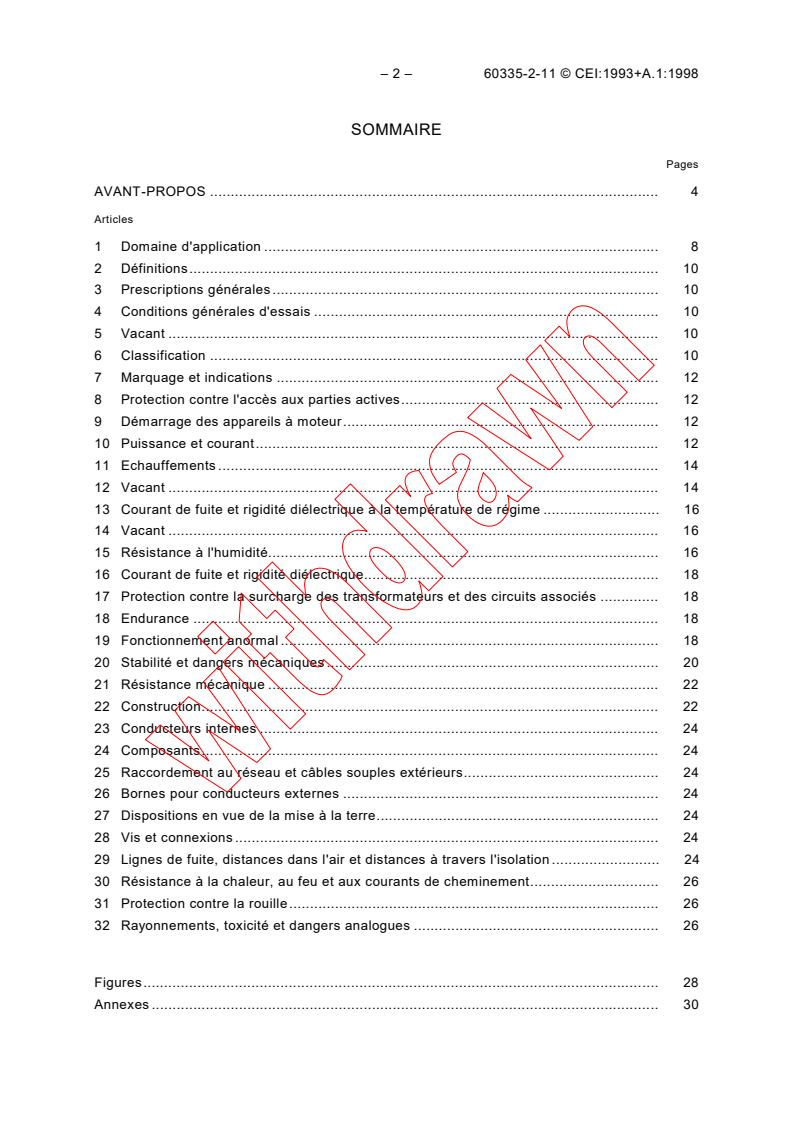
– 2 – 60335-2-11 © CEI:1993+A.1:1998
SOMMAIRE
Pages
AVANT-PROPOS . 4
Articles
1 Domaine d'application . 8
2 Définitions. 10
3 Prescriptions générales . 10
4 Conditions générales d'essais . 10
5 Vacant . 10
6 Classification . 10
7 Marquage et indications . 12
8 Protection contre l'accès aux parties actives. 12
9 Démarrage des appareils à moteur. 12
10 Puissance et courant. 12
11 Echauffements . 14
12 Vacant . 14
13 Courant de fuite et rigidité diélectrique à la température de régime . 16
14 Vacant . 16
15 Résistance à l'humidité. 16
16 Courant de fuite et rigidité diélectrique. 18
17 Protection contre la surcharge des transformateurs et des circuits associés . 18
18 Endurance . 18
19 Fonctionnement anormal . 18
20 Stabilité et dangers mécaniques . 20
21 Résistance mécanique . 22
22 Construction. 22
23 Conducteurs internes . 24
24 Composants. 24
25 Raccordement au réseau et câbles souples extérieurs. 24
26 Bornes pour conducteurs externes . 24
27 Dispositions en vue de la mise à la terre. 24
28 Vis et connexions . 24
29 Lignes de fuite, distances dans l'air et distances à travers l'isolation . 24
30 Résistance à la chaleur, au feu et aux courants de cheminement. 26
31 Protection contre la rouille. 26
32 Rayonnements, toxicité et dangers analogues . 26
Figures. 28
Annexes . 30
60335-2-11 © IEC:1993+A.1:1998 – 3 –
CONTENTS
Page
FOREWORD . 5
Clause
1 Scope . 9
2 Definitions. 11
3 General requirement . 11
4 General conditions for the tests . 11
5 Void . 11
6 Classification . 11
7 Marking and instructions. 13
8 Protection against access to live parts. 13
9 Starting of motor-operated appliances . 13
10 Power input and current . 13
11 Heating . 15
12 Void .15
13 Leakage current and electric strength at operating temperature . 17
14 Void .17
15 Moisture resistance . 17
16 Leakage current and electric strength. 19
17 Overload protection of transformers and associated circuits. 19
18 Endurance . 19
19 Abnormal operation . 19
20 Stability and mechanical hazards. 21
21 Mechanical strength . 23
22 Construction. 23
23 Internal wiring . 25
24 Components. 25
25 Supply connection and external flexible cords. 25
26 Terminals for external conductors. 25
27 Provision for earthing . 25
28 Screws and connections. 25
29 Creepage distances, clearances and distances through insulation . 25
30 Resistance to heat, fire and tracking. 27
31 Resistance to rusting. 27
32 Radiation, toxicity and similar hazards . 27
Figures. 29
Annexes . 31
– 4 – 60335-2-11 © CEI:1993+A.1:1998
COMMISSION ÉLECTROTECHNIQUE INTERNATIONALE
––––––––––
SÉCURITÉ DES APPAREILS ÉLECTRODOMESTIQUES
ET ANALOGUES –
Partie 2: Règles particulières pour
les sèche-linge à tambour
AVANT-PROPOS
1) La CEI (Commission Electrotechnique Internationale) est une organisation mondiale de normalisation composée
de l'ensemble des comités électrotechniques nationaux (Comités nationaux de la CEI). La CEI a pour objet de
favoriser la coopération internationale pour toutes les questions de normalisation dans les domaines de
l'électricité et de l'électronique. A cet effet, la CEI, entre autres activités, publie des Normes internationales.
Leur élaboration est confiée à des comités d'études, aux travaux desquels tout Comité national intéressé par le
sujet traité peut participer. Les organisations internationales, gouvernementales et non gouvernementales, en
liaison avec la CEI, participent également aux travaux. La CEI collabore étroitement avec l'Organisation
Internationale de Normalisation (ISO), selon des conditions fixées par accord entre les deux organisations.
2) Les décisions ou accords officiels de la CEI concernant les questions techniques représentent, dans la mesure
du possible un accord international sur les sujets étudiés, étant donné que les Comités nationaux intéressés
sont représentés dans chaque comité d’études.
3) Les documents produits se présentent sous la forme de recommandations internationales. Ils sont publiés
comme normes, rapports techniques ou guides et agréés comme tels par les Comités nationaux.
4) Dans le but d'encourager l'unification internationale, les Comités nationaux de la CEI s'engagent à appliquer de
façon transparente, dans toute la mesure possible, les Normes internationales de la CEI dans leurs normes
nationales et régionales. Toute divergence entre la norme de la CEI et la norme nationale ou régionale
correspondante doit être indiquée en termes clairs dans cette dernière.
5) La CEI n’a fixé aucune procédure concernant le marquage comme indication d’approbation et sa responsabilité
n’est pas engagée quand un matériel est déclaré conforme à l’une de ses normes.
6) L’attention est attirée sur le fait que certains des éléments de la présente Norme internationale peuvent faire
l’objet de droits de propriété intellectuelle ou de droits analogues. La CEI ne saurait être tenue pour
responsable de ne pas avoir identifié de tels droits de propriété et de ne pas avoir signalé leur existence.
La présente partie de la Norme internationale CEI 60335 a été établie par le comité d'études 61
de la CEI: Sécurité des appareils électrodomestiques et analogues.
Elle constitue la quatrième édition de la CEI 60335-2-11 et remplace la troisième édition et ses
modifications.
La présente version consolidée de la CEI 60335-2-11 est issue de la quatrième édition (1993),
[documents 61(BC)755 et 61(BC)769] et de son amendement 1 (1998) [documents
61/1334/FDIS et 61/1399/RVD].
Elle porte le numéro d'édition 4.1.
Une ligne verticale dans la marge indique où la publication de base a été modifiée par
l'amendement 1.
La présente partie 2 doit être utilisée conjointement avec la dernière édition de la CEI 60335-1
et ses amendements. Elle a été établie sur la base de la troisième édition (1991) de cette
norme.
60335-2-11 © IEC:1993+A.1:1998 – 5 –
INTERNATIONAL ELECTROTECHNICAL COMMISSION
––––––––––
SAFETY OF HOUSEHOLD AND SIMILAR
ELECTRICAL APPLIANCES –
Part 2: Particular requirements for
tumble dryers –
FOREWORD
1) The IEC (International Electrotechnical Commission) is a worldwide organization for standardization comprising
all national electrotechnical committees (IEC National Committees). The object of the IEC is to promote
international co-operation on all questions concerning standardization in the electrical and electronic fields. To
this end and in addition to other activities, the IEC publishes International Standards. Their preparation is
entrusted to technical committees; any IEC National Committee interested in the subject dealt with may
participate in this preparatory work. International, governmental and non-governmental organizations liaising
with the IEC also participate in this preparation. The IEC collaborates closely with the International Organization
for Standardization (ISO) in accordance with conditions determined by agreement between the two
organizations.
2) The formal decisions or agreements of the IEC on technical matters express, as nearly as possible, an
international consensus of opinion on the relevant subjects since each technical committee has representation
from all interested National Committees.
3) The documents produced have the form of recommendations for international use and are published in the form
of standards, technical reports or guides and they are accepted by the National Committees in that sense.
4) In order to promote international unification, IEC National Committees undertake to apply IEC International
Standards transparently to the maximum extent possible in their national and regional standards. Any
divergence between the IEC Standard and the corresponding national or regional standard shall be clearly
indicated in the latter.
5) The IEC provides no marking procedure to indicate its approval and cannot be rendered responsible for any
equipment declared to be in conformity with one of its standards.
6) Attention is drawn to the possibility that some of the elements of this International Standard may be the subject
of patent rights. The IEC shall not be held responsible for identifying any or all such patent rights.
This part of International Standard IEC 60335 has been prepared by IEC technical committee 61:
Safety of household and similar electrical appliances.
If forms the fourth edition of IEC 60335-2-11 and replaces the third edition and its
amendments.
This consolidated version of 60335-2-11 is based on the fourth edition (1993), [documents
61(CO)755 and 61(CO)769] and its amendment 1 (1998) [documents 61/1334/FDIS and
61/1399/RVD].
It bears the edition number 4.1.
A vertical line in the margin shows where the base publication has been modified by
amendment 1.
This part 2 is intended to be used in conjunction with the latest edition of IEC 60335-1 and its
amendments. It was established on the basis of the third edition (1991) of that standard.
– 6 – 60335-2-11 © CEI:1993+A.1:1998
La présente partie 2 complète ou modifie les articles correspondants de la CEI 60335-1 de
façon à la transformer en norme CEI: Règles de sécurité pour les sèche-linge électriques à
tambour (quatrième édition).
Lorsqu'un paragraphe particulier de la partie 1 n'est pas mentionné dans cette partie 2, ce
paragraphe s'applique pour autant qu'il est raisonnable. Lorsque la présente norme spécifie
«addition», «modification» ou «remplacement», le texte de la partie 1 doit être adapté en
conséquence.
NOTES
1 Les caractères d'imprimerie suivants sont employés:
– prescriptions: caractères romains;
– modalités d'essai: caractères italiques;
– notes: petits caractères romains;
Les mots en gras dans le texte sont définis à l'article 2.
2 Les paragraphes et les figures complémentaires à ceux de la partie 1 sont numérotés à partir de 101.
Les différences complémentaires suivantes existent dans certains pays:
– 2.2.9: Des pièces de linge de dimensions différentes sont utilisées (USA).
– 6.2: Il n'est pas requis que les sèche-linge à tambour soient IPX4 (USA).
– 7.1: L'indication concernant le nettoyage du collecteur de bourre doit être portée sur l'appareil en lettres d'au
moins 8 mm de haut et doit être clairement visible lorsque la porte de l'appareil est ouverte (Australie, Nouvelle
Zélande).
– 7.12: La masse de linge peut être remplacée par un nombre de pièces de linge et l'avertissement concernant
l'emploi de produits chimiques pour le nettoyage doit être porté sur l'appareil (USA).
– 11.2: D'autres méthodes sont utilisées pour effectuer les essais d'échauffement des sèche-linge à tambour
(USA).
– 11.7: L'essai est poursuivi jusqu'à établissement des conditions de régime et des critères différents sont utilisés
pour déterminer le moment où les conditions de régime sont atteintes (USA).
– 19.4: L'essai est effectué différemment (USA).
– 19.9: Un essai de surcharge est prescrit pour les sèche-linge à tambour à commande automatique.
– 20.101: La prescription est applicable aux ouvertures de porte dont la dimension est supérieure à 20 cm
(Norvège).
– 20.102: En ce qui concerne l'accessibilité au tambour on prend en compte un volume maximal de tambour de
60 dm³ et une dimension maximale de porte de 20 cm (USA).
– 20.103: Cet essai n'est pas effectué (USA).
– 22.103: Des méthodes différentes sont utilisées pour évaluer la stabilité des sèche-linge à tambour placés sur
le dessus d'une machine à laver (USA).
– 27.1: Des bornes et des contacts de terre peuvent être reliés au conducteur neutre d'un sèche-linge à tambour
(USA).
60335-2-11 © IEC:1993+A.1:1998 – 7 –
This part 2 supplements or modifies the corresponding clauses in IEC 60335-1, so as to
convert it into the IEC standard: Safety requirements for electric tumble dryers (fourth edition).
Where a particular subclause of part 1 is not mentioned in this part 2, that subclause applies
as far as is reasonable. Where this standard states "addition", "modification" or "replacement",
the relevant text in part 1 should be adapted accordingly.
NOTES
1 The following print types are used:
– requirements: in roman type;
– test specifications: in italic type;
– notes: in small roman type;
Words in bold in the text are defined in clause 2.
2 Subclauses and figures which are additional to those in part 1 are numbered starting form 101.
The following differences exist in some countries:
– 2.2.9: Different size cloths are used (USA).
– 6.2: Tumble dryers are not required to be IPX4 (USA).
– 7.1: An instruction concerning cleaning the lint trap is to be marked on the dryer in letters not less than 8 mm
high and is to be conspicuous when the dryer door is open (Australia, New Zealand).
– 7.12: Actual articles of clothing can be specified instead and warnings are required to be marked on the
appliance regarding the use of chemicals for cleaning (USA).
– 11.2: Other methods are used for conducting heating tests on tumble dryers (USA).
– 11.7: This test is continued until steady conditions are established and different criteria are used to determine
when steady conditions are reached (USA).
– 19.4: The test is conducted differently (USA).
– 19.9: A running overload test is required on automatically controlled tumble dryers (USA).
– 20.101: The requirement is applicable to door openings with a dimension exceeding 20 cm (Norway).
– 20.102: When considering accessibility to rotating drums, the maximum drum volume is 60 dm and the
maximum door opening is 20 cm (USA).
– 20.103: This test is not conducted (USA).
– 22.103: Different methods are used to evaluate the stability of stacked tumble dryers and washing machines
(USA).
– 27.1: Earthing terminals and contacts are permitted to be electrically connected to the neutral conductor of a
tumble dryer (USA)
– 8 – 60335-2-11 © CEI:1993+A.1:1998
SÉCURITÉ DES APPAREILS ÉLECTRODOMESTIQUES
ET ANALOGUES –
Partie 2: Règles particulières pour
les sèche-linge à tambour
1 Domaine d'application
L'article de la partie 1 est remplacé par:
La présente norme traite de la sécurité des sèche-linge à tambour pour usages domestiques
et analogues, la tension assignée des appareils n'étant pas supérieure à 250 V pour les
appareils monophasés et à 480 V pour les autres appareils.
NOTE 1 – La présente norme s'applique à la fonction séchage des appareils ayant une fonction lavage et une
fonction séchage.
Les appareils non destinés à un usage domestique normal mais qui néanmoins peuvent
constituer une source de danger pour le public tel que les appareils mis à la disposition
commune des usagers dans des immeubles d'habitation ou dans les blanchisseries
automatiques, sont également compris dans le domaine d'application de la présente norme.
Dans la mesure du possible, la présente norme traite des risques ordinaires présentés par les
appareils qui sont rencontrés par tous individus à l'intérieur et autour de l'habitation. Toutefois,
cette norme ne tient en général pas compte
– de l'utilisation des appareils par de jeunes enfants ou des personnes handicapées sans
surveillance;
– de l'emploi de l'appareil comme jouet par des jeunes enfants.
NOTE 2 – L'attention est attirée sur le fait que:
– pour les appareils destinés à être utilisés dans des véhicules ou à bord des navires ou d'avions, des
prescriptions supplémentaires peuvent être nécessaires;
– pour les appareils destinés à être utilisés dans les pays tropicaux, des prescriptions spéciales peuvent être
nécessaires;
– dans de nombreux pays, des prescriptions supplémentaires sont imposées par les organismes nationaux de la
santé publique, par les organismes nationaux responsables de la protection des travailleurs, par les organismes
responsables de l'alimentation en eau et par des organismes similaires.
NOTE 3 – La présente norme ne s'applique pas:
– aux appareils destinés exclusivement à des usages industriels ou commerciaux;
– aux appareils destinés à être utilisés dans des locaux présentant des conditions particulières, telles que la
présence d'une atmosphère corrosive ou explosive (poussière, vapeur ou gaz).
60335-2-11 © IEC:1993+A.1:1998 – 9 –
SAFETY OF HOUSEHOLD AND SIMILAR
ELECTRICAL APPLIANCES –
Part 2: Particular requirements for
tumble dryers
1 Scope
This clause of part 1 is replaced by:
This standard deals with the safety of electric tumble dryers intended for household and
similar purposes and having a rated voltage not more than 250 V for single-phase appliances
and 480 V for other appliances.
NOTE 1 – This standard applies to the drying function of appliances having both a washing and drying function.
Appliances not intended for normal household use but which nevertheless may be a source of
danger to the public, such as appliances for communal use in blocks of flats or in laundrettes,
are also within the scope of this standard.
So far as is practicable, this standard deals with the common hazards presented by appliances
which are encountered by all persons in and around the home. However, this standard does not
in general take into account
– the use of appliances by young children or infirm persons without supervision;
– playing with the appliance by young children.
NOTE 2 – Attention is drawn to the fact that:
– For appliances intended to be used in vehicles or on board ships or aircraft, additonal requirements may be
necessary;
– For appliances intended to be used in tropical countries, special requirements may be necessary;
– In many countries additional requirements are specified by the national health authorities, the national
authorities responsible for the protection of labour, the national water supply authorities and similar authorities.
NOTE 3 – This standard does not apply to:
– appliances intended exclusively for industrial or commercial purposes;
– appliances intended to be used in locations where special conditions prevail, such as the presence of a
corrosive or explosive atmosphere (dust, vapour or gas).
– 10 – 60335-2-11 © CEI:1993+A.1:1998
2 Définitions
L'article de la partie 1 est applicable avec l'exception suivante:
2.2.9 Remplacement:
conditions de fonctionnement normal: Le sèche-linge à tambour est mis en fonctionnement
le tambour étant chargé de linge dont la masse à sec est égale à la charge maximale indiquée
dans les instructions d'emploi.
Le linge est constitué de pièces de coton décati à double ourlet, de 70 cm × 70 cm environ et
de masse comprise entre 140 g/m² et 175 g/m² à sec. Le linge est imbibé d'eau dont la
température est de 25 °C ± 5 °C et dont la masse est égale à celle du linge.
Si la fonction de séchage peut suivre automatiquement la fonction de lavage dans la machine à
laver, le tambour n'est pas chargé séparément. L'appareil est mis en fonctionnement avec la
quantité maximale de linge indiquée dans les instructions d'emploi pour le cycle lavage-
séchage.
NOTE – Tout coton dont la teneur en eau n'est pas supérieure à 10 % est considéré comme sec.
Le coton conditionné pendant 24 h en air calme à une température de 20 °C ± 2 °C dans une humidité relative
comprise entre 60 % et 70 % et une pression de 860 mbar à 1 060 mbar, a une teneur en eau d'environ 7 %.
2.101 sèche-linge à tambour: Appareil dans lequel le linge est séché en le faisant tourner
dans un tambour à travers lequel de l'air chauffé est soufflé.
2.102 sèche-linge à tambour à condensation: Sèche-linge à tambour dans lequel l'air
utilisé pour le séchage est déshumidifié par refroidissement.
3 Prescriptions générales
L'article de la partie 1 est applicable.
4 Conditions générales d'essais
L'article de la partie 1 est applicable.
5 Vacant
6 Classification
L'article de la partie 1 est applicable avec l'exception suivante:
6.2 Addition:
Les appareils doivent être au moins IPX4.
60335-2-11 © IEC:1993+A.1:1998 – 11 –
2 Definitions
This clause of part 1 is applicable except as follows:
2.2.9 Replacement:
normal operation: The tumble dryer is operated with the drum filled with textile material
having a mass in the dry condition equal to the maximum load stated in the instructions for use.
The textile material consists of pre-washed double-hemmed cotton sheets approximately
2 2
70 cm × 70 cm having a mass between 140 g/m and 175 g/m in the dry condition. The textile
material is soaked with water having a temperature of 25 °C ± 5 °C and a mass equal to that of
the textile material.
If the drying function can automatically follow the washing function in a washing machine, the
drum is not separately loaded. The tumble dryer is operated with the maximum quantity of
textile material stated in the instructions for use for the combined washing-drying cycle.
NOTE – Cotton having a water content not exceeding 10 % is considered as being in the dry condition.
Cotton conditioned for 24 h in still air having a temperature of 20 °C ± 2 °C, a relative humidity between 60 % and
70 % and a pressure between 860 mbar and 1 060 mbar, will contain approximately 7 % of water.
2.101 tumble dryer: An appliance in which textile material is dried by tumbling in a rotating
drum through which heated air is blown.
2.102 A in which the air used for the drying
condensation-type tumble dryer: tumble dryer
process is dehumidified by cooling.
3 General requirement
This clause of part 1 is applicable.
4 General conditions for the tests
This clause of part 1 is applicable.
5 Void
6 Classification
This clause of part 1 is applicable, except as follows:
6.2 Addition:
Appliances shall be at least IPX4.
– 12 – 60335-2-11 © CEI:1993+A.1:1998
7 Marquage et indications
L'article de la partie 1 est applicable avec les exceptions suivantes:
7.1.2 Addition:
Les instructions d'emploi doivent indiquer
– la masse maximale de linge sec pour laquelle l'appareil est conçu;
– que le ne doit pas être utilisé si des produits chimiques ont été
sèche-linge à tambour
utilisés pour le nettoyage.
7.12.1 Addition:
Les instructions doivent indiquer
– que le collecteur de bourre doit être nettoyé fréquemment, le cas échéant;
– qu'on ne doit pas laisser de la bourre s'accumuler autour du sèche-linge à tambour (non
applicable pour les appareils raccordés à une ventilation vers l'extérieur de l'immeuble);
– pour les sèche-linge à tambour à condensation destinés à être raccordés au réseau
d'alimentation d'eau:
• la pression maximale de l'eau d'alimentation admise, en pascals ou bars;
• la pression minimale de l'eau d'alimentation en pascals ou en bars, si elle est
nécessaire pour un fonctionnement correct.
– pour les appareils comportant des ouvertures de ventilation à leur base, que les ouvertures
ne doivent pas être obstruées par un tapis.
Si le constructeur indique que le sèche-linge à tambour peut être placé sur le dessus d'une
machine à laver, les instructions doivent indiquer quelles machines à laver sont appropriées.
Des instructions doivent être données concernant l'assemblage du sèche-linge à tambour et
de la machine à laver.
7.101 L'enveloppe des électrovannes et composants analogues, incorporés aux tuyaux
extérieurs à l'appareil, destinés au raccordement au réseau d'eau, doit porter le symbole
n° 5036 de la CEI 60417 si leur tension de service est supérieure à la très basse tension.
La vérification est effectuée par examen.
8 Protection contre l'accès aux parties actives
L'article de la partie 1 est applicable.
9 Démarrage des appareils à moteur
L'article de la partie 1 n'est pas applicable.
10 Puissance et courant
L'article de la partie 1 est applicable.
60335-2-11 © IEC:1993+A.1:1998 – 13 –
7 Marking and instructions
This clause of part 1 is applicable, except as follows:
7.12 Addition:
The instructions for use shall state
– the maximum mass in kilogrammes of dry textile material for which the appliance is
designed;
– that the tumble dryer is not to be used if chemicals have been used for cleaning.
7.12.1 Addition:
The instructions for use shall state
– that the lint trap is to be cleaned frequently, if applicable;
– that lint is not to be allowed to accumulate around the tumble dryer (not applicable for
appliances intended to be vented to the exterior of the building);
–for condensation-type tumble dryers intended to be connected to the water mains:
• the maximum permissible inlet water pressure, in pascals or bars;
• the minimum permissible inlet water pressure, in pascals or bars, if necessary for
correct operation;
– for appliances with ventilation openings in the base, that a carpet must not obstruct the
openings.
If the instructions for use state that the tumble dryer can be placed on top of a washing
machine, the instructions shall state which washing machines are suitable. Instructions shall be
given for the assembly of the tumble dryer and washing machine.
7.101 The enclosure of magnetic valves and similar components incorporated in external
hoses for direct connection to the water mains, shall be marked with the symbol No. 5036 of
IEC 60417 if their working voltage exceeds extra-low voltage.
Compliance is checked by inspection.
8 Protection against access to live parts
This clause of part 1 is applicable.
9 Starting of motor-operated appliances
This clause of part 1 is not applicable.
10 Power input and current
This clause of part 1 is applicable.
– 14 – 60335-2-11 © CEI:1993+A.1:1998
11 Echauffements
L'article de la partie 1 est applicable avec les exceptions suivantes:
11.2 Addition:
Les collecteurs de bourre sont nettoyés puis 50 % de la surface du filtre est obturée.
11.3 Addition:
Les échauffements de la surface frontale accessible sont mesurés à l'aide de la sonde
représentée à la figure 101. La sonde est appliquée sur la surface avec une force de 4 N ± 1 N
de façon à assurer le meilleur contact possible entre la sonde et la surface.
NOTE – Tout appareil de mesure donnant les mêmes résultats peut être utilisé.
11.7 Remplacement:
Les appareils comportant une minuterie, un dispositif de commande sensible à l'humidité ou un
autre dispositif de commande limiteur de durée, sont soumis à des cycles de fonctionnement.
Chaque cycle comprend une période de fonctionnement ayant une durée égale au temps
maximal que peut fournir le dispositif de commande et une période de repos de 4 min pendant
laquelle l'appareil est rechargé.
L'essai peut être terminé si l'échauffement d'aucune partie ne dépasse la valeur déterminée au
cours du cycle précédent de plus de 8 K.
Les appareils ayant une fonction lavage et une fonction séchage comportant un programmateur
sont mis en fonctionnement avec le programme de séchage conduisant aux échauffements les
plus élevés.
Les autres appareils sont mis en fonctionnement continu jusqu'à obtention des conditions de
régime.
11.8 Addition:
Les échauffements de la surface frontale accessible ne doivent pas dépasser les valeurs
suivantes:
– parties en métal ou en métal peint 60 K
– parties en métal émaillé 65 K
– parties en verre ou en céramique 65 K
– parties en plastique de plus de 0,3 mm d'épaisseur 80 K
La limite d'échauffement de 80 K s'applique également aux matériaux plastiques ayant un
revêtement métallisé d'une épaisseur inférieure à 0,1 mm.
NOTE – Lorsque l'épaisseur des revêtements plastiques n'est pas supérieure à 0,3 mm, les limites d'échauffement
applicables sont celles du matériau support.
Les échauffements sont mesurés toutes les portes ou couvercles fermés.
60335-2-11 © IEC:1993+A.1:1998 – 15 –
11 Heating
This clause of part 1 is applicable, except as follows:
11.2 Addition:
Lint traps are cleaned and then 50 % of the area of the filter is blocked.
11.3 Addition:
Temperature rises of the accessible front surface are measured using the probe shown in
figure 101. The probe is applied with a force of 4 N ± 1 N to the surface in such a way that the
best possible contact between the probe and the surface is ensured.
NOTE – Any measuring instrument giving the same results may be used.
11.7 Replacement:
Appliances incorporating a timer, a humidity sensing control or other time-limiting control are
operated in cycles. Each cycle comprises an operating period having a duration equal to the
maximum time that can be provided by the control and a rest period of 4 min during which the
appliance is reloaded.
The test may be ended if the temperature rise of any part does not exceed the value
determined during the preceding cycle by more than 8 K.
Appliances having a washing and drying function which incorporates a programmer are
operated with the drying programme leading to the highest termperature rise.
Other appliances are operated continuously until steady conditions are established.
11.8 Addition:
The temperature rises of the accessible front surface shall not exceed the following values:
– metal and painted metal parts 60 K
– vitreous-enamelled metal parts 65 K
– glass and ceramic parts 65 K
– plastic parts having a thickness exceeding 0,3 mm 80 K
The temperature rise limit of 80 K also applies to plastic material having a metal finish of
thickness less than 0,1 mm.
NOTE – When the thickness of the plastic coating does not exceed 0,3 mm, the temperature-rise limits of the
supporting material applies.
The temperature rises are measured with all doors or covers in the closed position.
– 16 – 60335-2-11 © CEI:1993+A.1:1998
12 Vacant
13 Courant de fuite et rigidité diélectrique à la température de régime
L'article de la partie 1 est applicable avec l'exception suivante:
13.2 Modification:
A la place des valeurs limites du courant de fuite permises pour les appareils fixes de la
classe I, ce qui suit s'applique:
Pour les appareils fixes de la classe I, le courant de fuite ne doit pas dépasser 3,5 mA ou
1 mA par kW de puissance assignée, suivant la valeur la plus élevée, avec un maximum de
5 mA.
14 Vacant
15 Résistance à l'humidité
L'article de la partie 1 est applicable avec l'exception suivante:
15.1 Addition:
Les électrovannes et composants similaires incorporés aux tuyaux extérieurs à l'appareil
destinés au raccordement au réseau d'eau, sont soumis aux essais spécifiés pour les appareils
IPX7.
15.2 Modification:
A la place des modalités d'essais, ce qui suit s'applique.
Le tambour est rempli de linge mouillé comme spécifié pour les conditions de fonctionnement
normal. La masse de l'eau étant toutefois approximativement de 1,5 fois la masse à sec du
linge.
Les appareils destinés à être raccordés au réseau d'alimentation en eau sont mis en
fonctionnement avec la sortie du circuit de condensation bloquée. La vanne d'entrée est
maintenue ouverte et le remplissage est poursuivi pendant 1 min après le premier débordement
évident ou jusqu'à ce qu'un dispositif de protection fonctionne pour arrêter l'arrivée d'eau. La
vanne d'entrée est maintenue ouverte pendant 5 min après que le dispositif de protection a
fonctionné. La porte de chargement frontal éventuelle est alors ouverte mais les dispositifs de
verrouillage et dispositifs analogues ne sont pas forcés.
60335-2-11 © IEC:1993+A.1:1998 – 17 –
12 Void
13 Leakage current and electric strength at operating temperature
This clause of part 1 is applicable except as follows:
13.2 Modification:
Instead of the permissible leakage current for stationary class I appliances, the following
applies:
For stationary class I appliances, the leakage current shall not exceed 3,5 mA or 1 mA
per kW rated power input whichever is the greater, with a maximum of 5 mA.
14 Void
15 Moisture resistance
This clause of part 1 is applicable except as follows:
15.1 Addition:
Magnetic valves and similar components incorporated in external hoses for connection to the
water mains are subjected to the test specified for IPX7 appliances.
15.2 Modification:
Instead of the test specification, the following applies:
The drum is filled with wet textile material as specified for normal operation, the mass of the
water however, being approximately 1,5 times the mass of the dry textile material.
Appliances intended to be connected to the water mains are operated with the outlet of the
condensation circuit blocked. The inlet valve is hel
...