

IEC 60601-2-5:2000
(Main)Medical electrical equipment - Part 2-5: Particular requirements for the safety of ultrasonic physiotherapy equipment
General Information
- Abstract
This Particular Standard specifies requirements and tests for the safety of ultrasonic physiotherapy equipment. It amends and supplements IEC 60601-1 (second edition, 1988) including Amendments 1 and 2, hereinafter referred to as the General Standard. This Particular Standard takes into account IEC 60601-1-2 and IEC 61689.
- Status
- Published
- Publication Date
- 12-Jul-2000
- Technical Committee
- SC 62D - Particular medical equipment, software, and systems
- Current Stage
- DELPUB - Deleted Publication
- Start Date
- 30-Jul-2009
- Completion Date
- 28-Aug-2026
Buy Documents
IEC 60601-2-5:2000 - Medical electrical equipment - Part 2-5: Particular requirements for the safety of ultrasonic physiotherapy equipment Released:7/13/2000

IEC 60601-2-5:2000 - Medical electrical equipment - Part 2-5: Particular requirements for the safety of ultrasonic physiotherapy equipment Released:7/13/2000
Overview
IEC 60601-2-5:2000 is the Particular Standard that specifies safety requirements and test procedures for ultrasonic physiotherapy equipment. It amends and supplements the General Standard IEC 60601-1 (2nd edition, 1988 with Amendments 1 and 2) and takes into account collateral standards such as IEC 60601-1-2 and IEC 61689. This second edition (2000) replaces the 1984 publication and focuses on safety, testing and essential definitions for therapeutic ultrasound devices used in medical practice.
Key topics and technical requirements
This standard addresses practical safety and testing topics specifically for ultrasonic physiotherapy equipment, including:
- Scope and exclusions: Applies to therapeutic ultrasound systems but excludes ultrasound-driven surgical/dental tools, lithotripters and focused-pulse therapeutic systems (see IEC 60601-2-36 for lithotripsy).
- Terminology and definitions: Precise definitions for ultrasonic physiotherapy equipment, ultrasonic transducer, treatment head (applicator), effective radiating area, effective intensity, beam non-uniformity ratio, pulse duration/rep‑period, and other acoustic parameters (many terms cross-referenced to IEC 61689 and IEC 61161).
- Safety disciplines covered: Environmental conditions, protection against electric shock, mechanical strength, hazards from unwanted or excessive acoustic (ultrasonic) radiation, electromagnetic compatibility (EMC), ignition risks, excessive temperatures, leakage/ingress/cleaning, and constructional requirements.
- Performance and accuracy: Requirements for accuracy of operating data and protection against hazardous output, including test specifications for time-average and temporal‑maximum output power and associated beam characteristics.
- Abnormal and fault conditions: Provisions for testing and design to mitigate risks during abnormal operation and fault conditions.
- Rationale and guidance: Annex AA provides explanatory guidance (informative) to clarify the intent of key requirements.
Practical applications
IEC 60601-2-5 is used to:
- Guide design and engineering of safe ultrasound therapy devices (generators, transducers, applicators)
- Define test methods for output power, beam characteristics and EMC
- Support risk management and clinical safety assessments
- Provide technical input for regulatory conformity assessments and product documentation
- Inform maintenance, cleaning and accessory compatibility procedures
Who should use this standard
- Medical device manufacturers and product designers
- Test laboratories and conformity assessment bodies
- Regulatory affairs and quality assurance teams
- Clinical engineers and biomedical technicians
- Standards committees and safety officers working on ultrasound therapy
Related standards
- IEC 60601-1 (General Standard)
- IEC 60601-1-2 (EMC)
- IEC 61689 and IEC 61161 (acoustic measurement terminology and methods)
- Collateral standards IEC 60601-1-1 and IEC 60601-1-4
Keywords: IEC 60601-2-5, ultrasonic physiotherapy equipment, medical electrical equipment safety, ultrasound therapy safety standard, transducer, effective radiating area, beam non-uniformity ratio, electromagnetic compatibility.
Relations
- Effective Date
- 05-Sep-2023
Buy Documents
IEC 60601-2-5:2000 - Medical electrical equipment - Part 2-5: Particular requirements for the safety of ultrasonic physiotherapy equipment Released:7/13/2000
IEC 60601-2-5:2000 - Medical electrical equipment - Part 2-5: Particular requirements for the safety of ultrasonic physiotherapy equipment Released:7/13/2000
Get Certified
Connect with accredited certification bodies for this standard

BSI Group
BSI (British Standards Institution) is the business standards company that helps organizations make excellence a habit.

TÜV Rheinland
TÜV Rheinland is a leading international provider of technical services.

TÜV SÜD
TÜV SÜD is a trusted partner of choice for safety, security and sustainability solutions.
Sponsored listings
Frequently Asked Questions
IEC 60601-2-5:2000 is a standard published by the International Electrotechnical Commission (IEC). Its full title is "Medical electrical equipment - Part 2-5: Particular requirements for the safety of ultrasonic physiotherapy equipment". This standard covers: This Particular Standard specifies requirements and tests for the safety of ultrasonic physiotherapy equipment. It amends and supplements IEC 60601-1 (second edition, 1988) including Amendments 1 and 2, hereinafter referred to as the General Standard. This Particular Standard takes into account IEC 60601-1-2 and IEC 61689.
This Particular Standard specifies requirements and tests for the safety of ultrasonic physiotherapy equipment. It amends and supplements IEC 60601-1 (second edition, 1988) including Amendments 1 and 2, hereinafter referred to as the General Standard. This Particular Standard takes into account IEC 60601-1-2 and IEC 61689.
IEC 60601-2-5:2000 is classified under the following ICS (International Classification for Standards) categories: 11.040.60 - Therapy equipment. The ICS classification helps identify the subject area and facilitates finding related standards.
IEC 60601-2-5:2000 has the following relationships with other standards: It is inter standard links to IEC 60601-2-5:2009. Understanding these relationships helps ensure you are using the most current and applicable version of the standard.
IEC 60601-2-5:2000 is available in PDF format for immediate download after purchase. The document can be added to your cart and obtained through the secure checkout process. Digital delivery ensures instant access to the complete standard document.
Standards Content (Sample)
INTERNATIONAL IEC
STANDARD
60601-2-5
Second edition
2000-07
Medical electrical equipment –
Part 2-5:
Particular requirements for the safety of
ultrasonic physiotherapy equipment
Appareils électromédicaux –
Partie 2-5:
Règles particulières de sécurité des appareils
à ultrasons pour physiothérapie
Reference number
Numbering
As from 1 January 1997 all IEC publications are issued with a designation in the
60000 series.
Consolidated publications
Consolidated versions of some IEC publications including amendments are
available. For example, edition numbers 1.0, 1.1 and 1.2 refer, respectively, to the
base publication, the base publication incorporating amendment 1 and the base
publication incorporating amendments 1 and 2.
Validity of this publication
The technical content of IEC publications is kept under constant review by the IEC,
thus ensuring that the content reflects current technology.
Information relating to the date of the reconfirmation of the publication is available
in the IEC catalogue.
Information on the subjects under consideration and work in progress undertaken
by the technical committee which has prepared this publication, as well as the list
of publications issued, is to be found at the following IEC sources:
• IEC web site*
•
Catalogue of IEC publications
Published yearly with regular updates
(On-line catalogue)*
• IEC Bulletin
Available both at the IEC web site* and as a printed periodical
Terminology, graphical and letter symbols
For general terminology, readers are referred to IEC 60050: International
Electrotechnical Vocabulary (IEV).
For graphical symbols, and letter symbols and signs approved by the IEC for
general use, readers are referred to publications IEC 60027: Letter symbols to be
used in electrical technology, IEC 60417: Graphical symbols for use on equipment.
Index, survey and compilation of the single sheets and IEC 60617: Graphical symbols
for diagrams.
* See web site address on title page.
INTERNATIONAL IEC
STANDARD
60601-2-5
Second edition
2000-07
Medical electrical equipment –
Part 2-5:
Particular requirements for the safety of
ultrasonic physiotherapy equipment
Appareils électromédicaux –
Partie 2-5:
Règles particulières de sécurité des appareils
à ultrasons pour physiothérapie
IEC 2000 Copyright - all rights reserved
No part of this publication may be reproduced or utilized in any form or by any means, electronic or
mechanical, including photocopying and microfilm, without permission in writing from the publisher.
International Electrotechnical Commission 3, rue de Varembé Geneva, Switzerland
Telefax: +41 22 919 0300 e-mail: inmail@iec.ch IEC web site http://www.iec.ch
Commission Electrotechnique Internationale
PRICE CODE
R
International Electrotechnical Commission
For price, see current catalogue
– 2 – 60601-2-5 © IEC:2000(E)
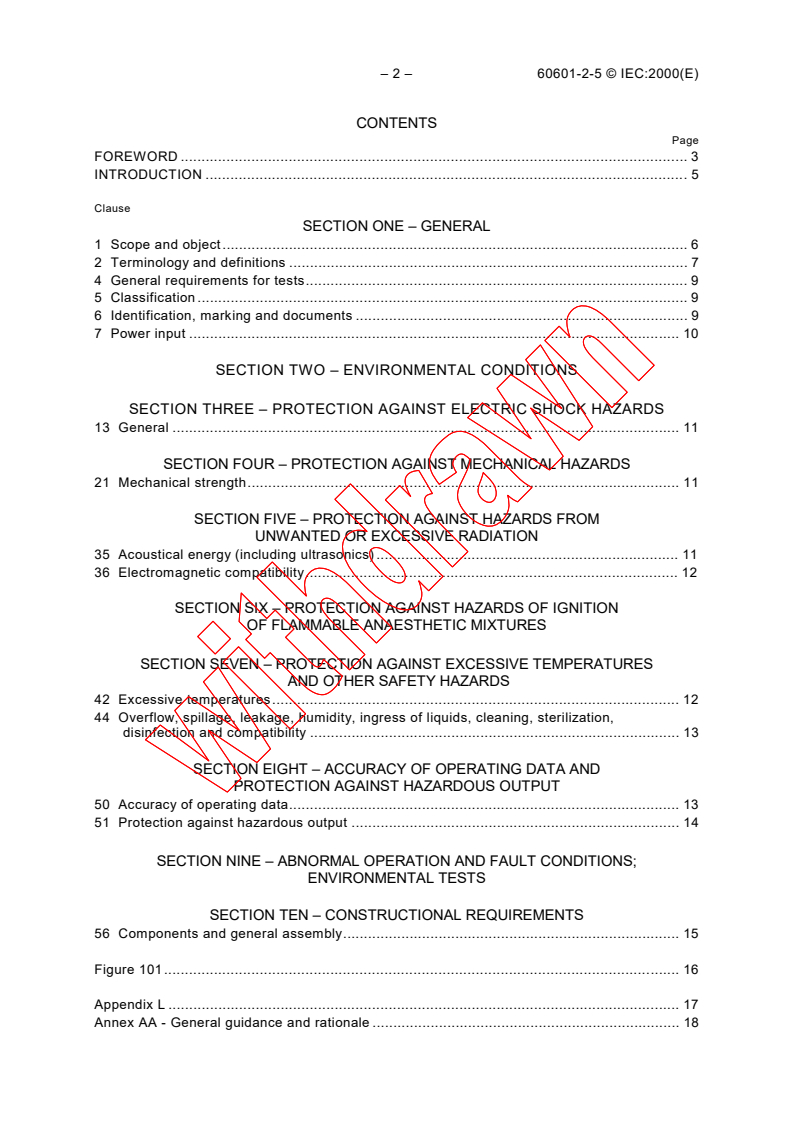
CONTENTS
Page
FOREWORD . 3
INTRODUCTION .5
Clause
SECTION ONE – GENERAL
1 Scope and object. 6
2 Terminology and definitions . 7
4 General requirements for tests. 9
5 Classification . 9
6 Identification, marking and documents . 9
7 Power input . 10
SECTION TWO – ENVIRONMENTAL CONDITIONS
SECTION THREE – PROTECTION AGAINST ELECTRIC SHOCK HAZARDS
13 General . 11
SECTION FOUR – PROTECTION AGAINST MECHANICAL HAZARDS
21 Mechanical strength. 11
SECTION FIVE – PROTECTION AGAINST HAZARDS FROM
UNWANTED OR EXCESSIVE RADIATION
35 Acoustical energy (including ultrasonics) . 11
36 Electromagnetic compatibility. 12
SECTION SIX – PROTECTION AGAINST HAZARDS OF IGNITION
OF FLAMMABLE ANAESTHETIC MIXTURES
SECTION SEVEN – PROTECTION AGAINST EXCESSIVE TEMPERATURES
AND OTHER SAFETY HAZARDS
42 Excessive temperatures. 12
44 Overflow, spillage, leakage, humidity, ingress of liquids, cleaning, sterilization,
disinfection and compatibility . 13
SECTION EIGHT – ACCURACY OF OPERATING DATA AND
PROTECTION AGAINST HAZARDOUS OUTPUT
50 Accuracy of operating data. 13
51 Protection against hazardous output . 14
SECTION NINE – ABNORMAL OPERATION AND FAULT CONDITIONS;
ENVIRONMENTAL TESTS
SECTION TEN – CONSTRUCTIONAL REQUIREMENTS
56 Components and general assembly. 15
Figure 101. 16
Appendix L . 17
Annex AA - General guidance and rationale . 18
60601-2-5 © IEC:2000(E) – 3 –
INTERNATIONAL ELECTROTECHNICAL COMMISSION
–––––––––––
MEDICAL ELECTRICAL EQUIPMENT –
Part 2-5: Particular requirements for the safety of
ultrasonic physiotherapy equipment
FOREWORD
1) The IEC (International Electrotechnical Commission) is a worldwide organization for standardization
comprising all national electrotechnical committees (IEC National Committees). The object of the IEC is to
promote international cooperation on all questions concerning standardization in the electrical and electronic
fields. To this end and in addition to other activities, the IEC publishes International Standards. Their
preparation is entrusted to technical committees; any IEC National Committee interested in the subject dealt
with may participate in this preparatory work. International, governmental and non-governmental
organizations liaising with the IEC also participate in this preparation. The IEC collaborates closely with the
International Organization for Standardization (ISO) in accordance with conditions determined by agreement
between the two organizations.
2) The formal decisions or agreements of the IEC on technical matters, prepared by technical committees on
which all the National Committees having a special interest therein are represented, express, as nearly as
possible, an international consensus of opinion on the subjects dealt with.
3) They have the form of recommendations for international use published in the form of standards, technical
specifications, technical reports or guides and they are accepted by the National Committees in that sense.
4) In order to promote international unification, IEC National Committees undertake to apply IEC International
Standards transparently to the maximum extent possible in their national and regional standards. Any
divergence between the IEC Standard and the corresponding national or regional standard shall be clearly
indicated in the latter.
5) Attention is drawn to the possibility that some of the elements of this International Standard may be the
subject of patent rights. IEC shall not be held responsible for identifying any or all such patent rights.
6) The IEC has not laid down any procedure concerning marking as an indication of approval and has no
responsibility when an item of equipment is declared to comply with one of its standards.
International Standard IEC 60601-2-5 has been prepared by sub-committee 62D: Electro-
medical equipment, of IEC technical committee 62: Electrical equipment in medical practice.
This second edition cancels and replaces the first edition published in 1984, and constitutes a
technical revision.
The text of this Particular Standard is based on the following documents:
FDIS Report on voting
62D/361/FDIS 62D/366/RVD
Full information on the voting for the approval of this standard can be found in the report on
voting indicated in the above table.
This publication has been drafted in accordance with the ISO/IEC Directives, Part 3.
Annex AA is for information only.
– 4 – 60601-2-5 © IEC:2000(E)
In this Particular Standard the following print types are used:
– requirements, compliance with which can be tested, and definitions: roman type;
– notes, explanations, advice, introductions, general statements, exceptions and references: smaller
type;
– test specifications: italic type;
–TERMS DEFINED IN CLAUSE 2 OF THE GENERAL STANDARD OR THIS PARTICULAR STANDARD: SMALL
CAPITALS.
The committee has decided that the contents of this publication will remain unchanged until
2005. At this date, the publication will be:
• reconfirmed;
• withdrawn;
• replaced by a revised edition, or
• amended.
A bilingual version of this publication may be issued at a later date.
60601-2-5 © IEC:2000(E) – 5 –
INTRODUCTION
This Particular Standard specifies requirements and tests for the safety of ULTRASONIC
PHYSIOTHERAPY EQUIPMENT. It amends and supplements IEC 60601-1 (second edition, 1988)
including Amendments 1 and 2, hereinafter referred to as the General Standard. This Particular
Standard takes into account IEC 60601-1-2 and IEC 61689.
A first edition of this Particular Standard was published in 1984, based on the first edition
(1977) of IEC 60601-1 and making reference to IEC 60150. The aim of this second edition is to
bring this Particular Standard up to date with reference to the publications and documents
mentioned above. The title has been changed to better reflect its scope based on
developments in the therapeutic application of ultrasound and in line with changes in the above
IEC standards.
The requirements are followed by specifications for the relevant tests.
A rationale for the more important requirements, where appropriate, is given in annex AA. It is
considered that a knowledge of the reasons for these requirements will not only facilitate the
proper application of the Particular Standard but will, in due course, expedite any revision
necessitated by changes in clinical practice or as a result of developments in technology.
However this annex does not form part of the requirements of this Standard.
The clauses and subclauses which have corresponding rationale statements are marked with
an asterisk * before their number.
– 6 – 60601-2-5 © IEC:2000(E)
MEDICAL ELECTRICAL EQUIPMENT –
Part 2-5: Particular requirements for the safety of
ultrasonic physiotherapy equipment
SECTION ONE – GENERAL
The clauses and subclauses of this section of the General Standard apply, except as follows:
1 Scope and object
1.1 Scope
Addition:
This Particular Standard specifies the requirements for safety of ULTRASONIC PHYSIOTHERAPY
EQUIPMENT used in medical practice, as defined in 2.1.101.
This Particular Standard does not apply to:
– EQUIPMENT in which a tool is driven by ULTRASOUND (for example EQUIPMENT used in
surgery or dentistry);
– EQUIPMENT in which focused ULTRASOUND pulse waves are used to destroy conglom-
erates such as stones in the kidneys or the bladder (lithotrites) (for information refer to
IEC 60601-2-36);
– ULTRASONIC PHYSIOTHERAPY EQUIPMENT in which focused ULTRASOUND pulse waves are
used.
1.2 Object
Replacement:
The object of this Particular Standard is to establish particular requirements for the safety of
ULTRASONIC PHYSIOTHERAPY EQUIPMENT used in medical practice, as defined in 2.1.101.
1.3 Particular Standards
Addition:
This Particular Standard refers to IEC 60601-1 (1988): Medical electrical equipment – Part 1:
General requirements for safety, as amended by its amendment 1 (1991) and amendment 2
(1995).
For brevity, Part 1 is referred to in this Particular Standard as the “General Standard” .
The numbering of sections, clauses and subclauses of this Particular Standard corresponds
with that of the General Standard. The changes to the text of the General Standard are
specified by the use of the following words:
“Replacement” means that the clause or subclause of the General Standard is replaced
completely by the text of this Particular Standard.
“Addition” means that the text of this Particular Standard is additional to the requirements of
the General Standard.
60601-2-5 © IEC:2000(E) – 7 –
“Amendment” means that the clause or subclause of the General Standard is amended as
indicated by the text of this Particular Standard.
Subclauses or figures which are additional to those of the General Standard are numbered
starting from 101, additional annexes are lettered AA, BB, etc., and additional items aa), bb), etc.
The term “this standard” is used to make reference to the General Standard and this Particular
Standard taken together.
Where there is no corresponding section, clause or subclause in this Particular Standard, the
section, clause or subclause of the General Standard, although possibly not relevant, applies
without modification; where it is intended that any part of the General Standard, although
possibly relevant, is not to be applied, a statement to that effect is given in this Particular
Standard.
The requirements of this Particular Standard take priority over those of the General Standard
and Collateral Standards mentioned below.
1.5 Collateral Standards
Addition:
The following Collateral Standards apply:
IEC 60601-1-1:1992, Medical electrical equipment – Part 1: General requirements for safety –
Section 1 – Collateral standard: Safety requirements for medical electrical systems
IEC 60601-1-2:1993, Medical electrical equipment – Part 1: General requirements for safety –
2. Collateral Standard: Electromagnetic compatibility – Requirements and tests
IEC 60601-1-4:1996, Medical electrical equipment – Part 1: General requirements for safety –
4. Collateral Standard: Programmable electrical medical systems
2 Terminology and definitions
2.1 EQUIPMENT parts, auxiliaries and ACCESSORIES
Additional definitions:
2.1.101
ULTRASONIC PHYSIOTHERAPY EQUIPMENT (hereinafter referred to as EQUIPMENT)
EQUIPMENT for the generation and application of ULTRASOUND to a PATIENT for therapeutic
purposes
NOTE – Essentially the EQUIPMENT comprises a generator of electric high-frequency power and a transducer for
converting this to ULTRASOUND.
2.1.102
ULTRASONIC TRANSDUCER
device capable of converting electrical energy to mechanical energy within the ultrasonic
frequency range
*2.1.103
TREATMENT HEAD
assembly comprising an ULTRASONIC TRANSDUCER and associated parts for local application of
ULTRASOUND to the PATIENT
NOTE – A TREATMENT HEAD is also referred to as an applicator.
– 8 – 60601-2-5 © IEC:2000(E)
2.1.104
ATTACHMENT HEAD
ACCESSORY intended to be attached to the TREATMENT HEAD for the purpose of modifying the
ultrasonic beam characteristics
2.12 MISCELLANEOUS
2.12.101
RATED OUTPUT POWER
Maximum OUTPUT POWER of the EQUIPMENT at any RATED MAINS VOLTAGE [IEC 61689,
definition 3.32]
2.12.102
ULTRASOUND
acoustic oscillation whose frequency is above the high-frequency limit of audible sound (about
16 kHz) (see 801-21-04 of IEC 60050(801)) [IEC 61689, definition 3.45]
2.12.103
EFFECTIVE RADIATING AREA
beam cross-sectional area extrapolated to the front face of the TREATMENT HEAD and multiplied
by a dimensionless factor according to IEC 61689 [IEC 61689, definition 3.20, modified]
NOTE – This may be thought of as the area of the face of the treatment head which contains 100% of the total
mean square acoustic power.
2.12.104
EFFECTIVE INTENSITY
ratio of the OUTPUT POWER to the EFFECTIVE RADIATING AREA. It is expressed in watts per square
centimetre [IEC 61689, definition 3.18, modified]
2.12.105
ACOUSTIC WORKING FREQUENCY
frequency of an acoustic signal based on the observation of the output of a hydrophone placed
in an acoustic field. The signal is analysed using the zero-crossing frequency technique (see
3.4.1 of IEC 61102) [IEC 61689, definition 3.3]
2.12.106
BEAM NON-UNIFORMITY RATIO
ratio of the square of the maximum r.m.s. acoustic pressure to the spatial average of the
square of the r.m.s. acoustic pressure where the spatial average is taken over the EFFECTIVE
RADIATING AREA, determined in accordance with IEC 61689 [IEC 61689, definition 3.9, modified]
2.12.107
BEAM TYPE
descriptive classification for the ultrasonic beam in one of three types: collimated, convergent
or divergent [IEC 61689, definition 3.11]
2.12.108
DUTY FACTOR
ratio of the PULSE DURATION to the PULSE REPETITION PERIOD (see 5.3.2.4 of IEC 60469-1)
[IEC 61689, definition 3.17]
2.12.109
OUTPUT POWER
time-average ultrasonic power radiated by a TREATMENT HEAD of EQUIPMENT into an approxi-
mately free field under specified conditions in a specified medium, preferably in water (see 3.5
of IEC 61161) [IEC 61689, definition 3.31]
60601-2-5 © IEC:2000(E) – 9 –
2.12.110
PULSE DURATION
time interval beginning at the first time the pressure amplitude exceeds a reference value and
ending at the last time the pressure amplitude returns to that value. The reference value is
equal to the sum of the minimum pressure amplitude and 10% of the difference between the
maximum and minimum pressure amplitude [IEC 61689, definition 3.35]
NOTE – The above definition from IEC 61689 differs from that of 3.30 of IEC 61102 to account for incomplete
modulation.
2.12.111
PULSE REPETITION PERIOD
absolute value of the time interval after which the same characteristics of a periodic waveform
recur (see 5.3.2.1 of IEC 60469-1) [IEC 61689, definition 3.36]
2.12.112
TEMPORAL-MAXIMUM INTENSITY
in the case of an amplitude modulated wave, this is the ratio of the TEMPORAL-MAXIMUM OUTPUT
POWER to the EFFECTIVE RADIATING AREA [IEC 61689, definition 3.41, modified]
2.12.113
TEMPORAL-MAXIMUM OUTPUT POWER
in the case of an amplitude modulated wave, this is a function of the actual OUTPUT POWER, the
temporal-peak acoustic pressure and the r.m.s. acoustic pressure and is determined as
specified in IEC 61689 [conforms to 3.34 of IEC 61689]
*4 General requirements for tests
This clause of the General Standard applies, except as follows:
*4.1 Tests
Note addition to rationale (see Annex AA).
5 Classification
This clause of the General Standard applies, except as follows:
5.6
Amendment:
Delete all dashed items except “– CONTINUOUS OPERATION”.
*6 Identification, marking and documents
6.1 Marking on the outside of EQUIPMENT or EQUIPMENT parts
p) Output
Replacement:
1. The generator of an EQUIPMENT shall additionally be provided with the following markings:
− ACOUSTIC WORKING FREQUENCY in MHz (in kHz for frequencies below 1 MHz)
– 10 – 60601-2-5 © IEC:2000(E)
− waveform (continuous, amplitude modulated (or pulsed))
− if amplitude modulated (or pulsed), a description or picture of the output waveforms,
along with values for the PULSE DURATION, PULSE REPETITION PERIOD, and DUTY FACTOR
for each modulation setting.
2. The generator shall carry a nameplate, permanently attached, on which is given a unique
serial number so that it is individually identified.
3. The treatment head shall be marked with its rated output power in watts, the effective
radiating area in square centimetres, the beam non-uniformity ratio, the beam type, a
designation of the specific generator (where applicable, see 6.8.2 aa) item 9) of the
equipment for which the treatment head is intended and a unique serial number.
6.8.2 Instructions for use
Additional item:
aa) The instructions for use shall additionally contain the following:
1) Information on ACOUSTIC WORKING FREQUENCY or FREQUENCIES in kilohertz or megahertz
and EFFECTIVE RADIATING AREA or AREAS in square centimetres of any TREATMENT HEAD or
ATTACHMENT HEAD.
2) A recommendation calling the USER's attention to the need for periodic maintenance,
especially:
− INTERVALS FOR REGULAR PERFORMANCE TESTING AND CALIBRATION BY THE USER;
− INSPECTION OF THE TREATMENT HEAD FOR CRACKS, WHICH MAY ALLOW THE INGRESS OF
CONDUCTIVE FLUID;
− INSPECTION OF THE TREATMENT HEAD CABLES AND ASSOCIATED CONNECTORS.
3) Advice on the procedures necessary for safe operation, drawing attention in the case of
TYPE B APPLIED PARTS to the SAFETY HAZARDS which may occur as a result of an inadequate
electrical installation.
EQUIPMENT
4) Advice on the type of electrical installation to which the may be safely
connected, including the connection of any POTENTIAL EQUALIZATION CONDUCTOR.
5) Advice drawing the USER’s attention to the need for care when handling the TREATMENT
HEAD since rough handling may adversely affect its characteristics.
6) A list of conditions for which ULTRASOUND treatment is contraindicated.
7) A statement of intended use(s).
8) Information on available TREATMENT HEADS.
TREATMENT HEAD
9) Where a has been designed for interchangeability, such that it is not
possible to specify a particular generator unit, this shall be stated and the method by which
interchangeability is achieved shall be described.
7 Power input
This clause of the General Standard applies with EQUIPMENT operated as specified in Clause 50.
SECTION TWO – ENVIRONMENTAL CONDITIONS
The clauses and subclauses of this section of the General Standard apply.
60601-2-5 © IEC:2000(E) – 11 –
SECTION THREE –
...
IEC 60601-2-5
Edition 2.0 2000-07
INTERNATIONAL
STANDARD
NORME
INTERNATIONALE
Medical electrical equipment –
Part 2-5: Particular requirements for the safety of ultrasonic physiotherapy
equipment
Appareils électromédicaux –
Partie 2-5: Règles particulières de sécurité des appareils à ultrasons pour
physiothérapie
All rights reserved. Unless otherwise specified, no part of this publication may be reproduced or utilized in any form or by
any means, electronic or mechanical, including photocopying and microfilm, without permission in writing from either IEC or
IEC's member National Committee in the country of the requester.
If you have any questions about IEC copyright or have an enquiry about obtaining additional rights to this publication,
please contact the address below or your local IEC member National Committee for further information.
Droits de reproduction réservés. Sauf indication contraire, aucune partie de cette publication ne peut être reproduite
ni utilisée sous quelque forme que ce soit et par aucun procédé, électronique ou mécanique, y compris la photocopie
et les microfilms, sans l'accord écrit de la CEI ou du Comité national de la CEI du pays du demandeur.
Si vous avez des questions sur le copyright de la CEI ou si vous désirez obtenir des droits supplémentaires sur cette
publication, utilisez les coordonnées ci-après ou contactez le Comité national de la CEI de votre pays de résidence.
IEC Central Office
3, rue de Varembé
CH-1211 Geneva 20
Switzerland
Email: inmail@iec.ch
Web: www.iec.ch
About the IEC
The International Electrotechnical Commission (IEC) is the leading global organization that prepares and publishes
International Standards for all electrical, electronic and related technologies.
About IEC publications
The technical content of IEC publications is kept under constant review by the IEC. Please make sure that you have the
latest edition, a corrigenda or an amendment might have been published.
ƒ Catalogue of IEC publications: www.iec.ch/searchpub
The IEC on-line Catalogue enables you to search by a variety of criteria (reference number, text, technical committee,…).
It also gives information on projects, withdrawn and replaced publications.
ƒ IEC Just Published: www.iec.ch/online_news/justpub
Stay up to date on all new IEC publications. Just Published details twice a month all new publications released. Available
on-line and also by email.
ƒ Electropedia: www.electropedia.org
The world's leading online dictionary of electronic and electrical terms containing more than 20 000 terms and definitions
in English and French, with equivalent terms in additional languages. Also known as the International Electrotechnical
Vocabulary online.
ƒ Customer Service Centre: www.iec.ch/webstore/custserv
If you wish to give us your feedback on this publication or need further assistance, please visit the Customer Service
Centre FAQ or contact us:
Email: csc@iec.ch
Tel.: +41 22 919 02 11
Fax: +41 22 919 03 00
A propos de la CEI
La Commission Electrotechnique Internationale (CEI) est la première organisation mondiale qui élabore et publie des
normes internationales pour tout ce qui a trait à l'électricité, à l'électronique et aux technologies apparentées.
A propos des publications CEI
Le contenu technique des publications de la CEI est constamment revu. Veuillez vous assurer que vous possédez
l’édition la plus récente, un corrigendum ou amendement peut avoir été publié.
ƒ Catalogue des publications de la CEI: www.iec.ch/searchpub/cur_fut-f.htm
Le Catalogue en-ligne de la CEI vous permet d’effectuer des recherches en utilisant différents critères (numéro de référence,
texte, comité d’études,…). Il donne aussi des informations sur les projets et les publications retirées ou remplacées.
ƒ Just Published CEI: www.iec.ch/online_news/justpub
Restez informé sur les nouvelles publications de la CEI. Just Published détaille deux fois par mois les nouvelles
publications parues. Disponible en-ligne et aussi par email.
ƒ Electropedia: www.electropedia.org
Le premier dictionnaire en ligne au monde de termes électroniques et électriques. Il contient plus de 20 000 termes et
définitions en anglais et en français, ainsi que les termes équivalents dans les langues additionnelles. Egalement appelé
Vocabulaire Electrotechnique International en ligne.
ƒ Service Clients: www.iec.ch/webstore/custserv/custserv_entry-f.htm
Si vous désirez nous donner des commentaires sur cette publication ou si vous avez des questions, visitez le FAQ du
Service clients ou contactez-nous:
Email: csc@iec.ch
Tél.: +41 22 919 02 11
Fax: +41 22 919 03 00
IEC 60601-2-5
Edition 2.0 2000-07
INTERNATIONAL
STANDARD
NORME
INTERNATIONALE
Medical electrical equipment –
Part 2-5: Particular requirements for the safety of ultrasonic physiotherapy
equipment
Appareils électromédicaux –
Partie 2-5: Règles particulières de sécurité des appareils à ultrasons pour
physiothérapie
INTERNATIONAL
ELECTROTECHNICAL
COMMISSION
COMMISSION
ELECTROTECHNIQUE
PRICE CODE
INTERNATIONALE
R
CODE PRIX
ICS 11.040.60 ISBN 2-8318-8312-1
– 2 – 60601-2-5 © CEI:2000
SOMMAIRE
AVANT-PROPOS .4
INTRODUCTION.8
SECTION UN – GÉNÉRALITÉS
1 Domaine d’application et objet.10
2 Terminologie et définitions.12
4 Exigences générales relatives aux essais .18
5 Classification .18
6 Identification, marquage et documentation.18
7 Puissance absorbée.20
SECTION DEUX – CONDITIONS D'ENVIRONNEMENT
SECTION TROIS – PROTECTION CONTRE LES RISQUES DE CHOCS
ÉLECTRIQUES
13 Généralités .20
SECTION QUATRE – PROTECTION CONTRE LES RISQUES MÉCANIQUES
21 Résistance mécanique .20
SECTION CINQ – PROTECTION CONTRE LES RISQUES DUS
AUX RAYONNEMENTS NON DÉSIRÉS OU EXCESSIFS
35 Énergie acoustique (y compris les ultrasons) .22
36 Compatibilité électromagnétique.22
SECTION SIX – PROTECTION CONTRE LES RISQUES D’ALLUMAGE
DE MÉLANGES ANESTHÉSIQUES INFLAMMABLES
SECTION SEPT – PROTECTION CONTRE LES TEMPÉRATURES EXCESSIVES
ET LES AUTRES RISQUES
42 Températures excessives.24
44 Débordements, renversements, fuites, humidité, pénétration de liquides, nettoyage,
stérilisation, désinfection et compatibilité .24
SECTION HUIT – PRÉCISION DES CARACTÉRISTIQUES DE FONCTIONNEMENT
ET PROTECTION CONTRE LES CARACTERISTIQUES DE SORTIE PRESENTANT
DES RISQUES
50 Précision des caractéristiques de fonctionnement.26
51 Protection contre les caractéristiques de sortie présentant des risques .26
SECTION NEUF – FONCTIONNEMENT ANORMAL ET CONDITIONS DE DÉFAUT;
ESSAIS D'ENVIRONNEMENT
SECTION DIX – RÈGLES DE CONSTRUCTION
56 Composants et ensembles .30
Figure 101 .30
Annexe L .32
Annexe AA – Guide et justifications .34
60601-2-5 ©IEC:2000 – 3 –
CONTENTS
FOREWORD.5
INTRODUCTION.9
SECTION ONE – GENERAL
1 Scope and object .11
2 Terminology and definitions.13
4 General requirements for tests .19
5 Classification .19
6 Identification, marking and documents.19
7 Power input.21
SECTION TWO – ENVIRONMENTAL CONDITIONS
SECTION THREE – PROTECTION AGAINST ELECTRIC SHOCK HAZARDS
13 General.21
SECTION FOUR – PROTECTION AGAINST MECHANICAL HAZARDS
21 Mechanical strength .21
SECTION FIVE – PROTECTION AGAINST HAZARDS FROM
UNWANTED OR EXCESSIVE RADIATION
35 Acoustical energy (including ultrasonics) .23
36 Electromagnetic compatibility .23
SECTION SIX – PROTECTION AGAINST HAZARDS OF IGNITION
OF FLAMMABLE ANAESTHETIC MIXTURES
SECTION SEVEN – PROTECTION AGAINST EXCESSIVE TEMPERATURES
AND OTHER SAFETY HAZARDS
42 Excessive temperatures .25
44 Overflow, spillage, leakage, humidity, ingress of liquids, cleaning, sterilization,
disinfection and compatibility.25
SECTION EIGHT – ACCURACY OF OPERATING DATA AND
PROTECTION AGAINST HAZARDOUS OUTPUT
50 Accuracy of operating data .27
51 Protection against hazardous output .27
SECTION NINE – ABNORMAL OPERATION AND FAULT CONDITIONS;
ENVIRONMENTAL TESTS
SECTION TEN – CONSTRUCTIONAL REQUIREMENTS
56 Components and general assembly .31
Figure 101 .31
Appendix L.33
Annex AA - General guidance and rationale.35
– 4 – 60601-2-5 © CEI:2000
COMMISSION ÉLECTROTECHNIQUE INTERNATIONALE
–––––––––––
APPAREILS ÉLECTROMÉDICAUX –
Partie 2-5: Règles particulières de sécurité
des appareils à ultrasons pour physiothérapie
AVANT-PROPOS
1) La Commission Electrotechnique Internationale (CEI) est une organisation mondiale de normalisation composée
de l'ensemble des comités électrotechniques nationaux (Comités nationaux de la CEI). La CEI a pour objet de
favoriser la coopération internationale pour toutes les questions de normalisation dans les domaines de
l'électricité et de l'électronique. A cet effet, la CEI – entre autres activités – publie des Normes internationales,
des Spécifications techniques, des Rapports techniques, des Spécifications accessibles au public (PAS) et des
Guides (ci-après dénommés "Publication(s) de la CEI"). Leur élaboration est confiée à des comités d'études,
aux travaux desquels tout Comité national intéressé par le sujet traité peut participer. Les organisations
internationales, gouvernementales et non gouvernementales, en liaison avec la CEI, participent également aux
travaux. La CEI collabore étroitement avec l'Organisation Internationale de Normalisation (ISO), selon des
conditions fixées par accord entre les deux organisations.
2) Les décisions ou accords officiels de la CEI concernant les questions techniques représentent, dans la mesure
du possible, un accord international sur les sujets étudiés, étant donné que les Comités nationaux de la CEI
intéressés sont représentés dans chaque comité d’études.
3) Les Publications de la CEI se présentent sous la forme de recommandations internationales et sont agréées
comme telles par les Comités nationaux de la CEI. Tous les efforts raisonnables sont entrepris afin que la CEI
s'assure de l'exactitude du contenu technique de ses publications; la CEI ne peut pas être tenue responsable de
l'éventuelle mauvaise utilisation ou interprétation qui en est faite par un quelconque utilisateur final.
4) Dans le but d'encourager l'uniformité internationale, les Comités nationaux de la CEI s'engagent, dans toute la
mesure possible, à appliquer de façon transparente les Publications de la CEI dans leurs publications
nationales et régionales. Toutes divergences entre toutes Publications de la CEI et toutes publications
nationales ou régionales correspondantes doivent être indiquées en termes clairs dans ces dernières.
5) La CEI n’a prévu aucune procédure de marquage valant indication d’approbation et n'engage pas sa
responsabilité pour les équipements déclarés conformes à une de ses Publications.
6) Tous les utilisateurs doivent s'assurer qu'ils sont en possession de la dernière édition de cette publication.
7) Aucune responsabilité ne doit être imputée à la CEI, à ses administrateurs, employés, auxiliaires ou
mandataires, y compris ses experts particuliers et les membres de ses comités d'études et des Comités
nationaux de la CEI, pour tout préjudice causé en cas de dommages corporels et matériels, ou de tout autre
dommage de quelque nature que ce soit, directe ou indirecte, ou pour supporter les coûts (y compris les frais
de justice) et les dépenses découlant de la publication ou de l'utilisation de cette Publication de la CEI ou de
toute autre Publication de la CEI, ou au crédit qui lui est accordé.
8) L'attention est attirée sur les références normatives citées dans cette publication. L'utilisation de publications
référencées est obligatoire pour une application correcte de la présente publication.
9) L’attention est attirée sur le fait que certains des éléments de la présente Publication de la CEI peuvent faire
l’objet de droits de propriété intellectuelle ou de droits analogues. La CEI ne saurait être tenue pour
responsable de ne pas avoir identifié de tels droits de propriété et de ne pas avoir signalé leur existence.
La Norme internationale CEI 60601-2-5 a été établie par le sous-comité 62D: Appareils
électromédicaux, du comité d'études 62 de la CEI: Équipements électriques dans la pratique
médicale.
Cette seconde édition de la CEI 60601-2-5 annule et remplace la première édition publiée en
1984 et constitue une révision technique.
Cette version bilingue, publiée en 2005-11, correspond à la version anglaise.
Le texte anglais de cette norme est issu des documents 62D/361/FDIS et 62D/366/RVD.
Le rapport de vote 62D/366/RVD donne toute information sur le vote ayant abouti à
l'approbation de cette norme.
60601-2-5 ©IEC:2000 – 5 –
INTERNATIONAL ELECTROTECHNICAL COMMISSION
–––––––––––
MEDICAL ELECTRICAL EQUIPMENT –
Part 2-5: Particular requirements for the safety of
ultrasonic physiotherapy equipment
FOREWORD
1) The International Electrotechnical Commission (IEC) is a worldwide organization for standardization comprising
all national electrotechnical committees (IEC National Committees). The object of IEC is to promote
international co-operation on all questions concerning standardization in the electrical and electronic fields. To
this end and in addition to other activities, IEC publishes International Standards, Technical Specifications,
Technical Reports, Publicly Available Specifications (PAS) and Guides (hereafter referred to as “IEC
Publication(s)”). Their preparation is entrusted to technical committees; any IEC National Committee interested
in the subject dealt with may participate in this preparatory work. International, governmental and non-
governmental organizations liaising with the IEC also participate in this preparation. IEC collaborates closely
with the International Organization for Standardization (ISO) in accordance with conditions determined by
agreement between the two organizations.
2) The formal decisions or agreements of IEC on technical matters express, as nearly as possible, an international
consensus of opinion on the relevant subjects since each technical committee has representation from all
interested IEC National Committees.
3) IEC Publications have the form of recommendations for international use and are accepted by IEC National
Committees in that sense. While all reasonable efforts are made to ensure that the technical content of IEC
Publications is accurate, IEC cannot be held responsible for the way in which they are used or for any
misinterpretation by any end user.
4) In order to promote international uniformity, IEC National Committees undertake to apply IEC Publications
transparently to the maximum extent possible in their national and regional publications. Any divergence
between any IEC Publication and the corresponding national or regional publication shall be clearly indicated in
the latter.
5) IEC provides no marking procedure to indicate its approval and cannot be rendered responsible for any
equipment declared to be in conformity with an IEC Publication.
6) All users should ensure that they have the latest edition of this publication.
7) No liability shall attach to IEC or its directors, employees, servants or agents including individual experts and
members of its technical committees and IEC National Committees for any personal injury, property damage or
other damage of any nature whatsoever, whether direct or indirect, or for costs (including legal fees) and
expenses arising out of the publication, use of, or reliance upon, this IEC Publication or any other IEC
Publications.
8) Attention is drawn to the Normative references cited in this publication. Use of the referenced publications is
indispensable for the correct application of this publication.
9) Attention is drawn to the possibility that some of the elements of this IEC Publication may be the subject of
patent rights. IEC shall not be held responsible for identifying any or all such patent rights.
International Standard IEC 60601-2-5 has been prepared by sub-committee 62D: Electro-
medical equipment, of IEC technical committee 62: Electrical equipment in medical practice.
This second edition of IEC 60601-2-5 cancels and replaces the first edition published in 1984
of which it constitutes a technical revision.
This bilingual version, published in 2005-11, corresponds to the English version.
The text of this standard is based on the following documents:
FDIS Report on voting
62D/361/FDIS 62D/366/RVD
Full information on the voting for the approval of this standard can be found in the report on
voting indicated in the above table.
– 6 – 60601-2-5 © CEI:2000
La version française de cette norme n’a pas été soumise au vote.
Dans la présente Norme Particulière, les caractères d'imprimerie suivants sont employés:
– exigences dont la conformité peut être vérifiée par un essai et définitions: caractères
romains;
– notes, explications, conseils, introductions, énoncés de portée générale, exceptions et références: petits
caractères romains;
– modalités d'essais: caractères italiques;
– TERMES DEFINIS A L'ARTICLE 2 DE LA NORME GENERALE OU DE LA PRESENTE NORME
PARTICULIERE: PETITES CAPITALES.
Le comité a décidé que le contenu de cette publication ne sera pas modifié avant la date de
maintenance indiquée sur le site Web de la CEI sous «http://webstore.iec.ch» dans les
données relatives à la publication recherchée. A cette date, la publication sera
• reconduite;
• supprimée;
• remplacée par une édition révisée, ou
• amendée.
60601-2-5 ©IEC:2000 – 7 –
The French version of this standard has not been voted upon.
In this Particular Standard the following print types are used:
– requirements, compliance with which can be tested, and definitions: roman type;
– notes, explanations, advice, introductions, general statements, exceptions and references: smaller type;
– test specifications, headings of subclauses and headings of items: italic type;
– TERMS DEFINED IN CLAUSE 2 OF THE GENERAL STANDARD OR THIS PARTICULAR STANDARD: SMALL
CAPITALS.
The committee has decided that the contents of this publication will remain unchanged until the
maintenance result date indicated on the IEC web site under "http://webstore.iec.ch" in the data
related to the specific publication. At this date, the publication will be
• reconfirmed;
• withdrawn;
• replaced by a revised edition, or
• amended.
– 8 – 60601-2-5 © CEI:2000
INTRODUCTION
La présente Norme Particulière spécifie les exigences et les essais pour la sécurité des
APPAREILS A ULTRASONS POUR PHYSIOTHERAPIE. Elle modifie et complète la CEI 60601-1
(deuxième édition, 1988) y compris les Amendements 1 et 2, appelée Norme Générale dans la
présente Norme. La présente Norme Particulière prend en compte la CEI 60601-1-2 et la
CEI 61689.
Une première édition de la présente Norme Particulière a été publiée en 1984, basée sur la
première édition (1977) de la CEI 60601-1 et faisant référence à la CEI 60150. L’objet de cette
deuxième édition est de mettre à jour la présente Norme Particulière en référence aux
publications et documents mentionnés ci-dessus. Le titre, sur la base des développements
dans l’application thérapeutique des ultrasons et conformément aux changements dans les
normes CEI citées ci-dessus, a été modifié pour mieux préciser sa portée.
Les exigences sont immédiatement suivies par les essais correspondants.
Le cas échéant, des justifications pour les exigences les plus importantes sont fournies dans
l’Annexe AA. On considère que la connaissance des raisons qui ont conduit à imposer ces
exigences facilitera non seulement l'application correcte de la Norme Particulière, mais
accélérera, en temps voulu, toute révision rendue nécessaire par suite de changements dans
la pratique clinique ou d'évolutions technologiques. Cette annexe ne fait cependant pas partie
des exigences de la présente Norme.
Les articles et paragraphes pour lesquels des justifications sont fournies sont marqués d’un
astérisque * avant leur numéro.
60601-2-5 ©IEC:2000 – 9 –
INTRODUCTION
This Particular Standard specifies requirements and tests for the safety of ULTRASONIC
PHYSIOTHERAPY EQUIPMENT. It amends and supplements IEC 60601-1 (second edition, 1988)
including Amendments 1 and 2, hereinafter referred to as the General Standard. This Particular
Standard takes into account IEC 60601-1-2 and IEC 61689.
A first edition of this Particular Standard was published in 1984, based on the first edition
(1977) of IEC 60601-1 and making reference to IEC 60150. The aim of this second edition is to
bring this Particular Standard up to date with reference to the publications and documents
mentioned above. The title has been changed to better reflect its scope based on
developments in the therapeutic application of ultrasound and in line with changes in the above
IEC standards.
The requirements are followed by specifications for the relevant tests.
A rationale for the more important requirements, where appropriate, is given in Annex AA. It is
considered that a knowledge of the reasons for these requirements will not only facilitate the
proper application of the Particular Standard but will, in due course, expedite any revision
necessitated by changes in clinical practice or as a result of developments in technology.
However this annex does not form part of the requirements of this Standard.
The clauses and subclauses which have corresponding rationale statements are marked with
an asterisk * before their number.
– 10 – 60601-2-5 © CEI:2000
APPAREILS ÉLECTROMÉDICAUX –
Partie 2-5: Règles particulières de sécurité
des appareils à ultrasons pour physiothérapie
SECTION UN – GÉNÉRALITÉS
Les articles et paragraphes de cette section de la Norme Générale s'appliquent avec les
exceptions suivantes:
1 Domaine d’application et objet
1.1 Domaine d’application
Addition:
La présente Norme Particulière spécifie des exigences pour la sécurité des APPAREILS A
ULTRASONS POUR PHYSIOTHERAPIE, utilisés dans la pratique médicale, tels que définis en
2.1.101.
La présente Norme Particulière ne s'applique pas:
– aux APPAREILS dans lesquels un outil est commandé par ULTRASONS (tels que des
APPAREILS utilisés en chirurgie ou en dentisterie);
– aux APPAREILS dans lesquels des ondes pulsées par ULTRASONS focalisés sont utilisées
pour désintégrer des conglomérats tels que des calculs urinaires ou vésicaux (lithotrites) –
(se référer à la CEI 60601-2-36 pour plus d’informations);
– aux APPAREILS A ULTRASONS POUR PHYSIOTHERAPIE dans lesquels des ondes pulsées par
ULTRASONS focalisés sont utilisées.
1.2 Objet
Remplacement:
L’objet de la présente Norme Particulière est d’établir des règles particulières de sécurité pour
APPAREILS A ULTRASONS POUR PHYSIOTHERAPIE utilisés dans la pratique médicale, tels que
définis en 2.1.101.
1.3 Normes particulières
Addition:
La présente Norme Particulière se réfère à la CEI 60601-1 (1988): Appareils électromédicaux –
Première partie: Prescriptions générales pour la sécurité, telle que modifiée par ses
Amendements 1 (1991) et 2 (1995).
Pour plus de concision, cette première partie est désignée comme la « Norme Générale » dans
la présente Norme Particulière.
La numérotation des sections, articles et paragraphes de la présente Norme Particulière
correspond à celle de la Norme Générale. Les modifications du texte de la Norme Générale
sont spécifiées par l’utilisation des termes suivants:
«Remplacement» signifie que l’article ou le paragraphe de la Norme Générale est remplacé
complètement par le texte de la présente Norme Particulière.
60601-2-5 ©IEC:2000 – 11 –
MEDICAL ELECTRICAL EQUIPMENT –
Part 2-5: Particular requirements for the safety of
ultrasonic physiotherapy equipment
SECTION ONE – GENERAL
The clauses and subclauses of this section of the General Standard apply, except as follows:
1 Scope and object
1.1 Scope
Addition:
This Particular Standard specifies the requirements for safety of ULTRASONIC PHYSIOTHERAPY
EQUIPMENT used in medical practice, as defined in 2.1.101.
This Particular Standard does not apply to:
– EQUIPMENT in which a tool is driven by ULTRASOUND (for example EQUIPMENT used in surgery
or dentistry);
– EQUIPMENT in which focused ULTRASOUND pulse waves are used to destroy conglom-
erates such as stones in the kidneys or the bladder (lithotrites) (for information refer to
IEC 60601-2-36);
– ULTRASONIC PHYSIOTHERAPY EQUIPMENT in which focused ULTRASOUND pulse waves are
used.
1.2 Object
Replacement:
The object of this Particular Standard is to establish particular requirements for the safety of
ULTRASONIC PHYSIOTHERAPY EQUIPMENT used in medical practice, as defined in 2.1.101.
1.3 Particular Standards
Addition:
This Particular Standard refers to IEC 60601-1 (1988): Medical electrical equipment – Part 1:
General requirements for safety, as amended by its amendment 1 (1991) and amendment 2
(1995).
For brevity, Part 1 is referred to in this Particular Standard as the “General Standard” .
The numbering of sections, clauses and subclauses of this Particular Standard corresponds
with that of the General Standard. The changes to the text of the General Standard are
specified by the use of the following words:
“Replacement” means that the clause or subclause of the General Standard is replaced
completely by the text of this Particular Standard.
– 12 – 60601-2-5 © CEI:2000
«Addition» signifie que le texte de la présente Norme Particulière est complémentaire aux
exigences de la Norme Générale.
«Modification» signifie que l’article ou le paragraphe de la Norme Générale est modifié comme
indiqué par le texte de la présente Norme Particulière.
Les paragraphes ou les figures complémentaires à ceux de la Norme Générale sont numérotés
à partir de 101; les annexes complémentaires sont appelées AA, BB, etc., et les points
complémentaires aa), bb), etc.
L’expression «la présente norme» est utilisée en référence à la Norme Générale et à la
présente Norme Particulière considérées conjointement.
S’il n’existe pas de section, article ou paragraphe correspondant dans la présente Norme
Particulière, alors la section, l’article ou le paragraphe de la Norme Générale s’applique sans
modification, bien qu’il puisse ne pas être significatif. Si une partie quelconque de la Norme
Générale ne s’applique pas, bien qu’elle puisse ne pas être significative, une indication à cet
effet est fournie dans la présente Norme Particulière.
Les exigences de la présente Norme Particulière ont priorité sur celles de la Norme Générale
et les Normes Collatérales mentionnées ci-dessous.
1.5 Normes Collatérales
Addition:
Les Normes Collatérales suivantes s'appliquent:
CEI 60601-1-1:1992, Appareils électromédicaux – Première partie: Prescriptions générales
pour la sécurité – Section 1 – Normes Collatérales: Prescriptions de sécurité pour les systèmes
électromédicaux
CEI 60601-1-2:1993, Appareils électromédicaux – Première partie: Prescriptions générales
pour la sécurité – 2. Norme Collatérale: Compatibilité électromagnétique – Prescriptions et
essais
CEI 60601-1-4:1996, Appareils électromédicaux – Première partie: Prescriptions générales
pour la sécurité – 4. Norme Collatérale: Systèmes électromédicaux programmables
2 Terminologie et définitions
2.1 Éléments des APPAREILS, équipements auxiliaires et ACCESSOIRES
Définitions complémentaires:
2.1.101
APPAREIL A ULTRASONS POUR PHYSIOTHERAPIE (appelé APPAREIL dans la présente norme)
APPAREIL conçu pour la production d'ULTRASONS et l'application de ceux-ci à un PATIENT à des
fins thérapeutiques
NOTE L'APPAREIL comporte essentiellement un générateur d'énergie électrique à haute fréquence et un
transducteur pour convertir cette énergie en ULTRASONS.
2.1.102
ELEMENT TRANSDUCTEUR
dispositif capable de convertir l'énergie électrique en énergie mécanique dans la gamme des
fréquences ultrasonores
60601-2-5 ©IEC:2000 – 13 –
“Addition” means that the text of this Particular Standard is additional to the requirements of
the General Standard.
“Amendment” means that the clause or subclause of the General Standard is amended as
indicated by the text of this Particular Standard.
Subclauses or figures which are additional to those of the General Standard are numbered
starting from 101, additional annexes are lettered AA, BB, etc., and additional items aa), bb), etc.
The term “this standard” is used to make reference to the General Standard and this Particular
Standard taken together.
Where there is no corresponding section, clause or subclause in this Particular Standard, the
section, clause or subclause of the General Standard, although possibly not relevant, applies
without modification; where it is intended that any part of the General Standard, although
possibly relevant, is not to be applied, a statement to that effect is given in this Particular
Standard.
The requirements of this Particular Standard take priority over those of the General Standard
and Collateral Standards mentioned below.
1.5 Collateral Standards
Addition:
The following Collateral Standards apply:
IEC 60601-1-1:1992, Medical electrical equipment – Part 1: General requirements for safety –
Section 1 – Collateral standard: Safety requirements for medical electrical systems
IEC 60601-1-2:1993, Medical electrical equipment – Part 1: General requirements for safety –
2. Collateral Standard: Electromagnetic compatibility – Requirements and tests
IEC 60601-1-4:1996, Medical electrical equipment – Part 1: General requirements for safety –
4. Collateral Standard: Programmable electrical medical systems
2 Terminology and definitions
2.1 EQUIPMENT parts, auxiliaries and ACCESSORIES
Additional definitions:
2.1.101
ULTRASONIC PHYSIOTHERAPY EQUIPMENT (hereinafter referred to as EQUIPMENT)
EQUIPMENT for the generation and application of ULTRASOUND to a PATIENT for therapeutic
purposes
NOTE Essentially the EQUIPMENT comprises a generator of electric high-frequency power and a transducer for
converting this to ULTRASOUND.
2.1.102
ULTRASONIC TRANSDUCER
device capable of converting electrical energy to mechanical energy within the ultrasonic
frequency range
– 14 – 60601-2-5 © CEI:2000
*2.1.103
TRANSDUCTEUR
ensemble comprenant un ELEMENT TRANSDUCTEUR et les parties associées pour une application
locale d’ULTRASONS à un PATIENT
NOTE Un TRANSDUCTEUR est aussi appelé applicateur.
2.1.104
ADAPTATEUR
ACCESSOIRE destiné à être attaché au TRANSDUCTEUR dans le but de modifier les
caractéristiques du faisceau ultrasonore
2.12 DIVERS
2.12.101
PUISSANCE DE SORTIE ASSIGNEE
PUISSANCE DE SORTIE maximale de l'APPAREIL pour toute TENSION DE RESEAU ASSIGNEE
[CEI 61689, définition 3.32]
2.12.102
ULTRASON
oscillation acoustique dont la fréquence est supérieure à la haute fréquence audible maximale
– soit environ 16 kHz (voir 801-21-04 de la CEI 60050(801))
[CEI 61689, définition 3.45]
2.12.103
SURFACE ACTIVE D'EMISSION
surface de la section transversale du faisceau extrapolée à la face avant du TRANSDUCTEUR et
multipliée par un facteur sans dimension selon la CEI 61689
[CEI 61689, définition 3.20, modifiée]
NOTE Cette surface peut être considérée comme celle de la face du transducteur contenant 100 % de la moyenne
quadratique totale de la puissance acoustique.
2.12.104
INTENSITE EFFECTIVE
rapport de la PUISSANCE DE SORTIE par la SURFACE ACTIVE D’EMISSION – exprimée en watts par
centimètre carré
[CEI 61689, définition 3.18, modifiée]
2.12.105
FREQUENCE ACOUSTIQUE DE TRAVAIL
fréquence d’un signal acoustique basée sur l’observation du signal de sortie d’un hydrophone
placé dans un champ acoustique; le signal est analysé à l’aide de la méthode de passage à
zéro (voir 3.4.1 de la CEI 61102)
[CEI 61689, définition 3.3]
2.12.106
TAUX DE NON-UNIFORMITE DU FAISCEAU
rapport du carré de la moyenne quadratique maximale de la pression acoustique par la
moyenne spatiale du carré de la moyenne quadratique de la pression acoustique, où la
moyenne spatiale est effectuée sur la SURFACE ACTIVE D’EMISSION, déterminée selon la
CEI 61689
[CEI 61689, définition 3.9, modifiée]
60601-2-5 ©IEC:2000 – 15 –
*2.1.103
TREATMENT HEAD
assembly comprising an ULTRASONIC TRANSDUCER and associated parts for local application of
ULTRASOUND to the PATIENT
NOTE A TREATMENT HEAD is also referred to as an applicator.
2.1.104
ATTACHMENT HEAD
ACCESSORY intended to be attached to the TREATMENT HEAD for the purpose of modifying the
ultrasonic beam characteristics
2.12 MISCELLANEOUS
2.12.101
RATED OUTPUT POWER
maximum OUTPUT POWER of the EQUIPMENT at any RATED MAINS VOLTAGE
[IEC 61689, definition 3.32]
2.12.102
ULTRASOUND
acoustic oscillation whose frequency is above the high-frequency limit of audible sound (about
16 kHz) (see 801-21-04 of IEC 60050(801))
[IEC 61689, definition 3.45]
2.12.103
EFFECTIVE RADIATING AREA
beam cross-sectional area extrapolated to the front face of the TREATMENT HEAD and multiplied
by a dimensionless factor according to IEC 61689
[IEC 61689, definition 3.20, modified]
NOTE This may be thought of as the area of the face of the treatment head which contains 100 % of the total
mean square acoustic power.
2.12.104
EFFECTIVE INTENSITY
ratio of the OUTPUT POWER to the EFFECTIVE RADIATING AREA. It is expressed in watts per square
centimetre
[IEC 61689, definition 3.18, modified]
2.12.105
ACOUSTIC WORKING FREQUENCY
frequency of an acoustic signal based on the observation of the output of a hydrophone placed
in an acoustic field. The signal is analysed using the zero-crossing frequency technique (see
3.4.1 of IEC 61102)
[IEC 61689, definition 3.3]
2.12.106
BEAM NON-UNIFORMITY RATIO
ratio of the square of the maximum r.m.s. acoustic pressure to the spatial average of the
square of the r.m.s. acoustic pressure where the spatial average is taken over the EFFECTIVE
RADIATING AREA, determined in accordance with IEC 61689
[IEC 61689, definition 3.9, modified]
– 16 – 60601-2-5 © CEI:2000
2.12.107
TYPE DE FAISCEAU
classification descriptive du faisceau ultrasonore selon l’un des trois types suivants: collimé,
convergent ou divergent
[CEI 61689, définition 3.11]
2.12.108
FACTEUR DE CHARGE
rapport de la DUREE D’IMPULSION à la PERIODE DE REPETITION DE L’IMPULSION (voir 5.3.2.4 de la
CEI 60469-1)
[CEI 61689, définition 3.17]
2.12.109
PUISSANCE DE SORTIE
moyenne temporelle de la puissance ultrasonore émise par un TRANSDUCTEUR d’un APPAREIL
dans un champ pratiquement libre, sous des conditions spécifiées et dans un milieu spécifié –
soit préférablement dans l’eau (voir 3.5 de la CEI 61161)
[CEI 61689, définition 3.31]
2.12.110
DUREE D’IMPULSION
intervalle temporel commençant la première fois que l’amplitude de pression dépasse une
valeur de référence et se terminant la dernière fois que l’amplitude retourne à cette valeur; la
valeur de référence est égale à la somme de l’amplitude de pression minimale et de 10 % de la
différence entre les amplitudes de pression maximale et minimale
[CEI 61689, définition 3.35]
NOTE La définition ci-dessus, provenant de la CEI 61689, diffère de celle de 3.30 de la CEI 61102 de manière à
prendre en compte les modulations incomplètes.
2.12.111
PERIODE DE REPETITION DE L’IMPULSION
valeur absolue de l’intervalle temporel après lequel les mêmes caractéristiques d’une forme
d'onde périodique se produisent à nouveau (voir 5.3.2.1 de la CEI 60469-1)
[CEI 61689, définition 3.36]
2.12.112
INTENSITE MAXIMALE TEMPORAIRE
dans le cas d’une onde à modulation d’amplitude, il s’agit du rapport de la PUISSANCE DE SORTIE
MAXIMALE TEMPORAIRE par la SURFACE ACTIVE D’EMISSION
[CEI 61689, définition 3.41, modifiée]
2.12.113
PUISSANCE DE SORTIE MAXIMALE TEMPORAIRE
dans le cas d’une onde à modulation d’amplitude, il s’agit d’une fonction de la PUISSANCE DE
SORTIE réelle, de la pression acoustique de crête temporaire et de la moyenne quadratique de
la pression acoustique, qui est déterminée comme spécifié dans la CEI 61689
[conformément à 3.34 de la CEI 61689]
60601-2-5 ©IEC:2000 – 17 –
2.12.107
BEAM TYPE
descriptive classification for the ultrasonic beam in one of three types: collimated, convergent
or divergent
[IEC 61689, definition 3.11]
2.12.108
DUTY FACTOR
ratio of the PULSE DURATION to the PULSE REPETITION PERIOD (see 5.3.2.4 of IEC 60469-1)
[IEC 61689, definition 3.17]
2.12.109
OUTPUT POWER
time-average ultrasonic power radiated by a TREATMENT HEAD of EQUIPMENT into an approxi-
mately free field under specified conditions in a specified medium, preferably in water (see 3.5
of IEC 61161)
[IEC 61689, definition 3.31]
2.12.110
PULSE DURATION
time interval beginning at the first time the pressure amplitude exceeds a reference value and
ending at the last time the pressure amplitude returns to that value. The reference value is
equal to the sum of the minimum pressure amplitude and 10 % of the difference between the
maximum and minimum pressure amplitude
[IEC 61689, definition 3.35]
NOTE The above definition from IEC 61689 differs from that of 3.30 of IEC 61102 to account for incomplete
modulation.
2.12.111
PULSE REPETITION PERIOD
absolute value of the time interval after which the same characteristics of a periodic waveform
recur (see 5.3.2.1 of IEC 60469-1)
[IEC 61689, definition 3.36]
2.12.112
TEMPORAL-MAXIMUM INTENSITY
in the case of an amplitude modulated wave, this is the ratio of the TEMPORAL-MAXIMUM OUTPUT
POWER to the EFFECTIVE RADIATING AREA
[IEC 61689, definition 3.41, modified]
2.12.113
TEMPORAL-MAXIMUM OUTPUT POWER
in the case of an amplitude modulated wave, this is a function of the actual OUTPUT POWER, the
temporal-peak acoustic pressure and the r.m.s. acoustic pressure and is determined as
specified in IEC 61689
[conforms to 3.34 of IEC 61689]
– 18 – 60601-2-5 © CEI:2000
*4 Exigences générales relatives aux essais
L'article correspondant de la Norme Générale s'applique avec l'exception suivante:
*4.1 Essais
Note additionnelle aux justifications (voir Annexe AA).
5 Classification
L'article correspondant de la Norme Générale s'applique avec l'exception suivante:
5.6
Modification:
Supprimer tous les éléments précédés d’un tiret sauf «– SERVICE CONTINU».
*6 Identification, marquage et documentation
6.1 Marquage extérieur d'un APPAREIL ou de parties d’un APPAREIL
p) Caractéristiques de sortie
Remplacement:
1. Le générateur d'un APPAREIL doit en outre porter les marquages suivants:
− FREQUENCE ACOUSTIQUE DE TRAVAIL en MHz (en kHz pour les fréquences en dessous de
1 MHz)
− forme d’onde (continue, à amplitude modulée (ou pulsée))
− si l’amplitude est modulée (ou pulsée), une description ou une image des formes d’onde
de sortie, ainsi que des valeurs de DUREE D’IMPULSION, PERIODE DE REPETITION
D’IMPULSION et de FACTEUR DE CHARGE pour chaque réglage de modulation.
2. Le générateur doit porter une plaque signalétique, fixée de façon permanente, sur laquelle
figure un numéro de série unique permettant
...