

IEC 60601-2-3:2012
(Main)Medical electrical equipment - Part 2-3: Particular requirements for the basic safety and essential performance of short-wave therapy equipment
General Information
- Abstract
IEC 60601-2-3:2012 specifies the requirements for the basic safety and essential performance of short-wave therapy equipment. Short-wave therapy equipment are defined as medical equipment for the therapeutic treatment of a patient by exposure to electric or magnetic fields produced in the frequency range of more than 13 MHz but not exceeding 45 MHz. Equipment having a rated output power not exceeding 10 W are exempted from certain requirements of this standard. This third edition cancels and replaces the second edition of IEC 60601-2-3 published in 1991 and its amendment 1 published in 1998. This edition constitutes a technical revision and has been aligned with IEC 60601-1:2005.
- Status
- Published
- Publication Date
- 11-Sep-2022
- Technical Committee
- SC 62D - Particular medical equipment, software, and systems
- Drafting Committee
- MT 18 - TC 62/SC 62D/MT 18
- Current Stage
- PPUB - Publication issued
- Start Date
- 20-Apr-2012
- Completion Date
- 30-Apr-2012
Buy Documents
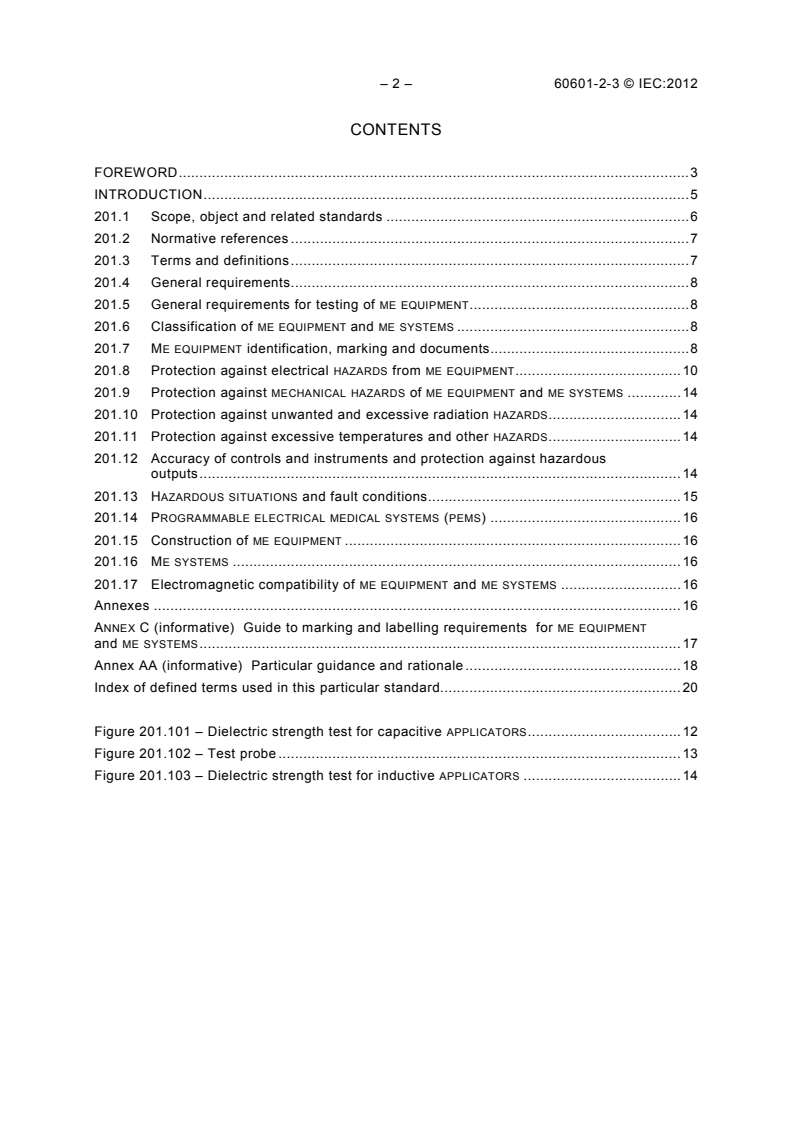
IEC 60601-2-3:2012 - Medical electrical equipment - Part 2-3: Particular requirements for the basic safety and essential performance of short-wave therapy equipment Released:4/20/2012

IEC 60601-2-3:2012+AMD1:2016 CSV - Medical electrical equipment - Part 2-3: Particular requirements for the basic safety and essential performance of short-wave therapy equipment Released:4/29/2016

IEC 60601-2-3:2012+AMD1:2016+AMD2:2022 CSV - Medical electrical equipment - Part 2-3: Particular requirements for the basic safety and essential performance of short-wave therapy equipment Released:9/12/2022
Overview
IEC 60601-2-3:2012 is an international standard published by the International Electrotechnical Commission (IEC) that sets forth particular requirements for the basic safety and essential performance of short-wave therapy equipment. This equipment is used medically for therapeutic treatments through exposure to electric or magnetic fields in the frequency range above 13 MHz and up to 45 MHz. The third edition of this standard, published in 2012 and amended in 2016, replaces the earlier editions from 1991 and 1998, aligning its requirements with the updated IEC 60601-1:2005 general standard for medical electrical equipment.
This standard provides a comprehensive framework designed to ensure that short-wave therapy devices operate safely and effectively while minimizing risks from electrical, mechanical, radiation, and thermal hazards.
Key Topics
Scope and Application
Specifies the applicability of the standard to medical devices producing electromagnetic fields for short-wave therapy, excluding those with output power below 10 W from certain requirements.Safety Requirements
Details minimum safety guidelines concerning electrical shock protection, mechanical strength, radiation exposure limits, and temperatures to prevent patient and operator harm.Performance Standards
Defines essential performance criteria including accuracy of controls and instrumentation, and safeguarding against hazardous outputs during both normal operation and fault conditions.Testing Procedures
Outlines standardized testing methods such as dielectric strength tests for capacitive and inductive applicators, ensuring equipment compliance with safety regulations.Marking, Identification, and Documentation
Mandates clear labeling and thorough documentation to facilitate correct equipment usage and maintenance, foster traceability, and comply with regulatory demands.Electromagnetic Compatibility (EMC)
Addresses requirements to prevent interference with other medical electrical equipment and ensures device operation in electromagnetic environments typical for healthcare.Programmable Electrical Medical Systems (PEMS)
Includes guidance for short-wave therapy systems incorporating programmable elements, focusing on software safety and risk management.Annexes and Guidance
Contains informative annexes providing rationale, detailed definitions, and practical advice for marking and labeling, which support manufacturers and regulators.
Applications
IEC 60601-2-3:2012 serves as a vital standard for:
Manufacturers of Short-Wave Therapy Devices: Ensuring design and production meet internationally recognized safety and performance criteria to achieve global market acceptance.
Healthcare Facilities: Assisting hospitals and clinics in selecting compliant equipment to provide safe physical therapy treatments involving electromagnetic exposure.
Regulatory Bodies and Certification Agencies: Offering a benchmark for conformity assessment and certification of medical electrical equipment used in physiotherapy.
Testing Laboratories: Providing standardized testing protocols to verify equipment safety and functionality according to established international benchmarks.
Medical Device Engineers & Designers: Aiding in the incorporation of necessary electrical and mechanical safety features during early stages of device development.
Related Standards
IEC 60601-2-3:2012 works in conjunction with several related standards, including but not limited to:
IEC 60601-1:2005 - General requirements for basic safety and essential performance of medical electrical equipment, forming the foundational baseline for testing and designing medical devices.
IEC 60601 Series - A comprehensive collection of standards covering various medical electrical equipment types; ensures consistency across different device categories.
ISO/IEC Directives - Guidelines that govern the structure, drafting, and application of standards, ensuring uniformity and clarity in international documentation.
EMC Standards - Specialized standards that address electromagnetic compatibility to ensure safe and reliable operation in complex medical environments.
Practical Value
Compliance with IEC 60601-2-3:2012 helps to:
- Enhance patient safety by mitigating risks linked to electromagnetic therapy devices.
- Provide confidence to users and healthcare providers concerning device reliability and performance.
- Facilitate market access and regulatory approval globally by meeting harmonized international requirements.
- Support consistent manufacturing quality through standardized safety and performance criteria.
- Reduce legal and liability risks arising from device malfunctions or unsafe practices.
By adhering to IEC 60601-2-3, manufacturers and healthcare providers ensure that short-wave therapy equipment delivers therapeutic benefits effectively while maintaining the highest safety standards.
Relations
- Effective Date
- 05-Sep-2023
- Effective Date
- 05-Sep-2023
- Effective Date
- 05-Sep-2023
Buy Documents
IEC 60601-2-3:2012 - Medical electrical equipment - Part 2-3: Particular requirements for the basic safety and essential performance of short-wave therapy equipment Released:4/20/2012
IEC 60601-2-3:2012+AMD1:2016 CSV - Medical electrical equipment - Part 2-3: Particular requirements for the basic safety and essential performance of short-wave therapy equipment Released:4/29/2016
IEC 60601-2-3:2012+AMD1:2016+AMD2:2022 CSV - Medical electrical equipment - Part 2-3: Particular requirements for the basic safety and essential performance of short-wave therapy equipment Released:9/12/2022
Get Certified
Connect with accredited certification bodies for this standard

BSI Group
BSI (British Standards Institution) is the business standards company that helps organizations make excellence a habit.

TÜV Rheinland
TÜV Rheinland is a leading international provider of technical services.

TÜV SÜD
TÜV SÜD is a trusted partner of choice for safety, security and sustainability solutions.
Sponsored listings
Frequently Asked Questions
IEC 60601-2-3:2012 is a standard published by the International Electrotechnical Commission (IEC). Its full title is "Medical electrical equipment - Part 2-3: Particular requirements for the basic safety and essential performance of short-wave therapy equipment". This standard covers: IEC 60601-2-3:2012 specifies the requirements for the basic safety and essential performance of short-wave therapy equipment. Short-wave therapy equipment are defined as medical equipment for the therapeutic treatment of a patient by exposure to electric or magnetic fields produced in the frequency range of more than 13 MHz but not exceeding 45 MHz. Equipment having a rated output power not exceeding 10 W are exempted from certain requirements of this standard. This third edition cancels and replaces the second edition of IEC 60601-2-3 published in 1991 and its amendment 1 published in 1998. This edition constitutes a technical revision and has been aligned with IEC 60601-1:2005.
IEC 60601-2-3:2012 specifies the requirements for the basic safety and essential performance of short-wave therapy equipment. Short-wave therapy equipment are defined as medical equipment for the therapeutic treatment of a patient by exposure to electric or magnetic fields produced in the frequency range of more than 13 MHz but not exceeding 45 MHz. Equipment having a rated output power not exceeding 10 W are exempted from certain requirements of this standard. This third edition cancels and replaces the second edition of IEC 60601-2-3 published in 1991 and its amendment 1 published in 1998. This edition constitutes a technical revision and has been aligned with IEC 60601-1:2005.
IEC 60601-2-3:2012 is classified under the following ICS (International Classification for Standards) categories: 11.040.60 - Therapy equipment. The ICS classification helps identify the subject area and facilitates finding related standards.
IEC 60601-2-3:2012 has the following relationships with other standards: It is inter standard links to IEC 60601-2-3:2012/AMD1:2016, IEC 60601-2-3:2012/AMD2:2022, IEC 60601-2-3:1991/AMD1:1998. Understanding these relationships helps ensure you are using the most current and applicable version of the standard.
IEC 60601-2-3:2012 is available in PDF format for immediate download after purchase. The document can be added to your cart and obtained through the secure checkout process. Digital delivery ensures instant access to the complete standard document.
Standards Content (Sample)
IEC 60601-2-3 ®
Edition 3.0 2012-04
INTERNATIONAL
STANDARD
NORME
INTERNATIONALE
Medical electrical equipment –
Part 2-3: Particular requirements for the basic safety and essential performance
of short-wave therapy equipment
Appareils électromédicaux –
Partie 2-3: Exigences particulières pour la sécurité de base et les performances
essentielles des appareils de thérapie à ondes courtes
All rights reserved. Unless otherwise specified, no part of this publication may be reproduced or utilized in any form
or by any means, electronic or mechanical, including photocopying and microfilm, without permission in writing from
either IEC or IEC's member National Committee in the country of the requester.
If you have any questions about IEC copyright or have an enquiry about obtaining additional rights to this publication,
please contact the address below or your local IEC member National Committee for further information.
Droits de reproduction réservés. Sauf indication contraire, aucune partie de cette publication ne peut être reproduite ni
utilisée sous quelque forme que ce soit et par aucun procédé, électronique ou mécanique, y compris la photocopie et les
microfilms, sans l'accord écrit de la CEI ou du Comité national de la CEI du pays du demandeur.
Si vous avez des questions sur le copyright de la CEI ou si vous désirez obtenir des droits supplémentaires sur cette
publication, utilisez les coordonnées ci-après ou contactez le Comité national de la CEI de votre pays de résidence.
IEC Central Office Tel.: +41 22 919 02 11
3, rue de Varembé Fax: +41 22 919 03 00
CH-1211 Geneva 20 info@iec.ch
Switzerland www.iec.ch
About the IEC
The International Electrotechnical Commission (IEC) is the leading global organization that prepares and publishes
International Standards for all electrical, electronic and related technologies.
About IEC publications
The technical content of IEC publications is kept under constant review by the IEC. Please make sure that you have the
latest edition, a corrigenda or an amendment might have been published.
Useful links:
IEC publications search - www.iec.ch/searchpub Electropedia - www.electropedia.org
The advanced search enables you to find IEC publications The world's leading online dictionary of electronic and
by a variety of criteria (reference number, text, technical electrical terms containing more than 30 000 terms and
committee,…). definitions in English and French, with equivalent terms in
It also gives information on projects, replaced and additional languages. Also known as the International
withdrawn publications. Electrotechnical Vocabulary (IEV) on-line.
IEC Just Published - webstore.iec.ch/justpublished Customer Service Centre - webstore.iec.ch/csc
Stay up to date on all new IEC publications. Just Published If you wish to give us your feedback on this publication
details all new publications released. Available on-line and or need further assistance, please contact the
also once a month by email. Customer Service Centre: csc@iec.ch.
A propos de la CEI
La Commission Electrotechnique Internationale (CEI) est la première organisation mondiale qui élabore et publie des
Normes internationales pour tout ce qui a trait à l'électricité, à l'électronique et aux technologies apparentées.
A propos des publications CEI
Le contenu technique des publications de la CEI est constamment revu. Veuillez vous assurer que vous possédez
l’édition la plus récente, un corrigendum ou amendement peut avoir été publié.
Liens utiles:
Recherche de publications CEI - www.iec.ch/searchpub Electropedia - www.electropedia.org
La recherche avancée vous permet de trouver des Le premier dictionnaire en ligne au monde de termes
publications CEI en utilisant différents critères (numéro de électroniques et électriques. Il contient plus de 30 000
référence, texte, comité d’études,…). termes et définitions en anglais et en français, ainsi que
Elle donne aussi des informations sur les projets et les les termes équivalents dans les langues additionnelles.
publications remplacées ou retirées. Egalement appelé Vocabulaire Electrotechnique
International (VEI) en ligne.
Just Published CEI - webstore.iec.ch/justpublished
Service Clients - webstore.iec.ch/csc
Restez informé sur les nouvelles publications de la CEI.
Just Published détaille les nouvelles publications parues. Si vous désirez nous donner des commentaires sur
Disponible en ligne et aussi une fois par mois par email. cette publication ou si vous avez des questions
contactez-nous: csc@iec.ch.
IEC 60601-2-3 ®
Edition 3.0 2012-04
INTERNATIONAL
STANDARD
NORME
INTERNATIONALE
Medical electrical equipment –
Part 2-3: Particular requirements for the basic safety and essential performance
of short-wave therapy equipment
Appareils électromédicaux –
Partie 2-3: Exigences particulières pour la sécurité de base et les performances
essentielles des appareils de thérapie à ondes courtes
INTERNATIONAL
ELECTROTECHNICAL
COMMISSION
COMMISSION
ELECTROTECHNIQUE
PRICE CODE
INTERNATIONALE
S
CODE PRIX
ICS 11.040.60 ISBN 978-2-8322-0071-1
– 2 – 60601-2-3 © IEC:2012
CONTENTS
FOREWORD . 3
INTRODUCTION . 5
201.1 Scope, object and related standards . 6
201.2 Normative references . 7
201.3 Terms and definitions . 7
201.4 General requirements . 8
201.5 General requirements for testing of ME EQUIPMENT . 8
201.6 Classification of ME EQUIPMENT and ME SYSTEMS . 8
201.7 ME EQUIPMENT identification, marking and documents. 8
201.8 Protection against electrical HAZARDS from ME EQUIPMENT . 10
201.9 Protection against MECHANICAL HAZARDS of ME EQUIPMENT and ME SYSTEMS . 14
201.10 Protection against unwanted and excessive radiation HAZARDS . 14
201.11 Protection against excessive temperatures and other HAZARDS . 14
201.12 Accuracy of controls and instruments and protection against hazardous
outputs . 14
201.13 HAZARDOUS SITUATIONS and fault conditions. 15
201.14 PROGRAMMABLE ELECTRICAL MEDICAL SYSTEMS (PEMS) . 16
201.15 Construction of ME EQUIPMENT . 16
201.16 ME SYSTEMS . 16
201.17 Electromagnetic compatibility of ME EQUIPMENT and ME SYSTEMS . 16
Annexes . 16
ANNEX C (informative) Guide to marking and labelling requirements for ME EQUIPMENT
and ME SYSTEMS . 17
Annex AA (informative) Particular guidance and rationale . 18
Index of defined terms used in this particular standard. 20
Figure 201.101 – Dielectric strength test for capacitive APPLICATORS . 12
Figure 201.102 – Test probe . 13
Figure 201.103 – Dielectric strength test for inductive APPLICATORS . 14
60601-2-3 © IEC:2012 – 3 –
INTERNATIONAL ELECTROTECHNICAL COMMISSION
____________
MEDICAL ELECTRICAL EQUIPMENT –
Part 2-3: Particular requirements for the basic safety and essential
performance of short-wave therapy equipment
FOREWORD
1) The International Electrotechnical Commission (IEC) is a worldwide organization for standardization comprising
all national electrotechnical committees (IEC National Committees). The object of IEC is to promote
international co-operation on all questions concerning standardization in the electrical and electronic fields. To
this end and in addition to other activities, IEC publishes International Standards, Technical Specifications,
Technical Reports, Publicly Available Specifications (PAS) and Guides (hereafter referred to as “IEC
Publication(s)”). Their preparation is entrusted to technical committees; any IEC National Committee interested
in the subject dealt with may participate in this preparatory work. International, governmental and non-
governmental organizations liaising with the IEC also participate in this preparation. IEC collaborates closely
with the International Organization for Standardization (ISO) in accordance with conditions determined by
agreement between the two organizations.
2) The formal decisions or agreements of IEC on technical matters express, as nearly as possible, an international
consensus of opinion on the relevant subjects since each technical committee has representation from all
interested IEC National Committees.
3) IEC Publications have the form of recommendations for international use and are accepted by IEC National
Committees in that sense. While all reasonable efforts are made to ensure that the technical content of IEC
Publications is accurate, IEC cannot be held responsible for the way in which they are used or for any
misinterpretation by any end user.
4) In order to promote international uniformity, IEC National Committees undertake to apply IEC Publications
transparently to the maximum extent possible in their national and regional publications. Any divergence
between any IEC Publication and the corresponding national or regional publication shall be clearly indicated in
the latter.
5) IEC itself does not provide any attestation of conformity. Independent certification bodies provide conformity
assessment services and, in some areas, access to IEC marks of conformity. IEC is not responsible for any
services carried out by independent certification bodies.
6) All users should ensure that they have the latest edition of this publication.
7) No liability shall attach to IEC or its directors, employees, servants or agents including individual experts and
members of its technical committees and IEC National Committees for any personal injury, property damage or
other damage of any nature whatsoever, whether direct or indirect, or for costs (including legal fees) and
expenses arising out of the publication, use of, or reliance upon, this IEC Publication or any other IEC
Publications.
8) Attention is drawn to the Normative references cited in this publication. Use of the referenced publications is
indispensable for the correct application of this publication.
9) Attention is drawn to the possibility that some of the elements of this IEC Publication may be the subject of
patent rights. IEC shall not be held responsible for identifying any or all such patent rights.
International standard IEC 60601-2-3 has been prepared by subcommittee 62D:
Electromedical equipment, of IEC technical committee 62: Electrical equipment in medical
practice.
This third edition cancels and replaces the second edition of IEC 60601-2-3 published in 1991
and its amendment 1 published in 1998. This edition constitutes a technical revision and has
been aligned with IEC 60601-1:2005.
The text of this particular standard is based on the following documents:
FDIS Report on voting
62D/977/FDIS 62D/993/RVD
Full information on the voting for the approval of this particular standard can be found in the
report on voting indicated in the above table.
– 4 – 60601-2-3 © IEC:2012
This publication has been drafted in accordance with the ISO/IEC Directives, Part 2.
In this standard, the following print types are used:
– Requirements and definitions: roman type.
– Test specifications: italic type.
– Informative material appearing outside of tables, such as notes, examples and references: in smaller type.
Normative text of tables is also in a smaller type.
– TERMS DEFINED IN CLAUSE 3 OF THE GENERAL STANDARD, IN THIS PARTICULAR STANDARD OR AS
NOTED: SMALL CAPITALS.
In referring to the structure of this standard, the term
– “clause” means one of the seventeen numbered divisions within the table of contents,
inclusive of all subdivisions (e.g. Clause 7 includes subclauses 7.1, 7.2, etc.);
– “subclause” means a numbered subdivision of a clause (e.g. 7.1, 7.2 and 7.2.1 are all
subclauses of Clause 7).
References to clauses within this standard are preceded by the term “Clause” followed by the
clause number. References to subclauses within this particular standard are by number only.
In this standard, the conjunctive “or” is used as an “inclusive or” so a statement is true if any
combination of the conditions is true.
The verbal forms used in this standard conform to usage described in Annex H of the ISO/IEC
Directives, Part 2. For the purposes of this standard, the auxiliary verb:
– “shall” means that compliance with a requirement or a test is mandatory for compliance
with this standard;
– “should” means that compliance with a requirement or a test is recommended but is not
mandatory for compliance with this standard;
– “may” is used to describe a permissible way to achieve compliance with a requirement or
test.
An asterisk (*) as the first character of a title or at the beginning of a paragraph or table title
indicates that there is guidance or rationale related to that item in Annex AA.
A list of all parts of the IEC 60601 series, published under the general title Medical electrical
equipment, can be found on the IEC website.
The committee has decided that the contents of this publication will remain unchanged until
the stability date indicated on the IEC web site under "http://webstore.iec.ch" in the data
related to the specific publication. At this date, the publication will be
• reconfirmed,
• withdrawn,
• replaced by a revised edition, or
• amended.
60601-2-3 © IEC:2012 – 5 –
INTRODUCTION
The minimum safety requirements specified in this particular standard are considered to
provide for a practical degree of safety in the operation of short-wave therapy equipment.
This particular standard amends and supplements IEC 60601-1 (third edition, 2005): Medical
electrical equipment – Part 1: General requirements for safety and essential performance,
hereinafter referred to as the general standard (see 201.1.4).
The requirements are followed by specifications for the relevant tests.
A "particular guidance and rationale" section giving some explanatory notes, where
appropriate, about the more important requirements is included in Annex AA.
Clauses or subclauses for which there are explanatory notes in annex AA are marked with an
asterisk (*).
It is considered that a knowledge of the reasons for these requirements will not only facilitate
the proper application of the standard but will, in due course, expedite any revision
necessitated by changes in clinical practice or as a result of developments in technology.
However, this annex does not form part of the requirements of this standard.
– 6 – 60601-2-3 © IEC:2012
MEDICAL ELECTRICAL EQUIPMENT –
Part 2-3: Particular requirements for the basic safety and essential
performance of short-wave therapy equipment
201.1 Scope, object and related standards
Clause 1 of the general standard applies, except as follows:
201.1.1 Scope
Replacement:
This particular standard specifies the requirements for the safety of SHORT-WAVE THERAPY
EQUIPMENT, hereafter referred to as ME EQUIPMENT, as defined in subclause 201.3.206.
LOW POWER EQUIPMENT as defined in subclause 201.3.202 is exempted from certain
requirements of this standard.
201.1.2 Object
Replacement:
The object of this particular standard is to establish particular BASIC SAFETY and ESSENTIAL
PERFORMANCE requirements for SHORT-WAVE THERAPY EQUIPMENT as defined in 201.3.206.
201.1.3 Collateral standards
Addition:
This particular standard refers to those applicable collateral standards that are listed in
Clause 2 of the general standard.
IEC 60601-1-3 does not apply. All other published collateral standards in the IEC 60601-1
series apply as published.
201.1.4 Particular standards
Replacement:
In the IEC 60601 series, particular standards may modify, replace or delete requirements
contained in the general standard and collateral standards as appropriate for the particular
ME EQUIPMENT under consideration, and may add other BASIC SAFETY and ESSENTIAL
PERFORMANCE requirements.
A requirement of a particular standard takes priority over the general standard.
For brevity, IEC 60601-1 is referred to in this particular standard as the general standard.
Collateral standards are referred to by their document number.
—————————
The general standard is IEC 60601-1:2005, Medical electrical equipment – Part 1: General requirements for
basic safety and essential performance
60601-2-3 © IEC:2012 – 7 –
The numbering of clauses and subclauses of this particular standard corresponds to that of
the general standard with the prefix “201” (e.g. 201.1 in this standard addresses the content
of Clause 1 of the general standard) or applicable collateral standard with the prefix “20x”
where x is the final digit(s) of the collateral standard document number (e.g. 202.4 in this
particular standard addresses the content of Clause 4 of the IEC 60601-1-2 collateral
standard, 203.4 in this particular standard addresses the content of Clause 4 of the
IEC 60601-1-3 collateral standard, etc.). The changes to the text of the general standard are
specified by the use of the following words:
“Replacement” means that the clause or subclause of the general standard or applicable
collateral standard is replaced completely by the text of this particular standard.
“Addition” means that the text of this particular standard is additional to the requirements of
the general standard or applicable collateral standard.
“Amendment” means that the clause or subclause of the general standard or applicable
collateral standard is amended as indicated by the text of this particular standard.
Subclauses, figures or tables which are additional to those of the general standard are
numbered starting from 201.101. However due to the fact that definitions in the general
standard are numbered 3.1 through 3.139, additional definitions in this standard are
numbered beginning from 201.3.201. Additional annexes are lettered AA, BB, etc., and
additional items aa), bb), etc.
Subclauses, figures or tables which are additional to those of a collateral standard are
numbered starting from 20x, where “x” is the number of the collateral standard, e.g. 202 for
IEC 60601-1-2, 203 for IEC 60601-1-3, etc.
The term “this standard” is used to make reference to the general standard, any applicable
collateral standards and this particular standard taken together.
Where there is no corresponding clause or subclause in this particular standard, the clause or
subclause of the general standard or applicable collateral standard, although possibly not
relevant, applies without modification; where it is intended that any part of the general
standard or applicable collateral standard, although possibly relevant, is not to be applied, a
statement to that effect is given in this particular standard.
201.2 Normative references
Clause 2 of the general standard applies.
201.3 Terms and definitions
For the purposes of this document, the terms and definitions given in IEC 60601-1:2005,
apply, except as follows:
Addition:
201.3.201
APPLICATOR
part of the ME EQUIPMENT used to couple the radio-frequency power to the PATIENT
201.3.202
LOW POWER EQUIPMENT
SHORT-WAVE THERAPY EQUIPMENT having a RATED OUTPUT POWER not exceeding 10 W
– 8 – 60601-2-3 © IEC:2012
201.3.203
MATCHED LOAD
complex load which, when connected, results in the maximum power being delivered from the
SHORT-WAVE THERAPY EQUIPMENT into the load
201.3.204
OUTPUT CIRCUIT
all conductive parts used to couple radio-frequency power from the generator to the
APPLICATORS, including conductive parts of the APPLICATORS and their connecting cables
201.3.205
* RATED OUTPUT POWER
value of the maximum radio-frequency power which can be fed into a MATCHED LOAD
201.3.206
* SHORT-WAVE THERAPY EQUIPMENT
ME EQUIPMENT for the therapeutic treatment of the PATIENT by exposure to electric or magnetic
fields produced in the frequency range of more than 13 MHz but not exceeding 45 MHz
201.4 General requirements
Clause 4 of the general standard applies.
201.5 General requirements for testing of ME EQUIPMENT
Clause 5 of the general standard applies, except as follows:
Additional subclause:
201.5.101 Routine tests
The testing during manufacture should include:
a) Measurement of the operating frequency with the ME EQUIPMENT operating under the
conditions specified in item b) below.
b) Output power test as specified in subclause 201.12.1.101 but only under the conditions
[APPLICATOR(S), spacing(s), load resistance] which produces the maximum output power.
c) Measurement of the PATIENT LEAKAGE CURRENT under the conditions stated in subclause
201.8.7.1 of this particular standard.
201.6 Classification of ME EQUIPMENT and ME SYSTEMS
Clause 6 of the general standard applies.
201.7 ME EQUIPMENT identification, marking and documents
Clause 7 of the general standard applies, except as follows:
201.7.2 Marking on the outside of ME EQUIPMENT or ME EQUIPMENT parts
Additional subclause:
201.7.2.101 Output
SHORT-WAVE THERAPY EQUIPMENT shall be marked with the following information:
60601-2-3 © IEC:2012 – 9 –
• RATED OUTPUT POWER in watts and the load impedance at which this power is available;
• operating frequency in megahertz;
• symbol number 5140 (non-ionizing electromagnetic radiation) of IEC 60878.
Compliance is checked by inspection.
201.7.3 Marking on the inside of ME EQUIPMENT or ME EQUIPMENT parts
Additional subclause:
201.7.3.101 * Marking for access
Symbols number 10 (caution) and number 11 (operating instructions) of Table D.1 in
Appendix D of the general standard shall be displayed on or near components or on panels
giving access to components if adjustment or replacement might cause the ME EQUIPMENT to
fail to comply with IEC 60601-1-2.
Compliance is checked by inspection.
201.7.4.2 * Control devices
Addition:
The output control shall have a scale and/or an associated indicator representing the radio-
frequency output. The numeral “0” shall not be used unless any power delivered in this
position is less than 2 % of the RATED OUTPUT POWER. If the output scale or indicator
represents watts of output power, it shall be so marked.
Compliance is checked by inspection and, if appropriate, by measurement of the output power
(see 201.12.1.101).
201.7.9.2 Instructions for use
Additional subclause:
201.7.9.2.101 Additional instructions for use
The instructions for use shall contain additionally:
a) Information concerning the compatibility of APPLICATOR connecting cables in order to
prevent the use of unsuitable cable.
b) *Notes on the application of ME EQUIPMENT drawing the OPERATOR’S attention to certain
precautions which are necessary during treatment.
In particular, advice shall be given on:
1) For all SHORT-WAVE THERAPY EQUIPMENT:
– The function of certain implanted electrical devices, for example pacemakers, may
be adversely affected during treatment with short-wave therapy. In case of doubt,
the advice of the physician in charge of the PATIENT should be sought.
– The function of other PATIENT connected ME EQUIPMENT may be adversely affected
by the operation of SHORT-WAVE THERAPY EQUIPMENT.
2) For all SHORT-WAVE THERAPY EQUIPMENT except LOW POWER EQUIPMENT:
– Short-wave therapy should not be applied to PATIENTS through clothing.
Conductive material should be excluded from the treatment area. Additionally, it
should not be applied to PATIENTS wearing metallic objects like jewellery or clothing
containing metallic material (for example metallic buttons, clips or thread).
– 10 – 60601-2-3 © IEC:2012
– Parts of the PATIENT’S body containing metallic implants (for example a medullary
nail) should normally be excluded from the treatment, unless special techniques
are used.
– Hearing aids should be removed.
– The PATIENT should not be allowed to come into contact with conductive parts
which are earthed or which have an appreciable capacitance to earth and which
may provide unwanted pathways for the radio-frequency current. In particular, beds
or chairs having metal frames should not be used.
– The connecting cables associated with the APPLICATOR(S) should be positioned in
such a way that contact with the PATIENT and with conductive or energy absorbing
objects is avoided.
c) Advice for the OPERATOR to inspect regularly the insulation of the APPLICATORS and their
cables for possible damage.
Compliance is checked by inspection of the instructions for use.
201.7.9.3 Technical description
201.7.9.3.1 * General
Addition:
– The technical description shall contain information on measuring the RATED OUTPUT POWER
including a description of the MATCHED LOAD.
– For SHORT-WAVE THERAPY EQUIPMENT with interchangeable APPLICATORS, the technical
description shall state the maximum safe output power that may be applied to each
APPLICATOR.
Compliance is checked by inspection of the technical description.
201.8 Protection against electrical HAZARDS from ME EQUIPMENT
Clause 8 of the general standard applies except as follows:
201.8.3 Classification of APPLIED PARTS
Addition:
aa) APPLICATORS of SHORT-WAVE THERAPY EQUIPMENT shall be TYPE BF or CF.
201.8.7.1 * General requirements
Item b) Addition:
– with the short-wave output not energized but in such a way that LEAKAGE CURRENTS and
PATIENT AUXILIARY CURRENTS are not affected.
201.8.8.3 * Dielectric strength
Addition:
APPLICATORS and their connecting cables shall withstand the maximum output voltage of the
SHORTWAVE THERAPY EQUIPMENT without breakdown before being subjected to the test in 8.8.3
of the general standard.
aa) Compliance for capacitive APPLICATORS and their connecting cables is checked as follows:.
Each pair of APPLICATORS is tested using the cables specified by the MANUFACTURER. The
APPLICATOR under test is suspended or supported so that it is spaced at least 50 cm from
60601-2-3 © IEC:2012 – 11 –
all other objects with the exception of the APPLICATOR arm of the ME EQUIPMENT or similar
supporting device. The second APPLICATOR of the pair is positioned in the center of and
spaced approximately 10 mm above an earthed metal plate having an area no less than
900 cm . The arrangement is shown in Figure 201.101.
NOTE It is essential that the metal plate used in this test has a low Impedance to earth at the operating
frequency.
The SHORT-WAVE THERAPY EQUIPMENT is operated at RATED MAINS VOLTAGE and at the
RATED OUTPUT POWER specified by the MANUFACTURER for the particular pair of APPLICATORS
under test. The output circuit is tuned to resonance, re-positioning the second APPLICATOR
as necessary.
The test is performed using an earthed metal probe of 8 mm diameter with a smooth and
clean hemispherical end, mounted into an insulating rod to form a test handle, as
illustrated in Figure 201.102. The hemispherical end of the probe shall be applied to the
APPLICATOR under test and moved slowly but continuously over the surface of the
APPLICATOR and the full length of its connecting cable and shall not be allowed to rest at
any point. During the test evidence of flash-over or breakdown constitutes failure.
The test is then repeated with the APPLICATORS changing places.
bb) Compliance for an inductive APPLICATOR and its connecting cable is checked as follows:
The APPLICATOR under test is positioned in the center of and spaced approximately 10 mm
above an earthed metal plate having an area no less than 900 cm . The arrangement is
shown in Figure 201.103.
NOTE It is essential that the metal plate used in this test has a low impedance to earth at the operating
frequency.
The SHORT-WAVE THERAPY EQUIPMENT is operated at RATED MAINS VOLTAGE and at the RATED
OUTPUT POWER specified by the MANUFACTURER for the particular APPLICATOR under test.
The output circuit is tuned to resonance, re-positioning the APPLICATOR as necessary.
The test is performed using an earthed metal probe of 8 mm diameter with a smooth and
clean hemispherical end, mounted into an insulating rod to form a test handle, as
illustrated in Figure 201.102. The hemispherical end of the probe shall be applied to the
APPLICATOR and moved slowly but continuously over the surface of the APPLICATOR and the
full length of its connecting cable and shall not be allowed to rest at any point. During the
test evidence of flash-over or breakdown constitutes failure.
– 12 – 60601-2-3 © IEC:2012
> 0,5 m
> 0,5 m
10 mm
IEC 484/12
Key
ME EQUIPMENT
2 Metal plate connected to earth
APPLICATOR being tested
4 Second APPLICATOR
APPLICATOR support
6 Test probe connected to earth
Figure 201.101 – Dielectric strength test for capacitive APPLICATORS
60601-2-3 © IEC:2012 – 13 –
IEC 485/12
Key
Handle made of insulating material
2 8 mm diameter metal rod with hemispherical end
3 Low impedance connection to earth
Figure 201.102 – Test probe
– 14 – 60601-2-3 © IEC:2012
10 mm
IEC 486/12
ME EQUIPMENT
2 Metal plate connected to earth
APPLICATOR being tested
APPLICATOR support
5 Test probe connected to earth
Figure 201.103 – Dielectric strength test for inductive APPLICATORS
201.9 Protection against MECHANICAL HAZARDS of ME EQUIPMENT and
ME SYSTEMS
Clause 9 of the general standard applies.
201.10 Protection against unwanted and excessive radiation HAZARDS
Clause 10 of the general standard applies.
201.11 Protection against excessive temperatures and other HAZARDS
Clause 11 of the general standard applies.
201.12 Accuracy of controls and instruments and protection against
hazardous outputs
Clause 12 of the general standard applies, except as follows:
201.12.1 Accuracy of controls and instruments
Additional subclause:
60601-2-3 © IEC:2012 – 15 –
201.12.1.101 * Accuracy of output control setting
The maximum output power of the SHORT-WAVE THERAPY EQUIPMENT when measured as
described below shall not deviate from the RATED OUTPUT POWER by more than ± 20 %.
Compliance is checked by measurement of the output power using the MATCHED LOAD
specified by the manufacturer.
For LOW POWER EQUIPMENT, make the measurement as specified by the manufacturer.
The power measuring device is selected so that the error is within ± 5 % of the reading when
checked using low frequencies (i.e. 50 Hz to 60 Hz a.c.) or d.c. and the accuracy of the
measuring device at the working frequency shall be validated.
During all the tests of this subclause artificial cooling of the MATCHED LOAD is permitted
provided it does not affect the measured result.
201.12.4 Protection against hazardous output
Additional subclauses:
201.12.4.101 * Maximum allowed output power
The maximum output power of the SHORT-WAVE THERAPY EQUIPMENT shall not exceed 500 W.
Compliance is checked by inspection of the results obtained in the compliance test performed
in accordance with 201.12.1.101.
201.12.4.102 Output reduction means
SHORT-WAVE THERAPY EQUIPMENT shall incorporate means (an output control) to reduce the
output power to less than 10 W or 5 % of the RATED OUTPUT POWER, whichever is the lower,
other than by detuning of the OUTPUT CIRCUIT.
Compliance is checked by inspection and functional test.
201.12.4.103 * Energizing the output
SHORT-WAVE THERAPY EQUIPMENT shall be so designed that the OUTPUT CIRCUIT cannot be
energized unless the output control is first set to the minimum position.
This requirement shall also be met after the interruption and restoration of the mains supply.
Compliance is checked by a functional test.
201.12.4.104 * Adjustable timer
SHORT-WAVE THERAPY EQUIPMENT shall be provided with an adjustable timer which de-
energizes the OUTPUT CIRCUIT after a preselected operating period has elapsed. The timer
shall have a range not exceeding 30 min and an accuracy of ± 1 min.
Compliance is checked by inspection and a functional check.
201.13 HAZARDOUS SITUATIONS and fault conditions
Clause 13 of the general standard applies.
– 16 – 60601-2-3 © IEC:2012
201.14 PROGRAMMABLE ELECTRICAL MEDICAL SYSTEMS (PEMS)
Clause 14 of the general standard applies.
201.15 Construction of ME EQUIPMENT
Clause 15 of the general standard applies.
201.16 ME SYSTEMS
Clause 16 of the general standard applies.
201.17 Electromagnetic compatibility of ME EQUIPMENT and ME SYSTEMS
Clause 17 of the general standard applies:
Annexes
The annexes of the general standard apply except as follows:
60601-2-3 © IEC:2012 – 17 –
Annex C
(informative)
Guide to marking and labelling requirements
for ME EQUIPMENT and ME SYSTEMS
201.C.1 Marking on the outside of ME EQUIPMENT, ME SYSTEMS or their parts
Additional requirements for marking on the outside of SHORT-WAVE THERAPY EQUIPMENT are
found in Table 201.C.101.
Table 201.C.101 – Marking on the outside of SHORT-WAVE THERAPY EQUIPMENT or its parts
Description of marking Subclause
RATED OUTPUT POWER 201.7.2.101
Operating frequency 201.7.2.101
Symbol number 5140 (non-ionizing radiation) of IEC 60878 201.7.2.101
– 18 – 60601-2-3 © IEC:2012
Annex AA
(informative)
Particular guidance and rationale
AA.1 General guidance
This appendix provides a concise rationale for the important requirements of this particular
standard and is intended for those who are familiar with the subject of the standard but who
have not participated in its development. An understanding of the reasons for the main
requirements is considered to be essential for the proper application of the standard.
Furthermore, as clinical practice and technology change, it is believed that a rationale for the
present requirements will facilitate any revision of the standard necessitated by these
developments.
AA.2 Rationale for particular clauses and subclauses
The following are rationales for specific clauses and subclauses in this particular standard,
with clause and subclause numbers parallel to those in the body of the document.
Definition 201.3.205 – RATED OUTPUT POWER
Selection of the power measurement equipment and technique will depend on whether the
output is continuous or pulsed.
Definition 201.3.206 – SHORT-WAVE THERAPY EQUIPMENT
The first edition’s definition was changed to move the minimum frequency up to 13 MHz
because CISPR 11 limits the amount of energy that may be radiated below 13 MHz.
CISPR 11 does permit unlimited radiated power at 13,56 MHz, 27,12 MHz, and 40,68 MHz so
changing the frequency range in this standard to 13 MHz – 45 MHz solves that issue.
Subclause 201.7.3.101 – Marking for access
The required markings help inform SERVICE PERSONNEL that adjusting or replacing components
may degrade the SHORT-WAVE THERAPY EQUIPMENT’S ability to suppress interference.
Subclause 201.7.4.2 – Control devices
As the power delivered depends on the load position of the APPLICATORS relative to the
PATIENT, a graduation in relative units is considered to be adequate. If the numeral "0" is
displayed, the OPERATOR will expect zero output at this position of the control.
Subclause 201.7.9.2.101, Item b)
Correct application of the SHORT-WAVE THERAPY EQUIPMENT is essential for PATIENT safety. The
advice given is intended to reduce the risk of burns and to alert the USER to possibly adverse
effects on other ME EQUIPMENT.
Some of the items are not necessary for LOW POWER EQUIPMENT.
60601-2-3 © IEC:2012 – 19 –
Subclause 201.7.9.3.1 – General
As the conditions for the measurement of the RATED OUTPUT POWER can vary, the
MANUFACTURER needs to provide information on how it should be measured.
Subclause 201.8.7.1 – General requirements
As a small LEAKAGE CURRENT cannot easily be measured in the presence of high radio-
frequency currents, the tests here are performed with the radio-frequency generator disabled.
Subclause 201.8.8.3 – Dielectric strength
The requirements and tests of this subclause take into account the fact that the insulation of
the OUTPUT CIRCUIT is stressed differently by radio-frequency voltages. The insulating
materials also need to be suitable for the highest temperatures occurring in NORMAL USE.
Subclause 201.12.1.101 Accuracy of output control setting
An accuracy of ± 20 % is adequate for this kind of ME EQUIPMENT.
Subclause 201.12.4.101 – Maximum allowed output power
RISKS tend to increase with the output power. A power of 500 W meets the maximum
requirements of normal treatment (except possibly whole-body heating).
Subclause 201.12.4.103 – Energizing the output
Energization of the generator only at the minimum setting of the output control prevents a
PATIENT from being treated inadvertently at an excessively high setting of this control.
Subclause 201.12.4.104 – Adjustable timer
Short-wave therapy is often performed without continuous supervision. Therefore a timer for
switching off is desirable.
– 20 – 60601-2-3 © IEC:2012
Index of defined terms used in this particular standard
APPLICATOR………………………………………….………………………………. . 201.3.201
BASIC SAFETY … . ……………………………………………………………… IEC 60601-1:2005, 3.10
ENCLOSURE . …………………………………………………….……. IEC 60601-1:2005, 3.26
ESSENTIAL PERFORMANCE . …………………………………………. IEC 60601-1:2005, 3.27
HAZARD …………………………… . …………………………………. IEC 60601-1:2005, 3.39
LEAKAGE CURRENT ………………………… . …………………………. IEC 60601-1:2005, 3.47
LOW POWER EQUIPMENT …………………………… . ……………………………. 201.3.202
MAINS VOLTAGE……………………………………………………. .… IEC 60601-1:2005, 3.54
MANUFACTURER ………………………………………………… . …… IEC 60601-1:2005, 3.55
MATCHED LOAD…………………………………………….……………… . …………. 201.3.203
MEDICAL ELECTRICAL EQUIPMENT (ME EQUIPMENT) ………………….……. . IEC 60601-1:2005, 3.63
MEDICAL ELECTRICAL SYSTEM (ME SYSTEM) ……….……………….…….… . IEC 60601-1:2005, 3.64
OPERATOR …………………………………………………………… . . IEC 60601-1:2005, 3.73
OUTPUT CIRCUIT ……………………………………………………………… . …… 201.3.204
PATIENT ………………………………………………………………. . . IEC 60601-1:2005, 3.76
PATIENT AUXILIARY CURRENT ……………………………………… . … IEC 60601-1:2005, 3.77
PATIENT LEAKAGE CURRENT ……….………………………………… . …. IEC 60601-1:2005, 3.80
RATED ……………………………………………………………………… . IEC 60601-1:2005, 3.97
RATED OUTPUT POWER …………………………….……………………… . …….………… 201.3.205
RISK ……………………………………………………………………………. . IEC 0601-1:2005, 3.102
SERVICE PERSONNEL ………………………………………………….……. . IEC 60601-1:2005, 3.113
SHORT-WAVE THERAPY EQUIPMENT ………………….…………………… . …………….…. 201.3.206
_____________
– 22 – 60601-2-3 © CEI:2012
SOMMAIRE
AVANT-PROPOS . 23
INTRODUCTION . 26
201.1 Domaine d'application, objet et normes connexes . 27
201.2 Références normatives . 28
201.3 Termes et définitions . 28
201.4 Exigences générales . 29
201.5 Exigences générales relatives aux essais des APPAREILS EM . 29
201.6 Classification des APPAREILS EM et des SYSTÈMES EM . 29
201.7 Identification, marquage et documentation des APPAREILS EM . 30
201.8 Protection contre les DANGERS d'origine électrique provenant des
APPAREILS EM . 31
201.9 Protection contre les DANGERS MÉCANIQUES des APPAREILS EM et SYSTÈMES EM . 36
201.10 Protection contre les DANGERS dus aux rayonnements involontaires et
excessifs . 36
201.11 Protection contre les températures excessives et les autres DANGERS . 36
201.12 Précision des commandes, des instruments et protection contre les
caractéristiques de sortie présentant des DANGERS . 36
201.13 SITUATIONS DANGEREUSES et conditions de défaut . 38
201.14 SYSTÈMES ÉLECTROMÉDICAUX PROGRAMMABLES (SEMP) . 38
201.15 Construction de L’APPAREIL EM . 38
201.16 SYSTÈMES EM . 38
201.17 Compatibilité électromagnétique des APPAREILS EM et des SYSTÈMES EM . 38
Annexes . 38
Annexe C (informative) Guide pour le marquage et exigences d’étiquetage pour les
APPAREILS EM et les SYSTÈMES EM . 39
Annexe AA (informative) Guide particulier et justifications . 40
Index des termes définis utilisés dans la présente norme p
...
IEC 60601-2-3 ®
Edition 3.1 2016-04
CONSOLIDATED VERSION
INTERNATIONAL
STANDARD
NORME
INTERNATIONALE
colour
inside
Medical electrical equipment –
Part 2-3: Particular requirements for the basic safety and essential performance
of short-wave therapy equipment
Appareils électromédicaux –
Partie 2-3: Exigences particulières pour la sécurité de base et les performances
essentielles des appareils de thérapie à ondes courtes
All rights reserved. Unless otherwise specified, no part of this publication may be reproduced or utilized in any form
or by any means, electronic or mechanical, including photocopying and microfilm, without permission in writing from
either IEC or IEC's member National Committee in the country of the requester. If you have any questions about IEC
copyright or have an enquiry about obtaining additional rights to this publication, please contact the address below or
your local IEC member National Committee for further information.
Droits de reproduction réservés. Sauf indication contraire, aucune partie de cette publication ne peut être reproduite
ni utilisée sous quelque forme que ce soit et par aucun procédé, électronique ou mécanique, y compris la photocopie
et les microfilms, sans l'accord écrit de l'IEC ou du Comité national de l'IEC du pays du demandeur. Si vous avez des
questions sur le copyright de l'IEC ou si vous désirez obtenir des droits supplémentaires sur cette publication, utilisez
les coordonnées ci-après ou contactez le Comité national de l'IEC de votre pays de résidence.
IEC Central Office Tel.: +41 22 919 02 11
3, rue de Varembé Fax: +41 22 919 03 00
CH-1211 Geneva 20 info@iec.ch
Switzerland www.iec.ch
About the IEC
The International Electrotechnical Commission (IEC) is the leading global organization that prepares and publishes
International Standards for all electrical, electronic and related technologies.
About IEC publications
The technical content of IEC publications is kept under constant review by the IEC. Please make sure that you have the
latest edition, a corrigenda or an amendment might have been published.
IEC Catalogue - webstore.iec.ch/catalogue Electropedia - www.electropedia.org
The stand-alone application for consulting the entire The world's leading online dictionary of electronic and
bibliographical information on IEC International Standards, electrical terms containing 20 000 terms and definitions in
Technical Specifications, Technical Reports and other English and French, with equivalent terms in 15 additional
documents. Available for PC, Mac OS, Android Tablets and languages. Also known as the International Electrotechnical
iPad. Vocabulary (IEV) online.
IEC publications search - www.iec.ch/searchpub IEC Glossary - std.iec.ch/glossary
The advanced search enables to find IEC publications by a 65 000 electrotechnical terminology entries in English and
variety of criteria (reference number, text, technical French extracted from the Terms and Definitions clause of
committee,…). It also gives information on projects, replaced IEC publications issued since 2002. Some entries have been
and withdrawn publications. collected from earlier publications of IEC TC 37, 77, 86 and
CISPR.
IEC Just Published - webstore.iec.ch/justpublished
Stay up to date on all new IEC publications. Just Published IEC Customer Service Centre - webstore.iec.ch/csc
details all new publications released. Available online and If you wish to give us your feedback on this publication or
also once a month by email. need further assistance, please contact the Customer Service
Centre: csc@iec.ch.
A propos de l'IEC
La Commission Electrotechnique Internationale (IEC) est la première organisation mondiale qui élabore et publie des
Normes internationales pour tout ce qui a trait à l'électricité, à l'électronique et aux technologies apparentées.
A propos des publications IEC
Le contenu technique des publications IEC est constamment revu. Veuillez vous assurer que vous possédez l’édition la
plus récente, un corrigendum ou amendement peut avoir été publié.
Catalogue IEC - webstore.iec.ch/catalogue Electropedia - www.electropedia.org
Application autonome pour consulter tous les renseignements
Le premier dictionnaire en ligne de termes électroniques et
bibliographiques sur les Normes internationales,
électriques. Il contient 20 000 termes et définitions en anglais
Spécifications techniques, Rapports techniques et autres
et en français, ainsi que les termes équivalents dans 15
documents de l'IEC. Disponible pour PC, Mac OS, tablettes
langues additionnelles. Egalement appelé Vocabulaire
Android et iPad.
Electrotechnique International (IEV) en ligne.
Recherche de publications IEC - www.iec.ch/searchpub
Glossaire IEC - std.iec.ch/glossary
La recherche avancée permet de trouver des publications IEC
65 000 entrées terminologiques électrotechniques, en anglais
en utilisant différents critères (numéro de référence, texte,
et en français, extraites des articles Termes et Définitions des
comité d’études,…). Elle donne aussi des informations sur les
publications IEC parues depuis 2002. Plus certaines entrées
projets et les publications remplacées ou retirées.
antérieures extraites des publications des CE 37, 77, 86 et
CISPR de l'IEC.
IEC Just Published - webstore.iec.ch/justpublished
Restez informé sur les nouvelles publications IEC. Just Service Clients - webstore.iec.ch/csc
Published détaille les nouvelles publications parues. Si vous désirez nous donner des commentaires sur cette
Disponible en ligne et aussi une fois par mois par email. publication ou si vous avez des questions contactez-nous:
csc@iec.ch.
IEC 60601-2-3 ®
Edition 3.1 2016-04
CONSOLIDATED VERSION
INTERNATIONAL
STANDARD
NORME
INTERNATIONALE
colour
inside
Medical electrical equipment –
Part 2-3: Particular requirements for the basic safety and essential performance
of short-wave therapy equipment
Appareils électromédicaux –
Partie 2-3: Exigences particulières pour la sécurité de base et les performances
essentielles des appareils de thérapie à ondes courtes
INTERNATIONAL
ELECTROTECHNICAL
COMMISSION
COMMISSION
ELECTROTECHNIQUE
INTERNATIONALE
ICS 11.040.60 ISBN 978-2-8322-3373-3
IEC 60601-2-3 ®
Edition 3.1 2016-04
CONSOLIDATED VERSION
REDLINE VERSION
VERSION REDLINE
colour
inside
Medical electrical equipment –
Part 2-3: Particular requirements for the basic safety and essential performance
of short-wave therapy equipment
Appareils électromédicaux –
Partie 2-3: Exigences particulières pour la sécurité de base et les performances
essentielles des appareils de thérapie à ondes courtes
– 2 – IEC 60601-2-3:2012+AMD1:2016 CSV
© IEC 2016
CONTENTS
FOREWORD. 3
INTRODUCTION . 6
201.1 Scope, object and related standards . 7
201.2 Normative references . 8
201.3 Terms and definitions . 8
201.4 General requirements . 9
201.5 General requirements for testing of ME EQUIPMENT . 9
201.6 Classification of ME EQUIPMENT and ME SYSTEMS . 9
201.7 ME EQUIPMENT identification, marking and documents . 9
201.8 Protection against electrical HAZARDS from ME EQUIPMENT . 11
201.9 Protection against MECHANICAL HAZARDS of ME EQUIPMENT and ME SYSTEMS . 15
201.10 Protection against unwanted and excessive radiation HAZARDS . 15
201.11 Protection against excessive temperatures and other HAZARDS . 15
201.12 Accuracy of controls and instruments and protection against hazardous
outputs . 15
201.13 HAZARDOUS SITUATIONS and fault conditions for ME EQUIPMENT . 16
201.14 PROGRAMMABLE ELECTRICAL MEDICAL SYSTEMS (PEMS) . 17
201.15 Construction of ME EQUIPMENT . 17
201.16 ME SYSTEMS . 17
201.17 Electromagnetic compatibility of ME EQUIPMENT and ME SYSTEMS . 17
Annexes . 17
ANNEX C (informative) Guide to marking and labelling requirements for ME EQUIPMENT
and ME SYSTEMS . 18
Annex AA (informative) Particular guidance and rationale . 19
Index of defined terms used in this particular standard . 21
Figure 201.101 – Dielectric strength test for capacitive APPLICATORS . 13
Figure 201.102 – Test probe . 14
Figure 201.103 – Dielectric strength test for inductive APPLICATORS . 15
© IEC 2016
INTERNATIONAL ELECTROTECHNICAL COMMISSION
____________
MEDICAL ELECTRICAL EQUIPMENT –
Part 2-3: Particular requirements for the basic safety and essential
performance of short-wave therapy equipment
FOREWORD
1) The International Electrotechnical Commission (IEC) is a worldwide organization for standardization comprising
all national electrotechnical committees (IEC National Committees). The object of IEC is to promote
international co-operation on all questions concerning standardization in the electrical and electronic fields. To
this end and in addition to other activities, IEC publishes International Standards, Technical Specifications,
Technical Reports, Publicly Available Specifications (PAS) and Guides (hereafter referred to as “IEC
Publication(s)”). Their preparation is entrusted to technical committees; any IEC National Committee interested
in the subject dealt with may participate in this preparatory work. International, governmental and non-
governmental organizations liaising with the IEC also participate in this preparation. IEC collaborates closely
with the International Organization for Standardization (ISO) in accordance with conditions determined by
agreement between the two organizations.
2) The formal decisions or agreements of IEC on technical matters express, as nearly as possible, an international
consensus of opinion on the relevant subjects since each technical committee has representation from all
interested IEC National Committees.
3) IEC Publications have the form of recommendations for international use and are accepted by IEC National
Committees in that sense. While all reasonable efforts are made to ensure that the technical content of IEC
Publications is accurate, IEC cannot be held responsible for the way in which they are used or for any
misinterpretation by any end user.
4) In order to promote international uniformity, IEC National Committees undertake to apply IEC Publications
transparently to the maximum extent possible in their national and regional publications. Any divergence
between any IEC Publication and the corresponding national or regional publication shall be clearly indicated in
the latter.
5) IEC itself does not provide any attestation of conformity. Independent certification bodies provide conformity
assessment services and, in some areas, access to IEC marks of conformity. IEC is not responsible for any
services carried out by independent certification bodies.
6) All users should ensure that they have the latest edition of this publication.
7) No liability shall attach to IEC or its directors, employees, servants or agents including individual experts and
members of its technical committees and IEC National Committees for any personal injury, property damage or
other damage of any nature whatsoever, whether direct or indirect, or for costs (including legal fees) and
expenses arising out of the publication, use of, or reliance upon, this IEC Publication or any other IEC
Publications.
8) Attention is drawn to the Normative references cited in this publication. Use of the referenced publications is
indispensable for the correct application of this publication.
9) Attention is drawn to the possibility that some of the elements of this IEC Publication may be the subject of
patent rights. IEC shall not be held responsible for identifying any or all such patent rights.
This consolidated version of the official IEC Standard and its amendment has been prepared
for user convenience.
IEC 60601-2-3 edition 3.1 contains the third edition (2012-04) [documents 62D/977/FDIS and
62D/993/RVD] and its amendment 1 (2016-04) [documents 62D/1330/FDIS and 62D/1350/RVD].
In this Redline version, a vertical line in the margin shows where the technical content is
modified by amendment 1. Additions are in green text, deletions are in strikethrough red text.
A separate Final version with all changes accepted is available in this publication.
– 4 – IEC 60601-2-3:2012+AMD1:2016 CSV
© IEC 2016
International standard IEC 60601-2-3 has been prepared by subcommittee 62D:
Electromedical equipment, of IEC technical committee 62: Electrical equipment in medical
practice.
This third edition cancels and replaces the second edition of IEC 60601-2-3 published in 1991
and its amendment 1 published in 1998. This edition constitutes a technical revision and has
been aligned with IEC 60601-1:2005.
This publication has been drafted in accordance with the ISO/IEC Directives, Part 2.
In this standard, the following print types are used:
– Requirements and definitions: roman type.
– Test specifications: italic type.
– Informative material appearing outside of tables, such as notes, examples and references: in smaller type.
Normative text of tables is also in a smaller type.
– TERMS DEFINED IN CLAUSE 3 OF THE GENERAL STANDARD, IN THIS PARTICULAR STANDARD OR AS
NOTED: SMALL CAPITALS.
In referring to the structure of this standard, the term
– “clause” means one of the seventeen numbered divisions within the table of contents,
inclusive of all subdivisions (e.g. Clause 7 includes subclauses 7.1, 7.2, etc.);
– “subclause” means a numbered subdivision of a clause (e.g. 7.1, 7.2 and 7.2.1 are all
subclauses of Clause 7).
References to clauses within this standard are preceded by the term “Clause” followed by the
clause number. References to subclauses within this particular standard are by number only.
In this standard, the conjunctive “or” is used as an “inclusive or” so a statement is true if any
combination of the conditions is true.
The verbal forms used in this standard conform to usage described in Annex H of the ISO/IEC
Directives, Part 2. For the purposes of this standard, the auxiliary verb:
– “shall” means that compliance with a requirement or a test is mandatory for compliance
with this standard;
– “should” means that compliance with a requirement or a test is recommended but is not
mandatory for compliance with this standard;
– “may” is used to describe a permissible way to achieve compliance with a requirement or
test.
An asterisk (*) as the first character of a title or at the beginning of a paragraph or table title
indicates that there is guidance or rationale related to that item in Annex AA.
A list of all parts of the IEC 60601 series, published under the general title Medical electrical
equipment, can be found on the IEC website.
© IEC 2016
The committee has decided that the contents of the base publication and its amendment will
remain unchanged until the stability date indicated on the IEC web site under
"http://webstore.iec.ch" in the data related to the specific publication. At this date, the
publication will be
• reconfirmed,
• withdrawn,
• replaced by a revised edition, or
• amended.
IMPORTANT – The 'colour inside' logo on the cover page of this publication indicates
that it contains colours which are considered to be useful for the correct
understanding of its contents. Users should therefore print this document using a
colour printer.
– 6 – IEC 60601-2-3:2012+AMD1:2016 CSV
© IEC 2016
INTRODUCTION
The minimum safety requirements specified in this particular standard are considered to
provide for a practical degree of safety in the operation of short-wave therapy equipment.
This particular standard amends and supplements IEC 60601-1 (third edition, 2005): Medical
electrical equipment – Part 1: General requirements for safety and essential performance,
hereinafter referred to as the general standard (see 201.1.4).
The requirements are followed by specifications for the relevant tests.
A "particular guidance and rationale" section giving some explanatory notes, where
appropriate, about the more important requirements is included in Annex AA.
Clauses or subclauses for which there are explanatory notes in annex AA are marked with an
asterisk (*).
It is considered that a knowledge of the reasons for these requirements will not only facilitate
the proper application of the standard but will, in due course, expedite any revision
necessitated by changes in clinical practice or as a result of developments in technology.
However, this annex does not form part of the requirements of this standard.
© IEC 2016
MEDICAL ELECTRICAL EQUIPMENT –
Part 2-3: Particular requirements for the basic safety and essential
performance of short-wave therapy equipment
201.1 Scope, object and related standards
Clause 1 of the general standard applies, except as follows:
201.1.1 Scope
Replacement:
This particular standard specifies the requirements for the safety of SHORT-WAVE THERAPY
EQUIPMENT, hereafter referred to as ME EQUIPMENT, as defined in subclause 201.3.206.
LOW POWER EQUIPMENT as defined in subclause 201.3.202 is exempted from certain
requirements of this standard.
201.1.2 Object
Replacement:
The object of this particular standard is to establish particular BASIC SAFETY and ESSENTIAL
PERFORMANCE requirements for SHORT-WAVE THERAPY EQUIPMENT as defined in 201.3.206.
201.1.3 Collateral standards
Addition:
This particular standard refers to those applicable collateral standards that are listed in
Clause 2 of the general standard.
IEC 60601-1-3 does not apply. All other published collateral standards in the IEC 60601-1
series apply as published.
201.1.4 Particular standards
Replacement:
In the IEC 60601 series, particular standards may modify, replace or delete requirements
contained in the general standard and collateral standards as appropriate for the particular
ME EQUIPMENT under consideration, and may add other BASIC SAFETY and ESSENTIAL
PERFORMANCE requirements.
A requirement of a particular standard takes priority over the general standard.
For brevity, IEC 60601-1 is referred to in this particular standard as the general standard.
Collateral standards are referred to by their document number.
—————————
The general standard is IEC 60601-1:2005, Medical electrical equipment – Part 1: General requirements for
basic safety and essential performance
– 8 – IEC 60601-2-3:2012+AMD1:2016 CSV
© IEC 2016
The numbering of clauses and subclauses of this particular standard corresponds to that of
the general standard with the prefix “201” (e.g. 201.1 in this standard addresses the content
of Clause 1 of the general standard) or applicable collateral standard with the prefix “20x”
where x is the final digit(s) of the collateral standard document number (e.g. 202.4 in this
particular standard addresses the content of Clause 4 of the IEC 60601-1-2 collateral
standard, 203.4 in this particular standard addresses the content of Clause 4 of the
IEC 60601-1-3 collateral standard, etc.). The changes to the text of the general standard are
specified by the use of the following words:
“Replacement” means that the clause or subclause of the general standard or applicable
collateral standard is replaced completely by the text of this particular standard.
“Addition” means that the text of this particular standard is additional to the requirements of
the general standard or applicable collateral standard.
“Amendment” means that the clause or subclause of the general standard or applicable
collateral standard is amended as indicated by the text of this particular standard.
Subclauses, figures or tables which are additional to those of the general standard are
numbered starting from 201.101. However due to the fact that definitions in the general
standard are numbered 3.1 through 3.139, additional definitions in this standard are
numbered beginning from 201.3.201. Additional annexes are lettered AA, BB, etc., and
additional items aa), bb), etc.
Subclauses, figures or tables which are additional to those of a collateral standard are
numbered starting from 20x, where “x” is the number of the collateral standard, e.g. 202 for
IEC 60601-1-2, 203 for IEC 60601-1-3, etc.
The term “this standard” is used to make reference to the general standard, any applicable
collateral standards and this particular standard taken together.
Where there is no corresponding clause or subclause in this particular standard, the clause or
subclause of the general standard or applicable collateral standard, although possibly not
relevant, applies without modification; where it is intended that any part of the general
standard or applicable collateral standard, although possibly relevant, is not to be applied, a
statement to that effect is given in this particular standard.
201.2 Normative references
Clause 2 of the general standard applies.
201.3 Terms and definitions
For the purposes of this document, the terms and definitions given in IEC 60601-1:2005,
apply, except as follows:
Addition:
201.3.201
APPLICATOR
part of the ME EQUIPMENT used to couple the radio-frequency power to the PATIENT
201.3.202
LOW POWER EQUIPMENT
SHORT-WAVE THERAPY EQUIPMENT having a RATED OUTPUT POWER not exceeding 10 W
© IEC 2016
201.3.203
MATCHED LOAD
complex load which, when connected, results in the maximum power being delivered from the
SHORT-WAVE THERAPY EQUIPMENT into the load
201.3.204
OUTPUT CIRCUIT
all conductive parts used to couple radio-frequency power from the generator to the
APPLICATORS, including conductive parts of the APPLICATORS and their connecting cables
201.3.205
* RATED OUTPUT POWER
value of the maximum radio-frequency power which can be fed into a MATCHED LOAD
201.3.206
* SHORT-WAVE THERAPY EQUIPMENT
ME EQUIPMENT for the therapeutic treatment of the PATIENT by exposure to electric or magnetic
fields produced in the frequency range of more than 13 MHz but not exceeding 45 MHz
201.4 General requirements
Clause 4 of the general standard applies.
201.5 General requirements for testing of ME EQUIPMENT
Clause 5 of the general standard applies, except as follows:
Additional subclause:
201.5.101 Routine tests
The testing during manufacture should include:
a) Measurement of the operating frequency with the ME EQUIPMENT operating under the
conditions specified in item b) below.
b) Output power test as specified in subclause 201.12.1.101 but only under the conditions
[APPLICATOR(S), spacing(s), load resistance] which produces the maximum output power.
c) Measurement of the PATIENT LEAKAGE CURRENT under the conditions stated in subclause
201.8.7.1 of this particular standard.
201.6 Classification of ME EQUIPMENT and ME SYSTEMS
Clause 6 of the general standard applies.
201.7 ME EQUIPMENT identification, marking and documents
Clause 7 of the general standard applies, except as follows:
201.7.2 Marking on the outside of ME EQUIPMENT or ME EQUIPMENT parts
Additional subclause:
201.7.2.101 Output
SHORT-WAVE THERAPY EQUIPMENT shall be marked with the following information:
– 10 – IEC 60601-2-3:2012+AMD1:2016 CSV
© IEC 2016
• RATED OUTPUT POWER in watts and the load impedance at which this power is available;
• operating frequency in megahertz;
• symbol number 5140 (non-ionizing electromagnetic radiation) of IEC 60878.
Compliance is checked by inspection.
201.7.3 Marking on the inside of ME EQUIPMENT or ME EQUIPMENT parts
Additional subclause:
201.7.3.101 * Marking for access
Symbols number 10 (caution) and number 11 (operating instructions) of Table D.1 in
Appendix D of the general standard shall be displayed on or near components or on panels
giving access to components if adjustment or replacement might cause the ME EQUIPMENT to
fail to comply with IEC 60601-1-2.
Compliance is checked by inspection.
201.7.4.2 * Control devices
Addition:
The output control shall have a scale and/or an associated indicator representing the radio-
frequency output. The numeral “0” shall not be used unless any power delivered in this
position is less than 2 % of the RATED OUTPUT POWER. If the output scale or indicator
represents watts of output power, it shall be so marked.
Compliance is checked by inspection and, if appropriate, by measurement of the output power
(see 201.12.1.101).
201.7.9.2 Instructions for use
Additional subclause:
201.7.9.2.101 Additional instructions for use
The instructions for use shall contain additionally:
a) Information concerning the compatibility of APPLICATOR connecting cables in order to
prevent the use of unsuitable cable.
b) *Notes on the application of ME EQUIPMENT drawing the OPERATOR’S attention to certain
precautions which are necessary during treatment.
In particular, advice shall be given on:
1) For all SHORT-WAVE THERAPY EQUIPMENT:
– The function of certain implanted electrical devices, for example pacemakers, may
be adversely affected during treatment with short-wave therapy. In case of doubt,
the advice of the physician in charge of the PATIENT should be sought.
PATIENT connected ME EQUIPMENT may be adversely affected
– The function of other
by the operation of SHORT-WAVE THERAPY EQUIPMENT.
2) For all SHORT-WAVE THERAPY EQUIPMENT except LOW POWER EQUIPMENT:
– Short-wave therapy should not be applied to PATIENTS through clothing.
Conductive material should be excluded from the treatment area. Additionally, it
should not be applied to PATIENTS wearing metallic objects like jewellery or clothing
containing metallic material (for example metallic buttons, clips or thread).
© IEC 2016
– Parts of the PATIENT’S body containing metallic implants (for example a medullary
nail) should normally be excluded from the treatment, unless special techniques
are used.
– Hearing aids should be removed.
– The PATIENT should not be allowed to come into contact with conductive parts
which are earthed or which have an appreciable capacitance to earth and which
may provide unwanted pathways for the radio-frequency current. In particular, beds
or chairs having metal frames should not be used.
– The connecting cables associated with the APPLICATOR(S) should be positioned in
such a way that contact with the PATIENT and with conductive or energy absorbing
objects is avoided.
c) Advice for the OPERATOR to inspect regularly the insulation of the APPLICATORS and their
cables for possible damage.
Compliance is checked by inspection of the instructions for use.
201.7.9.3 Technical description
201.7.9.3.1 * General
Addition:
– The technical description shall contain information on measuring the RATED OUTPUT POWER
including a description of the MATCHED LOAD.
– For SHORT-WAVE THERAPY EQUIPMENT with interchangeable APPLICATORS, the technical
description shall state the maximum safe output power that may be applied to each
APPLICATOR.
Compliance is checked by inspection of the technical description.
201.8 Protection against electrical HAZARDS from ME EQUIPMENT
Clause 8 of the general standard applies except as follows:
201.8.3 Classification of APPLIED PARTS
Addition:
aa) APPLICATORS of SHORT-WAVE THERAPY EQUIPMENT shall be TYPE BF or CF.
201.8.7.1 * General requirements
Item b) Addition:
– with the short-wave output not energized but in such a way that LEAKAGE CURRENTS and
PATIENT AUXILIARY CURRENTS are not affected.
201.8.8.3 * Dielectric strength
Addition:
APPLICATORS and their connecting cables shall withstand the maximum output voltage of the
SHORTWAVE THERAPY EQUIPMENT without breakdown before being subjected to the test in 8.8.3
of the general standard.
aa) Compliance for capacitive APPLICATORS and their connecting cables is checked as follows:.
Each pair of APPLICATORS is tested using the cables specified by the MANUFACTURER. The
APPLICATOR under test is suspended or supported so that it is spaced at least 50 cm from
– 12 – IEC 60601-2-3:2012+AMD1:2016 CSV
© IEC 2016
all other objects with the exception of the APPLICATOR arm of the ME EQUIPMENT or similar
supporting device. The second APPLICATOR of the pair is positioned in the center of and
spaced approximately 10 mm above an earthed metal plate having an area no less than
900 cm . The arrangement is shown in Figure 201.101.
NOTE It is essential that the metal plate used in this test has a low Impedance to earth at the operating
frequency.
The SHORT-WAVE THERAPY EQUIPMENT is operated at RATED MAINS VOLTAGE and at the
RATED OUTPUT POWER specified by the MANUFACTURER for the particular pair of APPLICATORS
under test. The output circuit is tuned to resonance, re-positioning the second APPLICATOR
as necessary.
The test is performed using an earthed metal probe of 8 mm diameter with a smooth and
clean hemispherical end, mounted into an insulating rod to form a test handle, as
illustrated in Figure 201.102. The hemispherical end of the probe shall be applied to the
APPLICATOR under test and moved slowly but continuously over the surface of the
APPLICATOR and the full length of its connecting cable and shall not be allowed to rest at
any point. During the test evidence of flash-over or breakdown constitutes failure.
The test is then repeated with the APPLICATORS changing places.
bb) Compliance for an inductive APPLICATOR and its connecting cable is checked as follows:
The APPLICATOR under test is positioned in the center of and spaced approximately 10 mm
above an earthed metal plate having an area no less than 900 cm . The arrangement is
shown in Figure 201.103.
NOTE It is essential that the metal plate used in this test has a low impedance to earth at the operating
frequency.
The SHORT-WAVE THERAPY EQUIPMENT is operated at RATED MAINS VOLTAGE and at the RATED
OUTPUT POWER specified by the MANUFACTURER for the particular APPLICATOR under test.
The output circuit is tuned to resonance, re-positioning the APPLICATOR as necessary.
The test is performed using an earthed metal probe of 8 mm diameter with a smooth and
clean hemispherical end, mounted into an insulating rod to form a test handle, as
illustrated in Figure 201.102. The hemispherical end of the probe shall be applied to the
APPLICATOR and moved slowly but continuously over the surface of the APPLICATOR and the
full length of its connecting cable and shall not be allowed to rest at any point. During the
test evidence of flash-over or breakdown constitutes failure.
© IEC 2016
> 0,5 m
> 0,5 m
10 mm
IEC 484/12
Key
ME EQUIPMENT
2 Metal plate connected to earth
3 APPLICATOR being tested
APPLICATOR
4 Second
APPLICATOR support
6 Test probe connected to earth
Figure 201.101 – Dielectric strength test for capacitive APPLICATORS
– 14 – IEC 60601-2-3:2012+AMD1:2016 CSV
© IEC 2016
IEC 485/12
Key
1 Handle made of insulating material
2 8 mm diameter metal rod with hemispherical end
3 Low impedance connection to earth
Figure 201.102 – Test probe
© IEC 2016
10 mm
IEC 486/12
ME EQUIPMENT
2 Metal plate connected to earth
APPLICATOR being tested
4 APPLICATOR support
Test probe connected to earth
Figure 201.103 – Dielectric strength test for inductive APPLICATORS
201.9 Protection against MECHANICAL HAZARDS of ME EQUIPMENT and
ME SYSTEMS
Clause 9 of the general standard applies.
201.10 Protection against unwanted and excessive radiation HAZARDS
Clause 10 of the general standard applies.
201.11 Protection against excessive temperatures and other HAZARDS
Clause 11 of the general standard applies.
201.12 Accuracy of controls and instruments and protection against
hazardous outputs
Clause 12 of the general standard applies, except as follows:
201.12.1 Accuracy of controls and instruments
Additional subclause:
– 16 – IEC 60601-2-3:2012+AMD1:2016 CSV
© IEC 2016
201.12.1.101 * Accuracy of output control setting
SHORT-WAVE THERAPY EQUIPMENT when measured as
The maximum output power of the
described below shall not deviate from the RATED OUTPUT POWER by more than ± 20 %.
Compliance is checked by measurement of the output power using the MATCHED LOAD
specified by the manufacturer.
For LOW POWER EQUIPMENT, make the measurement as specified by the manufacturer.
The power measuring device is selected so that the error is within ± 5 % of the reading when
checked using low frequencies (i.e. 50 Hz to 60 Hz a.c.) or d.c. and the accuracy of the
measuring device at the working frequency shall be validated.
During all the tests of this subclause artificial cooling of the MATCHED LOAD is permitted
provided it does not affect the measured result.
201.12.4 Protection against hazardous output
Additional subclauses:
201.12.4.101 * Maximum allowed output power
SHORT-WAVE THERAPY EQUIPMENT shall not exceed 500 W.
The maximum output power of the
Compliance is checked by inspection of the results obtained in the compliance test performed
in accordance with 201.12.1.101.
201.12.4.102 Output reduction means
SHORT-WAVE THERAPY EQUIPMENT shall incorporate means (an output control) to reduce the
output power to less than 10 W or 5 % of the RATED OUTPUT POWER, whichever is the lower,
other than by detuning of the OUTPUT CIRCUIT.
Compliance is checked by inspection and functional test.
201.12.4.103 * Energizing the output
SHORT-WAVE THERAPY EQUIPMENT shall be so designed that the OUTPUT CIRCUIT cannot be
energized unless the output control is first set to the minimum position.
This requirement shall also be met after the interruption and restoration of the mains supply.
Compliance is checked by a functional test.
201.12.4.104 * Adjustable timer
SHORT-WAVE THERAPY EQUIPMENT shall be provided with an adjustable timer which de-
energizes the OUTPUT CIRCUIT after a preselected operating period has elapsed. The timer
shall have a range not exceeding 30 min and an accuracy of ± 1 min.
Compliance is checked by inspection and a functional check.
201.13 HAZARDOUS SITUATIONS and fault conditions for ME EQUIPMENT
Clause 13 of the general standard applies.
© IEC 2016
201.14 PROGRAMMABLE ELECTRICAL MEDICAL SYSTEMS (PEMS)
Clause 14 of the general standard applies.
201.15 Construction of ME EQUIPMENT
Clause 15 of the general standard applies.
201.16 ME SYSTEMS
Clause 16 of the general standard applies.
201.17 Electromagnetic compatibility of ME EQUIPMENT and ME SYSTEMS
Clause 17 of the general standard applies:
Annexes
The annexes of the general standard apply except as follows:
– 18 – IEC 60601-2-3:2012+AMD1:2016 CSV
© IEC 2016
Annex C
(informative)
Guide to marking and labelling requirements
for ME EQUIPMENT and ME SYSTEMS
201.C.1 Marking on the outside of ME EQUIPMENT, ME SYSTEMS or their parts
Additional requirements for marking on the outside of SHORT-WAVE THERAPY EQUIPMENT are
found in Table 201.C.101.
SHORT-WAVE THERAPY EQUIPMENT or its parts
Table 201.C.101 – Marking on the outside of
Description of marking Subclause
RATED OUTPUT POWER 201.7.2.101
Operating frequency 201.7.2.101
Symbol number 5140 (non-ionizing radiation) of IEC 60878 201.7.2.101
© IEC 2016
Annex AA
(informative)
Particular guidance and rationale
AA.1 General guidance
This appendix provides a concise rationale for the important requirements of this particular
standard and is intended for those who are familiar with the subject of the standard but who
have not participated in its development. An understanding of the reasons for the main
requirements is considered to be essential for the proper application of the standard.
Furthermore, as clinical practice and technology change, it is believed that a rationale for the
present requirements will facilitate any revision of the standard necessitated by these
developments.
AA.2 Rationale for particular clauses and subclauses
The following are rationales for specific clauses and subclauses in this particular standard,
with clause and subclause numbers parallel to those in the body of the document.
Definition 201.3.205 – RATED OUTPUT POWER
Selection of the power measurement equipment and technique will depend on whether the
output is continuous or pulsed.
Definition 201.3.206 – SHORT-WAVE THERAPY EQUIPMENT
The first edition’s definition was changed to move the minimum frequency up to 13 MHz
because CISPR 11 limits the amount of energy that may be radiated below 13 MHz.
CISPR 11 does permit unlimited radiated power at 13,56 MHz, 27,12 MHz, and 40,68 MHz so
changing the frequency range in this standard to 13 MHz – 45 MHz solves that issue.
Subclause 201.7.3.101 – Marking for access
The required markings help inform SERVICE PERSONNEL that adjusting or replacing components
may degrade the SHORT-WAVE THERAPY EQUIPMENT’S ability to suppress interference.
Subclause 201.7.4.2 – Control devices
As the power delivered depends on the load position of the APPLICATORS relative to the
PATIENT, a graduation in relative units is considered to be adequate. If the numeral "0" is
displayed, the OPERATOR will expect zero output at this position of the control.
Subclause 201.7.9.2.101, Item b)
Correct application of the SHORT-WAVE THERAPY EQUIPMENT is essential for PATIENT safety. The
advice given is intended to reduce the risk of burns and to alert the USER to possibly adverse
effects on other ME EQUIPMENT.
Some of the items are not necessary for LOW POWER EQUIPMENT.
– 20 – IEC 60601-2-3:2012+AMD1:2016 CSV
© IEC 2016
Subclause 201.7.9.3.1 – General
As the conditions for the measurement of the RATED OUTPUT POWER can vary, the
MANUFACTURER needs to provide information on how it should be measured.
Subclause 201.8.7.1 – General requirements
As a small LEAKAGE CURRENT cannot easily be measured in the presence of high radio-
frequency currents, the tests here are performed with the radio-frequency generator disabled.
Subclause 201.8.8.3 – Dielectric strength
The requirements and tests of this subclause take into account the fact that the insulation of
the OUTPUT CIRCUIT is stressed differently by radio-frequency voltages. The insulating
materials also need to be suitable for the highest temperatures occurring in NORMAL USE.
Subclause 201.12.1.101 Accuracy of output control setting
An accuracy of ± 20 % is adequate for this kind of ME EQUIPMENT.
Subclause 201.12.4.101 – Maximum allowed output power
RISKS tend to increase with the output power. A power of 500 W meets the maximum
requirements of normal treatment (except possibly whole-body heating).
Subclause 201.12.4.103 – Energizing the output
Energization of the generator only at the minimum setting of the output control prevents a
PATIENT from being treated inadvertently at an excessively high setting of this control.
Subclause 201.12.4.104 – Adjustable timer
Short-wave therapy is often performed without continuous supervision. Therefore a timer for
switching off is desirable.
© IEC 2016
Index of defined terms used in this particular standard
APPLICATOR . 201.3.201
BASIC SAFETY . IEC 60601-1:2005, 3.10
ENCLOSURE . IEC 60601-1:2005, 3.26
ESSENTIAL PERFORMANCE . IEC 60601-1:2005, 3.27
HAZARD . IEC 60601-1:2005, 3.39
LEAKAGE CURRENT . IEC 60601-1:2005, 3.47
LOW POWER EQUIPMENT . 201.3.202
MAINS VOLTAGE . IEC 60601-1:2005, 3.54
MANUFACTURER . IEC 60601-1:2005, 3.55
MATCHED LOAD . 201.3.203
MEDICAL ELECTRICAL EQUIPMENT (ME EQUIPMENT) . IEC 60601-1:2005, 3.63
MEDICAL ELECTRICAL SYSTEM (ME SYSTEM) . IEC 60601-1:2005, 3.64
OPERATOR . IEC 60601-1:2005, 3.73
OUTPUT CIRCUIT . 201.3.204
PATIENT . IEC 60601-1:2005, 3.76
PATIEN
...
IEC 60601-2-3 ®
Edition 3.2 2022-09
CONSOLIDATED VERSION
INTERNATIONAL
STANDARD
NORME
INTERNATIONALE
colour
inside
Medical electrical equipment –
Part 2-3: Particular requirements for the basic safety and essential performance
of short-wave therapy equipment
Appareils électromédicaux –
Partie 2-3: Exigences particulières pour la sécurité de base et les performances
essentielles des appareils de thérapie à ondes courtes
All rights reserved. Unless otherwise specified, no part of this publication may be reproduced or utilized in any form
or by any means, electronic or mechanical, including photocopying and microfilm, without permission in writing from
either IEC or IEC's member National Committee in the country of the requester. If you have any questions about IEC
copyright or have an enquiry about obtaining additional rights to this publication, please contact the address below or
your local IEC member National Committee for further information.
Droits de reproduction réservés. Sauf indication contraire, aucune partie de cette publication ne peut être reproduite
ni utilisée sous quelque forme que ce soit et par aucun procédé, électronique ou mécanique, y compris la photocopie
et les microfilms, sans l'accord écrit de l'IEC ou du Comité national de l'IEC du pays du demandeur. Si vous avez des
questions sur le copyright de l'IEC ou si vous désirez obtenir des droits supplémentaires sur cette publication, utilisez
les coordonnées ci-après ou contactez le Comité national de l'IEC de votre pays de résidence.
IEC Secretariat Tel.: +41 22 919 02 11
3, rue de Varembé info@iec.ch
CH-1211 Geneva 20 www.iec.ch
Switzerland
About the IEC
The International Electrotechnical Commission (IEC) is the leading global organization that prepares and publishes
International Standards for all electrical, electronic and related technologies.
About IEC publications
The technical content of IEC publications is kept under constant review by the IEC. Please make sure that you have the
latest edition, a corrigendum or an amendment might have been published.
IEC publications search - webstore.iec.ch/advsearchform IEC Products & Services Portal - products.iec.ch
The advanced search enables to find IEC publications by a Discover our powerful search engine and read freely all the
variety of criteria (reference number, text, technical publications previews. With a subscription you will always
committee, …). It also gives information on projects, replaced have access to up to date content tailored to your needs.
and withdrawn publications.
Electropedia - www.electropedia.org
IEC Just Published - webstore.iec.ch/justpublished
The world's leading online dictionary on electrotechnology,
Stay up to date on all new IEC publications. Just Published
containing more than 22 300 terminological entries in English
details all new publications released. Available online and
and French, with equivalent terms in 19 additional languages.
once a month by email.
Also known as the International Electrotechnical Vocabulary
(IEV) online.
IEC Customer Service Centre - webstore.iec.ch/csc
If you wish to give us your feedback on this publication or
need further assistance, please contact the Customer Service
Centre: sales@iec.ch.
A propos de l'IEC
La Commission Electrotechnique Internationale (IEC) est la première organisation mondiale qui élabore et publie des
Normes internationales pour tout ce qui a trait à l'électricité, à l'électronique et aux technologies apparentées.
A propos des publications IEC
Le contenu technique des publications IEC est constamment revu. Veuillez vous assurer que vous possédez l’édition la
plus récente, un corrigendum ou amendement peut avoir été publié.
Recherche de publications IEC - IEC Products & Services Portal - products.iec.ch
webstore.iec.ch/advsearchform Découvrez notre puissant moteur de recherche et consultez
La recherche avancée permet de trouver des publications IEC gratuitement tous les aperçus des publications. Avec un
en utilisant différents critères (numéro de référence, texte, abonnement, vous aurez toujours accès à un contenu à jour
comité d’études, …). Elle donne aussi des informations sur adapté à vos besoins.
les projets et les publications remplacées ou retirées.
Electropedia - www.electropedia.org
IEC Just Published - webstore.iec.ch/justpublished
Le premier dictionnaire d'électrotechnologie en ligne au
Restez informé sur les nouvelles publications IEC. Just
monde, avec plus de 22 300 articles terminologiques en
Published détaille les nouvelles publications parues.
anglais et en français, ainsi que les termes équivalents dans
Disponible en ligne et une fois par mois par email.
19 langues additionnelles. Egalement appelé Vocabulaire
Electrotechnique International (IEV) en ligne.
Service Clients - webstore.iec.ch/csc
Si vous désirez nous donner des commentaires sur cette
publication ou si vous avez des questions contactez-nous:
sales@iec.ch.
IEC 60601-2-3 ®
Edition 3.2 2022-09
CONSOLIDATED VERSION
INTERNATIONAL
STANDARD
NORME
INTERNATIONALE
colour
inside
Medical electrical equipment –
Part 2-3: Particular requirements for the basic safety and essential performance
of short-wave therapy equipment
Appareils électromédicaux –
Partie 2-3: Exigences particulières pour la sécurité de base et les performances
essentielles des appareils de thérapie à ondes courtes
INTERNATIONAL
ELECTROTECHNICAL
COMMISSION
COMMISSION
ELECTROTECHNIQUE
INTERNATIONALE
ICS 11.040.60 ISBN 978-2-8322-5707-4
IEC 60601-2-3 ®
Edition 3.2 2022-09
CONSOLIDATED VERSION
REDLINE VERSION
VERSION REDLINE
colour
inside
Medical electrical equipment –
Part 2-3: Particular requirements for the basic safety and essential performance
of short-wave therapy equipment
Appareils électromédicaux –
Partie 2-3: Exigences particulières pour la sécurité de base et les performances
essentielles des appareils de thérapie à ondes courtes
– 2 – IEC 60601-2-3:2012+AMD1:2016
+AMD2:2022 CSV © IEC 2022
CONTENTS
FOREWORD . 3
INTRODUCTION . 6
INTRODUCTION to Amendment 2 . 6
201.1 Scope, object and related standards . 7
201.2 Normative references . 8
201.3 Terms and definitions . 8
201.4 General requirements . 9
201.5 General requirements for testing of ME EQUIPMENT . 9
201.6 Classification of ME EQUIPMENT and ME SYSTEMS . 9
201.7 ME EQUIPMENT identification, marking and documents . 9
201.8 Protection against electrical HAZARDS from ME EQUIPMENT . 11
201.9 Protection against MECHANICAL HAZARDS of ME EQUIPMENT and ME SYSTEMS . 15
201.10 Protection against unwanted and excessive radiation HAZARDS . 15
201.11 Protection against excessive temperatures and other HAZARDS . 15
201.12 Accuracy of controls and instruments and protection against hazardous outputs . 15
201.13 HAZARDOUS SITUATIONS and fault conditions for ME EQUIPMENT . 16
201.14 PROGRAMMABLE ELECTRICAL MEDICAL SYSTEMS (PEMS) . 17
201.15 Construction of ME EQUIPMENT . 17
201.16 ME SYSTEMS . 17
201.17 Electromagnetic compatibility of ME EQUIPMENT and ME SYSTEMS . 17
Annexes . 17
ANNEX C (informative) Guide to marking and labelling requirements for ME EQUIPMENT
and ME SYSTEMS . 18
Annex AA (informative) Particular guidance and rationale . 19
Index of defined terms used in this particular standard. 21
Figure 201.101 – Dielectric strength test for capacitive APPLICATORS . 13
Figure 201.102 – Test probe . 14
Figure 201.103 – Dielectric strength test for inductive APPLICATORS . 15
Table 201.C.101 – Marking on the outside of SHORT-WAVE THERAPY EQUIPMENT or its
parts . 18
+AMD2:2022 CSV © IEC 2022
INTERNATIONAL ELECTROTECHNICAL COMMISSION
____________
MEDICAL ELECTRICAL EQUIPMENT –
Part 2-3: Particular requirements for the basic safety and essential
performance of short-wave therapy equipment
FOREWORD
1) The International Electrotechnical Commission (IEC) is a worldwide organization for standardization comprising
all national electrotechnical committees (IEC National Committees). The object of IEC is to promote
international co-operation on all questions concerning standardization in the electrical and electronic fields. To
this end and in addition to other activities, IEC publishes International Standards, Technical Specifications,
Technical Reports, Publicly Available Specifications (PAS) and Guides (hereafter referred to as “IEC
Publication(s)”). Their preparation is entrusted to technical committees; any IEC National Committee interested
in the subject dealt with may participate in this preparatory work. International, governmental and non-
governmental organizations liaising with the IEC also participate in this preparation. IEC collaborates closely
with the International Organization for Standardization (ISO) in accordance with conditions determined by
agreement between the two organizations.
2) The formal decisions or agreements of IEC on technical matters express, as nearly as possible, an international
consensus of opinion on the relevant subjects since each technical committee has representation from all
interested IEC National Committees.
3) IEC Publications have the form of recommendations for international use and are accepted by IEC National
Committees in that sense. While all reasonable efforts are made to ensure that the technical content of IEC
Publications is accurate, IEC cannot be held responsible for the way in which they are used or for any
misinterpretation by any end user.
4) In order to promote international uniformity, IEC National Committees undertake to apply IEC Publications
transparently to the maximum extent possible in their national and regional publications. Any divergence
between any IEC Publication and the corresponding national or regional publication shall be clearly indicated in
the latter.
5) IEC itself does not provide any attestation of conformity. Independent certification bodies provide conformity
assessment services and, in some areas, access to IEC marks of conformity. IEC is not responsible for any
services carried out by independent certification bodies.
6) All users should ensure that they have the latest edition of this publication.
7) No liability shall attach to IEC or its directors, employees, servants or agents including individual experts and
members of its technical committees and IEC National Committees for any personal injury, property damage or
other damage of any nature whatsoever, whether direct or indirect, or for costs (including legal fees) and
expenses arising out of the publication, use of, or reliance upon, this IEC Publication or any other IEC
Publications.
8) Attention is drawn to the Normative references cited in this publication. Use of the referenced publications is
indispensable for the correct application of this publication.
9) Attention is drawn to the possibility that some of the elements of this IEC Publication may be the subject of
patent rights. IEC shall not be held responsible for identifying any or all such patent rights.
This consolidated version of the official IEC Standard and its amendments has been
prepared for user convenience.
IEC 60601-2-3 edition 3.2 contains the third edition (2012-04) [documents 62D/977/FDIS
and 62D/993/RVD], its amendment 1 (2016-04) [documents 62D/1330/FDIS and
62D/1350/RVD] and its amendment 2 (2022-09) [documents 62D/1846/CDV and
62D/1959/RVC].
In this Redline version, a vertical line in the margin shows where the technical content
is modified by amendments 1 and 2. Additions are in green text, deletions are in
strikethrough red text. A separate Final version with all changes accepted is available
in this publication.
– 4 – IEC 60601-2-3:2012+AMD1:2016
+AMD2:2022 CSV © IEC 2022
International standard IEC 60601-2-3 has been prepared by subcommittee 62D:
Electromedical equipment, of IEC technical committee 62: Electrical equipment in medical
practice.
This third edition cancels and replaces the second edition of IEC 60601-2-3 published in 1991
and its amendment 1 published in 1998. This edition constitutes a technical revision and has
been aligned with IEC 60601-1:2005.
This publication has been drafted in accordance with the ISO/IEC Directives, Part 2.
In this standard, the following print types are used:
– Requirements and definitions: roman type.
– Test specifications: italic type.
– Informative material appearing outside of tables, such as notes, examples and references: in smaller type.
Normative text of tables is also in a smaller type.
– TERMS DEFINED IN CLAUSE 3 OF THE GENERAL STANDARD, IN THIS PARTICULAR STANDARD OR AS
NOTED: SMALL CAPITALS.
In referring to the structure of this standard, the term
– “clause” means one of the seventeen numbered divisions within the table of contents,
inclusive of all subdivisions (e.g. Clause 7 includes subclauses 7.1, 7.2, etc.);
– “subclause” means a numbered subdivision of a clause (e.g. 7.1, 7.2 and 7.2.1 are all
subclauses of Clause 7).
References to clauses within this standard are preceded by the term “Clause” followed by the
clause number. References to subclauses within this particular standard are by number only.
In this standard, the conjunctive “or” is used as an “inclusive or” so a statement is true if any
combination of the conditions is true.
The verbal forms used in this standard conform to usage described in Annex H of the ISO/IEC
Directives, Part 2. For the purposes of this standard, the auxiliary verb:
– “shall” means that compliance with a requirement or a test is mandatory for compliance
with this standard;
– “should” means that compliance with a requirement or a test is recommended but is not
mandatory for compliance with this standard;
– “may” is used to describe a permissible way to achieve compliance with a requirement or
test.
An asterisk (*) as the first character of a title or at the beginning of a paragraph or table title
indicates that there is guidance or rationale related to that item in Annex AA.
A list of all parts of the IEC 60601 series, published under the general title Medical electrical
equipment, can be found on the IEC website.
+AMD2:2022 CSV © IEC 2022
The committee has decided that the contents of the base publication and its amendments will
remain unchanged until the stability date indicated on the IEC web site under
"http://webstore.iec.ch" in the data related to the specific publication. At this date, the
publication will be
• reconfirmed,
• withdrawn,
• replaced by a revised edition, or
• amended.
IMPORTANT – The 'colour inside' logo on the cover page of this publication indicates
that it contains colours which are considered to be useful for the correct
understanding of its contents. Users should therefore print this document using a
colour printer.
– 6 – IEC 60601-2-3:2012+AMD1:2016
+AMD2:2022 CSV © IEC 2022
INTRODUCTION
The minimum safety requirements specified in this particular standard are considered to
provide for a practical degree of safety in the operation of short-wave therapy equipment.
This particular standard amends and supplements IEC 60601-1 (third edition, 2005): Medical
electrical equipment – Part 1: General requirements for safety and essential performance,
hereinafter referred to as the general standard (see 201.1.4).
The requirements are followed by specifications for the relevant tests.
A "particular guidance and rationale" section giving some explanatory notes, where
appropriate, about the more important requirements is included in Annex AA.
Clauses or subclauses for which there are explanatory notes in annex AA are marked with an
asterisk (*).
It is considered that a knowledge of the reasons for these requirements will not only facilitate
the proper application of the standard but will, in due course, expedite any revision
necessitated by changes in clinical practice or as a result of developments in technology.
However, this annex does not form part of the requirements of this standard.
INTRODUCTION to Amendment 2
At the October 2019 meeting of IEC SC 62D in Shanghai, China, the subcommittee discussed
the need for administrative/technical changes to most 62D standards after completion of the
amendment projects within the IEC 60601-1 series. Those projects were all completed and
the amendments published in 2020.
The full list of IEC SC 62D documents that will be amended or revised may be found within
the IEC document 62D/1792/DC. The results and comments on the DC may be found within
62D1808/INF. The review report for this amendment is 62D/1829/RR.
+AMD2:2022 CSV © IEC 2022
MEDICAL ELECTRICAL EQUIPMENT –
Part 2-3: Particular requirements for the basic safety and essential
performance of short-wave therapy equipment
201.1 Scope, object and related standards
Clause 1 of the general standard applies, except as follows:
201.1.1 Scope
Replacement:
This particular standard specifies the requirements for the safety of SHORT-WAVE THERAPY
EQUIPMENT, hereafter referred to as ME EQUIPMENT, as defined in subclause 201.3.206.
LOW POWER EQUIPMENT as defined in subclause 201.3.202 is exempted from certain
requirements of this standard.
201.1.2 Object
Replacement:
The object of this particular standard is to establish particular BASIC SAFETY and ESSENTIAL
PERFORMANCE requirements for SHORT-WAVE THERAPY EQUIPMENT as defined in 201.3.206.
201.1.3 Collateral standards
Addition:
This particular standard refers to those applicable collateral standards that are listed in
Clause 2 of the general standard.
IEC 60601-1-3 and IEC 60601-1-12 does not apply. All other published collateral standards in
the IEC 60601-1 series apply as published.
201.1.4 Particular standards
Replacement:
In the IEC 60601 series, particular standards may modify, replace or delete requirements
contained in the general standard and collateral standards as appropriate for the particular
ME EQUIPMENT under consideration, and may add other BASIC SAFETY and ESSENTIAL
PERFORMANCE requirements.
A requirement of a particular standard takes priority over the general standard.
For brevity, IEC 60601-1 is referred to in this particular standard as the general standard.
Collateral standards are referred to by their document number.
—————————
The general standard is IEC 60601-1:2005, IEC 60601-1:2005/AMD1:2012 and IEC 60601-1:2005/AMD2:2020,
Medical electrical equipment – Part 1: General requirements for basic safety and essential performance
– 8 – IEC 60601-2-3:2012+AMD1:2016
+AMD2:2022 CSV © IEC 2022
The numbering of clauses and subclauses of this particular standard corresponds to that of
the general standard with the prefix “201” (e.g. 201.1 in this standard addresses the content
of Clause 1 of the general standard) or applicable collateral standard with the prefix “20x”
where x is the final digit(s) of the collateral standard document number (e.g. 202.4 in this
particular standard addresses the content of Clause 4 of the IEC 60601-1-2 collateral
standard, 203.4 in this particular standard addresses the content of Clause 4 of the
IEC 60601-1-3 collateral standard, etc.). The changes to the text of the general standard are
specified by the use of the following words:
“Replacement” means that the clause or subclause of the general standard or applicable
collateral standard is replaced completely by the text of this particular standard.
“Addition” means that the text of this particular standard is additional to the requirements of
the general standard or applicable collateral standard.
“Amendment” means that the clause or subclause of the general standard or applicable
collateral standard is amended as indicated by the text of this particular standard.
Subclauses, figures or tables which are additional to those of the general standard are
numbered starting from 201.101. However due to the fact that definitions in the general
standard are numbered 3.1 through 3.139, additional definitions in this standard are
numbered beginning from 201.3.201. Additional annexes are lettered AA, BB, etc., and
additional items aa), bb), etc.
Subclauses, figures or tables which are additional to those of a collateral standard are
numbered starting from 20x, where “x” is the number of the collateral standard, e.g. 202 for
IEC 60601-1-2, 203 for IEC 60601-1-3, etc.
The term “this standard” is used to make reference to the general standard, any applicable
collateral standards and this particular standard taken together.
Where there is no corresponding clause or subclause in this particular standard, the clause or
subclause of the general standard or applicable collateral standard, although possibly not
relevant, applies without modification; where it is intended that any part of the general
standard or applicable collateral standard, although possibly relevant, is not to be applied, a
statement to that effect is given in this particular standard.
201.2 Normative references
Clause 2 of the general standard applies, except as follows:
Addition:
IEC 60601-1:2005, Medical electrical equipment – Part 1: General requirements for basic
safety and essential performance
IEC 60601-1:2005/AMD1:2012
IEC 60601-1:2005/AMD2:2020
IEC TR 60878:2015, Graphical symbols for electrical equipment in medical practice
201.3 Terms and definitions
For the purposes of this document, the terms and definitions given in IEC 60601-1:2005,
IEC 60601‑1:2005/AMD1:2012 and IEC 60601-1:2005/AMD2:2020, apply, except as follows:
Addition:
+AMD2:2022 CSV © IEC 2022
201.3.201
APPLICATOR
part of the ME EQUIPMENT used to couple the radio-frequency power to the PATIENT
201.3.202
LOW POWER EQUIPMENT
SHORT-WAVE THERAPY EQUIPMENT having a RATED OUTPUT POWER not exceeding 10 W
201.3.203
MATCHED LOAD
complex load which, when connected, results in the maximum power being delivered from the
SHORT-WAVE THERAPY EQUIPMENT into the load
201.3.204
OUTPUT CIRCUIT
all conductive parts used to couple radio-frequency power from the generator to the
APPLICATORS, including conductive parts of the APPLICATORS and their connecting cables
201.3.205
* RATED OUTPUT POWER
value of the maximum radio-frequency power which can be fed into a MATCHED LOAD
201.3.206
* SHORT-WAVE THERAPY EQUIPMENT
ME EQUIPMENT for the therapeutic treatment of the PATIENT by exposure to electric or magnetic
fields produced in the frequency range of more than 13 MHz but not exceeding 45 MHz
201.4 General requirements
Clause 4 of the general standard applies.
201.5 General requirements for testing of ME EQUIPMENT
Clause 5 of the general standard applies, except as follows:
Additional subclause:
201.5.101 Routine tests
The testing during manufacture should include:
a) Measurement of the operating frequency with the ME EQUIPMENT operating under the
conditions specified in item b) below.
b) Output power test as specified in subclause 201.12.1.101 but only under the conditions
[APPLICATOR(S), spacing(s), load resistance] which produces the maximum output power.
c) Measurement of the PATIENT LEAKAGE CURRENT under the conditions stated in subclause
201.8.7.1 of this particular standard.
201.6 Classification of ME EQUIPMENT and ME SYSTEMS
Clause 6 of the general standard applies.
201.7 ME EQUIPMENT identification, marking and documents
Clause 7 of the general standard applies, except as follows:
– 10 – IEC 60601-2-3:2012+AMD1:2016
+AMD2:2022 CSV © IEC 2022
201.7.2 Marking on the outside of ME EQUIPMENT or ME EQUIPMENT parts
Additional subclause:
201.7.2.101 Output
HORT-WAVE THERAPY EQUIPMENT shall be marked with the following information:
S
• RATED OUTPUT POWER in watts and the load impedance at which this power is available;
• operating frequency in megahertz;
• symbol number 5140 (non-ionizing electromagnetic radiation) of IEC 60878.
Compliance is checked by inspection.
201.7.3 Marking on the inside of ME EQUIPMENT or ME EQUIPMENT parts
Additional subclause:
201.7.3.101 * Marking for access
Symbols number 10 (caution) and number 11 (operating instructions) of Table D.1 in
Appendix D of the general standard shall be displayed on or near components or on panels
giving access to components if adjustment or replacement might cause the ME EQUIPMENT to
fail to comply with IEC 60601-1-2.
Compliance is checked by inspection.
201.7.4.2 * Control devices
Addition:
The output control shall have a scale and/or an associated indicator representing the radio-
frequency output. The numeral “0” shall not be used unless any power delivered in this
position is less than 2 % of the RATED OUTPUT POWER. If the output scale or indicator
represents watts of output power, it shall be so marked.
Compliance is checked by inspection and, if appropriate, by measurement of the output power
(see 201.12.1.101).
201.7.9.2 Instructions for use
Additional subclause:
201.7.9.2.101 Additional instructions for use
The instructions for use shall contain additionally:
a) Information concerning the compatibility of APPLICATOR connecting cables in order to
prevent the use of unsuitable cable.
b) *Notes on the application of ME EQUIPMENT drawing the OPERATOR’S attention to certain
precautions which are necessary during treatment.
In particular, advice shall be given on:
1) For all SHORT-WAVE THERAPY EQUIPMENT:
– The function of certain implanted electrical devices, for example pacemakers, may
be adversely affected during treatment with short-wave therapy. In case of doubt,
the advice of the physician in charge of the PATIENT should be sought.
+AMD2:2022 CSV © IEC 2022
– The function of other PATIENT connected ME EQUIPMENT may be adversely affected
by the operation of SHORT-WAVE THERAPY EQUIPMENT.
2) For all SHORT-WAVE THERAPY EQUIPMENT except LOW POWER EQUIPMENT:
– Short-wave therapy should not be applied to PATIENTS through clothing.
Conductive material should be excluded from the treatment area. Additionally, it
should not be applied to PATIENTS wearing metallic objects like jewellery or clothing
containing metallic material (for example metallic buttons, clips or thread).
– Parts of the PATIENT’S body containing metallic implants (for example a medullary
nail) should normally be excluded from the treatment, unless special techniques
are used.
– Hearing aids should be removed.
– The PATIENT should not be allowed to come into contact with conductive parts
which are earthed or which have an appreciable capacitance to earth and which
may provide unwanted pathways for the radio-frequency current. In particular, beds
or chairs having metal frames should not be used.
– The connecting cables associated with the APPLICATOR(S) should be positioned in
such a way that contact with the PATIENT and with conductive or energy absorbing
objects is avoided.
c) Advice for the OPERATOR to inspect regularly the insulation of the APPLICATORS and their
cables for possible damage.
Compliance is checked by inspection of the instructions for use.
201.7.9.3 Technical description
201.7.9.3.1 * General
Addition:
– The technical description shall contain information on measuring the RATED OUTPUT POWER
including a description of the MATCHED LOAD.
– For SHORT-WAVE THERAPY EQUIPMENT with interchangeable APPLICATORS, the technical
description shall state the maximum safe output power that may be applied to each
APPLICATOR.
Compliance is checked by inspection of the technical description.
201.8 Protection against electrical HAZARDS from ME EQUIPMENT
Clause 8 of the general standard applies except as follows:
201.8.3 Classification of APPLIED PARTS
Addition:
aa) APPLICATORS of SHORT-WAVE THERAPY EQUIPMENT shall be TYPE BF or CF.
201.8.7.1 * General requirements
Item b) Addition:
– with the short-wave output not energized but in such a way that LEAKAGE CURRENTS and
PATIENT AUXILIARY CURRENTS are not affected.
201.8.8.3 * Dielectric strength
Addition:
– 12 – IEC 60601-2-3:2012+AMD1:2016
+AMD2:2022 CSV © IEC 2022
APPLICATORS and their connecting cables shall withstand the maximum output voltage of the
SHORTWAVE THERAPY EQUIPMENT without breakdown before being subjected to the test in 8.8.3
of the general standard.
aa) Compliance for capacitive APPLICATORS and their connecting cables is checked as follows:.
Each pair of APPLICATORS is tested using the cables specified by the MANUFACTURER. The
APPLICATOR under test is suspended or supported so that it is spaced at least 50 cm from
all other objects with the exception of the APPLICATOR arm of the ME EQUIPMENT or similar
supporting device. The second APPLICATOR of the pair is positioned in the center of and
spaced approximately 10 mm above an earthed metal plate having an area no less than
900 cm . The arrangement is shown in Figure 201.101.
NOTE It is essential that the metal plate used in this test has a low Impedance to earth at the operating
frequency.
The SHORT-WAVE THERAPY EQUIPMENT is operated at RATED MAINS VOLTAGE and at the
RATED OUTPUT POWER specified by the MANUFACTURER for the particular pair of APPLICATORS
under test. The output circuit is tuned to resonance, re-positioning the second APPLICATOR
as necessary.
The test is performed using an earthed metal probe of 8 mm diameter with a smooth and
clean hemispherical end, mounted into an insulating rod to form a test handle, as
illustrated in Figure 201.102. The hemispherical end of the probe shall be applied to the
APPLICATOR under test and moved slowly but continuously over the surface of the
APPLICATOR and the full length of its connecting cable and shall not be allowed to rest at
any point. During the test evidence of flash-over or breakdown constitutes failure.
The test is then repeated with the APPLICATORS changing places.
bb) Compliance for an inductive APPLICATOR and its connecting cable is checked as follows:
The APPLICATOR under test is positioned in the center of and spaced approximately 10 mm
above an earthed metal plate having an area no less than 900 cm . The arrangement is
shown in Figure 201.103.
NOTE It is essential that the metal plate used in this test has a low impedance to earth at the operating
frequency.
The SHORT-WAVE THERAPY EQUIPMENT is operated at RATED MAINS VOLTAGE and at the RATED
OUTPUT POWER specified by the MANUFACTURER for the particular APPLICATOR under test.
The output circuit is tuned to resonance, re-positioning the APPLICATOR as necessary.
The test is performed using an earthed metal probe of 8 mm diameter with a smooth and
clean hemispherical end, mounted into an insulating rod to form a test handle, as
illustrated in Figure 201.102. The hemispherical end of the probe shall be applied to the
APPLICATOR and moved slowly but continuously over the surface of the APPLICATOR and the
full length of its connecting cable and shall not be allowed to rest at any point. During the
test evidence of flash-over or breakdown constitutes failure.
+AMD2:2022 CSV © IEC 2022
> 0,5 m
> 0,5 m
10 mm
IEC 484/12
Key
ME EQUIPMENT
2 Metal plate connected to earth
APPLICATOR being tested
4 Second APPLICATOR
APPLICATOR support
6 Test probe connected to earth
Figure 201.101 – Dielectric strength test for capacitive APPLICATORS
– 14 – IEC 60601-2-3:2012+AMD1:2016
+AMD2:2022 CSV © IEC 2022
IEC 485/12
Key
Handle made of insulating material
2 8 mm diameter metal rod with hemispherical end
3 Low impedance connection to earth
Figure 201.102 – Test probe
+AMD2:2022 CSV © IEC 2022
10 mm
IEC 486/12
ME EQUIPMENT
2 Metal plate connected to earth
3 APPLICATOR being tested
APPLICATOR support
5 Test probe connected to earth
Figure 201.103 – Dielectric strength test for inductive APPLICATORS
201.9 Protection against MECHANICAL HAZARDS of ME EQUIPMENT and
ME SYSTEMS
Clause 9 of the general standard applies.
201.10 Protection against unwanted and excessive radiation HAZARDS
Clause 10 of the general standard applies.
201.11 Protection against excessive temperatures and other HAZARDS
Clause 11 of the general standard applies.
201.12 Accuracy of controls and instruments and protection against
hazardous outputs
Clause 12 of the general standard applies, except as follows:
201.12.1 Accuracy of controls and instruments
Additional subclause:
– 16 – IEC 60601-2-3:2012+AMD1:2016
+AMD2:2022 CSV © IEC 2022
201.12.1.101 * Accuracy of output control setting
The maximum output power of the SHORT-WAVE THERAPY EQUIPMENT when measured as
described below shall not deviate from the RATED OUTPUT POWER by more than ± 20 %.
Compliance is checked by measurement of the output power using the MATCHED LOAD
specified by the manufacturer.
For LOW POWER EQUIPMENT, make the measurement as specified by the manufacturer.
The power measuring device is selected so that the error is within ± 5 % of the reading when
checked using low frequencies (i.e. 50 Hz to 60 Hz a.c.) or d.c. and the accuracy of the
measuring device at the working frequency shall be validated.
During all the tests of this subclause artificial cooling of the MATCHED LOAD is permitted
provided it does not affect the measured result.
201.12.4 Protection against hazardous output
Additional subclauses:
201.12.4.101 * Maximum allowed output power
SHORT-WAVE THERAPY EQUIPMENT shall not exceed 500 W.
The maximum output power of the
Compliance is checked by inspection of the results obtained in the compliance test performed
in accordance with 201.12.1.101.
201.12.4.102 Output reduction means
SHORT-WAVE THERAPY EQUIPMENT shall incorporate means (an output control) to reduce the
output power to less than 10 W or 5 % of the RATED OUTPUT POWER, whichever is the lower,
other than by detuning of the OUTPUT CIRCUIT.
Compliance is checked by inspection and functional test.
201.12.4.103 * Energizing the output
SHORT-WAVE THERAPY EQUIPMENT shall be so designed that the OUTPUT CIRCUIT cannot be
energized unless the output control is first set to the minimum position.
This requirement shall also be met after the interruption and restoration of the mains supply.
Compliance is checked by a functional test.
201.12.4.104 * Adjustable timer
SHORT-WAVE THERAPY EQUIPMENT shall be provided with an adjustable timer which de-
energizes the OUTPUT CIRCUIT after a preselected operating period has elapsed. The timer
shall have a range not exceeding 30 min and an accuracy of ± 1 min.
Compliance is checked by inspection and a functional check.
201.13 HAZARDOUS SITUATIONS and fault conditions for ME EQUIPMENT
Clause 13 of the general standard applies.
+AMD2:2022 CSV © IEC 2022
201.14 PROGRAMMABLE ELECTRICAL MEDICAL SYSTEMS (PEMS)
Clause 14 of the general standard applies.
201.15 Construction of ME EQUIPMENT
Clause 15 of the general standard applies.
201.16 ME SYSTEMS
Clause 16 of the general standard applies.
201.17 Electromagnetic compatibility of ME EQUIPMENT and ME SYSTEMS
Clause 17 of the general standard applies:
Annexes
The annexes of the general standard apply except as follows:
– 18 – IEC 60601-2-3:2012+AMD1:2016
+AMD2:2022 CSV © IEC 2022
Annex C
(informative)
Guide to marking and labelling requirements
for ME EQUIPMENT and ME SYSTEMS
201.C.1 Marking on the outside of ME EQUIPMENT, ME SYSTEMS or their parts
Additional requirements for marking on the outside of SHORT-WAVE THERAPY EQUIPMENT are
found in Table 201.C.101.
SHORT-WAVE THERAPY EQUIPMENT or its parts
Table 201.C.101 – Marking on the outside of
Description of marking Subclause
RATED OUTPUT POWER 201.7.2.101
Operating frequency 201.7.2.101
Symbol number 5140 (non-ionizing radiation) of IEC 60878 201.7.2.101
+AMD2:2022 CSV © IEC 2022
Annex AA
(informative)
Particular guidance and rationale
AA.1 General guidance
This appendix provides a concise rationale for the important requirements of this particular
standard and is intended for those who are familiar with the subject of the standard but who
have not participated in its development. An understanding of the reasons for the main
requirements is considered to be essential for the proper application of the standard.
Furthermore, as clinical practice and technology change, it is believed that a rationale for the
present requirements will facilitate any revision of the standard necessitated by these
developments.
AA.2 Rationale for particular clauses and subclauses
The following are rationales for specific clauses and subclauses in this particular standard,
with clause and subclause numbers parallel to those in the body of the document.
Definition 201.3.205 – RATED OUTPUT POWER
Selection of the power measurement equipment and technique will depend on whether the
output is continuous or pulsed.
Definition 201.3.206 – SHORT-WAVE THERAPY EQUIPMENT
The first edition’s definition was changed to move the minimum frequency up to 13 MHz
because CISPR 11 limits the amount of energy that may be radiated below 13 MHz.
CISPR 11 does permit unlimited radiated power at 13,56 MHz, 27,12 MHz, and 40,68 MHz so
changing the frequency range in this standard to 13 MHz – 45 MHz solves that issue.
Subclause 201.7.3.101 – Marking for access
The required markings help inform SERVICE PERSONNEL that adjusting or replacing components
may degrade the SHORT-WAVE THERAPY EQUIPMENT’S ability to suppress interference.
Subclause 201.7.4.2 – Control devices
As the power delivered depends on the load position of the APPLICATORS relative to the
PATIENT, a graduation in relative units is considered to be adequate. If the numeral "0" is
displayed, the OPERATOR will expect zero output at this position of the control.
Subclause 201.7.9.2.101, Item b)
Correct application of the SHORT-WAVE THERAPY EQUIPMENT is essential for PATIENT safety. The
advice given is intended to reduce the risk of burns and to alert the USER to possibly adverse
effects on other ME EQUIPMENT.
LOW POWER EQUIPMENT.
Some of the items are not necessary for
– 20 – IEC 60601-2-3:2012+AMD1:2016
+AMD2:2022 CSV © IEC 2022
Subclause 201.7.9.3.1 – General
As the conditions for the measurement of the RATED OUTPUT POWER can vary, the
MANUFACTURER needs to provide information on how it should be measured.
Subclause 201.8.7.1 – General requirements
As a small LEAKAGE CURRENT cannot easily be measured in the presence of high radio-
frequency currents, the tests here are performed with the radio-frequency generator disabled.
Subclause 201.8.8.3 – Dielectric strength
The requirements and tests of this subclause take into account the fact that the insulation of
the OUTPUT CIRCUIT is stressed differently by radio-frequency voltages. The insulating
materials also need to be suitable for the highest temperatures occurring in NORMAL USE.
Subclause 201.12.1.101 Accuracy of output control setting
An accuracy of ± 20 % is adequate for this kind of ME EQUIPMENT.
Subclause 201.12.4.101 – Maximum allowed output power
RISKS tend to increase with the output power. A power of 500 W meets the maximum
requirements of normal treatment (except possibly whole-body heating).
Subclause 201.12.4.103 – Energizing the output
Energization of the generator only at the minimum setting of the output control prevents a
PATIENT from being treated inadvertently at an excessively high setting of this control.
Subclause 201.12.4.104 – Adjustable timer
Short-wave therapy is often performed without continuous supervision. Therefore a timer for
switching off is desirable.
+AMD2:2022 CSV © IEC 2022
Index of defined terms used in this particular standard
APPLICATOR . 201.3.201
BASIC SAFETY . IEC 60601-1:2005, 3.10
ENCLOSURE . IEC 60601-1:2005, 3.26
ESSENTIAL PERFORMANCE . IEC 60601-1:2005 and IEC 60601-1:2005/AMD1:2012, 3.27
HAZARD . IEC 60601-1:2005 and IEC 60601-1:2005/AMD2:2020, 3.39
LEAKAGE CURRENT . IEC 60601-1:2005, 3.47
LOW POWER EQUIPMENT . 201.3.202
MAINS VOLTAGE . IEC 60601-1:2005, 3.54
MANUFACTURER .
...