

IEC 61156-1:2007+AMD1:2009 CSV
(Main)Multicore and symmetrical pair/quad cables for digital communications - Part 1: Generic specification
General Information
- Abstract
IEC 61156-1:2009, consolidated version, consists of the third edition (2007) and its amendment 1 (2009). The technical content is therefore identical to the base edition and its amendment and has been prepared for user convenience. It bears the edition number 3.1 The contents of the corrigendum of August 2015 have been included in this copy.
- Status
- Published
- Publication Date
- 13-Oct-2009
- Technical Committee
- SC 46C - Wires and symmetric cables
- Current Stage
- DELPUB - Deleted Publication
- Completion Date
- 14-Mar-2023

Overview
IEC 61156-1:2007+AMD1:2009 CSV is an international standard published by the International Electrotechnical Commission (IEC) that provides a generic specification for multicore and symmetrical pair/quad cables used in digital communications. This third edition (edition 3.1), consolidating the 2007 base version and its 2009 amendment, sets the foundation for design, construction, and performance requirements critical for reliable transmission of digital signals.
As a key reference in the field of digital communication cables, IEC 61156-1 covers essential characteristics including electrical, mechanical, and environmental parameters. It is designed to ensure uniform quality and safety, offering comprehensive guidelines for manufacturers, engineers, and installers working with symmetrical pair and quad cables across various digital communication applications.
Key Topics
Scope and Purpose: Defines the generic requirements for multicore cables with symmetrical pairs or quads designed for digital communication systems.
Materials and Construction: Detailed description of conductor materials, insulation types, cable element assembly, screening, and sheath construction, ensuring robust and consistent cable manufacturing.
Electrical Characteristics: Establishes performance metrics such as conductor resistance, insulation resistance, capacitance, transfer impedance, coupling attenuation, velocity of propagation, characteristic impedance, and return loss-all critical for high-speed data integrity.
Transmission Properties and Tests:
- Attenuation and unbalance attenuation
- Near-end crosstalk (NEXT) and far-end crosstalk (FEXT)
- Alien (exogenous) crosstalk evaluations for bundled cables
- Phase delay and differential delay (delay skew)
Mechanical and Dimensional Requirements: Includes conductor and sheath tensile strength, elongation at break, bending and impact resistance, crush and shock testing adapted to cabling conditions in installations.
Environmental Resistance: Guidelines for assessing performance under thermal aging, cold bending, damp heat, solar radiation, chemicals, salt mist, water immersion, flame propagation, smoke generation, and toxic gas emission.
Installation Considerations: Addresses factors affecting cable handling, routing, and long-term performance in typical installation environments.
Applications
IEC 61156-1 standard is foundational for a wide array of digital communication infrastructures requiring reliable multicore symmetrical cables, including:
- Telecommunications Networks: Backbone and access cables ensuring high-fidelity data transmission.
- Data Centers: Structured cabling systems that demand stringent crosstalk and attenuation control for optimal performance.
- Building Automation and Control Systems: Symmetrical pair cables for secure and interference-free signal integrity.
- Industrial Digital Communication: Harsh environment installations requiring high mechanical and environmental durability.
- Broadcast and Multimedia Networks: High-speed digital video and audio signal transmission with low loss and minimal interference.
Adoption of IEC 61156-1 helps manufacturers and engineers comply with internationally accepted specifications, improving interoperability and reducing installation risks.
Related Standards
IEC 61156-1 is part of the broader IEC 61156 series which covers multicore and symmetrical cables for digital communications. Related documents include:
- IEC 61156-2: Detailed specifications for certain categories of symmetrical cables.
- IEC 61156-3 / IEC 61156-5: Specifications for other cable types with enhanced performance parameters.
- ISO/IEC 11801: International standard for generic cabling systems, complementing IEC 61156-1’s cable-specific requirements.
- IEC 60332: Standards addressing flame propagation and fire safety of cables.
- IEC 60754 & IEC 61034: Tests for halogen gas evolution and smoke generation in cables, referenced by IEC 61156-1.
Using these standards in conjunction ensures comprehensive compliance with quality, safety, and performance criteria across digital communication cabling systems.
Keywords: IEC 61156-1, multicore cables, symmetrical pair cables, symmetrical quad cables, digital communications cables, cable specification, cable construction, cable performance, crosstalk, attenuation, digital communication standards, IEC standards for cables, electrical characteristics, mechanical requirements, environmental testing.
Relations
- Effective Date
- 10-Feb-2026
- Effective Date
- 10-Feb-2026
- Effective Date
- 10-Feb-2026
- Effective Date
- 10-Feb-2026
- Effective Date
- 10-Feb-2026
- Effective Date
- 10-Feb-2026
- Effective Date
- 10-Feb-2026
- Effective Date
- 10-Feb-2026
- Effective Date
- 10-Feb-2026
- Effective Date
- 10-Feb-2026
- Effective Date
- 10-Feb-2026
- Effective Date
- 10-Feb-2026
- Effective Date
- 10-Feb-2026
- Effective Date
- 10-Feb-2026
- Effective Date
- 10-Feb-2026
Get Certified
Connect with accredited certification bodies for this standard

ANCE
Mexican certification and testing association.

Intertek Slovenia
Intertek testing, inspection, and certification services in Slovenia.

LNE (Laboratoire National de Métrologie et d'Essais)
French national laboratory for metrology and testing.
Sponsored listings
Frequently Asked Questions
IEC 61156-1:2007+AMD1:2009 CSV is a standard published by the International Electrotechnical Commission (IEC). Its full title is "Multicore and symmetrical pair/quad cables for digital communications - Part 1: Generic specification". This standard covers: IEC 61156-1:2009, consolidated version, consists of the third edition (2007) and its amendment 1 (2009). The technical content is therefore identical to the base edition and its amendment and has been prepared for user convenience. It bears the edition number 3.1 The contents of the corrigendum of August 2015 have been included in this copy.
IEC 61156-1:2009, consolidated version, consists of the third edition (2007) and its amendment 1 (2009). The technical content is therefore identical to the base edition and its amendment and has been prepared for user convenience. It bears the edition number 3.1 The contents of the corrigendum of August 2015 have been included in this copy.
IEC 61156-1:2007+AMD1:2009 CSV is classified under the following ICS (International Classification for Standards) categories: 33.120.20 - Wires and symmetrical cables. The ICS classification helps identify the subject area and facilitates finding related standards.
IEC 61156-1:2007+AMD1:2009 CSV has the following relationships with other standards: It is inter standard links to EN 61935-2:2010, EN 61375-2-5:2015, EN 60603-7-71:2010, EN 61076-3-114:2009, EN 61076-3-104:2017, EN 60603-7-81:2016, EN 60512-26-100:2008, EN 61158-2:2010, EN 60603-7-2:2009, EN 61784-5-6:2012, EN IEC 60512-28-100:2024, EN 60603-7-51:2010, EN 60603-7:2009, EN IEC 61158-2:2023, EN IEC 60512-27-200:2022. Understanding these relationships helps ensure you are using the most current and applicable version of the standard.
IEC 61156-1:2007+AMD1:2009 CSV is available in PDF format for immediate download after purchase. The document can be added to your cart and obtained through the secure checkout process. Digital delivery ensures instant access to the complete standard document.
Standards Content (Sample)
IEC 61156-1 ®
Edition 3.1 2009-10
INTERNATIONAL
STANDARD
NORME
INTERNATIONALE
colour
inside
Multicore and symmetrical pair/quad cables for digital communications –
Part 1: Generic specification
Câbles multiconducteurs à paires symétriques et quartes pour transmissions
numériques –
Partie 1: Spécification générique
IEC 61156-1:2007+A1:2009
All rights reserved. Unless otherwise specified, no part of this publication may be reproduced or utilized in any form or by
any means, electronic or mechanical, including photocopying and microfilm, without permission in writing from either IEC or
IEC's member National Committee in the country of the requester.
If you have any questions about IEC copyright or have an enquiry about obtaining additional rights to this publication,
please contact the address below or your local IEC member National Committee for further information.
Droits de reproduction réservés. Sauf indication contraire, aucune partie de cette publication ne peut être reproduite
ni utilisée sous quelque forme que ce soit et par aucun procédé, électronique ou mécanique, y compris la photocopie
et les microfilms, sans l'accord écrit de la CEI ou du Comité national de la CEI du pays du demandeur.
Si vous avez des questions sur le copyright de la CEI ou si vous désirez obtenir des droits supplémentaires sur cette
publication, utilisez les coordonnées ci-après ou contactez le Comité national de la CEI de votre pays de résidence.
IEC Central Office
3, rue de Varembé
CH-1211 Geneva 20
Switzerland
Email: inmail@iec.ch
Web: www.iec.ch
About the IEC
The International Electrotechnical Commission (IEC) is the leading global organization that prepares and publishes
International Standards for all electrical, electronic and related technologies.
About IEC publications
The technical content of IEC publications is kept under constant review by the IEC. Please make sure that you have the
latest edition, a corrigenda or an amendment might have been published.
ƒ Catalogue of IEC publications: www.iec.ch/searchpub
The IEC on-line Catalogue enables you to search by a variety of criteria (reference number, text, technical committee,…).
It also gives information on projects, withdrawn and replaced publications.
ƒ IEC Just Published: www.iec.ch/online_news/justpub
Stay up to date on all new IEC publications. Just Published details twice a month all new publications released. Available
on-line and also by email.
ƒ Electropedia: www.electropedia.org
The world's leading online dictionary of electronic and electrical terms containing more than 20 000 terms and definitions
in English and French, with equivalent terms in additional languages. Also known as the International Electrotechnical
Vocabulary online.
ƒ Customer Service Centre: www.iec.ch/webstore/custserv
If you wish to give us your feedback on this publication or need further assistance, please visit the Customer Service
Centre FAQ or contact us:
Email: csc@iec.ch
Tel.: +41 22 919 02 11
Fax: +41 22 919 03 00
A propos de la CEI
La Commission Electrotechnique Internationale (CEI) est la première organisation mondiale qui élabore et publie des
normes internationales pour tout ce qui a trait à l'électricité, à l'électronique et aux technologies apparentées.
A propos des publications CEI
Le contenu technique des publications de la CEI est constamment revu. Veuillez vous assurer que vous possédez
l’édition la plus récente, un corrigendum ou amendement peut avoir été publié.
ƒ Catalogue des publications de la CEI: www.iec.ch/searchpub/cur_fut-f.htm
Le Catalogue en-ligne de la CEI vous permet d’effectuer des recherches en utilisant différents critères (numéro de référence,
texte, comité d’études,…). Il donne aussi des informations sur les projets et les publications retirées ou remplacées.
ƒ Just Published CEI: www.iec.ch/online_news/justpub
Restez informé sur les nouvelles publications de la CEI. Just Published détaille deux fois par mois les nouvelles
publications parues. Disponible en-ligne et aussi par email.
ƒ Electropedia: www.electropedia.org
Le premier dictionnaire en ligne au monde de termes électroniques et électriques. Il contient plus de 20 000 termes et
définitions en anglais et en français, ainsi que les termes équivalents dans les langues additionnelles. Egalement appelé
Vocabulaire Electrotechnique International en ligne.
ƒ Service Clients: www.iec.ch/webstore/custserv/custserv_entry-f.htm
Si vous désirez nous donner des commentaires sur cette publication ou si vous avez des questions, visitez le FAQ du
Service clients ou contactez-nous:
Email: csc@iec.ch
Tél.: +41 22 919 02 11
Fax: +41 22 919 03 00
IEC 61156-1 ®
Edition 3.1 2009-10
INTERNATIONAL
STANDARD
NORME
INTERNATIONALE
colour
inside
Multicore and symmetrical pair/quad cables for digital communications –
Part 1: Generic specification
Câbles multiconducteurs à paires symétriques et quartes pour transmissions
numériques –
Partie 1: Spécification générique
INTERNATIONAL
ELECTROTECHNICAL
COMMISSION
COMMISSION
ELECTROTECHNIQUE
PRICE CODE
INTERNATIONALE
CP
CODE PRIX
ICS 33.120.20 ISBN 978-2-88910-417-8
– 2 – 61156-1 © IEC:2007+A1:2009
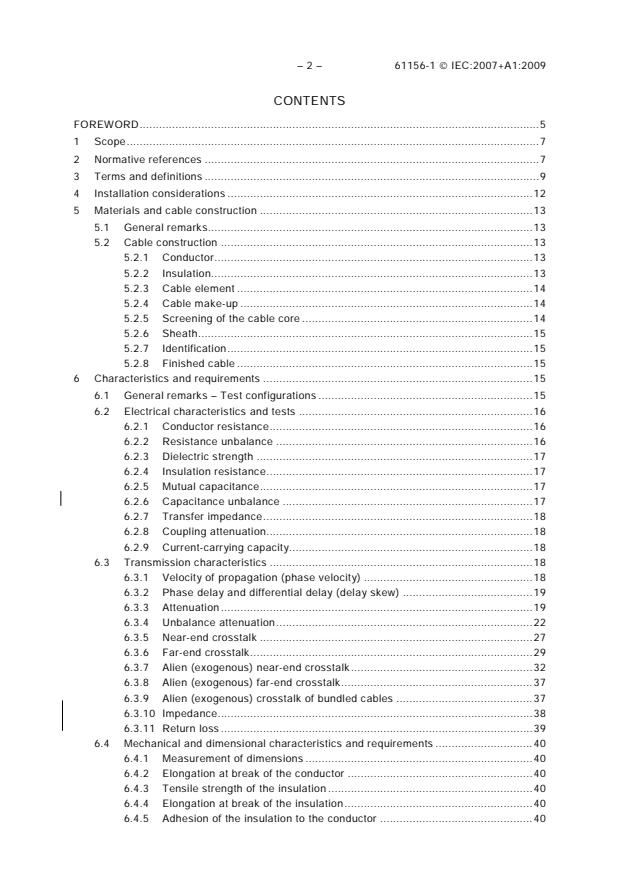
CONTENTS
FOREWORD.5
1 Scope.7
2 Normative references .7
3 Terms and definitions .9
4 Installation considerations .12
5 Materials and cable construction .13
5.1 General remarks.13
5.2 Cable construction .13
5.2.1 Conductor.13
5.2.2 Insulation.13
5.2.3 Cable element .14
5.2.4 Cable make-up .14
5.2.5 Screening of the cable core .14
5.2.6 Sheath.15
5.2.7 Identification.15
5.2.8 Finished cable .15
6 Characteristics and requirements .15
6.1 General remarks – Test configurations .15
6.2 Electrical characteristics and tests .16
6.2.1 Conductor resistance.16
6.2.2 Resistance unbalance .16
6.2.3 Dielectric strength .17
6.2.4 Insulation resistance.17
6.2.5 Mutual capacitance.17
6.2.6 Capacitance unbalance .17
6.2.7 Transfer impedance.18
6.2.8 Coupling attenuation.18
6.2.9 Current-carrying capacity.18
6.3 Transmission characteristics .18
6.3.1 Velocity of propagation (phase velocity) .18
6.3.2 Phase delay and differential delay (delay skew) .19
6.3.3 Attenuation .19
6.3.4 Unbalance attenuation.22
6.3.5 Near-end crosstalk .27
6.3.6 Far-end crosstalk.29
6.3.7 Alien (exogenous) near-end crosstalk.32
6.3.8 Alien (exogenous) far-end crosstalk.37
6.3.9 Alien (exogenous) crosstalk of bundled cables .37
6.3.10 Impedance.38
6.3.11 Return loss .39
6.4 Mechanical and dimensional characteristics and requirements .40
6.4.1 Measurement of dimensions .40
6.4.2 Elongation at break of the conductor .40
6.4.3 Tensile strength of the insulation .40
6.4.4 Elongation at break of the insulation.40
6.4.5 Adhesion of the insulation to the conductor .40
61156-1 © IEC:2007+A1:2009 – 3 –
6.4.6 Elongation at break of the sheath .40
6.4.7 Tensile strength of the sheath .40
6.4.8 Crush test of the cable .40
6.4.9 Impact test of the cable .40
6.4.10 Bending under tension.40
6.4.11 Repeated bending of the cable .43
6.4.12 Tensile performance of the cable.44
6.4.13 Shock test of the cable .44
6.4.14 Bump test of the cable.44
6.4.15 Vibration test of the cable.44
6.5 Environmental characteristics.44
6.5.1 Shrinkage of the insulation .44
6.5.2 Wrapping test of the insulation after thermal ageing .44
6.5.3 Bending test of the insulation at low temperature.45
6.5.4 Elongation at break of the sheath after ageing.45
6.5.5 Tensile strength of the sheath after ageing .45
6.5.6 Sheath pressure test at high temperature .45
6.5.7 Cold bend test of the cable .45
6.5.8 Heat shock test.46
6.5.9 Damp heat steady state.46
6.5.10 Solar radiation .46
6.5.11 Solvents and contaminating fluids.46
6.5.12 Salt mist and sulphur dioxide.46
6.5.13 Water immersion .46
6.5.14 Hygroscopicity.46
6.5.15 Wicking .47
6.5.16 Flame propagation characteristics of a single cable.48
6.5.17 Flame propagation characteristics of bunched cables .48
6.5.18 Halogen gas evolution .48
6.5.19 Smoke generation .48
6.5.20 Toxic gas emission .48
6.5.21 Integrated fire test method for cables in environmental
air handling spaces .48
Bibliography.49
Figure 1 – Test set-up for the measurement of attenuation, velocity of propagation and
phase delay .20
Figure 2 – Test set-up for the measurement of the differential-mode loss of the baluns .24
Figure 3 – Test set-up for the measurement of the common-mode loss of the baluns.24
Figure 4 – Test set-up for unbalance attenuation at near end (TCL).26
Figure 5 – Test set-up for unbalance attenuation at far end (TCTL) .26
Figure 6 – Test set-up for near-end crosstalk.28
Figure 7 – Test set-up for far-end crosstalk.30
Figure 8 – Test set-up for alien (exogenous) near-end crosstalk .33
Figure 9 – Test assembly cross-section; six cables around one cable .35
Figure 10 – Test assembly layout; six cables around one cable .35
– 4 – 61156-1 © IEC:2007+A1:2009
Figure 18 – Schematic diagram representing the position of the 9 cables
on a wooden drum .36
Figure 19 – Arrangement of the cables on the drum.36
Figure 20 – Preparation of one end.37
Figure 13 – Test set-up for characteristic impedance and return loss .38
Figure 14 – U-bend test configuration .41
Figure 15 – S-bend test configuration .42
Figure 16 – Repeated bending test configuration .43
Figure 17 – Wicking test configuration .47
Table 1 – Test balun performance characteristics .23
61156-1 © IEC:2007+A1:2009 – 5 –
INTERNATIONAL ELECTROTECHNICAL COMMISSION
____________
MULTICORE AND SYMMETRICAL PAIR/QUAD CABLES
FOR DIGITAL COMMUNICATIONS –
Part 1: Generic specification
FOREWORD
1) The International Electrotechnical Commission (IEC) is a worldwide organization for standardization comprising
all national electrotechnical committees (IEC National Committees). The object of IEC is to promote
international co-operation on all questions concerning standardization in the electrical and electronic fields. To
this end and in addition to other activities, IEC publishes International Standards, Technical Specifications,
Technical Reports, Publicly Available Specifications (PAS) and Guides (hereafter referred to as “IEC
Publication(s)”). Their preparation is entrusted to technical committees; any IEC National Committee interested
in the subject dealt with may participate in this preparatory work. International, governmental and non-
governmental organizations liaising with the IEC also participate in this preparation. IEC collaborates closely
with the International Organization for Standardization (ISO) in accordance with conditions determined by
agreement between the two organizations.
2) The formal decisions or agreements of IEC on technical matters express, as nearly as possible, an international
consensus of opinion on the relevant subjects since each technical committee has representation from all
interested IEC National Committees.
3) IEC Publications have the form of recommendations for international use and are accepted by IEC National
Committees in that sense. While all reasonable efforts are made to ensure that the technical content of IEC
Publications is accurate, IEC cannot be held responsible for the way in which they are used or for any
misinterpretation by any end user.
4) In order to promote international uniformity, IEC National Committees undertake to apply IEC Publications
transparently to the maximum extent possible in their national and regional publications. Any divergence
between any IEC Publication and the corresponding national or regional publication shall be clearly indicated in
the latter.
5) IEC itself does not provide any attestation of conformity. Independent certification bodies provide conformity
assessment services and, in some areas, access to IEC marks of conformity. IEC is not responsible for any
services carried out by independent certification bodies.
6) All users should ensure that they have the latest edition of this publication.
7) No liability shall attach to IEC or its directors, employees, servants or agents including individual experts and
members of its technical committees and IEC National Committees for any personal injury, property damage or
other damage of any nature whatsoever, whether direct or indirect, or for costs (including legal fees) and
expenses arising out of the publication, use of, or reliance upon, this IEC Publication or any other IEC
Publications.
8) Attention is drawn to the Normative references cited in this publication. Use of the referenced publications is
indispensable for the correct application of this publication.
9) Attention is drawn to the possibility that some of the elements of this IEC Publication may be the subject of
patent rights. IEC shall not be held responsible for identifying any or all such patent rights.
International Standard IEC 61156-1 has been prepared by subcommittee 46C: Wires and
symmetric cables, of IEC technical committee 46: Cables, wires, waveguides, r.f. connectors,
r.f. and microwave passive components and accessories.
The cables are classified in the study of generic cabling for information technology being
produced by ISO/IEC JTC1/SC 25.
This consolidated version of IEC 61156-1 consists of the third edition (2007) [documents
46C/815/FDIS and 46C/823/RVD], its amendment 1 (2009) [documents 46C/897/FDIS and
46C/899/RVD] and its corrigendum 1 (2015-08).
The technical content is therefore identical to the base edition and its amendment and has
been prepared for user convenience.
It bears the edition number 3.1.
– 6 – 61156-1 © IEC:2007+A1:2009
A vertical line in the margin shows where the base publication has been modified by
amendment 1.
This edition includes the following significant technical changes with respect to the previous
edition:
a) inclusion of definitions and test methods in support of the MICE table in ISO 24702;
b) inclusion of definitions and test methods in support of new cable categories 6 and 7 ;
A A
c) inclusion of definitions in support of PoEP.
This bilingual version (2008-02) replaces the English version.
The French version of this standard has not been voted upon.
This publication has been drafted in accordance with the ISO/IEC Directives, Part 2.
The list of all the parts of the IEC 61156 series, under the general title Multicore and
symmetrical pair/quad cables for digital communication, can be found on the IEC website.
The committee has decided that the contents of the base publication and its amendments will
remain unchanged until the maintenance result date indicated on the IEC web site under
"http://webstore.iec.ch" in the data related to the specific publication. At this date,
the publication will be
• reconfirmed,
• withdrawn,
• replaced by a revised edition, or
• amended.
IMPORTANT – The “colour inside” logo on the cover page of this publication indicates
that it contains colours which are considered to be useful for the correct understanding
of its contents. Users should therefore print this publication using a colour printer.
61156-1 © IEC:2007+A1:2009 – 7 –
MULTICORE AND SYMMETRICAL PAIR/QUAD CABLES
FOR DIGITAL COMMUNICATIONS –
Part 1: Generic specification
1 Scope
This part of IEC 61156 is applicable to communication systems such as ISDN, local area
networks and data communication systems and specifies the definitions, requirements and
test methods of multicore, symmetrical pair and quad cables.
This standard is also applicable to cables used for customer premises wiring.
2 Normative references
The following referenced documents are indispensable for the application of this document.
For dated references, only the edition cited applies. For undated references, the latest edition
of the referenced document (including any amendments) applies.
IEC 60028, International standard of resistance for copper
IEC 60050-726, International Electrotechnical Vocabulary (IEV) – Part 726: Transmission
lines and wave guides
IEC 60068-2-1, Environmental testing – Part 2: Tests – Tests A: Cold
IEC 60169-22, Radio-frequency connectors – Part 22: RF two-pole bayonet coupled
connectors for use with shielded balanced cables having twin inner conductors (Type BNO)
IEC 60189-1:1986, Low-frequency cables and wires with PVC insulation and PVC sheath –
)
Part 1: General test and measuring methods
IEC 60304, Standard colours for insulation for low-frequency cables and wires
IEC 60332-1-1, Tests on electric and optical fibre cables under fire conditions – Part 1-1: Test
for vertical flame propagation for a single insulated wire or cable – Apparatus
IEC 60332-2-1, Tests on electric and optical fibre cables under fire conditions – Part 2-1: Test
for vertical flame propagation for a single small insulated wire or cable – Apparatus
IEC 60332-3-10, Tests on electric cables under fire conditions – Part 3-10: Test for vertical
flame spread of vertically-mounted bunched wires or cables – Apparatus
IEC 60332-3-24, Tests on electric cables under fire conditions – Part 3-24: Test for vertical
flame spread of vertically-mounted bunched wires or cables – Category C
IEC 60708, Low-frequency cables with polyolefin insulation and moisture barrier polyolefin
sheath
_____________
)
There exists a 2007 edition of 60189-1.
– 8 – 61156-1 © IEC:2007+A1:2009
IEC 60754-2, Test on gases evolved during combustion of electric cables – Part 2:
Determination of the degree of acidity of gases evolved during the combustion of materials
taken from electric cables by measuring pH and conductivity
IEC 60794-1-2:2003, Optical fibre cables – Part 1-2: Generic specification – Basic optical
cable test procedures
IEC 60811-1-1:1993, Common test methods for insulating and sheathing materials of
electric cables and optical cables – Part 1: Methods for general application – Section 1:
Measurement of thickness and overall dimensions – Tests for determining the mechanical
properties
IEC 60811-1-2:1985, Common test methods for insulating and sheathing materials of
electric and optical cables – Part 1: Methods for general application – Section Two: Thermal
ageing methods
IEC 60811-1-3:1993, Common test methods for insulating and sheathing materials of
electric and optical cables – Part 1: Methods for general application – Section Three:
Methods for determining the density – Water absorption tests – Shrinkage test
IEC 60811-1-4:1985, Common test methods for insulating and sheathing materials of
electric and optical cables – Part 1: Methods for general application – Section Four: Test at
low temperature
IEC 60811-3-1:1985, Common test methods for insulating and sheathing materials of
electric and optical cables – Part 3: Methods specific to PVC compounds – Section One:
Pressure test at high temperature – Tests for resistance to cracking
IEC 60811-4-2:2004, Insulating and sheathing materials of electric cables – Common test
methods – Part 4-2: Methods specific to polyethylene and polypropylene compounds –
Tensile strength and elongation at break after conditioning at elevated temperature –
Wrapping test after conditioning at elevated temperature – Wrapping test after thermal
ageing in air – Measurement of mass increase – Long-term stability test – Test method for
copper-catalyzed oxidative degradation
IEC 61034 (all parts), Measurement of smoke density of cables burning under defined
conditions
IEC 61196-1-105, Coaxial communication cables – Part 1-105: Electrical test methods –
Test for withstand voltage of cable dielectric
IEC 62012-1:2004, Multicore and symmetrical pair/quad cables for digital communications to
be used in harsh environments – Part 1: Generic specification
IEC 62153-4-3, Metallic communication cables test methods – Part 4-3: Electromagnetic
compatibility (EMC) – Surface transfer impedance – Triaxial method
IEC 62153-4-4, Metallic communication cables test methods – Part 4-4: Electromagnetic
compatibility (EMC) – Shielded screening attenuation, test method for measuring of the
screening attenuation a up to and above 3 GHz
s
IEC 62153-4-5, Metallic communication cables test methods – Part 4-5: Electromagnetic
compatibility (EMC) – Coupling or screening attenuation – Absorbing clamp method
IEC 62255 (all parts), Multicore and symmetrical pair/quad cables for broadband digital
communications (high bit rate digital access telecommunication networks) – Outside plant
cables
61156-1 © IEC:2007+A1:2009 – 9 –
ITU-T Recommendation G.117:1996, Transmission aspects of unbalance about earth
ITU-T Recommendation O.9:1999, Measuring arrangements to assess the degree of
unbalance about earth
3 Terms and definitions
For the purposes of this document, the following terms and definitions, as well as those given
in IEC 60050-726, apply.
3.1
resistance unbalance
difference in resistance of the conductors within a pair or one side of a quad or between pairs
or quads
NOTE Resistance unbalance is expressed as a percentage (%).
3.2
capacitance unbalance to earth
arithmetic difference of the capacitance to earth of the conductors of a pair or one side of a
quad
NOTE Capacitance unbalance is expressed in pF/m.
3.3
mutual capacitance
electrical charge storage parameter of a pair of conductors (or with respect to the side of a
quad)
NOTE 1 Mutual capacitance is one of the four primary transmission line parameters: mutual capacitance, mutual
inductance, resistance and conductance.
NOTE 2 Mutual capacitance is expressed in pF/m.
3.4
velocity of propagation (phase velocity)
speed at which a sinusoidal signal propagates on a pair in the cable
NOTE Velocity of propagation is expressed in m/s.
3.5
delay (phase delay)
time duration between the instants that the wave front of a sinusoidal travelling wave, defined
by a specified phase, passes two given points in a cable
NOTE Phase delay is expressed in s/m.
3.6
differential phase delay (skew)
difference in phase delay between any two pairs in the cable
NOTE Differential phase delay (skew) is expressed in s.
3.7
attenuation
decrease in magnitude of power of a signal that propagates along a pair of a cable
NOTE Attenuation is expressed in dB/m.
– 10 – 61156-1 © IEC:2007+A1:2009
3.8
unbalance attenuation
magnitude of power of a signal that propagates between the common-mode circuit and the
differential-mode circuit of a cable
NOTE Unbalance attenuation is expressed in dB.
3.9
near-end crosstalk
NEXT
magnitude of the signal power coupling from a disturbing pair at the near end to a disturbed
pair measured at the near end
NOTE Near-end crosstalk is expressed in dB.
3.10
far-end crosstalk
FEXT
magnitude of the signal power coupling from a disturbing pair at the near end to a disturbed
pair measured at the far end
NOTE Far-end crosstalk is expressed in dB.
3.11
power sum of crosstalk
PS
summation of the crosstalk power from all disturbing pairs into a disturbed pair
NOTE 1 The summation is applicable to near-end and far-end crosstalk.
NOTE 2 The power sum of crosstalk is expressed in dB.
3.12
attenuation to crosstalk ratio, near-end
ACR-N
arithmetic difference between the near-end crosstalk and the attenuation of the disturbed pair
NOTE Attenuation to crosstalk ratio, near-end, is expressed in dB.
3.13
attenuation to crosstalk ratio, far-end
ACR-F
arithmetic difference between the far-end crosstalk and the attenuation of the disturbed pair
NOTE Attenuation to crosstalk ratio, far-end, is expressed in dB.
3.14
alien (exogenous) near-end crosstalk
ANEXT
near-end crosstalk where the disturbing and disturbed pairs are contained in different cables
NOTE Alien (exogenous) near-end crosstalk is expressed in dB.
3.15
alien (exogenous) far-end crosstalk
AFEXT
far-end crosstalk where the disturbing and disturbed pairs are contained in different cables
NOTE Alien (exogenous) far-end crosstalk is expressed in dB.
61156-1 © IEC:2007+A1:2009 – 11 –
3.16
power sum of alien (exogenous) crosstalk
PSA
summation of the alien (exogenous) crosstalk power from all disturbing pairs into a disturbed
pair in different cables
NOTE 1 The summation is applicable to near-end and far-end alien (exogenous) crosstalk.
NOTE 2 The power sum of alien (exogenous) crosstalk is expressed in dB.
3.17
characteristic impedance
Z
C
impedance at the input of a homogeneous line of infinite length
The impedance value is expressed in Ω, calculated, at relevant frequencies, as the square
root of the product of the impedances measured at the near end (input) of a cable pair when
the far end is terminated by a short-circuit load and then an open-circuit load.
NOTE 1 The asymptotic value at high frequencies is denoted as Z .
∞
NOTE 2 The characteristic impedance of a homogeneous cable pair is given by the quotient of a voltage wave
and current wave which are propagating in the same direction, either forwards or backwards.
NOTE 3 For homogeneous ideal cables, this method yields a flat smooth curve over the whole frequency range.
Real cables with distortions give curves with some roughness.
3.18
terminated input impedance
Z
in
impedance value, expressed in Ω, at relevant frequencies, measured at the near end (input)
when the far end is terminated with the system nominal impedance, Z
R
(See IEC/TR 62152.)
3.19
fitted characteristic impedance
Z
m
impedance value, expressed in Ω, calculated by applying a least squares function fitting
algorithm to the measured characteristic impedance values
3.20
mean characteristic impedance
Z
∞
asymptotic value at which the characteristic impedance approaches at sufficiently high
frequencies (≈100 MHz) such that the imaginary part (phase angle) is insignificant
NOTE 1 Normally measured from the capacitance and time delay.
NOTE 2 Applicable for cables with frequency independence of mutual capacitance.
3.21
return loss
RL
ratio of reflected power to input power at the input terminals of a cable pair
NOTE Return loss is expressed in dB.
3.22
balun
balanced to unbalanced impedance matching transformer
– 12 – 61156-1 © IEC:2007+A1:2009
3.23
bundled cable
grouping or assembly of several individual cables that are systematically laid up
NOTE Bundled cables are also referred to as speed-wrap, whip, or loomed cables.
3.24
current carrying capacity
maximum current a cable circuit (one or several conductors) can support resulting in a
specified increase of the surface temperature of the conductor beyond the ambient
temperature, not exceeding the maximum allowed operating temperature of the cable
3.25
hygroscopic
characteristic of a material to absorb moisture from the atmosphere
3.26
wicking
longitudinal flow of a liquid in a material due to capillary action
3.27
coupling attenuation
ratio between the transmitted power through the conductors and the maximum radiated peak
power, conducted and generated by the exited common-mode currents
3.28
ambient temperature
the temperature of the room or space surrounding the cable
3.29
operating temperature
the surface temperature of the conductors of a cable
The operating temperature is the sum of ambient temperature and of the temperature
increase due to the carried power.
4 Installation considerations
The cables shall be designed to meet the installation conditions encountered for each area as
follows.
a) Equipment cables
The cables are used between work stations and peripheral equipment (for example,
printer).
b) Work area cables
The cables are used between the work station and the communication outlets.
c) Horizontal floor wiring cables
The cables are used between the work area communication outlet and the communication
closet.
d) Riser cables and building back-bone cables
The cables are used for horizontal installation or vertically between floors.
e) Campus cables
These cables are used to interconnect buildings and shall be suitable for outdoor
installation. The cables should be sheathed and protected in accordance with IEC 62255.
61156-1 © IEC:2007+A1:2009 – 13 –
5 Materials and cable construction
5.1 General remarks
The choice of materials and cable construction shall be suitable for the intended application
and installation of the cable. Particular care shall be taken to meet any special requirements
for EMC (Electromagnetic Compatibility) or fire performance.
5.2 Cable construction
The cable construction shall be in accordance with the details and dimensions given in the
relevant detail specification.
5.2.1 Conductor
The conductor shall consist of annealed copper, uniform in quality and free from defects. The
properties of the copper shall be in accordance with IEC 60028.
The conductor may be either solid or stranded. The solid conductor shall be circular in
section and may be plain or metal-coated. The solid conductor shall be drawn in one piece.
Joints in the solid conductor are permitted, provided that the breaking strength of a joint is
not less than 85 % of the breaking strength of the unjointed solid conductor.
The stranded conductor shall consist of strands circular in section and assembled without
insulation between them by concentric stranding or bunched.
NOTE A bunched strand is not recommended for insulation displacement connection (IDC) application.
The individual strands of the conductor may be plain or metal-coated.
Joints in individual strands are permitted provided that the tensile strength of a joint is not
less than 85 % of the breaking strength of the unjointed individual strand. Joints in the
complete stranded conductor are not permitted unless allowed and specified in the relevant
detail specification.
The conductor of the work area and equipment cables may consist of one or more elements of
thin copper or copper alloy tape which shall be applied spirally over a fibrous thread. Joints in
the complete element are not permitted.
5.2.2 Insulation
The conductor insulation is composed of one or more suitable dielectric materials. The
insulation may be solid, cellular or composite (for example, foam skin).
The insulation shall be continuous, having a uniform thickness.
The insulation shall be applied to fit closely to the conductor.
The insulated conductors may be identified by colours and/or additional ring markings and/or
symbols achieved by the use of coloured insulation or by a coloured surface using extrusion,
printing or painting. Colours shall be clearly identifiable and shall correspond reasonably with
the standard colours shown in IEC 60304.
5.2.2.1 Colour code
The colour code for insulation is given in the relevant detail specification.
– 14 – 61156-1 © IEC:2007+A1:2009
5.2.3 Cable element
5.2.3.1 General
The cable element is
– a pair consisting of two insulated conductors twisted together and designated wire "a" and
wire "b", or
– a quad consisting of four insulated conductors twisted together and designated wire "a",
wire "c", wire "b" and wire "d" in order of rotation.
The choice of the maximum average length of lay in the finished cable shall be made with
respect to the specified crosstalk requirements, handling performance and the pair or quad
integrity.
NOTE Forming the element with a variable lay can lead to the infrequent but acceptable occurrence of the
maximum lay being longer than the specified length of lay.
5.2.3.2 Screening of the cable element
When a screen is required over the pair or quad, it may consist of the following:
a) an aluminium tape laminated to a plastic tape;
b) an aluminium tape laminated to a plastic tape and a metal-coated or plain copper drain
wire whereby the metal tape is in contact with the drain wire;
c) metallic braid;
d) an aluminium tape laminated to a plastic tape and a metallic braid.
Care should be taken when putting dissimilar metals in contact with each other. Coatings or
other methods of protection may be necessary to prevent galvanic interaction.
A protective wrapping may be applied under and/or over the screen.
5.2.4 Cable make-up
The cable elements may be laid up in concentric layers or in unit construction. The cable core
may be protected by wrappings of a non-hygroscopic, non-wicking tape.
NOTE 1 Fillers may be used to maintain a circular formation.
NOTE 2 Forming the element with a variable lay can lead to the infrequent but acceptable occurrence of the
maximum lay being longer than the specified length of lay.
5.2.5 Screening of the cable core
The cable core may be screened by
a) an aluminium tape laminated to a plastic tape which may be bonded to the sheath;
b) an aluminium tape laminated to a plastic tape and a metal-coated or plain copper drain
wire whereby the metal tape is in contact with the drain wire;
c) metallic braid;
d) an aluminium tape laminated to a plastic tape and a metallic braid;
e) plain copper or aluminium tape.
Care should be taken when putting dissimilar metals in contact with each other. Coatings or
other methods of protection may be necessary to prevent galvanic interaction.
A protective wrapping may be applied under and/or over the screen.
61156-1 © IEC:2007+A1:2009 – 15 –
5.2.6 Sheath
The sheath shall be a polymeric material.
The sheath shall be continuous, having a uniform thickness.
The sheath shall be applied to fit closely to the core of the cable. In the case of screened
cables, the sheath shall not adhere to the screen except when it is intentionally bonded to it.
The colour of the sheath may be specified in the relevant detail specification.
5.2.7 Identification
5.2.7.1 Cable marking
Each length of cable shall bear the name of the supplier and the cable type and, when
provided, the year of manufacture, using one of the following methods:
a) coloured threads or tapes;
b) printed tape;
c) printing on the core wrappings;
d) marking on the sheath.
Additional markings may be provided on the sheath as indicated in the relevant detail
specification.
5.2.7.2 Labelling
The following information shall be provided either on a label attached to each length of
finished cable or on the outside of the product package:
a) type of cable;
b) supplier’s name or logo;
c) year of manufacture;
d) length of cable in metres.
5.2.8 Finished cable
The finished cable shall have adequate protection for storage and shipment.
6 Characteristics and requirements
6.1 General remarks – Test configurations
Unless otherwise specified, all the tests shall be performed assuming that the operating
temperature is 20 °C. The temperature of the cable shall be stabilized at 20 °C and the test
signal shall be low enough to avoid any temperature increase.
Typical test configurations for the test specimen are
a) laid out on a non-metallic surface at least 25 mm from a conductive surface;
b) supported in aerial spans in such a way that there is a minimum separation of 25 mm
between convolutions;
c) wound as a single open helix on a drum with at least 25 mm between turns.
– 16 – 61156-1 © IEC:2007+A1:2009
The configurations a), b) and c) are not necessary for screened cables.
The parameters of mutual capacitance, crosstalk, characteristic impedance and attenuation
sometimes show measured values up to 10 % higher when the cable is measured in its
packaging. This difference arises due to the tight packaging density and interwinding effects.
Also, box packaging may negatively affect the cable return loss, crosstalk and characteristic
impedance with full or partial recovery of cable performance after installation.
In case of doubt, the measurements of mutual capacitance, impedance, attenuation and
crosstalk shall be performed on a cable sample removed from its packaging.
Measurement procedures for alien (exogenous) crosstalk specify options for the mounting of
the cables into special test configurations.
The common-mode termination resistors shall be
– 0 Ω for individually screened pair cables;
– 25 Ω for overall screened cables;
– 45 Ω to 50 Ω for unscreened cables.
6.2 Electrical characteristics and tests
6.2.1 Conductor resistance
The measurement of the conductor resistance shall be in accordance with 6.1 of IEC 60189-1.
6.2.2 Resistance unbalance
The measurement of the resistance unbalance and the accuracy of the measurement
equipment shall be in accordance with IEC 60708.
6.2.2.1 Resistance unbalance within a pair
The resistance unbalance between conductors of a pair or in the same side of a quad is given by
()R − R
m
...