


IEC 60255-5
Electrical Relays - Part 5: Insulation coordination for measuring relays and protection equipment - Requirements and tests
Electrical Relays - Part 5: Insulation coordination for measuring relays and protection equipment - Requirements and tests
Lays down general requirements for the insulation coordination of measuring relays and protection equipment. Gives guidance for the selection of clearances and creepage distances and other aspects related to the insulation of measuring relays and protection equipment; specifies requirements for voltage tests and insulation resistance measurement.
Relais électriques - Partie 5: Coordination de l'isolement des relais de mesure et des dispositifs de protection - Prescriptions et essais
Donne des prescriptions générales pour la coordination de l'isolement des relais de mesure et des dispositifs de protection. Fournit les directives pour la sélection des distances d'isolement et des lignes de fuite et d'autres aspects liés à l'isolation des relais de mesure et des dispositifs de protection; donne des prescriptions pour les essais de tension et la mesure de la résistance d'isolement.
Electrical relays - Part 5: Insulation tests for electrical relays
General Information
- Status
- Not Published
- Technical Committee
- TC 95 - Measuring relays and protection equipment
- Current Stage
- PPUB - Publication issued
- Start Date
- 14-Dec-2000
Overview
IEC 60255-5 defines the general requirements for insulation coordination of measuring relays and protection equipment. The standard provides guidance for designers, test engineers and manufacturers on selecting appropriate clearances and creepage distances, and describes the required procedures for voltage tests and insulation resistance measurements. Its objective is to support safe, reliable and compliant relay design and testing without prescribing circuit- or product‑specific numeric values.
Key Topics
- Scope and purpose: General principles for insulation coordination applied to measuring relays and protection equipment.
- Clearances and creepage: Guidance on selecting physical separation and surface distance to control breakdown and tracking risks.
- Insulation aspects: Consideration of materials, pollution degree and environmental conditions that affect dielectric behavior.
- Voltage testing: Specification of test types and conditions to verify dielectric withstand capability and construction integrity.
- Insulation resistance measurement: Requirements for verifying resistance levels that indicate acceptable insulation condition.
These topics emphasize practical, testable measures that reduce the risk of internal arcing, flashover, or progressive insulation degradation in protection systems.
Applications
IEC 60255-5 is directly applicable to the following use cases:
- Design and development of measuring relays and protection equipment, ensuring that insulation design aligns with operational and environmental demands.
- Production testing and type approval, where manufacturers confirm compliance with insulation coordination requirements before market release.
- Maintenance and service verification, using specified voltage and insulation resistance tests to assess ongoing insulation health.
- Equipment selection for utilities and industrial installations where relay reliability and personnel safety are critical.
Benefits include improved operational reliability, reduced failure risk, clearer product specifications for procurement, and support for regulatory or contractual compliance.
Related Standards
- Other parts of the IEC 60255 series (relays and relay requirements) provide complementary requirements for electrical, mechanical and functional aspects of protection devices.
- General IEC guidance on insulation coordination and dielectric testing may be referenced to address system‑level considerations and specific test methodologies.
For engineers and compliance professionals, IEC 60255-5 serves as a practical reference for integrating insulation coordination into relay design, testing routines and procurement specifications. Its focus on clearance, creepage, voltage tests and insulation resistance makes it essential for achieving durable, safe protection equipment.


Frequently Asked Questions
IEC 60255-5 is a standard published by the International Electrotechnical Commission (IEC). Its full title is "Electrical Relays - Part 5: Insulation coordination for measuring relays and protection equipment - Requirements and tests". This standard covers: Lays down general requirements for the insulation coordination of measuring relays and protection equipment. Gives guidance for the selection of clearances and creepage distances and other aspects related to the insulation of measuring relays and protection equipment; specifies requirements for voltage tests and insulation resistance measurement.
Lays down general requirements for the insulation coordination of measuring relays and protection equipment. Gives guidance for the selection of clearances and creepage distances and other aspects related to the insulation of measuring relays and protection equipment; specifies requirements for voltage tests and insulation resistance measurement.
IEC 60255-5 is classified under the following ICS (International Classification for Standards) categories: 29.120.70 - Relays. The ICS classification helps identify the subject area and facilitates finding related standards.
IEC 60255-5 is available in PDF format for immediate download after purchase. The document can be added to your cart and obtained through the secure checkout process. Digital delivery ensures instant access to the complete standard document.
Standards Content (Sample)
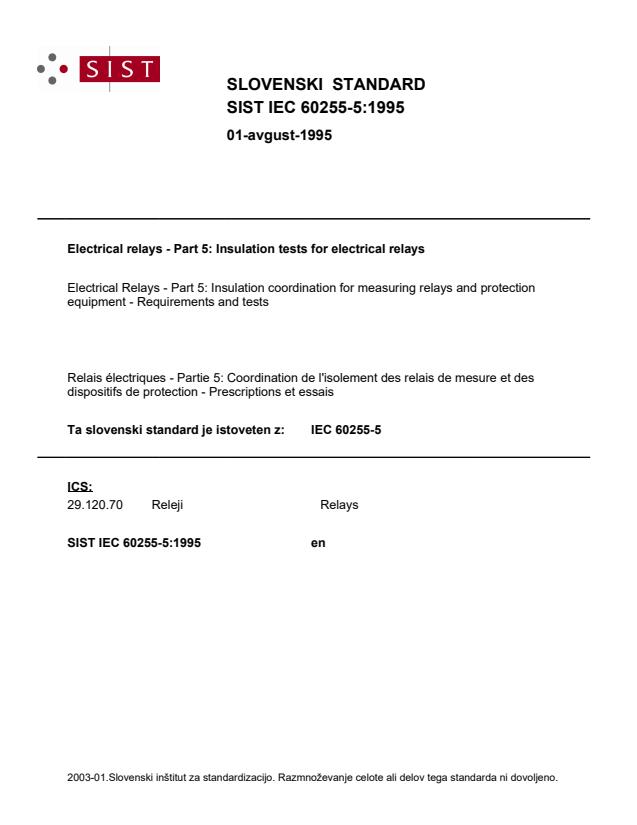
SLOVENSKI STANDARD
01-avgust-1995
Electrical relays - Part 5: Insulation tests for electrical relays
Electrical Relays - Part 5: Insulation coordination for measuring relays and protection
equipment - Requirements and tests
Relais électriques - Partie 5: Coordination de l'isolement des relais de mesure et des
dispositifs de protection - Prescriptions et essais
Ta slovenski standard je istoveten z: IEC 60255-5
ICS:
29.120.70 Releji Relays
2003-01.Slovenski inštitut za standardizacijo. Razmnoževanje celote ali delov tega standarda ni dovoljeno.
SIS
...
Questions, Comments and Discussion
Ask us and Technical Secretary will try to provide an answer. You can facilitate discussion about the standard in here.
Loading comments...