

IEC 61755-3-2:2024
(Main)Fibre optic interconnecting devices and passive components - Connector optical interfaces - Part 3-2: Connector parameters of dispersion unshifted single-mode physically contacting fibres - Angled 2,5 mm and 1,25 mm diameter cylindrical full zirconia ferrules
General Information
- Abstract
IEC 61755-3-2:2024 defines the dimensional limits of the optical interface that are necessary for single-mode fibre optic connectors with 2,5 mm or 1,25 mm diameter cylindrical zirconia (ZrO2) ferrules polished at an 8° angle to meet the specific requirements for fibre-to-fibre interconnection, as defined in IEC 61755-2-2. Ferrules made from the material specified in this standard are suitable for use in all the operating service environments defined in IEC 61753-1. Ferrule dimensions and features are contained in the IEC 61754 series of fibre optic connector interface standards. This second edition cancels and replaces the first edition published in 2006. This edition constitutes a technical revision. This edition includes the following significant technical changes with respect to the previous edition:
a) normative references have been added;
b) The introduction of an additional optical interface with a different fibre core eccentricity profile. The previous revision of optical interface standard is named "Variant 1: with fibre core axis oriented towards the connector guide key".
The additional optical interface is named "Variant 2: with fibre core axis not oriented towards the connector guide key";
c) statements added related to interoperability, where both variants remain intermateable within a given performance grade and are fully backwards compatible to IEC 61755-3-2:2006;
d) The addition of Grade B and Grade C interface requirements for both variants;
f) The addition of a descriptive statistic for the mean fibre core eccentricity (mean value) to describe the distribution of fibre core eccentricity to ensure interoperability;
g) A new informative Annex B to give guidance on the expected attenuation when mated to a reference connector plug;
h) A new informative Annex D to give guidance related to estimation of mean fibre eccentricity limits for finite production batch sizes.
- Status
- Published
- Publication Date
- 10-Apr-2024
- Technical Committee
- SC 86B - Fibre optic interconnecting devices and passive components
- Current Stage
- PPUB - Publication issued
- Start Date
- 11-Apr-2024
- Completion Date
- 19-Apr-2024
Buy Documents
IEC 61755-3-2:2024 - Fibre optic interconnecting devices and passive components - Connector optical interfaces - Part 3-2: Connector parameters of dispersion unshifted single-mode physically contacting fibres - Angled 2,5 mm and 1,25 mm diameter cylindrical full zirconia ferrules Released:4/11/2024
Overview
IEC 61755-3-2:2024 is an international standard published by the International Electrotechnical Commission (IEC) that specifies the connector parameters for dispersion unshifted single-mode fibre optic connectors using angled cylindrical full zirconia ferrules. The ferrules covered have diameters of 2.5 mm and 1.25 mm and are polished at an 8° angle. This second edition updates and replaces the original 2006 version and introduces technical revisions to support fibre-to-fibre interconnection consistency, enhanced interoperability, and expanded performance grading.
This standard plays a critical role in defining dimensional limits and optical interface parameters to ensure reliable physical contact between single-mode fibres, specifically those with dispersion unshifted characteristics. The ferrules specified meet requirements for demanding operating service environments according to IEC 61753-1, making them suitable for telecommunications, data centres, and high-performance fibre optic networks.
Key Topics
Ferrule Specifications: Defines dimensional limits for zirconia (ZrO₂) ferrules polished at an 8° angle with 2.5 mm and 1.25 mm diameters, which are standard sizes in fibre optic connectors.
Optical Interface Variants: Introduces two variants:
- Variant 1: Fibre core axis oriented towards the connector guide key.
- Variant 2: Fibre core axis not oriented towards the connector guide key.
Both variants are intermateable within performance grades and backward compatible with the 2006 edition.
Performance Grades: Expands interface requirements to include Grade B and Grade C for both variants, providing distinct quality and performance criteria.
Interoperability Assurance: Specifies statistical methods for measuring mean fibre core eccentricity to ensure compatibility and reduce attenuation when mating connectors.
Informative Annexes:
- Annex B offers guidance on expected attenuation when connectors are mated to reference plugs.
- Annex C provides simulation strategies for optical interface attenuation.
- Annex D assists in estimating fibre eccentricity limits for batch production sizes.
Applicable Standards: References other relevant IEC standards, including IEC 61754 for ferrule dimensions and IEC 61753-1 for operating environments.
Applications
IEC 61755-3-2:2024 is essential for manufacturers, engineers, and designers working with single-mode fibre optic interconnecting devices that require precise physical contact with minimal optical loss. Key application areas include:
Telecommunications Networks: Ensuring low-attenuation and reliable splicing and connectorization in long-haul and metro optical fibre systems.
Data Centres: Supporting high-density fibre optic connectivity with consistent performance in angled physical contact (APC) connectors.
Fibre Optic Component Manufacturing: Providing standards to manufacture zirconia ferrules with strict dimensional and angular tolerances to guarantee interoperability.
Test and Measurement: Assisting optical performance testing by defining standard parameters for attenuation and fibre core alignment.
Quality Assurance: Allowing quality control inspection against defined optical interface and fibre eccentricity metrics for batch production.
Related Standards
IEC 61755-2-2: Defines general optical interface requirements for fibre optic connectors relating to dispersion unshifted single-mode fibres.
IEC 61754 Series: Covers ferrule dimensions and physical features for fibre optic connector interfaces, including cylindrical zirconia ferrules.
IEC 61753-1: Specifies environmental and service condition classifications to ensure ferrule performance in varied operating environments.
IEC 61755-1: Provides overarching guidance and general optical interface requirements for connection of dispersion unshifted single-mode fibres.
ISO/IEC Directives: Sets framework for developing and maintaining consistency among international electrotechnical standards.
Keywords: IEC 61755-3-2, fibre optic connectors, zirconia ferrules, single-mode fibre, dispersion unshifted fibre, angled physical contact, optical interface standard, fibre core eccentricity, connector performance grades, optical attenuation, fibre optic interconnection, IEC standards, fibre optic manufacturing, APC ferrules.
Relations
- Effective Date
- 05-Sep-2023
- Effective Date
- 05-Sep-2023
Buy Documents
IEC 61755-3-2:2024 - Fibre optic interconnecting devices and passive components - Connector optical interfaces - Part 3-2: Connector parameters of dispersion unshifted single-mode physically contacting fibres - Angled 2,5 mm and 1,25 mm diameter cylindrical full zirconia ferrules Released:4/11/2024
Get Certified
Connect with accredited certification bodies for this standard

ANCE
Mexican certification and testing association.

Intertek Slovenia
Intertek testing, inspection, and certification services in Slovenia.

LNE (Laboratoire National de Métrologie et d'Essais)
French national laboratory for metrology and testing.
Sponsored listings
Frequently Asked Questions
IEC 61755-3-2:2024 is a standard published by the International Electrotechnical Commission (IEC). Its full title is "Fibre optic interconnecting devices and passive components - Connector optical interfaces - Part 3-2: Connector parameters of dispersion unshifted single-mode physically contacting fibres - Angled 2,5 mm and 1,25 mm diameter cylindrical full zirconia ferrules". This standard covers: IEC 61755-3-2:2024 defines the dimensional limits of the optical interface that are necessary for single-mode fibre optic connectors with 2,5 mm or 1,25 mm diameter cylindrical zirconia (ZrO2) ferrules polished at an 8° angle to meet the specific requirements for fibre-to-fibre interconnection, as defined in IEC 61755-2-2. Ferrules made from the material specified in this standard are suitable for use in all the operating service environments defined in IEC 61753-1. Ferrule dimensions and features are contained in the IEC 61754 series of fibre optic connector interface standards. This second edition cancels and replaces the first edition published in 2006. This edition constitutes a technical revision. This edition includes the following significant technical changes with respect to the previous edition: a) normative references have been added; b) The introduction of an additional optical interface with a different fibre core eccentricity profile. The previous revision of optical interface standard is named "Variant 1: with fibre core axis oriented towards the connector guide key". The additional optical interface is named "Variant 2: with fibre core axis not oriented towards the connector guide key"; c) statements added related to interoperability, where both variants remain intermateable within a given performance grade and are fully backwards compatible to IEC 61755-3-2:2006; d) The addition of Grade B and Grade C interface requirements for both variants; f) The addition of a descriptive statistic for the mean fibre core eccentricity (mean value) to describe the distribution of fibre core eccentricity to ensure interoperability; g) A new informative Annex B to give guidance on the expected attenuation when mated to a reference connector plug; h) A new informative Annex D to give guidance related to estimation of mean fibre eccentricity limits for finite production batch sizes.
IEC 61755-3-2:2024 defines the dimensional limits of the optical interface that are necessary for single-mode fibre optic connectors with 2,5 mm or 1,25 mm diameter cylindrical zirconia (ZrO2) ferrules polished at an 8° angle to meet the specific requirements for fibre-to-fibre interconnection, as defined in IEC 61755-2-2. Ferrules made from the material specified in this standard are suitable for use in all the operating service environments defined in IEC 61753-1. Ferrule dimensions and features are contained in the IEC 61754 series of fibre optic connector interface standards. This second edition cancels and replaces the first edition published in 2006. This edition constitutes a technical revision. This edition includes the following significant technical changes with respect to the previous edition: a) normative references have been added; b) The introduction of an additional optical interface with a different fibre core eccentricity profile. The previous revision of optical interface standard is named "Variant 1: with fibre core axis oriented towards the connector guide key". The additional optical interface is named "Variant 2: with fibre core axis not oriented towards the connector guide key"; c) statements added related to interoperability, where both variants remain intermateable within a given performance grade and are fully backwards compatible to IEC 61755-3-2:2006; d) The addition of Grade B and Grade C interface requirements for both variants; f) The addition of a descriptive statistic for the mean fibre core eccentricity (mean value) to describe the distribution of fibre core eccentricity to ensure interoperability; g) A new informative Annex B to give guidance on the expected attenuation when mated to a reference connector plug; h) A new informative Annex D to give guidance related to estimation of mean fibre eccentricity limits for finite production batch sizes.
IEC 61755-3-2:2024 is classified under the following ICS (International Classification for Standards) categories: 33.180.20 - Fibre optic interconnecting devices. The ICS classification helps identify the subject area and facilitates finding related standards.
IEC 61755-3-2:2024 has the following relationships with other standards: It is inter standard links to IEC 61755-3-2:2006, IEC 61755-3-2:2006/COR1:2009. Understanding these relationships helps ensure you are using the most current and applicable version of the standard.
IEC 61755-3-2:2024 is available in PDF format for immediate download after purchase. The document can be added to your cart and obtained through the secure checkout process. Digital delivery ensures instant access to the complete standard document.
Standards Content (Sample)
IEC 61755-3-2 ®
Edition 2.0 2024-04
INTERNATIONAL
STANDARD
NORME
INTERNATIONALE
Fibre optic interconnecting devices and passive components – Connector
optical interfaces –
Part 3-2: Connector parameters of dispersion unshifted single-mode physically
contacting fibres – Angled 2,5 mm and 1,25 mm diameter cylindrical full zirconia
ferrules
Dispositifs d’interconnexion et composants passifs fibroniques – Interfaces
optiques de connecteurs –
Partie 3-2: Paramètres des connecteurs pour fibres unimodales à dispersion non
décalée en contact physique – Ferrules cylindriques avec angle en zircone
pleine de 2,5 mm et 1,25 mm de diamètre
All rights reserved. Unless otherwise specified, no part of this publication may be reproduced or utilized in any form
or by any means, electronic or mechanical, including photocopying and microfilm, without permission in writing from
either IEC or IEC's member National Committee in the country of the requester. If you have any questions about IEC
copyright or have an enquiry about obtaining additional rights to this publication, please contact the address below or
your local IEC member National Committee for further information.
Droits de reproduction réservés. Sauf indication contraire, aucune partie de cette publication ne peut être reproduite ni
utilisée sous quelque forme que ce soit et par aucun procédé, électronique ou mécanique, y compris la photocopie et
les microfilms, sans l'accord écrit de l'IEC ou du Comité national de l'IEC du pays du demandeur. Si vous avez des
questions sur le copyright de l'IEC ou si vous désirez obtenir des droits supplémentaires sur cette publication, utilisez
les coordonnées ci-après ou contactez le Comité national de l'IEC de votre pays de résidence.
IEC Secretariat Tel.: +41 22 919 02 11
3, rue de Varembé info@iec.ch
CH-1211 Geneva 20 www.iec.ch
Switzerland
About the IEC
The International Electrotechnical Commission (IEC) is the leading global organization that prepares and publishes
International Standards for all electrical, electronic and related technologies.
About IEC publications
The technical content of IEC publications is kept under constant review by the IEC. Please make sure that you have the
latest edition, a corrigendum or an amendment might have been published.
IEC publications search - webstore.iec.ch/advsearchform IEC Products & Services Portal - products.iec.ch
The advanced search enables to find IEC publications by a Discover our powerful search engine and read freely all the
variety of criteria (reference number, text, technical publications previews, graphical symbols and the glossary.
committee, …). It also gives information on projects, replaced With a subscription you will always have access to up to date
and withdrawn publications. content tailored to your needs.
IEC Just Published - webstore.iec.ch/justpublished
Electropedia - www.electropedia.org
Stay up to date on all new IEC publications. Just Published
The world's leading online dictionary on electrotechnology,
details all new publications released. Available online and once
containing more than 22 500 terminological entries in English
a month by email.
and French, with equivalent terms in 25 additional languages.
Also known as the International Electrotechnical Vocabulary
IEC Customer Service Centre - webstore.iec.ch/csc
(IEV) online.
If you wish to give us your feedback on this publication or need
further assistance, please contact the Customer Service
Centre: sales@iec.ch.
A propos de l'IEC
La Commission Electrotechnique Internationale (IEC) est la première organisation mondiale qui élabore et publie des
Normes internationales pour tout ce qui a trait à l'électricité, à l'électronique et aux technologies apparentées.
A propos des publications IEC
Le contenu technique des publications IEC est constamment revu. Veuillez vous assurer que vous possédez l’édition la
plus récente, un corrigendum ou amendement peut avoir été publié.
Recherche de publications IEC - IEC Products & Services Portal - products.iec.ch
webstore.iec.ch/advsearchform Découvrez notre puissant moteur de recherche et consultez
La recherche avancée permet de trouver des publications IEC gratuitement tous les aperçus des publications, symboles
en utilisant différents critères (numéro de référence, texte, graphiques et le glossaire. Avec un abonnement, vous aurez
comité d’études, …). Elle donne aussi des informations sur les toujours accès à un contenu à jour adapté à vos besoins.
projets et les publications remplacées ou retirées.
Electropedia - www.electropedia.org
IEC Just Published - webstore.iec.ch/justpublished
Le premier dictionnaire d'électrotechnologie en ligne au monde,
Restez informé sur les nouvelles publications IEC. Just
avec plus de 22 500 articles terminologiques en anglais et en
Published détaille les nouvelles publications parues.
français, ainsi que les termes équivalents dans 25 langues
Disponible en ligne et une fois par mois par email.
additionnelles. Egalement appelé Vocabulaire
Electrotechnique International (IEV) en ligne.
Service Clients - webstore.iec.ch/csc
Si vous désirez nous donner des commentaires sur cette
publication ou si vous avez des questions contactez-nous:
sales@iec.ch.
IEC 61755-3-2 ®
Edition 2.0 2024-04
INTERNATIONAL
STANDARD
NORME
INTERNATIONALE
Fibre optic interconnecting devices and passive components – Connector
optical interfaces –
Part 3-2: Connector parameters of dispersion unshifted single-mode physically
contacting fibres – Angled 2,5 mm and 1,25 mm diameter cylindrical full
zirconia ferrules
Dispositifs d’interconnexion et composants passifs fibroniques – Interfaces
optiques de connecteurs –
Partie 3-2: Paramètres des connecteurs pour fibres unimodales à dispersion
non décalée en contact physique – Ferrules cylindriques avec angle en zircone
pleine de 2,5 mm et 1,25 mm de diamètre
INTERNATIONAL
ELECTROTECHNICAL
COMMISSION
COMMISSION
ELECTROTECHNIQUE
INTERNATIONALE
ICS 33.180.20 ISBN 978-2-8322-8593-0
– 2 – IEC 61755-3-2:2024 © IEC 2024
CONTENTS
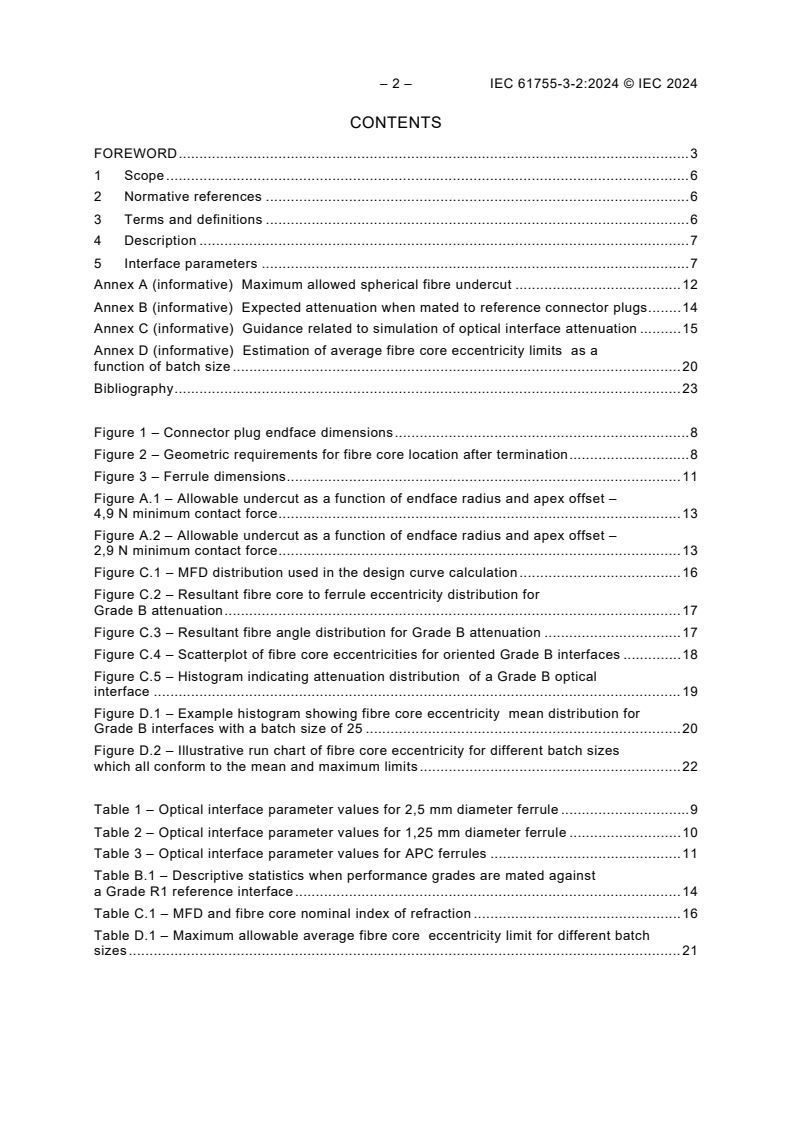
FOREWORD . 3
1 Scope . 6
2 Normative references . 6
3 Terms and definitions . 6
4 Description . 7
5 Interface parameters . 7
Annex A (informative) Maximum allowed spherical fibre undercut . 12
Annex B (informative) Expected attenuation when mated to reference connector plugs . 14
Annex C (informative) Guidance related to simulation of optical interface attenuation . 15
Annex D (informative) Estimation of average fibre core eccentricity limits as a
function of batch size . 20
Bibliography . 23
Figure 1 – Connector plug endface dimensions . 8
Figure 2 – Geometric requirements for fibre core location after termination . 8
Figure 3 – Ferrule dimensions . 11
Figure A.1 – Allowable undercut as a function of endface radius and apex offset –
4,9 N minimum contact force . 13
Figure A.2 – Allowable undercut as a function of endface radius and apex offset –
2,9 N minimum contact force . 13
Figure C.1 – MFD distribution used in the design curve calculation . 16
Figure C.2 – Resultant fibre core to ferrule eccentricity distribution for
Grade B attenuation . 17
Figure C.3 – Resultant fibre angle distribution for Grade B attenuation . 17
Figure C.4 – Scatterplot of fibre core eccentricities for oriented Grade B interfaces . 18
Figure C.5 – Histogram indicating attenuation distribution of a Grade B optical
interface . 19
Figure D.1 – Example histogram showing fibre core eccentricity mean distribution for
Grade B interfaces with a batch size of 25 . 20
Figure D.2 – Illustrative run chart of fibre core eccentricity for different batch sizes
which all conform to the mean and maximum limits . 22
Table 1 – Optical interface parameter values for 2,5 mm diameter ferrule . 9
Table 2 – Optical interface parameter values for 1,25 mm diameter ferrule . 10
Table 3 – Optical interface parameter values for APC ferrules . 11
Table B.1 – Descriptive statistics when performance grades are mated against
a Grade R1 reference interface . 14
Table C.1 – MFD and fibre core nominal index of refraction . 16
Table D.1 – Maximum allowable average fibre core eccentricity limit for different batch
sizes . 21
INTERNATIONAL ELECTROTECHNICAL COMMISSION
____________
FIBRE OPTIC INTERCONNECTING
DEVICES AND PASSIVE COMPONENTS –
CONNECTOR OPTICAL INTERFACES –
Part 3-2: Connector parameters of dispersion unshifted single-mode
physically contacting fibres – Angled 2,5 mm and 1,25 mm diameter
cylindrical full zirconia ferrules
FOREWORD
1) The International Electrotechnical Commission (IEC) is a worldwide organization for standardization comprising
all national electrotechnical committees (IEC National Committees). The object of IEC is to promote international
co-operation on all questions concerning standardization in the electrical and electronic fields. To this end and
in addition to other activities, IEC publishes International Standards, Technical Specifications, Technical Reports,
Publicly Available Specifications (PAS) and Guides (hereafter referred to as “IEC Publication(s)”). Their
preparation is entrusted to technical committees; any IEC National Committee interested in the subject dealt with
may participate in this preparatory work. International, governmental and non-governmental organizations liaising
with the IEC also participate in this preparation. IEC collaborates closely with the International Organization for
Standardization (ISO) in accordance with conditions determined by agreement between the two organizations.
2) The formal decisions or agreements of IEC on technical matters express, as nearly as possible, an international
consensus of opinion on the relevant subjects since each technical committee has representation from all
interested IEC National Committees.
3) IEC Publications have the form of recommendations for international use and are accepted by IEC National
Committees in that sense. While all reasonable efforts are made to ensure that the technical content of IEC
Publications is accurate, IEC cannot be held responsible for the way in which they are used or for any
misinterpretation by any end user.
4) In order to promote international uniformity, IEC National Committees undertake to apply IEC Publications
transparently to the maximum extent possible in their national and regional publications. Any divergence between
any IEC Publication and the corresponding national or regional publication shall be clearly indicated in the latter.
5) IEC itself does not provide any attestation of conformity. Independent certification bodies provide conformity
assessment services and, in some areas, access to IEC marks of conformity. IEC is not responsible for any
services carried out by independent certification bodies.
6) All users should ensure that they have the latest edition of this publication.
7) No liability shall attach to IEC or its directors, employees, servants or agents including individual experts and
members of its technical committees and IEC National Committees for any personal injury, property damage or
other damage of any nature whatsoever, whether direct or indirect, or for costs (including legal fees) and
expenses arising out of the publication, use of, or reliance upon, this IEC Publication or any other IEC
Publications.
8) Attention is drawn to the Normative references cited in this publication. Use of the referenced publications is
indispensable for the correct application of this publication.
9) IEC draws attention to the possibility that the implementation of this document may involve the use of (a)
patent(s). IEC takes no position concerning the evidence, validity or applicability of any claimed patent rights in
respect thereof. As of the date of publication of this document, IEC had not received notice of (a) patent(s), which
may be required to implement this document. However, implementers are cautioned that this may not represent
the latest information, which may be obtained from the patent database available at https://patents.iec.ch. IEC
shall not be held responsible for identifying any or all such patent rights.
IEC 61755-3-2 has been prepared by subcommittee 86B: Fibre optic interconnecting devices
and passive components, of IEC technical committee 86: Fibre optics. It is an International
Standard.
This second edition cancels and replaces the first edition published in 2006. This edition
constitutes a technical revision.
– 4 – IEC 61755-3-2:2024 © IEC 2024
This edition includes the following significant technical changes with respect to the previous
edition:
a) normative references have been added;
b) The introduction of an additional optical interface with a different fibre core eccentricity
profile. The previous revision of optical interface standard is named "Variant 1: with fibre
core axis oriented towards the connector guide key". The additional optical interface is
named "Variant 2: with fibre core axis not oriented towards the connector guide key";
c) statements added related to interoperability, where both variants remain intermateable
within a given performance grade and are fully backwards compatible to
IEC 61755-3-2:2006;
d) The addition of Grade B and Grade C interface requirements for both variants;
e) The addition of a descriptive statistic for the mean fibre core eccentricity (mean value) to
describe the distribution of fibre core eccentricity to ensure interoperability;
f) A new informative Annex B to give guidance on the expected attenuation when mated to a
reference connector plug;
g) A new informative Annex C to give guidance related to the simulation of optical interface
attenuation;
h) A new informative Annex D to give guidance related to estimation of mean fibre eccentricity
limits for finite production batch sizes.
The text of this International Standard is based on the following documents:
Draft Report on voting
86B/4864/FDIS 86B/4890/RVD
Full information on the voting for its approval can be found in the report on voting indicated in
the above table.
The language used for the development of this International Standard is English.
This document was drafted in accordance with ISO/IEC Directives, Part 2, and developed in
accordance with ISO/IEC Directives, Part 1 and ISO/IEC Directives, IEC Supplement, available
at www.iec.ch/members_experts/refdocs. The main document types developed by IEC are
described in greater detail at www.iec.ch/publications.
A list of all parts of the IEC 61755 series, under the general title Fibre optic interconnecting
devices and passive components – Connector optical interfaces for single-mode fibres, can be
found on the IEC website.
Future documents in this series will carry the new general title as cited above. Titles of existing
documents in this series will be updated at the time of the next edition.
The committee has decided that the contents of this document will remain unchanged until the
stability date indicated on the IEC website under webstore.iec.ch in the data related to the
specific document. At this date, the document will be
• reconfirmed,
• withdrawn, or
• revised.
IMPORTANT – The "colour inside" logo on the cover page of this document indicates
that it contains colours which are considered to be useful for the correct understanding
of its contents. Users should therefore print this document using a colour printer.
– 6 – IEC 61755-3-2:2024 © IEC 2024
FIBRE OPTIC INTERCONNECTING
DEVICES AND PASSIVE COMPONENTS –
CONNECTOR OPTICAL INTERFACES –
Part 3-2: Connector parameters of dispersion unshifted single-mode
physically contacting fibres – Angled 2,5 mm and 1,25 mm diameter
cylindrical full zirconia ferrules
1 Scope
This part of IEC 61755 defines the dimensional limits of the optical interface that are necessary
for single-mode fibre optic connectors with 2,5 mm or 1,25 mm diameter cylindrical zirconia
(ZrO ) ferrules polished at an 8° angle to meet the specific requirements for fibre-to-fibre
interconnection, as defined in IEC 61755-2-2.
Ferrules made from the material specified in this standard are suitable for use in all the
operating service environments defined in IEC 61753-1.
Ferrule dimensions and features are contained in the IEC 61754 series of fibre optic connector
interface standards.
2 Normative references
The following documents are referred to in the text in such a way that some or all of their content
constitutes requirements of this document. For dated references, only the edition cited applies.
For undated references, the latest edition of the referenced document (including any
amendments) applies.
IEC 61755-1, Fibre optic interconnecting devices and passive components – Connector optical
interfaces for single-mode fibres – Part 1: Optical interfaces for dispersion unshifted fibres –
General and guidance
3 Terms and definitions
For the purposes of this document, the terms and definitions given in IEC 61755-1 apply.
ISO and IEC maintain terminology databases for use in standardization at the following
addresses:
• IEC Electropedia: available at https://www.electropedia.org/
• ISO Online browsing platform: available at https://www.iso.org/obp
4 Description
The performance of an angled physical contact (APC) cylindrical ferrule optical interface is
determined by the alignment of the optical datum targets of two mating ferrules. There are three
conditions affecting the alignment of two optical datum targets: lateral offset, angular offset and
longitudinal offset.
Parameters influencing the lateral and angular offset of the optical fibre axes include the
following:
– ferrule outside diameter,
– ferrule bore concentricity relative to the ferrule outside diameter,
– ferrule bore angle relative to ferrule outside diameter axis,
– fibre cladding diameter relative to ferrule bore diameter,
– fibre core concentricity relative to the fibre cladding diameter,
– fibre core orientation relative to connector guide key,
– amount of angled PC polishing after tuning of the connector at PC condition,
– alignment sleeve inside diameter,
– force with which the alignment sleeve grips the ferrule.
Parameters influencing the connector plug endface deformation requirements necessary to
maintain the physical contact of the ferrules within a mated connection are as follows:
– endface spherical radius,
– endface spherical radius apex offset of ferrule or angle relative to the APC reference plane,
– fibre undercut,
– ferrule rotational clearance relative to keying,
– axial force on ferrule endface,
– ferrule and fibre material physical constants,
– alignment sleeve frictional force,
– connector keying accuracy.
5 Interface parameters
The endface dimensions of terminated connector plugs provided in Figure 1 and Figure 2 show
the geometrical position of the fibre core for two alternative variants. These core location
variants ensure full intermateability between Variant 1 and Variant 2 as defined in IEC 61755-1.
In addition, both variants produced per this document are fully backwards compatible with
Grade B in IEC 61755-3-2:2006.
The ferrule dimensions are defined in Figure 3. The parameter values are detailed in Table 1,
Table 2 and Table 3.
– 8 – IEC 61755-3-2:2024 © IEC 2024
NOTE B shows the polished spherical radius
Figure 1 – Connector plug endface dimensions
a) Variant 1 b) Variant 2
NOTE F, F’, G and H define the radial and angular polar coordinate limits of the optical fibre core axis relative to
the optical datum target of the ferrule.
Figure 2 – Geometric requirements for fibre core location after termination
Table 1 – Optical interface parameter values for 2,5 mm diameter ferrule
Parameter values
Ref. Grade A Grade B Grade C Grade D Unit Remarks
Min. Max. Min. Max. Min. Max. Min. Max.
b a a a
–100 –100 –100 nm Fibre undercut or protrusion
A
B 5 12 5 12 5 12 mm Spherical radius
C 0 50 0 50 0 50 µm Apex offset
D 2,498 5 2,499 5 2,498 5 2,499 5 2,498 5 2,499 5 mm Outside diameter
E 0 0,2 0 0,3 0 0,6 Angle of fibre axis
°
c d
F 0 0 Not Applicable µm Radius, See Figure 2 a)
1,0 1,4
e f g
F’ 0
0 0 µm Radius, See Figure 2 b)
0,6 1,1 1,5
G 0 0,3 0 0,3 Not Applicable µm Radius, See Figure 2 a)
H 0 50 0 50 Not Applicable See Figure 2 a)
°
I 8 8 8 Basic dimension
°
NOTE 1 The core location (F, F’, G, H) and tilt angle (E) values specified in this document have been calculated
to ensure that the attenuation values specified in IEC 61755-2-1 are met under all circumstances (See Annex C).
Guidance on expected attenuation values when mated to a reference connector plug can be found in Annex B.
NOTE 2 E, F, F’, G and H are measured in the PC state before polishing APC angle.
NOTE 3 Core eccentricity Variant 1 [Figure 2 a)] and Variant 2 [Figure 2 b)] are intended to be fully intermateable
for a given performance grade as defined in IEC 61755-1.
NOTE 4 Grade A is reserved for future application.
NOTE 5 Attenuation performance grades are defined in IEC 61755-1.
NOTE 6 See Annex D for information on estimation of average fibre core eccentricity limits as a function of batch
size. The batch size may be changed according to the guidance in Annex D. The batch size should be included in
the report.
NOTE 7 Refer to IEC 61300-3-47 for endface geometry measurement of PC spherically polished ferrules using
interferometry.
NOTE 8 To account for uncertainty in fibre core eccentricity measurements, the limits and mean values are
rounded to one significant digit after the comma.
a
Contact force 4,9 N nominal. Ferrule material: 3 mol % yttria stabilized zirconia, ZrO . Nominal material physical
constant values: Young’s Modulus, 200 GPa ± 20 GPa, Poisson’s Ratio, 0,30 to 0,31. See Annex A for details.
(−0,795) 6 2 6 2 3
A 1 988⋅ B − B⋅+10 BC⋅−10 ⋅10− 60
maximum
b
A as a negative value indicates fibre protrusion.
c
Fibre core eccentricity distribution shall have a mean less than or equal to 0,4 µm. See Note 6.
d
Fibre core eccentricity distribution shall have a mean less than or equal to 0,5 µm. See Note 6.
e
Fibre core eccentricity distribution shall have a mean less than or equal to 0,2 µm. See Note 6.
f
Fibre core eccentricity distribution shall have a mean less than or equal to 0,4 µm. See Note 6.
g
Fibre core eccentricity distribution shall have a mean less than or equal to 0,6 µm. See Note 6.
=
– 10 – IEC 61755-3-2:2024 © IEC 2024
Table 2 – Optical interface parameter values for 1,25 mm diameter ferrule
Parameter values
Ref. Grade A Grade B Grade C Grade D Unit Remarks
Min. Max. Min. Max. Min. Max. Min. Max.
b a a a
–100 –100 –100 nm Fibre undercut or protrusion
A
B 5 12 5 12 5 12 mm Spherical radius
C 0 50 0 50 0 50 µm Apex offset
D 1,248 5 1,249 5 1,248 5 1,249 5 1,248 5 1,249 5 mm Outside diameter
E 0 0,2 0 0,3 0 0,6 Angle of fibre axis
°
c d
F 0
0 Not Applicable µm Radius, See Figure 2 a)
1,0 1,4
e f g
F’ 0 0 0 µm Radius, See Figure 2 b)
0,6 1,1 1,5
G 0 0,3 0 0,3 Not Applicable µm Radius, See Figure 2 a)
H 0 50 0 50 Not Applicable ° See Figure 2 a)
I 8 8 8 Basic dimension
°
NOTE 1 The core location (F, F’, G, H) and tilt angle (E) values specified in this document have been calculated
to ensure that the attenuation values specified in IEC 61755-2-1 are met under all circumstances (See Annex C).
Guidance on expected attenuation values when mated to a reference connector plug can be found in Annex B.
NOTE 2 E, F, F’, G and H are measured in the PC state before polishing APC angle.
NOTE 3 Core eccentricity Variant 1 [Figure 2 a)] and Variant 2 [Figure 2 b)] are intended to be fully intermateable
for a given performance grade as defined in IEC 61755-1.
NOTE 4 Grade A is reserved for future application.
NOTE 5 Attenuation performance grades are defined in IEC 61755-1.
NOTE 6 See Annex D for information on estimation of average fibre core eccentricity limits as a function of batch
size. The batch size may be changed according to the guidance in Annex D. The batch size should be included in
the report.
NOTE 7 Refer to IEC 61300-3-47 for endface geometry measurement of PC spherically polished ferrules using
interferometry.
NOTE 8 To account for uncertainty in fibre core eccentricity measurements, the limits and mean values are
rounded to one significant digit after the comma.
a
Contact force 2,9 N nominal. Ferrule material: 3 mol % yttria stabilized zirconia, ZrO . Nominal material physical
constant values: Young’s Modulus, 200 GPa ± 20 GPa, Poisson’s Ratio, 0,30 to 0,31. See Annex A for details.
(−0,795) 6 2 6 2 3
A 1 798⋅ B − B⋅+10 BC⋅−10 ⋅10− 60
maximum
b
A as a negative value indicates fibre protrusion.
c
Fibre core eccentricity distribution shall have a mean less than or equal to 0,4 µm. See Note 6.
d
Fibre core eccentricity distribution shall have a mean less than or equal to 0,5 µm. See Note 6.
e
Fibre core eccentricity distribution shall have a mean less than or equal to 0,2 µm. See Note 6.
f
Fibre core eccentricity distribution shall have a mean less than or equal to 0,4 µm. See Note 6.
g
Fibre core eccentricity distribution shall have a mean less than or equal to 0,6 µm. See Note 6.
=
a) Conical type b) Step type
Figure 3 – Ferrule dimensions
Table 3 – Optical interface parameter values for APC ferrules
2,5 mm diameter ferrule 1,25 mm diameter ferrule
parameter values parameter values
Ref. Remarks
Min. Max. Min. Max.
mm mm mm mm
J 0,8 1,7 0,6 0,85 Diameter
K - 1,8 - 1,0
– 12 – IEC 61755-3-2:2024 © IEC 2024
Annex A
(informative)
Maximum allowed spherical fibre undercut
The maximum allowed spherical fibre undercut A (see Figure A.1 and Figure A.2) is
maximum
determined by the interaction of the parameters influencing the longitudinal offset of the optical
fibre axes as defined by Formula (A.1)
k
6 26 2 3
A =kB⋅ − B⋅+10 B⋅−10 C ⋅10− D − D
(A.1)
maximum 1 DTE PFW
where
A is the maximum spherical undercut for physical contact (nm),
maximum
k is the coefficient based on ferrule contact force and material properties,
is the exponent based on ferrule contact force and material properties,
k
B is the endface spherical radius (mm),
C is the apex offset from fibre axis (μm),
D is the differential thermal expansion between the ferrule material and the silica fibre
DTE
at maximum operating temperature (nm),
D is the permanent fibre withdrawal that exceeds the transient fibre movement
PFW
predicted by the first three terms in Formula (A.1) (nm).
Endface deformation term as a function of contact force, endface radius and material properties
is shown in Formula (A.2):
k
(A.2)
kB⋅
Geometric compensation term for the offset of the ferrule apex from the fibre axis is shown in
Formula (A.3):
6 26 2 3
B⋅+10 BC⋅−10 ⋅10
(A.3)
(−0,795) 6 2 6 2 3
A 1 988⋅ B − B⋅+10 BC⋅−10 ⋅10− 60
maximum
Figure A.1 – Allowable undercut as a function of endface radius and apex offset –
4,9 N minimum contact force
(−0,795) 6 2 6 2 3
A 1 798⋅ B − B⋅+10 BC⋅−10 ⋅10− 60
maximum
Figure A.2 – Allowable undercut as a function of endface radius and apex offset –
2,9 N minimum contact force
=
=
– 14 – IEC 61755-3-2:2024 © IEC 2024
Annex B
(informative)
Expected attenuation when mated to reference connector plugs
This annex describes the expected attenuation when terminated connector plugs are mated
against a reference interface. The use of reference cords helps to ensure consistency between
field measurements and factory measurements.
The performance grades defined within this document are based solely on the geometric optical
interface parameters which influence lateral and angular offset. Therefore, attenuation
measurements against a reference connector plug are not a substitution for dimensional
compliance of an optical interface and should not be used to select connector plugs for a given
performance grade.
The estimated descriptive statistics of connectors mated against reference interfaces defined
in IEC 61755-2-5 (Grade R1) are provided within Table B.1. These values are calculated at
1 310 nm wavelength using Monte Carlo techniques.
Table B.1 – Descriptive statistics when performance grades are mated against
a Grade R1 reference interface
Performance grade
(dB)
Descriptive statistic Description
Variant 1 Variant 2
B C B C D
µ Average 0,08 0,11 0,05 0,07 0,12
σ Standard deviation 0,06 0,09 0,04 0,06 0,11
0,97 ≥ 97 % probability 0,22 0,34 0,13 0,22 0,38
When screening products against a reference, the 99,9 % value is used as limits:
a) For Variant 1, it is recommended to use 0,35 dB for the Grade B limit and 0,45 dB for the
Grade C limit.
b) For Variant 2, it is recommended to use 0,20 dB for the Grade B limit, 0,35 dB for the Grade
C limit, and 0,65 dB for the Grade D limit.
This screening can be used to inspect for failure modes such as fractured fibres, mechanical
stresses, microbending or macrobending (assuring optical functionality).
Annex C
(informative)
Guidance related to simulation of optical interface attenuation
The attenuation of an optical interface is influenced by several parameters, which combine to
form a summation of both intrinsic (fibre property mismatch) and extrinsic (misalignment) losses.
Fibre related losses are direction independent and related to variation between mating mode
field diameters. Misalignment induced losses are influenced by lateral and angular offset of the
optical fibre axes. The alignment of the optical datum targets of two mating ferrules is a function
of dimensional limits placed on the fibre, ferrule, and alignment sleeve, including tolerances on
the fibre core eccentricity and cladding diameter, ferrule fibre hole size, concentricity, tilt
relative to the ferrule outside diameter, and fit of the ferrule within the alignment sleeve.
For a given performance grade, propagation of the individual tolerances in a worst-case
condition generally results in overly restrictive controls on the fibre, ferrule, and alignment
sleeve system. Therefore, statistical tolerance methods have been adopted for the development
of the optical interface. Estimated attenuation thresholds are placed on two statistical values:
th
the mean and the 97 percentile of the distribution of random-mate connections. The
attenuation distributions can be computed analytically from parameterized probability density
functions or using approaches such as Monte Carlo techniques.
th
The distributions and related statistical values (i.e. mean and 97 percentile) in this document
are valid for the entire population of random-mate connections.
th
The actual distributions of attenuation and the related statistical values (i.e. mean and 97
percentile) can deviate from the simulated ones in this document for two main reasons:
1) Batch effects in production of fibres and ferrules are encountered leading to different
attenuation populations.
2) Samples from an attenuation population are drawn and evaluated (e.g. a small-size
production lot of terminated assemblies).
Using the estimated attenuation population given in the document, confidence intervals for both
th
related statistical values (i.e. mean and 97 percentile) can be computed.
The attenuation, η , between mating fibres, is based on a Gaussian beam approximation
combined
for the distribution of the incident light and is given by Formula (C.1).
2 2 ωω
2ωω ( 21 )
( ) n
−⋅2 d
21 22
0
η =−−10log exp 2πθsin
( ) (C.1)
combined 10
2 22 2
ωω+ λ ωω+
21
( 21 )
ωω+
( 21 )
where
d is the total lateral offset,
θ is the angular offset between fibre core axes,
λ is the wavelength of transmitted light in vacuum,
n is the index of refraction of the fibre core,
ω is the transmit fibre mode field radius,
ω is the receive fibre mode field radius.
– 16 – IEC 61755-3-2:2024 © IEC 2024
Based on IEC 60793-2-50 family specification for single-mode non-dispersion shifted fibres
category B, the nominal fibre mode field diameter (MFD) range and nominal index of refraction
of the fibre cores are given in Table C.1.
Table C.1 – MFD and fibre core nominal index of refraction
n (core)
Fibre type Nominal wavelength Nominal MFD
[nm] [µm]
IEC 60793-2-50 category B fibres 1 310 8,6 to 9,2 1,452 0
For the purpose of modelling connector plug performance, a Gaussian modal mode field
diameter distribution is used with a centre at 8,9 µm and standard deviation of 0,23 µm. The
rationale for this assumption is to provide a conservative treatment of the parameter limits
based on modern, bending-loss insensitive fibres that generally fall within the lower end of the
mode field diameter range. When legacy fibres are considered, with a nominal mode field
diameter typically centred around 9,2 µm, incrementally lower attenuation can be achieved.
However, the magnitude of this improvement is largely minor in comparison to the defined
performance grade limits. The mode field distribution chosen is highlighted in Figure C.1.
Figure C.1 – MFD distribution used in the design curve calculation
As noted previously, an accumulation of tolerances, including the eccentricity of a fibre core, fit
of the fibre within a ferrule bore, and concentricity of the ferrule bore relative to the ferrule
outside diameter, results in a net lateral misalignment. To assure a common level of
performance, while providing manufacturing flexibility, only the net misalignment of a fibre core
with respect to the optical datum target of a ferrule is specified. This provides producers
freedom in selecting component tolerances, while still maintaining compliance with the limits
defined within this specification.
Each of the individual offset tolerances are treated as Gaussian to allow linear combinations of
random variables to be applied. The result is a two-dimensional offset distribution in (x, y) with
a bivariate normal shape. Furthermore, a multivariate transformation can be made between
rectangular and polar coordinates by computing the Jacobian determinant. The result is a
Rayleigh-shaped fibre core eccentricity distribution, combined with a uniform distribution for the
azimuthal angle of this radial offset. An example frequency plot for a typical Grade B optical
interface is shown in Figure C.2. Similar practices can be applied for the net angular offset, as
illustrated in Figure C.3.
a) Variant 1
b) Variant 2
Figure C.2 – Resultant fibre core to ferrule eccentricity
distribution for Grade B attenuation
Figure C.3 – Resultant fibre angle distribution for Grade B attenuation
– 18 – IEC 61755-3-2:2024 © IEC 2024
When an optical interface is oriented, the lateral offset of a given plug is tuned into the keyhole
area described previously in Figure 2 a) of this document. A nominal tuning sector of ±45° from
the connector polarity key is generally considered (4-position tuning), with an additional 10°
total tolerance on the angle to account for random uncertainty of the tuning angle boundaries;
thus, yielding a ±50° limit. The central diameter of the keyhole geometry indicates radial offsets
which are well centred and do not require tuning. This threshold could be identified via
attenuation measurement screening against a reference cord or visual inspection using
microscopy. A scatter plot showing a simulated population of fibre core deviation from the
optical datum target is shown in Figure C.4 for both variants.
a) Variant 1
b) Variant 2
Figure C.4 – Scatterplot of fibre core eccentricities for oriented Grade B interfaces
Based on the various dimensional parameters, the attenuation at the optical interface is finally
found. This is illustrated for a Grade B optical interface in Figure C.5.
a) Variant 1
b) Variant 2
c) Variant 1 to Variant 2
Figure C.5 – Histogram indicating attenuation distribution
of a Grade B optical interface
– 20 – IEC 61755-3-2:2024 © IEC 2024
Annex D
(informative)
Estimation of average fibre core eccentricity limits
as a function of batch size
To assure optical performance of randomly mated connectors, the distributions of the various
geometric interface dimensions should be controlled. Fibre core eccentricity, which has a
dominant influence on connection loss is constrained by a maximum tolerance limit as well as
a requirement for the population mean in Table 1 and Table 2. This control of the mean is an
important parameter, which provides confidence that the statistical values (i.e. mean and 97 %
percentile) for the defined attenuation grades are satisfied. While the use of statistical process
control (SPC) is not a requirement for the compliance of products, manufacturers should be
able to demonstrate with a reasonable level of confidence that their production conforms to the
population mean limit. One possible method of establishing this is described within this annex.
Given normal production practices, it is reasonable to select batch sizes to estimate bounds on
the allowable average fibre core eccentricity range. The standard error of the mean, σ , can
x
be expressed as
σ
σ =
(D.1)
x
n
where σ is the population standard deviation and n is the batch size. This provides a measure
of the dispersion of batch means around the population mean. The histogram illustrated in
Figure D.1 shows an example distribution of batch means for a size of 25. It should be noted
that the shape approximates a Gaussian distribution as established by the central limit theorem.
Figure D.1 – Example histogram showing fibre core eccentricity
mean distribution for Grade B interfaces with a batch size of 25
Selection of an appropriate batch size is dependent on a manufacturer’s production runs. In
general, increasing the batch size will decrease the standard error of the mean; where the
variance trends towards zero as the batch size increases. To specify a production limit on the
allowable mean for a given batch size, a confidence interval maximum of can be used.
3σ
x
Therefore, the maximum allowable average fibre core eccentricity, x , for a given batch size
max
can be expressed as
xµ+ 3
(D.2)
max x
where, µ is the population mean limit defined in the optical interface parameter grade tables
(Table 1 and Table 2). The recommended maximum allowable average fibre core eccentricity
for various batch sizes is given in Table D.1.
Table D.1 – Maximum allowable average fibre core
eccentricity limit for different batch sizes
(µm)
x
max
Batch size
Grade B Grade C Grade D
Variant 1 Variant 2 Variant 1 Variant 2 Variant 2
10 0,6 0,3 0,8 0,6 0,8
100 0,5 0,2 0,6 0,5 0,6
1 000 0,4 0,2 0,6 0,4 0,6
As described in Annex C, the actual attenuation statistics can deviate from the simulated
estimate due to batch effects and samples being randomly drawn from a population. This is
largely due to variation in the individual fibre core eccentricity values for a given sample size.
An illustrative example of batch effects for different size batches of Grade B Variant 1
connectors is given in Figure D.2. In this plot, individual connector measurements are shown,
along with the corresponding actual mean of a batch, the mean limit, and maximum tolerance.
All these lots would be accepted since the actual batch means are below their mean limits and
the single connector measurements are less than the maximum eccentricity threshold.
=
– 22 – IEC 61755-3-2:2024 © IEC 2024
Figure D.2 – Illustrative run chart of fibre core eccentricity for different batch sizes
which all conform to the mean and maximum limits
Bibliography
IEC 61300-3-47, Fibre optic interconnecting devices and passive components – Basic test and
measurement procedures – Part 3-47: Examinations and measurements – End face geometry
of PC/APC spherically polished ferrules using interferometry
IEC 61753-1, Fibre optic interconnecting devices and passive components – Performance
standard – Part 1: General and guidance
IEC 61754 (all parts), Fibre optic interconnecting devices and passive components – Fibre optic
connector interfaces
IEC 61755-2-2, Fibre optic interconnecting devices and passive components – Connector
optical interfaces for single-mode fibres – Part 2-2: Connection parameters of dispersion
unshifted physically contacting fibres –
...