

IEC 60974-2:2002
(Main)Arc welding equipment - Part 2: Liquid cooling systems
General Information
- Abstract
Specifies safety and construction requirements for liquid cooling systems intended to cool torches. These liquid cooling systems can be internal or external to power sources for arc welding and allied processes.
- Status
- Published
- Publication Date
- 23-Jun-2002
- Technical Committee
- TC 26 - Electric welding
- Current Stage
- DELPUB - Deleted Publication
- Start Date
- 14-Nov-2007
- Completion Date
- 28-Aug-2026
Buy Documents
IEC 60974-2:2002 - Arc welding equipment - Part 2: Liquid cooling systems Released:6/24/2002
IEC 60974-2:2002 - Arc welding equipment - Part 2: Liquid cooling systems Released:6/24/2002
Overview
IEC 60974-2:2002 - "Arc welding equipment - Part 2: Liquid cooling systems" specifies safety, construction and test requirements for liquid cooling systems used to cool welding torches. It applies to systems that are either internal (incorporated in welding power sources) or external to power sources. Refrigerated cooling systems are excluded. The standard is intended to ensure safe electrical insulation, mechanical integrity, pressure/thermal performance and clear marking/instructions for use.
Key topics and requirements
- Scope and definitions: clarifies terms such as liquid cooling system, internal/external cooling system and cooling power.
- Insulation and electric safety: references IEC 60974‑1 requirements for clearances, creepage distances and dielectric strength. Specific checks include dielectric tests without coolant and a leakage-current limit of 10 mA DC from the torch contact tip to protective earth (tested with 500 V DC).
- Mechanical and pressure tests:
- Manufacturer must declare rated maximum pressure; conformity checked by blocking the outlet.
- Systems must operate without leakage at rated pressure and 70 °C coolant; subjected to 1.5× rated pressure for inspection.
- Overflow/spillage safety test: add 15% of container volume (or 0.25 L) and pass dielectric strength test.
- Cooling liquid: typically water with antifreeze or corrosion inhibitors. The standard requires visible marking of recommended coolant and antifreeze characteristics (note: antifreeze affects electrical conductivity).
- Thermal and cooling-power testing:
- Cooling power declared as kW at 100% duty with coolant recommended by manufacturer and at 1 L/min flow.
- Test procedure: stabilize with an electrical heater set to produce ~40 K ±2 K temperature rise over ambient; run ≥60 minutes until temperature-rise rate ≤2 K/h. Formula and fluid data (specific heat, density) are used to calculate cooling power.
- Marking and documentation: rating plate sections for identification, energy input (mains voltage, current, IP rating) and liquid cooling data (rated cooling power, maximum pressure). User instructions and functional tests (leak checks, flow sensor operation) are required.
Applications and users
Who uses IEC 60974‑2:
- Welding equipment manufacturers (design, type/routine testing, compliance)
- Test laboratories and certification bodies (type and routine test protocols)
- Safety engineers and maintenance teams (installation, coolant selection, inspection)
- Procurement and specification writers (selecting appropriate external/internal cooling units)
Practical applications:
- Designing torch cooling circuits and housings
- Specifying cooling power and pressure ratings for industrial welding systems
- Verifying dielectric, leakage-current and pressure performance during QA
- Labelling and user instructions to support safe operation and maintenance
Related standards
- IEC 60974‑1: Arc‑welding equipment - Part 1: Welding power sources (normative reference)
- IEC 60974‑7: Arc‑welding equipment - Part 7: Torches
Keywords: IEC 60974-2, liquid cooling systems, arc welding equipment, cooling power, torch cooling, dielectric strength, leakage current, welding safety, cooling liquid.
Relations
- Effective Date
- 05-Sep-2023
Buy Documents
IEC 60974-2:2002 - Arc welding equipment - Part 2: Liquid cooling systems Released:6/24/2002
IEC 60974-2:2002 - Arc welding equipment - Part 2: Liquid cooling systems Released:6/24/2002
Get Certified
Connect with accredited certification bodies for this standard

DVS-ZERT GmbH
German welding certification society.
CARES (UK Certification Authority for Reinforcing Steels)
UK certification for reinforcing steels and construction.
EWF/IIW (European/International Welding Federation)
International welding personnel certification.
Sponsored listings
Frequently Asked Questions
IEC 60974-2:2002 is a standard published by the International Electrotechnical Commission (IEC). Its full title is "Arc welding equipment - Part 2: Liquid cooling systems". This standard covers: Specifies safety and construction requirements for liquid cooling systems intended to cool torches. These liquid cooling systems can be internal or external to power sources for arc welding and allied processes.
Specifies safety and construction requirements for liquid cooling systems intended to cool torches. These liquid cooling systems can be internal or external to power sources for arc welding and allied processes.
IEC 60974-2:2002 is classified under the following ICS (International Classification for Standards) categories: 25.160.30 - Welding equipment. The ICS classification helps identify the subject area and facilitates finding related standards.
IEC 60974-2:2002 has the following relationships with other standards: It is inter standard links to IEC 60974-2:2007. Understanding these relationships helps ensure you are using the most current and applicable version of the standard.
IEC 60974-2:2002 is available in PDF format for immediate download after purchase. The document can be added to your cart and obtained through the secure checkout process. Digital delivery ensures instant access to the complete standard document.
Standards Content (Sample)
INTERNATIONAL IEC
STANDARD
60974-2
First edition
2002-06
Arc welding equipment –
Part 2:
Liquid cooling systems
Matériel de soudage à l'arc –
Partie 2:
Systèmes de refroidissement par liquide
Reference number
Publication numbering
As from 1 January 1997 all IEC publications are issued with a designation in the
60000 series. For example, IEC 34-1 is now referred to as IEC 60034-1.
Consolidated editions
The IEC is now publishing consolidated versions of its publications. For example,
edition numbers 1.0, 1.1 and 1.2 refer, respectively, to the base publication, the
base publication incorporating amendment 1 and the base publication incorporating
amendments 1 and 2.
Further information on IEC publications
The technical content of IEC publications is kept under constant review by the IEC,
thus ensuring that the content reflects current technology. Information relating to
this publication, including its validity, is available in the IEC Catalogue of
publications (see below) in addition to new editions, amendments and corrigenda.
Information on the subjects under consideration and work in progress undertaken
by the technical committee which has prepared this publication, as well as the list
of publications issued, is also available from the following:
• IEC Web Site (www.iec.ch)
• Catalogue of IEC publications
The on-line catalogue on the IEC web site (www.iec.ch/catlg-e.htm) enables
you to search by a variety of criteria including text searches, technical
committees and date of publication. On-line information is also available on
recently issued publications, withdrawn and replaced publications, as well as
corrigenda.
• IEC Just Published
This summary of recently issued publications (www.iec.ch/JP.htm) is also
available by email. Please contact the Customer Service Centre (see below) for
further information.
• Customer Service Centre
If you have any questions regarding this publication or need further assistance,
please contact the Customer Service Centre:
Email: custserv@iec.ch
Tel: +41 22 919 02 11
Fax: +41 22 919 03 00
INTERNATIONAL IEC
STANDARD
60974-2
First edition
2002-06
Arc welding equipment –
Part 2:
Liquid cooling systems
Matériel de soudage à l'arc –
Partie 2:
Systèmes de refroidissement par liquide
IEC 2002 Copyright - all rights reserved
No part of this publication may be reproduced or utilized in any form or by any means, electronic or
mechanical, including photocopying and microfilm, without permission in writing from the publisher.
International Electrotechnical Commission, 3, rue de Varembé, PO Box 131, CH-1211 Geneva 20, Switzerland
Telephone: +41 22 919 02 11 Telefax: +41 22 919 03 00 E-mail: inmail@iec.ch Web: www.iec.ch
PRICE CODE
Commission Electrotechnique Internationale
N
International Electrotechnical Commission
Международная Электротехническая Комиссия
For price, see current catalogue
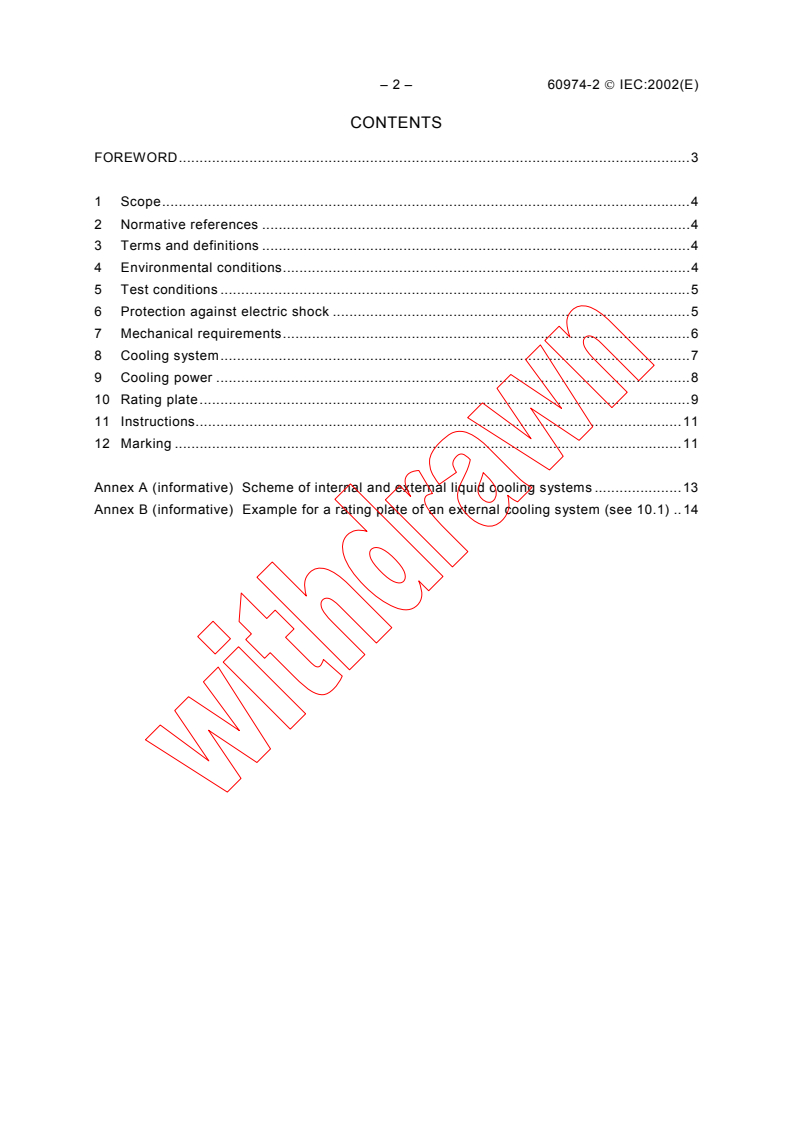
– 2 – 60974-2 IEC:2002(E)
CONTENTS
FOREWORD.3
1 Scope.4
2 Normative references .4
3 Terms and definitions .4
4 Environmental conditions.4
5 Test conditions .5
6 Protection against electric shock .5
7 Mechanical requirements.6
8 Cooling system.7
9 Cooling power .8
10 Rating plate.9
11 Instructions.11
12 Marking .11
Annex A (informative) Scheme of internal and external liquid cooling systems .13
Annex B (informative) Example for a rating plate of an external cooling system (see 10.1) .14
60974-2 © IEC:2002(E) – 3 –
INTERNATIONAL ELECTROTECHNICAL COMMISSION
___________
ARC WELDING EQUIPMENT –
Part 2: Liquid cooling systems
FOREWORD
1) The IEC (International Electrotechnical Commission) is a worldwide organization for standardization comprising
all national electrotechnical committees (IEC National Committees). The object of the IEC is to promote
international co-operation on all questions concerning standardization in the electrical and electronic fields. To
this end and in addition to other activities, the IEC publishes International Standards. Their preparation is
entrusted to technical committees; any IEC National Committee interested in the subject dealt with may
participate in this preparatory work. International, governmental and non-governmental organizations liaising
with the IEC also participate in this preparation. The IEC collaborates closely with the International
Organization for Standardization (ISO) in accordance with conditions determined by agreement between the
two organizations.
2) The formal decisions or agreements of the IEC on technical matters express, as nearly as possible, an
international consensus of opinion on the relevant subjects since each technical committee has representation
from all interested National Committees.
3) The documents produced have the form of recommendations for international use and are published in the form
of standards, technical specifications, technical reports or guides and they are accepted by the National
Committees in that sense.
4) In order to promote international unification, IEC National Committees undertake to apply IEC International
Standards transparently to the maximum extent possible in their national and regional standards. Any
divergence between the IEC Standard and the corresponding national or regional standard shall be clearly
indicated in the latter.
5) The IEC provides no marking procedure to indicate its approval and cannot be rendered responsible for any
equipment declared to be in conformity with one of its standards.
6) Attention is drawn to the possibility that some of the elements of this International Standard may be the subject
of patent rights. The IEC shall not be held responsible for identifying any or all such patent rights.
International Standard IEC 60974-2 has been prepared by IEC technical committee 26:
Electric welding.
The text of this standard is based on the following documents:
FDIS Report on voting
26/236/FDIS 26/238/RVD
Full information on the voting for the approval of this standard can be found in the report on
voting indicated in the above table.
This standard shall be used in conjunction with IEC 60974-1 (1998).
This publication has been drafted in accordance with the ISO/IEC Directives, Part 2.
The committee has decided that the contents of this publication will remain unchanged until
2005. At this date, the publication will be
• reconfirmed;
• withdrawn;
• replaced by a revised edition, or
• amended.
A bilingual version of this publication may be issued at a later date.
– 4 – 60974-2 IEC:2002(E)
ARC WELDING EQUIPMENT –
Part 2: Liquid cooling systems
1 Scope
This part of IEC 60974 specifies safety and construction requirements for liquid cooling
systems intended to cool torches. These liquid cooling systems can be internal or external to
power sources for arc welding and allied processes (see annex A).
This standard is not applicable to refrigerated cooling systems.
2 Normative references
The following referenced documents are indispensable for the application of this document.
For dated references, only the edition cited applies. For undated references, the latest edition
of the referenced document (including any amendments) applies.
IEC 60974-1:1998, Arc-welding equipment – Part 1: Welding power sources
Amendment 1 (2000)
IEC 60974-7:2000, Arc-welding equipment – Part 7: Torches
3 Terms and definitions
For the purposes of this part of IEC 60974 the definitions of IEC 60974-1, IEC 60974-7 and
following apply.
3.1
liquid cooling system
system that circulates and cools liquid used for decreasing the temperature of equipment of
arc welding and allied processes
3.2
internal cooling system
cooling system incorporated in a welding power source
3.3
external cooling system
cooling system not incorporated in a welding power source
3.4
cooling power (P)
cooling energy related to the mass flow rate
4 Environmental conditions
As specified in IEC 60974-1, clause 4.
60974-2 © IEC:2002(E) – 5 –
5 Test conditions
As specified in IEC 60974-1, clause 5.
External cooling systems may be tested without a welding power source.
Internal cooling systems shall be tested with the welding power source.
5.1 Type tests
All type tests shall be carried out on the same cooling system except as specified otherwise.
As a condition of conformity the type tests given below shall be carried out in the following
sequence:
a) general visual inspection, as defined in IEC 60974-1, 3.7;
b) protection provided by the enclosure, as specified in IEC 60974-1, 6.2.1;
c) mechanical requirements, see clause 7;
d) insulation resistance, see 6.1.3;
e) dielectric strength, see 6.1.4.
The other tests included in this standard and not listed here may be carried out in any
convenient sequence.
5.2 Routine tests
All routine tests given below shall be carried out on each cooling system in the following
sequence:
a) general visual inspection, as defined in IEC 60974-1, 3.7;
b) continuity of the protective circuit, as specified in IEC 60974-1, 10.4.2;
c) dielectric strength, see 6.1.4;
d) functional test as specified by the manufacturer, for example leaks of fluid or gas, flow
sensor operation.
6 Protection against electric shock
6.1 Insulation
As specified in IEC 60974-1, 6.1.
6.1.1 Clearances
As specified in IEC 60974-1, 6.1.1.
6.1.2 Creepage distances
As specified in IEC 60974-1, 6.1.2.
6.1.3 Insulation resistance
Without cooling liquid, see IEC 60974-1, 6.1.3
– 6 – 60974-2 IEC:2002(E)
6.1.4 Dielectric strength
Without cooling liquid, see IEC 60974-1, 6.1.4.
6.2 Protection against electric shock in normal service (direct contact)
As specified in IEC 60974-1, 6.2.
6.3 Protection against electric shock in case of a fault condition (indirect contact)
As specified in IEC 60974-1, 6.3.
6.4 Connection to the input supply
As specified in IEC 60974-1, clause 10.
6.5 Leakage current between welding circuit and protective earth
With the cooling system, filled with coolant as specified by the manufacturer, the current from
the contact tip of the torch to the protective earth connection of the cooling system shall not
exceed 10 mA d.c.
Conformity shall be checked without interference suppression or protection capacitors (see
6.3.1 of IEC 60974-1) by application of a d.c. voltage of 500 V at room temperature. When
tested, the coolant shall be flowing with at least a 3 m torch attached to the cooling system in
a typical fashion. Hoses used for external connection to the torch shall be with a maximum
length of 0,5 m.
7 Mechanical requirements
As specified in IEC 60974-1, clause 14.
For the compliance tests the cooling system shall be filled with cooling liquid.
7.1 Cooling liquid overflow
When filling the cooling system according to the manufacturer's instructions, overflow or
spillage shall not result in electric shock.
Conformity shall be checked by the following treatment and test. The liquid container is
completely filled. A further quantity of liquid equal to 15 % of the capacity of the container or
0,25 l, whichever is the greater, is then poured in steadily over a period of 60 s. Immediately
after this treatment, the equipment shall pass the dielectric strength test of 6.1.4 between
input circuits and exposed conductive parts.
7.2 Hose coupling devices and hose connections
If hose coupling devices or hose connections, which often have to be undone, are placed
above or near to live parts, these live parts shall be protected from cooling liquid by splash
proof enclosures, with drains or other appropriate measures. An exception is made for live
parts of the welding circuit.
60974-2 © IEC:2002(E) – 7 –
8 Cooling system
8.1 Rated maximum pressure
...
NORME CEI
INTERNATIONALE
IEC
60974-2
INTERNATIONAL
Première édition
STANDARD
First edition
2002-06
Matériel de soudage à l'arc –
Partie 2:
Systèmes de refroidissement par liquide
Arc welding equipment –
Part 2:
Liquid cooling systems
Numéro de référence
Reference number
CEI/IEC 60974-2:2005
Numérotation des publications Publication numbering
Depuis le 1er janvier 1997, les publications de la CEI As from 1 January 1997 all IEC publications are
sont numérotées à partir de 60000. Ainsi, la CEI 34-1 issued with a designation in the 60000 series. For
devient la CEI 60034-1. example, IEC 34-1 is now referred to as IEC 60034-1.
Editions consolidées Consolidated editions
Les versions consolidées de certaines publications de la The IEC is now publishing consolidated versions of its
CEI incorporant les amendements sont disponibles. Par publications. For example, edition numbers 1.0, 1.1
exemple, les numéros d’édition 1.0, 1.1 et 1.2 indiquent and 1.2 refer, respectively, to the base publication,
respectivement la publication de base, la publication de the base publication incorporating amendment 1 and
base incorporant l’amendement 1, et la publication de the base publication incorporating amendments 1
base incorporant les amendements 1 et 2. and 2.
Informations supplémentaires Further information on IEC publications
sur les publications de la CEI
Le contenu technique des publications de la CEI est The technical content of IEC publications is kept
constamment revu par la CEI afin qu'il reflète l'état under constant review by the IEC, thus ensuring that
actuel de la technique. Des renseignements relatifs à the content reflects current technology. Information
cette publication, y compris sa validité, sont dispo- relating to this publication, including its validity, is
nibles dans le Catalogue des publications de la CEI available in the IEC Catalogue of publications
(voir ci-dessous) en plus des nouvelles éditions, (see below) in addition to new editions, amendments
amendements et corrigenda. Des informations sur les and corrigenda. Information on the subjects under
sujets à l’étude et l’avancement des travaux entrepris consideration and work in progress undertaken by the
par le comité d’études qui a élaboré cette publication, technical committee which has prepared this
ainsi que la liste des publications parues, sont publication, as well as the list of publications issued,
également disponibles par l’intermédiaire de: is also available from the following:
• Site web de la CEI (www.iec.ch) • IEC Web Site (www.iec.ch)
• Catalogue des publications de la CEI • Catalogue of IEC publications
Le catalogue en ligne sur le site web de la CEI The on-line catalogue on the IEC web site
(www.iec.ch/searchpub) vous permet de faire des (www.iec.ch/searchpub) enables you to search by a
recherches en utilisant de nombreux critères, variety of criteria including text searches,
comprenant des recherches textuelles, par comité technical committees and date of publication. On-
d’études ou date de publication. Des informations en line information is also available on recently
ligne sont également disponibles sur les nouvelles issued publications, withdrawn and replaced
publications, les publications remplacées ou retirées, publications, as well as corrigenda.
ainsi que sur les corrigenda.
• IEC Just Published • IEC Just Published
Ce résumé des dernières publications parues This summary of recently issued publications
(www.iec.ch/online_news/justpub) est aussi dispo- (www.iec.ch/online_news/justpub) is also available
nible par courrier électronique. Veuillez prendre by email. Please contact the Customer Service
contact avec le Service client (voir ci-dessous) Centre (see below) for further information.
pour plus d’informations.
• Service clients • Customer Service Centre
Si vous avez des questions au sujet de cette If you have any questions regarding this
publication ou avez besoin de renseignements publication or need further assistance, please
supplémentaires, prenez contact avec le Service contact the Customer Service Centre:
clients:
Email: custserv@iec.ch Email: custserv@iec.ch
Tél: +41 22 919 02 11 Tel: +41 22 919 02 11
Fax: +41 22 919 03 00 Fax: +41 22 919 03 00
.
NORME CEI
INTERNATIONALE
IEC
60974-2
INTERNATIONAL
Première édition
STANDARD
First edition
2002-06
Matériel de soudage à l'arc –
Partie 2:
Systèmes de refroidissement par liquide
Arc welding equipment –
Part 2:
Liquid cooling systems
IEC 2005 Droits de reproduction réservés Copyright - all rights reserved
Aucune partie de cette publication ne peut être reproduite ni No part of this publication may be reproduced or utilized in any
utilisée sous quelque forme que ce soit et par aucun procédé, form or by any means, electronic or mechanical, including
électronique ou mécanique, y compris la photocopie et les photocopying and microfilm, without permission in writing from
microfilms, sans l'accord écrit de l'éditeur. the publisher.
International Electrotechnical Commission, 3, rue de Varembé, PO Box 131, CH-1211 Geneva 20, Switzerland
Telephone: +41 22 919 02 11 Telefax: +41 22 919 03 00 E-mail: inmail@iec.ch Web: www.iec.ch
CODE PRIX
N
PRICE CODE
Commission Electrotechnique Internationale
International Electrotechnical Commission
МеждународнаяЭлектротехническаяКомиссия
Pour prix, voir catalogue en vigueur
For price, see current catalogue
– 2 – 60974-2 CEI:2005
SOMMAIRE
AVANT-PROPOS.4
1 Domaine d’application .8
2 Références normatives.8
3 Termes et définitions .8
4 Conditions ambiantes .10
5 Conditions d’essais .10
6 Protection contre les chocs électriques.10
7 Exigences mécaniques .12
8 Système de refroidissement .14
9 Puissance de refroidissement.16
10 Plaque signalétique .18
11 Instructions.22
12 Marquage .24
Annexe A (informative) Schéma des systèmes de refroidissement par liquide internes
et externes.26
Annexe B (informative) Exemple d’une plaque signalétique pour un système de
refroidissement externe (voir 10.1) .28
60974-2 IEC:2005 – 3 –
CONTENTS
FOREWORD.5
1 Scope.9
2 Normative references.9
3 Terms and definitions .9
4 Environmental conditions.11
5 Test conditions.11
6 Protection against electric shock .11
7 Mechanical requirements.13
8 Cooling system.15
9 Cooling power.17
10 Rating plate.19
11 Instructions.23
12 Marking.25
Annex A (informative) Scheme of internal and external liquid cooling systems .27
Annex B (informative) Example for a rating plate of an external cooling system (see 10.1) .29
– 4 – 60974-2 CEI:2005
COMMISSION ÉLECTROTECHNIQUE INTERNATIONALE
____________
MATÉRIEL DE SOUDAGE À L’ARC –
Partie 2: Systèmes de refroidissement par liquide
AVANT-PROPOS
1) La Commission Electrotechnique Internationale (CEI) est une organisation mondiale de normalisation compo-
sée de l'ensemble des comités électrotechniques nationaux (Comités nationaux de la CEI). La CEI a pour objet
de favoriser la coopération internationale pour toutes les questions de normalisation dans les domaines de
l'électricité et de l'électronique. A cet effet, la CEI – entre autres activités – publie des Normes internationales,
des Spécifications techniques, des Rapports techniques, des Spécifications accessibles au public (PAS) et des
Guides (ci-après dénommés "Publication(s) de la CEI"). Leur élaboration est confiée à des comités d'études,
aux travaux desquels tout Comité national intéressé par le sujet traité peut participer. Les organisations inter-
nationales, gouvernementales et non gouvernementales, en liaison avec la CEI, participent également aux tra-
vaux. La CEI collabore étroitement avec l'Organisation Internationale de Normalisation (ISO), selon des condi-
tions fixées par accord entre les deux organisations.
2) Les décisions ou accords officiels de la CEI concernant les questions techniques représentent, dans la mesure
du possible, un accord international sur les sujets étudiés, étant donné que les Comités nationaux de la CEI in-
téressés sont représentés dans chaque comité d’études.
3) Les Publications de la CEI se présentent sous la forme de recommandations internationales et sont agréées
comme telles par les Comités nationaux de la CEI. Tous les efforts raisonnables sont entrepris afin que la CEI
s'assure de l'exactitude du contenu technique de ses publications; la CEI ne peut pas être tenue responsable
de l'éventuelle mauvaise utilisation ou interprétation qui en est faite par un quelconque utilisateur final.
4) Dans le but d'encourager l'uniformité internationale, les Comités nationaux de la CEI s'engagent, dans toute la
mesure possible, à appliquer de façon transparente les Publications de la CEI dans leurs publications nationa-
les et régionales. Toutes divergences entre toutes Publications de la CEI et toutes publications nationales ou
régionales correspondantes doivent être indiquées en termes clairs dans ces dernières.
5) La CEI n’a prévu aucune procédure de marquage valant indication d’approbation et n'engage pas sa responsa-
bilité pour les équipements déclarés conformes à une de ses Publications.
6) Tous les utilisateurs doivent s'assurer qu'ils sont en possession de la dernière édition de cette publication.
7) Aucune responsabilité ne doit être imputée à la CEI, à ses administrateurs, employés, auxiliaires ou mandatai-
res, y compris ses experts particuliers et les membres de ses comités d'études et des Comités nationaux de la
CEI, pour tout préjudice causé en cas de dommages corporels et matériels, ou de tout autre dommage de quel-
que nature que ce soit, directe ou indirecte, ou pour supporter les coûts (y compris les frais de justice) et les
dépenses découlant de la publication ou de l'utilisation de cette Publication de la CEI ou de toute autre Publi-
cation de la CEI, ou au crédit qui lui est accordé.
8) L'attention est attirée sur les références normatives citées dans cette publication. L'utilisation de publications
référencées est obligatoire pour une application correcte de la présente publication.
9) L’attention est attirée sur le fait que certains des éléments de la présente Publication de la CEI peuvent faire
l’objet de droits de propriété intellectuelle ou de droits analogues. La CEI ne saurait être tenue pour responsa-
ble de ne pas avoir identifié de tels droits de propriété et de ne pas avoir signalé leur existence.
La Norme internationale CEI 60974-2 a été établie par le comité d'études 26 de la CEI: Sou-
dage électrique.
Cette version bilingue (2005-07) remplace la version monolingue anglaise.
Le texte anglais de cette norme est issu des documents 26/236/FDIS et 26/238/RVD.
Le rapport de vote 26/238/RVD donne toute information sur le vote ayant abouti à l'approba-
tion de cette norme.
La version française de cette norme n’a pas été soumise au vote.
Cette norme doit être utilisée conjointement avec la CEI 60974-1 (1998).
Cette publication a été rédigée selon les Directives ISO/CEI, Partie 2.
60974-2 IEC:2005 – 5 –
INTERNATIONAL ELECTROTECHNICAL COMMISSION
___________
ARC WELDING EQUIPMENT –
Part 2: Liquid cooling systems
FOREWORD
1) The International Electrotechnical Commission (IEC) is a worldwide organization for standardization comprising
all national electrotechnical committees (IEC National Committees). The object of IEC is to promote
international co-operation on all questions concerning standardization in the electrical and electronic fields. To
this end and in addition to other activities, IEC publishes International Standards, Technical Specifications,
Technical Reports, Publicly Available Specifications (PAS) and Guides (hereafter referred to as “IEC
Publication(s)”). Their preparation is entrusted to technical committees; any IEC National Committee interested
in the subject dealt with may participate in this preparatory work. International, governmental and non-
governmental organizations liaising with the IEC also participate in this preparation. IEC collaborates closely
with the International Organization for Standardization (ISO) in accordance with conditions determined by
agreement between the two organizations.
2) The formal decisions or agreements of IEC on technical matters express, as nearly as possible, an international
consensus of opinion on the relevant subjects since each technical committee has representation from all
interested IEC National Committees.
3) IEC Publications have the form of recommendations for international use and are accepted by IEC National
Committees in that sense. While all reasonable efforts are made to ensure that the technical content of IEC
Publications is accurate, IEC cannot be held responsible for the way in which they are used or for any
misinterpretation by any end user.
4) In order to promote international uniformity, IEC National Committees undertake to apply IEC Publications
transparently to the maximum extent possible in their national and regional publications. Any divergence
between any IEC Publication and the corresponding national or regional publication shall be clearly indicated in
the latter.
5) IEC provides no marking procedure to indicate its approval and cannot be rendered responsible for any
equipment declared to be in conformity with an IEC Publication.
6) All users should ensure that they have the latest edition of this publication.
7) No liability shall attach to IEC or its directors, employees, servants or agents including individual experts and
members of its technical committees and IEC National Committees for any personal injury, property damage or
other damage of any nature whatsoever, whether direct or indirect, or for costs (including legal fees) and
expenses arising out of the publication, use of, or reliance upon, this IEC Publication or any other IEC
Publications.
8) Attention is drawn to the Normative references cited in this publication. Use of the referenced publications is
indispensable for the correct application of this publication.
9) Attention is drawn to the possibility that some of the elements of this IEC Publication may be the subject of
patent rights. IEC shall not be held responsible for identifying any or all such patent rights.
International Standard IEC 60974-2 has been prepared by IEC technical committee 26:
Electric welding.
This bilingual version (2005-07) replaces the English version.
The text of this standard is based on the following documents:
FDIS Report on voting
26/236/FDIS 26/238/RVD
Full information on the voting for the approval of this standard can be found in the report on
voting indicated in the above table.
The French version of this standard has not been voted upon.
This standard shall be used in conjunction with IEC 60974-1 (1998).
This publication has been drafted in accordance with the ISO/IEC Directives, Part 2.
– 6 – 60974-2 CEI:2005
La CEI 60974 comprend les parties suivantes, sous le titre général Matériel de soudage à
l’arc:
Partie 1: Sources de courant de soudage
Partie 2: Systèmes de refroidissement par liquide
Partie 3: Dispositifs d'amorçage et de stabilisation de l'arc
Partie 4: Sécurité, maintenance et inspection du matériel de soudage à l'arc en utilisation
(à l’étude)
Partie 5: Dévidoirs
Partie 6: Sources de courant de soudage manuel à l'arc métallique à service limité
Partie 7: Torches
Partie 8: Consoles de gaz pour soudage et systèmes de coupage plasma
Partie 10: Exigences relatives à la compatibilité électromagnétique (CEM)
Partie 11: Porte-électrodes
Partie 12: Dispositifs de connexion pour câbles de soudage
Partie 13: Termes (à l’étude)
Le comité a décidé que le contenu de cette publication ne sera pas modifié avant la date de
maintenance indiquée sur le site web de la CEI sous "http://webstore.iec.ch" dans les don-
nées relatives à la publication recherchée. A cette date, la publication sera
• reconduite,
• supprimée,
• remplacée par une édition révisée, ou
• amendée.
60974-2 IEC:2005 – 7 –
IEC 60974 consists of the following parts, under the general title Arc welding equipment:
Part 1: Welding power sources
Part 2: Liquid cooling systems
Part 3: Arc striking and stabilizing devices
Part 4: Safety, maintenance and inspection of arc welding equipment in use (under
consideration)
Part 5: Wire feeders
Part 6: Limited duty manual metal arc welding power sources
Part 7: Torches
Part 8: Gas consoles for welding and plasma cutting systems
Part 10: Electromagnetic compatibility (EMC) requirements
Part 11: Electrode holders
Part 12: Coupling devices for welding cables
Part 13: Terms (under consideration)
The committee has decided that the contents of this publication will remain unchanged until
the maintenance result date indicated on the IEC web site under "http://webstore.iec.ch" in
the data related to the specific publication. At this date, the publication will be
• reconfirmed;
• withdrawn;
• replaced by a revised edition, or
• amended.
– 8 – 60974-2 CEI:2005
MATÉRIEL DE SOUDAGE À L’ARC –
Partie 2: Systèmes de refroidissement par liquide
1 Domaine d’application
La présente partie de la CEI 60974 spécifie les exigences de sécurité et de construction des
systèmes de refroidissement par liquide destinés à refroidir des torches. Ces systèmes de
refroidissement par liquide peuvent être positionnés de manière interne ou externe aux
sources de courant de soudage pour le soudage à l’arc et les techniques connexes (voir
Annexe A).
La présente norme ne s’applique pas aux systèmes de refroidissement avec réfrigération.
2 Références normatives
Les documents de référence suivants sont indispensables pour l'application du présent
document. Pour les références datées, seule l'édition citée s'applique. Pour les références
non datées, la dernière édition du document de référence s'applique (y compris les éventuels
amendements).
CEI 60974-1:1998, Matériel de soudage à l’arc – Partie 1: Sources de courant pour soudage
Amendement 1 (2000)
CEI 60974-7:2000, Matériel de soudage à l’arc – Partie 7: Torches
3 Termes et définitions
Pour les besoins du présent document, les définitions de la CEI 60974-1, de la CEI 60974-7
ainsi que les suivantes s’appliquent.
3.1
système de refroidissement par liquide
système circulant et refroidissant un liquide utilisé pour abaisser la température du matériel
de soudage à l’arc et des techniques connexes
3.2
système de refroidissement interne
système de refroidissement incorporé dans une source de courant de soudage
3.3
système de refroidissement externe
système de refroidissement non incorporé dans une source de courant de soudage
3.4
puissance de refroidissement (P)
énergie de refroidissement par rapport au débit massique
60974-2 IEC:2005 – 9 –
ARC WELDING EQUIPMENT –
Part 2: Liquid cooling systems
1 Scope
This part of IEC 60974 specifies safety and construction requirements for liquid cooling
systems intended to cool torches. These liquid cooling systems can be internal or external to
power sources for arc welding and allied processes (see Annex A).
This standard is not applicable to refrigerated cooling systems.
2 Normative references
The following referenced documents are indispensable for the application of this document.
For dated references, only the edition cited applies. For undated references, the latest edition
of the referenced document (including any amendments) applies.
IEC 60974-1:1998, Arc-welding equipment – Part 1: Welding power sources
Amendment 1 (2000)
IEC 60974-7:2000, Arc-welding equipment – Part 7: Torches
3 Terms and definitions
For the purposes of this document, the definitions of IEC 60974-1, IEC 60974-7 and the
following apply.
3.1
liquid cooling system
system that circulates and cools liquid used for decreasing the temperature of equipment of
arc welding and allied processes
3.2
internal cooling system
cooling system incorporated in a welding power source
3.3
external cooling system
cooling system not incorporated in a welding power source
3.4
cooling power (P)
cooling energy related to the mass flow rate
– 10 – 60974-2 CEI:2005
4 Conditions ambiantes
Comme spécifiées dans l’Article 4 de la CEI 60974-1.
5 Conditions d’essais
Comme spécifiées dans l’Article 5 de la CEI 60974-1.
Les systèmes de refroidissement externes peuvent être soumis à l’essai seuls sans source de
courant de soudage.
Les systèmes de refroidissement internes doivent être soumis à l’essai conjointement avec la
source de courant de soudage.
5.1 Essais de type
Tous les essais de type doivent être effectués sur le même système de refroidissement sauf
indication contraire.
Pour vérifier la conformité, les essais de type donnés ci-après doivent être effectués dans
l’ordre suivant:
a) examen visuel général, comme spécifié en 3.7 de la CEI 60974-1;
b) protection procurée par l’enveloppe, comme spécifiée en 6.2.1 de la CEI 60974-1;
c) exigences mécaniques, voir Article 7;
d) résistance d’isolement, voir 6.1.3;
e) rigidité diélectrique, voir 6.1.4.
Les autres essais prévus par la présente norme et qui ne sont pas mentionnés ici peuvent
être effectués dans n’importe quel ordre approprié.
5.2 Essais individuels de série
Chaque système de refroidissement doit être soumis successivement aux essais individuels
de série suivants:
a) examen visuel général, comme spécifié en 3.7 de la CEI 60974-1;
b) continuité du circuit de protection, comme spécifiée en 10.4.2 de la CEI 60974-1;
c) rigidité diélectrique, voir 6.1.4;
d) essai de fonctionnement comme spécifié par le fabricant, par exemple fuite de liquide ou
de gaz, fonctionnement du détecteur de débit.
6 Protection contre les chocs électriques
6.1 Isolement
Comme spécifié en 6.1 de la CEI 60974-1.
6.1.1 Distances dans l’air
Comme spécifiées en 6.1.1 de la CEI 60974-1.
60974-2 IEC:2005 – 11 –
4 Environmental conditions
As specified in IEC 60974-1, Clause 4.
5 Test conditions
As specified in IEC 60974-1, Clause 5.
External cooling systems may be tested without a welding power source.
Internal cooling systems shall be tested with the welding power source.
5.1 Type tests
All type tests shall be carried out on the same cooling system except as specified otherwise.
As a condition of conformity the type tests given below shall be carried out in the following
sequence:
a) general visual inspection, as defined in IEC 60974-1, 3.7;
b) protection provided by the enclosure, as specified in IEC 60974-1, 6.2.1;
c) mechanical requirements, see Clause 7;
d) insulation resistance, see 6.1.3;
e) dielectric strength, see 6.1.4.
The other tests included in this standard and not listed here may be carried out in any
convenient sequence.
5.2 Routine tests
All routine tests given below shall be carried out on each cooling system in the following
sequence:
a) general visual inspection, as defined in IEC 60974-1, 3.7;
b) continuity of the protective circuit, as specified in IEC 60974-1, 10.4.2;
c) dielectric strength, see 6.1.4;
d) functional test as specified by the manufacturer, for example leaks of fluid or gas, flow
sensor operation.
6 Protection against electric shock
6.1 Insulation
As specified in IEC 60974-1, 6.1.
6.1.1 Clearances
As specified in IEC 60974-1, 6.1.1.
– 12 – 60974-2 CEI:2005
6.1.2 L
...