

IEC 61300-3-30:2020
(Main)Fibre optic interconnecting devices and passive components - Basic test and measurement procedures - Part 3-30: Examinations and measurements - Endface geometry of rectangular ferrule
General Information
- Abstract
IEC 61300-3-30:2020 describes a method of measuring the end face geometry of rectangular multifibre ferrules having an IEC defined optical interface. The primary attributes are fibre position relative to the end face, either withdrawal or protrusion, end face angle relative to the guide pin bores, fibre tip radii and core dip for multimode fibres. This second edition cancels and replaces the first edition published in 2003. This edition constitutes a technical revision.This edition includes the following significant technical changes with respect to the previous edition:
- measurement of the individual fibre tip radii;
- introduction of the geometry limit (GL) metric;
- introduction of the minus coplanarity metric;
- new method for measuring the core dips;
- all measurement regions are now identical for MM and SM fibres;
- the ferrule surface angle sign convention has been changed.
- Status
- Published
- Publication Date
- 13-Dec-2020
- Technical Committee
- SC 86B - Fibre optic interconnecting devices and passive components
- Drafting Committee
- WG 4 - TC 86/SC 86B/WG 4
Buy Documents
IEC 61300-3-30:2020 RLV - Fibre optic interconnecting devices and passive components - Basic test and measurement procedures - Part 3-30: Examinations and measurements - Endface geometry of rectangular ferrule Released:12/14/2020
IEC 61300-3-30:2020 - Fibre optic interconnecting devices and passive components - Basic test and measurement procedures - Part 3-30: Examinations and measurements - Endface geometry of rectangular ferrule Released:12/14/2020
Overview
IEC 61300-3-30:2020 defines a standardized method for measuring the endface geometry of rectangular multifibre ferrules with an IEC-defined optical interface. The standard specifies how to quantify primary endface attributes such as fibre position (protrusion or undercut), endface angle relative to guide pin bores, individual fibre tip radii, and core dip for multimode (MM) fibres. Measurements are performed using a three-dimensional interferometry analyser and consistent, repeatable measurement regions and conventions.
Key topics and technical requirements
- Measurement scope: Examines guide-pin based rectangular multifibre ferrules and connectors to evaluate endface shape and fibre tip geometry.
- Primary attributes:
- Fibre height: Protrusion (+p) or undercut (–p) relative to a best-fit plane.
- Endface angles: X and Y surface angles measured versus the reference plane aligned to guide pin bores.
- Fibre tip radii: Now measured for individual fibres (new in Edition 2).
- Core dip (MM fibres): New paraboloid-based method to quantify central core recession vs. cladding.
- New metrics and conventions introduced (Edition 2, 2020):
- Geometry Limit (GL) metric for assessing overall endface geometry.
- Minus coplanarity metric for assessing fibre plane deviations.
- Unified measurement regions for multimode and single‑mode (SM) fibres.
- Revised ferrule surface angle sign convention.
- Equipment & method: Uses a 3D interferometric surface analyser with specified ferrule holders, positioning stages, and predefined measurement regions and analysis procedures.
Practical applications and users
This standard is essential for ensuring consistent, interoperable connector performance and optimal physical contact across mated multifibre connectors. Typical users include:
- Connector and ferrule manufacturers - production quality control and process development.
- Optical component suppliers - incoming inspection and supplier qualification.
- Test laboratories and certification bodies - standardized conformance testing and reporting.
- Quality and reliability engineers - failure analysis, process improvement, and acceptance criteria.
- R&D teams - connector design validation and polishing process optimization.
Practical benefits include improved assembly repeatability, reduced insertion loss and back reflection due to poor mating, and objective pass/fail criteria for endface geometry.
Related standards
- Other parts of the IEC 61300 series (Basic test and measurement procedures) address additional connector and passive component tests and measurement methods. Users should consult the IEC webstore or IEC Electropedia for the latest related parts and cross-references.
Keywords: IEC 61300-3-30:2020, endface geometry, rectangular ferrule, multifibre ferrules, fibre tip radii, geometry limit (GL), minus coplanarity, core dip, 3D interferometry, multimode, single-mode.
Relations
- Effective Date
- 12-Apr-2024
- Effective Date
- 05-Sep-2023
Buy Documents
IEC 61300-3-30:2020 RLV - Fibre optic interconnecting devices and passive components - Basic test and measurement procedures - Part 3-30: Examinations and measurements - Endface geometry of rectangular ferrule Released:12/14/2020
IEC 61300-3-30:2020 - Fibre optic interconnecting devices and passive components - Basic test and measurement procedures - Part 3-30: Examinations and measurements - Endface geometry of rectangular ferrule Released:12/14/2020
Get Certified
Connect with accredited certification bodies for this standard

ANCE
Mexican certification and testing association.

Intertek Slovenia
Intertek testing, inspection, and certification services in Slovenia.

LNE (Laboratoire National de Métrologie et d'Essais)
French national laboratory for metrology and testing.
Sponsored listings
Frequently Asked Questions
IEC 61300-3-30:2020 is a standard published by the International Electrotechnical Commission (IEC). Its full title is "Fibre optic interconnecting devices and passive components - Basic test and measurement procedures - Part 3-30: Examinations and measurements - Endface geometry of rectangular ferrule". This standard covers: IEC 61300-3-30:2020 describes a method of measuring the end face geometry of rectangular multifibre ferrules having an IEC defined optical interface. The primary attributes are fibre position relative to the end face, either withdrawal or protrusion, end face angle relative to the guide pin bores, fibre tip radii and core dip for multimode fibres. This second edition cancels and replaces the first edition published in 2003. This edition constitutes a technical revision.This edition includes the following significant technical changes with respect to the previous edition: - measurement of the individual fibre tip radii; - introduction of the geometry limit (GL) metric; - introduction of the minus coplanarity metric; - new method for measuring the core dips; - all measurement regions are now identical for MM and SM fibres; - the ferrule surface angle sign convention has been changed.
IEC 61300-3-30:2020 describes a method of measuring the end face geometry of rectangular multifibre ferrules having an IEC defined optical interface. The primary attributes are fibre position relative to the end face, either withdrawal or protrusion, end face angle relative to the guide pin bores, fibre tip radii and core dip for multimode fibres. This second edition cancels and replaces the first edition published in 2003. This edition constitutes a technical revision.This edition includes the following significant technical changes with respect to the previous edition: - measurement of the individual fibre tip radii; - introduction of the geometry limit (GL) metric; - introduction of the minus coplanarity metric; - new method for measuring the core dips; - all measurement regions are now identical for MM and SM fibres; - the ferrule surface angle sign convention has been changed.
IEC 61300-3-30:2020 is classified under the following ICS (International Classification for Standards) categories: 33.180.20 - Fibre optic interconnecting devices. The ICS classification helps identify the subject area and facilitates finding related standards.
IEC 61300-3-30:2020 has the following relationships with other standards: It is inter standard links to IEC 61300-3-30:2026, IEC 61300-3-30:2003. Understanding these relationships helps ensure you are using the most current and applicable version of the standard.
IEC 61300-3-30:2020 is available in PDF format for immediate download after purchase. The document can be added to your cart and obtained through the secure checkout process. Digital delivery ensures instant access to the complete standard document.
Standards Content (Sample)
IEC 61300-3-30 ®
Edition 2.0 2020-12
REDLINE VERSION
INTERNATIONAL
STANDARD
colour
inside
Fibre optic interconnecting devices and passive components – Basic test and
measurement procedures –
Part 3-30: Examinations and measurements – Polish angle and fibre position on
single ferrule multifibre connectors Endface geometry of rectangular ferrule
All rights reserved. Unless otherwise specified, no part of this publication may be reproduced or utilized in any form
or by any means, electronic or mechanical, including photocopying and microfilm, without permission in writing from
either IEC or IEC's member National Committee in the country of the requester. If you have any questions about IEC
copyright or have an enquiry about obtaining additional rights to this publication, please contact the address below or
your local IEC member National Committee for further information.
IEC Central Office Tel.: +41 22 919 02 11
3, rue de Varembé info@iec.ch
CH-1211 Geneva 20 www.iec.ch
Switzerland
About the IEC
The International Electrotechnical Commission (IEC) is the leading global organization that prepares and publishes
International Standards for all electrical, electronic and related technologies.
About IEC publications
The technical content of IEC publications is kept under constant review by the IEC. Please make sure that you have the
latest edition, a corrigendum or an amendment might have been published.
IEC publications search - webstore.iec.ch/advsearchform Electropedia - www.electropedia.org
The advanced search enables to find IEC publications by a The world's leading online dictionary on electrotechnology,
variety of criteria (reference number, text, technical containing more than 22 000 terminological entries in English
committee,…). It also gives information on projects, replaced and French, with equivalent terms in 16 additional languages.
and withdrawn publications. Also known as the International Electrotechnical Vocabulary
(IEV) online.
IEC Just Published - webstore.iec.ch/justpublished
Stay up to date on all new IEC publications. Just Published IEC Glossary - std.iec.ch/glossary
details all new publications released. Available online and 67 000 electrotechnical terminology entries in English and
once a month by email. French extracted from the Terms and Definitions clause of
IEC publications issued since 2002. Some entries have been
IEC Customer Service Centre - webstore.iec.ch/csc collected from earlier publications of IEC TC 37, 77, 86 and
If you wish to give us your feedback on this publication or CISPR.
need further assistance, please contact the Customer Service
Centre: sales@iec.ch.
IEC 61300-3-30 ®
Edition 2.0 2020-12
REDLINE VERSION
INTERNATIONAL
STANDARD
colour
inside
Fibre optic interconnecting devices and passive components – Basic test and
measurement procedures –
Part 3-30: Examinations and measurements – Polish angle and fibre position on
single ferrule multifibre connectors Endface geometry of rectangular ferrule
INTERNATIONAL
ELECTROTECHNICAL
COMMISSION
ICS 33.180.20 ISBN 978-2-8322-9205-1
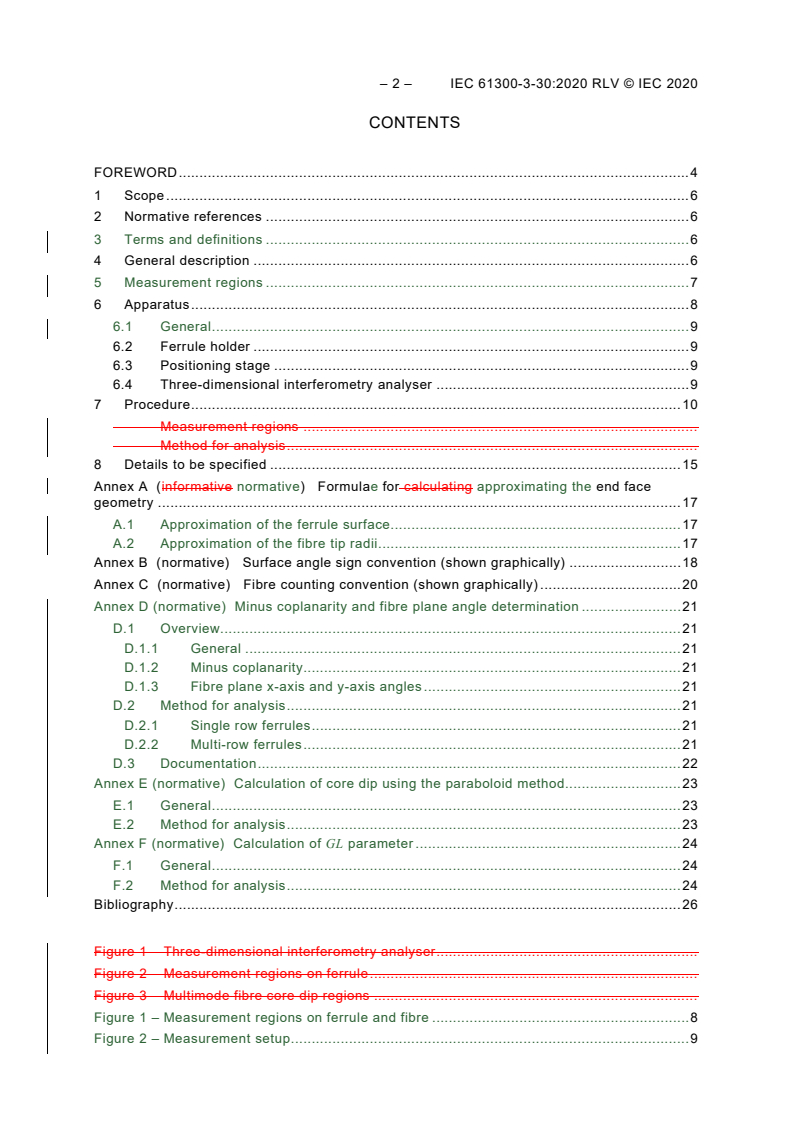
– 2 – IEC 61300-3-30:2020 RLV © IEC 2020
CONTENTS
FOREWORD . 4
1 Scope . 6
2 Normative references . 6
3 Terms and definitions . 6
4 General description . 6
5 Measurement regions . 7
6 Apparatus . 8
6.1 General . 9
6.2 Ferrule holder . 9
6.3 Positioning stage . 9
6.4 Three-dimensional interferometry analyser . 9
7 Procedure . 10
Measurement regions .
Method for analysis .
8 Details to be specified . 15
Annex A (informative normative) Formulae for calculating approximating the end face
geometry . 17
A.1 Approximation of the ferrule surface. 17
A.2 Approximation of the fibre tip radii. 17
Annex B (normative) Surface angle sign convention (shown graphically) . 18
Annex C (normative) Fibre counting convention (shown graphically) . 20
Annex D (normative) Minus coplanarity and fibre plane angle determination . 21
D.1 Overview. 21
D.1.1 General . 21
D.1.2 Minus coplanarity. 21
D.1.3 Fibre plane x-axis and y-axis angles . 21
D.2 Method for analysis . 21
D.2.1 Single row ferrules . 21
D.2.2 Multi-row ferrules . 21
D.3 Documentation . 22
Annex E (normative) Calculation of core dip using the paraboloid method. 23
E.1 General . 23
E.2 Method for analysis . 23
Annex F (normative) Calculation of GL parameter . 24
F.1 General . 24
F.2 Method for analysis . 24
Bibliography . 26
Figure 1 – Three-dimensional interferometry analyser .
Figure 2 – Measurement regions on ferrule .
Figure 3 – Multimode fibre core dip regions .
Figure 1 – Measurement regions on ferrule and fibre . 8
Figure 2 – Measurement setup . 9
Figure B.1 – Surface angle sign convention . 19
Figure C.1 – Fibre counting convention . 20
Figure E.1 – Paraboloid fit to a fibre endface exhibiting core dip . 23
Table 1 – Ferrule measurement areas.
Table 2 – Multimode core dip areas .
Table 1 – Ferrule measurement areas and parameters . 8
Table F.1 – Parameter constants for 4-fibre ferrules . 25
Table F.2 – Parameter constants for 8-fibre ferrules . 25
Table F.3 – Parameter constants for 12-fibre ferrules . 25
– 4 – IEC 61300-3-30:2020 RLV © IEC 2020
INTERNATIONAL ELECTROTECHNICAL COMMISSION
____________
FIBRE OPTIC INTERCONNECTING DEVICES
AND PASSIVE COMPONENTS –
BASIC TEST AND MEASUREMENT PROCEDURES –
Part 3-30: Examinations and measurements –
Polish angle and fibre position on single ferrule
multifibre connectors
Endface geometry of rectangular ferrule
FOREWORD
1) The International Electrotechnical Commission (IEC) is a worldwide organization for standardization comprising
all national electrotechnical committees (IEC National Committees). The object of IEC is to promote international
co-operation on all questions concerning standardization in the electrical and electronic fields. To this end and
in addition to other activities, IEC publishes International Standards, Technical Specifications, Technical Reports,
Publicly Available Specifications (PAS) and Guides (hereafter referred to as "IEC Publication(s)"). Their
preparation is entrusted to technical committees; any IEC National Committee interested in the subject dealt with
may participate in this preparatory work. International, governmental and non-governmental organizations liaising
with the IEC also participate in this preparation. IEC collaborates closely with the International Organization for
Standardization (ISO) in accordance with conditions determined by agreement between the two organizations.
2) The formal decisions or agreements of IEC on technical matters express, as nearly as possible, an international
consensus of opinion on the relevant subjects since each technical committee has representation from all
interested IEC National Committees.
3) IEC Publications have the form of recommendations for international use and are accepted by IEC National
Committees in that sense. While all reasonable efforts are made to ensure that the technical content of IEC
Publications is accurate, IEC cannot be held responsible for the way in which they are used or for any
misinterpretation by any end user.
4) In order to promote international uniformity, IEC National Committees undertake to apply IEC Publications
transparently to the maximum extent possible in their national and regional publications. Any divergence between
any IEC Publication and the corresponding national or regional publication shall be clearly indicated in the latter.
5) IEC itself does not provide any attestation of conformity. Independent certification bodies provide conformity
assessment services and, in some areas, access to IEC marks of conformity. IEC is not responsible for any
services carried out by independent certification bodies.
6) All users should ensure that they have the latest edition of this publication.
7) No liability shall attach to IEC or its directors, employees, servants or agents including individual experts and
members of its technical committees and IEC National Committees for any personal injury, property damage or
other damage of any nature whatsoever, whether direct or indirect, or for costs (including legal fees) and
expenses arising out of the publication, use of, or reliance upon, this IEC Publication or any other IEC Publications.
8) Attention is drawn to the Normative references cited in this publication. Use of the referenced publications is
indispensable for the correct application of this publication.
9) Attention is drawn to the possibility that some of the elements of this IEC Publication may be the subject of patent
rights. IEC shall not be held responsible for identifying any or all such patent rights.
This redline version of the official IEC Standard allows the user to identify the changes
made to the previous edition. A vertical bar appears in the margin wherever a change has
been made. Additions are in green text, deletions are in strikethrough red text.
International Standard IEC 61300-3-30 has been prepared by subcommittee 86B: Fibre optic
interconnecting devices and passive components, of IEC technical committee 86: Fibre optics.
This second edition cancels and replaces the first edition published in 2003. This edition
constitutes a technical revision.
This edition includes the following significant technical changes with respect to the previous
edition:
a) measurement of the individual fibre tip radii;
b) introduction of the geometry limit (GL) metric;
c) introduction of the minus coplanarity metric;
d) new method for measuring the core dips;
e) all measurement regions are now identical for MM and SM fibres;
f) the ferrule surface angle sign convention has been changed.
The text of this International Standard is based on the following documents:
FDIS Report on voting
86B/4357/FDIS 86B/4378/RVD
Full information on the voting for the approval of this International Standard can be found in the
report on voting indicated in the above table.
This document has been drafted in accordance with the ISO/IEC Directives, Part 2.
A list of all parts in the IEC 61300 series, published under the general title Fibre optic
interconnecting devices and passive components – Basic test and measurement procedures,
can be found on the IEC website.
The committee has decided that the contents of this document will remain unchanged until the
stability date indicated on the IEC website under "http://webstore.iec.ch" in the data related to
the specific document. At this date, the document will be
• reconfirmed,
• withdrawn,
• replaced by a revised edition, or
• amended.
IMPORTANT – The 'colour inside' logo on the cover page of this publication indicates
that it contains colours which are considered to be useful for the correct understanding
of its contents. Users should therefore print this document using a colour printer.
– 6 – IEC 61300-3-30:2020 RLV © IEC 2020
FIBRE OPTIC INTERCONNECTING DEVICES
AND PASSIVE COMPONENTS –
BASIC TEST AND MEASUREMENT PROCEDURES –
Part 3-30: Examinations and measurements –
Polish angle and fibre position on single ferrule
multifibre connectors
Endface geometry of rectangular ferrule
1 Scope
This part of IEC 61300 describes a procedure to assess method of measuring the end face
geometry in guide pin based multifibre ferrules and connectors of rectangular multifibre ferrules
having an IEC defined optical interface. The primary attributes are fibre position relative to the
end face, either undercut withdrawal or protrusion, end face angle relative to the guide pin bores,
fibre tip radii and core dip for multimode fibres.
2 Normative references
The following referenced documents are indispensable for the application of this document. For
dated references, only the edition cited applies. For undated references, the latest edition of
the referenced document (including any amendments) applies.
There are no normative references in this document.
3 Terms and definitions
No terms and definitions are listed in this document.
ISO and IEC maintain terminological databases for use in standardization at the following
addresses:
• IEC Electropedia: available at http://www.electropedia.org/
• ISO Online browsing platform: available at http://www.iso.org/obp
4 General description
Guide pin based multifibre connectors plugs typically have a rectangular end face with a long
axis and a short axis. Ideally, a flat polish is desired on the end face with the fibres protruding
slightly and all in the same plane to assure physical contact of the fibre cores when two
connectors are intermated. In practice, the end face typically has two different curvatures across
the surface along the long and short axis. Since mated ferrules are aligned by pins in the guide
holes, the end face of the ferrule must shall be properly oriented (X and Y angle S and S
x y
angles) with respect to the guide holes to achieve positive contact. The end face angle S in the
x
x axis and the end face angle S in the y axis are measured by finding the best fit plane based
y
on a percentage of the highest points in a specified region of interest. The highest points
typically show the greatest modulation from an interferometric standpoint. This allows for more
robust measurements and greater repeatability between different interferometers.
The angle of the best fit plane is calculated by comparing it to the reference plane which is
perpendicular to the axis of each guide hole. The fibre protrusion, (+p), or undercut, (–p), of the
fibres is a planar height defined as the distance between the fibre end face and the best fit
planar surface previously described. Core dip is specific to multimode fibres because the large
core is softer than the edge of the fibre and tends to polish away faster. Core dip is calculated
by subtracting the average height of the core area from the average height of an annular area
near the edge of the fibre. The height H (positive is a protrusion) of the fibres is a planar height
defined as the distance between the fibre end face and the best fit plane. Core dip is of more
relevance to multimode fibres because the large core is softer than the cladding of the fibre and
tends to polish away faster. Core dip is calculated using the paraboloid method described in
Annex E.
One method is described for this procedure measuring polish angle and fibre position for a
single ferrule multifibre connector by analysing the endface with a three-dimensional
interferometry type surface analyser.
5 Measurement regions
The following regions shall be defined on the ferrule end face.
a) Region of interest (ROI): the ROI is set on the ferrule surface and defined by a rectangular
region having a long axis (x axis) of length, L, and a short axis (y axis) of height, H. The
region of interest is chosen to cover the intended contact zone of the ferrule end face when
the ferrules are mated. The region of interest shall be centred on the fibre array. See
Figure 1. Refer to Table 1 for measurement areas to be used for different connectors.
b) Extracting region: the extracting region, which includes the fibre end face regions and the
associated adhesive regions, is defined by circles having a diameter E, centred on each
fibre;
c) Averaging region: the averaging region is set on the fibre surfaces to be used to calculate
the fibre height, and is defined by a circle having a diameter F. The averaging region is the
same for singlemode (SM) fibres and multimode (MM) fibres.
d) Core dip region: the core dip region is set on the fibre surfaces to be used to calculate the
fibre core-dip using the paraboloid method, and is defined by circles having a diameter CD,
centred on each fibre.
Core dip adjustment constant: the calculated core dip amplitude following the fit of a paraboloid
function to the fibre endface is adjusted by means of constant R .
– 8 – IEC 61300-3-30:2020 RLV © IEC 2020
Figure 1 – Measurement regions on ferrule and fibre
Table 1 – Ferrule measurement areas and parameters
Core dip Core dip
Ferrule
Averaging
Next %
fitting region adjustment
type Region of Extracting
% top
region-
Descrip- top
(diameter constant
(variant interest, ROI region
pixels
SM + MM
tion pixels
CD) R (see
number) (L × H) excluded (diameter E)
used (diameter F)
a
Annex E)
mm mm mm
mm
x104 MT-04 2,900 × 0,675 3 20 0,140 0,05 0,03 0,03
x108 MT-08 2,900 × 0,675 3 20 0,140 0,05 0,03 0,03
x112 MT-12 2,900 × 0,675 3 20 0,140 0,05 0,03 0,03
x124 MT-24 2,900 × 1,160 3 20 0,140 0,05 0,03 0,03
1002 MiniMT 0,900 × 0,675 3 20 0,140 0,05 0,03 0,03
a
The x defines 1 for polyphenylene sulfide (PPS) resin ferrule materials and 2 for thermoset materials; the second
digit represents 2,45 mm × 4,4 mm with 0 and 2,45 mm × 6,4 mm with 1; and the last two digits designates the
number of fibres (see Table 1 of IEC 61755-3-31:2015 and Table 1 of IEC 61755-3-32:2015).
6 Apparatus
Three-dimensional surface analysis by an interferometer system.
The apparatus shown in Figure 1 consists of a suitable ferrule holder, a positioning stage and
a three-dimensional interferometry analyser capable of analyzing rough surfaces and step
heights.
6.1 General
The apparatus shown in Figure 2 consists of a positioning stage, a ferrule holder, an
interferometric video microscope, a Personal Computer based fringe interpretation unit and a
monitor to view the ferrule endface interferogram and display the analysis results.
Figure 2 – Measurement setup
6.2 Ferrule holder
The ferrule holder is a suitable device to hold the ferrule in a fixed position, either vertical or
shall
horizontal, or in a tilted position in the case of an angled ferrule type. Some method must
be used to reference determine the axis of each guide hole and the average plane perpendicular
angle to them, which shall be considered the ideal end face angle to the guide hole axes. This
will typically entail the use of guide pins inserted into the guide holes or similar devices to
transfer the axis of each guide hole to a measurable surface angle. This plane shall be
considered as the reference plane P for reference to subsequent measurements.
6.3 Positioning stage
The ferrule holder is fixed to the positioning stage, which shall enable the ferrule holder to be
moved to the appropriate position. The stage shall have enough sufficient rigidity so as to allow
measurement of the ferrule end face parameters within the required accuracy uncertainties
detailed in 6.4.
6.4 Three-dimensional interferometry analyser
The three-dimensional interferometry analyser shall have the ability to measure the fibre heights
on the ferrule end face with an accuracy of uncertainty better than ±50 nm and the core dips
with an uncertainty better than ±20 nm. The analyser shall consist of an interferometric video
microscope unit, a Personal Computer based fringe interpretation (surface data processing)
unit and a monitor.
The interferometric video microscope unit shall consist of an interference microscope, a phase
shift actuator, an image detector and a frame grabber an image acquisition and processing
setup. The interference microscope equipped with an objective is arranged so as to view the
end face of the ferrule.
The surface data processing unit shall be able to process the surface height information so as
to measure the radius of curvature in the X and Y axis, the angle of the end face in the X and
– 10 – IEC 61300-3-30:2020 RLV © IEC 2020
Y axis and the protrusion or undercut of the fibres from the best fit planar surface. A flatness
deviation shall be calculated to determine if the connector has too great a curvature to consider
the surface a plane.
The following parameters of the interference microscope shall be calibrated:
– optical magnification of the microscope;
– Z travel of the phase shift actuator;
– ferrule holder tilt angle in the case of an angled ferrule type.
The surface data processing unit shall be able to process the surface height information so as
to measure the following parameters:
– ferrule surface x-angle S (refer to Figure B.1 a) for the sign convention);
x
– ferrule surface y-angle S (refer to Figure B.1 b) for the sign convention;
y
– fibre array minus coplanarity CF;
– fibre plane x-angle G ;
x
– fibre plane y-angle G ;
y
– fibre tip spherical radii RF (some conditions apply; see Clause 7, m); refer to Figure C.1 for
fibre counting convention);
– core dip CD (some conditions apply; see Clause 7, l); refer to Figure C.1 for fibre counting
convention);
– geometry limit GL;
– ferrule surface x-radius R ;
x
– ferrule surface y-radius R ;
y
– fibre height H (refer to Figure C.1 for fibre counting convention);
– adjacent fibre height differential HA (refer to Figure C.1 for fibre counting convention);
The monitor shall display the measured and calculated surface profiles along each axis.
Figure 1 – Three-dimensional interferometry analyser
7 Procedure
5.1 Measurement regions
The following regions shall be defined on the ferrule end face for the measurement.
a) Region of interest (ROI): the ROI is set on the ferrule surface and defined by a rectangular
region having a long axis (X axis) of length, L, and a short axis (Y axis) of height, H; The
region of interest is chosen to cover the intended contact zone of the ferrule end face when
the ferrules are mated. The region of interest shall be centred on the fibre array. See
Figure 2. Refer to Table 1 for measurement areas to be used for different connectors.
b) Extracting region: the extracting region, which includes the fibre end face regions and the
associated adhesive regions, are defined by circles having a diameter E, centred on each
fibre;
c) Fitting region: the fitting region is the region of interest excluding the extracting regions and
is the data set used in making calculations for the ferrule surface. It is assumed that the
surface points on the ferrule outside the fitting region will be lower than the surface points
in the fitting region.
d) Averaging region: the averaging region is set on the fibre surfaces to be used to calculate
the fibre height, and is defined by a circle having a diameter F. The averaging region is
different for singlemode (SM) fibres and multimode (MM) fibres.
e) To assess core dip in MM fibres, two averaging regions are used. The first is the core fitting
region with a diameter D . The second region is an annular area bound by a maximum
core
annular ring of diameter D and a minimum annular ring of D . See Figure 3. Refer to
max min
Table 2 for measurement areas.
Figure 2 – Measurement regions on ferrule
– 12 – IEC 61300-3-30:2020 RLV © IEC 2020
D Maximum annular region
max.
D Minimum annular region
min.
D Core fitting region
core
Multimode fiber
IEC 2666/02
Figure 3 – Multimode fibre core dip regions
5.2 Method for analysis
5.2.1 Affix the ferrule in the ferrule holder so
that the end face is held sufficiently steady with
respect to the interferometer.
5.2.2 Focus the microscope and/or the
sample until the fringes are in position to scan
the surface.
ROI
5.2.3 Map the surface of the ferrule. To
create data set “A”, use only the pixels
contained within the ROI.
"A"
5.2.4 Create data set “B” by removing the
extraction regions around the fibres.
"B"
5.2.5 Create surface “C” by fitting a bipara-
bolic curve to data set “B”. (See Annex A for a
suggested curve fitting routine.)
"C"
5.2.6 Create data set “D” by subtracting
surface “C” from data set “B”.
"D"
5.2.7 Create data set “E” by removing the
highest 3 % of all pixels in data set “D”. This
"E"
removes any small points that are extremely
high compared to the others. It is assumed
these will break off when the connectors
contact.
NOTE Points are selected as a percentage of the total
area which includes pixels for which heights could not be
determined.
5.2.8 Create data set “F” by identifying the
highest 20 % of all pixels in data set “E”.
"F"
NOTE Points are selected as a percentage of the total
area which includes pixels for which heights could not be
determined.
5.2.9 Create data set “G” by eliminating all
pixels from data set “A” except for those
identified in data set “F”.
"G"
5.2.10 Fit a plane to data set “G” and use the
plane to calculate X and Y angles using the
"E + Plane"
average of the guide pin bore axis as a
reference. (See Annex B for end face angle
sign conventions.) “Add” the extraction regions
back in. Calculate the fibre heights as the
distance normal to the plane at the
corresponding fibre centre locations. (See
Annex C for fibre counting conventions.)
5.2.11 Create surface “H” by fitting a
biparabolic curve to data set “G”. Calculate the
flatness deviation. To find the flatness
"H"
deviation, first draw a plane through the points
where the biparabolic curve intersects a
projection of the region of interest. Flatness
deviation is the distance from the apex of the
biparabolic curve to the plane. Calculate the X
NOTE Ferrule end faces are typically flat. The curvature in
and Y radius values.
these drawings has been exaggerated for illustrative
purposes.
5.2.12 Determine the MM core dip.
This is accomplished by subtracting the
average height of the core fitting region D
core
from the average height of the annular area,
defined by diameters D and D .
min max
The following procedure shall be used for this measurement.
a) Affix the ferrule in the ferrule holder so that the end face is held sufficiently steady with
respect to the interferometer.
b) Focus the microscope and/or the sample until the fringes are in position to scan the
surface.
c) Map the surface of the ferrule. To
create data set "A", use only the
pixels contained within the ROI.
– 14 – IEC 61300-3-30:2020 RLV © IEC 2020
d) Create data set "B" by removing
the extracting regions around the
fibres.
e) Create surface "C" by fitting a bi-
parabolic curve to data set "B"
(see Annex A for the curve fitting
routine).
f) Create data set "D" by subtracting
surface "C" from data set "B"
g) Create data set "E" by removing
the highest 3 % of all pixels in
data set "D". This removes any
small points that are extremely
high compared to the others. It is
assumed these will break off
when the connectors contact.
NOTE Points are selected as a percentage of the total area which includes pixels for which heights could
not be determined.
h) Create data set "F" by identifying
the highest 20 % of all pixels in
data set "E".
NOTE Points are selected as a percentage of the total area which includes pixels for which heights could
not be determined.
i) Create data set "G" by eliminating
all pixels from data set "A" except
for those identified in data set "F".
j) Fit a plane to data set "G" and use
the plane to calculate S and S
x y
angles using plane P as a
reference (see Annex B for end
face angle sign conventions).
"Add" the extracting regions back
in.
Calculate the fibre heights H as the distance normal to the plane at the corresponding
fibre centre locations (see Annex C for fibre counting conventions). Calculate the adjacent
fibre height differential HA for each fibre. For a given fibre, HA is the largest height
difference to the two (single row ferrule case) or four (multi row ferrule case) neighbour
fibres.
k) Fit a bi-parabolic curve to data set "G" (see Annex A for the curve fitting routine).
Calculate the ferrule surface R and R radii values.
X Y
l) Determine the core dip (for multi-mode and singlemode fibres) CD of each fibre. See
Annex E for a detailed procedure.
If CD of a given fibre is positive and larger than 10 nm, report CD and skip step m) for
that given fibre.
If CD of a given fibre is negative or smaller than 10 nm, do not report CD for that given
fibre and proceed to step m).
m) Determine the radius RF of a given fibre tip. This is accomplished by fitting a sphere to
the surface points of the averaging region of the fibre (see Annex A for the curve fitting
routine). The radius of the fitted sphere is then taken as the fibre tip radius.
n) Determine the minus coplanarity CF. See Annex D for a detailed procedure. Use the fibre
plane to calculate G and G angles using the average of the guide pin bore axes as a
X Y
reference (see Annex B for end face angle sign conventions).
o) If CD is negative or smaller than 10 nm for more than 50 % of the fibres, determine the
geometry limit GL using the median value of the RF values of the fibres which exhibited a
negative CD. See Annex F.
8 Details to be specified
Three-dimensional interferometry analysis.
The following measurements will be displayed:
a) end face angle in the X-axis;
b) end face angle in the Y-axis;
c) individual fibre positions – undercut (–p) or protrusion (+p) for all fibres;
d) maximum difference in fibre height among all fibres;
e) maximum adjacent fibre height differential;
f) flatness deviation over the region of interest;
g) maximum core dip for fibres.
Table 1 – Ferrule measurement areas
Region of Extraction Averaging Averaging
interest-ROI region region-MM region-SM
% Top pixels Next % top
Ferrule type
(diameter E) (diameter F) (diameter F)
(L × H)
excluded pixels used
2 mm mm mm
mm
MT 2,900 × 0,675 3 20 0,140 0,100 0,50
MiniMT 3 20 0,140 0,100 0,50
0,900 × 0,675
Table 2 – Multimode core dip areas
Core averaging region Annular region
D D D
core min max
20 µm 70 µm 90 µm
The following items shall be specified for this measurement:
– type of interferometry;
– 16 – IEC 61300-3-30:2020 RLV © IEC 2020
– nominal angle of tilt, for example Physical contact (PC)/angled PC (APC);
– any deviation from this method;
– measurement uncertainty.
Annex A
(informative normative)
Formulae for calculating approximating the end face geometry
A.1 Approximation of the ferrule surface
The ideal ferrule surface being calculated for multifibre connectors is described by
Formula (A.1):
2 2
Z = –X /(2R ) – Y /(2R ) + S X + S Y + C
x y x y
Z =−X /(2R )−Y /(2R )− S × X + S ×+YC (A.1)
X YX Y
The coefficients for this formula which result in the best fitting ideal surface are found using a
matrix computation method known as Cholesky Decomposition least square approximation. R
x
and R are the radius radii of curvatures for a bi-parabolic surface along the x and y axes: S
y x
provides the x-axis surface angle value, while S provides the y-axis surface angle value. C is
y
the constant that identifies the relative height. By setting the squared terms to zero, a planar
surface is defined.
A.2 Approximation of the fibre tip radii
The ideal surface being calculated for each fibre tip is a sphere and is described by
Formula (A.2):
2 2 22
(X − X )(+ Y −Y )(+−Z Z ) =RF (A.2)
00 0
The coefficients for this formula which result in the best fitting ideal surface are found using a
least square approximation. RF is the radius of curvature of the fitted sphere. X , Y and Z are
0 0 0
the coordinates of the centre of the fitted sphere, which may not necessarily be centred on the
fibre core (apex offset).
– 18 – IEC 61300-3-30:2020 RLV © IEC 2020
Annex B
(normative)
Surface angle sign convention (shown graphically)
Annex B describes surface angle sign convention graphically. Figure B.1 a) shows the x-axis
view, and Figure B.1 b) shows the y-axis view.
ROI length
X-axis
White
mark
Epoxy window
Positive X
Reference plane
surface angle
Negative X
90°
surface angle
Guide
pin axis
IEC 2667/02
Figure B.1a – X-axis view
ROI Height
Y-axis
White
mark
Epoxy window
Negative Y
Reference plane
surface angle
Positive Y
surface angle 90°
Guide
pin axis
IEC 2668/02
Figure B.1b – Y-axis view
a) X-axis view
b) Y-axis view
NOTE The optical interface coordinate system is established with an x axis, which passes through the guide hole
centres, a perpendicular y axis that passes through the midpoint of the line connecting the guide hole centres, and
an orthogonal z axis pointing away from the ferrule.
Figure B.1 – Surface angle sign convention
– 20 – IEC 61300-3-30:2020 RLV © IEC 2020
Annex C
(normative)
Fibre counting convention (shown graphically)
Annex C describes fibre counting convention as shown in Figure C.1.
NOTE Fibre counting convention is applicable for all variants: flat or angled.
Figure C.1 – Fibre counting convention
Annex D
(normative)
Minus coplanarity and fibre plane angle determination
D.1 Overview
D.1.1 General
Annex D describes three additional parameters to be calculated and reported for measurements
made in accordance with this document.
D.1.2 Minus coplanarity
Minus coplanarity is the greatest parallel offset between the best fit plane (or line in the case
of single row ferrules) of the fibre ends (the average elevation of the averaging regions) and a
fibre end below that plane (or line).
D.1.3 Fibre plane x-axis and y-axis angles
The relative tilt of the best fit plane of D.1.2 relative to the average of the guide pin bore axes.
D.2 Method for analysis
D.2.1 Single row ferrules
Create an array of X and Z values where X is the fibre location and Z is the fibre height
determined in Clause 7 j). Fit a least squares line z(X) to this data. Calculate the array minus
coplanarity CF as:
CF max(z(X )− Z )
(D.1)
i i
where
z(X ) – Z is the deviation of each fibre tip, i, from the fibre line.
i i
Calculate the x-axis G angle of the least squares fit line (the fibre line) using a line
X
perpendicular to the guide pin bores axes as a reference.
D.2.2 Multi-row ferrules
Create an array of X, Y and Z values where X and Y are the fibre locations and Z is the fibre
height determined in Clause 7 j). Fit a least squares plane z(X,Y) to this data. Calculate the
array minus coplanarity as:
CF max(z(X ,Y )− Z )
(D.2)
ii i
where
z(X ,Y ) – Z is the deviation of each fibre tip, i, from the fibre line.
i i i
Calculate the x-axis G and y-axis G angles of the least squares fit plane (the fibre plane)
X Y
using a plane perpendicular to the guide pin bores axes as a reference.
=
=
– 22 – IEC 61300-3-30:2020 RLV © IEC 2020
D.3 Documentation
In addition to the requirements of Clause 8, report:
– minus coplanarity;
– x-axis angle G of the fibre line (or plane if parts have more than one row);
X
– y-axis angle G of the fibre plane (if parts have more than one row).
Y
Annex E
(normative)
Calculation of core dip using the paraboloid method
E.1 General
Annex E describes the core dip parameter to be calculated and reported for measurements
made in accordance with this document. Core dip is a measurement of the fibre core elevation
compared to the cladding elevation at its endface.
E.2 Method for analysis
Fit to each fibre endface surface points located inside zone CD a paraboloid function of type:
Z AX+ BY++CX DY+ E
(E.1)
The coefficients for Formula (E.1) which result in the best fitting ideal surface are found using
a least square approximation. Figure E.1 shows the fitting manner graphically.
For each fibre, the core dip CD is then:
CD (A+ B)R / 2 (E.2)
NOTE See Table 1 for the value of R .
Figure E.1 – Paraboloid fit to a fibre endface exhibiting core dip
=
=
– 24 – IEC 61300-3-30:2020 RLV © IEC 2020
Annex F
(normative)
Calculation of GL parameter
F.1 General
Annex F describes the GL parameter to be calculated and reported for measurements made in
accordance with this document. GL is used to quantitatively assess the acceptability of an end
face geometry.
F.2 Method for analysis
For single-row ferrules, this term is a calculated merit function, which relates x-slope angle, S ,
x
minus coplanarity, CF, and fibre tip radii, RF. There are 30 constants that define the relationship
among these parameters. When fully expanded, the function takes the form of Formula (F.1):
A A
01qq
− − n
q
−
RF RF
(A − A )⋅e + A − ()A −⋅Ae + A ⋅
01 00 00 11 10 10 RF
− nn−⋅e +n ⋅ S
( )
10 0 X
GL()S ,CF ,RF ⋅−e 1 +
X
A
qq
−
RF
− ()A −⋅A e + A ⋅CF
qq10 q0
A
1q
−
RF
e + (A −⋅A ) e + A
11 10 10
B
qq
−
RF
− ()B −⋅B e +B ⋅CF
qq10 q0
BB B
01qq 1q
−− −
RF RF RF
(B − B )⋅e + B − ()BB−⋅e + B ⋅e + ( BB−⋅) e + B
01 00 00 11 10 10 11 10 10
⋅+S
X
B
1q
−
RF
e + B
10
p
q
−
RF
− ()p − p ⋅e + p ⋅CF
1 0 0
C D
q q
− −
RF RF
(CC−⋅) e + C ⋅ e −+1(D − D )⋅e + D ⋅CF
10 0 10 0
(F.1)
For incorporation with end face inspection algorithms, this function can also be expressed with
Unicode text:
GL(S_x,CF,RF) = [(((A_01 – A_00) · e^(–A_0q/RF) + A_00) – ((A_11 – A_10) ·
e^(–A_1q/RF) + A_10)) · e^(–((A_q1 – A_q0) · e^(–A_qq/RF) + A_q0) · CF) +
(A_11 – A_10) · e^(–A_1q/RF) + A_10] · (e^(–((n_1 – n_0) · e^(–n_q/RF) + n_0) ·
|S_x|) – 1) + [(((B_01 – B_00) · e^(–B_0q/RF) + B_0) – ((B_11 – B_10) ·
e^(–B_1q/RF) + B_10)) · e^(–((B_q1 – B_q0) · e^(–B_qq/RF) + B_q0) · CF) + (B_11 – B_10) ·
e^(–B_1q/RF) + B_10] · |S_x| + ((C_1 – C_0) · e^(–C_q/RF) + C_0) · (e^(–((p_1 – p_0) ·
0) · CF
e^(–p_q/RF) + p_0) · CF) – 1) + ((D_1 – D_0) · e^(–D_q/RF) + D_
The parameter constants are dependent on the number of fibres as summarized in Table F.1 to
Table F.3 .
___________
GL and coplanarity parameters are not defined for the 1002 ferrule type.
=
Table F.1 – Parameter constants for 4-fibre ferrules
A A A B B B
C D N p
0 1 q 0 1 q
f
2,334 1,049 0,000 20,930 0,000 0,402 2,470 12,402 0,000 4,296
f
0,000 0,000 4,907 84,717 84,717 139,916 0,000 18,072 19,663 27,813
f
6,676 8,306 0,000 0,393 0,000 12,201 3,575 2,135 0,000 7,108
q
Table F.2 – Parameter constants for 8-fibre ferrules
A A A B B B
C D N p
0 1 q 0 1 q
f
3,117 -0,372 0,000 122,558 0
...
IEC 61300-3-30 ®
Edition 2.0 2020-12
INTERNATIONAL
STANDARD
NORME
INTERNATIONALE
Fibre optic interconnecting devices and passive components – Basic test and
measurement procedures –
Part 3-30: Examinations and measurements – Endface geometry of rectangular
ferrule
Dispositifs d’interconnexion et composants passifs fibroniques – Procédures
fondamentales d’essais et de mesures –
Partie 3-30: Examens et mesures – Géométrie de la face terminale de la ferrule
rectangulaire
All rights reserved. Unless otherwise specified, no part of this publication may be reproduced or utilized in any form
or by any means, electronic or mechanical, including photocopying and microfilm, without permission in writing from
either IEC or IEC's member National Committee in the country of the requester. If you have any questions about IEC
copyright or have an enquiry about obtaining additional rights to this publication, please contact the address below or
your local IEC member National Committee for further information.
Droits de reproduction réservés. Sauf indication contraire, aucune partie de cette publication ne peut être reproduite ni
utilisée sous quelque forme que ce soit et par aucun procédé, électronique ou mécanique, y compris la photocopie et
les microfilms, sans l'accord écrit de l'IEC ou du Comité national de l'IEC du pays du demandeur. Si vous avez des
questions sur le copyright de l'IEC ou si vous désirez obtenir des droits supplémentaires sur cette publication, utilisez
les coordonnées ci-après ou contactez le Comité national de l'IEC de votre pays de résidence.
IEC Central Office Tel.: +41 22 919 02 11
3, rue de Varembé info@iec.ch
CH-1211 Geneva 20 www.iec.ch
Switzerland
About the IEC
The International Electrotechnical Commission (IEC) is the leading global organization that prepares and publishes
International Standards for all electrical, electronic and related technologies.
About IEC publications
The technical content of IEC publications is kept under constant review by the IEC. Please make sure that you have the
latest edition, a corrigendum or an amendment might have been published.
IEC publications search - webstore.iec.ch/advsearchform Electropedia - www.electropedia.org
The advanced search enables to find IEC publications by a The world's leading online dictionary on electrotechnology,
variety of criteria (reference number, text, technical containing more than 22 000 terminological entries in English
committee,…). It also gives information on projects, replaced and French, with equivalent terms in 16 additional languages.
and withdrawn publications. Also known as the International Electrotechnical Vocabulary
(IEV) online.
IEC Just Published - webstore.iec.ch/justpublished
Stay up to date on all new IEC publications. Just Published IEC Glossary - std.iec.ch/glossary
details all new publications released. Available online and once 67 000 electrotechnical terminology entries in English and
a month by email. French extracted from the Terms and Definitions clause of IEC
publications issued since 2002. Some entries have been
IEC Customer Service Centre - webstore.iec.ch/csc collected from earlier publications of IEC TC 37, 77, 86 and
If you wish to give us your feedback on this publication or need CISPR.
further assistance, please contact the Customer Service
Centre: sales@iec.ch.
A propos de l'IEC
La Commission Electrotechnique Internationale (IEC) est la première organisation mondiale qui élabore et publie des
Normes internationales pour tout ce qui a trait à l'électricité, à l'électronique et aux technologies apparentées.
A propos des publications IEC
Le contenu technique des publications IEC est constamment revu. Veuillez vous assurer que vous possédez l’édition la
plus récente, un corrigendum ou amendement peut avoir été publié.
Recherche de publications IEC - Le premier dictionnaire d'électrotechnologie en ligne au monde,
webstore.iec.ch/advsearchform avec plus de 22 000 articles terminologiques en anglais et en
La recherche avancée permet de trouver des publications IEC français, ainsi que les termes équivalents dans 16 langues
en utilisant différents critères (numéro de référence, texte, additionnelles. Egalement appelé Vocabulaire
comité d’études,…). Elle donne aussi des informations sur les Electrotechnique International (IEV) en ligne.
projets et les publications remplacées ou retirées.
Glossaire IEC - std.iec.ch/glossary
IEC Just Published - webstore.iec.ch/justpublished 67 000 entrées terminologiques électrotechniques, en anglais
Restez informé sur les nouvelles publications IEC. Just et en français, extraites des articles Termes et Définitions des
Published détaille les nouvelles publications parues. publications IEC parues depuis 2002. Plus certaines entrées
Disponible en ligne et une fois par mois par email. antérieures extraites des publications des CE 37, 77, 86 et
CISPR de l'IEC.
Service Clients - webstore.iec.ch/csc
Si vous désirez nous donner des commentaires sur cette
publication ou si vous avez des questions contactez-nous:
sales@iec.ch.
Electropedia - www.electropedia.org
IEC 61300-3-30 ®
Edition 2.0 2020-12
INTERNATIONAL
STANDARD
NORME
INTERNATIONALE
Fibre optic interconnecting devices and passive components – Basic test and
measurement procedures –
Part 3-30: Examinations and measurements – Endface geometry of rectangular
ferrule
Dispositifs d’interconnexion et composants passifs fibroniques – Procédures
fondamentales d’essais et de mesures –
Partie 3-30: Examens et mesures – Géométrie de la face terminale de la ferrule
rectangulaire
INTERNATIONAL
ELECTROTECHNICAL
COMMISSION
COMMISSION
ELECTROTECHNIQUE
INTERNATIONALE
ICS 33.180.20 ISBN 978-2-8322-9121-4
– 2 – IEC 61300-3-30:2020 © IEC 2020
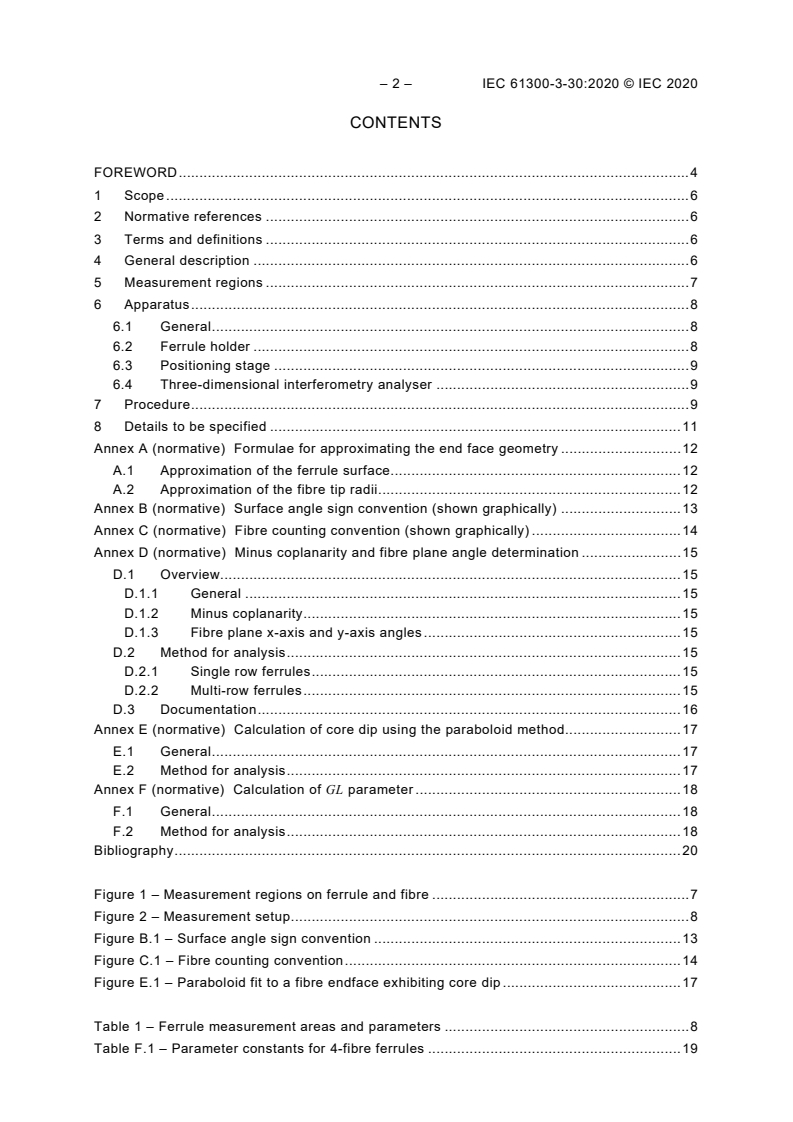
CONTENTS
FOREWORD . 4
1 Scope . 6
2 Normative references . 6
3 Terms and definitions . 6
4 General description . 6
5 Measurement regions . 7
6 Apparatus . 8
6.1 General . 8
6.2 Ferrule holder . 8
6.3 Positioning stage . 9
6.4 Three-dimensional interferometry analyser . 9
7 Procedure . 9
8 Details to be specified . 11
Annex A (normative) Formulae for approximating the end face geometry . 12
A.1 Approximation of the ferrule surface. 12
A.2 Approximation of the fibre tip radii. 12
Annex B (normative) Surface angle sign convention (shown graphically) . 13
Annex C (normative) Fibre counting convention (shown graphically) . 14
Annex D (normative) Minus coplanarity and fibre plane angle determination . 15
D.1 Overview. 15
D.1.1 General . 15
D.1.2 Minus coplanarity. 15
D.1.3 Fibre plane x-axis and y-axis angles . 15
D.2 Method for analysis . 15
D.2.1 Single row ferrules . 15
D.2.2 Multi-row ferrules . 15
D.3 Documentation . 16
Annex E (normative) Calculation of core dip using the paraboloid method. 17
E.1 General . 17
E.2 Method for analysis . 17
Annex F (normative) Calculation of GL parameter . 18
F.1 General . 18
F.2 Method for analysis . 18
Bibliography . 20
Figure 1 – Measurement regions on ferrule and fibre . 7
Figure 2 – Measurement setup . 8
Figure B.1 – Surface angle sign convention . 13
Figure C.1 – Fibre counting convention . 14
Figure E.1 – Paraboloid fit to a fibre endface exhibiting core dip . 17
Table 1 – Ferrule measurement areas and parameters . 8
Table F.1 – Parameter constants for 4-fibre ferrules . 19
Table F.2 – Parameter constants for 8-fibre ferrules . 19
Table F.3 – Parameter constants for 12-fibre ferrules . 19
– 4 – IEC 61300-3-30:2020 © IEC 2020
INTERNATIONAL ELECTROTECHNICAL COMMISSION
____________
FIBRE OPTIC INTERCONNECTING DEVICES
AND PASSIVE COMPONENTS –
BASIC TEST AND MEASUREMENT PROCEDURES –
Part 3-30: Examinations and measurements –
Endface geometry of rectangular ferrule
FOREWORD
1) The International Electrotechnical Commission (IEC) is a worldwide organization for standardization comprising
all national electrotechnical committees (IEC National Committees). The object of IEC is to promote international
co-operation on all questions concerning standardization in the electrical and electronic fields. To this end and
in addition to other activities, IEC publishes International Standards, Technical Specifications, Technical Reports,
Publicly Available Specifications (PAS) and Guides (hereafter referred to as "IEC Publication(s)"). Their
preparation is entrusted to technical committees; any IEC National Committee interested in the subject dealt with
may participate in this preparatory work. International, governmental and non-governmental organizations liaising
with the IEC also participate in this preparation. IEC collaborates closely with the International Organization for
Standardization (ISO) in accordance with conditions determined by agreement between the two organizations.
2) The formal decisions or agreements of IEC on technical matters express, as nearly as possible, an international
consensus of opinion on the relevant subjects since each technical committee has representation from all
interested IEC National Committees.
3) IEC Publications have the form of recommendations for international use and are accepted by IEC National
Committees in that sense. While all reasonable efforts are made to ensure that the technical content of IEC
Publications is accurate, IEC cannot be held responsible for the way in which they are used or for any
misinterpretation by any end user.
4) In order to promote international uniformity, IEC National Committees undertake to apply IEC Publications
transparently to the maximum extent possible in their national and regional publications. Any divergence between
any IEC Publication and the corresponding national or regional publication shall be clearly indicated in the latter.
5) IEC itself does not provide any attestation of conformity. Independent certification bodies provide conformity
assessment services and, in some areas, access to IEC marks of conformity. IEC is not responsible for any
services carried out by independent certification bodies.
6) All users should ensure that they have the latest edition of this publication.
7) No liability shall attach to IEC or its directors, employees, servants or agents including individual experts and
members of its technical committees and IEC National Committees for any personal injury, property damage or
other damage of any nature whatsoever, whether direct or indirect, or for costs (including legal fees) and
expenses arising out of the publication, use of, or reliance upon, this IEC Publication or any other IEC Publications.
8) Attention is drawn to the Normative references cited in this publication. Use of the referenced publications is
indispensable for the correct application of this publication.
9) Attention is drawn to the possibility that some of the elements of this IEC Publication may be the subject of patent
rights. IEC shall not be held responsible for identifying any or all such patent rights.
International Standard IEC 61300-3-30 has been prepared by subcommittee 86B: Fibre optic
interconnecting devices and passive components, of IEC technical committee 86: Fibre optics.
This second edition cancels and replaces the first edition published in 2003. This edition
constitutes a technical revision.
This edition includes the following significant technical changes with respect to the previous
edition:
a) measurement of the individual fibre tip radii;
b) introduction of the geometry limit (GL) metric;
c) introduction of the minus coplanarity metric;
d) new method for measuring the core dips;
e) all measurement regions are now identical for MM and SM fibres;
f) the ferrule surface angle sign convention has been changed.
The text of this International Standard is based on the following documents:
FDIS Report on voting
86B/4357/FDIS 86B/4378/RVD
Full information on the voting for the approval of this International Standard can be found in the
report on voting indicated in the above table.
This document has been drafted in accordance with the ISO/IEC Directives, Part 2.
A list of all parts in the IEC 61300 series, published under the general title Fibre optic
interconnecting devices and passive components – Basic test and measurement procedures,
can be found on the IEC website.
The committee has decided that the contents of this document will remain unchanged until the
stability date indicated on the IEC website under "http://webstore.iec.ch" in the data related to
the specific document. At this date, the document will be
• reconfirmed,
• withdrawn,
• replaced by a revised edition, or
• amended.
– 6 – IEC 61300-3-30:2020 © IEC 2020
FIBRE OPTIC INTERCONNECTING DEVICES
AND PASSIVE COMPONENTS –
BASIC TEST AND MEASUREMENT PROCEDURES –
Part 3-30: Examinations and measurements –
Endface geometry of rectangular ferrule
1 Scope
This part of IEC 61300 describes a method of measuring the end face geometry of rectangular
multifibre ferrules having an IEC defined optical interface. The primary attributes are fibre
position relative to the end face, either withdrawal or protrusion, end face angle relative to the
guide pin bores, fibre tip radii and core dip for multimode fibres.
2 Normative references
There are no normative references in this document.
3 Terms and definitions
No terms and definitions are listed in this document.
ISO and IEC maintain terminological databases for use in standardization at the following
addresses:
• IEC Electropedia: available at http://www.electropedia.org/
• ISO Online browsing platform: available at http://www.iso.org/obp
4 General description
Guide pin based multifibre connector plugs typically have a rectangular end face with a long
axis and a short axis. Ideally, a flat polish is desired on the end face with the fibres protruding
slightly and all in the same plane to assure physical contact of the fibre cores when two
connectors are intermated. In practice, the end face typically has two different curvatures across
the surface along the long and short axis. Since mated ferrules are aligned by pins in the guide
holes, the end face of the ferrule shall be properly oriented (S and S angles) with respect to
x y
the guide holes to achieve positive contact. The end face angle S in the x axis and the end
x
face angle S in the y axis are measured by finding the best fit plane based on a percentage of
y
the highest points in a specified region of interest. The highest points typically show the greatest
modulation from an interferometric standpoint. This allows for more robust measurements and
greater repeatability between different interferometers.
The angle of the best fit plane is calculated by comparing it to the reference plane which is
perpendicular to the axis of each guide hole. The height H (positive is a protrusion) of the fibres
is a planar height defined as the distance between the fibre end face and the best fit plane.
Core dip is of more relevance to multimode fibres because the large core is softer than the
cladding of the fibre and tends to polish away faster. Core dip is calculated using the paraboloid
method described in Annex E.
One method is described for measuring polish angle and fibre position for a single ferrule
multifibre connector by analysing the endface with a three-dimensional interferometry type
surface analyser.
5 Measurement regions
The following regions shall be defined on the ferrule end face.
a) Region of interest (ROI): the ROI is set on the ferrule surface and defined by a rectangular
region having a long axis (x axis) of length, L, and a short axis (y axis) of height, H. The
region of interest is chosen to cover the intended contact zone of the ferrule end face when
the ferrules are mated. The region of interest shall be centred on the fibre array. See
Figure 1. Refer to Table 1 for measurement areas to be used for different connectors.
b) Extracting region: the extracting region, which includes the fibre end face regions and the
associated adhesive regions, is defined by circles having a diameter E, centred on each
fibre;
c) Averaging region: the averaging region is set on the fibre surfaces to be used to calculate
the fibre height, and is defined by a circle having a diameter F. The averaging region is the
same for singlemode (SM) fibres and multimode (MM) fibres.
d) Core dip region: the core dip region is set on the fibre surfaces to be used to calculate the
fibre core-dip using the paraboloid method, and is defined by circles having a diameter CD,
centred on each fibre.
Core dip adjustment constant: the calculated core dip amplitude following the fit of a paraboloid
function to the fibre endface is adjusted by means of constant R .
Figure 1 – Measurement regions on ferrule and fibre
– 8 – IEC 61300-3-30:2020 © IEC 2020
Table 1 – Ferrule measurement areas and parameters
Core dip Core dip
Ferrule
Next % Averaging
fitting region adjustment
type Region of % top Extracting
Descrip- top region-
(diameter constant
(variant interest, ROI pixels region
tion pixels SM + MM
CD) R (see
number) excluded
(L × H) (diameter E)
used
(diameter F)
a
Annex E)
mm
mm mm mm
x104 MT-04 2,900 × 0,675 3 20 0,140 0,05 0,03 0,03
x108 MT-08 2,900 × 0,675 3 20 0,140 0,05 0,03 0,03
x112 MT-12 2,900 × 0,675 3 20 0,140 0,05 0,03 0,03
x124 MT-24 2,900 × 1,160 3 20 0,140 0,05 0,03 0,03
1002 MiniMT 0,900 × 0,675 3 20 0,140 0,05 0,03 0,03
a
The x defines 1 for polyphenylene sulfide (PPS) resin ferrule materials and 2 for thermoset materials; the second
digit represents 2,45 mm × 4,4 mm with 0 and 2,45 mm × 6,4 mm with 1; and the last two digits designates the
number of fibres (see Table 1 of IEC 61755-3-31:2015 and Table 1 of IEC 61755-3-32:2015).
6 Apparatus
6.1 General
The apparatus shown in Figure 2 consists of a positioning stage, a ferrule holder, an
interferometric video microscope, a Personal Computer based fringe interpretation unit and a
monitor to view the ferrule endface interferogram and display the analysis results.
Figure 2 – Measurement setup
6.2 Ferrule holder
The ferrule holder is a suitable device to hold the ferrule in a fixed position, either vertical or
horizontal, or in a tilted position in the case of an angled ferrule type. Some method shall be
used to determine the axis of each guide hole and the average plane perpendicular to the guide
hole axes. This plane shall be considered as the reference plane P for reference to subsequent
measurements.
6.3 Positioning stage
The ferrule holder is fixed to the positioning stage, which shall enable the ferrule holder to be
moved to the appropriate position. The stage shall have sufficient rigidity to allow measurement
of the ferrule end face parameters within the required uncertainties detailed in 6.4.
6.4 Three-dimensional interferometry analyser
The three-dimensional interferometry analyser shall have the ability to measure the fibre heights
on the ferrule end face with an uncertainty better than ±50 nm and the core dips with an
uncertainty better than ±20 nm. The analyser shall consist of an interferometric video
microscope unit, a Personal Computer based fringe interpretation (surface data processing)
unit and a monitor.
The interferometric video microscope unit shall consist of an interference microscope, a phase
shift actuator, an image detector and an image acquisition and processing setup. The
interference microscope equipped with an objective is arranged so as to view the end face of
the ferrule.
The following parameters of the interference microscope shall be calibrated:
– optical magnification of the microscope;
– Z travel of the phase shift actuator;
– ferrule holder tilt angle in the case of an angled ferrule type.
The surface data processing unit shall be able to process the surface height information so as
to measure the following parameters:
– ferrule surface x-angle S (refer to Figure B.1 a) for the sign convention);
x
– ferrule surface y-angle S (refer to Figure B.1 b) for the sign convention;
y
– fibre array minus coplanarity CF;
– fibre plane x-angle G ;
x
– fibre plane y-angle G ;
y
– fibre tip spherical radii RF (some conditions apply; see Clause 7, m); refer to Figure C.1 for
fibre counting convention);
– core dip CD (some conditions apply; see Clause 7, l); refer to Figure C.1 for fibre counting
convention);
– geometry limit GL;
– ferrule surface x-radius R ;
x
– ferrule surface y-radius R ;
y
– fibre height H (refer to Figure C.1 for fibre counting convention);
– adjacent fibre height differential HA (refer to Figure C.1 for fibre counting convention);
The monitor shall display the measured and calculated surface profiles along each axis.
7 Procedure
The following procedure shall be used for this measurement.
a) Affix the ferrule in the ferrule holder so that the end face is held sufficiently steady with
respect to the interferometer.
– 10 – IEC 61300-3-30:2020 © IEC 2020
b) Focus the microscope and/or the sample until the fringes are in position to scan the
surface.
c) Map the surface of the ferrule. To
create data set "A", use only the
pixels contained within the ROI.
d) Create data set "B" by removing
the extracting regions around the
fibres.
e) Create surface "C" by fitting a bi-
parabolic curve to data set "B"
(see Annex A for the curve fitting
routine).
f) Create data set "D" by subtracting
surface "C" from data set "B"
g) Create data set "E" by removing
the highest 3 % of all pixels in
data set "D". This removes any
small points that are extremely
high compared to the others. It is
assumed these will break off
when the connectors contact.
NOTE Points are selected as a percentage of the total area which includes pixels for which heights could
not be determined.
h) Create data set "F" by identifying
the highest 20 % of all pixels in
data set "E".
NOTE Points are selected as a percentage of the total area which includes pixels for which heights could
not be determined.
i) Create data set "G" by eliminating
all pixels from data set "A" except
for those identified in data set "F".
j) Fit a plane to data set "G" and use
the plane to calculate S and S
x y
angles using plane P as a
reference (see Annex B for end
face angle sign conventions).
"Add" the extracting regions back
in.
Calculate the fibre heights H as the distance normal to the plane at the corresponding
fibre centre locations (see Annex C for fibre counting conventions). Calculate the adjacent
fibre height differential HA for each fibre. For a given fibre, HA is the largest height
difference to the two (single row ferrule case) or four (multi row ferrule case) neighbour
fibres.
k) Fit a bi-parabolic curve to data set "G" (see Annex A for the curve fitting routine).
Calculate the ferrule surface R and R radii values.
X Y
l) Determine the core dip (for multi-mode and singlemode fibres) CD of each fibre. See
Annex E for a detailed procedure.
If CD of a given fibre is positive and larger than 10 nm, report CD and skip step m) for
that given fibre.
If CD of a given fibre is negative or smaller than 10 nm, do not report CD for that given
fibre and proceed to step m).
m) Determine the radius RF of a given fibre tip. This is accomplished by fitting a sphere to
the surface points of the averaging region of the fibre (see Annex A for the curve fitting
routine). The radius of the fitted sphere is then taken as the fibre tip radius.
n) Determine the minus coplanarity CF. See Annex D for a detailed procedure. Use the fibre
plane to calculate G and G angles using the average of the guide pin bore axes as a
X Y
reference (see Annex B for end face angle sign conventions).
o) If CD is negative or smaller than 10 nm for more than 50 % of the fibres, determine the
geometry limit GL using the median value of the RF values of the fibres which exhibited a
negative CD. See Annex F.
8 Details to be specified
The following items shall be specified for this measurement:
– type of interferometry;
– nominal angle of tilt, for example Physical contact (PC)/angled PC (APC);
– any deviation from this method;
– measurement uncertainty.
– 12 – IEC 61300-3-30:2020 © IEC 2020
Annex A
(normative)
Formulae for approximating the end face geometry
A.1 Approximation of the ferrule surface
The ideal ferrule surface being calculated for multifibre connectors is described by
Formula (A.1):
(A.1)
Z=−X /(2R )−Y /(2R )− S × X+ S ×+YC
X YX Y
The coefficients for this formula which result in the best fitting ideal surface are found using a
least square approximation. R and R are the radii of curvature for a bi-parabolic surface along
x y
the x and y axes: S provides the x-axis surface angle value, while S provides the y-axis
x y
surface angle value. C is the constant that identifies the relative height. By setting the squared
terms to zero, a planar surface is defined.
A.2 Approximation of the fibre tip radii
The ideal surface being calculated for each fibre tip is a sphere and is described by
Formula (A.2):
2 2 22
(X− X )(+ Y−Y )(+−Z Z ) =RF (A.2)
00 0
The coefficients for this formula which result in the best fitting ideal surface are found using a
least square approximation. RF is the radius of curvature of the fitted sphere. X , Y and Z are
0 0 0
the coordinates of the centre of the fitted sphere, which may not necessarily be centred on the
fibre core (apex offset).
Annex B
(normative)
Surface angle sign convention (shown graphically)
Annex B describes surface angle sign convention graphically. Figure B.1 a) shows the x-axis
view, and Figure B.1 b) shows the y-axis view.
a) X-axis view
b) Y-axis view
NOTE The optical interface coordinate system is established with an x axis, which passes through the guide hole
centres, a perpendicular y axis that passes through the midpoint of the line connecting the guide hole centres, and
an orthogonal z axis pointing away from the ferrule.
Figure B.1 – Surface angle sign convention
– 14 – IEC 61300-3-30:2020 © IEC 2020
Annex C
(normative)
Fibre counting convention (shown graphically)
Annex C describes fibre counting convention as shown in Figure C.1.
NOTE Fibre counting convention is applicable for all variants: flat or angled.
Figure C.1 – Fibre counting convention
Annex D
(normative)
Minus coplanarity and fibre plane angle determination
D.1 Overview
D.1.1 General
Annex D describes three additional parameters to be calculated and reported for measurements
made in accordance with this document.
D.1.2 Minus coplanarity
Minus coplanarity is the greatest parallel offset between the best fit plane (or line in the case
of single row ferrules) of the fibre ends (the average elevation of the averaging regions) and a
fibre end below that plane (or line).
D.1.3 Fibre plane x-axis and y-axis angles
The relative tilt of the best fit plane of D.1.2 relative to the average of the guide pin bore axes.
D.2 Method for analysis
D.2.1 Single row ferrules
Create an array of X and Z values where X is the fibre location and Z is the fibre height
determined in Clause 7 j). Fit a least squares line z(X) to this data. Calculate the array minus
coplanarity CF as:
CF max(z(X )− Z )
(D.1)
i i
where
) – Z is the deviation of each fibre tip, i, from the fibre line.
z(X
i i
Calculate the x-axis G angle of the least squares fit line (the fibre line) using a line
X
perpendicular to the guide pin bores axes as a reference.
D.2.2 Multi-row ferrules
Create an array of X, Y and Z values where X and Y are the fibre locations and Z is the fibre
height determined in Clause 7 j). Fit a least squares plane z(X,Y) to this data. Calculate the
array minus coplanarity as:
CF max(z(X ,Y )− Z )
(D.2)
ii i
where
z(X ,Y ) – Z is the deviation of each fibre tip, i, from the fibre line.
i i i
Calculate the x-axis G and y-axis G angles of the least squares fit plane (the fibre plane)
X Y
using a plane perpendicular to the guide pin bores axes as a reference.
=
=
– 16 – IEC 61300-3-30:2020 © IEC 2020
D.3 Documentation
In addition to the requirements of Clause 8, report:
– minus coplanarity;
– x-axis angle G of the fibre line (or plane if parts have more than one row);
X
– y-axis angle G of the fibre plane (if parts have more than one row).
Y
Annex E
(normative)
Calculation of core dip using the paraboloid method
E.1 General
Annex E describes the core dip parameter to be calculated and reported for measurements
made in accordance with this document. Core dip is a measurement of the fibre core elevation
compared to the cladding elevation at its endface.
E.2 Method for analysis
Fit to each fibre endface surface points located inside zone CD a paraboloid function of type:
Z AX+ BY++CX DY+ E (E.1)
The coefficients for Formula (E.1) which result in the best fitting ideal surface are found using
a least square approximation. Figure E.1 shows the fitting manner graphically.
For each fibre, the core dip CD is then:
CD (A+ B)R / 2 (E.2)
NOTE See Table 1 for the value of R .
Figure E.1 – Paraboloid fit to a fibre endface exhibiting core dip
=
=
– 18 – IEC 61300-3-30:2020 © IEC 2020
Annex F
(normative)
Calculation of GL parameter
F.1 General
Annex F describes the GL parameter to be calculated and reported for measurements made in
accordance with this document. GL is used to quantitatively assess the acceptability of an end
face geometry.
F.2 Method for analysis
For single-row ferrules, this term is a calculated merit function, which relates x-slope angle, S ,
x
minus coplanarity, CF, and fibre tip radii, RF. There are 30 constants that define the relationship
among these parameters. When fully expanded, the function takes the form of Formula (F.1):
A A
01qq
− − n
q
RF RF −
(A − A )⋅e + A − ()A −⋅Ae + A ⋅
01 00 00 11 10 10 RF
− nn−⋅e +n ⋅ S
( )
10 0 X
GL()S ,CF ,RF ⋅−e 1 +
X
A
qq
−
RF
− ()A −⋅A e + A ⋅CF
qq10 q0 A
1q
−
RF
e + (A −⋅A ) e + A
11 10 10
B
qq
−
RF
− ()B −B ⋅e +B ⋅CF
qq10 q0
BB B
01qq 1q
−− −
RF RF RF
(B − B )⋅e + B − ()BB−⋅e + B ⋅e + ( BB−⋅) e + B
01 00 00 11 10 10 11 10 10
⋅+S
X
B
1q
−
RF
e + B
10
p
q
−
RF
− ()p− p ⋅e + p ⋅CF
C 1 0 0 D
q q
− −
RF RF
(CC−⋅) e + C ⋅ e −+1(D − D )⋅e + D ⋅CF
10 0 10 0
(F.1)
For incorporation with end face inspection algorithms, this function can also be expressed with
Unicode text:
GL(S_x,CF,RF) = [(((A_01 – A_00) · e^(–A_0q/RF) + A_00) – ((A_11 – A_10) ·
e^(–A_1q/RF) + A_10)) · e^(–((A_q1 – A_q0) · e^(–A_qq/RF) + A_q0) · CF) +
(A_11 – A_10) · e^(–A_1q/RF) + A_10] · (e^(–((n_1 – n_0) · e^(–n_q/RF) + n_0) ·
|S_x|) – 1) + [(((B_01 – B_00) · e^(–B_0q/RF) + B_0) – ((B_11 – B_10) ·
e^(–B_1q/RF) + B_10)) · e^(–((B_q1 – B_q0) · e^(–B_qq/RF) + B_q0) · CF) + (B_11 – B_10) ·
e^(–B_1q/RF) + B_10] · |S_x| + ((C_1 – C_0) · e^(–C_q/RF) + C_0) · (e^(–((p_1 – p_0) ·
e^(–p_q/RF) + p_0) · CF) – 1) + ((D_1 – D_0) · e^(–D_q/RF) + D_0) · CF
=
The parameter constants are dependent on the number of fibres as summarized in Table F.1 to
Table F.3 .
Table F.1 – Parameter constants for 4-fibre ferrules
A A A B B B
C D N p
0 1 q 0 1 q
f
2,334 1,049 0,000 20,930 0,000 0,402 2,470 12,402 0,000 4,296
f
0,000 0,000 4,907 84,717 84,717 139,916 0,000 18,072 19,663 27,813
f
6,676 8,306 0,000 0,393 0,000 12,201 3,575 2,135 0,000 7,108
q
Table F.2 – Parameter constants for 8-fibre ferrules
A A A B B B
C D N p
0 1 q 0 1 q
f
3,117 -0,372 0,000 122,558 0,000 -0,439 2,109 15,227 0,000 6,253
f
0,000 0,000 4,779 151,602 151,602 -0,441 0,000 27,043 14,698 15,980
f
5,504 56,276 0,000 1,095 0,000 -4,844 10,334 2,216 0,000 7,994
q
Table F.3 – Parameter constants for 12-fibre ferrules
A A A B B B
C D N p
0 1 q 0 1 q
f
0,563 -0,313 0,000 120,677 0,000 0,000 3,452 20,367 0,000 4,874
f
0,000 0,000 10,082 148,540 148,540 2,481 0,000 36,545 69,299 8,685
f
110,476 78,066 0,000 3,129 0,000 0,000 11,688 1,800 0,000 5,860
q
NOTE Other fibre counts are under development.
___________
GL and coplanarity parameters are not defined for the 1002 ferrule type.
– 20 – IEC 61300-3-30:2020 © IEC 2020
Bibliography
IEC 61300 (all parts), Fibre optic interconnecting devices and passive components – Basic test
and measurement procedures
IEC 61755-3-31:2015, Fibre optic interconnecting devices and passive components –
Connector optical interfaces – Part 3-31: Connector parameters of non-dispersion shifted single
mode physically contacting fibres – Angled polyphenylene sulphide rectangular ferrules
IEC 61755-3-32:2015, Fibre optic interconnecting devices and passive components –
Connector optical interfaces – Part 3-32: Connector parameters of non-dispersion shifted single
mode physically contacting fibres – Angled thermoset epoxy rectangular ferrules
___________
– 22 – IEC 61300-3-30:2020 © IEC 2020
SOMMAIRE
AVANT-PROPOS . 24
1 Domaine d’application . 26
2 Références normatives . 26
3 Termes et définitions . 26
4 Description générale . 26
5 Régions de mesurage . 27
6 Appareillage . 28
6.1 Généralités . 28
6.2 Support de ferrule . 29
6.3 Etage de positionnement . 29
6.4 Analyseur d’interférométrie tridimensionnelle . 29
7 Mode opératoire . 30
8 Détails à spécifier . 32
Annexe A (normative) Formules d’approximation de la géométrie de la face terminale . 33
A.1 Approximation de la surface de la ferrule . 33
A.2 Approximation des rayons des pointes des fibres . 33
Annexe B (normative) Convention de signe de l’angle de surface (représentée
graphiquement) . 34
Annexe C (normative) Convention de comptage des fibres (représentée
graphiquement) . 35
Annexe D (normative) Détermination de coplanarité négative et de l’angle du plan de
fibre . 36
D.1 Aperçu général . 36
D.1.1 Généralités . 36
D.1.2 Coplanarité négative . 36
D.1.3 Angles des axes x et y du plan de fibre . 36
D.2 Méthode pour l’analyse . 36
D.2.1 Ferrules à rangée unique . 36
D.2.2 Ferrules à rangées multiples . 36
D.3 Documentation . 37
Annexe E (normative) Calcul de l’inclinaison du cœur à l’aide de la méthode
paraboloïde . 38
E.1 Généralités . 38
E.2 Méthode pour l’analyse . 38
Annexe F (normative) Calcul des paramètres GL . 39
F.1 Généralités . 39
F.2 Méthode pour l’analyse . 39
Bibliographie . 41
Figure 1 – Régions de mesurage sur la ferrule et la fibre . 28
Figure 2 – Configuration de mesurage . 29
Figure B.1 – Convention de signe de l’angle de surface . 34
Figure C.1 – Convention de comptage des fibres . 35
Figure E.1 – Adaptation paraboloïde à une face terminale de fibre présentant une
inclinaison du cœur . 38
Tableau 1 – Zones et paramètres de mesurage des ferrules . 28
Tableau F.1 – Constantes de paramètres pour les ferrules à 4 fibres . 40
Tableau F.2 – Constantes de paramètres pour les ferrules à 8 fibres . 40
Tableau F.3 – Constantes de paramètres pour les ferrules à 12 fibres . 40
---------
...