

IEC 61300-3-53:2020
(Main)Fibre optic interconnecting devices and passive components - Basic test and measurement procedures - Part 3-53: Examinations and measurements - Encircled angular flux (EAF) measurement method based on two-dimensional far field data from multimode waveguide (including fibre)
General Information
- Abstract
IEC 61300-3-53:2020 defines the encircled angular flux measurement of multimode waveguide light sources, in which most of the transverse modes are excited. The term "waveguide" is understood to include both channel waveguides and optical fibres but not slab waveguides. The applicable fibre types are the followings:
- A1 specified in IEC 60793-2-10;
- A3 specified in IEC 60793-2-30;
- A4 specified in IEC 60793-2-40.
This second edition cancels and replaces the first edition in 2015. This edition constitutes a technical revision. This edition includes the following significant technical changes with respect to the previous edition:
- the scope of the applicable wave guides, and graded index multimode optical wave guide and fibre have been included;
- the structure of 5.3 has been rearranged;
- Annex C and Annex D have been added.
The contents of the corrigendum of June 2023 have been included in this copy.
- Status
- Published
- Publication Date
- 14-Dec-2020
- Technical Committee
- SC 86B - Fibre optic interconnecting devices and passive components
- Drafting Committee
- WG 4 - TC 86/SC 86B/WG 4
- Current Stage
- PPUB - Publication issued
- Start Date
- 15-Dec-2020
- Completion Date
- 18-Dec-2020
Buy Documents
IEC 61300-3-53:2020 RLV - Fibre optic interconnecting devices and passive components - Basic test and measurement procedures - Part 3-53: Examinations and measurements - Encircled angular flux (EAF) measurement method based on two-dimensional far field data from multimode waveguide (including fibre) Released:12/15/2020
IEC 61300-3-53:2020 - Fibre optic interconnecting devices and passive components - Basic test and measurement procedures - Part 3-53: Examinations and measurements - Encircled angular flux (EAF) measurement method based on two-dimensional far field data from multimode waveguide (including fibre) Released:12/15/2020
Overview
IEC 61300-3-53:2020 specifies a standardized method for measuring Encircled Angular Flux (EAF) of step-index multimode waveguides (including optical fibres) using two‑dimensional far‑field data. The standard applies to multimode waveguides where most transverse modes are excited and covers channel waveguides and fibres (but not slab waveguides). This second edition (2020) replaces the 2015 edition, adds graded‑index multimode waveguides to the scope, reorganizes measurement method content, and includes new Annexes C and D; the June 2023 corrigendum is incorporated.
Key topics and technical requirements
- Measurement principle: Calculation of EAF from two‑dimensional far‑field intensity distributions to quantify angular power distribution of multimode sources.
- Applicable fibre types: Waveguides/fibres defined as A1 (IEC 60793‑2‑10), A3 (IEC 60793‑2‑30) and A4 (IEC 60793‑2‑40).
- Measurement methods:
- Method 1 - fθ lens imaging: Uses an fθ lens and camera to map angular flux to an image sensor.
- Method 2 - Direct imaging: Uses integrating spheres, single‑mode fibre scanning or imaging devices to capture far‑field power distribution.
- Equipment and calibration: Requirements for micro‑positioners, far‑field optical systems, cameras/detectors, power meters, calibration light sources and geometric calibration procedures.
- Data processing: Background noise removal, optical/mechanical centre determination, coordinate conversion (x‑y to polar), and computation of encircled angular flux curves.
- Uncertainty and artifacts: Consideration of CCD shading effects (Annex C), system recommendations (Annexes A and B) and a template compliance test using defined launch optics (Annex D).
- Results and reporting: Standard EAF charts and a list of information provided with each measurement and additional data available on request.
Applications and users
IEC 61300-3-53 is practical for:
- Fibre and waveguide manufacturers - validating modal output and launch conditions.
- Component and connector test labs - specifying and verifying angular power distributions for passive components.
- Optical system designers and OEMs - ensuring compatibility of multimode sources with receivers and modal launch specifications.
- Telecom and datacom test engineers - assessing link behavior sensitive to modal distribution and modal bandwidth effects.
- Standards bodies and conformity assessment organizations - harmonized test method for performance claims and compliance testing.
Practical use cases include characterizing light source launch conditions, troubleshooting modal‑dependent loss, and verifying component performance under defined angular flux conditions.
Related standards
- IEC 61300 series - general fibre optic interconnecting devices and basic test procedures.
- IEC 60793‑2‑10, IEC 60793‑2‑30, IEC 60793‑2‑40 - referenced fibre type specifications (A1, A3, A4).
Keywords: IEC 61300-3-53, Encircled Angular Flux (EAF), EAF measurement, multimode waveguide, far field data, fibre optics testing, fθ lens, direct imaging, step index multimode.
Relations
- Effective Date
- 05-Sep-2023
- Effective Date
- 05-Sep-2023
Buy Documents
IEC 61300-3-53:2020 RLV - Fibre optic interconnecting devices and passive components - Basic test and measurement procedures - Part 3-53: Examinations and measurements - Encircled angular flux (EAF) measurement method based on two-dimensional far field data from multimode waveguide (including fibre) Released:12/15/2020
IEC 61300-3-53:2020 - Fibre optic interconnecting devices and passive components - Basic test and measurement procedures - Part 3-53: Examinations and measurements - Encircled angular flux (EAF) measurement method based on two-dimensional far field data from multimode waveguide (including fibre) Released:12/15/2020
Get Certified
Connect with accredited certification bodies for this standard

ANCE
Mexican certification and testing association.

Intertek Slovenia
Intertek testing, inspection, and certification services in Slovenia.

LNE (Laboratoire National de Métrologie et d'Essais)
French national laboratory for metrology and testing.
Sponsored listings
Frequently Asked Questions
IEC 61300-3-53:2020 is a standard published by the International Electrotechnical Commission (IEC). Its full title is "Fibre optic interconnecting devices and passive components - Basic test and measurement procedures - Part 3-53: Examinations and measurements - Encircled angular flux (EAF) measurement method based on two-dimensional far field data from multimode waveguide (including fibre)". This standard covers: IEC 61300-3-53:2020 defines the encircled angular flux measurement of multimode waveguide light sources, in which most of the transverse modes are excited. The term "waveguide" is understood to include both channel waveguides and optical fibres but not slab waveguides. The applicable fibre types are the followings: - A1 specified in IEC 60793-2-10; - A3 specified in IEC 60793-2-30; - A4 specified in IEC 60793-2-40. This second edition cancels and replaces the first edition in 2015. This edition constitutes a technical revision. This edition includes the following significant technical changes with respect to the previous edition: - the scope of the applicable wave guides, and graded index multimode optical wave guide and fibre have been included; - the structure of 5.3 has been rearranged; - Annex C and Annex D have been added. The contents of the corrigendum of June 2023 have been included in this copy.
IEC 61300-3-53:2020 defines the encircled angular flux measurement of multimode waveguide light sources, in which most of the transverse modes are excited. The term "waveguide" is understood to include both channel waveguides and optical fibres but not slab waveguides. The applicable fibre types are the followings: - A1 specified in IEC 60793-2-10; - A3 specified in IEC 60793-2-30; - A4 specified in IEC 60793-2-40. This second edition cancels and replaces the first edition in 2015. This edition constitutes a technical revision. This edition includes the following significant technical changes with respect to the previous edition: - the scope of the applicable wave guides, and graded index multimode optical wave guide and fibre have been included; - the structure of 5.3 has been rearranged; - Annex C and Annex D have been added. The contents of the corrigendum of June 2023 have been included in this copy.
IEC 61300-3-53:2020 is classified under the following ICS (International Classification for Standards) categories: 33.180.20 - Fibre optic interconnecting devices. The ICS classification helps identify the subject area and facilitates finding related standards.
IEC 61300-3-53:2020 has the following relationships with other standards: It is inter standard links to IEC 61300-3-53:2020/COR1:2023, IEC 61300-3-53:2015. Understanding these relationships helps ensure you are using the most current and applicable version of the standard.
IEC 61300-3-53:2020 is available in PDF format for immediate download after purchase. The document can be added to your cart and obtained through the secure checkout process. Digital delivery ensures instant access to the complete standard document.
Standards Content (Sample)
IEC 61300-3-53 ®
Edition 2.0 2020-12
REDLINE VERSION
INTERNATIONAL
STANDARD
colour
inside
Fibre optic interconnecting devices and passive components – Basic test and
measurement procedures
Part 3-53: Examinations and measurements – Encircled angular flux (EAF)
measurement method based on two-dimensional far field data from step index
multimode waveguide (including fibre)
All rights reserved. Unless otherwise specified, no part of this publication may be reproduced or utilized in any form
or by any means, electronic or mechanical, including photocopying and microfilm, without permission in writing from
either IEC or IEC's member National Committee in the country of the requester. If you have any questions about IEC
copyright or have an enquiry about obtaining additional rights to this publication, please contact the address below or
your local IEC member National Committee for further information.
IEC Central Office Tel.: +41 22 919 02 11
3, rue de Varembé info@iec.ch
CH-1211 Geneva 20 www.iec.ch
Switzerland
About the IEC
The International Electrotechnical Commission (IEC) is the leading global organization that prepares and publishes
International Standards for all electrical, electronic and related technologies.
About IEC publications
The technical content of IEC publications is kept under constant review by the IEC. Please make sure that you have the
latest edition, a corrigendum or an amendment might have been published.
IEC publications search - webstore.iec.ch/advsearchform Electropedia - www.electropedia.org
The advanced search enables to find IEC publications by a The world's leading online dictionary on electrotechnology,
variety of criteria (reference number, text, technical containing more than 22 000 terminological entries in English
committee,…). It also gives information on projects, replaced and French, with equivalent terms in 16 additional languages.
and withdrawn publications. Also known as the International Electrotechnical Vocabulary
(IEV) online.
IEC Just Published - webstore.iec.ch/justpublished
Stay up to date on all new IEC publications. Just Published IEC Glossary - std.iec.ch/glossary
details all new publications released. Available online and 67 000 electrotechnical terminology entries in English and
once a month by email. French extracted from the Terms and Definitions clause of
IEC publications issued since 2002. Some entries have been
IEC Customer Service Centre - webstore.iec.ch/csc collected from earlier publications of IEC TC 37, 77, 86 and
If you wish to give us your feedback on this publication or CISPR.
need further assistance, please contact the Customer Service
Centre: sales@iec.ch.
IEC 61300-3-53 ®
Edition 2.0 2020-12
REDLINE VERSION
INTERNATIONAL
STANDARD
colour
inside
Fibre optic interconnecting devices and passive components – Basic test and
measurement procedures
Part 3-53: Examinations and measurements – Encircled angular flux (EAF)
measurement method based on two-dimensional far field data from step index
multimode waveguide (including fibre)
INTERNATIONAL
ELECTROTECHNICAL
COMMISSION
ICS 33.180.20 ISBN 978-2-8322-9211-2
– 2 – IEC 61300-3-53:2020 RLV © IEC 2020
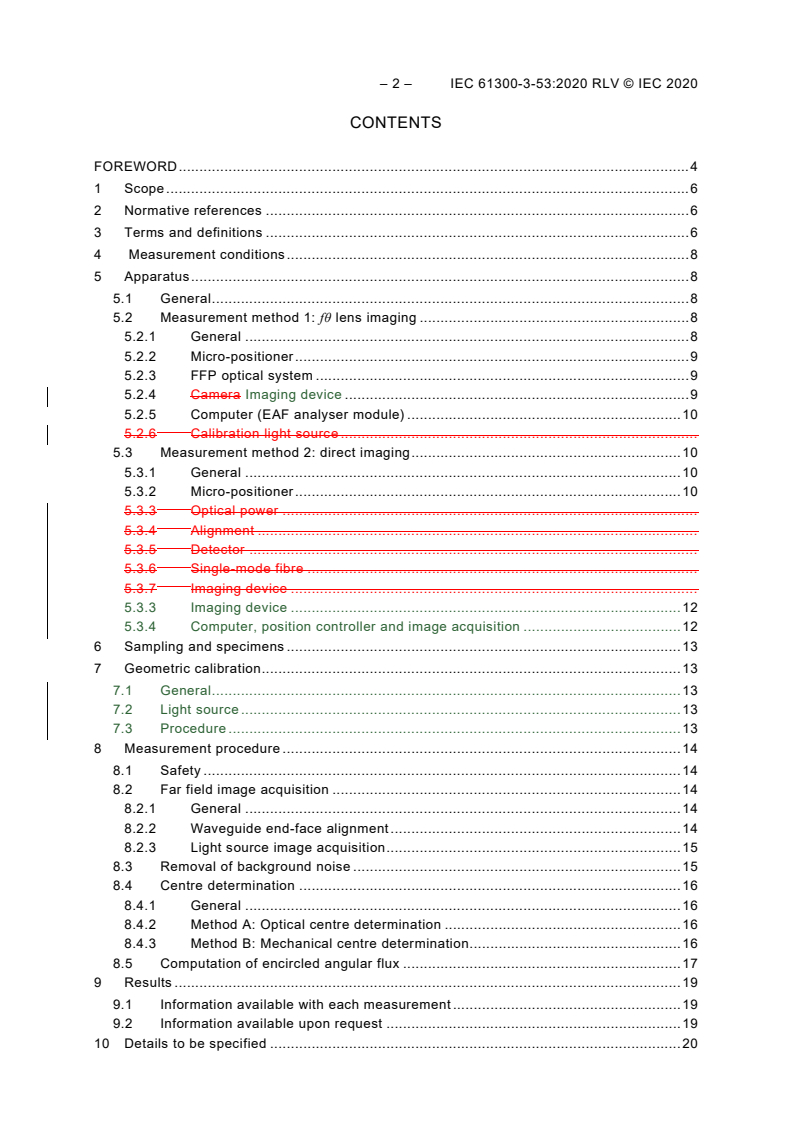
CONTENTS
FOREWORD . 4
1 Scope . 6
2 Normative references . 6
3 Terms and definitions . 6
4 Measurement conditions . 8
5 Apparatus . 8
5.1 General . 8
5.2 Measurement method 1: fθ lens imaging . 8
5.2.1 General . 8
5.2.2 Micro-positioner . 9
5.2.3 FFP optical system . 9
5.2.4 Camera Imaging device . 9
5.2.5 Computer (EAF analyser module) . 10
5.2.6 Calibration light source .
5.3 Measurement method 2: direct imaging . 10
5.3.1 General . 10
5.3.2 Micro-positioner . 10
5.3.3 Optical power .
5.3.4 Alignment .
5.3.5 Detector .
5.3.6 Single-mode fibre .
5.3.7 Imaging device .
5.3.3 Imaging device . 12
5.3.4 Computer, position controller and image acquisition . 12
6 Sampling and specimens . 13
7 Geometric calibration . 13
7.1 General . 13
7.2 Light source . 13
7.3 Procedure . 13
8 Measurement procedure . 14
8.1 Safety . 14
8.2 Far field image acquisition . 14
8.2.1 General . 14
8.2.2 Waveguide end-face alignment . 14
8.2.3 Light source image acquisition . 15
8.3 Removal of background noise . 15
8.4 Centre determination . 16
8.4.1 General . 16
8.4.2 Method A: Optical centre determination . 16
8.4.3 Method B: Mechanical centre determination . 16
8.5 Computation of encircled angular flux . 17
9 Results . 19
9.1 Information available with each measurement . 19
9.2 Information available upon request . 19
10 Details to be specified . 20
Annex A (informative) System requirements recommendations – Measurement
method 1: far field optical system . 21
A.1 General . 21
A.2 Requirements Recommendations . 21
Annex B (informative) System requirements recommendations – Measurement
method 2: direct imaging . 22
B.1 General . 22
B.2 Requirements Recommendations . 22
Annex C (informative) Shading effect of CCD devices: incident ray angular sensitivity . 23
C.1 General . 23
C.2 Scheme of shading and example of the characteristics . 23
Annex D (normative) Launch optics for the EAF template compliance test . 25
D.1 General . 25
D.2 Setup . 25
Bibliography . 26
Figure 1 – Apparatus configuration of measurement method 1: fθ lens imaging . 9
Figure 2 – Far field optical system diagram . 9
Figure 3 – Apparatus configuration: measurement method 2 – Direct imaging using an
integrating sphere .
Figure 4 – Apparatus configuration: measurement method 2 – Direct imaging using a
single-mode fibre .
Figure 5 – Apparatus configuration: measurement method 2 – Direct imaging using an
imaging device .
Figure 3 – Apparatus configuration of measurement method 2: direct imaging . 13
Figure 4 – Calibration apparatus example . 14
Figure 5 – Acquired far field image . 15
Figure 6 – Acquired far field image with false colour . 15
Figure 7 – Optical centre determination . 16
Figure 8 – Coordinate conversion Transformation of x-y to polar coordinates on the
image sensor plane . 17
Figure 9 – Standard Typical encircled angular flux chart . 19
Figure A.1 – An example of an optical system using an fθ lens . 21
Figure C.1 – Scheme of shading effect . 23
Figure C.2 – Example of shading characteristics . 24
Figure D.1 – Schematic view of the setup for the EAF compliance test . 25
– 4 – IEC 61300-3-53:2020 RLV © IEC 2020
INTERNATIONAL ELECTROTECHNICAL COMMISSION
____________
FIBRE OPTIC INTERCONNECTING
DEVICES AND PASSIVE COMPONENTS –
BASIC TEST AND MEASUREMENT PROCEDURES
Part 3-53: Examinations and measurements – Encircled angular
flux (EAF) measurement method based on two-dimensional
far field data from step index multimode waveguide (including fibre)
FOREWORD
1) The International Electrotechnical Commission (IEC) is a worldwide organization for standardization comprising
all national electrotechnical committees (IEC National Committees). The object of IEC is to promote international
co-operation on all questions concerning standardization in the electrical and electronic fields. To this end and
in addition to other activities, IEC publishes International Standards, Technical Specifications, Technical Reports,
Publicly Available Specifications (PAS) and Guides (hereafter referred to as "IEC Publication(s)"). Their
preparation is entrusted to technical committees; any IEC National Committee interested in the subject dealt with
may participate in this preparatory work. International, governmental and non-governmental organizations liaising
with the IEC also participate in this preparation. IEC collaborates closely with the International Organization for
Standardization (ISO) in accordance with conditions determined by agreement between the two organizations.
2) The formal decisions or agreements of IEC on technical matters express, as nearly as possible, an international
consensus of opinion on the relevant subjects since each technical committee has representation from all
interested IEC National Committees.
3) IEC Publications have the form of recommendations for international use and are accepted by IEC National
Committees in that sense. While all reasonable efforts are made to ensure that the technical content of IEC
Publications is accurate, IEC cannot be held responsible for the way in which they are used or for any
misinterpretation by any end user.
4) In order to promote international uniformity, IEC National Committees undertake to apply IEC Publications
transparently to the maximum extent possible in their national and regional publications. Any divergence between
any IEC Publication and the corresponding national or regional publication shall be clearly indicated in the latter.
5) IEC itself does not provide any attestation of conformity. Independent certification bodies provide conformity
assessment services and, in some areas, access to IEC marks of conformity. IEC is not responsible for any
services carried out by independent certification bodies.
6) All users should ensure that they have the latest edition of this publication.
7) No liability shall attach to IEC or its directors, employees, servants or agents including individual experts and
members of its technical committees and IEC National Committees for any personal injury, property damage or
other damage of any nature whatsoever, whether direct or indirect, or for costs (including legal fees) and
expenses arising out of the publication, use of, or reliance upon, this IEC Publication or any other IEC Publications.
8) Attention is drawn to the Normative references cited in this publication. Use of the referenced publications is
indispensable for the correct application of this publication.
9) Attention is drawn to the possibility that some of the elements of this IEC Publication may be the subject of patent
rights. IEC shall not be held responsible for identifying any or all such patent rights.
This redline version of the official IEC Standard allows the user to identify the changes
made to the previous edition. A vertical bar appears in the margin wherever a change has
been made. Additions are in green text, deletions are in strikethrough red text.
International Standard IEC 61300-3-53 has been prepared by subcommittee 86B: Fibre optic
interconnecting devices and passive components, of IEC technical committee 86:Fibre optics.
This second edition cancels and replaces the first edition in 2015. This edition constitutes a
technical revision.
This edition includes the following significant technical changes with respect to the previous
edition:
a) the scope of the applicable wave guides, and graded index multimode optical wave guide
and fibre have been included;
b) the structure of 5.3 has been rearranged;
c) Annex C and Annex D have been added.
The text of this International Standard is based on the following documents:
FDIS Report on voting
86B/4343/FDIS 86B/4373/RVD
Full information on the voting for the approval of this International Standard can be found in the
report on voting indicated in the above table.
This document has been drafted in accordance with the ISO/IEC Directives, Part 2.
A list of all parts in the IEC 61300, published under the general title Fibre optic interconnecting
devices and passive components – Basic test and measurement procedures, can be found on
the IEC website.
The committee has decided that the contents of this document will remain unchanged until the
stability date indicated on the IEC website under "http://webstore.iec.ch" in the data related to
the specific document. At this date, the document will be
• reconfirmed,
• withdrawn,
• replaced by a revised edition, or
• amended.
IMPORTANT – The 'colour inside' logo on the cover page of this publication indicates
that it contains colours which are considered to be useful for the correct understanding
of its contents. Users should therefore print this document using a colour printer.
The contents of the corrigendum 1 (2023-06) have been included in this copy.
– 6 – IEC 61300-3-53:2020 RLV © IEC 2020
FIBRE OPTIC INTERCONNECTING
DEVICES AND PASSIVE COMPONENTS –
BASIC TEST AND MEASUREMENT PROCEDURES
Part 3-53: Examinations and measurements – Encircled angular
flux (EAF) measurement method based on two-dimensional
far field data from step index multimode waveguide (including fibre)
1 Scope
This part of IEC 61300 is intended to characterize defines the encircled angular flux of
measurement step index of multimode waveguide light sources, in which most of the transverse
modes are excited. The term "waveguide" is understood to include both channel waveguides
and optical fibres but not slab waveguides in this standard.
Encircled angular flux (EAF) is the fraction of the total optical power radiating from a step index
multimode waveguide’s core within a certain solid angle. The EAF is measured as a function of
the numerical aperture full angle. The basic approach is to collect, for every measurement, two
dimensional far field data using a calibrated camera and to convert them mathematically into
encircled angular flux.
The applicable fibre types are the followings:
• A1 specified in IEC 60793-2-10;
• A3 specified in IEC 60793-2-30;
• A4 specified in IEC 60793-2-40.
2 Normative references
The following documents are referred to in the text in such a way that some or all of their content
constitutes requirements of this document. For dated references, only the edition cited applies.
For undated references, the latest edition of the referenced document (including any
amendments) applies.
IEC 60793-2-10, Optical fibres – Part 2-10: Product specifications – Sectional specification for
category A1 multimode fibres
IEC 60793-2-30, Optical fibres – Part 2-30: Product specifications – Sectional specification for
category A3 multimode fibres
IEC 60793-2-40, Optical fibres – Part 2-40: Product specifications – Sectional specification for
category A4 multimode fibres
IEC 60825-1, Safety of laser products – Part 1: Equipment classification and requirements
IEC 61300-1:2016, Fibre optic interconnecting devices and passive components – Basic test
and measurement procedures – Part 1: General and guidance
3 Terms and definitions
For the purposes of this document, the following terms and definitions apply.
ISO and IEC maintain terminological databases for use in standardization at the following
addresses:
• IEC Electropedia: available at http://www.electropedia.org/
• ISO Online browsing platform: available at http://www.iso.org/obp
3.1
encircled angular flux
EAF
fraction of the total optical power radiating from a step index multimode waveguide’s core within
a certain solid angle
3.2
Fraunhofer far field
far field which occurs when
L ≫ D /λ
where
L is the distance of the detection plane from the waveguide end facet;
D is the diameter of the multimode waveguide core or strictly mode field diameter;
λ is the wavelength.
3.3
fθ lens
lens converting the angle of incidence of the input beam, θ, into the output beam height, h
Note 1 to entry: The relationship between them is h = fθ, where f is the focal length of the lens.
3.4
mode power distribution
MPD
relative mode power in each of the mode groups of a multimode fibre
[SOURCE: IEC 62614-2:2015, 3.5, modified – The words "often shown graphically" have been
deleted.]
3.5
numerical aperture
NA
sine of the vertex half-angle of the largest cone of meridional rays that can enter or leave the
core of an optical waveguide, multiplied by the refractive index of the medium in which the cone
is located
3.6
far field pattern
FFP
angular distribution of light radiating from a waveguide’s core, which corresponds to the optical
power distribution on a plane normal to the waveguide axis some distance from its end facet
Note 1 to entry: The distance depends on the largest waveguide cross section, a, the wavelength, lambda λ, and
the angle,φ, to the optical axis. It is abbreviated to FFP. In the far field region, the shape of the distribution does not
change as the distance from the waveguide end facet increases; the distribution only scales in size with distance, L.
2a cos φ
( )
L >>
λ
– 8 – IEC 61300-3-53:2020 RLV © IEC 2020
3.7
far field image
far field pattern formed on an imaging device
3.6
centroid
optical centre of the far field image
3.8
neutral density filter
ND filter
filter that attenuates light of all colours equally
4 Standard atmospheric Measurement conditions
Optical fibres which are applied to this measurement are specified in IEC 60793-2-10,
IEC 60793-2-30 and IEC 60793-2-40. The measurement ambient condition shall be the
standard atmospheric conditions are specified in IEC 61300-1.
5 Apparatus
5.1 General
The optical source multimode waveguide shall be long enough to ensure that all cladding modes
are stripped by passage through the waveguide. Often, the fibre coating or tight buffer is
sufficient to perform this function. Alternatively, a cladding mode stripper shall be used in the
source launch optical multimode optical fibre. An example of a typical cladding mode stripper
which would be suitable for optical fibre is sufficient windings of the fibre around a mandrel of
an appropriate diameter. The windings also have a more important essential effect to fully fill
the transverse modes across the maximum mode field diameter. It should be checked that all
of the transverse modes of the fibre are sufficiently well excited. See Annex D. This can be
done by comparing the FFPs for different lengths of the launch fibre or different light sources.
Once the FFP no longer changes in form as the launch fibre length is increased, there is no
need to increase the length further.
5.2 Measurement method 1: fθ lens imaging
5.2.1 General
In theory, this measurement method, which is effectively a coherent optical method to Fourier
transform the near field to the far field using a lens, does not operate well using very wideband
optical sources. Experimentally, it has been shown to operate sufficiently well for sources up to
30 nm bandwidth, which are most commonly used.
Figure 1 below shows the apparatus configuration. The measurement system consists of a
micro-positioner, a far field broadband optical system, an imaging device (e.g. camera) and
computer (beam analysis module EAF analyser module). An appropriate type of camera
(detector imaging device) should shall be chosen to suit the wavelength under test.
FFP optical system
Camera
(image sensor)
Optical fibre
Micro-positioner
Computer
(EAF analyser module)
IEC
Figure 1 – Apparatus configuration of measurement method 1: fθ lens imaging
5.2.2 Micro-positioner
The micro-positioner shall have a function of fixing an optical waveguide and moving in three
directions (X, Y, Z). In addition yaw and pitch controls are recommended.
The micro-positioner shall hold the optical source (including the waveguide) and be able to
move in three directions (X, Y, Z). Angular movement for the optical system is recommended.
5.2.3 FFP optical system
As shown in Figure 2, basically, an fθ lens can directly convert input the light from the multimode
waveguide to a far field image; however, scaling the far field image in order to fit the image
sensor in the camera imaging device and adjustment of the light intensity in order to prevent
saturation may be is required. The FFP optical system shall be is chosen to operate at the
measurement wavelength across the required measurement bandwidth to match that of the
detection system. See Annex A for more information.
Figure 2 – Far field optical system diagram
5.2.4 Camera Imaging device
Imaging device includes a camera, CCD, CMOS, etc. that can detect images. Although The
detector is typically a charge coupled device (CCD) or a complementary metal oxide
semiconductor (CMOS) camera, other types of array cameras may be considered. The type of
image sensor imaging device shall be chosen by the measurement wavelength. Absolute
radiometric intensity measurement of flux (optical power flow) is not required.
– 10 – IEC 61300-3-53:2020 RLV © IEC 2020
5.2.5 Computer (EAF analyser module)
Since the acquired image contains many thousands of pixels, and the image conversion into
encircled angular flux requires substantial computation, a computer is required. The computer
will usually shall be connected to the image sensor imaging device through an image acquisition
board (or with an embedded image acquisition circuit), and installed beam analysis software
which enables the computer as a EAF analyser shall be installed.
5.2.6 Calibration light source
Calibration light source is used when calibrating the apparatus in Clause 7. The calibration
source is assumed to be broadband and incoherent so that speckle is not a problem, and to
have a sufficiently symmetrical far field distribution so that the calculated centroid of the far
field indicates the location of the optical centre axis of the waveguide with sufficient accuracy
for the purposes of this standard.
5.3 Measurement method 2: direct imaging
5.3.1 General
There are three alternative methods to detect the far field. One uses a detector, one uses a
single-mode fibre and the other uses a camera.
In this method, far field images are acquired directly by an imaging device without any optical
system. The distance between the optical waveguide source under test and the imaging device
shall be long enough to achieve Fraunhofer far field.
NOTE A CCD device generally consist of CCD semiconductor tip and micro lens array to get higher sensitivity
practically, then the structure generates shading effect which is incident angle dependent sensitivity consequently.
For more information, see Annex C and Figure 3.
See detail information of imaging device setup in Annex B.
When the far field image is larger than the area of the imaging device, multiple images shall be
taken and stitched together to configure a complete far field image.
5.3.2 Micro-positioner
Both the input step index multimode waveguide source and the photo detector (PD) shall be
mounted on high precision motorized translation Astages. The motorized translation stages
shall operate for both coarse alignment with tenths millimetres step movement for wide position
and accurate alignment with sub-micron step adjustment to maximize the light through the
waveguide.
5.3.3 Optical power
The output from the multimode waveguide shall be set to a power level of 0 dBm.
5.3.4 Alignment
Firstly, the input waveguide and detector shall be properly aligned to obtain the maximum output
power.
5.3.5 Detector
An integrating sphere PD preceded by a pinhole shall be placed sufficiently far from the optical
source launch multimode waveguide facet so as to be in the Fraunhofer or far field. The
Fraunhofer far field occurs when L >> D /λ where L is the distance of the detection plane from
the waveguide end facet, D is the diameter of the multimode waveguide core or strictly mode
field diameter and λ is the wavelength. For example, a large area integrating sphere PD
preceded by a pinhole, shown in Figure 3, shall be used to measure the integrated output optical
power so avoiding inconsistencies due to laser speckle and spatial variation of efficiency across
the photodiode detector. In this method the integrating sphere and its pinhole are moved in X
and Y to sample the far field. This has the advantage that a very large area can be sampled.
Moreover, it can also be moved in an arc on a goniometer so that its input facet always faces
the centre of the core of the multimode waveguide output. This goniometric method can also be
used to calibrate the far field in the fθ imaging method as the far field is measured directly as a
function of angle. If the detector aperture is instead moved across an XY plane then the lateral
position from the optical axis shall be converted to an angle of divergence from the optical axis.
The angle is the arctangent of the ratio of the lateral X or Y position to the distance L. Therefore,
considerable care needs to be taken to accurately measure L.
Pin hole
Integrating
L
Waveguide
sphere PD
(optical fibre)
Controller
Computer
(EAF analyser module)
Micro-
Motorized micro-
positioner
positioner
IEC
Figure 3 – Apparatus configuration: measurement method 2 –
Direct imaging using an integrating sphere
5.3.6 Single-mode fibre
The single-mode optical fibre shall be placed sufficiently far from the optical source launch
multimode waveguide facet so as to be in the Fraunhofer or far field. The Fraunhofer far field
occurs when L >> D /λ where L is the distance of the detection plane from the waveguide end
facet, D is the diameter of the multimode waveguide core or strictly mode field diameter and λ
is the wavelength. For example, a single-mode fibre attached to a detector, shown in Figure 4,
shall be placed in the far field and moved in X and Y to sample the far field. This has the
advantage that a very large area can be sampled. Moreover, it can also be moved in an arc on
a goniometer so that its input facet always faces the centre of the core of the multimode
waveguide output. This goniometric method can also be used to calibrate the far field in the fθ
imaging method as the far field is measured directly as a function of angle. If the single-mode
fibre core is instead moved across an XY plane then the lateral position from the optical axis
shall be converted to an angle of divergence from the optical axis. The angle is the arctangent
of the ratio of the lateral X or Y position to the distance L. Therefore, considerable care needs
to be taken to accurately measure L.
Single-mode optical fibre
L
Waveguide
(optical fibre)
PD
Controller
Computer
Micro-
Motorized micro- (EAF analyser module)
positioner
positioner
IEC
Figure 4 – Apparatus configuration: measurement method 2 –
Direct imaging using a single-mode fibre
– 12 – IEC 61300-3-53:2020 RLV © IEC 2020
5.3.7 Imaging device
An imaging device plane without any lens system shall be placed sufficiently far from the optical
source launch multimode waveguide facet so as to be in the Fraunhofer or far field. The
Fraunhofer far field occurs when L >> D /λ where L is the distance of the detection plane from
the waveguide end facet, D is the diameter of the multimode waveguide core or strictly mode
field diameter and λ is the wavelength. For example, an imaging device, shown in Figure 5,
shall be placed L away from the exit facet of the multimode waveguide. The distance L between
the imaging device and the waveguide end facet is much larger than the core size of the
waveguide, so the field captured is the far field distribution. The imaging device may for example,
be a CCD camera with its lens removed so that the light distribution falls directly on the CCD
chip. The lateral position from the optical axis in the far field shall be converted to an angle of
divergence from the optical axis. The angle is the arctangent of the ratio of the lateral X or Y
position to the distance L. Therefore, considerable care needs to be taken to accurately
measure L.
L Camera
Waveguide
(optical fibre)
Controller
Computer
Micro-
Motorized micro-
(EAF analyser module)
positioner
positioner
IEC
Figure 5 – Apparatus configuration: measurement method 2 –
Direct imaging using an imaging device
5.3.3 Imaging device
An imaging device includes a camera, CCD, CMOS, etc. that can detect images. An imaging
device plane without any lens system shall be placed sufficiently far from the optical source
launch multimode waveguide facet so as to be in the Fraunhofer far field.
The imaging device may, for example, be a CCD camera with its lens removed so that the light
distribution falls directly on the CCD chip. The lateral position from the optical axis in the far
field shall be converted to an angle of divergence from the optical axis. The angle is the
arctangent of the ratio of the lateral X or Y position to the distance L. Therefore, considerable
care shall be taken to accurately measure L.
5.3.4 Computer, position controller and image acquisition
The computer controls the position of the imaging device (camera) so that the proper image(s)
is(are) acquired. If the far field image is too large to shoot an single image, the computerized
controller moves the imaging device to the several different positions to acquire multiple images
which are finally combined and become one far field image.
NOTE A CCD device generally consist of CCD semiconductor tip and micro lens array to get higher sensitivity
practically, then the structure generates shading effect which is incident angle dependent sensitivity consequently.
For more information, see Annex C.
Figure 3 – Apparatus configuration of measurement method 2: direct imaging
6 Sampling and specimens
Light sources to be tested shall be chosen and prepared by the user of this standard, who shall
document the sampling and preparation procedures used. The only requirements on the light
sources under test are that they have an operating wavelength compatible with the detector
and fθ lens, and have optical connectors or splices compatible with the input port of the
apparatus. The construction details of the light sources are otherwise unspecified.
The sampling and preparation procedures for the light sources which launch light into multimode
waveguides to be tested shall be documented. The light sources under test shall have an
operating wavelength compatible with the detector and fθ lens, and have optical connectors or
splices compatible with the input port of the apparatus. The construction details of the light
sources are not otherwise specified.
7 Geometric calibration
7.1 General
Calibration of the apparatus is critical to the accuracy of this measurement procedure.
Calibration shall be performed periodically. If the calibration is known to drift significantly during
a measurement interval, the drift of the source(s) shall be identified and eliminated. If the
apparatus is disassembled or its components in or affecting the optical path are otherwise
manipulated, calibration shall be performed before measurements are made.
The purpose of geometric calibration is to obtain the measurement data needed to compute the
conversion factor. The factor will shall be used to convert camera coordinates to light launching
angle relative to the optical axis of optical waveguide.
7.2 Light source
The calibration light source shall be broadband and incoherent, in order to avoid speckle noise
issues, and shall have a sufficiently symmetrical far field distribution so that the calculated
centroid of the far field indicates the location of the optical centre axis of the waveguide with
sufficient accuracy for the purposes of this document.
7.3 Procedure
Calibration is shall be performed to measure the conversion factor that relates the light
launching angle to the pixel of the detector corresponding to this angle. The factor has a unit of
degree per pixel and will shall be used to convert camera imaging device coordinates to far
field angle coordinates. The collimated light source for geometric calibration, shown in Figure
4, shall have a spectral power distribution similar to that of the measurement light source and
– 14 – IEC 61300-3-53:2020 RLV © IEC 2020
the central wavelength within 30 nm around the nominal wavelength of the measurement light
source.
An example of The calibration procedure is stated below:
set a collimated light source whose incident angle relative to the optic axis of the
Step 1:
far field optical system can be precisely controlled; and
NOTE An example of the calibration apparatus is shown in Figure 4.
Step 2: measure the conversion factors from the whole range of angles to be measured
with an interval small enough (e.g. 1°) to enable accurate interpolation.
Figure 4 – Calibration apparatus example
Alternatively the direct imaging methods described in Clause 5 may be used for calibration.
8 Measurement procedure
8.1 Safety
All procedures in which a light emitting diode (LED) or a laser source is used as the optical
source shall be carried out using safety precautions in accordance with IEC 60825-1.
8.2 Far field image acquisition
8.2.1 General
Acquiring an image is central to the measurement of encircled angular flux. The approach to
image acquisition depends on the general characteristics of the light source being measured.
8.2.2 Waveguide end-face alignment
A waveguide end-face is shall be placed at the front focal point of the FFP optical system. The
live far field image acquired on the computer display is shall be adjusted to be in the centre of
the display using the X and Y axes of the micro-positioner, and to a minimum diameter and in
focus using the Z axis of the micro-positioner in 5.2.2.
8.2.3 Light source image acquisition
Measurement light sources are shall be sufficiently incoherent and are shall be sufficiently
intense to easily get good dynamic range, although attenuation may be required using neutral
density (ND) filter(s). The acquired image should shall be shown in the PC display as in Figure
5. The picture may be displayed with false colour in Figure 6.
Figure 5 – Acquired far field image
Figure 6 – Acquired far field image with false colour
8.3 Removal of background noise
The dark current of the camera which is acquired by obscuring the input light beforehand shall
be removed from the acquired image, or 0,5 % intensity of the peak power in the acquired image
shall be set as a threshold background level to keep the parts of the image above this threshold.
– 16 – IEC 61300-3-53:2020 RLV © IEC 2020
8.4 Centre determination
8.4.1 General
One of the two methods needs to shall be used.
8.4.2 Method A: Optical centre determination
The encircled angular flux is computed with respect to the optical centroid of the FFP distribution.
As shown in Figure 7, the centroid of the acquired image shall be determined with the use of
Formula (1).
Figure 7 – Optical centre determination
′ ′′ ′ ′′
x I (x ,y ) y I (x ,y )
∑∑ ∑ ∑
xy′′ x′ y′
′′ ′
O x 00,y O x 0,y 0− ,
( ) ( )
(1)
′′ ′′
I (x ,y ) I (x ,y )
∑∑ ∑∑
xy′′ xy′′
where
O’ is the origin of FFP optical system;
O is the calculated centroid of the acquired image;
(x’, y’) is the x-y coordinates based on the FFP optical system origin;
I(x’, y’) is the light intensity at coordinate (x’, y’).
8.4.3 Method B: Mechanical centre determination
The encircled angular flux is computed with respect to the optical central axis of the
measurement optics. The optical central axis of the measurement optics, O , shall be
m
determined by measuring the far field pattern of a reference waveguide. The reference
waveguide shall be a single-mode fibre, and the end-face of the fibre should be perpendicular
to the optical axis.
= = = = =
′ ′′ ′ ′′
x I (x ,y ) y I (x ,y )
∑∑m mm ∑ m∑ mm
x′′y x′ y′
′′ ′
O (x 00,y ) O (x 00,y )− ,
mm m mm m (2)
′′ ′′
I (x ,y ) I (x ,y )
∑∑ m m ∑∑ m m
xy′′ xy′′
where
O’ is the origin of direct imaging;
m
O is the calculated centroid of the acquired image;
m
(x’ , y’ ) is the x-y coordinates based on the direct imaging origin.
m m
I(x’ , y’ ) is the light intensity at coordinate (x’ , y’ ).
m m m m
For method B, O’ shall be fixed during a series of measurements.
m
8.5 Computation of encircled angular flux
Before computation of encircled angular flux, the x-y coordinates are converted to polar
coordinates using r and φ as shown in Figure 8 (b). Figure 8 (a) shows the side view of the fibre
and the emitted beam. Applying r and φ to encircled flux equation, light intensity distribution on
an FFP screen is described in Formula (3).
y
r
max
I(r,φ)
r
max
r'
r
φ
SI-MMF
r
θ
x
2θ
max
d
f
a) b)
IEC
a) Side view b) Image sensor plane
Figure 8 – Coordinate conversion Transformation of x-y to polar coordinates
on the image sensor plane
FFP screen
== ===
– 18 – IEC 61300-3-53:2020 RLV © IEC 2020
′
2𝜋𝜋 𝑟𝑟
𝐼𝐼(𝑟𝑟,𝜑𝜑)∙𝑟𝑟∙𝑑𝑑𝑟𝑟∙𝑑𝑑𝜑𝜑
∫ ∫
′ 0 0
𝐸𝐸𝐸𝐸(𝑟𝑟 ) = (3)
2𝜋𝜋 𝑟𝑟
𝑚𝑚𝑚𝑚𝑚𝑚
( )
∫ ∫ 𝐼𝐼𝑟𝑟,𝜑𝜑∙𝑟𝑟∙𝑑𝑑𝑟𝑟∙𝑑𝑑𝜑𝜑
0 0
d
Equation (4) is a simple equation that shows the relationship between r, θ and , and its
f
differential form (5):
( )
𝑟𝑟 =𝑑𝑑 ·𝑡𝑡𝑡𝑡𝑡𝑡𝜃𝜃 (4)
𝑓𝑓
2 −3
( ) ( )
𝑟𝑟 · d𝑟𝑟 =𝑑𝑑 · 𝑠𝑠𝑠𝑠𝑡𝑡𝜃𝜃 · 𝑐𝑐𝑐𝑐𝑠𝑠 𝜃𝜃 · 𝑑𝑑𝜃𝜃 (5)
Replacing r withθ using Equation (
...
IEC 61300-3-53 ®
Edition 2.0 2020-12
INTERNATIONAL
STANDARD
NORME
INTERNATIONALE
colour
inside
Fibre optic interconnecting devices and passive components – Basic test and
measurement procedures
Part 3-53: Examinations and measurements – Encircled angular flux (EAF)
measurement method based on two-dimensional far field data from multimode
waveguide (including fibre)
Dispositifs d'interconnexion et composants passifs fibroniques – Procédures
fondamentales d'essais et de mesures –
Partie 3-53: Examens et mesures – Méthode de mesure du flux angulaire inscrit
(EAF) fondée sur les données bidimensionnelles de champ lointain d’un guide
d’ondes multimodal (fibre incluse)
All rights reserved. Unless otherwise specified, no part of this publication may be reproduced or utilized in any form
or by any means, electronic or mechanical, including photocopying and microfilm, without permission in writing from
either IEC or IEC's member National Committee in the country of the requester. If you have any questions about IEC
copyright or have an enquiry about obtaining additional rights to this publication, please contact the address below or
your local IEC member National Committee for further information.
Droits de reproduction réservés. Sauf indication contraire, aucune partie de cette publication ne peut être reproduite
ni utilisée sous quelque forme que ce soit et par aucun procédé, électronique ou mécanique, y compris la photocopie
et les microfilms, sans l'accord écrit de l'IEC ou du Comité national de l'IEC du pays du demandeur. Si vous avez des
questions sur le copyright de l'IEC ou si vous désirez obtenir des droits supplémentaires sur cette publication, utilisez
les coordonnées ci-après ou contactez le Comité national de l'IEC de votre pays de résidence.
IEC Central Office Tel.: +41 22 919 02 11
3, rue de Varembé info@iec.ch
CH-1211 Geneva 20 www.iec.ch
Switzerland
About the IEC
The International Electrotechnical Commission (IEC) is the leading global organization that prepares and publishes
International Standards for all electrical, electronic and related technologies.
About IEC publications
The technical content of IEC publications is kept under constant review by the IEC. Please make sure that you have the
latest edition, a corrigendum or an amendment might have been published.
IEC publications search - webstore.iec.ch/advsearchform Electropedia - www.electropedia.org
The advanced search enables to find IEC publications by a The world's leading online dictionary on electrotechnology,
variety of criteria (reference number, text, technical containing more than 22 000 terminological entries in English
committee,…). It also gives information on projects, replaced and French, with equivalent terms in 16 additional languages.
and withdrawn publications. Also known as the International Electrotechnical Vocabulary
(IEV) online.
IEC Just Published - webstore.iec.ch/justpublished
Stay up to date on all new IEC publications. Just Published IEC Glossary - std.iec.ch/glossary
details all new publications released. Available online and 67 000 electrotechnical terminology entries in English and
once a month by email. French extracted from the Terms and Definitions clause of
IEC publications issued since 2002. Some entries have been
IEC Customer Service Centre - webstore.iec.ch/csc collected from earlier publications of IEC TC 37, 77, 86 and
If you wish to give us your feedback on this publication or CISPR.
need further assistance, please contact the Customer Service
Centre: sales@iec.ch.
A propos de l'IEC
La Commission Electrotechnique Internationale (IEC) est la première organisation mondiale qui élabore et publie des
Normes internationales pour tout ce qui a trait à l'électricité, à l'électronique et aux technologies apparentées.
A propos des publications IEC
Le contenu technique des publications IEC est constamment revu. Veuillez vous assurer que vous possédez l’édition la
plus récente, un corrigendum ou amendement peut avoir été publié.
Recherche de publications IEC - Electropedia - www.electropedia.org
webstore.iec.ch/advsearchform Le premier dictionnaire d'électrotechnologie en ligne au
La recherche avancée permet de trouver des publications IEC monde, avec plus de 22 000 articles terminologiques en
en utilisant différents critères (numéro de référence, texte, anglais et en français, ainsi que les termes équivalents dans
comité d’études,…). Elle donne aussi des informations sur les 16 langues additionnelles. Egalement appelé Vocabulaire
projets et les publications remplacées ou retirées. Electrotechnique International (IEV) en ligne.
IEC Just Published - webstore.iec.ch/justpublished Glossaire IEC - std.iec.ch/glossary
Restez informé sur les nouvelles publications IEC. Just 67 000 entrées terminologiques électrotechniques, en anglais
Published détaille les nouvelles publications parues. et en français, extraites des articles Termes et Définitions des
Disponible en ligne et une fois par mois par email. publications IEC parues depuis 2002. Plus certaines entrées
antérieures extraites des publications des CE 37, 77, 86 et
Service Clients - webstore.iec.ch/csc CISPR de l'IEC.
Si vous désirez nous donner des commentaires sur cette
publication ou si vous avez des questions contactez-nous:
sales@iec.ch.
IEC 61300-3-53 ®
Edition 2.0 2020-12
INTERNATIONAL
STANDARD
NORME
INTERNATIONALE
colour
inside
Fibre optic interconnecting devices and passive components – Basic test and
measurement procedures
Part 3-53: Examinations and measurements – Encircled angular flux (EAF)
measurement method based on two-dimensional far field data from multimode
waveguide (including fibre)
Dispositifs d'interconnexion et composants passifs fibroniques – Procédures
fondamentales d'essais et de mesures –
Partie 3-53: Examens et mesures – Méthode de mesure du flux angulaire inscrit
(EAF) fondée sur les données bidimensionnelles de champ lointain d’un guide
d’ondes multimodal (fibre incluse)
INTERNATIONAL
ELECTROTECHNICAL
COMMISSION
COMMISSION
ELECTROTECHNIQUE
INTERNATIONALE
ICS 33.180.20 ISBN 978-2-8322-9136-8
– 2 – IEC 61300-3-53:2020 © IEC 2020
CONTENTS
FOREWORD . 4
1 Scope . 6
2 Normative references . 6
3 Terms and definitions . 6
4 Measurement conditions . 8
5 Apparatus . 8
5.1 General . 8
5.2 Measurement method 1: fθ lens imaging . 8
5.2.1 General . 8
5.2.2 Micro-positioner . 8
5.2.3 FFP optical system . 9
5.2.4 Imaging device . 9
5.2.5 Computer (EAF analyser module) . 9
5.3 Measurement method 2: direct imaging . 9
5.3.1 General . 9
5.3.2 Micro-positioner . 9
5.3.3 Imaging device . 10
5.3.4 Computer, position controller and image acquisition . 10
6 Sampling and specimens . 10
7 Geometric calibration . 10
7.1 General . 10
7.2 Light source . 11
7.3 Procedure . 11
8 Measurement procedure . 11
8.1 Safety . 11
8.2 Far field image acquisition . 12
8.2.1 General . 12
8.2.2 Waveguide end-face alignment . 12
8.2.3 Light source image acquisition . 12
8.3 Removal of background noise . 13
8.4 Centre determination . 13
8.4.1 General . 13
8.4.2 Method A: Optical centre determination . 13
8.4.3 Method B: Mechanical centre determination . 14
8.5 Computation of encircled angular flux . 15
9 Results . 16
9.1 Information available with each measurement . 16
9.2 Information available upon request . 17
10 Details to be specified . 17
Annex A (informative) System recommendations – Measurement method 1: far field
optical system . 18
A.1 General . 18
A.2 Recommendations . 18
Annex B (informative) System recommendations – Measurement method 2: direct
imaging . 19
B.1 General . 19
B.2 Recommendations . 19
Annex C (informative) Shading effect of CCD devices: incident ray angular sensitivity . 20
C.1 General . 20
C.2 Scheme of shading and example of the characteristics . 20
Annex D (normative) Launch optics for the EAF template compliance test . 22
D.1 General . 22
D.2 Setup . 22
Bibliography . 23
Figure 1 – Apparatus configuration of measurement method 1: fθ lens imaging . 8
Figure 2 – Far field optical system diagram . 9
Figure 3 – Apparatus configuration of measurement method 2: direct imaging . 10
Figure 4 – Calibration apparatus example . 11
Figure 5 – Acquired far field image . 12
Figure 6 – Acquired far field image with false colour . 13
Figure 7 – Optical centre determination . 14
Figure 8 – Transformation of x-y to polar coordinates on the image sensor plane . 15
Figure 9 – Typical encircled angular flux chart . 16
Figure A.1 – An example of an optical system using an fθ lens . 18
Figure C.1 – Scheme of shading effect . 20
Figure C.2 – Example of shading characteristics . 21
Figure D.1 – Schematic view of the setup for the EAF compliance test . 22
– 4 – IEC 61300-3-53:2020 © IEC 2020
INTERNATIONAL ELECTROTECHNICAL COMMISSION
____________
FIBRE OPTIC INTERCONNECTING
DEVICES AND PASSIVE COMPONENTS –
BASIC TEST AND MEASUREMENT PROCEDURES
Part 3-53: Examinations and measurements – Encircled angular
flux (EAF) measurement method based on two-dimensional
far field data from multimode waveguide (including fibre)
FOREWORD
1) The International Electrotechnical Commission (IEC) is a worldwide organization for standardization comprising
all national electrotechnical committees (IEC National Committees). The object of IEC is to promote international
co-operation on all questions concerning standardization in the electrical and electronic fields. To this end and
in addition to other activities, IEC publishes International Standards, Technical Specifications, Technical Reports,
Publicly Available Specifications (PAS) and Guides (hereafter referred to as "IEC Publication(s)"). Their
preparation is entrusted to technical committees; any IEC National Committee interested in the subject dealt with
may participate in this preparatory work. International, governmental and non-governmental organizations liaising
with the IEC also participate in this preparation. IEC collaborates closely with the International Organization for
Standardization (ISO) in accordance with conditions determined by agreement between the two organizations.
2) The formal decisions or agreements of IEC on technical matters express, as nearly as possible, an international
consensus of opinion on the relevant subjects since each technical committee has representation from all
interested IEC National Committees.
3) IEC Publications have the form of recommendations for international use and are accepted by IEC National
Committees in that sense. While all reasonable efforts are made to ensure that the technical content of IEC
Publications is accurate, IEC cannot be held responsible for the way in which they are used or for any
misinterpretation by any end user.
4) In order to promote international uniformity, IEC National Committees undertake to apply IEC Publications
transparently to the maximum extent possible in their national and regional publications. Any divergence between
any IEC Publication and the corresponding national or regional publication shall be clearly indicated in the latter.
5) IEC itself does not provide any attestation of conformity. Independent certification bodies provide conformity
assessment services and, in some areas, access to IEC marks of conformity. IEC is not responsible for any
services carried out by independent certification bodies.
6) All users should ensure that they have the latest edition of this publication.
7) No liability shall attach to IEC or its directors, employees, servants or agents including individual experts and
members of its technical committees and IEC National Committees for any personal injury, property damage or
other damage of any nature whatsoever, whether direct or indirect, or for costs (including legal fees) and
expenses arising out of the publication, use of, or reliance upon, this IEC Publication or any other IEC Publications.
8) Attention is drawn to the Normative references cited in this publication. Use of the referenced publications is
indispensable for the correct application of this publication.
9) Attention is drawn to the possibility that some of the elements of this IEC Publication may be the subject of patent
rights. IEC shall not be held responsible for identifying any or all such patent rights.
International Standard IEC 61300-3-53 has been prepared by subcommittee 86B: Fibre optic
interconnecting devices and passive components, of IEC technical committee 86:Fibre optics.
This second edition cancels and replaces the first edition in 2015. This edition constitutes a
technical revision.
This edition includes the following significant technical changes with respect to the previous
edition:
a) the scope of the applicable wave guides, and graded index multimode optical wave guide
and fibre have been included;
b) the structure of 5.3 has been rearranged;
c) Annex C and Annex D have been added.
The text of this International Standard is based on the following documents:
FDIS Report on voting
86B/4343/FDIS 86B/4373/RVD
Full information on the voting for the approval of this International Standard can be found in the
report on voting indicated in the above table.
This document has been drafted in accordance with the ISO/IEC Directives, Part 2.
A list of all parts in the IEC 61300, published under the general title Fibre optic interconnecting
devices and passive components – Basic test and measurement procedures, can be found on
the IEC website.
The committee has decided that the contents of this document will remain unchanged until the
stability date indicated on the IEC website under "http://webstore.iec.ch" in the data related to
the specific document. At this date, the document will be
• reconfirmed,
• withdrawn,
• replaced by a revised edition, or
• amended.
IMPORTANT – The 'colour inside' logo on the cover page of this publication indicates
that it contains colours which are considered to be useful for the correct understanding
of its contents. Users should therefore print this document using a colour printer.
– 6 – IEC 61300-3-53:2020 © IEC 2020
FIBRE OPTIC INTERCONNECTING
DEVICES AND PASSIVE COMPONENTS –
BASIC TEST AND MEASUREMENT PROCEDURES
Part 3-53: Examinations and measurements – Encircled angular
flux (EAF) measurement method based on two-dimensional
far field data from multimode waveguide (including fibre)
1 Scope
This part of IEC 61300 defines the encircled angular flux measurement of multimode waveguide
light sources, in which most of the transverse modes are excited. The term "waveguide" is
understood to include both channel waveguides and optical fibres but not slab waveguides.
The applicable fibre types are the followings:
• A1 specified in IEC 60793-2-10;
• A3 specified in IEC 60793-2-30;
• A4 specified in IEC 60793-2-40.
2 Normative references
The following documents are referred to in the text in such a way that some or all of their content
constitutes requirements of this document. For dated references, only the edition cited applies.
For undated references, the latest edition of the referenced document (including any
amendments) applies.
IEC 60793-2-10, Optical fibres – Part 2-10: Product specifications – Sectional specification for
category A1 multimode fibres
IEC 60793-2-30, Optical fibres – Part 2-30: Product specifications – Sectional specification for
category A3 multimode fibres
IEC 60793-2-40, Optical fibres – Part 2-40: Product specifications – Sectional specification for
category A4 multimode fibres
IEC 60825-1, Safety of laser products – Part 1: Equipment classification and requirements
IEC 61300-1:2016, Fibre optic interconnecting devices and passive components – Basic test
and measurement procedures – Part 1: General and guidance
3 Terms and definitions
For the purposes of this document, the following terms and definitions apply.
ISO and IEC maintain terminological databases for use in standardization at the following
addresses:
• IEC Electropedia: available at http://www.electropedia.org/
• ISO Online browsing platform: available at http://www.iso.org/obp
3.1
encircled angular flux
EAF
fraction of the total optical power radiating from a multimode waveguide’s core within a certain
solid angle
3.2
Fraunhofer far field
far field which occurs when
L ≫ D /λ
where
L is the distance of the detection plane from the waveguide end facet;
D is the diameter of the multimode waveguide core or strictly mode field diameter;
λ is the wavelength.
3.3
fθ lens
lens converting the angle of incidence of the input beam, θ, into the output beam height, h
Note 1 to entry: The relationship between them is h = fθ, where f is the focal length of the lens.
3.4
mode power distribution
MPD
relative mode power in each of the mode groups of a multimode fibre
[SOURCE: IEC 62614-2:2015, 3.5, modified – The words "often shown graphically" have been
deleted.]
3.5
numerical aperture
NA
sine of the vertex half-angle of the largest cone of meridional rays that can enter or leave the
core of an optical waveguide, multiplied by the refractive index of the medium in which the cone
is located
3.6
far field pattern
FFP
angular distribution of light radiating from a waveguide’s core, which corresponds to the optical
power distribution on a plane normal to the waveguide axis some distance from its end facet
Note 1 to entry: The distance depends on the largest waveguide cross section, a, the wavelength, λ, and the angle,φ,
to the optical axis. In the far field region, the shape of the distribution does not change as the distance from the
waveguide end facet increases; the distribution only scales in size with distance, L.
2a cos φ
( )
L>>
λ
3.7
far field image
far field pattern formed on an imaging device
– 8 – IEC 61300-3-53:2020 © IEC 2020
3.8
neutral density filter
ND filter
filter that attenuates light of all colours equally
4 Measurement conditions
Optical fibres which are applied to this measurement are specified in IEC 60793-2-10,
IEC 60793-2-30 and IEC 60793-2-40. The measurement ambient condition shall be the
standard atmospheric conditions specified in IEC 61300-1.
5 Apparatus
5.1 General
The optical source multimode waveguide shall be long enough to ensure that all cladding modes
are stripped by passage through the waveguide. Often, the fibre coating or tight buffer is
sufficient to perform this function. Alternatively, a cladding mode stripper shall be used in the
source launch multimode optical fibre. An example of a typical cladding mode stripper which
would be suitable for optical fibre is sufficient windings of the fibre around a mandrel of an
appropriate diameter. The windings also have a more important essential effect to fully fill the
transverse modes across the maximum mode field diameter. It should be checked that all of the
transverse modes of the fibre are sufficiently well excited. See Annex D. This can be done by
comparing the FFPs for different lengths of the launch fibre or different light sources. Once the
FFP no longer changes in form as the launch fibre length is increased, there is no need to
increase the length further.
5.2 Measurement method 1: fθ lens imaging
5.2.1 General
In theory, this measurement method, which is effectively a coherent optical method to Fourier
transform the near field to the far field using a lens, does not operate well using very wideband
optical sources. Experimentally, it has been shown to operate sufficiently well for sources up to
30 nm bandwidth, which are most commonly used.
Figure 1 below shows the apparatus configuration. The measurement system consists of a
micro-positioner, a far field broadband optical system, an imaging device (e.g. camera) and
computer (EAF analyser module). An appropriate type of camera (imaging device) shall be
chosen to suit the wavelength under test.
Figure 1 – Apparatus configuration of measurement method 1: fθ lens imaging
5.2.2 Micro-positioner
The micro-positioner shall hold the optical source (including the waveguide) and be able to
move in three directions (X, Y, Z). Angular movement for the optical system is recommended.
5.2.3 FFP optical system
As shown in Figure 2, an fθ lens can directly convert the light from the multimode waveguide to
a far field image; however, scaling the far field image in order to fit the image sensor in the
imaging device and adjustment of the light intensity in order to prevent saturation is required.
The FFP optical system is chosen to operate at the measurement wavelength across the
required measurement bandwidth to match that of the detection system. See Annex A for more
information.
Figure 2 – Far field optical system diagram
5.2.4 Imaging device
Imaging device includes a camera, CCD, CMOS, etc. that can detect images. The detector is
typically a charge coupled device (CCD) or a complementary metal oxide semiconductor (CMOS)
camera. The type of imaging device shall be chosen by the measurement wavelength. Absolute
intensity measurement is not required.
5.2.5 Computer (EAF analyser module)
Since the acquired image contains many thousands of pixels, and the image conversion into
encircled angular flux requires substantial computation, a computer is required. The computer
shall be connected to the imaging device through an image acquisition board (or with an
embedded image acquisition circuit), and beam analysis software which enables the computer
as a EAF analyser shall be installed.
5.3 Measurement method 2: direct imaging
5.3.1 General
In this method, far field images are acquired directly by an imaging device without any optical
system. The distance between the optical waveguide source under test and the imaging device
shall be long enough to achieve Fraunhofer far field.
NOTE A CCD device generally consist of CCD semiconductor tip and micro lens array to get higher sensitivity
practically, then the structure generates shading effect which is incident angle dependent sensitivity consequently.
For more information, see Annex C and Figure 3.
See detail information of imaging device setup in Annex B.
When the far field image is larger than the area of the imaging device, multiple images shall be
taken and stitched together to configure a complete far field image.
5.3.2 Micro-positioner
Both the input multimode waveguide source and the photo detector (PD) shall be mounted on
motorized translation Astages. The motorized translation stages shall operate for both coarse
alignment with tenths millimetres step movement for wide position and accurate alignment with
sub-micron step adjustment to maximize the light through the waveguide.
– 10 – IEC 61300-3-53:2020 © IEC 2020
5.3.3 Imaging device
An imaging device includes a camera, CCD, CMOS, etc. that can detect images. An imaging
device plane without any lens system shall be placed sufficiently far from the optical source
launch multimode waveguide facet so as to be in the Fraunhofer far field.
The imaging device may, for example, be a CCD camera with its lens removed so that the light
distribution falls directly on the CCD chip. The lateral position from the optical axis in the far
field shall be converted to an angle of divergence from the optical axis. The angle is the
arctangent of the ratio of the lateral X or Y position to the distance L. Therefore, considerable
care shall be taken to accurately measure L.
5.3.4 Computer, position controller and image acquisition
The computer controls the position of the imaging device (camera) so that the proper image(s)
is(are) acquired. If the far field image is too large to shoot an single image, the computerized
controller moves the imaging device to the several different positions to acquire multiple images
which are finally combined and become one far field image.
NOTE A CCD device generally consist of CCD semiconductor tip and micro lens array to get higher sensitivity
practically, then the structure generates shading effect which is incident angle dependent sensitivity consequently.
For more information, see Annex C.
Figure 3 – Apparatus configuration of measurement method 2: direct imaging
6 Sampling and specimens
The sampling and preparation procedures for the light sources which launch light into multimode
waveguides to be tested shall be documented. The light sources under test shall have an
operating wavelength compatible with the detector and fθ lens, and have optical connectors or
splices compatible with the input port of the apparatus. The construction details of the light
sources are not otherwise specified.
7 Geometric calibration
7.1 General
Calibration of the apparatus is critical to the accuracy of this measurement procedure.
Calibration shall be performed periodically. If the calibration is known to drift significantly during
a measurement interval, the drift of the source(s) shall be identified and eliminated. If the
apparatus is disassembled or its components in or affecting the optical path are otherwise
manipulated, calibration shall be performed before measurements are made.
The purpose of geometric calibration is to obtain the measurement data needed to compute the
conversion factor. The factor shall be used to convert camera coordinates to light launching
angle relative to the optical axis of optical waveguide.
7.2 Light source
The calibration light source shall be broadband and incoherent, in order to avoid speckle noise
issues, and shall have a sufficiently symmetrical far field distribution so that the calculated
centroid of the far field indicates the location of the optical centre axis of the waveguide with
sufficient accuracy for the purposes of this document.
7.3 Procedure
Calibration shall be performed to measure the conversion factor that relates the light launching
angle to the pixel of the detector corresponding to this angle. The factor has a unit of degree
per pixel and shall be used to convert imaging device coordinates to far field angle coordinates.
The collimated light source for geometric calibration, shown in Figure 4, shall have a spectral
power distribution similar to that of the measurement light source and the central wavelength
within 30 nm around the nominal wavelength of the measurement light source.
The calibration procedure is stated below:
Step 1: set a collimated light source whose incident angle relative to the optic axis of the
far field optical system can be precisely controlled; and
NOTE An example of the calibration apparatus is shown in Figure 4.
Step 2: measure the conversion factors from the whole range of angles to be measured
with an interval small enough (e.g. 1°) to enable accurate interpolation.
Figure 4 – Calibration apparatus example
8 Measurement procedure
8.1 Safety
All procedures in which a light emitting diode (LED) or a laser source is used as the optical
source shall be carried out using safety precautions in accordance with IEC 60825-1.
– 12 – IEC 61300-3-53:2020 © IEC 2020
8.2 Far field image acquisition
8.2.1 General
Acquiring an image is central to the measurement of encircled angular flux. The approach to
image acquisition depends on the general characteristics of the light source being measured.
8.2.2 Waveguide end-face alignment
A waveguide end-face shall be placed at the front focal point of the FFP optical system. The
live far field image acquired on the computer display shall be adjusted to be in the centre of the
display using the X and Y axes of the micro-positioner, and to a minimum diameter and in focus
using the Z axis of the micro-positioner in 5.2.2.
8.2.3 Light source image acquisition
Measurement light sources shall be sufficiently incoherent and shall be sufficiently intense to
easily get good dynamic range, although attenuation may be required using neutral density
(ND) filter(s). The acquired image shall be shown in the PC display as in Figure 5. The picture
may be displayed with false colour in Figure 6.
Figure 5 – Acquired far field image
Figure 6 – Acquired far field image with false colour
8.3 Removal of background noise
The dark current of the camera which is acquired by obscuring the input light beforehand shall
be removed from the acquired image, or 0,5 % intensity of the peak power in the acquired image
shall be set as a background level.
8.4 Centre determination
8.4.1 General
One of the two methods shall be used.
8.4.2 Method A: Optical centre determination
The encircled angular flux is computed with respect to the optical centroid of the FFP distribution.
As shown in Figure 7, the centroid of the acquired image shall be determined with the use of
Formula (1).
– 14 – IEC 61300-3-53:2020 © IEC 2020
Figure 7 – Optical centre determination
x′ I x′′,y y′ I x′′,y
( ) ( )
∑∑ ∑ ∑
xy′′ x′ y′
′′ ′
O(x 00,y ) O(x 0,y 0)− ,
(1)
′′ ′′
I x ,y I x ,y
( ) ( )
∑∑ ∑∑
′′ ′′
xy xy
where
O’ is the origin of FFP optical system;
O is the calculated centroid of the acquired image;
(x’, y’) is the x-y coordinates based on the FFP optical system origin;
I(x’, y’) is the light intensity at coordinate (x’, y’).
8.4.3 Method B: Mechanical centre determination
The encircled angular flux is computed with respect to the optical central axis of the
measurement optics. The optical central axis of the measurement optics, O , shall be
m
determined by measuring the far field pattern of a reference waveguide. The reference
waveguide shall be a single-mode fibre, and the end-face of the fibre should be perpendicular
to the optical axis.
′ ′′ ′ ′′
x I(x ,y ) y I(x ,y )
∑∑m mm ∑ m∑ mm
x′′y x′ y′
′′ ′
O x 00,y O x 00,y − ,
( ) ( ) (2)
mm m mm m
′′ ′′
I x ,y I x ,y
( ) ( )
m m m m
∑∑ ∑∑
′′ ′′
xy xy
where
O’ is the origin of direct imaging;
m
O is the calculated centroid of the acquired image;
m
, y’ ) is the x-y coordinates based on the direct imaging origin.
(x’
m m
== ===
= = = = =
I(x’ , y’ ) is the light intensity at coordinate (x’ , y’ ).
m m m m
For method B, O’ shall be fixed during a series of measurements.
m
8.5 Computation of encircled angular flux
Before computation of encircled angular flux, the x-y coordinates are converted to polar
coordinates using r and φ as shown in Figure 8 (b). Figure 8 (a) shows the side view of the fibre
and the emitted beam. Applying r and φ to encircled flux equation, light intensity distribution on
an FFP screen is described in Formula (3).
a) Side view b) Image sensor plane
Figure 8 – Transformation of x-y to polar coordinates on the image sensor plane
2π r'
I(r,φ )⋅⋅r dr⋅ dφ
∫∫
EF( r')=
(3)
2πr
max
I(r,φ )⋅⋅r dr⋅ dφ
∫∫
Here is a simple Formula (4) to show the relationship between r, θ and d , and its differential
f
form, Formula (5):
rd⋅tan( θ)
(4)
f
23−
rd⋅= d⋅sin(θ)⋅cos (θ)⋅ dθ (5)
rf
Replacing r withθ using Formula (4) and Formula (5), Formula (6) is obtained. This shows EAF
′).
value E (θ
2π θ'
sin(θ)
I(r,φ )⋅⋅ dθdφ
∫∫
cos (θ)
E( θ')=
(6)
2πθ
sin(θ)
max
I(r,φ )⋅⋅ dθdφ
∫∫
cos ( θ)
where
r is the radial distance from the origin corresponding to an angle between one ray
emitted from the multimode waveguide and the optical axis of the multimode
waveguide;
=
– 16 – IEC 61300-3-53:2020 © IEC 2020
r is the radial distance from the origin corresponding to the maximum ray angle, which
max
is approximately 30° for category A3 multimode fibre for example;
φ is a circular angle in polar coordinates;
θ is an angle between one ray emitted from the multimode waveguide and the optical
axis;
θ is the maximum ray angle, which is approximately 30° for category A3 multimode
max
fibre for example;
d is the distance between the end of multimode optical waveguide and FFP screen;
f
O and O are the calculated centroids discussed in 8.4.
m
An example of EAF is shown in Figure 9.
Figure 9 – Typical encircled angular flux chart
9 Results
9.1 Information available with each measurement
Report the following with each measurement:
• date and time of measurement;
• identification of source;
• nominal wavelength of source;
• method of centre determination;
• the encircled angular flux at each angle shall be reported after a series of measurements is
completed;
• EAF as a graph as a function of angle θ (Figure 9), including any specified template limits.
For method B, specify the single-mode fibre and multimode fibre connectors and their lateral
and angular tolerances, if the measurements are referenced to the connector.
9.2 Information available upon request
The following information shall be available upon request:
• date of most recent calibration of equipment;
• method of calibration of equipment;
• the integration limit parameters (larger than the angle corresponding to the NA of the
specimen and less than the field of view);
• the original images used in the computations;
• the derived centre, and if different, the centroid image;
• the angular data functions computed in 8.5.
10 Details to be specified
The following details, as applicable, shall be stated in the relevant specification:
• type of source to be measured;
• sampling requirements, if any;
• criteria to be met by sources;
• any deviations to the procedure that may apply;
• angle θ at which the EAF is to be reported;
• the EAF template used to report results;
• measurement uncertainty.
– 18 – IEC 61300-3-53:2020 © IEC 2020
Annex A
(informative)
System recommendations –
Measurement method 1: far field optical system
A.1 General
An fθ lens can directly convert the distribution of intensity as a function of input light angle to
the distribution of intensity as a function of radius in the far field. However, scaling the far field
image in order to fit the image sensor in the camera may be required. In addition, adjustment
of the input light intensity in order to prevent the saturation of the image sensor may also be
required using an ND filter(s). Accordingly, the far field optical system consists of fθ (telecentric)
optical system and imaging optical system (relay lens). An ND filter may be placed at the filter
port. Figure A.1 shows an example of an optical system using fθ lens.
Figure A.1 – An example of an optical system using an fθ lens
A.2 Recommendations
Recommended specifications of the far field optical system are:
Main lens system: fθ objective lens
Range of measurement angle to the optical axes: ±40° (NA = 0,64)
Resolution of measurement angle: 0,1° or less
Annex B
(informative)
System recommendations –
Measurement method 2: direct imaging
B.1 General
The principle of this measurement method is that light diverges from the step index multimode
waveguide connected to the light source and this light is allowed to diverge in free space without
passing through any lenses, prisms, apertures or other optical elements before it impinges on
the photodiode or CCD or CMOS detector apart from the case of the integrating sphere where
multiple internal reflections are permitted.
B.2 Recommendations
The distance L between the imaging device and the waveguide end facet is much larger than
the core size of the waveguide, so the field captured is the far field distribution. It should be
confirmed that all of the light distribution is detected by the CCD camera, which may require
the camera to be moved closer to the light source or alternatively multiple images may be
stitched together.
Recommended setup specifications are:
Distance of detection surface from waveguide end facet: L ≫ D /λ
Range of measurement angle to the optical axes: ±40° (NA = 0,64)
Resolution of measurement angle: 0,1° or less
– 20 – IEC 61300-3-53:2020 © IEC 2020
Annex C
(informative)
Shading effect of CCD devices: incident ray angular sensitivity
C.1 General
It is generally known that a CCD device consist of a CCD semiconductor tip and a micro lens
array. The purpose of the lens array is to maximize the CCD sensitivity. At the same time, the
structure causes the incident angle dependent sensitivity. When FFP image is gotten with use
of direct imaging method with CCD camera, the higher angle image data may be affected by
the shading effect. The shading effect is strongly dependent upon the actual CCD product
structure and the tester should consult the CCD camera manufacturer shading characteristics,
then adjust the measurement result using the data, although self-correction function may be
included in some CCD devices.
C.2 Scheme of shading and example of the characteristics
Figure C.1 shows a scheme of shading effect of a CCD device.
Figure C.2 shows an example of shading characteristics.
Figure C.1 – Scheme of shading effect
Figure C.2 – Example of shading characteristics
– 22 – IEC 61300-3-53:2020 © IEC 2020
Annex D
(normative)
Launch optics for the EAF template compliance test
D.1 General
IEC 61300-1:2016, Clause 10, specifies an EAF template fo
...