

IEC 61784-1-0:2023
(Main)Industrial networks - Profiles - Part 1-0: Fieldbus profiles - General concepts and terminology
General Information
- Abstract
IEC 61784-1-0:2023 series defines several Communication Profile Families (CPF). Each CPF specifies a set of protocol specific communication profiles (CPs) based primarily on the IEC 61158 series, to be used in the design of devices involved in communications in factory manufacturing and process control.
This part of IEC 61784-1 defines a common terminology for all CPFs and conventions to be used in the specification of the CPs. It also provides a compliance statement and an overview of the structure and contents of the CPFs in the IEC 61784-1 series.
- Status
- Published
- Publication Date
- 23-Mar-2023
- Technical Committee
- SC 65C - Industrial networks
- Drafting Committee
- WG 9 - TC 65/SC 65C/WG 9
- Current Stage
- PPUB - Publication issued
- Start Date
- 24-Mar-2023
- Completion Date
- 31-Mar-2023
Overview
IEC 61784-1-0:2023 is an international standard published by the International Electrotechnical Commission (IEC) focusing on industrial networks and fieldbus communication profiles. As part of the IEC 61784-1 series, this standard lays out general concepts and terminology for Communication Profile Families (CPFs) used in industrial settings such as factory manufacturing and process control. The document defines a common vocabulary and conventions essential for specifying protocol-specific communication profiles based primarily on the IEC 61158 series.
This standard provides a framework for ensuring interoperability and device design compliance by harmonizing multiple communication protocol families within industrial networks. It serves as a foundational reference for engineers and developers working to implement or standardize communication protocols across industrial automation systems.
Key Topics
- Communication Profile Families (CPF): IEC 61784-1-0 defines several CPFs, each encompassing a set of protocol-specific communication profiles. These CPFs correspond to subsets of the IEC 61158 standard series and facilitate harmonized device communication.
- Common Terminology and Conventions: A unified set of terms, definitions, abbreviations, symbols, and conventions applicable across all CPFs to foster clear understanding and consistent specification of communication profiles.
- Conformance and Compliance: Guidelines and statements ensuring devices and implementations conform to the established communication profiles, promoting interoperability and reducing divergent protocol implementations.
- Profile Structure Overview: Explanation of the structural organization of CPFs within the IEC 61784-1 series, enabling efficient navigation and application of relevant profiles.
- Communication Layers Covered: Definitions and conventions cover multiple communication layers including physical, data-link, and application layers as referenced in IEC 61158.
- Intellectual Property Considerations: Notes on intellectual property rights related to protocol types and related combinations authorized by rights holders, ensuring legal and compliant implementation.
Applications
IEC 61784-1-0:2023 is critical for industrial automation professionals developing and integrating communication solutions within:
- Factory Manufacturing Networks: Designing and specifying communication protocols for diverse devices and controllers to interact seamlessly on the manufacturing floor.
- Process Control Systems: Ensuring reliable protocol communication profiles for process automation where precision and compliance are paramount.
- Industrial Device Development: Guiding device manufacturers in adopting consistent communication profiles to meet international standards for interoperability.
- Protocol Harmonization: Facilitating international consensus and harmonized implementation of multiple fieldbus technologies, critical for global industrial network solutions.
- Safety and Security Profiles: Enabling extensions and future additions that address functional safety and information security aspects within industrial communication.
By adhering to this standard, industrial entities can reduce integration complexity, ensure device interoperability, and support long-term maintainability of communication-enabled equipment.
Related Standards
- IEC 61158 Series: Fundamental standards defining fieldbus specifications and communication protocols considered the base for all CPFs within IEC 61784-1.
- IEC 61784-1 Series: Broader documentation defining multiple parts and subparts for Communication Profile Families, providing detailed protocol profiles for various industrial applications.
- IEC 61784-1-1:2023 and Subsequent Parts: Specific parts of IEC 61784-1 defining individual Communication Profile Families geared toward particular protocol subsets.
- ISO/IEC TR 10000-1: Technical report providing definitions and explanations for communication profiles and interoperability concepts referenced in IEC 61784-1-0.
- IEC 61784-2 Series: Addresses real-time communication profiles and protocol types supplementing the foundational profiles outlined in IEC 61784-1.
Keywords: IEC 61784-1-0, industrial networks, fieldbus profiles, communication profile families, IEC 61158, industrial automation standards, fieldbus communication, protocol harmonization, device interoperability, process control communication, factory automation protocols, IEC standards for industrial communication.
Relations
- Effective Date
- 05-Sep-2023
Get Certified
Connect with accredited certification bodies for this standard

BSI Group
BSI (British Standards Institution) is the business standards company that helps organizations make excellence a habit.

NYCE
Mexican standards and certification body.
Sponsored listings
Frequently Asked Questions
IEC 61784-1-0:2023 is a standard published by the International Electrotechnical Commission (IEC). Its full title is "Industrial networks - Profiles - Part 1-0: Fieldbus profiles - General concepts and terminology". This standard covers: IEC 61784-1-0:2023 series defines several Communication Profile Families (CPF). Each CPF specifies a set of protocol specific communication profiles (CPs) based primarily on the IEC 61158 series, to be used in the design of devices involved in communications in factory manufacturing and process control. This part of IEC 61784-1 defines a common terminology for all CPFs and conventions to be used in the specification of the CPs. It also provides a compliance statement and an overview of the structure and contents of the CPFs in the IEC 61784-1 series.
IEC 61784-1-0:2023 series defines several Communication Profile Families (CPF). Each CPF specifies a set of protocol specific communication profiles (CPs) based primarily on the IEC 61158 series, to be used in the design of devices involved in communications in factory manufacturing and process control. This part of IEC 61784-1 defines a common terminology for all CPFs and conventions to be used in the specification of the CPs. It also provides a compliance statement and an overview of the structure and contents of the CPFs in the IEC 61784-1 series.
IEC 61784-1-0:2023 is classified under the following ICS (International Classification for Standards) categories: 35.100.20 - Data link layer; 35.240.50 - IT applications in industry. The ICS classification helps identify the subject area and facilitates finding related standards.
IEC 61784-1-0:2023 has the following relationships with other standards: It is inter standard links to IEC 61784-1:2019. Understanding these relationships helps ensure you are using the most current and applicable version of the standard.
IEC 61784-1-0:2023 is available in PDF format for immediate download after purchase. The document can be added to your cart and obtained through the secure checkout process. Digital delivery ensures instant access to the complete standard document.
Standards Content (Sample)
IEC 61784-1-0 ®
Edition 1.0 2023-03
INTERNATIONAL
STANDARD
NORME
INTERNATIONALE
Industrial networks – Profiles –
Part 1-0: Fieldbus profiles – General concepts and terminology
Réseaux industriels – Profils –
Partie 1-0: Profils de bus de terrain – Concepts généraux et terminologie
All rights reserved. Unless otherwise specified, no part of this publication may be reproduced or utilized in any form
or by any means, electronic or mechanical, including photocopying and microfilm, without permission in writing from
either IEC or IEC's member National Committee in the country of the requester. If you have any questions about IEC
copyright or have an enquiry about obtaining additional rights to this publication, please contact the address below or
your local IEC member National Committee for further information.
Droits de reproduction réservés. Sauf indication contraire, aucune partie de cette publication ne peut être reproduite ni
utilisée sous quelque forme que ce soit et par aucun procédé, électronique ou mécanique, y compris la photocopie et
les microfilms, sans l'accord écrit de l'IEC ou du Comité national de l'IEC du pays du demandeur. Si vous avez des
questions sur le copyright de l'IEC ou si vous désirez obtenir des droits supplémentaires sur cette publication, utilisez
les coordonnées ci-après ou contactez le Comité national de l'IEC de votre pays de résidence.
IEC Secretariat Tel.: +41 22 919 02 11
3, rue de Varembé info@iec.ch
CH-1211 Geneva 20 www.iec.ch
Switzerland
About the IEC
The International Electrotechnical Commission (IEC) is the leading global organization that prepares and publishes
International Standards for all electrical, electronic and related technologies.
About IEC publications
The technical content of IEC publications is kept under constant review by the IEC. Please make sure that you have the
latest edition, a corrigendum or an amendment might have been published.
IEC publications search - webstore.iec.ch/advsearchform IEC Products & Services Portal - products.iec.ch
The advanced search enables to find IEC publications by a Discover our powerful search engine and read freely all the
variety of criteria (reference number, text, technical publications previews. With a subscription you will always have
committee, …). It also gives information on projects, replaced access to up to date content tailored to your needs.
and withdrawn publications.
Electropedia - www.electropedia.org
IEC Just Published - webstore.iec.ch/justpublished
The world's leading online dictionary on electrotechnology,
Stay up to date on all new IEC publications. Just Published
containing more than 22 300 terminological entries in English
details all new publications released. Available online and once
and French, with equivalent terms in 19 additional languages.
a month by email.
Also known as the International Electrotechnical Vocabulary
(IEV) online.
IEC Customer Service Centre - webstore.iec.ch/csc
If you wish to give us your feedback on this publication or need
further assistance, please contact the Customer Service
Centre: sales@iec.ch.
A propos de l'IEC
La Commission Electrotechnique Internationale (IEC) est la première organisation mondiale qui élabore et publie des
Normes internationales pour tout ce qui a trait à l'électricité, à l'électronique et aux technologies apparentées.
A propos des publications IEC
Le contenu technique des publications IEC est constamment revu. Veuillez vous assurer que vous possédez l’édition la
plus récente, un corrigendum ou amendement peut avoir été publié.
Recherche de publications IEC - Découvrez notre puissant moteur de recherche et consultez
webstore.iec.ch/advsearchform gratuitement tous les aperçus des publications. Avec un
La recherche avancée permet de trouver des publications IEC abonnement, vous aurez toujours accès à un contenu à jour
en utilisant différents critères (numéro de référence, texte, adapté à vos besoins.
comité d’études, …). Elle donne aussi des informations sur les
projets et les publications remplacées ou retirées. Electropedia - www.electropedia.org
Le premier dictionnaire d'électrotechnologie en ligne au monde,
IEC Just Published - webstore.iec.ch/justpublished
avec plus de 22 300 articles terminologiques en anglais et en
Restez informé sur les nouvelles publications IEC. Just
français, ainsi que les termes équivalents dans 19 langues
Published détaille les nouvelles publications parues.
additionnelles. Egalement appelé Vocabulaire
Disponible en ligne et une fois par mois par email.
Electrotechnique International (IEV) en ligne.
Service Clients - webstore.iec.ch/csc
Si vous désirez nous donner des commentaires sur cette
publication ou si vous avez des questions contactez-nous:
sales@iec.ch.
IEC Products & Services Portal - products.iec.ch
IEC 61784-1-0 ®
Edition 1.0 2023-03
INTERNATIONAL
STANDARD
NORME
INTERNATIONALE
Industrial networks – Profiles –
Part 1-0: Fieldbus profiles – General concepts and terminology
Réseaux industriels – Profils –
Partie 1-0: Profils de bus de terrain – Concepts généraux et terminologie
INTERNATIONAL
ELECTROTECHNICAL
COMMISSION
COMMISSION
ELECTROTECHNIQUE
INTERNATIONALE
ICS 35.100.20; 35.240.50 ISBN 978-2-8322-6590-1
– 2 – IEC 61784-1-0:2023 © IEC 2023
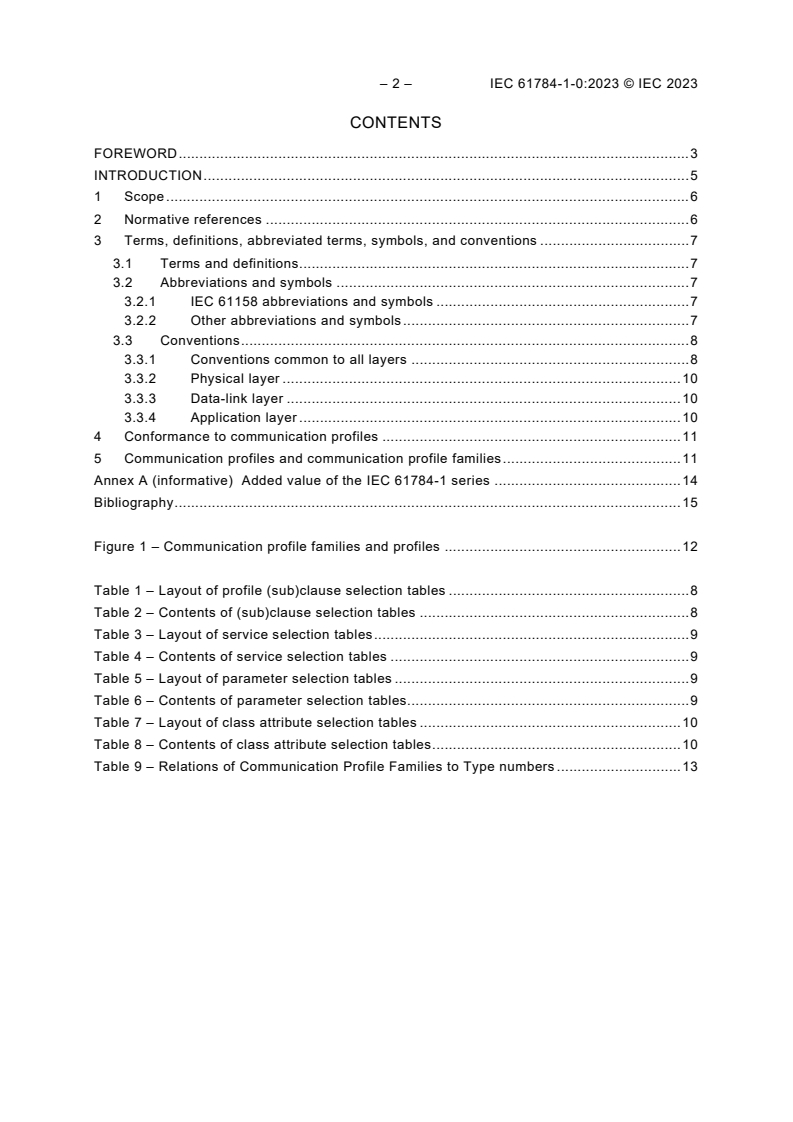
CONTENTS
FOREWORD . 3
INTRODUCTION . 5
1 Scope . 6
2 Normative references . 6
3 Terms, definitions, abbreviated terms, symbols, and conventions . 7
3.1 Terms and definitions . 7
3.2 Abbreviations and symbols . 7
3.2.1 IEC 61158 abbreviations and symbols . 7
3.2.2 Other abbreviations and symbols . 7
3.3 Conventions . 8
3.3.1 Conventions common to all layers . 8
3.3.2 Physical layer . 10
3.3.3 Data-link layer . 10
3.3.4 Application layer . 10
4 Conformance to communication profiles . 11
5 Communication profiles and communication profile families . 11
Annex A (informative) Added value of the IEC 61784-1 series . 14
Bibliography . 15
Figure 1 – Communication profile families and profiles . 12
Table 1 – Layout of profile (sub)clause selection tables . 8
Table 2 – Contents of (sub)clause selection tables . 8
Table 3 – Layout of service selection tables . 9
Table 4 – Contents of service selection tables . 9
Table 5 – Layout of parameter selection tables . 9
Table 6 – Contents of parameter selection tables. 9
Table 7 – Layout of class attribute selection tables . 10
Table 8 – Contents of class attribute selection tables . 10
Table 9 – Relations of Communication Profile Families to Type numbers . 13
INTERNATIONAL ELECTROTECHNICAL COMMISSION
____________
INDUSTRIAL NETWORKS –
PROFILES –
Part 1-0: Fieldbus profiles –
General concepts and terminology
FOREWORD
1) The International Electrotechnical Commission (IEC) is a worldwide organization for standardization comprising
all national electrotechnical committees (IEC National Committees). The object of IEC is to promote international
co-operation on all questions concerning standardization in the electrical and electronic fields. To this end and
in addition to other activities, IEC publishes International Standards, Technical Specifications, Technical Reports,
Publicly Available Specifications (PAS) and Guides (hereafter referred to as “IEC Publication(s)”). Their
preparation is entrusted to technical committees; any IEC National Committee interested in the subject dealt with
may participate in this preparatory work. International, governmental and non-governmental organizations liaising
with the IEC also participate in this preparation. IEC collaborates closely with the International Organization for
Standardization (ISO) in accordance with conditions determined by agreement between the two organizations.
2) The formal decisions or agreements of IEC on technical matters express, as nearly as possible, an international
consensus of opinion on the relevant subjects since each technical committee has representation from all
interested IEC National Committees.
3) IEC Publications have the form of recommendations for international use and are accepted by IEC National
Committees in that sense. While all reasonable efforts are made to ensure that the technical content of IEC
Publications is accurate, IEC cannot be held responsible for the way in which they are used or for any
misinterpretation by any end user.
4) In order to promote international uniformity, IEC National Committees undertake to apply IEC Publications
transparently to the maximum extent possible in their national and regional publications. Any divergence between
any IEC Publication and the corresponding national or regional publication shall be clearly indicated in the latter.
5) IEC itself does not provide any attestation of conformity. Independent certification bodies provide conformity
assessment services and, in some areas, access to IEC marks of conformity. IEC is not responsible for any
services carried out by independent certification bodies.
6) All users should ensure that they have the latest edition of this publication.
7) No liability shall attach to IEC or its directors, employees, servants or agents including individual experts and
members of its technical committees and IEC National Committees for any personal injury, property damage or
other damage of any nature whatsoever, whether direct or indirect, or for costs (including legal fees) and
expenses arising out of the publication, use of, or reliance upon, this IEC Publication or any other IEC
Publications.
8) Attention is drawn to the Normative references cited in this publication. Use of the referenced publications is
indispensable for the correct application of this publication.
9) Attention is drawn to the possibility that some of the elements of this IEC Publication may be the subject of patent
rights. IEC shall not be held responsible for identifying any or all such patent rights.
Attention is drawn to the fact that the use of some of the associated protocol types is restricted
by their intellectual-property-right holders. In all cases, the commitment to limited release of
intellectual-property-rights made by the holders of those rights permits a layer protocol type to
be used with other layer protocols of the same type, or in other type combinations explicitly
authorized by their respective intellectual property right holders.
NOTE Combinations of protocol types are specified in the IEC 61784-1 series and the IEC 61784-2 series.
IEC 61784-1-0 has been prepared by subcommittee 65C: Industrial networks, of IEC technical
committee 65: Industrial-process measurement, control and automation. It is an International
Standard.
This first edition, together with the other parts of the same series, cancels and replaces the fifth
edition of IEC 61784-1 published in 2019. This first edition constitutes a technical revision.
– 4 – IEC 61784-1-0:2023 © IEC 2023
This edition includes the following significant technical changes with respect to
IEC 61784-1:2019:
a) split of the original IEC 61784-1 into several subparts, one subpart for the material of a
generic nature, and one subpart for each Communication Profile Family specified in the
original document;
b) move most contents of the original scope into a new dedicated subclause;
c) addition of a new Communication Profile Family (CPF 22).
The text of this International Standard is based on the following documents:
Draft Report on voting
65C/1207/FDIS 65C/1236/RVD
Full information on the voting for its approval can be found in the report on voting indicated in
the above table.
The language used for the development of this International Standard is English.
This document was drafted in accordance with ISO/IEC Directives, Part 2, and developed in
accordance with ISO/IEC Directives, Part 1 and ISO/IEC Directives, IEC Supplement, available
at www.iec.ch/members_experts/refdocs. The main document types developed by IEC are
described in greater detail at www.iec.ch/publications.
A list of all parts of the IEC 61784-1 series, published under the general title Industrial networks
– Profiles – Part 1: Fieldbus profiles, can be found on the IEC website.
The committee has decided that the contents of this document will remain unchanged until the
stability date indicated on the IEC website under webstore.iec.ch in the data related to the
specific document. At this date, the document will be
• reconfirmed,
• withdrawn,
• replaced by a revised edition, or
• amended.
INTRODUCTION
The IEC 61784-1 series provides a set of Communication Profiles (CP) in the sense of
ISO/IEC TR 10000-1. These answer the need of identifying the protocol families co-existing
within the IEC 61158 series, as a result of the international harmonization of fieldbus
technologies available on the market. More specifically, these profiles help to correctly state
the compliance with the IEC 61158 series, and to avoid the spreading of divergent
implementations, which would limit its use, clearness and understanding. Additional profiles to
address specific market concerns, such as functional safety or information security, can be
addressed by future parts of the IEC 61784-1 series.
The IEC 61784-1 series contains several Communication Profile Families (CPF), which specify
one or more communication profiles. Such profiles identify, in a strict sense, protocol subsets
of the IEC 61158 series via protocol specific communication profiles. They do not define device
profiles that specify communication profiles together with application functions needed to
answer the need of a specific application ("application profiles").
It is agreed that these latter classes of profiles would facilitate the use of the IEC 61158 series
of standards; the profiles defined in the IEC 61784-1 series are a necessary step to achieve
that task.
It is also important to clarify that interoperability – defined as the ability of two or more network
systems to exchange information and to make mutual use of the information that has been
exchanged (see ISO/IEC TR 10000-1) – can be directly achieved on the same link only for those
devices complying with the same communication profile.
Profiles contained in the IEC 61784-1 series are constructed of references to IEC 61158-2 and
the IEC 61158-3, IEC 61158-4, IEC 61158-5 and IEC 61158-6 series, and other IS, TS or
worldwide-accepted standards, as appropriate . Each profile is required to reference at least
one part of the IEC 61158 series in addition to IEC 61158-1.
Two or more Profiles, which are related to a common family, are specified within a
"Communication Profile Family" (CPF).
___________
International Standardised Profiles may contain normative references to specifications other than International
Standards; see ISO/IEC JTC 1 N 4047: The Normative Referencing of Specifications other than International
Standards in JTC 1 International Standardized Profiles – Guidelines for ISP Submitters.
– 6 – IEC 61784-1-0:2023 © IEC 2023
INDUSTRIAL NETWORKS –
PROFILES –
Part 1-0: Fieldbus profiles –
General concepts and terminology
1 Scope
The IEC 61784-1 series defines several Communication Profile Families (CPF). Each CPF
specifies a set of protocol specific communication profiles (CPs) based primarily on the
IEC 61158 series, to be used in the design of devices involved in communications in factory
manufacturing and process control.
This part of IEC 61784-1 defines a common terminology for all CPFs and conventions to be
used in the specification of the CPs. It also provides a compliance statement and an overview
of the structure and contents of the CPFs in the IEC 61784-1 series.
NOTE The added value of the IEC 61784-1 series is explained in Annex A.
2 Normative references
The following documents are referred to in the text in such a way that some or all of their content
constitutes requirements of this document. For dated references, only the edition cited applies.
For undated references, the latest edition of the referenced document (including any
amendments) applies.
NOTE All parts of the IEC 61158 series, as well as the IEC 61784-1 series and the IEC 61784-2 series are
maintained simultaneously. Cross-references to these documents within the text therefore refer to the editions as
dated in this list of normative references.
IEC 61158 (all parts), Industrial communication networks – Fieldbus specifications
IEC 61784-1 (all parts), Industrial networks – Profiles – Part 1: Fieldbus profiles
IEC 61784-1-1:2023, Industrial networks – Profiles – Part 1-1: Fieldbus profiles –
Communication Profile Family 1
IEC 61784-1-2:2023, Industrial networks – Profiles – Part 1-2: Fieldbus profiles –
Communication Profile Family 2
IEC 61784-1-3:2023, Industrial networks – Profiles – Part 1-3: Fieldbus profiles –
Communication Profile Family 3
IEC 61784-1-4:2023, Industrial networks – Profiles – Part 1-4: Fieldbus profiles –
Communication Profile Family 4
IEC 61784-1-5:2023, Industrial networks – Profiles – Part 1-5: Fieldbus profiles –
Communication Profile Family 5
IEC 61784-1-6:2023, Industrial networks – Profiles – Part 1-6: Fieldbus profiles –
Communication Profile Family 6
IEC 61784-1-8:2023, Industrial networks – Profiles – Part 1-8: Fieldbus profiles –
Communication Profile Family 8
IEC 61784-1-9:2023, Industrial networks – Profiles – Part 1-9: Fieldbus profiles –
Communication Profile Family 9
IEC 61784-1-16:2023, Industrial networks – Profiles – Part 1-16: Fieldbus profiles –
Communication Profile Family 16
IEC 61784-1-19:2023, Industrial networks – Profiles – Part 1-19: Fieldbus profiles –
Communication Profile Family 19
IEC 61784-1-22:2023, Industrial networks – Profiles – Part 1-22: Fieldbus profiles –
Communication Profile Family 22
3 Terms, definitions, abbreviated terms, symbols, and conventions
3.1 Terms and definitions
For the purposes of this document, all terms and definitions provided in the IEC 61158 series
apply.
ISO and IEC maintain terminological databases for use in standardization at the following
addresses:
• IEC Electropedia: available at https://www.electropedia.org/
• ISO Online browsing platform: available at https://www.iso.org/obp
3.2 Abbreviations and symbols
3.2.1 IEC 61158 abbreviations and symbols
For the purposes of this document, all abbreviations and symbols defined in the IEC 61158
series apply. The following abbreviations, found within the IEC 61158 series, are repeated here
for use by those who wish to understand the general structure of the IEC 61784-1 series without
referring to the IEC 61158 series.
AL Application layer
APDU Application protocol data unit
AR Application relationship
ASE Application service element
DL- Data-link layer (as a prefix)
DLL Data-link layer
DLSDU Data-link service data unit
PhL Physical layer
TPDU Transport protocol data unit
3.2.2 Other abbreviations and symbols
CP communication profile
CPF communication profile family
MAU medium attachment unit
– 8 – IEC 61784-1-0:2023 © IEC 2023
3.3 Conventions
3.3.1 Conventions common to all layers
3.3.1.1 (Sub)clause selection tables
(Sub)clause selection for all layers is defined in tables, as shown in Table 1 and Table 2. The
selected base specifications are indicated just before the selection table(s). Selection is done
at the highest (sub)clause level possible to define the profile selection unambiguously.
Table 1 – Layout of profile (sub)clause selection tables
Clause Header Presence Constraints
Table 2 – Contents of (sub)clause selection tables
Column Text Meaning
Clause <#> (Sub)clause number of the base specifications
Next subclauses Any following subclauses of the same level up to the last subclause
Next clauses Any following clauses up to the last clause of the base specification
Next annexes Any following annexes up to the last annex of the base specification
Header (Sub)clause title of the base specifications
Presence NO This (sub)clause is not included in the profile
YES This (sub)clause is fully (100 %) included in the profile
In this case no further detail is given
— Presence is defined in the following subclauses
Partial Parts of this (sub)clause are included in the profile
Constraints See <#> Constraints/remarks are defined in the given subclause, table or figure of this
profile document
— No constraints other than given in the reference document (sub)clause,
or not applicable
The text defines the constraint directly; for longer text, table footnotes or table
notes may be used
If sequences of (sub)clauses do not match the profile, then the numbers are concatenated.
EXAMPLE 1 Concatenated subclauses
3.4 – 3.7 — NO —
EXAMPLE 2 Concatenated clauses up to the last clause
Next clauses — NO —
EXAMPLE 3 Concatenated annexes up to the last annex
Next annexes — NO —
3.3.1.2 Service selection tables
If selection of services is defined in a table, the format of Table 3 is used. The table identifies
the selected services and includes service constraints, as explained in Table 4.
Table 3 – Layout of service selection tables
Service ref. Service name Usage Constraint
Table 4 – Contents of service selection tables
Column Text Meaning
Service ref. <#> (Sub)clause number of the base specifications where the service is defined
— Not applicable
Service name The name of the service
Usage M Mandatory
O Optional
— Service is never used
Constraints See <#> Constraints/remarks are defined in the given subclause, table or figure of this
profile document
— No constraints other than given in the reference document (sub)clause, or not
applicable
The text defines the constraint directly, for longer text, table footnotes or table
notes may be used
If selection of service parameters is defined in a table, the format of Table 5 is used. Each table
identifies the selected parameters and includes parameter constraints, as explained in Table 6.
Table 5 – Layout of parameter selection tables
Parameter ref. Parameter name Usage Constraint
Table 6 – Contents of parameter selection tables
Column Text Meaning
Parameter ref. <#> (Sub)clause number of the base specifications where the service is defined
— Not applicable
Parameter name The name of the service parameter
Usage M Mandatory
O Optional
— Attribute is never present
Constraints See <#> Constraints/remarks are defined in the given subclause, table or figure of this
profile document
— No constraints other than given in the reference document (sub)clause,
or not applicable
The text defines the constraint directly; for longer text, table footnotes or table
notes may be used
– 10 – IEC 61784-1-0:2023 © IEC 2023
3.3.2 Physical layer
No additional conventions are defined.
3.3.3 Data-link layer
3.3.3.1 Service profile conventions
No additional conventions are defined.
3.3.3.2 Service and parameter selections
These are described using the common conventions, see 3.3.1.2.
3.3.4 Application layer
3.3.4.1 Service profile conventions
ASE and class selection is described using (sub)clause selection tables, see 3.3.1.1. If the
usage of selected ASE and classes is further constrained, this is specified in the profile (e.g.
an optional item of the base standard is mandatory in the profile).
If selection of class attributes is defined in a table, the format of Table 7 is used. The table
identifies the selected class attributes and includes their constraints, as explained in Table 8.
Table 7 – Layout of class attribute selection tables
Attribute Attribute Name Usage Constraint
Table 8 – Contents of class attribute selection tables
Column Text Meaning
Attribute <#> Attribute number of the base specification class
— Not applicable
Attribute Name The name of the attribute
Usage M Mandatory
O Optional
— Attribute is never present
Constraints See <#> Constraints/remarks are defined in the given subclause, table or figure of this
profile document
— No constraints other than given in the reference document (sub)clause,
or not applicable
The text defines the constraint directly; for longer text, table footnotes or table
notes may be used
3.3.4.2 Service and parameter selections
These are described using the common conventions, see 3.3.1.2.
4 Conformance to communication profiles
Each communication profile within the IEC 61784-1 series includes part of the IEC 61158
series. It may also include parts of other standards or international specifications.
A statement of compliance with a Communication Profile Family n (CPF n) of the IEC 61784-1
series shall be stated as either
Compliance with IEC 61784-1-n:2023
or
Compliance with IEC 61784-1-n (Ed.1.0)
and a statement of compliance with a Communication Profile (CP) of the IEC 61784-1 series
shall be stated as either
Compliance with IEC 61784-1-n:2023 CP n/m
or
Compliance with IEC 61784-1-n (Ed.1.0) CP n/m
where the Type within the angle brackets < > is optional and the angle brackets are not to be
included.
Product standards shall not include any conformity assessment aspects (including QM
provisions), neither normative nor informative, other than provisions for product testing
(evaluation and examination).
5 Communication profiles and communication profile families
Each CP selects specifications for the communications protocol stack at a device. It contains a
minimal set of required services at the application layer and specification of options in
intermediate layers defined through references. If no application layer is included, then a
minimal set of required services at the Data-link layer is specified. The appropriate references
to the protocol specific types are given in each communication profile family or associated
profiles.
NOTE All CPs are based on standards or draft standards or International Standards published by the IEC or from
standards or International Standards established by other standards bodies or open standards processes.
The structure of CPFs is specified in Figure 1.
___________
In accordance with ISO/IEC Directives
The date should not be used when the edition number is used.
– 12 – IEC 61784-1-0:2023 © IEC 2023
Figure 1 – Communication profile families and profiles
Each profile selects an appropriate consistent and compatible subset of services and protocols
from the total available set that is defined and modelled in the IEC 61158 series. For the
selected subset of services and protocols, the profile also describes any possible or necessary
constraints in parameter values.
Table 9 shows the CPFs that are defined in the IEC 61784-1 series.
Table 9 – Relations of Communication Profile Families to Type numbers
IEC 61784-1 (all parts) contents Corresponding IEC 61158 Types
CPF Part Communication Profile Families Type
(see Note 1)
1 IEC 61784-1-1 Foundation® Fieldbus 1, 5, 9 (see Note 2)
2 IEC 61784-1-2 CIP™ 2
3 IEC 61784-1-3 PROFIBUS & PROFINET 3 (see Note 3)
4 IEC 61784-1-4 P-NET® 4
5 IEC 61784-1-5 WorldFIP® 7
6 IEC 61784-1-6 INTERBUS® 8
7 Has been removed based on lack of market 6
relevance
8 IEC 61784-1-8 CC-Link 18
9 IEC 61784-1-9 HART 20
16 IEC 61784-1-16 SERCOS 16
19 IEC 61784-1-19 MECHATROLINK 24
22 IEC 61784-1-22 AUTBUS™ 28
NOTE 1 See the specific parts of the IEC 61784-1 series for information on the respective trademark holders.
NOTE 2 CP 1/1 has a denigrated PhL device profile subclass, which uses a variant of a Type 3 PhL.
NOTE 3 CP 3/2 has a denigrated PhL device profile subclass, which uses a variant of a Type 1 PhL.
NOTE 4 Other CPFs can be found in the IEC 61784-2 series.
– 14 – IEC 61784-1-0:2023 © IEC 2023
Annex A
(informative)
Added value of the IEC 61784-1 series
The approval of the IEC 61784-1 series as an International Standard means that a number of
industry specifications for field communication have well-defined communication stacks
(physical layer, data-link layer, application layer).
The added value of the IEC 61784-1 series is that:
– It is the guideline to properly use the IEC 61158 series of International Standards.
– The communication profiles are fully defined and available as International Standards.
– Devices declared fully compliant with one of these profiles are usable on the same network
(they support the basic level of interoperability).
– Compliance may be supported by independent organizations.
– It gives the possibility to reference other existing national and international standards, where
neither IEC nor ISO have equivalent standards.
– The harmonization work done in the IEC 61158 series resulted in the identification of some
common views, concepts, definitions, and approaches. This helps understand the basis of
fieldbus technologies.
– The IEC 61784-1 series specifies the different fieldbus concepts in one International
Standard. This is a first and important step forward in resolving difficulty in comparing
market products and performances.
The communication profiles give the normative basis needed to support the complementary
work about the application functions.
Bibliography
IEC 61158-1, Industrial communication networks – Fieldbus specifications – Part 1: Overview
and guidance for the IEC 61158 and IEC 61784 series
IEC 61158-2, Industrial communication networks – Fieldbus specifications – Part 2: Physical
layer specification and service definition
IEC 61158-3 (all parts), Industrial communication networks – Fieldbus specifications – Part 3:
Data-link layer service definition
IEC 61158-4 (all parts), Industrial communication networks – Fieldbus specifications – Part 4:
Data-link layer protocol specification
IEC 61158-5 (all parts), Industrial communication networks – Fieldbus specifications – Part 5:
Application layer service definition
IEC 61158-6 (all parts), Industrial communication networks – Fieldbus specifications – Part 6:
Application layer protocol specification
IEC 61784-2 (all parts), Industrial networks – Profiles – Part 2: Additional real-time fieldbus
profiles based on ISO/IEC/IEEE 8802-3
ISO/IEC 2022, Information technology – Character code structure and extension techniques
ISO/IEC 7498-1, Information technology – Open Systems Interconnection – Basic Reference
Model: The Basic Model
ISO/IEC 7498-3, Information technology – Open Systems Interconnection – Basic Reference
Model: Naming and addressing
ISO/IEC TR 10000-1, Information technology – Framework and taxonomy of International
Standardized Profiles – Part 1: General principles and documentation framework
ISO/IEC 10731, Information technology – Open Systems Interconnection – Basic Reference
Model – Conventions for the definition of OSI services
ISO/IEC/IEEE 8802-3, Telecommunications and exchange between information technology
systems – Requirements for local and metropolitan area networks – Part 3: Standard for
Ethernet
___________
– 16 – IEC 61784-1-0:2023 © IEC 2023
SOMMAIRE
AVANT-PROPOS . 17
INTRODUCTION . 19
1 Domaine d’application . 20
2 Références normatives . 20
3 Termes, définitions, abréviations, symboles et conventions . 21
3.1 Termes et définitions . 21
3.2 Abréviations et symboles . 21
3.2.1 Abréviations et symboles de l’IEC 61158 . 21
3.2.2 Autres abréviations et symboles . 21
3.3 Conventions . 22
3.3.1 Conventions communes à toutes les couches . 22
3.3.2 Couche physique . 24
3.3.3 Couche liaison de données . 24
3.3.4 Couche application . 24
4 Conformité aux profils de communication . 25
5 Profils de communication et familles de profils de communication . 26
Annexe A Valeur ajoutée de la série IEC 61784-1 . 28
Bibliographie . 29
Figure 1 – Familles de profils de communication et profils . 26
Tableau 1 – Structure des tableaux de sélection des articles/paragraphes
correspondant aux profils . 22
Tableau 2 – Contenu des tableaux de sélection des articles/paragraphes . 22
Tableau 3 – Structure des tableaux de sélection des services . 23
Tableau 4 – Contenu des tableaux de sélection des services . 23
Tableau 5 – Structure des tableaux de sélection des paramètres . 23
Tableau 6 – Contenu des tableaux de sélection des paramètres . 24
Tableau 7 – Structure des tableaux de sélection des attributs de classe . 24
Tableau 8 – Contenu des tableaux de sélection des attributs de classe . 25
Tableau 9 – Correspondances entre les familles de profils de communication et les
numéros de types . 27
COMMISSION ÉLECTROTECHNIQUE INTERNATIONALE
____________
RÉSEAUX INDUSTRIELS – PROFILS –
Partie 1-0: Profils de bus de terrain –
Concepts généraux et terminologie
AVANT-PROPOS
1) La Commission Électrotechnique Internationale (IEC) est une organisation mondiale de normalisation composée
de l’ensemble des comités électrotechniques nationaux (Comités nationaux de l’IEC). L’IEC a pour objet de
favoriser la coopération internationale pour toutes les questions de normalisation dans les domaines de
l’électricité et de l’électronique. A cet effet, l’IEC – entre autres activités – publie des Normes internationales,
des Spécifications techniques, des Rapports techniques, des Spécifications accessibles au public (PAS) et des
Guides (ci-après dénommés "Publication(s) de l’IEC"). Leur élaboration est confiée à des comités d’études, aux
travaux desquels tout Comité national intéressé par le sujet traité peut participer. Les organisations
internationales, gouvernementales et non gouvernementales, en liaison avec l’IEC, participent également aux
travaux. L’IEC collabore étroitement avec l’Organisation Internationale de Normalisation (ISO), selon des
conditions fixées par accord entre les deux organisations.
2) Les décisions ou accords officiels de l’IEC concernant les questions techniques représentent, dans la mesure du
possible, un accord international sur les sujets étudiés, étant donné que les Comités nationaux de l’IEC intéressés
sont représentés dans chaque comité d’études.
3) Les Publications de l’IEC se présentent sous la forme de recommandations internationales et sont agréées
comme telles par les Comités nationaux de l’IEC. Tous les efforts raisonnables sont entrepris afin que l’IEC
s’assure de l’exactitude du contenu technique de ses Publications; l’IEC ne peut pas être tenue responsable de
l’éventuelle mauvaise utilisation ou interprétation qui en est faite par un quelconque utilisateur final.
4) Dans le but d’encourager l’uniformité internationale, les Comités nationaux de l’IEC s’engagent, dans toute la
mesure possible, à appliquer de façon transparente les Publications de l’IEC dans leurs publications nationales
et régionales. Toutes divergences entre toutes Publications de l’IEC et toutes publications nationales ou
régionales correspondantes doivent être indiquées en termes clairs dans ces dernières.
5) L’IEC elle-même ne fournit aucune attestation de conformité. Des organismes de certification indépendants
fournissent des services d’évaluation de conformité et, dans certains secteurs, accèdent aux marques de
conformité de l’IEC. L’IEC n’est responsable d’aucun des services effectués par les organismes de certification
indépendants.
6) Tous les utilisateurs doivent s’assurer qu’ils sont en possession de la dernière édition de cette publication.
7) Aucune responsabilité ne doit être imputée à l’IEC, à ses administrateurs, employés, auxiliaires ou mandataires,
y compris ses experts particuliers et les membres de ses comités d’études et des Comités nationaux de l’IEC,
pour tout préjudice causé en cas de dommages corporels et matériels, ou de tout autre dommage de quelque
nature que ce soit, directe ou indirecte, ou pour supporter les coûts (y compris les frais de justice) et les dépenses
découlant de la publication ou de l’utilisation de cette Publication de l’IEC ou de toute autre Publication de l’IEC,
ou au crédit qui lui est accordé.
8) L’attention est attirée sur les références normatives citées dans cette publication. L’utilisation de publications
référencées est obligatoire pour une application correcte de la présente publication.
9) L’attention est attirée sur le fait que certains des éléments de la présente Publication de l’IEC peuvent faire l’objet
de droits de brevet. L’IEC ne saurait être tenue pour responsable de ne pas avoir identifié de tels droits de
propriété et averti de leur existence.
L’attention est attirée sur le fait que l’utilisation de certains des types de protocoles associés
est restreinte par les détenteurs des droits de propriété intellectuelle. En tout état de cause,
l’engagement de renonciation partielle aux droits de propriété intellectuelle pris par les
détenteurs de ces droits autorise l’utilisation d’un type de protocole de couche avec les autres
protocoles de couche du même type, ou dans des combinaisons avec d’autres types autorisées
explicitement par les détenteurs respectifs des droits de propriété intellectuelle pour ces types.
NOTE Les combinaisons de types de protocoles sont spécifiées dans la série IEC 61784-1 et dans la série
IEC 61784-2.
L’IEC 61784-1-0 a été établie par le sous-comité 65C: Réseaux industriels, du comité
d’études 65 de l’IEC: Mesure, commande et automation dans les processus industriels Il s’agit
d’une Norme internationale.
– 18 – IEC 61784-1-0:2023 © IEC 2023
Cette première édition, conjointement avec les autres parties de la même série, annule et
remplace la cinquième édition de l’IEC 61784-1 parue en 2019. Cette première édition constitue
une révision technique.
Cette édition inclut les modifications techniques majeures suivantes par rapport à
l’IEC 61784-1:2019:
a) scission de l’IEC 61784-1 d’origine en plusieurs sous-parties, une sous-partie pour le
matériel de nature générique et une sous-partie pour chaque famille de profils de
communication spécifiée dans le document d’origine;
b) déplacement de la plupart des contenus du domaine d’application d’origine dans un
nouveau paragraphe dédié;
c) ajout d’une nouvelle famille de profils de communication (CPF 22).
Le texte de cette Norme internationale est issu des documents suivants:
Projet Rapport de vote
65C/1207/FDIS 65C/1236/RVD
Le rapport de vote indiqué dans le tableau ci-dessus donne toute information sur le vote ayant
abouti à son approbation.
La version française de cette norme n'a pas été soumise au vote.
La langue employée pour l’élaboration de cette Norme internationale est l’anglais.
Ce document a été rédigé selon les Directives ISO/IEC, Partie 2, il a été développé selon les
Directives ISO/IEC, Partie 1 et les Directives ISO/IEC, Supplément IEC, disponibles sous
www.iec.ch/
...