

IEC 60974-7:2000
(Main)Arc welding equipment - Part 7: Torches
General Information
- Abstract
Specifies safety and construction requirements for torches consisting of the torch body, the cable-hose assembly and other components. It does not apply to to torches for air-arc cutting/ gouging
- Status
- Published
- Publication Date
- 20-Mar-2000
- Technical Committee
- TC 26 - Electric welding
- Current Stage
- DELPUB - Deleted Publication
- Start Date
- 25-Jul-2005
- Completion Date
- 28-Aug-2026
Overview
IEC 60974-7:2000 is an international standard developed by the International Electrotechnical Commission (IEC) that specifies the safety and construction requirements for arc welding torches. This standard covers torches consisting of the torch body, cable-hose assembly, and other related components used in arc welding processes. However, it explicitly excludes torches designed for air-arc cutting and gouging applications.
The standard ensures that welding torches meet stringent safety, electrical, and thermal performance criteria, providing manufacturers and users with clear guidelines to enhance operational safety, reliability, and durability in welding equipment.
Key Topics
Scope and Application
IEC 60974-7 applies to various types of arc welding torches, including torches for Metal Inert Gas (MIG), Metal Active Gas (MAG), Tungsten Inert Gas (TIG), plasma arc welding, and self-shielded flux-cored welding. It excludes torches used specifically for air-arc cutting or gouging.Classification
Torches are classified based on:- Welding process type
- Method of guidance (manual, mechanized)
- Cooling method (air-cooled, liquid-cooled)
- Arc striking method for plasma processes
Safety Requirements
The standard mandates comprehensive protection against electric shock, addressing:- Rated voltage and insulation resistance
- Dielectric strength and protection under normal operating conditions
- Additional requirements for plasma cutting torches to withstand specific electrical hazards
Thermal Performance
The standard specifies temperature rise limits and defines heating tests for different torch types to ensure safe operation without overheating during use.Mechanical Resistance and Durability
IEC 60974-7 includes tests for resistance to hot objects, impact resistance, and mechanical robustness to guarantee durability under typical working conditions.Marking and Documentation
Clear marking requirements and comprehensive instructions for use are detailed to ensure correct identification, safe handling, and maintenance of welding torches.
Applications
IEC 60974-7 is essential for manufacturers, safety inspectors, and end-users involved with arc welding equipment to ensure that torches meet internationally recognized safety and performance standards. Its applications include:
Manufacturing and Quality Control
Welding torch manufacturers use this standard to design and verify that their products meet safety, electrical insulation, and thermal requirements before market release.Safety Compliance
Safety regulators and certification bodies refer to this standard to evaluate and approve welding equipment, ensuring user protection from electrical hazards and equipment failures.Industrial Welding Operations
Fabricators, construction companies, and repair workshops benefit from consistent quality and safety performance in welding torches, reducing workplace accidents and improving operational efficiency.Equipment Maintenance and Training
Users and technicians rely on the standard’s marking and instruction requirements to maintain, use, and troubleshoot torches correctly, extending equipment lifespan and safeguarding workers.
Related Standards
IEC 60974-1: Arc Welding Equipment - Part 1: Rating and Performance
Defines general electrical performance and rating requirements for arc welding equipment complementing the torch specifications.IEC 60050: International Electrotechnical Vocabulary (IEV)
Provides standardized terminology relevant to electrical and welding technologies referenced throughout IEC 60974-7.IEC 60027, 60417, 60617: Electrical Symbols and Graphical Symbols
Establish standard symbols used in equipment marking and technical documentation, supporting interoperability and comprehension.ISO Standards on Welding Safety and Procedures
Complementary standards that provide broader safety and procedural guidance within which IEC 60974-7 torches operate.
Conclusion
IEC 60974-7:2000 is a critical standard ensuring the safety, reliability, and performance of arc welding torches. By defining clear requirements for construction, electrical safety, thermal management, and mechanical robustness, it supports the global welding industry in maintaining high-quality welding practices. Compliance with this standard enhances operator safety, equipment durability, and operational efficiency, making it indispensable for manufacturers, users, and safety bodies involved in arc welding technology.
Relations
- Effective Date
- 05-Sep-2023
Get Certified
Connect with accredited certification bodies for this standard

DVS-ZERT GmbH
German welding certification society.
CARES (UK Certification Authority for Reinforcing Steels)
UK certification for reinforcing steels and construction.
EWF/IIW (European/International Welding Federation)
International welding personnel certification.
Sponsored listings
Frequently Asked Questions
IEC 60974-7:2000 is a standard published by the International Electrotechnical Commission (IEC). Its full title is "Arc welding equipment - Part 7: Torches". This standard covers: Specifies safety and construction requirements for torches consisting of the torch body, the cable-hose assembly and other components. It does not apply to to torches for air-arc cutting/ gouging
Specifies safety and construction requirements for torches consisting of the torch body, the cable-hose assembly and other components. It does not apply to to torches for air-arc cutting/ gouging
IEC 60974-7:2000 is classified under the following ICS (International Classification for Standards) categories: 25.160.30 - Welding equipment. The ICS classification helps identify the subject area and facilitates finding related standards.
IEC 60974-7:2000 has the following relationships with other standards: It is inter standard links to IEC 60974-7:2005. Understanding these relationships helps ensure you are using the most current and applicable version of the standard.
IEC 60974-7:2000 is available in PDF format for immediate download after purchase. The document can be added to your cart and obtained through the secure checkout process. Digital delivery ensures instant access to the complete standard document.
Standards Content (Sample)
NORME CEI
INTERNATIONALE IEC
60974-7
INTERNATIONAL
Première édition
STANDARD
First edition
2000-03
Matériel de soudage à l'arc –
Partie 7:
Torches
Arc welding equipment –
Part 7:
Torches
Numéro de référence
Reference number
CEI/IEC 60974-7:2000
Numéros des publications Numbering
Depuis le 1er janvier 1997, les publications de la CEI As from 1 January 1997 all IEC publications are
sont numérotées à partir de 60000. issued with a designation in the 60000 series.
Publications consolidées Consolidated publications
Les versions consolidées de certaines publications de Consolidated versions of some IEC publications
la CEI incorporant les amendements sont disponibles. including amendments are available. For example,
Par exemple, les numéros d’édition 1.0, 1.1 et 1.2 edition numbers 1.0, 1.1 and 1.2 refer, respectively, to
indiquent respectivement la publication de base, la the base publication, the base publication incor-
publication de base incorporant l’amendement 1, et la porating amendment 1 and the base publication
publication de base incorporant les amendements 1 incorporating amendments 1 and 2.
et 2.
Validité de la présente publication Validity of this publication
Le contenu technique des publications de la CEI est The technical content of IEC publications is kept
constamment revu par la CEI afin qu'il reflète l'état under constant review by the IEC, thus ensuring that
actuel de la technique. the content reflects current technology.
Des renseignements relatifs à la date de reconfir- Information relating to the date of the reconfirmation
mation de la publication sont disponibles dans le of the publication is available in the IEC catalogue.
Catalogue de la CEI.
Les renseignements relatifs à des questions à l’étude et Information on the subjects under consideration and
des travaux en cours entrepris par le comité technique work in progress undertaken by the technical
qui a établi cette publication, ainsi que la liste des committee which has prepared this publication, as well
publications établies, se trouvent dans les documents ci- as the list of publications issued, is to be found at the
dessous: following IEC sources:
• «Site web» de la CEI* • IEC web site*
• Catalogue des publications de la CEI • Catalogue of IEC publications
Publié annuellement et mis à jour Published yearly with regular updates
régulièrement
(Catalogue en ligne)* (On-line catalogue)*
• Bulletin de la CEI • IEC Bulletin
Disponible à la fois au «site web» de la CEI* Available both at the IEC web site* and
et comme périodique imprimé as a printed periodical
Terminologie, symboles graphiques Terminology, graphical and letter
et littéraux symbols
En ce qui concerne la terminologie générale, le lecteur For general terminology, readers are referred to
se reportera à la CEI 60050: Vocabulaire Electro- IEC 60050: International Electrotechnical Vocabulary
technique International (VEI). (IEV).
Pour les symboles graphiques, les symboles littéraux For graphical symbols, and letter symbols and signs
et les signes d'usage général approuvés par la CEI, le approved by the IEC for general use, readers are
lecteur consultera la CEI 60027: Symboles littéraux à referred to publications IEC 60027: Letter symbols to
utiliser en électrotechnique, la CEI 60417: Symboles be used in electrical technology, IEC 60417: Graphical
graphiques utilisables sur le matériel. Index, relevé et symbols for use on equipment. Index, survey and
compilation des feuilles individuelles, et la CEI 60617: compilation of the single sheets and IEC 60617:
Symboles graphiques pour schémas. Graphical symbols for diagrams.
* Voir adresse «site web» sur la page de titre. * See web site address on title page.
NORME CEI
INTERNATIONALE IEC
60974-7
INTERNATIONAL
Première édition
STANDARD
First edition
2000-03
Matériel de soudage à l'arc –
Partie 7:
Torches
Arc welding equipment –
Part 7:
Torches
IEC 2000 Droits de reproduction réservés Copyright - all rights reserved
Aucune partie de cette publication ne peut être reproduite ni No part of this publication may be reproduced or utilized in
utilisée sous quelque forme que ce soit et par aucun procédé, any form or by any means, electronic or mechanical,
électronique ou mécanique, y compris la photo-copie et les including photocopying and microfilm, without permission in
microfilms, sans l'accord écrit de l'éditeur. writing from the publisher.
International Electrotechnical Commission 3, rue de Varembé Geneva, Switzerland
Telefax: +41 22 919 0300 e-mail: inmail@iec.ch IEC web site http://www.iec.ch
CODE PRIX
Commission Electrotechnique Internationale
U
PRICE CODE
International Electrotechnical Commission
Pour prix, voir catalogue en vigueur
For price, see current catalogue
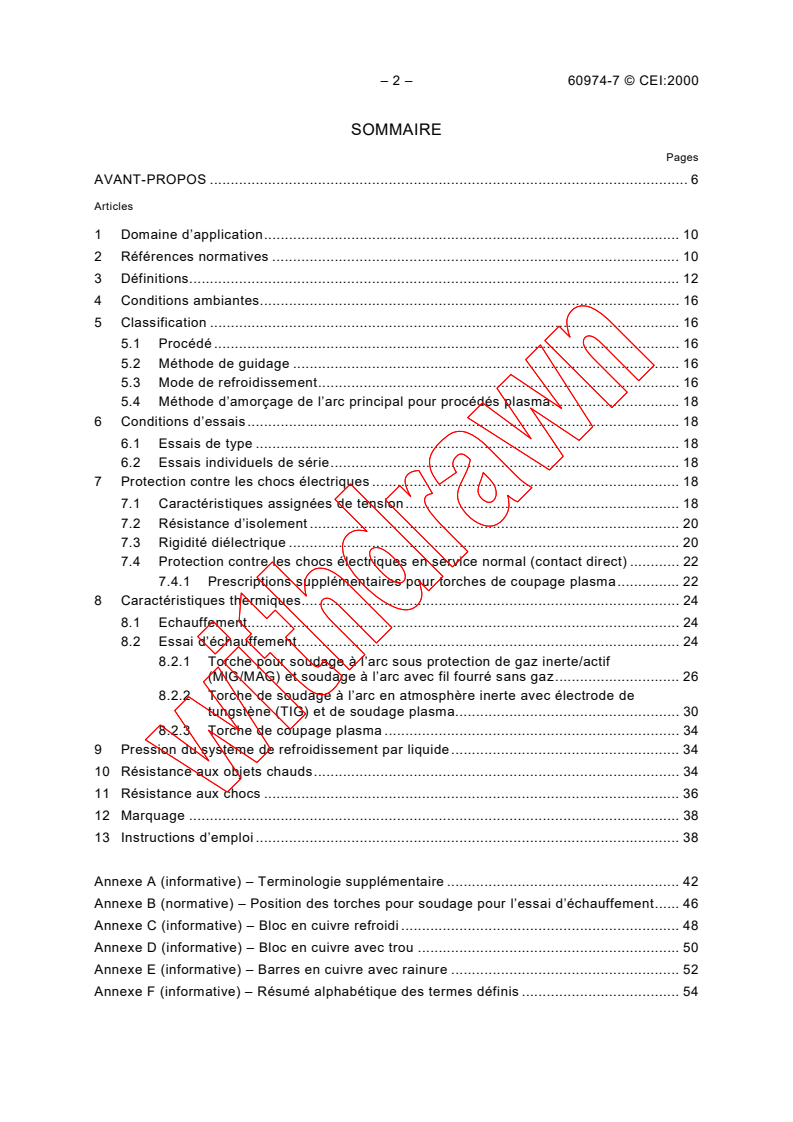
– 2 – 60974-7 © CEI:2000
SOMMAIRE
Pages
AVANT-PROPOS . 6
Articles
1 Domaine d’application. 10
2 Références normatives . 10
3 Définitions. 12
4 Conditions ambiantes. 16
5 Classification .16
5.1 Procédé . 16
5.2 Méthode de guidage . 16
5.3 Mode de refroidissement. 16
5.4 Méthode d’amorçage de l’arc principal pour procédés plasma. 18
6 Conditions d’essais . 18
6.1 Essais de type . 18
6.2 Essais individuels de série. 18
7 Protection contre les chocs électriques . 18
7.1 Caractéristiques assignées de tension. 18
7.2 Résistance d’isolement . 20
7.3 Rigidité diélectrique . 20
7.4 Protection contre les chocs électriques en service normal (contact direct) . 22
7.4.1 Prescriptions supplémentaires pour torches de coupage plasma. 22
8 Caractéristiques thermiques. 24
8.1 Echauffement. 24
8.2 Essai d’échauffement. 24
8.2.1 Torche pour soudage à l’arc sous protection de gaz inerte/actif
(MIG/MAG) et soudage à l’arc avec fil fourré sans gaz. 26
8.2.2 Torche de soudage à l’arc en atmosphère inerte avec électrode de
tungstène (TIG) et de soudage plasma. 30
8.2.3 Torche de coupage plasma . 34
9 Pression du système de refroidissement par liquide. 34
10 Résistance aux objets chauds. 34
11 Résistance aux chocs . 36
12 Marquage .38
13 Instructions d’emploi . 38
Annexe A (informative) – Terminologie supplémentaire . 42
Annexe B (normative) – Position des torches pour soudage pour l’essai d’échauffement. 46
Annexe C (informative) – Bloc en cuivre refroidi . 48
Annexe D (informative) – Bloc en cuivre avec trou . 50
Annexe E (informative) – Barres en cuivre avec rainure . 52
Annexe F (informative) – Résumé alphabétique des termes définis . 54
60974-7 © IEC:2000 – 3 –
CONTENTS
Page
FOREWORD . 7
Clause
1 Scope . 11
2 Normative references. 11
3 Definitions. 13
4 Environmental conditions . 17
5 Classification .17
5.1 Process . 17
5.2 Method of guidance . 17
5.3 Type of cooling . 17
5.4 Method of striking the main arc for plasma processes . 19
6 Test conditions . 19
6.1 Type tests. 19
6.2 Routine tests . 19
7 Protection against electric shock. 19
7.1 Voltage rating . 19
7.2 Insulation resistance. 21
7.3 Dielectric strength. 21
7.4 Protection against electric shock in normal service (direct contact) . 23
7.4.1 Additional requirements for plasma cutting torches . 23
8 Thermal rating . 25
8.1 Temperature rise . 25
8.2 Heating test . 25
8.2.1 Metal inert/active gas (MIG/MAG) and self-shielded flux cored arc welding
torch . 27
8.2.2 Tungsten inert gas (TIG) and plasma arc welding torch. 31
8.2.3 Plasma cutting torch . 35
9 Pressure of the cooling liquid system . 35
10 Resistance to hot objects . 35
11 Impact resistance. 37
12 Marking. 39
13 Instructions for use . 39
Annex A (informative) – Additional terminology. 43
Annex B (normative) – Position of the welding torches for the heating test . 47
Annex C (informative) – Cooled copper block . 49
Annex D (informative) – Copper block with a hole . 51
Annex E (informative) – Copper bars with a slot . 53
Annex F (informative) – Alphabetical summary of defined terms. 55
– 4 – 60974-7 © CEI:2000
Tableau 1 – Caractéristiques assignées de tension pour torches. 20
Tableau 2 – Valeurs d’essais pour le soudage à l’arc sous protection de gaz inerte (MIG)
des alliages d’aluminium . 28
Tableau 3 – Valeurs d’essais pour le soudage à l’arc sous protection de gaz actif (MAG)
des aciers doux. 28
Tableau 4 – Valeurs d’essais pour le soudage à l’arc sous protection de gaz actif (MAG)
avec fil fourré . 30
Tableau 5 – Valeurs d’essais pour le soudage à l’arc avec fil fourré sans gaz
des aciers doux. 30
Tableau 6 – Valeurs d’essais pour le soudage à l’arc en atmosphère inerte avec électrode
de tungstène (TIG) . 32
Tableau 7 – Valeurs d’essais pour le soudage plasma . 32
Figure 1 – Dispositif d’essai de résistance aux objets chauds. 36
Figure 2 – Dispositif pour l’essai de résistance aux chocs . 38
60974-7 © IEC:2000 – 5 –
Table 1 – Voltage rating of torches. 21
Table 2 – Test values for metal inert gas arc welding (MIG) of aluminium alloys. 29
Table 3 – Test values for metal active gas arc welding (MAG) of mild steel . 29
Table 4 – Test values for metal active gas arc welding (MAG) with flux-cored wire. 31
Table 5 – Test values for self-shielded flux-cored arc welding of mild steel . 31
Table 6 – Test values for tungsten inert gas arc welding (TIG) . 33
Table 7 – Test values for plasma arc welding . 33
Figure 1 – Device for testing the resistance to hot objects. 37
Figure 2 – Device for the impact test . 39
– 6 – 60974-7 © CEI:2000
COMMISSION ÉLECTROTECHNIQUE INTERNATIONALE
–––––––––––––
MATÉRIEL DE SOUDAGE À L'ARC –
Partie 7: Torches
AVANT-PROPOS
1) La CEI (Commission Électrotechnique Internationale) est une organisation mondiale de normalisation
composée de l'ensemble des comités électrotechniques nationaux (Comités nationaux de la CEI). La CEI a
pour objet de favoriser la coopération internationale pour toutes les questions de normalisation dans les
domaines de l'électricité et de l'électronique. A cet effet, la CEI, entre autres activités, publie des Normes
internationales. Leur élaboration est confiée à des comités d'études, aux travaux desquels tout Comité national
intéressé par le sujet traité peut participer. Les organisations internationales, gouvernementales et non
gouvernementales, en liaison avec la CEI, participent également aux travaux. La CEI collabore étroitement
avec l'Organisation Internationale de Normalisation (ISO), selon des conditions fixées par accord entre les
deux organisations.
2) Les décisions ou accords officiels de la CEI concernant les questions techniques représentent, dans la mesure
du possible, un accord international sur les sujets étudiés, étant donné que les Comités nationaux intéressés
sont représentés dans chaque comité d’études.
3) Les documents produits se présentent sous la forme de recommandations internationales. Ils sont publiés
comme normes, spécifications techniques, rapports techniques ou guides et agréés comme tels par les
Comités nationaux.
4) Dans le but d'encourager l'unification internationale, les Comités nationaux de la CEI s'engagent à appliquer de
façon transparente, dans toute la mesure possible, les Normes internationales de la CEI dans leurs normes
nationales et régionales. Toute divergence entre la norme de la CEI et la norme nationale ou régionale
correspondante doit être indiquée en termes clairs dans cette dernière.
5) La CEI n’a fixé aucune procédure concernant le marquage comme indication d’approbation et sa responsabilité
n’est pas engagée quand un matériel est déclaré conforme à l’une de ses normes.
6) L’attention est attirée sur le fait que certains des éléments de la présente Norme internationale peuvent faire
l’objet de droits de propriété intellectuelle ou de droits analogues. La CEI ne saurait être tenue pour
responsable de ne pas avoir identifié de tels droits de propriété et de ne pas avoir signalé leur existence.
La Norme internationale CEI 60974-7 a été établie par le comité d'études 26 de la CEI:
Soudage électrique.
Le texte de cette norme est issu des documents suivants:
FDIS Rapport de vote
26/174/FDIS 26/188/RVD
Le rapport de vote indiqué dans le tableau ci-dessus donne toute information sur le vote ayant
abouti à l'approbation de cette norme.
Cette publication a été rédigée selon les Directives ISO/CEI, Partie 3.
L'annexe B fait partie intégrante de cette norme.
Les annexes A, C, D, E et F sont données uniquement à titre d'information.
60974-7 © IEC:2000 – 7 –
INTERNATIONAL ELECTROTECHNICAL COMMISSION
–––––––––––
ARC WELDING EQUIPMENT –
Part 7: Torches
FOREWORD
1) The IEC (International Electrotechnical Commission) is a worldwide organization for standardization comprising
all national electrotechnical committees (IEC National Committees). The object of the IEC is to promote
international co-operation on all questions concerning standardization in the electrical and electronic fields. To
this end and in addition to other activities, the IEC publishes International Standards. Their preparation is
entrusted to technical committees; any IEC National Committee interested in the subject dealt with may
participate in this preparatory work. International, governmental and non-governmental organizations liaising
with the IEC also participate in this preparation. The IEC collaborates closely with the International
Organization for Standardization (ISO) in accordance with conditions determined by agreement between the
two organizations.
2) The formal decisions or agreements of the IEC on technical matters express, as nearly as possible, an
international consensus of opinion on the relevant subjects since each technical committee has representation
from all interested National Committees.
3) The documents produced have the form of recommendations for international use and are published in the form
of standards, technical specifications, technical reports or guides and they are accepted by the National
Committees in that sense.
4) In order to promote international unification, IEC National Committees undertake to apply IEC International
Standards transparently to the maximum extent possible in their national and regional standards. Any
divergence between the IEC Standard and the corresponding national or regional standard shall be clearly
indicated in the latter.
5) The IEC provides no marking procedure to indicate its approval and cannot be rendered responsible for any
equipment declared to be in conformity with one of its standards.
6) Attention is drawn to the possibility that some of the elements of this International Standard may be the subject
of patent rights. The IEC shall not be held responsible for identifying any or all such patent rights.
International Standard IEC 60974-7 has been prepared by IEC technical committee 26:
Electric welding.
The text of this standard is based on the following documents:
FDIS Report on voting
26/174/FDIS 26/188/RVD
Full information on the voting for the approval of this standard can be found in the report on
voting indicated in the above table.
This publication has been drafted in accordance with the ISO/IEC Directives, Part 3.
Annex B forms an integral part of this standard.
Annexes A, C, D, E and F are for information only.
– 8 – 60974-7 © CEI:2000
Les futures normes de cette série porteront dorénavant le nouveau titre général cité ci-dessus. Le
titre des normes existant déjà dans cette série sera mis à jour lors d'une prochaine édition.
(Cette remarque ne s'applique qu'au texte français).
Le comité a décidé que le contenu de cette publication ne sera pas modifié avant 2005-12. A
cette date, la publication sera:
y reconduite;
y supprimée;
y remplacée par une édition révisée, ou
y amendée.
60974-7 © IEC:2000 – 9 –
The committee has decided that the contents of this publication will remain unchanged until
2005-12. At this date, the publication will be
reconfirmed;
withdrawn;
replaced by a revised edition, or
amended.
– 10 – 60974-7 © CEI:2000
MATÉRIEL DE SOUDAGE À L'ARC –
Partie 7: Torches
1 Domaine d’application
La présente partie de la CEI 60974 spécifie les règles de sécurité et de construction
applicables aux torches pour le soudage à l’arc et les procédés connexes.
Dans la présente norme une torche comprend le corps de torche, le faisceau d’autres
composants.
La présente norme ne s’applique pas aux porte-électrode pour le soudage manuel électrique
à l’arc ni aux torches pour le coupage/gougeage air-arc.
2 Références normatives
Les documents normatifs suivants contiennent des dispositions qui, par suite de la référence
qui y est faite, constituent des dispositions valables pour la présente partie de la CEI 60974.
Pour les références datées, les amendements ultérieurs ou les révisions de ces publications
ne s’appliquent pas. Toutefois, les parties prenantes aux accords fondés sur la présente
partie de la CEI 60974 sont invitées à rechercher la possibilité d'appliquer les éditions les
plus récentes des documents normatifs indiqués ci-après. Pour les références non datées, la
dernière édition du document normatif en référence s’applique. Les membres de la CEI et de
l'ISO possèdent le registre des Normes internationales en vigueur.
CEI 60050(151):1978, Vocabulaire Electrotechnique International – Chapitre 151: Dispositifs
électriques et magnétiques
CEI 60050(851):1991, Vocabulaire Electrotechnique International – Chapitre 851: Soudage
électrique
CEI 60051-2:1984, Appareils mesureurs électriques indicateurs analogiques à action directe
et leurs accessoires – Deuxième partie: Prescriptions particulières pour les ampèremètres et
les voltmètres
CEI 60529:1989, Degrés de protection procurés par l’enveloppe (Code IP)
CEI 60664-1:1992, Coordination de l'isolement des matériels dans les systèmes (réseaux) à
basse tension – Partie 1: Principes, prescriptions et essais
CEI 60974-1:1998, Matériel de soudage électrique – Partie 1: Sources de courant pour
soudage
CEI 61558-1:1997, Sécurité des transformateurs, blocs d'alimentation et analogues – Partie 1:
Règles générales et essais
60974-7 © IEC:2000 – 11 –
ARC WELDING EQUIPMENT –
Part 7: Torches
1 Scope
This part of IEC 60974 specifies safety and construction requirements for torches for arc
welding and allied processes.
In this standard, a torch consists of the torch body, the cable-hose assembly and other
components.
This standard is not applicable to electrode holders for manual metal arc welding or torches
for air-arc cutting/gouging.
2 Normative references
The following normative documents contain provisions which, through reference in this text,
constitute provisions of this part of IEC 60974. For dated references, subsequent
amendments to, or revisions of, any of these publications do not apply. However, parties to
agreements based on this part of IEC 60974 are encouraged to investigate the possibility of
applying the most recent editions of the normative documents indicated below. For undated
references, the latest edition of the normative document referred to applies. Members of IEC
and ISO maintain registers of currently valid International Standards.
IEC 60050(151):1978, International Electrotechnical Vocabulary – Chapter 151: Electrical and
magnetic devices
IEC 60050(851):1991, International Electrotechnical Vocabulary – Chapter 851: Electric
welding
IEC 60051-2:1984, Direct acting indicating analogue electrical measuring instruments and
their accessories – Part 2: Special requirements for ammeters and voltmeters
IEC 60529:1989, Degrees of protection provided by enclosures (IP Code)
IEC 60664-1:1992, Insulation coordination for equipment within low-voltage systems – Part 1:
Principles, requirements and tests
IEC 60974-1:1998, Arc welding equipment – Part 1: Welding power sources
IEC 61558-1:1997, Safety of power transformers, power supply units and similar – Part 1:
General requirements and tests
– 12 – 60974-7 © CEI:2000
3 Définitions
Pour les besoins de la présente partie de la CEI 60974, les définitions suivantes s’appliquent
conjointement avec celles de la CEI 60050(151), CEI 60050(851), et CEI 60664-1:
NOTE Une terminologie complémentaire est donnée dans l’annexe A.
3.1
torche
unité qui délivre à l’arc tous les éléments nécessaires au soudage, au coupage ou aux
procédés connexes (par exemple courant, gaz, agent de refroidissement, fil-électrode)
3.2
pistolet
torche avec un manche approximativement perpendiculaire au corps de torche
3.3
corps de torche
composant principal auquel le faisceau ainsi que les autres composants sont raccordés
3.4
manche
partie destinée à être tenue dans la main de l’opérateur
3.5
buse
composant fixé à la terminaison de la torche afin de diriger le gaz de protection autour de
l’arc et sur le bain de fusion
3.6
électrode réfractaire
électrode de soudage à l’arc qui ne fournit pas de métal d’apport
3.7
fil-électrode
fil d’apport solide ou tubulaire qui conduit le courant de soudage
3.8
tube-contact
pièce métallique interchangeable fixée à l’extrémité avant de la torche, qui transmet le
courant de soudage au fil-électrode et qui le guide
3.9
faisceau
ensemble mobile de câbles et de tuyaux avec ses éléments de connexion, qui fournit toutes
les alimentations nécessaires au corps de torche
3.10
torche manuelle
torche tenue et guidée par la main de l’opérateur pendant son fonctionnement
3.11
torche guidée mécaniquement
torche fixée à et guidée par un dispositif mécanique pendant son fonctionnement
60974-7 © IEC:2000 – 13 –
3 Definitions
For the purposes of this part of IEC 60974, the following definitions apply, together with those
in IEC 60050(151), IEC 60050(851), and IEC 60664-1.
NOTE Additional terminology is given in annex A.
3.1
torch
device that conveys all services necessary to the arc for welding, cutting or allied processes
(for example, current, gas, coolant, wire electrode)
3.2
gun
torch with a handle substantially perpendicular to the torch body
3.3
torch body
main component to which the cable-hose assembly and other components are connected
3.4
handle
part designed to be held in the operator's hand
3.5
gas nozzle
component at the exit end of the torch directing the shielding gas around the arc and over the
weld pool
3.6
non-consumable electrode
arc welding electrode which does not provide filler metal
3.7
wire electrode
solid or tubular filler wire which conducts welding current
3.8
contact tip
replaceable metal component fixed at the front end of the torch, which transfers the welding
current to, and guides, the wire electrode
3.9
cable-hose assembly
flexible assembly of cables and hoses, and their connecting elements, that delivers all
necessary supplies to the torch body
3.10
manual torch
torch held and guided by the operator's hand during its operation
3.11
mechanically guided torch
torch fixed to, and guided by, a mechanical device during its operation
– 14 – 60974-7 © CEI:2000
3.12
torche refroidie par air
torche refroidie par l’air ambiant et, le cas échéant, par le gaz de protection
3.13
torche refroidie par liquide
torche refroidie par la circulation d’un liquide de refroidissement
3.14
torche motorisée
torche avec des moyens incorporés pour appliquer un mouvement au fil-électrode
3.15
torche à bobine incorporée
pistolet motorisé avec alimentation incorporée pour le fil d’apport
3.16
tension d’amorçage et de stabilisation de l’arc
tension superposée au circuit de soudage afin d’amorcer et/ou de maintenir l’arc
3.17
métal d’apport
métal ajouté au cours d’une opération de soudage ou de techniques connexes [VEI 851-04-24]
3.18
fil d’apport
métal d’apport sous forme de fil solide ou tubulaire qui peut ou peut ne pas faire partie du
circuit de soudage
3.19
tuyère
composant qui contient l’orifice de constriction à travers lequel passe l’arc plasma
3.20
examen visuel général
examen visuel destiné à vérifier qu’il n’y a pas de désaccord apparent par rapport aux termes
de la norme concernée [CEI 60974-1, 3.7]
3.21
système de coupage plasma
combinaison de source de courant, torche et dispositifs de sécurité associés pour le
coupage/gougeage plasma
3.22
source de courant de coupage plasma
équipement destiné à fournir un courant et une tension, ayant des caractéristiques
appropriées pour le coupage/gougeage plasma et pouvant fournir du gaz et du liquide de
refroidissement
NOTE 1 Une source de courant de coupage plasma peut également fournir des services à d’autres équipements
et accessoires, par exemple tensions auxiliaires, liquide de refroidissement et gaz.
NOTE 2 Dans la suite du texte, le terme «source de courant de coupage» est utilisé.
[CEI 60974-1, 3.1 modifié]
60974-7 © IEC:2000 – 15 –
3.12
air-cooled torch
torch cooled by the ambient air and, where appropriate, by the shielding gas
3.13
liquid-cooled torch
torch cooled by the circulation of a cooling liquid
3.14
motorized torch
torch incorporating means to supply motion to the wire electrode
3.15
spool-on torch
motorized torch incorporating a filler wire supply
3.16
arc striking and stabilizing voltage
voltage superimposed on the welding circuit to initiate or maintain the arc or both
3.17
filler metal
metal added during welding or allied processes [IEV 851-04-24]
3.18
filler wire
filler metal in solid or tubular wire form which may or may not be part of the welding circuit
3.19
plasma tip
component that provides the constricting orifice through which the plasma arc passes
3.20
general visual inspection
inspection by eye to verify that there are no apparent discrepancies with respect to the
provisions of the standard concerned [IEC 60974-1, 3.7]
3.21
plasma cutting system
combination of power source, torch, and associated safety devices for plasma cutting/gouging
3.22
plasma cutting power source
equipment for supplying current and voltage and having the required characteristics suitable
for plasma cutting/gouging and which may supply gas and cooling liquid
NOTE 1 A plasma cutting power source may also supply services to other equipment and auxiliaries, for example
auxiliary power, cooling liquid, and gas.
NOTE 2 In the following text, the term "cutting power source" is used.
[IEC 60974-1, 3.1 modified]
– 16 – 60974-7 © CEI:2000
3.23
très basse tension de sécurité (TBTS)
tension n’excédant pas 50 V en courant alternatif ou 120 V en courant continu lissé entre
conducteurs ou entre un conducteur quelconque et la terre dans un circuit dont la séparation
du réseau d’alimentation est assurée par des moyens tels qu’un transformateur de sécurité
NOTE 1 Une tension maximale inférieure à 50 V en courant alternatif ou 120 V en courant continu lissé peut être
spécifiée dans des règles particulières, plus spécialement lorsque le contact direct avec des parties actives est
possible.
NOTE 2 Lorsque la source est un transformateur de sécurité, il convient que la limite de tension ne soit pas
dépassée à toute charge comprise entre la pleine charge et à vide.
NOTE 3 «Lissé» est conventionnellement la valeur efficace d’une tension ayant un taux d’ondulation ne
dépassant pas 10 % de la composante continue; la valeur crête maximale ne dépasse pas 140 V pour un système
en courant continu lissé avec une tension nominale de 120 V, et 70 V pour un système en courant continu lissé
avec une tension nominale de 60 V.
[CEI 61558-1, 3.7.16, modifié]
4 Conditions ambiantes
a) Température de l’air ambiant:
– pendant le soudage: –10 °C à +40 °C;
– pendant le transport et stockage: –25 °C à +55 °C;
b) Humidité relative de l’air: inférieure ou égale à 90 % à 20 °C.
5 Classification
Les torches doivent être classifiées selon
a) le procédé auquel elles sont destinées; voir 5.1;
b) la méthode de guidage; voir 5.2;
c) le mode de refroidissement; voir 5.3;
d) la méthode d’amorçage de l’arc principal pour les procédés plasma; voir 5.4.
5.1 Procédé
Les torches peuvent être conçues pour
a) le soudage MIG/MAG;
b) le soudage à l’arc avec fil fourré sans gaz;
c) le soudage TIG;
d) le soudage plasma;
e) le soudage à l’arc sous flux en poudre;
f) le coupage/gougeage plasma.
5.2 Méthode de guidage
a) Manuel.
b) Mécanique.
5.3 Mode de refroidissement
a) Air ambiant ou gaz de protection; voir 3.12.
b) Liquide; voir 3.13.
60974-7 © IEC:2000 – 17 –
3.23
SELV
voltage which does not exceed 50 V a.c. or 120 V ripple-free d.c. between conductors, or
between any conductor and earth, in a circuit which is isolated from the supply mains by such
means as a safety isolating transformer
NOTE 1 Maximum voltage lower than 50 V a.c. or 120 V ripple-free d.c. may be specified in particular
requirements, especially when direct contact with live parts is allowed.
NOTE 2 The voltage limit should not be exceeded at any load between full load and no-load when the source is a
safety isolating transformer.
NOTE 3 “Ripple-free” is conventionally an r.m.s. ripple voltage not more than 10 % of the d.c. component; the
maximum peak value does not exceed 140 V for a nominal 120 V ripple-free d.c. system and 70 V for a nominal
60 V ripple-free d.c. system.
[IEC 61558-1, 3.7.16]
4 Environmental conditions
a) Ambient air temperature
– during welding: –10 °C to +40 °C;
– during transport and storage: –25 °C to +55 °C;
b) Relative humidity of the air: up to 90 % at 20 °C.
5 Classification
Torches shall be classified in accordance with
a) the process for which they are designed, see 5.1;
b) the method by which they are guided, see 5.2;
c) the type of cooling, see 5.3;
d) the method of striking the main arc for plasma processes, see 5.4.
5.1 Process
Torches can be designed for
a) MIG/MAG welding;
b) self-shielded flux-cored arc welding;
c) TIG welding;
d) plasma welding;
e) submerged arc welding;
f) plasma cutting/gouging.
5.2 Method of guidance
a) Manually.
b) Mechanically.
5.3 Type of cooling
a) Ambient air or shielding gas, see 3.12.
b) Liquid, see 3.13.
– 18 – 60974-7 © CEI:2000
5.4 Méthode d’amorçage de l’arc principal pour les procédés plasma
a) Par une tension d’amorçage d’arc.
b) Par un arc pilote.
c) Par contact.
6 Conditions d’essais
Tous les essais doivent être effectués sur la même torche initialement neuve, totalement
assemblée et équipée de son faisceau.
Tous les essais doivent être effectués à une température de l’air ambiant comprise entre
10 °C et 40 °C.
La précision des instruments de mesure doit être la suivante:
a) appareils de mesure électrique: classe 0,5 (±0,5 % de la lecture à pleine échelle, voir
CEI 60051-2), à l’exception du mesurage de la résistance d’isolement et de la rigidité
diélectrique, où la précision des instruments de mesure n’est pas spécifiée mais doit être
prise en compte pour le mesurage;
b) dispositif de mesure de température: ±2 K.
6.1 Essais de type
Tous les essais de type indiqués ci-après doivent être effectués sur le même échantillon et
dans l’ordre suivant:
a) examen visuel général;
b) résistance aux chocs, voir l’article 11;
c) résistance aux objets chauds, voir l’article 10;
d) protection contre le contact direct, voir 7.4;
e) résistance d’isolement, voir 7.2;
f) rigidité diélectrique, voir 7.3;
g) examen visuel général.
L’essai d’échauffement peut, selon 8.2, être effectué sur un échantillon individuel et doit être
suivi de l’essai de fuite conformément à l’article 9.
6.2 Essais individuels de série
Chaque torche doit être soumise successivement aux essais individuels de série suivants:
a) examen visuel général;
b) essai de fonctionnement comme spécifié par le fabricant, par exemple fuite de liquide ou
de gaz, interrupteur de la torche.
7 Protection contre les chocs électriques
7.1 Caractéristiques assignées de tension
Les torches doivent être assignées selon la classification et l’utilisation comme indiqué au
tableau 1 et, le cas échéant, selon la tension d’amorçage et de stabilisation de l’arc.
60974-7 © IEC:2000 – 19 –
5.4 Method of striking the main arc for plasma processes
a) By an arc striking voltage.
b) By a pilot arc.
c) By contact.
6 Test conditions
All tests shall be carried out on the same new and completely assembled torch, fitted with the
cable-hose assembly normally supplied.
All tests shall be carried out at an ambient air temperature between 10 °C and 40 °C.
The accuracy of measuring instruments shall be:
a) electrical measuring instruments: class 0,5 (±0,5 % of full-scale reading, see IEC 60051-2),
except for the measurement of insulation resistance and dielectric strength where the
accuracy of the instruments is not specified, but shall be taken into account for the
measurement;
b) temperature measuring device: ±2 K.
6.1 Type tests
All type tests given below shall be carried out on the same sample and in the following
sequence:
a) general visual inspection;
b) impact resistance, see clause 11;
c) resistance to hot objects, see clause 10;
d) protection against direct contact, see 7.4;
e) insulation resistance, see 7.2;
f) dielectric strength, see 7.3;
g) general visual inspection.
The heating test according to 8.2 may be carried out on a separate sample and shall be
followed by the leakage test according to clause 9.
6.2 Routine tests
The following routine tests shall be carried out on each torch in the following sequence:
a) general visual inspection;
b) functional test as specified by the manufacturer, for example, leaks of fluid or gas, trigger
operation.
7 Protection against electric shock
7.1 Voltage rating
Torches shall be rated according to the classification and use as given in table 1 and the arc
striking and stabilizing voltage, if applicable.
– 20 – 60974-7 © CEI:2000
Tableau 1 – Caractéristiques assignées de tension pour torches
Caractéristiques Résistance Rigidité Degré de protection
assignées de d’isolement diélectrique
Classification
tension
MΩ V eff Orifice de Manche Autres
V
crête
buse parties
Torches guidées
manuellement, sauf pour 113 1 1 000 IP0X IP3X IP3X
le coupage plasma
Torches guidées
Non
mécaniquement, sauf pour 141 1 1 000 IP0X IP2X
applicable
le coupage plasma
Torches de coupage
Tuyère,
plasma guidées 500 2,5 2 100 IP4X IP3X
voir 7.4.1
manuellement
Torches de coupage
Non
plasma guidées 500 2,5 2 100 IP0X IP2X
applicable
mécaniquement
7.2 Résistance d’isolement
Après le traitement d’humidification, la résistance d’isolement d’une torche neuve ne doit pas
être inférieure aux valeurs données au tableau 1.
La conformité doit être effectuée par l’essai suivant.
a) Traitement d’humidification
Une enceinte est maintenue à une température t entre 20 °C et 30 °C avec une humidité
relative comprise entre 91 % et 95 %.
La torche munie de sa gaine enveloppe (sans liquide de refroidissement pour les torches
refroidies par liquide) est portée à une température comprise entre t et (t + 4) °C et placée
dans l’enceinte pendant 48 h.
b) Mesure de la résistance d’isolement
Immédiatement après le traitement d’humidification, la torche avec 1 m de chaque côté du
faisceau est essuyée et fermement enveloppée d’une feuille métallique recouvrant toute la
surface extérieure des parties isolantes.
La résistance d’isolement est mesurée sous une tension continue égale à 500 V appliquée
entre
– tous les circuits et la feuille métallique,
et
– tous les fils et circuits destinés à être isolés l’un de l’autre dans la torche.
La mesure est faite après stabilisation de la mesure.
7.3 Rigidité diélectrique
L’isolation doit supporter les tensions d’essai indiquées au tableau 1 sans contournement ni
claquage.
De plus l’isolation entre le manche et le circuit de coupage doit, pour les torches de coupage
plasma manuel, supporter une tension d’essai égale à 3 750 V eff.
La tension d’essai à courant alternatif doit être de forme sinusoïdale avec une valeur de crête
ne dépassant pas 1,45 fois la tension indiquée au tableau 1, ayant une fréquence d’environ
50 Hz ou 60 Hz. En variante, une tension d’essai continue égale à 1,4 fois la valeur efficace
peut être utilisée.
60974-7 © IEC:2000 – 21 –
Table 1 – Voltage rating of torches
Voltage Insulation Dielectric Degree of protection
rating resistance strength
Classification
V MΩ V r.m.s. Nozzle Handle Other
peak
orifice parts
Manually guided torches
113 1 1 000 IP0X IP3X IP3X
except for plasma cutting
Mechanically guided torches Not
141 1
...