


IEC PAS 62271-109:2002
(Main)High-voltage switchgear and controlgear - Part 109: Alternating-current series capacitor by-pass switches
General Information
- Abstract
Is applicable to a.c. series capacitor by-pass switches designed for outdoor installation and for operation at frequencies of 50 Hz and 60 Hz on systems having voltages above 1 000 V. It is only applicable to by-pass switches for use in three-phase systems. This specification is also applicable to the operating devices of by-pass switches and to their auxiliary equipment. This specification does not cover vacuum by-pass switches.
- Status
- Replaced
- Publication Date
- 04-Jul-2002
- Technical Committee
- SC 17A - Switching devices
- Current Stage
- DELPUB - Deleted Publication
- Start Date
- 30-Aug-2006
- Completion Date
- 28-Aug-2026

Relations
- Effective Date
- 05-Sep-2023
Get Certified
Connect with accredited certification bodies for this standard

IMQ S.p.A. (Certification)
Italian electrical product certification.

SLG Prüf- und Zertifizierungs GmbH
German testing and certification body.

UL Solutions
Global safety science company with testing, inspection and certification.
Sponsored listings
Frequently Asked Questions
IEC PAS 62271-109:2002 is a technical specification published by the International Electrotechnical Commission (IEC). Its full title is "High-voltage switchgear and controlgear - Part 109: Alternating-current series capacitor by-pass switches". This standard covers: Is applicable to a.c. series capacitor by-pass switches designed for outdoor installation and for operation at frequencies of 50 Hz and 60 Hz on systems having voltages above 1 000 V. It is only applicable to by-pass switches for use in three-phase systems. This specification is also applicable to the operating devices of by-pass switches and to their auxiliary equipment. This specification does not cover vacuum by-pass switches.
Is applicable to a.c. series capacitor by-pass switches designed for outdoor installation and for operation at frequencies of 50 Hz and 60 Hz on systems having voltages above 1 000 V. It is only applicable to by-pass switches for use in three-phase systems. This specification is also applicable to the operating devices of by-pass switches and to their auxiliary equipment. This specification does not cover vacuum by-pass switches.
IEC PAS 62271-109:2002 is classified under the following ICS (International Classification for Standards) categories: 29.130.10 - High voltage switchgear and controlgear; 29.130.99 - Other switchgear and controlgear. The ICS classification helps identify the subject area and facilitates finding related standards.
IEC PAS 62271-109:2002 has the following relationships with other standards: It is inter standard links to IEC 62271-109:2006. Understanding these relationships helps ensure you are using the most current and applicable version of the standard.
IEC PAS 62271-109:2002 is available in PDF format for immediate download after purchase. The document can be added to your cart and obtained through the secure checkout process. Digital delivery ensures instant access to the complete standard document.
Standards Content (Sample)
IEC/PAS 62271-109
Edition 1.0
2002-07
High-voltage switchgear and controlgear –
Part 109:
Alternating-current series capacitor
by-pass switches
PUBLICLY AVAILABLE SPECIFICATION
INTERNATIONAL Reference number
ELECTROTECHNICAL
IEC/PAS 62271-109
COMMISSION
IEC/PAS 62271-109
Edition 1.0
2002-07
High-voltage switchgear and controlgear –
Part 109:
Alternating-current series capacitor
by-pass switches
PUBLICLY AVAILABLE SPECIFICATION
INTERNATIONAL Reference number
ELECTROTECHNICAL
IEC/PAS 62271-109
COMMISSION
– 2 – Copyright © 2002, IEC
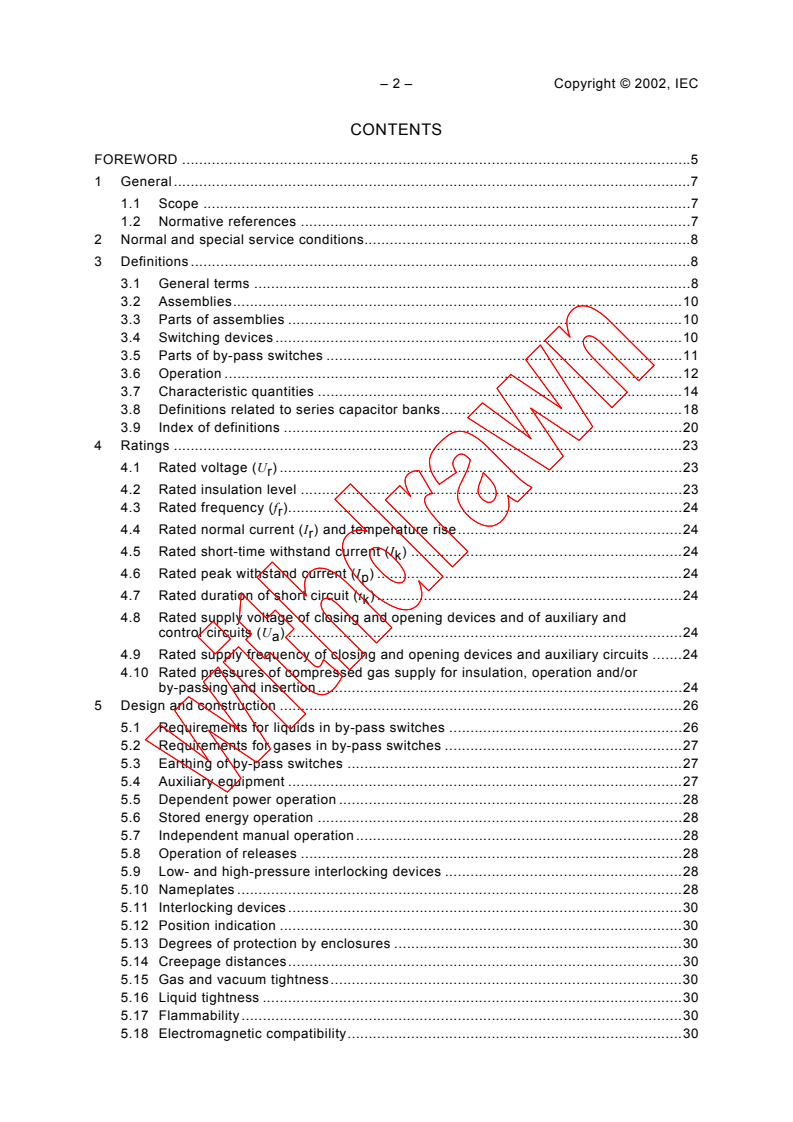
CONTENTS
FOREWORD .5
1 General.7
1.1 Scope .7
1.2 Normative references .7
2 Normal and special service conditions.8
3 Definitions .8
3.1 General terms .8
3.2 Assemblies.10
3.3 Parts of assemblies .10
3.4 Switching devices .10
3.5 Parts of by-pass switches .11
3.6 Operation .12
3.7 Characteristic quantities .14
3.8 Definitions related to series capacitor banks.18
3.9 Index of definitions .20
4 Ratings .23
4.1 Rated voltage (U ) .23
r
4.2 Rated insulation level .23
4.3 Rated frequency (f ).24
r
4.4 Rated normal current (I ) and temperature rise.24
r
4.5 Rated short-time withstand current (I ) .24
k
4.6 Rated peak withstand current (I ) .24
p
4.7 Rated duration of short circuit (t ) .24
k
4.8 Rated supply voltage of closing and opening devices and of auxiliary and
control circuits (U ) .24
a
4.9 Rated supply frequency of closing and opening devices and auxiliary circuits .24
4.10 Rated pressures of compressed gas supply for insulation, operation and/or
by-passing and insertion .24
5 Design and construction .26
5.1 Requirements for liquids in by-pass switches .26
5.2 Requirements for gases in by-pass switches .27
5.3 Earthing of by-pass switches .27
5.4 Auxiliary equipment .27
5.5 Dependent power operation .28
5.6 Stored energy operation .28
5.7 Independent manual operation.28
5.8 Operation of releases .28
5.9 Low- and high-pressure interlocking devices .28
5.10 Nameplates .28
5.11 Interlocking devices .30
5.12 Position indication .30
5.13 Degrees of protection by enclosures .30
5.14 Creepage distances.30
5.15 Gas and vacuum tightness.30
5.16 Liquid tightness .30
5.17 Flammability.30
5.18 Electromagnetic compatibility.30
6 Type tests .31
6.1 General .32
6.1.1 Grouping of tests .32
6.1.2 Information for identification of specimens .32
6.1.3 Information to be included in type test reports.32
6.2 Dielectric tests.32
6.2.1 Ambient air conditions during tests .32
6.2.2 Wet test procedure.32
6.2.3 Condition of by-pass switch during dielectric tests .33
6.2.4 Criteria to pass the test .33
6.2.5 Application of test voltage and test conditions.33
6.2.6 Tests of by-pass switches of U ≤ 245 kV or U ≤ 245 kV.33
re rp
6.2.7 Tests of by-pass switches of U > 245 kV or U > 245 kV .33
re rp
6.2.8 Artificial pollution tests .34
6.2.9 Partial discharge tests.34
6.2.10 Tests on auxiliary and control circuits .34
6.2.11 Voltage test as a condition check .34
6.3 Radio interference voltage (r.i.v.) tests.35
6.4 Measurement of the resistance of the main circuit .35
6.5 Temperature-rise tests.35
6.5.1 Conditions of the by-pass switch to be tested .35
6.5.2 Arrangement of the equipment .35
6.5.3 Measurement of the temperature and the temperature rise.35
6.5.4 Ambient air temperature.36
6.5.5 Temperature-rise tests of the auxiliary and control equipment .36
6.5.6 Interpretation of the temperature-rise tests .36
6.6 Short-time withstand current and peak withstand current tests .36
6.6.1 Arrangement of the by-pass switch and of the test circuit .36
6.6.2 Test current and duration .36
6.6.3 Behaviour of the by-pass switch during test .36
6.6.4 Conditions of the by-pass switch after test.36
6.7 Verification of the degree of protection.36
6.7.1 Verification of the IP coding.36
6.7.2 Mechanical impact test.36
6.8 Tightness tests .36
6.9 Electromagnetic compatibility (EMC) tests.36
7 Routine tests .57
7.1 Dielectric test on the main circuit .57
7.2 Dielectric test on auxiliary and control circuits .57
7.3 Measurement of the resistance of the main circuit .57
7.4 Tightness test.57
7.5 Design and visual checks.57
8 Guide to the selection of by-pass switches for service .59
9 Information to be given with enquiries, tenders and orders .59
10 Rules for transport, storage, installation, operation and maintenance.62
10.1 Conditions during transport, storage and installation.62
10.2 Installation .62
10.3 Operation .68
10.4 Maintenance.68
11 Safety .68
– 4 – Copyright © 2002, IEC
Annex A (normative) Tolerances on test quantities during type tests .83
Annex B (normative) Records and reports of type tests.87
B.1 Information and results to be recorded .87
B.2 Information to be included in type test reports .87
B.2.1 General .87
B.2.2 Apparatus tested.87
B.2.3 Rated characteristics of by-pass switch, including its operating
devices and auxiliary equipment.87
B.2.4 Test conditions (for each series of tests; if applicable) .87
B.2.5 Short-time withstand current and peak withstand current test .88
B.2.6 No-load operation .88
B.2.7 By-pass making current test-duty .88
B.2.8 Insertion current test-duty .88
B.2.9 Oscillographic and other records .88
Annex C (informative) List of symbols and abbreviations used .90
Figure 1 – By-pass switch; Opening and closing operations70
Figure 2 – By-pass switch – Close-Open cycle .71
Figure 3 – By-pass switch – Open-Close cycle .72
Figure 4 – Test sequences for low and high temperature tests .73
Figure 5 – Static terminal load forces .74
Figure 6 – Directions for static terminal load tests .75
Figure 7a – Reference mechanical travel characteristics (idealised curve) .76
Figure 7b – Reference mechanical travel characteristics (idealised curve) with the
prescribed envelopes centered over the reference curve (+5 %, –5 %), contact
separation in this example at time t = 20 ms .76
Figure 7c – Reference mechanical travel characteristics (idealised curve) with the
prescribed envelopes fully displaced upward from the reference curve (+10 %, –0 %),
contact separation in this example at time t = 20 ms .77
Figure 7d – Reference mechanical travel characteristics (idealised curve) with the
prescribed envelopes fully displaced downward from the reference curve (+0 %, –10 %),
contact separation in this example at time t = 20 ms 77
Figure 8 – Equivalent testing set-up for unit testing of by-pass switches with more than
one separate by-pass units .78
Figure 9 – Recommended test circuit for the by-pass making current test-duty .79
Figure 10 – Recommended LC test circuit for the insertion current test-duty.80
Figure 11 – Recommended test circuit for the insertion current test-duty (mainly for
high rated insertion current) .81
Figure 12 – Recommended direct test circuit for the insertion current test-duty .82
Table 1 – Nameplate information.29
Table 2 – Type tests .32
Table 3 – Number of operating sequences.40
Table 4 – Examples of static horizontal and vertical forces for static terminal load test .46
Table 5 – Invalid tests.53
Table 6 – Application of voltage for dielectric test on the main circuit .57
Table A.1 – Tolerances on test quantities for type tests .84
INTERNATIONAL ELECTROTECHNICAL COMMISSION
___________
HIGH-VOLTAGE SWITCHGEAR AND CONTROLGEAR –
Part 109: Alternating-current series capacitor by-pass switches
FOREWORD
A PAS is a technical specification not fulfilling the requirements for a standard, but made available to
the public.
IEC-PAS 62271-109 has been processed by subcommittee 17A: High-voltage switchgear and
controlgear, of IEC technical committee 17: Switchgear and controlgear.
The text of this PAS is based on the This PAS was approved for
following document: publication by the P-members of the
committee concerned as indicated in
the following document:
Draft PAS Report on voting
17A/631/PAS 17A/637/RVD
Following publication of this PAS, the technical committee or subcommittee concerned will investigate
the possibility of transforming the PAS into an International Standard.
1) The IEC (International Electrotechnical Commission) is a worldwide organization for standardization comprising
all national electrotechnical committees (IEC National Committees). The object of the IEC is to promote
international co-operation on all questions concerning standardization in the electrical and electronic fields. To
this end and in addition to other activities, the IEC publishes International Standards. Their preparation is
entrusted to technical committees; any IEC National Committee interested in the subject dealt with may
participate in this preparatory work. International, governmental and non-governmental organizations liaising
with the IEC also participate in this preparation. The IEC collaborates closely with the International
Organization for Standardization (ISO) in accordance with conditions determined by agreement between the
two organizations.
2) The formal decisions or agreements of the IEC on technical matters express, as nearly as possible, an
international consensus of opinion on the relevant subjects since each technical committee has representation
from all interested National Committees.
3) The documents produced have the form of recommendations for international use and are published in the form
of standards, technical specifications, technical reports or guides and they are accepted by the National
Committees in that sense.
4) In order to promote international unification, IEC National Committees undertake to apply IEC International
Standards transparently to the maximum extent possible in their national and regional standards. Any
divergence between the IEC Standard and the corresponding national or regional standard shall be clearly
indicated in the latter.
5) The IEC provides no marking procedure to indicate its approval and cannot be rendered responsible for any
equipment declared to be in conformity with one of its standards.
– 6 – Copyright © 2002, IEC
New numbering
In accordance with the decision taken at the joint SC 17A/SC 17C meeting in Frankfurt (item
20.7 of 17A/535/RM) a common numbering system will be established of the standards falling
under the responsibility of SC 17A and SC 17C. IEC 62271 (with the main title of High-voltage
switchgear and controlgear) is the basis of the common standard.
Numbering of the standards will apply the following principle:
a) Common standards prepared by SC 17A and SC 17C will start with IEC 62271-001;
b) Standards of SC 17A will start with IEC 62271-100;
c) Standards of SC 17C will start with number IEC 62271-200;
d) Guides prepared by SC 17A and SC 17C will start with number IEC 62271-300.
The following Table provides an overview of the relationship between the old and new
numbering:
Common numbering of standards falling under the responsibility of
subcommittees 17A and 17C
IEC 62271 HIGH-VOLTAGE SWITCHGEAR AND CONTROLGEAR
Part Original title Old IEC
number, if any
1 Common specifications IEC 60694
IEC 60516
100 High-voltage alternating current circuit-breakers IEC 60056
101 Synthetic testing of high-voltage alternating current circuit-breakers IEC 60427
102 High-voltage alternating current disconnectors and earthing switches IEC 60129
103 High-voltage switches for rated voltages above 1 kV and less than 52 kV IEC 60265-1
104 High-voltage switches for rated voltages of 52 kV and above IEC 60265-2
105 High voltage alternating current switch-fuse combinations IEC 60420
106 High-voltage alternating current contactors and contactor based motor-starters IEC 60470
107 Alternating current switchgear-fuse combinations New
108 Switchgear having combined functions New
200 Metal enclosed switchgear and controlgear for rated voltages up to and including 38 kV IEC 60298
201 Insulation-enclosed switchgear and controlgear for rated voltages up to and including IEC 60466
52 kV
202 High-voltage/low voltage prefabricated substations IEC 61330
203 Gas-insulated metal enclosed switchgear for rated voltages above 52 kV IEC 60517
IEC 61259
204 High-voltage gas-insulated transmission lines for rated voltages of 72,5 kV and above IEC 61640
300 Guide for seismic qualification IEC 61166
301 Guide for inductive load switching IEC 61233
302 Guide for short-circuit and switching test procedures for metal-enclosed and dead tank IEC 61633
circuit-breakers switches
303 Use and handling of sulphur hexafluoride (SF ) in high-voltage switchgear and controlgear IEC 61634
304 Additional requirements for enclosed switchgear and controlgear from 1 kV to 72,5 kV to IEC 60932
be used in severe climatic conditions
305 Cable connections for gas-insulated metal-enclosed switchgear for rated voltages above IEC 60859
52 kV
306 Direct connection between power transformers and gas-insulated metal-enclosed IEC 61639
switchgear for rated voltages above 52 kV
307 The use of electronic and associated technologies in auxiliary equipment of switchgear IEC 62063
and controlgear
308 Guide for asymmetrical short-circuit breaking test duty T100a New
309 Electrical endurance testing for circuit-breakers rated 72,5 kV and above New
HIGH-VOLTAGE SWITCHGEAR AND CONTROLGEAR –
Part 109: Alternating-current series capacitor by-pass switches
1 General
1.1 Scope
This Publicly Available Specification is applicable to a.c. series capacitor by-pass switches
designed for outdoor installation and for operation at frequencies of 50 Hz and 60 Hz on
systems having voltages above 1 000 V.
It is only applicable to by-pass switches for use in three-phase systems.
This specification is also applicable to the operating devices of by-pass switches and to their
auxiliary equipment.
This specification does not cover vacuum by-pass switches.
1.2 Normative references
The following normative documents contain provisions which, through reference in this text,
constitute provisions of this Publicly Available Specification. For dated references,
subsequent amendments to, or revisions of, any of these publications do not apply. However,
parties to agreements based on this Publicly Available Specification are encouraged to
investigate the possibility of applying the most recent editions of the normative documents
indicated below. For undated references, the latest edition of the normative document referred
to applies. Members of IEC and ISO maintain registers of currently valid International
Standards.
IEC 60050(151):1978, International Electrotechnical Vocabulary – Chapter 151: Electrical and
magnetic devices
IEC 60050(441):1984, International Electrotechnical Vocabulary – Chapter 441: Switchgear,
controlgear and fuses
IEC 60050(436):1990, International Electrotechnical Vocabulary – Chapter 436: Power
capacitors
IEC 60050(601):1985, International Electrotechnical Vocabulary – Chapter 601: Generation,
transmission and distribution of electricity – General
IEC 60050(604):1987, International Electrotechnical Vocabulary – Chapter 604: Generation,
transmission and distribution of electricity – Operation
IEC 60059:1999, IEC standard current ratings
IEC 60060: all parts, High-voltage test techniques
IEC 60099-4:2002, Surge arresters – Part 4: Metal-oxide surge arresters without gaps for a.c.
systems
IEC 60129:1984, Alternating current disconnectors and earthing switches
IEC 60137:1995, Bushings for alternating voltages above 1 000 V
– 8 – Copyright © 2002, IEC
IEC 60143-1:1992, Series capacitors for power systems – Part 1: General – Performance,
testing and rating – Safety requirements – Guide for installation
IEC 60143-2:1994, Series capacitors for power systems – Part 2: Protective equipment for
series capacitor banks
IEC 60255-3:1989, Electrical relays – Part 3: Single output energizing quantity measuring
relays with dependent or independent time
IEC 60296:1982, Specification for unused mineral insulating oils for transformers and switchgear
IEC 60376:1971, Specification and acceptance of new sulphur hexafluoride
IEC 60427:1989, Synthetic testing of high-voltage alternating current circuit-breakers
IEC 60480:1974, Guide to the checking of sulphur hexafluoride (SF ) taken from electrical
equipment
IEC 60529:1989, Degrees of protection provided by enclosures (IP code)
IEC 60694:1996, Common specifications for high-voltage switchgear and controlgear standards
IEC 61633:1995, High-voltage alternating current circuit-breakers – Guide for short-circuit and
switching test procedures for metal-enclosed and dead tank circuit-breakers
IEC 61634:1995, High-voltage switchgear and controlgear – Use and handling of sulphur
hexafluoride (SF ) in high-voltage switchgear and controlgear
IEC 62271-100:2001, High-voltage switchgear and controlgear – Part 100: High-voltage
alternating current circuit-breakers
2 Normal and special service conditions
Clause 2 of IEC 60694 is applicable.
3 Definitions
For the purpose of this Publicly Available Specification, the definitions of IEC 60050(151),
IEC 60050(436), IEC 60050(441), IEC 60050(604), IEC 60143-1, IEC 60143-2 and IEC 60694
apply. Some of them are recalled here for ease of reference.
Additional definitions are classified so as to be aligned with the classification used in
IEC 60050(441).
3.1 General terms
3.1.101
switchgear and controlgear
[IEV 441-11-01]
3.1.102
outdoor switchgear and controlgear
[IEV 441-11-05]
3.1.103
short-circuit current
[IEV 441-11-07]
3.1.104
ambient air temperature
[IEV 441-11-13]
3.1.105
temperature rise (of a part of a by-pass switch)
difference between the temperature of the part and the ambient air temperature
3.1.106
overvoltage (in a system)
any voltage between one phase and earth or between phases having a peak value or values
exceeding the corresponding peak of the highest voltage for equipment
[IEV 604-03-09, modified]
3.1.107
unit test
test made on a by-passing or insertion unit or group of units at the by-pass making current or
the insertion current, specified for the test on the complete pole of a by-pass switch and at the
appropriate fraction of the applied voltage, or the transient recovery voltage, specified for the
test on the complete pole of the by-pass switch
3.1.108
external insulation
distances in air and the surfaces in contact with open air of solid insulation of the equipment,
which are subject to dielectric stresses and to the effects of atmospheric and other external
conditions such as pollution, humidity, vermin, etc.
[IEV 604-03-02, modified]
3.1.109
internal insulation
internal solid, liquid or gaseous parts of the insulation of equipment, which are protected from
the effects of atmospheric and other external conditions
[IEV 604-03-03]
3.1.110
self-restoring insulation
insulation which completely recovers its insulating properties after a disruptive discharge
[IEV 604-03-04]
3.1.111
non-self restoring insulation
insulation which loses its insulating properties, or does not recover them completely, after a
disruptive discharge
[IEV 604-03-05]
3.1.112
disruptive discharge
phenomenon associated with the failure of insulation under electric stress, in which the
discharge completely bridges the insulation under test, reducing the voltage between the
electrodes to zero or nearly to zero
NOTE 1 This term applies to discharges in solid, liquid and gaseous dielectrics and to combinations of these.
NOTE 2 A disruptive discharge in a solid dielectric produces permanent loss of dielectric strength (non-self-
restoring insulation); in a liquid or gaseous dielectric, the loss may be only temporary (self-restoring insulation).
– 10 – Copyright © 2002, IEC
NOTE 3 The term "sparkover" is used when a disruptive discharge occurs in a gaseous or liquid dielectric. The
term "flashover" is used when a disruptive discharge occurs over the surface of a solid dielectric in a gaseous or
liquid medium. The term "puncture" is used when a disruptive discharge occurs through a solid dielectric.
3.1.112
restrike performance
expected probability of restrike during insertion current test duty as demonstrated by specified
type test
NOTE Specific numeric probabilities cannot be applied throughout a by-pass switch service life.
3.2 Assemblies
No particular definitions.
3.3 Parts of assemblies
No particular definitions.
3.4 Switching devices
3.4.101
switching device
[IEV 441-14-01]
3.4.102
mechanical switching device
[IEV 441-14-02]
3.4.103
by-pass switch
switching device used in parallel with a series capacitor and its overvoltage protector to shunt
line current of a specified level for a specified time, or continuously. Besides by-passing the
capacitor, this device normally has the capability to insert the capacitor into a circuit that
carries a specified level of current
3.4.104
by-pass switch class BP1
by-pass switch used as the non-primary device for by-passing the capacitor. This class of by-
pass switch is used in conjunction with a fast by-passing device such as a spark gap (see
Figure 2 of IEC 60143-2)
3.4.105
by-pass switch class BP2
by-pass switch used as the primary by-passing device
3.4.106
by-pass switch class M1
by-pass switch with normal mechanical endurance (mechanically type tested for 2 000
operating sequences) not falling into the category of class M2 as defined in 3.4.107
3.4.107
by-pass switch class M2
frequently operated by-pass switch for special service requirements and designed so as to
require only limited maintenance as demonstrated by specific type tests (by-pass switch with
extended mechanical endurance, mechanically type tested for 10 000 operating sequences).
This type of by-pass switch is normally used on multi-segmented capacitors where the control
of the capacitor impedance is a frequent duty
NOTE A combination of the different classes of by-pass switches with regard to application and mechanical
endurance is possible. For the designation of these by-pass switches the notation of the different classes are
combined following an alphabetical order, for example BP1-M2.
3.5 Parts of by-pass switches
3.5.101
pole
[IEV 441-15-01]
3.5.102
main circuit
[IEV 441-15-02]
3.5.103
control circuit
[IEV 441-15-03]
3.5.104
auxiliary circuit
[IEV 441-15-04]
3.5.105
contact
[IEV 441-15-05]
3.5.106
contact piece
[IEV 441-15-06]
3.5.107
main contact
[IEV 441-15-07]
3.5.108
arcing contact
[IEV 441-15-08]
3.5.109
control contact
[IEV 441-15-09]
3.5.110
auxiliary contact
[IEV 441-15-10]
3.5.111
auxiliary switch
[IEV 441-15-11]
3.5.112
“a” contact;
make contact
[IEV 441-15-12]
3.5.113
“b” contact;
break contact
[IEV 441-15-13]
– 12 – Copyright © 2002, IEC
3.5.114
sliding contact
[IEV 441-15-15]
3.5.115
rolling contact
[IEV 441-15-16]
3.5.116
release
[IEV 441-15-17]
3.5.117
arc control device
[IEV 441-15-18]
3.5.118
position indicating device
[IEV 441-15-25]
3.5.119
connection (bolted or equivalent)
two or more conductors designed to ensure permanent circuit continuity when forced together
by means of screws, bolts or the equivalent
3.5.120
terminal
component provided for the connection of a device to external conductors
[IEV 151-01-03]
3.5.121
by-pass (or insertion) unit
part of a by-pass switch which in itself acts as a by-pass switch and which, in series with one
or more identical and simultaneously operated by-pass or insertion units, forms the complete
by-pass switch
NOTE 1 By-pass units and insertion units are normally combined but may be separated. Each unit may have
several contacts.
NOTE 2 The means controlling the voltage distribution between units may differ from unit to unit.
3.5.122
module
assembly which generally comprises by-pass or insertion units, post-insulators and
mechanical parts and which is mechanically and electrically connected to other identical
assemblies to form a pole of a by-pass switch
3.5.123
enclosure
part of switchgear and controlgear providing a specified degree of protection (see IEC 60529)
of equipment against external influences and a specified degree of protection against
approach to or contact with live parts and against contact with moving parts
[IEV 441-13-01, modified]
3.6 Operation
3.6.101
operation
[IEV 441-16-01]
3.6.102
operating cycle
[IEV 441-16-02]
3.6.103
operating sequence
[IEV 441-16-03]
3.6.104
closing operation
[IEV 441-16-08]
3.6.105
opening operation
[IEV 441-16-09]
3.6.106
auto-reopening
the operating sequence of a by-pass switch whereby, following its closing, it opens
automatically after a predetermined time
3.6.107
positive opening operation
[IEV 441-16-11]
3.6.108
positively driven operation
[IEV 441-16-12]
3.6.109
dependent power operation
[IEV 441-16-14]
3.6.110
stored energy operation
operation by means of energy stored in the mechanism itself prior to the switching operation
and sufficient to complete the specified operating sequence under predetermined conditions
3.6.112
independent manual operation
a stored energy operation where the energy originates from manual power, stored and
released in one continuous operation, such that the speed and force of the operation are
independent of the action of the operator
[IEV 441-16-16]
3.6.113
closed position
[IEV 441-16-22]
3.6.114
open position
[IEV 441-16-23]
3.6.115
shunt release
[IEV 441-16-41]
– 14 – Copyright © 2002, IEC
3.6.116
anti-pumping device
device that prevents the reopening after a open-close operation as long as the device
initiating opening is maintained in the position for opening
3.6.118
interlocking device
[IEV 441-16-49]
3.6.119
by-pass switch with lock-out preventing opening
by-pass switch in which none of the moving contacts can insert the capacitor if the opening
command is initiated while the conditions which should cause the closing operation remain
established
3.7 Characteristic quantities
Figures 1 to 3 illustrate some definitions of this subclause.
Time quantities, see definitions 3.7.120 to 3.7.130, are expressed in milliseconds or in cycles.
When expressed in cycles, the power frequency should be stated in brackets.
3.7.101
rated value
quantity value assigned, generally by a manufacturer, for a specified operating condition of
component, device or equipment
[IEV 151-04-03]
3.7.102
prospective current (of a circuit and with respect to a switching device or a fuse)
[IEV 441-17-01]
3.7.103
prospective peak current
peak value of the first current loop of the prospective current during the transient period
following initiation
NOTE The definition assumes that the current is made by an ideal by-pass switch, i.e. with instantaneous and
simultaneous transition of its impedance across the terminals of each pole from infinity to zero. The peak value
may differ from one pole to another; it depends on the instantaneous voltage across the capacitor prior to by-
passing.
3.7.104
peak current
peak value of the first current loop during the transient period following initiation
3.7.105
(peak) by-pass current
peak value of the first current loop in a pole of a by-pass switch during the transient period
following the initiation of current during a by-passing operation
NOTE 1 The peak value may differ from one pole to another and from one operation to another as it depends on
the instantaneous capacitor voltage prior to by-passing.
NOTE 2 Where, for a three-phase circuit, a single value of (peak) by-passing current is referred to, this is, unless
otherwise stated, the highest value in any phase.
3.7.106
by-pass insertion current
steady state root-mean-square current that flows through the by-pass switch immediately prior
to opening
3.7.107
insertion capacity
value of prospective current that a by-pass switch is capable of inserting at stated voltage
under prescribed conditions of use and behaviour
3.7.108
by-passing capacity
value of prospective current that a by-pass switch is capable of by-passing at a stated voltage
under prescribed conditions of use and behaviour
3.7.109
short-circuit making capacity
[IEV 441-17-10]
3.7.110
short-time withstand current
[IEV 441-17-17]
3.7.111
peak withstand current
[IEV 441-17-18]
3.7.112
applied voltage
[IEV 441-17-24]
3.7.113
recovery voltage
[IEV 441-17-25]
3.7.114
power frequency recovery voltage
[IEV 441-17-27]
3.7.115
peak arc voltage
[IEV 441-17-30]
3.7.116
clearance
[IEV 441-17-31]
3.7.117
clearance between poles
[IEV 441-17-32]
3.7.118
clearance to earth
[IEV 441-17-33]
3.7.119
clearance between open contacts
[IEV 441-17-34]
– 16 – Copyright © 2002, IEC
3.7.120
opening time
opening time of a by-pass switch defined according to the tripping method as stated below
and with any time delay device forming an integral part of the by-pass switch adjusted to its
minimum setting.
For a by-pass switch tripped by any form of auxiliary power, the opening time is the interval of
time between the instant of energising the opening release, the by-pass switch being in the
closed position, and the instant when the arcing contacts have separated in all poles
NOTE 1 For by-pass switches with more than one insertion unit per pole, the instant when the arcing contacts
have separated in all poles is determined as the instant of contact separation in the first unit of the last pole.
NOTE 2 The opening time includes the operating time of any auxiliary equipment necessary to open the by-pass
switch and forming an integral part of the by-pass switch.
3.7.121
arcing time (of a multipole switching device)
interval of time between the instant of the first initiation of an arc and the instant of final arc
extinction in all poles
[IEV 441-17-38]
3.7.122
insertion time
interval of time between the beginning of the opening time of a by-pass switch and the end of
the arcing time
3.7.123
closing time
interval of time between energising the closing circuit, the by-pass switch being in the open
position, and the instant when the contacts touch in all poles
NOTE The closing time includes the operating time of any auxiliary equipment necessary to close the by-pass
switch and forming an integral part of the by-pass switch.
3.7.124
by-pass time
interval of time between energising the closing circuit, the by-pass switch being in the open
position, and the instant when the current begins to flow in the first pole
NOTE 1 The by-pass time includes the operating time of any auxiliary equipment necessary to close the by-pass
switch and forming an integral part of the by-pass switch.
NOTE 2 The by-pass time may vary, e.g. due to the variation of the pre-arcing time.
3.7.125
pre-arcing time
interval of time between the initiation of current flow in the first pole during a by-passing
operation and the instant when the contacts touch in all poles for three-phase conditions and
the instant when the contacts touch in the arcing pole for single-phase conditions
NOTE The pre-arcing time depends on the instantaneous value of the applied voltage during a specific by-
passing operation and therefore may vary considerably.
3.7.126
open-close time
interval of time between the instant when the arcing contacts have separated in all poles and
the instant when the contacts touch in the first pole during a by-passing operation
NOTE Unless otherwise stated, it is assumed that the closing release incorporated in the by-pass switch is
energised at the instant when the contacts have separated in all poles during opening. This represents the
minimum open-close time.
3.7.127
dead time (during auto-reclosing)
interval of time between final arc extinction in all poles in the insertion operation and the first
re-establishment of current in any pole in the subsequent by-passing operation
NOTE The dead time may vary, e.g. due to the variation of the pre-arcing time.
3.7.128
by-pass insertion time
interval of time between the initiation of current flow in the first pole during a by-passing
operation and the end of the arcing time during the subsequent insertion operation
NOTE 1 The by-pass insertion time may vary due to the variation of the pre-arcing and arcing times.
NOTE 2 The by-pass insertion time should be compatible with system requirements.
3.7.129
minimum trip duration
minimum time the auxiliary power is applied to the opening release to ensure complete
opening of the by-pass switch
3.7.130
minimum close duration
minimum time the auxiliary power is applied to the closing device to ensure complete closing
of the by-pass switch
3.7.131
re-ignition (of an a.c. mechanical switching device)
[IEV 441-17-45]
3.7.132
restrike (of an a.c. mechanical switching device)
[IEV 441-17-46]
3.7.133
normal current
current which the main circuit of a by-pass switch is capable of carrying continuously under
specified conditions of use and behaviour
3.7.134
insulation level
for a by-pass switch, a characteristic defined by values indicating the insulation withstand
voltages to earth and/or across the by-pass units
3.7.135
power frequency withstand voltage
r.m.s. value of sinusoidal power frequency voltage that the by-pass switch can withstand
during tests made under specified conditions and for a specified time
[IEV 604-03-40, modified]
3.7.136
impulse withstand voltage
peak value of the standard impulse voltage wave which the insulation of the by-pass switch
withstands under specified test conditions
NOTE Depending on the shape of wave, the term may be qualified as "switching impulse withstand voltage" or
"lightning impulse withstand voltage".
3.7.137
minimum functional pressure for operation
pressure, referred to the standard atmospheric air conditions of +20 °C and 101,3 kPa, which
may be expressed in relative or absolute terms, at which and above which rated
characteristics of a by-pass switch are maintained and at which a replenishment of the
operating device becomes necessary
NOTE This pressure is often designated as interlocking pressure (refer to 3.6.4.6 of IEC 60694).
– 18 – Copyright © 2002, IEC
3.7.138
minimum functional pressure for by-passing, insertion and insulation
pressure for by-passing, insertion and for insulation, referred to the standard atmospheric air
conditions of +20 °C and 101,3 kPa, which may be expressed in relative or absolute terms, at
which and above which rated characteristics of a by-pass switch are maintained an
...