

IEC 61977:2010
(Main)Fibre optic interconnecting devices and passive components - Fibre optic filters - Generic specification
General Information
- Abstract
IEC 61977:2010(E) applies to the family of fibre optic filters. These are passive components used to select specific wavelengths. The standard covers their optical, mechanical and envoronmental properties; as well as the measurement and text procedures for quality assessment. The changes with respect to the previous edition include having substantially increased the number of terms, added an informative annex for example of filtering technologies and deleted quality assessment procedures.
- Status
- Published
- Publication Date
- 20-Apr-2010
- Technical Committee
- SC 86B - Fibre optic interconnecting devices and passive components
- Drafting Committee
- WG 7 - TC 86/SC 86B/WG 7
- Current Stage
- DELPUB - Deleted Publication
- Start Date
- 28-Aug-2015
- Completion Date
- 28-Aug-2026
Overview
IEC 61977:2010 - "Fibre optic interconnecting devices and passive components - Fibre optic filters - Generic specification" is an international standard that defines generic requirements for the family of fixed, passive fibre optic filters used to select or suppress specific wavelengths in optical systems. It covers optical, mechanical and environmental properties and describes measurement and test procedures for assessing filter performance. This edition expands the vocabulary of terms, adds an informative annex with examples of filtering technologies (e.g., etalon, fibre Bragg grating, thin‑film filters) and removes the previous edition’s quality‑assessment procedures.
Key topics and technical requirements
- Scope and classification: Defines categories such as short‑wave pass, long‑wave pass, band‑pass and notch filters and possible combinations; distinguishes transmitting and reflecting types.
- Terms and definitions: Substantially increased glossary (ports, insertion loss, chromatic dispersion, TFF, FBG, etalon, GFF/GEQ).
- Performance requirements: Specifies optical performance concepts (insertion loss as a function of wavelength, pass‑band/stop‑band behaviour, chromatic dispersion and related performance terms).
- Design, construction and materials: Requirements for materials, workmanship, marking and packaging to ensure component integrity in optical networks.
- Documentation and specification system: Standardizes symbols, drawings, test and measurement declarations, test reports and user instructions for consistent procurement and verification.
- Environmental, mechanical and safety requirements: Defines conditions for storage, handling, environmental resistance and laser‑safety references.
- Measurement and test procedures: References basic test methods (e.g., IEC 61300 series) and normative documents for correct measurement of optical and mechanical parameters.
- Informative annex: Examples of filtering technologies (etalon, fibre Bragg grating, multilayer thin‑film) illustrating mechanisms and transmission characteristics.
Practical applications and users
IEC 61977 is applicable wherever fixed passive fibre optic filters are specified or evaluated, including:
- Telecom and DWDM system designers selecting wavelength routing and channel management components.
- Passive component manufacturers (thin‑film, FBG, etalon vendors) for product specifications and conformance testing.
- Test laboratories and quality engineers performing optical performance verification (insertion loss, pass‑band shape, dispersion).
- Procurement specialists and systems integrators specifying component requirements for networks, amplifiers (gain‑flattening), and passive modules.
- Standards committees and regulatory bodies aligning component definitions and test methods.
Related standards and keywords
- Related references: IEC 61300 (test procedures), IEC 60050(731) (vocabulary), IEC 61930 (graphic symbology), IEC 60825 (laser safety).
- SEO keywords: IEC 61977, fibre optic filters, fibre optic interconnecting devices, passive optical components, thin‑film filter (TFF), fibre Bragg grating (FBG), etalon, band‑pass filter, notch filter, insertion loss, DWDM, gain flattening filter.
Relations
- Effective Date
- 05-Sep-2023
- Effective Date
- 05-Sep-2023
Get Certified
Connect with accredited certification bodies for this standard

ANCE
Mexican certification and testing association.

Intertek Slovenia
Intertek testing, inspection, and certification services in Slovenia.

LNE (Laboratoire National de Métrologie et d'Essais)
French national laboratory for metrology and testing.
Sponsored listings
Frequently Asked Questions
IEC 61977:2010 is a standard published by the International Electrotechnical Commission (IEC). Its full title is "Fibre optic interconnecting devices and passive components - Fibre optic filters - Generic specification". This standard covers: IEC 61977:2010(E) applies to the family of fibre optic filters. These are passive components used to select specific wavelengths. The standard covers their optical, mechanical and envoronmental properties; as well as the measurement and text procedures for quality assessment. The changes with respect to the previous edition include having substantially increased the number of terms, added an informative annex for example of filtering technologies and deleted quality assessment procedures.
IEC 61977:2010(E) applies to the family of fibre optic filters. These are passive components used to select specific wavelengths. The standard covers their optical, mechanical and envoronmental properties; as well as the measurement and text procedures for quality assessment. The changes with respect to the previous edition include having substantially increased the number of terms, added an informative annex for example of filtering technologies and deleted quality assessment procedures.
IEC 61977:2010 is classified under the following ICS (International Classification for Standards) categories: 33.180.20 - Fibre optic interconnecting devices. The ICS classification helps identify the subject area and facilitates finding related standards.
IEC 61977:2010 has the following relationships with other standards: It is inter standard links to IEC 61977:2001, IEC 61977:2015. Understanding these relationships helps ensure you are using the most current and applicable version of the standard.
IEC 61977:2010 is available in PDF format for immediate download after purchase. The document can be added to your cart and obtained through the secure checkout process. Digital delivery ensures instant access to the complete standard document.
Standards Content (Sample)
IEC 61977 ®
Edition 2.0 2010-04
INTERNATIONAL
STANDARD
Fibre optic interconnecting devices and passive components –
Fibre optic filters – Generic specification
All rights reserved. Unless otherwise specified, no part of this publication may be reproduced or utilized in any form
or by any means, electronic or mechanical, including photocopying and microfilm, without permission in writing from
either IEC or IEC's member National Committee in the country of the requester.
If you have any questions about IEC copyright or have an enquiry about obtaining additional rights to this publication,
please contact the address below or your local IEC member National Committee for further information.
IEC Central Office
3, rue de Varembé
CH-1211 Geneva 20
Switzerland
Email: inmail@iec.ch
Web: www.iec.ch
About the IEC
The International Electrotechnical Commission (IEC) is the leading global organization that prepares and publishes
International Standards for all electrical, electronic and related technologies.
About IEC publications
The technical content of IEC publications is kept under constant review by the IEC. Please make sure that you have the
latest edition, a corrigenda or an amendment might have been published.
ƒ Catalogue of IEC publications: www.iec.ch/searchpub
The IEC on-line Catalogue enables you to search by a variety of criteria (reference number, text, technical committee,…).
It also gives information on projects, withdrawn and replaced publications.
ƒ IEC Just Published: www.iec.ch/online_news/justpub
Stay up to date on all new IEC publications. Just Published details twice a month all new publications released. Available
on-line and also by email.
ƒ Electropedia: www.electropedia.org
The world's leading online dictionary of electronic and electrical terms containing more than 20 000 terms and definitions
in English and French, with equivalent terms in additional languages. Also known as the International Electrotechnical
Vocabulary online.
ƒ Customer Service Centre: www.iec.ch/webstore/custserv
If you wish to give us your feedback on this publication or need further assistance, please visit the Customer Service
Centre FAQ or contact us:
Email: csc@iec.ch
Tel.: +41 22 919 02 11
Fax: +41 22 919 03 00
IEC 61977 ®
Edition 2.0 2010-04
INTERNATIONAL
STANDARD
Fibre optic interconnecting devices and passive components –
Fibre optic filters – Generic specification
INTERNATIONAL
ELECTROTECHNICAL
COMMISSION
PRICE CODE
T
ICS 33.180.20 ISBN 978-2-88910-594-6
– 2 – 61977 © IEC:2010(E)
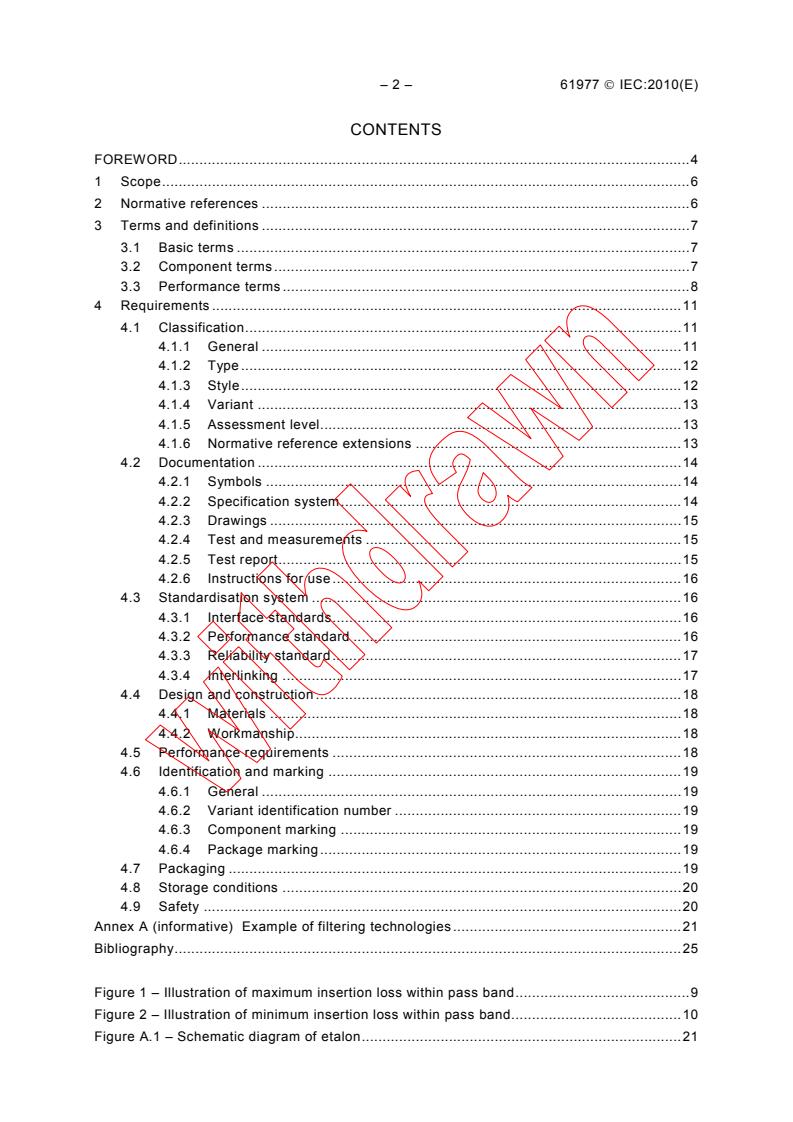
CONTENTS
FOREWORD.4
1 Scope.6
2 Normative references .6
3 Terms and definitions .7
3.1 Basic terms .7
3.2 Component terms.7
3.3 Performance terms.8
4 Requirements .11
4.1 Classification.11
4.1.1 General .11
4.1.2 Type.12
4.1.3 Style.12
4.1.4 Variant .13
4.1.5 Assessment level.13
4.1.6 Normative reference extensions .13
4.2 Documentation .14
4.2.1 Symbols .14
4.2.2 Specification system.14
4.2.3 Drawings .15
4.2.4 Test and measurements .15
4.2.5 Test report.15
4.2.6 Instructions for use.16
4.3 Standardisation system .16
4.3.1 Interface standards.16
4.3.2 Performance standard .16
4.3.3 Reliability standard.17
4.3.4 Interlinking .17
4.4 Design and construction .18
4.4.1 Materials .18
4.4.2 Workmanship.18
4.5 Performance requirements .18
4.6 Identification and marking .19
4.6.1 General .19
4.6.2 Variant identification number .19
4.6.3 Component marking .19
4.6.4 Package marking.19
4.7 Packaging .19
4.8 Storage conditions .20
4.9 Safety .20
Annex A (informative) Example of filtering technologies .21
Bibliography.25
Figure 1 – Illustration of maximum insertion loss within pass band.9
Figure 2 – Illustration of minimum insertion loss within pass band.10
Figure A.1 – Schematic diagram of etalon.21
61977 © IEC:2010(E) – 3 –
Figure A.2 – Transmission characteristic of etalon .22
Figure A.3 – Usage of fibre Bragg grating .22
Figure A.3 – Fibre Bragg grating .23
Figure A.4 – Structure of multilayer thin-film .24
Table 1 – The IEC specification structure.14
Table 2 – Standards interlink matrix.18
Table 3 – Quality assurance options .18
– 4 – 61977 © IEC:2010(E)
INTERNATIONAL ELECTROTECHNICAL COMMISSION
____________
FIBRE OPTIC INTERCONNECTING
DEVICES AND PASSIVE COMPONENTS –
FIBRE OPTIC FILTERS – GENERIC SPECIFICATION
FOREWORD
1) The International Electrotechnical Commission (IEC) is a worldwide organization for standardization comprising
all national electrotechnical committees (IEC National Committees). The object of IEC is to promote
international co-operation on all questions concerning standardization in the electrical and electronic fields. To
this end and in addition to other activities, IEC publishes International Standards, Technical Specifications,
Technical Reports, Publicly Available Specifications (PAS) and Guides (hereafter referred to as “IEC
Publication(s)”). Their preparation is entrusted to technical committees; any IEC National Committee interested
in the subject dealt with may participate in this preparatory work. International, governmental and non-
governmental organizations liaising with the IEC also participate in this preparation. IEC collaborates closely
with the International Organization for Standardization (ISO) in accordance with conditions determined by
agreement between the two organizations.
2) The formal decisions or agreements of IEC on technical matters express, as nearly as possible, an international
consensus of opinion on the relevant subjects since each technical committee has representation from all
interested IEC National Committees.
3) IEC Publications have the form of recommendations for international use and are accepted by IEC National
Committees in that sense. While all reasonable efforts are made to ensure that the technical content of IEC
Publications is accurate, IEC cannot be held responsible for the way in which they are used or for any
misinterpretation by any end user.
4) In order to promote international uniformity, IEC National Committees undertake to apply IEC Publications
transparently to the maximum extent possible in their national and regional publications. Any divergence
between any IEC Publication and the corresponding national or regional publication shall be clearly indicated in
the latter.
5) IEC itself does not provide any attestation of conformity. Independent certification bodies provide conformity
assessment services and, in some areas, access to IEC marks of conformity. IEC is not responsible for any
services carried out by independent certification bodies.
6) All users should ensure that they have the latest edition of this publication.
7) No liability shall attach to IEC or its directors, employees, servants or agents including individual experts and
members of its technical committees and IEC National Committees for any personal injury, property damage or
other damage of any nature whatsoever, whether direct or indirect, or for costs (including legal fees) and
expenses arising out of the publication, use of, or reliance upon, this IEC Publication or any other IEC
Publications.
8) Attention is drawn to the Normative references cited in this publication. Use of the referenced publications is
indispensable for the correct application of this publication.
9) Attention is drawn to the possibility that some of the elements of this IEC Publication may be the subject of
patent rights. IEC shall not be held responsible for identifying any or all such patent rights.
International Standard IEC 61977 has been prepared by subcommittee 86B: Fibre optic
interconnecting devices and passive components, of IEC technical committee 86: Fibre optics.
This second edition cancels and replaces the first edition published in 2001. It constitutes a
technical revision. The changes with respect to the previous edition include having
substantially increased the number of terms, added an informative annex for example of
filtering technologies and deleted quality assessment procedures.
61977 © IEC:2010(E) – 5 –
The text of this standard is based on the following documents:
FDIS Report on voting
86B/2982/FDIS 86B/3015/RVD
Full information on the voting for the approval of this standard can be found in the report on
voting indicated in the above table.
This publication has been drafted in accordance with the ISO/IEC Directives, Part 2.
The committee has decided that the contents of this publication will remain unchanged until
the stability date indicated on the IEC web site under "http://webstore.iec.ch" in the data
related to the specific publication. At this date, the publication will be
• reconfirmed,
• withdrawn,
• replaced by a revised edition, or
• amended.
A bilingual version of this publication may be issued at a later date.
– 6 – 61977 © IEC:2010(E)
FIBRE OPTIC INTERCONNECTING
DEVICES AND PASSIVE COMPONENTS –
FIBRE OPTIC FILTERS – GENERIC SPECIFICATION
1 Scope
This International Standard applies to the family of fibre optic filters. These components have
all of the following general features:
– they are passive for the reason that they contain no optoelectronic or other transducing
elements which can process the optical signal launched into the input port;
– they modify the spectral intensity distribution in order to select some wavelengths and
inhibit others;
– they are fixed, i.e. the modification of the spectral intensity distribution is fixed and can not
be tuned;
– they have input and output ports or a common port (having both functions of input and
output) for the transmission of optical power; the ports are optical fibre or optical fibre
connectors;
– they differ according to their characteristics. They can be divided into the following
categories:
• short-wave pass (only wavelengths lower than or equal to a specified value are
passed);
• long-wave pass (only wavelengths greater than or equal to a specified value are
passed);
• band-pass (only an optical window is allowed);
• notch (only an optical window is inhibited).
It is also possible to have a combination of the above categories.
This standard establishes uniform requirements for optical, mechanical and environmental
properties.
2 Normative references
The following referenced documents are indispensable for the application of this document.
For dated references, only the edition cited applies. For undated references, the latest edition
of the referenced document (including any amendments) applies.
IEC 60027 (all parts), Letter symbols to be used in electrical technology
IEC 60050(731), International Electrotechnical Vocabulary – Chapter 731: Optical fibre
communication
IEC 61300 (all parts), Fibre optic interconnecting devices and passive components – Basic
test and measurement procedures
IEC 60617-SN, Graphical symbols for diagrams
IEC 60695-11-5, Fire hazard testing – Part 11-5: Test flames – Needle-flame test method –
Apparatus, confirmatory test arrangement and guidance
61977 © IEC:2010(E) – 7 –
, requirements and
IEC 60825-1, Safety of laser products – Part 1: Equipment classification
user’s guide
IEC 61930, Fibre optic graphic symbology
IEC Guide 102, Electronic components – Specification structures for quality assessment
(Qualification approval and capability approval)
IECQ 01, IEC Quality Assessment System for Electronic Components (IECQ Scheme) – Basic
Rules
IECQ 001002-3, IEC Quality Assessment System for Electronic Components (IECQ) – Rules
of Procedure – Part 3: Approval procedures
ISO 129-1, Technical drawings – Indication of dimensions and tolerances – Part 1: General
principles
ISO 286-1, ISO system of limits and fits – Part 1: Bases of tolerances, deviations and fits
ISO 1101, Geometrical Product Specifications (GPS) – Geometrical tolerancing – Tolerances
of form, orientation, location and run-out
ISO 8601, Data elements and interchange formats – Information interchange –
Representation of dates and times
3 Terms and definitions
For the purposes of this document, the terms and definitions given in IEC 60050(731) and the
following apply.
3.1 Basic terms
3.1.1
port
an optical fibre or optical fibre connector attached to a passive component for the entry and/or
exit of the optical power (input and/or output port)
3.2 Component terms
3.2.1
band pass filter
device designed to allow signals between two specific wavelengths to pass
3.2.2
etalon
device consisted of a transparent plane-parallel plate with two reflecting surfaces, or two
parallel highly reflecting mirrors. The varying transmission function of an etalon is caused by
interference between the multiple reflections of light between the two reflecting surfaces
3.2.3
fibre Bragg grating
FBG
device which can reflect particular wavelengths of light and transmit other wavelengths
– 8 – 61977 © IEC:2010(E)
3.2.4
fibre optic filter
passive component used in fibre optic transmission to modify the spectral intensity distribution
of a signal in order to pass some wavelengths and block some others
3.2.5
gain flattening filter/ gain equalizer
GFF/ GEQ
device designed to have the inverse characteristic of an optical device which has an insertion
loss wavelength characteristic
3.2.6
long wavelength pass filter
LWPF
filter that passes long wavelength signals but reduces the amplitude of short wavelength
signals
3.2.7
notch filter
filter that passes all wavelength except those in a stop band centred on a centre wavelength
3.2.8
reflecting type fibre optic filter
fibre optic filter in which the input and output ports are coincident
3.2.9
short wavelength pass filter
SWPF
filter that passes short wavelength signals but reduces the amplitude of long wavelength
signals
3.2.10
thin-film filter
TFF
optical filter which passes a particular wavelength band and reflecting all other wavelengths
by using interference effect of thin-film
3.2.11
transmitting type fibre optic filter
fibre optic filter in which the input and output ports are different
3.3 Performance terms
3.3.1
insertion loss
reduction of optical power, when transmitted between the ports of a two-port fibre optic filter
expressed in decibels. It is defined as:
a = −10 log()P P
out in
where
P is the optical power launched into one of the two ports;
in
P is the optical power received from the other port.
out
The insertion loss is a function of wavelength
61977 © IEC:2010(E) – 9 –
3.3.2
chromatic dispersion
group delay between two closely spaced wavelengths (or frequencies) inside an optical signal
going through a pair of conducting ports of a WDM device. It corresponds to the difference
between the arrival times of these two closely spaced wavelengths (or frequencies).
Chromatic dispersion is defined as the variation (first order derivative) of this group delay over
a range of wavelengths (or frequencies) especially over the channel operating wavelength (or
frequency) range at a given time, temperature, pressure and humidity. It is expressed as D in
terms of units of ps/nm or ps/GHz and it is a predictor of the broadening of a pulse
transmitted through the device
3.3.3
free spectral range
in the case of a periodic spectral response of a fibre optic filter, the difference between two
adjacent operating wavelengths
3.3.4
isolation wavelength
nominal wavelength λ (where λ ≠ λ ), that is nominally suppressed by a fibre optic filter
k h k
3.3.5
isolation wavelength range, stopband
specified range of wavelengths from λ to λ around the isolation wavelength λ , that
kmin kmax k
are nominally suppressed by a fibre optic filter
3.3.6
maximum insertion loss within pass band
maximum value of the insertion loss within pass band. Figure 1 shows pass band and
maximum insertion loss within pass band
Maximum insertion loss
within pass band
Pass band
Wavelength
IEC 616/10
Figure 1 – Illustration of maximum insertion loss within pass band
3.3.7
maximum slope of spectral ripple
maximum value in module of the derivative of the insertion loss (for transmitting-type fibre
optic filter) or return loss (for reflecting-type fibre optic filter) as a function of wavelength over
the bandpass
3.3.8
minimum insertion loss within pass band
minimum value of the insertion loss within pass band. Figure 2 shows pass band and
minimum insertion loss within pass band
Insertion
loss (dB)
– 10 – 61977 © IEC:2010(E)
Minimum insertion loss
within pass band
Pass band
Wavelength
IEC 617/10
Figure 2 – Illustration of minimum insertion loss within pass band
3.3.9
operating wavelength
nominal wavelength λ , at which a fibre optic filter operates with the specified performances
h
3.3.10
operating wavelength range, bandpass
specified range of wavelengths from λ to λ around the operating wavelength λ ,
hmin hmax h
within which a fibre optic filter operates with the specified performances
3.3.11
polarization dependent loss
PDL
maximum variation of insertion loss over all the polarization states
3.3.12
polarization mode dispersion
PMD
when an optical signal passes through an optical fibre, component or subsystem, such as
going through a pair of conducting ports of a WDM device, the change in the shape and rms
width of the pulse due to the average delay of the travelling time between the two principal
states of polarization (PSP), differential group delay (DGD), and/or to the waveform distortion
for each PSP, is called PMD. PMD, together with polarization dependent loss (PDL) and
polarization dependent gain (PDG), when applicable, may introduce waveform distortion
leading to unacceptable bit error rate increase
3.3.13
reflectance
percentage of optical power reflected by the filter at the operating wavelength
3.3.14
return loss
fraction of input power that is returned from a port of a fibre optic filter, expressed in decibels.
It is defined as:
RL = −10 log()P P
refl in
where
P is the optical power launched into the port;
in
P is the optical power received back from the same port.
refl
Insertion
loss (dB)
61977 © IEC:2010(E) – 11 –
The return loss is a function of wavelength
3.3.15
spectral ripple (flatness)
maximum peak-to-peak variation in insertion loss (for transmitting-type fibre optic filter) or
return loss (for reflecting-type fibre optic filter) over the bandpass
3.3.16
transmittance
percentage of optical power transmitted by the filter at the operating wavelength
3.3.17
wavelength dependent loss of fibre optic filter
variation of insertion loss of fibre optic filter over its operating wavelength
3.3.18
X dB-bandwidth
a) for transmitting-type fibre optic filters: defined through the spectral dependence of the
insertion loss as the minimum wavelength range about the operating wavelength λ within
h
which the variation of the insertion loss is less than "X" dB; the minimum wavelength
range is determined considering the worst case shift due to temperature operating range
and polarisation;
b) for reflecting-type fibre optic filters: defined through the spectral dependence of the return
loss as the minimum wavelength range about the operating wavelength λ within which the
h
variation of the return loss is less than "X" dB. The minimum wavelength range is
determined considering the worst case shift due to temperature operating range and
polarisation
4 Requirements
4.1 Classification
4.1.1 General
Filters are classified either totally or in part by the following categories:
− type;
− style;
− variant;
− environmental category;
− assessment level;
− normative reference extensions.
An example of a typical filter classification is as follows:
Type Fixed
Style – Configuration C
...