

IEC 60691:1993
(Main)Thermal-links - Requirements and application guide
General Information
- Abstract
Applies to thermal-links, intended for incorporation in electrical appliances, electronic equipment and component parts thereof, normally intended for use indoors, in order to protect them against excessive temperatures under abnormal conditions. May be applicable to thermal-links for use under other than indoor conditions, provided that the climatic and other circum- stances in the immediate surroundings of such thermal-links are comparable with those in this standard.
- Status
- Published
- Publication Date
- 29-Mar-2001
- Technical Committee
- SC 32C - Miniature fuses
- Drafting Committee
- WG 2 - TC 32/SC 32C/WG 2
- Current Stage
- DELPUB - Deleted Publication
- Start Date
- 19-Dec-2002
- Completion Date
- 28-Aug-2026
Overview
IEC 60691:1993 – Thermal-links – Requirements and application guide is an international standard developed by the International Electrotechnical Commission (IEC). The standard sets out comprehensive requirements and application guidance for thermal-links, which are non-resettable devices designed to protect electrical appliances and electronic equipment against excessive temperatures during abnormal operating conditions. While primarily aimed at devices used indoors, IEC 60691 may also apply where surrounding conditions are comparable to those specified in the standard.
Thermal-links play a crucial safety role in preventing overheating and can be found in a wide range of household, commercial, and industrial equipment. The standard defines terminology, performance criteria, testing methods, marking, and documentation requirements, ensuring uniformity and safety across global markets.
Key Topics
IEC 60691:1993 covers several essential aspects of thermal-links, including:
- Scope and object: Specifies the intended use of thermal-links, their rated voltages (not exceeding 690 V a.c. or d.c.), and rated currents (not exceeding 63 A). The standard is not applicable to thermal-links under extreme environments such as corrosive or explosive atmospheres.
- Definitions: Provides precise definitions for terms such as thermal-link (TL), rated functioning temperature, holding temperature, maximum temperature limit, rated current, interrupting current, and related key concepts.
- General requirements: Ensures that thermal-links possess suitable electrical and mechanical properties. Emphasizes safe and reliable operation, resistance to mechanical stress, and the need for proper replacement after functioning.
- Test methods: Details standardized testing procedures, including temperature, electrical, and mechanical tests, as well as specific requirements for creepage distances, clearances, dielectric strength, insulation resistance, and resistance to environmental influences such as humidity.
- Marking and documentation: Stipulates requirements for clear marking and adequate documentation for traceability and safe application.
Applications
Thermal-links specified under IEC 60691 are used in:
- Electrical appliances: Such as irons, toasters, and heating devices, where they serve as safety devices to interrupt current when critical temperatures are exceeded.
- Electronic equipment: Including power supplies, transformers, and battery packs, to protect sensitive components from thermal damage.
- Component parts: For integration into switches, relays, connectors, and various assemblies where temperature rise under fault conditions poses a risk.
- Hand-held and portable devices: As long as safety is assured and molten materials do not compromise user safety or equipment insulation.
Practical Value
- Uniform safety standards: Ensures consistency in the performance and safety of thermal protection devices across different manufacturers and markets.
- Product compliance: Supports manufacturers in achieving regulatory compliance for safety in target markets.
- Design guidance: Offers practical information and application guidelines for proper selection, installation, and replacement of thermal-links.
- Prevention of overheating: Minimizes risks linked to fire, electric shock, and equipment failure by interrupting circuits under excessive temperature conditions.
Related Standards
Thermal-links and their application often overlap with other international standards for safety and performance. Key related standards include:
- IEC 60065: Safety requirements for mains operated electronic and related apparatus for household and similar use.
- IEC 60068 series: Environmental testing, including tests for humidity and robustness of terminations.
- IEC 60112: Methods for determining the resistance and tracking properties of insulating materials.
- IEC 60335-2-3: Particular safety requirements for electric irons.
- IEC 60664-1: Insulation coordination for equipment within low-voltage systems.
- IEC 60730-1: General requirements for automatic electrical controls for household and similar use.
For effective thermal over-temperature protection in electrical and electronic equipment, IEC 60691:1993 and these related standards provide the foundational requirements for performance, safety, and application of thermal-links. Manufacturers, designers, and testing laboratories are encouraged to consult the standard for detailed specifications and to ensure that devices meet global safety expectations.
Relations
- Amended By
IEC 60691:1993/AMD2:2000 - Amendment 2 - Thermal-links - Requirements and application guide - Effective Date
- 05-Sep-2023
- Effective Date
- 05-Sep-2023
Get Certified
Connect with accredited certification bodies for this standard

IMQ S.p.A. (Certification)
Italian electrical product certification.

SLG Prüf- und Zertifizierungs GmbH
German testing and certification body.

UL Solutions
Global safety science company with testing, inspection and certification.
Sponsored listings
Frequently Asked Questions
IEC 60691:1993 is a standard published by the International Electrotechnical Commission (IEC). Its full title is "Thermal-links - Requirements and application guide". This standard covers: Applies to thermal-links, intended for incorporation in electrical appliances, electronic equipment and component parts thereof, normally intended for use indoors, in order to protect them against excessive temperatures under abnormal conditions. May be applicable to thermal-links for use under other than indoor conditions, provided that the climatic and other circum- stances in the immediate surroundings of such thermal-links are comparable with those in this standard.
Applies to thermal-links, intended for incorporation in electrical appliances, electronic equipment and component parts thereof, normally intended for use indoors, in order to protect them against excessive temperatures under abnormal conditions. May be applicable to thermal-links for use under other than indoor conditions, provided that the climatic and other circum- stances in the immediate surroundings of such thermal-links are comparable with those in this standard.
IEC 60691:1993 is classified under the following ICS (International Classification for Standards) categories: 29.120.50 - Fuses and other overcurrent protection devices. The ICS classification helps identify the subject area and facilitates finding related standards.
IEC 60691:1993 has the following relationships with other standards: It is inter standard links to IEC 60691:1993/AMD2:2000, IEC 60691:2002. Understanding these relationships helps ensure you are using the most current and applicable version of the standard.
IEC 60691:1993 is available in PDF format for immediate download after purchase. The document can be added to your cart and obtained through the secure checkout process. Digital delivery ensures instant access to the complete standard document.
Standards Content (Sample)
NORME CEI
INTERNATIONALE IEC
INTERNATIONAL
Edition 2.2
STANDARD
2001-03
Edition 2:1993 consolidée par les amendements 1:1995 et 2:2000
Edition 2:1993 consolidated with amendments 1:1995 and 2:2000
Protecteurs thermiques –
Prescriptions et guide d'application
Thermal-links –
Requirements and application guide
Numéro de référence
Reference number
CEI/IEC 60691:1993+A1:1995+A2:2000
Numérotation des publications Publication numbering
Depuis le 1er janvier 1997, les publications de la CEI As from 1 January 1997 all IEC publications are
sont numérotées à partir de 60000. Ainsi, la CEI 34-1 issued with a designation in the 60000 series. For
devient la CEI 60034-1. example, IEC 34-1 is now referred to as IEC 60034-1.
Editions consolidées Consolidated editions
Les versions consolidées de certaines publications de la The IEC is now publishing consolidated versions of its
CEI incorporant les amendements sont disponibles. Par publications. For example, edition numbers 1.0, 1.1
exemple, les numéros d’édition 1.0, 1.1 et 1.2 indiquent and 1.2 refer, respectively, to the base publication,
respectivement la publication de base, la publication de the base publication incorporating amendment 1 and
base incorporant l’amendement 1, et la publication de the base publication incorporating amendments 1
base incorporant les amendements 1 et 2. and 2.
Informations supplémentaires Further information on IEC publications
sur les publications de la CEI
Le contenu technique des publications de la CEI est The technical content of IEC publications is kept
constamment revu par la CEI afin qu'il reflète l'état under constant review by the IEC, thus ensuring that
actuel de la technique. Des renseignements relatifs à the content reflects current technology. Information
cette publication, y compris sa validité, sont dispo- relating to this publication, including its validity, is
nibles dans le Catalogue des publications de la CEI available in the IEC Catalogue of publications
(voir ci-dessous) en plus des nouvelles éditions, (see below) in addition to new editions, amendments
amendements et corrigenda. Des informations sur les and corrigenda. Information on the subjects under
sujets à l’étude et l’avancement des travaux entrepris consideration and work in progress undertaken by the
par le comité d’études qui a élaboré cette publication, technical committee which has prepared this
ainsi que la liste des publications parues, sont publication, as well as the list of publications issued,
également disponibles par l’intermédiaire de: is also available from the following:
• Site web de la CEI (www.iec.ch) • IEC Web Site (www.iec.ch)
• Catalogue des publications de la CEI • Catalogue of IEC publications
Le catalogue en ligne sur le site web de la CEI The on-line catalogue on the IEC web site
(www.iec.ch/catlg-f.htm) vous permet de faire des (www.iec.ch/catlg-e.htm) enables you to search
recherches en utilisant de nombreux critères, by a variety of criteria including text searches,
comprenant des recherches textuelles, par comité technical committees and date of publication. On-
d’études ou date de publication. Des informations line information is also available on recently
en ligne sont également disponibles sur les issued publications, withdrawn and replaced
nouvelles publications, les publications rempla- publications, as well as corrigenda.
cées ou retirées, ainsi que sur les corrigenda.
• IEC Just Published
• IEC Just Published
Ce résumé des dernières publications parues
This summary of recently issued publications
(www.iec.ch/JP.htm) est aussi disponible par
(www.iec.ch/JP.htm) is also available by email.
courrier électronique. Veuillez prendre contact
Please contact the Customer Service Centre (see
avec le Service client (voir ci-dessous) pour plus
below) for further information.
d’informations.
• Service clients
• Customer Service Centre
Si vous avez des questions au sujet de cette
If you have any questions regarding this
publication ou avez besoin de renseignements
publication or need further assistance, please
supplémentaires, prenez contact avec le Service
contact the Customer Service Centre:
clients:
Email: custserv@iec.ch
Email: custserv@iec.ch
Tél: +41 22 919 02 11
Tel: +41 22 919 02 11
Fax: +41 22 919 03 00
Fax: +41 22 919 03 00
.
NORME CEI
INTERNATIONALE IEC
INTERNATIONAL
Edition 2.2
STANDARD
2001-03
Edition 2:1993 consolidée par les amendements 1:1995 et 2:2000
Edition 2:1993 consolidated with amendments 1:1995 and 2:2000
Protecteurs thermiques –
Prescriptions et guide d'application
Thermal-links –
Requirements and application guide
IEC 2001 Droits de reproduction réservés Copyright - all rights reserved
Aucune partie de cette publication ne peut être reproduite ni No part of this publication may be reproduced or utilized in
utilisée sous quelque forme que ce soit et par aucun procédé, any form or by any means, electronic or mechanical,
électronique ou mécanique, y compris la photocopie et les including photocopying and microfilm, without permission in
microfilms, sans l'accord écrit de l'éditeur. writing from the publisher.
International Electrotechnical Commission 3, rue de Varembé Geneva, Switzerland
Telefax: +41 22 919 0300 e-mail: inmail@iec.ch IEC web site http://www.iec.ch
CODE PRIX
Commission Electrotechnique Internationale
S
PRICE CODE
International Electrotechnical Commission
Pour prix, voir catalogue en vigueur
For price, see current catalogue
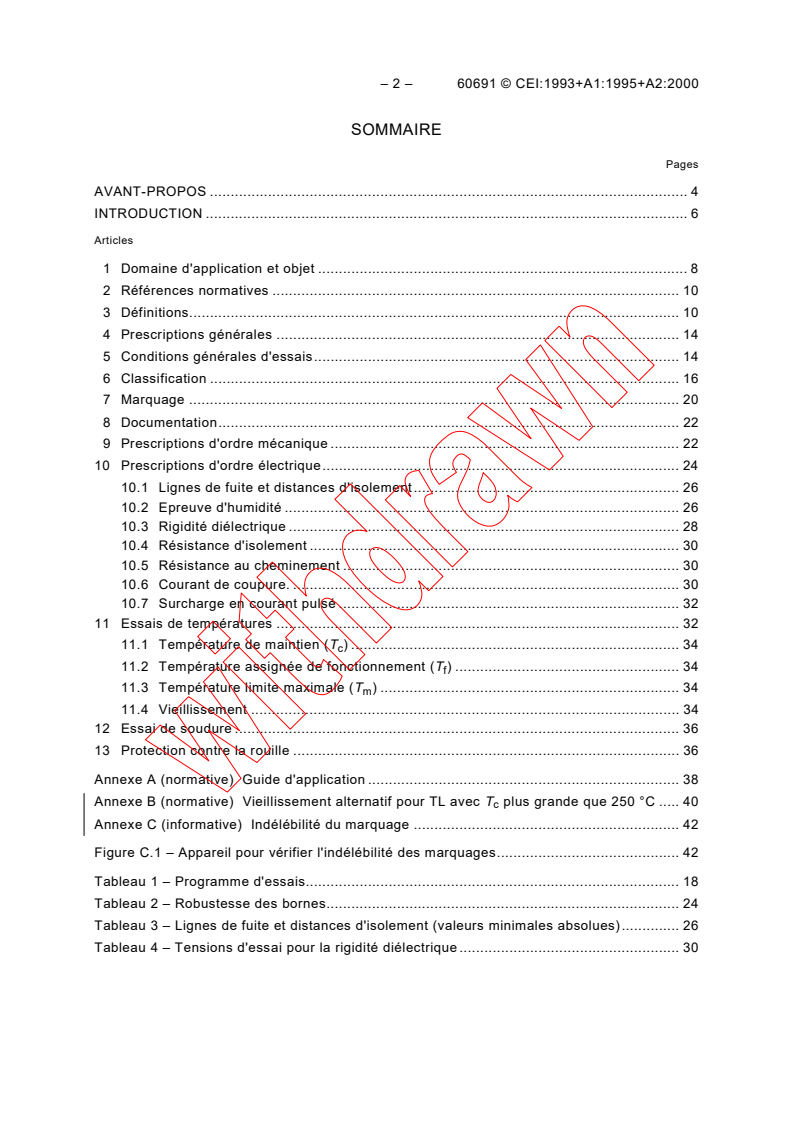
– 2 – 60691 © CEI:1993+A1:1995+A2:2000
SOMMAIRE
Pages
AVANT-PROPOS . 4
INTRODUCTION .6
Articles
1 Domaine d'application et objet . 8
2 Références normatives . 10
3 Définitions. 10
4 Prescriptions générales . 14
5 Conditions générales d'essais. 14
6 Classification . 16
7 Marquage . 20
8 Documentation. 22
9 Prescriptions d'ordre mécanique . 22
10 Prescriptions d'ordre électrique. 24
10.1 Lignes de fuite et distances d'isolement. 26
10.2 Epreuve d'humidité . 26
10.3 Rigidité diélectrique . 28
10.4 Résistance d'isolement . 30
10.5 Résistance au cheminement . 30
10.6 Courant de coupure. . 30
10.7 Surcharge en courant pulsé . 32
11 Essais de températures . 32
11.1 Température de maintien (T ) . 34
c
11.2 Température assignée de fonctionnement (T ) . 34
f
11.3 Température limite maximale (T ) . 34
m
11.4 Vieillissement . 34
12 Essai de soudure . 36
13 Protection contre la rouille . 36
Annexe A (normative) Guide d'application . 38
Annexe B (normative) Vieillissement alternatif pour TL avec T plus grande que 250 °C . 40
c
Annexe C (informative) Indélébilité du marquage . 42
Figure C.1 – Appareil pour vérifier l'indélébilité des marquages. 42
Tableau 1 – Programme d'essais. 18
Tableau 2 – Robustesse des bornes. 24
Tableau 3 – Lignes de fuite et distances d'isolement (valeurs minimales absolues). 26
Tableau 4 – Tensions d'essai pour la rigidité diélectrique . 30
60691 © IEC:1993+A1:1995+A2:2000 – 3 –
CONTENTS
Page
FOREWORD . 5
INTRODUCTION .7
Clause
1 Scope and object .9
2 Normative references. 11
3 Definitions. 11
4 General requirements . 15
5 General notes on tests. 15
6 Classification . 17
7 Marking. 21
8 Documentation. 23
9 Mechanical requirements . 23
10 Electrical requirements . 25
10.1 Creepage distances and clearances . 27
10.2 Humidity test. 27
10.3 Dielectric strength. 29
10.4 Insulation resistance. 31
10.5 Resistance to tracking . 31
10.6 Interrupting current . 31
10.7 Transient overload current . 33
11 Temperature tests. 33
11.1 Holding temperature (T ) . 35
c
11.2 Rated functioning temperature (T ). 35
f
11.3 Maximum temperature limit (T ) . 35
m
11.4 Ageing . 35
12 Soldering test. 37
13 Resistance to rusting . 37
Annex A (normative) Application guide . 39
Annex B (normative) Alternate ageing for TL with T greater than 250 °C. 41
c
Annex C (informative) Indelibility of marking . 43
Figure C.1 – Apparatus for testing the indelibility of markings. 43
Table 1 – Testing schedule . 19
Table 2 – Strength of terminals . 25
Table 3 – Creepage distances and clearances (absolute minimum values). 27
Table 4 – Test voltages for dielectric strength . 31
– 4 – 60691 © CEI:1993+A1:1995+A2:2000
COMMISSION ÉLECTROTECHNIQUE INTERNATIONALE
____________
PROTECTEURS THERMIQUES –
PRESCRIPTIONS ET GUIDE D'APPLICATION
AVANT-PROPOS
1) La CEI (Commission Électrotechnique Internationale) est une organisation mondiale de normalisation
composée de l'ensemble des comités électrotechniques nationaux (Comités nationaux de la CEI). La CEI a
pour objet de favoriser la coopération internationale pour toutes les questions de normalisation dans les
domaines de l'électricité et de l'électronique. A cet effet, la CEI, entre autres activités, publie des Normes
internationales. Leur élaboration est confiée à des comités d'études, aux travaux desquels tout Comité national
intéressé par le sujet traité peut participer. Les organisations internationales, gouvernementales et non
gouvernementales, en liaison avec la CEI, participent également aux travaux. La CEI collabore étroitement
avec l'Organisation Internationale de Normalisation (ISO), selon des conditions fixées par accord entre les
deux organisations.
2) Les décisions ou accords officiels de la CEI concernant les questions techniques représentent, dans la mesure
du possible, un accord international sur les sujets étudiés, étant donné que les Comités nationaux intéressés
sont représentés dans chaque comité d’études.
3) Les documents produits se présentent sous la forme de recommandations internationales. Ils sont publiés
comme normes, spécifications techniques, rapports techniques ou guides et agréés comme tels par les
Comités nationaux.
4) Dans le but d'encourager l'unification internationale, les Comités nationaux de la CEI s'engagent à appliquer de
façon transparente, dans toute la mesure possible, les Normes internationales de la CEI dans leurs normes
nationales et régionales. Toute divergence entre la norme de la CEI et la norme nationale ou régionale
correspondante doit être indiquée en termes clairs dans cette dernière.
5) La CEI n’a fixé aucune procédure concernant le marquage comme indication d’approbation et sa responsabilité
n’est pas engagée quand un matériel est déclaré conforme à l’une de ses normes.
6) L’attention est attirée sur le fait que certains des éléments de la présente Norme internationale peuvent faire
l’objet de droits de propriété intellectuelle ou de droits analogues. La CEI ne saurait être tenue pour
responsable de ne pas avoir identifié de tels droits de propriété et de ne pas avoir signalé leur existence
La Norme internationale CEI 60691 a été établie par le sous-comité 32C: Coupe-circuit à
fusibles miniatures, du comité d'études 32 de la CEI: Coupe-circuit à fusibles.
La présente version consolidée de la CEI 60691 est issue de la deuxième édition (1993)
[documents 32C(BC)66+68 et 32C(BC)67+69+69A] de son amendement 1 (1995) [documents
32C/133/FDIS et 32C/149/RVD] et de son amendement 2 (2000) [documents 32C/247/FDIS et
32C/254/RVD].
Elle porte le numéro d'édition 2.2.
Une ligne verticale dans la marge indique où la publication de base a été modifiée par les
amendements 1 et 2.
Les annexes A et B font partie intégrante de cette norme.
L'annexe C est donnée uniquement à titre d'information.
Le comité a décidé que le contenu de la publication de base et de ses amendements ne sera
pas modifié avant 2002. A cette date, la publication sera
reconduite;
supprimée;
remplacée par une édition révisée, ou
amendée.
60691 © IEC:1993+A1:1995+A2:2000 – 5 –
INTERNATIONAL ELECTROTECHNICAL COMMISSION
____________
THERMAL-LINKS –
REQUIREMENTS AND APPLICATION GUIDE
FOREWORD
1) The IEC (International Electrotechnical Commission) is a worldwide organization for standardization comprising
all national electrotechnical committees (IEC National Committees). The object of the IEC is to promote
international co-operation on all questions concerning standardization in the electrical and electronic fields. To
this end and in addition to other activities, the IEC publishes International Standards. Their preparation is
entrusted to technical committees; any IEC National Committee interested in the subject dealt with may
participate in this preparatory work. International, governmental and non-governmental organizations liaising
with the IEC also participate in this preparation. The IEC collaborates closely with the International
Organization for Standardization (ISO) in accordance with conditions determined by agreement between the
two organizations.
2) The formal decisions or agreements of the IEC on technical matters express, as nearly as possible, an
international consensus of opinion on the relevant subjects since each technical committee has representation
from all interested National Committees.
3) The documents produced have the form of recommendations for international use and are published in the form
of standards, technical specifications, technical reports or guides and they are accepted by the National
Committees in that sense.
4) In order to promote international unification, IEC National Committees undertake to apply IEC International
Standards transparently to the maximum extent possible in their national and regional standards. Any
divergence between the IEC Standard and the corresponding national or regional standard shall be clearly
indicated in the latter.
5) The IEC provides no marking procedure to indicate its approval and cannot be rendered responsible for any
equipment declared to be in conformity with one of its standards.
6) Attention is drawn to the possibility that some of the elements of this International Standard may be the subject
of patent rights. The IEC shall not be held responsible for identifying any or all such patent rights.
International Standard IEC 60691 has been prepared by subcommittee 32C: Miniature fuses,
of IEC technical committee 32: Fuses.
This consolidated version of IEC 60691 is based on the second edition (1993) [documents
32C(CO)66+68 and 32C(CO)67+69+69A], its amendment 1 (1995) [documents 32C/133/FDIS
and 32C/149/RVD] and amendment 2 (2000) [documents 32C/247/FDIS and 32C/254/RVD].
It bears the edition number 2.2.
A vertical line in the margin shows where the base publication has been modified by
amendments 1 and 2.
Annexes A and B form an integral part of this standard.
Annex C is for information only.
The committee has decided that the contents of the base publication and its amendments will
remain unchanged until 2002. At this date, the publication will be
reconfirmed;
withdrawn;
replaced by a revised edition, or
amended.
– 6 – 60691 © CEI:1993+A1:1995+A2:2000
INTRODUCTION
Les protecteurs thermiques, définis comme des dispositifs n'étant pas réutilisables,
fonctionnant une seule fois sans réutilisation, sont très employés pour la protection thermique
des appareils dans lesquels, lors de fonctionnements anormaux, une ou plusieurs parties
peuvent atteindre des températures excessives.
Puisque ces dispositifs possèdent plusieurs points communs avec les fusibles miniatures et
qu'ils sont utilisés pour obtenir un niveau de protection comparable, on s'est efforcé, dans
cette norme, d'établir une série de spécifications principales pour de tels composants.
60691 © IEC:1993+A1:1995+A2:2000 – 7 –
INTRODUCTION
Thermal-links, defined as non-resettable devices functioning once only without refunctioning,
are widely applied for the thermal protection of equipment in which, under fault conditions,
one or more parts may reach hazardous temperatures.
As these devices have several aspects in common with miniature fuse-links and are used for
obtaining a comparable degree of protection, this standard has endeavoured to lay down a
number of basic requirements for such devices.
– 8 – 60691 © CEI:1993+A1:1995+A2:2000
PROTECTEURS THERMIQUES –
PRESCRIPTIONS ET GUIDE D'APPLICATION
1 Domaine d'application et objet
1.1 La présente Norme internationale est applicable aux protecteurs thermiques destinés
à être incorporés dans les appareils électriques, le matériel électronique et ses composants,
normalement utilisés à l'intérieur d'un local, afin de les protéger contre les températures
excessives lors de fonctionnement anormal.
NOTE 1 L'appareil peut ne pas être prévu pour produire de la chaleur.
NOTE 2 L'efficacité de la protection contre des températures excessives dépend logiquement de la position et
du mode de montage du protecteur thermique ainsi que du courant qui le traverse.
NOTE 3 L'attention est attirée sur le fait que les lignes de fuite et les distances d'isolement extérieures,
spécifiées dans le tableau 3, peuvent dans quelques cas être plus petites que celles exigées par les normes de
certains appareils ou équipements. Dans de tels cas, il convient que des moyens supplémentaires soient prévus
lorsqu'un protecteur thermique est monté dans l'équipement de façon à ajuster les lignes de fuite et les
distances d'isolement aux valeurs exigées par la norme de l'équipement concerné.
1.2 Cette norme peut s'appliquer aux protecteurs thermiques utilisés dans d'autres
conditions que celles qui sont réunies à l'intérieur d'un local, pourvu que les conditions
climatiques ou autres de l'entourage immédiat de tels protecteurs thermiques soient
comparables à celles de la présente norme.
1.3 Cette norme peut s'appliquer aux protecteurs thermiques dans leurs formes les plus
simples (par exemple les lames ou les fils de fusion), pourvu que le matériau fondu, expulsé
pendant le fonctionnement, ne soit pas préjudiciable à la sécurité du matériel, particuliè-
rement dans le cas du matériel tenu à la main, ou mobile indépendamment de sa position.
1.4 Cette norme est applicable aux protecteurs thermiques dont la tension assignée
n'excède pas 690 V en courant alternatif ou en courant continu, et dont le courant assigné
n'excède pas 63 A.
1.5 Cette norme n'est pas applicable aux protecteurs thermiques utilisés dans des
conditions extrêmes, telles que des atmosphères corrosives ou explosives.
1.6 Cette norme n'est pas applicable aux protecteurs thermiques destinés à être utilisés
en courant alternatif avec une fréquence inférieure à 45 Hz ou supérieure à 62 Hz.
1.7 La présente norme est destinée:
a) à établir des prescriptions uniformes pour les protecteurs thermiques;
b) à définir des méthodes d'essai;
c) à fournir des renseignements utiles pour l'utilisation des protecteurs thermiques dans les
appareils.
60691 © IEC:1993+A1:1995+A2:2000 – 9 –
THERMAL-LINKS –
REQUIREMENTS AND APPLICATION GUIDE
1 Scope and object
1.1 This International Standard is applicable to thermal-links, intended for incorporation in
electrical appliances, electronic equipment and component parts thereof, normally intended
for use indoors, in order to protect them against excessive temperatures under abnormal
conditions.
NOTE 1 The equipment need not be designed to generate heat.
NOTE 2 The effectiveness of the protection against excessive temperatures logically depends upon the position
and method of mounting of the thermal-link, as well as upon the current which it is carrying.
NOTE 3 Attention is drawn to the fact that the external creepage distances and clearances specified in table 3
may in some cases be smaller than those required by certain appliance or equipment standards. In such cases,
additional means should be provided when a thermal-link is mounted in the equipment in order to adjust the
creepage distances and clearances to the values required by the relevant equipment standard.
1.2 This standard may be applicable to thermal-links for use under other than indoor
conditions, provided that the climatic and other circumstances in the immediate surroundings
of such thermal-links are comparable with those in this standard.
1.3 This standard may be applicable to thermal-links in their simplest forms (e.g. melting
strips or wires), provided that molten materials, expelled during function, cannot adversely
interfere with the safe use of the equipment, especially in the case of hand-held or portable
equipment irrespective of its attitude.
1.4 This standard is applicable to thermal-links with a rated voltage not exceeding 690 V
a.c. or d.c. and a rated current not exceeding 63 A.
1.5 This standard is not applicable to thermal-links used under extreme conditions such as
corrosive or explosive atmospheres.
1.6 This standard is not applicable to thermal-links to be used in circuits on a.c. with a
frequency lower than 45 Hz or higher than 62 Hz.
1.7 The object of this standard is:
a) to establish uniform requirements for thermal-links;
b) to define methods of test;
c) to provide useful information for the application of thermal-links in equipment.
– 10 – 60691 © CEI:1993+A1:1995+A2:2000
2 Références normatives
Les documents normatifs suivants contiennent des dispositions qui, par suite de la référence
qui y est faite, constituent des dispositions valables pour la présente Norme internationale. Au
moment de la publication, les éditions indiquées étaient en vigueur. Tout document normatif
est sujet à révision et les parties prenantes aux accords fondés sur la présente Norme
internationale sont invitées à rechercher la possibilité d'appliquer les éditions les plus
récentes des documents normatifs indiqués ci-après. Les membres de la CEI et de l'ISO
possèdent le registre des Normes internationales en vigueur.
CEI 60065:1985, Règles de sécurité pour les appareils électroniques et appareils associés à
usage domestique ou à usage général analogue, reliés à un réseau
CEI 60068-2-3:1969, Essais d'environnement – Deuxième partie: Essais – Essai Ca: Essai
continu de chaleur humide
CEI 60068-2-20:1979, Essais d'environnement – Deuxième partie: Essais – Essai T: Soudure
CEI 60068-2-21:1983, Essais d'environnement – Deuxième partie: Essais – Essai U:
Robustesse des sorties et des dispositifs de fixation
CEI 60112:1979, Méthode pour déterminer les indices de résistance et de tenue au
cheminement des matériaux isolants solides dans des conditions humides
CEI 60260:1968, Enceintes d'épreuve à humidité relative constante fonctionnant sans
injection de vapeur
CEI 60335-2-3:1993, Sécurité des appareils électrodomestiques et analogues – Partie 2:
Règles particulières pour les fers à repasser électriques
CEI 60664-1:1992, Coordination de l'isolement des matériels dans les systèmes (réseaux) à
basse tension – Partie 1: Principes, prescriptions et essais
CEI 60730-1:1999, Dispositifs de commande électrique automatiques à usage domestique et
analogue – Partie 1: Règles générales
3 Définitions
Pour les besoins de la présente norme, les définitions suivantes sont applicables:
3.1
protecteur thermique (TL)
élément non réutilisable qui ouvrira un circuit une seule fois lorsqu'il sera exposé, pendant
une durée suffisamment longue, à une température excédant celle pour laquelle il a été conçu
3.2
température assignée de fonctionnement (T )
f
température du protecteur thermique qui provoque son changement de conductibilité,
mesurée sous des conditions spécifiées
NOTE Cette température est prédéterminée par le constructeur.
3.3
température de maintien (T )
c
température maximale du protecteur thermique pour laquelle, dans des conditions déter-
minées et pendant un temps spécifié, l'état de conductibilité ne changera pas
NOTE Cette température, ce temps et ces conditions sont indiqués par le constructeur.
60691 © IEC:1993+A1:1995+A2:2000 – 11 –
2 Normative references
The following normative documents contain provisions which, through reference in this text,
constitute provisions of this International Standard. At the time of publication, the editions
indicated were valid. All normative documents are subject to revision, and parties to
agreements based on this International Standard are encouraged to investigate the possibility
of applying the most recent editions of the normative documents indicated below. Members of
IEC and ISO maintain registers of currently valid International Standards.
IEC 60065:1985, Safety requirements for mains operated electronic and related apparatus for
household and similar general use
IEC 60068-2-3:1969, Environmental testing – Part 2: Tests – Test Ca: Damp heat, steady
state
IEC 60068-2-20:1979, Environmental testing – Part 2: Tests – Test T: Soldering
IEC 60068-2-21:1983, Environmental testing – Part 2: Tests – Test U: Robustness of
terminations and integral mounting devices
IEC 60112:1979, Method for determining the comparative and the proof-tracking indices of
solid insulating materials under moist conditions
IEC 60260:1968, Test enclosures of non-injection type for constant relative humidity
IEC 60335-2-3:1993, Safety of household and similar electrical appliances – Part 2: Particular
requirements for electric irons
IEC 60664-1:1992, Insulation coordination for equipment within low-voltage systems – Part 1:
Principles, requirements and tests
IEC 60730-1:1999, Automatic electrical controls for household and similar use – Part 1:
General requirements
3 Definitions
For the purposes of this standard, the following definitions apply:
3.1
thermal-link (TL)
a non-resettable device which will open a circuit once only when exposed for a sufficient
length of time to a temperature in excess of that for which it has been designed
3.2
rated functioning temperature (T )
f
the temperature of the thermal-link which causes it to change its state of conductivity when
measured under specified conditions
NOTE This temperature is pre-determined by the manufacturer.
3.3
holding temperature (T )
c
the maximum temperature of the thermal-link at which it will not change its state of
conductivity during a specified time under specified conditions
NOTE This temperature, time and conditions are declared by the manufacturer.
– 12 – 60691 © CEI:1993+A1:1995+A2:2000
3.4
température limite maximale (T )
m
température du protecteur thermique, indiquée par le constructeur, jusqu'à laquelle les
propriétés mécaniques et électriques du protecteur thermique, qui a changé son état de
conductibilité, ne sont pas altérées pendant un temps donné
3.5
courant assigné (I )
r
courant maximal que le protecteur thermique peut supporter pendant un temps donné, à T ,
c
sans altérer sa température de fonctionnement
3.6
courant de coupure (I )
b
valeur du courant que le protecteur thermique est capable de couper dans de bonnes condi-
tions de sécurité, sous tension assignée et suivant des caractéristiques spécifiées du circuit
3.7
surcharge en courant pulsé (I )
p
train d'impulsions de courant continu que le protecteur thermique est capable de supporter
sans que ses caractéristiques en soient altérées
3.8
tension assignée (U )
r
tension qui sert à la classification du protecteur thermique
3.9
ligne de fuite
distance la plus courte le long de la surface d'une matière isolante entre deux parties
conductrices
NOTE Une surface accessible de matière isolante est considérée comme une partie conductrice. Dans le cadre
de l'essai, de telles surfaces sont enveloppées d'une feuille métallique.
3.10
distance d'isolement
distance la plus courte dans l'air entre deux parties conductrices
NOTE Une surface accessible de matière isolante est considérée comme une partie conductrice. Dans le cadre
de l'essai, de telles surfaces sont enveloppées d'une feuille métallique.
3.11
capacité thermique
quantité de chaleur nécessaire pour élever de 1 K la température d'un système ou d'un
matériau. Elle est habituellement exprimée en joules par kelvin
3.12
essai de type (d'un produit)
essai effectué sur un ou plusieurs dispositifs réalisés selon une conception donnée pour
vérifier que cette conception répond à certaines spécifications
3.13
série homogène (de protecteurs thermiques)
série de protecteurs thermiques dont chacun ne diffère de l'autre que par des caractéristiques
telles que, pour un essai donné, l'essai d'un ou d'un nombre réduit de protecteurs thermiques
déterminés de la série peut être considéré comme représentatif de tous les protecteurs
thermiques de la série.
3.14
matériel mobile
matériel qui est déplacé pendant son fonctionnement ou qui peut être facilement déplacé tout
en restant relié au circuit d'alimentation.
60691 © IEC:1993+A1:1995+A2:2000 – 13 –
3.4
maximum temperature limit (T )
m
the temperature of the thermal-link, stated by the manufacturer, up to which the mechanical
and electrical properties of the thermal-link having changed its state of conductivity, will not
be impaired for a given time
3.5
rated current (I )
r
the maximum current that the thermal-link is able to carry for a specified time at T without
c
alteration of its functioning temperature
3.6
interrupting current (I )
b
the value of the current that the thermal-link is capable of interrupting safely at rated voltage
and under specified circuit conditions
3.7
transient overload current (I )
p
a direct-current pulse train which the thermal-link is able to withstand without impairing its
characteristics
3.8
rated voltage (U )
r
the voltage used to classify a thermal-link
3.9
creepage distance
the shortest distance along the surface of insulating material between two conductive parts
NOTE An accessible surface of insulating material is considered to be a conductive part. For test purposes such
surfaces are covered by metal foil.
3.10
clearance
the shortest distance in air between two conductive parts
NOTE An accessible surface of insulating material is considered to be a conductive part. For test purposes such
surfaces are covered by a metal foil.
3.11
heat capacity
the quantity of heat required to increase the temperature of a system or a substance by 1 K. It
is usually expressed in joules per kelvin
3.12
type test (of a product)
a test of one or more devices made to a certain design to show that the design meets certain
specifications
3.13
homogeneous series (of thermal-links)
a series of thermal-links, deviating from each other only in such characteristics that, for a
given test, the testing of one or a reduced number of particular thermal-links of that series
may be taken as representative for all the thermal-links of the series
3.14
portable equipment
equipment which is moved while in operation or which can easily be moved from one place to
another while connected to the supply
– 14 – 60691 © CEI:1993+A1:1995+A2:2000
4 Prescriptions générales
Une protection convenable de l'équipement contre des températures excessives ne dépend
pas seulement des propriétés du protecteur thermique mais aussi, en grande partie, du
montage du protecteur thermique dans l'équipement. Donc, en plus d'une bonne conception,
on doit tenir compte des prescriptions du guide d'application de l'annexe A.
NOTE Afin de ne pas compromettre le niveau de sécurité du matériel après le fonctionnement d'un protecteur
thermique, il est essentiel de remplacer le protecteur thermique entièrement par un composant identique,
rétablissant ainsi les caractéristiques électriques et thermiques à leur niveau d'origine.
4.1 Les protecteurs thermiques doivent avoir des propriétés électriques et mécaniques
convenables, et être construits pour supporter toutes les conditions de manipulations qu'ils
rencontreront probablement durant le montage et l'emploi normal, lorsqu'ils sont utilisés dans
les limites de cette norme.
NOTE 1 L'attention est attirée sur le fait que l'environnement du protecteur thermique en cours d'utilisation peut
être différent de l'environnement indiqué dans les essais de cette norme.
NOTE 2 Il convient que les protecteurs thermiques ne soient pas utilisés pour des courants dépassant la valeur
limite prévue par le constructeur. Cette remarque est particulièrement importante pour les protecteurs thermiques
qui, pour la protection contre les courts-circuits, dépendent des éléments de remplacement (fusibles) placés dans
le circuit d'alimentation.
4.2 Les protecteurs thermiques doivent opérer d'une façon sûre et fiable, et être capables
d'assurer la protection du matériel durant sa vie normale.
4.3 Lorsqu'un protecteur thermique change son état de conductibilité, ni arc ni flamme ne
doit être entretenu et aucun matériau qui pourrait provoquer des dommages à son entourage
immédiat ou provoquer une situation dangereuse ne doit être expulsé.
NOTE Pour l'emploi de protecteurs thermiques sous forme de lames ou de fils de fusion, il convient de veiller à ce
que le métal fondu ne court-circuite ni ne réduise les lignes de fuite et distances d'isolement, afin d'éviter les
détériorations de l'isolement.
4.4 Après son fonctionnement, le protecteur thermique ne doit pas avoir subi de
dommages tels que son remplacement ne soit pas possible, ou que la sécurité du matériel en
ce qui concerne les risques de chocs ou de claquages électriques soit compromise.
NOTE A la suite d'un échauffement possible occasionné par des composants, tels que des éléments chauffants
de grande capacité thermique, le protecteur thermique peut être exposé, après son fonctionnement, à de très
hautes températures destructrices dans des conditions de fonctionnement anormales qui peuvent apparaître dans
le matériel.
4.5 Après avoir fonctionné, le protecteur thermique ne doit pas être réparable.
5 Conditions générales d'essais
5.1 Sauf indication contraire, tous les essais décrits dans la présente norme sont des
essais de type.
NOTE Il est recommandé, là où les essais d'acceptation sont nécessaires, de les choisir parmi les essais de type
de cette norme.
5.2 Sauf spécification contraire, tous les essais doivent être effectués dans les conditions
atmosphériques suivantes:
Température: 15 °C à 35 °C;
Humidité relative: 45 % à 75 %;
4 5
Pression de l'air: 8,6 × 10 Pa à 1,06 × 10 Pa.
Dans les cas où les conditions ci-dessus ont une influence appréciable, elles doivent être
maintenues aussi constantes que possible pendant les essais.
Si les limites de température spécifiées dans ce paragraphe sont trop larges pour certains
essais, ceux-ci doivent être répétés, en cas de doute, à une température de (23 ± 1) °C.
60691 © IEC:1993+A1:1995+A2:2000 – 15 –
4 General requirements
Adequate protection of the equipment against excessive temperatures not only depends upon
the properties of the thermal-link but also to a large extent upon the mounting of the thermal-
link in the equipment. Therefore in addition to good engineering practice, the requirements of
the application guide in annex A shall be considered.
NOTE In order not to impair the safety level of the equipment after a thermal-link has functioned, it is essential to
replace the thermal-link as a whole with an identical component thus restoring electrical and thermal
characteristics to the original level.
4.1 Thermal-links shall have adequate electrical and mechanical strength, and be so
constructed as to withstand all conditions of handling likely to be encountered during
mounting and normal use, when used within the limits of this standard.
NOTE 1 Attention is drawn to the fact that the surroundings of the thermal-link in the application may differ from
the surroundings prescribed in the tests of this standard.
NOTE 2 Thermal-links should not be used outside the range of currents specified by the manufacturer. This is
particularly important for thermal-links which, for short-circuit protection, depend upon fuse-links in the supply
circuit.
4.2 Thermal-links shall perform safely and reliably, and be capable of protecting the
equipment during its normal life.
4.3 When a thermal-link changes its state of conductivity, no arc or flame shall be
maintained, nor material expelled that might impair the surrounding area or otherwise create a
hazardous situation.
NOTE For thermal-links using melting strips or wires, care should be taken to prevent molten material from short-
circuiting or bridging creepage distances and clearances in air, to avoid the risk of impairing the insulation system
of the equipment.
4.4 After it has functioned, the thermal-link shall not be damaged in such a way that its
replacement is prevented, or the safety of the equipment with regard to shock hazard and
electrical breakdown is impaired.
NOTE Due to possible thermal overshoot caused by parts, such as heating elements, with a large heat capacity,
the thermal-link may be exposed, after it has functioned, to destructively high temperatures under fault conditions
produced in the equipment.
4.5 After it has operated, the thermal-link shall not be repairable.
5 General notes on tests
5.1 Unless otherwise indicated, all tests described in this standard are type tests.
NOTE It is recommended that, where acceptance tests are required, they are chosen from the type tests in this
standard.
5.2 Unless therwise specified, all tests shall be carried out under the following
o
atmospheric conditions.
Temperature: 15 °C to 35 °C;
Relative humidity: 45 % to 75 %;
4 5
Air pressure: 8,6 × 10 Pa to 1,06 × 10 Pa.
Where the above-mentioned conditions have a significant influence, they shall be kept
substantially constant during the tests.
If the temperature limits given in this subclause are too wide for certain tests, these shall be
repeated, in case of doubt, at a temperature of (23 ± 1) °C.
– 16 – 60691 © CEI:1993+A1:1995+A2:2000
5.3 Dans chaque procès-verbal d'essais, la température ambiante doit être indiquée.
Si les conditions normales d'humidité relative ou de pression ne sont pas remplies au cours
des essais, une note à ce sujet doit être ajoutée au procès-verbal.
5.4 Si le résultat d'un essai dépend de façon appréciable de la position ou du mode de
montage du spécimen, la condition la plus défavorable doit être retenue pour les essais en
question et notée.
NOTE Il convient de respecter les indications évent
...