

IEC 61300-1:2016
(Main)Fibre optic interconnecting devices and passive components - Basic test and measurement procedures - Part 1: General and guidance
General Information
- Abstract
IEC 61300-1:2016 provides general information and guidance for the basic test and measurement procedures defined in the IEC 61300-2 and IEC 61300-3 series for interconnecting devices and passive components. This standard should be used in combination with the relevant specification which will define the tests to be used, the required degree of severity for each of them, their sequence, if relevant, and the permissible performance limits. In the event of conflict between this basic standard and the relevant specification, the latter will take precedence. This fourth edition cancels and replaces the third edition published in 2011. This edition constitutes a technical revision. This edition includes the following significant technical changes with respect to the previous edition: reconsideration of the terms and definitions; addition of Clause 4. Keywords: test and measurement procedures for interconnecting devices and passive components
- Status
- Published
- Publication Date
- 27-Jul-2016
- Technical Committee
- SC 86B - Fibre optic interconnecting devices and passive components
- Drafting Committee
- WG 4 - TC 86/SC 86B/WG 4
- Current Stage
- DELPUB - Deleted Publication
- Start Date
- 04-Apr-2022
- Completion Date
- 28-Sep-2020

IEC 61300-1:2016 Overview
IEC 61300-1:2016 is an international standard published by the International Electrotechnical Commission (IEC) that provides general information and guidance for basic test and measurement procedures of fibre optic interconnecting devices and passive components. This standard forms Part 1 of a series addressing test and measurement procedures, specifically introducing the fundamentals that support more detailed procedures in the IEC 61300-2 and IEC 61300-3 series.
The fourth edition of IEC 61300-1:2016 updates and replaces the previous 2011 edition, including significant technical revisions such as the reconsideration of terms and definitions and the addition of Clause 4 on requirements. It is intended to be used with relevant product specifications defining tests, severity, sequence, and permissible performance limits.
Key Topics
- General Guidance: Establishes foundational principles for mechanical, environmental, and optical test procedures related to fibre optic devices and components.
- Terms and Definitions: Clarifies terminology and abbreviations essential for consistent interpretation of test and measurement processes.
- Test Requirements: Defines requirements for respective IEC 61300-2 (mechanical and environmental tests) and IEC 61300-3 (optical measurements) series.
- Standard Atmospheric Conditions: Specifies conditions to ensure repeatability and accuracy during testing.
- Significance of Measurement Values: Explains how nominal values, tolerances, and measurement ranges are reported and interpreted.
- Calibration and Safety: Details essential practices for calibration, verification, and safety measures to uphold standardized testing integrity.
- Launch Conditions: Addresses conditions for multimode and single-mode fibre optic launches, including specific profiles like A1a, A1b, and A3e fibres, vital for accurate attenuation measurements.
- Graphical Symbols: Introduces standardized symbols used in documentation to aid communication and reduce ambiguity.
Applications
IEC 61300-1:2016 is applicable for:
- Manufacturers of Fibre Optic Devices: Ensures that testing routines for interconnecting devices and passive components meet international standards, enhancing product reliability and market acceptance.
- Test Laboratories: Provides a consistent framework to design and perform fundamental test procedures with reproducibility and uniformity.
- Design and Quality Assurance Teams: Guides in defining test plans aligned with product specifications, confirming component durability under environmental and mechanical stresses.
- Compliance and Certification: Supports compliance with international norms for fibre optic products in telecommunications, data centers, and other high-performance optical networks.
- Research and Development: Assists R&D professionals in evaluating new fibre optic interconnect technologies using standardized measurement approaches.
This standard supports the effective evaluation of the physical and optical characteristics of fibre optic components before, during, and after environmental or mechanical stress tests.
Related Standards
- IEC 61300-2 Series: Covers detailed mechanical and environmental test procedures referenced by IEC 61300-1.
- IEC 61300-3 Series: Focuses on detailed optical test and measurement procedures for components and interconnecting devices.
- IEC 60793-2 Series: Defines specifications for optical fibres such as the types covered under launch conditions in IEC 61300-1.
- ISO/IEC Directives Part 2: Provides the framework for drafting and structuring IEC publications, ensuring consistency and clarity across standards.
- Additional IEC Publications: Includes technical specifications and reports relevant to fibre optic technologies and testing methodologies accessible through the IEC webstore and Electropedia.
Keywords: Fibre optic interconnecting devices, passive components, test procedures, measurement procedures, IEC 61300-1, fibre optic testing, optical fibre components, calibration, launch conditions, attenuation measurement, environmental testing, multimode fibre, single-mode fibre.
Relations
- Effective Date
- 05-Sep-2023
- Effective Date
- 05-Sep-2023
Get Certified
Connect with accredited certification bodies for this standard

ANCE
Mexican certification and testing association.

Intertek Slovenia
Intertek testing, inspection, and certification services in Slovenia.

LNE (Laboratoire National de Métrologie et d'Essais)
French national laboratory for metrology and testing.
Sponsored listings
Frequently Asked Questions
IEC 61300-1:2016 is a standard published by the International Electrotechnical Commission (IEC). Its full title is "Fibre optic interconnecting devices and passive components - Basic test and measurement procedures - Part 1: General and guidance". This standard covers: IEC 61300-1:2016 provides general information and guidance for the basic test and measurement procedures defined in the IEC 61300-2 and IEC 61300-3 series for interconnecting devices and passive components. This standard should be used in combination with the relevant specification which will define the tests to be used, the required degree of severity for each of them, their sequence, if relevant, and the permissible performance limits. In the event of conflict between this basic standard and the relevant specification, the latter will take precedence. This fourth edition cancels and replaces the third edition published in 2011. This edition constitutes a technical revision. This edition includes the following significant technical changes with respect to the previous edition: reconsideration of the terms and definitions; addition of Clause 4. Keywords: test and measurement procedures for interconnecting devices and passive components
IEC 61300-1:2016 provides general information and guidance for the basic test and measurement procedures defined in the IEC 61300-2 and IEC 61300-3 series for interconnecting devices and passive components. This standard should be used in combination with the relevant specification which will define the tests to be used, the required degree of severity for each of them, their sequence, if relevant, and the permissible performance limits. In the event of conflict between this basic standard and the relevant specification, the latter will take precedence. This fourth edition cancels and replaces the third edition published in 2011. This edition constitutes a technical revision. This edition includes the following significant technical changes with respect to the previous edition: reconsideration of the terms and definitions; addition of Clause 4. Keywords: test and measurement procedures for interconnecting devices and passive components
IEC 61300-1:2016 is classified under the following ICS (International Classification for Standards) categories: 33.180.20 - Fibre optic interconnecting devices. The ICS classification helps identify the subject area and facilitates finding related standards.
IEC 61300-1:2016 has the following relationships with other standards: It is inter standard links to IEC 61300-1:2022, IEC 61300-1:2011. Understanding these relationships helps ensure you are using the most current and applicable version of the standard.
IEC 61300-1:2016 is available in PDF format for immediate download after purchase. The document can be added to your cart and obtained through the secure checkout process. Digital delivery ensures instant access to the complete standard document.
Standards Content (Sample)
IEC 61300-1 ®
Edition 4.0 2016-07
INTERNATIONAL
STANDARD
NORME
INTERNATIONALE
Fibre optic interconnecting devices and passive components – Basic test and
measurement procedures –
Part 1: General and guidance
Dispositifs d'interconnexion et composants passifs fibroniques – Procédures
fondamentales d'essais et de mesures –
Partie 1: Généralités et lignes directrices
All rights reserved. Unless otherwise specified, no part of this publication may be reproduced or utilized in any form
or by any means, electronic or mechanical, including photocopying and microfilm, without permission in writing from
either IEC or IEC's member National Committee in the country of the requester. If you have any questions about IEC
copyright or have an enquiry about obtaining additional rights to this publication, please contact the address below or
your local IEC member National Committee for further information.
Droits de reproduction réservés. Sauf indication contraire, aucune partie de cette publication ne peut être reproduite
ni utilisée sous quelque forme que ce soit et par aucun procédé, électronique ou mécanique, y compris la photocopie
et les microfilms, sans l'accord écrit de l'IEC ou du Comité national de l'IEC du pays du demandeur. Si vous avez des
questions sur le copyright de l'IEC ou si vous désirez obtenir des droits supplémentaires sur cette publication, utilisez
les coordonnées ci-après ou contactez le Comité national de l'IEC de votre pays de résidence.
IEC Central Office Tel.: +41 22 919 02 11
3, rue de Varembé Fax: +41 22 919 03 00
CH-1211 Geneva 20 info@iec.ch
Switzerland www.iec.ch
About the IEC
The International Electrotechnical Commission (IEC) is the leading global organization that prepares and publishes
International Standards for all electrical, electronic and related technologies.
About IEC publications
The technical content of IEC publications is kept under constant review by the IEC. Please make sure that you have the
latest edition, a corrigenda or an amendment might have been published.
IEC Catalogue - webstore.iec.ch/catalogue Electropedia - www.electropedia.org
The stand-alone application for consulting the entire The world's leading online dictionary of electronic and
bibliographical information on IEC International Standards, electrical terms containing 20 000 terms and definitions in
Technical Specifications, Technical Reports and other English and French, with equivalent terms in 15 additional
documents. Available for PC, Mac OS, Android Tablets and languages. Also known as the International Electrotechnical
iPad. Vocabulary (IEV) online.
IEC publications search - www.iec.ch/searchpub IEC Glossary - std.iec.ch/glossary
The advanced search enables to find IEC publications by a 65 000 electrotechnical terminology entries in English and
variety of criteria (reference number, text, technical French extracted from the Terms and Definitions clause of
committee,…). It also gives information on projects, replaced IEC publications issued since 2002. Some entries have been
and withdrawn publications. collected from earlier publications of IEC TC 37, 77, 86 and
CISPR.
IEC Just Published - webstore.iec.ch/justpublished
Stay up to date on all new IEC publications. Just Published IEC Customer Service Centre - webstore.iec.ch/csc
details all new publications released. Available online and If you wish to give us your feedback on this publication or
also once a month by email. need further assistance, please contact the Customer Service
Centre: csc@iec.ch.
A propos de l'IEC
La Commission Electrotechnique Internationale (IEC) est la première organisation mondiale qui élabore et publie des
Normes internationales pour tout ce qui a trait à l'électricité, à l'électronique et aux technologies apparentées.
A propos des publications IEC
Le contenu technique des publications IEC est constamment revu. Veuillez vous assurer que vous possédez l’édition la
plus récente, un corrigendum ou amendement peut avoir été publié.
Catalogue IEC - webstore.iec.ch/catalogue Electropedia - www.electropedia.org
Application autonome pour consulter tous les renseignements
Le premier dictionnaire en ligne de termes électroniques et
bibliographiques sur les Normes internationales,
électriques. Il contient 20 000 termes et définitions en anglais
Spécifications techniques, Rapports techniques et autres
et en français, ainsi que les termes équivalents dans 15
documents de l'IEC. Disponible pour PC, Mac OS, tablettes
langues additionnelles. Egalement appelé Vocabulaire
Android et iPad.
Electrotechnique International (IEV) en ligne.
Recherche de publications IEC - www.iec.ch/searchpub
Glossaire IEC - std.iec.ch/glossary
La recherche avancée permet de trouver des publications IEC 65 000 entrées terminologiques électrotechniques, en anglais
en utilisant différents critères (numéro de référence, texte, et en français, extraites des articles Termes et Définitions des
comité d’études,…). Elle donne aussi des informations sur les publications IEC parues depuis 2002. Plus certaines entrées
projets et les publications remplacées ou retirées. antérieures extraites des publications des CE 37, 77, 86 et
CISPR de l'IEC.
IEC Just Published - webstore.iec.ch/justpublished
Service Clients - webstore.iec.ch/csc
Restez informé sur les nouvelles publications IEC. Just
Published détaille les nouvelles publications parues. Si vous désirez nous donner des commentaires sur cette
Disponible en ligne et aussi une fois par mois par email. publication ou si vous avez des questions contactez-nous:
csc@iec.ch.
IEC 61300-1 ®
Edition 4.0 2016-07
INTERNATIONAL
STANDARD
NORME
INTERNATIONALE
Fibre optic interconnecting devices and passive components – Basic test and
measurement procedures –
Part 1: General and guidance
Dispositifs d'interconnexion et composants passifs fibroniques – Procédures
fondamentales d'essais et de mesures –
Partie 1: Généralités et lignes directrices
INTERNATIONAL
ELECTROTECHNICAL
COMMISSION
COMMISSION
ELECTROTECHNIQUE
INTERNATIONALE
ICS 33.180.20 ISBN 978-2-8322-3554-6
– 2 – IEC 61300-1:2016 IEC 2016
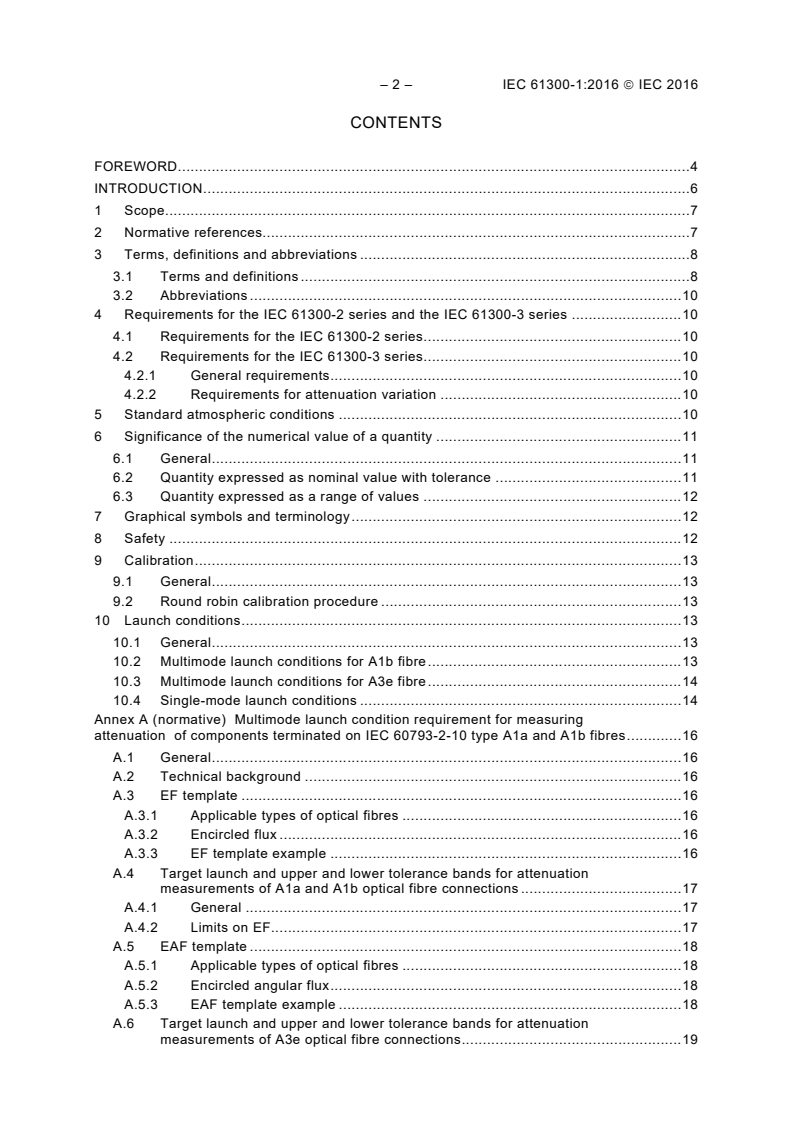
CONTENTS
FOREWORD . 4
INTRODUCTION . 6
1 Scope . 7
2 Normative references. 7
3 Terms, definitions and abbreviations . 8
3.1 Terms and definitions . 8
3.2 Abbreviations . 10
4 Requirements for the IEC 61300-2 series and the IEC 61300-3 series . 10
4.1 Requirements for the IEC 61300-2 series . 10
4.2 Requirements for the IEC 61300-3 series . 10
4.2.1 General requirements . 10
4.2.2 Requirements for attenuation variation . 10
5 Standard atmospheric conditions . 10
6 Significance of the numerical value of a quantity . 11
6.1 General . 11
6.2 Quantity expressed as nominal value with tolerance . 11
6.3 Quantity expressed as a range of values . 12
7 Graphical symbols and terminology . 12
8 Safety . 12
9 Calibration . 13
9.1 General . 13
9.2 Round robin calibration procedure . 13
10 Launch conditions . 13
10.1 General . 13
10.2 Multimode launch conditions for A1b fibre . 13
10.3 Multimode launch conditions for A3e fibre . 14
10.4 Single-mode launch conditions . 14
Annex A (normative) Multimode launch condition requirement for measuring
attenuation of components terminated on IEC 60793-2-10 type A1a and A1b fibres . 16
A.1 General . 16
A.2 Technical background . 16
A.3 EF template . 16
A.3.1 Applicable types of optical fibres . 16
A.3.2 Encircled flux . 16
A.3.3 EF template example . 16
A.4 Target launch and upper and lower tolerance bands for attenuation
measurements of A1a and A1b optical fibre connections . 17
A.4.1 General . 17
A.4.2 Limits on EF. 17
A.5 EAF template . 18
A.5.1 Applicable types of optical fibres . 18
A.5.2 Encircled angular flux . 18
A.5.3 EAF template example . 18
A.6 Target launch and upper and lower tolerance bands for attenuation
measurements of A3e optical fibre connections . 19
A.6.1 General . 19
A.6.2 Limits on EAF . 19
Bibliography . 20
Figure A.1 – EF template example . 17
Figure A.2 – Encircled angular flux template example . 19
Table 1 – Standard atmospheric conditions . 11
Table 2 – Expected uncertainty for measured attenuation of single connections for
A1b fibre. 14
Table 3 – Expected uncertainty for measured attenuation of single connections for
A3e fibre. 14
Table A.1 – EF requirements for 50 µm core fibre at 850 nm . 17
Table A.2 – EF requirements for 50 µm core fibre at 1 300 nm . 18
Table A.3 – EF requirements for 62,5 µm fibre at 850 nm . 18
Table A.4 – EF requirements for 62,5 µm fibre at 1 300 nm . 18
Table A.5 – EAF requirements for NA of 0,37 and 200 µm core fibre at 850 nm . 19
– 4 – IEC 61300-1:2016 IEC 2016
INTERNATIONAL ELECTROTECHNICAL COMMISSION
____________
FIBRE OPTIC INTERCONNECTING
DEVICES AND PASSIVE COMPONENTS –
BASIC TEST AND MEASUREMENT PROCEDURES –
Part 1: General and guidance
FOREWORD
1) The International Electrotechnical Commission (IEC) is a worldwide organization for standardization comprising
all national electrotechnical committees (IEC National Committees). The object of IEC is to promote
international co-operation on all questions concerning standardization in the electrical and electronic fields. To
this end and in addition to other activities, IEC publishes International Standards, Technical Specifications,
Technical Reports, Publicly Available Specifications (PAS) and Guides (hereafter referred to as “IEC
Publication(s)”). Their preparation is entrusted to technical committees; any IEC National Committee interested
in the subject dealt with may participate in this preparatory work. International, governmental and non-
governmental organizations liaising with the IEC also participate in this preparation. IEC collaborates closely
with the International Organization for Standardization (ISO) in accordance with conditions determined by
agreement between the two organizations.
2) The formal decisions or agreements of IEC on technical matters express, as nearly as possible, an international
consensus of opinion on the relevant subjects since each technical committee has representation from all
interested IEC National Committees.
3) IEC Publications have the form of recommendations for international use and are accepted by IEC National
Committees in that sense. While all reasonable efforts are made to ensure that the technical content of IEC
Publications is accurate, IEC cannot be held responsible for the way in which they are used or for any
misinterpretation by any end user.
4) In order to promote international uniformity, IEC National Committees undertake to apply IEC Publications
transparently to the maximum extent possible in their national and regional publications. Any divergence
between any IEC Publication and the corresponding national or regional publication shall be clearly indicated in
the latter.
5) IEC itself does not provide any attestation of conformity. Independent certification bodies provide conformity
assessment services and, in some areas, access to IEC marks of conformity. IEC is not responsible for any
services carried out by independent certification bodies.
6) All users should ensure that they have the latest edition of this publication.
7) No liability shall attach to IEC or its directors, employees, servants or agents including individual experts and
members of its technical committees and IEC National Committees for any personal injury, property damage or
other damage of any nature whatsoever, whether direct or indirect, or for costs (including legal fees) and
expenses arising out of the publication, use of, or reliance upon, this IEC Publication or any other IEC
Publications.
8) Attention is drawn to the Normative references cited in this publication. Use of the referenced publications is
indispensable for the correct application of this publication.
9) Attention is drawn to the possibility that some of the elements of this IEC Publication may be the subject of
patent rights. IEC shall not be held responsible for identifying any or all such patent rights.
International Standard IEC 61300-1 has been prepared by subcommittee 86B: Fibre optic
interconnecting devices and passive components, of IEC technical committee 86: Fibre Optics.
This fourth edition cancels and replaces the third edition published in 2011. This edition
constitutes a technical revision.
This edition includes the following significant technical changes with respect to the previous
edition:
a) reconsideration of the terms and definitions;
b) addition of Clause 4.
The text of this standard is based on the following documents:
FDIS Report on voting
86B/3992/FDIS 86B/4008/RVD
Full information on the voting for the approval of this standard can be found in the report on
voting indicated in the above table.
This publication has been drafted in accordance with the ISO/IEC Directives, Part 2.
A list of all parts in the IEC 61300 series, published under the general title, Fibre optic
interconnecting and passive components – Basic test and measurement procedures, can be
found on the IEC website.
The committee has decided that the contents of this publication will remain unchanged until
the stability date indicated on the IEC website under "http://webstore.iec.ch" in the data
related to the specific publication. At this date, the publication will be
• reconfirmed,
• withdrawn,
• replaced by a revised edition, or
• amended.
– 6 – IEC 61300-1:2016 IEC 2016
INTRODUCTION
The publications in the IEC 61300 series contain information on mechanical and
environmental testing procedures and measurement procedures relating to fibre optic
interconnecting devices and passive components. They are intended to be used to achieve
uniformity and reproducibility in environmental testing procedures and measurement
procedures.
The term "test procedure" refers to procedures commonly known as mechanical and
environmental tests. The expressions "environmental conditioning" and "environmental
testing" refer to the environments to which components or equipment may be exposed so that
an assessment may be made of their performance under the conditions of use, transport and
storage.
The term "measurement procedure" refers to those measurements which are necessary
to assess the physical and optical characteristics of a component and may also be used
before, during or after a test procedure to measure the effects of environmental conditioning or
testing. The return loss and attenuation tests are examples of measurement procedures.
The requirements for the performance of components or equipment subjected to the test and
measurement procedures described in this part of IEC 61300 are not included. The relevant
specification for the device under test defines the allowed performance limits.
When drafting a specification or purchase contract, only those tests which are necessary for
the relevant components or equipment taking into account the technical and economic
aspects should be specified.
The mechanical and environmental test procedures are contained in the IEC 61300-2 series
and the measurement procedures in the IEC 61300-3 series. Each test or measurement
procedure is published as a stand-alone publication so that it may be modified, expanded or
cancelled without having an effect on any other test or measurement procedure. However it
should be noted that, where practical, reference is made to other standards as opposed to
repeating all or part of already existing standards. As an example, the cold test for fibre optic
apparatus refers to IEC 60068-2-1, but it also provides other needed information such as
purpose, recommended severities and a list of items to be specified.
Multiple methods may be contained in a test or measurement procedure. As an example,
several methods of measuring attenuation are contained in the attenuation measurement
procedure.
If more than one method is contained in a test or measurement procedure, the reference
method may be identified.
The tests in this standard permit the performance of components or equipment to be
compared. To assess the overall quality of a production lot, the test procedures should be
applied in accordance with a suitable sampling plan and may be supplemented by appropriate
additional tests, if necessary.
To provide tests appropriate to the different intensities of an environmental condition, some of
the test procedures have a number of degrees of severity. These different degrees of severity
are obtained by varying the time, temperature or some other determining factor separately or
in combination.
FIBRE OPTIC INTERCONNECTING
DEVICES AND PASSIVE COMPONENTS –
BASIC TEST AND MEASUREMENT PROCEDURES –
Part 1: General and guidance
1 Scope
This part of IEC 61300 provides general information and guidance for the basic test and
measurement procedures defined in the IEC 61300-2 and IEC 61300-3 series for
interconnecting devices and passive components.
This standard should be used in combination with the relevant specification which will define
the tests to be used, the required degree of severity for each of them, their sequence, if
relevant, and the permissible performance limits. In the event of conflict between this basic
standard and the relevant specification, the latter will take precedence.
2 Normative references
The following documents, in whole or in part, are normatively referenced in this document and
are indispensable for its application. For dated references, only the edition cited applies. For
undated references, the latest edition of the referenced document (including any
amendments) applies.
IEC 60050-731, International Electrotechnical Vocabulary – Chapter 731: Optical fibre
communication
IEC 60617, Graphical symbols for diagrams (available at http://std.iec.ch/iec60617)
IEC 60793-2-10, Optical fibres – Part 2-10: Product specifications – Sectional specification for
category A1 multimode fibres
IEC 60793-2-30, Optical fibres – Part 2-30: Product specifications – Sectional specification for
category A3 multimode fibres
IEC 60793-2-40, Optical fibres – Part 2-40: Product specifications – Sectional specification for
category A4 multimode fibres
IEC 60825-1, Safety of laser products – Part 1: Equipment classification and requirements
IEC 60825-2, Safety of laser products – Part 2: Safety of optical fibre communication systems
(OFCS)
IEC 61280-1-4, Fibre optic communication subsystem test procedures – Part 1-4: General
communication subsystems – Light source encircled flux measurement method
IEC 61280-4-1, Fibre optic communication subsystem test procedures – Part 4-1: Installed
cable plant – Multimode attenuation measurement
IEC 61300-2 (all parts), Fibre optic interconnecting devices and passive components – Basic
test and measurement procedures – Tests
– 8 – IEC 61300-1:2016 IEC 2016
IEC 61300-3 (all parts), Fibre optic interconnecting devices and passive components – Basic
test and measurement procedures – Examinations and measurements
IEC 61300-3-1, Fibre optic interconnecting devices and passive components – Basic test and
measurement procedures – Part 3-1: Examinations and measurements – Visual examination
IEC 61300-3-35, Fibre optic interconnecting devices and passive components – Basic test
and measurement procedures – Part 3-35: Examinations and measurements – Visual
inspection of fibre optic connectors and fibre-stub transceivers
IEC 61300-3-53, Fibre optic interconnecting devices and passive components – Basic test
and measurement procedures – Part 3-53: Examinations and measurements – Encircled
angular flux (EAF) measurement method based on two-dimensional far field data from step
index multimode waveguide (including fibre)
3 Terms, definitions and abbreviations
3.1 Terms and definitions
For the purposes of this document, the following terms and definitions apply.
3.1.1
test
technical operation that consists of the determination of one or more characteristics of a given
product, process or service according to a specified procedure and normally consists of the
following steps:
a) preparation (where required);
b) pre-conditioning (where required);
c) initial examination and measurement (where required);
d) conditioning;
e) recovery (where required);
f) final examination and measurement.
3.1.2
device under test
DUT
interconnecting device, passive component, equipment or other item designated to be tested
3.1.3
preparation
preparing the DUT according to the manufacturer’s instructions or as specified in the relevant
specification
3.1.4
pre-conditioning
treatment of a DUT with the object of removing or partly counteracting the effects of its
previous environmental history
3.1.5
conditioning
exposure of a DUT to environmental conditions for a specified duration in order to determine
the effects of such conditions on the DUT
3.1.6
recovery
treatment of a DUT after conditioning in order that the properties of the DUT may stabilise
before measurement
3.1.7
examination
visual and/or mechanical inspection of a DUT made with or without the use of special
equipment
Note 1 to entry: Usually carried out before and after the test, and/or during the test.
3.1.8
measurement
process of obtaining one or more values that can reasonably be attributed to a quantity
[SOURCE: IEC 60050:2010, 112-04-01, modified – The adverb "experimentally" has been
removed from the definition, as well as the notes.]
3.1.9
encircled flux
EF
fraction of cumulative near-field power to the total output power as a function of radial
distance from the optical centre of the core, defined by Equation (1),
r
xI(x)dx
∫
EF( r ) = (1)
R
xI(x)dx
∫
where
I(x) is the near-field intensity profile as a function of radial position, r;
R is the maximum range of integration
Note 1 to entry: EF shall be measured according to IEC 61280-1-4.
3.1.10
encircled angular flux
EAF
fraction of cumulative far-field power to the total output power as a function of incident angle θ
from the optical central axis of the far-field pattern, defined by Equation (2),
sin(θ )
′
2π θ
I(r,ϕ) dθdϕ
∫ ∫
0 0
cos (θ )
EAF(θ′) =
sin(θ )
2π θ
max
I(r,ϕ) dθdϕ
∫ ∫
0 0
cos (θ )
(2)
where
I(r,φ) is the 2 dimensional far-field intensity profile as a function of moving radius
r and argument φ;
incident angle θ’ = tan-1(r/d);
d is the distance between luminescent point and far field screen; and
θmax is the maximum range of integration.
Note 1 to entry: EAF shall be measured according to IEC 61300-3-53.
– 10 – IEC 61300-1:2016 IEC 2016
3.2 Abbreviations
For the purposes of this document, the following abbreviations apply:
DMA differential mode dispersion
DUT device under test
EAF encircled angular flux
EF encircled flux
LED light emitting diode
SI step index
4 Requirements for the IEC 61300-2 series and the IEC 61300-3 series
4.1 Requirements for the IEC 61300-2 series
The IEC 61300-2 series shall contain these items:
• test apparatus;
• test procedures, stated in the test requirements;
• severities;
• details to be specified.
4.2 Requirements for the IEC 61300-3 series
4.2.1 General requirements
The IEC 61300-3 series shall contain these items:
• measurement apparatus;
• measurement procedures;
• method of calculation (where required);
• measurement uncertainty;
• details to be specified.
4.2.2 Requirements for attenuation variation
For interconnection devices, the attenuation variation is defined as the peak-to-peak variation
of attenuation during the test, unless otherwise specified.
For passive optical components, the attenuation variation is defined as a plus or minus
deviation from the original value at the start of the test, unless otherwise specified.
5 Standard atmospheric conditions
Standard atmospheric conditions shall be controlled within some range to ensure proper
correlation of data obtained from measurements and tests conducted in various facilities. Test
and measurement procedures shall be conducted under the following atmospheric conditions
unless otherwise specified. In some cases, special ambient conditions may be needed and can
be specified in the relevant specification.
The standard range of atmospheric conditions for carrying out measurements and tests is set
out in Table 1.
Table 1 – Standard atmospheric conditions
Temperature Relative humidity Air pressure
18 °C to 28 °C 25 % to 75 % 86 kPa to 106 kPa
Variations in ambient temperature and humidity shall be kept to a minimum during a series of
measurements.
6 Significance of the numerical value of a quantity
6.1 General
The numerical values of quantities for the various parameters (temperature, humidity, stress,
duration, optical power levels, etc.) given in the basic methods of environmental and optical
testing constituting the IEC 61300-2 series and the optical and physical measurements
constituting the IEC 61300-3 series are expressed in different ways according to the needs of
each individual test.
The two cases that most frequently arise are:
a) the quantity is expressed as a nominal value with a tolerance;
b) the quantity is expressed as a range of values.
For these two cases, the significance of the numerical value is discussed in 6.2 and 6.3.
6.2 Quantity expressed as nominal value with tolerance
Examples of two forms of presentation are:
a) 40 mm ± 2 mm
2 s ± 0,5 s
0,3 dB ± 0,1 dB
+ 3
b) 93 % %
–2
The expression of a quantity as a numerical value indicates the intention that the test should
be carried out at the stated value. The object of stating tolerances is to take account of the
following factors in particular:
• the difficulties in regulating some devices and their drift (undesired slow variation) during
the test;
• uncertainties of instrument;
• non-uniformity of environmental parameters, for which no specific tolerances are given, in
the test space in which the DUTs are located.
These tolerances are not intended to allow latitude in the adjustment of the values of the
parameter within the test space. Hence, when a quantity is expressed by a nominal value with
a tolerance, the test apparatus shall be adjusted so as to obtain this nominal value making
allowance for the uncertainties of instrument.
In principle, the test apparatus shall not be adjusted to maintain a limiting value of the
tolerance zone, even if its uncertainty is so small as to ensure that this limiting value would
not be exceeded.
– 12 – IEC 61300-1:2016 IEC 2016
EXAMPLE: If the quantity is expressed numerically as 100 ± 5, the test apparatus is adjusted to maintain the
target value of 100 making allowance for the uncertainties of instrument and in no case is adjusted to maintain a
target value of 95 or 105.
In order to avoid any limiting value applicable to the DUT during the carrying out of the test, it
may be necessary in some cases to set the test apparatus near to one tolerance limit.
In the particular case where the quantity is expressed by a nominal value with a unilateral
tolerance (which is generally the case unless justified otherwise by special conditions, for
example, a non-linear response), the test apparatus shall be set as close as possible to the
nominal value (which is also a tolerance limit) taking account of the uncertainty of
measurement, which depends on the apparatus used for the test (including the instruments
used to measure the values of the parameters).
+ 0
EXAMPLE: If the quantity is expressed numerically as 100 % % and the test apparatus is capable of an
–5
overall uncertainty in the control of the parameter of ±1 %, then the test apparatus is adjusted to maintain a target
value of 99 %. If, on the other hand, the overall uncertainty is ± 2,5 %, then the adjustment is set to maintain a
target value of 97,5 %.
6.3 Quantity expressed as a range of values
Examples of forms of presentation:
a) From 18 °C to 28 °C
Relative humidity from 80 % to 100 %
From 1 h to 2 h
b) Return loss ≥ 55 dB
Attenuation ≤ 0,50 dB
The use of words in expressing a range leads to ambiguity; for example, the phrase "from
80 % to 100 %" is recognised as "excluding the values of 80 and 100" by some readers, as
"80 and 100 are included" by others. The use of symbols, for example > 80 or ≥ 80, is
generally less likely to be ambiguous and is therefore to be preferred.
The expression of a quantity as a range of values indicates that the value to which the test
apparatus is adjusted has only a small influence on the result of the test.
Where the uncertainty of the control of the parameter (including uncertainties of instrument)
permits, any desired value within the given range may be chosen. For example, if it is stated
that the temperature shall be from 18 °C to 28 °C, any value within this range can be used
(but it is not intended that the temperature should be programmed to vary over the range).
7 Graphical symbols and terminology
The terminology used in the interpretation and preparation of fibre optic test and
measurement procedures shall be taken from IEC 60050-731.
Graphical symbols used for the preparation and interpretation of fibre optic test and
measurement procedures shall be selected where possible from IEC 60617.
8 Safety
The precautions for carrying out fibre optic measurements, as far as laser radiation is
concerned, are given in IEC 60825-1. Fibre optic components and systems may emit
hazardous radiation. This may occur
a) at sources;
b) in transmission systems during installation, during service or intentional interruption and
failure or unintentional interruption;
c) while measuring and testing.
For hazard evaluation, precautions and manufacturer's requirements, the relevant standards
are IEC 60825-1 and IEC 60825-2.
Other safety aspects are referred to in applicable test methods and other standards.
9 Calibration
9.1 General
The equipment used shall have a valid calibration certificate in accordance with the applicable
quality system for the period over which the testing is done. Preferably international or
national standards should be adopted (e.g. IEC 61315). The calibration should be traceable to
a national standard if available.
In cases where no calibration standard exists, the manufacturer or laboratory carrying out the
test shall state the uncertainty of the test equipment to their best knowledge.
9.2 Round robin calibration procedure
Where the uncertainty is unknown, it may be necessary to use a round robin calibration
procedure for calibrating measuring instruments (e.g. gauges).
10 Launch conditions
10.1 General
The loss characteristics of a component frequently depend, to a very significant extent, on
how the light is launched into the input fibre. It is recommended that the launch conditions are
used for all optical measurements. In order to obtain repeatable measurements, it is
necessary to use standard launch conditions, which are clearly defined, and can be duplicated
easily and precisely.
To achieve consistent results, first inspect and, if necessary, clean and inspect again all
connector plugs and adaptors prior to measurement. Visual examination shall be undertaken
in accordance with IEC 61300-3-1. Additionally, end-faces of optical connectors shall be
inspected in accordance with IEC 61300-3-35.
10.2 Multimode launch conditions for A1b fibre
Annex A provides a procedure for establishing the launch conditions for multimode fibre of
category A1 defined in IEC 60793-2-10. The launch conditions are defined by tolerance bands
on a target encircled flux (EF) metric.
NOTE IEC 62614 and IEC TR 61282-11 provide useful information on multi-mode launch condition.
These tolerance bands have been created for testing installed fibre optic links as defined in
IEC 61280-4-1, to limit the variation in measured attenuation. The expected tolerances for
links (with multiple connectors) are different to those for a single connection. When the
measured EF of the source is within the specified tolerance bands, the expected uncertainty
for the measured attenuation value of a single connection, in dB, is according to Table 2.
– 14 – IEC 61300-1:2016 IEC 2016
Table 2 – Expected uncertainty for measured
attenuation of single connections for A1b fibre
Fibre nominal core diameter Wavelength Expected uncertainty
due to mode variation
µm nm dB
50 850
± 0,08
Table 2 is valid for attenuation values ≤ 0,75 dB.
When calculating the total uncertainty of the multimode attenuation measurement, the
uncertainty due to the modal variations shall be included.
10.3 Multimode launch conditions for A3e fibre
Annex A provides a procedure for establishing the launch conditions for category A3e
multimode fibre defined in IEC 60793-2-30. The launch condition is defined by tolerance band
on a target encircled angular flux (EAF) metric.
NOTE IEC 61300-3-53 provides useful information on multi-mode launch condition.
These tolerance bands have been created for testing connecting devices, to limit the variation
in measured attenuation. When the measured EAF of the source is within the specified
tolerance band, the expected uncertainty for the measured attenuation value of a single
connection, in dB, is according to Table 3.
Table 3 – Expected uncertainty for measured
attenuation of single connections for A3e fibre
Fibre nominal core NA Wavelength Expected uncertainty
diameter due to mode variation
nm dB
µm
200 850
0,37 ± 0,2
Table 3 is valid for attenuation values ≤ 2,0 dB.
When calculating the total uncertainty of the multimode attenuation measurement, the
uncertainty due to the modal variations shall be included.
10.4 Single-mode launch conditions
For single-mode components, the wavelength of the source (including the total spectral width)
shall be longer than the cut-off wavelength of the fibre. The deployment and length of the fibre
on the input shall be such that any higher order modes that may initially be launched are
sufficiently attenuated.
For polarization sensitive devices, the state of polarization of input power may be significant
and, when required, shall be specified in the relevant specification.
The power in the fibre shall be set high enough, within the power level, not to generate non-
linear scattering effects.
Precautions shall be taken to ensure that cladding modes do not affect the measurement.
Cladding modes shall be eliminated either as a natural function of the fibre coating in the
input and output fibres, or by adding cladding mode eliminators if specified in the relevant
specification.
Precautions shall be taken to ensure that excessive bending of the fibres on either the input
or output fibre, which could affect the measurement, does not occur. The fibres should remain
fixed in position during the measurement.
The stability of the launch shall be suitable for the measurement to be undertaken. The
stability shall be maintained over the measurement time and operational temperature range.
– 16 – IEC 61300-1:2016 IEC 2016
Annex A
(normative)
Multimode launch condition requirement for measuring attenuation
of components terminated on IEC 60793-2-10 type A1a and A1b fibres
A.1 General
Annex A describes the general multimode launch condition requirements used for measuring
attenuation. The purpose of these requirements is to ensure consistency of field
measurements with factory measurements and consistency of factory or field measurements
when different types of test equipment are used.
Use of these launch conditions should ensure that when a component is factory tested it
meets the requirements of field testing after installation of the product in the field.
For multimode step index (SI) fibre, defined by IEC 60793-2-30 and IEC 60793-2-40,
Encircled Angular Flux (EAF) measurement method, defined by IEC 61300-3-53, is used.
A.2 Technical background
Light sources, typically used in measuring attenuation, may have varying modal distributions
when launched into multimode fibre. These differing modal distributions, combined with the
differential mode attenuation (DMA) inherent in most multimode components, commonly
cause measurement variations when measuring attenuation of multimode components. For
example, attenuation measurement variations can occur when two similar light sources or
different launch cords are used.
In the past legacy (LED based) applications had a wide power budget which in most cases
masked the variance in result between the factory and field measurement.
As technology has evolved, the system requirements for attenuation have become more
stringent. Demanding application requirements are driving the need for accurate and
reproducible multimode attenuation measurements over a variety of field-test instruments.
Attenuation measurement experiments with different field-test instruments having the same
standards-compliant set-up produce measurement variations that are induced by their
differing launch conditions.
A.3 EF template
A.3.1 Applicable types of optical fibres
These guidelines are suitable for 50 µm and 62,5 µm core fibres, both with 125 µm cladding
diameter.
A.3.2 Encircled flux
The EF is determined from the near field measurement of the light coming from the end of the
reference grade launching cord.
A.3.3 EF template example
An example of an encircled flux template for 50 µm core fibre at 850 nm is shown in
Figure A.1.
0,9
0,8
0,7
0,6
0,5
0,4
0,3
0,2
0,1
0 5 10 15 20 25
Radius (µm)
IEC
Figure A.1 – EF template example
A.4 Target launch and upper and lower tolerance bands for attenuation
measurements of A1a and A1b optical fibre connections
A.4.1 General
The specified launch condition in this document is valid for attenuation measurement of
multimode fibre optic connections. The launch condition for attenuation measurements for
multimode connectors shall meet the EF requirements of Tables A.1 to A.4 when measured at
the output of the reference connector.
A.4.2 Limits on EF
The limits for the EF are derived from a target near field and a set of boundary conditions
designed to constrain the variation in attenuation induced by variations in the source to within
± 10 % or ± X dB, whichever is largest, of the value that would be obtained if the target launch
were used. The variable X is a tolerance threshold that varies with fibre core size and
...