

IEC 60317-52:2014
(Main)Specifications for particular types of winding wires - Part 52: Aromatic polyamide (aramid) tape wrapped round copper wire, temperature index 220
General Information
- Abstract
IEC 60317-52:2014 specifies requirements for tape wrapped round copper winding wire of temperature index 220. The insulation consists of one or more wrappings of aromatic polyamide (aramid) tape of various thicknesses. The range of nominal conductor diameters covered by this standard is:
- 1,600 mm up to and including 5,000 mm;
- the nominal conductor diameters are given in Table 1. This second edition cancels and replaces the first edition published in 1999. This edition constitutes a technical revision. This edition includes the following significant technical changes with respect to the previous edition:
- new 3.2.2 containing general notes on winding wire, formerly a part of the scope;
- new 3.3, containing requirements for appearance;
- modification to Clause 15 to delete the note on revisions to IEC 60172;
- new Clause 23, Pin hole test. Keywords: tape wrapped round copper winding wire of temperature index 220, aromatic polyamide (aramid) tape
- Status
- Published
- Publication Date
- 13-Feb-2014
- Technical Committee
- TC 55 - Winding wires
- Drafting Committee
- WG 1 - TC 55/WG 1
- Current Stage
- PPUB - Publication issued
- Start Date
- 14-Feb-2014
- Completion Date
- 15-May-2014
Buy Documents
IEC 60317-52:2014 - Specifications for particular types of winding wires - Part 52: Aromatic polyamide (aramid) tape wrapped round copper wire, temperature index 220 Released:2/14/2014
IEC 60317-52:2014 Overview
IEC 60317-52:2014 is an international standard developed by the International Electrotechnical Commission (IEC) that specifies the requirements for a specialized type of winding wire. This wire is characterized by its construction: copper wire wrapped with one or more layers of aromatic polyamide (aramid) tape insulation. The standard defines specifications for wires with a temperature index of 220°C and covers nominal conductor diameters ranging from 1.600 mm to 5.000 mm.
The second edition, published in 2014, supersedes the 1999 edition and includes important technical revisions such as new guidelines on wire appearance, generalized notes on winding wire, and the addition of a pin hole test. This standard is crucial for manufacturers, designers, and users of electrical equipment requiring high-temperature resistant winding wires.
Key Topics
- Wire Construction: The winding wire consists of a copper conductor wrapped by one or more layers of aramid tape insulation, offering excellent thermal resistance.
- Temperature Index: The aramid tape insulation ensures the wire can operate safely at temperatures up to 220°C.
- Nominal Conductor Diameter: Standardized sizes range from 1.600 mm to 5.000 mm, providing flexibility for various electrical applications.
- Appearance Requirements: Newly introduced appearance criteria help ensure consistent quality and visual inspection standards.
- Testing Procedures:
- Electrical resistance verification
- Elongation and springiness testing
- Flexibility, adherence, and resistance to solvents, abrasion, and heat analysis
- Pin hole detection test to ensure insulation integrity
- Heat Shock Test: Not applicable for this wire type due to its unique insulation, implying different reliability considerations.
- Packaging: Specific packaging requirements maintain the wire's quality during transport and storage.
Applications
IEC 60317-52 compliant winding wires are ideal for use in high-performance electrical and electronic equipment, including:
- Motors and Generators: Where high operating temperatures require robust wire insulation to prevent failure.
- Transformers and Reactors: Applications demanding reliable copper wire insulation with excellent mechanical and thermal properties.
- Automotive and Aerospace Electrical Systems: Critical environments needing durable, heat-resistant conductors.
- Industrial Equipment: Devices exposed to elevated temperatures benefit from the thermal stability of aramid tape wrapped wires.
- Electrical Coils and Electromagnets: Enhanced durability and temperature endurance ensure long service life.
Related Standards
IEC 60317-52:2014 is part of the IEC 60317 series covering particular types of winding wires. It relates closely to other international standards, such as:
- IEC 60851: Test methods for winding wires, ensuring conformity and performance validation.
- IEC 60172: Test procedures for determining the temperature index of enamelled winding wires.
- IEC 60819-3-3: Specifications for individual insulating materials including unfilled aramid papers.
- IEC 60264: Packaging standards for winding wires to ensure proper handling and storage.
- ISO 3:1973: Preferred numbers standard, relevant for defining nominal wire diameters.
Practical Value
Compliance with IEC 60317-52:2014 ensures that copper winding wires wrapped with aramid tape meet rigorous quality and safety benchmarks, which help manufacturers deliver reliable, high-temperature electrical components. This standard supports worldwide interoperability, quality assurance, and enhances the operational lifespan of electrical assemblies subjected to demanding thermal environments.
By adhering to IEC 60317-52, industries can optimize performance, reduce downtime, and maintain safety standards, making it an essential reference for professionals involved in the design, production, and application of high-temperature resistant winding wires.
Relations
- Effective Date
- 05-Sep-2023
Buy Documents
IEC 60317-52:2014 - Specifications for particular types of winding wires - Part 52: Aromatic polyamide (aramid) tape wrapped round copper wire, temperature index 220 Released:2/14/2014
Get Certified
Connect with accredited certification bodies for this standard

IMQ S.p.A. (Certification)
Italian electrical product certification.

SLG Prüf- und Zertifizierungs GmbH
German testing and certification body.

UL Solutions
Global safety science company with testing, inspection and certification.
Sponsored listings
Frequently Asked Questions
IEC 60317-52:2014 is a standard published by the International Electrotechnical Commission (IEC). Its full title is "Specifications for particular types of winding wires - Part 52: Aromatic polyamide (aramid) tape wrapped round copper wire, temperature index 220". This standard covers: IEC 60317-52:2014 specifies requirements for tape wrapped round copper winding wire of temperature index 220. The insulation consists of one or more wrappings of aromatic polyamide (aramid) tape of various thicknesses. The range of nominal conductor diameters covered by this standard is: - 1,600 mm up to and including 5,000 mm; - the nominal conductor diameters are given in Table 1. This second edition cancels and replaces the first edition published in 1999. This edition constitutes a technical revision. This edition includes the following significant technical changes with respect to the previous edition: - new 3.2.2 containing general notes on winding wire, formerly a part of the scope; - new 3.3, containing requirements for appearance; - modification to Clause 15 to delete the note on revisions to IEC 60172; - new Clause 23, Pin hole test. Keywords: tape wrapped round copper winding wire of temperature index 220, aromatic polyamide (aramid) tape
IEC 60317-52:2014 specifies requirements for tape wrapped round copper winding wire of temperature index 220. The insulation consists of one or more wrappings of aromatic polyamide (aramid) tape of various thicknesses. The range of nominal conductor diameters covered by this standard is: - 1,600 mm up to and including 5,000 mm; - the nominal conductor diameters are given in Table 1. This second edition cancels and replaces the first edition published in 1999. This edition constitutes a technical revision. This edition includes the following significant technical changes with respect to the previous edition: - new 3.2.2 containing general notes on winding wire, formerly a part of the scope; - new 3.3, containing requirements for appearance; - modification to Clause 15 to delete the note on revisions to IEC 60172; - new Clause 23, Pin hole test. Keywords: tape wrapped round copper winding wire of temperature index 220, aromatic polyamide (aramid) tape
IEC 60317-52:2014 is classified under the following ICS (International Classification for Standards) categories: 29.060.10 - Wires. The ICS classification helps identify the subject area and facilitates finding related standards.
IEC 60317-52:2014 has the following relationships with other standards: It is inter standard links to IEC 60317-52:1999. Understanding these relationships helps ensure you are using the most current and applicable version of the standard.
IEC 60317-52:2014 is available in PDF format for immediate download after purchase. The document can be added to your cart and obtained through the secure checkout process. Digital delivery ensures instant access to the complete standard document.
Standards Content (Sample)
IEC 60317-52 ®
Edition 2.0 2014-02
INTERNATIONAL
STANDARD
NORME
INTERNATIONALE
Specifications for particular types of winding wires –
Part 52: Aromatic polyamide (aramid) tape wrapped round copper wire,
temperature index 220
Spécifications pour types particuliers de fils de bobinage –
Partie 52: Fil de section circulaire en cuivre enveloppé avec un ruban polyamide
aromatique (aramide), d’indice de température 220
All rights reserved. Unless otherwise specified, no part of this publication may be reproduced or utilized in any form
or by any means, electronic or mechanical, including photocopying and microfilm, without permission in writing from
either IEC or IEC's member National Committee in the country of the requester. If you have any questions about IEC
copyright or have an enquiry about obtaining additional rights to this publication, please contact the address below or
your local IEC member National Committee for further information.
Droits de reproduction réservés. Sauf indication contraire, aucune partie de cette publication ne peut être reproduite
ni utilisée sous quelque forme que ce soit et par aucun procédé, électronique ou mécanique, y compris la photocopie
et les microfilms, sans l'accord écrit de l'IEC ou du Comité national de l'IEC du pays du demandeur. Si vous avez des
questions sur le copyright de l'IEC ou si vous désirez obtenir des droits supplémentaires sur cette publication, utilisez
les coordonnées ci-après ou contactez le Comité national de l'IEC de votre pays de résidence.
IEC Central Office Tel.: +41 22 919 02 11
3, rue de Varembé Fax: +41 22 919 03 00
CH-1211 Geneva 20 info@iec.ch
Switzerland www.iec.ch
About the IEC
The International Electrotechnical Commission (IEC) is the leading global organization that prepares and publishes
International Standards for all electrical, electronic and related technologies.
About IEC publications
The technical content of IEC publications is kept under constant review by the IEC. Please make sure that you have the
latest edition, a corrigenda or an amendment might have been published.
IEC Catalogue - webstore.iec.ch/catalogue Electropedia - www.electropedia.org
The stand-alone application for consulting the entire The world's leading online dictionary of electronic and
bibliographical information on IEC International Standards, electrical terms containing more than 30 000 terms and
Technical Specifications, Technical Reports and other definitions in English and French, with equivalent terms in 14
documents. Available for PC, Mac OS, Android Tablets and additional languages. Also known as the International
iPad. Electrotechnical Vocabulary (IEV) online.
IEC publications search - www.iec.ch/searchpub IEC Glossary - std.iec.ch/glossary
The advanced search enables to find IEC publications by a More than 55 000 electrotechnical terminology entries in
variety of criteria (reference number, text, technical English and French extracted from the Terms and Definitions
committee,…). It also gives information on projects, replaced clause of IEC publications issued since 2002. Some entries
and withdrawn publications. have been collected from earlier publications of IEC TC 37,
77, 86 and CISPR.
IEC Just Published - webstore.iec.ch/justpublished
Stay up to date on all new IEC publications. Just Published IEC Customer Service Centre - webstore.iec.ch/csc
details all new publications released. Available online and If you wish to give us your feedback on this publication or
also once a month by email. need further assistance, please contact the Customer Service
Centre: csc@iec.ch.
A propos de l'IEC
La Commission Electrotechnique Internationale (IEC) est la première organisation mondiale qui élabore et publie des
Normes internationales pour tout ce qui a trait à l'électricité, à l'électronique et aux technologies apparentées.
A propos des publications IEC
Le contenu technique des publications IEC est constamment revu. Veuillez vous assurer que vous possédez l’édition la
plus récente, un corrigendum ou amendement peut avoir été publié.
Catalogue IEC - webstore.iec.ch/catalogue Electropedia - www.electropedia.org
Application autonome pour consulter tous les renseignements
Le premier dictionnaire en ligne de termes électroniques et
bibliographiques sur les Normes internationales,
électriques. Il contient plus de 30 000 termes et définitions en
Spécifications techniques, Rapports techniques et autres
anglais et en français, ainsi que les termes équivalents dans
documents de l'IEC. Disponible pour PC, Mac OS, tablettes
14 langues additionnelles. Egalement appelé Vocabulaire
Android et iPad.
Electrotechnique International (IEV) en ligne.
Recherche de publications IEC - www.iec.ch/searchpub
Glossaire IEC - std.iec.ch/glossary
Plus de 55 000 entrées terminologiques électrotechniques, en
La recherche avancée permet de trouver des publications IEC
en utilisant différents critères (numéro de référence, texte, anglais et en français, extraites des articles Termes et
comité d’études,…). Elle donne aussi des informations sur les Définitions des publications IEC parues depuis 2002. Plus
projets et les publications remplacées ou retirées. certaines entrées antérieures extraites des publications des
CE 37, 77, 86 et CISPR de l'IEC.
IEC Just Published - webstore.iec.ch/justpublished
Service Clients - webstore.iec.ch/csc
Restez informé sur les nouvelles publications IEC. Just
Published détaille les nouvelles publications parues. Si vous désirez nous donner des commentaires sur cette
Disponible en ligne et aussi une fois par mois par email. publication ou si vous avez des questions contactez-nous:
csc@iec.ch.
IEC 60317-52 ®
Edition 2.0 2014-02
INTERNATIONAL
STANDARD
NORME
INTERNATIONALE
Specifications for particular types of winding wires –
Part 52: Aromatic polyamide (aramid) tape wrapped round copper wire,
temperature index 220
Spécifications pour types particuliers de fils de bobinage –
Partie 52: Fil de section circulaire en cuivre enveloppé avec un ruban polyamide
aromatique (aramide), d’indice de température 220
INTERNATIONAL
ELECTROTECHNICAL
COMMISSION
COMMISSION
ELECTROTECHNIQUE
PRICE CODE
INTERNATIONALE
CODE PRIX Q
ICS 29.060.10 ISBN 978-2-8322-1414-5
– 2 – IEC 60317-52:2014 © IEC 2014
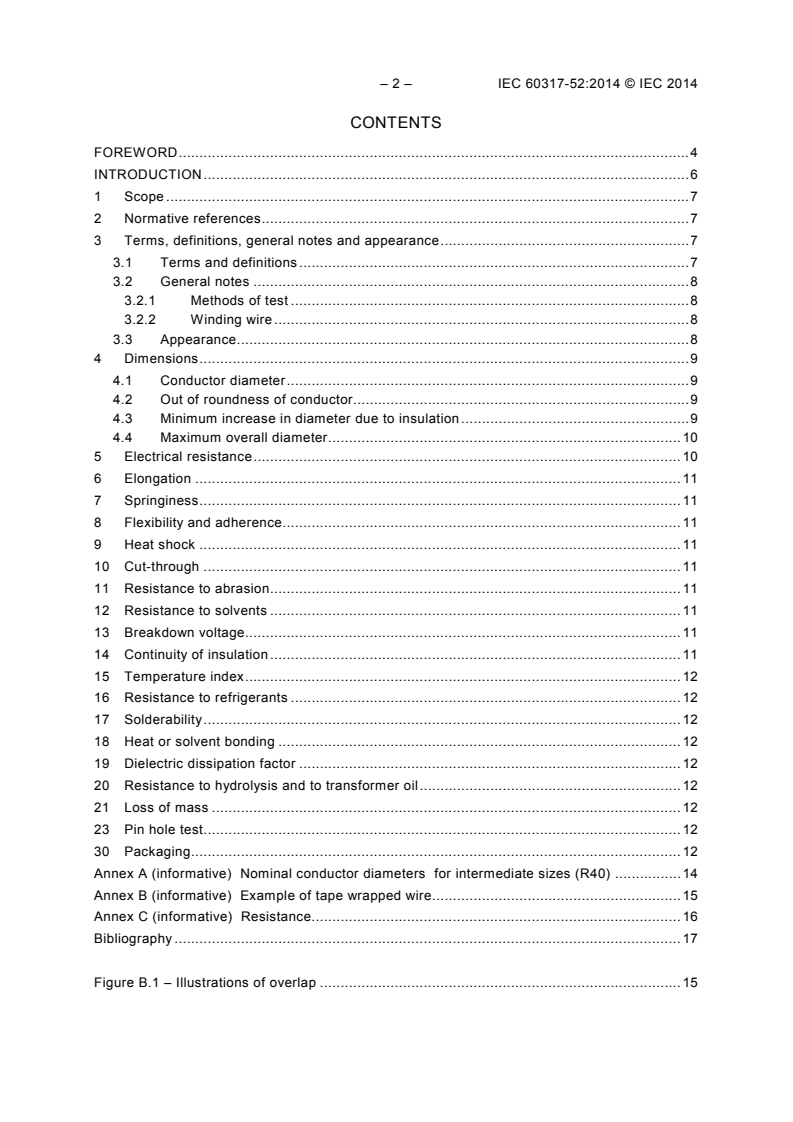
CONTENTS
FOREWORD . 4
INTRODUCTION . 6
1 Scope . 7
2 Normative references . 7
3 Terms, definitions, general notes and appearance . 7
3.1 Terms and definitions . 7
3.2 General notes . 8
3.2.1 Methods of test . 8
3.2.2 Winding wire . 8
3.3 Appearance . 8
4 Dimensions . 9
4.1 Conductor diameter . 9
4.2 Out of roundness of conductor. 9
4.3 Minimum increase in diameter due to insulation . 9
4.4 Maximum overall diameter . 10
5 Electrical resistance . 10
6 Elongation . 11
7 Springiness . 11
8 Flexibility and adherence . 11
9 Heat shock . 11
10 Cut-through . 11
11 Resistance to abrasion . 11
12 Resistance to solvents . 11
13 Breakdown voltage. 11
14 Continuity of insulation . 11
15 Temperature index . 12
16 Resistance to refrigerants . 12
17 Solderability . 12
18 Heat or solvent bonding . 12
19 Dielectric dissipation factor . 12
20 Resistance to hydrolysis and to transformer oil . 12
21 Loss of mass . 12
23 Pin hole test . 12
30 Packaging . 12
Annex A (informative) Nominal conductor diameters for intermediate sizes (R40) . 14
Annex B (informative) Example of tape wrapped wire . 15
Annex C (informative) Resistance. 16
Bibliography . 17
Figure B.1 – Illustrations of overlap . 15
Table 1 – Conductor diameters . 9
Table 2 – Elongation requirements . 11
Table A.1 – Conductor diameters (R40) . 14
Table C.1 – Nominal resistance . 16
– 4 – IEC 60317-52:2014 © IEC 2014
INTERNATIONAL ELECTROTECHNICAL COMMISSION
____________
SPECIFICATIONS FOR PARTICULAR
TYPES OF WINDING WIRES –
Part 52: Aromatic polyamide (aramid) tape wrapped
round copper wire, temperature index 220
FOREWORD
1) The International Electrotechnical Commission (IEC) is a worldwide organization for standardization comprising
all national electrotechnical committees (IEC National Committees). The object of IEC is to promote
international co-operation on all questions concerning standardization in the electrical and electronic fields. To
this end and in addition to other activities, IEC publishes International Standards, Technical Specifications,
Technical Reports, Publicly Available Specifications (PAS) and Guides (hereafter referred to as “IEC
Publication(s)”). Their preparation is entrusted to technical committees; any IEC National Committee interested
in the subject dealt with may participate in this preparatory work. International, governmental and non-
governmental organizations liaising with the IEC also participate in this preparation. IEC collaborates closely
with the International Organization for Standardization (ISO) in accordance with conditions determined by
agreement between the two organizations.
2) The formal decisions or agreements of IEC on technical matters express, as nearly as possible, an international
consensus of opinion on the relevant subjects since each technical committee has representation from all
interested IEC National Committees.
3) IEC Publications have the form of recommendations for international use and are accepted by IEC National
Committees in that sense. While all reasonable efforts are made to ensure that the technical content of IEC
Publications is accurate, IEC cannot be held responsible for the way in which they are used or for any
misinterpretation by any end user.
4) In order to promote international uniformity, IEC National Committees undertake to apply IEC Publications
transparently to the maximum extent possible in their national and regional publications. Any divergence
between any IEC Publication and the corresponding national or regional publication shall be clearly indicated in
the latter.
5) IEC itself does not provide any attestation of conformity. Independent certification bodies provide conformity
assessment services and, in some areas, access to IEC marks of conformity. IEC is not responsible for any
services carried out by independent certification bodies.
6) All users should ensure that they have the latest edition of this publication.
7) No liability shall attach to IEC or its directors, employees, servants or agents including individual experts and
members of its technical committees and IEC National Committees for any personal injury, property damage or
other damage of any nature whatsoever, whether direct or indirect, or for costs (including legal fees) and
expenses arising out of the publication, use of, or reliance upon, this IEC Publication or any other IEC
Publications.
8) Attention is drawn to the Normative references cited in this publication. Use of the referenced publications is
indispensable for the correct application of this publication.
9) Attention is drawn to the possibility that some of the elements of this IEC Publication may be the subject of
patent rights. IEC shall not be held responsible for identifying any or all such patent rights.
International Standard IEC 60317-52 has been prepared by IEC technical committee 55:
Winding wires.
This second edition cancels and replaces the first edition published in 1999. This edition
constitutes a technical revision.
This edition includes the following significant technical changes with respect to the previous
edition:
– new 3.2.2 containing general notes on winding wire, formerly a part of the scope;
– new 3.3, containing requirements for appearance;
– modification to Clause 15 to delete the note on revisions to IEC 60172;
– new Clause 23, Pin hole test.
The text of this standard is based on the following documents:
CDV Report on voting
55/1395/CDV 55/1457/RVC
Full information on the voting for the approval of this standard can be found in the report on
voting indicated in the above table.
This publication has been drafted in accordance with the ISO/IEC Directives, Part 2.
The numbering of clauses in this standard is not continuous from Clauses 20 and 30 in order to
reserve space for possible future wire requirements prior to those for wire packaging.
A list of all parts in the IEC 60317, published under the general title Specifications for particular
types of winding wires, can be found on the IEC website.
The committee has decided that the contents of this publication will remain unchanged until the
stability date indicated on the IEC web site under "http://webstore.iec.ch" in the data related to
the specific publication. At this date, the publication will be
• reconfirmed,
• withdrawn,
• replaced by a revised edition, or
• amended.
– 6 – IEC 60317-52:2014 © IEC 2014
INTRODUCTION
This part of IEC 60317 is one of a series which deals with insulated wires used for windings in
electrical equipment. The series has three groups describing:
1) Winding wires – Test methods (IEC 60851);
2) Specifications for particular types of winding wires (IEC 60317);
3) Packaging of winding wires (IEC 60264).
SPECIFICATIONS FOR PARTICULAR
TYPES OF WINDING WIRES –
Part 52: Aromatic polyamide (aramid) tape wrapped
round copper wire, temperature index 220
1 Scope
This part of IEC 60317 specifies requirements for tape wrapped round copper winding wire of
temperature index 220. The insulation consists of one or more wrappings of aromatic
polyamide (aramid) tape of various thicknesses.
NOTE The heat shock test is inappropriate for this type of wire. Therefore a heat shock temperature cannot be
established. Consequently, a class based on the requirements for temperature index and heat shock temperature
cannot be specified.
The range of nominal conductor diameters covered by this standard is:
– 1,600 mm up to and including 5,000 mm;
– the nominal conductor diameters are given in Table 1.
2 Normative references
The following documents, in whole or in part, are normatively referenced in this document and
are indispensable for its application. For dated references, only the edition cited applies. For
undated references, the latest edition of the referenced document (including any amendments)
applies.
IEC 60172, Test procedure for the determination of the temperature index of enamelled winding
wires
IEC 60819-3-3:2011, Non-cellulosic papers for electrical purposes – Part 3: Specifications for
individual materials – Sheet 3: Unfilled aramid (aromatic polyamide) papers
IEC 60851 (all parts), Winding wires – Test methods
ISO 3:1973, Preferred numbers – Series of preferred numbers
3 Terms, definitions, general notes and appearance
3.1 Terms and definitions
For the purposes of this document, the following terms and definitions apply.
3.1.1
class
thermal performance of a wire expressed by the temperature index and the heat shock
temperature
3.1.2
conductor
bare metal after removal of the insulation
– 8 – IEC 60317-52:2014 © IEC 2014
3.1.3
covering
material which is wound, wrapped or braided around a bare or insulated conductor
3.1.4
insulation
coating or covering on the conductor with the specific function of withstanding voltage
3.1.5
winding wire
wire used for winding a coil to provide a magnetic field
3.1.6
wire
conductor coated or covered with an insulation
3.2 General notes
3.2.1 Methods of test
All methods of test used in this part of IEC 60317 are given in IEC 60851.
The clause numbers used in this standard are identical to the corresponding test numbers in
the IEC 60851 series of standards.
In case of inconsistencies between the publication on methods of test and this standard,
IEC 60317-52 shall prevail.
Where no specific range of nominal conductor diameters is given for a test, the test applies to
all nominal conductor diameters covered by the specification sheet.
Unless otherwise specified, all tests shall be carried out at a temperature from 15 °C to 35 °C
and a relative humidity from 45 % to 75 %. Before measurements are made, the specimens
shall be preconditioned under these atmospheric conditions for a time sufficient to allow the
specimens to reach stability.
The wire to be tested shall be removed from the packaging in such a way that the wire will not
be subjected to tension or unnecessary bends. Before each test, sufficient wire should be
discarded to ensure that any damaged wire is not included in the test specimens.
3.2.2 Winding wire
The temperature in degrees Celsius corresponding to the temperature index is not necessarily
that at which the wire is recommended to be operated and this will depend on many factors,
including the types of equipment involved.
When reference is made to winding wire according to this standard, the following information
should be given:
– reference to IEC 60317-52;
– diameter of the conductor;
– reference should also be made to the number and thickness of the tapes used and to the
degree of overlap, as agreed between the purchaser and supplier.
3.3 Appearance
Before wrapping, the conductor shall be completely free from copper dust and other extraneous
matter.
The tape covering shall be essentially smooth and continuous, wrapped around the conductor
tightly, evenly and free from creases, wrinkles and foreign material when examined with normal
vision, as wound on the original spool or reel.
4 Dimensions
4.1 Conductor diameter
The series of preferred nominal conductor diameters shall correspond to series R20 according
to ISO 3. The actual values and their tolerances are given in Table 1.
The series of intermediate diameters from which the user may select intermediate nominal
conductor diameters, when required for technical reasons, shall correspond to series R40
according to ISO 3. The actual values and their tolerances are given in Annex A.
The conductor diameter shall not differ from the nominal diameter by more than the limits given
in Table 1.
Table 1 – Conductor diameters
Nominal conductor Tolerance Nominal conductor Tolerance
diameter diameter
± ±
mm mm mm mm
1,600 0,016 3,150 0,032
1,800 0,018 3,550 0,036
2,000 0,020 4,000 0,040
2,240 0,022 4,500 0,045
2,500 0,025 5,000 0,050
2,800 0,028
NOTE The dimensions of intermediate nominal conductor diameters for R40 series are given in Annex A.
4.2 Out of roundness of conductor
The difference between the minimum and maximum diameter, at any one point, shall not be
more than the figure given in columns 2 and 4 of Table 1.
4.3 Minimum increase in diameter due to insulation
The minimum increase in diameter due to the insulation shall not be less than the values
calculated using the following formula:
2 Σ T n
i
min. i
where
T is the minimum thickness of the tape in layer number i and n is determined by the
min.i i
degree of overlap in that layer:
– for overlaps of 0 % up to, but not including 50 % n = 1;
– for overlaps of 50 % up to, but not including 66 % n = 2;
– for overlaps of 66 % up to, and including 75 % n = 3.
Minimum thickness shall be calculated from the values given in Table 1 of IEC 60819-3-3:2011
where the permissible deviation of the central thickness value is:
– 10 – IEC 60317-52:2014 © IEC 2014
– for nominal thickness 0,05 mm ± 20 %
– for nominal thicknesses 0,08 mm and greater ± 15 %.
EXAMPLE 1 For a construction using two layers of 0,05 mm tape with 50 % overlap:
T = 0,04 mm, n = 2
min.1 1
T = 0,04 mm, n = 2
min.2 2
Therefore, the minimum increase due to the insulation equals:
2 (0,04 × 2 + 0,04 × 2) mm = 0,320 mm
EXAMPLE 2 For a construction using one layer of 0,05 mm tape with an overlap of 55 % followed by two layers of
0,08 mm tape with no overlap:
T = 0,04 mm, n = 2
min.1 1
T = 0,068 mm, n = 1
min.2 2
T = 0,068 mm, n = 1
min.3 3
Therefore, the minimum increase due to the insulation equals:
2 (0,04 × 2 + 0,068 × 1 + 0,068 × 1) mm = 0,432 mm
As there are many varied constructions of this type of wire, the dimensions due to the
insulation are subject to agreement between purchaser and supplier and shall be clearly stated
in the purchase order.
4.4 Maximum overall diameter
The overall diameter shall not exceed the sum of the maximum conductor diameter given in
Table 1 and the maximum increase in diameter due to the insulation which is calculated using
the formula given below.
One or more tapes may be applied. Combinations of different types, different thickness and
degree of overlap shall be agreed between the purchaser and the supplier.
Where adhesive is used to secure the loose ends of the tape, it shall be compatible with the
insulation system in use.
The formula for calculating the maximum increase due to the insulation is:
2 Σ (n + 1) T
i max.i
where
n is determined by the degree of overlap in accordance with 4.3 in layer number i;
i
T is the maximum paper thickness as calculated in accordance with 4.3 in that layer.
max.i
See the example given in Annex B.
5 Electrical resistance
No resistance values are specified.
The nominal resistance at 20 °C is given in Annex C.
6 Elongation
The elongation at fracture shall be in accordance with the values given in Table 2.
Table 2 – Elongation requirements
Nominal conductor diameter Minimal elongation
mm
Over Up to and including %
– 2,500 30
2,500 5,000 32
7 Springiness
The springback of the wire shall not exceed 5,5°.
8 Flexibility and adherence
The covering shall not expose the conductor nor shall it show any tearing or appreciable
loosening when the wire is wrapped round a mandrel of six times its nominal diameter.
9 Heat shock
Test inappropriate.
10 Cut-through
Test inappropriate.
11 Resistance to abrasion
Test inappropriate.
12 Resistance to solvents
Test inappropriate.
13 Breakdown voltage
At least four out of five specimens shall not break down at a voltage less than or equal to
11,8 kV/mm, based on half the minimum increase in diameter due to the tape.
NOTE The method is described in IEC 60851-5 for round wires of sizes greater than 2,500 mm.
14 Continuity of insulation
Test inappropriate.
– 12 – IEC 60317-52:2014 © IEC 2014
15 Temperature index
The method of test shall be in accordance with IEC 60172. The minimum temperature index
shall be 220.
16 Resistance to refrigerants
Test inappropriate.
17 Solderability
Test inappropriate.
18 Heat or solvent bonding
Test inappropriate.
19 Dielectric dissipation factor
Test inappropriate.
20 Resistance to hydrolysis and to transformer oil
Test inappropriate.
21 Loss of mass
Test inappropriate.
23 Pin hole test
Test inappropriate.
30 Packaging
The kind of packaging may influence certain properties of the wire, for example springiness.
Therefore, the kind of packaging, for example the type of spool, shall be agreed between
purchaser and supplier.
The wire shall be evenly and compactly wound or placed in containers. No spool or container
shall contain more than one length of wire unless agreed between purchaser and supplier.
Marking of the label, when there is more than one length and/or identification of the separate
lengths in the package, shall be agreed between the purchaser and supplier.
Where wires are delivered in coils, the dimensions and the maximum mass of such coils and
any additional protection shall be agreed between purchaser and supplier.
Labels shall be securely attached to the flange of each spool and (where applicable) containers
or coils and shall include the following information:
a) manufacturer's name, trade mark and/or IEC 60317-52;
b) type of wire and insulation;
c) net mass of wire;
d) dimensions of wire;
e) date of manufacture.
...