

IEC 60335-2-80:1997
(Main)Safety of household and similar electrical appliances - Part 2: Particular requirements for fans
General Information
- Abstract
Deals with the safety of electric fans for household and similar purposes. Examples are ceiling, table and pedestal fans. This standard replaces IEC 60342-1: 1981 and its amendment 1 (1982) and IEC 60342-3: 1982.
- Status
- Published
- Publication Date
- 22-Apr-1997
- Technical Committee
- TC 61 - Safety of household and similar electrical appliances
- Current Stage
- DELPUB - Deleted Publication
- Start Date
- 19-Sep-2002
- Completion Date
- 28-Aug-2026
IEC 60335-2-80:1997 Overview
IEC 60335-2-80:1997 is an international standard published by the International Electrotechnical Commission (IEC) that sets out safety requirements for electric fans intended for household and similar use. This standard specifically covers various fan types, including ceiling, table, and pedestal fans. It replaces earlier standards IEC 60342-1:1981 (and its amendment 1 from 1982) and IEC 60342-3:1982, reflecting updated technical advances and ensuring harmonization with current safety practices.
As part of the broader IEC 60335 series on the safety of household and similar electrical appliances, this document complements IEC 60335-1, providing particular requirements that address risks and hazards unique to fan appliances. The standard is designed to protect users against electrical, mechanical, and other hazards associated with electrically operated fans.
Key Topics Covered
The standard comprehensively addresses various aspects of fan safety and performance, including:
- Scope and Definitions: Clarifies the types of fans and terms used throughout the standard for consistent understanding.
- General Safety Requirements: Specifies fundamental safety measures applicable to all household electric fans.
- Marking and Instructions: Requirements for labels and user instructions to ensure safe installation, operation, and maintenance.
- Protection Against Access to Live Parts: Ensures that users cannot easily contact electrical components that might cause shocks.
- Starting of Motor-Operated Fans: Establishes criteria for the safe starting behavior of fan motors.
- Power Input and Current Testing: Sets limits for electrical input power and operational current to prevent overheating or electrical faults.
- Temperature and Heating Control: Limits heating under normal and abnormal conditions to avoid fire risks.
- Leakage Current and Dielectric Strength: Ensures insulation integrity to prevent electrical leakage that might harm users.
- Humidity and Moisture Resistance: Ensures fan durability and safety in various environmental conditions.
- Mechanical Safety and Stability: Addresses structural integrity, mechanical hazards, and stability to prevent physical injuries.
- Internal Wiring and Components: Specifies requirements for wiring, components, and connections to withstand operational stresses.
- Earthing and Wiring Connections: Defines grounding and terminal requirements to enhance electrical safety.
- Resistance to Heat, Fire, and Corrosion: Details construction requirements for materials to resist heat, combustion, and rust.
The standard also covers endurance testing, abnormal operation scenarios, mechanical strength, and radiation or toxicity hazards, ensuring comprehensive safety management.
Applications
IEC 60335-2-80:1997 is essential for manufacturers, testing laboratories, certification bodies, and regulatory agencies involved with the design, production, and compliance verification of household fans. Key practical uses include:
- Product Development: Guiding manufacturers in designing fans that meet internationally recognized safety benchmarks.
- Certification and Compliance: Supporting conformity assessments required for market approval in global regions.
- Quality Control: Providing test methods and performance criteria to verify product safety during manufacturing.
- Consumer Safety Assurance: Ensuring fans placed in households meet stringent safety standards to minimize electrical and mechanical hazards.
- Regulatory Reference: Acting as a baseline for national and regional standards harmonization concerning household electrical appliances.
Typical products covered are ceiling fans, pedestal fans, table fans, and similar household appliances designed for air circulation, all aimed at safe, reliable operation in homes and comparable environments.
Related Standards
This particular part (Part 2-80) should be used in conjunction with the latest edition of:
- IEC 60335-1: General requirements for household and similar electrical appliances, forming the foundational safety framework.
- Other parts of IEC 60335 series covering specific appliances that may be used alongside fans or integrated into multifunctional devices.
Additional complementary IEC standards referenced include:
- IEC 50 (International Electrotechnical Vocabulary): For standardized terminology.
- IEC 27, IEC 417, IEC 617, IEC 878: Related to graphical and letter symbols used in electrical appliance documentation.
By adhering to IEC 60335-2-80:1997 alongside these related standards, stakeholders ensure electric fans are safe, reliable, and compliant with global requirements, promoting consumer protection and facilitating international trade.
Keywords: IEC 60335-2-80, electric fan safety standard, household electrical appliances, fan safety requirements, IEC fan standards, electrical appliance safety, mechanical hazards, electric fan testing, IEC 60335 series, household fan standards.
Relations
- Effective Date
- 05-Sep-2023
Get Certified
Connect with accredited certification bodies for this standard

Institut za varilstvo d.o.o. (Welding Institute)
Slovenia's leading welding institute since 1952. ISO 3834, EN 1090, pressure equipment certification, NDT personnel, welder qualification. Only IIW Au
Sponsored listings
Frequently Asked Questions
IEC 60335-2-80:1997 is a standard published by the International Electrotechnical Commission (IEC). Its full title is "Safety of household and similar electrical appliances - Part 2: Particular requirements for fans". This standard covers: Deals with the safety of electric fans for household and similar purposes. Examples are ceiling, table and pedestal fans. This standard replaces IEC 60342-1: 1981 and its amendment 1 (1982) and IEC 60342-3: 1982.
Deals with the safety of electric fans for household and similar purposes. Examples are ceiling, table and pedestal fans. This standard replaces IEC 60342-1: 1981 and its amendment 1 (1982) and IEC 60342-3: 1982.
IEC 60335-2-80:1997 is classified under the following ICS (International Classification for Standards) categories: 23.120 - Ventilators. Fans. Air-conditioners. The ICS classification helps identify the subject area and facilitates finding related standards.
IEC 60335-2-80:1997 has the following relationships with other standards: It is inter standard links to IEC 60335-2-80:2002. Understanding these relationships helps ensure you are using the most current and applicable version of the standard.
IEC 60335-2-80:1997 is available in PDF format for immediate download after purchase. The document can be added to your cart and obtained through the secure checkout process. Digital delivery ensures instant access to the complete standard document.
Standards Content (Sample)
NORME CEI
INTERNATIONALE
IEC
60335-2-80
INTERNATIONAL
Première édition
STANDARD
First edition
1997-04
Sécurité des appareils électrodomestiques
et analogues
Partie 2:
Règles particulières pour les ventilateurs
Safety of household and similar electrical
appliances
Part 2:
Particular requirements for fans
Numéro de référence
Reference number
CEI/IEC 60335-2-80: 1997
Validité de la présente publication Validity of this publication
Le contenu technique des publications de la CEI est cons- The technical content of IEC publications is kept under
tamment revu par la CEI afin qu'il reflète l'état actuel de constant review by the IEC, thus ensuring that the content
la technique. reflects current technology.
Des renseignements relatifs à la date de reconfirmation de Information relating to the date of the reconfirmation of the
la publication sont disponibles auprès du Bureau Central de publication is available from the IEC Central Office.
la CEI.
Les renseignements relatifs à ces révisions, à l'établis- Information on the revision work, the issue of revised
sement des éditions révisées et aux amendements peuvent editions and amendments may be obtained from IEC
être obtenus auprès des Comités nationaux de la CEI et National Committees and from the following IEC
dans les documents ci-dessous: sources:
• Bulletin de la CEI • IEC Bulletin
• Annuaire de la CEI • IEC Yearbook
Publié annuellement Published yearly
• Catalogue des publications de la CEI • Catalogue of IEC publications
Publié annuellement et mis à jour régulièrement Published yearly with regular updates
Terminologie Terminology
En ce qui concerne la terminologie générale, le lecteur se For general terminology, readers are referred to IEC 50:
reportera à la CEI 50: Vocabulaire Electrotechnique Inter- International Electrotechnical Vocabulary (IEV), which is
national (VEI), qui se présente sous forme de chapitres issued in the form of separate chapters each dealing
séparés traitant chacun d'un sujet défini. Des détails with a specific field. Full details of the IEV will be
complets sur le VEI peuvent être obtenus sur demande. supplied on request. See also the IEC Multilingual
Voir également le dictionnaire multilingue de la CEI. Dictionary.
Les termes et définitions figurant dans la présente publi- The terms and definitions contained in the present publi-
cation ont été soit tirés du VEI, soit spécifiquement cation have either been taken from the IEV or have been
approuvés aux fins de cette publication. specifically approved for the purpose of this publication.
Symboles graphiques et littéraux Graphical and letter symbols
Pour les symboles graphiques, les symboles littéraux et les For graphical symbols, and letter symbols and signs
signes d'usage général approuvés par la CEI, le lecteur approved by the IEC for general use, readers are referred to
consultera: publications:
– la CEI 27: Symboles littéraux à utiliser en – IEC 27: Letter symbols to be used in electrical
électro-technique; technology;
– la CEI 417: Symboles graphiques utilisables – IEC 417: Graphical symbols for use on
sur le matériel. Index, relevé et compilation des equipment. Index, survey and compilation of the
feuilles individuelles; single sheets;
– la CEI 617: Symboles graphiques pour schémas; – IEC 617: Graphical symbols for diagrams;
et pour les appareils électromédicaux, and for medical electrical equipment,
– la CEI 878: Symboles graphiques pour – IEC 878: Graphical symbols for electromedical
équipements électriques en pratique médicale. equipment in medical practice.
Les symboles et signes contenus dans la présente publi- The symbols and signs contained in the present publication
cation ont été soit tirés de la CEI 27, de la CEI 417, de la have either been taken from IEC 27, IEC 417, IEC 617
CEI 617 et/ou de la CEI 878, soit spécifiquement approuvés and/or IEC 878, or have been specifically approved for the
aux fins de cette publication. purpose of this publication.
Publications de la CEI établies par le IEC publications prepared by the same
même comité d'études technical committee
L'attention du lecteur est attirée sur les listes figurant à la fin The attention of readers is drawn to the end pages of this
de cette publication, qui énumèrent les publications de la publication which list the IEC publications issued by the
CEI préparées par le comité d'études qui a établi la technical committee which has prepared the present
présente publication. publication.
NORME
CEI
INTERNATIONALE
IEC
60335-2-80
INTERNATIONAL
Première édition
STANDARD
First edition
1997-04
Sécurité des appareils électrodomestiques
et analogues
Partie 2:
Règles particulières pour les ventilateurs
Safety of household and similar electrical
appliances
Part 2:
Particular requirements for fans
IEC 1997 Droits de reproduction réservés Copyright - all rights reserved
Aucune partie de cette publication ne peut être reproduite ni utilisée No part of this publication may be reproduced or utilized in
sous quelque forme que ce soit et par aucun procédé, électronique any form or by any means, electronic or mechanical, including
ou mécanique, y compris la photocopie et les microfilms, sans photocopying and microfilm, without permission in writing from
l'accord écrit de l'éditeur. the publisher.
International Electrotechnical Commission 3, rue de Varembé Geneva, Switzerland
Telefax: +41 22 919 0300 e-mail: inmail@iec.ch IEC web site http: //www.iec.ch
CODE PRIX
Commission Electrotechnique Internationale
PRICE CODE L
International Electrotechnical Commission
Pour prix, voir catalogue en vigueur
For price, see current catalogue
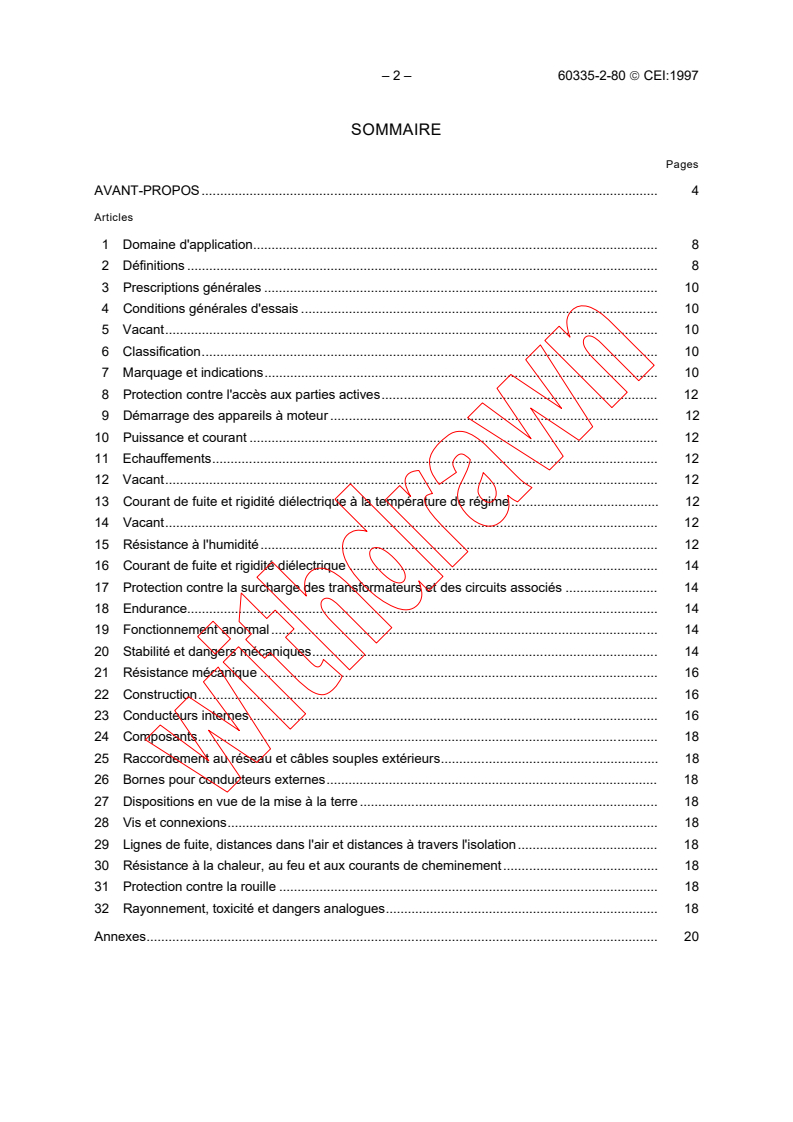
– 2 – 60335-2-80 CEI:1997
SOMMAIRE
Pages
AVANT-PROPOS. 4
Articles
1 Domaine d'application. 8
2 Définitions . 8
3 Prescriptions générales . 10
4 Conditions générales d'essais . 10
5 Vacant. 10
6 Classification. 10
7 Marquage et indications. 10
8 Protection contre l'accès aux parties actives. 12
9 Démarrage des appareils à moteur . 12
10 Puissance et courant . 12
11 Echauffements. 12
12 Vacant. 12
13 Courant de fuite et rigidité diélectrique à la température de régime. 12
14 Vacant. 12
15 Résistance à l'humidité. 12
16 Courant de fuite et rigidité diélectrique .14
17 Protection contre la surcharge des transformateurs et des circuits associés . 14
18 Endurance. 14
19 Fonctionnement anormal. 14
20 Stabilité et dangers mécaniques.14
21 Résistance mécanique. 16
22 Construction. 16
23 Conducteurs internes. 16
24 Composants. 18
25 Raccordement au réseau et câbles souples extérieurs. 18
26 Bornes pour conducteurs externes. 18
27 Dispositions en vue de la mise à la terre . 18
28 Vis et connexions. 18
29 Lignes de fuite, distances dans l'air et distances à travers l'isolation. 18
30 Résistance à la chaleur, au feu et aux courants de cheminement. 18
31 Protection contre la rouille . 18
32 Rayonnement, toxicité et dangers analogues. 18
Annexes. 20
60335-2-80 IEC:1997 – 3 –
CONTENTS
Page
FOREWORD . 5
Clause
1 Scope. 9
2 Definitions . 9
3 General requirement. 11
4 General conditions for the tests. 11
5 Void. 11
6 Classification. 11
7 Marking and instructions. 11
8 Protection against access to live parts . 13
9 Starting of motor-operated appliances. 13
10 Power input and current. 13
11 Heating. 13
12 Void. 13
13 Leakage current and electric strength at operating temperature. 13
14 Void. 13
15 Moisture resistance. 13
16 Leakage current and electric strength . 15
17 Overload protection of transformers and associated circuits. 15
18 Endurance. 15
19 Abnormal operation. 15
20 Stability and mechanical hazards . 15
21 Mechanical strength. 17
22 Construction. 17
23 Internal wiring. 17
24 Components. 19
25 Supply connection and external flexible cords. 19
26 Terminals for external conductors . 19
27 Provision for earthing. 19
28 Screws and connections. 19
29 Creepage distances, clearances and distances through insulation. 19
30 Resistance to heat, fire and tracking . 19
31 Resistance to rusting . 19
32 Radiation, toxicity and similar hazards. 19
Annexes. 21
– 4 – 60335-2-80 CEI:1997
COMMISSION ÉLECTROTECHNIQUE INTERNATIONALE
_________
SÉCURITÉ DES APPAREILS ÉLECTRODOMESTIQUES ET ANALOGUES
Partie 2: Règles particulières pour les ventilateurs
AVANT-PROPOS
1) La CEI (Commission Electrotechnique Internationale) est une organisation mondiale de normalisation composée
de l'ensemble des comités électrotechniques nationaux (Comités nationaux de la CEI). La CEI a pour objet de
favoriser la coopération internationale pour toutes les questions de normalisation dans les domaines de
l'électricité et de l'électronique. A cet effet, la CEI, entre autres activités, publie des Normes Internationales.
Leur élaboration est confiée à des comités d'études, aux travaux desquels tout Comité national intéressé par le
sujet traité peut participer. Les organisations internationales, gouvernementales et non gouvernementales, en
liaison avec la CEI, participent également aux travaux. La CEI collabore étroitement avec l'Organisation
Internationale de Normalisation (ISO), selon des conditions fixées par accord entre les deux organisations.
2) Les décisions ou accords officiels de la CEI concernant les questions techniques représentent, dans la mesure
du possible un accord international sur les sujets étudiés, étant donné que les Comités nationaux intéressés
sont représentés dans chaque comité d’études.
3) Les documents produits se présentent sous la forme de recommandations internationales. Ils sont publiés
comme normes, rapports techniques ou guides et agréés comme tels par les Comités nationaux.
4) Dans le but d'encourager l'unification internationale, les Comités nationaux de la CEI s'engagent à appliquer de
façon transparente, dans toute la mesure possible, les Normes internationales de la CEI dans leurs normes
nationales et régionales. Toute divergence entre la norme CEI et la norme nationale ou régionale
correspondante doit être indiquée en termes clairs dans cette dernière.
5) La CEI n’a fixé aucune procédure concernant le marquage comme indication d’approbation et sa responsabilité
n’est pas engagée quand un matériel est déclaré conforme à l’une de ses normes.
6) L’attention est attirée sur le fait que certains des éléments de la présente Norme internationale peuvent faire
l’objet de droits de propriété intellectuelle ou de droits analogues. La CEI ne saurait être tenue pour
responsable de ne pas avoir identifié de tels droits de propriété et de ne pas avoir signalé leur existence.
La présente partie de la Norme internationale CEI 60335 a été établie par le comité d'études
61 de la CEI: Sécurité des appareils électrodomestiques et analogues.
Elle constitue la première édition de la CEI 60335-2-80 et remplace la CEI 60342-1: 1981 et sa
modification 1 (1982) et la CEI 60342-3: 1982, qui sont annulées.
Le texte de cette norme est issu des documents suivants:
FDIS Rapport de vote
61/1059/FDIS 61/1203/RVD
Le rapport de vote indiqué dans le tableau ci-dessus donne toute information sur le vote ayant
abouti à l'approbation de cette norme.
La présente partie 2 doit être utilisée conjointement avec la dernière édition de la CEI 60335-1
et ses amendements. Elle a été établie sur la base de la troisième édition (1991) de cette
norme.
La présente partie 2 complète ou modifie les articles correspondants de la CEI 60335-1 de
façon à la transformer en norme CEI: Règles de sécurité pour les ventilateurs électriques.
60335-2-80 IEC:1997 – 5 –
INTERNATIONAL ELECTROTECHNICAL COMMISSION
_________
SAFETY OF HOUSEHOLD AND SIMILAR ELECTRICAL APPLIANCES
Part 2: Particular requirements for fans
FOREWORD
1) The IEC (International Electrotechnical Commission) is a worldwide organization for standardization comprising
all national electrotechnical committees (IEC National Committees). The object of the IEC is to promote
international co-operation on all questions concerning standardization in the electrical and electronic fields. To
this end and in addition to other activities, the IEC publishes International Standards. Their preparation is
entrusted to technical committees; any IEC National Committee interested in the subject dealt with may
participate in this preparatory work. International, governmental and non-governmental organizations liaising
with the IEC also participate in this preparation. The IEC collaborates closely with the International Organization
for Standardization (ISO) in accordance with conditions determined by agreement between the two
organizations.
2) The formal decisions or agreements of the IEC on technical matters express, as nearly as possible, an
international consensus of opinion on the relevant subjects since each technical committee has representation
from all interested National Committees.
3) The documents produced have the form of recommendations for international use and are published in the form
of standards, technical reports or guides and they are accepted by the National Committees in that sense.
4) In order to promote international unification, IEC National Committees undertake to apply IEC International
Standards transparently to the maximum extent possible in their national and regional standards. Any
divergence between the IEC Standard and the corresponding national or regional standard shall be clearly
indicated in the latter.
5) The IEC provides no marking procedure to indicate its approval and cannot be rendered responsible for any
equipment declared to be in conformity with one of its standards.
6) Attention is drawn to the possibility that some of the elements of this International Standard may be the subject
of patent rights. The IEC shall not be held responsible for identifying any or all such patent rights.
This part of IEC 60335 has been prepared by IEC technical committee 61: Safety of household
and similar electrical appliances.
It forms the first edition of IEC 60335-2-80 and replaces IEC 60342-1: 1981 and its amendment 1
(1982) and IEC 60342-3: 1982, which are withdrawn.
The text of this standard is based on the following documents:
FDIS Report on voting
61/1059/FDIS 61/1203/RVD
Full information on the voting for the approval of this standard can be found in the report on
voting indicated in the above table.
This part 2 is to be used in conjunction with the latest edition of IEC 60335-1 and its
amendments. It was established on the basis of the third edition (1991) of that standard.
This part 2 supplements or modifies the corresponding clauses in IEC 60335-1, so as to
convert it into the IEC standard: Safety requirements for electric fans.
– 6 – 60335-2-80 CEI:1997
Lorsqu'un paragraphe particulier de la partie 1 n'est pas mentionné dans cette partie 2, ce
paragraphe s'applique pour autant qu'il est raisonnable. Lorsque la présente norme spécifie
«addition», «modification» ou «remplacement», le texte correspondant de la partie 1 doit être
adapté en conséquence.
NOTES
1 Les caractères d'imprimerie suivants sont utilisés:
– prescriptions: caractères romains;
– modalités d'essais: caractères italiques;
– notes: petits caractères romains.
Les termes figurant en caractères gras dans le texte sont définis à l'article 2. Lorsqu'une définition de la partie 1
concerne un adjectif, l'adjectif et le nom associé figurent également en gras.
2 Les paragraphes qui sont complémentaires à ceux de la partie 1 sont numérotés à partir de 101.
Les différences complémentaires suivantes existent dans certains pays:
– 4.7: Tous les ventilateurs sont essayés à une température ambiante de 40 °C ± 2 °C (Australie).
– 6.2: Cette prescription n'est pas applicable (USA).
– 7.1: Le marquage «T» n'est pas requis (USA).
– 7.1: Les ventilateurs pour installation dans des murs ou des fenêtres doivent porter un marquage faisant
référence aux instructions d'emploi (Allemagne).
– 7.12.1: Les instructions d'installation des ventilateurs pour installation dans des murs ou des fenêtres doivent
indiquer la dépression maximale admise dans la pièce lorsque le ventilateur est mis en fonctionnement
simultanément avec un appareil alimenté avec une énergie autre que l'électricité (Allemagne).
– 7.12.1: Pour les ventilateurs destinés à être montés à haut niveau, les instructions d'installation doivent
indiquer que le ventilateur doit être installé de telle façon que les pales soient à plus de 2,1 m du sol (Australie).
– 7.12.1: D'autres hauteurs de montage sont spécifiées et doivent être marquées sur les appareils (USA).
– 19.7: Cette addition n'est pas applicable (USA).
– 20.1: L'essai complémentaire pour les ventilateurs à colonne portables n'est pas effectué (Japon).
– 20.2: Des prescriptions différentes s'appliquent (USA).
– 21.101: Des charges différentes sont appliquées (USA).
– 22.101: La prescription n'est pas applicable (USA).
– 22.103: La prescription n'est pas applicable (USA).
– 23.3: Des prescriptions différentes s'appliquent (USA).
60335-2-80 IEC:1997 – 7 –
Where a particular subclause of part 1 is not mentioned in this part 2, that subclause applies
as far as is reasonable. Where this standard states "addition", "modification" or "replacement",
the relevant text in part 1 is to be adapted accordingly.
NOTES
1 The following print types are used:
– requirements: in roman type;
– test specifications: in italic type;
– notes: in small roman type.
Words in bold in the text are defined in clause 2. When a definition of part 1 concerns an adjective, the
adjective and the associated noun are also in bold.
2 Subclauses which are additional to those in part 1 are numbered starting from 101.
The following additional differences exist in some countries:
– 4.7: All fans are tested at an ambient temperature of 40 °C ± 2 °C (Australia).
– 6.2: This requirement is not applicable (USA).
– 7.1: The "T" marking is not required (USA).
– 7.1: Fans for installation in walls or windows shall be marked with a reference to the instructions for use
(Germany).
– 7.12.1: The instructions for fans to be installed in walls or windows shall state the maximum negative pressure
allowed in the room when the fan is operated simultaneously with an appliance supplied with energy other than
electricity (Germany).
– 7.12.1: For fans intended to be mounted at high level, the instructions shall state that the fan is to be installed
so that the blades are more than 2,1 m above the floor (Australia).
– 7.12.1: Other mounting heights are specified and have to be marked on the appliance (USA).
– 19.7: The addition is not applicable (USA).
– 20.1: The additional test for portable pedestal fans is not carried out (Japan).
– 20.2: Different requirements apply (USA).
– 21.101: Different loads are applied (USA).
– 22.101: The requirement is not applicable (USA).
– 22.103: The requirement is not applicable (USA).
– 23.3: Different requirements apply (USA).
– 8 – 60335-2-80 CEI:1997
SÉCURITÉ DES APPAREILS ÉLECTRODOMESTIQUES ET ANALOGUES
Partie 2: Règles particulières pour les ventilateurs
1 Domaine d'application
L'article de la partie 1 est remplacé par:
La présente norme traite de la sécurité des ventilateurs électriques pour usages domestiques
et analogues dont la tension assignée n'est pas supérieure à 250 V pour les appareils mono-
phasés et à 480 V pour les autres appareils.
NOTE 1 – Comme exemples de ventilateurs entrant dans le domaine d’application de la présente norme on peut citer:
– les ventilateurs de plafonds;
– les ventilateurs de table;
– les ventilateurs à colonne;
– les ventilateurs de cloison;
– les ventilateurs de conduits.
La norme s'applique également aux dispositifs de commande séparés fournis avec les ventilateurs
Les ventilateurs non destinés à un usage domestique normal mais qui peuvent néanmoins
constituer une source de danger pour le public, tels que les ventilateurs destinés à être utilisés
dans les magasins, chez les artisans et dans les fermes, sont compris dans le domaine d'appli-
cation de la présente norme.
Dans la mesure du possible, la présente norme traite des risques ordinaires présentés par les
appareils qui sont encourus par tous les individus à l'intérieur et autour de l'habitation.
Cette norme ne tient en général pas compte
– de l'utilisation des appareils par des jeunes enfants ou des personnes handicapées, sans
surveillance;
– de l'emploi de l'appareil comme jouet par des jeunes enfants.
NOTES
2 L'attention est attirée sur le fait que
– pour les appareils destinés à être utilisés dans des véhicules ou à bord de navires ou d'avions, des
prescriptions supplémentaires peuvent être nécessaires;
– dans de nombreux pays, des prescriptions supplémentaires sont imposées par les organismes nationaux
de la santé publique, par les organismes nationaux responsables de la protection des travailleurs et par des
organismes analogues.
3 La présente norme ne s'applique pas
– aux appareils destinés exclusivement à des usages industriels;
– aux appareils destinés à être utilisés dans des locaux présentant des conditions particulières telles que la
présence d'une atmosphère corrosive ou explosive (poussière, vapeur ou gaz);
– aux ventilateurs incorporés dans d'autres appareils, sauf spécification contraire dans la norme correspondante.
2 Définitions
L'article de la partie 1 est applicable avec les exceptions suivantes.
2.2.9 Remplacement:
conditions de fonctionnement normal: Fonctionnement de l'appareil dans les conditions suivantes.
Les ventilateurs de table et à colonne sont mis en fonctionnement, le mécanisme d'oscillation
éventuel étant en fonctionnement.
Les ventilateurs de plafond sont fixés à un plafond.
60335-2-80 IEC:1997 – 9 –
SAFETY OF HOUSEHOLD AND SIMILAR ELECTRICAL APPLIANCES
Part 2: Particular requirements for fans
1 Scope
This clause of part 1 is replaced by:
This standard deals with the safety of electric fans for household and similar purposes, their
rated voltage being not more than 250 V for single-phase appliances and 480 V for other
appliances.
NOTE 1 – Examples of fans which are within the scope of this standard are:
– ceiling fans;
– table fans;
– pedestal fans;
– partition fans;
– duct fans.
This standard also applies to separate controls provided with the fans.
Fans not intended for normal household use but which nevertheless may be a source of danger
to the public, such as fans intended for use in shops, in light industry and on farms, are within
the scope of this standard.
So far as is practicable, this standard deals with the common hazards presented by appliances
which are encountered by all persons in and around the home.
This standard does not in general take into account
– the use of appliances by young children or infirm persons without supervision;
– playing with the appliance by young children.
NOTES
2 Attention is drawn to the fact that
– for appliances intended to be used in vehicles or on board ships or aircraft, additional requirements may
be necessary;
– in many countries additional requirements are specified by the national health authorities, the national
authorities responsible for the protection of labour and similar authorities.
3 This standard does not apply to
– appliances intended exclusively for industrial purposes;
– appliances intended to be used in locations where special conditions prevail, such as the presence of a
corrosive or explosive atmosphere (dust, vapour or gas);
– fans incorporated in other appliances, unless otherwise specified in the relevant standard.
2 Definitions
This clause of part 1 is applicable except as follows.
2.2.9 Replacement:
normal operation: Operation of the appliance under the following conditions.
Table and pedestal fans are operated with any oscillating mechanism in operation.
Ceiling fans are fixed to a ceiling.
– 10 – 60335-2-80 CEI:1997
Les ventilateurs de parois sont installés au centre d'une paroi appropriée dont les dimensions
sont au moins égales à quatre fois le diamètre de la prise d'air.
Les ventilateurs de conduits sont installés dans un conduit, conformément aux instructions
d'installation, la longueur du conduit étant d'environ quatre fois le diamètre du ventilateur.
3 Prescriptions générales
L'article de la partie 1 est applicable.
4 Conditions générales d'essais
L'article de la partie 1 est applicable avec l'exception suivante.
4.7 Addition:
Pour les ventilateurs destinés à être utilisés dans des climats tropicaux, les essais des articles 10,
11 et 13 sont effectués à une température ambiante de 40 °C ± 2 °C.
5 Vacant
6 Classification
L'article de la partie 1 est applicable avec les exceptions suivantes.
6.2 Addition:
Les ventilateurs de conduit doivent être au moins IPX2.
6.101 Les ventilateurs doivent être de l'une des classes suivantes, d'après les conditions
climatiques:
– ventilateurs pour climats tempérés;
– ventilateurs pour climats tropicaux.
7 Marquage et indications
L'article de la partie 1 est applicable avec les exceptions suivantes.
7.1 Addition:
Les ventilateurs pour climats tropicaux doivent porter la lettre «T»
7.12.1 Addition:
Les instructions d'installation doivent indiquer:
– le modèle ou la référence de type des luminaires qui peuvent être installés sur les
ventilateurs construits à cet effet;
– pour les ventilateurs de cloison, si le ventilateur est prévu pour montage dans des
fenêtres ou des murs extérieurs;
– pour les ventilateurs prévus pour être montés à haut niveau, que le ventilateur doit être
installé de telle façon que les pales soient à plus de 2,3 m du sol;
– pour les ventilateurs de conduits et les ventilateurs de cloison, que des précautions
doivent être prises pour éviter un refoulement, à l'intérieur de la pièce, de gaz provenant du
tuyau d'évacuation d'appareils à gaz ou d'autres appareils à feu ouvert.
60335-2-80 IEC:1997 – 11 –
Partition fans are installed in the centre of a suitable partition having dimensions at least four
times the diameter of the air inlet.
Duct fans are installed in a duct in accordance with the instructions for installation, the length
of the duct being approximately four times the diameter of the fan.
3 General requirement
This clause of part 1 is applicable.
4 General conditions for the tests
This clause of part 1 is applicable except as follows.
4.7 Addition:
For fans intended to be used in tropical climates, the tests of clauses 10, 11 and 13 are carried
out at an ambient temperature of 40 °C ± 2 °C.
5 Void
6 Classification
This clause of part 1 is applicable except as follows.
6.2 Addition:
Duct fans shall be at least IPX2.
6.101 Fans shall be of one of the following classes with respect to climatic conditions:
– fans for temperate climates;
– fans for tropical climates.
7 Marking and instructions
This clause of part 1 is applicable except as follows.
7.1 Addition:
Fans for tropical climates shall be marked with the letter "T".
7.12.1 Addition:
The instructions for installation shall state
– the model or type reference of luminaires which may be installed in fans which are
constructed for this purpose;
– for partition fans, if the fan is intended for mounting in outside windows or walls;
– for fans intended to be mounted at high level, that the fan is to be installed so that the
blades are more than 2,3 m above the floor;
– for duct and partition fans, that precautions must be taken to avoid the back-flow of
gases into the room from the open flue of gas or other open-fire appliances.
– 12 – 60335-2-80 CEI:1997
8 Protection contre l'accès aux parties actives
L'article de la partie 1 est applicable.
9 Démarrage des appareils à moteur
L'article de la partie 1 n'est pas applicable.
10 Puissance et courant
L'article de la partie 1 est applicable avec les exceptions suivantes.
10.1 Addition:
Les ventilateurs comportant des volets ou des dispositifs analogues sont essayés, ceux-ci
étant en position ouverte.
10.2 Addition:
Les ventilateurs comportant des volets ou des dispositifs analogues sont essayés, ceux-ci
étant en position ouverte.
11 Echauffements
L'article de la partie 1 est applicable avec les exceptions suivantes.
11.7 Remplacement:
Les ventilateurs sont mis en fonctionnement jusqu'à établissement des conditions de régime.
11.8 Addition:
Les limites d'échauffements des ventilateurs pour climats tropicaux sont réduites de 15 K.
12 Vacant
13 Courant de fuite et rigidité diélectrique à la température de régime
L'article de la partie 1 est applicable.
14 Vacant
15 Résistance à l'humidité
L'article de la partie 1 est applicable avec l'exception suivante.
15.1.1 Addition:
La partie extérieure des ventilateurs prévus pour être montés dans des fenêtres ou des murs
extérieurs est soumise à l'essai de 14.2.4 de la CEI 60529, la partie du ventilateur qui n'est pas
montée à l'extérieur de la fenêtre ou du mur étant protégée contre les projections d'eau du tube
oscillant. Le ventilateur est soumis à l'essai au repos puis est alimenté sous la tension
assignée et mis en fonctionnement, les volets ou dispositifs similaires étant en position
ouverte.
Les ventilateurs de conduit sont soumis à l'essai de 14.2.2 de la CEI 60529 au repos puis en
fonctionnement, alimentés sous la tension assignée.
60335-2-80 IEC:1997 – 13 –
8 Protection against access to live parts
This clause of part 1 is applicable.
9 Starting of motor-operated appliances
This clause of part 1 is not applicable.
10 Power input and current
This clause of part 1 is applicable except as follows.
10.1 Addition:
Fans incorporating shutters or similar devices are tested with these in the open position.
10.2 Addition:
Fans incorporating shutters or similar devices are tested with these in the open position.
11 Heating
This clause of part 1 is applicable except as follows.
11.7 Replacement:
Fans are operated until steady conditions are established.
11.8 Addition:
The temperature rise limits for fans for tropical climates are reduced by 15 K.
12 Void
13 Leakage current and electric strength at operating temperature
This clause of part 1 is applicable.
14 Void
15 Moisture resistance
This clause of part 1 is applicable except as follows.
15.1.1 Addition:
The outer part of fans intended to be mounted in outside windows and walls is subjected to the
test of 14.2.4 of IEC 60529, the part of the fan which is not mounted on the outside of the
window or wall being protected against spray from the oscillating tube. The fan is tested at rest
and then supplied at rated voltage and operated with the shutters or similar devices in the
open position.
Duct fans are subjected to the test of 14.2.2 of IEC 60529 at rest and then in operation while
supplied at rated voltage.
– 14 – 60335-2-80 CEI:1997
16 Courant de fuite et rigidité diélectrique
L'article de la partie 1 est applicable.
17 Protection contre la surcharge des transformateurs et des circuits associés
L'article de la partie 1 est applicable.
18 Endurance
L'article de la partie 1 n'est pas applicable.
19 Fonctionnement anormal
L'article de la partie 1 est applicable avec les exceptions suivantes.
19.1 Addition:
Les ventilateurs comportant des volets ou des dispositifs similaires commandés par un
dispositif de commande sont également soumis à l'essai de 19.101.
19.7 Addition:
Les dispositifs de commande séparés sont montés sur une planche en contre-plaqué peinte en
noir mat. Environ 50 % de la surface de chaque ouverture d'aération est obstruée. La tempé-
rature des enroulements ne doit pas dépasser les valeurs du tableau 6 et la température de
la planche ne doit pas dépasser 90 °C.
19.9 N'est pas applicable.
19.101 Les ventilateurs comportant des volets ou dispositifs analogues qui sont commandés
automatiquement sont alimentés sous la tension assignée et sont mis en fonctionnement avec
les volets ou dispositifs analogues maintenus fermés ou ouverts, suivant la condition la plus
défavorable.
20 Stabilité et dangers mécaniques
L'article de la partie 1 est applicable avec les exceptions suivantes.
20.1 Addition:
Les ventilateurs à colonne mobiles, dont la hauteur est supérieure à 1,7 m et la masse
supérieure à 10 kg, sont placés sur une surface horizontale. Une force horizontale de 40 N est
appliquée au ventilateur à une hauteur de 1,5 m. Le ventilateur ne doit pas se renverser.
20.101 Les pales des ventilateurs, autres que celles des ventilateurs pour montage à haut niveau,
doivent être protégées, à moins que leurs bords d'attaque et leurs extrémités soient arrondis et
– qu'elles aient une dureté inférieure à D 60 Shore, ou
– que leur vitesse périphérique soit inférieure à 15 m/s lorsque le ventilateur est alimenté
sous la tension assignée, ou
– que le ventilateur ait une puissance restituée ne dépassant pas 2 W lorsqu'il est alimenté
sous la tension assignée.
NOTE – Un bord ayant un rayon d'au moins 0,5 mm est considéré comme étant arrondi.
Les protecteurs sont soumis à une force de poussée et de traction de 20 N appliquée dans
l'axe du moteur du ventilateur. Après l'essai, il ne doit pas être possible de toucher les parties
mobiles dangereuses avec le doigt d'épreuve utilisé pour l'essai de 20.2.
60335-2-80 IEC:1997 – 15 –
16 Leakage current and electric strength
This clause of part 1 is applicable.
17 Overload protection of transformers and associated circuits
This clause of part 1 is applicable.
18 Endurance
This clause of part 1 is not applicable.
19 Abnormal operation
This clause of part 1 is applicable except as follows.
19.1 Addition:
Fans incorporating shutters or similar devices operated by a control are also subjected to the
test of 19.101.
19.7 Addition:
Separate controls are mounted on a dull-black painted plywood board. Approximately 50 % of
the area of each ventilating opening is blocked. The temperature of windings shall not exceed
the values of table 6 and the temperature of the board shall not exceed 90 °C.
19.9 Not applicable.
19.101
Fans incorporating shutters or similar devices which are operated automatically are
supplied at rated voltage and operated with the shutters or similar devices held in the closed
or open position, whichever is more unfavourable.
20 Stability and mechanical hazards
This clause of part 1 is applicable except as follows.
20.1 Addition:
Portable pedestal fans having a height exceeding 1,7 m and a mass exceeding 10 kg are
placed on a horizontal surface. A horizontal force of 40 N is applied to the fan at a height of 1,5 m.
The fan shall not overturn.
20.101 Fan blades, other than those of fans for mounting at high level, shall be guarded
unless their leading edges and tips are rounded and
– they have a hardness less than D 60 Shore, or
– they have a peripheral speed less than 15 m/s when the fan is supplied at rated voltage,
or
– the fan has a power output not exceeding 2 W when supplied at rated voltage.
NOTE – An edge with a radius of not less than 0,5 mm is considered to be rounded.
Guards are subjected to a push and pull force of 20 N applied along the axis of the fan motor.
After the test, it shall not be possible to touch dangerous moving parts with the test finger used
for the test of 20.2.
– 16 – 60335-2-80 CEI:1997
21 Résistance mécanique
L'article de la partie 1 est applicable avec l'exception suivante.
21.101 Les ventilateurs de plafond doivent avoir une résistance appropriée.
La vérification est effectuée par l'essai suivant:
Les ventilateurs de plafond sont fixés conformément aux instructions d'installation. Une charge
égale à quatre fois la masse du ventilateur est suspendue au corps du ventilateur. La charge
est maintenue pendant 1 min.
Un couple de 1 Nm est alors appliqué pendant 1 min à la partie fixe du ventilateur. L'essai est
répété le couple étant appliqué dans le sens inverse.
Le système de suspension ne doit pas se casser et le ventilateur ne doit pas être endommagé
à tel point que la conformité à 8.1, 16.3, et 29.1 soit affectée.
22 Construction
L'article de la partie 1 est applicable avec les exceptions suivantes.
22.11 Addition:
La force de 50 N n'est pas appliquée aux clips utilisés pour fixer les protecteurs de pales. A la place,
une force de 15 N est appliquée aux clips, dans n'importe quelle direction, pour tenter de les enlever.
22.101 Les coupe-circuit thermiques incorporés dans les ventilateurs pour conduit afin de
satisfaire à l'article 19 doivent être sans réarmement automatique.
La vérification est effectuée par examen.
22.102 Les ventilateurs comportant des dispositions pour fixer un luminaire doivent comporter
des bornes et des conducteurs internes appropriés.
La vérification est effectuée par examen.
22.103 L'isolation électrique pour laquelle des distances dans l'air et lignes de fuite sont
spécifiées ne doit pas être située dans des conduits ventilés, à moins que
...