

IEC 63267-2-2:2024
(Main)Fibre optic interconnecting devices and passive components - Connector optical interfaces for enhanced macro bend multimode fibres - Part 2-2: Connection parameters of physically contacting 50 μm core diameter fibres - Non-angled and angled for reference connector applications
General Information
- Abstract
IEC 63267-2-2:2024 defines the dimensional limits of an optical interface for reference connections necessary to meet specific requirements for fibre-to-fibre interconnection of non-angled and angled polished multimode reference connectors intended to be used for attenuation measurements in the field or factory. Several grades of reference connections are defined in this document.
The multimode reference connections are terminated to restricted IEC 60793-2-10 A1-OM2b to A1-OM5b fibre at the 850 nm band only.
The geometrical dimensions and tolerances of the specified reference connections have been developed primarily to limit the variation in measured attenuation between multiple sets of two reference connectors, and therefore to limit the variation in measured attenuation between randomly chosen reference connectors when mated with connectors in the field or factory.
- Status
- Published
- Publication Date
- 14-Mar-2024
- Technical Committee
- SC 86B - Fibre optic interconnecting devices and passive components
- Current Stage
- PPUB - Publication issued
- Start Date
- 15-Mar-2024
- Completion Date
- 29-Mar-2024
Buy Documents
IEC 63267-2-2:2024 - Fibre optic interconnecting devices and passive components - Connector optical interfaces for enhanced macro bend multimode fibres - Part 2-2: Connection parameters of physically contacting 50 µm core diameter fibres - Non-angled and angled for reference connector applications Released:3/15/2024
Overview
IEC 63267-2-2:2024 is an international standard by the International Electrotechnical Commission (IEC) that specifies the dimensional limits and connection parameters for physically contacting fibre optic connectors with a 50 μm core diameter. This standard addresses both non-angled (PC) and angled (APC) polished multimode reference connectors intended for applications where accurate attenuation measurements are critical, such as in the field or in manufacturing environments. The standard is crucial for ensuring consistent performance and low measurement uncertainty between reference connectors, particularly for enhanced macro bend multimode fibres operating at the 850 nm wavelength.
Key Topics
- Dimensional Specifications: Sets out strict tolerances for geometrical dimensions and alignment to minimize variability in measured attenuation.
- Performance Grades: Defines several grades of reference connections to accommodate different connector types and applications. Attenuation levels for each grade are specified at 850 nm.
- Fibre Types: Applies specifically to reference connectors terminated to multimode optical fibres within the restricted IEC 60793-2-10 A1-OM2b to A1-OM5b categories.
- Attenuation Measurement: Emphasizes the importance of using reference-grade connectors for accurate attenuation measurements, providing detailed guidance to limit measurement uncertainty.
- Visual Inspection Requirements: Outlines inspection criteria based on IEC 61300-3-35 for fibre end face quality in reference connectors, with specific requirements for defect and scratch sizes.
- Measurement Uncertainty Contributions: Details sources of variability, including geometry mismatch and measurement setup, and provides methods for uncertainty calculation.
Applications
IEC 63267-2-2:2024 is highly relevant for professionals involved in the testing, manufacturing, and certification of fibre optic components and systems, especially where attenuation measurements are required to be highly reproducible. Key application areas include:
- Factory and Field Attenuation Testing: Used to define consistent reference connector interfaces to ensure accurate loss measurements when certifying or troubleshooting multimode fibre links.
- Quality Assurance in Manufacturing: Supports the production of high-quality fibre optic connectors and cable assemblies, ensuring connector consistency across batches and minimizing measurement discrepancies.
- Connector and Cable Characterization: Facilitates comparative testing of different connector types under controlled conditions, providing reliable reference standards.
- Network Installation and Maintenance: Assists field technicians by supplying standardized reference connectors, reducing uncertainty during network acceptance testing or maintenance.
Related Standards
For comprehensive compliance and best practices in fibre optic connector interface design and testing, the following related IEC standards should be considered:
- IEC 60793-2-10: Product specifications for category A1 multimode fibres, providing the base requirements for fibre types applicable in IEC 63267-2-2.
- IEC 61300-3-35: Procedures for visual inspection of fibre optic connectors; referenced for end face inspection criteria.
- IEC 61300-3-4: Examines recommendations for fibre optic attenuation measurement methods.
- IEC 61300-1: General guidance on test and measurement procedures for fibre optic passive components.
- IEC 62614 (all parts): Details multimode launch conditions impacting measurement accuracy.
- IEC 63267 (all parts): Addresses connector optical interfaces for enhanced macro bend multimode fibre.
- IEC TR 62627-04: Guide for uncertainty calculation in attenuation measurement.
- IEC TR 61282-14: Methods for determining uncertainties of attenuation measurements in optical fibre plants.
Practical Value
Adopting IEC 63267-2-2:2024 enables manufacturers, test laboratories, and installers to achieve low and consistent measurement uncertainty in fibre optic attenuation, contributing to reliable network performance and interoperability. The standard’s approach to limiting dimension and alignment tolerances ensures that connectors selected as reference units deliver reproducible results, thus supporting quality control and compliance with international best practices in fibre optic communication infrastructure.
Keywords: IEC 63267-2-2:2024, fibre optic connectors, multimode reference connectors, attenuation measurement, macro bend fibres, 50 μm core, connector optical interface standard, optical fibre interconnection, performance grades, IEC standards, measurement uncertainty.
Relations
- Effective Date
- 26-Oct-2025
Buy Documents
IEC 63267-2-2:2024 - Fibre optic interconnecting devices and passive components - Connector optical interfaces for enhanced macro bend multimode fibres - Part 2-2: Connection parameters of physically contacting 50 µm core diameter fibres - Non-angled and angled for reference connector applications Released:3/15/2024
Get Certified
Connect with accredited certification bodies for this standard

ANCE
Mexican certification and testing association.

Intertek Slovenia
Intertek testing, inspection, and certification services in Slovenia.

LNE (Laboratoire National de Métrologie et d'Essais)
French national laboratory for metrology and testing.
Sponsored listings
Frequently Asked Questions
IEC 63267-2-2:2024 is a standard published by the International Electrotechnical Commission (IEC). Its full title is "Fibre optic interconnecting devices and passive components - Connector optical interfaces for enhanced macro bend multimode fibres - Part 2-2: Connection parameters of physically contacting 50 μm core diameter fibres - Non-angled and angled for reference connector applications". This standard covers: IEC 63267-2-2:2024 defines the dimensional limits of an optical interface for reference connections necessary to meet specific requirements for fibre-to-fibre interconnection of non-angled and angled polished multimode reference connectors intended to be used for attenuation measurements in the field or factory. Several grades of reference connections are defined in this document. The multimode reference connections are terminated to restricted IEC 60793-2-10 A1-OM2b to A1-OM5b fibre at the 850 nm band only. The geometrical dimensions and tolerances of the specified reference connections have been developed primarily to limit the variation in measured attenuation between multiple sets of two reference connectors, and therefore to limit the variation in measured attenuation between randomly chosen reference connectors when mated with connectors in the field or factory.
IEC 63267-2-2:2024 defines the dimensional limits of an optical interface for reference connections necessary to meet specific requirements for fibre-to-fibre interconnection of non-angled and angled polished multimode reference connectors intended to be used for attenuation measurements in the field or factory. Several grades of reference connections are defined in this document. The multimode reference connections are terminated to restricted IEC 60793-2-10 A1-OM2b to A1-OM5b fibre at the 850 nm band only. The geometrical dimensions and tolerances of the specified reference connections have been developed primarily to limit the variation in measured attenuation between multiple sets of two reference connectors, and therefore to limit the variation in measured attenuation between randomly chosen reference connectors when mated with connectors in the field or factory.
IEC 63267-2-2:2024 is classified under the following ICS (International Classification for Standards) categories: 33.180.20 - Fibre optic interconnecting devices. The ICS classification helps identify the subject area and facilitates finding related standards.
IEC 63267-2-2:2024 has the following relationships with other standards: It is inter standard links to IEC 61755-6-2:2018. Understanding these relationships helps ensure you are using the most current and applicable version of the standard.
IEC 63267-2-2:2024 is available in PDF format for immediate download after purchase. The document can be added to your cart and obtained through the secure checkout process. Digital delivery ensures instant access to the complete standard document.
Standards Content (Sample)
IEC 63267-2-2 ®
Edition 1.0 2024-03
INTERNATIONAL
STANDARD
NORME
INTERNATIONALE
colour
inside
Fibre optic interconnecting devices and passive components – Connector
optical interfaces for enhanced macro bend multimode fibres –
Part 2-2: Connection parameters of physically contacting 50 μm core diameter
fibres – Non-angled and angled for reference connector applications
Dispositifs d'interconnexion et composants passifs fibroniques – Interfaces
optiques de connecteurs pour fibre multimodale à performances améliorées par
macrocourbures –
Partie 2-2: Paramètres de connexion de fibres de diamètre de cœur de 50 µm en
contact physique – Fibres inclinées et non inclinées pour les applications de
connecteurs de référence
All rights reserved. Unless otherwise specified, no part of this publication may be reproduced or utilized in any form
or by any means, electronic or mechanical, including photocopying and microfilm, without permission in writing from
either IEC or IEC's member National Committee in the country of the requester. If you have any questions about IEC
copyright or have an enquiry about obtaining additional rights to this publication, please contact the address below or
your local IEC member National Committee for further information.
Droits de reproduction réservés. Sauf indication contraire, aucune partie de cette publication ne peut être reproduite ni
utilisée sous quelque forme que ce soit et par aucun procédé, électronique ou mécanique, y compris la photocopie et
les microfilms, sans l'accord écrit de l'IEC ou du Comité national de l'IEC du pays du demandeur. Si vous avez des
questions sur le copyright de l'IEC ou si vous désirez obtenir des droits supplémentaires sur cette publication, utilisez
les coordonnées ci-après ou contactez le Comité national de l'IEC de votre pays de résidence.
IEC Secretariat Tel.: +41 22 919 02 11
3, rue de Varembé info@iec.ch
CH-1211 Geneva 20 www.iec.ch
Switzerland
About the IEC
The International Electrotechnical Commission (IEC) is the leading global organization that prepares and publishes
International Standards for all electrical, electronic and related technologies.
About IEC publications
The technical content of IEC publications is kept under constant review by the IEC. Please make sure that you have the
latest edition, a corrigendum or an amendment might have been published.
IEC publications search - webstore.iec.ch/advsearchform IEC Products & Services Portal - products.iec.ch
The advanced search enables to find IEC publications by a Discover our powerful search engine and read freely all the
variety of criteria (reference number, text, technical publications previews, graphical symbols and the glossary.
committee, …). It also gives information on projects, replaced With a subscription you will always have access to up to date
and withdrawn publications. content tailored to your needs.
IEC Just Published - webstore.iec.ch/justpublished
Electropedia - www.electropedia.org
Stay up to date on all new IEC publications. Just Published
The world's leading online dictionary on electrotechnology,
details all new publications released. Available online and once
containing more than 22 500 terminological entries in English
a month by email.
and French, with equivalent terms in 25 additional languages.
Also known as the International Electrotechnical Vocabulary
IEC Customer Service Centre - webstore.iec.ch/csc
(IEV) online.
If you wish to give us your feedback on this publication or need
further assistance, please contact the Customer Service
Centre: sales@iec.ch.
A propos de l'IEC
La Commission Electrotechnique Internationale (IEC) est la première organisation mondiale qui élabore et publie des
Normes internationales pour tout ce qui a trait à l'électricité, à l'électronique et aux technologies apparentées.
A propos des publications IEC
Le contenu technique des publications IEC est constamment revu. Veuillez vous assurer que vous possédez l’édition la
plus récente, un corrigendum ou amendement peut avoir été publié.
Recherche de publications IEC - IEC Products & Services Portal - products.iec.ch
webstore.iec.ch/advsearchform Découvrez notre puissant moteur de recherche et consultez
La recherche avancée permet de trouver des publications IEC gratuitement tous les aperçus des publications, symboles
en utilisant différents critères (numéro de référence, texte, graphiques et le glossaire. Avec un abonnement, vous aurez
comité d’études, …). Elle donne aussi des informations sur les toujours accès à un contenu à jour adapté à vos besoins.
projets et les publications remplacées ou retirées.
Electropedia - www.electropedia.org
IEC Just Published - webstore.iec.ch/justpublished
Le premier dictionnaire d'électrotechnologie en ligne au monde,
Restez informé sur les nouvelles publications IEC. Just
avec plus de 22 500 articles terminologiques en anglais et en
Published détaille les nouvelles publications parues.
français, ainsi que les termes équivalents dans 25 langues
Disponible en ligne et une fois par mois par email.
additionnelles. Egalement appelé Vocabulaire
Electrotechnique International (IEV) en ligne.
Service Clients - webstore.iec.ch/csc
Si vous désirez nous donner des commentaires sur cette
publication ou si vous avez des questions contactez-nous:
sales@iec.ch.
IEC 63267-2-2 ®
Edition 1.0 2024-03
INTERNATIONAL
STANDARD
NORME
INTERNATIONALE
colour
inside
Fibre optic interconnecting devices and passive components – Connector
optical interfaces for enhanced macro bend multimode fibres –
Part 2-2: Connection parameters of physically contacting 50 μm core diameter
fibres – Non-angled and angled for reference connector applications
Dispositifs d'interconnexion et composants passifs fibroniques – Interfaces
optiques de connecteurs pour fibre multimodale à performances améliorées par
macrocourbures –
Partie 2-2: Paramètres de connexion de fibres de diamètre de cœur de 50 µm en
contact physique – Fibres inclinées et non inclinées pour les applications de
connecteurs de référence
INTERNATIONAL
ELECTROTECHNICAL
COMMISSION
COMMISSION
ELECTROTECHNIQUE
INTERNATIONALE
ICS 33.180.20 ISBN 978-2-8322-8416-2
– 2 – IEC 63267-2-2:2024 © IEC 2024
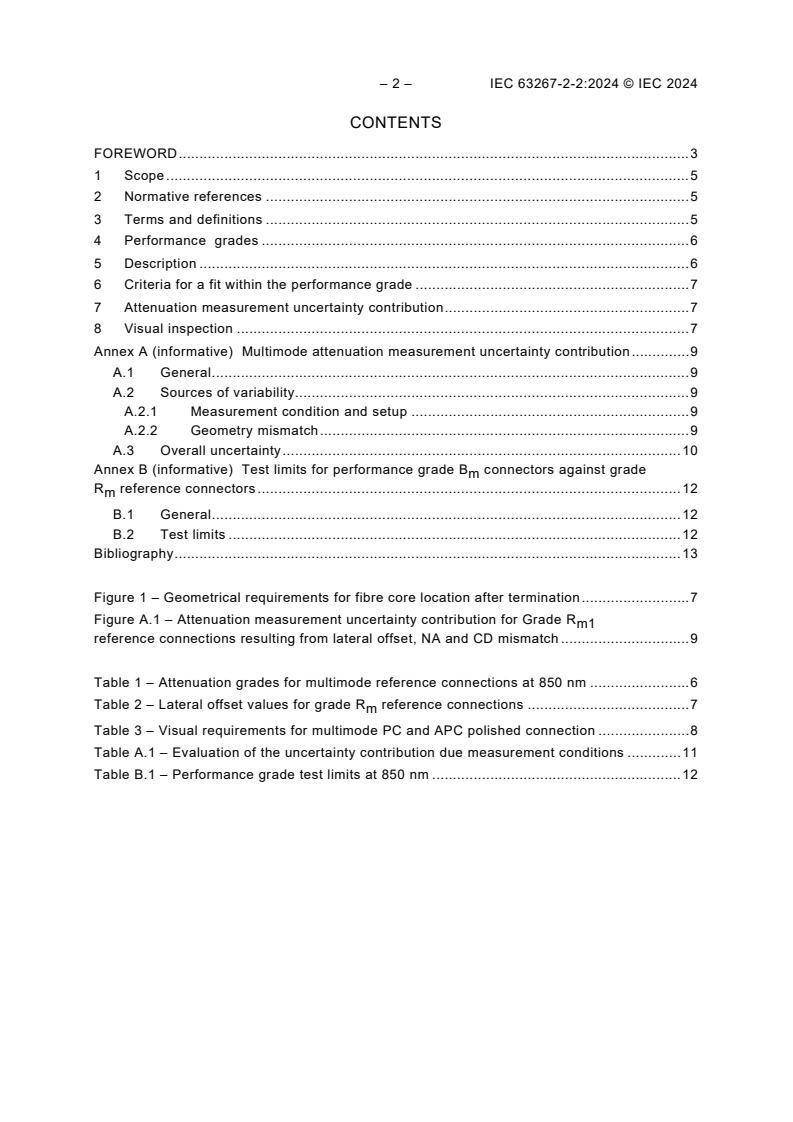
CONTENTS
FOREWORD . 3
1 Scope . 5
2 Normative references . 5
3 Terms and definitions . 5
4 Performance grades . 6
5 Description . 6
6 Criteria for a fit within the performance grade . 7
7 Attenuation measurement uncertainty contribution . 7
8 Visual inspection . 7
Annex A (informative) Multimode attenuation measurement uncertainty contribution . 9
A.1 General . 9
A.2 Sources of variability. 9
A.2.1 Measurement condition and setup . 9
A.2.2 Geometry mismatch . 9
A.3 Overall uncertainty . 10
Annex B (informative) Test limits for performance grade B connectors against grade
m
R reference connectors . 12
m
B.1 General . 12
B.2 Test limits . 12
Bibliography . 13
Figure 1 – Geometrical requirements for fibre core location after termination . 7
Figure A.1 – Attenuation measurement uncertainty contribution for Grade R
m1
reference connections resulting from lateral offset, NA and CD mismatch . 9
Table 1 – Attenuation grades for multimode reference connections at 850 nm . 6
Table 2 – Lateral offset values for grade R reference connections . 7
m
Table 3 – Visual requirements for multimode PC and APC polished connection . 8
Table A.1 – Evaluation of the uncertainty contribution due measurement conditions . 11
Table B.1 – Performance grade test limits at 850 nm . 12
INTERNATIONAL ELECTROTECHNICAL COMMISSION
____________
FIBRE OPTIC INTERCONNECTING DEVICES AND PASSIVE
COMPONENTS – CONNECTOR OPTICAL INTERFACES FOR
ENHANCED MACRO BEND MULTIMODE FIBRES –
Part 2-2: Connection parameters of physically contacting
50 μm core diameter fibres – Non-angled and angled for
reference connector applications
FOREWORD
1) The International Electrotechnical Commission (IEC) is a worldwide organization for standardization comprising
all national electrotechnical committees (IEC National Committees). The object of IEC is to promote international
co-operation on all questions concerning standardization in the electrical and electronic fields. To this end and
in addition to other activities, IEC publishes International Standards, Technical Specifications, Technical Reports,
Publicly Available Specifications (PAS) and Guides (hereafter referred to as “IEC Publication(s)”). Their
preparation is entrusted to technical committees; any IEC National Committee interested in the subject dealt with
may participate in this preparatory work. International, governmental and non-governmental organizations liaising
with the IEC also participate in this preparation. IEC collaborates closely with the International Organization for
Standardization (ISO) in accordance with conditions determined by agreement between the two organizations.
2) The formal decisions or agreements of IEC on technical matters express, as nearly as possible, an international
consensus of opinion on the relevant subjects since each technical committee has representation from all
interested IEC National Committees.
3) IEC Publications have the form of recommendations for international use and are accepted by IEC National
Committees in that sense. While all reasonable efforts are made to ensure that the technical content of IEC
Publications is accurate, IEC cannot be held responsible for the way in which they are used or for any
misinterpretation by any end user.
4) In order to promote international uniformity, IEC National Committees undertake to apply IEC Publications
transparently to the maximum extent possible in their national and regional publications. Any divergence between
any IEC Publication and the corresponding national or regional publication shall be clearly indicated in the latter.
5) IEC itself does not provide any attestation of conformity. Independent certification bodies provide conformity
assessment services and, in some areas, access to IEC marks of conformity. IEC is not responsible for any
services carried out by independent certification bodies.
6) All users should ensure that they have the latest edition of this publication.
7) No liability shall attach to IEC or its directors, employees, servants or agents including individual experts and
members of its technical committees and IEC National Committees for any personal injury, property damage or
other damage of any nature whatsoever, whether direct or indirect, or for costs (including legal fees) and
expenses arising out of the publication, use of, or reliance upon, this IEC Publication or any other IEC
Publications.
8) Attention is drawn to the Normative references cited in this publication. Use of the referenced publications is
indispensable for the correct application of this publication.
9) IEC draws attention to the possibility that the implementation of this document may involve the use of (a)
patent(s). IEC takes no position concerning the evidence, validity or applicability of any claimed patent rights in
respect thereof. As of the date of publication of this document, IEC had not received notice of (a) patent(s), which
may be required to implement this document. However, implementers are cautioned that this may not represent
the latest information, which may be obtained from the patent database available at https://patents.iec.ch. IEC
shall not be held responsible for identifying any or all such patent rights.
IEC 63267-2-2 has been prepared by subcommittee 86B: Fibre optic interconnecting devices
and passive components, of IEC technical committee 86: Fibre optics. It is an International
Standard.
– 4 – IEC 63267-2-2:2024 © IEC 2024
The text of this International Standard is based on the following documents:
Draft Report on voting
86B/4857/FDIS 86B/4878/RVD
Full information on the voting for its approval can be found in the report on voting indicated in
the above table.
The language used for the development of this International Standard is English.
This document was drafted in accordance with ISO/IEC Directives, Part 2, and developed in
accordance with ISO/IEC Directives, Part 1 and ISO/IEC Directives, IEC Supplement, available
at www.iec.ch/members_experts/refdocs. The main document types developed by IEC are
described in greater detail at www.iec.ch/publications.
A list of all parts in the IEC 63267 series, published under the general title Fibre optic
interconnecting devices and passive components – Connector optical interfaces for enhanced
macro bend multimode fibre, can be found on the IEC website.
Future documents in this series will carry the new general title as cited above. Titles of existing
documents in this series will be updated at the time of the next edition.
The committee has decided that the contents of this document will remain unchanged until the
stability date indicated on the IEC website under webstore.iec.ch in the data related to the
specific document. At this date, the document will be
• reconfirmed,
• withdrawn, or
• revised.
IMPORTANT – The "colour inside" logo on the cover page of this document indicates
that it contains colours which are considered to be useful for the correct understanding
of its contents. Users should therefore print this document using a colour printer.
FIBRE OPTIC INTERCONNECTING DEVICES AND PASSIVE
COMPONENTS – CONNECTOR OPTICAL INTERFACES FOR
ENHANCED MACRO BEND MULTIMODE FIBRES –
Part 2-2: Connection parameters of physically contacting
50 μm core diameter fibres – Non-angled and angled for
reference connector applications
1 Scope
This part of IEC 63267 defines the dimensional limits of an optical interface for reference
connections necessary to meet specific requirements for fibre-to-fibre interconnection of non-
angled and angled polished multimode reference connectors intended to be used for attenuation
measurements in the field or factory.
Several grades of reference connections are defined in this document. The multimode reference
connections are terminated to restricted IEC 60793-2-10 A1-OM2b to A1-OM5b fibre at the
850 nm band only. The geometrical dimensions and tolerances of the specified reference
connections have been developed primarily to limit the variation in measured attenuation
between multiple sets of two reference connectors, and therefore to limit the variation in
measured attenuation between randomly chosen reference connectors when mated with
connectors in the field or factory.
2 Normative references
The following documents are referred to in the text in such a way that some or all of their content
constitutes requirements of this document. For dated references, only the edition cited applies.
For undated references, the latest edition of the referenced document (including any
amendments) applies.
IEC 60793-2-10, Optical fibres – Part 2-10: Product specifications – Sectional specification for
category A1 multimode fibres
IEC 61300-3-35, Fibre optic interconnecting devices and passive components – Basic test and
measurement procedures – Part 3-35: Examinations and measurements – Visual inspection of
fibre optic connectors and fibre-stub transceivers
3 Terms and definitions
No terms and definitions are listed in this document.
ISO and IEC maintain terminology databases for use in standardization at the following
addresses:
• IEC Electropedia: available at https://www.electropedia.org/
• ISO Online browsing platform: available at https://www.iso.org/obp
– 6 – IEC 63267-2-2:2024 © IEC 2024
4 Performance grades
This document currently specifies several performance grades.
The performance grade for physical contact non-angled (PC) and angled (APC) polished fibre-
to-fibre reference connections detailed in this document is shown in Table 1.
The attenuation is measured in accordance with IEC 61300-3-4 (insertion method B).
The attenuation test limit of reference grade connectors mated with standard grade B
m
connectors is provided in Annex B.
Table 1 – Attenuation grades for multimode reference connections at 850 nm
Reference grade Attenuation
[dB]
R ≤ 0,1
m1
R ≤ 0,15
m12
R ≤ 0,15
m16
R ≤ 0,15
m16A
R ≤ 0,15
m24
R ≤ 0,15
m32
NOTE 1 Grade R reference connection applies to 1,25 mm and 2,5 mm single
m1
fibre cylindrical ferrules while all other reference grades apply to multifibre
rectangular ferrules.
NOTE 2 The number in the designation of the reference grade indicates the number
of fibres in the reference connector. The letter “A” indicates an angled physical
contact interface.
NOTE 3 As described in Annex A, the contribution to measurement uncertainty in
attenuation measurement between any connector according to the IEC optical
interface standards in the 63267 series and a population of IEC reference connectors
is for all performance grades ± 0,071 dB.
5 Description
Optical reference connections are connections manufactured with restricted tolerances on
dimensions that contribute to lateral and angular offset of mating fibre cores. These connections
are mainly used for attenuation measurement purposes in field and factory and shall be
considered as part of the measurement setup. The goal is to strongly reduce the measurement
uncertainty. The attenuation uncertainties due to the reference connections are defined in this
document and are discussed in Annex A.
The performance of a multimode optical interface is not only determined by the alignment
accuracy of the optical datum targets of two mating fibres, but largely by any fibre parameter
mismatches. Parameters influencing the fibre-to-fibre intrinsic attenuation include:
• core diameter (CD) mismatch,
• numerical aperture (NA) mismatch.
6 Criteria for a fit within the performance grade
Figure 1 and Table 2 give the criteria for meeting the performance grades as listed in Table 1.
The parameters that are selected for the criteria definition are based on their degree of
significance in affecting the performance.
All R multimode reference connections shall be terminated on selected multimode (MM)
m
A1-OM2b to A1-OM5b fibre, as specified in IEC 60793-2-10, with a core diameter of
50 µm ± 0,5 µm and a numerical aperture of 0,200 ± 0,002. The selection is required to restrict
the variability of attenuation measurements using reference connectors.
Figure 1 – Geometrical requirements for fibre core location after termination
Table 2 – Lateral offset values for grade R reference connections
m
a
F [µm]
Reference grade Minimum Maximum
R
m1
R
m12
R
m16
0 1,0
R
m16A
R
m24
R
m32
a
Parameter F defines the core location of a reference connector in relation to the
optical datum target (Figure 1). In addition, parameter F describes also the
maximum lateral offset between the fibre cores of two mated reference connectors.
NOTE Lateral offset of R grades for rectangle ferrules consists of both the fibre
m
true position on the ferrule and the relative ferrule position from guide pin and bore
fitting.
7 Attenuation measurement uncertainty contribution
Using the specified fibre geometry and the dimensional tolerances mentioned in Clause 6, it is
possible to achieve measurements using the specified reference connections that have an
uncertainty of ±0,071 dB, with random varied reference connections and with the target EF
launch as specified in IEC 61300-1 satisfied (see Annex A).
8 Visual inspection
The fibre end faces of all reference grade variants shall be inspected to IEC 61300-3-35 and
shall meet the requirements as detailed in Table 3. The zone size for multimode fibres has been
set at 65 µm. This has been done to simplify the grading process.
– 8 – IEC 63267-2-2:2024 © IEC 2024
Table 3 – Visual requirements for multimode PC and APC polished connection
Zone Defects Scratches
(diameter) (diameter) (width)
< 2 µm: no limit < 3 µm: no limit
A: core zone
≥ 2 µm and ≤ 5 µm: maximum 4 ≥ 3 µm and ≤ 4 µm: maximum 4
65 µm
> 5 µm: none > 4 µm: none
B: cladding zone ≤ 25 µm: no limit
No limit
65 µm to 110 µm > 25 µm: none
Annex A
(informative)
Multimode attenuation measurement uncertainty contribution
A.1 General
The attenuation of a multimode connectorised component (or connector) based on a cylindrical
ferrule is measured against an R reference connector in a reference adapter and when based
m1
on rectangular ferrules against the relevant pinned/unpinned R to R reference connector.
m12 m32
Since reference connection parts vary within the tolerances allowed in this document, the
variability has to be considered as a contribution to the attenuation measurement uncertainty
of the setup.
A.2 Sources of variability
A.2.1 Measurement condition and setup
Measurement condition and setup variability are caused by factors such as power meter
calibration, finite display resolution, linearity, connector/detector coupling repeatability, source
stability and launch conditions. IEC TR 62627-04 gives a more detailed explanation of how to
determine this uncertainty for single mode fibres and it can be adapted for use with MM
connections.
A.2.2 Geometry mismatch
Another factor causing variability is the mismatch between the fibre geometry parameters of the
reference connector and the DUT connector, such as core diameter (CD), numerical aperture
(NA) and lateral offset. For the calculation, worst case mismatch is used assuming that the DUT
fibre has a CD of 47,5 µm and a NA of 0,185. The calculated uncertainty also depends on the
offset between the fibre cores of reference and DUT plugs. See Figure A.1.
Figure A.1 – Attenuation measurement uncertainty contribution for Grade R
m1
reference connections resulting from lateral offset, NA and CD mismatch
– 10 – IEC 63267-2-2:2024 © IEC 2024
The red line presents the averaged result of a Monte Carlo Simulation (MCS) of the calculated
attenuation of a DUT plug with a worst-case minimal CD and NA (47,5 µm and 0,185 NA) mated
to 6 000 Grade R reference connectors.
m1
The blue line presents the averaged result of the MCS of the calculated attenuation of a DUT
plug with nominal CD and NA (50 µm and 0,200 NA) mated to 6 000 Grade R reference
m1
connectors.
The red and blue bars show the calculated range of values for the different lateral offsets; the
black bars are 95 % of the calculated variation representing the range for uncertainty.
The calculated average attenuation for the DUT plug with nominal core diameter and nominal
NA fibre is much lower (approximately 0,5 dB) than for the DUT plug with minimal CD and
minimal NA fibre. The calculated variation (bars) is also much smaller.
The worst-case variability due to geometry mismatch between reference connections and the
DUT is 0,17 dB.
The uncertainty U is 0,17 dB/ 2 = 0,085 dB.
Geo
A.3 Overall uncertainty
The overall measurement uncertainty is calculated from Table A.1 which is an adaptation of the
tables provided in IEC TR 62627-04 for multimode fibre.
Table A.1 – Evaluation of the uncertainty contribution due measurement conditions
c d
Error Probability Standard Sensitivity Uncertainty
Uncertainty Divisor
a, b d e f
contribution
coefficient
source distribution uncertainty
i X u u u(x ) c u (y)
i i i i
(dB) (%)
(%) (%)
u
1 0,005 0,12 rect 1,732 1 0,07 √2 0,10
TypeA
u
2 0,08 1,84 rect 1,732 1 1,06 1 1,06
MMLC
u
3 0,005 0,12 rect 1,732 1 0,07 √2 0,10
Displ
u
4 0,005 0,12 normal 1 0,12 1 0,12
Lin
u
5 0,02 0,46 rect 1,732 1 0,27 1 0,27
Unif
u
6 0,01 0,23 rect 1,732 1 0,13 √2 0,19
Pstab
u
7 0,05 1,16 rect 1,732 1 0,67 1 0,67
mating
U
8 0,085 1,96 normal 2 0,98 1 0,98
Geo
1,63 %
uu
∑ i
0,071 dB
i=1
a
The uncertainty values listed in Table A.1 are, when applicable, values of IEC TR 62627-04. Refer to the
IEC 62614 series for uncertainty value due to multimode launch conditions.
b
Definition of the error sources is, when applicable, the same as IEC TR 62627-04:2012, 4.2. Definition of
error due to multimode launch conditions, u , is the same as IEC TR 61282-14:2019, 5.2.5.3. U is
MMLC Geo
defined in A.2.2. The errors have been estimated in dB and were then transformed into a percentage for all
further calculations.
c
Probability distributions are estimated for single measurements to be rectangular. For rectangular probability
distributions the uncertainty should be divided by √3 = 1,7321.
d
Standard uncertainty is obtained by dividing the uncertainty by the divisor.
e
Sensitivity coefficient is obtained directly from IEC TR 62627-04:2012, 4.2, Formula (2) and
IEC TR 61282-14:2019, Table 5.
f
The values have been rounded up to get conservative results.
Therefore, the expanded uncertainty at 95 % confidence level (k = 2) is: U = 2 u = 0,142 dB.
==
– 12 – IEC 63267-2-2:2024 © IEC 2024
Annex B
(informative)
Test limits for performance grade B connectors
m
against grade R reference connectors
m
B.1 General
Annex B provides information on the test limits for performance grade B connectors against
m
grade R reference connectors. The use of reference connectors is not normative but if
m
reference connectors are used, for example in case of quality conformance, the specified
maximum attenuation limits in Table B.1 are normative.
B.2 Test limits
The performance grade for PC and APC polished fibre-to-fibre reference connections detailed
in this document are shown in Table B.1.
The attenuation is measured in accordance with IEC 61300-3-4 (insertion method B).
Table B.1 – Performance grade test limits at 850 nm
Reference grade Attenuation [dB] Attenuation test limit [dB]
reference connection to grade R reference connection
m
reference connection
to standard grade B conn
...