

IEC 61300-2-1:2009
(Main)Fibre optic interconnecting devices and passive components - Basic test and measurement procedures - Part 2-1: Tests - Vibration (sinusoidal)
General Information
- Abstract
IEC 61300-2-1:2009 evaluates the effects of vibration on fibre optic devices at the predominant frequency ranges and magnitudes that may be encountered during field service. Changes from the previous edition are to reconsider the severity and the structure of this standard. The contents of the corrigendum of January 2010 have been included in this copy.
- Status
- Published
- Publication Date
- 17-Aug-2009
- Technical Committee
- SC 86B - Fibre optic interconnecting devices and passive components
- Drafting Committee
- WG 4 - TC 86/SC 86B/WG 4
- Current Stage
- DELPUB - Deleted Publication
- Start Date
- 23-Jan-2023
- Completion Date
- 28-Sep-2020
Buy Documents
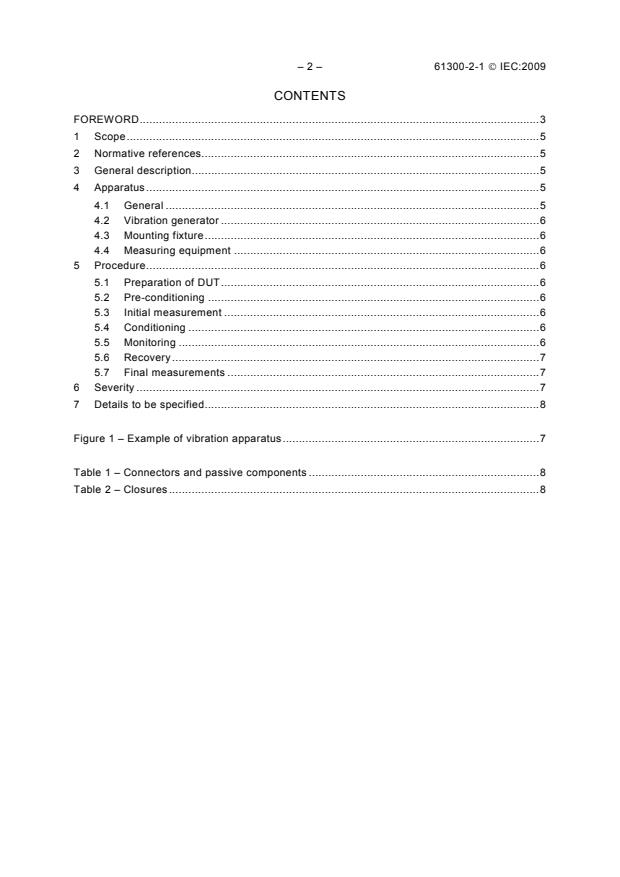
IEC 61300-2-1:2009 - Fibre optic interconnecting devices and passive components - Basic test and measurement procedures - Part 2-1: Tests - Vibration (sinusoidal) Released:8/18/2009
IEC 61300-2-1:2009 Overview
The IEC 61300-2-1:2009 standard, titled Fibre optic interconnecting devices and passive components - Basic test and measurement procedures - Part 2-1: Tests - Vibration (sinusoidal), is a critical document from the International Electrotechnical Commission (IEC). It focuses on evaluating the impact of sinusoidal vibration on fibre optic devices within frequency ranges and magnitudes typically encountered in real-world field service. This standard is the third edition, incorporating a 2010 corrigendum, and updates previous editions by reconsidering test severity and refining structural content.
Designed for engineers, manufacturers, and testers of fibre optic components, this standard ensures reliable performance and durability of fibre optic interconnecting devices and passive components when subjected to vibrational stress. It aligns with relevant IEC test methods such as IEC 60068-2-6 (sinusoidal vibration) and various IEC 61300 series standards covering optical performance measurements.
Key Topics Covered
Scope and Purpose
Evaluates vibrational effects on fibre optic devices to simulate service conditions, despite the predominance of complex vibration profiles in actual practice. The sinusoidal vibration test proved effective for this purpose.Test Apparatus
Establishes use of a vibration generator capable of producing sinusoidal motion, mounting fixtures designed to avoid resonant interference, and optical measurement equipment for real-time attenuation and return loss monitoring.Testing Procedure
- Preparation and pre-conditioning of the device under test (DUT)
- Mounting DUT with proper fixture and suspension of fibre leads
- Multi-axis vibration exposure simulating longitudinal and transverse modes
- Continuous frequency sweep during vibration endurance testing
- Monitoring optical signals with oscilloscopes, x-y plotters, or digital acquisition systems
- Post-test recovery, cleaning, and final measurement to detect any permanent degradation
Performance Monitoring
Optical characteristics such as attenuation, return loss, and transient loss are recorded throughout the vibration exposure to ensure deviation stays within permissible limits as defined by the component's technical specifications.Severity and Specification Details
Defines vibration frequency ranges, amplitudes (displacement or acceleration), and duration parameters for standardized reproducibility. Also highlights necessary information to specify when ordering or defining tests.
Practical Applications
IEC 61300-2-1:2009 is essential for:
Component Manufacturers
Ensuring design robustness of connectors, splice closures, and passive components against vibrational stresses encountered during transportation, installation, or operational environments such as industrial settings or mobile systems.Quality Assurance and Testing Labs
Providing structured test methodology for endurance verification and acceptance testing to guarantee compliance with international standards and improve product reliability and customer confidence.Telecommunications and Data Networking
Supporting the deployment of fibre optic systems in harsh conditions by verifying interconnect integrity, minimizing optical performance degradation caused by environmental vibration.Military and Aerospace Applications
Evaluating components destined for high-vibration environments typical of airborne or ruggedized platforms.
Related IEC Standards
- IEC 60068-2-6 - Environmental testing procedures for sinusoidal vibration, serving as the foundational environmental test referenced for vibration generation and setup.
- IEC 61300-1 - General guidelines and principles for fibre optic interconnecting devices and passive components testing.
- IEC 61300-3-1 - Visual examination to identify physical damage post-vibration testing.
- IEC 61300-3-3 - Active monitoring of optical performance parameters such as attenuation and return loss during stress tests.
- IEC 61300-3-28 - Measurement of transient loss critical for detecting fast optical performance variations during vibration.
IEC 61300-2-1:2009 empowers manufacturers and testers to simulate realistic vibrational stress, ensuring fibre optic devices maintain their functional integrity and optical performance under operational conditions. Adhering to this standard promotes enhanced product durability, reliability, and international compliance in fibre optic interconnecting technology.
Relations
- Effective Date
- 05-Sep-2023
- Effective Date
- 05-Sep-2023
- Effective Date
- 05-Sep-2023
- Effective Date
- 05-Sep-2023
Buy Documents
IEC 61300-2-1:2009 - Fibre optic interconnecting devices and passive components - Basic test and measurement procedures - Part 2-1: Tests - Vibration (sinusoidal) Released:8/18/2009
Get Certified
Connect with accredited certification bodies for this standard

ANCE
Mexican certification and testing association.

Intertek Slovenia
Intertek testing, inspection, and certification services in Slovenia.

LNE (Laboratoire National de Métrologie et d'Essais)
French national laboratory for metrology and testing.
Sponsored listings
Frequently Asked Questions
IEC 61300-2-1:2009 is a standard published by the International Electrotechnical Commission (IEC). Its full title is "Fibre optic interconnecting devices and passive components - Basic test and measurement procedures - Part 2-1: Tests - Vibration (sinusoidal)". This standard covers: IEC 61300-2-1:2009 evaluates the effects of vibration on fibre optic devices at the predominant frequency ranges and magnitudes that may be encountered during field service. Changes from the previous edition are to reconsider the severity and the structure of this standard. The contents of the corrigendum of January 2010 have been included in this copy.
IEC 61300-2-1:2009 evaluates the effects of vibration on fibre optic devices at the predominant frequency ranges and magnitudes that may be encountered during field service. Changes from the previous edition are to reconsider the severity and the structure of this standard. The contents of the corrigendum of January 2010 have been included in this copy.
IEC 61300-2-1:2009 is classified under the following ICS (International Classification for Standards) categories: 33.180.20 - Fibre optic interconnecting devices. The ICS classification helps identify the subject area and facilitates finding related standards.
IEC 61300-2-1:2009 has the following relationships with other standards: It is inter standard links to IEC 61300-2-1:2009/COR1:2010, IEC 61300-2-1:2023, IEC 61300-2-1:2003/COR1:2004, IEC 61300-2-1:2003. Understanding these relationships helps ensure you are using the most current and applicable version of the standard.
IEC 61300-2-1:2009 is available in PDF format for immediate download after purchase. The document can be added to your cart and obtained through the secure checkout process. Digital delivery ensures instant access to the complete standard document.
Standards Content (Sample)
IEC 61300-2-1 ®
Edition 3.0 2009-08
INTERNATIONAL
STANDARD
NORME
INTERNATIONALE
colour
inside
Fibre optic interconnecting devices and passive components – Basic test and
measurement procedures –
Part 2-1: Tests – Vibration (sinusoidal)
Dispositifs d'interconnexion et composants passifs à fibres optiques –
Méthodes fondamentales d'essais et de mesures –
Partie 2-1: Essais – Vibrations (sinusoïdales)
All rights reserved. Unless otherwise specified, no part of this publication may be reproduced or utilized in any form or by
any means, electronic or mechanical, including photocopying and microfilm, without permission in writing from either IEC or
IEC's member National Committee in the country of the requester.
If you have any questions about IEC copyright or have an enquiry about obtaining additional rights to this publication,
please contact the address below or your local IEC member National Committee for further information.
Droits de reproduction réservés. Sauf indication contraire, aucune partie de cette publication ne peut être reproduite
ni utilisée sous quelque forme que ce soit et par aucun procédé, électronique ou mécanique, y compris la photocopie
et les microfilms, sans l'accord écrit de la CEI ou du Comité national de la CEI du pays du demandeur.
Si vous avez des questions sur le copyright de la CEI ou si vous désirez obtenir des droits supplémentaires sur cette
publication, utilisez les coordonnées ci-après ou contactez le Comité national de la CEI de votre pays de résidence.
IEC Central Office
3, rue de Varembé
CH-1211 Geneva 20
Switzerland
Email: inmail@iec.ch
Web: www.iec.ch
About the IEC
The International Electrotechnical Commission (IEC) is the leading global organization that prepares and publishes
International Standards for all electrical, electronic and related technologies.
About IEC publications
The technical content of IEC publications is kept under constant review by the IEC. Please make sure that you have the
latest edition, a corrigenda or an amendment might have been published.
ƒ Catalogue of IEC publications: www.iec.ch/searchpub
The IEC on-line Catalogue enables you to search by a variety of criteria (reference number, text, technical committee,…).
It also gives information on projects, withdrawn and replaced publications.
ƒ IEC Just Published: www.iec.ch/online_news/justpub
Stay up to date on all new IEC publications. Just Published details twice a month all new publications released. Available
on-line and also by email.
ƒ Electropedia: www.electropedia.org
The world's leading online dictionary of electronic and electrical terms containing more than 20 000 terms and definitions
in English and French, with equivalent terms in additional languages. Also known as the International Electrotechnical
Vocabulary online.
ƒ Customer Service Centre: www.iec.ch/webstore/custserv
If you wish to give us your feedback on this publication or need further assistance, please visit the Customer Service
Centre FAQ or contact us:
Email: csc@iec.ch
Tel.: +41 22 919 02 11
Fax: +41 22 919 03 00
A propos de la CEI
La Commission Electrotechnique Internationale (CEI) est la première organisation mondiale qui élabore et publie des
normes internationales pour tout ce qui a trait à l'électricité, à l'électronique et aux technologies apparentées.
A propos des publications CEI
Le contenu technique des publications de la CEI est constamment revu. Veuillez vous assurer que vous possédez
l’édition la plus récente, un corrigendum ou amendement peut avoir été publié.
ƒ Catalogue des publications de la CEI: www.iec.ch/searchpub/cur_fut-f.htm
Le Catalogue en-ligne de la CEI vous permet d’effectuer des recherches en utilisant différents critères (numéro de référence,
texte, comité d’études,…). Il donne aussi des informations sur les projets et les publications retirées ou remplacées.
ƒ Just Published CEI: www.iec.ch/online_news/justpub
Restez informé sur les nouvelles publications de la CEI. Just Published détaille deux fois par mois les nouvelles
publications parues. Disponible en-ligne et aussi par email.
ƒ Electropedia: www.electropedia.org
Le premier dictionnaire en ligne au monde de termes électroniques et électriques. Il contient plus de 20 000 termes et
définitions en anglais et en français, ainsi que les termes équivalents dans les langues additionnelles. Egalement appelé
Vocabulaire Electrotechnique International en ligne.
ƒ Service Clients: www.iec.ch/webstore/custserv/custserv_entry-f.htm
Si vous désirez nous donner des commentaires sur cette publication ou si vous avez des questions, visitez le FAQ du
Service clients ou contactez-nous:
Email: csc@iec.ch
Tél.: +41 22 919 02 11
Fax: +41 22 919 03 00
IEC 61300-2-1 ®
Edition 3.0 2009-08
INTERNATIONAL
STANDARD
NORME
INTERNATIONALE
colour
inside
Fibre optic interconnecting devices and passive components – Basic test and
measurement procedures –
Part 2-1: Tests – Vibration (sinusoidal)
Dispositifs d'interconnexion et composants passifs à fibres optiques –
Méthodes fondamentales d'essais et de mesures –
Partie 2-1: Essais – Vibrations (sinusoïdales)
INTERNATIONAL
ELECTROTECHNICAL
COMMISSION
COMMISSION
ELECTROTECHNIQUE
PRICE CODE
INTERNATIONALE
H
CODE PRIX
ICS 33.180.20 ISBN 978-2-88910-487-1
– 2 – 61300-2-1 © IEC:2009
CONTENTS
FOREWORD.3
1 Scope.5
2 Normative references.5
3 General description.5
4 Apparatus.5
4.1 General .5
4.2 Vibration generator .6
4.3 Mounting fixture.6
4.4 Measuring equipment .6
5 Procedure.6
5.1 Preparation of DUT.6
5.2 Pre-conditioning .6
5.3 Initial measurement .6
5.4 Conditioning .6
5.5 Monitoring .6
5.6 Recovery .7
5.7 Final measurements .7
6 Severity .7
7 Details to be specified.8
Figure 1 – Example of vibration apparatus.7
Table 1 – Connectors and passive components .8
Table 2 – Closures .8
61300-2-1 © IEC:2009 – 3 –
INTERNATIONAL ELECTROTECHNICAL COMMISSION
____________
FIBRE OPTIC INTERCONNECTING DEVICES
AND PASSIVE COMPONENTS –
BASIC TEST AND MEASUREMENT PROCEDURES –
Part 2-1: Tests –
Vibration (sinusoidal)
FOREWORD
1) The International Electrotechnical Commission (IEC) is a worldwide organization for standardization comprising
all national electrotechnical committees (IEC National Committees). The object of IEC is to promote
international co-operation on all questions concerning standardization in the electrical and electronic fields. To
this end and in addition to other activities, IEC publishes International Standards, Technical Specifications,
Technical Reports, Publicly Available Specifications (PAS) and Guides (hereafter referred to as “IEC
Publication(s)”). Their preparation is entrusted to technical committees; any IEC National Committee interested
in the subject dealt with may participate in this preparatory work. International, governmental and non-
governmental organizations liaising with the IEC also participate in this preparation. IEC collaborates closely
with the International Organization for Standardization (ISO) in accordance with conditions determined by
agreement between the two organizations.
2) The formal decisions or agreements of IEC on technical matters express, as nearly as possible, an international
consensus of opinion on the relevant subjects since each technical committee has representation from all
interested IEC National Committees.
3) IEC Publications have the form of recommendations for international use and are accepted by IEC National
Committees in that sense. While all reasonable efforts are made to ensure that the technical content of IEC
Publications is accurate, IEC cannot be held responsible for the way in which they are used or for any
misinterpretation by any end user.
4) In order to promote international uniformity, IEC National Committees undertake to apply IEC Publications
transparently to the maximum extent possible in their national and regional publications. Any divergence
between any IEC Publication and the corresponding national or regional publication shall be clearly indicated in
the latter.
5) IEC itself does not provide any attestation of conformity. Independent certification bodies provide conformity
assessment services and, in some areas, access to IEC marks of conformity. IEC is not responsible for any
services carried out by independent certification bodies.
6) All users should ensure that they have the latest edition of this publication.
7) No liability shall attach to IEC or its directors, employees, servants or agents including individual experts and
members of its technical committees and IEC National Committees for any personal injury, property damage or
other damage of any nature whatsoever, whether direct or indirect, or for costs (including legal fees) and
expenses arising out of the publication, use of, or reliance upon, this IEC Publication or any other IEC
Publications.
8) Attention is drawn to the Normative references cited in this publication. Use of the referenced publications is
indispensable for the correct application of this publication.
9) Attention is drawn to the possibility that some of the elements of this IEC Publication may be the subject of
patent rights. IEC shall not be held responsible for identifying any or all such patent rights.
International Standard IEC 61300-2-1 has been prepared by subcommittee 86B: Fibre optic
interconnecting devices and passive components, of IEC technical committee 86: Fibre optics.
This third edition of IEC 61300-2-1 cancels and replaces the second edition published in 2003
and constitutes a technical revision. Changes from the previous edition are to reconsider the
severity and the structure of this standard.
– 4 – 61300-2-1 © IEC:2009
The text of this standard is based on the following documents:
FDIS Report on voting
86B/2862/FDIS 86B/2903/RVD
Full information on the voting for the approval of this standard can be found in the report on
voting indicated in the above table.
This publication has been drafted in accordance with the ISO/IEC Directives, Part 2.
A list of all parts of IEC 61300 series, published under the general title Fibre optic
interconnecting devices and passive components – Basic test and measurement procedures
can be found on the IEC website.
The committee has decided that the contents of this publication will remain unchanged until the
maintenance result date indicated on the IEC web site under "http://webstore.iec.ch" in the data
related to the specific publication. At this date, the publication will be
• reconfirmed,
• withdrawn,
• replaced by a revised edition, or
• amended.
The contents of the corrigendum of January 2010 have been included in this copy.
IMPORTANT – The “colour inside” logo on the cover page of this publication indicates
that it contains colours which are considered to be useful for the correct understanding
of its contents. Users should therefore print this publication using a colour printer.
61300-2-1 © IEC:2009 – 5 –
FIBRE OPTIC INTERCONNECTING DEVICES
AND PASSIVE COMPONENTS –
BASIC TEST AND MEASUREMENT PROCEDURES –
Part 2-1: Tests –
Vibration (sinusoidal)
1 Scope
This part of IEC 61300 evaluates the effects of vibration on fibre optic devices at the
predominant frequency ranges and magnitudes that may be encountered during field service.
NOTE Most vibrations encountered in service are not of a simple harmonic nature. However, it has been shown
that tests based on vibrations of this type are satisfactory to simulating actual service.
2 Normative references
The following referenced documents are indispensable for the application of this document. For
dated references, only the edition cited applies. For undated references, the latest edition of
the referenced document (including any amendments) applies.
IEC 60068-2-6, Environmental testing − Part 2-6: Tests − Test Fc: Vibration (sinusoidal)
IEC 61300-1, Fibre optic interconnecting devices and passive components – Basic test and
measurement procedures – Part 1: General and guidance
IEC 61300-3-1, Fibre optic interconnecting devices and passive components – Basic test and
measurement procedures – Part 3-1: Examinations and measurements – Visual examination
IEC 61300-3-3, Fibre optic interconnecting devices and passive components – Basic test and
measurement procedures – Part 3-3: Examinations and measurements – Active monitoring of
changes in attenuation and return loss
IEC 61300-3-28, Fibre optic interconnecting devices and passive components – Basic test and
measurement procedures – Part 3-28: Examinations and measurements – Transient loss
3 General description
This procedure is derived from IEC 60068-2-6, test Fc. The device under test (DUT) is
mounted on a vibration generator and vibrated with a sinusoidal motion. The DUT is exposed to
vibration in three mutually perpendicular directions, one of which is parallel to the optical axis.
The vibration amplitude is specified either in terms of constant displacement or constant
acceleration.
4 Apparatus
4.1 General
The apparatus shall be in accordance with IEC 60068-2-6, test Fc and consists of the following
elements.
– 6 – 61300-2-1 © IEC:2009
4.2 Vibration generator
A vibration generator capable of generating a sinusoidal excitation and its auxiliary test
equipment.
4.3 Mounting fixture
A suitable DUT mounting fixture capable of transmitting the vibration conditions specified shall
be used. The mounting fixture shall be designed so that the resonant vibration inherent in the
fixture shall not have an effect on the specified frequency range. The amplitude and the
acceleration of the applied vibration shall be monitored on the test fixture near the DUT
mounting points.
4.4 Measuring equipment
Unless otherwise specified, measuring equipment specified in IEC 61300-3-3 shall be
connected to the DUT for monitoring the optical performances during the test; moreover the
transient loss measuring equipment specified in IEC 61300-3-28 shall be used to detect fast
variation of attenuation.
5 Procedure
5.1 Preparation of DUT
Prepare the DUT according to the manufacturer’s instructions or as specified in the relevant
specification.
5.2 Pre-conditioning
Pre-condition the DUT for 2 h at the standard test conditions specified in IEC 61300-1, unless
otherwise specified in the relevant specification.
5.3 Initial measurement
Complete initial examinations and measurements of the DUT as required by the relevant
specification.
5.4 Conditioning
The DUT shall be mounted rigidly to the fixture in a manner that simulates normal mounting as
closely as possible. A minimum of 200 mm of optical fibre/cable shall be unsupported on both
ends of the DUT and be attached free of tension to the vibrating surface. Conduct the
procedure in accordance with IEC 60068-2-6, test Fc. The DUT shall be vibrated in three
mutually perpendicular axes coincident with the principal axes of the device. If the sample has
axial symmetry the number of axes to be tested can be reduced to two. The vibration
endurance shall be performed by sweeping continuously between minimum and maximum
frequency at a specified rate. An example of vibration apparatus test is outlined in Figure 1.
5.5 Monitoring
The attenuation and/or return loss of the DUT shall be monitored during the test using an x-y-
plotter, an oscilloscope or/and a digital data acquisition system for recording as described in
IEC 61300-3-28, unless otherwise specified in the relevant specification. Any change in optical
performance shall be within the limit given in the relevant specification.
61300-2-1 © IEC:2009 – 7 –
Device under test
DUT cabling holder
Mounting fixture
Fibre lead (length >20 cm)
Accelerometer
To optical monitoring apparatus
Vibration generator
To vibration control system
IEC 2656/02
Figure 1 – Example of vibration apparatus
5.6 Recovery
Allow the DUT to remain under standard test conditions for 2 h, as defined in IEC 61300-1,
unless otherwise specified in the relevant specification. Clean the DUT in accordance with the
manufacturer’s instructions.
5.7 Final measurements
On completion of the test, remove all fixtures and make final measurements, as defined by the
relevant specification, to ensure that there is no permanent damage to the DUT. The results of
the final measurement shall be within the limit established in the relevant specification.
Unless otherwise specified, visually examine the DUT in accordance with IEC 61300-3-1.
Check for ev
...