


IEC 61754-7:2008
(Main)Fibre optic interconnecting devices and passive components - Fibre optic connector interfaces - Part 7: Type MPO connector family
General Information
- Abstract
IEC 61754-7:2008 defines the standard interface dimensions for type MPO family of connectors. This third edition cancels and replaces the second edition published in 2004. This third edition constitutes a technical revision. Specific technical changes involve the addition of an aligned key adaptor interface definition to address all existing MPO applications. Keywords: standard interface dimensions for type MPO family of connectors
- Status
- Replaced
- Publication Date
- 26-Mar-2008
- Technical Committee
- SC 86B - Fibre optic interconnecting devices and passive components
- Current Stage
- DELPUB - Deleted Publication
- Start Date
- 13-Dec-2017
- Completion Date
- 28-Aug-2026
Buy Documents
IEC 61754-7:2008 - Fibre optic interconnecting devices and passive components - Fibre optic connector interfaces - Part 7: Type MPO connector family Released:3/27/2008
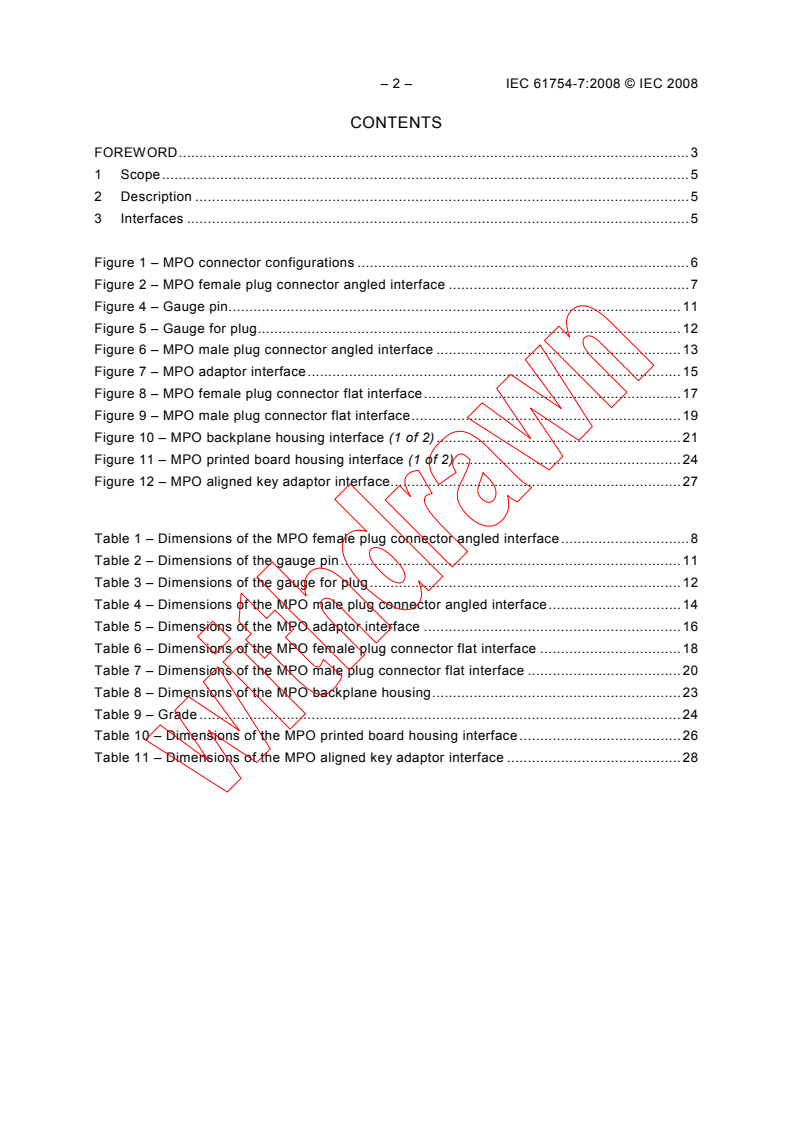
IEC 61754-7:2008 - Fibre optic interconnecting devices and passive components - Fibre optic connector interfaces - Part 7: Type MPO connector family Released:3/27/2008
Relations
- Effective Date
- 05-Sep-2023
- Effective Date
- 05-Sep-2023
- Effective Date
- 05-Sep-2023
Buy Documents
IEC 61754-7:2008 - Fibre optic interconnecting devices and passive components - Fibre optic connector interfaces - Part 7: Type MPO connector family Released:3/27/2008
IEC 61754-7:2008 - Fibre optic interconnecting devices and passive components - Fibre optic connector interfaces - Part 7: Type MPO connector family Released:3/27/2008
Get Certified
Connect with accredited certification bodies for this standard

ANCE
Mexican certification and testing association.

Intertek Slovenia
Intertek testing, inspection, and certification services in Slovenia.

LNE (Laboratoire National de Métrologie et d'Essais)
French national laboratory for metrology and testing.
Sponsored listings
Frequently Asked Questions
IEC 61754-7:2008 is a standard published by the International Electrotechnical Commission (IEC). Its full title is "Fibre optic interconnecting devices and passive components - Fibre optic connector interfaces - Part 7: Type MPO connector family". This standard covers: IEC 61754-7:2008 defines the standard interface dimensions for type MPO family of connectors. This third edition cancels and replaces the second edition published in 2004. This third edition constitutes a technical revision. Specific technical changes involve the addition of an aligned key adaptor interface definition to address all existing MPO applications. Keywords: standard interface dimensions for type MPO family of connectors
IEC 61754-7:2008 defines the standard interface dimensions for type MPO family of connectors. This third edition cancels and replaces the second edition published in 2004. This third edition constitutes a technical revision. Specific technical changes involve the addition of an aligned key adaptor interface definition to address all existing MPO applications. Keywords: standard interface dimensions for type MPO family of connectors
IEC 61754-7:2008 is classified under the following ICS (International Classification for Standards) categories: 33.180.20 - Fibre optic interconnecting devices. The ICS classification helps identify the subject area and facilitates finding related standards.
IEC 61754-7:2008 has the following relationships with other standards: It is inter standard links to IEC 61754-7-2:2017, IEC 61754-7-1:2014, IEC 61754-7:2004. Understanding these relationships helps ensure you are using the most current and applicable version of the standard.
IEC 61754-7:2008 is available in PDF format for immediate download after purchase. The document can be added to your cart and obtained through the secure checkout process. Digital delivery ensures instant access to the complete standard document.
Standards Content (Sample)
IEC 61754-7
Edition 3.0 2008-03
INTERNATIONAL
STANDARD
Fibre optic interconnecting devices and passive components – Fibre optic
connector interfaces –
Part 7: Type MPO connector family
All rights reserved. Unless otherwise specified, no part of this publication may be reproduced or utilized in any form
or by any means, electronic or mechanical, including photocopying and microfilm, without permission in writing from
either IEC or IEC's member National Committee in the country of the requester.
If you have any questions about IEC copyright or have an enquiry about obtaining additional rights to this publication,
please contact the address below or your local IEC member National Committee for further information.
IEC Central Office
3, rue de Varembé
CH-1211 Geneva 20
Switzerland
Email: inmail@iec.ch
Web: www.iec.ch
About the IEC
The International Electrotechnical Commission (IEC) is the leading global organization that prepares and publishes
International Standards for all electrical, electronic and related technologies.
About IEC publications
The technical content of IEC publications is kept under constant review by the IEC. Please make sure that you have the
latest edition, a corrigenda or an amendment might have been published.
ƒ Catalogue of IEC publications: www.iec.ch/searchpub
The IEC on-line Catalogue enables you to search by a variety of criteria (reference number, text, technical committee,…).
It also gives information on projects, withdrawn and replaced publications.
ƒ IEC Just Published: www.iec.ch/online_news/justpub
Stay up to date on all new IEC publications. Just Published details twice a month all new publications released. Available
on-line and also by email.
ƒ Electropedia: www.electropedia.org
The world's leading online dictionary of electronic and electrical terms containing more than 20 000 terms and definitions
in English and French, with equivalent terms in additional languages. Also known as the International Electrotechnical
Vocabulary online.
ƒ Customer Service Centre: www.iec.ch/webstore/custserv
If you wish to give us your feedback on this publication or need further assistance, please visit the Customer Service
Centre FAQ or contact us:
Email: csc@iec.ch
Tel.: +41 22 919 02 11
Fax: +41 22 919 03 00
IEC 61754-7
Edition 3.0 2008-03
INTERNATIONAL
STANDARD
Fibre optic interconnecting devices and passive components – Fibre optic
connector interfaces –
Part 7: Type MPO connector family
INTERNATIONAL
ELECTROTECHNICAL
COMMISSION
PRICE CODE
U
ICS 33.180.20 ISBN 2-8318-9667-3
– 2 – 61754-7 © IEC:2008(E)
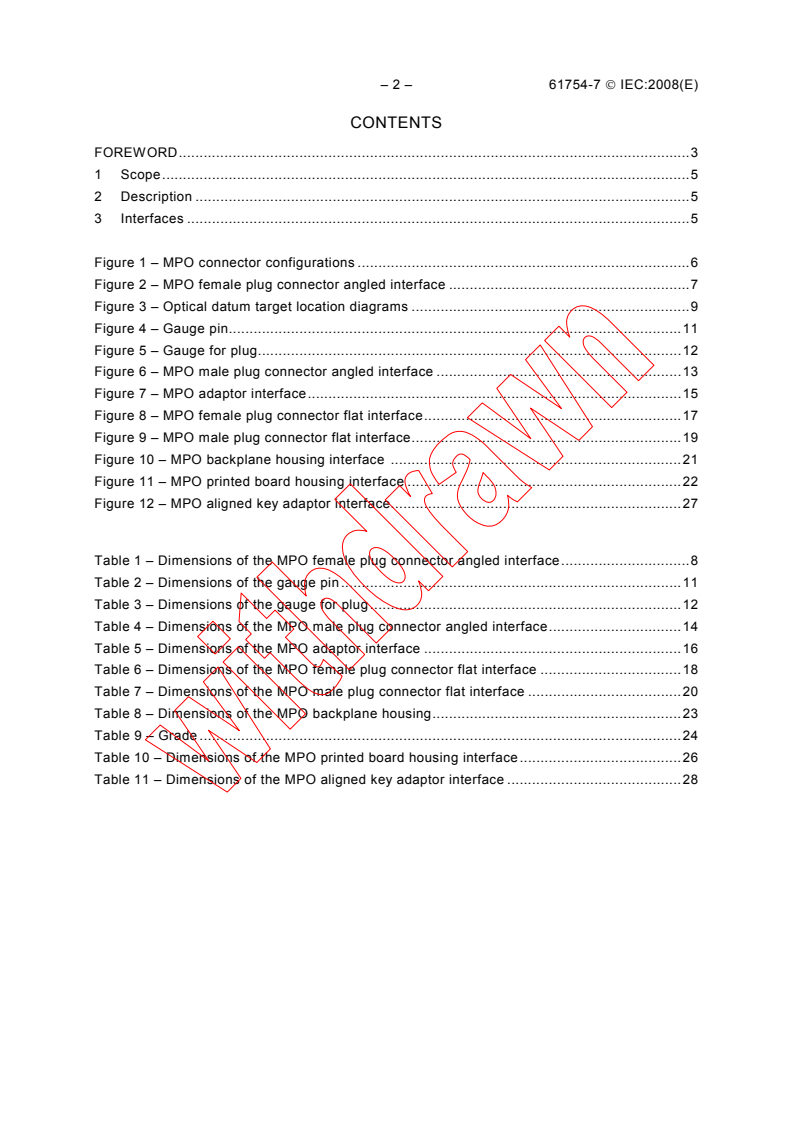
CONTENTS
FOREWORD.3
1 Scope.5
2 Description .5
3 Interfaces .5
Figure 1 – MPO connector configurations .6
Figure 2 – MPO female plug connector angled interface .7
Figure 3 – Optical datum target location diagrams .9
Figure 4 – Gauge pin.11
Figure 5 – Gauge for plug.12
Figure 6 – MPO male plug connector angled interface .13
Figure 7 – MPO adaptor interface.15
Figure 8 – MPO female plug connector flat interface.17
Figure 9 – MPO male plug connector flat interface.19
Figure 10 – MPO backplane housing interface .21
Figure 11 – MPO printed board housing interface .22
Figure 12 – MPO aligned key adaptor interface.27
Table 1 – Dimensions of the MPO female plug connector angled interface.8
Table 2 – Dimensions of the gauge pin.11
Table 3 – Dimensions of the gauge for plug.12
Table 4 – Dimensions of the MPO male plug connector angled interface.14
Table 5 – Dimensions of the MPO adaptor interface .16
Table 6 – Dimensions of the MPO female plug connector flat interface .18
Table 7 – Dimensions of the MPO male plug connector flat interface .20
Table 8 – Dimensions of the MPO backplane housing.23
Table 9 – Grade .24
Table 10 – Dimensions of the MPO printed board housing interface.26
Table 11 – Dimensions of the MPO aligned key adaptor interface .28
61754-7 © IEC:2008(E) – 3 –
INTERNATIONAL ELECTROTECHNICAL COMMISSION
___________
FIBRE OPTIC INTERCONNECTING
DEVICES AND PASSIVE COMPONENTS –
FIBRE OPTIC CONNECTOR INTERFACES –
Part 7: Type MPO connector family
FOREWORD
1) The International Electrotechnical Commission (IEC) is a worldwide organization for standardization comprising
all national electrotechnical committees (IEC National Committees). The object of IEC is to promote
international co-operation on all questions concerning standardization in the electrical and electronic fields. To
this end and in addition to other activities, IEC publishes International Standards, Technical Specifications,
Technical Reports, Publicly Available Specifications (PAS) and Guides (hereafter referred to as “IEC
Publication(s)”). Their preparation is entrusted to technical committees; any IEC National Committee interested
in the subject dealt with may participate in this preparatory work. International, governmental and non-
governmental organizations liaising with the IEC also participate in this preparation. IEC collaborates closely
with the International Organization for Standardization (ISO) in accordance with conditions determined by
agreement between the two organizations.
2) The formal decisions or agreements of IEC on technical matters express, as nearly as possible, an international
consensus of opinion on the relevant subjects since each technical committee has representation from all
interested IEC National Committees.
3) IEC Publications have the form of recommendations for international use and are accepted by IEC National
Committees in that sense. While all reasonable efforts are made to ensure that the technical content of IEC
Publications is accurate, IEC cannot be held responsible for the way in which they are used or for any
misinterpretation by any end user.
4) In order to promote international uniformity, IEC National Committees undertake to apply IEC Publications
transparently to the maximum extent possible in their national and regional publications. Any divergence
between any IEC Publication and the corresponding national or regional publication shall be clearly indicated in
the latter.
5) IEC provides no marking procedure to indicate its approval and cannot be rendered responsible for any
equipment declared to be in conformity with an IEC Publication.
6) All users should ensure that they have the latest edition of this publication.
7) No liability shall attach to IEC or its directors, employees, servants or agents including individual experts and
members of its technical committees and IEC National Committees for any personal injury, property damage or
other damage of any nature whatsoever, whether direct or indirect, or for costs (including legal fees) and
expenses arising out of the publication, use of, or reliance upon, this IEC Publication or any other IEC
Publications.
8) Attention is drawn to the Normative references cited in this publication. Use of the referenced publications is
indispensable for the correct application of this publication.
The International Electrotechnical Commission (IEC) draws attention to the fact that it is claimed that compliance
with this document may involve the use of a patent concerning MPO connectors.
The IEC takes no position concerning the evidence, validity and scope of this patent right.
The holder of this patent right has assured the IEC that he/she is willing to negotiate licences under reasonable and
non-discriminatory terms and conditions with applicants throughout the world. In this respect, the statement of the
holder of this patent right is registered with the IEC. Information may be obtained from:
Intellectual Property Department,
Nippon Telegraph and Telephone Corporation,
20-2 Nishi-shinjuku 3-Chome Shinjukuku,
Tokyo 163-14, Japan.
Attention is drawn to the possibility that some of the elements of this document may be the subject of patent rights
other than those identified above. IEC shall not be held responsible for identifying any or all such patent rights.
International Standard IEC 61754-7 has been prepared by subcommittee 86B: Fibre optic
interconnecting devices and passive components, of IEC technical committee 86: Fibre optics.
– 4 – 61754-7 © IEC:2008(E)
This third edition cancels and replaces the second edition published in 2004. This third edition
constitutes a technical revision.
Specific technical changes involve the addition of an aligned key adaptor interface definition to
address all existing MPO applications.
The text of this standard is based on the following documents:
CDV Report on voting
86/2581/CDV 86/2672/RVC
Full information on the voting for the approval of this standard can be found in the report on
voting indicated in the above table.
This publication has been drafted in accordance with the ISO/IEC Directives, Part 2.
A list of all the parts in the IEC 61754 series, under the general title Fibre optic interconnecting
devices and passive components – fibre optic connector interfaces, can be found on the IEC
website.
The committee has decided that the contents of this publication will remain unchanged until the
maintenance result date indicated on the IEC web site under "http://webstore.iec.ch" in the data
related to the specific publication. At this date, the publication will be
• reconfirmed,
• withdrawn,
• replaced by a revised edition, or
• amended.
A bilingual version of this publication may be issued at a later date.
___________
This new extended title will be applied to other parts of IEC 61754 as and when they are re-issued.
61754-7 © IEC:2008(E) – 5 –
FIBRE OPTIC INTERCONNECTING
DEVICES AND PASSIVE COMPONENTS –
FIBRE OPTIC CONNECTOR INTERFACES –
Part 7: Type MPO connector family
1 Scope
This part of IEC 61754 defines the standard interface dimensions for type MPO family of
connectors.
2 Description
The parent connector for type MPO connector family is a multiway plug connector charac-
terized by a rectangular ferrule normally 6,4 mm × 2,5 mm which utilizes two pins of 0,7 mm
diameter as its alignment. It is applicable to a joint of multiple fibres up to 12 fibres by arraying
them between two pin-positioning holes in the ferrule. Furthermore, it is capable of joining up to
24 fibres by arraying them with a two layer arrangement. The connector includes a push-pull
coupling mechanism and a ferrule spring loaded in the direction of the optical axis. The
connector has a single male key which may be used to orient and limit the relative position
between the connector and the component to which it is mated.
Connector interfaces are configured using a female plug without pins, a male plug with pins
fixed and an adaptor as shown in Figure 1. The female plug is intermateable with the male plug.
Moreover, connector interfaces between the female plug and the male plug are configured by
applying a backplane housing and a printed board housing instead of the adaptor.
3 Interfaces
This standard contains the following standard interfaces:
Interface 7-1: MPO female plug connector angled interface – Push/pull consisting of:
Interface 7-1-1 for 2 to 12 fibres
Interface 7-1-2 for 16 to 24 fibres
Interface 7-2: MPO male plug connector angled interface – Push/pull consisting of:
Interface 7-2-1 for 2 to 12 fibres
Interface 7-2-2 for 16 to 24 fibres
Interface 7-3: MPO adaptor interface – Push/pull
Interface 7-4: MPO female plug connector flat interface – Push/pull consisting of:
Interface 7-4-1 for 2 to 12 fibres
Interface 7-4-2 for 16 to 24 fibres
Interface 7-5: MPO male plug connector flat interface – Push/pull consisting of:
Interface 7-5-1 for 2 to 12 fibres
Interface 7-5-2 for 16 to 24 fibres
Interface 7-6: MPO backplane housing interface – Self-retaining
Interface 7-7: MPO printed board housing interface – Self-retaining
– 6 – 61754-7 © IEC:2008(E)
Interface 7-8: MPO adaptor interface – Push/pull, aligned key configuration
The following standards are intermateable:
Female plugs Adaptors/housings Male plugs
7-1-1 7-3 7-2-1
7-1-2 7-3 7-2-2
7-4-1 7-3 and 7-8 7-5-1
7-4-2 7-3 and 7-8 7-5-2
7-1-1 7-6 and 7-7 7-2-1
7-1-2 7-6 and 7-7 7-2-2
7-4-1 7-6 and 7-7 7-5-1
7-4-2 7-6 and 7-7 7-5-2
NOTE Connector interfaces among 2 to 12 fibres will intermate and will correctly align the lower defined numbers
of optical datum targets. Also connector interfaces among 16 to 24 fibres will intermate and will correctly align the
lower defined numbers of optical datum targets.
Female plug Adaptor
Male plug
Printed
Backplane
board
housing
housing
IEC 1065/2000
Figure 1 – MPO connector configurations
61754-7 © IEC:2008(E) – 7 –
Z
R
∅
Q
P
I
K
O
J
N
AC
AB
Y
L
AA
Pin-holes
Coupling sleeve
M
See Figure 3
IEC 395/08
AD
Figure 2 – MPO female plug connector angled interface
∅A
T
C
U
D
∅E
∅F
∅G
∅H
S
X
– 8 – 61754-7 © IEC:2008(E)
Table 1 – Dimensions of the MPO female plug connector angled interface
Dimensions
Reference Notes
Minimum Maximum
A 0,699 mm 0,701 mm 1
C 4,597 mm 4,603 mm 2
D 6,3 mm 6,5 mm
E 8,34 mm 8,54 mm
F 9,49 mm 9,59 mm
G 10,85 mm 11,05 mm
H 12,19 mm 12,59 mm
I 8,8 mm 9,2 mm 3
J 7,9 mm 8,1 mm
K 1,4 mm –
L 0,2 mm 0,8 mm 4 and 5
M 2,4 mm 2,6 mm
N 2,8 mm 3,0 mm
O 4,89 mm 4,99 mm
P 5,59 mm 5,69 mm
Q 5,7 mm –
R – 7,7 mm
S 2,9 mm 3,1 mm
T – 0,8 mm
U 2,4 mm 2,5 mm
AA 42° 45°
AB – 45°
45°
AC –
AD 7,5° 8,5°
NOTE 1 Each pin-hole must accept a gauge pin as shown in Figure 4 to a depth of 5,5 mm with a maximum force
of 1,7 N. In addition, two pin-holes of a plug must accept a gauge as shown in Figure 5 to a depth of 5,5 mm with a
maximum force of 3,4 N.
NOTE 2 Dimension C is defined as the distance between two pin-hole centres.
NOTE 3 Dimension I is given for a fibre endface centre of a plug end when not mated. It is noticed that a ferrule is
movable by a certain axial compression force, and therefore dimension I is variable. Ferrule compression force must
be 7,8 N to 11,8 N when a position of the fibre endface from the datum Z is in the range of 8,2 mm to 8,4 mm.
NOTE 4 Coupling sleeve must be movable by a certain axial compression force. Dimension L is given for a
coupling sleeve end when not mated. Couplin
...
IEC 61754-7 ®
Edition 3.0 2008-03
INTERNATIONAL
STANDARD
NORME
INTERNATIONALE
Fibre optic interconnecting devices and passive components – Fibre optic
connector interfaces –
Part 7: Type MPO connector family
Dispositifs d’interconnexion et composants passifs à fibres optiques –
Interfaces de connecteurs pour fibres optiques –
Partie 7: Famille de connecteurs de type MPO
All rights reserved. Unless otherwise specified, no part of this publication may be reproduced or utilized in any form
or by any means, electronic or mechanical, including photocopying and microfilm, without permission in writing from
either IEC or IEC's member National Committee in the country of the requester. If you have any questions about IEC
copyright or have an enquiry about obtaining additional rights to this publication, please contact the address below or
your local IEC member National Committee for further information.
Droits de reproduction réservés. Sauf indication contraire, aucune partie de cette publication ne peut être reproduite
ni utilisée sous quelque forme que ce soit et par aucun procédé, électronique ou mécanique, y compris la photocopie
et les microfilms, sans l'accord écrit de l'IEC ou du Comité national de l'IEC du pays du demandeur. Si vous avez des
questions sur le copyright de l'IEC ou si vous désirez obtenir des droits supplémentaires sur cette publication, utilisez
les coordonnées ci-après ou contactez le Comité national de l'IEC de votre pays de résidence.
IEC Central Office Tel.: +41 22 919 02 11
3, rue de Varembé Fax: +41 22 919 03 00
CH-1211 Geneva 20 info@iec.ch
Switzerland www.iec.ch
About the IEC
The International Electrotechnical Commission (IEC) is the leading global organization that prepares and publishes
International Standards for all electrical, electronic and related technologies.
About IEC publications
The technical content of IEC publications is kept under constant review by the IEC. Please make sure that you have the
latest edition, a corrigenda or an amendment might have been published.
IEC Catalogue - webstore.iec.ch/catalogue Electropedia - www.electropedia.org
The stand-alone application for consulting the entire The world's leading online dictionary of electronic and
bibliographical information on IEC International Standards, electrical terms containing more than 30 000 terms and
Technical Specifications, Technical Reports and other definitions in English and French, with equivalent terms in 14
documents. Available for PC, Mac OS, Android Tablets and additional languages. Also known as the International
iPad. Electrotechnical Vocabulary (IEV) online.
IEC publications search - www.iec.ch/searchpub IEC Glossary - std.iec.ch/glossary
The advanced search enables to find IEC publications by a More than 55 000 electrotechnical terminology entries in
variety of criteria (reference number, text, technical English and French extracted from the Terms and Definitions
committee,…). It also gives information on projects, replaced clause of IEC publications issued since 2002. Some entries
and withdrawn publications. have been collected from earlier publications of IEC TC 37,
77, 86 and CISPR.
IEC Just Published - webstore.iec.ch/justpublished
Stay up to date on all new IEC publications. Just Published IEC Customer Service Centre - webstore.iec.ch/csc
details all new publications released. Available online and If you wish to give us your feedback on this publication or
also once a month by email. need further assistance, please contact the Customer Service
Centre: csc@iec.ch.
A propos de l'IEC
La Commission Electrotechnique Internationale (IEC) est la première organisation mondiale qui élabore et publie des
Normes internationales pour tout ce qui a trait à l'électricité, à l'électronique et aux technologies apparentées.
A propos des publications IEC
Le contenu technique des publications IEC est constamment revu. Veuillez vous assurer que vous possédez l’édition la
plus récente, un corrigendum ou amendement peut avoir été publié.
Catalogue IEC - webstore.iec.ch/catalogue Electropedia - www.electropedia.org
Application autonome pour consulter tous les renseignements
Le premier dictionnaire en ligne de termes électroniques et
bibliographiques sur les Normes internationales,
électriques. Il contient plus de 30 000 termes et définitions en
Spécifications techniques, Rapports techniques et autres
anglais et en français, ainsi que les termes équivalents dans
documents de l'IEC. Disponible pour PC, Mac OS, tablettes
14 langues additionnelles. Egalement appelé Vocabulaire
Android et iPad.
Electrotechnique International (IEV) en ligne.
Recherche de publications IEC - www.iec.ch/searchpub
Glossaire IEC - std.iec.ch/glossary
La recherche avancée permet de trouver des publications IEC Plus de 55 000 entrées terminologiques électrotechniques, en
en utilisant différents critères (numéro de référence, texte, anglais et en français, extraites des articles Termes et
comité d’études,…). Elle donne aussi des informations sur les Définitions des publications IEC parues depuis 2002. Plus
projets et les publications remplacées ou retirées. certaines entrées antérieures extraites des publications des
CE 37, 77, 86 et CISPR de l'IEC.
IEC Just Published - webstore.iec.ch/justpublished
Service Clients - webstore.iec.ch/csc
Restez informé sur les nouvelles publications IEC. Just
Published détaille les nouvelles publications parues. Si vous désirez nous donner des commentaires sur cette
Disponible en ligne et aussi une fois par mois par email. publication ou si vous avez des questions contactez-nous:
csc@iec.ch.
IEC 61754-7 ®
Edition 3.0 2008-03
INTERNATIONAL
STANDARD
NORME
INTERNATIONALE
Fibre optic interconnecting devices and passive components – Fibre optic
connector interfaces –
Part 7: Type MPO connector family
Dispositifs d’interconnexion et composants passifs à fibres optiques –
Interfaces de connecteurs pour fibres optiques –
Partie 7: Famille de connecteurs de type MPO
INTERNATIONAL
ELECTROTECHNICAL
COMMISSION
COMMISSION
ELECTROTECHNIQUE
PRICE CODE
INTERNATIONALE
CODE PRIX U
ICS 33.180.20 ISBN 978-2-8322-1462-6
– 2 – IEC 61754-7:2008 © IEC 2008
CONTENTS
FOREWORD . 3
1 Scope . 5
2 Description . 5
3 Interfaces . 5
Figure 1 – MPO connector configurations . 6
Figure 2 – MPO female plug connector angled interface . 7
Figure 4 – Gauge pin . 11
Figure 5 – Gauge for plug . 12
Figure 6 – MPO male plug connector angled interface . 13
Figure 7 – MPO adaptor interface . 15
Figure 8 – MPO female plug connector flat interface . 17
Figure 9 – MPO male plug connector flat interface . 19
Figure 10 – MPO backplane housing interface (1 of 2) . 21
Figure 11 – MPO printed board housing interface (1 of 2) . 24
Figure 12 – MPO aligned key adaptor interface . 27
Table 1 – Dimensions of the MPO female plug connector angled interface . 8
Table 2 – Dimensions of the gauge pin . 11
Table 3 – Dimensions of the gauge for plug . 12
Table 4 – Dimensions of the MPO male plug connector angled interface . 14
Table 5 – Dimensions of the MPO adaptor interface . 16
Table 6 – Dimensions of the MPO female plug connector flat interface . 18
Table 7 – Dimensions of the MPO male plug connector flat interface . 20
Table 8 – Dimensions of the MPO backplane housing . 23
Table 9 – Grade . 24
Table 10 – Dimensions of the MPO printed board housing interface . 26
Table 11 – Dimensions of the MPO aligned key adaptor interface . 28
INTERNATIONAL ELECTROTECHNICAL COMMISSION
___________
FIBRE OPTIC INTERCONNECTING
DEVICES AND PASSIVE COMPONENTS –
FIBRE OPTIC CONNECTOR INTERFACES –
Part 7: Type MPO connector family
FOREWORD
1) The International Electrotechnical Commission (IEC) is a worldwide organization for standardization comprising
all national electrotechnical committees (IEC National Committees). The object of IEC is to promote
international co-operation on all questions concerning standardization in the electrical and electronic fields. To
this end and in addition to other activities, IEC publishes International Standards, Technical Specifications,
Technical Reports, Publicly Available Specifications (PAS) and Guides (hereafter referred to as “IEC
Publication(s)”). Their preparation is entrusted to technical committees; any IEC National Committee interested
in the subject dealt with may participate in this preparatory work. International, governmental and non-
governmental organizations liaising with the IEC also participate in this preparation. IEC collaborates closely
with the International Organization for Standardization (ISO) in accordance with conditions determined by
agreement between the two organizations.
2) The formal decisions or agreements of IEC on technical matters express, as nearly as possible, an international
consensus of opinion on the relevant subjects since each technical committee has representation from all
interested IEC National Committees.
3) IEC Publications have the form of recommendations for international use and are accepted by IEC National
Committees in that sense. While all reasonable efforts are made to ensure that the technical content of IEC
Publications is accurate, IEC cannot be held responsible for the way in which they are used or for any
misinterpretation by any end user.
4) In order to promote international uniformity, IEC National Committees undertake to apply IEC Publications
transparently to the maximum extent possible in their national and regional publications. Any divergence
between any IEC Publication and the corresponding national or regional publication shall be clearly indicated in
the latter.
5) IEC provides no marking procedure to indicate its approval and cannot be rendered responsible for any
equipment declared to be in conformity with an IEC Publication.
6) All users should ensure that they have the latest edition of this publication.
7) No liability shall attach to IEC or its directors, employees, servants or agents including individual experts and
members of its technical committees and IEC National Committees for any personal injury, property damage or
other damage of any nature whatsoever, whether direct or indirect, or for costs (including legal fees) and
expenses arising out of the publication, use of, or reliance upon, this IEC Publication or any other IEC
Publications.
8) Attention is drawn to the Normative references cited in this publication. Use of the referenced publications is
indispensable for the correct application of this publication.
The International Electrotechnical Commission (IEC) draws attention to the fact that it is claimed that compliance
with this document may involve the use of a patent concerning MPO connectors.
The IEC takes no position concerning the evidence, validity and scope of this patent right.
The holder of this patent right has assured the IEC that he/she is willing to negotiate licences under reasonable and
non-discriminatory terms and conditions with applicants throughout the world. In this respect, the statement of the
holder of this patent right is registered with the IEC. Information may be obtained from:
Intellectual Property Department,
Nippon Telegraph and Telephone Corporation,
20-2 Nishi-shinjuku 3-Chome Shinjukuku,
Tokyo 163-14, Japan.
Attention is drawn to the possibility that some of the elements of this document may be the subject of patent rights
other than those identified above. IEC shall not be held responsible for identifying any or all such patent rights.
International Standard IEC 61754-7 has been prepared by subcommittee 86B: Fibre optic
interconnecting devices and passive components, of IEC technical committee 86: Fibre optics.
– 4 – IEC 61754-7:2008 © IEC 2008
This third edition cancels and replaces the second edition published in 2004. This third edition
constitutes a technical revision. Specific technical changes involve the addition of an aligned
key adaptor interface definition to address all existing MPO applications.
This bilingual version (2014-03) corresponds to the monolingual English version, published in
2008-03.
The text of this standard is based on the following documents:
CDV Report on voting
86/2581/CDV 86/2672/RVC
Full information on the voting for the approval of this standard can be found in the report on
voting indicated in the above table.
The French version of this standard has not been voted upon.
This publication has been drafted in accordance with the ISO/IEC Directives, Part 2.
A list of all the parts in the IEC 61754 series, under the general title Fibre optic interconnecting
devices and passive components – fibre optic connector interfaces, can be found on the IEC
website.
The committee has decided that the contents of this publication will remain unchanged until the
maintenance result date indicated on the IEC web site under "http://webstore.iec.ch" in the data
related to the specific publication. At this date, the publication will be
• reconfirmed,
• withdrawn,
• replaced by a revised edition, or
• amended.
___________
This new extended title will be applied to other parts of IEC 61754 as and when they are re-issued.
FIBRE OPTIC INTERCONNECTING
DEVICES AND PASSIVE COMPONENTS –
FIBRE OPTIC CONNECTOR INTERFACES –
Part 7: Type MPO connector family
1 Scope
This part of IEC 61754 defines the standard interface dimensions for type MPO family of
connectors.
2 Description
The parent connector for type MPO connector family is a multiway plug connector charac-
terized by a rectangular ferrule normally 6,4 mm × 2,5 mm which utilizes two pins of 0,7 mm
diameter as its alignment. It is applicable to a joint of multiple fibres up to 12 fibres by arraying
them between two pin-positioning holes in the ferrule. Furthermore, it is capable of joining up to
24 fibres by arraying them with a two layer arrangement. The connector includes a push-pull
coupling mechanism and a ferrule spring loaded in the direction of the optical axis. The
connector has a single male key which may be used to orient and limit the relative position
between the connector and the component to which it is mated.
Connector interfaces are configured using a female plug without pins, a male plug with pins
fixed and an adaptor as shown in Figure 1. The female plug is intermateable with the male plug.
Moreover, connector interfaces between the female plug and the male plug are configured by
applying a backplane housing and a printed board housing instead of the adaptor.
3 Interfaces
This standard contains the following standard interfaces:
Interface 7-1: MPO female plug connector angled interface – Push/pull consisting of:
Interface 7-1-1 for 2 to 12 fibres
Interface 7-1-2 for 16 to 24 fibres
Interface 7-2: MPO male plug connector angled interface – Push/pull consisting of:
Interface 7-2-1 for 2 to 12 fibres
Interface 7-2-2 for 16 to 24 fibres
Interface 7-3: MPO adaptor interface – Push/pull
Interface 7-4: MPO female plug connector flat interface – Push/pull consisting of:
Interface 7-4-1 for 2 to 12 fibres
Interface 7-4-2 for 16 to 24 fibres
Interface 7-5: MPO male plug connector flat interface – Push/pull consisting of:
Interface 7-5-1 for 2 to 12 fibres
Interface 7-5-2 for 16 to 24 fibres
Interface 7-6: MPO backplane housing interface – Self-retaining
Interface 7-7: MPO printed board housing interface – Self-retaining
– 6 – IEC 61754-7:2008 © IEC 2008
Interface 7-8: MPO adaptor interface – Push/pull, aligned key configuration
The following standards are intermateable:
Female plugs Adaptors/housings Male plugs
7-1-1 7-3 7-2-1
7-1-2 7-3 7-2-2
7-4-1 7-3 and 7-8 7-5-1
7-4-2 7-3 and 7-8 7-5-2
7-1-1 7-6 and 7-7 7-2-1
7-1-2 7-6 and 7-7 7-2-2
7-4-1 7-6 and 7-7 7-5-1
7-4-2 7-6 and 7-7 7-5-2
NOTE Connector interfaces among 2 to 12 fibres will intermate and will correctly align the lower defined numbers
of optical datum targets. Also connector interfaces among 16 to 24 fibres will intermate and will correctly align the
lower defined numbers of optical datum targets.
Female plug Adaptor
Male plug
Printed
Backplane
board
housing
housing
IEC 1065/2000
Figure 1 – MPO connector configurations
Figure 2 – MPO female plug connector angled interface
– 8 – IEC 61754-7:2008 © IEC 2008
Table 1 – Dimensions of the MPO female plug connector angled interface
Dimensions
Reference Notes
Minimum Maximum
A 0,699 mm 0,701 mm 1
C
4,597 mm 4,603 mm 2
D 6,3 mm 6,5 mm
E 8,34 mm 8,54 mm
F 9,49 mm 9,59 mm
G
10,85 mm 11,05 mm
H 12,19 mm 12,59 mm
I 8,8 mm 9,2 mm 3
J 7,9 mm 8,1 mm
K
1,4 mm –
L 0,2 mm 0,8 mm 4 and 5
M 2,4 mm 2,6 mm
N 2,8 mm 3,0 mm
O 4,89 mm
4,99 mm
P 5,59 mm 5,69 mm
Q 5,7 mm –
R – 7,7 mm
S 2,9 mm
3,1 mm
T – 0,8 mm
U 2,4 mm 2,5 mm
AA 42° 45°
AB –
45°
AC – 45°
AD 7,5° 8,5°
NOTE 1 Each pin-hole must accept a gauge pin as shown in Figure 4 to a depth of 5,5 mm with a maximum force
of 1,7 N. In addition, two pin-holes of a plug must accept a gauge as shown in Figure 5 to a depth of 5,5 mm with a
maximum force of 3,4 N.
NOTE 2 Dimension C is defined as the distance between two pin-hole centres.
NOTE 3 Dimension I is given for a fibre endface centre of a plug end when not mated. It is noticed that a ferrule is
movable by a certain axial compression force, and therefore dimension I is variable. Ferrule compression force must
be 7,8 N to 11,8 N when a position of the fibre endface from the datum Z is in the range of 8,2 mm to 8,4 mm.
NOTE 4 Coupling sleeve must be movable by a certain axial compression force. Dimension L is given for a
coupling sleeve end when not mated. Coupling sleeve compression force must be 2,9 N to 6,9 N when a position of
the coupling sleeve endface from datum Z is in the range of 0 mm to 0,1 mm to the right or to the left of datum Z.
NOTE 5 An adaptor coupling part must be unlocked by a left-direction movement of a coupling sleeve, when it is
separate from an adaptor. When the coupling sleeve is moved for unlocking, a position of the coupling sleeve
endface must be larger than 2,0 mm in the left direction from the datum Z.
Y
Y Y
Two fibres
Four fibres
Eight fibres
Y
Y
Ten fibres
Twelve fibres
IEC 1594/04
Figure 3 – Optical datum target location diagrams (1 of 2)
X
X 0,125 0,125
0,125 0,125
0,375
0,375
0,625
0,625
0,875
0,875
X
1,125 1,125
0,125 0,125
0,375 0,375
X 0,125 0,125
0,375
0,375
X 0,125 0,125
0,625
0,625
0,875
0,875
1,125
1,125
0,375
1,375 1,375 0,375
0,625
0,625
0,875
0,875
– 10 – IEC 61754-7:2008 © IEC 2008
0,250
0,250
0,250 0,250
Y
Y
Sixteen fibres
Twenty fibres
0,250
0,250
Y
IEC 1595/04
Twenty four fibres
NOTE The optical datum target location diagram is shown in the figure. Here, datum X is defined as the line
passing through two pin-hole centres, and datum Y is defined as the line perpendicular to datum X and passing
through the midpoint of two pin-hole centres.
Figure 3 (2 of 2)
0,125 0,125 0,125 0,125
X
X
0,375 0,375
0,375 0,375
0,625 0,625
0,625
0,625
0,875 0,875
0,875 0,875
1,125
1,125
1,375 1,375
0,125 0,125
X
0,375
0,375
0,625
0,625
0,875
0,875
1,125 1,125
BB
BC
B
IEC 1596/04
Figure 4 – Gauge pin
Table 2 – Dimensions of the gauge pin
Dimensions
mm
Reference Notes
Minimum Maximum
A 0,698 5 0,699 0 1
B 10,8 11,2 2
BA 0,2 0,4
BB 0,2 0,5
BC 6,0 –
NOTE 1 Surface roughness R = 0,1 µm for the length of dimension BC.
z
NOTE 2 Typical dimensions.
∅BA
∅A
0,0005
– 12 – IEC 61754-7:2008 © IEC 2008
∅0,001
W
W
BB
U
BC
0,000 5
IEC 396/08
Figure 5 – Gauge for plug
Table 3 – Dimensions of the gauge for plug
Dimensions
mm
Reference Notes
Minimum Maximum
A 0,698 5 0,699 0 For two pins, 1
C 4,599 5 4,600 5
D 6,3 6,5 2
U 2,4 2,5 2
BA 0,2 0,4
BB 0,2 0,5
BC 6,0 6,5
NOTE 1 Surface roughness R = 0,1 µm.
z
NOTE 2 Typical dimensions.
∅BA
∅A
D
C
Figure 6 – MPO male plug connector angled interface
– 14 – IEC 61754-7:2008 © IEC 2008
Table 4 – Dimensions of the MPO male plug connector angled interface
Dimensions
Reference Notes
Minimum Maximum
A 0,697 mm 0,699 mm 1
C 4,597 mm 4,603 mm
D 6,3 mm 6,5 mm 2
E 8,34 mm 8,54 mm
F 9,49 mm 9,59 mm
G 10,85 mm 11,05 mm
H 12,19 mm 12,59 mm
I 8,8 mm 9,2 mm
J 7,9 mm 8,1 mm 3
K 1,4 mm –
L 0,2 mm 0,8 mm
M 2,4 mm 2,6 mm 4 and 5
N 2,8 mm 3,0 mm
O 4,89 mm 4,99 mm
P 5,59 mm 5,69 mm
Q 5,7 mm –
R – 7,7 mm
S 2,9 mm 3,1 mm
T – 0,8 mm
U 2,4 mm 2,5 mm
AA 42º 45º
AB –
45º
AC
– 45º
AD 7,5º
8,5º
BA 0,2 mm
0,4 mm
BB 6
0,2 mm 0,5 mm
CA 1,6 mm
3,3 mm
NOTE 1 Each guide pin must be retained with a minimum force of 19,6 N. Surface roughness R must
z
be below 0,5 µm.
NOTE 2 Dimension C is defined as the distance between two guide-pin centres.
NOTE 3 Dimension I is given for a fibre endface centre of a plug end when not mated. It is noticed that
a ferrule is movable by a certain axial compression force, and therefore the dimension I is variable.
Ferrule compression force must be 7,8 N to 11,8 N when a position of the fibre endface from the datum Z is
in the range of 8,2 mm to 8,4 mm.
NOTE 4 Coupling sleeve must be movable by a certain axial compression force. Dimension L is given
for a coupling sleeve end when not mated. Coupling sleeve compression force must be 2,9 N to 6,9 N
when a position of the coupling sleeve endface from datum Z is in the range of 0 mm to 0,1 mm to the
right or to the left of datum Z.
NOTE 5 An adaptor coupling part must be unlocked by a left-direction movement of a coupling sleeve,
when it is separate from an adaptor. When the coupling sleeve is moved for unlocking, a position of the
coupling sleeve endface must be larger than 2,0 mm in the left direction from the datum Z.
NOTE 6 The top shape of guide-pin may be a round shape that is symmetrical about the guide-pin axis
with a minimum radius of 0,15 mm.
R
P
O
X
N
Z
I
A
AB
B B
K
AA
A
L
Keyways opposed
Section A-A
M
Section B-B
IEC 398/08
Figure 7 – MPO adaptor interface
S
∅H
∅W
∅F
V
V
∅E
– 16 – IEC 61754-7:2008 © IEC 2008
Table 5 – Dimensions of the MPO adaptor interface
Dimensions
mm
Reference Notes
Minimum Maximum
E 8,54 mm 8,74 mm
F 9,6 mm 9,7 mm
H 12,6 mm –
I 8,2 mm 8,4 mm
K – 1,39 mm
L 0 0,1 mm
M 1,6 mm 2,0 mm
N 2,4 mm 2,6 mm
O 5,0 mm 5,1 mm
P 5,7 mm 5,9 mm
R 7,8 mm –
S 3,4 mm 3,6 mm
V 0,95 mm 1,15 mm
W 11,8 mm 12,2 mm
X 3,4 mm –
AA 45° 48°
AB 45° 50°
NOTE 1 Dimension L is the distance from datum Z to a latch-ledge end. The latch-ledge end may be located to
the right or to the left of datum Z.
Figure 8 – MPO female plug connector flat interface
– 18 – IEC 61754-7:2008 © IEC 2008
Table 6 – Dimensions of the MPO female plug connector flat interface
Dimensions
Reference Notes
Minimum Maximum
A 0,699 mm 0,701 mm 1
C 4,597 mm 4,603 mm 2
D 6,3 mm 6,5 mm
E 8,34 mm 8,54 mm
F 9,49 mm 9,59 mm
G 10,85 mm 11,05 mm
H 12,19 mm 12,59 mm
I 8,8 mm 9,2 mm 3
J 7,9 mm 8,1 mm
K 1,4 mm –
L 0,2 mm 0,8 mm 4 and 5
M 2,4 mm 2,6 mm
N 2,8 mm 3,0 mm
O 4,89 mm 4,99 mm
P 5,59 mm 5,69 mm
Q 5,7 mm –
R – 7,7 mm
S 2,9 mm 3,1 mm
U 2,4 mm 2,5 mm
AA 42° 45°
AB – 45°
AC – 45°
NOTE 1 Each pin-hole must accept a gauge pin as shown in Figure 5 to a depth of 5,5 mm with a
maximum force of 1,7 N. In addition, two pin-holes of a plug must accept a gauge as shown in Figure 6 to
a depth of 5,5 mm with a maximum force of 3,4 N.
NOTE 2 Dimension C is defined as the distance between two pin-hole centres.
NOTE 3 Dimension I is given for a fibre endface centre of a plug end when not mated. It is noticed that a
ferrule is movable by a certain axial compression force, and therefore the dimension I is variable. Ferrule
compression force must be 7,8 N to 11,8 N when a position of the fibre endface from the datum Z is in the
range of 8,2 mm to 8,4 mm.
NOTE 4 Coupling sleeve must be movable by a certain axial compression force. Dimension L is given for
a coupling sleeve end when not mated. Coupling sleeve compression force must be 2,9 N to 6,9 N when a
position of the coupling sleeve endface from datum Z is in the range of 0 mm to 0,1 mm to the right or to
the left of datum Z.
NOTE 5 An adaptor coupling part must be unlocked by a movement away from the adaptor of a coupling
sleeve, when it is separate from the adaptor. When the coupling sleeve is moved for unlocking, a position
of the coupling sleeve endface must be larger than 2,0 mm in the left direction from the datum Z.
Figure 9 – MPO male plug connector flat interface
– 20 – IEC 61754-7:2008 © IEC 2008
Table 7 – Dimensions of the MPO male plug connector flat interface
Dimensions
Reference Notes
Minimum Maximum
A 0,697 mm 0,699 mm 1
C 4,597 mm 4,603 mm 2
D 6,3 mm 6,5 mm
E 8,34 mm 8,54 mm
F 9,49 mm 9,59 mm
G 10,85 mm 11,05 mm
H 12,19 mm 12,59 mm
I 8,8 mm 9,2 mm 3
J 7,9 mm 8,1 mm
K 1,4 mm –
L 0,2 mm 0,8 mm 4 and 5
M 2,4 mm 2,6 mm
N 2,8 mm 3,0 mm
O 4,89 mm 4,99 mm
P 5,59 mm 5,69 mm
Q 5,7 mm –
R – 7,7 mm
S 2,9 mm 3,1 mm
U 2,4 mm 2,5 mm
AA 42° 45°
AB – 45°
AC – 45°
BA 0,2 mm 0,4 mm 6
BB 0,2 mm 0,5 mm
CA 1,6 mm 3,3 mm
NOTE 1 Each guide-pin must be retained with a minimum force of 19,6 N. Surface roughness R must be
z
below 0,5 µm.
NOTE 2 Dimension C is defined as the distance between two guide-pin centres.
NOTE 3 Dimension I is given for a fibre endface centre of a plug end when not mated. It is noticed that a
ferrule is movable by a certain axial compression force, and therefore the dimension I is variable. Ferrule
compression force must be 7,8 N to 11,8 N when a position of the fibre endface from the datum Z is in the
range of 8,2 mm to 8,4 mm.
NOTE 4 Coupling sleeve must be movable by a certain axial compression force. Dimension L is given for
a coupling sleeve end when not mated. Coupling sleeve compression force must be 2,9 N to 6,9 N when a
position of the coupling sleeve endface from datum Z is in the range of 0 mm to 0,1 mm to the right or to
the left of datum Z.
NOTE 5 An adaptor coupling part must be unlocked by a movement away from the adaptor of a coupling
sleeve, when it is separate from the adaptor. When the coupling sleeve is moved for unlocking, a position
of the coupling sleeve endface must be larger than 2,0 mm in the left direction from the datum Z.
NOTE 6 The top shape of guide-pin may be a round shape that is symmetrical about the guide-pin axis
with a minimum radius of 0,15 mm.
Figure 10 – MPO backplane housing interface (1 of 2)
– 22 – IEC 61754-7:2008 © IEC 2008
NOTE 1 In the figure of cross-section G-G, the inner housing must be movable to the right at least 0,9 mm under
the condition that the inner latch is completed. In addition, the inner housing must be movable at least 2 mm to the
left when the inner latch is released.
NOTE 2 In the figure of expanded cross-section I, the inner latch spring must be moved by more than 0,65 mm to
the right when the inner latch is released or latched.
Figure 10 (2 of 2)
Table 8 – Dimensions of the MPO backplane housing
Dimensions
Reference Notes
Minimum Maximum
E 8,54 mm 8,74 mm A part of diameter
F 9,6 mm 9,7 mm A part of diameter
H 12,6 mm – A part of diameter
K 1,19 mm 1,39 mm
L 0 0,1 mm
M 1,6 mm 2,0 mm
N 2,4 mm 2,6 mm
O 5,0 mm 5,1 mm
P 5,7 mm 5,9 mm
S 3,4 mm 3,6 mm
V 0,95 mm 1,15 mm
W 11,8 mm 12,2 mm A part of diameter
X 3,4 mm –
AA 45° 48°
AB 45° 50°
DA See Table 9
DB See Table 9
DC 12,25 mm 12,35 mm
DD 16,5 mm 16,6 mm
DE 14,3 mm 14,4 mm
DF 9,91 mm 10,01 mm
DG 8,2 mm 8,4 mm
DH 7,9 mm 8,1 mm See note
DI 4,15 mm 4,45 mm See note
DJ 2,65 mm 2,75 mm
DK 4,1 mm 4,3 mm
DL 3,35 mm 3,45 mm
DM 0,9 mm 1,0 mm
DN 0,55 mm 0,65 mm
DO 11,55 mm 11,65 mm
DP 9,91 mm 10,01 mm
DQ 9,15 mm 9,25 mm
DR 0,35 mm 0,45 mm
DS 0,25 mm 0,35 mm
DT 0,55 mm 0,65 mm
DU 0,55 mm 0,70 mm
EA 12,14 mm 12,2 mm
EB 4,95 mm 5,05 mm
EC 7,94 mm 8,00 mm
ED 5,6 mm 5,8 mm
EE 8,15 mm 8,25 mm
EF 5,55 mm 5,65 mm
EG 2,55 mm 2,65 mm
EH 0,85 mm 0,95 mm
EI 8,6 mm 8,7 mm
EJ 1,45 mm 1,55 mm
EK 1,9 mm 2,0 mm
EL 0,35 mm 0,45 mm
NOTE These dimensions are given when the inner housing is moved in its most left-side position
under the condition that the inner latch is engaged.
– 24 – IEC 61754-7:2008 © IEC 2008
Table 9 – Grade
Dimensions
mm
Grade Reference Notes
Minimum Maximum
1 DA 2,0 2,1 Backplane thickness 2,4 mm
DB 2,65 2,75 (see note)
1 DA 2,0 2,1 Backplane thickness 3,2 mm
DB 3,45 3,55 (see note)
NOTE Add grade number to the interface reference number.
Figure 11 – MPO printed board housing interface (1 of 2)
Figure 11 (2 of 2)
– 26 – IEC 61754-7:2008 © IEC 2008
Table 10 – Dimensions of the MPO printed board housing interface
Dimensions
Reference Notes
Minimum Maximum
E 8,54 mm 8,74 mm
A part of diameter
F 9,6 mm 9,7 mm
A part of diameter
H 12,6 mm –
A part of diameter
K 1,19 mm 1,39 mm
L 0 0,1 mm
M 1,6 mm 2,0 mm
N 2,4 mm 2,6 mm
O 5,0 mm 5,1 mm
P 5,7 mm 5,9 mm
R 7,8 mm –
S 3,4 mm 3,6 mm
V 0,95 mm 1,15 mm
W 11,8 mm 12,2 mm
A part of diameter
X 3,4 mm –
AA 45° 48°
AB 45° 50°
DD 16,5 mm 16,6 mm
See note
DE 14, 05 mm 14,15 mm
DF 9,8 mm 9,9 mm
DG 7,9 mm 8,1 mm
DP 9,8 mm 9,9 mm
EA 12,21 mm 12,27 mm
EB 5,1 mm 5,2 mm
EC 8,01 mm 8,07 mm
ED 5,9 mm
6,1 mm
EH 0,75 mm
0,85 mm
FA 9,1 mm
9,3 mm
FB 0,6 mm
0,8 mm
FC 1,35 mm
1,65 mm
FD 0,25 mm
0,35 mm
FE 11,05 mm
11,15 mm
FF 1,55 mm
1,65 mm
FG 8,9 mm
9,0 mm
FH 1,4 mm
1,6 mm
FI 1,9 mm
2,2 mm
FJ 6,35 mm
6,55 mm
FK 2,9 mm
3,0 mm
FL 0,35 mm
0,45 mm
NOTE The dimension DD is defined at the top of the main latch spring. The dimension DD must
become greater than 18,6 mm when the printed board housing is coupled to, or removed from,
a backplane housing.
R
P
O
X
N
Z
I
A
AB
B B
K
AA
A L
Keyways aligned
M
Section A-A
Section B-B
IEC 403/08
Figure 12 – MPO aligned key adaptor interface
S
∅H
∅W
∅F
V ∅E V
– 28 – IEC 61754-7:2008 © IEC 2008
Table 11 – Dimensions of the MPO aligned key adaptor interface
Dimensions
Reference Notes
Minimum Maximum
E 8,54 mm 8,74 mm
F 9,6 mm 9,7 mm
H 12,6 mm –
I 8,2 mm 8,4 mm
K – 1,39 mm
L 0 0,1 mm
M 1,6 mm 2,0 mm
N 2,4 mm 2,6 mm
O 5,0 mm 5,1 mm
P 5,7 mm 5,9 mm
R 7,8 mm –
S 3,4 mm 3,6 mm
V 0,95 mm 1,15 mm
W 11,8 mm 12,2 mm
X 3,4 mm –
AA 45° 48°
AB 45° 50°
NOTE 1 Dimension L is the distance from datum Z to a latch-ledge end. The latch-ledge end may be located to
the right or to the left of datum Z.
NOTE 2 The keyways for each MPO plug are aligned on the same side of the adaptor. Dimension I is the distance
from datum Z to the adaptor centreline.
___________
– 30 – IEC 61754-7:2008 © IEC 2008
SOMMAIRE
AVANT-PROPOS . 31
1 Domaine d’application . 33
2 Description . 33
3 Interfaces . 33
Figure 1 – Configurations de connecteur MPO . 34
Figure 2 – Interface angulaire pour connecteur MPO à fiche femelle . 35
Figure 3 – Schémas d'emplacement de la cible de référence optique (1 de 2) . 37
Figure 4 – Broche calibrée . 39
Figure 5 – Calibre pour la fiche . 40
Figure 6 – Interface angulaire pour connecteur MPO à fiche mâle . 41
Figure 7 – Interface pour raccord MPO . 43
Figure 8 – Interface plate pour connecteur MPO à fiche femelle . 45
Figure 9 – Interface plate pour connecteur MPO à fiche mâle . 47
Figure 10 – Interface pour support de fond de panier MPO (1 de 2) . 49
Figure 11 – Interface pour support de fond de panier MPO (1 de 2) . 52
Figure 12 – Interface pour raccord MPO à détrompeur aligné . 55
Tableau 1 – Dimensions de l’interface angulaire pour connecteur MPO à fiche femelle . 36
Tableau 2 – Dimensions de la broche calibrée . 39
Tableau 3 – Dimensions du calibre pour la fiche . 40
Tableau 4 – Dimensions de l’interface angulaire pour connecteur MPO à fiche mâle . 42
Tableau 5 – Dimensions de l’interface pour raccord MPO . 44
Tableau 6 – Dimensions de l’interface plate pour connecteur MPO à fiche femelle . 46
Tableau 7 – Dimensions de l’interface plate pour connecteur MPO à fiche mâle . 48
Tableau 8 – Dimensions du support de fond de panier MPO . 51
Tableau 9 – Classe . 52
Tableau 10 – Dimensions de l’interface pour support de carte imprimée MPO . 54
Tableau 11 – Dimensions de l’interface pour raccord MPO à détrompeur aligné . 56
COMMISSION ÉLECTROTECHNIQUE INTERNATIONALE
___________
DISPOSITIFS D’INTERCONNEXION ET
COMPOSANTS PASSIFS À FIBRES OPTIQUES –
INTERFACES DE CONNECTEURS POUR FIBRES OPTIQUES –
Partie 7: Famille de connecteurs de type MPO
AVANT-PROPOS
1) La Commission Électrotechnique Internationale (CEI) est une organisation mondiale de normalisation composée
de l'ensemble des comités électrotechniques nationaux (Comités nationaux de la CEI). La CEI a pour objet de
favoriser la coopération internationale pour toutes les questions de normalisation dans les domaines de
l'électricité et de l'électronique. A cet effet, la CEI – entre autres activités – publie des Normes internationales,
des Spécifications techniques, des Rapports techniques, des Spécifications accessibles au public (PAS) et des
Guides (ci-après dénommés "Publication(s) de la CEI"). Leur élaboration est confiée à des comités d'études,
aux travaux desquels tout Comité national intéressé par le sujet traité peut participer. Les organisations
internationales, gouvernementales et non gouvernementales, en liaison avec la CEI, participent également aux
travaux. La CEI collabore étroitement avec l'Organisation Internationale de Normalisation (ISO), selon des
conditions fixées par accord entre les deux organisations.
2) Les décisions ou accords officiels de la CEI concernant les questions techniques représentent, dans la mesure
du possible, un accord international sur les sujets étudiés, étant donné que les Comités nationaux intéressés
sont représentés dans chaque comité d’études.
3) Les publications CEI se présentent sous la forme de recommandations internationales et elles sont agréées
comme telles par les Comités nationaux de la CEI. Tous les efforts raisonnables sont entrepris afin que la CEI
s'assure de l'exactitude du contenu technique de ses publications; la CEI ne peut pas être tenue responsable de
l'éventuelle mauvaise utilisation ou interprétation qui en est faite par un quelconque utilisateur final.
4) Dans le but d'encourager l'uniformité internationale, les Comités nationaux de la CEI s'engagent à appliquer de
façon transparente, dans toute la mesure possible, les publications de la CEI dans leurs publications nationales
et régionales. Toutes divergences entre toutes Publications de la CEI et toutes publications nationales ou
régionales correspondantes doivent être indiquées en termes clairs dans ces dernières.
5) La CEI n’a fixé aucune procédure concernant le marquage comme indication d’approbation et sa responsabilité
n’est pas engagée quand un matériel est déclaré conforme à l’une de ses normes.
6) Tous les utilisateurs doivent s'assurer qu'ils sont en possession de la dernière édition de cette publication.
7) Aucune responsabilité ne doit être imputée à la CEI, à ses administrateurs, employés, auxiliaires ou
mandataires, y compris ses experts particuliers et les membres de ses comités d'études et des Comités
nationaux de la CEI, pour tout préjudice causé en cas de dommages corporels et matériels, ou de tout autre
dommage de quelque nature que ce soit, directe ou indirecte, ou pour supporter les coûts (y compris les frais
de justice) et les dépenses découlant de la publication ou de l'utilisation de cette Publication de la CEI ou de
toute autre Publication de la CEI, ou au crédit qui lui est accordé.
8) L'attention est attirée sur les références Normatives citées dans cette publication. L'utilisation de publications
référencées est obligatoire pour une application correcte de la présente publication.
La Commission Electrotechnique Internationale (CEI) attire l'attention sur le fait qu'il est déclaré que la conformité
avec les dispositions du présent document peut impliquer l'utilisation d'un brevet intéressant les connecteurs de
type MPO.
La CEI ne prend pas position quant à la preuve, à la validité et à la portée de ces droits de propriété.
Le détenteur de ces droits de propriété a donné l'assurance à la CEI qu'il consent à négocier des licences avec des
demandeurs du monde entier, soit sans frais soit à des termes et conditions raisonnables et non discriminatoires. À
ce propos, la déclaration du détenteur des droits de propriété est enregistrée auprès de la CEI. Des informations
peuvent être obtenues auprès de:
Intellectual Property Department,
Nippon Telegraph and Telephone Corporation,
20-2 Nishi-shinjuku 3-Chome Shinjukuku,
Tokyo 163-14, Japan.
L'attention est d'autre part attirée sur le fait que certains des éléments du présent document peuvent faire l'objet de
droits de propriété autres que ceux qui ont été mentionnés ci-dessus. La CEI ne saurait être tenue pour
responsable de l’identification de ces droits de propriété en tout ou partie.
– 32 – IEC 61754-7:2008 © IEC 2008
La Norme internationale CEI 61754-7 a été établie par le sous-comité 86B: Dispositifs
d'interconnexion et composants passifs à fibres optiques, du comité d'études 86 de la CEI:
Fibres optiques.
Cette troisième édition annule et remplace la deuxième édition parue en 2004. Cette troisième
...