

IEC 60172:2020
(Main)Test procedure for the determination of the temperature index of enamelled and tape wrapped winding wires
General Information
- Abstract
IEC 60172:2020 specifies, in accordance with the provisions of IEC 60216-1, a method for evaluating the temperature index of enamelled wire, varnished or unvarnished with an impregnating agent, and of tape wrapped round and rectangular wire, in air at atmospheric pressure by periodically monitoring changes in response to AC proof voltage tests. This procedure does not apply to fibre-insulated wire or wire covered with tapes containing inorganic fibres. NOTE The data obtained according to this test procedure provide the designer and development engineer with information for the selection of winding wire for further evaluation of insulation systems and equipment tests. This fifth edition cancels and replaces the fourth edition published in 2015. This edition constitutes a technical revision. This edition includes the following significant technical changes with respect to the previous edition:
- revision of 3.1, definition of thermal index;
- revision of 3.3, time to failure;
- revisions to 5.1.1 for clarity and to reduce the range wire size range to which the test applies;
- revisions to 5.1.2 for tape wrapped round and enamelled or tape wrapped rectangular wire for clarity;
- revision to Clause 9 to add the correlation coefficient, r to the report.
- Status
- Published
- Publication Date
- 22-Nov-2020
- Technical Committee
- TC 55 - Winding wires
- Drafting Committee
- WG 1 - TC 55/WG 1
- Current Stage
- PPUB - Publication issued
- Start Date
- 23-Nov-2020
- Completion Date
- 27-Dec-2020
Buy Documents
IEC 60172:2020 RLV - Test procedure for the determination of the temperature index of enamelled and tape wrapped winding wires Released:11/23/2020
IEC 60172:2020 - Test procedure for the determination of the temperature index of enamelled and tape wrapped winding wires Released:11/23/2020
Overview
IEC 60172:2020 - Test procedure for the determination of the temperature index of enamelled and tape‑wrapped winding wires - specifies a standardized method to evaluate the thermal capability of winding wire insulation. Aligned with IEC 60216‑1, the procedure exposes specimens to controlled heat‑storage cycles in air at atmospheric pressure and periodically applies AC proof voltage tests to monitor insulation deterioration. The temperature index (TI) is the Celsius temperature corresponding to an extrapolated lifetime of 20 000 hours on an Arrhenius thermal‑endurance plot.
Key topics and requirements
- Scope and exclusions: Applies to enamelled wire (varnished or unvarnished, with or without impregnation) and tape‑wrapped round/rectangular wire. Does not apply to fibre‑insulated wire or tapes containing inorganic fibres.
- Specimen preparation: Detailed methods for enamelled non‑tape wrapped round wire (nominal conductor diameters from 0.224 mm up to 2.65 mm) and for tape‑wrapped round/rectangular wire are specified to ensure repeatable results.
- Test cycle: Repeated heat‑storage exposure at selected temperatures followed by room‑temperature AC proof voltage tests until sufficient specimen failures occur.
- Data analysis: Calculation of specimen failure time, time‑to‑failure statistics, linear regression of log(life) versus reciprocal absolute temperature, and plotting on thermal endurance graph paper to derive TI.
- Reporting: Test report must include results and statistical metrics - Clause 9 now requires inclusion of the correlation coefficient (r) for the regression.
- Normative references: IEC 60216‑1 (ageing procedures/evaluation) and IEC 60216‑3 (calculating thermal endurance characteristics).
Applications and who uses it
- Winding wire manufacturers use IEC 60172 to characterize enamel and tape insulation and to support product datasheets (temperature index, thermal class guidance).
- Motor, transformer and generator designers rely on TI data to select appropriate winding wire for insulation systems and for further equipment qualification tests.
- R&D and materials engineers use the method to compare insulation formulations, varnish impregnation effects, or tape systems under accelerated thermal ageing.
- Test laboratories and certification bodies apply this standardized procedure to provide reproducible, comparable thermal‑endurance data.
Practical value
- Provides a reproducible, internationally recognized method to quantify insulation thermal performance.
- TI data support material selection, comparative evaluations, and risk‑based design decisions for electrical rotating machines and other wound components.
- Inclusion of statistical metrics (e.g., correlation coefficient r) increases confidence in TI extrapolations and design use.
Related standards
- IEC 60216‑1 - Electrical insulating materials: Thermal endurance procedures and evaluation.
- IEC 60216‑3 - Instructions for calculating thermal endurance characteristics.
Keywords: IEC 60172, temperature index, enamelled winding wire, tape wrapped winding wire, thermal endurance, AC proof voltage, winding wire testing, IEC 60216.
Relations
- Effective Date
- 05-Sep-2023
Buy Documents
IEC 60172:2020 RLV - Test procedure for the determination of the temperature index of enamelled and tape wrapped winding wires Released:11/23/2020
IEC 60172:2020 - Test procedure for the determination of the temperature index of enamelled and tape wrapped winding wires Released:11/23/2020
Get Certified
Connect with accredited certification bodies for this standard

IMQ S.p.A. (Certification)
Italian electrical product certification.

SLG Prüf- und Zertifizierungs GmbH
German testing and certification body.

UL Solutions
Global safety science company with testing, inspection and certification.
Sponsored listings
Frequently Asked Questions
IEC 60172:2020 is a standard published by the International Electrotechnical Commission (IEC). Its full title is "Test procedure for the determination of the temperature index of enamelled and tape wrapped winding wires". This standard covers: IEC 60172:2020 specifies, in accordance with the provisions of IEC 60216-1, a method for evaluating the temperature index of enamelled wire, varnished or unvarnished with an impregnating agent, and of tape wrapped round and rectangular wire, in air at atmospheric pressure by periodically monitoring changes in response to AC proof voltage tests. This procedure does not apply to fibre-insulated wire or wire covered with tapes containing inorganic fibres. NOTE The data obtained according to this test procedure provide the designer and development engineer with information for the selection of winding wire for further evaluation of insulation systems and equipment tests. This fifth edition cancels and replaces the fourth edition published in 2015. This edition constitutes a technical revision. This edition includes the following significant technical changes with respect to the previous edition: - revision of 3.1, definition of thermal index; - revision of 3.3, time to failure; - revisions to 5.1.1 for clarity and to reduce the range wire size range to which the test applies; - revisions to 5.1.2 for tape wrapped round and enamelled or tape wrapped rectangular wire for clarity; - revision to Clause 9 to add the correlation coefficient, r to the report.
IEC 60172:2020 specifies, in accordance with the provisions of IEC 60216-1, a method for evaluating the temperature index of enamelled wire, varnished or unvarnished with an impregnating agent, and of tape wrapped round and rectangular wire, in air at atmospheric pressure by periodically monitoring changes in response to AC proof voltage tests. This procedure does not apply to fibre-insulated wire or wire covered with tapes containing inorganic fibres. NOTE The data obtained according to this test procedure provide the designer and development engineer with information for the selection of winding wire for further evaluation of insulation systems and equipment tests. This fifth edition cancels and replaces the fourth edition published in 2015. This edition constitutes a technical revision. This edition includes the following significant technical changes with respect to the previous edition: - revision of 3.1, definition of thermal index; - revision of 3.3, time to failure; - revisions to 5.1.1 for clarity and to reduce the range wire size range to which the test applies; - revisions to 5.1.2 for tape wrapped round and enamelled or tape wrapped rectangular wire for clarity; - revision to Clause 9 to add the correlation coefficient, r to the report.
IEC 60172:2020 is classified under the following ICS (International Classification for Standards) categories: 29.060.10 - Wires. The ICS classification helps identify the subject area and facilitates finding related standards.
IEC 60172:2020 has the following relationships with other standards: It is inter standard links to IEC 60172:2015. Understanding these relationships helps ensure you are using the most current and applicable version of the standard.
IEC 60172:2020 is available in PDF format for immediate download after purchase. The document can be added to your cart and obtained through the secure checkout process. Digital delivery ensures instant access to the complete standard document.
Standards Content (Sample)
IEC 60172 ®
Edition 5.0 2020-11
REDLINE VERSION
INTERNATIONAL
STANDARD
colour
inside
Test procedure for the determination of the temperature index of enamelled and
tape wrapped winding wires
All rights reserved. Unless otherwise specified, no part of this publication may be reproduced or utilized in any form
or by any means, electronic or mechanical, including photocopying and microfilm, without permission in writing from
either IEC or IEC's member National Committee in the country of the requester. If you have any questions about IEC
copyright or have an enquiry about obtaining additional rights to this publication, please contact the address below or
your local IEC member National Committee for further information.
IEC Central Office Tel.: +41 22 919 02 11
3, rue de Varembé info@iec.ch
CH-1211 Geneva 20 www.iec.ch
Switzerland
About the IEC
The International Electrotechnical Commission (IEC) is the leading global organization that prepares and publishes
International Standards for all electrical, electronic and related technologies.
About IEC publications
The technical content of IEC publications is kept under constant review by the IEC. Please make sure that you have the
latest edition, a corrigendum or an amendment might have been published.
IEC publications search - webstore.iec.ch/advsearchform Electropedia - www.electropedia.org
The advanced search enables to find IEC publications by a The world's leading online dictionary on electrotechnology,
variety of criteria (reference number, text, technical containing more than 22 000 terminological entries in English
committee,…). It also gives information on projects, replaced and French, with equivalent terms in 16 additional languages.
and withdrawn publications. Also known as the International Electrotechnical Vocabulary
(IEV) online.
IEC Just Published - webstore.iec.ch/justpublished
Stay up to date on all new IEC publications. Just Published IEC Glossary - std.iec.ch/glossary
details all new publications released. Available online and 67 000 electrotechnical terminology entries in English and
once a month by email. French extracted from the Terms and Definitions clause of
IEC publications issued since 2002. Some entries have been
IEC Customer Service Centre - webstore.iec.ch/csc collected from earlier publications of IEC TC 37, 77, 86 and
If you wish to give us your feedback on this publication or CISPR.
need further assistance, please contact the Customer Service
Centre: sales@iec.ch.
IEC 60172 ®
Edition 5.0 2020-11
REDLINE VERSION
INTERNATIONAL
STANDARD
colour
inside
Test procedure for the determination of the temperature index of enamelled and
tape wrapped winding wires
INTERNATIONAL
ELECTROTECHNICAL
COMMISSION
ICS 29.060.10 ISBN 978-2-8322-9123-8
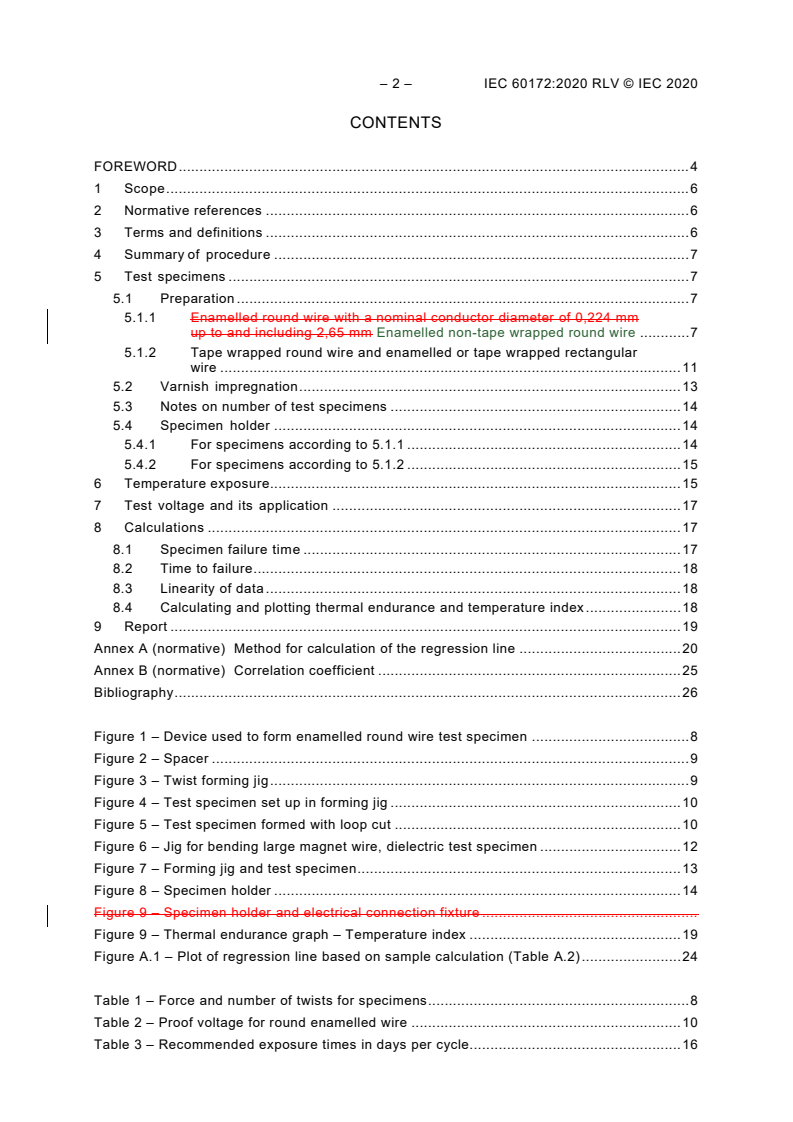
– 2 – IEC 60172:2020 RLV © IEC 2020
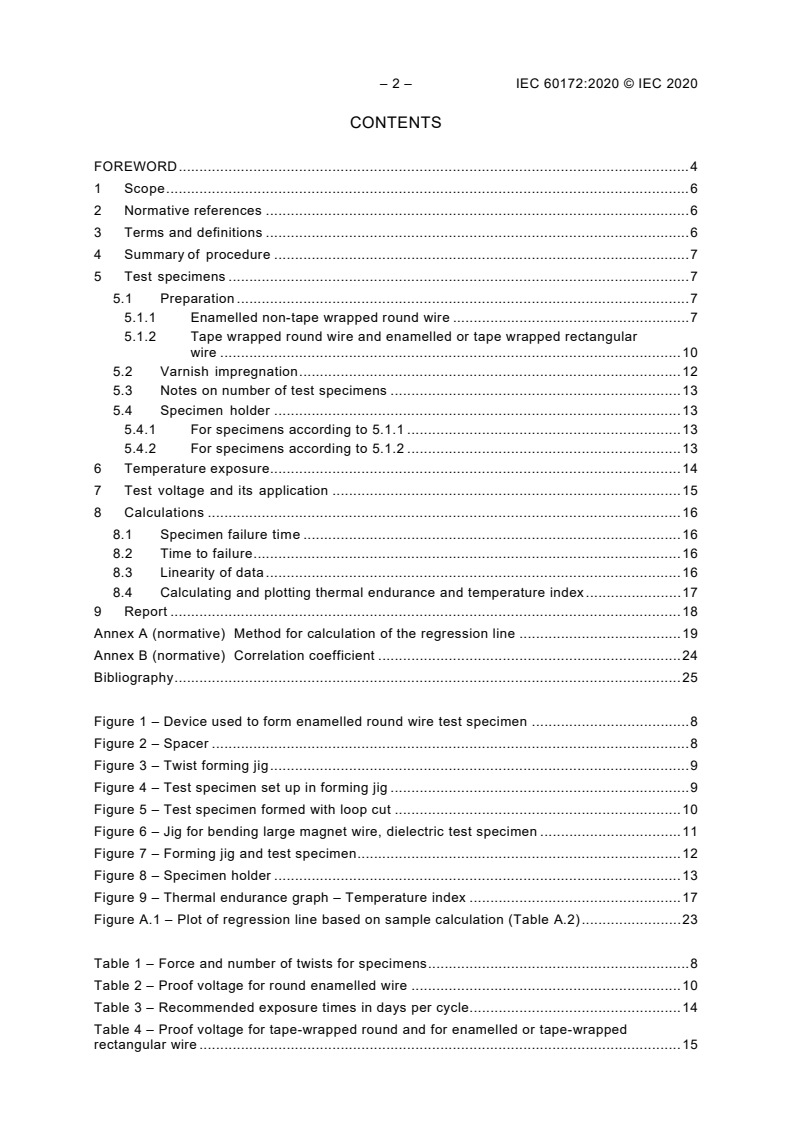
CONTENTS
FOREWORD . 4
1 Scope . 6
2 Normative references . 6
3 Terms and definitions . 6
4 Summary of procedure . 7
5 Test specimens . 7
5.1 Preparation . 7
5.1.1 Enamelled round wire with a nominal conductor diameter of 0,224 mm
up to and including 2,65 mm Enamelled non-tape wrapped round wire . 7
5.1.2 Tape wrapped round wire and enamelled or tape wrapped rectangular
wire . 11
5.2 Varnish impregnation . 13
5.3 Notes on number of test specimens . 14
5.4 Specimen holder . 14
5.4.1 For specimens according to 5.1.1 . 14
5.4.2 For specimens according to 5.1.2 . 15
6 Temperature exposure. 15
7 Test voltage and its application . 17
8 Calculations . 17
8.1 Specimen failure time . 17
8.2 Time to failure . 18
8.3 Linearity of data . 18
8.4 Calculating and plotting thermal endurance and temperature index . 18
9 Report . 19
Annex A (normative) Method for calculation of the regression line . 20
Annex B (normative) Correlation coefficient . 25
Bibliography . 26
Figure 1 – Device used to form enamelled round wire test specimen . 8
Figure 2 – Spacer . 9
Figure 3 – Twist forming jig . 9
Figure 4 – Test specimen set up in forming jig . 10
Figure 5 – Test specimen formed with loop cut . 10
Figure 6 – Jig for bending large magnet wire, dielectric test specimen . 12
Figure 7 – Forming jig and test specimen . 13
Figure 8 – Specimen holder . 14
Figure 9 – Specimen holder and electrical connection fixture .
Figure 9 – Thermal endurance graph – Temperature index . 19
Figure A.1 – Plot of regression line based on sample calculation (Table A.2) . 24
Table 1 – Force and number of twists for specimens . 8
Table 2 – Proof voltage for round enamelled wire . 10
Table 3 – Recommended exposure times in days per cycle. 16
Table 4 – Proof voltage for tape-wrapped round and for enamelled or tape-wrapped
rectangular wire . 17
Table A.1 – Commonly used test temperatures in degrees Celsius and the
corresponding kelvins with its reciprocal and reciprocal squared values . 22
Table A.2 – Sample calculation . 23
– 4 – IEC 60172:2020 RLV © IEC 2020
INTERNATIONAL ELECTROTECHNICAL COMMISSION
____________
TEST PROCEDURE FOR THE DETERMINATION OF THE TEMPERATURE
INDEX OF ENAMELLED AND TAPE WRAPPED WINDING WIRES
FOREWORD
1) The International Electrotechnical Commission (IEC) is a worldwide organization for standardization comprising
all national electrotechnical committees (IEC National Committees). The object of IEC is to promote
international co-operation on all questions concerning standardization in the electrical and electronic fields. To
this end and in addition to other activities, IEC publishes International Standards, Technical Specifications,
Technical Reports, Publicly Available Specifications (PAS) and Guides (hereafter referred to as “IEC
Publication(s)”). Their preparation is entrusted to technical committees; any IEC National Committee interested
in the subject dealt with may participate in this preparatory work. International, governmental and non-
governmental organizations liaising with the IEC also participate in this preparation. IEC collaborates closely
with the International Organization for Standardization (ISO) in accordance with conditions determined by
agreement between the two organizations.
2) The formal decisions or agreements of IEC on technical matters express, as nearly as possible, an international
consensus of opinion on the relevant subjects since each technical committee has representation from all
interested IEC National Committees.
3) IEC Publications have the form of recommendations for international use and are accepted by IEC National
Committees in that sense. While all reasonable efforts are made to ensure that the technical content of IEC
Publications is accurate, IEC cannot be held responsible for the way in which they are used or for any
misinterpretation by any end user.
4) In order to promote international uniformity, IEC National Committees undertake to apply IEC Publications
transparently to the maximum extent possible in their national and regional publications. Any divergence
between any IEC Publication and the corresponding national or regional publication shall be clearly indicated in
the latter.
5) IEC itself does not provide any attestation of conformity. Independent certification bodies provide conformity
assessment services and, in some areas, access to IEC marks of conformity. IEC is not responsible for any
services carried out by independent certification bodies.
6) All users should ensure that they have the latest edition of this publication.
7) No liability shall attach to IEC or its directors, employees, servants or agents including individual experts and
members of its technical committees and IEC National Committees for any personal injury, property damage or
other damage of any nature whatsoever, whether direct or indirect, or for costs (including legal fees) and
expenses arising out of the publication, use of, or reliance upon, this IEC Publication or any other IEC
Publications.
8) Attention is drawn to the Normative references cited in this publication. Use of the referenced publications is
indispensable for the correct application of this publication.
9) Attention is drawn to the possibility that some of the elements of this IEC Publication may be the subject of
patent rights. IEC shall not be held responsible for identifying any or all such patent rights.
This redline version of the official IEC Standard allows the user to identify the changes
made to the previous edition. A vertical bar appears in the margin wherever a change
has been made. Additions are in green text, deletions are in strikethrough red text.
International Standard IEC 60172 has been prepared by IEC Technical Committee 55:
Winding wires.
This fifth edition cancels and replaces the fourth edition published in 2015. This edition
constitutes a technical revision.
This edition includes the following significant technical changes with respect to the previous
edition:
– revision of 3.1, definition of thermal index;
– revision of 3.3, time to failure;
– revisions to 5.1.1 for clarity and to reduce the range wire size range to which the test
applies;
– revisions to 5.1.2 for tape wrapped round and enamelled or tape wrapped rectangular wire
for clarity;
– revision to Clause 9 to add the correlation coefficient, r to the report.
The text of this International Standard is based on the following documents:
FDIS Report on voting
55/1876/FDIS 55/1893/RVD
Full information on the voting for the approval of this International Standard can be found in
the report on voting indicated in the above table.
This document has been drafted in accordance with the ISO/IEC Directives, Part 2.
The committee has decided that the contents of this document will remain unchanged until the
stability date indicated on the IEC website under "http://webstore.iec.ch" in the data related to
the specific document. At this date, the document will be
• reconfirmed,
• withdrawn,
• replaced by a revised edition, or
• amended.
IMPORTANT – The 'colour inside' logo on the cover page of this publication indicates
that it contains colours which are considered to be useful for the correct
understanding of its contents. Users should therefore print this document using a
colour printer.
– 6 – IEC 60172:2020 RLV © IEC 2020
TEST PROCEDURE FOR THE DETERMINATION OF THE TEMPERATURE
INDEX OF ENAMELLED AND TAPE WRAPPED WINDING WIRES
1 Scope
This International Standard specifies, in accordance with the provisions of IEC 60216-1, a
method for evaluating the temperature index of enamelled wire, varnished or unvarnished with
an impregnating agent, and of tape wrapped round and rectangular wire, in air at atmospheric
pressure by periodically monitoring changes in response to AC proof voltage tests. This
procedure does not apply to fibre-insulated wire or wire covered with tapes containing
inorganic fibres.
NOTE The data obtained according to this test procedure provide the designer and development engineer with
information for the selection of winding wire for further evaluation of insulation systems and equipment tests.
2 Normative references
The following documents are referred to in the text in such a way that some or all of their
content constitutes requirements of this document. For dated references, only the edition
cited applies. For undated references, the latest edition of the referenced document (including
any amendments) applies.
IEC 60216-1, Electrical insulating materials – Thermal endurance properties – Part 1: Ageing
procedures and evaluation of test results
IEC 60216-3, Electrical insulating materials – Thermal endurance properties – Part 3:
Instructions for calculating thermal endurance characteristics
3 Terms and definitions
For the purposes of this document, the following terms and definitions apply.
ISO and IEC maintain terminological databases for use in standardization at the following
addresses:
• IEC Electropedia: available at http://www.electropedia.org/
• ISO Online browsing platform: available at http://www.iso.org/obp
3.1
temperature index
TI
numerical value of the Celsius temperature expressed in degrees Celsius characterizing the
thermal capability of an insulating material or an insulation system
number which permits comparison of the temperature/time characteristics of an electrical
insulating material, or a simple combination of materials, based on the temperature in degrees
Celsius which is obtained by extrapolating the Arrhenius plot of life versus temperature to a
lifetime of 20 000 h
Note 1 to entry: In case of insulating materials, the temperature index is derived from the thermal endurance
relationship at a given time, normally 20 000 hours. It may be used as basis for determination of the material’s
temperature class.
Note 2 1 to entry: In case of insulation systems, the temperature index may be derived from known service
experience or from a known comparative functional evaluation of an evaluated and established reference insulation
system as basis.
[SOURCE: IEC 60050-212:2010, 212-12-11 modified by merging Note 1 into the definition,
and to specify a lifetime of 20 000 h.]
3.2
specimen failure time
number of hours at the exposure temperature that have elapsed at the time a specimen
proof test
fails the
3.3
time to failure
L
number of hours to failure calculated from the specimen mean value or logarithmic mean
value failure times for a set of specimens at one exposure temperature, in accordance with
8.2
4 Summary of procedure
A set of specimens in accordance with Clause 5 is subjected to a testing cycle. This cycle
consists of a heat-storing heat-exposure period at a temperature given in Clause 6,
followed by a proof voltage test at room temperature in accordance with Clause 7.
This cycle is repeated until a sufficient number of specimens has failed. The time to failure is
calculated in accordance with Clause 8. The test is carried out at three or more
temperatures. A regression line is calculated in accordance with 8.4 and the time to failure
values plotted on thermal endurance graph paper as a function of the exposure
temperature.
The temperature in degrees Celsius, corresponding to the point of intersection of the
regression line with the ordinate of 20 000 h endurance represents the temperature index of
the winding wire under test.
5 Test specimens
5.1 Preparation
5.1.1 Enamelled round wire with a nominal conductor diameter of 0,224 mm up to and
including 2,65 mm
Enamelled non-tape wrapped round wire
The grade of insulation used for determining the thermal index shall be grade 2 or grade 2B
for self-bonding winding wires.
Wire sizes 0,315 mm and 0,28 mm are permitted for use when the specification size range is
limited to 0,50 mm and finer.
NOTE For round enamelled winding wires, in order to avoid undue fragility of the test specimen, experience has
shown that nominal conductor diameters of 0,800 mm up to and including 2,65 mm are generally found convenient
to handle and test.
This procedure applies to enamelled round wires that are not tape wrapped. The thermal
index can be determined by evaluating enamelled non-tape wrapped round wire with a
nominal conductor diameter of 0,224 mm up to and including 2,65 mm.
NOTE For round enamelled winding wires, experience has shown that nominal conductor diameters of 0,800 mm
up to and including 1,60 mm are generally found convenient to handle and test.
Wires with a nominal conductor diameter between 0,280 mm and 0,500 mm are permitted for
use when the specification range of diameters is limited to 0,500 mm and finer.
– 8 – IEC 60172:2020 RLV © IEC 2020
The grade of insulation used for determining the thermal index shall be grade 2 or grade 2B
for self-bonding winding wires.
Specimens shall be prepared as follows:
a) A wire specimen approximately 400 mm in length shall be twisted together over a distance
of 125 mm with a device as shown in Figure 1. The force (weight) applied to the wire pair
while being twisted and the number of twists are specified in Table 1.
Figure 1 – Device used to form enamelled round wire test specimen
Table 1 – Force and number of twists for specimens
Nominal diameter Force applied to Number of twists
wire pairs per
mm N 125 mm
Over Up to and
including
0,224 0,25 0,85 33
0,25 0,35 1,7 23
0,35 0,50 3,4 16
0,50 0,75 7,0 12
0,75 1,05 13,5 8
1,05 1,50 27,0 6
1,50 2,15 54,0 4
2,15 3,50 2,65 108,0 3
b) Spacers may be prepared as shown in Figure 2. Such thermally stable insulating
materials as ceramic or silicone glass fibre laminate may be used. The spacers are
marked with a suitable identifying letter or number.
Dimensions in millimetres
Material: Silicone glass laminate
Figure 2 – Spacer
c) The test specimens may be shaped in a jig, an engineering drawing of which is shown
in Figure 3. A specimen is placed in the jig and a spacer, placed on the parallel leads
of the twisted pair, is brought up to the face of the jig as shown in Figure 4. The leads
are then bent parallel to hold the spacer in position. The forming jig provides more
uniform test specimens. If a specimen holder is used, the spacers are unnecessary.
Dimensions in millimetres
R = Radius of bend
Figure 3 – Twist forming jig
– 10 – IEC 60172:2020 RLV © IEC 2020
Figure 4 – Test specimen set up in forming jig
d) The loop at the end of the twisted section shall be cut at two places (not one) to
provide the maximum spacing between the cut ends as shown in Figure 5. Any bending
of the wires, at this end or the other untwisted end, to ensure adequate separation
between the wires shall avoid sharp bends or damage to the insulation.
Figure 5 – Test specimen formed with loop cut
e) In order to ensure homogeneity of the batch set of test specimens, it is recommended
that test specimens be subjected to, and withstand without breakdown, a test voltage three
times the value given in Table 2 for 1 s prior to starting thermal exposure cycling.
Table 2 – Proof voltage for round enamelled wire
Increase in diameter due to the insulation Voltage
(mm) (rms)
Over Up to and including
– 0,015 300
0,015 0,024 300
0,024 0,035 400
0,035 0,050 500
0,050 0,070 700
0,070 0,090 1 000
0,090 0,130 1 200
5.1.2 Tape wrapped round wire and enamelled or tape wrapped rectangular wire
NOTE This procedure applies to any convenient dimension of round or rectangular wire. However, selecting wires
having dimensions that minimize the bending force needed to shape the test specimen will make the procedure
easier to perform. Wire with high stiffness will yield specimens with poor wire-to-wire contact areas.
This procedure applies to any convenient dimension of tape wrapped round or tape wrapped
or enamelled rectangular wire.
It is recommended to select a wire having dimensions that minimize the bending force
necessary to shape the test specimen, since wire with high stiffness will yield specimens with
poor wire-to-wire contact areas.
Specimens shall be prepared as follows:
a) Two straight specimens of wire each of 250 mm length shall be cut from the supply spool.
b) 10 mm to 15 mm of the insulation shall be removed from one end of each piece of wire to
provide for electrical connection.
c) Each specimen shall be formed in a jig, as shown in Figure 6. This produces a straight
centre section of about 150 mm with bent ends, which provide the necessary flare at both
ends of the final specimen.
– 12 – IEC 60172:2020 RLV © IEC 2020
Dimensions in millimetres
Figure 6 – Jig for bending large magnet wire, dielectric test specimen
d) The two formed specimens shall be placed together back-to-back and tightly wrapped with
glass yarn over the straight centre section of the specimen, as shown in Figure 7.
Figure 7 – Forming jig and test specimen
Care shall be taken that the centre section shows a close contact between the two pieces.
After tying, further bending of the ends shall be avoided. Pre-annealing of the specimen
prior to testing or impregnating will remove stress and craze marks and therefore may be
desirable with certain material.
e) Prior to testing starting the thermal exposure cycles, the specimen shall be proof-tested at
1 000 V AC.
5.2 Varnish impregnation
Experience has shown that Insulated wire according to IEC 60317 and impregnating agents
according to IEC 60455-3-5 or IEC 60464-3-2 can affect one another during the thermal
ageing process.
NOTE 1 Testing varnished specimens will allow for evaluation of the compatibility of the wire insulation with an
impregnating agent. Thus, the temperature indices of different combinations can be compared.
Interaction between wire insulation and such agent may increase or decrease the relative
thermal life of this combination compared with the life of the wire tested without impregnation.
Therefore, with impregnated specimens, this test procedure may give an indication of the
thermal endurance of a combination of wire insulation and impregnating agent.
If such impregnation is required, the following procedure shall be applied:
– 14 – IEC 60172:2020 RLV © IEC 2020
With the specimen in the vertical position, it shall be immersed in the impregnating agent for
(60 ± 10) s (see note). It shall be removed slowly and uniformly at a rate of about 1 mm/s. It
shall be drained horizontally for 10 min to 15 min and cured horizontally according to the
manufacturer's recommendation or to an agreed schedule. If more than one treatment is to be
given, immerse, drain and cure the specimen vertically reversing the specimen for each
subsequent treatment.
NOTE 2 Some impregnating agents, such as high viscosity or thixotropic products require alternative processing
methods.
5.3 Notes on number of test specimens
The accuracy of the test results depends largely upon the number of test specimens aged at
each temperature. A greater number of test specimens is required to achieve an acceptable
degree of accuracy if there is a wide spread in results among the specimens exposed at each
temperature.
Experience has shown that twenty specimens without impregnation and ten specimens with
impregnation give results with an acceptable tolerance. A minimum of ten specimens shall be
used.
5.4 Specimen holder
5.4.1 For specimens according to 5.1.1
Since individual handling of the twisted specimens may result in premature failures, it is
recommended that the specimens be placed in a suitable holder, as shown in Figure 8. The
holder should be designed in a manner that will protect the twisted specimens from external
mechanical damage and warping. The holder will be so constructed as to allow the ends of
the twist to protrude from the holder to make electrical connections for the proof testing as
shown in Figure 9. The holder shall be designed for at least ten specimens to decrease
handling time.
Figure 8 – Specimen holder
IEC
Figure 9 – Specimen holder and electrical connection fixture
5.4.2 For specimens according to 5.1.2
The specimen shall be hung in the oven. No special holder is required.
6 Temperature exposure
Recommended temperatures to which the test specimens are subjected are given in this
Clause 6.
Test specimens shall be subjected to the temperatures given in this Clause 6.
In Table 3, the recommended The test temperature and time of exposure in each cycle are
given in Table 3. A test cycle is defined as one exposure to a high temperature followed by
one proof-voltage test at room temperature (20 – 30 °C). The test specimens shall be placed
directly into and removed from the ageing ovens without controlling the heating or cooling
rate.
The ovens should shall be heated to the proper temperatures before the specimens are
subjected to the exposure temperature.
The specimens should shall be aged in a forced air circulation oven which is capable of
maintaining the temperature of the specimens under test within 2 °C of the selected exposure
temperature.
The exposure times are selected to subject the test specimens to approximately 10 cycles at
each temperature before the time to failure is reached.
– 16 – IEC 60172:2020 RLV © IEC 2020
Table 3 – Recommended exposure times in days per cycle
Exposure or ageing
Estimated temperature index
temperature
(ºC)
105-109 120-130 150-159 180-189 200-209 220-239 240-249
320 – – – – – – 1
310 – – – – – – 2
300 – – – – – 1 4
290 – – – – – 2 7
280 – – – – 1 4 14
270 – – – – 2 7 28
260 – – – 1 4 14 49
250 – – – 2 7 28 –
240 – – – 4 14 49 –
230 – – – 7 28 – –
220 – – 1 14 49 – –
210 – 1 2 28 – – –
200 – 2 4 49 – – –
190 1 4 7 – – – –
180 2 7 14 – – – –
170 4 14 28 – – – –
160 7 28 49 – – – –
150 14 49 – – – – –
140 28 – – – – – –
130 49 – – – – – –
120 – – – – – – –
NOTE The recommendations in Table 3 differ from those in IEC 60216-3 but have been found to be more
suitable for enamelled wires.
Thermal endurance values obtained from test specimens subjected to an average of less than
eight or more than twenty cycles at the exposed temperature may not be reliable and should
not be used to predict the temperature rating of the enamelled wire. Therefore, a shorter or
longer cycle time than those given in Table 3 may be chosen for certain exposure
temperatures, to ensure that the average number of cycles to failure falls within this range.
After the specimens have been subjected to a particular cycle, the time may be appropriately
increased or decreased to control the number of cycles required to reach the time to failure.
shall be exposed to a minimum of three and preferably four exposure
Test specimens should
temperatures. The lowest temperature, recommended at 20 °C above the desired thermal
class, should shall be one which results in a time frame to failure of more than 5 000 h. The
highest exposure temperature shall have a value of at least 100 h to be considered a valid
data point. Exposure temperatures should not be more than 20 °C apart. The accuracy of the
temperature index predicted from the results will improve as the exposure temperature
approaches the temperature to which the insulation is exposed in service.
7 Test voltage and its application
The voltage to be applied shall be an AC voltage and shall have a nominal frequency of 50 Hz
or 60 Hz of an approximately sine-wave form, the peak factor being within the limits of
√2 ± 5 % (1,34 to 1,48). The test transformer shall have a rated power of at least 500 VA and
shall provide a current of essentially undistorted waveform under test conditions.
To detect failure, the overcurrent indication device shall operate when a current of 5 mA or
more flows through the high-voltage circuit. The test voltage source shall have a capacity to
supply the detection current (5 mA or more) with a maximum voltage drop of 10 %.
The test specimens are removed from the ovens and cooled to room temperature. Each
specimen shall be subjected to a proof voltage according to the increase in diameter due to
insulation average thickness of the enamel as specified in Table 3 for specimens according to
5.1.1 and in Table 4 for specimens according to 5.1.2. In the case of self-bonding wires, the
self-bonding layer is included in the increase in diameter due to the insulation.
Table 4 – Proof voltage for tape-wrapped round and for enamelled
or tape-wrapped rectangular wire
Increase in dimension due to the insulation Voltage
(mm) (rms)
Over Up to and including
0,035 0,050 300
0,050 0,065 375
0,065 0,080 450
0,080 0,090 550
0,090 0,100 650
0,100 0,115 700
0,115 0,130 750
0,130 0,140 800
0,140 0,150 850
The proof voltage shall be applied to the test specimens for approximately 1 s.
NOTE A relatively short time of application of the test voltage is desirable to minimize minimizes the effects of
corona and dielectric fatigue.
Care shall be taken in all cases to avoid mechanical damage to the test specimens. The
specimens that fail the proof test shall can be discarded and the remaining specimens
returned to the oven for another temperature exposure.
8 Calculations
8.1 Specimen failure time
The failure time of an individual specimen at one exposure temperature is determined by
calculating the mid-point between the total hours of exposure temperature at which the
specimen failed the proof voltage and the total hours of exposure of the previous cycles. This
assumes that the specimen would probably have failed the proof voltage at some point in the
middle of the last temperature exposure cycle. Thus, the specimen failure time is the sum of
the total hours at the time to failure, minus half the hours of the last exposure cycle.
– 18 – IEC 60172:2020 RLV © IEC 2020
8.2 Time to failure
The time to failure of a set of specimens at one exposure temperature shall be calculated by
using either the median value or the logarithmic mean value. For many materials, the median
value is statistically valid. In most cases, use of the median will significantly reduce testing
time, since the test ceases once the median value has been obtained.
When using the median value, the time to failure is calculated as follows:
Where there are a total number of n specimens in a set of specimens, the time to failure of the
set equals:
a) the specimen failure time of specimen number (n + 1)/2; if n is odd (see 8.1);
b) the logarithmic mean value of the specimen failure times of specimens number n/2 and
(n + 2)/2; if n is even (see 8.1).
For instance, if n is 12, the time to failure of the set would be the mean value of the specimen
failure times of the sixth and the seventh specimen. For convenience, it is suggested that
when the median value is used for calculating the time to failure of the set, the total number of
specimens of a set be odd, thus simplifying calculation.
When using the logarithmic mean value, the time to failure is calculated by dividing the sum of
the logarithms of the specimen failure times of the set (see 8.1) by the total number n of
specimens in the set. The antilogarithm of this mean value is the time to failure of the set.
8.3 Linearity of data
To avoid misleading extrapolations (see 8.4), the correlation coefficient should shall be
calculated as shown in Annex B, to provide a measure of linearity.
If the correlation coefficient r is equal to or greater than 0,95, the data are said to be linear
and the data points will be reasonably close to a straight line. In the event that the correlation
coefficient is less than 0,95, the data are said to be non-linear and an additional test should
shall be performed at a temperature below the lowest previous temperature.
The new temperature point may be 10 °C below the previous lowest temperature point. When
re-calculating the temperature Index and correlation coefficient, one temperature point may be
deleted, starting with the highest temperature, for each new temperature point obtained.
The data will be linear if the thermal deterioration of the enamelled wire or the varnished
enamelled wire appears as one chemical reaction. Non-linearity may indicate that:
a) two or more reactions which have different activation energies (slopes) are predominant at
different temperatures within the testing range; or
b) errors have been introduced through the sampling technique and/or the testing procedure.
Non-linear data should shall not be used for extrapolation.
8.4 Calculating and plotting thermal endurance and temperature index
Thermal endurance is graphically presented by plotting the time to failure (see 8.2) versus its
respective exposure temperature on graph paper having a logarithmic time scale as the
ordinate and the reciprocal of absolute temperature as the abscissa. The exposure
temperatures at 2 000 h and 20 000 h are estimated based on the first order regression
calculation presented in Annex A. A regression line is drawn through these two points on the
graph, which represents the thermal endurance of the enamelled winding wire (see Figure 9).
Figure 9 – Thermal endurance graph – Temperature index
The temperature index of the enamelled wire is the number corresponding to the temperature
in degrees Celsius at which the regression line intersects the 20 000 h line. It is listed without
reference to degrees Celsius.
If further statistical analysis of the data is necessary, reference may be made to IEC 60216-3.
9 Report
The report of the results shall contain the following information as a minimum:
a) identification or description of the wire enamel, grade and the type of conductor
(e.g. copper, aluminium, etc.);
b) identification or description of the impregnating varnish and varnishing process;
c) time to failure of each set of specimens at each exposure temperature;
d) a graph of the first order regression line through the time to failure values;
e) the temperature index (TI);
f) the correlation coefficient, r.
– 20 – IEC 60172:2020 RLV © IEC 2020
Annex A
(normative)
Method for calculation of the regression line
Annex A presents a method for quickly plotting the regression line for thermal endurance
data. This method may be used for any number of measurements at various test
temperatures. If information concerning the confidence limits is required, a more detailed
analysis shall be made in accordance with IEC 60216-3.
It has been established that many insulations deteriorate in such a manner that the following
formula applies:
B/T
L = Ae (A.1)
where:
L = insulation endurance in hours;
T = absolute temperature in kelvins;
A, B = constants for each insulation, and
e = base of natural logarithms.
Formula (A.1) may be expressed as a linear function by taking logarithms:
B
log LAlog (log e) (A.2)
10 10 10
T
Let:
Y = log L;
a = log A;
X = 1/T;
b = (log e) B.
Then:
Y a bX (A.3)
Thus, data from testing at higher temperatures may be plotted on log L versus 1/ T
graph paper and a straight line extrapolated to lower temperatures. However, since the
nature of logarithmic plots does not allow accurate extrapolation by the method of drawing
the best apparent straight line through the data points, a more rigorous method shall be
used for greater accuracy and uniformity. By using the method of least squares, the
constants a and b may be derived in terms of the experimental data obtained. These
equations are as follows:
Yb X
a (A.4)
N
N XY XY
b (A.5)
NX () X
where:
X = 1/T = reciprocal of the test temperature in kelvins (θ °C + 273 °C);
N = number of test temperatures used;
Y = log L = logarithm of time to failure;
Ʃ = summation of N values.
Knowing the constant a, and the slope b of the regression line, the temperature at any
required life value may be calculated as follows:
Y a bX
1 b
T (A.6)
X Ya-
b
Temperature at 20 000 h in °C = -273 (A.7)
4,3010- a
(temperature index)
b
Temperature at 2 000 h in °C = -273 (A.8)
3,3010- a
To simplify the handling of the test data used in Formulae (A.4) to (A.8), it is suggested
that the steps for a sample calculation be followed as outlined below (see Table A.1 and
Table A.2):
a) In column 1, list the temperatures in °C, as illustrated in Table A.2, at which a set of
specimens was tested;
2 2
b) In columns 2 and 3, list the reciprocals (X = 1/T) and the reciprocals squared (X = 1/T )
of the above test temperatures converted to kelvins (see also Table A.1);
c) In the column 4, list the time to failure L, in hours, of each set of specimens, and in the
column 5, list the log of the values in the fourth column (Y = log L);
10 10
d) In column 6, list the products of X and Y;
e) Provide summation for columns 2, 3, 5 and 6 and enter the summation (indicated by
Ʃ) at the bottom of the respective column;
f) Indicate the number N of times to failure on the worksheet;
g) Using the values obtained in steps e) and f), compute b (Formula (A.5)) and a
(Formula (A.4)) in that order. The constant a will always be negative;
h) Using constants a and b, calculate the temperature in degrees °C at 20 000 h
(Formula (A.7)) and at 2 000 h (Formula (A.8));
i) Plot the above two temperature points from step h) on a log L versus 1/T graph
paper graphing system and draw the regression line through them as shown in
Figure A.1. It is recommended that this graph supplement the minimum test report
;
information required in Clause 9
j) Plot the times to failure L at their respective temperatures on the same graph.
– 22 – IEC 60172:2020 RLV © IEC 2020
Table A.1 – Commonly used test temperatures in degrees Celsius and the
corresponding kelvins with its reciprocal and reciprocal squared values
2 2
θ T X = 1/T X = 1/T
−1 −2
(°C) (K) (K ) (K )
−3 −6
105 378 2,646 × 10 6,999 × 10
−3 −6
120 393 2,545 × 10 6,475 × 10
−3 −6
125 398 2,513 × 10 6,313 × 10
−3 −6
130 403 2,481 × 10 6,157 × 10
−3 −6
140 413 2,421 × 10 5,863 × 10
−3 −6
150 423 2,364 × 10 5,589 × 10
−3 −6
155 428 2,336 × 10 5,459 × 10
−3 −6
165 438 2,283 × 10 5,212 × 10
−3 −6
175 448 2,232 × 10 4,982 × 10
−3 −6
180 453 2,208 × 10 4,873 × 10
−3 −6
185 458 2,183 × 10 4,767 × 10
−3 −6
190 463 2,160 × 10 4,665 × 10
−3 −6
200 473 2,114 × 10 4,470 × 10
−3 −6
210 483 2,070 × 10 4,287 × 10
−3 −6
220 493 2,028 × 10 4,114 × 10
−3 −6
225 498 2,008 × 10 4,032 × 10
−3 −6
230 503 1,988 × 10 3,952 × 10
−3 −6
240 513 1,949 × 10 3,800 × 10
−3 −6
250 523 1,912 × 10 3,656 × 10
−3 −6
260 533 1,876 × 10 3,520 × 10
−3 −6
270 543 1,842 × 10 3,392 × 10
−3 −6
280 553 1,808 × 10 3,270 × 10
−3 −6
300 573 1,745 × 10 3,048 × 10
−3 −6
320 593 1,686 × 10 2,844 × 10
NOTE Calculations for X are based on non-rounded values.
Table A.2 – Sample calculation
Column 1 Column 2 Column 3 Column 4 Column 5 Column 6
2 2
Temperature X = 1/T X = 1/T L (h) Y = log L XY = (log L)/T
10 10
(°C)
−3 −6 −3
170 2,257 73 × 10 5,095 57 × 10 5 600 3,748 19 8,460 92 × 10
−3 −6 −3
185 2,183 41 × 10 4,767 26 × 10 2 600 3,414 97 7,456 27 × 10
−3 −6 −3
200 2,114 16 × 10 4,469 69 × 10 1 500 3,176 09 6,714 78 × 10
−3 −6 −3
215 2,049 18 × 10 4,199 14 × 10 640 2,806 18 5,750 37 × 10
−3 −6 −3
Ʃ 8,604 09 × 10 18,531 66 × 10 13,145 43 28,382 34 × 10
N = 4
-3 -3
N XY XY 4 x28,38234 x10 8,60409 x10 x13,14543
b 4413
2 2 -6 -3 -3
NX () X 4 x18,53166 x10 8,60409 xx10 8,60409 x10
-3
Yb X 13,145434413 x8,60409 x10
a 6,20610
N 4
b
Temperature at 20 000 h in degrees °C =
273
Ya
°C
-273=147
4,301 0+6,20610
b
Temperature at 2 000 h in degrees Celsius =
-273
Ya
°C
-273=191
3,301 0+6,20610
– 24 – IEC 60172:2020 RLV © IEC 2020
Figure A.1 – Plot of regression line based on sample calculation (Table A.2)
Annex B
(normative)
Correlation coefficient
The correlation coefficient r is a measure of the amount of relationship between variables.
When r = 1,0, a perfect association between the variable exists, and when r = 0, a completely
random relation exists.
aY + bXY - N(Avg Y )
r = (B.1)
2 2
Y - N(Avg Y )
where:
a = Y intercept of the regression line;
b = Slope of the regression line;
...
IEC 60172 ®
Edition 5.0 2020-11
INTERNATIONAL
STANDARD
NORME
INTERNATIONALE
colour
inside
Test procedure for the determination of the temperature index of enamelled and
tape wrapped winding wires
Méthode d’essai pour la détermination de l’indice de température des fils de
bobinage émaillés et enveloppés de ruban
All rights reserved. Unless otherwise specified, no part of this publication may be reproduced or utilized in any form
or by any means, electronic or mechanical, including photocopying and microfilm, without permission in writing from
either IEC or IEC's member National Committee in the country of the requester. If you have any questions about IEC
copyright or have an enquiry about obtaining additional rights to this publication, please contact the address below or
your local IEC member National Committee for further information.
Droits de reproduction réservés. Sauf indication contraire, aucune partie de cette publication ne peut être reproduite
ni utilisée sous quelque forme que ce soit et par aucun procédé, électronique ou mécanique, y compris la photocopie
et les microfilms, sans l'accord écrit de l'IEC ou du Comité national de l'IEC du pays du demandeur. Si vous avez des
questions sur le copyright de l'IEC ou si vous désirez obtenir des droits supplémentaires sur cette publication, utilisez
les coordonnées ci-après ou contactez le Comité national de l'IEC de votre pays de résidence.
IEC Central Office Tel.: +41 22 919 02 11
3, rue de Varembé info@iec.ch
CH-1211 Geneva 20 www.iec.ch
Switzerland
About the IEC
The International Electrotechnical Commission (IEC) is the leading global organization that prepares and publishes
International Standards for all electrical, electronic and related technologies.
About IEC publications
The technical content of IEC publications is kept under constant review by the IEC. Please make sure that you have the
latest edition, a corrigendum or an amendment might have been published.
IEC publications search - webstore.iec.ch/advsearchform Electropedia - www.electropedia.org
The advanced search enables to find IEC publications by a The world's leading online dictionary on electrotechnology,
variety of criteria (reference number, text, technical containing more than 22 000 terminological entries in English
committee,…). It also gives information on projects, replaced and French, with equivalent terms in 16 additional languages.
and withdrawn publications. Also known as the International Electrotechnical Vocabulary
(IEV) online.
IEC Just Published - webstore.iec.ch/justpublished
Stay up to date on all new IEC publications. Just Published IEC Glossary - std.iec.ch/glossary
details all new publications released. Available online and 67 000 electrotechnical terminology entries in English and
once a month by email. French extracted from the Terms and Definitions clause of
IEC publications issued since 2002. Some entries have been
IEC Customer Service Centre - webstore.iec.ch/csc collected from earlier publications of IEC TC 37, 77, 86 and
If you wish to give us your feedback on this publication or CISPR.
need further assistance, please contact the Customer Service
Centre: sales@iec.ch.
A propos de l'IEC
La Commission Electrotechnique Internationale (IEC) est la première organisation mondiale qui élabore et publie des
Normes internationales pour tout ce qui a trait à l'électricité, à l'électronique et aux technologies apparentées.
A propos des publications IEC
Le contenu technique des publications IEC est constamment revu. Veuillez vous assurer que vous possédez l’édition la
plus récente, un corrigendum ou amendement peut avoir été publié.
Recherche de publications IEC - Electropedia - www.electropedia.org
webstore.iec.ch/advsearchform Le premier dictionnaire d'électrotechnologie en ligne au
La recherche avancée permet de trouver des publications IEC monde, avec plus de 22 000 articles terminologiques en
en utilisant différents critères (numéro de référence, texte, anglais et en français, ainsi que les termes équivalents dans
comité d’études,…). Elle donne aussi des informations sur les 16 langues additionnelles. Egalement appelé Vocabulaire
projets et les publications remplacées ou retirées. Electrotechnique International (IEV) en ligne.
IEC Just Published - webstore.iec.ch/justpublished Glossaire IEC - std.iec.ch/glossary
Restez informé sur les nouvelles publications IEC. Just 67 000 entrées terminologiques électrotechniques, en anglais
Published détaille les nouvelles publications parues. et en français, extraites des articles Termes et Définitions des
Disponible en ligne et une fois par mois par email. publications IEC parues depuis 2002. Plus certaines entrées
antérieures extraites des publications des CE 37, 77, 86 et
Service Clients - webstore.iec.ch/csc CISPR de l'IEC.
Si vous désirez nous donner des commentaires sur cette
publication ou si vous avez des questions contactez-nous:
sales@iec.ch.
IEC 60172 ®
Edition 5.0 2020-11
INTERNATIONAL
STANDARD
NORME
INTERNATIONALE
colour
inside
Test procedure for the determination of the temperature index of enamelled and
tape wrapped winding wires
Méthode d’essai pour la détermination de l’indice de température des fils de
bobinage émaillés et enveloppés de ruban
INTERNATIONAL
ELECTROTECHNICAL
COMMISSION
COMMISSION
ELECTROTECHNIQUE
INTERNATIONALE
ICS 29.060.10 ISBN 978-2-8322-9086-6
– 2 – IEC 60172:2020 © IEC 2020
CONTENTS
FOREWORD . 4
1 Scope . 6
2 Normative references . 6
3 Terms and definitions . 6
4 Summary of procedure . 7
5 Test specimens . 7
5.1 Preparation . 7
5.1.1 Enamelled non-tape wrapped round wire . 7
5.1.2 Tape wrapped round wire and enamelled or tape wrapped rectangular
wire . 10
5.2 Varnish impregnation . 12
5.3 Notes on number of test specimens . 13
5.4 Specimen holder . 13
5.4.1 For specimens according to 5.1.1 . 13
5.4.2 For specimens according to 5.1.2 . 13
6 Temperature exposure. 14
7 Test voltage and its application . 15
8 Calculations . 16
8.1 Specimen failure time . 16
8.2 Time to failure . 16
8.3 Linearity of data . 16
8.4 Calculating and plotting thermal endurance and temperature index . 17
9 Report . 18
Annex A (normative) Method for calculation of the regression line . 19
Annex B (normative) Correlation coefficient . 24
Bibliography . 25
Figure 1 – Device used to form enamelled round wire test specimen . 8
Figure 2 – Spacer . 8
Figure 3 – Twist forming jig . 9
Figure 4 – Test specimen set up in forming jig . 9
Figure 5 – Test specimen formed with loop cut . 10
Figure 6 – Jig for bending large magnet wire, dielectric test specimen . 11
Figure 7 – Forming jig and test specimen . 12
Figure 8 – Specimen holder . 13
Figure 9 – Thermal endurance graph – Temperature index . 17
Figure A.1 – Plot of regression line based on sample calculation (Table A.2) . 23
Table 1 – Force and number of twists for specimens . 8
Table 2 – Proof voltage for round enamelled wire . 10
Table 3 – Recommended exposure times in days per cycle. 14
Table 4 – Proof voltage for tape-wrapped round and for enamelled or tape-wrapped
rectangular wire . 15
Table A.1 – Commonly used test temperatures in degrees Celsius and the
corresponding kelvins with its reciprocal and reciprocal squared values . 21
Table A.2 – Sample calculation . 22
– 4 – IEC 60172:2020 © IEC 2020
INTERNATIONAL ELECTROTECHNICAL COMMISSION
____________
TEST PROCEDURE FOR THE DETERMINATION OF THE TEMPERATURE
INDEX OF ENAMELLED AND TAPE WRAPPED WINDING WIRES
FOREWORD
1) The International Electrotechnical Commission (IEC) is a worldwide organization for standardization comprising
all national electrotechnical committees (IEC National Committees). The object of IEC is to promote
international co-operation on all questions concerning standardization in the electrical and electronic fields. To
this end and in addition to other activities, IEC publishes International Standards, Technical Specifications,
Technical Reports, Publicly Available Specifications (PAS) and Guides (hereafter referred to as “IEC
Publication(s)”). Their preparation is entrusted to technical committees; any IEC National Committee interested
in the subject dealt with may participate in this preparatory work. International, governmental and non-
governmental organizations liaising with the IEC also participate in this preparation. IEC collaborates closely
with the International Organization for Standardization (ISO) in accordance with conditions determined by
agreement between the two organizations.
2) The formal decisions or agreements of IEC on technical matters express, as nearly as possible, an international
consensus of opinion on the relevant subjects since each technical committee has representation from all
interested IEC National Committees.
3) IEC Publications have the form of recommendations for international use and are accepted by IEC National
Committees in that sense. While all reasonable efforts are made to ensure that the technical content of IEC
Publications is accurate, IEC cannot be held responsible for the way in which they are used or for any
misinterpretation by any end user.
4) In order to promote international uniformity, IEC National Committees undertake to apply IEC Publications
transparently to the maximum extent possible in their national and regional publications. Any divergence
between any IEC Publication and the corresponding national or regional publication shall be clearly indicated in
the latter.
5) IEC itself does not provide any attestation of conformity. Independent certification bodies provide conformity
assessment services and, in some areas, access to IEC marks of conformity. IEC is not responsible for any
services carried out by independent certification bodies.
6) All users should ensure that they have the latest edition of this publication.
7) No liability shall attach to IEC or its directors, employees, servants or agents including individual experts and
members of its technical committees and IEC National Committees for any personal injury, property damage or
other damage of any nature whatsoever, whether direct or indirect, or for costs (including legal fees) and
expenses arising out of the publication, use of, or reliance upon, this IEC Publication or any other IEC
Publications.
8) Attention is drawn to the Normative references cited in this publication. Use of the referenced publications is
indispensable for the correct application of this publication.
9) Attention is drawn to the possibility that some of the elements of this IEC Publication may be the subject of
patent rights. IEC shall not be held responsible for identifying any or all such patent rights.
International Standard IEC 60172 has been prepared by IEC Technical Committee 55:
Winding wires.
This fifth edition cancels and replaces the fourth edition published in 2015. This edition
constitutes a technical revision.
This edition includes the following significant technical changes with respect to the previous
edition:
– revision of 3.1, definition of thermal index;
– revision of 3.3, time to failure;
– revisions to 5.1.1 for clarity and to reduce the range wire size range to which the test
applies;
– revisions to 5.1.2 for tape wrapped round and enamelled or tape wrapped rectangular wire
for clarity;
– revision to Clause 9 to add the correlation coefficient, r to the report.
The text of this International Standard is based on the following documents:
FDIS Report on voting
55/1876/FDIS 55/1893/RVD
Full information on the voting for the approval of this International Standard can be found in
the report on voting indicated in the above table.
This document has been drafted in accordance with the ISO/IEC Directives, Part 2.
The committee has decided that the contents of this document will remain unchanged until the
stability date indicated on the IEC website under "http://webstore.iec.ch" in the data related to
the specific document. At this date, the document will be
• reconfirmed,
• withdrawn,
• replaced by a revised edition, or
• amended.
IMPORTANT – The 'colour inside' logo on the cover page of this publication indicates
that it contains colours which are considered to be useful for the correct
understanding of its contents. Users should therefore print this document using a
colour printer.
– 6 – IEC 60172:2020 © IEC 2020
TEST PROCEDURE FOR THE DETERMINATION OF THE TEMPERATURE
INDEX OF ENAMELLED AND TAPE WRAPPED WINDING WIRES
1 Scope
This International Standard specifies, in accordance with the provisions of IEC 60216-1, a
method for evaluating the temperature index of enamelled wire, varnished or unvarnished with
an impregnating agent, and of tape wrapped round and rectangular wire, in air at atmospheric
pressure by periodically monitoring changes in response to AC proof voltage tests. This
procedure does not apply to fibre-insulated wire or wire covered with tapes containing
inorganic fibres.
NOTE The data obtained according to this test procedure provide the designer and development engineer with
information for the selection of winding wire for further evaluation of insulation systems and equipment tests.
2 Normative references
The following documents are referred to in the text in such a way that some or all of their
content constitutes requirements of this document. For dated references, only the edition
cited applies. For undated references, the latest edition of the referenced document (including
any amendments) applies.
IEC 60216-1, Electrical insulating materials – Thermal endurance properties – Part 1: Ageing
procedures and evaluation of test results
IEC 60216-3, Electrical insulating materials – Thermal endurance properties – Part 3:
Instructions for calculating thermal endurance characteristics
3 Terms and definitions
For the purposes of this document, the following terms and definitions apply.
ISO and IEC maintain terminological databases for use in standardization at the following
addresses:
• IEC Electropedia: available at http://www.electropedia.org/
• ISO Online browsing platform: available at http://www.iso.org/obp
3.1
temperature index
TI
number which permits comparison of the temperature/time characteristics of an electrical
insulating material, or a simple combination of materials, based on the temperature in degrees
Celsius which is obtained by extrapolating the Arrhenius plot of life versus temperature to a
lifetime of 20 000 h
Note 1 to entry: In case of insulation systems, the temperature index may be derived from known service
experience or from a known comparative functional evaluation of an evaluated and established reference insulation
system as basis.
[SOURCE: IEC 60050-212:2010, 212-12-11] modified by merging Note 1 into the definition,
and to specify a lifetime of 20 000 h.]
3.2
specimen failure time
number of hours at the exposure temperature that have elapsed at the time a specimen
fails the proof test
3.3
time to failure
number of hours to failure calculated from the specimen mean value or logarithmic mean
value failure times for a set of specimens at one exposure temperature, in accordance with
8.2
4 Summary of procedure
A set of specimens in accordance with Clause 5 is subjected to a testing cycle. This cycle
consists of a heat-exposure period at a temperature given in Clause 6, followed by a proof
voltage test at room temperature in accordance with Clause 7.
This cycle is repeated until a sufficient number of specimens has failed. The time to failure is
calculated in accordance with Clause 8. The test is carried out at three or more
temperatures. A regression line is calculated in accordance with 8.4 and the time to failure
values plotted on thermal endurance graph paper as a function of the exposure
temperature.
The temperature in degrees Celsius, corresponding to the point of intersection of the
regression line with the ordinate of 20 000 h endurance represents the temperature index of
the winding wire under test.
5 Test specimens
5.1 Preparation
5.1.1 Enamelled non-tape wrapped round wire
This procedure applies to enamelled round wires that are not tape wrapped. The thermal
index can be determined by evaluating enamelled non-tape wrapped round wire with a
nominal conductor diameter of 0,224 mm up to and including 2,65 mm.
NOTE For round enamelled winding wires, experience has shown that nominal conductor diameters of 0,800 mm
up to and including 1,60 mm are generally found convenient to handle and test.
Wires with a nominal conductor diameter between 0,280 mm and 0,500 mm are permitted for
use when the specification range of diameters is limited to 0,500 mm and finer.
The grade of insulation used for determining the thermal index shall be grade 2 or grade 2B
for self-bonding winding wires.
Specimens shall be prepared as follows:
a) A wire specimen approximately 400 mm in length shall be twisted together over a distance
of 125 mm with a device as shown in Figure 1. The force (weight) applied to the wire pair
while being twisted and the number of twists are specified in Table 1.
– 8 – IEC 60172:2020 © IEC 2020
Figure 1 – Device used to form enamelled round wire test specimen
Table 1 – Force and number of twists for specimens
Nominal diameter Force applied to Number of twists
wire pairs per
mm N 125 mm
Over Up to and
including
0,224 0,25 0,85 33
0,25 0,35 1,7 23
0,35 0,50 3,4 16
0,50 0,75 7,0 12
0,75 1,05 13,5 8
1,05 1,50 27,0 6
1,50 2,15 54,0 4
2,15 2,65 108,0 3
b) Spacers may be prepared as shown in Figure 2. Such thermally stable insulating
materials as ceramic or silicone glass fibre laminate may be used. The spacers are
marked with a suitable identifying letter or number.
Dimensions in millimetres
Material: Silicone glass laminate
Figure 2 – Spacer
c) The test specimens may be shaped in a jig, an engineering drawing of which is shown
in Figure 3. A specimen is placed in the jig and a spacer, placed on the parallel leads
of the twisted pair, is brought up to the face of the jig as shown in Figure 4. The leads
are then bent parallel to hold the spacer in position. The forming jig provides more
uniform test specimens. If a specimen holder is used, the spacers are unnecessary.
Dimensions in millimetres
R = Radius of bend
Figure 3 – Twist forming jig
Figure 4 – Test specimen set up in forming jig
d) The loop at the end of the twisted section shall be cut at two places (not one) to
provide the maximum spacing between the cut ends as shown in Figure 5. Any bending
of the wires, at this end or the other untwisted end, to ensure adequate separation
between the wires shall avoid sharp bends or damage to the insulation.
– 10 – IEC 60172:2020 © IEC 2020
Figure 5 – Test specimen formed with loop cut
In order to ensure homogeneity of the set of test specimens, it is recommended that test
specimens be subjected to, and withstand without breakdown, a test voltage three times the
value given in Table 2 for 1 s prior to starting thermal exposure cycling.
Table 2 – Proof voltage for round enamelled wire
Increase in diameter due to the insulation Voltage
(mm) (rms)
Over Up to and including
– 0,015 300
0,015 0,024 300
0,024 0,035 400
0,035 0,050 500
0,050 0,070 700
0,070 0,090 1 000
0,090 0,130 1 200
5.1.2 Tape wrapped round wire and enamelled or tape wrapped rectangular wire
This procedure applies to any convenient dimension of tape wrapped round or tape wrapped
or enamelled rectangular wire.
It is recommended to select a wire having dimensions that minimize the bending force
necessary to shape the test specimen, since wire with high stiffness will yield specimens with
poor wire-to-wire contact areas.
Specimens shall be prepared as follows:
a) Two straight specimens of wire each of 250 mm length shall be cut from the supply spool.
b) 10 mm to 15 mm of the insulation shall be removed from one end of each piece of wire to
provide for electrical connection.
c) Each specimen shall be formed in a jig, as shown in Figure 6. This produces a straight
centre section of about 150 mm with bent ends, which provide the necessary flare at both
ends of the final specimen.
Dimensions in millimetres
Figure 6 – Jig for bending large magnet wire, dielectric test specimen
– 12 – IEC 60172:2020 © IEC 2020
d) The two formed specimens shall be placed together back-to-back and tightly wrapped with
glass yarn over the straight centre section of the specimen, as shown in Figure 7.
Figure 7 – Forming jig and test specimen
Care shall be taken that the centre section shows a close contact between the two pieces.
After tying, further bending of the ends shall be avoided. Pre-annealing of the specimen
prior to testing or impregnating will remove stress and craze marks and therefore may be
desirable with certain material.
e) Prior to starting the thermal exposure cycles, the specimen shall be proof-tested at
1 000 V AC.
5.2 Varnish impregnation
Insulated wire according to IEC 60317 and impregnating agents according to IEC 60455-3-5
or IEC 60464-3-2 can affect one another during the thermal ageing process.
NOTE 1 Testing varnished specimens will allow for evaluation of the compatibility of the wire insulation with an
impregnating agent. Thus, the temperature indices of different combinations can be compared.
Interaction between wire insulation and such agent may increase or decrease the relative
thermal life of this combination compared with the life of the wire tested without impregnation.
Therefore, with impregnated specimens, this test procedure may give an indication of the
thermal endurance of a combination of wire insulation and impregnating agent.
If such impregnation is required, the following procedure shall be applied:
With the specimen in the vertical position, it shall be immersed in the impregnating agent for
(60 ± 10) s. It shall be removed slowly and uniformly at a rate of about 1 mm/s. It shall be
drained horizontally for 10 min to 15 min and cured horizontally according to the
manufacturer's recommendation or to an agreed schedule. If more than one treatment is to be
given, immerse, drain and cure the specimen vertically reversing the specimen for each
subsequent treatment.
NOTE 2 Some impregnating agents, such as high viscosity or thixotropic products require alternative processing
methods.
5.3 Notes on number of test specimens
The accuracy of the test results depends largely upon the number of test specimens aged at
each temperature. A greater number of test specimens is required to achieve an acceptable
degree of accuracy if there is a wide spread in results among the specimens exposed at each
temperature.
Experience has shown that twenty specimens without impregnation and ten specimens with
impregnation give results with an acceptable tolerance. A minimum of ten specimens shall be
used.
5.4 Specimen holder
5.4.1 For specimens according to 5.1.1
Since individual handling of the twisted specimens may result in premature failures, it is
recommended that the specimens be placed in a suitable holder, as shown in Figure 8. The
holder should be designed in a manner that will protect the twisted specimens from external
mechanical damage and warping. The holder will be so constructed as to allow the ends of
the twist to protrude from the holder to make electrical connections for proof testing. The
holder shall be designed for at least ten specimens to decrease handling time.
Figure 8 – Specimen holder
5.4.2 For specimens according to 5.1.2
The specimen shall be hung in the oven. No special holder is required.
– 14 – IEC 60172:2020 © IEC 2020
6 Temperature exposure
Test specimens shall be subjected to the temperatures given in this Clause 6.
The test temperature and time of exposure in each cycle are given in Table 3. A test cycle is
defined as one exposure to a high temperature followed by one proof-voltage test at room
temperature (20 – 30 °C). The test specimens shall be placed directly into and removed from
the ageing ovens without controlling the heating or cooling rate.
The ovens shall be heated to the proper temperatures before the specimens are subjected to
the exposure temperature.
The specimens shall be aged in a forced air circulation oven which is capable of maintaining
the temperature of the specimens under test within 2 °C of the selected exposure
temperature.
The exposure times are selected to subject the test specimens to approximately 10 cycles at
each temperature before the time to failure is reached.
Table 3 – Recommended exposure times in days per cycle
Exposure or ageing
Estimated temperature index
temperature
(ºC)
105-109 120-130 150-159 180-189 200-209 220-239 240-249
320 – – – – – – 1
310 – – – – – – 2
300 – – – – – 1 4
290 – – – – – 2 7
280 – – – – 1 4 14
270 – – – – 2 7 28
260 – – – 1 4 14 49
250 – – – 2 7 28 –
240 – – – 4 14 49 –
230 – – – 7 28 – –
220 – – 1 14 49 – –
210 – 1 2 28 – – –
200 – 2 4 49 – – –
190 1 4 7 – – – –
180 2 7 14 – – – –
170 4 14 28 – – – –
160 7 28 49 – – – –
150 14 49 – – – – –
140 28 – – – – – –
130 49 – – – – – –
120 – – – – – – –
Thermal endurance values obtained from test specimens subjected to an average of less than
eight or more than twenty cycles at the exposed temperature may not be reliable and should
not be used to predict the temperature rating of the enamelled wire. Therefore, a shorter or
longer cycle time than those given in Table 3 may be chosen for certain exposure
temperatures, to ensure that the average number of cycles to failure falls within this range.
After the specimens have been subjected to a particular cycle, the time may be appropriately
increased or decreased to control the number of cycles required to reach the time to failure.
Test specimens shall be exposed to a minimum of three and preferably four exposure
temperatures. The lowest temperature, recommended at 20 °C above the desired thermal
class, shall be one which results in a time frame to failure of more than 5 000 h. The highest
exposure temperature shall have a value of at least 100 h to be considered a valid data point.
Exposure temperatures should not be more than 20 °C apart. The accuracy of the
temperature index predicted from the results will improve as the exposure temperature
approaches the temperature to which the insulation is exposed in service.
7 Test voltage and its application
The voltage to be applied shall be an AC voltage and shall have a nominal frequency of 50 Hz
or 60 Hz of an approximately sine-wave form, the peak factor being within the limits of
√2 ± 5 % (1,34 to 1,48). The test transformer shall have a rated power of at least 500 VA and
shall provide a current of essentially undistorted waveform under test conditions.
To detect failure, the overcurrent indication device shall operate when a current of 5 mA or
more flows through the high-voltage circuit. The test voltage source shall have a capacity to
supply the detection current (5 mA or more) with a maximum voltage drop of 10 %.
The test specimens are removed from the ovens and cooled to room temperature. Each
specimen shall be subjected to a proof voltage according to the average thickness of the
enamel as specified in Table 3 for specimens according to 5.1.1 and in Table 4 for specimens
according to 5.1.2. In the case of self-bonding wires, the self-bonding layer is included in the
increase in diameter due to the insulation.
Table 4 – Proof voltage for tape-wrapped round and for enamelled
or tape-wrapped rectangular wire
Increase in dimension due to the insulation Voltage
(mm) (rms)
Over Up to and including
0,035 0,050 300
0,050 0,065 375
0,065 0,080 450
0,080 0,090 550
0,090 0,100 650
0,100 0,115 700
0,115 0,130 750
0,130 0,140 800
0,140 0,150 850
The proof voltage shall be applied to the test specimens for approximately 1 s.
NOTE A relatively short time of application of the test voltage minimizes the effects of corona and dielectric
fatigue.
– 16 – IEC 60172:2020 © IEC 2020
Care shall be taken in all cases to avoid mechanical damage to the test specimens. The
specimens that fail the proof test can be discarded and the remaining specimens returned to
the oven for another temperature exposure.
8 Calculations
8.1 Specimen failure time
The failure time of an individual specimen at one exposure temperature is determined by
calculating the mid-point between the total hours of exposure temperature at which the
specimen failed the proof voltage and the total hours of exposure of the previous cycles. This
assumes that the specimen would probably have failed the proof voltage at some point in the
middle of the last temperature exposure cycle. Thus, the specimen failure time is the sum of
the total hours at the time to failure, minus half the hours of the last exposure cycle.
8.2 Time to failure
The time to failure of a set of specimens at one exposure temperature shall be calculated by
using either the median value or the logarithmic mean value. For many materials, the median
value is statistically valid. In most cases, use of the median will significantly reduce testing
time, since the test ceases once the median value has been obtained.
When using the median value, the time to failure is calculated as follows:
Where there are a total number of n specimens in a set of specimens, the time to failure of the
set equals:
a) the specimen failure time of specimen number (n + 1)/2; if n is odd;
b) the mean value of the specimen failure times of specimen number n/2 and (n + 2)/2; if n is
even.
For instance, if n is 12, the time to failure of the set would be the mean value of the specimen
failure times of the sixth and the seventh specimen. For convenience, it is suggested that
when the median value is used for calculating the time to failure of the set, the total number of
specimens of a set be odd, thus simplifying calculation.
When using the logarithmic mean value, the time to failure is calculated by dividing the sum of
the logarithms of the specimen failure times of the set by the total number n of specimens in
the set. The antilogarithm of this mean value is the time to failure of the set.
8.3 Linearity of data
To avoid misleading extrapolations (see 8.4), the correlation coefficient shall be calculated as
shown in Annex B, to provide a measure of linearity.
If the correlation coefficient r is equal to or greater than 0,95, the data are said to be linear
and the data points will be reasonably close to a straight line. In the event that the correlation
coefficient is less than 0,95, the data are said to be non-linear and an additional test shall be
performed at a temperature below the lowest previous temperature.
The new temperature point may be 10 °C below the previous lowest temperature point. When
re-calculating the temperature Index and correlation coefficient, one temperature point may be
deleted, starting with the highest temperature, for each new temperature point obtained.
The data will be linear if the thermal deterioration of the enamelled wire or the varnished
enamelled wire appears as one chemical reaction. Non-linearity may indicate that:
a) two or more reactions which have different activation energies (slopes) are predominant at
different temperatures within the testing range; or
b) errors have been introduced through the sampling technique and/or the testing procedure.
Non-linear data shall not be used for extrapolation.
8.4 Calculating and plotting thermal endurance and temperature index
Thermal endurance is graphically presented by plotting the time to failure (see 8.2) versus its
respective exposure temperature on graph paper having a logarithmic time scale as the
ordinate and the reciprocal of absolute temperature as the abscissa. The exposure
temperatures at 2 000 h and 20 000 h are estimated based on the first order regression
calculation presented in Annex A. A regression line is drawn through these two points on the
graph, which represents the thermal endurance of the enamelled winding wire (see Figure 9).
Figure 9 – Thermal endurance graph – Temperature index
The temperature index of the enamelled wire is the number corresponding to the temperature
in degrees Celsius at which the regression line intersects the 20 000 h line. It is listed without
reference to degrees Celsius.
If further statistical analysis of the data is necessary, reference may be made to IEC 60216-3.
– 18 – IEC 60172:2020 © IEC 2020
9 Report
The report of the results shall contain the following information as a minimum:
a) identification or description of the wire enamel, grade and the type of conductor
(e.g. copper, aluminium, etc.);
b) identification or description of the impregnating varnish and varnishing process;
c) time to failure of each set of specimens at each exposure temperature;
d) a graph of the first order regression line through the time to failure values;
e) the temperature index (TI);
f) the correlation coefficient, r.
Annex A
(normative)
Method for calculation of the regression line
Annex A presents a method for quickly plotting the regression line for thermal endurance
data. This method may be used for any number of measurements at various test
temperatures. If information concerning the confidence limits is required, a more detailed
analysis shall be made in accordance with IEC 60216-3.
It has been established that many insulations deteriorate in such a manner that the following
formula applies:
B/T
L= Ae (A.1)
where:
L = insulation endurance in hours;
T = absolute temperature in kelvins;
A, B = constants for each insulation, and
e = base of natural logarithms.
Formula (A.1) may be expressed as a linear function by taking logarithms:
B
log LAlog (log e) (A.2)
10 10 10
T
Let:
Y = log L;
a = log A;
X = 1/T;
b = (log e) B.
Then:
Y a bX (A.3)
Thus, data from testing at higher temperatures may be plotted on log L versus 1/ T
graph paper and a straight line extrapolated to lower temperatures. However, since the
nature of logarithmic plots does not allow accurate extrapolation by the method of drawing
the best apparent straight line through the data points, a more rigorous method shall be
used for greater accuracy and uniformity. By using the method of least squares, the
constants a and b may be derived in terms of the experimental data obtained. These
equations are as follows:
Yb X
a (A.4)
N
– 20 – IEC 60172:2020 © IEC 2020
N XY XY
b (A.5)
NX () X
where:
X = 1/T = reciprocal of the test temperature in kelvins (θ °C + 273 °C);
N = number of test temperatures used;
Y = log L = logarithm of time to failure;
Ʃ = summation of N values.
Knowing the constant a, and the slope b of the regression line, the temperature at any
required life value may be calculated as follows:
Y a bX
1 b
T (A.6)
X Ya-
b
Temperature at 20 000 h in °C = -273 (A.7)
4,3010- a
(temperature index)
b
Temperature at 2 000 h in °C = -273 (A.8)
3,3010- a
To simplify the handling of the test data used in Formulae (A.4) to (A.8), it is suggested
that the steps for a sample calculation be followed as outlined below (see Table A.1 and
Table A.2):
a) In column 1, list the temperatures in °C, as illustrated in Table A.2, at which a set of
specimens was tested;
2 2
b) In columns 2 and 3, list the reciprocals (X = 1/T) and the reciprocals squared (X = 1/T )
of the above test temperatures converted to kelvins (see also Table A.1);
c) In the column 4, list the time to failure L, in hours, of each set of specimens, and in the
column 5, list the log of the values in the fourth column (Y = log L);
10 10
d) In column 6, list the products of X and Y;
summation for columns 2, 3, 5 and 6 and enter the summation (indicated by
e) Provide
Ʃ) at the bottom of the respective column;
f) Indicate the number N of times to failure on the worksheet;
g) Using the values obtained in steps e) and f), compute b (Formula (A.5)) and a
(Formula (A.4)) in that order. The constant a will always be negative;
h) Using constants a and b, calculate the temperature in degrees °C at 20 000 h
(Formula (A.7)) and at 2 000 h (Formula (A.8));
i) Plot the above two temperature points from step h) on a log L versus 1/T graphing
system and draw the regression line through them as shown in Figure A.1. It is
recommended that this graph supplement the minimum test report information required in
Clause 9;
j) Plot the times to failure L at their respective temperatures on the same graph.
Table A.1 – Commonly used test temperatures in degrees Celsius and the
corresponding kelvins with its reciprocal and reciprocal squared values
2 2
θ T X = 1/T X = 1/T
−1 −2
(°C) (K) (K ) (K )
−3 −6
105 378 2,646 × 10 6,999 × 10
−3 −6
120 393 2,545 × 10 6,475 × 10
−3 −6
125 398 2,513 × 10 6,313 × 10
−3 −6
130 403 2,481 × 10 6,157 × 10
−3 −6
140 413 2,421 × 10 5,863 × 10
−3 −6
150 423 2,364 × 10 5,589 × 10
−3 −6
155 428 2,336 × 10 5,459 × 10
−3 −6
165 438 2,283 × 10 5,212 × 10
−3 −6
175 448 2,232 × 10 4,982 × 10
−3 −6
180 453 2,208 × 10 4,873 × 10
−3 −6
185 458 2,183 × 10 4,767 × 10
−3 −6
190 463 2,160 × 10 4,665 × 10
−3 −6
200 473 2,114 × 10 4,470 × 10
−3 −6
210 483 2,070 × 10 4,287 × 10
−3 −6
220 493 2,028 × 10 4,114 × 10
−3 −6
225 498 2,008 × 10 4,032 × 10
−3 −6
230 503 1,988 × 10 3,952 × 10
−3 −6
240 513 1,949 × 10 3,800 × 10
−3 −6
250 523 1,912 × 10 3,656 × 10
−3 −6
260 533 1,876 × 10 3,520 × 10
−3 −6
270 543 1,842 × 10 3,392 × 10
−3 −6
280 553 1,808 × 10 3,270 × 10
−3 −6
300 573 1,745 × 10 3,048 × 10
−3 −6
320 593 1,686 × 10 2,844 × 10
NOTE Calculations for X are based on non-rounded values.
– 22 – IEC 60172:2020 © IEC 2020
Table A.2 – Sample calculation
Column 1 Column 2 Column 3 Column 4 Column 5 Column 6
2 2
Temperature X = 1/T X = 1/T L (h) Y = log L XY = (log L)/T
10 10
(°C)
−3 −6 −3
170 2,257 73 × 10 5,095 57 × 10 5 600 3,748 19 8,460 92 × 10
−3 −6 −3
185 2,183 41 × 10 4,767 26 × 10 2 600 3,414 97 7,456 27 × 10
−3 −6 −3
200 2,114 16 × 10 4,469 69 × 10 1 500 3,176 09 6,714 78 × 10
−3 −6 −3
215 2,049 18 × 10 4,199 14 × 10 640 2,806 18 5,750 37 × 10
−3 −6 −3
Ʃ 8,604 09 × 10 18,531 66 × 10 13,145 43 28,382 34 × 10
N = 4
-3 -3
N XY XY 4 x28,38234 x10 8,60409 x10 x13,14543
b 4413
-6 -3 -3
2 2
NX () X 4 x18,53166 x10 8,60409 xx10 8,60409 x10
-3
Yb X 13,145434413 x8,60409 x10
a 6,20610
N 4
b
Temperature at 20 000 h in degrees °C =
273
Ya
°C
-273=147
4,301 0+6,20610
b
Temperature at 2 000 h in degrees Celsius =
-273
Ya
°C
-273=191
3,301 0+6,20610
Figure A.1 – Plot of regression line based on sample calculation (Table A.2)
– 24 – IEC 60172:2020 © IEC 2020
Annex B
(normative)
Correlation coefficient
The correlation coefficient r is a measure of the amount of relationship bet
...