


IEC 61753-1:2018
(Main)Fibre optic interconnecting devices and passive components - Performance standard - Part 1: General and guidance
Fibre optic interconnecting devices and passive components - Performance standard - Part 1: General and guidance
IEC 61753-1:2018 provides guidance for the drafting of performance standards for all passive fibre optic products. This document defines the tests and severities which form the performance categories or general operating service environments and identifies those tests which are considered to be product specific. Test and severity details are given in Annex A. This second edition cancels and replaces the first edition published in 2007. It constitutes a technical revision. This edition includes the following significant technical changes with respect to the previous edition:
a) definitions updated with new products: wall outlets, wall or pole mounted boxes, splices, ODF modules, street cabinets, hardened connectors and field mountable connectors;
b) categories U and O are replaced by categories OP and OP+. No mandatory sequence in category OP+. Category OP+ contains the tests from category OP with the addition of only 4 other tests;
c) addition of Category I (Industrial);
d) temperature ranges added (with the HD suffix to the categories C, OP, OP+ and I) in case passive optical components are placed in a housing together with active electronics (HD stands for “heat dissipation”);
e) the height of category A changed from 3 m to ground level (0 m);
f) the lower level height of category G environment changed from ground level (0 m) to –1 m below ground level. Upper level remains at 3 m above ground level;
g) addition of performance tests, test severities and performance criteria for new products: Wall outlet, wall or pole mounted boxes, mechanical splices, fusion splice protectors, ODF modules, street cabinets, field mountable connectors and hardened optical connectors;
h) test severity of "Mating durability" test for connectors in categories C, OP ,OP+ and I is reduced to 200 cycles for connectors with cylindrical ferrules and 50 cycles for connectors with rectangular ferrules;
i) test severity of "Change of temperature" test for connectors and passive optical components in category I is reduced from 20 cycles to 12 cycles (harmonized with connectors and components from other categories);
j) test severity of "Flexing of strain relief" test for connectors in categories C, OP and OP+ is reduced to 50 cycles;
k) test severities of "Assembly and disassembly of fibre optic mechanical splices, fibre management systems and closures" test for all enclosures is reduced to 5 cycles;
l) test severities of "Change of temperature" test for all protective housings in categories C, A, G and S is reduced from 20 cycles to 12 cycles (harmonized with connectors and components);
m) test severities of "Resistance to solvents and contaminating fluids" test for closures in categories G and S changed – kerosene is removed, diesel oil exposure reduced to 1 h immersion and 24 h drying at room temperature;
n) sealing performance criteria of sealed closures for categories G and A are reduced to 20 kPa overpressure.
o) the change in attenuation criterion for connectors has changed from peak-to-peak into a +/- deviation from the original value of the transmitted power at the start of the test (harmonized with the change in attenuation criterion for components, splices and protective housings).
Keywords: performance standards for all passive fibre optic products
The contents of the corrigendum of May 2019 have been included in this copy.
Dispositifs d'interconnexion et composants passifs fibroniques - Norme de performance - Partie 1 : Généralités et recommandations
L'IEC 61753-1:2018 fournit des recommandations pour la rédaction de normes de qualité de fonctionnement applicables à tous les produits passifs fibroniques. Le présent document définit les essais et les sévérités qui constituent les catégories de qualité de fonctionnement ou les environnements de service ou de fonctionnement général et elle identifie les essais qui sont considérés comme spécifiques à un produit. Les informations détaillées concernant les essais et les sévérités sont données à l’Annexe A. Cette deuxième édition annule et remplace la première édition parue en 2007. Elle constitue une révision technique. Cette édition inclut les modifications techniques majeures suivantes par rapport à l’édition précédente:
a) définitions mises à jour avec de nouveaux produits: prises murales, coffrets à montage mural ou sur poteau, épissures, modules ODF, armoires d’environnement urbain, connecteurs renforcés et connexions montables sur le terrain;
b) les catégories U et O ont été remplacées par les catégories OP et OP+. Pas de séquence obligatoire dans la catégorie OP+. La catégorie OP+ contient les essais de la catégorie OP avec l’ajout de seulement 4 autres essais;
c) ajout de la catégorie I (industriel);
d) ajout des plages de température (avec le suffixe HD aux catégories C, OP, OP+ et I) au cas où des composants optiques passifs sont placés dans un boîtier avec des composants électroniques actifs (HD signifie Heat Dissipation, dissipation thermique);
e) la hauteur de la catégorie A a été modifiée de 3 m au niveau du sol (0 m);
f) la hauteur du niveau inférieur de l’environnement de catégorie G a été modifiée du niveau du sol (0 m) à –1 m en dessous du niveau du sol. Le niveau supérieur reste à 3 m au-dessus du niveau du sol;
g) ajout d’essais de performance, de sévérités d’essai et de critères de qualité de fonctionnement pour de nouveaux produits: prises murales, coffrets à montage mural ou sur poteau, épissures mécaniques, protecteurs d’épissures par fusion, modules ODF, armoires d’environnement urbain, connexions montables sur le terrain et connecteurs optiques renforcés;
h) la sévérité de l’essai «Durabilité de l’accouplement» pour les connecteurs des catégories C, OP, OP+ et I a été ramenée à 200 cycles pour les connecteurs avec férules cylindriques et à 50 cycles pour les connecteurs avec férules rectangulaires;
i) la sévérité de l’essai «Variations de température» pour les connecteurs et les composants optiques passifs de la catégorie I a été ramenée de 20 cycles à 12 cycles (harmonisée avec les connecteurs et les composants d’autres catégories);
j) la sévérité de l’essai «Flexion du serre-câble» pour les connecteurs des catégories C, OP et OP+ a été ramenée à 50 cycles;
k) les sévérités de l’essai «Montage et démontage des épissures mécaniques fibroniques, des systèmes de gestion des fibres et des boîtiers» pour tous les boîtiers ont été ramenées à 5 cycles;
l) les sévérités de l’essai «Variations de température» pour tous les boîtiers de protection des catégories C, A, G et S ont été ramenées de 20 cycles à 12 cycles (harmonisées avec les connecteurs et les composants);
m) les sévérités de l’essai «Résistance aux solvants et aux fluides contaminants» pour les boîtiers des catégories G et S ont été modifiées: le kérosène a été supprimé, l’exposition au gasoil a été ramenée à 1 h d’immersion et à 24 h de séchage à température ambiante;
n) les critères de performance d’étanchéité des boîtiers étanches pour les catégories G et A ont été ramenés à une surpression de 20 kPa;
o) le critère de variations de l’affaiblissement pour les connecteurs a été modifié de crête-à-crête à une divergence +/- par rapport à la valeur d’origine de la puissance transmise au début de l’essai (harmonisée avec les critères de variations de l’affaiblissement pour les composants, épissures et boîtiers de protection).
Mots-clés: normes de qualité de fonctionnement applicables à tous les produits passifs fibroniques
Le contenu
General Information
- Status
- Published
- Publication Date
- 14-Aug-2018
- Technical Committee
- SC 86B - Fibre optic interconnecting devices and passive components
- Current Stage
- PPUB - Publication issued
- Start Date
- 15-Aug-2018
- Completion Date
- 10-Aug-2018
Relations
- Effective Date
- 05-Sep-2023
- Effective Date
- 05-Sep-2023
- Effective Date
- 05-Sep-2023
Overview
IEC 61753-1:2018 - Fibre optic interconnecting devices and passive components - Part 1: General and guidance - defines how to draft performance standards for all passive fibre optic products. This second edition (2018, corrigendum May 2019 included) replaces the 2007 edition and provides guidance on selecting tests, severities and pass/fail criteria that establish performance categories and general operating service environments. Annex A contains the normative list of tests, severities and performance criteria.
Key topics and technical requirements
- Performance categories and operating environments: Defines categories such as C (controlled), OP / OP+ (outdoor protected / extended outdoor protected), I (industrial), A (aerial), G (ground), S (subterranean) and E (extreme). An HD suffix covers components placed in housings with active electronics (heat dissipation).
- Tests and severities: Normative test definitions and severity levels are provided in Annex A. Tests include environmental, mechanical and performance verifications (examples from the standard):
- Mating durability: reduced to 200 cycles for cylindrical-ferrule connectors and 50 cycles for rectangular-ferrule connectors.
- Change of temperature: harmonized reductions to 12 cycles for many categories (including category I and many housings).
- Flexing of strain relief: reduced to 50 cycles for connectors in categories C, OP and OP+.
- Assembly/disassembly for enclosures: severity reduced to 5 cycles.
- Resistance to solvents/contaminating fluids: amended exposures (kerosene removed; diesel oil immersion reduced).
- Sealing performance: sealed closures in categories G and A require 20 kPa overpressure.
- Attenuation criterion: changed from peak-to-peak to a ± deviation relative to original transmitted power (harmonized across components, splices and housings).
- Product scope updates: New or clarified definitions for wall outlets, boxes, splices, ODF modules, street cabinets, hardened and field-mountable connectors, fusion splice protectors and mechanical splices.
- Test sequencing and reporting: Guidance on grouping/sequencing tests, sample definitions, pass/fail criteria and performance standard test reports.
Practical applications and users
IEC 61753-1 is essential for:
- Manufacturers of passive fibre optic products (connectors, closures, ODF modules, splices, cabinets) to develop product performance standards and test plans.
- Test laboratories and QA teams performing environmental and mechanical qualification testing.
- Systems integrators, network designers and procurement specialists who need to specify performance categories and verify compliance for indoor, outdoor, industrial or harsh-environment deployments.
- Certification bodies and standards committees aligning product requirements and interoperability.
Related standards
- Refer to other parts of the IEC 61753 series and related IEC standards on fibre optic connectors and components for product-specific test methods and dimensional/optical specifications.
Keywords: performance standards for all passive fibre optic products, fibre optic interconnecting devices and passive components, IEC 61753-1, performance categories, tests and severities, passive fibre optic products.

IEC 61753-1:2018+AMD1:2020 CSV - Fibre optic interconnecting devices and passive components - Performance standard - Part 1: General and guidance Released:6/24/2020
IEC 61753-1:2018 RLV - Fibre optic interconnecting devices and passive components - Performance standard - Part 1: General and guidance Released:8/15/2018 Isbn:9782832259702

IEC 61753-1:2018+AMD1:2020 CSV - Fibre optic interconnecting devices and passive components - Performance standard - Part 1: General and guidance Released:6/24/2020
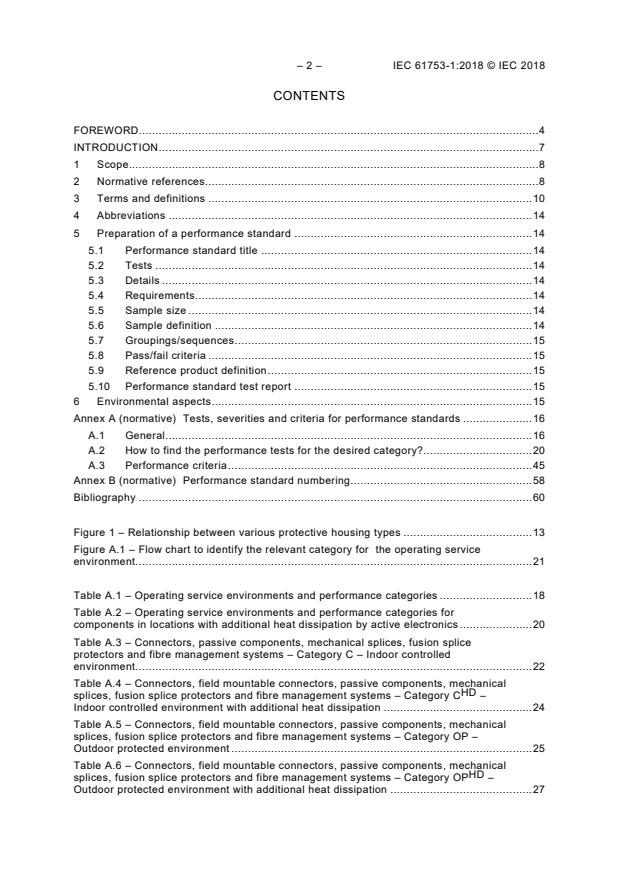
IEC 61753-1:2018 - Fibre optic interconnecting devices and passive components - Performance standard - Part 1: General and guidance
Frequently Asked Questions
IEC 61753-1:2018 is a standard published by the International Electrotechnical Commission (IEC). Its full title is "Fibre optic interconnecting devices and passive components - Performance standard - Part 1: General and guidance". This standard covers: IEC 61753-1:2018 provides guidance for the drafting of performance standards for all passive fibre optic products. This document defines the tests and severities which form the performance categories or general operating service environments and identifies those tests which are considered to be product specific. Test and severity details are given in Annex A. This second edition cancels and replaces the first edition published in 2007. It constitutes a technical revision. This edition includes the following significant technical changes with respect to the previous edition: a) definitions updated with new products: wall outlets, wall or pole mounted boxes, splices, ODF modules, street cabinets, hardened connectors and field mountable connectors; b) categories U and O are replaced by categories OP and OP+. No mandatory sequence in category OP+. Category OP+ contains the tests from category OP with the addition of only 4 other tests; c) addition of Category I (Industrial); d) temperature ranges added (with the HD suffix to the categories C, OP, OP+ and I) in case passive optical components are placed in a housing together with active electronics (HD stands for “heat dissipation”); e) the height of category A changed from 3 m to ground level (0 m); f) the lower level height of category G environment changed from ground level (0 m) to –1 m below ground level. Upper level remains at 3 m above ground level; g) addition of performance tests, test severities and performance criteria for new products: Wall outlet, wall or pole mounted boxes, mechanical splices, fusion splice protectors, ODF modules, street cabinets, field mountable connectors and hardened optical connectors; h) test severity of "Mating durability" test for connectors in categories C, OP ,OP+ and I is reduced to 200 cycles for connectors with cylindrical ferrules and 50 cycles for connectors with rectangular ferrules; i) test severity of "Change of temperature" test for connectors and passive optical components in category I is reduced from 20 cycles to 12 cycles (harmonized with connectors and components from other categories); j) test severity of "Flexing of strain relief" test for connectors in categories C, OP and OP+ is reduced to 50 cycles; k) test severities of "Assembly and disassembly of fibre optic mechanical splices, fibre management systems and closures" test for all enclosures is reduced to 5 cycles; l) test severities of "Change of temperature" test for all protective housings in categories C, A, G and S is reduced from 20 cycles to 12 cycles (harmonized with connectors and components); m) test severities of "Resistance to solvents and contaminating fluids" test for closures in categories G and S changed – kerosene is removed, diesel oil exposure reduced to 1 h immersion and 24 h drying at room temperature; n) sealing performance criteria of sealed closures for categories G and A are reduced to 20 kPa overpressure. o) the change in attenuation criterion for connectors has changed from peak-to-peak into a +/- deviation from the original value of the transmitted power at the start of the test (harmonized with the change in attenuation criterion for components, splices and protective housings). Keywords: performance standards for all passive fibre optic products The contents of the corrigendum of May 2019 have been included in this copy.
IEC 61753-1:2018 provides guidance for the drafting of performance standards for all passive fibre optic products. This document defines the tests and severities which form the performance categories or general operating service environments and identifies those tests which are considered to be product specific. Test and severity details are given in Annex A. This second edition cancels and replaces the first edition published in 2007. It constitutes a technical revision. This edition includes the following significant technical changes with respect to the previous edition: a) definitions updated with new products: wall outlets, wall or pole mounted boxes, splices, ODF modules, street cabinets, hardened connectors and field mountable connectors; b) categories U and O are replaced by categories OP and OP+. No mandatory sequence in category OP+. Category OP+ contains the tests from category OP with the addition of only 4 other tests; c) addition of Category I (Industrial); d) temperature ranges added (with the HD suffix to the categories C, OP, OP+ and I) in case passive optical components are placed in a housing together with active electronics (HD stands for “heat dissipation”); e) the height of category A changed from 3 m to ground level (0 m); f) the lower level height of category G environment changed from ground level (0 m) to –1 m below ground level. Upper level remains at 3 m above ground level; g) addition of performance tests, test severities and performance criteria for new products: Wall outlet, wall or pole mounted boxes, mechanical splices, fusion splice protectors, ODF modules, street cabinets, field mountable connectors and hardened optical connectors; h) test severity of "Mating durability" test for connectors in categories C, OP ,OP+ and I is reduced to 200 cycles for connectors with cylindrical ferrules and 50 cycles for connectors with rectangular ferrules; i) test severity of "Change of temperature" test for connectors and passive optical components in category I is reduced from 20 cycles to 12 cycles (harmonized with connectors and components from other categories); j) test severity of "Flexing of strain relief" test for connectors in categories C, OP and OP+ is reduced to 50 cycles; k) test severities of "Assembly and disassembly of fibre optic mechanical splices, fibre management systems and closures" test for all enclosures is reduced to 5 cycles; l) test severities of "Change of temperature" test for all protective housings in categories C, A, G and S is reduced from 20 cycles to 12 cycles (harmonized with connectors and components); m) test severities of "Resistance to solvents and contaminating fluids" test for closures in categories G and S changed – kerosene is removed, diesel oil exposure reduced to 1 h immersion and 24 h drying at room temperature; n) sealing performance criteria of sealed closures for categories G and A are reduced to 20 kPa overpressure. o) the change in attenuation criterion for connectors has changed from peak-to-peak into a +/- deviation from the original value of the transmitted power at the start of the test (harmonized with the change in attenuation criterion for components, splices and protective housings). Keywords: performance standards for all passive fibre optic products The contents of the corrigendum of May 2019 have been included in this copy.
IEC 61753-1:2018 is classified under the following ICS (International Classification for Standards) categories: 33.180.20 - Fibre optic interconnecting devices. The ICS classification helps identify the subject area and facilitates finding related standards.
IEC 61753-1:2018 has the following relationships with other standards: It is inter standard links to IEC 61753-1:2018/AMD1:2020, IEC 61753-1:2018/COR1:2019, IEC 61753-1:2007. Understanding these relationships helps ensure you are using the most current and applicable version of the standard.
IEC 61753-1:2018 is available in PDF format for immediate download after purchase. The document can be added to your cart and obtained through the secure checkout process. Digital delivery ensures instant access to the complete standard document.
Standards Content (Sample)
IEC 61753-1 ®
Edition 2.1 2020-06
CONSOLIDATED VERSION
INTERNATIONAL
STANDARD
colour
inside
Fibre optic interconnecting devices and passive components – Performance
standard –
Part 1: General and guidance
All rights reserved. Unless otherwise specified, no part of this publication may be reproduced or utilized in any form
or by any means, electronic or mechanical, including photocopying and microfilm, without permission in writing from
either IEC or IEC's member National Committee in the country of the requester. If you have any questions about IEC
copyright or have an enquiry about obtaining additional rights to this publication, please contact the address below or
your local IEC member National Committee for further information.
IEC Central Office Tel.: +41 22 919 02 11
3, rue de Varembé info@iec.ch
CH-1211 Geneva 20 www.iec.ch
Switzerland
About the IEC
The International Electrotechnical Commission (IEC) is the leading global organization that prepares and publishes
International Standards for all electrical, electronic and related technologies.
About IEC publications
The technical content of IEC publications is kept under constant review by the IEC. Please make sure that you have the
latest edition, a corrigendum or an amendment might have been published.
IEC publications search - webstore.iec.ch/advsearchform Electropedia - www.electropedia.org
The advanced search enables to find IEC publications by a The world's leading online dictionary on electrotechnology,
variety of criteria (reference number, text, technical containing more than 22 000 terminological entries in English
committee,…). It also gives information on projects, replaced and French, with equivalent terms in 16 additional languages.
and withdrawn publications. Also known as the International Electrotechnical Vocabulary
(IEV) online.
IEC Just Published - webstore.iec.ch/justpublished
Stay up to date on all new IEC publications. Just Published IEC Glossary - std.iec.ch/glossary
details all new publications released. Available online and 67 000 electrotechnical terminology entries in English and
once a month by email. French extracted from the Terms and definitions clause of
IEC publications issued between 2002 and 2015. Some
IEC Customer Service Centre - webstore.iec.ch/csc entries have been collected from earlier publications of IEC
If you wish to give us your feedback on this publication or TC 37, 77, 86 and CISPR.
need further assistance, please contact the Customer Service
Centre: sales@iec.ch.
IEC 61753-1 ®
Edition 2.1 2020-06
CONSOLIDATED VERSION
INTERNATIONAL
STANDARD
colour
inside
Fibre optic interconnecting devices and passive components – Performance
standard –
Part 1: General and guidance
INTERNATIONAL
ELECTROTECHNICAL
COMMISSION
ICS 33.180.20 ISBN 978-2-8322-8581-7
IEC 61753-1 ®
Edition 2.1 2020-06
REDLINE VERSION
colour
inside
Fibre optic interconnecting devices and passive components – Performance
standard –
Part 1: General and guidance
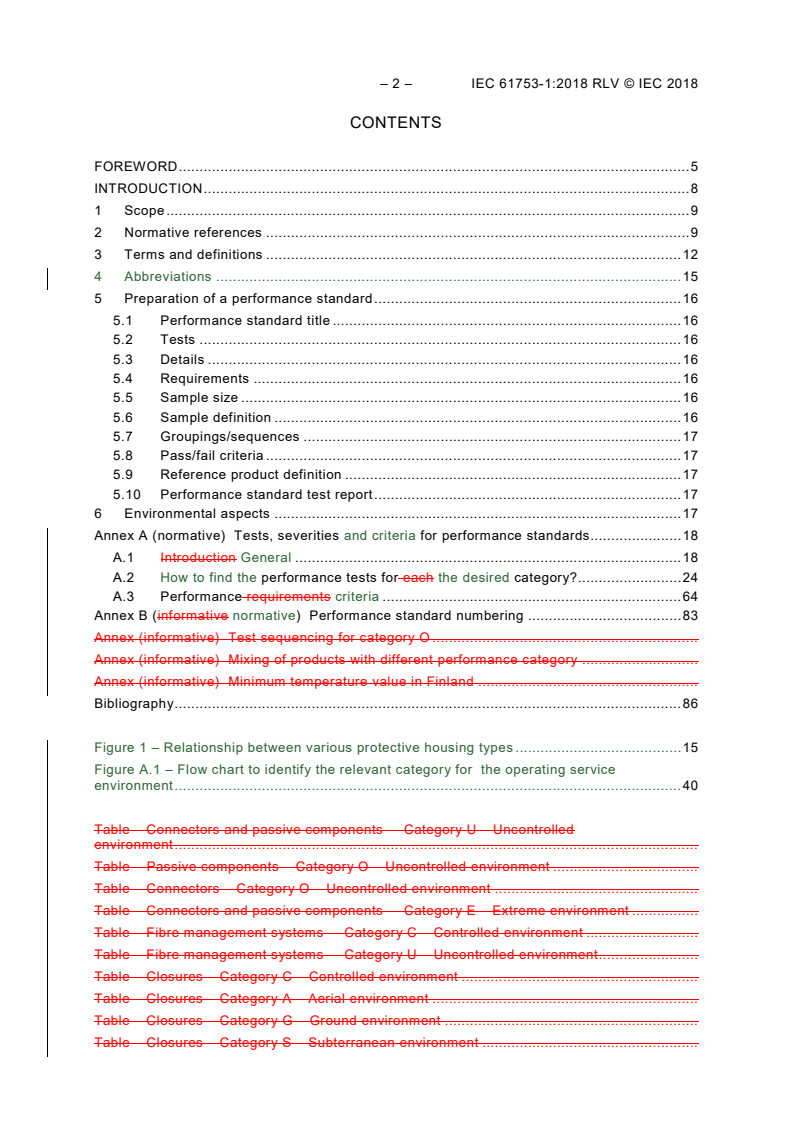
– 2 – IEC 61753-1:2018+AMD1:2020 CSV
© IEC 2020
CONTENTS
FOREWORD . 4
INTRODUCTION . 7
1 Scope . 8
2 Normative references . 8
3 Terms and definitions . 10
4 Abbreviations . 14
5 Preparation of a performance standard . 14
5.1 Performance standard title . 14
5.2 Tests . 14
5.3 Details . 14
5.4 Requirements . 14
5.5 Sample size . 14
5.6 Sample definition . 14
5.7 Groupings/sequences . 15
5.8 Pass/fail criteria . 15
5.9 Reference product definition . 15
5.10 Performance standard test report . 15
6 Environmental aspects . 15
Annex A (normative) Tests, severities and criteria for performance standards . 16
A.1 General . 16
A.2 How to find the performance tests for the desired category? . 20
A.3 Performance criteria . 45
Annex B (normative) Performance standard numbering. 58
Bibliography . 59
Figure 1 – Relationship between various protective housing types . 13
Figure A.1 – Flow chart to identify the relevant category for the operating service
environment . 21
Table A.1 – Operating service environments and performance categories . 18
Table A.2 – Operating service environments and performance categories for
components in locations with additional heat dissipation by active electronics . 20
Table A.3 – Connectors, passive components, mechanical splices, fusion splice
protectors and fibre management systems – Category C – Indoor controlled
environment . 22
Table A.4 – Connectors, field mountable connectors, passive components, mechanical
HD
splices, fusion splice protectors and fibre management systems – Category C –
Indoor controlled environment with additional heat dissipation . 24
Table A.5 – Connectors, field mountable connectors, passive components, mechanical
splices, fusion splice protectors and fibre management systems – Category OP –
Outdoor protected environment . 25
Table A.6 – Connectors, field mountable connectors, passive components, mechanical
HD
splices, fusion splice protectors and fibre management systems – Category OP –
Outdoor protected environment with additional heat dissipation . 27
© IEC 2020
Table A.7 – Connectors, field mountable connectors, passive components, mechanical
splices, fusion splice protectors and fibre management systems – Category OP+ –
Extended outdoor protected environment . 28
Table A.8 – Connectors, field mountable connectors, passive components, mechanical
HD
splices, fusion splice protectors and fibre management systems – Category OP+ –
Extended outdoor protected environment with additional heat dissipation . 28
Table A.9 – Connectors, passive optical components – Category I – Industrial
environment . 29
HD
Table A.10 – Connectors, passive optical components – Category I – Industrial
environment with additional heat dissipation . 31
Table A.11 – Connectors and passive optical components – Category E – Extreme
environment . 32
Table A.12 – Wall outlets, boxes, optical distribution frame modules and closures –
Category C – Indoor controlled environment . 34
Table A.13 – Hardened optical connectors, street cabinets, boxes and closures
Category A – Outdoor aerial environment . 36
Table A.14 – Hardened optical connectors and closures – Category G – Outdoor
ground environment . 39
Table A.15 – Hardened optical connectors and closures – Category S – Outdoor
subterranean environment . 42
Table A.16 – Single mode connectors . 45
Table A.17 – Single mode field mountable connectors . 46
Table A.18 – Multi mode connectors . 47
Table A.19 – Single mode mechanical splices . 48
Table A.20 – Multi mode mechanical splices . 49
Table A.21 – Single mode fusion splice protectors . 49
Table A.22 – Passive optical components . 50
Table A.23 – Fibre management systems . 51
Table A.24 – Category C – Wall outlets and boxes . 52
Table A.25 – Category C – Optical distribution frame modules (OFDM) . 53
Table A.26 – Category A, single mode boxes, street cabinets and free breathing
closures . 54
Table A.27 – Category C, A, G and S single mode sealed closures . 55
Table A.28 – Category A, G and S single mode hardened fibre optic connectors . 56
– 4 – IEC 61753-1:2018+AMD1:2020 CSV
© IEC 2020
INTERNATIONAL ELECTROTECHNICAL COMMISSION
____________
FIBRE OPTIC INTERCONNECTING DEVICES AND
PASSIVE COMPONENTS – PERFORMANCE STANDARD –
Part 1: General and guidance
FOREWORD
1) The International Electrotechnical Commission (IEC) is a worldwide organization for standardization comprising
all national electrotechnical committees (IEC National Committees). The object of IEC is to promote
international co-operation on all questions concerning standardization in the electrical and electronic fields. To
this end and in addition to other activities, IEC publishes International Standards, Technical Specifications,
Technical Reports, Publicly Available Specifications (PAS) and Guides (hereafter referred to as "IEC
Publication(s)"). Their preparation is entrusted to technical committees; any IEC National Committee interested
in the subject dealt with may participate in this preparatory work. International, governmental and non-
governmental organizations liaising with the IEC also participate in this preparation. IEC collaborates closely
with the International Organization for Standardization (ISO) in accordance with conditions determined by
agreement between the two organizations.
2) The formal decisions or agreements of IEC on technical matters express, as nearly as possible, an international
consensus of opinion on the relevant subjects since each technical committee has representation from all
interested IEC National Committees.
3) IEC Publications have the form of recommendations for international use and are accepted by IEC National
Committees in that sense. While all reasonable efforts are made to ensure that the technical content of IEC
Publications is accurate, IEC cannot be held responsible for the way in which they are used or for any
misinterpretation by any end user.
4) In order to promote international uniformity, IEC National Committees undertake to apply IEC Publications
transparently to the maximum extent possible in their national and regional publications. Any divergence
between any IEC Publication and the corresponding national or regional publication shall be clearly indicated in
the latter.
5) IEC itself does not provide any attestation of conformity. Independent certification bodies provide conformity
assessment services and, in some areas, access to IEC marks of conformity. IEC is not responsible for any
services carried out by independent certification bodies.
6) All users should ensure that they have the latest edition of this publication.
7) No liability shall attach to IEC or its directors, employees, servants or agents including individual experts and
members of its technical committees and IEC National Committees for any personal injury, property damage or
other damage of any nature whatsoever, whether direct or indirect, or for costs (including legal fees) and
expenses arising out of the publication, use of, or reliance upon, this IEC Publication or any other IEC
Publications.
8) Attention is drawn to the Normative references cited in this publication. Use of the referenced publications is
indispensable for the correct application of this publication.
9) Attention is drawn to the possibility that some of the elements of this IEC Publication may be the subject of
patent rights. IEC shall not be held responsible for identifying any or all such patent rights.
This consolidated version of the official IEC Standard and its amendment has been
prepared for user convenience.
IEC 61753-1 edition 2.1 contains the second edition (2018-08) [documents
86B/4131/FDIS and 86B/4137/RVD] and its corrigendum (2019-05), and its amendment 1
(2020-06) [documents 86B/4253/CDV and 86B/4288A/RVC].
In this Redline version, a vertical line in the margin shows where the technical content
is modified by amendment 1. Additions are in green text, deletions are in strikethrough
red text. A separate Final version with all changes accepted is available in this
publication.
© IEC 2020
International Standard IEC 61753-1 has been prepared by subcommittee 86B: Fibre optic
interconnecting devices and passive components, of IEC technical committee 86: Fibre optics.
This second edition constitutes a technical revision.
This edition includes the following significant technical changes with respect to the previous
edition:
a) definitions updated with new products: wall outlets, wall or pole mounted boxes, splices,
ODF modules, street cabinets, hardened connectors and field mountable connectors;
b) categories U and O are replaced by categories OP and OP+. No mandatory sequence in
category OP+. Category OP+ contains the tests from category OP with the addition of only
4 other tests;
c) addition of Category I (Industrial);
d) temperature ranges added (with the HD suffix to the categories C, OP, OP+ and I) in case
passive optical components are placed in a housing together with active electronics (HD
stands for “heat dissipation”);
e) the height of category A changed from 3 m to ground level (0 m);
f) the lower level height of category G environment changed from ground level (0 m) to –1 m
below ground level. Upper level remains at 3 m above ground level;
g) addition of performance tests, test severities and performance criteria for new products:
Wall outlet, wall or pole mounted boxes, mechanical splices, fusion splice protectors, ODF
modules, street cabinets, field mountable connectors and hardened optical connectors;
h) test severity of "Mating durability" test for connectors in categories C, OP ,OP+ and I is
reduced to 200 cycles for connectors with cylindrical ferrules and 50 cycles for connectors
with rectangular ferrules;
i) test severity of "Change of temperature" test for connectors and passive optical
components in category I is reduced from 20 cycles to 12 cycles (harmonized with
connectors and components from other categories);
j) test severity of "Flexing of strain relief" test for connectors in categories C, OP and OP+ is
reduced to 50 cycles;
k) test severities of "Assembly and disassembly of fibre optic mechanical splices, fibre
management systems and closures" test for all enclosures is reduced to 5 cycles;
l) test severities of "Change of temperature" test for all protective housings in categories C,
A, G and S is reduced from 20 cycles to 12 cycles (harmonized with connectors and
components);
m) test severities of "Resistance to solvents and contaminating fluids" test for closures in
categories G and S changed – kerosene is removed, diesel oil exposure reduced to 1 h
immersion and 24 h drying at room temperature;
n) sealing performance criteria of sealed closures for categories G and A are reduced to
20 kPa overpressure.
o) the change in attenuation criterion for connectors has changed from peak-to-peak into a
+/- deviation from the original value of the transmitted power at the start of the test
(harmonized with the change in attenuation criterion for components, splices and
protective housings).
This document has been drafted in accordance with the ISO/IEC Directives, Part 2.
A list of all parts in the IEC 61753 series, published under the general title Fibre optic
interconnecting devices and passive components – Performance standard, can be found on the
IEC website.
– 6 – IEC 61753-1:2018+AMD1:2020 CSV
© IEC 2020
The committee has decided that the contents of the base publication and its amendment will
remain unchanged until the stability date indicated on the IEC web site under
"http://webstore.iec.ch" in the data related to the specific publication. At this date, the
publication will be
• reconfirmed,
• withdrawn,
• replaced by a revised edition, or
• amended.
IMPORTANT – The 'colour inside' logo on the cover page of this publication indicates
that it contains colours which are considered to be useful for the correct
understanding of its contents. Users should therefore print this document using a
colour printer.
© IEC 2020
INTRODUCTION
The IEC 61753 series is dealing with performance standards for all passive fibre optic
products, including connectors, passive optical components, fibre management systems and
various protective housings. The standard is published in multiple parts. This part, Part 1,
covers general information on performance standards. Subsequent parts are known as
performance standards and are numbered according to the classification defined in Annex B.
These standards contain the minimum test and measurement severities which are common to
all passive fibre optic products, for a particular service environment or performance category,
and the test and measurement severities which are considered specific to that particular
product in that environment.
Performance Standards define the requirements for standard optical performance under a set
of specified conditions. Each standard contains a series or a set of tests and measurements
with clearly stated conditions, severities and pass/fail criteria. The series of tests, commonly
referred to as an operating service environment or performance category, is intended to be
run on a ‘one-off’ basis to prove the product’s ability to satisfy the requirements of a specific
application, market sector or user group.
This document define those sets of tests which form each operating service environment or
performance category and which have been standardised for international use. A product that
has been shown to meet all the requirements of a performance standard can be declared as
complying with that performance standard.
Products having the same classification from one manufacturer that satisfy a performance
standard, will operate within the boundaries set by the performance standard. Intermateability
or interchangeability of products from different suppliers (having the same classification and
conforming to the same performance standard) can only be guaranteed when these products
also meet the interface standards. Only in this condition will an equivalent level of
performance be provided when they are used together (for example, in the case of optical
connectors).
Conformance to a performance standard is not a guarantee of lifetime assured performance
or reliability. Reliability testing is the subject of a separate test schedule, where the tests and
severities selected are truly representative of the requirements of this reliability test
programme. Consistency of manufacture will be maintained using a recognised quality
assurance programme whilst the reliability of product will be evaluated using the procedures
recommended in IEC 62005 (all parts).
Tests and measurements are selected from IEC 61300 (all parts). Where this is not possible,
the required test method is attached as an annex to the performance standard.
– 8 – IEC 61753-1:2018+AMD1:2020 CSV
© IEC 2020
FIBRE OPTIC INTERCONNECTING DEVICES AND
PASSIVE COMPONENTS – PERFORMANCE STANDARD –
Part 1: General and guidance
1 Scope
This part of IEC 61753 provides guidance for the drafting of performance standards for all
passive fibre optic products.
This document defines the tests and severities which form the performance categories or
general operating service environments and identifies those tests which are considered to be
product specific. Test and severity details are given in Annex A.
2 Normative references
The following documents are referred to in the text in such a way that some or all of their
content constitutes requirements of this document. For dated references, only the edition
cited applies. For undated references, the latest edition of the referenced document (including
any amendments) applies.
IEC 60529, Degrees of protection provided by enclosures (IP Code)
IEC 61300 (all parts), Fibre optic interconnecting devices and passive components – Basic
test and measurement procedures
IEC 61300-2-1, Fibre optic interconnecting devices and passive components – Basic test and
measurement procedures – Part 2-1: Tests – Vibration (sinusoidal)
IEC 61300-2-2, Fibre optic interconnecting devices and passive components – Basic test and
measurement procedures – Part 2-2: Tests – Mating durability
IEC 61300-2-4, Fibre optic interconnecting devices and passive components – Basic test and
measurement procedures – Part 2-4: Tests – Fibre/cable retention
IEC 61300-2-5, Fibre optic interconnecting devices and passive components – Basic test and
measurement procedures – Part 2-5: Tests – Torsion
IEC 61300-2-6, Fibre optic interconnecting devices and passive components – Basic test and
measurement procedures – Part 2-6: Tests – Tensile strength of coupling mechanism
IEC 61300-2-7, Fibre optic interconnecting devices and passive components – Basic test and
measurement procedures – Part 2-7: Tests – Bending moment
IEC 61300-2-9, Fibre optic interconnecting devices and passive components – Basic test and
measurement procedures – Part 2-9: Tests – Shock
IEC 61300-2-10, Fibre optic interconnecting devices and passive components – Basic test
and measurement procedures – Part 2-10: Tests – Crush resistance
IEC 61300-2-11, Fibre optic interconnecting devices and passive components – Basic test
and measurement procedures – Part 2-11: Tests – Axial compression
© IEC 2020
IEC 61300-2-12, Fibre optic interconnecting devices and passive components – Basic test
and measurement procedures – Part 2-12: Tests – Impact
IEC 61300-2-17, Fibre optic interconnecting devices and passive components – Basic test
and measurement procedures – Part 2-17: Tests – Cold
IEC 61300-2-18, Fibre optic interconnecting devices and passive components – Basic test
and measurement procedures – Part 2-18: Tests – Dry heat – High temperature endurance
IEC 61300-2-19, Fibre optic interconnecting devices and passive components – Basic test
and measurement procedures – Part 2-19: Tests – Damp heat (steady state)
IEC 61300-2-21, Fibre optic interconnecting devices and passive components – Basic test
and measurement procedures – Part 2-21: Tests – Composite temperature/humidity cyclic
test
IEC 61300-2-22, Fibre optic interconnecting devices and passive components – Basic test
and measurement procedures – Part 2-22: Tests – Change of temperature
IEC 61300-2-23, Fibre optic interconnecting devices and passive components – Basic test
and measurement procedures – Part 2-23: Tests – Sealing for non-pressurized closures of
fibre optic devices
IEC 61300-2-26, Fibre optic interconnecting devices and passive components – Basic test
and measurement procedures – Part 2-26: Tests – Salt mist
IEC 61300-2-27, Fibre optic interconnecting devices and passive components – Basic test
and measurement procedures – Part 2-27: Tests – Dust – Laminar flow
IEC 61300-2-28, Fibre optic interconnecting devices and passive components – Basic test
and measurement procedures – Part 2-28: Tests – Corrosive atmosphere (sulphur dioxide)
IEC 61300-2-33, Fibre optic interconnecting devices and passive components – Basic test
and measurement procedures – Part 2-33: Tests – Assembly and disassembly of fibre optic
mechanical splices, fibre management systems and closures
IEC 61300-2-34, Fibre optic interconnecting devices and passive components – Basic test
and measurement procedures – Part 2-34: Tests – Resistance to solvents and contamining
fluids of interconnecting components and closures
IEC 61300-2-35, Fibre optic interconnecting devices and passive components – Basic test
and measurement procedures – Part 2-35: Tests – Cable nutation
IEC 61300-2-37, Fibre optic interconnecting devices and passive components – Basic test
and measurement procedures – Part 2-37: Tests – Cable bending for fibre optic closures
IEC 61300-2-38, Fibre optic interconnecting devices and passive components – Basic test
and measurement procedures – Part 2-38: Tests – Sealing for pressurized fibre optic closures
IEC 61300-2-42, Fibre optic interconnecting devices and passive components – Basic test
and measurement procedures – Part 2-42: Tests – Static side load for strain relief
IEC 61300-2-44, Fibre optic interconnecting devices and passive components – Basic test
and measurement procedures – Part 2-44: Tests – Flexing of the strain relief of fibre optic
devices
– 10 – IEC 61753-1:2018+AMD1:2020 CSV
© IEC 2020
IEC 61300-2-45, Fibre optic interconnecting devices and passive components – Basic test
and measurement procedures – Part 2-45: Tests – Durability test by water immersion
IEC 61300-2-46, Fibre optic interconnecting devices and passive components – Basic test
and measurement procedures – Part 2-46: Tests – Damp heat, cyclic
IEC 61300-2-50, Fibre optic interconnecting devices and passive components – Basic test
and measurement procedures – Part 2-50: Tests – Fibre optic connector proof test with static
load – Singlemode and multimode
IEC 61300-3-3, Fibre optic interconnecting devices and passive components – Basic test and
measurement procedures – Part 3-3: Examinations and measurements – Active monitoring of
changes in attenuation and return loss
IEC 61300-3-4, Fibre optic interconnecting devices and passive components – Basic test and
measurement procedures – Part 3-4: Examinations and measurements – Attenuation
IEC 61300-3-6, Fibre optic interconnecting devices and passive components – Basic test and
measurement procedures – Part 3-6: Examinations and measurements – Return loss
IEC 61300-3-7, Fibre optic interconnecting devices and passive components – Basic test and
measurement procedures – Part 3-7: Examinations and measurements – Wavelength
dependence of attenuation and return loss of single mode components
IEC 61300-3-28, Fibre optic interconnecting devices and passive components – Basic test
and measurement procedures – Part 3-28: Examinations and measurements – Transient loss
IEC 61300-3-29, Fibre optic interconnecting devices and passive components – Basic test
and measurement procedures – Part 3-29: Examinations and measurements – Spectral
transfer characteristics of DWDM devices
IEC 61300-3-34, Fibre optic interconnecting devices and passive components – Basic test
and measurement procedures – Part 3-34: Examinations and measurements – Attenuation of
random mated connectors
IEC 61300-3-45, Fibre optic interconnecting devices and passive components – Basic test
and measurement procedures – Part 3-45: Examinations and measurements – Attenuation of
random mated multi-fibre connectors
IEC Guide 109, Environmental aspects – Inclusion in electrotechnical product standards
ISO 1998-1:1998, Petroleum industry – Terminology – Part 1: Raw materials and products
3 Terms and definitions
For the purposes of this document, the following terms and definitions apply.
ISO and IEC maintain terminological databases for use in standardization at the following
addresses:
• IEC Electropedia: available at http://www.electropedia.org/
• ISO Online browsing platform: available at http://www.iso.org/obp
NOTE Terms and definitions for various components can be found in IEC TS 62538 and in the relevant IEC 61753
series performance standards.
© IEC 2020
3.1
adaptor
component that permits mating between a connector and another optical component
Note 1 to entry: Another optical component is a connector plug, an active device, a passive optical component.
3.2
box
free breathing housing that is permanently fixed to a wall or pole
Note 1 to entry: A box is not specifically designed to allow cable movement (e.g. torsion, bending) at the cable
ports during operation.
3.3
connector
component normally attached to a cable or piece of apparatus for the purpose of providing
interconnection and disconnection of fibre optic cables
3.4
fibre management system
FMS
system to control, protect and store splices, connectors, passive optical components and
fibres from incoming to outgoing cables
Note 1 to entry: Splice trays or organiser trays are parts of a fibre management system.
3.5
fibre splice
permanent or separable joint between optical fibres achieved by either fusion splicing or
mechanical splicing
3.6
field mountable connector
FMC
connector which is mounted directly onto fibre or fibre cable in the field
3.7
free breathing closure
protective housing that allows a free exchange of air with the environment
Note 1 to entry: A free breathing closure may look like a sealed closure, but it is not designed to hold a varying
overpressure or underpressure caused by temperature changes or atmospheric pressure changes. Free breathing
closures are used in aerial environments for the interconnection of cables.
Note 2 to entry: Limited water ingress and/or limited dust ingress is possible. Free breathing closures are not
intended for use in areas that are subject to flooding or water immersion.
3.8
hardened fibre optic connector
water and dust tight connector
Note 1 to entry: A hardened fibre optic connector is typically used as connection in outside plant.
3.9
MICE
classification system that describes the environment conditions that are local to a channel
based upon the following factors:
– mechanical (M),
– ingress (I),
– climatic and chemical (C),
– 12 – IEC 61753-1:2018+AMD1:2020 CSV
© IEC 2020
– electromagnetic (E)
Note 1 to entry: The term MICE is referenced in the generic cabling standards produced by ISO/IEC JTC1 SC25
and relates to the classification of the environment local to the cabling channel.
There are four primary environmental criteria used to classify an environment:
– the M element, defining the mechanical characteristics of the environment;
– the I element, defining the ingress protection characteristics of the environment;
– the C element, defining the climatic and chemical characteristics of the environment;
– the E element, defining the electromagnetic characteristics of the environment.
Each of the four primary environmental criteria is further divided into specific parameters and levels for those
parameters. The MICE classification for a given location is therefore defined as MaIbCcEd where a, b, c and d are
the individual sub-classifications (levels) for the M, I, C and E criteria respectively.
The suffices for the four primary environmental criteria are either 1, 2 or 3. For example, the most benign
environment is described as M1I1C1E1 whereas the most harsh environment would be defined as M3I3C3E3.
Note 2 to entry: The E element is considered not relevant to passive optical components.
[SOURCE: ISO/IEC 24702:2006, 3.1.11, modified – The notes have been added.]
3.10
optical distribution frame module
ODF module
ODFM
housing which is mountable in a supporting structure
Note 1 to entry: An ODFM contains a fibre management system and can provide rearrangeable interconnections
between the incoming to the outgoing cables.
Note 2 to entry: The supporting structure that houses the ODFM is often called an equipment rack.
3.11
operating service environment
typical service environment or operating location simulated by a performance category
3.12
performance category
series of tests and measurements with clearly stated conditions and severities, which are
chosen to simulate a particular operating service environment
3.13
performance standard
standard which is designed to verify that a product is capable of meeting the requirements of
a particular service environment
Note 1 to entry: A performance standard contains a combination of those tests, together with their severities and
pass-fail criteria, which are applied to all passive fibre optic products for a particular performance category,
together with those which are considered specific to that particular product in that environment.
3.14
performance standard test report
report to be produced on completion of testing to a performance standard
3.15
product specific tests
tests which are considered to be specific to a particular product category or type
Note 1 to entry: Where there is a specific IP requirement for a product, this is the subject of a separate test and is
included in the relevant product performance standard.
Note 2 to entry: Where there is a specific requirement for a product, this is the subject of a separate test and is
included in the relevant product performance standard.
© IEC 2020
3.16
protective housing
indoor and outdoor housing utilised for the storage, distribution or protection of one or more
cable joints or any passive or active telecom equipment
Note 1 to entry: Examples of protective housings: wall boxes, cabinets, cases, optical distribution frame sub racks,
closures or pedestals as shown in Figure 1. A closure can be either a "sealed closure" or a "free breathing closure".
Note 2 to entry: The protective housing contains a fibre management system.
Protective housings
Air and water tight Free breathing
Free breathing
closures
Sealed closures ODFM
Street cabinets
Wall outlets
Boxes
IEC
Figure 1 – Relationship between various protective housing types
3.17
sealed closure
watertight and dust-tight housing that can hold a varying overpressure or underpressure
caused by temperature changes or atmospheric pressure changes
Note 1 to entry: There is no exchange of air with the outside environment when exposed to temperatures over the
specified operating temperature range.
Note 2 to entry: Although often referred to as hermetic sealed closures, humidity can enter the inner closure by
diffusion.
Note 3 to entry: Sealed boxes or sealed wall outlets shall be treated as sealed closures.
Note 4 to entry: Complete inner filled housings are also considered to be sealed closures.
3.18
street cabinet
free outdoor breathing above ground-installed housing that is permanently attached to the
ground
Note 1 to entry: A street cabinet is permanently fixed to the ground and is not specifically designed to allow cable
movement (e.g. torsion, bending) during operation.
3.19
wall outlet
free breathing housing with fixed connecting devices where the horizontal cable terminates
Note 1 to entry: The wall outlet provides the interface to work area cabling.
– 14 – IEC 61753-1:2018+AMD1:2020 CSV
© IEC 2020
4 Abbreviations
FMC field mountable connector
FMS fibre management system
ODFM optical distribution frame module
5 Preparation of a performance standard
5.1 Performance standard title
The performance standard title shall be clear. This information shall include
– the product description,
– the appropriate performance category, and
– any other variant or differentiation information to distinguish it from other performance
standards.
5.2 Tests
The tests to be carried out on the product in order for it to meet the performance standard
shall be clearly defined, including those which are product specific. No ambiguity or options
shall be allowed.
The selected tests combined with the severities/durations, groupings/sequencing, method
used and pass/fail criteria shall be indicative of a defined operating service environment.
The test method to be used shall be clearly defined for each test. Wherever possible, the test
method shall be selected from the IEC 61300 (all parts), but where this is not possible other
test methods may be defined. If an undefined test method is used, the test method and details
to be specified shall be included in the appropriate annex of the performance standard.
Performance standards may call up additional tests that may be needed to fully characterise a
particular connector or component.
5.3 Details
The details to be considered (severities and durations) shall be given for all tests and
measurements defined in a performance standard. They shall be directly related to the
performance requirements defined by the operating service environment. No ambiguity or
options are allowed.
5.4 Requirements
The performance requirements that shall be satisfied in order for the product to comply with
the performance standard shall be specified for each test and/or measurement. No
ambiguities are allowed.
5.5 Sample size
The sample size for each test shall be defined in the appropriate annex of the performance
standard. No deviations are allowed.
5.6 Sample definition
The sample to be tested shall be defined in the relevant performance standard.
© IEC 2020
5.7 Groupings/sequences
In general, no sequencing is required and each test is intended to be performed individually.
When applicable, test groups and test sequences can be required by the user, user group or
manufacturer.
5.8 Pass/fail criteria
Where required by the performance category, the pass/fail criteria shall be unambiguously
stated for each test within the performance standard. No deviation or exceptions are allowed.
5.9 Reference product definition
Where a performance standard requires the use of a reference product or component, the
reference product shall be clearly defined in the appropriate annex of the performance
standard.
5.10 Performance standard test report
Conformance to a performance standard shall be supported by a test report. The test report
shall clearly demonstrate that the tests were carried out in accordance with the requirements
of the performance standard and provide full details of the tests together with a pass/fail
declaration. All test and measurement requirements shall be satisfied before a component
may be declared to be in compliance with the performance standard.
The failure of any product to comply with a particular test or sequence of tests shall be
reported in the performance standard test report. An analysis of the cause of the failure shall
be undertaken and any corrective actions taken shall be described.
If no design changes are made to the product, the test or test sequence where the failure
occurred shall be rerun with the results of both tests reported.
If design changes are made, another complete performance standard test programme shall be
undertaken. Any tests previously completed successfully shall be repeated with new samples.
6 Environmental aspects
The requirements concerning the reduction of adverse environmental impacts over the whole
life cycle of products are not covered in this document. The appropriate environmental
aspects shall be implemented according to the guidelines in IEC Guide 109.
– 16 – IEC 61753-1:2018+AMD1:2020 CSV
© IEC 2020
Annex A
(normative)
Tests, severities and criteria for performance standards
A.1 General
Annex A defines the tests, the recommended severities and the recommended performance
criteria for the various performance categories, which reflect the operating service
environments applicable to passive fibre optic products. The list of the operating service
environments is given in Table A.1 and Table A.2.
The performance standards of the following components are covered by this document:
– fibre optic connectors and adaptors;
– field mountable connectors (FMC);
– splices (fusion splice protectors and mechanical splices);
– passive optical components;
– fibre management systems (FMS);
– hardened connectors.
The performance standards of the following protective housings are covered by this document:
– wall outlets (indoor applications only);
– boxes (wall mounted and pole mounted);
– street cabinets;
– optical distribution frame modules (ODFM);
– closures (sealed closures and free breathing closures).
The choice of tests and associated severities in each performance category is based
...
IEC 61753-1 ®
Edition 2.0 2018-08
REDLINE VERSION
INTERNATIONAL
STANDARD
colour
inside
Fibre optic interconnecting devices and passive components – Performance
standard –
Part 1: General and guidance for performance standards
All rights reserved. Unless otherwise specified, no part of this publication may be reproduced or utilized in any form
or by any means, electronic or mechanical, including photocopying and microfilm, without permission in writing from
either IEC or IEC's member National Committee in the country of the requester. If you have any questions about IEC
copyright or have an enquiry about obtaining additional rights to this publication, please contact the address below or
your local IEC member National Committee for further information.
IEC Central Office Tel.: +41 22 919 02 11
3, rue de Varembé info@iec.ch
CH-1211 Geneva 20 www.iec.ch
Switzerland
About the IEC
The International Electrotechnical Commission (IEC) is the leading global organization that prepares and publishes
International Standards for all electrical, electronic and related technologies.
About IEC publications
The technical content of IEC publications is kept under constant review by the IEC. Please make sure that you have the
latest edition, a corrigenda or an amendment might have been published.
IEC Catalogue - webstore.iec.ch/catalogue Electropedia - www.electropedia.org
The stand-alone application for consulting the entire The world's leading online dictionary of electronic and
bibliographical information on IEC International Standards, electrical terms containing 21 000 terms and definitions in
Technical Specifications, Technical Reports and other English and French, with equivalent terms in 16 additional
documents. Available for PC, Mac OS, Android Tablets and languages. Also known as the International Electrotechnical
iPad. Vocabulary (IEV) online.
IEC publications search - webstore.iec.ch/advsearchform IEC Glossary - std.iec.ch/glossary
The advanced search enables to find IEC publications by a 67 000 electrotechnical terminology entries in English and
variety of criteria (reference number, text, technical French extracted from the Terms and Definitions clause of
committee,…). It also gives information on projects, replaced IEC publications issued since 2002. Some entries have been
and withdrawn publications. collected from earlier publications of IEC TC 37, 77, 86 and
CISPR.
IEC Just Published - webstore.iec.ch/justpublished
Stay up to date on all new IEC publications. Just Published IEC Customer Service Centre - webstore.iec.ch/csc
details all new publications released. Available online and If you wish to give us your feedback on this publication or
also once a month by email. need further assistance, please contact the Customer Service
Centre: sales@iec.ch.
IEC 61753-1 ®
Edition 2.0 2018-08
REDLINE VERSION
INTERNATIONAL
STANDARD
colour
inside
Fibre optic interconnecting devices and passive components – Performance
standard –
Part 1: General and guidance for performance standards
INTERNATIONAL
ELECTROTECHNICAL
COMMISSION
ICS 33.180.20 ISBN 978-2-8322-5970-2
– 2 – IEC 61753-1:2018 RLV © IEC 2018
CONTENTS
FOREWORD . 5
INTRODUCTION . 8
1 Scope . 9
2 Normative references . 9
3 Terms and definitions . 12
4 Abbreviations . 15
5 Preparation of a performance standard . 16
5.1 Performance standard title . 16
5.2 Tests . 16
5.3 Details . 16
5.4 Requirements . 16
5.5 Sample size . 16
5.6 Sample definition . 16
5.7 Groupings/sequences . 17
5.8 Pass/fail criteria . 17
5.9 Reference product definition . 17
5.10 Performance standard test report . 17
6 Environmental aspects . 17
Annex A (normative) Tests, severities and criteria for performance standards . 18
A.1 Introduction General . 18
A.2 How to find the performance tests for each the desired category? . 24
A.3 Performance requirements criteria . 64
Annex B (informative normative) Performance standard numbering . 83
Annex (informative) Test sequencing for category O .
Annex (informative) Mixing of products with different performance category .
Annex (informative) Minimum temperature value in Finland .
Bibliography . 86
Figure 1 – Relationship between various protective housing types . 15
Figure A.1 – Flow chart to identify the relevant category for the operating service
environment . 40
Table – Connectors and passive components – Category U – Uncontrolled
environment .
Table – Passive components – Category O – Uncontrolled environment .
Table – Connectors – Category O – Uncontrolled environment .
Table – Connectors and passive components – Category E – Extreme environment .
Table – Fibre management systems – Category C – Controlled environment .
Table – Fibre management systems – Category U – Uncontrolled environment .
Table – Closures – Category C – Controlled environment .
Table – Closures – Category A – Aerial environment .
Table – Closures – Category G – Ground environment .
Table – Closures – Category S – Subterranean environment .
Table – Connectors .
Table – Closures .
Table – Test sequence for passive optical components category O .
Table – Test sequence connectors category O .
Table A.1 – General Operating service environments and performance categories . 20
Table A.2 – Operating service environments and performance categories for
components in locations with additional heat dissipation by active electronics . 23
Table A.3 – Connectors, passive components, mechanical splices, fusion splice
protectors and fibre management systems – Category C – Indoor controlled
environment . 41
Table A.4 – Connectors, field mountable connectors, passive components, mechanical
HD
splices, fusion splice protectors and fibre management systems – Category C –
Indoor controlled environment with additional heat dissipation . 43
Table A.5 – Connectors, field mountable connectors, passive components, mechanical
splices, fusion splice protectors and fibre management systems – Category OP –
Outdoor protected environment . 44
Table A.6 – Connectors, field mountable connectors, passive components, mechanical
HD
splices, fusion splice protectors and fibre management systems – Category OP –
Outdoor protected environment with additional heat dissipation . 46
Table A.7 – Connectors, field mountable connectors, passive components, mechanical
splices, fusion splice protectors and fibre management systems – Category OP+ –
Extended outdoor protected environment . 47
Table A.8 – Connectors, field mountable connectors, passive components, mechanical
HD
splices, fusion splice protectors and fibre management systems – Category OP+ –
Extended outdoor protected environment with additional heat dissipation . 47
Table A.9 – Connectors, passive optical components – Category I – Industrial
environment . 48
HD
Table A.10 – Connectors, passive optical components – Category I – Industrial
environment with additional heat dissipation . 50
Table A.11 – Connectors and passive optical components – Category E – Extreme
environment . 51
Table A.12 – Wall outlets, boxes, optical distribution frame modules and closures –
Category C – Indoor controlled environment . 53
Table A.13 – Hardened optical connectors, street cabinets, boxes and closures
Category A – Outdoor aerial environment . 55
Table A.14 – Hardened optical connectors and closures – Category G – Outdoor
ground environment . 58
Table A.15 – Hardened optical connectors and closures – Category S – Outdoor
subterranean environment . 61
Table A.16 – Single mode connectors . 66
Table A.17 – Single mode field mountable connectors . 67
Table A.18 – Multi mode connectors . 68
Table A.19 – Single mode mechanical splices . 69
Table A.20 – Multi mode mechanical splices . 70
Table A.21 – Single mode fusion splice protectors . 70
Table A.22 – Passive optical components . 71
Table A.23 – Fibre management systems . 72
Table A.24 – Category C – Wall outlets and boxes . 73
Table A.25 – Category C – Optical distribution frame modules (OFDM) . 74
– 4 – IEC 61753-1:2018 RLV © IEC 2018
Table A.26 – Category A, single mode boxes, street cabinets and free breathing
closures . 75
Table A.27 – Category C, A, G and S single mode sealed closures . 76
Table A.28 – Category A, G and S single mode hardened fibre optic connectors . 77
INTERNATIONAL ELECTROTECHNICAL COMMISSION
____________
FIBRE OPTIC INTERCONNECTING DEVICES AND
PASSIVE COMPONENTS – PERFORMANCE STANDARD –
Part 1: General and guidance for performance standards
FOREWORD
1) The International Electrotechnical Commission (IEC) is a worldwide organization for standardization comprising
all national electrotechnical committees (IEC National Committees). The object of IEC is to promote
international co-operation on all questions concerning standardization in the electrical and electronic fields. To
this end and in addition to other activities, IEC publishes International Standards, Technical Specifications,
Technical Reports, Publicly Available Specifications (PAS) and Guides (hereafter referred to as "IEC
Publication(s)"). Their preparation is entrusted to technical committees; any IEC National Committee interested
in the subject dealt with may participate in this preparatory work. International, governmental and non-
governmental organizations liaising with the IEC also participate in this preparation. IEC collaborates closely
with the International Organization for Standardization (ISO) in accordance with conditions determined by
agreement between the two organizations.
2) The formal decisions or agreements of IEC on technical matters express, as nearly as possible, an international
consensus of opinion on the relevant subjects since each technical committee has representation from all
interested IEC National Committees.
3) IEC Publications have the form of recommendations for international use and are accepted by IEC National
Committees in that sense. While all reasonable efforts are made to ensure that the technical content of IEC
Publications is accurate, IEC cannot be held responsible for the way in which they are used or for any
misinterpretation by any end user.
4) In order to promote international uniformity, IEC National Committees undertake to apply IEC Publications
transparently to the maximum extent possible in their national and regional publications. Any divergence
between any IEC Publication and the corresponding national or regional publication shall be clearly indicated in
the latter.
5) IEC itself does not provide any attestation of conformity. Independent certification bodies provide conformity
assessment services and, in some areas, access to IEC marks of conformity. IEC is not responsible for any
services carried out by independent certification bodies.
6) All users should ensure that they have the latest edition of this publication.
7) No liability shall attach to IEC or its directors, employees, servants or agents including individual experts and
members of its technical committees and IEC National Committees for any personal injury, property damage or
other damage of any nature whatsoever, whether direct or indirect, or for costs (including legal fees) and
expenses arising out of the publication, use of, or reliance upon, this IEC Publication or any other IEC
Publications.
8) Attention is drawn to the Normative references cited in this publication. Use of the referenced publications is
indispensable for the correct application of this publication.
9) Attention is drawn to the possibility that some of the elements of this IEC Publication may be the subject of
patent rights. IEC shall not be held responsible for identifying any or all such patent rights.
This redline version of the official IEC Standard allows the user to identify the changes
made to the previous edition. A vertical bar appears in the margin wherever a change
has been made. Additions are in green text, deletions are in strikethrough red text.
– 6 – IEC 61753-1:2018 RLV © IEC 2018
International Standard IEC 61753-1 has been prepared by subcommittee 86B: Fibre optic
interconnecting devices and passive components, of IEC technical committee 86: Fibre optics.
This second edition cancels and replaces the first edition published in 2007. It constitutes a
technical revision.
This edition includes the following significant technical changes with respect to the previous
edition:
a) definitions updated with new products: wall outlets, wall or pole mounted boxes, splices,
ODF modules, street cabinets, hardened connectors and field mountable connectors;
b) categories U and O are replaced by categories OP and OP+. No mandatory sequence in
category OP+. Category OP+ contains the tests from category OP with the addition of only
4 other tests;
c) addition of Category I (Industrial);
d) temperature ranges added (with the HD suffix to the categories C, OP, OP+ and I) in case
passive optical components are placed in a housing together with active electronics (HD
stands for “heat dissipation”);
e) the height of category A changed from 3 m to ground level (0 m);
f) the lower level height of category G environment changed from ground level (0 m) to –1 m
below ground level. Upper level remains at 3 m above ground level;
g) addition of performance tests, test severities and performance criteria for new products:
Wall outlet, wall or pole mounted boxes, mechanical splices, fusion splice protectors, ODF
modules, street cabinets, field mountable connectors and hardened optical connectors;
h) test severity of "Mating durability" test for connectors in categories C, OP ,OP+ and I is
reduced to 200 cycles for connectors with cylindrical ferrules and 50 cycles for connectors
with rectangular ferrules;
i) test severity of "Change of temperature" test for connectors and passive optical
components in category I is reduced from 20 cycles to 12 cycles (harmonized with
connectors and components from other categories);
j) test severity of "Flexing of strain relief" test for connectors in categories C, OP and OP+ is
reduced to 50 cycles;
k) test severities of "Assembly and disassembly of fibre optic mechanical splices, fibre
management systems and closures" test for all enclosures is reduced to 5 cycles;
l) test severities of "Change of temperature" test for all protective housings in categories C,
A, G and S is reduced from 20 cycles to 12 cycles (harmonized with connectors and
components);
m) test severities of "Resistance to solvents and contaminating fluids" test for closures in
categories G and S changed – kerosene is removed, diesel oil exposure reduced to 1 h
immersion and 24 h drying at room temperature;
n) sealing performance criteria of sealed closures for categories G and A are reduced to
20 kPa overpressure.
o) the change in attenuation criterion for connectors has changed from peak-to-peak into a
+/- deviation from the original value of the transmitted power at the start of the test
(harmonized with the change in attenuation criterion for components, splices and
protective housings).
The text of this International Standard is based on the following documents:
FDIS Report on voting
86B/4131/FDIS 86B/4137/RVD
Full information on the voting for the approval of this International Standard can be found in
the report on voting indicated in the above table.
This document has been drafted in accordance with the ISO/IEC Directives, Part 2.
A list of all parts in the IEC 61753 series, published under the general title Fibre optic
interconnecting devices and passive components – Performance standard, can be found on the
IEC website.
The committee has decided that the contents of this document will remain unchanged until the
stability date indicated on the IEC website under "http://webstore.iec.ch" in the data related to
the specific document. At this date, the document will be
• reconfirmed,
• withdrawn,
• replaced by a revised edition, or
• amended.
IMPORTANT – The 'colour inside' logo on the cover page of this publication indicates
that it contains colours which are considered to be useful for the correct
understanding of its contents. Users should therefore print this document using a
colour printer.
The contents of the corrigendum of May 2019 have been included in this copy.
– 8 – IEC 61753-1:2018 RLV © IEC 2018
INTRODUCTION
The IEC 61753 series is dealing with performance standards for all passive fibre optic
products, including connectors, passive optical components, fibre management systems and
various protective housings. The standard is published in multiple parts. This part, Part 1,
covers general information on performance standards. Subsequent parts are known as
performance standards and are numbered according to the classification defined in Annex B.
These standards contain the minimum test and measurement severities which are common to
all passive fibre optic products, for a particular service environment or performance category,
and the test and measurement severities which are considered specific to that particular
product in that environment.
Performance Standards define the requirements for standard optical performance under a set
of specified conditions. Each standard contains a series or a set of tests and measurements
with clearly stated conditions, severities and pass/fail criteria. The series of tests, commonly
referred to as an operating service environment or performance category, is intended to be
run on a ‘one-off’ basis to prove the product’s ability to satisfy the requirements of a specific
application, market sector or user group.
This document define those sets of tests which form each operating service environment or
performance category and which have been standardised for international use. A product that
has been shown to meet all the requirements of a performance standard may can be declared
as complying with that performance standard.
Products having the same classification from one manufacturer that satisfy a performance
standard, will operate within the boundaries set by the performance standard. Intermateability
or interchangeability of products from different suppliers (having the same classification and
conforming to the same performance standard) can only be guaranteed when these products
also meet the interface standards. Only in this condition will an equivalent level of
performance be provided when they are used together (for example, in the case of optical
connectors).
Conformance to a performance standard is not a guarantee of lifetime assured performance
or reliability. Reliability testing must be is the subject of a separate test schedule, where the
tests and severities selected are truly representative of the requirements of this reliability test
programme. Consistency of manufacture should will be maintained using a recognised quality
assurance programme whilst the reliability of product should will be evaluated using the
procedures recommended in IEC 62005 (all parts).
Tests and measurements are selected from IEC 61300 (all parts). Where this is not possible,
the required test method is attached as an annex to the performance standard.
FIBRE OPTIC INTERCONNECTING DEVICES AND
PASSIVE COMPONENTS – PERFORMANCE STANDARD –
Part 1: General and guidance for performance standards
1 Scope
This part of IEC 61753 deals with provides guidance for the drafting of performance standards
for all passive fibre optic products, including connectors, passive optical components, fibre
management systems and closures. The IEC 61753 series is published in multiple parts.
This Part 1 covers general information on performance standards. This document defines the
tests and severities which form the performance categories or general operating service
environments and identifies those tests which are considered to be product specific. Test and
severity details are given in Annex A. Part 1 also includes references, definitions and rules for
creating a performance standard, together with informative annexes, such as a description of
test sequencing given in Annex B, and other pertinent information.
Subsequent parts which form IEC 61753 are known as performance standards and are
numbered according to the classification defined in Annex C. These standards contain the
minimum test and measurement severities which a specific product must satisfy, in order to
be categorized as meeting the requirements for use in a particular service environment. A
product performance standard will contain a combination of those tests and measurements
which are common to all passive fibre optic products, for a particular service environment or
performance category, and those which are considered specific to that particular product in
that environment.
2 Normative references
The following documents are referred to in the text in such a way that some or all of their
content constitutes requirements of this document. For dated references, only the edition
cited applies. For undated references, the latest edition of the referenced document (including
any amendments) applies.
IEC 60529, Degrees of protection provided by enclosures (IP Code)
IEC 60590, Determination of the aromatic hydrocarbon content of new mineral insulating oils
IEC 61300 (all parts), Fibre optic interconnecting devices and passive components – Basic
test and measurement procedures
IEC 61300-2-1, Fibre optic interconnecting devices and passive components – Basic test and
measurement procedures – Part 2-1: Tests – Vibration (sinusoidal)
IEC 61300-2-2, Fibre optic interconnecting devices and passive components – Basic test and
measurement procedures – Part 2-2: Tests – Mating durability
IEC 61300-2-4, Fibre optic interconnecting devices and passive components – Basic test and
measurement procedures – Part 2-4: Tests – Fibre/cable retention
IEC 61300-2-5, Fibre optic interconnecting devices and passive components – Basic test and
measurement procedures – Part 2-5: Tests – Torsion/Twist
– 10 – IEC 61753-1:2018 RLV © IEC 2018
IEC 61300-2-6, Fibre optic interconnecting devices and passive components – Basic test and
measurement procedures – Part 2-6: Tests – Tensile strength of coupling mechanism
IEC 61300-2-7:1995, Fibre optic interconnecting devices and passive components – Basic
test and measurement procedures – Part 2-7: Tests – Bending moment
IEC 61300-2-9, Fibre optic interconnecting devices and passive components – Basic test and
measurement procedures – Part 2-9: Tests – Shock
IEC 61300-2-10:1995, Fibre optic interconnecting devices and passive components – Basic
test and measurement procedures – Part 2-10: Tests – Crush resistance
IEC 61300-2-11:1995, Fibre optic interconnecting devices and passive components – Basic
test and measurement procedures – Part 2-11: Tests – Axial compression
IEC 61300-2-12, Fibre optic interconnecting devices and passive components – Basic test
and measurement procedures – Part 2-12: Tests – Impact
IEC 61300-2-17, Fibre optic interconnecting devices and passive components – Basic test
and measurement procedures – Part 2-17: Tests – Cold
IEC 61300-2-18, Fibre optic interconnecting devices and passive components – Basic test
and measurement procedures – Part 2-18: Tests – Dry heat – High temperature endurance
IEC 61300-2-19, Fibre optic interconnecting devices and passive components – Basic test
and measurement procedures – Part 2-19: Tests – Damp heat (steady state)
IEC 61300-2-21, Fibre optic interconnecting devices and passive components – Basic test
and measurement procedures – Part 2-21: Tests – Composite temperature/humidity cyclic
test
IEC 61300-2-22, Fibre optic interconnecting devices and passive components – Basic test
and measurement procedures – Part 2-22: Tests – Change of temperature
IEC 61300-2-23, Fibre optic interconnecting devices and passive components – Basic test
and measurement procedures – Part 2-23: Tests – Sealing for non-pressurized closures of
fibre optic devices
IEC 61300-2-26, Fibre optic interconnecting devices and passive components – Basic test
and measurement procedures – Part 2-26: Tests – Salt mist
IEC 61300-2-27, Fibre optic interconnecting devices and passive components – Basic test
and measurement procedures – Part 2-27: Tests – Dust – Laminar flow
IEC 61300-2-28, Fibre optic interconnecting devices and passive components – Basic test
and measurement procedures – Part 2-28: Tests – Industrial Corrosive atmosphere (sulphur
dioxide)
IEC 61300-2-33, Fibre optic interconnecting devices and passive components – Basic test
and measurement procedures – Part 2-33: Tests – Assembly and disassembly of fibre optic
mechanical splices, fibre management systems and closures
IEC 61300-2-34, Fibre optic interconnecting devices and passive components – Basic test
and measurement procedures – Part 2-34: Tests – Resistance to solvents and contamining
fluids of interconnecting components and closures
IEC 61300-2-35, Fibre optic interconnecting devices and passive components – Basic test
and measurement procedures – Part 2-35: Tests – Cable nutation
IEC 61300-2-37, Fibre optic interconnecting devices and passive components – Basic test
and measurement procedures – Part 2-37: Tests – Cable bending for fibre optic closures
IEC 61300-2-38, Fibre optic interconnecting devices and passive components – Basic test
and measurement procedures – Part 2-38: Tests – Sealing for pressurized closures of fibre
optic devices closures
IEC 61300-2-42, Fibre optic interconnecting devices and passive components – Basic test
and measurement procedures – Part 2-42: Tests – Static side load for connectors strain relief
IEC 61300-2-44, Fibre optic interconnecting devices and passive components – Basic test
and measurement procedures – Part 2-44: Tests – Flexing of the strain relief of fibre optic
devices
IEC 61300-2-45, Fibre optic interconnecting devices and passive components – Basic test
and measurement procedures – Part 2-45: Tests – Durability test by water immersion
IEC 61300-2-46, Fibre optic interconnecting devices and passive components – Basic test
and measurement procedures – Part 2-46: Tests – Damp heat, cyclic
IEC 61300-2-48, Fibre optic interconnecting devices and passive components – Basic test
and measurement procedures – Part 2-48: Tests – Temperature-humidity cycling
IEC 61300-2-49, Fibre optic interconnecting devices and passive components – Basic test
and measurement procedures – Part 2-49: Tests – Connector Installation test
IEC 61300-2-50, Fibre optic interconnecting devices and passive components – Basic test
and measurement procedures – Part 2-50: Tests – Fibre optic connector proof test with static
load – Singlemode and multimode
IEC 61300-2-51 Fibre optic interconnecting devices and passive components – Basic test and
measurement procedures – Part 2-51: Tests – Fibre optic connector test for transmission with
applied tensile load – singlemode and multimode
IEC 61300-3-3, Fibre optic interconnecting devices and passive components – Basic test and
measurement procedures – Part 3-3: Examinations and measurements – Active monitoring of
changes in attenuation and return loss
IEC 61300-3-4, Fibre optic interconnecting devices and passive components – Basic test and
measurement procedures – Part 3-4: Examinations and measurements – Attenuation
IEC 61300-3-6, Fibre optic interconnecting devices and passive components – Basic test and
measurement procedures – Part 3-6: Examinations and measurements – Return loss
IEC 61300-3-7, Fibre optic interconnecting devices and passive components – Basic test and
measurement procedures – Part 3-7: Examinations and measurements – Wavelength
dependence of attenuation and return loss of single mode components
IEC 61300-3-28, Fibre optic interconnecting devices and passive components – Basic test
and measurement procedures – Part 3-28: Examinations and measurements – Transient loss
IEC 61300-3-29, Fibre optic interconnecting devices and passive components – Basic test
and measurement procedures – Part 3-29: Examinations and measurements – Spectral
transfer characteristics of DWDM devices
– 12 – IEC 61753-1:2018 RLV © IEC 2018
IEC 61300-3-34, Fibre optic interconnecting devices and passive components – Basic test
and measurement procedures – Part 3-34: Examinations and measurements – Attenuation of
random mated connectors
IEC 61300-3-45, Fibre optic interconnecting devices and passive components – Basic test
and measurement procedures – Part 3-45: Examinations and measurements – Attenuation of
random mated multi-fibre connectors
IEC Guide 109, Environmental aspects – Inclusion in electrotechnical product standards
ISO 1998 (all parts), Petroleum industry – Terminology
ISO 1998-1:1998, Petroleum industry – Terminology – Part 1: Raw materials and products
3 Terms and definitions
For the purposes of this document, the following terms and definitions apply.
ISO and IEC maintain terminological databases for use in standardization at the following
addresses:
• IEC Electropedia: available at http://www.electropedia.org/
• ISO Online browsing platform: available at http://www.iso.org/obp
NOTE Terms and definitions for various components can be found in IEC TS 62538 and in the relevant IEC
61753 series performance standards or generic specification.
3.1
adaptor
component that permits mating between a connector and another optical component
Note 1 to entry: Another optical component is a connector plug, an active device, a passive optical component.
3.2
box
free breathing housing that is permanently fixed to a wall or pole
Note 1 to entry: A box is not specifically designed to allow cable movement (e.g. torsion, bending) at the cable
ports during operation.
3.3
connector
component normally attached to a cable or piece of apparatus for the purpose of providing
interconnection and disconnection of fibre optic cables
3.4
fibre management system
FMS
system to control, protect and store splices, connectors, passive optical components and
fibres from incoming to outgoing cables
Note 1 to entry: Splice trays or organiser trays are parts of a fibre management system.
3.5
fibre splice
permanent or separable joint between optical fibres achieved by either fusion splicing or
mechanical splicing
3.6
field mountable connector
FMC
connector which is mounted directly onto fibre or fibre cable in the field
3.7
free breathing closure
protective housing that allows a free exchange of air with the environment
Note 1 to entry: A free breathing closure may look like a sealed closure, but it is not designed to hold a varying
overpressure or underpressure caused by temperature changes or atmospheric pressure changes. Free breathing
closures are used in aerial environments for the interconnection of cables.
Note 2 to entry: Limited water ingress and/or limited dust ingress is possible. Free breathing closures are not
intended for use in areas that are subject to flooding or water immersion.
3.8
hardened fibre optic connector
water and dust tight connector
Note 1 to entry: A hardened fibre optic connector is typically used as connection in outside plant.
3.9
MICE
classification system that describes the environment conditions that are local to a channel
based upon the following factors:
– mechanical (M),
– ingress (I),
– climatic and chemical (C),
– electromagnetic (E)
Note 1 to entry: The term MICE is referenced in the generic cabling standards produced by ISO/IEC JTC1 SC25
and relates to the classification of the environment local to the cabling channel.
There are four primary environmental criteria used to classify an environment:
– the M element, defining the mechanical characteristics of the environment;
– the I element, defining the ingress protection characteristics of the environment;
– the C element, defining the climatic and chemical characteristics of the environment;
– the E element, defining the electromagnetic characteristics of the environment.
Each of the four primary environmental criteria is further divided into specific parameters and levels for those
parameters. The MICE classification for a given location is therefore defined as MaIbCcEd where a, b, c and d are
the individual sub-classifications (levels) for the M, I, C and E criteria respectively.
The suffices for the four primary environmental criteria are either 1, 2 or 3. For example, the most benign
environment is described as M1I1C1E1 whereas the most harsh environment would be defined as M3I3C3E3.
Note 2 to entry: The E element is considered not relevant to passive optical components.
[SOURCE: ISO/IEC 24702:2006, 3.1.11, modified – The notes have been added.]
3.10
optical distribution frame module
ODF module
ODFM
housing which is mountable in a supporting structure
Note 1 to entry: An ODFM contains a fibre management system and can provide rearrangeable interconnections
between the incoming to the outgoing cables.
Note 2 to entry: The supporting structure that houses the ODFM is often called an equipment rack.
– 14 – IEC 61753-1:2018 RLV © IEC 2018
3.11
operating service environment
typical service environment or operating location simulated by a performance category
3.12
performance category
series of tests and measurements (which may or may not be grouped into a specific sequence)
with clearly stated conditions and severities, which are chosen to simulate a particular
operating service environment
3.13
performance standard
standard which is designed to verify that a product is capable of meeting the requirements of
a particular service environment
Note 1 to entry: A performance standard contains a combination of those tests, together with their severities and
pass-fail criteria, which shall be are applied to all passive fibre optic products for a particular performance category,
together with those which are considered specific to that particular product in that environment.
3.14
performance standard test report
report to be produced on completion of testing to a performance standard
3.15
product specific tests
tests which are considered to be specific to a particular product category or type, e.g.
connectors, attenuators, enclosures for aerial applications
Note 1 to entry: Where there is a specific IP requirement for a product, this shall be is the subject of a separate
test and shall be is included in the relevant product performance standard.
Note 2 to entry: Where there is a specific requirement for a product, this is the subject of a separate test and is
included in the relevant product performance standard.
3.16
protective housing
indoor and outdoor housing utilised for the storage, distribution or protection of one or more
cable joints or any passive or active telecom equipment
Note 1 to entry: Examples of protective housings: wall boxes, cabinets, cases, optical distribution frame sub racks,
closures or pedestals as shown in Figure 1. A closure can be either a "sealed closure" or a "free breathing closure".
Note 2 to entry: The protective housing contains a fibre management system.
Protective housings
Air and water tight Free breathing
Free breathing
closures
Sealed closures ODFM
Street cabinets
Wall outlets
Boxes
IEC
Figure 1 – Relationship between various protective housing types
3.17
sealed closure
watertight and dust-tight housing that can hold a varying overpressure or underpressure
caused by temperature changes or atmospheric pressure changes
Note 1 to entry: There is no exchange of air with the outside environment when exposed to temperatures over the
specified operating temperature range.
Note 2 to entry: Although often referred to as hermetic sealed closures, humidity can enter the inner closure by
diffusion.
Note 3 to entry: Sealed boxes or sealed wall outlets shall be treated as sealed closures.
Note 4 to entry: Complete inner filled housings are also considered to be sealed closures.
3.18
street cabinet
free outdoor breathing above ground-installed housing that is permanently attached to the
ground
Note 1 to entry: A street cabinet is permanently fixed to the ground and is not specifically designed to allow cable
movement (e.g. torsion, bending) during operation.
3.19
wall outlet
free breathing housing with fixed connecting devices where the horizontal cable terminates
Note 1 to entry: The wall outlet provides the interface to work area cabling.
4 Abbreviations
FMC field mountable connector
FMS fibre management system
ODFM optical distribution frame module
– 16 – IEC 61753-1:2018 RLV © IEC 2018
5 Preparation of a performance standard
In the preparation of a performance standard, the following items shall be considered and
defined, together with any relevant instructions pertaining to them.
5.1 Performance standard title
The performance standard title shall be clear. This information shall include
– the product description,
– the appropriate performance category, and
– any other variant or differentiation information to distinguish it from other performance
standards.
5.2 Tests
The tests to be carried out on the product in order for it to meet the performance standard
shall be clearly defined, including those which are product specific. No ambiguity or options
shall be allowed.
The selected tests combined with the severities/durations, groupings/sequencing, method
used and pass/fail criteria shall be indicative of a defined operating service environment.
The test method to be used shall be clearly defined for each test. Wherever possible, the test
method shall be selected from the IEC 61300 (all parts), but where this is not possible other
test methods may be defined.
...
IEC 61753-1 ®
Edition 2.1 2020-06
CONSOLIDATED VERSION
INTERNATIONAL
STANDARD
NORME
INTERNATIONALE
colour
inside
Fibre optic interconnecting devices and passive components – Performance
standard –
Part 1: General and guidance
Dispositifs d’interconnexion et composants passifs à fibres optiques – Norme
de performance –
Partie 1 : Généralités et recommandations
All rights reserved. Unless otherwise specified, no part of this publication may be reproduced or utilized in any form
or by any means, electronic or mechanical, including photocopying and microfilm, without permission in writing from
either IEC or IEC's member National Committee in the country of the requester. If you have any questions about IEC
copyright or have an enquiry about obtaining additional rights to this publication, please contact the address below or
your local IEC member National Committee for further information.
Droits de reproduction réservés. Sauf indication contraire, aucune partie de cette publication ne peut être reproduite
ni utilisée sous quelque forme que ce soit et par aucun procédé, électronique ou mécanique, y compris la photocopie
et les microfilms, sans l'accord écrit de l'IEC ou du Comité national de l'IEC du pays du demandeur. Si vous avez des
questions sur le copyright de l'IEC ou si vous désirez obtenir des droits supplémentaires sur cette publication, utilisez
les coordonnées ci-après ou contactez le Comité national de l'IEC de votre pays de résidence.
IEC Central Office Tel.: +41 22 919 02 11
3, rue de Varembé info@iec.ch
CH-1211 Geneva 20 www.iec.ch
Switzerland
About the IEC
The International Electrotechnical Commission (IEC) is the leading global organization that prepares and publishes
International Standards for all electrical, electronic and related technologies.
About IEC publications
The technical content of IEC publications is kept under constant review by the IEC. Please make sure that you have the
latest edition, a corrigendum or an amendment might have been published.
IEC publications search - webstore.iec.ch/advsearchform Electropedia - www.electropedia.org
The advanced search enables to find IEC publications by a The world's leading online dictionary on electrotechnology,
variety of criteria (reference number, text, technical containing more than 22 000 terminological entries in English
committee,…). It also gives information on projects, replaced and French, with equivalent terms in 16 additional languages.
and withdrawn publications. Also known as the International Electrotechnical Vocabulary
(IEV) online.
IEC Just Published - webstore.iec.ch/justpublished
Stay up to date on all new IEC publications. Just Published IEC Glossary - std.iec.ch/glossary
details all new publications released. Available online and 67 000 electrotechnical terminology entries in English and
once a month by email. French extracted from the Terms and definitions clause of
IEC publications issued between 2002 and 2015. Some
IEC Customer Service Centre - webstore.iec.ch/csc entries have been collected from earlier publications of IEC
If you wish to give us your feedback on this publication or TC 37, 77, 86 and CISPR.
need further assistance, please contact the Customer Service
Centre: sales@iec.ch.
A propos de l'IEC
La Commission Electrotechnique Internationale (IEC) est la première organisation mondiale qui élabore et publie des
Normes internationales pour tout ce qui a trait à l'électricité, à l'électronique et aux technologies apparentées.
A propos des publications IEC
Le contenu technique des publications IEC est constamment revu. Veuillez vous assurer que vous possédez l’édition la
plus récente, un corrigendum ou amendement peut avoir été publié.
Recherche de publications IEC - Electropedia - www.electropedia.org
webstore.iec.ch/advsearchform Le premier dictionnaire d'électrotechnologie en ligne au
La recherche avancée permet de trouver des publications IEC monde, avec plus de 22 000 articles terminologiques en
en utilisant différents critères (numéro de référence, texte, anglais et en français, ainsi que les termes équivalents dans
comité d’études,…). Elle donne aussi des informations sur les 16 langues additionnelles. Egalement appelé Vocabulaire
projets et les publications remplacées ou retirées. Electrotechnique International (IEV) en ligne.
IEC Just Published - webstore.iec.ch/justpublished Glossaire IEC - std.iec.ch/glossary
Restez informé sur les nouvelles publications IEC. Just 67 000 entrées terminologiques électrotechniques, en anglais
Published détaille les nouvelles publications parues. et en français, extraites des articles Termes et définitions des
Disponible en ligne et une fois par mois par email. publications IEC parues entre 2002 et 2015. Plus certaines
entrées antérieures extraites des publications des CE 37, 77,
Service Clients - webstore.iec.ch/csc 86 et CISPR de l'IEC.
Si vous désirez nous donner des commentaires sur cette
publication ou si vous avez des questions contactez-nous:
sales@iec.ch.
IEC 61753-1 ®
Edition 2.1 2020-06
CONSOLIDATED VERSION
INTERNATIONAL
STANDARD
NORME
INTERNATIONALE
colour
inside
Fibre optic interconnecting devices and passive components – Performance
standard –
Part 1: General and guidance
Dispositifs d’interconnexion et composants passifs à fibres optiques – Norme
de performance –
Partie 1 : Généralités et recommandations
INTERNATIONAL
ELECTROTECHNICAL
COMMISSION
COMMISSION
ELECTROTECHNIQUE
INTERNATIONALE
ICS 33.180.20 ISBN 978-2-8322-8982-2
IEC 61753-1 ®
Edition 2.1 2020-06
CONSOLIDATED VERSION
REDLINE VERSION
VERSION REDLINE
colour
inside
Fibre optic interconnecting devices and passive components – Performance
standard –
Part 1: General and guidance
Dispositifs d’interconnexion et composants passifs à fibres optiques – Norme
de performance –
Partie 1 : Généralités et recommandations
– 2 – IEC 61753-1:2018+AMD1:2020 CSV
© IEC 2020
CONTENTS
FOREWORD . 4
INTRODUCTION . 7
1 Scope . 8
2 Normative references . 8
3 Terms and definitions . 10
4 Abbreviations . 14
5 Preparation of a performance standard . 14
5.1 Performance standard title . 14
5.2 Tests . 14
5.3 Details . 14
5.4 Requirements . 14
5.5 Sample size . 14
5.6 Sample definition . 14
5.7 Groupings/sequences . 15
5.8 Pass/fail criteria . 15
5.9 Reference product definition . 15
5.10 Performance standard test report . 15
6 Environmental aspects . 15
Annex A (normative) Tests, severities and criteria for performance standards . 16
A.1 General . 16
A.2 How to find the performance tests for the desired category? . 20
A.3 Performance criteria . 45
Annex B (normative) Performance standard numbering. 58
Bibliography . 59
Figure 1 – Relationship between various protective housing types . 13
Figure A.1 – Flow chart to identify the relevant category for the operating service
environment . 21
Table A.1 – Operating service environments and performance categories . 18
Table A.2 – Operating service environments and performance categories for
components in locations with additional heat dissipation by active electronics . 20
Table A.3 – Connectors, passive components, mechanical splices, fusion splice
protectors and fibre management systems – Category C – Indoor controlled
environment . 22
Table A.4 – Connectors, field mountable connectors, passive components, mechanical
HD
splices, fusion splice protectors and fibre management systems – Category C –
Indoor controlled environment with additional heat dissipation . 24
Table A.5 – Connectors, field mountable connectors, passive components, mechanical
splices, fusion splice protectors and fibre management systems – Category OP –
Outdoor protected environment . 25
Table A.6 – Connectors, field mountable connectors, passive components, mechanical
HD
splices, fusion splice protectors and fibre management systems – Category OP –
Outdoor protected environment with additional heat dissipation . 27
© IEC 2020
Table A.7 – Connectors, field mountable connectors, passive components, mechanical
splices, fusion splice protectors and fibre management systems – Category OP+ –
Extended outdoor protected environment . 28
Table A.8 – Connectors, field mountable connectors, passive components, mechanical
HD
splices, fusion splice protectors and fibre management systems – Category OP+ –
Extended outdoor protected environment with additional heat dissipation . 28
Table A.9 – Connectors, passive optical components – Category I – Industrial
environment . 29
HD
Table A.10 – Connectors, passive optical components – Category I – Industrial
environment with additional heat dissipation . 31
Table A.11 – Connectors and passive optical components – Category E – Extreme
environment . 32
Table A.12 – Wall outlets, boxes, optical distribution frame modules and closures –
Category C – Indoor controlled environment . 34
Table A.13 – Hardened optical connectors, street cabinets, boxes and closures
Category A – Outdoor aerial environment . 36
Table A.14 – Hardened optical connectors and closures – Category G – Outdoor
ground environment . 39
Table A.15 – Hardened optical connectors and closures – Category S – Outdoor
subterranean environment . 42
Table A.16 – Single mode connectors . 45
Table A.17 – Single mode field mountable connectors . 46
Table A.18 – Multi mode connectors . 47
Table A.19 – Single mode mechanical splices . 48
Table A.20 – Multi mode mechanical splices . 49
Table A.21 – Single mode fusion splice protectors . 49
Table A.22 – Passive optical components . 50
Table A.23 – Fibre management systems . 51
Table A.24 – Category C – Wall outlets and boxes . 52
Table A.25 – Category C – Optical distribution frame modules (OFDM) . 53
Table A.26 – Category A, single mode boxes, street cabinets and free breathing
closures . 54
Table A.27 – Category C, A, G and S single mode sealed closures . 55
Table A.28 – Category A, G and S single mode hardened fibre optic connectors . 56
– 4 – IEC 61753-1:2018+AMD1:2020 CSV
© IEC 2020
INTERNATIONAL ELECTROTECHNICAL COMMISSION
____________
FIBRE OPTIC INTERCONNECTING DEVICES AND
PASSIVE COMPONENTS – PERFORMANCE STANDARD –
Part 1: General and guidance
FOREWORD
1) The International Electrotechnical Commission (IEC) is a worldwide organization for standardization comprising
all national electrotechnical committees (IEC National Committees). The object of IEC is to promote
international co-operation on all questions concerning standardization in the electrical and electronic fields. To
this end and in addition to other activities, IEC publishes International Standards, Technical Specifications,
Technical Reports, Publicly Available Specifications (PAS) and Guides (hereafter referred to as "IEC
Publication(s)"). Their preparation is entrusted to technical committees; any IEC National Committee interested
in the subject dealt with may participate in this preparatory work. International, governmental and non-
governmental organizations liaising with the IEC also participate in this preparation. IEC collaborates closely
with the International Organization for Standardization (ISO) in accordance with conditions determined by
agreement between the two organizations.
2) The formal decisions or agreements of IEC on technical matters express, as nearly as possible, an international
consensus of opinion on the relevant subjects since each technical committee has representation from all
interested IEC National Committees.
3) IEC Publications have the form of recommendations for international use and are accepted by IEC National
Committees in that sense. While all reasonable efforts are made to ensure that the technical content of IEC
Publications is accurate, IEC cannot be held responsible for the way in which they are used or for any
misinterpretation by any end user.
4) In order to promote international uniformity, IEC National Committees undertake to apply IEC Publications
transparently to the maximum extent possible in their national and regional publications. Any divergence
between any IEC Publication and the corresponding national or regional publication shall be clearly indicated in
the latter.
5) IEC itself does not provide any attestation of conformity. Independent certification bodies provide conformity
assessment services and, in some areas, access to IEC marks of conformity. IEC is not responsible for any
services carried out by independent certification bodies.
6) All users should ensure that they have the latest edition of this publication.
7) No liability shall attach to IEC or its directors, employees, servants or agents including individual experts and
members of its technical committees and IEC National Committees for any personal injury, property damage or
other damage of any nature whatsoever, whether direct or indirect, or for costs (including legal fees) and
expenses arising out of the publication, use of, or reliance upon, this IEC Publication or any other IEC
Publications.
8) Attention is drawn to the Normative references cited in this publication. Use of the referenced publications is
indispensable for the correct application of this publication.
9) Attention is drawn to the possibility that some of the elements of this IEC Publication may be the subject of
patent rights. IEC shall not be held responsible for identifying any or all such patent rights.
This consolidated version of the official IEC Standard and its amendment has been
prepared for user convenience.
IEC 61753-1 edition 2.1 contains the second edition (2018-08) [documents
86B/4131/FDIS and 86B/4137/RVD] and its corrigendum (2019-05), and its amendment 1
(2020-06) [documents 86B/4253/CDV and 86B/4288A/RVC].
In this Redline version, a vertical line in the margin shows where the technical content
is modified by amendment 1. Additions are in green text, deletions are in strikethrough
red text. A separate Final version with all changes accepted is available in this
publication.
© IEC 2020
International Standard IEC 61753-1 has been prepared by subcommittee 86B: Fibre optic
interconnecting devices and passive components, of IEC technical committee 86: Fibre optics.
This second edition constitutes a technical revision.
This edition includes the following significant technical changes with respect to the previous
edition:
a) definitions updated with new products: wall outlets, wall or pole mounted boxes, splices,
ODF modules, street cabinets, hardened connectors and field mountable connectors;
b) categories U and O are replaced by categories OP and OP+. No mandatory sequence in
category OP+. Category OP+ contains the tests from category OP with the addition of only
4 other tests;
c) addition of Category I (Industrial);
d) temperature ranges added (with the HD suffix to the categories C, OP, OP+ and I) in case
passive optical components are placed in a housing together with active electronics (HD
stands for “heat dissipation”);
e) the height of category A changed from 3 m to ground level (0 m);
f) the lower level height of category G environment changed from ground level (0 m) to –1 m
below ground level. Upper level remains at 3 m above ground level;
g) addition of performance tests, test severities and performance criteria for new products:
Wall outlet, wall or pole mounted boxes, mechanical splices, fusion splice protectors, ODF
modules, street cabinets, field mountable connectors and hardened optical connectors;
h) test severity of "Mating durability" test for connectors in categories C, OP ,OP+ and I is
reduced to 200 cycles for connectors with cylindrical ferrules and 50 cycles for connectors
with rectangular ferrules;
i) test severity of "Change of temperature" test for connectors and passive optical
components in category I is reduced from 20 cycles to 12 cycles (harmonized with
connectors and components from other categories);
j) test severity of "Flexing of strain relief" test for connectors in categories C, OP and OP+ is
reduced to 50 cycles;
k) test severities of "Assembly and disassembly of fibre optic mechanical splices, fibre
management systems and closures" test for all enclosures is reduced to 5 cycles;
l) test severities of "Change of temperature" test for all protective housings in categories C,
A, G and S is reduced from 20 cycles to 12 cycles (harmonized with connectors and
components);
m) test severities of "Resistance to solvents and contaminating fluids" test for closures in
categories G and S changed – kerosene is removed, diesel oil exposure reduced to 1 h
immersion and 24 h drying at room temperature;
n) sealing performance criteria of sealed closures for categories G and A are reduced to
20 kPa overpressure.
o) the change in attenuation criterion for connectors has changed from peak-to-peak into a
+/- deviation from the original value of the transmitted power at the start of the test
(harmonized with the change in attenuation criterion for components, splices and
protective housings).
This document has been drafted in accordance with the ISO/IEC Directives, Part 2.
A list of all parts in the IEC 61753 series, published under the general title Fibre optic
interconnecting devices and passive components – Performance standard, can be found on the
IEC website.
– 6 – IEC 61753-1:2018+AMD1:2020 CSV
© IEC 2020
The committee has decided that the contents of the base publication and its amendment will
remain unchanged until the stability date indicated on the IEC web site under
"http://webstore.iec.ch" in the data related to the specific publication. At this date, the
publication will be
• reconfirmed,
• withdrawn,
• replaced by a revised edition, or
• amended.
IMPORTANT – The 'colour inside' logo on the cover page of this publication indicates
that it contains colours which are considered to be useful for the correct
understanding of its contents. Users should therefore print this document using a
colour printer.
© IEC 2020
INTRODUCTION
The IEC 61753 series is dealing with performance standards for all passive fibre optic
products, including connectors, passive optical components, fibre management systems and
various protective housings. The standard is published in multiple parts. This part, Part 1,
covers general information on performance standards. Subsequent parts are known as
performance standards and are numbered according to the classification defined in Annex B.
These standards contain the minimum test and measurement severities which are common to
all passive fibre optic products, for a particular service environment or performance category,
and the test and measurement severities which are considered specific to that particular
product in that environment.
Performance Standards define the requirements for standard optical performance under a set
of specified conditions. Each standard contains a series or a set of tests and measurements
with clearly stated conditions, severities and pass/fail criteria. The series of tests, commonly
referred to as an operating service environment or performance category, is intended to be
run on a ‘one-off’ basis to prove the product’s ability to satisfy the requirements of a specific
application, market sector or user group.
This document define those sets of tests which form each operating service environment or
performance category and which have been standardised for international use. A product that
has been shown to meet all the requirements of a performance standard can be declared as
complying with that performance standard.
Products having the same classification from one manufacturer that satisfy a performance
standard, will operate within the boundaries set by the performance standard. Intermateability
or interchangeability of products from different suppliers (having the same classification and
conforming to the same performance standard) can only be guaranteed when these products
also meet the interface standards. Only in this condition will an equivalent level of
performance be provided when they are used together (for example, in the case of optical
connectors).
Conformance to a performance standard is not a guarantee of lifetime assured performance
or reliability. Reliability testing is the subject of a separate test schedule, where the tests and
severities selected are truly representative of the requirements of this reliability test
programme. Consistency of manufacture will be maintained using a recognised quality
assurance programme whilst the reliability of product will be evaluated using the procedures
recommended in IEC 62005 (all parts).
Tests and measurements are selected from IEC 61300 (all parts). Where this is not possible,
the required test method is attached as an annex to the performance standard.
– 8 – IEC 61753-1:2018+AMD1:2020 CSV
© IEC 2020
FIBRE OPTIC INTERCONNECTING DEVICES AND
PASSIVE COMPONENTS – PERFORMANCE STANDARD –
Part 1: General and guidance
1 Scope
This part of IEC 61753 provides guidance for the drafting of performance standards for all
passive fibre optic products.
This document defines the tests and severities which form the performance categories or
general operating service environments and identifies those tests which are considered to be
product specific. Test and severity details are given in Annex A.
2 Normative references
The following documents are referred to in the text in such a way that some or all of their
content constitutes requirements of this document. For dated references, only the edition
cited applies. For undated references, the latest edition of the referenced document (including
any amendments) applies.
IEC 60529, Degrees of protection provided by enclosures (IP Code)
IEC 61300 (all parts), Fibre optic interconnecting devices and passive components – Basic
test and measurement procedures
IEC 61300-2-1, Fibre optic interconnecting devices and passive components – Basic test and
measurement procedures – Part 2-1: Tests – Vibration (sinusoidal)
IEC 61300-2-2, Fibre optic interconnecting devices and passive components – Basic test and
measurement procedures – Part 2-2: Tests – Mating durability
IEC 61300-2-4, Fibre optic interconnecting devices and passive components – Basic test and
measurement procedures – Part 2-4: Tests – Fibre/cable retention
IEC 61300-2-5, Fibre optic interconnecting devices and passive components – Basic test and
measurement procedures – Part 2-5: Tests – Torsion
IEC 61300-2-6, Fibre optic interconnecting devices and passive components – Basic test and
measurement procedures – Part 2-6: Tests – Tensile strength of coupling mechanism
IEC 61300-2-7, Fibre optic interconnecting devices and passive components – Basic test and
measurement procedures – Part 2-7: Tests – Bending moment
IEC 61300-2-9, Fibre optic interconnecting devices and passive components – Basic test and
measurement procedures – Part 2-9: Tests – Shock
IEC 61300-2-10, Fibre optic interconnecting devices and passive components – Basic test
and measurement procedures – Part 2-10: Tests – Crush resistance
IEC 61300-2-11, Fibre optic interconnecting devices and passive components – Basic test
and measurement procedures – Part 2-11: Tests – Axial compression
© IEC 2020
IEC 61300-2-12, Fibre optic interconnecting devices and passive components – Basic test
and measurement procedures – Part 2-12: Tests – Impact
IEC 61300-2-17, Fibre optic interconnecting devices and passive components – Basic test
and measurement procedures – Part 2-17: Tests – Cold
IEC 61300-2-18, Fibre optic interconnecting devices and passive components – Basic test
and measurement procedures – Part 2-18: Tests – Dry heat – High temperature endurance
IEC 61300-2-19, Fibre optic interconnecting devices and passive components – Basic test
and measurement procedures – Part 2-19: Tests – Damp heat (steady state)
IEC 61300-2-21, Fibre optic interconnecting devices and passive components – Basic test
and measurement procedures – Part 2-21: Tests – Composite temperature/humidity cyclic
test
IEC 61300-2-22, Fibre optic interconnecting devices and passive components – Basic test
and measurement procedures – Part 2-22: Tests – Change of temperature
IEC 61300-2-23, Fibre optic interconnecting devices and passive components – Basic test
and measurement procedures – Part 2-23: Tests – Sealing for non-pressurized closures of
fibre optic devices
IEC 61300-2-26, Fibre optic interconnecting devices and passive components – Basic test
and measurement procedures – Part 2-26: Tests – Salt mist
IEC 61300-2-27, Fibre optic interconnecting devices and passive components – Basic test
and measurement procedures – Part 2-27: Tests – Dust – Laminar flow
IEC 61300-2-28, Fibre optic interconnecting devices and passive components – Basic test
and measurement procedures – Part 2-28: Tests – Corrosive atmosphere (sulphur dioxide)
IEC 61300-2-33, Fibre optic interconnecting devices and passive components – Basic test
and measurement procedures – Part 2-33: Tests – Assembly and disassembly of fibre optic
mechanical splices, fibre management systems and closures
IEC 61300-2-34, Fibre optic interconnecting devices and passive components – Basic test
and measurement procedures – Part 2-34: Tests – Resistance to solvents and contamining
fluids of interconnecting components and closures
IEC 61300-2-35, Fibre optic interconnecting devices and passive components – Basic test
and measurement procedures – Part 2-35: Tests – Cable nutation
IEC 61300-2-37, Fibre optic interconnecting devices and passive components – Basic test
and measurement procedures – Part 2-37: Tests – Cable bending for fibre optic closures
IEC 61300-2-38, Fibre optic interconnecting devices and passive components – Basic test
and measurement procedures – Part 2-38: Tests – Sealing for pressurized fibre optic closures
IEC 61300-2-42, Fibre optic interconnecting devices and passive components – Basic test
and measurement procedures – Part 2-42: Tests – Static side load for strain relief
IEC 61300-2-44, Fibre optic interconnecting devices and passive components – Basic test
and measurement procedures – Part 2-44: Tests – Flexing of the strain relief of fibre optic
devices
– 10 – IEC 61753-1:2018+AMD1:2020 CSV
© IEC 2020
IEC 61300-2-45, Fibre optic interconnecting devices and passive components – Basic test
and measurement procedures – Part 2-45: Tests – Durability test by water immersion
IEC 61300-2-46, Fibre optic interconnecting devices and passive components – Basic test
and measurement procedures – Part 2-46: Tests – Damp heat, cyclic
IEC 61300-2-50, Fibre optic interconnecting devices and passive components – Basic test
and measurement procedures – Part 2-50: Tests – Fibre optic connector proof test with static
load – Singlemode and multimode
IEC 61300-3-3, Fibre optic interconnecting devices and passive components – Basic test and
measurement procedures – Part 3-3: Examinations and measurements – Active monitoring of
changes in attenuation and return loss
IEC 61300-3-4, Fibre optic interconnecting devices and passive components – Basic test and
measurement procedures – Part 3-4: Examinations and measurements – Attenuation
IEC 61300-3-6, Fibre optic interconnecting devices and passive components – Basic test and
measurement procedures – Part 3-6: Examinations and measurements – Return loss
IEC 61300-3-7, Fibre optic interconnecting devices and passive components – Basic test and
measurement procedures – Part 3-7: Examinations and measurements – Wavelength
dependence of attenuation and return loss of single mode components
IEC 61300-3-28, Fibre optic interconnecting devices and passive components – Basic test
and measurement procedures – Part 3-28: Examinations and measurements – Transient loss
IEC 61300-3-29, Fibre optic interconnecting devices and passive components – Basic test
and measurement procedures – Part 3-29: Examinations and measurements – Spectral
transfer characteristics of DWDM devices
IEC 61300-3-34, Fibre optic interconnecting devices and passive components – Basic test
and measurement procedures – Part 3-34: Examinations and measurements – Attenuation of
random mated connectors
IEC 61300-3-45, Fibre optic interconnecting devices and passive components – Basic test
and measurement procedures – Part 3-45: Examinations and measurements – Attenuation of
random mated multi-fibre connectors
IEC Guide 109, Environmental aspects – Inclusion in electrotechnical product standards
ISO 1998-1:1998, Petroleum industry – Terminology – Part 1: Raw materials and products
3 Terms and definitions
For the purposes of this document, the following terms and definitions apply.
ISO and IEC maintain terminological databases for use in standardization at the following
addresses:
• IEC Electropedia: available at http://www.electropedia.org/
• ISO Online browsing platform: available at http://www.iso.org/obp
NOTE Terms and definitions for various components can be found in IEC TS 62538 and in the relevant IEC 61753
series performance standards.
© IEC 2020
3.1
adaptor
component that permits mating between a connector and another optical component
Note 1 to entry: Another optical component is a connector plug, an active device, a passive optical component.
3.2
box
free breathing housing that is permanently fixed to a wall or pole
Note 1 to entry: A box is not specifically designed to allow cable movement (e.g. torsion, bending) at the cable
ports during operation.
3.3
connector
component normally attached to a cable or piece of apparatus for the purpose of providing
interconnection and disconnection of fibre optic cables
3.4
fibre management system
FMS
system to control, protect and store splices, connectors, passive optical components and
fibres from incoming to outgoing cables
Note 1 to entry: Splice trays or organiser trays are parts of a fibre management system.
3.5
fibre splice
permanent or separable joint between optical fibres achieved by either fusion splicing or
mechanical splicing
3.6
field mountable connector
FMC
connector which is mounted directly onto fibre or fibre cable in the field
3.7
free breathing closure
protective housing that allows a free exchange of air with the environment
Note 1 to entry: A free breathing closure may look like a sealed closure, but it is not designed to hold a varying
overpressure or underpressure caused by temperature changes or atmospheric pressure changes. Free breathing
closures are used in aerial environments for the interconnection of cables.
Note 2 to entry: Limited water ingress and/or limited dust ingress is possible. Free breathing closures are not
intended for use in areas that are subject to flooding or water immersion.
3.8
hardened fibre optic connector
water and dust tight connector
Note 1 to entry: A hardened fibre optic connector is typically used as connection in outside plant.
3.9
MICE
classification system that describes the environment conditions that are local to a channel
based upon the following factors:
– mechanical (M),
– ingress (I),
– climatic and chemical (C),
– 12 – IEC 61753-1:2018+AMD1:2020 CSV
© IEC 2020
– electromagnetic (E)
Note 1 to entry: The term MICE is referenced in the generic cabling standards produced by ISO/IEC JTC1 SC25
and relates to the classification of the environment local to the cabling channel.
There are four primary environmental criteria used to classify an environment:
– the M element, defining the mechanical characteristics of the environment;
– the I element, defining the ingress protection characteristics of the environment;
– the C element, defining the climatic and chemical characteristics of the environment;
– the E element, defining the electromagnetic characteristics of the environment.
Each of the four primary environmental criteria is further divided into specific parameters and levels for those
parameters. The MICE classification for a given location is therefore defined as MaIbCcEd where a, b, c and d are
the individual sub-classifications (levels) for the M, I, C and E criteria respectively.
The suffices for the four primary environmental criteria are either 1, 2 or 3. For example, the most benign
environment is described as M1I1C1E1 whereas the most harsh environment would be defined as M3I3C3E3.
Note 2 to entry: The E element is considered not relevant to passive optical components.
[SOURCE: ISO/IEC 24702:2006, 3.1.11, modified – The notes have been added.]
3.10
optical distribution frame module
ODF module
ODFM
housing which is mountable in a supporting structure
Note 1 to entry: An ODFM contains a fibre management system and can provide rearrangeable interconnections
between the incoming to the outgoing cables.
Note 2 to entry: The supporting structure that houses the ODFM is often called an equipment rack.
3.11
operating service environment
typical service environment or operating location simulated by a performance category
3.12
performance category
series of tests and measurements with clearly stated conditions and severities, which are
chosen to simulate a particular operating service environment
3.13
performance standard
standard which is designed to verify that a product is capable of meeting the requirements of
a particular service environment
Note 1 to entry: A performance standard contains a combination of those tests, together with their severities and
pass-fail criteria, which are applied to all passive fibre optic products for a particular performance category,
together with those which are considered specific to that particular product in that environment.
3.14
performance standard test report
report to be produced on completion of testing to a performance standard
3.15
product specific tests
tests which are considered to be specific to a particular product category or type
Note 1 to entry: Where there is a specific IP requirement for a product, this is the subject of a separate test and is
included in the relevant product performance standard.
Note 2 to entry: Where there is a specific requirement for a product, this is the subject of a separate test and is
included in the relevant product performance standard.
© IEC 2020
3.16
protective housing
indoor and outdoor housing utilised for the storage, distribution or protection of one or more
cable joints or any passive or active telecom equipment
Note 1 to entry: Examples of protective housings: wall boxes, cabinets, cases, optical distribution frame sub racks,
closures or pedestals as shown in Figure 1. A closure can be either a "sealed closure" or a "free breathing closure".
Note 2 to entry: The protective housing contains a fibre management system.
Protective housings
Air and water tight Free breathing
Free breathing
closures
Sealed closures ODFM
Street cabinets
Wall outlets
Boxes
IEC
Figure 1 – Relationship between various protective housing types
3.17
sealed closure
watertight and dust-tight housing that can hold a varying overpressure or underpressure
caused by temperature changes or atmospheric pressure changes
Note 1 to entry: There is no exchange of air with the outside environment when exposed to temperatures over the
specified operating temperature range.
Note 2 to entry: Although often referred to as hermetic sealed closures, humidity can enter the inner closure by
diffusion.
Note 3 to entry: Sealed boxes or sealed wall outlets shall be treated as sealed closures.
Note 4 to entry: Complete inner filled housings are also considered to be sealed closures.
3.18
street cabinet
free outdoor breathing above ground-installed housing that is permanently attached to the
ground
Note 1 to entry: A street cabinet is permanently fixed to the ground and is not specifically designed to allow cable
movement (e.g. torsion, bending) during operation.
3.19
wall outlet
free breathing housing with fixed connecting devices where the horizontal cable terminates
Note 1 to entry: The wall outlet provides the interface to work area cabling.
– 14 – IEC 61753-1:2018+AMD1:2020 CSV
© IEC 2020
4 Abbreviations
FMC field mountable connector
FMS fibre management system
ODFM optical distribution frame module
5 Preparation of a performance standard
5.1 Performance standard title
The performance standard title shall be clear. This information shall include
– the product description,
– the appropriate performance category, and
– any other variant or differentiation information to distinguish it from other performance
standards.
5.2 Tests
The tests to be carried out on the product in order for it to meet the performance standard
shall be clearly defined, including those which are product specific. No ambiguity or options
shall be allowed.
The selected tests combined with the severities/durations, groupings/sequencing, method
used and pass/fail criteria shall be indicative of a defined operating service environment.
The test method to be used shall be clearly defined for each test. Wherever possible, the test
method shall be selected from the IEC 61300 (all parts), but where this is not possible other
test methods may be defined. If an undefined test method is used, the test method and details
to be specified shall be included in the appropriate annex of the performance standard.
Performance standards may call up additional tests that may be needed to fully characterise a
particular connector or component.
5.3 Details
The details to be considered (severities and durations) shall be given for all tests and
measurements defined in a performance standard. They shall be directly related to the
performance requirements defined by the operating service environment. No ambiguity or
options are allowed.
5.4 Requirements
The performance requirements that shall be satisfied in order for the product to comply with
the performance standard shall be specified for each test and/or measurement. No
ambiguities are allowed.
5.5 Sample size
The sample size for each test shall be defined in the appropriate annex of the performance
standard. No deviations are allowed.
5.6 Sample definition
The sample to be tested shall be defined in the relevant performance standard.
© IEC 2020
5.7 Groupings/sequences
In general, no sequencing is required and each test is intended to be performed individually.
When applicable, test groups and test se
...
IEC 61753-1 ®
Edition 2.0 2018-08
INTERNATIONAL
STANDARD
NORME
INTERNATIONALE
colour
inside
Fibre optic interconnecting devices and passive components – Performance
standard –
Part 1: General and guidance
Dispositifs d'interconnexion et composants passifs fibroniques – Norme de
performance –
Partie 1: Généralités et recommandations
All rights reserved. Unless otherwise specified, no part of this publication may be reproduced or utilized in any form
or by any means, electronic or mechanical, including photocopying and microfilm, without permission in writing from
either IEC or IEC's member National Committee in the country of the requester. If you have any questions about IEC
copyright or have an enquiry about obtaining additional rights to this publication, please contact the address below or
your local IEC member National Committee for further information.
Droits de reproduction réservés. Sauf indication contraire, aucune partie de cette publication ne peut être reproduite
ni utilisée sous quelque forme que ce soit et par aucun procédé, électronique ou mécanique, y compris la photocopie
et les microfilms, sans l'accord écrit de l'IEC ou du Comité national de l'IEC du pays du demandeur. Si vous avez des
questions sur le copyright de l'IEC ou si vous désirez obtenir des droits supplémentaires sur cette publication, utilisez
les coordonnées ci-après ou contactez le Comité national de l'IEC de votre pays de résidence.
IEC Central Office Tel.: +41 22 919 02 11
3, rue de Varembé info@iec.ch
CH-1211 Geneva 20 www.iec.ch
Switzerland
About the IEC
The International Electrotechnical Commission (IEC) is the leading global organization that prepares and publishes
International Standards for all electrical, electronic and related technologies.
About IEC publications
The technical content of IEC publications is kept under constant review by the IEC. Please make sure that you have the
latest edition, a corrigenda or an amendment might have been published.
IEC Catalogue - webstore.iec.ch/catalogue Electropedia - www.electropedia.org
The stand-alone application for consulting the entire The world's leading online dictionary of electronic and
bibliographical information on IEC International Standards, electrical terms containing 21 000 terms and definitions in
Technical Specifications, Technical Reports and other English and French, with equivalent terms in 16 additional
documents. Available for PC, Mac OS, Android Tablets and languages. Also known as the International Electrotechnical
iPad. Vocabulary (IEV) online.
IEC publications search - webstore.iec.ch/advsearchform IEC Glossary - std.iec.ch/glossary
The advanced search enables to find IEC publications by a 67 000 electrotechnical terminology entries in English and
variety of criteria (reference number, text, technical French extracted from the Terms and Definitions clause of
committee,…). It also gives information on projects, replaced IEC publications issued since 2002. Some entries have been
and withdrawn publications. collected from earlier publications of IEC TC 37, 77, 86 and
CISPR.
IEC Just Published - webstore.iec.ch/justpublished
Stay up to date on all new IEC publications. Just Published IEC Customer Service Centre - webstore.iec.ch/csc
details all new publications released. Available online and If you wish to give us your feedback on this publication or
also once a month by email. need further assistance, please contact the Customer Service
Centre: sales@iec.ch.
A propos de l'IEC
La Commission Electrotechnique Internationale (IEC) est la première organisation mondiale qui élabore et publie des
Normes internationales pour tout ce qui a trait à l'électricité, à l'électronique et aux technologies apparentées.
A propos des publications IEC
Le contenu technique des publications IEC est constamment revu. Veuillez vous assurer que vous possédez l’édition la
plus récente, un corrigendum ou amendement peut avoir été publié.
Catalogue IEC - webstore.iec.ch/catalogue Electropedia - www.electropedia.org
Application autonome pour consulter tous les renseignements
Le premier dictionnaire en ligne de termes électroniques et
bibliographiques sur les Normes internationales,
électriques. Il contient 21 000 termes et définitions en anglais
Spécifications techniques, Rapports techniques et autres
et en français, ainsi que les termes équivalents dans 16
documents de l'IEC. Disponible pour PC, Mac OS, tablettes
langues additionnelles. Egalement appelé Vocabulaire
Android et iPad.
Electrotechnique International (IEV) en ligne.
Recherche de publications IEC -
Glossaire IEC - std.iec.ch/glossary
webstore.iec.ch/advsearchform
67 000 entrées terminologiques électrotechniques, en anglais
La recherche avancée permet de trouver des publications IEC et en français, extraites des articles Termes et Définitions des
en utilisant différents critères (numéro de référence, texte, publications IEC parues depuis 2002. Plus certaines entrées
comité d’études,…). Elle donne aussi des informations sur les antérieures extraites des publications des CE 37, 77, 86 et
projets et les publications remplacées ou retirées. CISPR de l'IEC.
IEC Just Published - webstore.iec.ch/justpublished Service Clients - webstore.iec.ch/csc
Restez informé sur les nouvelles publications IEC. Just Si vous désirez nous donner des commentaires sur cette
Published détaille les nouvelles publications parues. publication ou si vous avez des questions contactez-nous:
Disponible en ligne et aussi une fois par mois par email. sales@iec.ch.
IEC 61753-1 ®
Edition 2.0 2018-08
INTERNATIONAL
STANDARD
NORME
INTERNATIONALE
colour
inside
Fibre optic interconnecting devices and passive components – Performance
standard –
Part 1: General and guidance
Dispositifs d'interconnexion et composants passifs fibroniques – Norme de
performance –
Partie 1: Généralités et recommandations
INTERNATIONAL
ELECTROTECHNICAL
COMMISSION
COMMISSION
ELECTROTECHNIQUE
INTERNATIONALE
ICS 33.180.20 ISBN 978-2-8322-5923-8
– 2 – IEC 61753-1:2018 © IEC 2018
CONTENTS
FOREWORD . 4
INTRODUCTION . 7
1 Scope . 8
2 Normative references. 8
3 Terms and definitions . 10
4 Abbreviations . 14
5 Preparation of a performance standard . 14
5.1 Performance standard title . 14
5.2 Tests . 14
5.3 Details . 14
5.4 Requirements . 14
5.5 Sample size . 14
5.6 Sample definition . 14
5.7 Groupings/sequences . 15
5.8 Pass/fail criteria . 15
5.9 Reference product definition . 15
5.10 Performance standard test report . 15
6 Environmental aspects . 15
Annex A (normative) Tests, severities and criteria for performance standards . 16
A.1 General . 16
A.2 How to find the performance tests for the desired category? . 20
A.3 Performance criteria . 45
Annex B (normative) Performance standard numbering . 58
Bibliography . 60
Figure 1 – Relationship between various protective housing types . 13
Figure A.1 – Flow chart to identify the relevant category for the operating service
environment . 21
Table A.1 – Operating service environments and performance categories . 18
Table A.2 – Operating service environments and performance categories for
components in locations with additional heat dissipation by active electronics . 20
Table A.3 – Connectors, passive components, mechanical splices, fusion splice
protectors and fibre management systems – Category C – Indoor controlled
environment . 22
Table A.4 – Connectors, field mountable connectors, passive components, mechanical
HD
splices, fusion splice protectors and fibre management systems – Category C –
Indoor controlled environment with additional heat dissipation . 24
Table A.5 – Connectors, field mountable connectors, passive components, mechanical
splices, fusion splice protectors and fibre management systems – Category OP –
Outdoor protected environment . 25
Table A.6 – Connectors, field mountable connectors, passive components, mechanical
HD
splices, fusion splice protectors and fibre management systems – Category OP –
Outdoor protected environment with additional heat dissipation . 27
Table A.7 – Connectors, field mountable connectors, passive components, mechanical
splices, fusion splice protectors and fibre management systems – Category OP+ –
Extended outdoor protected environment . 28
Table A.8 – Connectors, field mountable connectors, passive components, mechanical
HD
splices, fusion splice protectors and fibre management systems – Category OP+ –
Extended outdoor protected environment with additional heat dissipation . 28
Table A.9 – Connectors, passive optical components – Category I – Industrial
environment . 29
HD
Table A.10 – Connectors, passive optical components – Category I – Industrial
environment with additional heat dissipation . 31
Table A.11 – Connectors and passive optical components – Category E – Extreme
environment . 32
Table A.12 – Wall outlets, boxes, optical distribution frame modules and closures –
Category C – Indoor controlled environment . 34
Table A.13 – Hardened optical connectors, street cabinets, boxes and closures
Category A – Outdoor aerial environment . 36
Table A.14 – Hardened optical connectors and closures – Category G – Outdoor
ground environment . 39
Table A.15 – Hardened optical connectors and closures – Category S – Outdoor
subterranean environment. 42
Table A.16 – Single mode connectors . 45
Table A.17 – Single mode field mountable connectors . 46
Table A.18 – Multi mode connectors . 47
Table A.19 – Single mode mechanical splices . 48
Table A.20 – Multi mode mechanical splices . 49
Table A.21 – Single mode fusion splice protectors . 49
Table A.22 – Passive optical components . 50
Table A.23 – Fibre management systems . 51
Table A.24 – Category C – Wall outlets and boxes . 52
Table A.25 – Category C – Optical distribution frame modules (OFDM) . 53
Table A.26 – Category A, single mode boxes, street cabinets and free breathing
closures. 54
Table A.27 – Category C, A, G and S single mode sealed closures .55
Table A.28 – Category A, G and S single mode hardened fibre optic connectors . 56
– 4 – IEC 61753-1:2018 © IEC 2018
INTERNATIONAL ELECTROTECHNICAL COMMISSION
____________
FIBRE OPTIC INTERCONNECTING DEVICES AND
PASSIVE COMPONENTS – PERFORMANCE STANDARD –
Part 1: General and guidance
FOREWORD
1) The International Electrotechnical Commission (IEC) is a worldwide organization for standardization comprising
all national electrotechnical committees (IEC National Committees). The object of IEC is to promote
international co-operation on all questions concerning standardization in the electrical and electronic fields. To
this end and in addition to other activities, IEC publishes International Standards, Technical Specifications,
Technical Reports, Publicly Available Specifications (PAS) and Guides (hereafter referred to as "IEC
Publication(s)"). Their preparation is entrusted to technical committees; any IEC National Committee interested
in the subject dealt with may participate in this preparatory work. International, governmental and non-
governmental organizations liaising with the IEC also participate in this preparation. IEC collaborates closely
with the International Organization for Standardization (ISO) in accordance with conditions determined by
agreement between the two organizations.
2) The formal decisions or agreements of IEC on technical matters express, as nearly as possible, an international
consensus of opinion on the relevant subjects since each technical committee has representation from all
interested IEC National Committees.
3) IEC Publications have the form of recommendations for international use and are accepted by IEC National
Committees in that sense. While all reasonable efforts are made to ensure that the technical content of IEC
Publications is accurate, IEC cannot be held responsible for the way in which they are used or for any
misinterpretation by any end user.
4) In order to promote international uniformity, IEC National Committees undertake to apply IEC Publications
transparently to the maximum extent possible in their national and regional publications. Any divergence
between any IEC Publication and the corresponding national or regional publication shall be clearly indicated in
the latter.
5) IEC itself does not provide any attestation of conformity. Independent certification bodies provide conformity
assessment services and, in some areas, access to IEC marks of conformity. IEC is not responsible for any
services carried out by independent certification bodies.
6) All users should ensure that they have the latest edition of this publication.
7) No liability shall attach to IEC or its directors, employees, servants or agents including individual experts and
members of its technical committees and IEC National Committees for any personal injury, property damage or
other damage of any nature whatsoever, whether direct or indirect, or for costs (including legal fees) and
expenses arising out of the publication, use of, or reliance upon, this IEC Publication or any other IEC
Publications.
8) Attention is drawn to the Normative references cited in this publication. Use of the referenced publications is
indispensable for the correct application of this publication.
9) Attention is drawn to the possibility that some of the elements of this IEC Publication may be the subject of
patent rights. IEC shall not be held responsible for identifying any or all such patent rights.
International Standard IEC 61753-1 has been prepared by subcommittee 86B: Fibre optic
interconnecting devices and passive components, of IEC technical committee 86: Fibre optics.
This second edition cancels and replaces the first edition published in 2007. It constitutes a
technical revision.
This edition includes the following significant technical changes with respect to the previous
edition:
a) definitions updated with new products: wall outlets, wall or pole mounted boxes, splices,
ODF modules, street cabinets, hardened connectors and field mountable connectors;
b) categories U and O are replaced by categories OP and OP+. No mandatory sequence in
category OP+. Category OP+ contains the tests from category OP with the addition of only
4 other tests;
c) addition of Category I (Industrial);
d) temperature ranges added (with the HD suffix to the categories C, OP, OP+ and I) in case
passive optical components are placed in a housing together with active electronics (HD
stands for “heat dissipation”);
e) the height of category A changed from 3 m to ground level (0 m);
f) the lower level height of category G environment changed from ground level (0 m) to –1 m
below ground level. Upper level remains at 3 m above ground level;
g) addition of performance tests, test severities and performance criteria for new products:
Wall outlet, wall or pole mounted boxes, mechanical splices, fusion splice protectors, ODF
modules, street cabinets, field mountable connectors and hardened optical connectors;
h) test severity of "Mating durability" test for connectors in categories C, OP ,OP+ and I is
reduced to 200 cycles for connectors with cylindrical ferrules and 50 cycles for connectors
with rectangular ferrules;
i) test severity of "Change of temperature" test for connectors and passive optical
components in category I is reduced from 20 cycles to 12 cycles (harmonized with
connectors and components from other categories);
j) test severity of "Flexing of strain relief" test for connectors in categories C, OP and OP+ is
reduced to 50 cycles;
k) test severities of "Assembly and disassembly of fibre optic mechanical splices, fibre
management systems and closures" test for all enclosures is reduced to 5 cycles;
l) test severities of "Change of temperature" test for all protective housings in categories C,
A, G and S is reduced from 20 cycles to 12 cycles (harmonized with connectors and
components);
m) test severities of "Resistance to solvents and contaminating fluids" test for closures in
categories G and S changed – kerosene is removed, diesel oil exposure reduced to 1 h
immersion and 24 h drying at room temperature;
n) sealing performance criteria of sealed closures for categories G and A are reduced to
20 kPa overpressure.
o) the change in attenuation criterion for connectors has changed from peak-to-peak into a
+/- deviation from the original value of the transmitted power at the start of the test
(harmonized with the change in attenuation criterion for components, splices and
protective housings).
The text of this International Standard is based on the following documents:
FDIS Report on voting
86B/4131/FDIS 86B/4137/RVD
Full information on the voting for the approval of this International Standard can be found in
the report on voting indicated in the above table.
This document has been drafted in accordance with the ISO/IEC Directives, Part 2.
A list of all parts in the IEC 61753 series, published under the general title Fibre optic
interconnecting devices and passive components – Performance standard, can be found on the
IEC website.
– 6 – IEC 61753-1:2018 © IEC 2018
The committee has decided that the contents of this document will remain unchanged until the
stability date indicated on the IEC website under "http://webstore.iec.ch" in the data related to
the specific document. At this date, the document will be
• reconfirmed,
• withdrawn,
• replaced by a revised edition, or
• amended.
IMPORTANT – The 'colour inside' logo on the cover page of this publication indicates
that it contains colours which are considered to be useful for the correct
understanding of its contents. Users should therefore print this document using a
colour printer.
The contents of the corrigendum of May 2019 have been included in this copy.
INTRODUCTION
The IEC 61753 series is dealing with performance standards for all passive fibre optic
products, including connectors, passive optical components, fibre management systems and
various protective housings. The standard is published in multiple parts. This part, Part 1,
covers general information on performance standards. Subsequent parts are known as
performance standards and are numbered according to the classification defined in Annex B.
These standards contain the minimum test and measurement severities which are common to
all passive fibre optic products, for a particular service environment or performance category,
and the test and measurement severities which are considered specific to that particular
product in that environment.
Performance Standards define the requirements for standard optical performance under a set
of specified conditions. Each standard contains a series or a set of tests and measurements
with clearly stated conditions, severities and pass/fail criteria. The series of tests, commonly
referred to as an operating service environment or performance category, is intended to be
run on a ‘one-off’ basis to prove the product’s ability to satisfy the requirements of a specific
application, market sector or user group.
This document define those sets of tests which form each operating service environment or
performance category and which have been standardised for international use. A product that
has been shown to meet all the requirements of a performance standard can be declared as
complying with that performance standard.
Products having the same classification from one manufacturer that satisfy a performance
standard, will operate within the boundaries set by the performance standard. Intermateability
or interchangeability of products from different suppliers (having the same classification and
conforming to the same performance standard) can only be guaranteed when these products
also meet the interface standards. Only in this condition will an equivalent level of
performance be provided when they are used together (for example, in the case of optical
connectors).
Conformance to a performance standard is not a guarantee of lifetime assured performance
or reliability. Reliability testing is the subject of a separate test schedule, where the tests and
severities selected are truly representative of the requirements of this reliability test
programme. Consistency of manufacture will be maintained using a recognised quality
assurance programme whilst the reliability of product will be evaluated using the procedures
recommended in IEC 62005 (all parts).
Tests and measurements are selected from IEC 61300 (all parts). Where this is not possible,
the required test method is attached as an annex to the performance standard.
– 8 – IEC 61753-1:2018 © IEC 2018
FIBRE OPTIC INTERCONNECTING DEVICES AND
PASSIVE COMPONENTS – PERFORMANCE STANDARD –
Part 1: General and guidance
1 Scope
This part of IEC 61753 provides guidance for the drafting of performance standards for all
passive fibre optic products.
This document defines the tests and severities which form the performance categories or
general operating service environments and identifies those tests which are considered to be
product specific. Test and severity details are given in Annex A.
2 Normative references
The following documents are referred to in the text in such a way that some or all of their
content constitutes requirements of this document. For dated references, only the edition
cited applies. For undated references, the latest edition of the referenced document (including
any amendments) applies.
IEC 60529, Degrees of protection provided by enclosures (IP Code)
IEC 61300 (all parts), Fibre optic interconnecting devices and passive components – Basic
test and measurement procedures
IEC 61300-2-1, Fibre optic interconnecting devices and passive components – Basic test and
measurement procedures – Part 2-1: Tests – Vibration (sinusoidal)
IEC 61300-2-2, Fibre optic interconnecting devices and passive components – Basic test and
measurement procedures – Part 2-2: Tests – Mating durability
IEC 61300-2-4, Fibre optic interconnecting devices and passive components – Basic test and
measurement procedures – Part 2-4: Tests – Fibre/cable retention
IEC 61300-2-5, Fibre optic interconnecting devices and passive components – Basic test and
measurement procedures – Part 2-5: Tests – Torsion
IEC 61300-2-6, Fibre optic interconnecting devices and passive components – Basic test and
measurement procedures – Part 2-6: Tests – Tensile strength of coupling mechanism
IEC 61300-2-7, Fibre optic interconnecting devices and passive components – Basic test and
measurement procedures – Part 2-7: Tests – Bending moment
IEC 61300-2-9, Fibre optic interconnecting devices and passive components – Basic test and
measurement procedures – Part 2-9: Tests – Shock
IEC 61300-2-10, Fibre optic interconnecting devices and passive components – Basic test
and measurement procedures – Part 2-10: Tests – Crush resistance
IEC 61300-2-11, Fibre optic interconnecting devices and passive components – Basic test
and measurement procedures – Part 2-11: Tests – Axial compression
IEC 61300-2-12, Fibre optic interconnecting devices and passive components – Basic test
and measurement procedures – Part 2-12: Tests – Impact
IEC 61300-2-17, Fibre optic interconnecting devices and passive components – Basic test
and measurement procedures – Part 2-17: Tests – Cold
IEC 61300-2-18, Fibre optic interconnecting devices and passive components – Basic test
and measurement procedures – Part 2-18: Tests – Dry heat – High temperature endurance
IEC 61300-2-19, Fibre optic interconnecting devices and passive components – Basic test
and measurement procedures – Part 2-19: Tests – Damp heat (steady state)
IEC 61300-2-21, Fibre optic interconnecting devices and passive components – Basic test
and measurement procedures – Part 2-21: Tests – Composite temperature/humidity cyclic
test
IEC 61300-2-22, Fibre optic interconnecting devices and passive components – Basic test
and measurement procedures – Part 2-22: Tests – Change of temperature
IEC 61300-2-23, Fibre optic interconnecting devices and passive components – Basic test
and measurement procedures – Part 2-23: Tests – Sealing for non-pressurized closures of
fibre optic devices
IEC 61300-2-26, Fibre optic interconnecting devices and passive components – Basic test
and measurement procedures – Part 2-26: Tests – Salt mist
IEC 61300-2-27, Fibre optic interconnecting devices and passive components – Basic test
and measurement procedures – Part 2-27: Tests – Dust – Laminar flow
IEC 61300-2-28, Fibre optic interconnecting devices and passive components – Basic test
and measurement procedures – Part 2-28: Tests – Corrosive atmosphere (sulphur dioxide)
IEC 61300-2-33, Fibre optic interconnecting devices and passive components – Basic test
and measurement procedures – Part 2-33: Tests – Assembly and disassembly of fibre optic
mechanical splices, fibre management systems and closures
IEC 61300-2-34, Fibre optic interconnecting devices and passive components – Basic test
and measurement procedures – Part 2-34: Tests – Resistance to solvents and contamining
fluids of interconnecting components and closures
IEC 61300-2-35, Fibre optic interconnecting devices and passive components – Basic test
and measurement procedures – Part 2-35: Tests – Cable nutation
IEC 61300-2-37, Fibre optic interconnecting devices and passive components – Basic test
and measurement procedures – Part 2-37: Tests – Cable bending for fibre optic closures
IEC 61300-2-38, Fibre optic interconnecting devices and passive components – Basic test
and measurement procedures – Part 2-38: Tests – Sealing for pressurized fibre optic closures
IEC 61300-2-42, Fibre optic interconnecting devices and passive components – Basic test
and measurement procedures – Part 2-42: Tests – Static side load for strain relief
IEC 61300-2-44, Fibre optic interconnecting devices and passive components – Basic test
and measurement procedures – Part 2-44: Tests – Flexing of the strain relief of fibre optic
devices
– 10 – IEC 61753-1:2018 © IEC 2018
IEC 61300-2-45, Fibre optic interconnecting devices and passive components – Basic test
and measurement procedures – Part 2-45: Tests – Durability test by water immersion
IEC 61300-2-46, Fibre optic interconnecting devices and passive components – Basic test
and measurement procedures – Part 2-46: Tests – Damp heat, cyclic
IEC 61300-2-50, Fibre optic interconnecting devices and passive components – Basic test
and measurement procedures – Part 2-50: Tests – Fibre optic connector proof test with static
load – Singlemode and multimode
IEC 61300-3-3, Fibre optic interconnecting devices and passive components – Basic test and
measurement procedures – Part 3-3: Examinations and measurements – Active monitoring of
changes in attenuation and return loss
IEC 61300-3-4, Fibre optic interconnecting devices and passive components – Basic test and
measurement procedures – Part 3-4: Examinations and measurements – Attenuation
IEC 61300-3-6, Fibre optic interconnecting devices and passive components – Basic test and
measurement procedures – Part 3-6: Examinations and measurements – Return loss
IEC 61300-3-7, Fibre optic interconnecting devices and passive components – Basic test and
measurement procedures – Part 3-7: Examinations and measurements – Wavelength
dependence of attenuation and return loss of single mode components
IEC 61300-3-28, Fibre optic interconnecting devices and passive components – Basic test
and measurement procedures – Part 3-28: Examinations and measurements – Transient loss
IEC 61300-3-29, Fibre optic interconnecting devices and passive components – Basic test
and measurement procedures – Part 3-29: Examinations and measurements – Spectral
transfer characteristics of DWDM devices
IEC 61300-3-34, Fibre optic interconnecting devices and passive components – Basic test
and measurement procedures – Part 3-34: Examinations and measurements – Attenuation of
random mated connectors
IEC 61300-3-45, Fibre optic interconnecting devices and passive components – Basic test
and measurement procedures – Part 3-45: Examinations and measurements – Attenuation of
random mated multi-fibre connectors
IEC Guide 109, Environmental aspects – Inclusion in electrotechnical product standards
ISO 1998-1:1998, Petroleum industry – Terminology – Part 1: Raw materials and products
3 Terms and definitions
For the purposes of this document, the following terms and definitions apply.
ISO and IEC maintain terminological databases for use in standardization at the following
addresses:
• IEC Electropedia: available at http://www.electropedia.org/
• ISO Online browsing platform: available at http://www.iso.org/obp
NOTE Terms and definitions for various components can be found in IEC TS 62538 and in the relevant IEC 61753
series performance standards.
3.1
adaptor
component that permits mating between a connector and another optical component
Note 1 to entry: Another optical component is a connector plug, an active device, a passive optical component.
3.2
box
free breathing housing that is permanently fixed to a wall or pole
Note 1 to entry: A box is not specifically designed to allow cable movement (e.g. torsion, bending) at the cable
ports during operation.
3.3
connector
component normally attached to a cable or piece of apparatus for the purpose of providing
interconnection and disconnection of fibre optic cables
3.4
fibre management system
FMS
system to control, protect and store splices, connectors, passive optical components and
fibres from incoming to outgoing cables
Note 1 to entry: Splice trays or organiser trays are parts of a fibre management system.
3.5
fibre splice
permanent or separable joint between optical fibres achieved by either fusion splicing or
mechanical splicing
3.6
field mountable connector
FMC
connector which is mounted directly onto fibre or fibre cable in the field
3.7
free breathing closure
protective housing that allows a free exchange of air with the environment
Note 1 to entry: A free breathing closure may look like a sealed closure, but it is not designed to hold a varying
overpressure or underpressure caused by temperature changes or atmospheric pressure changes. Free breathing
closures are used in aerial environments for the interconnection of cables.
Note 2 to entry: Limited water ingress and/or limited dust ingress is possible. Free breathing closures are not
intended for use in areas that are subject to flooding or water immersion.
3.8
hardened fibre optic connector
water and dust tight connector
Note 1 to entry: A hardened fibre optic connector is typically used as connection in outside plant.
3.9
MICE
classification system that describes the environment conditions that are local to a channel
based upon the following factors:
– mechanical (M),
– ingress (I),
– climatic and chemical (C),
– 12 – IEC 61753-1:2018 © IEC 2018
– electromagnetic (E)
Note 1 to entry: The term MICE is referenced in the generic cabling standards produced by ISO/IEC JTC1 SC25
and relates to the classification of the environment local to the cabling channel.
There are four primary environmental criteria used to classify an environment:
– the M element, defining the mechanical characteristics of the environment;
– the I element, defining the ingress protection characteristics of the environment;
– the C element, defining the climatic and chemical characteristics of the environment;
– the E element, defining the electromagnetic characteristics of the environment.
Each of the four primary environmental criteria is further divided into specific parameters and levels for those
parameters. The MICE classification for a given location is therefore defined as MaIbCcEd where a, b, c and d are
the individual sub-classifications (levels) for the M, I, C and E criteria respectively.
The suffices for the four primary environmental criteria are either 1, 2 or 3. For example, the most benign
environment is described as M1I1C1E1 whereas the most harsh environment would be defined as M3I3C3E3.
Note 2 to entry: The E element is considered not relevant to passive optical components.
[SOURCE: ISO/IEC 24702:2006, 3.1.11, modified – The notes have been added.]
3.10
optical distribution frame module
ODF module
ODFM
housing which is mountable in a supporting structure
Note 1 to entry: An ODFM contains a fibre management system and can provide rearrangeable interconnections
between the incoming to the outgoing cables.
Note 2 to entry: The supporting structure that houses the ODFM is often called an equipment rack.
3.11
operating service environment
typical service environment or operating location simulated by a performance category
3.12
performance category
series of tests and measurements with clearly stated conditions and severities, which are
chosen to simulate a particular operating service environment
3.13
performance standard
standard which is designed to verify that a product is capable of meeting the requirements of
a particular service environment
Note 1 to entry: A performance standard contains a combination of those tests, together with their severities and
pass-fail criteria, which are applied to all passive fibre optic products for a particular performance category,
together with those which are considered specific to that particular product in that environment.
3.14
performance standard test report
report to be produced on completion of testing to a performance standard
3.15
product specific tests
tests which are considered to be specific to a particular product category or type
Note 1 to entry: Where there is a specific IP requirement for a product, this is the subject of a separate test and is
included in the relevant product performance standard.
Note 2 to entry: Where there is a specific requirement for a product, this is the subject of a separate test and is
included in the relevant product performance standard.
3.16
protective housing
indoor and outdoor housing utilised for the storage, distribution or protection of one or more
cable joints or any passive or active telecom equipment
Note 1 to entry: Examples of protective housings: wall boxes, cabinets, cases, optical distribution frame sub racks,
closures or pedestals as shown in Figure 1. A closure can be either a "sealed closure" or a "free breathing closure".
Note 2 to entry: The protective housing contains a fibre management system.
Protective housings
Air and water tight Free breathing
Free breathing
closures
Sealed closures ODFM
Street cabinets
Wall outlets
Boxes
IEC
Figure 1 – Relationship between various protective housing types
3.17
sealed closure
watertight and dust-tight housing that can hold a varying overpressure or underpressure
caused by temperature changes or atmospheric pressure changes
Note 1 to entry: There is no exchange of air with the outside environment when exposed to temperatures over the
specified operating temperature range.
Note 2 to entry: Although often referred to as hermetic sealed closures, humidity can enter the inner closure by
diffusion.
Note 3 to entry: Sealed boxes or sealed wall outlets shall be treated as sealed closures.
Note 4 to entry: Complete inner filled housings are also considered to be sealed closures.
3.18
street cabinet
free outdoor breathing above ground-installed housing that is permanently attached to the
ground
Note 1 to entry: A street cabinet is permanently fixed to the ground and is not specifically designed to allow cable
movement (e.g. torsion, bending) during operation.
3.19
wall outlet
free breathing housing with fixed connecting devices where the horizontal cable terminates
Note 1 to entry: The wall outlet provides the interface to work area cabling.
– 14 – IEC 61753-1:2018 © IEC 2018
4 Abbreviations
FMC field mountable connector
FMS fibre management system
ODFM optical distribution frame module
5 Preparation of a performance standard
5.1 Performance standard title
The performance standard title shall be clear. This information shall include
– the product description,
– the appropriate performance category, and
– any other variant or differentiation information to distinguish it from other performance
standards.
5.2 Tests
The tests to be carried out on the product in order for it to meet the performance standard
shall be clearly defined, including those which are product specific. No ambiguity or options
shall be allowed.
The selected tests combined with the severities/durations, groupings/sequencing, method
used and pass/fail criteria shall be indicative of a defined operating service environment.
The test method to be used shall be clearly defined for each test. Wherever possible, the test
method shall be selected from the IEC 61300 (all parts), but where this is not possible other
test methods may be defined. If an undefined test method is used, the test method and details
to be specified shall be included in the appropriate annex of the performance standard.
Performance standards may call up additional tests that may be needed to fully characterise a
particular connector or component.
5.3 Details
The details to be considered (severities and durations) shall be given for all tests and
measurements defined in a performance standard. They shall be directly related to the
performance requirements defined by the operating service environment. No ambiguity or
options are allowed.
5.4 Requirements
The performance requirements that shall be satisfied in order for the product to comply with
the performance standard shall be specified for each test and/or measurement. No
ambiguities are allowed.
5.5 Sample size
The sample size for each test shall be defined in the appropriate annex of the performance
standard. No deviations are allowed.
5.6 Sample definition
The sample to be tested shall be defined in the relevant performance standard.
5.7 Groupings/sequences
In general, no sequencing is required and each test is intended to be performed individually.
When applicable, test groups and test sequences can be required by the user, user group or
manufacturer.
5.8 Pass/fail criteria
Where required by the performance category, the pass/fail criteria shall be unambiguously
stated for each test within the performance standard. No deviation or exceptions are allowed.
5.9 Reference product definition
Where a performance standard requires the use of a reference product or component, the
reference product shall be clearly defined in the appropriate annex of the performance
standard.
5.10 Perform
...
Questions, Comments and Discussion
Ask us and Technical Secretary will try to provide an answer. You can facilitate discussion about the standard in here.
Loading comments...