

CLC/TR 50422:2013
(Main)Guide for the application of the European Standard EN 50160
General Information
- Abstract
The aim of this Technical Report is to provide background information and explanations on EN 50160 with regard to the history of its development as well as to its correct application.
- Status
- Published
- Publication Date
- 12-Sep-2013
- Technical Committee
- CLC/TC 8X - System aspects of electrical energy supply
- Drafting Committee
- IEC/TC 8 - IEC_TC_8
- Current Stage
- 6060 - Document made available - Publishing
- Start Date
- 13-Sep-2013
- Completion Date
- 13-Sep-2013


Overview
CLC/TR 50422:2013 is a Technical Report published by CENELEC that serves as a practical guide for the application of the European standard EN 50160 (physical characteristics of the public electricity supply). It provides background, history and interpretation of EN 50160:2010 and explains how to apply the standard correctly across low (LV), medium (MV) and high voltage (HV) systems. The report clarifies measurement practice, test methods and the relationship between EN 50160 and related standards and directives.
Key topics
- Scope and history - development of EN 50160 from early UNIPEDE work through successive editions and the reasoning behind changes (e.g., move to a 230 V nominal voltage in Europe).
- Power quality (PQ) parameters - definitions and explanations for frequency, magnitude of the voltage wave, waveform distortion (harmonics), unbalance, rapid voltage changes, flicker, voltage dips, swells, interruptions and transient overvoltages.
- Measurement & verification - guidance on averaging times, observation periods, PQ values, probability factors and procedures to verify compliance with EN 50160.
- Classification and statistics - how to characterise and record voltage dips/swells, residual voltage and duration for statistical reporting.
- HV inclusion & trends - extension of the Standard to high voltage systems and discussion of emerging trends such as increased distributed generation and power-electronics impact.
- Informative annexes - practical guidance on distributed generation effects, high-frequency components (2 kHz–150 kHz), and overvoltages.
Applications
- Distribution and transmission network operators use the guide to interpret EN 50160 limits, establish monitoring programs and prepare compliance reports.
- Regulators and utilities rely on it for defining service quality criteria and aligning national practices with European PQ requirements.
- Equipment manufacturers and appliance designers consult the guide to understand expected supply characteristics and to design equipment robust to typical disturbances.
- Testing laboratories & consultants use the measurement and verification guidance for PQ audits, compliance testing and troubleshooting power quality issues.
Related standards
- EN 50160 (physical characteristics of electricity supplied by public networks) - primary reference.
- EN 61000-4-30 - power quality measurement methods (mentioned in the guide).
- EN 60038 and various EMC standards - positioning EN 50160 within the broader standards landscape.
CLC/TR 50422:2013 is a practical, interpretative resource that helps technical teams, regulators and manufacturers apply EN 50160 consistently for power quality monitoring, compliance verification and system design. Keywords: EN 50160, CLC/TR 50422:2013, power quality, voltage dips, harmonics, flicker, distributed generation, measurement, verification.
Get Certified
Connect with accredited certification bodies for this standard

IMQ S.p.A. (Certification)
Italian electrical product certification.

SLG Prüf- und Zertifizierungs GmbH
German testing and certification body.

UL Solutions
Global safety science company with testing, inspection and certification.
Sponsored listings
Frequently Asked Questions
CLC/TR 50422:2013 is a technical report published by CLC. Its full title is "Guide for the application of the European Standard EN 50160". This standard covers: The aim of this Technical Report is to provide background information and explanations on EN 50160 with regard to the history of its development as well as to its correct application.
The aim of this Technical Report is to provide background information and explanations on EN 50160 with regard to the history of its development as well as to its correct application.
CLC/TR 50422:2013 is classified under the following ICS (International Classification for Standards) categories: 29.020 - Electrical engineering in general. The ICS classification helps identify the subject area and facilitates finding related standards.
CLC/TR 50422:2013 is associated with the following European legislation: Standardization Mandates: M/490. When a standard is cited in the Official Journal of the European Union, products manufactured in conformity with it benefit from a presumption of conformity with the essential requirements of the corresponding EU directive or regulation.
CLC/TR 50422:2013 is available in PDF format for immediate download after purchase. The document can be added to your cart and obtained through the secure checkout process. Digital delivery ensures instant access to the complete standard document.
Standards Content (Sample)
SLOVENSKI STANDARD
01-julij-2014
Vodilo za uporabo evropskega standarda EN 50160
Guide for the application of the European Standard EN 50160
Leitfaden zur Anwendung der Europäischen Norm EN 50160
Guide d’application de la Norme Européenne EN 50160
Ta slovenski standard je istoveten z: CLC/TR 50422:2013
ICS:
29.240.01 Omrežja za prenos in Power transmission and
distribucijo električne energije distribution networks in
na splošno general
2003-01.Slovenski inštitut za standardizacijo. Razmnoževanje celote ali delov tega standarda ni dovoljeno.
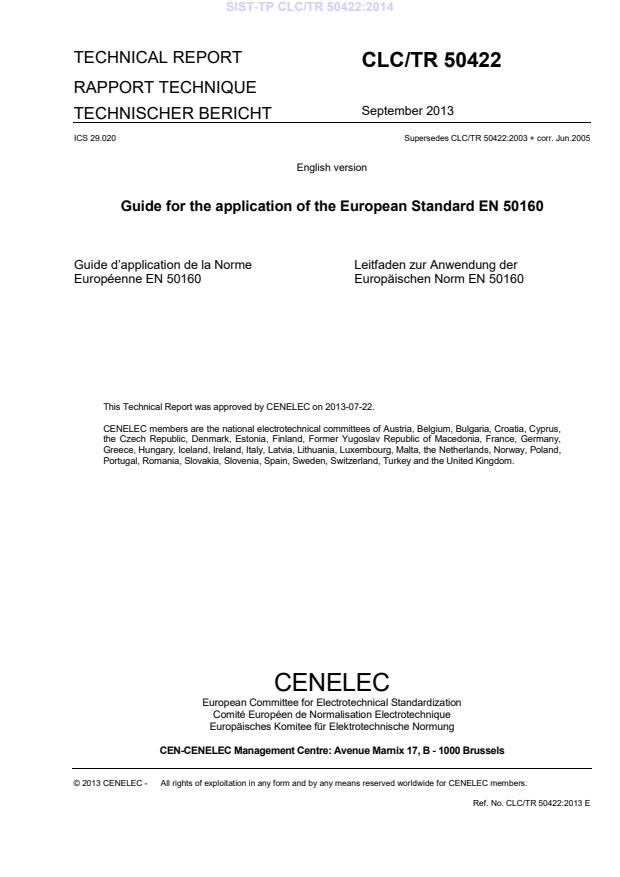
TECHNICAL REPORT
CLC/TR 50422
RAPPORT TECHNIQUE
September 2013
TECHNISCHER BERICHT
ICS 29.020 Supersedes CLC/TR 50422:2003 + corr. Jun.2005
English version
Guide for the application of the European Standard EN 50160
Guide d’application de la Norme Leitfaden zur Anwendung der
Européenne EN 50160 Europäischen Norm EN 50160
This Technical Report was approved by CENELEC on 2013-07-22.
CENELEC members are the national electrotechnical committees of Austria, Belgium, Bulgaria, Croatia, Cyprus,
the Czech Republic, Denmark, Estonia, Finland, Former Yugoslav Republic of Macedonia, France, Germany,
Greece, Hungary, Iceland, Ireland, Italy, Latvia, Lithuania, Luxembourg, Malta, the Netherlands, Norway, Poland,
Portugal, Romania, Slovakia, Slovenia, Spain, Sweden, Switzerland, Turkey and the United Kingdom.
CENELEC
European Committee for Electrotechnical Standardization
Comité Européen de Normalisation Electrotechnique
Europäisches Komitee für Elektrotechnische Normung
CEN-CENELEC Management Centre: Avenue Marnix 17, B - 1000 Brussels
© 2013 CENELEC - All rights of exploitation in any form and by any means reserved worldwide for CENELEC members.
Ref. No. CLC/TR 50422:2013 E
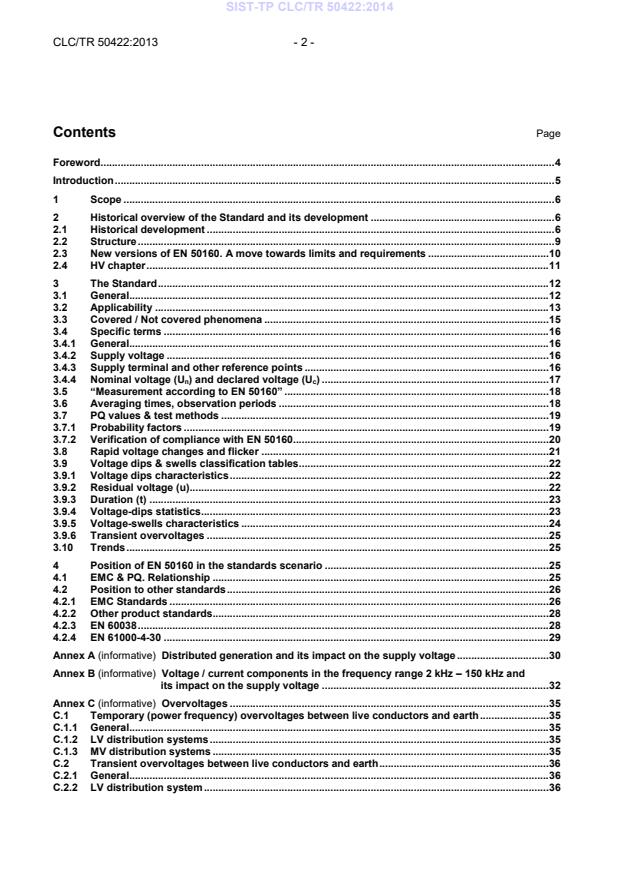
Contents Page
Foreword. 4
Introduction . 5
1 Scope . 6
2 Historical overview of the Standard and its development . 6
2.1 Historical development . 6
2.2 Structure . 9
2.3 New versions of EN 50160. A move towards limits and requirements . 10
2.4 HV chapter . 11
3 The Standard . 12
3.1 General. 12
3.2 Applicability . 13
3.3 Covered / Not covered phenomena . 15
3.4 Specific terms . 16
3.4.1 General. 16
3.4.2 Supply voltage . 16
3.4.3 Supply terminal and other reference points . 16
3.4.4 Nominal voltage (U ) and declared voltage (U ) . 17
n c
3.5 “Measurement according to EN 50160” . 18
3.6 Averaging times, observation periods . 18
3.7 PQ values & test methods . 19
3.7.1 Probability factors . 19
3.7.2 Verification of compliance with EN 50160. 20
3.8 Rapid voltage changes and flicker . 21
3.9 Voltage dips & swells classification tables. 22
3.9.1 Voltage dips characteristics . 22
3.9.2 Residual voltage (u) . 22
3.9.3 Duration (t) . 23
3.9.4 Voltage-dips statistics. 23
3.9.5 Voltage-swells characteristics . 24
3.9.6 Transient overvoltages . 25
3.10 Trends . 25
4 Position of EN 50160 in the standards scenario . 25
4.1 EMC & PQ. Relationship . 25
4.2 Position to other standards . 26
4.2.1 EMC Standards . 26
4.2.2 Other product standards. 28
4.2.3 EN 60038 . 28
4.2.4 EN 61000-4-30 . 29
Annex A (informative) Distributed generation and its impact on the supply voltage . 30
Annex B (informative) Voltage / current components in the frequency range 2 kHz – 150 kHz and
its impact on the supply voltage . 32
Annex C (informative) Overvoltages . 35
C.1 Temporary (power frequency) overvoltages between live conductors and earth . 35
C.1.1 General. 35
C.1.2 LV distribution systems . 35
C.1.3 MV distribution systems . 35
C.2 Transient overvoltages between live conductors and earth . 36
C.2.1 General. 36
C.2.2 LV distribution system . 36
- 3 - CLC/TR 50422:2013
C.2.3 MV distribution systems . 38
C.3 Temporary (power frequency) overvoltages between live conductors . 38
Annex D (informative) Abbreviations . 39
Bibliography . 41
Foreword
This document (CLC/TR 50422:2013) has been prepared by CLC/TC 8X "System aspects of electrical energy
supply".
This Technical Report, prepared by TF 8 of CLC/TC 8X/WG 1 "Physical characteristics of electrical energy", is
based on CLC/TR 50422:2003 (first edition) [4] and the development having taken place since.
This document supersedes CLC/TR 50422:2003 + corrigendum June 2005.
this second edition has been extended, with regard to
the inclusion of high voltage (HV) supply in the Standard,
the relation between EN 50160 and other standards,
the choice of power quality (PQ) values and related probabilities,
actual trends in network use, which might lead to further development of the Standard.
For the purpose of this Technical Report, “the Standard” refers to EN 50160:2010 [8]. Likewise, “the Guide”
refers to this Application Guide, CLC/TR 50422:2013.
Attention is drawn to the possibility that some of the elements of this document may be the subject of patent
rights. CENELEC shall not be held responsible for identifying any or all such patent rights.
This document has been prepared under a mandate given to CENELEC by the European Commission and
the European Free Trade Association.
- 5 - CLC/TR 50422:2013
Introduction
By its very nature, a standard has to be concise and cannot give a comprehensive background of the subject
being dealt with. It was accordingly decided to prepare a guide providing additional information and
clarification of the Standard, whose first edition was published in 1994. The recent Application Guide
nd
represents the 2 edition of such a guide, which considers the development of the Standard having taken
st
place since the publication of the 1 edition.
1 Scope
The aim of this Technical Report is to provide background information and explanations on EN 50160 with
regard to the history of its development as well as to its correct application.
2 Historical overview of the Standard and its development
2.1 Historical development
The very first document dealing with some set of PQ characteristics – and therefore the origin of a related
European Standard some 13 years later – was an article published by the International Union of Producers
and Distributors of Electric Energy (UNIPEDE) in their magazine “Electricity Supply”, in May 1981 [32].
Experts of UNIPEDE WG “DISPERT” were commissioned “to define the different kinds of disturbances, which
can affect LV distribution voltage, caused by periodical or transient phenomena, resulting in overvoltages,
voltage dips, or other kinds of irregularities in the voltage wave”.
This document was prepared on the basis of information collected by European distributors, for the purpose of
providing information to network users fed from LV systems and to appliance designers on the actual
characteristics of the voltage distributed. It provided information about a set of characteristics:
being recognised as representing the main irregularities in the LV supply voltage;
being assumed as covering about 95 % of the cases;
representing real supply voltage characteristics, to be taken into account at designing electrical and
electronic equipment with respect to their undegraded operation on mains supply;
not intended to represent limit values, but with a view to acceptable values,
distinguished in four groups:
a) (quasi)stationary phenomena, mostly with close relation to 50 Hz:
slow voltage variations;
frequency variation;
unbalance of three-phase voltages;
harmonic voltage distortion;
sudden voltage changes;
DC component;
b) caused by occasional transient phenomena:
voltage dips;
transient voltage depressions;
spikes originating in the operation of electrical equipment;
surges of atmospheric origin;
- 7 - CLC/TR 50422:2013
c) ripple control signals (or similar);
d) HF signals.
The existing levels of harmonic distortion, which were later used as the basis for the voltage characteristics of
harmonics, were published in 1981 in a paper published by the International Council on Large Electric
Systems (CIGRE) [29].
Eight years later, in September 1989, UNIPEDE published document DISNORM 12 [33],
• which kept the main principles of the afore-mentioned document, in particular the consideration of a
remaining “low probability – approximately 5 % – to find the characteristics in question”,
• laying down the values of the supply voltage at the supply terminals which may reasonably be expected
under the present state of technologies,
• by grouping the considered set of characteristics into the 4 groups:
1) frequency;
2) magnitude of the voltage wave;
3) voltage waveform;
4) symmetry of the three-phase system.
In 1991, the European Commission (EC) published two Directives that subsequently led to an EC request to
CENELEC to work out (a) related standard(s):
i) Directive 85/374/EEC on the liability for defective products [41],
specifying amongst others that “the producer shall be liable for damage caused by a defect in his
product”, and that “ ‘product’ includes electricity.”
ii) Directive 89/336/EEC on the electromagnetic compatibility [42];
specifying amongst others that Member states are “responsible for ensuring that electric energy
distribution networks are protected from electromagnetic disturbance which can affect them and,
consequently, equipment fed by them”.
Additionally, two further aspects as being mentioned in the related Draft request to CENELEC as of
11 January 1991 were to be considered:
I) the development of electronic components in electrical equipment, in particular power electronics which
are bringing about a relative deterioration in the quality of “electricity” as a product, while at the same time
there is an increase in the level of network users’ requirements;
II) widely varying regulations, specifications or contracts in force in the various Member States from one to
another.
The related Draft request to CENELEC required the preparation of (a) European Standard(s)
1)
giving the physical characteristics of electricity supplied by low, medium and high voltage public
distribution networks,
on the basis of UNIPEDE DISNORM 12 [33],
by trying to comply with international standards and in particular IEC standards as far as possible.
With involvement of manufacturers, network operators and consultants, CENELEC BT set up BTTF 68-6,
whose result, the first edition of EN 50160, was ratified on 5 July 1994 [5]. As a first step, this standard dealt
with PQ on LV and MV level (see 2.4).
According to the originally given task of describing physical characteristics of the electricity, the values given
in this first edition of EN 50160 [5] represented PQ levels, which can be expected to be present at the supply
terminals in Europe.
With the next editions [6] and [7], since the establishment of CLC/TC 8X/WG 1 by CLC/TC 8X (System
aspects of electricity supply), EN 50160 experienced some actualisation. Related development was intensified
when the Council of European Energy Regulators (CEER) joined this CENELEC work in 2006, leading to the
present edition 2010 of EN 50160 [8], which is the base of this Technical Report.
With regard to the quite complex characteristics of electricity, it was deemed necessary to provide
explanations to its background as well as to its specifications in more detail. That was done at first by
UNIPEDE, who published a first Application Guide to the European Standard EN 50160 in January 1995 [34],
followed by a related Eurelectric publication in July 1995 [30]. In 2003, CENELEC published
CLC/TR 50422:2003 (edition 1), experiencing one Corrigendum in June 2005 [4].
During a phase of further developing EN 50160, some major changes took place, which were to be
considered at related standardisation work.
Move from the LV nominal voltage 220 V to 230 V U , for continental Europe, and from 240 V to 230 V for
n
the UK, according to HD 472 S1:1989 [16]. With consideration of some transition periods, this HD
specified the nominal voltage U in Europe with 230 V on from 01/01/1996 at latest; for reaching the
n
voltage band of U ± 10 %, finally, with corrigendum February 2002 to HD 472 S1:1989, a deadline of
n
01/01/2009 was specified.
2)
Extension of CENELEC membership from the National Committees from 18 countries in 1994 to those
3)
of 33 countries in 2013 .
Increase of the application of electronic components in electrical equipment and installations and
therefore of related emissions into the supply network.
Increase of the susceptibility of electrical equipment and installations to disturbing voltage components.
Increase of network users’ requirements on power quality.
1) Frequency, magnitude of the voltage wave (slow variations of the voltage level, rapid variations of the voltage level,
voltage dips, 50 Hz overvoltage, transient overvoltage), harmonics, unbalance, voltage interruptions, signal
transmissions through the network.
2) AT, BE, CH, DE, DK, ES, FI, FR, GB, GR, IE, IS, IT, LU, NL, NO, PT, SE
3) AT, BE, BG, CH, CY, CZ, DE, DK, EE, ES, FI, FR, GB, GR, HR, HU, IE, IS, IT, LT, LU, LV, MK, MT, NL, NO, PL, PT,
RO, SE, SI, SK, TR
- 9 - CLC/TR 50422:2013
An important change in the European electricity industry has been the deregulation of the electricity market by
introducing open competition for production and sale of electricity while at the same time introducing a natural
and regulated monopoly in the form of the electricity network operators. According to European Directive
2009/72/EC [3] the role of national regulatory authorities is amongst others “setting and approving standards
and requirements for quality of supply” which has resulted in a stronger engagement of regulatory authorities
in power quality issues on national as well as on European level, for example resulting in a cooperation
between the European Energy Regulators and CENELEC.
2.2 Structure
On from the very beginning of PQ specifications, i.e. when UNIPEDE published their „Characteristics of the
Low Voltage Electricity Supply“ in 1981 [32] and their Application Guide to EN 50160 [34], it was recognised
that such specifications would deal with a quite specific product, showing particular characteristics, somehow
different from any other product (see 3.7.1). Informative Annex A of EN 50160:2010 [8] provides related
information in more detail.
Contrary to the primary perception of electricity, which might be described by parameters like continuity,
voltage magnitude and frequency, there are lots of PQ characteristics when considering electricity supply in
detail. On from the first publications by UNIPEDE, an appropriate choice out of this number of PQ
characteristics has been made for being dealt with as the main characteristics of the supply voltage.
Considering PQ phenomena, a classification can be made based on different principles, e.g. on
the predictability of phenomena affecting the voltage, enabling the specification of definite values for the
corresponding characteristics.
That leads to a classification in definite and indicative values,
the – more or less, to some degree given – continuity of occurrence of phenomena.
That leads to a classification in continuous phenomena and in events.
UNIPEDE started with a classification similar to the first example, which was kept for the EN 50160 editions
from 1994 to 2007. Table 1 shows the classification as it was used in the first edition of EN 50160 as of 1994.
Table 1 — Classification of PQ phenomena according to EN 50160:1994 [5] –
Definite and indicative values
Definite values Indicative values
Power frequency Supply voltage dips
Short interruptions of the supply voltage
Magnitude of the supply voltage variations
Long interruptions of the supply voltage
Rapid voltage changes including flicker severity Temporary power frequency overvoltages
Unsymmetry Transient overvoltages
Harmonic voltage Interharmonic voltage
Mains signalling voltages on the supply voltage
After edition 2007, the classification of PQ phenomena for EN 50160 has been changed to a distinction
between
• continuous phenomena, i.e. deviations from the nominal value that occur continuously over time. Such
phenomena occur mainly due to load pattern, changes of load, non-linear loads or distributed generation,
• voltage events, i.e. sudden and significant deviations from normal or desired weave shape which typically
occur due to unpredictable events (e.g. faults) or to external causes (e.g. weather conditions, third party
actions, force majeure)
See Table 2 for the classification used in the Standard. The classification is independent of the cause of the
phenomenon, but continuous phenomena mainly occur due to load patterns, changes in load or non-linear
load whereas voltage events typically occur due to unpredictable events (e.g. faults) or to external causes
(e.g. weather conditions, third party actions, force majeure).
Table 2 — Classification of PQ phenomena according to EN 50160:2010 [8] –
Continuous phenomena and voltage events
Continuous phenomena Voltage events
Variations in power frequency Interruptions of the supply voltage
Supply voltage variations Supply voltage dips
Rapid voltage changes including those resulting in
Supply voltage swells
light flicker
Supply voltage unbalance Transient overvoltages
Harmonic voltage
Interharmonic voltage
Mains signalling voltages
EN 50160:2010 [8] gives limits for most continuous phenomena. No limits are given for single rapid voltage
changes and for interharmonics.
Only indicative values for voltage events are given in EN 50160:2010 [8] pending the gathering of additional
information from actual measurements and other investigations.
In EN 50160:2010 [8], an Informative Annex provides information about
a) indicative values currently available at a European level for some of the events defined and described in
the Standard,
b) the way of using these values,
c) recommendations for the way of collecting further measurement data, in order to allow for comparisons
between different systems and for obtaining homogeneous data at a European level.
2.3 New versions of EN 50160. A move towards limits and requirements
As explained in 2.1, the objective for EN 50160 was to establish (a) standard(s) giving the physical
characteristics of electricity energy supplied by low, medium and high voltage public distribution networks,
similar to the formerly published document DISNORM 12 of UNIPEDE, complying with inter-national
standards and in particular IEC standards as far as possible.
- 11 - CLC/TR 50422:2013
When considering the development from the very first UNIPEDE document dated 1981 to the first edition of
EN 50160, already some movement in the meaning of values – at least from the chosen terminology – can be
recognised. While, considering the cases, where values are specified, except irregularities caused by
occasional transient phenomena,
a) the 1981 UNIPEDE document uses wording like “should not differ” (e.g. slow voltage variations), “does
not vary by more” (e.g. frequency variation), “values which the distributors endeavour not to exceed” (e.g.
harmonics), “are usually …” (e.g. voltage changes)
b) UNIPEDE DISNORM 12 explicitly talks of “values” at the supply terminals, which “are” (e.g. frequency),
“is usually” (e.g. unbalance), “will generally be lower” (e.g. 50 Hz overvoltages), represent a “normal limit
which may be exceeded” (e.g. rapid variations), figure as “compatibility levels” (e.g. harmonics),
c) EN 50160:1994 – for definite values – uses a somehow more distinct wording, giving information about
values which under normal operating conditions are not exceeded with a certain probability, i.e. between
95 % and 100 % of the averaging times during an observation period (see 3.1, 3.2),
all three documents having a really describing character.
With the following versions, besides
the extension of the scope also to HV (see 2.4) and
the phenomena dealt with
in principle (voltage swells on from 2010)
in more detail (e.g. voltage dips and swells),
the standard tends to have more and more set limits, with decreasing probabilities of it being exceeded, e.g.
• frequency for systems with synchronous connection to an interconnected system,
• slow voltage variations (drop of exception for remote areas for LV, decrease of residual probability for
variations of U outside the limits of U ± 10 %),
n n
with the increasing meaning of distinct requirements the network operator shall meet.
2.4 HV chapter
HV was one of the voltage levels addressed by the European Commission (EC) in their Draft request to
CENELEC in 1991. From the practical point of view, at this time – not only but also with regard to the very
small number HV customers, compared with MV and, in particular, LV customers – HV appeared as less
important for getting a specification of PQ characteristics; following to that, the first edition of EN 50160 was
worked out for the voltage levels LV and MV only.
In the meantime, due to liberalisation and, resulting from that, the separation of distribution network operators
as well as of generating companies from transmission system operators, for regulatory as well as for
contractual purposes the specification of PQ characteristics for the interface to HV systems got some more
importance, although the number of related complaints was quite limited. The interface with HV systems
concerns different types of network users: large industrial installations, production units and distribution
networks. With regard to the lack of related EN 50160 specifications, as a first step related questions were
sometimes dealt with by referring to EN 50160 with recommending to apply it using the specifications of the
Standard for lower voltage levels, either using the same limits or with some correction made.
After edition 2007 of EN 50160, with due regard to meshed network structures of transmission systems being
somehow different from LV and MV networks, it was decided to extend the scope of EN 50160 from LV and
MV also to higher voltages. For the purpose of EN 50160, PQ should be described for the supply terminals in
public networks but it was decided that single network users connected to EHV should not be covered. As a
result, the Scope of EN 50160 got extended to voltages up to 150 kV. Further work on transmission systems
and EHV systems was postponed, although being aware of the fact, that PQ in lower voltage levels is also
affected by the quality on higher voltage levels.
With regard to
the before-mentioned differences of HV systems from LV and MV systems
some open questions of assigning shares of PQ characteristics to the network levels
the nearly complete lack of standardised electromagnetic compatibility (EMC) specifications for HV (only
two IEC/TRs for planning levels for harmonics and voltage fluctuations available)
the lack of broader experience with PQ on this voltage level in Europe
some specific solutions different from the chapters for LV and MV, have been chosen for providing PQ
specifications, e.g.
• due to the limited relevance for this voltage level, no values are given for several phenomena like supply
th th rd th
voltage variations, harmonic voltages for the 17 , 19 , 23 , 25 order, mains signalling voltages
• for several phenomena like harmonics, EN 50160:2010 [8] gives only indicative values; in particular,
specification of THD is under further consideration. In the case of complaints, limits for harmonics in HV
networks should be chosen on the base of MV network limits, suitably modified by agreement between
HV network operator and the connected network user;
• the flicker limit was chosen equal to the LV and MV limit but drawing attention to the uncertainty of
transmission coefficients and requiring mitigation measures in case of excession of P = 1.
lt
Further consideration of PQ specifications for this voltage level is envisaged.
3 The Standard
3.1 General
EN 50160 is a CENELEC Product Standard, which defines, describes and specifies the main voltage
characteristics that can be expected at the supply terminals in European public low, medium or high voltage
networks. It is not harmonised under any EU New Approach Directive. According to the CENELEC Internal
Regulations, the Standard is to be implemented as a national standard in all CENELEC Member countries.
In accordance with the general status of a standard, the specifications given in the main part of EN 50160 are
not mandatory by themselves, but can become mandatory by being referred to in a contract between partners,
local regulation and also network codes.
The Standard considers the fact that electricity distribution systems have to be developed taking into account
a) the provision of adequate conditions for the operation of network users’ equipment and, at the same time,
b) avoidance of unnecessary increases in the cost of the electricity supply.
An economic [28] balance is to be kept between the costs attributable to creating a more benign
environment for the use of equipment connected to the public electricity network and the costs of
achieving appropriate emission and immunity of the equipment to the environment in which it is intended
to be used.
- 13 - CLC/TR 50422:2013
Initially the costs for creating a more benign environment are borne by the network operator and the costs
for achieving appropriately low emission and high immunity are borne by the equipment manufacturer.
Often, but not always, those costs are included in the network tariffs and/or in the price of equipment.
Specifications on the voltage quality and different types of deviations from the ideal voltage are given by
means of a number of voltage-quality indices related to the point of delivery, with a range of values for a
number of phenomena. These values
are generally higher than the actually occurring values for these parameters in the vast majority of
networks. Even at the worst served locations, the value of the voltage quality indices will be below the
defined values most of the time. These defined values may be exceeded with a defined small residual
probability, as stated in the Standard.
should not be interpreted as typical values or description of PQ at a certain supply terminal or in a certain
network area. Most of the network users receive a PQ far better than specified in EN 50160, i.e. at most
locations the value of the voltage-quality indices will always be well below the limits all the time.
of the 2010 edition of the Standard, with regard to the change of character of the Standard (see also 2.3),
represent kind of minimum requirements on the PQ in public European supply networks.
In the Standard all phenomena are equally treated; no attempt is made to rank them related to importance;
also with regard to such importance
• being different for different types of network users, and even for different network users of the same type
• being even changing over the years as new types of equipment with different emission and immunity
properties are coming on the market.
3.2 Applicability
By its Scope, the Standard is restricted to the electricity supplied at the supply terminals (see 3.4.3), and does
not deal with the supply system or the network user´s installation or equipment.
As the Standard is intended to deal only with the characteristics of the voltage at specified points on the public
distribution networks, it does not deal directly with the properties of networks themselves, such as short circuit
power/network impedance. Clearly, however, the network characteristics will have an effect upon the
magnitude of several of the phenomena described by the Standard.
The limits in EN 50160 apply irrespective of the kind of network user, to
network users only consuming electricity all the time
network users only producing electricity all the time
network users consuming as well as producing electricity
However, the technical details of keeping the voltage characteristics within their limits change when large
single units or significant numbers of small production units are connected to the distribution network.
Although the technical details on how to keep the limits are beyond the scope of EN 50160, the impact of
distributed generation is discussed in some detail in Annex A of this Application Guide.
According to the task having been assigned to EN 50160 in the early nineties, the applicability of EN 50160 is
to be considered with regard to locality, time and the operating conditions on the supply network. Considering
this classification, the PQ specifications of EN 50160 relate to
a) any supply terminal to a network user in European electricity supply networks (100 % of sites). It
does thus not apply
to any point in the network user’s installation,
to any point in the public supply network that is not itself a supply terminal.
There are several hundred million such points in the present European Union, and each point is unique
with respect to the characteristics of the electricity delivered. The characteristics are caused to vary by
various actions of the operators of the public electricity networks, and also by the actions of the network
users.
Note that network users include also other network operators.
b) the expectable meeting of the specified values with a defined probability (x % of time; x close to
100 %) (see 3.7.1)
For the network operator, network users are randomly switching their appliances on and off and changing
their operating conditions. Every such action results in a change in the characteristics.
In addition, appliances operated by network users may generate disturbances in the current and inject
them on the electricity networks; the result of this is an increased level of voltage disturbances, with
possible detrimental effects on some of the voltage characteristics.
Due to the development in equipment technology and the resulting – cumulative – effect of operation
equipment of similar technical design to the electricity network, the resulting values of disturbances
represent an additional important item to be considered when talking about PQ (see also 4.2.1).
c) normal operating conditions on the supply network. This includes also the correct operation of
protection devices in the case of a fault in the network (e.g. blowing of a fuse, operation of a circuit-
breaker); the operation of loads agreed between network user and distribution network operator and
changes in network configuration. Conditions other than the normal operating conditions, and therefore
out of Scope of EN 50160, are a rarity.
EN 50160 does not apply under exceptional conditions, for which the Standard lists several specific
examples, which
are beyond the network operator's control and which
can cause one or more of the characteristics to depart from the values given.
Table 3 gives explanations to examples for exceptional conditions listed in the Standard and their causes.
A specific example would be conditions under which the network operator is prevented from carrying out
repair or maintenance work due to weather conditions of extreme severity or duration (long lasting
blizzards, flood situations, landslides, extreme wind conditions etc.).
In addition, effects of several types of external events (atmospheric phenomena, construction activities,
malicious damage or vandalism, traffic mishaps etc.) impact the PQ. Neither the timing nor effect of such
external events can be known in advance. Also equipment failure can result in interruptions of the supply
voltage. Whenever the supply is interrupted, the other voltage characteristics lose their technical
meaning.
If supply can be maintained to all or as many network users as possible, even at the expense of some
temporary deterioration of one or more of the voltage characteristics, for most network users this is
normally preferable to an outright interruption.
- 15 - CLC/TR 50422:2013
Table 3 — Exceptional conditions and examples
Exceptional condition Examples
Extreme weather conditions and other Storm of extreme severity (exceeding the legally required
natural disasters design conditions of the network equipment; when impacting a
HV network, the same disturbances are detected on MV and LV
networks), land-slides, earthquakes, long lasting blizzards,
extremer wind conditions, avalanches, floods.
Third party interference Intentional damage (sabotage, vandalism, terrorism)
Acts by public authorities Constraints imposed by government or other public authorities
for public safety or environmental concerns, animal protection
laws
Prevention of the DNO from carrying out necessary alterations
to the supply system, by government or other public authorities
Industrial actions (subject to legal Withdrawal of labour, strike
requirements)
Power shortages resulting from external Generation restrictions or interruption of transmission lines.
events
Force majeure
According to the Scope of the Standard, its specifications may be superseded in total or in part by terms of a
contract between an individual network user and the network operator. Such a contract is most likely to arise
for network users with relatively large electricity demand, supplied from the MV or HV network. It may also
arise in sparsely populated or difficult terrain, such as mountain regions, where supply costs are high. In such
an area, a network user may be willing to accept a supply, at lower cost, which does not entirely comply with
EN 50160.
Requirements set by a national Regulatory Authority on the PQ as delivered by a network operator can be
more stringent than the specifications given by the Standard.
3.3 Covered / Not covered phenomena
The description of electricity as a product is done by means of giving a range of PQ indices at the supply
terminal of the network user.
Related to voltage characteristics, EN 50160 covers:
a) the main characteristics (called “phenomena”) of the voltage (at a network user´s supply terminals in
public networks for low, medium and high voltage levels). This covers a large part of the electromagnetic
disturbances that are present at the supply terminals.
b) limits or values within which the voltage characteristics can be expected;
c) main conditions when the Standard is not applicable.
Some electromagnetic disturbances having gained importance since the publication of the first version of
EN 50160 are not covered in the Standard. Some examples are briefly summarised below, in arbitrary order
and without indicating their importance:
interruptions with a duration less than a few seconds are labelled as “transient interruptions”. The reason
for this separate label is that their impact on end-user equipment is different, sometimes more severe,
from the impact of short interruptions with a longer duration.
waveform distortion in the frequency range between 2 kHz and 150 kHz is getting increased attention due
to a number of reasons. This is discussed in more detail in Annex B of this Guide.
3.4 Specific terms
3.4.1 General
Related to voltages, in EN 50160 the following voltage terms are used:
supply voltage,
supply terminal / point of delivery,
nominal voltage U ,
n
declared voltage U .
c
The following explanations should support correct application.
3.4.2 Supply voltage
With regard to the original task given to the Standard, to "define, describe and specify the characteristics of
electrical energy", the supply voltage should be interpreted here as the actual value of the voltage, waveform
or voltage as a function of time, occurring at a network user's supply terminal (see 3.4.3).
Different voltage characteristics (like "r.m.s. voltage" and "total harmonic distortion") are calculated from this
waveform.
The term “supply voltage” should not be confused with the voltage being supplied at the load points (see
3.4.3), i.e. inside the network user’s installation, for which
the term “utilisation voltage” is used, e.g. in EN 60038 [11],
EN 50160 does not set any limits.
Note that the term “supply voltage” is also defined in EN 50160 (definition 3.21) as “r.m.s. voltage at a given
time at the supply terminal, measured over a given interval”.
3.4.3 Supply terminal and other reference points
When talking about electricity supply, different points are to be considered as reference points:
a) the point, where electric energy is delivered to the network user’s installation or fed into the public supply
network by a generator
For this point, the term
“supply terminal” is defined in EN 60038 and EN 50160:
“point in a transmission or distribution network designated as such and contractually fixed at which
electrical energy is exchanged between contractual partners”
- 17 - CLC/TR 50422:2013
“supply terminal” is also referred to in IEV 617-4-2
“delivery point” is defined in IEV 601-02-33
“Interface point between an electric power system and
...