


EN IEC 60793-1-22:2024
(Main)Optical fibres - Part 1-22: Measurement methods and test procedures - Length measurement
Optical fibres - Part 1-22: Measurement methods and test procedures - Length measurement
IEC 60793-1-22:2024 establishes uniform requirements for measuring the length and elongation of optical fibre (typically within cable). The length of an optical fibre is a fundamental value for the evaluation of transmission characteristics such as losses and bandwidths.
Lichtwellenleiter - Teil 1-22: Messmethoden und Prüfverfahren - Längenmessung
Fibres optiques - Partie 1-22: Méthodes de mesure et procédures d'essai - Mesure de la longueur
L’IEC 60793-1-22:2024 établit des exigences uniformes pour mesurer la longueur et l’allongement de la fibre optique (typiquement dans le câble). La longueur d’une fibre optique est une valeur fondamentale pour l’évaluation des caractéristiques de transmission, telles que les pertes et la bande passante.
Optična vlakna - 1-22. del: Merilne metode in postopki preskušanja - Merjenje dolžine (IEC 60793-1-22:2024)
Standard IEC 60793-1-22:2024 določa enotne zahteve za merjenje dolžine in raztezanja optičnih vlaken (običajno znotraj kabla). Dolžina optičnega vlakna je temeljna vrednost za ocenjevanje prenosnih lastnosti, kot so izgube in pasovne širine.
General Information
- Status
- Published
- Publication Date
- 15-Aug-2024
- Technical Committee
- CLC/TC 86A - Optical fibres and optical fibre cables
- Drafting Committee
- IEC/SC 86A - IEC_SC_86A
- Current Stage
- 6060 - Document made available - Publishing
- Start Date
- 16-Aug-2024
- Due Date
- 28-Jun-2024
- Completion Date
- 16-Aug-2024
Relations
- Effective Date
- 06-Sep-2022
- Effective Date
- 03-Feb-2026
- Effective Date
- 09-Feb-2026
- Effective Date
- 03-Feb-2026
- Effective Date
- 03-Feb-2026
- Effective Date
- 03-Feb-2026
- Effective Date
- 03-Feb-2026
- Effective Date
- 03-Feb-2026
- Effective Date
- 03-Feb-2026
- Effective Date
- 03-Feb-2026
- Effective Date
- 03-Feb-2026
- Effective Date
- 03-Feb-2026
- Effective Date
- 03-Feb-2026
- Effective Date
- 03-Feb-2026
- Effective Date
- 03-Feb-2026
Overview
EN IEC 60793-1-22:2024 (CLC / CENELEC adoption of IEC 60793-1-22:2024) defines uniform measurement methods and test procedures for optical fibre length and elongation. The standard covers techniques used to determine the physical and optical length of fibres (typically within cable) - a fundamental parameter for evaluating transmission characteristics such as attenuation (loss), bandwidth and latency. EN IEC 60793-1-22:2024 supersedes the 2002 edition and is part of the IEC 60793 series for optical fibres.
Key topics and technical requirements
- Scope and purpose: Establishes requirements for accurate length measurement and elongation testing of optical fibres used in telecom and industrial cabling.
- Multiple measurement methods: Detailed normative procedures for:
- Method A - Delay measuring (time-of-flight / pulse techniques)
- Method B - Backscattering (OTDR-like techniques and variants)
- Method C - Fibre elongation (measuring change in fibre length under load)
- Method D - Mechanical length (direct mechanical measurement)
- Method E - Phase shift (frequency/phase modulation techniques)
- Apparatus and calibration: Requirements for optical sources, detectors, modulators, launch conditions, signal processors, and calibration procedures to ensure traceability and repeatability.
- Sampling and test procedure: Guidelines on sample selection, test setup, measurement steps, calculations, and result reporting.
- Results and specification information: How to calculate and present length, elongation and uncertainties; reference test methods and annexes.
- Informative methods: Annex F describes a Brillouin frequency shift test method as informative material (useful for distributed sensing considerations).
- Interoperability: Cross-references to related IEC/EN documents (e.g., IEC 60793-1-40, IEC 60793-1-42) and notes about national implementation.
Applications and who uses this standard
- Fibre manufacturers - quality control, production testing and specification compliance for fibre length and mechanical properties.
- Test laboratories and certification bodies - accredited testing, traceable measurements, and issuing conformance reports.
- Network operators and installers - validation of installed fibre plant length, splice/connector location, and performance diagnostics.
- R&D and product development - accurate length/elongation data for new fibre designs and cable engineering.
- Procurement and compliance teams - contractual specifications and acceptance testing of fibre and cable deliveries.
Related standards
- IEC 60793 series (optical fibres)
- IEC 60793-1-40 (attenuation measurement methods)
- IEC 60793-1-42 (chromatic dispersion measurement methods)
- Referenced standards noted in Annex ZA (e.g., IEC 60794-1-1, IEC 61757-1-2) for complementary test and cabling requirements.
EN IEC 60793-1-22:2024 is essential for anyone needing standardized, traceable methods to measure optical fibre length and elongation for performance evaluation, QA and compliance in fibre optic systems.

Get Certified
Connect with accredited certification bodies for this standard

TL 9000 QuEST Forum
Telecommunications quality management system.

ANCE
Mexican certification and testing association.

Intertek Slovenia
Intertek testing, inspection, and certification services in Slovenia.
Sponsored listings
Frequently Asked Questions
EN IEC 60793-1-22:2024 is a standard published by CLC. Its full title is "Optical fibres - Part 1-22: Measurement methods and test procedures - Length measurement". This standard covers: IEC 60793-1-22:2024 establishes uniform requirements for measuring the length and elongation of optical fibre (typically within cable). The length of an optical fibre is a fundamental value for the evaluation of transmission characteristics such as losses and bandwidths.
IEC 60793-1-22:2024 establishes uniform requirements for measuring the length and elongation of optical fibre (typically within cable). The length of an optical fibre is a fundamental value for the evaluation of transmission characteristics such as losses and bandwidths.
EN IEC 60793-1-22:2024 is classified under the following ICS (International Classification for Standards) categories: 33.180.10 - Fibres and cables. The ICS classification helps identify the subject area and facilitates finding related standards.
EN IEC 60793-1-22:2024 has the following relationships with other standards: It is inter standard links to EN 60793-1-22:2002, EN 60793-1-42:2013, EN 3745-202:2005, EN IEC 60793-1-1:2022, EN 60793-2-70:2017, EN IEC 60793-2-60:2025, EN 60793-2:2016, EN IEC 60794-1-101:2024, EN 60794-1-1:2011, EN 60793-2-40:2011, EN 60793-1-43:2015, EN 60793-1-1:2017, EN IEC 61158-2:2023, EN IEC 60794-1-1:2023, EN 60793-2-20:2016. Understanding these relationships helps ensure you are using the most current and applicable version of the standard.
EN IEC 60793-1-22:2024 is available in PDF format for immediate download after purchase. The document can be added to your cart and obtained through the secure checkout process. Digital delivery ensures instant access to the complete standard document.
Standards Content (Sample)
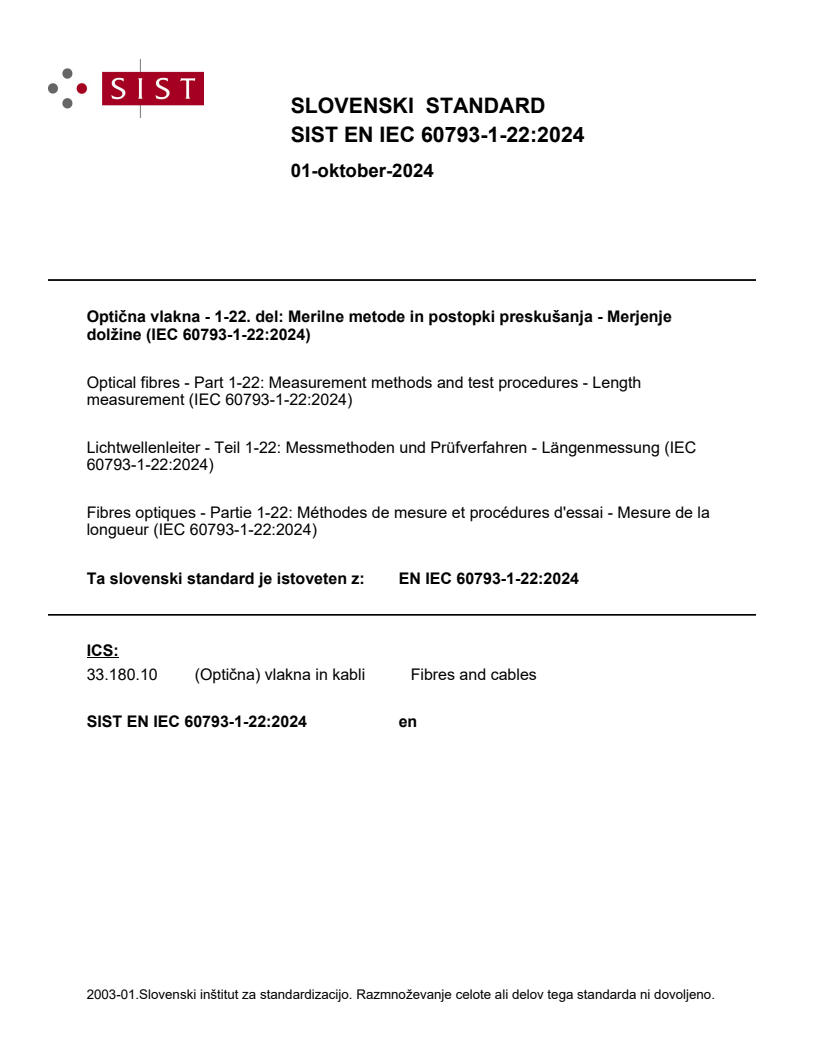
SLOVENSKI STANDARD
01-oktober-2024
Optična vlakna - 1-22. del: Merilne metode in postopki preskušanja - Merjenje
dolžine (IEC 60793-1-22:2024)
Optical fibres - Part 1-22: Measurement methods and test procedures - Length
measurement (IEC 60793-1-22:2024)
Lichtwellenleiter - Teil 1-22: Messmethoden und Prüfverfahren - Längenmessung (IEC
60793-1-22:2024)
Fibres optiques - Partie 1-22: Méthodes de mesure et procédures d'essai - Mesure de la
longueur (IEC 60793-1-22:2024)
Ta slovenski standard je istoveten z: EN IEC 60793-1-22:2024
ICS:
33.180.10 (Optična) vlakna in kabli Fibres and cables
2003-01.Slovenski inštitut za standardizacijo. Razmnoževanje celote ali delov tega standarda ni dovoljeno.
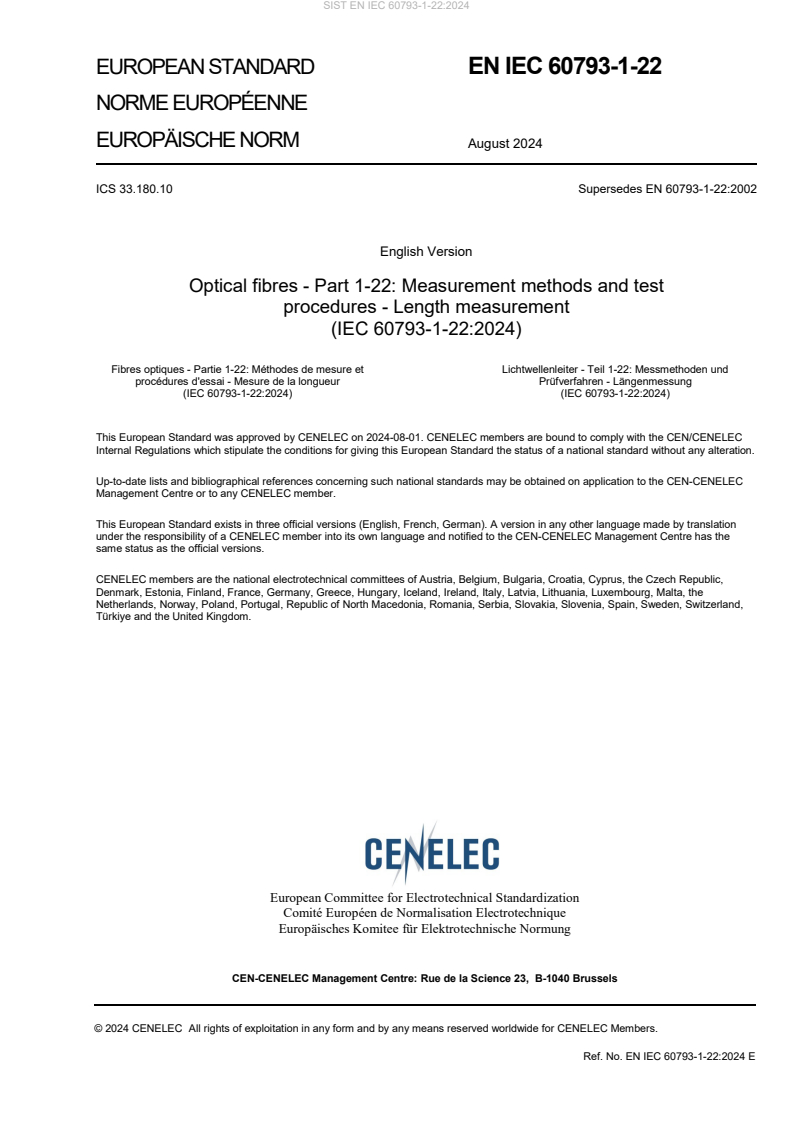
EUROPEAN STANDARD EN IEC 60793-1-22
NORME EUROPÉENNE
EUROPÄISCHE NORM August 2024
ICS 33.180.10 Supersedes EN 60793-1-22:2002
English Version
Optical fibres - Part 1-22: Measurement methods and test
procedures - Length measurement
(IEC 60793-1-22:2024)
Fibres optiques - Partie 1-22: Méthodes de mesure et Lichtwellenleiter - Teil 1-22: Messmethoden und
procédures d'essai - Mesure de la longueur Prüfverfahren - Längenmessung
(IEC 60793-1-22:2024) (IEC 60793-1-22:2024)
This European Standard was approved by CENELEC on 2024-08-01. CENELEC members are bound to comply with the CEN/CENELEC
Internal Regulations which stipulate the conditions for giving this European Standard the status of a national standard without any alteration.
Up-to-date lists and bibliographical references concerning such national standards may be obtained on application to the CEN-CENELEC
Management Centre or to any CENELEC member.
This European Standard exists in three official versions (English, French, German). A version in any other language made by translation
under the responsibility of a CENELEC member into its own language and notified to the CEN-CENELEC Management Centre has the
same status as the official versions.
CENELEC members are the national electrotechnical committees of Austria, Belgium, Bulgaria, Croatia, Cyprus, the Czech Republic,
Denmark, Estonia, Finland, France, Germany, Greece, Hungary, Iceland, Ireland, Italy, Latvia, Lithuania, Luxembourg, Malta, the
Netherlands, Norway, Poland, Portugal, Republic of North Macedonia, Romania, Serbia, Slovakia, Slovenia, Spain, Sweden, Switzerland,
Türkiye and the United Kingdom.
European Committee for Electrotechnical Standardization
Comité Européen de Normalisation Electrotechnique
Europäisches Komitee für Elektrotechnische Normung
CEN-CENELEC Management Centre: Rue de la Science 23, B-1040 Brussels
© 2024 CENELEC All rights of exploitation in any form and by any means reserved worldwide for CENELEC Members.
Ref. No. EN IEC 60793-1-22:2024 E
European foreword
The text of document 86A/2456/FDIS, future edition 2 of IEC 60793-1-22, prepared by SC 86A "Fibres
and cables" of IEC/TC 86 "Fibre optics" was submitted to the IEC-CENELEC parallel vote and
approved by CENELEC as EN IEC 60793-1-22:2024.
The following dates are fixed:
• latest date by which the document has to be implemented at national (dop) 2025-05-01
level by publication of an identical national standard or by endorsement
• latest date by which the national standards conflicting with the (dow) 2027-08-01
document have to be withdrawn
This document supersedes EN 60793-1-22:2002 and all of its amendments and corrigenda (if any).
Attention is drawn to the possibility that some of the elements of this document may be the subject of
patent rights. CENELEC shall not be held responsible for identifying any or all such patent rights.
Any feedback and questions on this document should be directed to the users’ national committee. A
complete listing of these bodies can be found on the CENELEC website.
Endorsement notice
The text of the International Standard IEC 60793-1-22:2024 was approved by CENELEC as a
European Standard without any modification.
In the official version, for Bibliography, the following notes have to be added for the standard indicated:
IEC 60794-1-1 NOTE Approved as EN IEC 60794-1-1
IEC 61757-1-2 NOTE Approved as EN IEC 61757-1-2
Annex ZA
(normative)
Normative references to international publications
with their corresponding European publications
The following documents are referred to in the text in such a way that some or all of their content
constitutes requirements of this document. For dated references, only the edition cited applies. For
undated references, the latest edition of the referenced document (including any amendments)
applies.
NOTE 1 Where an International Publication has been modified by common modifications, indicated by (mod),
the relevant EN/HD applies.
NOTE 2 Up-to-date information on the latest versions of the European Standards listed in this annex is available
here: www.cencenelec.eu.
Publication Year Title EN/HD Year
IEC 60793-1-40 - Optical fibres - Part 1-40: Attenuation EN IEC 60793-1-40 -
measurement methods
IEC 60793-1-42 - Optical fibres - Part 1-42: Measurement EN 60793-1-42 -
methods and test procedures - Chromatic
dispersion
IEC 60793-1-22 ®
Edition 2.0 2024-06
INTERNATIONAL
STANDARD
NORME
INTERNATIONALE
Optical fibres –
Part 1-22: Measurement methods and test procedures – Length measurement
Fibres optiques –
Partie 1-22: Méthodes de mesure et procédures d'essai – Mesure de la longueur
INTERNATIONAL
ELECTROTECHNICAL
COMMISSION
COMMISSION
ELECTROTECHNIQUE
INTERNATIONALE
ICS 33.180.10 ISBN 978-2-8322-9195-5
– 2 – IEC 60793-1-22:2024 © IEC 2024
CONTENTS
FOREWORD . 5
INTRODUCTION . 7
1 Scope . 8
2 Normative references . 8
3 Terms, definitions, and abbreviated terms . 8
3.1 Terms and definitions . 8
3.2 Abbreviated terms . 8
4 Overview of method . 9
4.1 General . 9
4.2 Method A – Delay measuring . 9
4.3 Method B – Backscattering . 9
4.4 Method C – Fibre elongation . 9
4.5 Method D – Mechanical length . 9
4.6 Method E – Phase shift . 10
4.7 Reference test method . 10
5 Apparatus . 10
6 Sampling . 10
7 Procedure . 10
8 Calculations . 10
9 Results . 10
10 Specification information . 11
Annex A (normative) Requirements specific to method A – Delay measuring . 12
A.1 General . 12
A.2 Principle . 12
A.3 Apparatus . 12
A.3.1 Two techniques . 12
A.3.2 Optical source . 13
A.3.3 Optical detector . 14
A.4 Procedure . 14
A.4.1 Calibration . 14
A.4.2 Average group index value . 14
A.4.3 Length measurement . 14
A.5 Calculations . 15
A.5.1 General . 15
A.5.2 Transmitted-pulse technique . 15
A.5.3 Reflected-pulse technique . 16
A.6 Results . 16
Annex B (normative) Requirements specific to method B – Backscattering . 17
B.1 General . 17
B.2 Apparatus . 17
B.2.1 General . 17
B.2.2 Optical transmitter . 17
B.2.3 Launch conditions . 18
B.2.4 Optical coupler or splitter . 18
B.2.5 Optical receiver . 18
IEC 60793-1-22:2024 © IEC 2024 – 3 –
B.2.6 Pulse duration and repetition rate . 18
B.2.7 Signal processor . 18
B.2.8 Display . 18
B.2.9 Data interface (optional) . 18
B.2.10 Reflection controller (optional) . 18
B.2.11 Splices and connectors . 19
B.3 Sampling. 19
B.4 Procedure . 19
B.4.1 Three techniques . 19
B.4.2 Procedure common to all three techniques . 19
B.4.3 Procedures specific to each technique . 20
B.4.4 Determination of group index . 22
B.5 Results . 23
Annex C (normative) Requirements specific to method C – Fibre elongation . 24
C.1 Principle . 24
C.2 Apparatus . 24
C.2.1 General requirements . 24
C.2.2 Optical measurement equipment . 25
C.2.3 Instrument resolution . 25
C.3 Procedure . 26
C.3.1 Calibration . 26
C.3.2 Sample measurement . 26
C.4 Results . 27
Annex D (normative) Requirements specific to method D – Mechanical length . 28
D.1 Principle . 28
D.2 Apparatus . 28
D.3 Procedure . 28
D.3.1 Calibration . 28
D.3.2 Operation . 28
Annex E (normative) Requirements specific to method E – Phase shift . 29
E.1 General . 29
E.2 Apparatus . 29
E.2.1 General . 29
E.2.2 Light source . 29
E.2.3 Modulator . 29
E.2.4 Launch optics . 30
E.2.5 Signal detector and signal detection electronics . 30
E.2.6 Reference signal. 30
E.2.7 Computation equipment . 31
E.3 Sampling. 31
E.4 Procedure . 31
E.4.1 Selection of starting frequency . 31
E.4.2 Selection of maximum frequency . 31
E.4.3 Phase measurement performance . 31
E.4.4 Measurement of length of test fibre . 32
E.5 Calculation and interpretation of results . 32
E.6 Group index . 33
E.6.1 General . 33
E.6.2 Cut-back method . 33
– 4 – IEC 60793-1-22:2024 © IEC 2024
E.6.3 Substitution method . 33
Annex F (informative) Brillouin frequency shift test method . 35
F.1 General . 35
F.2 Principle . 35
F.3 Apparatus . 36
F.3.1 General requirements . 36
F.3.2 Optical measurement equipment . 36
F.3.3 Instrument resolution . 37
F.4 Procedure . 38
F.4.1 Calibration . 38
F.4.2 Sample measurement . 38
F.5 Results . 40
Bibliography . 41
Figure A.1 – Time measurement of the transmitted pulse . 13
Figure A.2 – Time measurement of the reflected pulse . 13
Figure A.3 – Principle of fibre-length measurement . 15
Figure B.1 – Block diagram of an OTDR . 17
Figure B.2 – Schematic OTDR trace of a sample (z to z ) with a section of unknown
1 0
length, z , preceding it and without a reflection pulse from the fibre joint point (two-
point technique (B.4.3.1)). 21
Figure B.3 – Schematic OTDR trace of sample (z to z ) with a section of unknown
1 2
length, z , preceding it and with a reflection pulse from the fibre joint point (two-point
technique (B.4.3.1)) . 21
Figure B.4 – Schematic trace of a sample (0 to z ) with no section preceding it (single-
point technique 0 (B.4.3.2)) . 22
Figure B.5 – Schematic OTDR trace of a sample (z to z ) with a section of known
D 2
length, z , preceding it (single-point technique 1 (B.4.3.3)) . 22
D
Figure C.1 – Equipment set-up for phase-shift technique (C.2.2.2) . 25
Figure C.2 – Equipment set-up for differential pulse-delay technique (C.2.2.3) . 26
Figure E.1 – Apparatus for fibre length measurement . 34
Figure F.1 – Equipment setup for BOTDR technique . 37
Figure F.2 – Equipment setup for BOTDR technique . 37
Figure F.3 – Differential strain recorded during a pulling test over a 100 m of cable . 39
Figure F.4 – Absolute strain profile recorded during a pulling test over a 100 m of cable . 39
Table 1 – Measurement methods . 9
IEC 60793-1-22:2024 © IEC 2024 – 5 –
INTERNATIONAL ELECTROTECHNICAL COMMISSION
____________
OPTICAL FIBRES –
Part 1-22: Measurement methods and test procedures –
Length measurement
FOREWORD
1) The International Electrotechnical Commission (IEC) is a worldwide organization for standardization comprising
all national electrotechnical committees (IEC National Committees). The object of IEC is to promote international
co-operation on all questions concerning standardization in the electrical and electronic fields. To this end and
in addition to other activities, IEC publishes International Standards, Technical Specifications, Technical Reports,
Publicly Available Specifications (PAS) and Guides (hereafter referred to as “IEC Publication(s)”). Their
preparation is entrusted to technical committees; any IEC National Committee interested in the subject dealt with
may participate in this preparatory work. International, governmental and non-governmental organizations liaising
with the IEC also participate in this preparation. IEC collaborates closely with the International Organization for
Standardization (ISO) in accordance with conditions determined by agreement between the two organizations.
2) The formal decisions or agreements of IEC on technical matters express, as nearly as possible, an international
consensus of opinion on the relevant subjects since each technical committee has representation from all
interested IEC National Committees.
3) IEC Publications have the form of recommendations for international use and are accepted by IEC National
Committees in that sense. While all reasonable efforts are made to ensure that the technical content of IEC
Publications is accurate, IEC cannot be held responsible for the way in which they are used or for any
misinterpretation by any end user.
4) In order to promote international uniformity, IEC National Committees undertake to apply IEC Publications
transparently to the maximum extent possible in their national and regional publications. Any divergence between
any IEC Publication and the corresponding national or regional publication shall be clearly indicated in the latter.
5) IEC itself does not provide any attestation of conformity. Independent certification bodies provide conformity
assessment services and, in some areas, access to IEC marks of conformity. IEC is not responsible for any
services carried out by independent certification bodies.
6) All users should ensure that they have the latest edition of this publication.
7) No liability shall attach to IEC or its directors, employees, servants or agents including individual experts and
members of its technical committees and IEC National Committees for any personal injury, property damage or
other damage of any nature whatsoever, whether direct or indirect, or for costs (including legal fees) and
expenses arising out of the publication, use of, or reliance upon, this IEC Publication or any other IEC
Publications.
8) Attention is drawn to the Normative references cited in this publication. Use of the referenced publications is
indispensable for the correct application of this publication.
9) IEC draws attention to the possibility that the implementation of this document may involve the use of (a)
patent(s). IEC takes no position concerning the evidence, validity or applicability of any claimed patent rights in
respect thereof. As of the date of publication of this document, IEC had not received notice of (a) patent(s), which
may be required to implement this document. However, implementers are cautioned that this may not represent
the latest information, which may be obtained from the patent database available at https://patents.iec.ch. IEC
shall not be held responsible for identifying any or all such patent rights.
IEC 60793-1-22 has been prepared by subcommittee 86A: Fibres and cables, of IEC technical
committee 86: Fibre optics. It is an International Standard.
This second edition cancels and replaces the first edition published in 2001. This edition
constitutes a technical revision.
This edition includes the following significant technical changes with respect to the previous
edition:
a) Inclusion of category C single mode fibres in Table 1;
b) Inclusion of a new informative Annex F on Brillouin frequency shift test method to determine
the tensile strain applied to a fibre.
– 6 – IEC 60793-1-22:2024 © IEC 2024
The text of this International Standard is based on the following documents:
Draft Report on voting
86A/2456/FDIS 86A/2474/RVD
Full information on the voting for its approval can be found in the report on voting indicated in
the above table.
The language used for the development of this International Standard is English.
This document was drafted in accordance with ISO/IEC Directives, Part 2, and developed in
accordance with ISO/IEC Directives, Part 1 and ISO/IEC Directives, IEC Supplement, available
at www.iec.ch/members_experts/refdocs. The main document types developed by IEC are
described in greater detail at www.iec.ch/publications.
A list of all parts in the IEC 60793 series, published under the general title Optical fibres, can
be found on the IEC website.
The committee has decided that the contents of this document will remain unchanged until the
stability date indicated on the IEC website under webstore.iec.ch in the data related to the
specific document. At this date, the document will be
• reconfirmed,
• withdrawn, or
• revised.
IEC 60793-1-22:2024 © IEC 2024 – 7 –
INTRODUCTION
Publications in the IEC 60793-1 series concern measurement methods and test procedures as
they apply to optical fibres.
Within the same series several different areas are grouped, as follows:
• IEC 60793-1-20 to IEC 60793-1-29: Measurement methods and test procedures for
dimensions
• IEC 60793-1-30 to IEC 60793-1-39: Measurement methods and test procedures for
mechanical characteristics
• IEC 60793-1-40 to IEC 60793-1-49: Measurement methods and test procedures for
transmission and optical characteristics
• IEC 60793-1-50 to IEC 60793-1-59: Measurement methods and test procedures for
environmental characteristics.
• IEC 60793-1-60 to IEC 60793-1-69: Measurement methods and test procedures for
polarization-maintaining fibres.
IEC 60793-1-2X consists of the following parts, under the general title: Optical fibres:
• Part 1-20: Measurement methods and test procedures – Fibre geometry
• Part 1-21: Measurement methods and test procedures – Coating geometry
• Part 1-22: Measurement methods and test procedures – Length measurement
– 8 – IEC 60793-1-22:2024 © IEC 2024
OPTICAL FIBRES –
Part 1-22: Measurement methods and test procedures –
Length measurement
1 Scope
This part of IEC 60793 establishes uniform requirements for measuring the length and
elongation of optical fibre (typically within cable).
The length of an optical fibre is a fundamental value for the evaluation of transmission
characteristics such as losses and bandwidths.
2 Normative references
The following documents are referred to in the text in such a way that some or all of their content
constitutes requirements of this document. For dated references, only the edition cited applies.
For undated references, the latest edition of the referenced document (including any
amendments) applies.
IEC 60793-1-40, Optical fibres – Part 1-40: Attenuation measurement methods
IEC 60793-1-42, Optical fibres – Part 1-42: Measurement methods and test procedures –
Chromatic dispersion
3 Terms, definitions, and abbreviated terms
3.1 Terms and definitions
No terms and definitions are listed in this document.
ISO and IEC maintain terminology databases for use in standardization at the following
addresses:
• IEC Electropedia: available at https://www.electropedia.org/
• ISO Online browsing platform: available at https://www.iso.org/obp
3.2 Abbreviated terms
For the purposes of this document, the following abbreviated terms apply.
BOTDA Brillouin optical time domain analysis
BOTDR Brillouin optical time domain reflectometry
FWHM full-width half-maximum
OTDR optical time domain reflectometer
RMSW root-mean-squared width
RTM reference test method
IEC 60793-1-22:2024 © IEC 2024 – 9 –
4 Overview of method
4.1 General
This document gives five methods for measuring length, which are presented in Table 1.
Table 1 – Measurement methods
Method Characteristics covered Fibre categories covered
A Delay measuring Length All A1, B, and C
B Backscattering Length All A1, B, and C
a c b
C Fibre elongation Fibre elongation A1, B1 , and C
D Mechanical Length All
E Phase shift Length All A1, B, and C
a
The measurement of fibre elongation is used in IEC 60794-1-1.
b
This measurement is applicable unreservedly to type B single-mode fibres. For type A1 multimode fibres, take
particular care when interpreting the results because the results of this measurement can be influenced by
interfering modal effects, for example, due to the occurrence of non-longitudinal stresses on the fibre.
Application of the measurement to A2 to A4 multimode fibres is under consideration.
c
Informative Annex F has been added to determine the tensile strain applied to a fibre. It uses Brillouin
reflectometry (BOTDR) or so-called Brillouin analysis (BOTDA), which are single-sided and double-sided
methods respectively.
Information common to all measurements is contained in Clause 2 to Clause 8. Information on
specific application appears in Annex A, Annex B, Annex C, Annex D, and Annex E for methods
A, B, C, D and E, respectively.
4.2 Method A – Delay measuring
The delay measuring method applies to measurements of the fibre length by the measurement
of the propagation time of an optical pulse or a pulse train based on a known value of the group
index of the fibre.
Alternatively, this method is suitable for measuring the group index of a fibre of known length.
Therefore, in practice this fibre length measurement method is calibrated against a known
length of fibre of the same type.
4.3 Method B – Backscattering
The backscattering method, which is a single-sided measurement, uses an optical time domain
reflectometer (OTDR), and measures the optical power backscattered from different points in
the fibre to the beginning of the fibre.
4.4 Method C – Fibre elongation
This measurement method describes a procedure for determining the fibre elongation. It does
not measure absolute strain, but instead measures the changes in strain from one loading
condition to another.
4.5 Method D – Mechanical length
This measurement method describes a procedure for determining the fibre length by winding a
fibre around a fixed diameter calibrated wheel that rotates. The length is determined by the
number of revolutions of the wheel.
– 10 – IEC 60793-1-22:2024 © IEC 2024
4.6 Method E – Phase shift
The phase shift method describes a procedure for determining the fibre length. The length is
determined from the phase shift that occurs when a predetermined modulation frequency f
max
is applied.
4.7 Reference test method
The reference test method (RTM), which shall be the one used to settle disputes, varies
depending on whether the fibre is cabled or not, such as
– uncabled fibre: method D;
– length of fibre within cable: method B;
– elongation of fibre within cable: method C;
– elongation of uncabled fibre: method C.
5 Apparatus
Annex A, Annex B, Annex C, Annex D, and Annex E include layout drawings and other
equipment requirements for each of the methods A, B, C, D and E, respectively.
6 Sampling
See the appropriate Annex A, Annex B, Annex C, Annex D or Annex E for specific
requirements. General requirements follow.
Prepare a flat end face, perpendicular to the fibre axis, at the input and output ends of each
sample for measurements based on optical delay measurements.
7 Procedure
See the appropriate Annex A, Annex B, Annex C, Annex D or Annex E for specific
requirements.
8 Calculations
See the appropriate Annex A, Annex B, Annex C, Annex D or Annex E for specific
requirements.
9 Results
The following information shall be provided with each measurement:
– date and title of measurement;
– identification and description of sample, including whether fibre or cable;
– sample length, or elongation;
– measurement method used: A, B, C, D or E;
– other results, as required by the appropriate Annex A, Annex B, Annex C, Annex D or
Annex E.
IEC 60793-1-22:2024 © IEC 2024 – 11 –
The following information shall be available upon request:
– description of measurement apparatus arrangement;
– type and wavelength of measurement source;
– launch conditions;
– details of computation technique;
– date of latest calibration of equipment.
See Annex A, Annex B, Annex C, Annex D and Annex E for any additional information that shall
be available upon request.
10 Specification information
The detail specification shall specify the following information:
– type of fibre (or cable) to be measured;
– failure or acceptance criteria;
– information to be reported;
– deviations to the procedure that apply.
– 12 – IEC 60793-1-22:2024 © IEC 2024
Annex A
(normative)
Requirements specific to method A – Delay measuring
A.1 General
Use this method to measure the length of optical fibre by itself or installed in cable. If the sample
is a fibre in a cable, determine the value of group index N under conditions applicable to the
sample under measurement (for example, tension, temperature). This is done by inverting
Formula (A.1) and the measurements on a sample with a known length.
A.2 Principle
An optical pulse travelling through an optical fibre with length L and average group index N
experiences a time delay, ∆t:
NL
∆=t
(A.1)
C
where
∆t is the time delay;
N is the average group index;
C is the velocity of light in vacuum.
If N is known, the measurement of ∆t gives L. On the other hand, the measurement of ∆t gives
the value of N when L is known.
A.3 Apparatus
A.3.1 Two techniques
There are two techniques for measuring the propagation time of an optical pulse:
– time measurement of the transmitted pulse (∆t measured);
– time measurement of the reflected pulse (2∆t measured).
See Figure A.1 and Figure A.2 for two different arrangements corresponding to the two
techniques applying a sampling oscilloscope.
Instead of the sampling oscilloscope, backscattering equipment, or a counter with separate
start-stop gate and averaging capability (e.g. at least 10 counts), can be used.
IEC 60793-1-22:2024 © IEC 2024 – 13 –
Figure A.1 – Time measurement of the transmitted pulse
Figure A.2 – Time measurement of the reflected pulse
A.3.2 Optical source
A.3.2.1 Measurement with the sampling oscilloscope
An optical pulse generator shall be a high-power laser diode, excited by an electrical pulse train
generator, tunable in frequency and width. Record the wavelength and the spectral width.
A.3.2.2 Measurement with a counter or a backscattering apparatus
An optical pulse generator shall be a high-power laser diode, excited by an electrical pulse train
generator, tunable in width. The time between two pulses shall be longer than the travelling
time of the transmitted pulse (∆t, with counter) or the reflected pulse (2∆t, with backscattering
equipment). Record the wavelength and the spectral width of the laser diode.
– 14 – IEC 60793-1-22:2024 © IEC 2024
A.3.3 Optical detector
The receiver shall be a high-speed avalanche photodiode. The sensitivity of the optical detector
at the measuring wavelength, and its bandwidth shall not influence the shape of the pulse.
A.4 Procedure
A.4.1 Calibration
Measure the delay time of the optical source to the launching point (this is the delay time of the
measurement apparatus itself).
A.4.2 Average group index value
On a known length of mechanically measured fibre, the measurement of ∆t, gives the average
value, N, of the group index of the fibre.
A.4.3 Length measurement
The length measurement is a time-domain reading on the screen of an oscilloscope (or the
reading of the averaged travelling time on the display of an electronic counter to be corrected
for the calibration value).
NOTE See Figure A.3 for an illustration of an important practical improvement for achieving the accuracy of the
measurement, independent of the actual length of the fibre sample. This uses a dual-channel approach.
IEC 60793-1-22:2024 © IEC 2024 – 15 –
a) Channel 1: emitted pulse
b) Channel 2: transmitted pulse
c) Emitted pulse after adjustment of the repetition rate in such a way that the second pulse of channel 1
coincides with the transmitted pulse of channel 2
Figure A.3 – Principle of fibre-length measurement
A.5 Calculations
A.5.1 General
Obtain the fibre length from one of the following formulae:
A.5.2 Transmitted-pulse technique
∆×t c
L =
(A.2)
N
– 16 – IEC 60793-1-22:2024 © IEC 2024
A.5.3 Reflected-pulse technique
∆×t c
L = (A.3)
2N
where
L is the fibre length, in m;
∆t is the transmission or reflection time, in ns;
c is the light velocity in vacuum, in m/ns;
N is the average group index.
A.6 Results
In addition to the results in Clause 9, the following information can be available upon request:
– average group index;
– delay time of the measurement apparatus;
– transmission or reflection time.
IEC 60793-1-22:2024 © IEC 2024 – 17 –
Annex B
(normative)
Requirements specific to method B – Backscattering
B.1 General
This method uses an OTDR to measure the length of optical fibre by itself and installed in cable.
B.2 Apparatus
B.2.1 General
This method uses an optical time-domain reflectometer (OTDR), which shall normally consist
of the following minimum list of components. See Figure B.1 for a block diagram.
Figure B.1 – Block diagram of an OTDR
B.2.2 Optical transmitter
B.2.2.1 This usually includes one or more pulsed laser diode sources capable of one or more
pulse durations and pulse repetition rates. Unless otherwise specified in the detail specification,
the spectrum for each wavelength shall satisfy the following.
B.2.2.2 The centroidal wavelength shall lie within 15 nm of the specified value; report the
difference between the centroidal wavelength and the specified value if it is greater than 10 nm.
B.2.2.3 The root-mean-squared width (RMSW) shall not exceed 10 nm, or the full-width at half
maximum (FWHM) shall not exceed 25 nm.
B.2.2.4 If the data are to be used in a spectral attenuation model:
– the spectral width shall not exceed 15 nm (FWHM) or 6 nm (RMS) for wavelengths in the
water peak region (e.g. 1 360 nm to 1 430 nm);
– report the actual centroidal wavelength to within 2 nm of the actual value.
– 18 – IEC 60793-1-22:2024 © IEC 2024
B.2.3 Launch conditions
Provide a means for connecting the test fibre (or the optional dead-zone fibre of B.2.10) to the
instrument panel, or to a fibre pigtail from the source.
For type A fibre, optical sources can produce launch conditions that are neither well controlled
nor appropriate for this measurement method. Therefore, unless otherwise specified in the
detail specification, launch conditions for attenuation measurements shall be those used in cut-
back attenuation measurements (IEC 60793-1-40 method A).
B.2.4 Optical coupler or splitter
A coupler or splitter within the instrument directs the power from the transmitter into the fibre.
It also directs light returning in the fibre from the opposite direction to the receiver.
B.2.5 Optical receiver
This usually includes a photodiode detector having a bandwidth, sensitivity, linearity and
dynamic range compatible with the pulse durations used and signal levels received.
B.2.6 Pulse duration and repetition rate
The OTDR can be provided a choice of several pulse durations and repetition rates (sometimes
coupled to the distance control) to optimize the trade-off between resolution and range. With a
high amplitude reflection, it can be necessary to set the rate or range to a value exceeding twice
the distance of the reflection in order to prevent spurious ‘ghost’ images. Pulse coding
techniques can also be used.
NOTE Care should be taken when selecting the pulse duration, repetition rate and source power. For shorter
distance measurements, short pulse durations are necessary to provide adequate resolution. This in turn will limit
dynamic range and maximum measurable length. For long length measurements, the dynamic range can be increased
by increasing the peak optical power up to a level below which non-linear effects are insignificant. Alternatively,
pulse width can be increased, which will reduce the resolution of the measurements.
B.2.7 Signal processor
If required, the signal-to-noise level can be increased using signal averaging over a longer
measurement time.
B.2.8 Display
This is incorporated into the OTDR and is part of the equipment controlling the OTDR. The
OTDR signal is displayed in a graphical form with the vertical scale as decibels and the
horizontal scale as distance. The vertical decibel scale shall correspond to half the round-trip
of the backscatter loss. The horizontal scale shall correspond to half the associated (round-trip)
optical group delay, converted to distance. Tools such as cursors can be used to manually or
automatically measure all
...
Questions, Comments and Discussion
Ask us and Technical Secretary will try to provide an answer. You can facilitate discussion about the standard in here.
Loading comments...