


EN 60793-1-46:2002
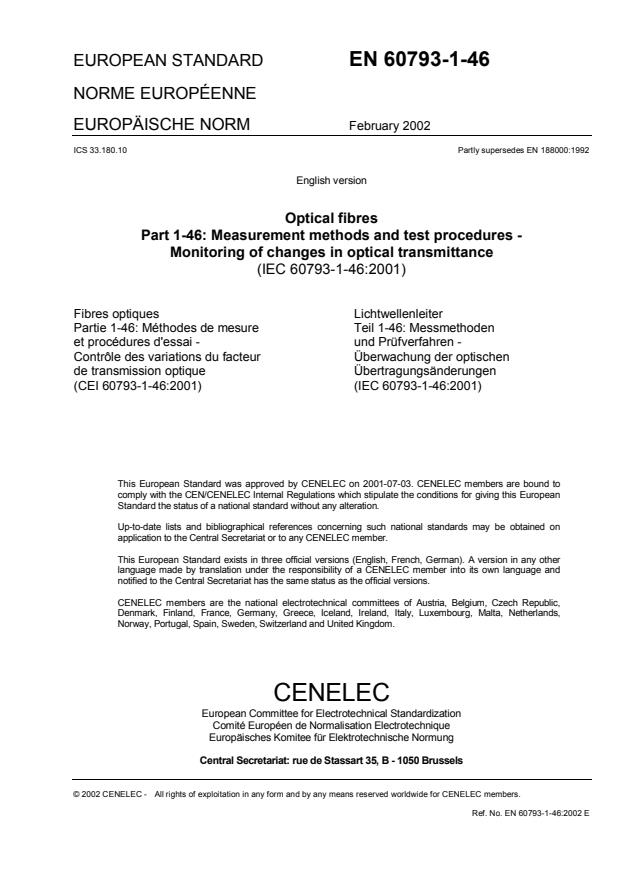
(Main)Optical fibres - Part 1-46: Measurement methods and test procedures - Monitoring of changes in optical transmittance
General Information
- Abstract
Gives two methods for monitoring the changes in optical transmittance of optical fibres and cables that occur during mechanical and environmental testing. It provides a monitor in the change of optical transmission characteristics arising from optical discontinuity, physical defects and modifications of the attenuation slope. The methods are the change in transmittance by transmitted power, and by backscattering. They apply to both multimode and single-mode fibres.
- Status
- Published
- Publication Date
- 20-Feb-2002
- Withdrawal Date
- 30-Jun-2004
- Technical Committee
- CLC/TC 86A - Optical fibres and optical fibre cables
- Drafting Committee
- IEC/SC 86A - IEC_SC_86A
- Parallel Committee
- IEC/SC 86A - IEC_SC_86A
- Current Stage
- 6060 - Document made available - Publishing
- Start Date
- 21-Feb-2002
- Completion Date
- 21-Feb-2002



Overview
EN 60793-1-46:2002, published by CENELEC (CLC), is part of the comprehensive EN 60793 standards series focusing on optical fibres. This specific standard outlines methods for monitoring changes in optical transmittance of optical fibres and cables, particularly during mechanical and environmental testing. By standardizing measurement procedures, EN 60793-1-46 ensures consistency, reliability, and comparability of results across manufacturers, labs, and testing scenarios.
The standard is applicable to both multimode and single-mode optical fibres. It specifies two principal test methods for monitoring variations in transmittance: by transmitted power and by backscattering. These methods enable the detection of optical discontinuities, physical defects, and modifications to the attenuation slope, which are key factors affecting fibre performance.
Key Topics
EN 60793-1-46 provides structured requirements and procedures for:
Method A: Change in transmittance by transmitted power
- Measures variations in transmitted optical power during testing, detecting changes caused by defects or environmental stresses.
- Employed in laboratory, factory, or field settings.
- Utilizes reference specimens and optical detection devices to ensure stable and accurate readings.
Method B: Change in transmittance by backscattering
- Uses backscattered light to evaluate changes in optical fibre transmittance.
- Particularly suited for detecting and localizing points of attenuation or discontinuity along the fibre.
Other key elements include:
- Sampling & Specimen Preparation: Guidance on specimen length and preparation of end faces for optimal measurement precision.
- Reporting Requirements: Specifies essential information to document, such as measurement conditions, specimen identification, and recorded changes in transmittance.
- Specification Criteria: Details on acceptance criteria, fibre type under test, and any procedural deviations.
Applications
EN 60793-1-46 is vital for:
- Product quality control: Ensuring that optical fibres and cables meet industry performance standards by monitoring transmission integrity.
- Mechanical and environmental testing: Observing how fibres behave under conditions like bending, tensile stress, and temperature variation, detecting loss-inducing factors.
- Research and development: Enabling R&D teams to evaluate new fibre designs and materials for performance consistency.
- Telecommunications infrastructure: Supporting the deployment and maintenance of optical networks by verifying fibre quality during installation or after repair.
- Manufacturing process validation: Confirming production processes consistently yield fibres with reliable transmission characteristics.
By standardizing measurement procedures across diverse environments and fibre types, the standard streamlines testing, reduces ambiguity, and improves cross-comparison between manufacturers and laboratories.
Related Standards
EN 60793-1-46 is part of the larger EN 60793 series on optical fibres, which includes related standards for comprehensive fibre characterization:
- EN 60793-1-40: Measurement methods and test procedures for attenuation
- EN 60793-1-41: Bandwidth measurement
- EN 60793-1-42: Chromatic dispersion measurement
- EN 60793-1-43: Numerical aperture measurement
- EN 60793-1-44: Cut-off wavelength measurement
- EN 60793-1-45: Mode field diameter measurement
- IEC 60793-1-1 & IEC 60793-1-2: Generic specifications for optical fibres
For detailed information on procedures for backscattering, refer to IEC 60793-1-40, method C.
Implementing EN 60793-1-46 ensures harmonized, high-quality measurement of changes in optical transmittance, supporting the ongoing development and reliability of optical fibre networks worldwide.
Relations
- Effective Date
- 29-Jan-2023
- Effective Date
- 14-Feb-2023
- Effective Date
- 03-Feb-2026
- Effective Date
- 03-Feb-2026
- Effective Date
- 03-Feb-2026
- Effective Date
- 03-Feb-2026
- Effective Date
- 03-Feb-2026
- Effective Date
- 03-Feb-2026
- Effective Date
- 03-Feb-2026
- Effective Date
- 03-Feb-2026
- Effective Date
- 03-Feb-2026
- Effective Date
- 03-Feb-2026
- Effective Date
- 03-Feb-2026
- Effective Date
- 03-Feb-2026
- Effective Date
- 03-Feb-2026
Get Certified
Connect with accredited certification bodies for this standard

TL 9000 QuEST Forum
Telecommunications quality management system.

ANCE
Mexican certification and testing association.

Intertek Slovenia
Intertek testing, inspection, and certification services in Slovenia.
Sponsored listings
Frequently Asked Questions
EN 60793-1-46:2002 is a standard published by CLC. Its full title is "Optical fibres - Part 1-46: Measurement methods and test procedures - Monitoring of changes in optical transmittance". This standard covers: Gives two methods for monitoring the changes in optical transmittance of optical fibres and cables that occur during mechanical and environmental testing. It provides a monitor in the change of optical transmission characteristics arising from optical discontinuity, physical defects and modifications of the attenuation slope. The methods are the change in transmittance by transmitted power, and by backscattering. They apply to both multimode and single-mode fibres.
Gives two methods for monitoring the changes in optical transmittance of optical fibres and cables that occur during mechanical and environmental testing. It provides a monitor in the change of optical transmission characteristics arising from optical discontinuity, physical defects and modifications of the attenuation slope. The methods are the change in transmittance by transmitted power, and by backscattering. They apply to both multimode and single-mode fibres.
EN 60793-1-46:2002 is classified under the following ICS (International Classification for Standards) categories: 33.180.10 - Fibres and cables. The ICS classification helps identify the subject area and facilitates finding related standards.
EN 60793-1-46:2002 has the following relationships with other standards: It is inter standard links to EN 188000:1992, EN IEC 60793-1-46:2024, EN 60793-1-40:2003, EN 60793-2-10:2004, EN 60793-1-1:2003, EN 60793-2-40:2002, EN 60793-2-50:2008, EN 60793-2-50:2004, EN 60794-2-50:2008, EN 60793-1-47:2007, EN 60794-2-41:2008, EN 60793-2-20:2009, EN 60793-2-10:2007, EN 60793-1-47:2002, EN 60793-1-54:2013. Understanding these relationships helps ensure you are using the most current and applicable version of the standard.
EN 60793-1-46:2002 is available in PDF format for immediate download after purchase. The document can be added to your cart and obtained through the secure checkout process. Digital delivery ensures instant access to the complete standard document.