


HD 60364-8-82:2025/prA1:2025
(Amendment)Low-voltage electrical installations - Part 8-82: Functional aspects - Prosumer's low-voltage electrical installations
Low-voltage electrical installations - Part 8-82: Functional aspects - Prosumer's low-voltage electrical installations
Errichten von Niederspannungsanlagen - Teil 8-82: Funktionale Aspekte - Kombinierte Erzeugungs-/Verbrauchsanlagen
Installations électriques à basse tension - Partie 8-82: Aspects fonctionnels - Installations électriques à basse tension du prosommateur
Nizkonapetostne električne inštalacije - 8-82. del: Funkcionalni vidiki - Nizkonapetostne električne inštalacije proizvajalca-odjemalca - Dopolnilo A1
General Information
- Status
- Not Published
- Publication Date
- 16-Nov-2026
- Technical Committee
- CLC/TC 64 - Electrical installations and protection against electric shock
- Current Stage
- 4060 - Enquiry results established and sent to TC, SR, BTTF - Enquiry
- Start Date
- 18-Jul-2025
- Completion Date
- 18-Jul-2025
Relations
- Effective Date
- 25-Mar-2025
Overview
The IEC HD 60364-8-82:2025/prA1:2025 standard is an amendment to the international standard addressing low-voltage electrical installations with a focus on prosumer's low-voltage electrical installations (PEIs). Developed by the International Electrotechnical Commission (IEC) Technical Committees 64 and 8, this amendment introduces new functional aspects pertinent to decentralized electrical energy systems, particularly those incorporating DC systems and power electronic converters.
This standard aims to enhance safety, reliability, and interoperability for prosumers-entities who both produce and consume electrical energy. It sets guidelines for installations involving renewable energy sources, energy storage systems, and local DC power distribution architectures interconnected through isolated interlink converters.
Key Topics
Prosumer Electrical Installations (PEIs): Focuses on installations where users generate and use their own electricity, often involving renewable energy sources and local energy storage.
DC System Integration:
Highlights architecture based on DC backbones enabling efficient interconnection and operation of distributed sources and loads, which is ideal for modern applications such as electric vehicles, LED lighting, and IT equipment.Isolated Interlink Converters (IILC):
Defines systems using power electronic converter systems (PECS) that offer galvanic isolation between AC and DC power systems, allowing separate earthing arrangements and enhancing system safety.Pre-charging and Start-Up Sequences:
Recommends controlled energization of DC circuits to protect equipment and avoid unwanted tripping of protective devices.DC Circuit Classification:
Divides DC circuits into types based on power supply arrangements (C1: single-ended supply, C2: two-ended supply, C3: multiple-source supply), enabling tailored protection and control strategies.Earthing Arrangements:
Restricts certain earthing types (e.g., TT and TN-C-S) for the DC side of PEIs to minimize corrosion risks and ensure consistent grounding safety.Protection Against Electric Shock:
Emphasizes safety requirements for different network configurations, particularly in TN-S systems where the System Referencing Conductor (SRC) must be appropriately connected near the interlink converter.
Applications
Decentralized Renewable Energy Systems:
Facilitates safe integration of local photovoltaic (PV) panels, wind turbines, and battery energy storage systems into residential or commercial low-voltage electrical installations.Electric Vehicle Supply Equipment (EVSE):
Supports architectures for bidirectional isolated DC/DC converters enabling vehicle-to-grid or grid-to-vehicle power flows.Local DC Distribution Networks:
Suitable for buildings or facilities optimizing energy use by distributing DC power directly to loads, reducing conversion losses and improving efficiency.Islandable Microgrids:
Provides guidelines for microgrids capable of operating in grid-connected or islanded modes through switching devices and isolated interlink converters.Smart Buildings and Industrial Facilities:
Enables advanced energy management balancing power generation, storage, and consumption in real-time, improving power quality and system responsiveness.
Related Standards
IEC 60364 Series:
The broader series for low-voltage electrical installations including design, protection, and functional aspects for electrical systems.IEC 62477-1:
Covers safety requirements related to power electronic converter systems (PECS), which form essential components in prosumer installations.IEC TR 63282:
Provides detailed guidelines on DC voltage bands and operational limits relevant to DC power distribution in prosumer applications.IEC 63532 (Under Development):
Specifies safety and performance requirements for Interlink Converters (ILCs) connecting AC and DC distribution systems.
Practical Value
This amendment to IEC HD 60364-8-82 elevates the safety, functionality, and flexibility of modern low-voltage installations where consumers actively produce and manage their own electricity. It addresses challenges of integrating DC systems and power electronic equipment in a standardized way, minimizing risks associated with electrical shock, equipment damage, and system instability.
By adhering to this standard, electrical engineers, designers, and installers can ensure:
- Compliance with international best practices for prosumer electrical systems
- Enhanced operational safety through proper isolation and earthing methods
- Optimized power flow management including start-up and fault handling procedures
- Support for renewable energy integration and emerging technologies like EV charging
This standard positions itself as an essential reference for promoting sustainable, safe, and efficient electrical installations in the evolving energy landscape.

Frequently Asked Questions
HD 60364-8-82:2025/prA1:2025 is a draft published by CLC. Its full title is "Low-voltage electrical installations - Part 8-82: Functional aspects - Prosumer's low-voltage electrical installations". This standard covers: Low-voltage electrical installations - Part 8-82: Functional aspects - Prosumer's low-voltage electrical installations
Low-voltage electrical installations - Part 8-82: Functional aspects - Prosumer's low-voltage electrical installations
HD 60364-8-82:2025/prA1:2025 is classified under the following ICS (International Classification for Standards) categories: 91.140.50 - Electricity supply systems. The ICS classification helps identify the subject area and facilitates finding related standards.
HD 60364-8-82:2025/prA1:2025 has the following relationships with other standards: It is inter standard links to HD 60364-8-82:2025. Understanding these relationships helps ensure you are using the most current and applicable version of the standard.
HD 60364-8-82:2025/prA1:2025 is available in PDF format for immediate download after purchase. The document can be added to your cart and obtained through the secure checkout process. Digital delivery ensures instant access to the complete standard document.
Standards Content (Sample)
SLOVENSKI STANDARD
01-junij-2025
Nizkonapetostne električne inštalacije - 8-82. del: Funkcionalni vidiki -
Nizkonapetostne električne inštalacije proizvajalca-odjemalca - Dopolnilo A1
Amendment 1 - Low-voltage electrical installations - Part 8-82: Functional aspects -
Prosumer's low-voltage electrical installations
Errichten von Niederspannungsanlagen - Teil 8-82: Funktionale Aspekte - Kombinierte
Erzeugungs-/Verbrauchsanlagen
Installations électriques à basse tension - Partie 8-2: Aspects fonctionnels - Installations
électriques à basse tension du prosommateur
Ta slovenski standard je istoveten z: HD 60364-8-82:2025/prA1:2025
ICS:
91.140.50 Sistemi za oskrbo z elektriko Electricity supply systems
kSIST FprHD 60364-8- en
82:2022/oprA1:2025
2003-01.Slovenski inštitut za standardizacijo. Razmnoževanje celote ali delov tega standarda ni dovoljeno.
64/2755/CDV
COMMITTEE DRAFT FOR VOTE (CDV)
PROJECT NUMBER:
IEC 60364-8-82/AMD1 ED1
DATE OF CIRCULATION: CLOSING DATE FOR VOTING:
2025-04-25 2025-07-18
SUPERSEDES DOCUMENTS:
64/2682/CD, 64/2753/CC
IEC TC 64 : ELECTRICAL INSTALLATIONS AND PROTECTION AGAINST ELECTRIC SHOCK
SECRETARIAT: SECRETARY:
Germany Mr Wolfgang Niedenzu
OF INTEREST TO THE FOLLOWING COMMITTEES: HORIZONTAL FUNCTION(S):
TC 8,SC 8A,SC 8B,TC 22,SC 22E,SC 23E,SC 23K,SC
32B,TC 57,TC 59,TC 69,TC 82,TC 85,TC 120,SC 121A,SC
121B,PC 128,SyC LVDC
ASPECTS CONCERNED:
Safety
SUBMITTED FOR CENELEC PARALLEL VOTING NOT SUBMITTED FOR CENELEC PARALLEL VOTING
This document is still under study and subject to change. It should not be used for reference purposes.
Recipients of this document are invited to submit, with their comments, notification of any relevant patent rights of which
they are aware and to provide supporting documentation.
Recipients of this document are invited to submit, with their comments, notification of any relevant “In Some Countries”
clauses to be included should this proposal proceed. Recipients are reminded that the CDV stage is the final stage for
submitting ISC clauses. (SEE AC/22/2007 OR NEW GUIDANCE DOC).
TITLE:
Amendment 1 - Low-voltage electrical installations - Part 8-82: Functional aspects - Prosumer's low-
voltage electrical installations
PROPOSED STABILITY DATE: 2029
NOTE FROM TC/SC OFFICERS:
electronic file, to make a copy and to print out the content for the sole purpose of preparing National Committee positions.
You may not copy or "mirror" the file or printed version of the document, or any part of it, for any other purpose without
permission in writing from IEC.
General
2 IEC 60364-8-82/AMD1 ED1 © IEC 2025
1 INTERNATIONAL ELECTROTECHNICAL COMMISSION
2 ____________
4 LOW VOLTAGE ELECTRICAL INSTALLATIONS –
6 Part 8-82: Functional aspects - Prosumer's low-voltage electrical installations
8 AMENDMENT 1
10 FOREWORD
11 1) The International Electrotechnical Commission (IEC) is a worldwide organization for standardization comprising all
12 national electrotechnical committees (IEC National Committees). The object of IEC is to promote international co -operation
13 on all questions concerning standardization in the electrical and electronic fields. To this end and in addition to other
14 activities, IEC publishes International Standards, Technical Specifications, Technical Reports, Publicly Available
15 Specifications (PAS) and Guides (hereafter referred to as “IEC Publication(s)”). Their preparation is entrusted to technical
16 committees; any IEC National Committee interested in the subject dealt with may participate in this preparatory work.
17 International, governmental and non-governmental organizations liaising with the IEC also participate in this preparation.
18 IEC collaborates closely with the International Organization for Standardization (ISO) in accordance with conditions
19 determined by agreement between the two organizations.
20 2) The formal decisions or agreements of IEC on technical matters express, as nearly as possible, an international consensus
21 of opinion on the relevant subjects since each technical committee has representation from all interested IEC National
22 Committees.
23 3) IEC Publications have the form of recommendations for international use and are accepted by IEC National Committees
24 in that sense. While all reasonable efforts are made to ensure that the technical content of IEC Publications is accurate,
25 IEC cannot be held responsible for the way in which they are used or for any misinterpretation by any end user.
26 4) In order to promote international uniformity, IEC National Committees undertake to apply IEC Publications transparently
27 to the maximum extent possible in their national and regional publications. Any divergence between any IEC Publication
28 and the corresponding national or regional publication shall be clearly indicated in the latter.
29 5) IEC itself does not provide any attestation of conformity. Independent certification bodies provide conformity assessment
30 services and, in some areas, access to IEC marks of conformity. IEC is not responsible for any services carried out by
31 independent certification bodies.
32 6) All users should ensure that they have the latest edition of this publication.
33 7) No liability shall attach to IEC or its directors, employees, servants or agents including individual experts and members
34 of its technical committees and IEC National Committees for any personal injury, property damage or other damage of
35 any nature whatsoever, whether direct or indirect, or for costs (including legal fees) and expenses arising out of the
36 publication, use of, or reliance upon, this IEC Publication or any other IEC Publications.
37 8) Attention is drawn to the Normative references cited in this publication. Use of the referenced publications is indispensable
38 for the correct application of this publication.
39 9) IEC draws attention to the possibility that the implementation of this document may involve the use of (a) patent(s). IEC
40 takes no position concerning the evidence, validity or applicability of any claimed patent rights in respect thereof. As of
41 the date of publication of this document, IEC had not received notice of (a) patent(s), which may be required to implement
42 this document. However, implementers are cautioned that this may not represent the latest information, which may be
43 obtained from the patent database available at https://patents.iec.ch. IEC shall not be held responsible for identifying any
44 or all such patent rights.
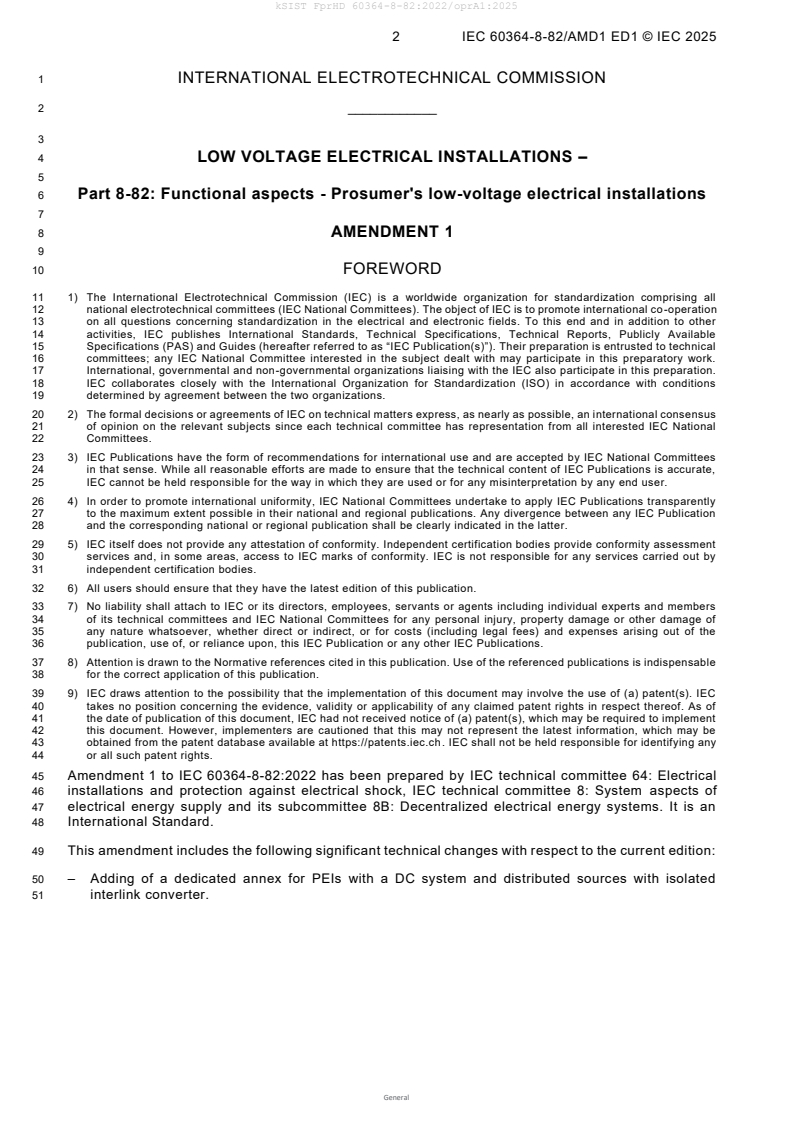
45 Amendment 1 to IEC 60364-8-82:2022 has been prepared by IEC technical committee 64: Electrical
46 installations and protection against electrical shock, IEC technical committee 8: System aspects of
47 electrical energy supply and its subcommittee 8B: Decentralized electrical energy systems. It is an
48 International Standard.
49 This amendment includes the following significant technical changes with respect to the current edition:
50 – Adding of a dedicated annex for PEIs with a DC system and distributed sources with isolated
51 interlink converter.
General
IEC 60364-8-82/AMD1 ED1 © IEC 2025 3
52 The text of this Amendment is based on the following documents:
Draft Report on voting
XX/XX/XXXX XX/XX/XXX
54 Full information on the voting for its approval can be found in the report on voting indicated in the
55 above table.
56 The language used for the development of this Amendment is English.
57 This document was drafted in accordance with ISO/IEC Directives, Part 2, and developed in
58 accordance with ISO/IEC Directives, Part 1 and ISO/IEC Directives, IEC Supplement, available at
59 www.iec.ch/members_experts/refdocs. The main document types developed by IEC are described in
60 greater detail at www.iec.ch/publications/.
61 The committee has decided that the contents of this document will remain unchanged until the stability
62 date indicated on the IEC website under webstore.iec.ch in the data related to the specific document.
63 At this date, the document will be
64 • reconfirmed,
65 • withdrawn,
66 • replaced by a revised edition, or
67 • amended.
69 ___________
70 82.3 Terms and definitions
71 Add the following terms and definitions to the list:
72 82.3.20
73 Interlink converter
74 ILC
75 PECS (Power Electronic Converter System) interconnecting two different power systems, independent
76 by nature (AC or DC), in voltage and frequency allowing transfer of energy between independent power
77 systems.
78 Note 1 to entry: Different types of PECS could be defined depending on the nature of the installation, AC/DC or DC/DC or
79 AC/AC, unidirectional or bidirectional but without energy storage capability.
80 Note 2 to entry: PECS as defined in the safety group standard IEC 62477-1.
81 82.3.21
82 Isolated Interlink converter
83 IILC
84 ILC (Interlink converter) that provides at least a basic insulation between the different interconnected
85 power systems and allows separate earthing systems for the connected power systems.
86 Note 1 to entry: see in Figure F.1, the IILC represented by item #18.
87 82.3.22
88 Pre-charging
89 energizing a DC circuit with limited currents in capacitances
90 82.3.23
91 Intertripping
92 tripping of protective devices initiated from tripping of another protective devic e
IEC 63532 ED1 InterLink Converters (ILC) connecting AC and DC distribution systems - Safety and Performance
Requirements (under development)
General
4 IEC 60364-8-82/AMD1 ED1 © IEC 2025
93 82.8.2.2.1 General
94 Add the following at the end of the third paragraph:
95 (See Annex F: PEIs with a DC system and distributed sources with isolated interlink converter )
General
IEC 60364-8-82/AMD1 ED1 © IEC 2025 5
96 Annex F
97 (normative)
99 PEIs with a DC system and distributed sources with isolated interlink converter
100 F.1 General
101 Introduction of local power supplies based on renewable energy sources and local Electrical Energy
102 Storage (EES) system is usually carried out using a DC system and a Power Electronic Converter.
103 Loads may also be controlled by power electronic converters and operate in DC e.g. information
104 technology, LED lighting, electrical vehicle etc. Using DC distribution can provide optimization for such
105 systems.
106 NOTE 1 An electrical vehicle can also be a non-permanently connected local storage unit.
107 An important aspect of prosumer electrical installations is that sources may be decentralized. Clause
108 82.8 describes PEIs with local supplies connected to the main distribution board. A lternate
109 architectures, e.g. based on a DC backbone interconnecting sources and loads, with specific protective
110 measures to comply with clause 82.8.2.2.1, may be used.
111 This annex is dedicated to PEIs with a DC system connected to the Distribution Network through an
112 isolated interlink converter (IILC) with local sources interconnected through converters to a DC
113 distribution system, e.g. see Figure F.1.
114 NOTE 2 Annex F can apply also to stand-alone PEI.
115 NOTE 3 The isolated interlink converter can be made of several units in parallel.
116 NOTE 4 PEI with non-isolated interlink converter is possible and may be included in a future revision.
8 2 23
13a 13b
21 22
Loads
Loads Load Loads Load
119 Key
120 1: Distribution network
121 2: Bidirectional isolated DC/DC Electric Vehicle Supply Equipment (EVSE)
122 8: DC/DC bidirectional non-isolated converter for Electrical Energy Storage (EES) system
123 9: DC/DC non-isolated PV converter
124 12: Point of Connection (POC)
125 13 (13a+13b): PEI
126 13a: AC side of the PEI (solid line), see an example in Figure 2
127 13b: DC side of the PEI (dotted line in blue)
128 18: AC/DC Isolated interlink converter (unidirectional or bidirectional)
129 19: DC/DC unidirectional non-isolated converter
130 20: DC/AC unidirectional non-isolated inverter
General
6 IEC 60364-8-82/AMD1 ED1 © IEC 2025
131 21: DC/AC unidirectional isolated inverter
132 22: DC/DC unidirectional isolated converter
133 23: DC/AC Bidirectional non-isolated converter connected to a regenerative load
134 NOTE 5 Arrows indicate power flow in normal operation.
135 Figure F.1 – Example of a PEI with a DC system
136 F.2 Types of PEI with a DC system
137 F.2.1 General
138 A PEI with a DC system connected to the Distribution Network through an isolated interlink converter
139 can be grid connected or islandable (see Figure F.2 for islandable PEI).
13a
AC AC
load load
13b
141 Key
142 1: Distribution network
143 2: Point of Connection (POC)
144 3: Main switching device
145 4: Switching device for islanding (SDFI) (see 82.6.3.4.3)
146 5: System referencing conductor switching device (see 82.8.2.2.4)
147 13 (13a+13b): PEI
148 13a: AC side of the PEI (solid line), see an example in Figure 2
149 13b: DC side of the PEI (dotted line in blue)
150 18: AC/DC Isolated interlink converter (unidirectional or bidirectional)
151 Figure F.2 – Example of islandable PEI architecture
General
IEC 60364-8-82/AMD1 ED1 © IEC 2025 7
152 NOTE When the SDFI is in closed position and the interlink converter is inactive (not exchanging power with the distribution
153 network), the PEI is still considered as grid connected.
154 F.2.2 Interaction with the distribution network
155 The AC side of the PEI shall comply with 82.6.3 (see Figure 4). In addition to requirements of 82.6.3,
156 a start-up sequence for the DC system shall be defined including pre-charging when needed to prevent
157 damage to equipment and tripping of protective devices.
158 The start-up sequence is required when the DC system is put in service or after the system or a part
159 of it, has been de-energized. This sequence consists of several steps of pre-charging of the different
160 circuits to reach the operating voltage of the DC system.
161 Pre-charging can be provided by the interlink converter, an OCPD, a dedicated converter supplied from
162 the AC side of the PEI or by a local energy source on the DC system.
163 The steps consist of:
164 • pre-charging all capacitances of the C3 circuit (see F.3.3). Pre-charging of the C3 circuit is
165 complete when the operating voltage band is reached (band B3 as defined in IEC TR 63282).
166 • pre-charging all circuits connected to the C3 circuit.
167 The start-up sequence is completed when all circuits part of the DC system, intended to be energized ,
168 are pre-charged and the operating voltage band is reached (band B3 as defined in IEC TR 63282).
169 Pre-charging shall not impair the isolation provided by isolated converters.
170 Any other auxiliary circuits (e.g. measurement, controller etc.) connected between the AC side of the
171 PEI and the DC system, shall not impair the isolation provided by the interlink converter.
172 Provisions shall be made to prevent inadvertent or unauthorized start-up and pre-charging. This can
173 be achieved either by means of mechanical or electrical interlocks.
174 F.3 General characteristics of the DC side of the PEI
175 F.3.1 DC Voltage characteristics
176 As per IEC TR 63282, the DC voltages are divided into 7 different bands for temporary and continuous
177 operation. Figure 2 of IEC TR 63282:2024 defines those different voltage bands and its limits in terms
178 of voltage but also maximum time of operation in this band. The nominal operation band of the DC
179 system is called nominal band or B3. This band is characterized by a power balance between local
180 sources, the grid through the interlink converter and the loads. All devices shall be designed for
181 permanent operation in this voltage band B3.
182 The rated voltage for equipment shall not be less than U4.
183 The insulation voltage (Ui) for equipment shall not be less than U6.
184 The operating voltage can be used as a signal to ensure the stability and flexibility of such a PEI (see
185 IEC TR 63282:2024, 4.3.2).
186 The DC side of the PEI (13b in Figure F.1) shall be designed in order to maintain:
187 – correct power balancing between sources and loads (e.g. droop control),
188 – system stability,
189 – power quality (e.g. ripple).
190 F.3.2 Type of electric systems of the DC side of the PEI
191 Electric systems are defined in IEC 60364-1.
192 The DC side of the PEI shall have one single interconnected earthing arrangement in order to avoid
193 risk of corrosion in the surrounding of the installation (see F.4.5). Therefore, TT is not permitted.
General
8 IEC 60364-8-82/AMD1 ED1 © IEC 2025
194 To minimize current in conductive parts not intended to carry current in normal situation, TN -C and
195 TN-C-S are not permitted.
196 When IT is selected, exposed conductive parts shall be connected to the same earthing arrangement .
197 F.3.3 DC circuit classification
198 The DC circuits of a PEI are classified as follows (see Figure F.3):
199 • Circuit C1: circuit supplied from one end;
200 • Circuit C2: circuit supplied from both ends;
201 • Circuit C3: circuit connected to more than two sources.
OCPD
1 C2
8 2
OCPD OCPD OCPD OCPD
C2
C2 C2
C2
OCPD OCPD
OCPD OCPD
13a
13b
C3
OCPD
OCPD OCPD OCPD
OCPD
C1 C1
C1 C1
21 22
19 20
Loads
C1
C1 C1 C1
Loads Load Loads Load
203 Key
204 1: Distribution network
205 2: Bidirectional isolated DC/DC Electric Vehicle Supply Equipment (EVSE)
206 8: DC/DC bidirectional non-isolated converter for Electrical Energy Storage (EES) systems
207 9: DC/DC non-isolated PV converter
208 12: Point of Connection (POC)
209 13 (13a+13b): PEI
210 13a: AC side of the PEI (solid line), see an example in Figure 2
211 13b: DC side of the PEI (dotted line in blue)
212 18: AC/DC Isolated interlink converter (unidirectional or bidirectional)
213 19: DC/DC unidirectional non-isolated converter
214 20: DC/AC unidirectional non-isolated inverter
215 21: DC/AC unidirectional isolated inverter
216 22: DC/DC unidirectional isolated converter
General
IEC 60364-8-82/AMD1 ED1 © IEC 2025 9
217 23: DC/AC Bidirectional non-isolated converter connected to a regenerative load
218 24: System Referencing Conductor (SRC)
219 Note C1, C2 and C3 circuits are defined in F.3.3.
220 Figure F.3 – Example of a PEI with a DC system and illustration of DC circuit classification
221 F.4 Protection of PEI with a DC system
222 F.4.1 Protection against electric shock
223 F.4.1.1 TN-S system
224 The System Referencing Conductor (SRC) shall be connected near the interlink converter .
225 In case of a fault on a C2 or C3 circuit and where automatic disconnection of supply is used, all supplies
226 connected to this circuit shall be disconnected according to disconnection times defined in IEC 60364 -
227 4-41. In order to disconnect all supplies, an intertripping function may be implemented (see F.5.2.3).
228 Unintended energizing of all sources after automatic disconnection of supply shall be prevented.
229 F.4.1.2 IT syst
...
Questions, Comments and Discussion
Ask us and Technical Secretary will try to provide an answer. You can facilitate discussion about the standard in here.
Loading comments...