


FprEN IEC 60721-3-5:2025
(Main)Classification of environmental conditions - Part 3-5: Classification of groups of environmental parameters and their severities - Ground vehicle installations
Classification of environmental conditions - Part 3-5: Classification of groups of environmental parameters and their severities - Ground vehicle installations
IEC 60721-3-5:2026 classifies the groups of environmental parameters and their severities to which a product, not forming part of the vehicle, is subjected when installed on or in a ground vehicle. Such products are for example radios, communication systems, fare meters, flow meters for liquids transported by the vehicle, for example milk, petroleum products, etc. Vehicles where products can be permanently or temporarily installed include - road vehicles: passenger cars, commercial vehicles, special vehicles, towing vehicles, trailers, mopeds, motorcycles, - rail vehicles: trains, trams, - tracked vehicles: excavators, cranes, rubber tracked vehicles, - overland vehicles: four-wheel drive cars, tractors, snow scooters, - handling and storage vehicles: fork-lift trucks (manual and robot), luggage transporters, and - self-propelled machinery: diggers, harvesters. This third edition cancels and replaces the second edition, published in 1997. This edition constitutes a technical revision. This edition includes the following significant technical changes with respect to the previous edition: a) most classes have been replaced by completely new classes based on the use of additional information obtained from referenced Technical Reports; b) Table 1 through to Table 7 have been reviewed and updated; c) the content of Annex A and Annex B has either been incorporated into the main body of the document or deleted.
Klassifizierung von Umgebungsbedingungen - Teil 3-5: Klassen von Einflussgrößen und deren Grenzwerte - Einsatz an und in Landfahrzeugen
Classification des conditions d'environnement - Partie 3-5: Classification des groupements des agents d'environnement et de leurs sévérités -Installations de véhicules terrestres
L'IEC 60721-3-5:2026 classifie les groupements des agents d'environnement et leurs sévérités, auxquels est soumis un produit qui ne fait pas partie du véhicule, lorsque le produit est installé sur ou dans un véhicule terrestre. Les exemples de tels produits sont les récepteurs radio, les systèmes de communication, les compteurs de kilométrage/tarification, les débitmètres pour les liquides transportés par le véhicule, par exemple lait, produits pétroliers, etc. Les véhicules à bord desquels les produits peuvent être installés de façon permanente ou provisoire comprennent - les véhicules routiers: véhicules de tourisme, véhicules utilitaires, véhicules spéciaux, véhicules tracteurs, remorques, cyclomoteurs, motocyclettes; - les véhicules ferroviaires: trains, tramways; - les véhicules à chenilles: pelles, grues, véhicules à chenilles en caoutchouc; - les véhicules tout-terrain: véhicules à quatre roues motrices, tracteurs, motoneiges; - les véhicules de manutention et de stockage: chariots élévateurs à fourche (manuels et robotisés), convoyeurs à bagages; et - les machines automotrices: excavatrices, moissonneuses. Cette troisième édition annule et remplace la deuxième édition parue en 1997. Cette édition constitue une révision technique. Cette édition inclut les modifications techniques majeures suivantes par rapport à l'édition précédente: a) la plupart des classes ont été remplacées par des classes totalement nouvelles, établies en fonction de l'utilisation d'informations supplémentaires obtenues dans les Rapports techniques référencés; b) les Tableau 1 à Tableau 7 ont été revus et mis à jour; c) le contenu de l'Annexe A et de l'Annexe B a été soit incorporé dans le corps principal du document soit supprimé.
Razvrščanje okoljskih pogojev - 3. del: Razvrščanje skupin okoljskih parametrov in njihove resnosti - 5. odsek: Inštalacije v kopenskih vozilih
General Information
- Status
- Not Published
- Publication Date
- 26-Feb-2026
- Technical Committee
- CLC/SR 104 - Environmental conditions, classification and methods of test
- Current Stage
- 5060 - Voting results sent to TC, SR - Formal Approval
- Start Date
- 28-Nov-2025
- Completion Date
- 28-Nov-2025
Relations
- Effective Date
- 04-Jul-2023
Overview
The FprEN IEC 60721-3-5:2025 standard, titled Classification of environmental conditions - Part 3-5: Classification of groups of environmental parameters and their severities - Ground vehicle installations, issued by the CLC, provides a comprehensive framework to classify the environmental conditions and severity levels to which products installed in or on ground vehicles are exposed. These products include items that are not integral parts of the vehicle but mounted either permanently or temporarily, such as communication systems, meters for liquids, or instrumentation devices.
This third edition is a technical revision of the 1997 edition, reflecting updated classifications based on new technical data. It is especially relevant for manufacturers, engineers, and testing laboratories involved in designing and validating equipment for various types of ground vehicles, including road vehicles, rail vehicles, tracked vehicles, and self-propelled machinery.
Key Topics
Scope and Application
The standard addresses the classification of environmental parameters and severity levels affecting non-vehicle integral products installed on ground vehicles like passenger cars, commercial vehicles, trains, cranes, excavators, and agricultural machinery. It excludes products forming part of the vehicle structure but can be applied to exchangeable parts with similar installation.Environmental Parameter Groups
The classification organizes environmental parameters into groups with specific classes:- Climatic conditions (K): Covers ambient temperature, humidity, solar radiation, precipitation, and other meteorological factors affecting products.
- Special climatic conditions (Z): Includes rare or severe weather phenomena relevant to ground vehicle installations.
- Biological conditions (B): Addresses biological agents like fungi, insects, or rodents that may affect equipment.
- Chemically active substances (C): Classifies corrosive chemicals or pollutants encountered.
- Mechanically active substances (S): Covers particulate matter such as dust or abrasive particles.
- Contaminating fluids (F) and Mechanical conditions (M): Address fluids leaking or spilled onto devices and mechanical stresses such as vibration and shock from vehicle operation.
Severity Levels
Each environmental parameter is further classified by severity levels identifying typical exposures ranging from mild to extreme. This helps in selecting appropriate design parameters and test conditions.Design and Testing Guidance
The standard emphasizes considering combined environmental factors simultaneously-for example, vibration plus temperature variation-and the effects of both short-term extreme events and long-term exposure on product reliability. This supports realistic testing and verification protocols for ground vehicle equipment.
Applications
Product Development for Ground Vehicles
Helps manufacturers specify environmental requirements that products must meet when installed inside or outside vehicles, improving durability and performance under real operating conditions.Environmental Testing and Validation
Laboratories and certifiers can use this classification to develop appropriate test plans simulating real-world environmental stresses like temperature cycles, mechanical shocks, humidity, and contamination.Specification and Procurement
Provides standardized vocabulary and severity classifications to include in technical specifications, procurement contracts, and compliance documents for equipment used in automotive, rail, agricultural, and industrial vehicle sectors.Safety Critical Equipment Design
Supports risk management by defining environmental classes that products vital to vehicle safety must withstand, ensuring operational integrity under adverse conditions.
Related Standards
IEC 60721-1: Classification of environmental conditions - Part 1: Environmental parameters and their severities
Foundation for terminology and parameter definitions used in Part 3-5.IEC 60721 Series
Other parts address storage, transportation, and other environmental classifications complementary to ground vehicle installations.IEC Technical Reports (IEC TR 62130, IEC TR 62131 series)
Provide detailed guidance on environmental measurement data and condition definitions relevant for applying this standard.ISO/IEC Directives, Part 2
Relevant for the document’s drafting and publication procedures.
Keywords: IEC 60721-3-5, ground vehicle installations, environmental classification, climatic conditions, vibration, shock, contamination, chemical exposure, biological agents, environmental severity, product testing, electrotechnical standards, vehicle-mounted equipment.

Get Certified
Connect with accredited certification bodies for this standard

IMP NDT d.o.o.
Non-destructive testing services. Radiography, ultrasonic, magnetic particle, penetrant, visual inspection.
Inštitut za kovinske materiale in tehnologije
Institute of Metals and Technology. Materials testing, metallurgical analysis, NDT.
Q Techna d.o.o.
NDT and quality assurance specialist. 30+ years experience. NDT personnel certification per ISO 9712, nuclear and thermal power plant inspections, QA/
Sponsored listings
Frequently Asked Questions
FprEN IEC 60721-3-5:2025 is a draft published by CLC. Its full title is "Classification of environmental conditions - Part 3-5: Classification of groups of environmental parameters and their severities - Ground vehicle installations". This standard covers: IEC 60721-3-5:2026 classifies the groups of environmental parameters and their severities to which a product, not forming part of the vehicle, is subjected when installed on or in a ground vehicle. Such products are for example radios, communication systems, fare meters, flow meters for liquids transported by the vehicle, for example milk, petroleum products, etc. Vehicles where products can be permanently or temporarily installed include - road vehicles: passenger cars, commercial vehicles, special vehicles, towing vehicles, trailers, mopeds, motorcycles, - rail vehicles: trains, trams, - tracked vehicles: excavators, cranes, rubber tracked vehicles, - overland vehicles: four-wheel drive cars, tractors, snow scooters, - handling and storage vehicles: fork-lift trucks (manual and robot), luggage transporters, and - self-propelled machinery: diggers, harvesters. This third edition cancels and replaces the second edition, published in 1997. This edition constitutes a technical revision. This edition includes the following significant technical changes with respect to the previous edition: a) most classes have been replaced by completely new classes based on the use of additional information obtained from referenced Technical Reports; b) Table 1 through to Table 7 have been reviewed and updated; c) the content of Annex A and Annex B has either been incorporated into the main body of the document or deleted.
IEC 60721-3-5:2026 classifies the groups of environmental parameters and their severities to which a product, not forming part of the vehicle, is subjected when installed on or in a ground vehicle. Such products are for example radios, communication systems, fare meters, flow meters for liquids transported by the vehicle, for example milk, petroleum products, etc. Vehicles where products can be permanently or temporarily installed include - road vehicles: passenger cars, commercial vehicles, special vehicles, towing vehicles, trailers, mopeds, motorcycles, - rail vehicles: trains, trams, - tracked vehicles: excavators, cranes, rubber tracked vehicles, - overland vehicles: four-wheel drive cars, tractors, snow scooters, - handling and storage vehicles: fork-lift trucks (manual and robot), luggage transporters, and - self-propelled machinery: diggers, harvesters. This third edition cancels and replaces the second edition, published in 1997. This edition constitutes a technical revision. This edition includes the following significant technical changes with respect to the previous edition: a) most classes have been replaced by completely new classes based on the use of additional information obtained from referenced Technical Reports; b) Table 1 through to Table 7 have been reviewed and updated; c) the content of Annex A and Annex B has either been incorporated into the main body of the document or deleted.
FprEN IEC 60721-3-5:2025 is classified under the following ICS (International Classification for Standards) categories: 19.040 - Environmental testing. The ICS classification helps identify the subject area and facilitates finding related standards.
FprEN IEC 60721-3-5:2025 has the following relationships with other standards: It is inter standard links to EN 60721-3-5:1997. Understanding these relationships helps ensure you are using the most current and applicable version of the standard.
FprEN IEC 60721-3-5:2025 is available in PDF format for immediate download after purchase. The document can be added to your cart and obtained through the secure checkout process. Digital delivery ensures instant access to the complete standard document.
Standards Content (Sample)
SLOVENSKI STANDARD
oSIST prEN IEC 60721-3-5:2025
01-marec-2025
Razvrščanje okoljskih pogojev - 3. del: Razvrščanje skupin okoljskih parametrov
in njihove resnosti - 5. odsek: Inštalacije v kopenskih vozilih
Classification of environmental conditions - Part 3: Classificationof groups of
environmental parameters and their severities -section 5: Ground vehicle installations
Classification des conditions d'environnement - Partie 3: Classification des groupements
des agents d'environnement et de leurs sévérités - Section 5: Installations des véhicules
terrestres
Ta slovenski standard je istoveten z: prEN IEC 60721-3-5:2024
ICS:
19.040 Preskušanje v zvezi z Environmental testing
okoljem
oSIST prEN IEC 60721-3-5:2025 en
2003-01.Slovenski inštitut za standardizacijo. Razmnoževanje celote ali delov tega standarda ni dovoljeno.
oSIST prEN IEC 60721-3-5:2025
oSIST prEN IEC 60721-3-5:2025
104/1084/CDV
COMMITTEE DRAFT FOR VOTE (CDV)
PROJECT NUMBER:
IEC 60721-3-5 ED3
DATE OF CIRCULATION: CLOSING DATE FOR VOTING:
2024-12-27 2025-03-21
SUPERSEDES DOCUMENTS:
104/1060/CD, 104/1079/CC
IEC TC 104 : ENVIRONMENTAL CONDITIONS, CLASSIFICATION AND METHODS OF TEST
SECRETARIAT: SECRETARY:
Sweden Mr Joakim Grafström
OF INTEREST TO THE FOLLOWING COMMITTEES: HORIZONTAL FUNCTION(S):
TC 9,TC 44,SC 45B,TC 100,TA 6
ASPECTS CONCERNED:
SUBMITTED FOR CENELEC PARALLEL VOTING NOT SUBMITTED FOR CENELEC PARALLEL VOTING
Attention IEC-CENELEC parallel voting
The attention of IEC National Committees, members of
CENELEC, is drawn to the fact that this Committee Draft
for Vote (CDV) is submitted for parallel voting.
The CENELEC members are invited to vote through the
CENELEC online voting system.
This document is still under study and subject to change. It should not be used for reference purposes.
Recipients of this document are invited to submit, with their comments, notification of any relevant patent rights of
which they are aware and to provide supporting documentation.
Recipients of this document are invited to submit, with their comments, notification of any relevant “In Some
Countries” clauses to be included should this proposal proceed. Recipients are reminded that the CDV stage is the
final stage for submitting ISC clauses. (SEE AC/22/2007 OR NEW GUIDANCE DOC).
TITLE:
Classification of environmental conditions - Part 3: Classificationof groups of environmental
parameters and their severities -Section 5: Ground vehicle installations
PROPOSED STABILITY DATE: 2035
NOTE FROM TC/SC OFFICERS:
download this electronic file, to make a copy and to print out the content for the sole purpose of preparing National
Committee positions. You may not copy or "mirror" the file or printed version of the document, or any part of it,
for any other purpose without permission in writing from IEC.
oSIST prEN IEC 60721-3-5:2025
IEC CDV 60721-3-5 © IEC 2024 2 104/1084/CDV
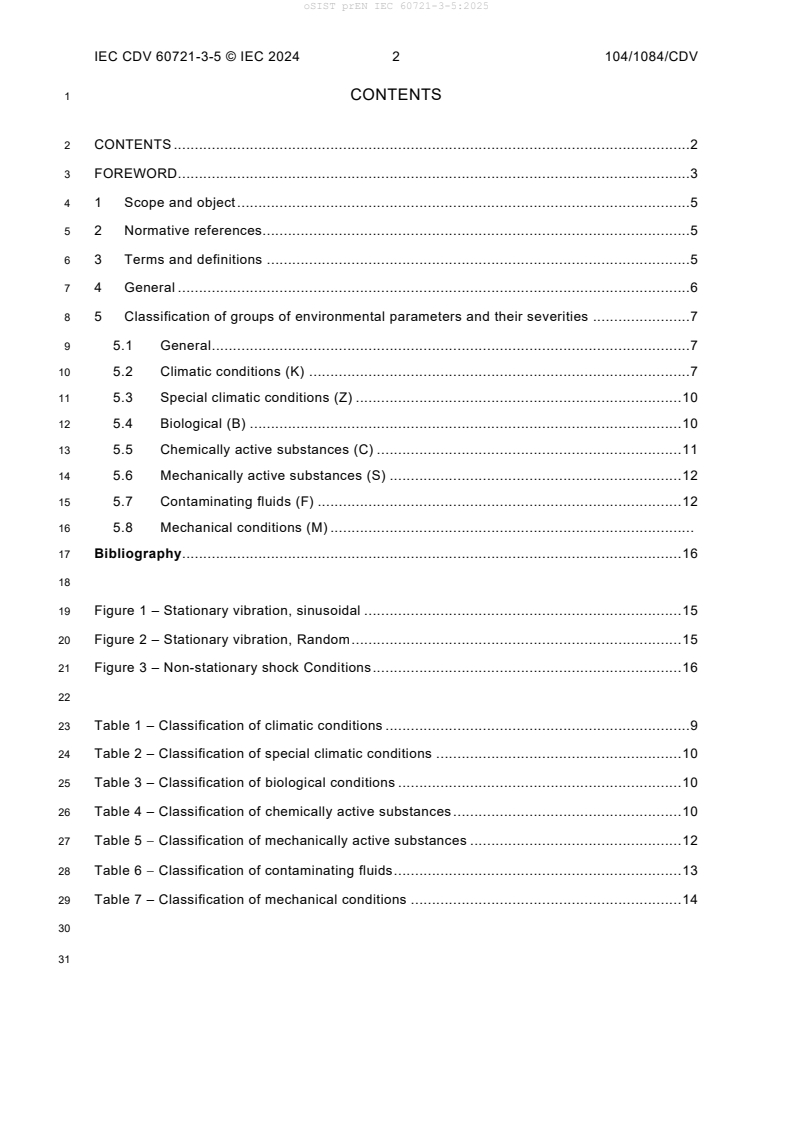
1 CONTENTS
2 CONTENTS . 2
3 FOREWORD . 3
4 1 Scope and object . 5
5 2 Normative references. 5
6 3 Terms and definitions . 5
7 4 General . 6
8 5 Classification of groups of environmental parameters and their severities . 7
9 5.1 General . 7
10 5.2 Climatic conditions (K) . 7
11 5.3 Special climatic conditions (Z) . 10
12 5.4 Biological (B) . 10
13 5.5 Chemically active substances (C) . 11
14 5.6 Mechanically active substances (S) . 12
15 5.7 Contaminating fluids (F) . 12
16 5.8 Mechanical conditions (M) .
17 Bibliography. 16
19 Figure 1 – Stationary vibration, sinusoidal . 15
20 Figure 2 – Stationary vibration, Random . 15
21 Figure 3 – Non-stationary shock Conditions . 16
23 Table 1 – Classification of climatic conditions . 9
24 Table 2 – Classification of special climatic conditions . 10
25 Table 3 – Classification of biological conditions . 10
26 Table 4 – Classification of chemically active substances . 10
27 Table 5 − Classification of mechanically active substances . 12
28 Table 6 − Classification of contaminating fluids . 13
29 Table 7 – Classification of mechanical conditions . 14
oSIST prEN IEC 60721-3-5:2025
IEC CDV 60721-3-5 © IEC 2024 3 104/1084/CDV
32 INTERNATIONAL ELECTROTECHNICAL COMMISSION
33 ____________
35 CLASSIFICATION OF ENVIRONMENTAL CONDITIONS –
37 Part 3-5: Classification of groups of environmental parameters and their
38 severities – Ground Vehicle Installations
40 FOREWORD
41 1) The International Electrotechnical Commission (IEC) is a worldwide organization for standardization comprising
42 all national electrotechnical committees (IEC National Committees). The object of IEC is to promote international
43 co-operation on all questions concerning standardization in the electrical and electronic fields. To this end and
44 in addition to other activities, IEC publishes International Standards, Technical Specifications, Technical Reports,
45 Publicly Available Specifications (PAS) and Guides (hereafter referred to as “IEC Publication(s)”). Their
46 preparation is entrusted to technical committees; any IEC National Committee interested in the subject dealt with
47 may participate in this preparatory work. International, governmental and non-governmental organizations liaising
48 with the IEC also participate in this preparation. IEC collaborates closely with the International Organization for
49 Standardization (ISO) in accordance with conditions determined by agreement between the two organizations.
50 2) The formal decisions or agreements of IEC on technical matters express, as nearly as possible, an international
51 consensus of opinion on the relevant subjects since each technical committee has representation from all
52 interested IEC National Committees.
53 3) IEC Publications have the form of recommendations for international use and are accepted by IEC National
54 Committees in that sense. While all reasonable efforts are made to ensure that the technical content of IEC
55 Publications is accurate, IEC cannot be held responsible for the way in which they are used or for any
56 misinterpretation by any end user.
57 4) In order to promote international uniformity, IEC National Committees undertake to apply IEC Publications
58 transparently to the maximum extent possible in their national and regional publications. Any divergence between
59 any IEC Publication and the corresponding national or regional publication shall be clearly indicated in the latter.
60 5) IEC itself does not provide any attestation of conformity. Independent certification bodies provide conformity
61 assessment services and, in some areas, access to IEC marks of conformity. IEC is not responsible for any
62 services carried out by independent certification bodies.
63 6) All users should ensure that they have the latest edition of this publication.
64 7) No liability shall attach to IEC or its directors, employees, servants or agents including individual experts and
65 members of its technical committees and IEC National Committees for any personal injury, property damage or
66 other damage of any nature whatsoever, whether direct or indirect, or for costs (including legal fees) and
67 expenses arising out of the publication, use of, or reliance upon, this IEC Publication or any other IEC
68 Publications.
69 8) Attention is drawn to the Normative references cited in this publication. Use of the referenced publications is
70 indispensable for the correct application of this publication.
71 9) Attention is drawn to the possibility that some of the elements of this IEC Publication may be the subject of patent
72 rights. IEC shall not be held responsible for identifying any or all such patent rights.
73 International Standard IEC 60721-3-5 has been prepared by IEC technical committee 104:
74 Environmental conditions, classification, and methods of test.
75 This third edition cancels and replaces the second edition, published in 1997, and constitutes
76 a technical revision.
77 This edition includes the following significant changes with respect to the previous edition:
78 a) Most classes have been replaced by completely new classes based on the use of
79 additional information obtained from referenced Technical Reports.
oSIST prEN IEC 60721-3-5:2025
IEC CDV 60721-3-5 © IEC 2024 4 104/1084/CDV
80 b) Table 1 through to Table 7 have been reviewed and updated.
81 c) The content of Annex A and B has either been incorporated into main body text or deleted.
82 The text of this International Standard is based on the following documents:
FDIS Report on voting
xxx xxx
84 Full information on the voting for the approval of this International Standard can be found in the
85 report on voting indicated in the above table.
86 This document has been drafted in accordance with the ISO/IEC Directives, Part 2.
87 A list of all parts in the IEC 60721 series, published under the general title Classification of
88 environmental conditions, can be found on the IEC website.
89 The committee has decided that the contents of this document will remain unchanged until the
90 stability date indicated on the IEC website under "http://webstore.iec.ch" in the data related to
91 the specific document. At this date, the document will be
92 • reconfirmed,
93 • withdrawn,
94 • replaced by a revised edition, or
95 • amended.
IMPORTANT – The 'colour inside' logo on the cover page of this publication indicates
that it contains colours which are considered to be useful for the correct understanding
of its contents. Users should therefore print this document using a colour printer.
oSIST prEN IEC 60721-3-5:2025
IEC CDV 60721-3-5 © IEC 2024 5 104/1084/CDV
98 CLASSIFICATION OF ENVIRONMENTAL CONDITIONS –
99 Part 3-5: Classification of groups of environmental parameters and their
100 severities – Ground Vehicle Installations
101 1 Scope and object
102 This part of IEC 60721 classifies the groups of environmental parameters and their severities
103 to which a product. not forming part of the vehicle, is subjected when installed on or in a ground
104 vehicle. Such products are for example radios, communication systems, fare meters, flow
105 meters for liquids transported by the vehicle, for example milk, petroleum products, etc.
106 Vehicles where products may be permanently or temporarily installed include:
107 • road vehicles: passenger cars, commercial vehicles, special vehicles, towing vehicles,
108 trailers, mopeds, motorcycles,
109 • rail vehicles: trains, trams,
110 • tracked vehicles: excavators, cranes, rubber tracked vehicles,
111 • overland vehicles: four-wheel drive cars, tractors, snow scooters,
112 • handling and storage vehicles: fork-lift trucks (manual and robot), luggage transporters,
113 and
114 • self-propelled machinery: diggers, harvesters.
115 Although this document is not intended for products forming part of the vehicles, the
116 environmental condition classification may also be used for some exchangeable parts, installed
117 in a similar way and in the same locations of the vehicle as products which do not form part of
118 the vehicle. Only severe conditions which may be harmful to products are included.
119 Conditions of storage, transportation and handling are given in IEC 60721-3-1 and
120 IEC 60721-3-2. Classification of storage and transportation environmental conditions are given
121 in other subparts of the IEC 60721-3 series.
122 Accidental incidents are not included but it can be important to take their occurrence into
123 account for products vital to the safety of the ground vehicle.
124 2 Normative references
125 The following documents are referred to in the text in such a way that some or all of their content
126 constitutes requirements of this document. For dated references, only the edition cited applies.
127 For undated references, the latest edition of the referenced document (including any
128 amendments) applies.
129 IEC 60721-1, Classification of environmental conditions − Part 1: Environmental parameters
130 and their severities
131 3 Terms and definitions
132 For the purposes of this document, the terms and definitions given in IEC 60721-1 and the
133 following apply.
oSIST prEN IEC 60721-3-5:2025
IEC CDV 60721-3-5 © IEC 2024 6 104/1084/CDV
134 3.1
135 internally mounted
136 mounted internally in the vehicle, in a compartment which affords some protection from the
137 environment, ranging from complete isolation from external influences, to protection only from
138 precipitation when the vehicle is not moving
139 3.2
140 externally mounted
141 mounted on the outside of the vehicle and not protected from any external influences
142 3.3
143 Weatherprotected
144 protected from the influences of meteorological conditions
145 3.4
146 non-weatherprotected
147 not protected from the influences of meteorological conditions
148 ISO and IEC maintain terminological databases for use in standardization at the following
149 addresses:
150 • IEC Electropedia: available at http://www.electropedia.org/
151 • ISO Online browsing platform: available at http://www.iso.org/obp
152 4 General
153 A product may be subjected to a range of environmental conditions during its lifetime. These
154 conditions have been separated into classes described in IEC 60721-3-0. The classes given
155 may be used for defining the maximum short-term environmental stresses on a product.
156 However, they do not provide information regarding the long-term or total lifetime environmental
157 stresses a product may experience. This means that no reliability or lifetime assessment is
158 possible based on these classes alone. Refer to the IEC 60721-2 series and applicable
159 technical reports (IEC TR 62130 as well as IEC TR 62131-3, -4 and -5) for further information
160 on actual environmental conditions.
161 A product may be simultaneously exposed to a number of environmental parameters. For
162 example, solar radiation with temperature, temperature with humidity, as well as vibration with
163 temperature change. Combinations of the environmental parameters given may increase the
164 stress effect on a product. Therefore, combined conditions should be considered in the design
165 and evaluation of a product.
166 Products should be designed to survive and operate in different environments. Basically, they
167 will be affected by environmental influences in two ways:
168 • by the effects of short-term extreme environmental conditions which may directly cause
169 malfunction or destroy the product and
170 • by the effect of long-term subjection to non-extreme environmental stresses which may
171 slowly degrade the product and finally cause malfunction or destruction of the product.
172 Short-term extreme environmental conditions may occur at any time in a product's life. A product
173 may be unaffected by an extreme condition when it is new but fail when it is subjected to the
174 same condition after being used for a long period of time due to the effect of ageing. The order
175 in which the environmental conditions are applied may affect the results of an evaluation.
176 It is important for the product specification, when referring to a certain class in the
177 IEC 607213 series, to define whether the product is required to be capable of operating or only
178 to survive without permanent damage when being exposed to the conditions described by the
179 class.
oSIST prEN IEC 60721-3-5:2025
IEC CDV 60721-3-5 © IEC 2024 7 104/1084/CDV
180 The environmental classes can be used as a basis for the selection of design and test severities
181 with respect to the consequence of failure. Information contained in the IEC 607213 series can
182 be used as a means to help establish expected requirements for use, storage, transportation,
183 etc., and in the development of relevant specifications. The selected severities used for testing
184 should attempt to produce the effects of the actual environment.
185 EXAMPLE 1 A high temperature test on a heat dissipating product is designed to simulate the thermal effect of
186 subjecting a product to conditions of high air temperature, solar radiation and other possible heat sources dependent
187 on the application.
188 EXAMPLE 2 In a mechanical shock test, the product may be subjected to mechanical shocks of simple pulse shapes
189 (e.g., half-sine), while the actual conditions cannot be described by such simple pulses.
190 It is recognized that extreme or special environmental conditions can exist which require
191 consideration of severities that are not addressed by this document.
192 5 Classification of groups of environmental parameters and their severities
193 5.1 General
194 A number of classes for climatic conditions (K), special climatic conditions (Z), biological
195 conditions (B), chemically active substances (C), mechanically active substances (S), and
196 mechanical conditions (M) are specified.
197 This classification allows for a number of possible combinations of environmental conditions
198 which bear upon products wherever stored. It represents the real situation concerning
199 world-wide conditions of storage due to local influences of open-air climate, etc. For certain
200 environmental parameters, it has not yet been possible to specify quantitative severities.
201 For a given location or product, reference should be made to the total set of classes as defined
202 in 5.2 through 5.7, for example:
203 5K11/5Z2/5B1/5C3/5S5/5F1/5M5
204 5.2 Climatic conditions (K)
205 NOTE The classes defined in previous versions of this document have been replaced with new classes as a result
206 of recent efforts at collecting information regarding climatic conditions. Those results are contained in Technical
207 Reports referenced in this document.
208 When selecting appropriate classes, attention should be paid to the fact that the climatic
209 conditions inside buildings may depend on the outside (open-air) conditions, especially air
210 temperature and solar radiation, and the type of building construction. Walls with good thermal
211 insulation or high thermal capacity can consistently smooth the peaks of outside air temperature
212 variations between day and night, or, exceptionally, those produced over a longer period of
213 time. Walls with poor thermal insulation or low thermal capacity cannot have this effect and
214 peaks can be magnified due to the effect of solar radiation during the day, and to the effect of
215 building radiation at night. The effect of solar radiation can be increased by either heat-trap or
216 greenhouse effects.
217 The severity of these effects may be influenced for instance by constructional details (sort and
218 thickness of material, colour of surface, sealing or breathing of casings or enclosures, product
219 heating, etc.) and by mounting details (selection of mounting site, consideration of degree of
220 exposure to prevailing wind and weather, etc.).
221 The climatic conditions specified for classes 5K7 to 5K14 refer to the conditions in use of the
222 products. These conditions have been experienced world-wide over a long period of time taking
223 into account all the parameters that can influence them
...
Questions, Comments and Discussion
Ask us and Technical Secretary will try to provide an answer. You can facilitate discussion about the standard in here.
Loading comments...