


prEN IEC 60068-3-6:2025
(Main)Environmental testing - Part 3-6: Supporting documentation and guidance - Confirmation of the performance of temperature/ humidity chambers
Environmental testing - Part 3-6: Supporting documentation and guidance - Confirmation of the performance of temperature/ humidity chambers
Umgebungseinflüsse - Teil 3-6: Unterstützende Dokumentation und Leitfaden - Bestätigung des Leistungsvermögens von Temperatur- und Klima-Prüfkammern
Essais d'environnement - Partie 3-6: Documentation d'accompagnement et recommandations - Confirmation des performances des chambres d'essai en température/humidité
Okoljsko preskušanje - 3-6. del: Podporna dokumentacija in navodilo - Potrjevanje tehničnih lastnosti toplotnih/vlažnih komor
General Information
- Status
- Not Published
- Publication Date
- 13-Dec-2026
- Technical Committee
- CLC/SR 104 - Environmental conditions, classification and methods of test
- Current Stage
- 4060 - Enquiry results established and sent to TC, SR, BTTF - Enquiry
- Start Date
- 15-Aug-2025
- Completion Date
- 15-Aug-2025
Relations
- Effective Date
- 21-Feb-2023
- Effective Date
- 21-Feb-2023
Overview
prEN IEC 60068-3-6:2025 (IEC 60068-3-6 Ed.3) is an IEC supporting-document that defines standardized methods and guidance for confirming the performance of temperature and temperature/humidity (climate) chambers. It specifies procedures for measuring chamber behaviour without test specimens to determine whether a chamber can meet the climatic test requirements of the IEC 60068-2 series. This third edition merges material from previous parts, clarifies mandatory vs. non-mandatory information, and adds definitions for temperature and humidity uniformity.
Keywords: environmental testing, chamber performance, temperature/humidity chambers, IEC 60068-3-6, climate chambers.
Key Topics
- Scope and purpose: Methodology to verify chamber capability to achieve specified temperature and/or relative humidity conditions (empty chamber basis).
- Measurement systems: Guidance on temperature and humidity measurement systems and general instrumentation requirements.
- Sensor placement: Recommended sensor locations and layouts (examples provided for chambers up to 2 000 L and for larger chambers).
- Performance parameters:
- Stabilization criteria and achieved temperature/relative humidity
- Fluctuation (short-term variation)
- Gradient (vertical/horizontal differences)
- Spatial variation and uniformity across the working space
- Rate of change (temperature ramping)
- Data collection and calculation: Procedures for recording, processing and calculating performance metrics during test windows.
- Standard test sequences: Defined sequences for confirming the operating range of temperature-only chambers and temperature/humidity chambers (tables and example climatograms included).
- Reporting: Required information to include in a chamber performance test report for traceability and specification.
Keywords: performance verification, sensor placement, stabilization, fluctuation, temperature gradient, relative humidity uniformity.
Applications
- Chamber manufacturers: To produce standardized technical specifications and validate declared performance.
- Test laboratories and QA teams: For regular chamber performance monitoring, calibration checks, and acceptance testing.
- Test specifiers and product engineers: To ensure environmental conditioning equipment meets IEC 60068-2 test requirements before use in product qualification.
- Regulatory and conformity assessment: As part of documentation supporting environmental test results and lab competence.
Practical benefits include improved reproducibility of environmental tests, clearer vendor specifications, and consistent acceptance criteria for climate chambers.
Keywords: environmental conditioning, climate chamber testing, chamber monitoring, calibration, test lab QA.
Related Standards
- IEC 60068-1 - Environmental testing: General and guidance
- IEC 60068-2 (all parts) - Environmental tests (test methods)
- IEC 60068-3-7 - Measurements in temperature chambers for tests A and B (with load)
- IEC 60068-3-11 - Guidance on variations and uncertainties in climatic conditions
These documents are intended to be used together for comprehensive chamber verification and uncertainty analysis.
Buy Documents


Get Certified
Connect with accredited certification bodies for this standard

IMP NDT d.o.o.
Non-destructive testing services. Radiography, ultrasonic, magnetic particle, penetrant, visual inspection.
Inštitut za kovinske materiale in tehnologije
Institute of Metals and Technology. Materials testing, metallurgical analysis, NDT.
Q Techna d.o.o.
NDT and quality assurance specialist. 30+ years experience. NDT personnel certification per ISO 9712, nuclear and thermal power plant inspections, QA/
Sponsored listings
Frequently Asked Questions
prEN IEC 60068-3-6:2025 is a draft published by CLC. Its full title is "Environmental testing - Part 3-6: Supporting documentation and guidance - Confirmation of the performance of temperature/ humidity chambers". This standard covers: Environmental testing - Part 3-6: Supporting documentation and guidance - Confirmation of the performance of temperature/ humidity chambers
Environmental testing - Part 3-6: Supporting documentation and guidance - Confirmation of the performance of temperature/ humidity chambers
prEN IEC 60068-3-6:2025 is classified under the following ICS (International Classification for Standards) categories: 19.040 - Environmental testing. The ICS classification helps identify the subject area and facilitates finding related standards.
prEN IEC 60068-3-6:2025 has the following relationships with other standards: It is inter standard links to EN IEC 60068-3-6:2018, EN IEC 60068-3-6:2018/AC:2018-05. Understanding these relationships helps ensure you are using the most current and applicable version of the standard.
prEN IEC 60068-3-6:2025 is available in PDF format for immediate download after purchase. The document can be added to your cart and obtained through the secure checkout process. Digital delivery ensures instant access to the complete standard document.
Standards Content (Sample)
SLOVENSKI STANDARD
oSIST prEN IEC 60068-3-6:2024
01-januar-2024
Okoljsko preskušanje - 3-6. del: Podporna dokumentacija in navodilo - Potrjevanje
tehničnih lastnosti toplotnih/vlažnih komor
Environmental testing - Part 3-6: Supporting documentation and guidance - Confirmation
of the performance of temperature/humidity chambers
Essais d'environnement - Partie 3-6: Documentation d'accompagnement et
recommandations - Confirmation des performances des chambres d'essai en
température/humidité
Ta slovenski standard je istoveten z: prEN IEC 60068-3-6:2023
ICS:
01.110 Tehnična dokumentacija za Technical product
izdelke documentation
19.040 Preskušanje v zvezi z Environmental testing
okoljem
29.020 Elektrotehnika na splošno Electrical engineering in
general
oSIST prEN IEC 60068-3-6:2024 en
2003-01.Slovenski inštitut za standardizacijo. Razmnoževanje celote ali delov tega standarda ni dovoljeno.
oSIST prEN IEC 60068-3-6:2024
oSIST prEN IEC 60068-3-6:2024
104/1022/CDV
COMMITTEE DRAFT FOR VOTE (CDV)
PROJECT NUMBER:
IEC 60068-3-6 ED3
DATE OF CIRCULATION: CLOSING DATE FOR VOTING:
2023-11-03 2024-01-26
SUPERSEDES DOCUMENTS:
104/976/CD, 104/995A/CC
IEC TC 104 : ENVIRONMENTAL CONDITIONS, CLASSIFICATION AND METHODS OF TEST
SECRETARIAT: SECRETARY:
Sweden Mr Henrik Lagerström
OF INTEREST TO THE FOLLOWING COMMITTEES: PROPOSED HORIZONTAL STANDARD:
Other TC/SCs are requested to indicate their interest, if
any, in this CDV to the secretary.
FUNCTIONS CONCERNED:
EMC ENVIRONMENT QUALITY ASSURANCE SAFETY
SUBMITTED FOR CENELEC PARALLEL VOTING NOT SUBMITTED FOR CENELEC PARALLEL VOTING
Attention IEC-CENELEC parallel voting
The attention of IEC National Committees, members of
CENELEC, is drawn to the fact that this Committee Draft
for Vote (CDV) is submitted for parallel voting.
The CENELEC members are invited to vote through the
CENELEC online voting system.
This document is still under study and subject to change. It should not be used for reference purposes.
Recipients of this document are invited to submit, with their comments, notification of any relevant patent rights of
which they are aware and to provide supporting documentation.
Recipients of this document are invited to submit, with their comments, notification of any relevant “In Some
Countries” clauses to be included should this proposal proceed. Recipients are reminded that the CDV stage is the
final stage for submitting ISC clauses. (SEE AC/22/2007 OR NEW GUIDANCE DOC).
TITLE:
Environmental testing - Part 3-6: Supporting documentation and guidance - Confirmation of the
performance of temperature/ humidity chambers
PROPOSED STABILITY DATE: 2026
NOTE FROM TC/SC OFFICERS:
download this electronic file, to make a copy and to print out the content for the sole purpose of preparing
National Committee positions. You may not copy or "mirror" the file or printed version of the document, or any
part of it, for any other purpose without permission in writing from IEC.
oSIST prEN IEC 60068-3-6:2024
IEC CDV 60068-3-6 © IEC 2023 2 104/1022/CDV
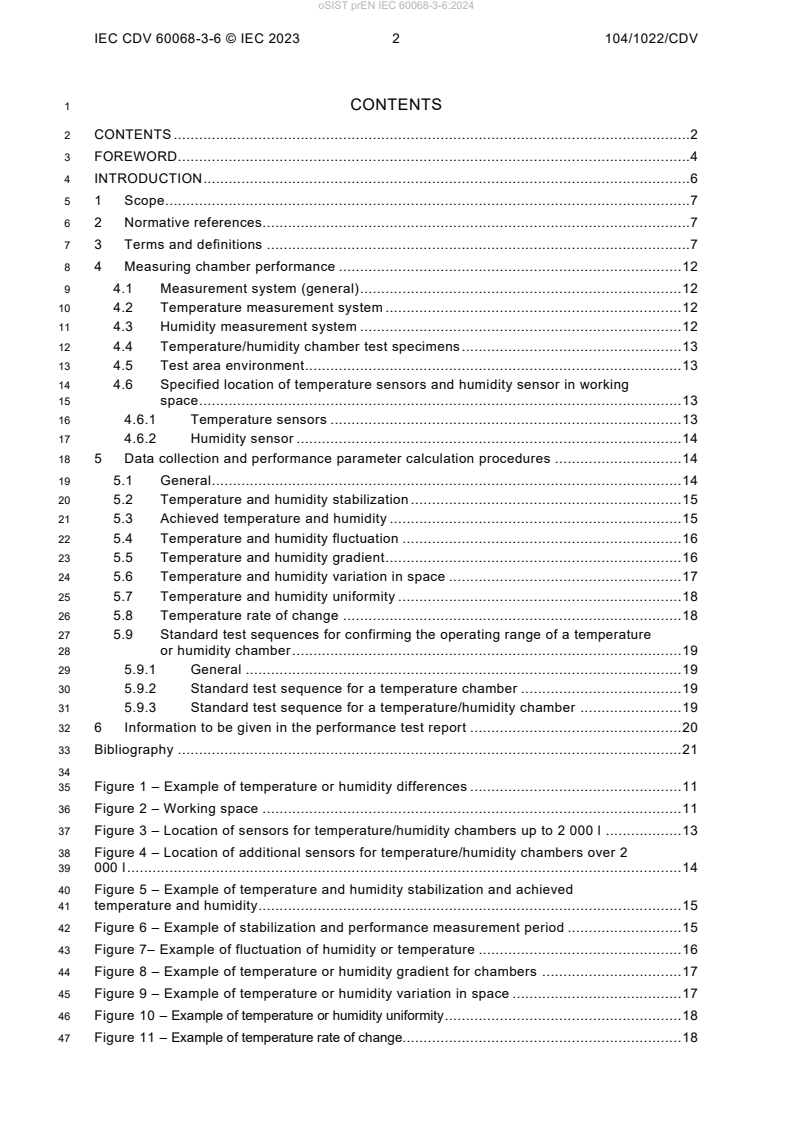
1 CONTENTS
2 CONTENTS . 2
3 FOREWORD . 4
4 INTRODUCTION . 6
5 1 Scope . 7
6 2 Normative references. 7
7 3 Terms and definitions . 7
8 4 Measuring chamber performance . 12
9 4.1 Measurement system (general) . 12
10 4.2 Temperature measurement system . 12
11 4.3 Humidity measurement system . 12
12 4.4 Temperature/humidity chamber test specimens . 13
13 4.5 Test area environment. 13
14 4.6 Specified location of temperature sensors and humidity sensor in working
15 space . 13
16 4.6.1 Temperature sensors . 13
17 4.6.2 Humidity sensor . 14
18 5 Data collection and performance parameter calculation procedures . 14
19 5.1 General . 14
20 5.2 Temperature and humidity stabilization . 15
21 5.3 Achieved temperature and humidity . 15
22 5.4 Temperature and humidity fluctuation . 16
23 5.5 Temperature and humidity gradient . 16
24 5.6 Temperature and humidity variation in space . 17
25 5.7 Temperature and humidity uniformity . 18
26 5.8 Temperature rate of change . 18
27 5.9 Standard test sequences for confirming the operating range of a temperature
28 or humidity chamber . 19
29 5.9.1 General . 19
30 5.9.2 Standard test sequence for a temperature chamber . 19
31 5.9.3 Standard test sequence for a temperature/humidity chamber . 19
32 6 Information to be given in the performance test report . 20
33 Bibliography . 21
35 Figure 1 – Example of temperature or humidity differences . 11
36 Figure 2 – Working space . 11
37 Figure 3 – Location of sensors for temperature/humidity chambers up to 2 000 l . 13
38 Figure 4 – Location of additional sensors for temperature/humidity chambers over 2
39 000 l . 14
40 Figure 5 – Example of temperature and humidity stabilization and achieved
41 temperature and humidity . 15
42 Figure 6 – Example of stabilization and performance measurement period . 15
43 Figure 7– Example of fluctuation of humidity or temperature . 16
44 Figure 8 – Example of temperature or humidity gradient for chambers . 17
45 Figure 9 – Example of temperature or humidity variation in space . 17
46 Figure 10 – Example of temperature or humidity uniformity . 18
47 Figure 11 – Example of temperature rate of change . 18
oSIST prEN IEC 60068-3-6:2024
IEC CDV 60068-3-6 © IEC 2023 3 104/1022/CDV
48 Figure 12– Example of climatogram . 20
50 Table 1 – Practical dimensions . 12
51 Table 2 – Example of test sequence . 19
oSIST prEN IEC 60068-3-6:2024
IEC CDV 60068-3-6 © IEC 2023 4 104/1022/CDV
54 INTERNATIONAL ELECTROTECHNICAL COMMISSION
55 ____________
57 ENVIRONMENTAL TESTING –
59 Part 3-6: Supporting documentation and guidance –
60 Confirmation of the performance of temperature/humidity chambers
62 FOREWORD
63 1) The International Electrotechnical Commission (IEC) is a worldwide organization for standardization comprising
64 all national electrotechnical committees (IEC National Committees). The object of IEC is to promote
65 international co-operation on all questions concerning standardization in the electrical and electronic fields. To
66 this end and in addition to other activities, IEC publishes International Standards, Technical Specifications,
67 Technical Reports, Publicly Available Specifications (PAS) and Guides (hereafter referred to as “IEC
68 Publication(s)”). Their preparation is entrusted to technical committees; any IEC National Committee interested
69 in the subject dealt with may participate in this preparatory work. International, governmental and non -
70 governmental organizations liaising with the IEC also participate in this preparation. IEC collaborates closely
71 with the International Organization for Standardization (ISO) in accordance with conditions determined by
72 agreement between the two organizations.
73 2) The formal decisions or agreements of IEC on technical matters express, as nearly as possible, an international
74 consensus of opinion on the relevant subjects since each technical committee has representation from all
75 interested IEC National Committees.
76 3) IEC Publications have the form of recommendations for international use and are accepted by IEC National
77 Committees in that sense. While all reasonable efforts are made to ensure that the technical content of IEC
78 Publications is accurate, IEC cannot be held responsible for the way in which they are used or for any
79 misinterpretation by any end user.
80 4) In order to promote international uniformity, IEC National Committees undertake to apply IEC Publications
81 transparently to the maximum extent possible in their national and regional publications. Any divergence
82 between any IEC Publication and the corresponding national or regional publication shall be clearly indicated in
83 the latter.
84 5) IEC itself does not provide any attestation of conformity. Independent certification bodies provide conformity
85 assessment services and, in some areas, access to IEC marks of conformity. IEC is not responsible for any
86 services carried out by independent certification bodies.
87 6) All users should ensure that they have the latest edition of this publication.
88 7) No liability shall attach to IEC or its directors, employees, servants or agents including individual experts and
89 members of its technical committees and IEC National Committees for any personal injury, property damage or
90 other damage of any nature whatsoever, whether direct or indirect, or for costs (including legal fees) and
91 expenses arising out of the publication, use of, or reliance upon, this IEC Publication or any other IEC
92 Publications.
93 8) Attention is drawn to the Normative references cited in this publication. Use of the referenced publications is
94 indispensable for the correct application of this publication.
95 9) Attention is drawn to the possibility that some of the elements of this IEC Publication may be the subject of
96 patent rights. IEC shall not be held responsible for identifying any or all such patent rights.
97 International Standard IEC 60068-3-6 has been prepared by IEC technical committee 104:
98 Environmental conditions, classification and methods of test.
99 This third edition cancels and replaces the second edition published in 2018. This edition
100 constitutes a technical revision.
101 This edition includes the following significant technical changes with respect to the previous
102 edition:
103 a) The contents of IEC 60068-3-5 and IEC 60068-3-6 are merged into this document due to
104 the significant overlap between the two.
105 b) Addition of new terms and definitions for temperature and humidity uniformity.
106 c) Significant editorial re-writing for clarity.
107 d) Clarification of mandatory versus non-mandatory information.
108 e) Updates to several figures.
oSIST prEN IEC 60068-3-6:2024
IEC CDV 60068-3-6 © IEC 2023 5 104/1022/CDV
109 f) New information in bibliography and removal of listings from the normative references
110 section deemed non-mandatory in new edition.
111 The text of this International Standard is based on the following documents:
FDIS Report on voting
104/XXX/XXX 104/XXX/XXX
113 Full information on the voting for the approval of this International Standard can be found in
114 the report on voting indicated in the above table.
115 The French version of this standard has not been voted upon.
116 This document has been drafted in accordance with the ISO/IEC Directives, Part 2. Upon
117 publication, the intention of TC104 is to withdraw IEC 60068-3-5.
118 IEC 60068-3-6 is to be read in conjunction with IEC 60068-3-11:XXXX. A list of all parts in the
119 IEC 60068 series, published under the general title Environmental testing, can be found on
120 the IEC website.
121 The committee has decided that the contents of this document will remain unchanged until the
122 stability date indicated on the IEC website under "http://webstore.iec.ch" in the data related to
123 the specific document. At this date, the document will be
124 • reconfirmed,
125 • withdrawn,
126 • replaced by a revised edition, or
127 • amended.
oSIST prEN IEC 60068-3-6:2024
IEC CDV 60068-3-6 © IEC 2023 6 104/1022/CDV
130 INTRODUCTION
131 IEC 60068 (all parts) contains fundamental information on environmental testing procedures
132 and severities.
133 The expression "environmental conditioning" or "environmental testing" covers the natural and
134 artificial environments to which components or equipment may be exposed so that an
135 assessment can be made of their performance under conditions of use, transport and storage
136 to which they may be exposed in practice.
137 Temperature and humidity chambers used for "environmental conditioning" or "environmental
138 testing" are not described in any publication, although the method of maintaining and
139 measuring temperature and/or humidity has a great influence on test results. The physical
140 characteristics of temperature and humidity chambers can also influence test results.
141 The goal of this document is to provide methods for measuring the performance
142 characteristics of temperature and humidity chambers. This process can be useful for test
143 specifiers and chamber users, and it can provide standardized methods for chamber
144 manufacturers to specify chamber performance.
oSIST prEN IEC 60068-3-6:2024
IEC CDV 60068-3-6 © IEC 2023 7 104/1022/CDV
148 ENVIRONMENTAL TESTING –
150 Part 3-6: Supporting documentation and guidance –
151 Confirmation of the performance of temperature and humidity chambers
155 1 Scope
156 This part of IEC 60068 provides a standardized method of establishing whether temperature
157 as well as temperature and humidity chambers, without specimens, are able to achieve the
158 requirements of the relevant climatic test procedures of IEC 60068-2.
159 This document is intended for users when conducting regular chamber performance
160 monitoring.
161 Guidance on establishing variations and uncertainties of the climatic conditions within
162 environmental test chambers are provided in IEC 60068-3-11. The guidance of that document
163 is intended to be used with an empty climatic test chamber, a chamber containing a test load,
164 or a chamber contain a test specimen undergoing testing. The guidance is particularly
165 applicable when the specimen or test load is large in comparison to the chamber working
166 space, is heat-dissipating or influences the airflow within the chamber.
167 When considering temperature only chambers, the passages in this document related to
168 humidity do not need to be applied.
169 2 Normative references
170 The following documents are referred to in the text in such a way that some or all of their
171 content constitutes requirements of this document. For dated references, only the edition
172 cited applies. For undated references, the latest edition of the referenced document (including
173 any amendments) applies.
174 IEC 60068-1, Environmental testing – Part 1: General and guidance
175 IEC 60068-2 (all parts), Environmental testing – Part 2: Tests
176 IEC 60068-3-7, Environmental testing – Part 3-7: Supporting documentation and guidance –
177 Measurements in temperature chambers for tests A and B (with load)
178 3 Terms and definitions
179 For the purpose of this document, the following terms and definitions apply.
180 ISO and IEC maintain terminological databases for use in standardization at the following
181 addresses:
182 • IEC Electropedia: available at http://www.electropedia.org/
183 • ISO Online browsing platform: available at http://www.iso.org/obp
oSIST prEN IEC 60068-3-6:2024
IEC CDV 60068-3-6 © IEC 2023 8 104/1022/CDV
184 3.1
185 temperature chamber
186 enclosure or space in some parts of which the temperature conditions, specified in IEC
187 60068-2 (all parts), can be achieved
188 3.2
189 temperature/humidity chamber
190 enclosure or space in some parts of which the temperature and humidity conditions specified
191 in IEC 60068-2 (all parts) can be achieved
192 Note 1 to entry: All temperature/humidity chambers can be considered as temperature chambers when humidity
193 conditions are not specified.
195 3.3
196 absolute humidity
197 mass of water vapour present in a unit volume of moist air
198 Note 1 to entry: Typical units of measure are g/m .
199 Note 2 to entry Unless otherwise specified, "humidity" is relative humidity (RH).
201 3.4
202 dewpoint
203 T
d
204 temperature at which the saturation vapour pressure over water is equal to the partial
205 pressure of the water vapour in the air
206 3.5
207 saturation vapour pressure
208 maximum possible pressure exerted by a water vapour in equilibrium with its solid or liquid
209 phase, such that any increase will initiate within the vapour a change to a more condensed
210 state
211 3.6
212 partial vapour pressure
213 contribution of water vapour in a given volume of air at a constant pressure and temperature
214 of the atmosphere
215 3.7
216 relative humidity
217 RH
218 ratio of the partial vapour pressure, divided by the saturation vapour pressure of a given
219 volume of air at a constant temperature, expressed as percentage
220 Note 1 to entry: The most popular method to express the water vapour content in air is relative humidity.
221 Note 2 to entry Unless otherwise specified, "humidity" is relative humidity (RH).
222 3.8
223 climatogram
224 graphical display of combined temperature and relative humidity conditions
225 Note 1 to entry: These are sometimes used to define the achievable operating parameters of a chamber.
226 3.9
227 temperature setpoint
228 desired temperature as set by the chamber controls
229 3.10
230 achieved temperature
231 temperature at the centre of the working space when the chamber has reached temperature
232 stabilization
oSIST prEN IEC 60068-3-6:2024
IEC CDV 60068-3-6 © IEC 2023 9 104/1022/CDV
233 3.11
234 achieved relative humidity
235 achieved humidity
236 relative humidity at the centre of the working space when the chamber has reached
237 temperature stabilization
238 3.12
239 temperature stabilization
240 state at which the chamber temperature fluctuation is at its minimum or within a specified
241 tolerance for a specified period of time
242 Note 1 to entry: See Figure 5
243 3.13
244 relative humidity stabilization
245 humidity stabilization
246 state at which the chamber humidity fluctuation is at its minimum or within a specified
247 tolerance for a specified duration
248 Note 1 to entry: See Figure 5
249 3.14
250 temperature fluctuation
251 difference between the maximum and minimum temperatures at a specific point in the working
252 space during a specified interval of time
253 Note 1 to entry: This is an indicator of the maximum temperature variations that can be expected over time within
254 the working space when operating normally at a constant temperature.
255 Note 2 to entry: This is often measured at the centre point of the chamber.
256 3.15
257 relative humidity fluctuation
258 difference between the maximum and minimum
...
SLOVENSKI STANDARD
01-september-2025
Okoljsko preskušanje - 3-6. del: Podporna dokumentacija in navodilo - Potrjevanje
tehničnih lastnosti toplotnih/vlažnih komor
Environmental testing - Part 3-6: Supporting documentation and guidance - Confirmation
of the performance of temperature/humidity chambers
Umgebungseinflüsse - Teil 3-6: Unterstützende Dokumentation und Leitfaden -
Bestätigung des Leistungsvermögens von Temperatur- und Klima-Prüfkammern
Essais d'environnement - Partie 3-6: Documentation d'accompagnement et
recommandations - Confirmation des performances des chambres d'essai en
température/humidité
Ta slovenski standard je istoveten z: prEN IEC 60068-3-6:2025
ICS:
01.110 Tehnična dokumentacija za Technical product
izdelke documentation
19.040 Preskušanje v zvezi z Environmental testing
okoljem
29.020 Elektrotehnika na splošno Electrical engineering in
general
2003-01.Slovenski inštitut za standardizacijo. Razmnoževanje celote ali delov tega standarda ni dovoljeno.
104/1114/CDV
COMMITTEE DRAFT FOR VOTE (CDV)
PROJECT NUMBER:
IEC 60068-3-6 ED3
DATE OF CIRCULATION: CLOSING DATE FOR VOTING:
2025-06-20 2025-08-15
SUPERSEDES DOCUMENTS:
104/1022/CDV, 104/1051B/RVC
IEC TC 104 : ENVIRONMENTAL CONDITIONS, CLASSIFICATION AND METHODS OF TEST
SECRETARIAT: SECRETARY:
Sweden Mr Joakim Grafström
OF INTEREST TO THE FOLLOWING COMMITTEES: HORIZONTAL FUNCTION(S):
ASPECTS CONCERNED:
SUBMITTED FOR CENELEC PARALLEL VOTING NOT SUBMITTED FOR CENELEC PARALLEL VOTING
Attention IEC-CENELEC parallel voting
The attention of IEC National Committees, members of
CENELEC, is drawn to the fact that this Committee Draft
for Vote (CDV) is submitted for parallel voting.
The CENELEC members are invited to vote through the
CENELEC online voting system.
This document is still under study and subject to change. It should not be used for reference purposes.
Recipients of this document are invited to submit, with their comments, notification of any relevant patent rights of
which they are aware and to provide supporting documentation.
Recipients of this document are invited to submit, with their comments, notification of any relevant “In Some
Countries” clauses to be included should this proposal proceed. Recipients are reminded that the CDV stage is
the final stage for submitting ISC clauses. (SEE AC/22/2007 OR NEW GUIDANCE DOC).
TITLE:
Environmental testing - Part 3-6: Supporting documentation and guidance - Confirmation of the
performance of temperature/ humidity chambers
PROPOSED STABILITY DATE: 2026
NOTE FROM TC/SC OFFICERS:
download this electronic file, to make a copy and to print out the content for the sole purpose of preparing National
Committee positions. You may not copy or "mirror" the file or printed version of the document, or any part of it,
for any other purpose without permission in writing from IEC.
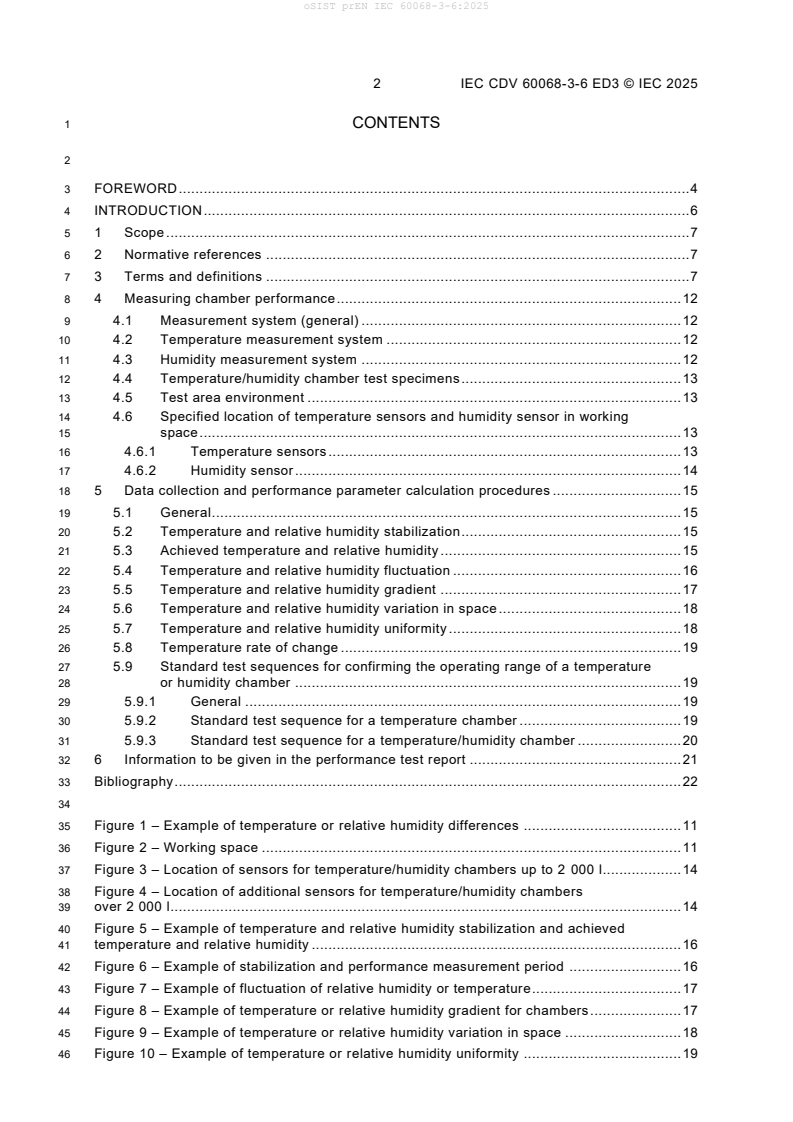
2 IEC CDV 60068-3-6 ED3 © IEC 2025
1 CONTENTS
3 FOREWORD . 4
4 INTRODUCTION . 6
5 1 Scope . 7
6 2 Normative references . 7
7 3 Terms and definitions . 7
8 4 Measuring chamber performance . 12
9 4.1 Measurement system (general) . 12
10 4.2 Temperature measurement system . 12
11 4.3 Humidity measurement system . 12
12 4.4 Temperature/humidity chamber test specimens . 13
13 4.5 Test area environment . 13
14 4.6 Specified location of temperature sensors and humidity sensor in working
15 space . 13
16 4.6.1 Temperature sensors . 13
17 4.6.2 Humidity sensor . 14
18 5 Data collection and performance parameter calculation procedures . 15
19 5.1 General . 15
20 5.2 Temperature and relative humidity stabilization . 15
21 5.3 Achieved temperature and relative humidity . 15
22 5.4 Temperature and relative humidity fluctuation . 16
23 5.5 Temperature and relative humidity gradient . 17
24 5.6 Temperature and relative humidity variation in space . 18
25 5.7 Temperature and relative humidity uniformity . 18
26 5.8 Temperature rate of change . 19
27 5.9 Standard test sequences for confirming the operating range of a temperature
28 or humidity chamber . 19
29 5.9.1 General . 19
30 5.9.2 Standard test sequence for a temperature chamber . 19
31 5.9.3 Standard test sequence for a temperature/humidity chamber . 20
32 6 Information to be given in the performance test report . 21
33 Bibliography . 22
35 Figure 1 – Example of temperature or relative humidity differences . 11
36 Figure 2 – Working space . 11
37 Figure 3 – Location of sensors for temperature/humidity chambers up to 2 000 l . 14
38 Figure 4 – Location of additional sensors for temperature/humidity chambers
39 over 2 000 l . 14
40 Figure 5 – Example of temperature and relative humidity stabilization and achieved
41 temperature and relative humidity . 16
42 Figure 6 – Example of stabilization and performance measurement period . 16
43 Figure 7 – Example of fluctuation of relative humidity or temperature . 17
44 Figure 8 – Example of temperature or relative humidity gradient for chambers . 17
45 Figure 9 – Example of temperature or relative humidity variation in space . 18
46 Figure 10 – Example of temperature or relative humidity uniformity . 19
IEC CDV 60068-3-6 ED3 © IEC 2025 3
47 Figure 11 – Example of temperature rate of change . 19
48 Figure 12 – Example of climatogram . 21
50 Table 1 – Practical dimensions . 12
51 Table 2 – Standard test sequence for a temperature/humidity chamber . 20
4 IEC CDV 60068-3-6 ED3 © IEC 2025
54 INTERNATIONAL ELECTROTECHNICAL COMMISSION
55 ____________
57 ENVIRONMENTAL TESTING –
59 Part 3-6: Supporting documentation and guidance –
60 Confirmation of the performance of temperature/humidity chambers
62 FOREWORD
63 1) The International Electrotechnical Commission (IEC) is a worldwide organization for standardization comprising
64 all national electrotechnical committees (IEC National Committees). The object of IEC is to promote international
65 co-operation on all questions concerning standardization in the electrical and electronic fields. To this end and
66 in addition to other activities, IEC publishes International Standards, Technical Specifications, Technical Reports,
67 Publicly Available Specifications (PAS) and Guides (hereafter referred to as "IEC Publication(s)"). Their
68 preparation is entrusted to technical committees; any IEC National Committee interested in the subject dealt with
69 may participate in this preparatory work. International, governmental and non-governmental organizations liaising
70 with the IEC also participate in this preparation. IEC collaborates closely with the International Organization for
71 Standardization (ISO) in accordance with conditions determined by agreement between the two organizations.
72 2) The formal decisions or agreements of IEC on technical matters express, as nearly as possible, an international
73 consensus of opinion on the relevant subjects since each technical committee has representation from all
74 interested IEC National Committees.
75 3) IEC Publications have the form of recommendations for international use and are accepted by IEC National
76 Committees in that sense. While all reasonable efforts are made to ensure that the technical content of IEC
77 Publications is accurate, IEC cannot be held responsible for the way in which they are used or for any
78 misinterpretation by any end user.
79 4) In order to promote international uniformity, IEC National Committees undertake to apply IEC Publications
80 transparently to the maximum extent possible in their national and regional publications. Any divergence between
81 any IEC Publication and the corresponding national or regional publication shall be clearly indicated in the latter.
82 5) IEC itself does not provide any attestation of conformity. Independent certification bodies provide conformity
83 assessment services and, in some areas, access to IEC marks of conformity. IEC is not responsible for any
84 services carried out by independent certification bodies.
85 6) All users should ensure that they have the latest edition of this publication.
86 7) No liability shall attach to IEC or its directors, employees, servants or agents including individual experts and
87 members of its technical committees and IEC National Committees for any personal injury, property damage or
88 other damage of any nature whatsoever, whether direct or indirect, or for costs (including legal fees) and
89 expenses arising out of the publication, use of, or reliance upon, this IEC Publication or any other IEC
90 Publications.
91 8) Attention is drawn to the Normative references cited in this publication. Use of the referenced publications is
92 indispensable for the correct application of this publication.
93 9) IEC draws attention to the possibility that the implementation of this document may involve the use of (a)
94 patent(s). IEC takes no position concerning the evidence, validity or applicability of any claimed patent rights in
95 respect thereof. As of the date of publication of this document, IEC had not received notice of (a) patent(s), which
96 may be required to implement this document. However, implementers are cautioned that this may not represent
97 the latest information, which may be obtained from the patent database available at https://patents.iec.ch. IEC
98 shall not be held responsible for identifying any or all such patent rights.
99 IEC 60068-3-6 has been prepared by IEC technical committee 104: Environmental conditions,
100 classification and methods of test. It is an International Standard.
101 This third edition cancels and replaces the second edition published in 2018 and IEC 60068-3-
102 5:2018. This edition constitutes a technical revision.
103 This edition includes the following significant technical changes with respect to the previous
104 edition and IEC 60068-3-5:2018:
105 a) merge of the contents of IEC 60068-3-5 and IEC 60068-3-6 into this document due to the
106 significant overlap between the two;
107 b) addition of new terms and definitions for temperature and humidity uniformity ;
108 c) significant editorial re-writing for clarity;
IEC CDV 60068-3-6 ED3 © IEC 2025 5
109 d) clarification of mandatory versus non-mandatory information;
110 e) updates to several figures;
111 f) new information in bibliography and removal of listings from the normative references clause
112 deemed non-mandatory in this new edition.
113 The text of this International Standard is based on the following documents:
Draft Report on voting
104/XX/FDIS 104/XX/RVD
115 Full information on the voting for its approval can be found in the report on voting indicated in
116 the above table.
117 The language used for the development of this International Standard is English.
118 This document was drafted in accordance with ISO/IEC Directives, Part 2, and developed in
119 accordance with ISO/IEC Directives, Part 1 and ISO/IEC Directives, IEC Supplement, available
120 at www.iec.ch/members_experts/refdocs. The main document types developed by IEC are
121 described in greater detail at www.iec.ch/publications.
122 This document is to be read in conjunction with IEC 60068-3-7 and IEC 60068-3-11.
123 A list of all parts in the IEC 60068 series, published under the general title Environmental
124 testing, can be found on the IEC website.
125 The committee has decided that the contents of this document will remain unchanged until the
126 stability date indicated on the IEC website under webstore.iec.ch in the data related to the
127 specific document. At this date, the document will be
128 • reconfirmed,
129 • withdrawn, or
130 • revised.
IMPORTANT – The "colour inside" logo on the cover page of this document indicates
that it contains colours which are considered to be useful for the correct understanding
of its contents. Users should therefore print this document using a colour printer.
6 IEC CDV 60068-3-6 ED3 © IEC 2025
134 INTRODUCTION
135 The IEC 60068 series contains fundamental information on environmental testing procedures
136 and severities.
137 The expression "environmental conditioning" or "environmental testing" covers the natural and
138 artificial environments to which components or equipment can be exposed so that an
139 assessment can be made of their performance under conditions of use, transport and storage
140 to which they may be exposed in practice.
141 Temperature and humidity chambers used for "environmental conditioning" or "environmental
142 testing" are not described in any publication, although the method of maintaining and measuring
143 temperature or temperature and humidity has a great influence on test results. The physical
144 characteristics of temperature and humidity chambers can also influence test results.
145 The goal of this document is to provide methods for measuring the performance characteristics
146 of temperature and humidity chambers. This process can be useful for test specifiers and
147 chamber users, and it can provide standardized methods for chamber manufacturers to specify
148 chamber performance.
IEC CDV 60068-3-6 ED3 © IEC 2025 7
151 ENVIRONMENTAL TESTING –
153 Part 3-6: Supporting documentation and guidance –
154 Confirmation of the performance of temperature/humidity chambers
158 1 Scope
159 This part of IEC 60068 provides a standardized method of establishing whether temperature as
160 well as temperature and humidity chambers, without specimens, are able to achieve the
161 requirements of the relevant climatic test procedures of the IEC 60068-2 series.
162 This document is intended for users when conducting regular chamber performance monitoring
163 and chamber manufacturers when providing technical specifications on performance . It is
164 intended to be used in conjunction with IEC 60068-3-7 and IEC 60068-3-11, depending on the
165 specific requirements of the user. When considering temperature chambers without humidity
166 control, the passages in this document related to humidity do not apply.
167 NOTE IEC 60068-3-7 is intended for establishing performance of chambers loaded with specimens, either with
168 heat dissipation or not. This is important because specimens can influence the air flow through the chamber or, in
169 the case of heat dissipating specimens, the temperature of the chamber, both which can significa ntly influence its
170 performance. Guidance on establishing variations and uncertainties of the climatic conditions within environmental
171 test chambers are provided in IEC 60068-3-11. The guidance of that document is intended to be used with an empty
172 climatic test chamber, a chamber containing a test load, or a chamber containing a test specimen undergoing testing.
173 The guidance is particularly applicable when the specimen or test load is large in comparison to the chamber working
174 space, is heat-dissipating or influences the airflow within the chamber.
175 NOTE IEC 60068-2-11 includes specific guidance for confirming the performance of chambers running salt mist
176 tests, including cyclic salt mist testing according to IEC 60068-2-52.
177 2 Normative references
178 The following documents are referred to in the text in such a way that some or all of their content
179 constitutes requirements of this document. For dated references, only the edition cited applies.
180 For undated references, the latest edition of the referenced document (including any
181 amendments) applies.
182 IEC 60068-1, Environmental testing – Part 1: General and guidance
183 IEC 60068-2 (all parts), Environmental testing – Part 2: Tests
184 IEC 60068-3-7, Environmental testing – Part 3-7: Supporting documentation and guidance –
185 Measurements in temperature chambers for tests A (Cold) and B (Dry heat) (with load)
186 3 Terms and definitions
187 For the purposes of this document, the following terms and definitions apply.
188 ISO and IEC maintain terminology databases for use in standardization at the following
189 addresses:
190 • IEC Electropedia: available at https://www.electropedia.org/
191 • ISO Online browsing platform: available at https://www.iso.org/obp
8 IEC CDV 60068-3-6 ED3 © IEC 2025
192 3.1
193 temperature chamber
194 enclosure or space in some parts of which the temperature conditions specified in the
195 IEC 60068-2 series can be achieved
196 3.2
197 temperature/humidity chamber
198 enclosure or space in some parts of which the temperature and humidity conditions specified
199 in the IEC 60068-2 series can be achieved
200 Note 1 to entry: All temperature/humidity chambers can be considered as temperature chambers when humidity
201 conditions are not specified.
202 3.3
203 absolute humidity
204 mass of water vapour present in a unit volume of moist air
205 Note 1 to entry: Typical units of measure are g/m3.
206 Note 2 to entry: "Humidity" is relative humidity (RH), unless otherwise specified.
207 3.4
208 dewpoint
209 T
d
210 temperature at which the saturation vapour pressure over water is equal to the partial pressure
211 of the water vapour in the air
212 3.5
213 saturation vapour pressure
214 maximum possible pressure exerted by a water vapour in equilibrium with its solid or liquid
215 phase, such that any increase will initiate within the vapour a change to a more condensed
216 state
217 3.6
218 partial vapour pressure
219 contribution of water vapour in a given volume of air at a constant pressure and temperature of
220 the atmosphere
221 3.7
222 relative humidity
223 RH
224 ratio of the partial vapour pressure, divided by the saturation vapour pressure of a given volume
225 of air at a constant temperature, expressed as percentage
226 Note 1 to entry: The most popular method to express the water vapour content in air is relative humidity.
227 Note 2 to entry: "Humidity" is relative humidity (RH), unless otherwise specified.
228 3.8
229 climatogram
230 graphical display of combined temperature and relative humidity conditions
231 Note 1 to entry: Climatograms can be used to define the achievable operating parameters of a chamber.
232 3.9
233 temperature set point
234 desired temperature as set by the chamber controls
IEC CDV 60068-3-6 ED3 © IEC 2025 9
235 3.10
236 achieved temperature
237 temperature at the centre of the working space when the chamber has reached temperature
238 stabilization
239 3.11
240 achieved relative humidity
241 achieved humidity
242 relative humidity at the centre of the working space when the chamber has reached relative
243 humidity stabilization
244 3.12
245 temperature stabilization
246 state at which the chamber temperature fluctuation is at its minimum or within a specified
247 tolerance for a specified period of time
248 SEE: Figure 5.
249 3.13
250 relative humidity stabilization
251 humidity stabilization
252 state at which the chamber humidity fluctuation is at its minimum or within a specified tolerance
253 for a specified period of time
254 SEE: Figure 5.
255 3.14
256 temperature fluctuation
257 two times the sample standard deviation of temperature measuring samples at a specific point
258 in the working space during a specified period of time
259 Note 1 to entry: The temperature fluctuation is an indicator of the maximum temperature variations that can be
260 expected over time within the working space when operating normally at a constant temperature.
261 Note 2 to entry: The temperature fluctuation is often measured at the centre point of the working space.
262 3.15
263 relative humidity fluctuation
264 two times the sample standard deviation of relative humidity measuring samples at a specific
265 point in the working space during a specified period of time
266 Note 1 to entry: The relative humidity fluctuation is an indicator of the maximum humidity variations that can be
267 expected over time within the working space when operating normally at a constant temperature and humidity.
268 Note 2 to entry: The relative humidity fl
...
Questions, Comments and Discussion
Ask us and Technical Secretary will try to provide an answer. You can facilitate discussion about the standard in here.
Loading comments...