

EN 60721-3-7:1995/A1:1997
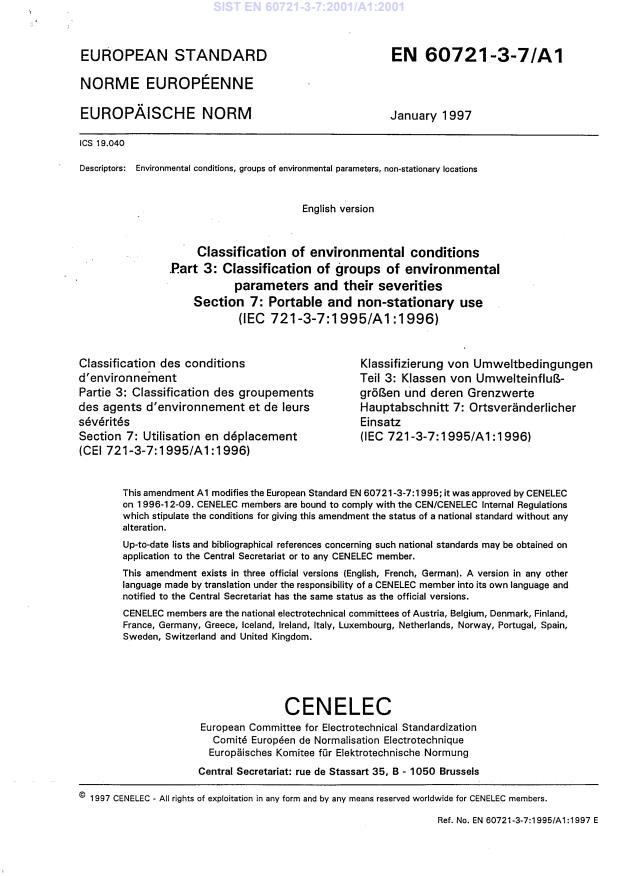
(Amendment)Classification of environmental conditions - Part 3: Classification of groups of environmental parameters and their severities - Section 7: Portable and non-stationary use
General Information
- Abstract
EN following parallel vote
- Status
- Published
- Publication Date
- 09-Jan-1997
- Withdrawal Date
- 31-Aug-1997
- Technical Committee
- CLC/SR 104 - Environmental conditions, classification and methods of test
- Drafting Committee
- IEC/TC 104 - IEC_TC_104
- Parallel Committee
- IEC/TC 104 - IEC_TC_104
- Current Stage
- 9093 - Decision to confirm - Review Enquiry
- Start Date
- 05-Jan-2026
- Completion Date
- 25-Aug-2026

Overview
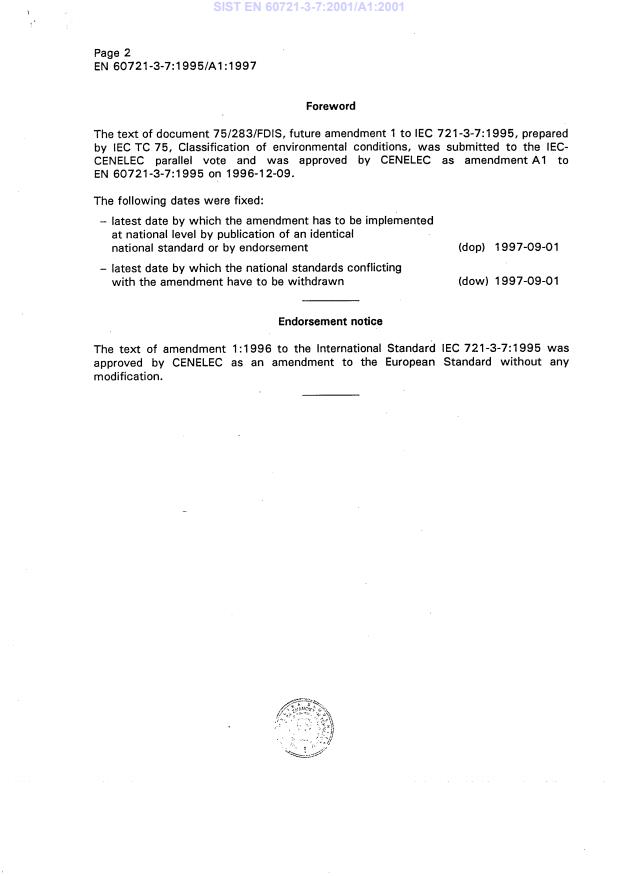
EN 60721-3-7:1995/A1:1997 (adopted by CLC) is an amendment to Section 7 of the EN 60721 series, which provides a standardized classification of environmental conditions for portable and non‑stationary use. The document defines how groups of environmental parameters and their severities are described so manufacturers, test laboratories and specifiers can uniformly define and communicate expected environmental stresses for equipment used in mobile, handheld or frequently relocated applications.
Key Topics
- Scope and purpose: Establishes a common framework to classify environmental influences for portable and non‑stationary equipment so that design, testing and procurement can reference the same severity levels.
- Environmental parameter groups: Covers categories of environmental influences relevant to portable use (for example mechanical stress, temperature, humidity, contamination and electromagnetic environment) and groups them for consistent treatment.
- Severity classes: Specifies a graduated set of severity classes describing how intense or frequent an environmental parameter is expected to be for a given application (note: this summary does not reproduce numeric limits).
- Assignment and combination rules: Guidance on how to assign classes to products and how combined environments should be interpreted when multiple parameters apply simultaneously.
- Documentation and communication: Recommendations for stating environmental classifications on datasheets, specifications and test plans to ensure clarity between suppliers, manufacturers and testing organizations.
Applications
Who uses EN 60721-3-7 and how it is applied:
- Manufacturers of portable electronics, tools, instrumentation and mobile equipment use the standard to define environmental design targets and reliability requirements.
- Test laboratories and QA teams use the classification to select appropriate environmental tests and to interpret test results against expected severity classes.
- Procurement and specification writers reference the standard to create clear environmental requirements in contracts and technical specifications.
- Design and reliability engineers apply the classification to guide material selection, enclosure design, sealing, and shock/vibration mitigation measures.
Practical benefits include improved interoperability of specifications, reduced ambiguity in environmental requirements, and streamlined testing and compliance processes for portable and non‑stationary products.
Related standards
- EN 60721 series (other parts) - broader classification of environmental conditions for different application modalities.
- Relevant CENELEC/CLC and IEC documents on environmental testing and qualification (used together with EN 60721 classifications for test methods and limits).
Keywords: EN 60721-3-7, classification of environmental conditions, portable and non-stationary use, environmental testing, severity classes, CLC, environmental parameters.
Relations
- Effective Date
- 04-Jul-2023
- Effective Date
- 03-Feb-2026
- Effective Date
- 03-Feb-2026
- Effective Date
- 03-Feb-2026
- Effective Date
- 29-Jan-2023
Get Certified
Connect with accredited certification bodies for this standard

IMP NDT d.o.o.
Non-destructive testing services. Radiography, ultrasonic, magnetic particle, penetrant, visual inspection.
Inštitut za kovinske materiale in tehnologije
Institute of Metals and Technology. Materials testing, metallurgical analysis, NDT.
Q Techna d.o.o.
NDT and quality assurance specialist. 30+ years experience. NDT personnel certification per ISO 9712, nuclear and thermal power plant inspections, QA/
Sponsored listings
Frequently Asked Questions
EN 60721-3-7:1995/A1:1997 is a amendment published by CLC. Its full title is "Classification of environmental conditions - Part 3: Classification of groups of environmental parameters and their severities - Section 7: Portable and non-stationary use". This standard covers: EN following parallel vote
EN following parallel vote
EN 60721-3-7:1995/A1:1997 is classified under the following ICS (International Classification for Standards) categories: 19.040 - Environmental testing. The ICS classification helps identify the subject area and facilitates finding related standards.
EN 60721-3-7:1995/A1:1997 has the following relationships with other standards: It is inter standard links to EN IEC 60721-3-7:2026, EN 60664-5:2003, EN 60051-1:2017, EN 61514-2:2013, EN 60721-3-7:1995. Understanding these relationships helps ensure you are using the most current and applicable version of the standard.
EN 60721-3-7:1995/A1:1997 is available in PDF format for immediate download after purchase. The document can be added to your cart and obtained through the secure checkout process. Digital delivery ensures instant access to the complete standard document.
Standards Content (Sample)
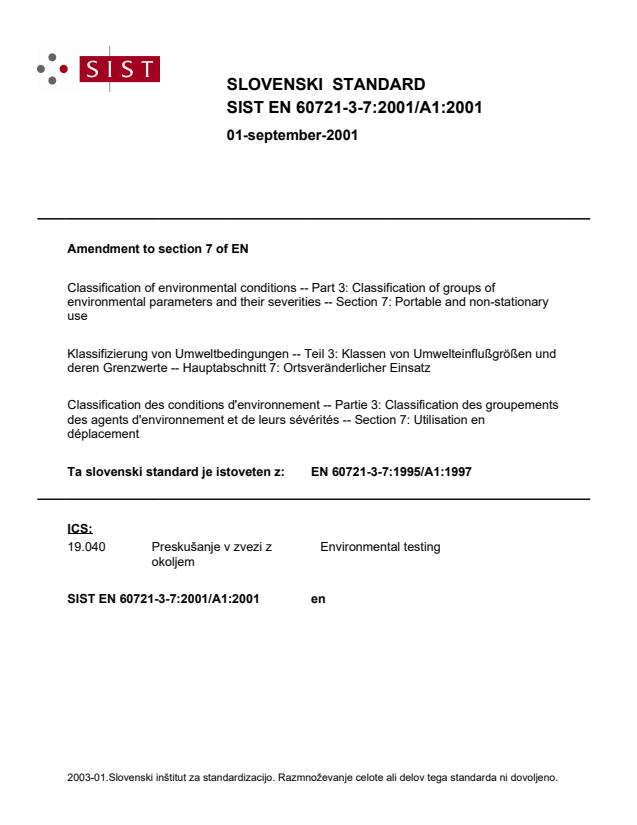
SLOVENSKI STANDARD
01-september-2001
Amendment to section 7 of EN
Classification of environmental conditions -- Part 3: Classification of groups of
environmental parameters and their severities -- Section 7: Portable and non-stationary
use
Klassifizierung von Umweltbedingungen -- Teil 3: Klassen von Umwelteinflußgrößen und
deren Grenzwerte -- Hauptabschnitt 7: Ortsveränderlicher Einsatz
Classification des conditions d'environnement -- Partie 3: Classification des groupements
des agents d'environnement et de leurs sévérités -- Section 7: Utilisation en
déplacement
Ta slovenski standard je istoveten z: EN 60721-3-7:1995/A1:1997
ICS:
19.040 Preskušanje v zvezi z Environmental testing
okoljem
2003-01.Slovenski inštitut za standardizacijo. Razmnoževanje c
...