


EN 60793-1-48:2003
(Main)Optical fibres - Part 1-48: Measurement methods and test procedures - Polarization mode dispersion
General Information
- Abstract
Applies to three methods of measuring PMD. Uniform requirements for measuring the PMD of optical fibre, thereby assisting in the inspection of fibres and cables for commercial purposes are established.
- Status
- Withdrawn
- Publication Date
- 19-Nov-2003
- Withdrawal Date
- 31-Oct-2006
- Technical Committee
- CLC/TC 86A - Optical fibres and optical fibre cables
- Drafting Committee
- IEC/SC 86A - IEC_SC_86A
- Parallel Committee
- IEC/SC 86A - IEC_SC_86A
- Current Stage
- 9960 - Withdrawal effective - Withdrawal
- Start Date
- 01-Sep-2010
- Completion Date
- 01-Sep-2010

Relations
- Effective Date
- 28-Jan-2023
- Effective Date
- 10-Feb-2026
- Effective Date
- 03-Feb-2026
- Effective Date
- 03-Feb-2026
- Effective Date
- 03-Feb-2026
- Effective Date
- 03-Feb-2026
- Effective Date
- 03-Feb-2026
- Effective Date
- 03-Feb-2026
- Effective Date
- 03-Feb-2026
- Effective Date
- 03-Feb-2026
- Effective Date
- 03-Feb-2026
- Effective Date
- 03-Feb-2026
- Effective Date
- 03-Feb-2026
Get Certified
Connect with accredited certification bodies for this standard

ANCE
Mexican certification and testing association.

Intertek Slovenia
Intertek testing, inspection, and certification services in Slovenia.

LNE (Laboratoire National de Métrologie et d'Essais)
French national laboratory for metrology and testing.
Sponsored listings
Frequently Asked Questions
EN 60793-1-48:2003 is a standard published by CLC. Its full title is "Optical fibres - Part 1-48: Measurement methods and test procedures - Polarization mode dispersion". This standard covers: Applies to three methods of measuring PMD. Uniform requirements for measuring the PMD of optical fibre, thereby assisting in the inspection of fibres and cables for commercial purposes are established.
Applies to three methods of measuring PMD. Uniform requirements for measuring the PMD of optical fibre, thereby assisting in the inspection of fibres and cables for commercial purposes are established.
EN 60793-1-48:2003 is classified under the following ICS (International Classification for Standards) categories: 33.180.10 - Fibres and cables. The ICS classification helps identify the subject area and facilitates finding related standards.
EN 60793-1-48:2003 has the following relationships with other standards: It is inter standard links to EN 60793-1-48:2007, IEC TR 61282-3:2002, EN 60793-1-44:2002, EN 60794-3:2002, EN 61280-1-4:2003, EN 60793-1-50:2002, EN 61158-2:2014, EN 61300-3-32:2006, EN 60793-1-1:2003, EN 60793-2-40:2011, EN 60793-1-32:2010, EN 60794-4-10:2007, EN 61753-143-2:2013. Understanding these relationships helps ensure you are using the most current and applicable version of the standard.
EN 60793-1-48:2003 is available in PDF format for immediate download after purchase. The document can be added to your cart and obtained through the secure checkout process. Digital delivery ensures instant access to the complete standard document.
Standards Content (Sample)
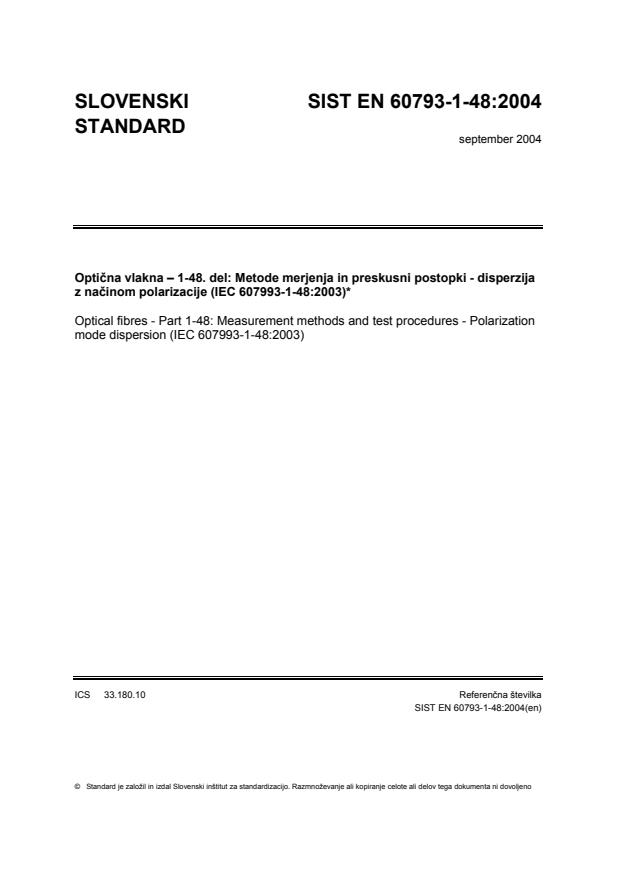
STANDARDOptična vlakna – 1-48. del: Metode merjenja in preskusni postopki - disperzija z načinom polarizacije (IEC 607993-1-48:2003)*Optical fibres - Part 1-48: Measurement methods and test procedures - Polarization mode dispersion (IEC 607993-1-48:2003)©
Standard je založil in izdal Slovenski inštitut za standardizacijo. Razmnoževanje ali kopiranje celote ali delov tega dokumenta ni dovoljenoReferenčna številkaSIST EN 60793-1-48:2004(en)ICS33.180.10
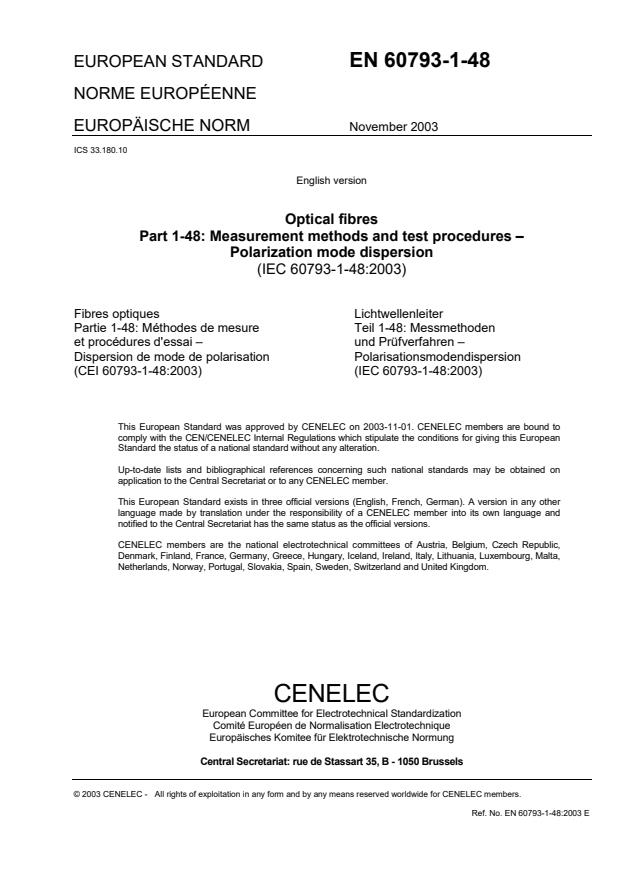
EUROPEAN STANDARD
EN 60793-1-48 NORME EUROPÉENNE EUROPÄISCHE NORM
November 2003 CENELEC European Committee for Electrotechnical Standardization Comité Européen de Normalisation Electrotechnique Europäisches Komitee für Elektrotechnische Normung
Central Secretariat: rue de Stassart 35, B - 1050 Brussels
© 2003 CENELEC - All rights of exploitation in any form and by any means reserved worldwide for CENELEC members.
Ref. No. EN 60793-1-48:2003 E
ICS 33.180.10
English version
Optical fibres Part 1-48: Measurement methods and test procedures –
Polarization mode dispersion (IEC 60793-1-48:2003)
Fibres optiques Partie 1-48: Méthodes de mesure
et procédures d'essai –
Dispersion de mode de polarisation (CEI 60793-1-48:2003)
Lichtwellenleiter Teil 1-48: Messmethoden
und Prüfverfahren – Polarisationsmodendispersion (IEC 60793-1-48:2003)
This European Standard was approved by CENELEC on 2003-11-01. CENELEC members are bound to comply with the CEN/CENELEC Internal Regulations which stipulate the conditions for giving this European Standard the status of a national standard without any alteration.
Up-to-date lists and bibliographical references concerning such national standards may be obtained on application to the Central Secretariat or to any CENELEC member.
This European Standard exists in three official versions (English, French, German). A version in any other language made by translation under the responsibility of a CENELEC member into its own language and notified to the Central Secretariat has the same status as the official versions.
CENELEC members are the national electrotechnical committees of Austria, Belgium, Czech Republic, Denmark, Finland, France, Germany, Greece, Hungary, Iceland, Ireland, Italy, Lithuania, Luxembourg, Malta, Netherlands, Norway, Portugal, Slovakia, Spain, Sweden, Switzerland and United Kingdom.
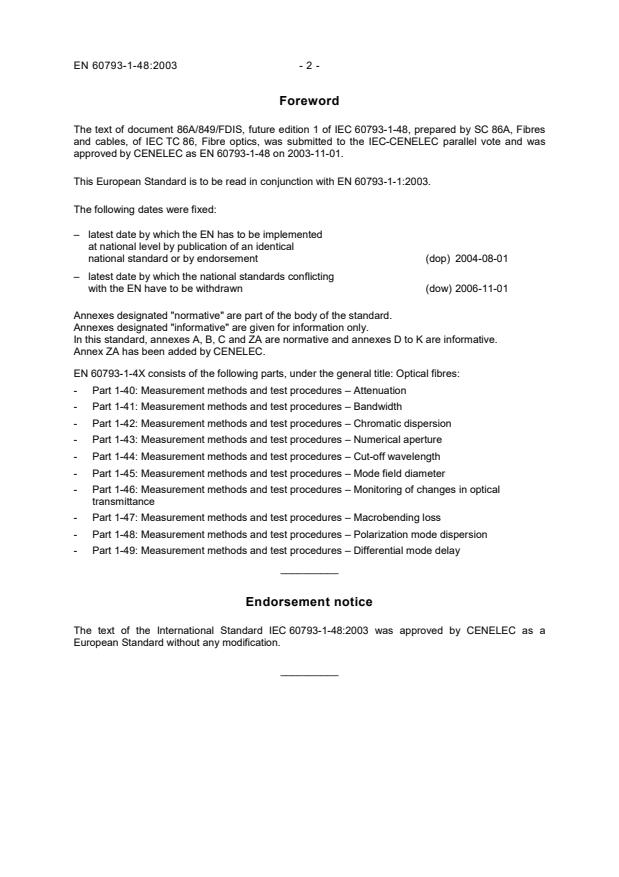
Foreword The text of document 86A/849/FDIS, future edition 1 of IEC 60793-1-48, prepared by SC 86A, Fibres and cables, of IEC TC 86, Fibre optics, was submitted to the IEC-CENELEC parallel vote and was approved by CENELEC as EN 60793-1-48 on 2003-11-01. This European Standard is to be read in conjunction with EN 60793-1-1:2003. The following dates were fixed: – latest date by which the EN has to be implemented
at national level by publication of an identical
national standard or by endorsement
(dop) 2004-08-01 – latest date by which the national standards conflicting
with the EN have to be withdrawn
(dow) 2006-11-01
Annexes designated "normative" are part of the body of the standard.
Annexes designated "informative" are given for information only.
In this standard, annexes A, B, C and ZA are normative and annexes D to K are informative. Annex ZA has been added by CENELEC. EN 60793-1-4X consists of the following parts, under the general title: Optical fibres: - Part 1-40: Measurement methods and test procedures – Attenuation - Part 1-41: Measurement methods and test procedures – Bandwidth - Part 1-42: Measurement methods and test procedures – Chromatic dispersion - Part 1-43: Measurement methods and test procedures – Numerical aperture - Part 1-44: Measurement methods and test procedures – Cut-off wavelength - Part 1-45: Measurement methods and test procedures – Mode field diameter - Part 1-46: Measurement methods and test procedures – Monitoring of changes in optical transmittance - Part 1-47: Measurement methods and test procedures – Macrobending loss - Part 1-48: Measurement methods and test procedures – Polarization mode dispersion - Part 1-49: Measurement methods and test procedures – Differential mode delay __________ Endorsement notice The text of the International Standard IEC 60793-1-48:2003 was approved by CENELEC as a European Standard without any modification. __________
- 3 - EN 60793-1-48:2003
Annex ZA
(normative)
Normative references to international publications
with their corresponding European publications This European Standard incorporates by dated or undated reference, provisions from other publications. These normative references are cited at the appropriate places in the text and the publications are listed hereafter. For dated references, subsequent amendments to or revisions of any of these publications apply to this European Standard only when incorporated in it by amendment or revision. For undated references the latest edition of the publication referred to applies (including amendments). NOTE When an international publication has been modified by common modifications, indicated by (mod), the relevant EN/HD applies. Publication Year Title EN/HD Year IEC 60793-1-1 - 1) Optical fibres Part 1-1: Measurement methods and test procedures - General and guidance
EN 60793-1-1 2003 2) IEC 60793-1-44 2001 Part 1-44: Measurement methods and test procedures - Cut-off wavelength
EN 60793-1-44 2002 IEC 60793-1-50 2001 Part 1-50: Measurement methods and test procedures - Damp heat (steady state)
EN 60793-1-50 2002 IEC 60793-2-50 2002 Part 2-50: Product specifications - Sectional specification for class B single-mode fibres
EN 60793-2-50 2002 IEC 60794-3 2001 Optical fibres cables Part 3: Sectional specification - Outdoor cables
EN 60794-3 2002 IEC 61280 Series Fibre optic communication subsystem test procedures
EN 61280 Series IEC/TR 61282-3 2002 Fibre optic communication system design guides Part 3: Calculation of polarization mode dispersion - -
1) Undated reference. 2) Valid edition at date of issue.
NORMEINTERNATIONALECEIIECINTERNATIONALSTANDARD60793-1-48Première éditionFirst edition2003-05Fibres optiques –Partie 1-48:Méthodes de mesure et procédures d'essai –Dispersion de mode de polarisationOptical fibres –Part 1-48:Measurement methods and test procedures –Polarization mode dispersionPour prix, voir catalogue en vigueurFor price, see current catalogue© IEC 2003
Droits de reproduction réservés
⎯
Copyright - all rights reservedAucune partie de cette publication ne peut être reproduite niutilisée sous quelque forme que ce soit et par aucun procédé,électronique ou mécanique, y compris la photocopie et lesmicrofilms, sans l'accord écrit de l'éditeur.No part of this publication may be reproduced or utilized in anyform or by any means, electronic or mechanical, includingphotocopying and microfilm, without permission in writing fromthe publisher.International Electrotechnical Commission,
3, rue de Varembé, PO Box 131, CH-1211 Geneva 20, SwitzerlandTelephone: +41 22 919 02 11
Telefax: +41 22 919 03 00
E-mail: inmail@iec.ch
Web: www.iec.chCODE PRIXPRICE CODEXACommission Electrotechnique InternationaleInternational Electrotechnical Commission
60793-1-48 © IEC:2003– 3 –CONTENTSFOREWORD.7INTRODUCTION.111Scope.132Normative references.133General.133.1Reference test method.173.2Applicability.194Apparatus.194.1Light source and polarizers.194.2Input optics.214.3Input positioner.214.4Cladding mode stripper.214.5High-order mode filter.214.6Output positioner.234.7Output optics.234.8Detector.234.9Computer.235Sampling and specimens.235.1Specimen length.255.2Deployment.256Procedure.276.1Deploy the fibre or cable and prepare the ends.276.2Attach the ends to the input and output optics.276.3Engage the computer to complete the scans and measurements foundin Annexes A, B, and C for the three measurement methods.276.4Complete documentation.277Calculation or interpretation of results.278Documentation.278.1Information required for each measurement.278.2Information to be available.299Specification information.29Annex A (normative)
Fixed analyser measurement method.31Annex B (normative)
Stokes evaluation method.47Annex C (normative)
Interferometry method.61Annex D (informative)
PMD intercomparison results and observations.69Annex E (informative)
Strategies for improving precision.77Annex F (informative)
Peak identification algorithm for extrema counting used inMethod A.81Annex G (informative)
Fourier analysis theoretical background for Method A.85Annex H (informative)
Determination of mode-coupling regime from DGD values.91
60793-1-48 © IEC:2003– 5 –Annex I (informative)
Formalistic equivalence of PSA and JME and result comparison.97Annex J (informative)
PMD determination by Method C for an interferogram with anauto-correlation peak.111Annex K (informative)
Glossary.117Bibliography.119Figure A.1 – Block diagrams for fixed analyser.31Figure A.2 – Examples of the R-function for the fixed analyser method.37Figure A.3 – PMD by Fourier analysis.45Figure B.1 – Block diagram for Method B.47Figure B.2 – DGD versus wavelength.51Figure B.3 – Histogram of DGD values.51Figure C.1 – Schematic diagram for Method C.61Figure C.2 – Typical data obtained by Method C.65Figure D.1 – PMD wavelength scan data round robin.71Figure H.1 – Example assessments of PMD measurement statistics – measured andideal DGD values with superimposed Maxwell curves.95Figure I.1 – DGD versus optical frequency.101Figure I.2 – PSP trajectories on the Poincaré sphere.103Figure I.3 – Differences between PSP trajectories and the three Stokes parametersfrom Figure I.2.103Figure I.4 – Rectangular system of coordinates defined by the response Stokes vectorsand direction angles of
the polarization dispersion vector in this system of coordinates.105Figure I.5 – Arc of a circle described by the output SOP in the interval [ω,ω + ∆ω].107Table D.1 – Comparison of PMD methods and calculations from the COST 241 PMDRound Robin.73Table D.2 – Matrix of PMD measurement methods.75
60793-1-48 © IEC:2003– 7 –INTERNATIONAL ELECTROTECHNICAL COMMISSION____________OPTICAL FIBRES –Part 1-48: Measurement methods and test procedures –Polarization mode dispersionFOREWORD1)The IEC (International Electrotechnical Commission) is a worldwide organization for standardization comprisingall national electrotechnical committees (IEC National Committees). The object of the IEC is to promoteinternational co-operation on all questions concerning standardization in the electrical and electronic fields. Tothis end and in addition to other activities, the IEC publishes International Standards. Their preparation isentrusted to technical committees; any IEC National Committee interested in the subject dealt with mayparticipate in this preparatory work. International, governmental and non-governmental organizations liaisingwith the IEC also participate in this preparation. The IEC collaborates closely with the InternationalOrganization for Standardization (ISO) in accordance with conditions determined by agreement between thetwo organizations.2)The formal decisions or agreements of the IEC on technical matters express, as nearly as possible, aninternational consensus of opinion on the relevant subjects since each technical committee has representationfrom all interested National Committees.3)The documents produced have the form of recommendations for international use and are published in the formof standards, technical specifications, technical reports or guides and they are accepted by the NationalCommittees in that sense.4)
In order to promote international unification, IEC National Committees undertake to apply IEC InternationalStandards transparently to the maximum extent possible in their national and regional standards. Anydivergence between the IEC Standard and the corresponding national or regional standard shall be clearlyindicated in the latter.5)
The IEC provides no marking procedure to indicate its approval and cannot be rendered responsible for anyequipment declared to be in conformity with one of its standards.6)
Attention is drawn to the possibility that some of the elements of this International Standard may be the subjectof patent rights. The IEC shall not be held responsible for identifying any or all such patent rights.International Standard IEC 60793-1-48 has been prepared by subcommittee 86A: Fibres andcables, of IEC technical committee 86: Fibre optics.The text of this standard is based on the following documents:FDISReport on voting86A/849/FDIS86A/858/RVDFull information on the voting for the approval of this standard can be found in the report onvoting indicated in the above table.This publication has been drafted in accordance with the ISO/IEC Directives, Part 2.This standard is to be read in conjunction with IEC 60793-1-1.
60793-1-48 © IEC:2003– 9 –IEC 60793-1-4X consists of the following parts, under the general title Optical fibres:Part 1-40:Measurement methods and test procedures – AttenuationPart 1-41:Measurement methods and test procedures – BandwidthPart 1-42:Measurement methods and test procedures – Chromatic dispersionPart 1-43:Measurement methods and test procedures – Numerical aperturePart 1-44:Measurement methods and test procedures – Cut-off wavelengthPart 1-45:Measurement methods and test procedures – Mode field diameterPart 1-46:Measurement methods and test procedures – Monitoring of changesin optical transmittancePart 1-47:Measurement methods and test procedures – Macrobending lossPart 1-48:Measurement methods and test procedures – Polarization mode dispersion1Part 1-49:Measurement methods and test procedures – Differential mode delay2The committee has decided that the contents of this publication will remain unchangeduntil 2005. At this date, the publication will be•reconfirmed;•withdrawn;•replaced by a revised edition, or•amended.___________1 To be published.2 To be published.
60793-1-48 © IEC:2003– 11 –INTRODUCTIONPolarization mode dispersion (PMD) causes an optical pulse to spread in the time domain.This dispersion could impair the performance of a telecommunications system. The effect canbe related to differential phase and group velocities and corresponding arrival times δτ ofdifferent polarization components of the signal. For a sufficiently narrow band source, theeffect can be related to a differential group delay (DGD), ∆τ, between pairs of orthogonallypolarized principal states of polarization (PSP) at a given wavelength. For broadbandtransmission, the delays bifurcate and result in an output pulse that is spread out in the timedomain. In this case, the spreading can be related to the average of DGD values.In long fibre spans, DGD is random in both time and wavelength since it depends on thedetails of the birefringence along the entire fibre length. It is also sensitive to time-dependenttemperature and mechanical perturbations on the fibre. For this reason, a useful way tocharacterize PMD in long fibres is in terms of the expected value, <∆τ>, or the mean DGDover wavelength. In principle, the expected value <∆τ> does not undergo large changes for agiven fibre from day to day or from source to source, unlike the parameters δτ or ∆τ. Inaddition, <∆τ> is a useful predictor of lightwave system performance.The term “PMD” is used both in the general sense of two polarization modes having differentgroup velocities, and in the specific sense of the expected value <∆τ>. The DGD ∆τ or pulsebroadening δτ can be averaged over wavelength, yielding <∆τ>λ, or time, yielding <∆τ>t, ortemperature, yielding <∆τ>T. For most purposes, it is not necessary to distinguish betweenthese various options for obtaining <∆τ>.The coupling length lc is the length of fibre or cable at which appreciable coupling betweenthe two SOPs begins to occur. If the fibre length L satisfies the condition L << lc , mode-coupling is negligible and <∆τ> scales with fibre length. The corresponding PMD coefficient is“short-length” PMD coefficient = <∆τ>/L.(1)Fibres in practical systems are nearly always in the L >> lc , regime and mode-coupling israndom. If mode-coupling is found to be random, <∆τ> scales with the square root of fibrelength, and“long-length” PMD coefficient = <∆τ>/L(2)The text provides means for deciding when it is appropriate to use Equations (1) or (2) tocalculate the PMD coefficient. Typical units are ps for ∆τ, km for L, ps/km for short-lengthPMD, and ps/km for long-length PMD. See 5.1 and Annex H for more details on determiningthe mode-coupling regime.
60793-1-48 © IEC:2003– 13 –OPTICAL FIBRES –Part 1-48: Measurement methods and test procedures –Polarization mode dispersion1 ScopeThis part of IEC 60793 applies to three methods of measuring PMD, which are described inClause 3. It establishes uniform requirements for measuring the PMD of optical fibre, therebyassisting in the inspection of fibres and cables for commercial purposes.2 Normative referencesThe following referenced documents are indispensable for the application of this document.For dated references, only the edition cited applies. For undated references, the latest editionof the referenced document (including any amendments) applies.IEC 60793-1-1, Optical fibres – Part 1-1: Generic specification – GeneralIEC 60793-1-44:2001, Optical fibres – Part 1-44: Measurement methods and test procedures– Cut-off wavelengthIEC 60793-1-50:2001, Optical fibres – Part 1-50: Measurement methods and test procedures– Damp heat (steady state)IEC 60793-2-50:2002, Optical fibres – Part 2-50: Product specifications – Sectional specifi-cation for class B single-mode fibresIEC 60794-3:2001, Optical fibre cables – Part 3: Sectional specification – Outdoor cablesIEC 61280 (all parts), Fibre optic communication subsystem basic test proceduresIEC 61282-3:2002, Fibre optic communication system design guides – Part 3: Calculation ofpolarization mode dispersion in fibre optic systems3 GeneralThree methods are described for measuring PMD (see Annexes A, B and C for more details).The methods are listed below in the order of their introduction. For some methods, multipleapproaches of analysing the measured results are also provided.Method AFixed analyserExtrema counting (EC)Fourier transform (FT)
60793-1-48 © IEC:2003– 15 –Method BStokes parameter evaluationJones matrix eigenanalysis (JME)Poincaré sphere analysis (PSA)State of polarization (SOP)Method CInterferometryNegligible mode-couplingRandom mode-couplingAll these methods are suitable for laboratory measurements of factory lengths of optical fibreand optical fibre cable. For all methods, changes in the deployment of the specimen can alterthe results. For installed lengths, only Method C is appropriate for measurements of installedoptical fibre cable that may be moving or vibrating.All methods require light sources that are controlled at one or more SOPs. All methodsrequire injecting light across a broad spectral region (i.e. 50 nm to 200 nm wide) to obtaina PMD value that is characteristic of the region (i.e. 1 300 nm or 1 550 nm). The methodsdiffer ina) the wavelength characteristics of the source;b) the physical characteristics that are actually measured;c) the analysis methods.Method A measures PMD by measuring a response to a change of narrowband light across awavelength range. At the source, the light is linearly polarized at one or more states ofpolarization. For each state, the change in output power that is filtered through a fixedpolarization analyser, relative to the power detected without the analyser, is measured as afunction of wavelength. The resulting measured function can be analysed in one of two ways.• By counting the number of peaks and valleys (extrema counting) of the curve andapplication of a formula that has been shown [1]3 to agree with the average of DGDvalues. This analysis is considered as a frequency domain approach.• By taking the Fourier transform of the measured function. This transform is equivalent tothe pulse spreading obtained by the broadband transmission of Method C. Appropriatecharacterization of the width of the transform function agrees with the average of DGDvalues.Method B measures PMD by measuring a response to a change of narrowband light across awavelength range. At the source, the light is linearly polarized at one or more states ofpolarization. The Stokes vector of the output light is measured for each wavelength. Thechange of these Stokes vectors with angular optical frequency (wavelength), ω and with the(optional) change in input state of polarization yields the DGD as a function of wavelengththrough relationships that are based on the following definitions:()()()ωωΩωωss×=dd(3a)___________3
Figures in square brackets refer to the bibliography.
60793-1-48 © IEC:2003– 17 –()()ωΩωτ=∆(3b)wheresis the output Stokes vector;Ω is the polarization dispersion vector in the direction of the PSPs;∆τ is the DGD.For both the JME and PSA analysis approaches, three linear SOPs at nominally 0°, 45°, and90° (orthogonal on the Poincaré sphere) must be launched for each wavelength. For the SOPanalysis, only one input state is required.The JME approach is completed by transforming the output Stokes vectors to Jones matrices[2], appropriate combination of the matrices at adjacent wavelengths, and a calculation usingthe eigenvalues of the result to obtain the DGD, by application of an argument formula, at thebase frequency.The PSA approach is completed by doing matrix algebra on the normalized output Stokesvectors to infer the output Stokes vector associated with circular birefringence at two adjacentwavelengths, followed by the application of an arcsine formula to obtain the DGD.The SOP approach is based on a piecewise evaluation of Equation (3a) using the normalizedmeasured Stokes vectors.The JME and PSA approaches are mathematically equivalent for common assumptions. TheSOP approach yields valid results when the transit of the output Stokes vector is well-behaved (negligible mode-coupling) but can produce incorrect results when the output Stokesvector changes rapidly and randomly. The extra measurement time required for the threeinput states of polarization for JME and PSA result in a more robust measurement.Method C is based on a broadband light source that is linearly polarized. The cross-correlation of the emerging electromagnetic field is determined by the interference pattern ofthe output light. The characterization of this pattern is either done by computing the r.m.swidth for randomly mode-coupled specimens or by evaluation of the most extremeinterferogram “spike” for specimens with negligible mode-coupling. For random mode-coupledspecimens, the r.m.s width relates to the average DGD (PMD).Information common to all three methods is contained in Clauses 3 to 9, and requirementspertaining to each individual method appear in Annexes A, B, and C, respectively.3.1 Reference test methodMethod B, Stokes parameter evaluation (only JME and PSA approaches), is the reference testmethod (RTM), which shall be the one used to settle disputes.
60793-1-48 © IEC:2003– 19 –3.2 ApplicabilityPMD in fibre is a statistical parameter. IEC 60794-3 includes a statistical requirement on PMDthat is based on sampled measurements of optical fibre cable and calculations forconcatenated links. IEC 60793-2-50 includes an optional maximum for individual uncabledfibres for support of cabled results – provided that the relationship of measurements onuncabled fibre and cabled fibre have been demonstrated to be stable for a given cableconstruction.The fibre or cable deployment should be selected so externally induced mode-coupling isminimized. Sources of such external mode-coupling can be:a) excessive tension;b) excessive bending induced from‚‚‚‚fibre cross-overs on a shipping reel;‚‚‚‚crimping of fibre within a cable on a spool that is too small;‚‚‚‚too small a bend radius;c) excessive twist.Reproducibility of individual measurements should be evaluated after perturbing the fibre toallow sampling the full range of mode-coupling combinations. This can be done by, forexample, changing the temperature slightly or making small adjustments in the deployment.Annex D includes information on the inter-comparison of the methods based on round-robinstudies. Gisin [3] reported a fundamental reproducibility limit for measurements showing thatthe reproducibility increases as the PMD increases and as the spectral width of the sourceincreases. Annex E includes information on approaches to improving the precision.Guidelines for the calculation of PMD for systems that include other components such asdispersion compensators or optical amplifiers are given in IEC 61282-3. Test methods foroptical amplifiers are given in IEC 61280.4 ApparatusThe following apparatus is common to all three measurement methods. Annexes A, B, and Cinclude layout drawings and other equipment requirements for each of the three methods,respectively.4.1 Light source and polarizersSee Annexes A, B, and C for detailed options of the spectral characteristics of the lightsource. The source shall produce sufficient radiation at the intended wavelength(s) and bestable in intensity over a time period sufficient to perform the measurement.For all methods, the polarization of the light is required to be linearly polarized before it isinjected into the fibre. Use a polarization adjuster to transform the source light to a state thatis roughly circular for the centre of the wavelength range being used. Use a polarizer totransform this light to linear polarization at one or more states. The polarizer can be one of aset of three oriented at 0°, 45°, and 90°. In an open-beam set-up, a wave plate may performthe polarization adjustment. The polarization adjuster set-up can be verified by measuring theoutput power at the three linear polarizations. If the output powers are within 3 dB of oneanother, the adjuster set-up is suitable.
60793-1-48 © IEC:2003– 21 –For Methods A and B, the effective spectral width of the source, ∆λ, shall be narrow enoughso that light emerging from the fibre remains polarized under all conditions of measurement.A degree of polarization (DOP) of 90 % or greater is preferred, although measurementsmay be performed with values as low as 25 % with reduced precision. For a given value ofDGD, ∆τ, the lowest DOP which can result is given by()»»»¼º«««¬ª¸¸¸¹·¨¨¨©§π−=220ûû2ln41exp100(%)λλτcDOP(4)assuming a Gaussian spectrum width (full-width half-max) centred at λ0 (c is the speed oflight in vacuum.)For Method C, the polarizer extinction ratio over the source spectral width shall be >20 dB.For Method B, the SOP approach, the polarization controller is set to optimize the conditionsfor the determination of the rotation angle on the Poincaré sphere, if necessary, by selectingan input state for which the variation in the output Stokes vectors with wavelength is maximal.4.2 Input opticsAn optical lens system or fibre pigtail may be employed to excite the specimen. It is recom-mended that the power coupled into the specimen be relatively insensitive to the position ofits input end face. This can be accomplished by using a launch beam that spatially andangularly overfills the input end face.If using a butt splice, employ index-matching material between the fibre pigtail and thespecimen to avoid interference effects. The coupling shall be stable for the duration ofthe measurement.4.3 Input positionerProvide means of positioning the input end of the specimen to the light source. Examplesinclude the use of x-y-z micropositioner stages, or mechanical coupling devices such asconnectors, vacuum splices, three-rod splices, etc. The position of the fibre shall remainstable over the duration of the measurement.4.4 Cladding mode stripperUse a device that extracts cladding modes. In some circumstances, the fibre coating willperform this function.4.5 High-order mode filterUse a means to remove high-order propagating modes in the desired wavelength range that isgreater than, or equal to, the cut-off wavelength (see IEC 60793-1-44) of the specimen. Forexample, a one-turn bend of radius = 30 mm on the fibre is generally sufficient.
60793-1-48 © IEC:2003– 23 –4.6 Output positionerProvide a suitable means for aligning the fibre output end face to the output optics. Suchcoupling may include the use of lenses or may be a mechanical connector to a detectorpigtail.Provide means such as a side-viewing microscope or camera with a cross-hair to locate thefibre at a fixed distance from the output optics. It may be sufficient to provide only longitudinaladjustment if the fibre is constrained in the lateral plane by a device such as a vacuum chuck.4.7 Output opticsSee
Annex A, B, or C, as appropriate.4.8 DetectorFor signal detection, an optical detector is used which is linear and stable over the range ofintensities and measurement times that are encountered in performing the measurement.A typical system might include synchronous detection by a chopper/lock-in amplifier, anoptical power meter, optical spectrum analyser, or a polarimeter. To use the entire spectralrange of the source, the detection system must have a wavelength range which includes thewavelengths produced by the light source. See Annex A, B, or C, as appropriate, foradditional details.4.9 ComputerUse a computer to perform operations such as controlling the apparatus, taking intensitymeasurements, and processing the data to obtain the final results.5
Sampling and specimensA specimen is a known length of single-mode optical fibre (IEC 60793-2-50) which may ormay not be cabled. The sample and pigtails must be fixed in position at a nominally constanttemperature throughout the measurement. Standard ambient conditions shall be employedunless otherwise specified. In the case of installed fibres and cables, prevailing deploymentconditions may be used.Mechanical and temperature stability of the test device may be observed by the followingprocedures. For Method A, the output power from the fibre at a fixed wavelength is measuredwith the output analyser in place. In a time period corresponding to a typical completemeasurement, the output power change should be small relative to the changes produced bya wavelength increment. For Method B, the output state of polarization of the test fibre on aPoincaré sphere display is viewed. In a time period corresponding to an adjacent pair ofJones matrix measurements, the output polarization change should be small relative to thechange produced by a wavelength increment. Method C is normally robust with regard toslight temperature change or fibre movements.End faces for the input and output ends of the test sample must be prepared as appropriatefor the requirements of the apparatus and procedure. Precautions shall be taken to avoid anyreflections.
60793-1-48 © IEC:2003– 25 –5.1 Specimen lengthThe specimen length is dictated by three factors:a) minimum desired PMD coefficient;b) mode-coupling regime;c) signal-to-noise ratio.Each test method and implementation is limited to a minimum PMD value (ps) that can bemeasured. In many cases, this minimum can be determined on the basis of theory. It can alsobe determined experimentally by examining the measured distribution. For fibres in the highmode-coupling regime, the minimum PMD coefficient is determined by dividing the PMD valueby the square root of the fibre length (km). For the negligible mode-coupling case, the divisionis by the length. The length that is measured and the minimum measurable PMD value willtherefore determine the minimum measurable PMD coefficient. Fibres or cables with lengthssufficient to achieve this minimum can be selected for measurement. Alternatively, specimenscan be cut to a length that is satisfactory. The minimum measurable PMD value shall bedocumented. The length of the individual specimens shall be recorded.NOTE
The length may also be limited by the deployment method (see 5.2) and instrument dynamic range.The values specified in IEC 60794-3 and IEC 60793-1-50 express the PMD coefficient interms of ps/√km – in effect, these documents assume that the length measured is sufficient toinduce the randomly mode-coupled regime. For a given fibre type or cable construction, thiscan be confirmed by doing a cut-back experiment in which the PMD value is measured on aspecimen at each of several lengths – achieved by cutting the specimen back betweenmeasurements. Lengths above which there is a square-root dependence of the PMD value onlength may be considered as randomly mode-coupled. Annex H provides additionalinformation on the confirmation of the randomly mode-coupled assumptions.The dynamic range is limited by the method, the source power, and the overall loss of thespecimen, which is affected by length. This limit must generally be determined on the basis ofspecific implementations by experimental means. This limit shall be documented.5.2 DeploymentThe deployment of the fibre or cable can influence the result. For normal measurements to beused in specification conformance evaluation, the following requirements apply.5.2.1 Uncabled fibreThe fibre shall be kept at minimal tension either by loosely wrapping it on a spool with asmooth surface or by deploying in loops on a flat smooth surface (smoothness equivalent orbetter than paper of grade 88 g/m2).In either case, the fibre shall be deployed without crossing over itself and with bend radii inexcess of 15 cm. Any pigtails to which the fibre is connected shall also have bend radiiin excess of 15 cm.For the most accurate measurements of specimens with low PMD, use the Stokes parameterevaluation method. For optical fibre and cable, PMD measurements have an inherentsampling variability that increases as the PMD value decreases or as the wavelength windowthat is sampled in the measurement decreases [3]. When PMD measurements are combined
60793-1-48 © IEC:2003– 27 –to evaluate the statistical specification of optical fibre cable (see IEC 60794-3), this variabilityleads to a possible overstatement of the link design value (PMDq). For experiments in whichprecise PMD values are needed, the procedures of Annex E are recommended. This annexcalls for retests following multiple perturbations of the individual specimens.NOTE
Alternative deployments may be used if applicability to values measured on cabled fibres or otherdeployment conditions are demonstrated.5.2.2 Optical fibre cablePMD measurements on fibres in cables wound on shipping drums may not always reflect thefunctionally relevant PMD values for fibres in the installed cable deployment configuration.Consequently, to demonstrate compliance with the cabled-fibre PMD specification, alternativedeployment configurations or mapping functions relating on-drum PMD value to off-drum PMDvalue may be used. The exact deployment configuration shall be agreed upon between thesupplier and the customer.6 Procedure6.1Deploy the fibre or cable and prepare the ends.6.2Attach the ends to the input and output optics.6.3Engage the computer to complete the scans and measurements found in Annexes A, B,and C for the three measurement methods.6.4Complete documentation.7 Calculation or interpretation of resultsEquations (1) and (2) provide the calculation of the PMD coefficient from the PMD value thatis measured. Subclause 5.1 and Annex H provide information on how to determine whichformula to use. For fibre and cable in excess of 1 km, random mode-coupling is normallyobserved.Annexes A, B, and C provide calculations to convert the measured data into PMD values.IEC 60794-3 and IEC 61282-3 provide calculations for computing the link design value,PMDQ, the maximum differential group delay DGDmax and the probability of exceeding it, PF.IEC 61282-3 also provides calculations to combine these values with the PMD values of othernetwork elements.8 Documentation8.1 Information required for each measurementa) Specimen identificationb) Testing datec) Specimen lengthd) PMD coefficient and its units (ps/√km or ps/km)e) Wavelength region (for example, 1 300 nm or 1 550 nm)
60793-1-48 © IEC:2003– 29 –8.2 Information to be availablea) Measurement method usedb) Calculation approach usedc) Description of the deployment method (including any fibre support mechanism)d) Wavelength rangee) For Methods A and B, the number of wavelengths sampledf) For Method C, the type of fringe-detection techniqueg) Description of the equipmenth) Date of latest calibrationi) Evidence supporting the mode-coupling regime (indicated by units of the PMD coefficient)j) For Method B with narrowband source, the wavelength range resolution and number ofwavelengthsk) For Method B with broadband source, the centre wavelength and –3 dB linewidth9 Specification informationa) Type of fibre or cableb) Failure or acceptance criteriac) Wavelength regiond) Any deviations from this procedure
60793-1-48 © IEC:2003– 31 –Annex A (normative)Fixed analyser measurement methodThis annex contains requirements specific to Method A.A.1 ApparatusFigure A.1 shows possible block diagrams.LampMonochromatorPolarizerTest fibreAnalyzerDetectorComputerLock-inamplifierChopperIEC
1309/03Figure A.1a – Narrowband sourceBraodbandsourceOptical spectrumanalyzerPolarizerAnalyzerSpliceSpliceTestfibreIEC
1310/03Figure A.1b – Broadband sourceFigure A.1 – Block diagrams for fixed analyserA.1.1 Light sourceIn all cases, two kinds of light sources may be used, depending on the type of analyser.A narrowband source, such as the broadband lamp and monochromator combination shownin Figure A.1a, can be used with a polarization analyser. A broadband source as shown inFigure A.1b can be used with a narrow bandpass filtering analyser such as an opticalspectrum analyser or an interferometer used as a Fourier transform spectrum analyser placedbefore the analyser. In the case of a broadband source, the width of the filter is taken as thespectral width for the purpose of calculations.In both cases, the spectral width shall be sufficiently small to maintain the desired degree ofpolarization (see 4.1). In both cases, the range of wavelengths shall be sufficient to provide aPMD measurement of sufficient precision at the specified wavelength region (see Clause A.3).
60793-1-48 © IEC:2003– 33 –To insure that all features in the optical spectrum are adequately resolved, the spectral widthshould satisfy()1max0û8/û−<τυλλ(A.1)whereν =c/λ is the optical frequency;∆λ is the spectral width;∆τmax is the maximum anticipated DGD.For λ in the vicinity of 1 550 nm, Equation (A.1) reduces to the condition that ∆λ (nm) shouldbe less than the reciprocal of ∆τ (ps).A.1.2 AnalyserThe angular orientation of the analyser is not critical but should remain fixed throughoutthe measurement. With negligible mode-coupling or low PMD values, some adjustment of theanalyser may be helpful in maximizing the amplitude of the oscillations in Figure A.2 – whichcan also be achieved by rotating the fibre at splices or connectors.NOTE
The analyser can be replaced by a polarimeter.A.2 ProcedureA.2.1 Wavelength range and incrementThe procedure requires measuring the power as a function of wavelengths (or opticalfrequencies) over a range at a defined wavelength increment once with the analyser in theoptical path and once without. The wavelength range can influence the precision of the result(see Clause A.3). The wavelength increment should be selected to satisfy Equation (A.1), withthe wavelength increment replacing ∆λ.If the Fourier transform method is used, the step size should ideally be uniform in opticalfrequency and the number of steps should be a power of 2. The monochromator step-size,expressed in optical frequency, δν, must be a factor of two smaller than the “oscillationfrequency” corresponding to the maximum DGD measured. Because of the large amountof power outside the second moment for randomly mode-coupled fibres, the Nyquist conditionmust be at least three times the frequency of the second moment for the maximum anticipatedDGD. That is:maxû61τδν>(A.2)NOTE 1
If, from the Fourier transform, it is evident that there is significant energy near ∆τmax, the measurementshould be repeated with a reduced increment.NOTE 2
The source spectral width is generally equal to, or less than, the smallest wavelength increment. Forexample, for ∆τmax = 0,67 ps, a monochromator spe
...