


EN 62305-1:2006
(Main)Protection against lightning - Part 1: General principles
General Information
- Abstract
Provides the general principles to be followed in the protection against lightning of - structures including their installations and contents as well as persons, - services connected to a structure. The following cases are outside the scope of this standard: - railway systems; - vehicles, ships, aircraft, offshore installations; - underground high pressure pipelines; - pipe, power and telecommunication lines not connected to a structure.
- Status
- Withdrawn
- Publication Date
- 22-Feb-2006
- Withdrawal Date
- 31-Jan-2009
- Technical Committee
- CLC/TC 81X - Lightning protection
- Drafting Committee
- IEC/TC 81 - IEC_TC_81
- Parallel Committee
- IEC/TC 81 - IEC_TC_81
- Current Stage
- 9960 - Withdrawal effective - Withdrawal
- Start Date
- 13-Jan-2014
- Completion Date
- 13-Jan-2014
Buy Documents

Relations
- Effective Date
- 29-Jan-2023
- Effective Date
- 09-Feb-2026
- Effective Date
- 03-Feb-2026
- Effective Date
- 03-Feb-2026
- Effective Date
- 03-Feb-2026
- Effective Date
- 03-Feb-2026
- Effective Date
- 03-Feb-2026
- Effective Date
- 03-Feb-2026
- Effective Date
- 03-Feb-2026
- Effective Date
- 03-Feb-2026
- Effective Date
- 03-Feb-2026
- Effective Date
- 03-Feb-2026
- Effective Date
- 03-Feb-2026
- Effective Date
- 03-Feb-2026
Buy Documents
Get Certified
Connect with accredited certification bodies for this standard

DIBt (Deutsches Institut für Bautechnik)
German Institute for Building Technology.
DIN CERTCO
DIN Group product certification.

IMQ S.p.A. (Certification)
Italian electrical product certification.
Sponsored listings
Frequently Asked Questions
EN 62305-1:2006 is a standard published by CLC. Its full title is "Protection against lightning - Part 1: General principles". This standard covers: Provides the general principles to be followed in the protection against lightning of - structures including their installations and contents as well as persons, - services connected to a structure. The following cases are outside the scope of this standard: - railway systems; - vehicles, ships, aircraft, offshore installations; - underground high pressure pipelines; - pipe, power and telecommunication lines not connected to a structure.
Provides the general principles to be followed in the protection against lightning of - structures including their installations and contents as well as persons, - services connected to a structure. The following cases are outside the scope of this standard: - railway systems; - vehicles, ships, aircraft, offshore installations; - underground high pressure pipelines; - pipe, power and telecommunication lines not connected to a structure.
EN 62305-1:2006 is classified under the following ICS (International Classification for Standards) categories: 29.020 - Electrical engineering in general; 91.120.40 - Lightning protection. The ICS classification helps identify the subject area and facilitates finding related standards.
EN 62305-1:2006 has the following relationships with other standards: It is inter standard links to EN 62305-1:2011, EN ISO 7808:1998, EN 62305-2:2006, EN 62305-3:2006, EN 62305-4:2006, EN 61822:2009, EN 60794-3-60:2008, EN 61936-1:2010, EN 60728-11:2010, EN 62561-5:2011, EN 61400-24:2010, CLC/TS 61643-12:2009, EN 62305-3:2011, HD 60364-5-54:2011. Understanding these relationships helps ensure you are using the most current and applicable version of the standard.
EN 62305-1:2006 is available in PDF format for immediate download after purchase. The document can be added to your cart and obtained through the secure checkout process. Digital delivery ensures instant access to the complete standard document.
Standards Content (Sample)
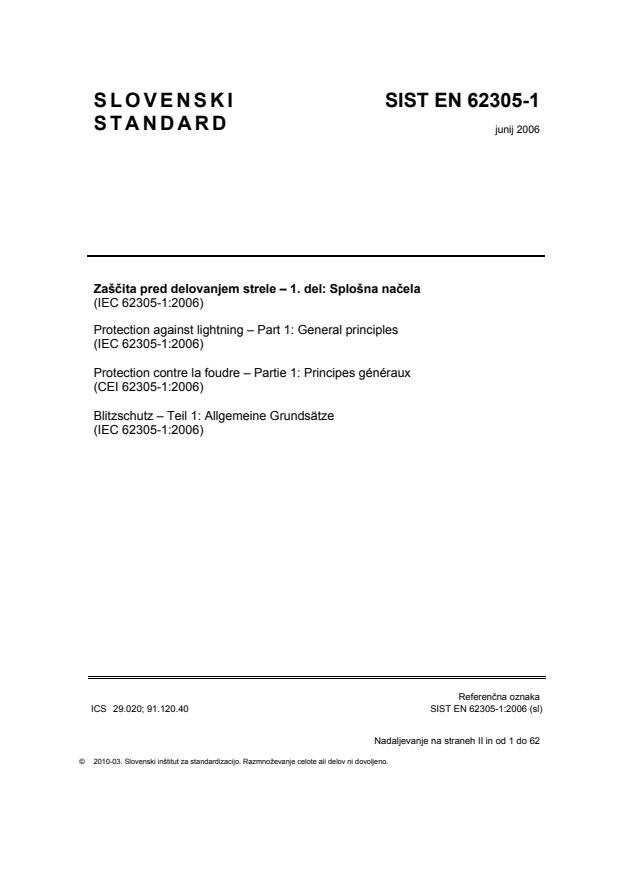
SLOVENSKI SIST EN 62305-1:2006
STANDARD
junij 2006
Zaščita pred delovanjem strele – 1. del: Splošna načela
Protection against lightning - Part 1: General principles
ICS 91.120.40 Referenčna številka
© Standard je založil in izdal Slovenski inštitut za standardizacijo. Razmnoževanje ali kopiranje celote ali delov tega dokumenta ni dovoljeno
Corrigendum to EN 62305-1:2006
English version
___________
Foreword
the last paragraph by:
Replace
Annex ZA has been added by CENELEC.
Annex ZA (see overleaf):
Add
November 2006
Annex ZA
(normative)
Normative references to international publications
with their corresponding European publications
The following referenced documents are indispensable for the application of this document. For dated
references, only the edition cited applies. For undated references, the latest edition of the referenced
document (including any amendments) applies.
NOTE When an international publication has been modified by common modifications, indicated by (mod), the relevant EN/HD
applies.
Publication Year Title EN/HD Year
1) 2)
IEC 62305-2 - Protection against lightning EN 62305-2 2006
Part 2: Risk management
1) 2)
IEC 62305-3 (mod) - Protection against lightning EN 62305-3 2006
Part 3: Physical damage to structures and life
hazard
1) 2)
IEC 62305-4 - Protection against lightning EN 62305-4 2006
Part 4: Electrical and electronic systems
within structures
3)
IEC 62305-5 - Protection against lightning - -
Part 5: Services
___________
1)
Undated reference.
2)
Valid edition at date of issue.
3)
To be published.
IEC 62305-1
Edition 1.0 2006-01
INTERNATIONAL
STANDARD
NORME
INTERNATIONALE
Protection against lightning –
Part 1: General principles
Protection contre la foudre –
Partie 1: Principes généraux
INTERNATIONAL
ELECTROTECHNICAL
COMMISSION
COMMISSION
ELECTROTECHNIQUE
PRICE CODE
INTERNATIONALE
XB
CODE PRIX
ICS 29.020; 91.120.40 ISBN 2-8318-8358-X
62305-1 IEC:2006 – 3 – – 2 – 62305-1 © IEC:2006
CONTENTS
FOREWORD.5
INTRODUCTION.7
1 Scope.8
2 Normative references.8
3 Terms and definitions .8
4 Lightning current parameters .14
5 Damage due to lightning .14
5.1 Damage to a structure .14
5.2 Damage to a service.17
5.3 Types of loss .18
6 Need and economic convenience for lightning protection.20
6.1 Need for lightning protection .20
6.2 Economic convenience of lightning protection .21
7 Protection measures .21
7.1 Protection measures to reduce injury of living beings due to touch and step
voltages.21
7.2 Protection measures to reduce physical damage.21
7.3 Protection measures to reduce failure of electrical and electronic systems .22
7.4 Protection measures selection .22
8 Basic criteria for protection of structures and services.22
8.1 Lightning protection levels (LPL) .23
8.2 Lightning protection zones (LPZ).27
8.3 Protection of structures.28
8.4 Protection of services .29
Annex A (informative) Parameters of lightning current .30
Annex B (informative) Time functions of the lightning current for analysis purposes .38
Annex C (informative) Simulation of the lightning current for test purposes .44
Annex D (informative) Test parameters simulating the effects of lightning on LPS
components .48
Annex E (informative) Surges due to lightning at different installation points .63
Bibliography .68
62305-1 © IEC:200662305-1 IEC:2006 – 5 – – 3 –
Figure 1 – Types of loss and corresponding risks resulting from different types of
damage.20
Figure 2 – LPZ defined by an LPS (IEC 62305-3).25
Figure 3 – LPZ defined by protection measures against LEMP (IEC 62305-4) .26
Figure A.1 – Definitions of short stroke parameters (typically T <2 ms).30
Figure A.2 – Definitions of long stroke parameters (typically 2 ms
long
Figure A.3 – Possible components of downward flashes (typical in flat territory and to
lower structures) .31
Figure A.4 – Possible components of upward flashes (typical to exposed and/or higher
structures) .32
Figure A.5 – Cumulative frequency distribution of lightning current parameters (lines
through 95 % and 5 % value).35
Figure B.1 – Waveshape of the current rise of the first short stroke .39
Figure B.2 – Waveshape of the current tail of the first short stroke .40
Figure B.3 – Waveshape of the current rise of the subsequent short strokes.41
Figure B.4 – Waveshape of the current tail of the subsequent short strokes.42
Figure B.5 – Amplitude density of the lightning current according to LPL I .43
Figure C.1 – Example test generator for the simulation of the specific energy of the first
short stroke and the charge of the long stroke .45
Figure C.2 – Definition for the current steepness in accordance with Table C.3.46
Figure C.3 – Example test generator for the simulation of the front steepness of the
first short stroke for large test items .47
Figure C.4 – Example test generator for the simulation of the front steepness of the
subsequent short strokes for large test items.47
Figure D.1 – General arrangement of two conductors for the calculation of
electrodynamic force .55
Figure D.2 – Typical conductor arrangement in an LPS.55
Figure D.3 – Diagram of the stresses for the configuration of Figure D.2.56
Figure D.4 – Force per unit length along the horizontal conductor of Figure D.2 .56
Table 1 – Effects of lightning on typical structures .15
Table 2 – Effects of lightning on typical services.17
Table 3 – Damages and loss in a structure according to different points of strike of
lightning .19
Table 4 – Damages and loss in a service according to different points of strike of
lightning .19
Table 5 – Maximum values of lightning parameters according to LPL.24
Table 6 – Minimum values of lightning parameters and related rolling sphere radius
corresponding to LPL .27
Table 7 – Probabilities for the limits of the lightning current parameters .27
Table A.1 – Tabulated values of lightning current parameters taken from CIGRE
[3], [4]
(Electra No. 41 or No. 69*) .33
Table A.2 – Logarithmic normal distribution of lightning current parameters –
µ
Mean and dispersion σ calculated from 95 % and 5 % values from CIGRE (Electra
log
[3], [4]
No. 41 or No. 69) .34
62305-1 IEC:2006 – 7 – – 4 – 62305-1 © IEC:2006
Table B.1 – Parameters for Equation B.1.38
Table C.1 – Test parameters of the first short stroke .45
Table C.2 – Test parameters of the long stroke .45
Table C.3 – Test parameters of the short strokes .46
Table D.1 – Summary of the lightning threat parameters to be considered in the
calculation of the test values for the different LPS components and for the different LPL.49
Table D.2 – Physical characteristics of typical materials used in LPS components .52
Table D.3 – Temperature rise for conductors of different sections as a function of W/R .52
Table E.1 – Conventional earthing impedance values Z and Z according to the
resistivity of the soil.64
Table E.2 – Expected surge overcurrents due to lightning flashes .65
62305-1 © IEC:200662305-1 IEC:2006 – 9 – – 5 –
INTERNATIONAL ELECTROTECHNICAL COMMISSION
____________
PROTECTION AGAINST LIGHTNING –
Part 1: General principles
FOREWORD
1) The International Electrotechnical Commission (IEC) is a worldwide organization for standardization comprising
all national electrotechnical committees (IEC National Committees). The object of IEC is to promote
international co-operation on all questions concerning standardization in the electrical and electronic fields. To
this end and in addition to other activities, IEC publishes International Standards, Technical Specifications,
Technical Reports, Publicly Available Specifications (PAS) and Guides (hereafter referred to as “IEC
Publication(s)”). Their preparation is entrusted to technical committees; any IEC National Committee interested
in the subject dealt with may participate in this preparatory work. International, governmental and non-
governmental organizations liaising with the IEC also participate in this preparation. IEC collaborates closely
with the International Organization for Standardization (ISO) in accordance with conditions determined by
agreement between the two organizations.
2) The formal decisions or agreements of IEC on technical matters express, as nearly as possible, an international
consensus of opinion on the relevant subjects since each technical committee has representation from all
interested IEC National Committees.
3) IEC Publications have the form of recommendations for international use and are accepted by IEC National
Committees in that sense. While all reasonable efforts are made to ensure that the technical content of IEC
Publications is accurate, IEC cannot be held responsible for the way in which they are used or for any
misinterpretation by any end user.
4) In order to promote international uniformity, IEC National Committees undertake to apply IEC Publications
transparently to the maximum extent possible in their national and regional publications. Any divergence
between any IEC Publication and the corresponding national or regional publication shall be clearly indicated in
the latter.
5) IEC provides no marking procedure to indicate its approval and cannot be rendered responsible for any
equipment declared to be in conformity with an IEC Publication.
6) All users should ensure that they have the latest edition of this publication.
7) No liability shall attach to IEC or its directors, employees, servants or agents including individual experts and
members of its technical committees and IEC National Committees for any personal injury, property damage or
other damage of any nature whatsoever, whether direct or indirect, or for costs (including legal fees) and
expenses arising out of the publication, use of, or reliance upon, this IEC Publication or any other IEC
Publications.
8) Attention is drawn to the Normative references cited in this publication. Use of the referenced publications is
indispensable for the correct application of this publication.
9) Attention is drawn to the possibility that some of the elements of this IEC Publication may be the subject of
patent rights. IEC shall not be held responsible for identifying any or all such patent rights.
International Standard IEC 62305-1 has been prepared by IEC technical committee 81:
Lightning protection.
The IEC 62305 series (Parts 1 to 5), is produced in accordance with the New Publications Plan,
approved by National Committees (81/171/RQ (2001-06-29)), which restructures and updates
in a more simple and rational form the publications of the IEC 61024 series, the IEC 61312
series and the IEC 61663 series.
The text of this first edition of IEC 62305-1 is compiled from and replaces
– IEC 61024-1-1, first edition (1993).
62305-1 IEC:2006 – 11 – – 6 – 62305-1 © IEC:2006
The text of this standard is based on the following documents:
FDIS Report on voting
81/262/FDIS 81/267/RVD
Full information on the voting for the approval of this standard can be found in the report on
voting indicated in the above table.
This publication has been drafted, as close as possible, in accordance with the ISO/IEC
Directives, Part 2.
IEC 62305 consists of the following parts, under the general title Protection against lightning:
Part 1: General principles
Part 2: Risk management
Part 3: Physical damage to structures and life hazard
Part 4: Electrical and electronic systems within structures
Part 5: Services
The committee has decided that the contents of this publication will remain unchanged until the
maintenance result date indicated on the IEC web site under "http://webstore.iec.ch" in the data
related to the specific publication. At this date, the publication will be
• reconfirmed;
• withdrawn;
• replaced by a revised edition, or
• amended.
___________
To be published
62305-1 © IEC:200662305-1 IEC:2006 – 13 – – 7 –
INTRODUCTION
There are no devices nor methods capable of modifying the natural weather phenomena to the
extent that they can prevent lightning discharges. Lightning flashes to, or nearby, structures (or
services connected to the structures) are hazardous to people, to the structures themselves,
their contents and installations as well as to services. This is why the application of lightning
protection measures is essential.
The need for protection, the economic benefits of installing protection measures and the
selection of adequate protection measures should be determined in terms of risk management.
Risk management is the subject of IEC 62305-2.
The criteria for design, installation and maintenance of lightning protection measures are
considered in three separate groups:
– the first group concerns protection measures to reduce physical damage and life hazard in
a structure is given in IEC 62305-3,
– the second group concerns protection measures to reduce failures of electrical and
electronic systems in a structure is given in IEC 62305-4,
– the third group concerns protection measures to reduce physical damage and failures of
services connected to a structure (mainly electrical and telecommunication lines) is given in
IEC 62305-5.
62305-1 IEC:2006 – 15 – – 8 – 62305-1 © IEC:2006
PROTECTION AGAINST LIGHTNING –
Part 1: General principles
1 Scope
This part of IEC 62305 provides the general principles to be followed in the protection against
lightning of
– structures including their installations and contents as well as persons,
– services connected to a structure.
The following cases are outside the scope of this standard:
– railway systems;
– vehicles, ships, aircraft, offshore installations;
– underground high pressure pipelines;
− pipe, power and telecommunication lines not connected to a structure.
NOTE Usually these systems are under special regulations made by various specific authorities.
2 Normative references
The following referenced documents are indispensable for the application of this document. For
dated references, only the edition cited applies. For undated references, the latest edition of
the referenced document (including any amendments) applies.
IEC 62305-2, Protection against lightning – Part 2: Risk management
IEC 62305-3, Protection against lightning – Part 3: Physical damage to structures and life
hazard
IEC 62305-4, Protection against lightning – Part 4: Electrical and electronic systems within
structures
IEC 62305-5, Protection against lightning – Part 5: Services
3 Terms and definitions
For the purposes of this document, the following terms and definitions apply.
3.1
lightning flash to earth
electrical discharge of atmospheric origin between cloud and earth consisting of one or more
strokes
___________
To be published.
62305-1 © IEC:200662305-1 IEC:2006 – 17 – – 9 –
3.2
downward flash
lightning flash initiated by a downward leader from cloud to earth
NOTE A downward flash consists of a first short stroke, which can be followed by subsequent short strokes. One
or more short strokes may be followed by a long stroke.
3.3
upward flash
lightning flash initiated by an upward leader from an earthed structure to cloud
NOTE An upward flash consists of a first long stroke with or without multiple superimposed short strokes. One or
more short strokes may be followed by a long stroke.
3.4
lightning stroke
single electrical discharge in a lightning flash to earth
3.5
short stroke
part of the lightning flash which corresponds to an impulse current
NOTE This current has a time to the half value T typically less than 2 ms (see Figure A.1).
3.6
long stroke
part of the lightning flash which corresponds to a continuing current
NOTE The duration time T (time from the 10 % value on the front to the 10 % value on the tail) of this
long
continuing current is typically more than 2 ms and less than 1 s (see Figure A.2)
3.7
multiple strokes
lightning flash consisting on average of 3-4 strokes, with typical time interval between them of
about 50 ms
NOTE Events having up to a few dozen strokes with intervals between them ranging from 10 ms to 250 ms have
been reported.
3.8
point of strike
point where a lightning flash strikes the earth, or protruding object (e.g. structure, LPS, service,
tree, etc.)
NOTE A lightning flash may have more than one point of strike.
3.9
lightning current
i
current flowing at the point of strike
3.10
peak value
I
maximum value of the lightning current
3.11
average steepness of the front of short stroke current
average rate of change of current within a time interval t – t
2 1
NOTE It is expressed by the difference i(t ) – i(t ) of the values of the current at the start and at the end of this
2 1
interval, divided by t – t (see Figure A.1).
2 1
62305-1 IEC:2006 – 19 – – 10 – 62305-1 © IEC:2006
3.12
front time of short stroke current
T
virtual parameter defined as 1,25 times the time interval between the instants when the 10 %
and 90 % of the peak value are reached (see Figure A.1)
3.13
virtual origin of short stroke current
O
point of intersection with time axis of a straight line drawn through the 10 % and the 90 %
reference points on the stroke current front (see Figure A.1); it precedes by 0,1 T that instant
at which the current attains 10 % of its peak value
3.14
time to half value of short stroke current
T
virtual parameter defined as the time interval between the virtual origin O and the instant at
which the current has decreased to half the peak value (see Figure A.1)
3.15
flash duration
T
time for which the lightning current flows at the point of strike
3.16
duration of long stroke current
T
long
time duration during which the current in a long stroke is between the 10 % of the peak value
during the increase of the continuing current and 10 % of the peak value during the decrease of
the continuing current (see Figure A.2)
3.17
flash charge
Q
flash
time integral of the lightning current for the entire lightning flash duration
3.18
short stroke charge
Q
short
time integral of the lightning current in a short stroke
3.19
long stroke charge
Q
long
time integral of the lightning current in a long stroke
3.20
specific energy
W/R
time integral of the square of the lightning current for the entire flash duration
NOTE It represents the energy dissipated by the lightning current in a unit resistance.
3.21
specific energy of short stroke current
time integral of the square of the lightning current for the duration of the short stroke
NOTE The specific energy in a long stroke current is negligible.
62305-1 © IEC:200662305-1 IEC:2006 – 21 – – 11 –
3.22
object to be protected
structure or service to be protected against the effects of lightning
3.23
structure to be protected
structure for which protection is required against the effects of lightning in accordance with this
standard
NOTE A structure to be protected may be a part of a larger structure.
3.24
service to be protected
service connected to a structure for which protection is required against the effects of lightning
in accordance with this standard
3.25
lightning flash to an object
lightning flash striking an object to be protected
3.26
lightning flash near an object
lightning flash striking close enough to an object to be protected that it may cause dangerous
overvoltages
3.27
electrical system
system incorporating low voltage power supply components
3.28
electronic system
system incorporating sensitive electronic components such as communication equipment,
computer, control and instrumentation systems, radio systems, power electronic installations
3.29
internal systems
electrical and electronic systems within a structure
3.30
physical damage
damage to a structure (or to its contents) or to a service due to mechanical, thermal, chemical
and explosive effects of lightning
3.31
injury of living beings
injuries, including loss of life, to people or to animals due to touch and step voltages caused by
lightning
3.32
failure of electrical and electronic systems
permanent damage of electrical and electronic systems due to LEMP
62305-1 IEC:2006 – 23 – – 12 – 62305-1 © IEC:2006
3.33
lightning electromagnetic impulse
LEMP
electromagnetic effects of lightning current
NOTE It includes conducted surges as well as radiated impulse electromagnetic field effects.
3.34
surge
transient wave appearing as overvoltage and /or overcurrent caused by LEMP
NOTE Surges caused by LEMP can arise from (partial) lightning currents, from induction effects in installation
loops and as remaining threat downstream of SPD.
3.35
lightning protection zone
LPZ
zone where the lightning electromagnetic environment is defined
NOTE The zone boundaries of an LPZ are not necessarily physical boundaries (e.g. walls, floor and ceiling).
3.36
risk
R
value of probable average annual loss (humans and goods) due to lightning, relative to the total
value (humans and goods) of the object to be protected
3.37
tolerable risk
R
T
maximum value of the risk which can be tolerated for the object to be protected
3.38
lightning protection level
LPL
number related to a set of lightning current parameters values relevant to the probability that
the associated maximum and minimum design values will not be exceeded in naturally
occurring lightning
NOTE Lightning protection level is used to design protection measures according to the relevant set of lightning
current parameters.
3.39
protection measures
measures to be adopted in the object to be protected to reduce the risk
3.40
lightning protection system
LPS
complete system used to reduce physical damage due to lightning flashes to a structure
NOTE It consists of both external and internal lightning protection systems.
3.41
external lightning protection system
part of the LPS consisting of an air-termination system, a down-conductor system and an
earth-termination system
62305-1 © IEC:200662305-1 IEC:2006 – 25 – – 13 –
3.42
internal lightning protection system
part of the LPS consisting of lightning equipotential bonding and/or electrical insulation of
external LPS
3.43
air-termination system
part of an external LPS using metallic elements such as rods, mesh conductors or catenary
wires intended to intercept lightning flashes
3.44
down-conductor system
part of an external LPS intended to conduct lightning current from the air-termination system to
the earth-termination system
3.45
earth-termination system
part of an external LPS which is intended to conduct and disperse lightning current into the
earth
3.46
external conductive parts
extended metal items entering or leaving the structure to be protected such as pipe works,
cable metallic elements, metal ducts, etc. which may carry a part of the lightning current
3.47
lightning equipotential bonding
bonding to LPS of separated metallic parts, by direct conductive connections or via surge
protective devices, to reduce potential differences caused by lightning current
3.48
shielding wire
metallic wire used to reduce physical damage due to lightning flashes to a service
3.49
LEMP protection measures system
LPMS
complete system of protection measures for internal systems against LEMP
3.50
magnetic shield
closed, metallic, grid-like or continuous screen enveloping the object to be protected, or part of
it, used to reduce failures of electrical and electronic systems
3.51
surge protective device
SPD
device intended to limit transient overvoltages and divert surge currents. It contains at least
one non linear component
3.52
coordinated SPD protection
set of SPD properly selected, coordinated and erected to reduce failures of electrical and
electronic systems
62305-1 IEC:2006 – 27 – – 14 – 62305-1 © IEC:2006
3.53
rated impulse withstand voltage
U
w
impulse withstand voltage assigned by the manufacturer to the equipment or to a part of it,
characterizing the specified withstand capability of its insulation against overvoltages
NOTE For the purposes of this standard, only withstand voltage between live conductors and earth is considered.
[1]
(IEC 60664-1:2002)
3.54
conventional earthing impedance
ratio of the peak values of the earth-termination voltage and the earth-termination current
which, in general, do not occur simultaneously
4 Lightning current parameters
The lightning current parameters used in the IEC 62305 series are given in Annex A.
The time function of the lightning current to be used for analysis purposes is given in Annex B.
Information for simulation of lightning current for test purposes is given in Annex C.
The basic parameters to be used in laboratory to simulate the effects of lightning on LPS
components are given in Annex D.
Information on surges due to lightning at different installation points is given in Annex E.
5 Damage due to lightning
5.1 Damage to a structure
Lightning affecting a structure can cause damage to the structure itself and to its occupants
and contents, including failure of internal systems. The damages and failures may also extend
to the surroundings of the structure and even involve the local environment. The scale of this
extension depends on the characteristics of the structure and on the characteristics of the
lightning flash.
5.1.1 Effects of lightning on a structure
The main characteristics of structures relevant to lightning effects include:
− construction (e.g. wood, brick, concrete, reinforced concrete, steel frame construction);
− function (dwelling house, office, farm, theatre, hotel, school, hospital, museum, church,
prison, department store, bank, factory, industry plant, sports area);
− occupants and contents (persons and animals, presence of combustible or non-combustible
materials, explosive or non-explosive materials, electrical and electronic systems with low or
high withstand voltage);
___________
References in square brackets refer to the bibliography.
62305-1 © IEC:200662305-1 IEC:2006 – 29 – – 15 –
− connected services (power lines, telecommunication lines, pipelines);
− existing or provided protection measures (e.g. protection measures to reduce physical
damage and life hazard, protection measures to reduce failure of internal systems);
− scale of the extension of danger (structure with difficulty of evacuation or structure where
panic may be created, structure dangerous to the surroundings, structure dangerous to the
environment).
Table 1 reports the effects of lightning on various types of structures.
Table 1 – Effects of lightning on typical structures
Type of structure
according to
Effects of lightning
function and/or
contents
Dwelling-house Puncture of electrical installations, fire and material damage
Damage normally limited to objects exposed to the point of strike or to the lightning current
path
Failure of electrical and electronic equipment and systems installed (e.g. TV sets,
computers, modems, telephones, etc.)
Farm building Primary risk of fire and hazardous step voltages as well as material damage
Secondary risk due to loss of electric power, and life hazard to livestock due to failure of
electronic control of ventilation and food supply systems, etc.
Theatre, Damage to the electrical installations (e.g. electric lighting) likely to cause panic
Hotel, Failure of fire alarms resulting in delayed fire fighting measures
School
Department store
Sports area
Bank As above, plus problems resulting from loss of communication, failure of computers and loss
of data
Insurance company
Commercial
company, etc.
Hospital As above, plus problems of people in intensive care, and the difficulties of rescuing immobile
people
Nursing home
Prison
Industry Additional effects depending on the contents of factories, ranging from minor to unacceptable
damage and loss of production
Museums and Loss of irreplaceable cultural heritage
archeological sites
Church
Telecommunications Unacceptable loss of services to the public
Power plants
Firework factory Consequences of fire and explosion to the plant and its surroundings
Munition works
Chemical plant Fire and malfunction of the plant with detrimental consequences to the local and global
environment
Refinery
Nuclear plant
Biochemical
laboratories and
plants
62305-1 IEC:2006 – 31 – – 16 – 62305-1 © IEC:2006
5.1.2 Sources and types of damage to a structure
The lightning current is the source of damage. The following situations shall be taken into
account, depending on the position of the point of strike relative to the structure considered:
− S1: flashes to the structure;
− S2: flashes near the structure;
− S3: flashes to the services connected to the structure;
− S4: flashes near the services connected to the structure.
Flashes to the structure can cause:
– immediate mechanical damage, fire and/or explosion due to the hot lightning plasma arc
itself, due to the current resulting in ohmic heating of conductors (over-heated conductors),
or due to the charge resulting in arc erosion (melted metal);
– fire and/or explosion triggered by sparks caused by overvoltages resulting from resistive
and inductive coupling and to passage of part of the lightning currents;
– injury to people by step and touch voltages resulting from resistive and inductive coupling;
– failure or malfunction of internal systems due to LEMP.
Flashes near the structure can cause:
– failure or malfunction of internal systems due to LEMP.
Flashes to a service connected to the structure can cause:
– fire and/or explosion triggered by sparks due to overvoltages and lightning currents
transmitted through the connected service;
– injury to people due to touch voltages inside the structure caused by lightning currents
transmitted through the connected service;
– failure or malfunction of internal systems due to overvoltages appearing on connected lines
and transmitted to the structure.
Flashes near a service connected to the structure can cause:
– failure or malfunction of internal systems due to overvoltages induced on connected lines
and transmitted to the structure.
NOTE 1 Malfunctioning of internal systems is not covered by the IEC 62305 series. Reference should be made to
[2]
IEC 61000-4-5 .
NOTE 2 Only the sparks carrying lightning current (total or partial) are regarded as able to trigger fire.
NOTE 3 Lightning flashes, direct to or near the incoming pipelines, do not cause damages to the structure,
provided that they are bonded to the equipotential bar of the structure (see IEC 62305-3).
As result, the lightning can cause three basic type of damages:
− D1: injury of living beings due to touch and step voltages;
− D2: physical damage (fire, explosion, mechanical destruction, chemical release) due to
lightning current effects including sparking;
− D3: failure of internal systems due to LEMP.
62305-1 © IEC:200662305-1 IEC:2006 – 33 – – 17 –
5.2 Damage to a service
Lightning affecting a service can cause damage to the physical means itself (line or pipe) used
to provide the service, as well as to connected electrical and electronic equipment.
NOTE The service to be considered is the physical connection between
– the switch telecommunication building and the user’s building or two switch telecommunication buildings or two
users’ buildings, for the telecommunication (TLC) lines,
– the switch telecommunication building or the user`s building and a distribution node, or two distribution nodes for
the telecommunication (TLC) lines,
– the high voltage (HV) substation and the user’s building, for the power lines,
– the main distribution station and the user’s building, for pipes.
The scale of this extension depends on the characteristics of the service, on the type and
extension of the electrical and electronic systems and on the characteristics of the lightning
flash.
5.2.1 Effects of lightning on a service
The main characteristics of services relevant to lightning effects include:
– construction (line: overhead, underground, screened, unscreened, fibre optic; pipe: above
ground, buried, metallic, plastic);
– function (telecommunication line, power line, pipeline);
– structure supplied (construction, contents, dimensions, location);
– existing or provided protection measures (e.g. shielding wire, SPD, route redundancy, fluid
storage systems, generating sets, uninterruptible power systems).
Table 2 reports the effects of lightning on various types of services.
Table 2 – Effects of lightning on typical services
Type of service Effects of lightning
Telecommunication line Mechanical damage to line, melting of screens and conductors,
breakdown of insulation of cable and equipment leading to a primary
failure with immediate loss of service
Secondary failures on the optical fibre cables with damage of the cable
but without loss of service
Power lines Damages to insulators of low voltage overhead line, puncturing of
insulation of cable line, breakdown of insulation of line equipment and of
transformers, with consequential loss of service
Water pipes Damages to electrical and electronic control equipments likely to cause
loss of service
Gas pipes Puncturing of non-metallic flange gaskets likely to cause fire and/or
explosion.
Fuel pipes
Damage to electrical and electronic control equipments likely to cause
loss of service
5.2.2 Sources and types of damage to a service
The lightning current is the source of damage. The following situations shall be taken into
account, depending on the position of the point of strike relative to the service considered:
− S1: flashes to the supplied structure;
− S3: flashes to the service connected to the structure;
− S4: flashes near the service connected to the structure.
62305-1 IEC:2006 – 35 – – 18 – 62305-1 © IEC:2006
Flashes to the supplied structure can cause:
– melting of metallic wires and of cable screens due to parts of the lightning current flowing
into the services (resulting from resistive heating);
– breakdown of insulation of lines and of the connected equipments (due to the resistive
coupling);
– puncturing of non-metallic gaskets in flanges of pipes, as well as gaskets in insulating
joints.
NOTE 1 Optical fibre cable without metallic conductor are not affected by lightning flashes striking the supplied
structure.
Flashes to a service connected to the structure can cause:
– immediate mechanical damage of metallic wires or piping due to electrodynamic stress or
heating effects caused by lightning current (breaking and/or melting of metallic wires,
screens or piping), and due to the heat of the lightning plasma arc itself (puncturing of
plastic protective cover);
– immediate electrical damage of lines (breakdown of insulation) and of connected
equipment;
– puncturing of thin overhead metallic pipes and of non-metallic gaskets in flanges, where
consequences may extend to fire and explosion depending on the nature of conveyed
fluids.
Flashes near a service connected to the structure can cause:
– breakdown of insulation of lines and of the connected equipments due to inductive coupling
(induced overvoltages).
NOTE 2 Optical fibre cable without metallic conductors are not affected by lightning flashes striking the ground.
As a result, the lightning can cause two basic type of damage:
– D2: physical damage (fire, explosion, mechanical destruction, chemical release) due to
thermal effects of lightning current
– D3: failure of electrical and electronic systems due to overvoltages.
5.3 Types of loss
Each type of damage, alone or in combination with others, may produce different consequential
loss in the object to be protected. The type of loss that may appear depends on the
characteristics of the object itself.
For the purposes of this standard the following types of loss are considered:
− L1: loss of human life;
− L2: loss of service to the public;
− L3: loss of cultural heritage;
− L4: loss of economical value (structure and its content, service and loss of activity).
Loss of type L1, L2 and L3 may be considered as loss of social values, whereas loss of type L4
may be considered as purely economical loss.
Losses which may appear in a structure are as follows:
− L1: loss of human life;
− L2: loss of service to the public;
62305-1 © IEC:200662305-1 IEC:2006 – 37 – – 19 –
− L3: loss of cultural heritage
− L4: loss of economic value (structure and its content).
Losses which may appear in a service are as follows:
− L2: loss of service to the public;
− L4: loss of economic value (service and loss of activity).
NOTE In a service, loss of human life is not considered in this standard.
The relationship between source of damage, type of damage and loss is reported in Table 3 for
structures and in Table 4 for services.
Table 3 – Damages and loss in a structure according to
different points of strike of lightning
Source of Type of
Point of strike Type of loss
damage damage
**
L1 L4
D1
,
Structure S1 D2 L1, L2, L3, L4
*
D3 L1 , L2, L4
*
Near a structure S2 D3 L1 , L2, L4
**
L1, L4
D1
Service connected to
S3
D2
the structure
L1, L2, L3, L4
D3
L1*, L2, L4
*
Near a service S4 D3 L1 , L2, L4
* Only for structures with risk of explosion and for hospitals or other structures where failure of internal systems
immediately endangers human life.
** Only for properties where animals may be lost.
Table 4 – Damages and loss in a service according to different points of strike of
lightning
Point of strike Source of damage Type of damage Type of loss
D2
Service S3
D3
Near the service S4 D3 L2, L4
D2
Supplied structure S1
D3
62305-1 IEC:2006 – 39 – – 20 – 62305-1 © IEC:2006
Types of loss resulting from types of damage and the corresponding risks are reported in
Figure 1.
Risk
Risk Risk Risk
1)
1)
R
R R
R 4
1 2 3
Loss of
Loss of
Loss of Loss of
Type of cultural
human
service to economic
loss heritage
life
the public values
2)
Failure of Failure of 3) Failure of
Injury of
Injury of
electrical electrical Physical Physical electrical
Type of Physical Physical
living
living
and and damage damage and
damage damage
damage
beings
beings
electronic electronic electronic
systems systems systems
IEC 2061/05
1)
Only for structures.
2)
Only for hospitals or other structures where failure on internal systems immediately endanger human life.
3)
Only for properties where animals may be lost.
Figur
...
SLOVENSKI SIST EN 62305-1
STANDARD
junij 2006
Zaščita pred delovanjem strele – 1. del: Splošna načela
(IEC 62305-1:2006)
Protection against lightning – Part 1: General principles
(IEC 62305-1:2006)
Protection contre la foudre – Partie 1: Principes généraux
(CEI 62305-1:2006)
Blitzschutz – Teil 1: Allgemeine Grundsätze
(IEC 62305-1:2006)
Referenčna oznaka
ICS 29.020; 91.120.40 SIST EN 62305-1:2006 (sl)
Nadaljevanje na straneh II in od 1 do 62
© 2010-03. Slovenski inštitut za standardizacijo. Razmnoževanje celote ali delov ni dovoljeno.
SIST EN 62305-1 : 2006
NACIONALNI UVOD
Standard SIST EN 62305-1 (sl), Zaščita pred delovanjem strele – 1. del: Splošna načela (IEC 62305-
1:2006), 2006, ima status slovenskega standarda in je istoveten evropskemu standardu EN 62305-1
(en), Protection against lightning – Part 1: General principles, 2006.
NACIONALNI PREDGOVOR
Evropski standard EN 62305-1:2006 je pripravil tehnični odbor Evropskega komiteja za
standardizacijo v elektrotehniki CLC/TC 81X Zaščita pred delovanjem strele. Evropski standard je
istoveten mednarodnemu standardu IEC 62305-1:2006, ki ga je pripravil tehnični odbor Mednarodne
elektrotehniške komisije IEC/TC 81 Zaščita pred delovanjem strele.
Slovenski standard SIST EN 62305-1:2006 je prevod evropskega standarda EN 62305-1:2006. V
primeru spora glede besedila slovenskega prevoda v tem standardu je odločilen izvirni evropski
standard v angleškem jeziku. Slovensko izdajo standarda je pripravil tehnični odbor SIST/TC STZ
Zaščita pred delovanjem strele.
Odločitev za privzem tega standarda po metodi ponatisa je dne 24. oktobra 2006 sprejel tehnični
odbor SIST/TC STZ.
OSNOVA ZA IZDAJO STANDARDA
Privzem standarda EN 62305-1:2006.
ZVEZE S STANDARDI
S privzemom tega evropskega standarda veljajo za omenjeni namen referenčnih standardov vsi
standardi, navedeni v izvirniku, razen tistih, ki so že sprejeti v nacionalno standardizacijo:
SIST EN 62305-2 Zaščita pred delovanjem strele – 2. del: Vodenje rizika
SIST EN 62305-3 Zaščita pred delovanjem strele – 3. del: Fizična škoda na zgradbah in
nevarnost za živa bitja
SIST EN 62305-4 Zaščita pred delovanjem strele – 4. del: Električni in elektronski
sistemi v zgradbah
OPOMBA
– Nacionalni uvod in nacionalni predgovor nista sestavni del standarda.
– Povsod, kjer se v besedilu standarda uporablja izraz “evropski standard”, v SIST EN 62305-
1:2006 to pomeni “slovenski standard”.
– Ta nacionalni dokument je istoveten z EN 62305-1:2006 in je objavljen z dovoljenjem
CENELEC
Avenue Marnix 17
B-1050 Bruselj
Belgija
– This national document is identical with EN 62305-1:2006 and is published with the permission
of
CENELEC
Avenue Marnix 17
B-1050 Bruxelles
Belgium
II
EVROPSKI STANDARD EN 62305-1
EUROPEAN STANDARD
NORME EUROPÉENNE
EUROPÄISCHE NORM februar 2006
ICS 29.020; 91.120.40 Vključuje Popravek, november 2006
Slovenska izdaja
Zaščita pred delovanjem strele – 1. del: Splošna načela
(IEC 62305-1:2006)
Protection against lightning – Protection contre la foudre – Blitzschutz –
Part 1: General principles Partie 1: Principes généraux Teil 1: Allgemeine Grundsätze
(IEC 62305-1:2006) (CEI 62305-1:2006) (IEC 62305-1:2006)
Ta evropski standard je CENELEC sprejel 1. februarja 2006. Članice CENELEC morajo izpolnjevati
notranje predpise CEN/CENELEC, s katerimi je predpisano, da mora biti ta standard brez kakršnihkoli
sprememb sprejet kot nacionalni standard.
Najnovejši seznami teh nacionalnih standardov z njihovimi bibliografskimi podatki se na zahtevo lahko
dobijo pri Centralnem sekretariatu ali katerikoli članici CENELEC.
Ta evropski standard obstaja v treh izvirnih izdajah (angleški, francoski in nemški). Izdaje v drugih
jezikih, ki jih članice CENELEC na lastno odgovornost prevedejo in izdajo ter prijavijo pri Centralnem
sekretariatu CEN, veljajo kot uradne izdaje.
Članice CENELEC so nacionalni organi za standarde Avstrije, Belgije, Cipra, Češke republike,
Danske, Estonije, Finske, Francije, Grčije, Irske, Islandije, Italije, Latvije, Litve, Luksemburga, Malte,
Madžarske, Nemčije, Nizozemske, Norveške, Poljske, Portugalske, Romunije, Slovaške, Slovenije,
Španije, Švedske, Švice in Združenega kraljestva.
CENELEC
Evropski komite za standardizacijo v elektrotehniki
European Committee for Electrotechnical Standardization
Comité Européen de Normalisation Electrotechnique
Europäisches Komitee für Elektrotechnische Normung
Centralni sekretariat: Rue de Stassart 35, B-1050 Bruselj
© 2006 CENELEC. Lastnice avtorskih pravic so vse države članice CENELEC. Ref. oznaka EN 62305-1:2006 E
SIST EN 62305-1 : 2006
Predgovor
Besedilo dokumenta 81/262/FDIS, prihodnje 1. izdaje standarda IEC 62305-1, ki ga je pripravil
tehnični odbor IEC/TC 81 Strelovodna zaščita, je CENELEC 1. februarja 2006 po vzporednem
glasovanju v IEC in CENELEC sprejel kot EN 62305-1.
Določena sta bila naslednja datuma:
– zadnji datum, do katerega mora EN dobiti status
nacionalnega standarda bodisi z objavo istovetnega besedila
ali z razglasitvijo (dop) 2006-11-01
– zadnji datum, ko je treba razveljaviti nacionalne standarde,
ki so z EN v nasprotju (dow) 2009-02-01
Dodatek ZA je dodal CENELEC.
Vsebina popravka iz novembra 2006 je vključena v to izdajo.
Razglasitvena objava
Besedilo mednarodnega standarda IEC 62305-1:2006 je CENELEC odobril kot evropski standard brez
sprememb.
SIST EN 62305-1: 2006
Dodatek ZA
(normativni)
Sklicevanje na mednarodne publikacije z njihovimi ustreznimi evropskimi
publikacijami
Pri uporabi tega dokumenta so nujno potrebni naslednji referenčni dokumenti. Pri datiranih
sklicevanjih velja le navedena izdaja dokumenta. Pri nedatiranih sklicevanjih se uporablja zadnja
izdaja publikacije (vključno z dopolnili).
OPOMBA: Kadar je mednarodna publikacija spremenjena in so spremembe označene z (mod), se uporablja ustrezni
dokument EN/HD,
Standard Leto Naslov EN/HD Leto
1) 2)
IEC 62305-2 – Zaščita pred delovanjem strele – 2. del: EN 62305-2 2006
Vodenje rizika
Protection against lightning – Part 2: Risk
management
1) 2)
IEC 62305-3 (mod) – Zaščita pred delovanjem strele – 3. del: EN 62305-3 2006
Fizična škoda na zgradbah in nevarnost za
živa bitja
Protection against lightning – Part 3:
Physical damage to structures and life
hazard
1) 2)
IEC 62305-4 – Zaščita pred delovanjem strele – 4. del: EN 62305-4 2006
Električni in elektronski sistemi v zgradbah
Protection against lightning – Part 4:
Electrical and electronic systems within
structures
3)
IEC 62305-5 – Zaščita pred delovanjem strele – 5. del: – –
Oskrba
Protection against lightning – Part 5:
Services
1)
Nedatirano sklicevanje.
2)
Veljavna je datirana izdaja.
3)
V pripravi.
SIST EN 62305-1 : 2006
VSEBINA Stran
Predgovor .2
Dodatek ZA.3
Predgovor .6
Uvod .8
1 Področje uporabe .9
2 Zveza s standardi .9
3 Izrazi in definicije .9
4 Parametri toka strele .14
5 Škoda zaradi udarov strele.14
5.1 Škoda na zgradbah .14
5.2 Škoda na oskrbovalnem vodu .16
5.3 Vrste izgube.18
6 Potreba in ekonomska upravičenost zaščite pred delovanjem strele .20
6.1 Potreba po zaščiti pred delovanjem strele .20
6.2 Ekonomska upravičenost zaščite pred delovanjem strele .21
7 Zaščitni ukrepi .21
7.1 Zaščitni ukrepi za zmanjšanje poškodb živih bitij zaradi napetosti koraka in dotika.21
7.2 Zaščitni ukrepi za zmanjšanje fizične škode .22
7.3 Zaščitni ukrepi za zmanjšanje škode na električnih in elektronskih sistemih .22
7.4 Izbor zaščitnih ukrepov.22
8 Osnovni kriteriji za zaščito zgradb in oskrbovalnih vodov.23
8.1 Zaščitni nivo sistema zaščite pred delovanjem strele (LPL) .23
8.2 Zaščitne cone pred delovanjem strele (LPZ) .27
8.3 Zaščita zgradb.28
8.4. Zaščita oskrbovalnih vodov .29
Dodatek A (informativni): Parametri toka strele .30
Dodatek B (informativni): Časovne oblike toka strele za analitične potrebe.38
Dodatek C (informativni): Simulacija toka strele za namene preskušanja .42
Dodatek D (informativni): Preskusni parametri za simulacijo učinkov udara strele na komponente LPS.45
Dodatek E (informativni) Udarni vali zaradi udara strele v različne točke napeljave .58
Bibliografija .62
Slika 1: Vrste izgub in ustrezni riziko, ki se kaže v različnih vrstah škode .20
Slika 2: Zaščitne cone (LPZ), izbrane za LPS (IEC 62305-3).25
Slika 3: Zaščitne cone, izbrane na podlagi zaščitnih ukrepov pred LEMP (IEC 62305-4).26
Slika A.1: Definicije parametrov kratkotrajnega udara strele (značilno za T < 2 ms).30
Slika A.2: Definicije parametrov dolgotrajnega udara strele (značilno za 2 ms < T < 1 s).31
dolgi
Slika A.3: Mogoči deli strele navzdol (značilni za ravnine in nizke zgradbe) .31
Slika A.4: Mogoči deli strele navzgor (značilno za izpostavljene in/ali visoke zgradbe) .32
SIST EN 62305-1: 2006
Slika A.5: Skupna frekvenčna porazdelitev parametrov toka strele (krivulje skozi 95-odstotno
in 5-odstotno vrednostjo).35
Slika B.1: Valovna oblika čela toka za prvi kratkotrajni udar strele.39
Slika B.2: Valovna oblika hrbta toka za prvi kratkotrajni udar strele .39
Slika B.3: Valovna oblika čela toka sledilnih kratkotrajnih udarov.40
Slika B.4: Valovna oblika hrbta toka sledilnih kratkotrajnih udarov.40
Slika B.5: Amplitudna gostota toka strele za LPL I .41
Slika C.1: Primer preskusnega generatorja za vzpostavitev specifične energije prvega
kratkotrajnega udara in naboja dolgotrajnega udara .42
Slika C.2: Definiranje strmine toka skladno s preglednico C.3.44
Slika C.3: Primer preskusnega generatorja za simulacijo strmine čela prvega kratkotrajnega
udara za obsežne preskusne predmete.44
Slika C.4: Primer preskusnega generatorja za simulacijo strmine čela sledilnih kratkotrajnih
udara za obsežne preskusne predmete.44
Slika D.1: Generalni položaj dveh vodnikov za izračun elektrodinamične sile.51
Slika D.2: Tipičen položaj vodnikov v določenem LPS .51
Slika D.3: Diagram obremenitve za konfiguracijo na sliki D.2.52
Slika D.4: Sila na dolžinsko enoto vzdolž vodoravnega vodnika s slike D.2.52
Preglednica 1: Učinki strele na tipične zgradbe .15
Preglednica 2: Učinki strele na tipične oskrbovalne vode.17
Preglednica 3: Škoda in izguba v zgradbi glede na različne točke udara strele.19
Preglednica 4: Škoda in izguba v oskrbovalnem vodu glede na različne točke udara .20
Preglednica 5: Največje vrednosti parametra strele v povezavi z LPL .24
Preglednica 6: Najmanjše vrednosti parametrov toka strele in ustreznih polmerov
kotaleče krogle za določene zaščitne nivoje (LPL) .27
Preglednica 7: Verjetnosti za omejitev parametrov toka strele .27
Preglednica A.1: Vrednosti parametrov toka strele po podatkih CIGRE (Electra, št. 41 ali št. 69).33
Preglednica A.2: Logaritemska normalna porazdelitev parametrov toka strele –
srednja vrednost µ in raztros σ , izračunana od 95 % do 5 % vrednosti, po podatkih CIGRE
log
(Electra, št. 41 ali št. 69* .34
Preglednica B.1: Parametri za enačbo B.1 .38
Preglednica C.1: Preskusni parametri prvega kratkotrajnega udara .43
Preglednica C.2: Preskusni parametri dolgotrajnega udara.43
Preglednica C.3: Preskusni parametri kratkotrajnih udarov strele .43
Preglednica D.1: Pregled parametrov nevarnosti strele, ki jih je treba upoštevati v izračunih
vrednosti za različne komponente LPS in različne LPL .46
Preglednica D.2: Fizične značilnosti tipičnih materialov, uporabljenih v komponentah .49
Preglednica D.3: Dvig temperature vodnikov z različnimi prerezi v odvisnosti od W/R .49
Preglednica E.1: Običajna ozemljitvena impedanca z vrednostma Z in Z v skladu z upornostjo tal .59
Preglednica E.2: Pričakovani nadtokovni vali udara strele .60
SIST EN 62305-1 : 2006
PREDGOVOR
1) IEC (Mednarodna elektrotehniška komisija) je svetovna organizacija za standardizacijo, ki
združuje vse nacionalne elektrotehnične komiteje (nacionalni komiteji IEC). Cilj IEC je pospeševati
mednarodno sodelovanje v vseh vprašanjih standardizacije s področja elektrotehnike in
elektronike. V ta namen poleg drugih aktivnosti izdaja mednarodne standarde. Za njihovo pripravo
so odgovorni tehnični odbori (TC). Vsak nacionalni komite IEC, ki ga zanima obravnavana tema,
lahko sodeluje v tem pripravljalnem delu. Prav tako lahko v pripravi sodelujejo mednarodne
organizacije ter vladne in nevladne ustanove, ki so povezane z IEC. IEC deluje v tesni povezavi z
mednarodno organizacijo za standardizacijo ISO skladno s pogoji, določenimi v soglasju med
obema organizacijama.
2) Uradne odločitve ali sporazumi IEC o tehničnih vprašanjih, pripravljeni v tehničnih odborih, kjer so
prisotni vsi nacionalni komiteji, ki jih tema zanima, izražajo, kolikor je mogoče, mednarodno
soglasje o obravnavani temi.
3) Publikacije IEC imajo obliko priporočil za mednarodno uporabo ter jih kot takšne sprejmejo
nacionalni komiteji IEC. Čeprav IEC skuša zagotavljati natančnost tehničnih vsebin v publikacijah
IEC, IEC ni odgovoren za način uporabe ali za možne napačne interpretacije končnih
uporabnikov.
4) Da bi se pospeševalo mednarodno poenotenje, so nacionalni komiteji IEC v svojih nacionalnih in
regionalnih standardih dolžni čim pregledneje uporabljati mednarodne standarde. Vsako
odstopanje med standardom IEC in ustreznim nacionalnim ali regionalnim standardom je treba v
slednjem jasno označiti
5) IEC ni določil nobenega postopka v zvezi z označevanjem kot znakom strinjanja in ne prevzema
nikakršne odgovornosti za opremo, ki je deklarirana, da ustreza kateremu od publikacij IEC.
6) Vsi uporabniki bi naj si zagotovili zadnjo izdajo teh publikacij.
7) IEC ali njegovi direktorji, zaposleni, uslužbenci ali agenti, vključno s samostojnimi strokovnjaki ter
člani tehničnih odborov in nacionalnih komitejev IEC, ne prevzemajo nobene odgovornosti za
kakršno koli osebno poškodbo, škodo na premoženju ali katero koli drugo škodo kakršne koli
vrste, bodisi posredne ali neposredne, ali za stroške (vključno z zakonitim lastništvom) in izdatke,
povezane s publikacijo, njeno uporabo ali zanašanjem na to publikacijo IEC ali katero koli drugo
publikacijo IEC.
8) Posebno pozornost je treba posvetiti normativnim virom, na katere se sklicuje ta publikacija.
Uporaba navedenih publikacij je nujna za pravilno uporabo te publikacije.
9) Opozarjamo na možnost, da bi lahko bil kateri od elementov tega mednarodnega standarda
predmet patentnih pravic. IEC ne odgovarja za identifikacijo nobene od teh patentnih pravic.
Mednarodni standard IEC 62305-1 je pripravil tehnični odbor IEC/TC 81 Strelovodna zaščita.
Skupina standardov IEC 62305 (deli od 1 do 5) je izdelana v skladu z novim programom dela, ki so ga
odobrili nacionalni komiteji (81/171/RQ (2001-06-29)), ter v preprostejši in racionalnejši obliki
restrukturira in posodablja skupine standardov IEC 61024, IEC 61312 in IEC 61663.
Besedilo te prve izdaje standarda IEC 62305-1 je združeno iz naslednjega standarda, ki ga
nadomešča:
– IEC 61024-1-1, prva izdaja (1993).
SIST EN 62305-1: 2006
Besedilo tega standarda temelji na naslednjih dokumentih:
FDIS Poročilo o glasovanju
81/262/FDIS 81/267/RVD
Celotna informacija o glasovanju za sprejetje tega standarda je na voljo v poročilu o glasovanju,
navedenem v gornji preglednici.
Ta izdaja je bila pripravljena v skladu drugim delom Direktiv ISO/IEC.
IEC 62305 sestavljajo naslednji deli pod skupnim naslovom Zaščita pred delovanjem strele:
1. del: Splošna načela
2. del: Vodenje rizika
3. del Fizična škoda na zgradbah in nevarnost za živa bitja
4. del: Električni in elektronski sistemi v zgradbah
1)
5. del: Oskrba
Odbor se je odločil, da bo vsebina te publikacije ostala nespremenjena do datuma, ko bodo znani
rezultati pregleda vzdrževanja standarda in ki je objavljen na spletni strani IEC
»http://webstore.iec.ch« pod datumom v zvezi s posebnimi publikacijami. S tem datumom bo
publikacija:
– ponovno potrjena,
– umaknjena,
– zamenjana z revidirano izdajo,
– dopolnjena.
1)
V pripravi.
SIST EN 62305-1 : 2006
UVOD
Naprav ali metod, ki bi lahko spremenile potek naravnih pojavov do take mere, da bi preprečile
razelektritev strele, ni. Udari strele v zgradbe ali njihovo bližino (ali oskrbovalne vode, ki so nanje
priključeni) so nevarni ljudem in samim zgradbam z njihovo vsebino in inštalacijami ter tudi
oskrbovalnim vodom. To pojasnjuje vzroke za nujnost ukrepov zaščite pred delovanjem strele.
Potreba po zaščiti, gospodarske prednosti zaradi vgrajenih zaščitnih ukrepov in izbor ustreznih
zaščitnih ukrepov morajo biti določeni z vidiki vodenja rizika. Vodenje rizika je predmet standarda IEC
62305-2.
Merila za projektiranje, namestitev in vzdrževanje ukrepov zaščite pred delovanjem strele so
razdeljena v tri skupine:
– prva skupina se nanaša na zaščitne ukrepe za zmanjšanje fizične škode in nevarnosti za živa
bitja v zgradbah in je podana v IEC 62305-3,
– druga skupina se nanaša na zaščitne ukrepe za zmanjšanje škode na električnih in elektronskih
sistemih v zgradbi in je podana v IEC 62305-4,
– tretja skupina se nanaša na zaščitne ukrepe za zmanjšanje fizične škode in škode na
oskrbovalnih vodih, ki so priključeni na zgradbo (predvsem električni in telekomunikacijski vodi)
in je podana v IEC 62305-5.
SIST EN 62305-1: 2006
Zaščita pred delovanjem strele – 1. del: Splošna načela
1 Področje uporabe
Ta del IEC 62305 določa splošna načela, ki jih je treba upoštevati pri zaščiti pred delovanjem strele:
– za zgradbe vključno z njihovimi inštalacijami in opremo (vsebinami) ter za osebe,
– oskrbovalne vode, povezane z zgradbo.
Ta standard se ne uporablja v naslednjih primerih:
– za železniške sisteme;
– za vozila, ladje, letala in morske ploščadi;
– za podzemne visokotlačne cevovode;
– za cevovode ter energetske in telekomunikacijske vode, ki niso povezani z zgradbo.
OPOMBA: Za te sisteme ponavadi veljajo posebni predpisi, ki jih izdajo različne specifične oblasti.
2 Zveza s standardi
Spodaj navedeni standardi so nujno potrebni pri uporabi tega dokumenta. Pri datiranem sklicevanju se
upoštevajo samo navedene izdaje. Pri nedatiranem sklicevanju se upoštevajo zadnje izdaje
navedenih dokumentov (vključno s popravki in dopolnili).
IEC 62305-2 Zaščita pred delovanjem strele – 2. del: Vodenje rizika
IEC 62305-3 Zaščita pred delovanjem strele – 3. del: Fizična škoda na zgradbah in
nevarnost za živa bitja
IEC 62305-4 Zaščita pred delovanjem strele – 4. del: Električni in elektronski sistemi v
zgradbah
IEC 62305-5 Zaščita pred delovanjem strele – 5. del: Oskrba
3 Izrazi in definicije
V tem dokumentu so uporabljene naslednje definicije.
3.1
udar strele proti zemlji
atmosfersko električno razelektrenje med oblakom in zemljo, sestavljeno iz enega ali več zaporednih
udarov
3.2
strela navzdol
udar strele, ki je z vodilnim udarom usmerjen od oblaka proti zemlji
OPOMBA: Strela navzdol je sestavljena iz prvega kratkotrajnega udara, ki mu lahko sledijo kratkotrajni udari. Enemu ali
več kratkotrajnim udarom lahko sledi dolgotrajni udar.
3.3
strela navzgor (proti oblaku)
udar strele, ki je z vodilnim udarom usmerjen od zgradbe na zemlji proti oblaku
OPOMBA: Strela navzgor je sestavljena iz prvega dolgotrajnega udara s superponiranimi kratkimi udari ali brez njih.
Enemu ali več kratkotrajnim udarom lahko sledi dolgotrajni udar.
V pripravi.
SIST EN 62305-1 : 2006
3.4
udar strele
enkratna električna razelektritev ob udaru strele proti zemlji
3.5
kratkotrajni udar
razelektritveni tok strele, ki ustreza udarnemu toku
OPOMBA: Trajanje polvala T tega toka je krajše od 2 ms (glej sliko A.1).
3.6
dolgotrajni udar
razelektritveni tok strele, ki je odvisen od nadaljevalnega toka strele
OPOMBA: Čas trajanja T (tj. čas od 10 % na čelu do 10 % vrednosti na hrbtu) stalnega nadaljevalnega toka je tipično
dolgi
daljši od 2 ms in krajši kot 1 s (slika A.2).
3.7
večkratni udar
udar strele, ki je ponavadi sestavljen iz 3 do 4 udarov s tipičnim intervalnim trajanjem okoli 50 ms
OPOMBA: Ugotovljeni so večkratni udari z nekaj desetimi intervali s trajanjem od 10 ms do 250 ms.
3.8
točka udara
točka, kjer strela udari v zemljo ali v izpostavljen objekt (npr. zgradba, LPS, oskrbovalni vod, drevo
ipd.)
OPOMBA: Udar strele ima lahko več točk udara.
3.9
tok strele, i
tok, ki steče skozi točko udara
3.10
temenska vrednost, I
največja vrednost toka strele
3.11
povprečna strmina čela toka kratkotrajnega udara strele
povprečna hitrost spremembe toka v časovnem intervalu t – t
2 1
OPOMBA: Izražena je z razliko i(t ) – i(t ) jakosti toka na začetku in na koncu tega intervala, deljeno s t – t (glej sliko A.1).
2 1 2 1.
3.12
čas čela toka kratkotrajnega udara strele, T
navidezni parameter, ki je definiran kot 1,25-kratnik časovnega intervala med trenutkoma, ko sta
doseženi 10-odstotna in 90-odstotna temenska vrednost (glej sliko A.1)
3.13
navidezna izvorna jakost toka kratkotrajnega udara strele, O
točka presečišča časovne osi in premice, ki poteka skozi referenčni točki 10 % in 90 % na čelu toka
strele (glej sliko A.1); točka za 0,1 T prehiteva trenutek, ko tok doseže 10 % temenske vrednosti
3.14
čas polovične vrednosti toka kratkotrajnega udara strele, T
navidezni parameter, ki je definiran kot časovni interval med navideznim začetkom O in trenutkom, v
katerem tok pade na polovico temenske vrednosti
SIST EN 62305-1: 2006
3.15
trajanje razelektritvenega procesa strele, T
čas, v katerem tok strele teče skozi točko udara
3.16
trajanje toka dolgotrajnega udara strele, T
dolgi
čas trajanja razelektritvenega toka, ko tok med točkama dolgotrajnega udara strele doseže vrednost
od 10-odstotne temenske vrednosti v naraščanju do 10-odstotne temenske vrednosti v upadanju
3.17
naboj strele, Q
strele
časovni integral toka strele v času celotnega trajanja udara strele
3.18
naboj kratkotrajnega udara strele, Q
kratki
časovni integral toka strele kratkotrajnega udara
3.19
naboj dolgotrajnega udara strele, Q
dolgi
časovni integral toka strele dolgotrajnega udara
3.20
specifična energija, W/R
časovni integral kvadrata toka strele v času celotnega trajanja udara strele
OPOMBA: Predstavlja energijo, ki jo tok udara strele sprosti na enoto upornosti.
3.21
specifična energija toka kratkotrajnega udara strele
časovni integral kvadrata toka strele v času trajanja kratkotrajnega udara strele
OPOMBA: Specifična energija dolgotrajnega udara je zanemarljiva.
3.22
ščiteni objekt
zgradba ali oskrbovalni vod, za katerega je zahtevana zaščita pred učinki strele
3.23
ščitena zgradba
zgradba, za katero je zahtevana zaščita pred učinki strele v skladu s tem standardom
OPOMBA: Ščitena zgradba je lahko del večje zgradbe.
3.24
ščiteni oskrbovalni vod
oskrbovalni vod ali napeljava, za katero je zahtevana zaščita pred učinki strele v skladu s tem
standardom
3.25
udar strele v objekt
udar strele, ki udari v ščiteni objekt
3.26
udar strele v bližino objekta
udar strele, ki udari tako blizu ščitenega objekta, da lahko povzroči nevarne prenapetosti
3.27
električni sistem
sistem, ki vključuje komponente napajanja z nizko napetostjo
SIST EN 62305-1 : 2006
3.28
elektronski sistem
sistem, ki vsebuje občutljive elektronske komponente, kot so komunikacijska oprema, računalnik,
kontrolni in instrumentni sistemi, radijski sistemi, močnostna inštalacija za elektroniko
3.29
notranji sistemi
električni in elektronski sistemi v zgradbi
3.30
fizična škoda
škoda na zgradbi (oziroma njenih komponentah) ali na oskrbovalnem vodu, ki nastane zaradi
mehanskih, toplotnih, kemičnih in eksplozijskih učinkov strele
3.31
poškodba živih bitij
poškodbe ljudi ali živali, vključno z izgubo življenja, zaradi prevelike napetosti dotika in koraka, ki ju
povzroči delovanje strele
3.32
škoda na električnih in elektronskih sistemih
trajna škoda na električnih ali elektronskih sistemih zaradi elektromagnetnega impulza strele (LEMP)
3.33
elektromagnetni udar strele, LEMP
elektromagnetni učinki toka strele
OPOMBA: LEMP vključuje konduktivne učinke udara in tudi sevalne učinke impulznega elektromagnetnega polja.
3.34
udarni val
prehodni val, ki se pojavlja kot prenapetost in/ali nadtok in ju povzroči LEMP
OPOMBA: Udarni valovi, katerih vir je LEMP, lahko nastanejo zaradi porazdeljenih tokov strele, indukcijskih vplivov v
inštalacijskih zankah in kot preostanek udarnih valov za prenapetostnimi zaščitnimi napravami (SPD).
3.35
zaščitna cona pred udarom strele, LPZ
cona, kjer je določeno elektromagnetno okolje kot posledica udara strele
OPOMBA: Meje med zaščitnimi conami pred udarom strele (LPZ) niso nujno enake fizičnim mejam (npr. stene, tla, strop).
3.36
riziko, R
vrednost verjetne letne izgube (ljudi in blaga) zaradi udara strele, relativno na celotno vrednost (ljudi in
blaga) v ščitenem objektu
3.37
tolerančni riziko, R
T
največja vrednost rizika, ki je še sprejemljiva za ščiteni objekt
3.38
zaščitni nivo sistema zaščite pred delovanjem strele, LPL
število, ki se nanaša na celoten sklop vrednosti parametrov toka strele, ki ustreza določenemu riziku,
kjer povezane največje in najmanjše ciljne vrednosti zaščite pred delovanjem strele ne bodo
presežene ob normalnem delovanju strele
OPOMBA: Zaščitni nivo sistema zaščite pred delovanjem strele se uporablja za projektiranje zaščitnih ukrepov skladno z
odgovarjajočimi parametri toka strele.
SIST EN 62305-1: 2006
3.39
zaščitni ukrepi
ukrepi, izvedeni na ščitenem objektu, da se zmanjša riziko
3.40
sistem zaščite pred delovanjem strele, LPS
celoten sistem, uporabljen za zmanjšanje fizične škode zaradi udara strele v zgradbo
OPOMBA: Sestavljen je iz zunanjega in notranjega sistema zaščite pred delovanjem strele.
3.41
zunanji sistem zaščite pred delovanjem strele
del LPS, sestavljen iz zračnega lovilnega sistema, odvodniškega sistema in ozemljitvenega sistema
3.42
notranji sistem zaščite pred delovanjem strele
del LPS, sestavljen iz ekvipotencialnega povezovanja zaradi strele in/ali električne izolacije zunanjega
LPS
3.43
lovilni sistem
del zunanjega LPS, ki za sprejemanje udara strele uporablja zunanje elemente, kot so palice, mreže
vodnikov, povezovalne vrvi
3.44
odvodni sistem
del zunanjega LPS, ki je namenjen odvajanju toka strele iz lovilnega sistema v ozemljitveni sistem
3.45
ozemljitveni sistem
del zunanjega LPS, ki je namenjen odvajanju in razpršitvi toka strele v zemljo
3.46
zunanji prevodni deli
izpostavljeni kovinski deli, kot so cevni sistemi, kabelski oklopi, kovinski kanali ipd., ki vstopajo v
ščiteni objekt in izstopajo iz njega ter lahko prevajajo del toka strele
3.47
izenačitev potencialov zaradi delovanja strele
povezava ločenih kovinskih delov z LPS na podlagi direktnega prevodnega stika ali prek prenapetostne
zaščitne naprave, da se doseže zmanjšanje potencialnih razlik, ki jih povzroči tok strele
3.48
oklopljen kabel
kovinske žice, ki se uporabljajo za zmanjšanje fizične škode zaradi udara strele v oskrbovalne vode
3.49
sistem zaščitnih ukrepov pred LEMP, LPMS
celoten sistem zaščitnih ukrepov za notranji sistem zaščite proti LEMP
3.50
magnetni oklop
zaključen kovinski oklop iz mreže ali iz masivne kovinske pločevine, ki objema ščiteni objekt ali njegov
del, da bi se zmanjšale okvare električnih in elektronskih sistemov
SIST EN 62305-1 : 2006
3.51
prenapetostna zaščitna naprava, SPD
naprava, namenjena omejitvi prehodnih prenapetosti in prevajanju udarnih tokov. Vsebuje najmanj
eno nelinearno komponento
3.52
koordinirana prenapetostna zaščita
niz pravilno izbranih prenapetostnih zaščitnih naprav, ki so usklajene in vgrajene tako, da zmanjšujejo
okvare električnih in elektronskih sistemov
3.53
naznačena zdržna udarna napetost, U
w
zdržna udarna napetost, ki jo določi proizvajalec opreme ali njenega dela in označuje zdržnost njene
izolacije pred prenapetostmi
OPOMBA: V tem standardu je upoštevana le zdržna napetost med vodnikom pod napetostjo in zemljo. (IEC 60664-
[1]3
1:2002)
3.54
dogovorna ozemljitvena upornost
razmerje temenskih vrednosti napetosti in toka ozemljitvenega sistem, ki v splošnem ne nastopata
sočasno
4 Parametri toka strele
Parametri toka strele, uporabljeni v skupini standardov IEC 62305, so podani v dodatku A.
Časovna funkcija toka strele, uporabljena za analitične namene, je prikazana v dodatku B.
Informacija o simulaciji toka strele za preskusne namene je podana v dodatku C.
Osnovni parametri, ki jih laboratoriji uporabljajo za simulacijo učinkov strele na komponente LPS, so
podani v dodatku D.
Informacija o zaščitnih napravah, ki se uporabljajo zaradi strele v različnih točkah inštalacije, je
podana v dodatku E.
5 Škoda zaradi udarov strele
5.1 Škoda na zgradbah
Udar strele v objekt, ki učinkuje na zgradbo, lahko povzroči škodo na sami zgradbi, osebah v njej in
opremi, kamor se šteje tudi škoda na notranjih sistemih. Škode in okvare se lahko razširijo na okolico
zgradbe in celo na širše lokalno področje. Velikost vplivov širjenja je odvisna od karakteristik zgradbe
in karakteristik udara strele.
5.1.1 Učinki udara strele na zgradbo
Za posledične učinke udara strele so pomembne naslednje značilnosti:
– konstrukcija (npr. les, zidak, beton, ojačen beton, konstrukcija z jeklenim okvirjem);
– funkcija (stanovanje, hiša, pisarna, kmetija, gledališče, hotel, šola, bolnišnica, muzej, cerkev,
zapor, veleblagovnica, banka, tovarna, industrijska območja, športne arene);
– osebe in oprema (ljudje in živali, prisotnost gorljivih ali negorljivih materialov ter eksplozivnih ali
neeksplozivnih materialov, električni in elektronski sistemi z nizko ali visoko zdržno napetostjo);
Reference v oglatih oklepajih se nanašajo na bibliografijo.
SIST EN 62305-1: 2006
– povezani oskrbovalni vodi (energetski vodi, telekomunikacijski vodi, cevovodi);
– obstoječi ali potrebni zaščitni ukrepi (npr. zaščitni ukrepi za zmanjšanje fizične škode in
življenjske nevarnosti, zaščitni ukrepi za zmanjšanje škode na notranjih sistemih);
– stopnja razširjanja nevarnosti (zgradbe z oteženo evakuacijo ali zgradbe, kjer lahko nastane
panika, zgradba, nevarna za okolico, zgradba, nevarna za lokalno okolje).
Preglednica 1 prikazuje učinke strele na različne tipe zgradb.
Preglednica 1: Učinki strele na tipične zgradbe
Vrsta zgradbe v
povezavi s funkcijo Učinki strele
in/ali osebami
Stanovanje – hiša Preboj električne inštalacije, požar, materialna škoda.
Škoda je normalno omejena z izpostavljenostjo objekta točki udara ali poti
toka strele.
Škoda na električni in elektronski opremi in sistemih (npr. TV aparati,
računalniki, modemi, telefoni itd.).
Stavba v kmetijstvu Primarno tveganje požara in nevarne napetosti koraka ter tudi materialna
škoda.
Sekundarno tveganje zaradi izgube električnega napajanja in življenjska
nevarnost za živino zaradi okvare elektronskega nadzora ventilacije in
oskrbe s hrano.
Gledališče Škoda na električnih inštalacijah (npr. električna razsvetljava), ki
Hotel najverjetneje povzroči paniko.
Šola
Veleblagovnica Škoda na požarnem alarmnem sistemu, ki povzroči preprečitev izvajanja
Športna dvorana požarnovarnostnih ukrepov.
Banka Enako kot zgoraj in dodatno težave, ki nastanejo s prekinitvijo
Zavarovalnica telekomunikacije, z okvaro računalnikov, z izgubo podatkov.
Poslovni prostor itd.
Bolnišnica Enako kot zgoraj in dodatno težave ljudi v intenzivni negi in težave pri
Zdravstveni dom reševanju nepokretnih ljudi.
Zapor
Industrija Dodatni učinki zaradi naprav in opreme v podjetju, ki so razvrščeni od
manjše do nesprejemljive škode in izgube proizvodnje.
Muzeji in arheološka Izguba nenadomestljive kulturne dediščine.
najdbišča
Cerkev
Telekomunikacije Nesprejemljiva izguba javne oskrbe.
Energetski postroji
Tovarna ognjemetov Posledice zaradi požara in eksplozije za obrat in okolico.
Delavnice razstreliva
Kemijska tovarna Požar in motnje delovanja obrata s škodljivimi posledicami za lokalno in
Rafinerija globalno okolje.
Jedrska elektrarna
Biokemijski laboratoriji in
objekti
SIST EN 62305-1 : 2006
5.1.2 Vzroki in vrste škode na zgradbah
Vir škode je tok strele. Upoštevati je treba naslednje možnosti, ki so odvisne od točke udara v objekt:
– S1: udari strele (razelektritve) v zgradbo,
– S2: udari strele (razelektritve) v bližino zgradbe,
– S3: udari strele (razelektritve) v oskrbovalne vode,
– S4: udari strele (razelektritve) v bližino oskrbovalnih vodov.
Udari strele v objekt lahko povzročijo:
– takojšnjo mehansko škodo, požar in/ali eksplozijo zaradi vročega plazmičnega obloka strele pri
ohmskem segrevanju, zaradi toka strele in ohmskega segrevanja prevodnikov (pregreti vodniki)
ali zaradi naboja, ki povzroči obločno erozijo (taljena kovina);
– požar in/ali eksplozijo zaradi sledi prenapetosti, ki so posledica uporovnih in induktivnih povezav
ter prehoda delov toka strele;
– poškodbe ljudi pri napetostih koraka in dotika, ki so posledica uporovnih in induktivnih povezav;
– okvare in motnje v delovanju notranjih sistemov zaradi LEMP.
Udari strele v bližino objekta lahko povzročijo:
– okvare in motnje v delovanju notranjih sistemov zaradi LEMP.
Udari strele v oskrbovalni vod, povezan z objektom, lahko povzročijo:
– požar in/ali eksplozijo, sprožena z iskrenjem zaradi prenapetosti in tokov strele, ki se prenesejo
po povezanem oskrbovalnem vodu;
– poškodbe ljudi zaradi napetosti koraka in dotika v notranjosti zgradb, ki jih povzročajo toki strele,
ki se prenesejo po povezanem oskrbovalnem vodu;
– okvare in motnje v delovanju notranjih sistemov zaradi prenapetosti, ki se pojavijo na povezanih
vodih in se prenesejo v zgradbo.
Udari strele v bližino oskrbovalnega voda, povezanega z objektom, lahko povzročijo:
– okvare in motnje v delovanju notranjih sistemov zaradi prenapetosti, ki se pojavijo na povezanih
vodih in se prenesejo v zgradbo.
OPOMBA 1: Skupina standardov IEC 62305 ne obravnava motenj v delovanju notranjih sistemov. Priporočljiva je napotitev
na IEC 61000-4-5 .
OPOMBA 2: Le iskre zaradi toka strele (celotnega ali delnega) se štejejo za sposobne zanetiti požar.
OPOMBA 3: Udari strele v vstopajoče cevovode ali v njihovo bližino ne povzročijo škode na zgradbi, če je zagotovljena
ekvipotencialna povezava z zbiralko za izenačitev potencialov v zgradbi (glej IEC 62305-3).
V splošnem lahko udar strele povzroči tri osnovne vrste škode:
– D1: poškodbe živih bitij zaradi napetosti dotika in koraka;
– D2: fizična škoda (požar, eksplozija, mehansko uničenje, kemični izpusti) zaradi učinkov toka
strele vključno z iskrenjem;
– D3: škoda na notranjih sistemih zaradi LEMP.
5.2 Škoda na oskrbovalnem vodu
Strela, ki deluje na oskrbovalni vod, lahko povzroči fizično škodo na sredstvih (na vodu ali cevovodu),
ki se uporabljajo za zagotovitev oskrbe, ter na povezani električni in elektronski opremi.
SIST EN 62305-1: 2006
OPOMBA: Kot oskrbovalni vodi je treba upoštevati povezavo med:
– vozliščno telekomunikacijsko centralo in uporabnikovo stavbo ali med dvema telekomunikacijskima
vozliščnima centralama ali med dvema uporabnikovima stavbama, za telekomunikacijske (TLC) vode,
– vozliščno telekomunikacijsko centralo ali uporabnikovo stavbo in razdelilnim vozliščem ali med dvema
razdelilnima vozliščema, za telekomunikacijske (TLC) vode,
– visokonapetostno podpostajo (HV) in uporabnikovo stavbo, za energetske vode,
– glavno distribucijsko postajo in uporabnikovo stavbo, za cevovode.
Stopnja razširjanja nevarnosti je odvisna od karakteristik napeljave, od vrste in razširjenosti električnih
in elektronskih sistemov in od parametrov udara strele.
5.2.1 Učinki strele na oskrbovalni vod
Glede učinkov strele na oskrbovalne vode so najpomembnejše naslednje značilnosti:
– konstrukcija (vod: nadzemni, podzemni, zaslonjeni, nezaslonjeni, optični; cevovod: nadzemni,
zakopan, kovinski, plastični);
– funkcija (telekomunikacijska vod, energetski vod, cevovod);
– oskrbovana zgradba (konstrukcija, vsebina, mere, lokacija);
– obstoječi ali zagotovljeni zaščitni ukrepi (npr. oklopljeni vodniki, SPD, redundančna pot, tekoči
shranjevalni sistemi, agregati za proizvodnjo električne energije, brezprekinitveni sistemi
napajanja).
V preglednici 2 je prikazan seznam učinkov strele na različne vrste oskrbovalnih vodov.
Preglednica 2: Učinki strele na tipične oskrbovalne vode
Vrsta oskrbovalnega voda Učinek strele
Telekomunikacijski vod Mehanska škoda na vodu, taljenje zaslonov in vodnikov, uničenje
izolacije kabla in opreme, kar povzroči bistveno škodo in takojšnjo
izgubo oskrbe.
Manj pomembna škoda na optičnih kablih s škodo na kablu, vendar
brez izgube oskrbe.
Energetski vod Škoda na izolatorjih nizkonapetostnih nadzemnih vodov, preboji
izolacije kabelskih vodov, uničenje izolacije opreme vodov in
transformatorjev s posledično izgubo oskrbe.
Vodovod Škoda na električni in elektronski krmilni opremi, ki lahko povzroči
izgubo oskrbe.
Plinovod Preboj nekovinskih tesnil prirobnic, ki lahko povzroči ogenj in/ali
eksplozijo.
Cevovod za gorivo Škoda na električni in elektronski krmilni opremi, ki lahko povzroči
izgubo oskrbe.
5.2.2 Viri in vrste škode na oskrbovalnem vodu
Vir škode je tok strele. Upoštevati je treba naslednje možnosti, ki so odvisne od točke udara strele v
oskrbovalni vod:
– S1: udari strele (razelektritve) v oskrbovano zgradbo;
– S3: udari strele (razelektritve) v oskrbovalni vod, povezan z zgradbo;
– S4: udari strele (razelektritve) v bližino oskrbovalnega voda, povezanega z objektom.
SIST EN 62305-1 : 2006
Udari strele v oskrbovano zgradbo lahko povzročijo:
– taljenje kovinskih žic in kabelskih zaslonov zaradi delov toka strele, ki teče v oskrbovalni vod
(prihaja do ohmskega segrevanja);
– uničenje izolacije vodov in priključene opreme (zaradi galvanske povezave);
– preboj nekovinskih tesnil prirobnic cevovodov in tudi tesnil v izolacijskih spojkah.
OPOMBA 1: Udari strele ne vplivajo na kabel z optičnimi vlakni brez kovinskega vodnika, ki oskrbuje zgradbo.
Udari s
...