

EN 15948:2015
(Main)Cereals - Determination of moisture and protein - Method using Near-Infrared-Spectroscopy in whole kernels
- Abstract
This European Standard defines a routine method for the determination of moisture and protein in whole kernels of barley and wheat using a near-infrared spectrophotometer in the constituent ranges:
a) for wheat:
1) moisture content minimum range from 8 % to 22 %;
2) protein content minimum range from 7 % to 20 %.
b) for barley:
1) moisture content minimum range from 8 % to 22 %;
2) protein content minimum range from 7 % to 16 %.
This European Standard describes the modalities to be implemented by the supplier (5.3 and 5.4) and the user of the method.
- Status
- Withdrawn
- Publication Date
- 07-Apr-2015
- Withdrawal Date
- 06-Oct-2026
- Technical Committee
- CEN/TC 338 - Cereal and cereal products
- Drafting Committee
- CEN/TC 338 - Cereal and cereal products
- Current Stage
- 9960 - Withdrawal effective - Withdrawal
- Start Date
- 28-Oct-2020
- Completion Date
- 07-Oct-2026


Relations
- Effective Date
- 15-Apr-2015
- Effective Date
- 12-Apr-2017
- Effective Date
- 25-Aug-2026
- Effective Date
- 28-Jan-2026
- Effective Date
- 28-Jan-2026
Get Certified
Connect with accredited certification bodies for this standard

BSI Group
BSI (British Standards Institution) is the business standards company that helps organizations make excellence a habit.

Bureau Veritas
Bureau Veritas is a world leader in laboratory testing, inspection and certification services.

DNV
DNV is an independent assurance and risk management provider.
Sponsored listings
Frequently Asked Questions
EN 15948:2015 is a standard published by the European Committee for Standardization (CEN). Its full title is "Cereals - Determination of moisture and protein - Method using Near-Infrared-Spectroscopy in whole kernels". This standard covers: This European Standard defines a routine method for the determination of moisture and protein in whole kernels of barley and wheat using a near-infrared spectrophotometer in the constituent ranges: a) for wheat: 1) moisture content minimum range from 8 % to 22 %; 2) protein content minimum range from 7 % to 20 %. b) for barley: 1) moisture content minimum range from 8 % to 22 %; 2) protein content minimum range from 7 % to 16 %. This European Standard describes the modalities to be implemented by the supplier (5.3 and 5.4) and the user of the method.
This European Standard defines a routine method for the determination of moisture and protein in whole kernels of barley and wheat using a near-infrared spectrophotometer in the constituent ranges: a) for wheat: 1) moisture content minimum range from 8 % to 22 %; 2) protein content minimum range from 7 % to 20 %. b) for barley: 1) moisture content minimum range from 8 % to 22 %; 2) protein content minimum range from 7 % to 16 %. This European Standard describes the modalities to be implemented by the supplier (5.3 and 5.4) and the user of the method.
EN 15948:2015 is classified under the following ICS (International Classification for Standards) categories: 67.060 - Cereals, pulses and derived products. The ICS classification helps identify the subject area and facilitates finding related standards.
EN 15948:2015 has the following relationships with other standards: It is inter standard links to EN 15948:2012, EN 15948:2020, ISO 5725-2:1994, EN ISO 12099:2010, ENV 14237:2002. Understanding these relationships helps ensure you are using the most current and applicable version of the standard.
EN 15948:2015 is available in PDF format for immediate download after purchase. The document can be added to your cart and obtained through the secure checkout process. Digital delivery ensures instant access to the complete standard document.
Standards Content (Sample)
2003-01.Slovenski inštitut za standardizacijo. Razmnoževanje celote ali delov tega standarda ni dovoljeno.Getreide - Bestimmung der Feuchte und des Proteins - Verfahren der Nahinfrarot-Spektroskopie bei ganzen KörnernCéréales - Détermination de la teneur en eau et en protéines - Méthode utilisant la spectroscopie dans le proche infrarouge sur des grains entiersCereals - Determination of moisture and protein - Method using Near-Infrared-Spectroscopy in whole kernels67.060QMLKCereals, pulses and derived productsICS:Ta slovenski standard je istoveten z:EN 15948:2015SIST EN 15948:2015en,fr,de01-junij-2015SIST EN 15948:2015SLOVENSKI
STANDARDSIST EN 15948:20121DGRPHãþD
EUROPEAN STANDARD NORME EUROPÉENNE EUROPÄISCHE NORM
EN 15948
March 2015 ICS 67.060 Supersedes EN 15948:2012English Version
Cereals - Determination of moisture and protein - Method using Near-Infrared-Spectroscopy in whole kernels
Céréales - Détermination de la teneur en eau et en protéines - Méthode utilisant la spectroscopie dans le proche infrarouge sur des grains entiers
Getreide - Bestimmung der Feuchte und des Proteins - Verfahren der Nahinfrarot-Spektroskopie bei ganzen Körnern This European Standard was approved by CEN on 5 January 2015.
CEN members are bound to comply with the CEN/CENELEC Internal Regulations which stipulate the conditions for giving this European Standard the status of a national standard without any alteration. Up-to-date lists and bibliographical references concerning such national standards may be obtained on application to the CEN-CENELEC Management Centre or to any CEN member.
This European Standard exists in three official versions (English, French, German). A version in any other language made by translation under the responsibility of a CEN member into its own language and notified to the CEN-CENELEC Management Centre has the same status as the official versions.
CEN members are the national standards bodies of Austria, Belgium, Bulgaria, Croatia, Cyprus, Czech Republic, Denmark, Estonia, Finland, Former Yugoslav Republic of Macedonia, France, Germany, Greece, Hungary, Iceland, Ireland, Italy, Latvia, Lithuania, Luxembourg, Malta, Netherlands, Norway, Poland, Portugal, Romania, Slovakia, Slovenia, Spain, Sweden, Switzerland, Turkey and United Kingdom.
EUROPEAN COMMITTEE FOR STANDARDIZATION
COMITÉ EUROPÉEN DE NORMALISATION EUROPÄISCHES KOMITEE FÜR NORMUNG
CEN-CENELEC Management Centre:
Avenue Marnix 17,
B-1000 Brussels © 2015 CEN All rights of exploitation in any form and by any means reserved worldwide for CEN national Members. Ref. No. EN 15948:2015 ESIST EN 15948:2015
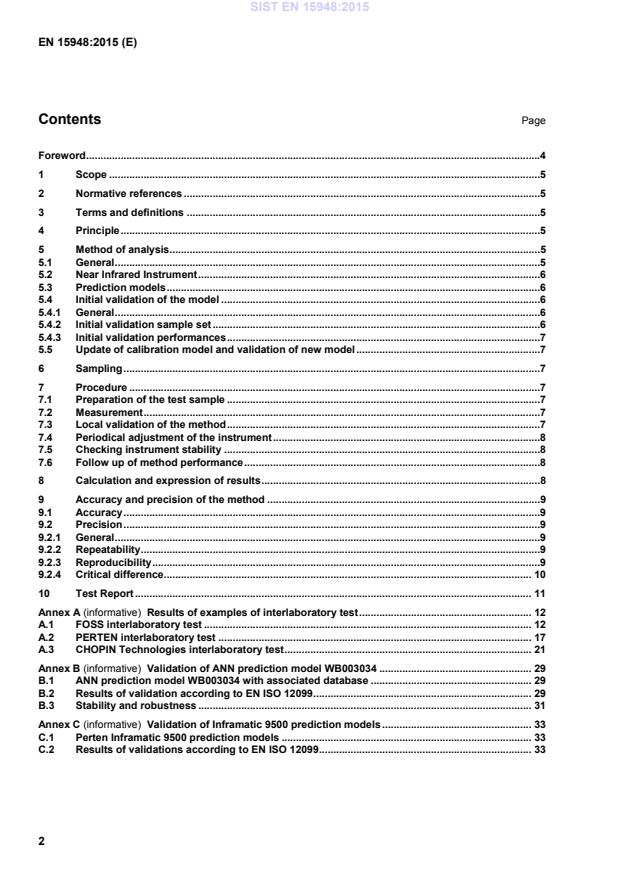
Results of examples of interlaboratory test . 12 A.1 FOSS interlaboratory test . 12 A.2 PERTEN interlaboratory test . 17 A.3 CHOPIN Technologies interlaboratory test . 21 Annex B (informative)
Validation of ANN prediction model WB003034 . 29 B.1 ANN prediction model WB003034 with associated database . 29 B.2 Results of validation according to EN ISO 12099 . 29 B.3 Stability and robustness . 31 Annex C (informative)
Validation of Inframatic 9500 prediction models . 33 C.1 Perten Inframatic 9500 prediction models . 33 C.2 Results of validations according to EN ISO 12099 . 33 SIST EN 15948:2015
Validation of Infraneo prediction models . 39 D.1 CHOPIN Technologies Infraneo prediction models . 39 D.2 Results of validation according to EN ISO 12099 . 39 Bibliography . 45
Moisture Wheat and barley Protein Wheat Protein Barley Overall accuracy expressed as SEP as constituent % w/w 0,24 % 0,27 % 0,27 % Constituent concentration in the independent validation data set Min 8 % 7 % d.m. 7 % d.m. Max 22 % 20 % d.m. 16 % d.m. NOTE The minimum performance given in Table 1 includes the variation of reference data as documented by the number of reference labs involved, regional and genetic variations, the number of countries and crop species involved and the robustness over the last five years (see also Annex B). 5.5 Update of calibration model and validation of new model The prediction model in accordance with this standard shall be updated by the one issuing the calibration model to ensure inclusion of new climatic crop conditions and new varieties introduced on the market. These updates shall be made by keeping the original database with addition of the new samples as needed. The new prediction model shall be updated according to EN ISO 12099. Validation shall be made according to the initial validation (5.4) and include at least 20 new samples. 6 Sampling Sampling is not part of the method specified in this European Standard. A recommended sampling procedure is given in EN ISO 24333 [5]. It is important that the sample analyzed in routine is truly representative for the batch and has not been damaged or modified. 7 Procedure 7.1 Preparation of the test sample No specific sample preparation is required. 7.2 Measurement Follow the instructions of the instrument manufacturer. 7.3 Local validation of the method Before use, the method shall be validated on an independent test set that is representative of the sample population to be analyzed. For the determination of bias, at least 10 samples are needed; for the determination of Standard Error of Prediction (SEP, see EN ISO 12099:2010, 6.5) at least 20 samples are SIST EN 15948:2015
are the numbers of test results corresponding to each of the averaged values; CDr (protein) = 0,30; CDr (moisture) = 0,11. 9.2.4.3 Comparison of two groups of measurements in two laboratories The critical difference (CD) between two averaged values obtained in two different laboratories from two test results under repeatability conditions is equal to: 22221211281280522RrRr,,,CDssssnn=−−−=− where rs is the standard deviation of repeatability; Rs is the standard deviation of reproducibility; 1n and 2n are the number of test results corresponding to each of the averaged values; CDR (protein) = 0,32; CDR (moisture) = 0,23. SIST EN 15948:2015
Results of examples of interlaboratory test A.1 FOSS interlaboratory test An interlaboratory test, organized by the company FOSS Analytical AB (Sweden) in 2008, involving 20 participants from 12 countries was carried out on 6 wheat and 4 barley samples from the 2007 harvest, containing protein and moisture in various concentrations. The participants were the master labs of European grain networks. The grain networks did also assist in the collection of the samples (Table A.1). The results obtained were subjected to statistical analysis in accordance with ISO 5725-1 and ISO 5725-2 to calculate the precision data shown in Table A.2 to Table A.5. Table A.1 — Samples for the interlaboratory study Sample Description Country of origin B1 Spring barley (2-row, malting barley) UK B2 Spring barley (2-row, feed barley) Denmark B3 Spring barley (2-row, malting barley) Denmark B4 Winter barley (6-row, malting barley) France W1 Spring wheat (hard) Germany W2 Spring wheat (hard) France W3 Winter wheat (hard) UK W4 Spring wheat (soft) Germany W5 Winter wheat (hard) Italy W6 Durum wheat Italy SIST EN 15948:2015
Key X
% protein (dm) Y
s% 1
Ì sr 2
◼◼ SR 3
Linear (sR) 4
Linear (sr) Figure A.1 — Standard deviations for the repeatability, sr, and reproducibility, sR, as a function of the protein content SIST EN 15948:2015
Key X
% moisture Y
s% 1
Ì sr 2
◼◼ SR 3
Linear (sR) 4
Linear (sr) Figure A.2 — Standard deviations for th
...