


prEN ISO 18090-1
(Main)Radiological protection - Characteristics of reference pulsed radiation - Part 1: Photon radiation (ISO/DIS 18090-1:2025)
Radiological protection - Characteristics of reference pulsed radiation - Part 1: Photon radiation (ISO/DIS 18090-1:2025)
ISO/TS 18090-1:2015 is directly applicable to pulsed X-radiation with pulse duration of 0,1 ms up to 10 s. This covers the whole range used in medical diagnostics at the time of publication. Some specifications may also be applicable for much shorter pulses; one example is the air kerma of one pulse. Such a pulse may be produced, e.g. by X-ray flash units or high-intensity femtosecond-lasers. Other specifications are not applicable for much shorter pulses; one example is the time-dependent behaviour of the air kerma rate. This may not be measurable for technical reasons as no suitable instrument is available, e.g. for pulses produced by a femtosecond-laser.
ISO/TS 18090-1:2015 specifies the characteristics of reference pulsed radiation for calibrating and testing radiation protection dosemeters and dose rate meters with respect to their response to pulsed radiation. The radiation characteristics includes the following:
a) time-dependent behaviour of the air kerma rate of the pulse;
b) time-dependent behaviour of the X-ray tube high voltage during the pulse;
c) uniformity of the air kerma rate within a cross-sectional area of the radiation beam;
d) air kerma of one radiation pulse;
e) air kerma rate of the radiation pulse;
f) repetition frequency.
ISO/TS 18090-1:2015 does not define new radiation qualities. Instead, it uses those radiation qualities specified in existing ISO and IEC standards. This part of ISO/TS 18090 gives the link between the parameters for pulsed radiation and the parameters for continuous radiation specifying the radiation qualities. It does not specify specific values or series of values for the pulsed radiation field but specifies only those limits for the relevant pulsed radiation parameters that are required for calibrating dosemeters and dose rate meters and for determining their response depending on the said parameters.
The pulse parameters with respect to the phantom-related quantities were determined using conversion coefficients according to ISO 4037 (all parts). This is possible as the radiation qualities specified in existing ISO and IEC standards are used.
A given reference pulsed X-ray facility is characterized by the parameter ranges over which the full specifications and requirements according to this part of ISO/TS 18090 are met. Therefore, not all reference pulsed X-ray facilities can produce pulses covering the same parameter ranges.
Strahlenschutz - Eigenschaften gepulster Referenzstrahlung - Teil 1: Photonenstrahlung (ISO/DIS 18090-1:2025)
Radioprotection - Caractéristiques des champs de rayonnement pulsés de référence - Partie 1: Radiation de photons (ISO/DIS 18090-1:2025)
L'ISO/TS 18090-1:2015 s'applique directement au rayonnement X pulsé ayant une durée d'impulsion comprise entre 0,1 ms et 10 s. Cela couvre toute la gamme utilisée en diagnostic médical au moment de la publication. Certaines spécifications peuvent également s'appliquer à des impulsions beaucoup plus courtes; un exemple est le kerma dans l'air d'une impulsion. Une telle impulsion peut être produite, par exemple, par des générateurs de rayons X « éclair » ou des lasers femtoseconde intenses. D'autres spécifications ne s'appliquent pas aux impulsions beaucoup plus courtes; un exemple est le comportement du débit kerma dans l'air en fonction du temps. Il se peut qu'il ne soit pas mesurable pour des raisons techniques, car aucun instrument approprié n'est disponible, par exemple pour des impulsions produites par un laser femtoseconde.
L'ISO/TS 18090-1:2015 spécifie les caractéristiques d'un rayonnement pulsé de référence pour l'étalonnage et les essais de dosimètres de radioprotection et de débitmètres de dose par rapport à leur réponse à un rayonnement pulsé. Les caractéristiques du rayonnement comprennent ce qui suit:
a) le comportement en fonction du temps du débit de kerma dans l'air de l'impulsion;
b) le comportement en fonction du temps de la haute tension du tube à rayons X pendant l'impulsion;
c) l'uniformité du débit de kerma dans l'air dans une section transversale du faisceau de rayonnement;
d) le kerma dans l'air d'une impulsion de rayonnement;
e) le débit de kerma dans l'air de l'impulsion de rayonnement;
f) la fréquence de répétition.
L'ISO/TS 18090-1:2015 ne définit pas de nouvelles qualités de rayonnement. Au lieu de cela, elle utilise les qualités de rayonnement spécifiées dans les normes ISO et IEC existantes. L'ISO/TS 18090-1:2015 indique la relation entre les paramètres relatifs à un rayonnement pulsé et les paramètres relatifs à un rayonnement continu spécifiant les qualités de rayonnement. Elle ne stipule pas de valeurs spécifiques ni de séries de valeurs pour le champ de rayonnement pulsé, mais spécifie uniquement les limites pour les paramètres pertinents de rayonnement pulsé qui sont requis pour l'étalonnage des dosimètres et des débitmètres de dose et pour la détermination de leur réponse en fonction desdits paramètres.
Radiološka zaščita - Značilnosti referenčnega impulznega sevanja - 1. del: Fotonsko sevanje (ISO/DIS 18090-1:2025)
General Information
- Status
- Not Published
- Publication Date
- 26-Jan-2027
- Current Stage
- 4060 - Closure of enquiry - Enquiry
- Start Date
- 24-Sep-2025
- Completion Date
- 24-Sep-2025
Relations
- Effective Date
- 04-Oct-2023
Overview
The prEN ISO 18090-1:2025 standard addresses radiological protection by defining the characteristics of reference pulsed photon radiation, primarily focusing on pulsed X-radiation with pulse durations ranging from 0.1 milliseconds up to 10 seconds. Applicable mainly to medical diagnostic radiation fields, the standard ensures accurate calibration and testing of radiation protection dosemeters and dose rate meters in pulsed radiation environments. It builds on existing ISO and IEC radiation quality standards without introducing new radiation qualities, offering a comprehensive framework to measure, specify, and evaluate pulsed photon radiation parameters.
Key Topics
Pulse Duration and Parameters
The standard covers pulses from 0.1 ms to 10 seconds, which encompass typical medical diagnostic applications. Some parameters, such as air kerma per pulse, also extend to shorter pulses produced by X-ray flash units and high-intensity femtosecond lasers.Radiation Characteristics for Calibration
Calibration parameters detailed in the standard include:- Time-dependent air kerma rate behavior during the pulse
- Time-dependent X-ray tube high voltage during pulse emission
- Uniformity of air kerma rate across the radiation beam's cross-sectional area
- Air kerma of a single radiation pulse
- Air kerma rate during the pulse
- Pulse repetition frequency
Reference Field Specifications
The document specifies limits for pulsed radiation parameters essential for calibrating dosemeters but does not prescribe exact values. It bridges pulsed radiation parameters with continuous radiation parameters used in existing standards, aligning with ISO 4037 conversion coefficients for phantom-related dosimetric quantities.Measurement and Testing Methods
It defines test methods and interpretation guidelines for each radiation characteristic to ensure reproducibility and uniformity across diverse reference pulsed X-ray facilities. This standard focuses primarily on single pulses, which pose greater measurement challenges compared to repeated or continuous radiation.
Applications
The prEN ISO 18090-1:2025 standard is critically important in:
Medical Diagnostics
Ensuring the accurate calibration of dosemeters used in diagnostic imaging technologies like pulsed X-ray systems, fluoroscopy, and computed tomography. This calibration helps maintain patient safety and dose accuracy within clinical environments.Radiation Protection Instrumentation
Standardizing the performance of radiation dosemeters and dose rate meters operating in pulsed radiation fields, providing manufacturers and testing labs with clear guidelines on instrument response criteria and performance validation.Advanced Research and Industrial Uses
The standard's applicability to shorter pulses produced by novel technologies such as femtosecond lasers and X-ray flash units positions it as a reference for emerging radiological applications requiring pulsed photon radiation calibration.Regulatory Compliance
Serving as a reference for national and international bodies to establish regulations and safety limits related to pulsed photon radiation measurement and protection, fostering harmonized standards across countries.
Related Standards
ISO 4037 Series
Provides conversion coefficients for phantom-related dosimetric quantities and fundamental radiation qualities used as a basis in pulsed radiation context.IEC/TS 62743 and IEC/TS 63050
Describe requirements for electronic radiation protection dosemeters' response in pulsed radiation fields, complementing this standard's reference radiation characteristics.Existing ISO and IEC Radiation Quality Standards
The prEN ISO 18090-1:2025 integrates these pre-existing radiation quality parameters within the pulsed radiation framework, facilitating consistent and interoperable calibration processes.
By implementing the prEN ISO 18090-1:2025 standard, stakeholders ensure precise calibration and testing of dosemeters exposed to pulsed photon radiation, thereby maintaining robust radiological protection in medical, research, and industrial environments. This standard supports safe and accurate radiation measurement crucial for patient safety, occupational protection, and compliance with international regulatory frameworks.

Get Certified
Connect with accredited certification bodies for this standard

NSF International
Global independent organization facilitating standards development and certification.

CIS Institut d.o.o.
Personal Protective Equipment (PPE) certification body. Notified Body NB-2890 for EU Regulation 2016/425 PPE.

Kiwa BDA Testing
Building and construction product certification.
Sponsored listings
Frequently Asked Questions
prEN ISO 18090-1 is a draft published by the European Committee for Standardization (CEN). Its full title is "Radiological protection - Characteristics of reference pulsed radiation - Part 1: Photon radiation (ISO/DIS 18090-1:2025)". This standard covers: ISO/TS 18090-1:2015 is directly applicable to pulsed X-radiation with pulse duration of 0,1 ms up to 10 s. This covers the whole range used in medical diagnostics at the time of publication. Some specifications may also be applicable for much shorter pulses; one example is the air kerma of one pulse. Such a pulse may be produced, e.g. by X-ray flash units or high-intensity femtosecond-lasers. Other specifications are not applicable for much shorter pulses; one example is the time-dependent behaviour of the air kerma rate. This may not be measurable for technical reasons as no suitable instrument is available, e.g. for pulses produced by a femtosecond-laser. ISO/TS 18090-1:2015 specifies the characteristics of reference pulsed radiation for calibrating and testing radiation protection dosemeters and dose rate meters with respect to their response to pulsed radiation. The radiation characteristics includes the following: a) time-dependent behaviour of the air kerma rate of the pulse; b) time-dependent behaviour of the X-ray tube high voltage during the pulse; c) uniformity of the air kerma rate within a cross-sectional area of the radiation beam; d) air kerma of one radiation pulse; e) air kerma rate of the radiation pulse; f) repetition frequency. ISO/TS 18090-1:2015 does not define new radiation qualities. Instead, it uses those radiation qualities specified in existing ISO and IEC standards. This part of ISO/TS 18090 gives the link between the parameters for pulsed radiation and the parameters for continuous radiation specifying the radiation qualities. It does not specify specific values or series of values for the pulsed radiation field but specifies only those limits for the relevant pulsed radiation parameters that are required for calibrating dosemeters and dose rate meters and for determining their response depending on the said parameters. The pulse parameters with respect to the phantom-related quantities were determined using conversion coefficients according to ISO 4037 (all parts). This is possible as the radiation qualities specified in existing ISO and IEC standards are used. A given reference pulsed X-ray facility is characterized by the parameter ranges over which the full specifications and requirements according to this part of ISO/TS 18090 are met. Therefore, not all reference pulsed X-ray facilities can produce pulses covering the same parameter ranges.
ISO/TS 18090-1:2015 is directly applicable to pulsed X-radiation with pulse duration of 0,1 ms up to 10 s. This covers the whole range used in medical diagnostics at the time of publication. Some specifications may also be applicable for much shorter pulses; one example is the air kerma of one pulse. Such a pulse may be produced, e.g. by X-ray flash units or high-intensity femtosecond-lasers. Other specifications are not applicable for much shorter pulses; one example is the time-dependent behaviour of the air kerma rate. This may not be measurable for technical reasons as no suitable instrument is available, e.g. for pulses produced by a femtosecond-laser. ISO/TS 18090-1:2015 specifies the characteristics of reference pulsed radiation for calibrating and testing radiation protection dosemeters and dose rate meters with respect to their response to pulsed radiation. The radiation characteristics includes the following: a) time-dependent behaviour of the air kerma rate of the pulse; b) time-dependent behaviour of the X-ray tube high voltage during the pulse; c) uniformity of the air kerma rate within a cross-sectional area of the radiation beam; d) air kerma of one radiation pulse; e) air kerma rate of the radiation pulse; f) repetition frequency. ISO/TS 18090-1:2015 does not define new radiation qualities. Instead, it uses those radiation qualities specified in existing ISO and IEC standards. This part of ISO/TS 18090 gives the link between the parameters for pulsed radiation and the parameters for continuous radiation specifying the radiation qualities. It does not specify specific values or series of values for the pulsed radiation field but specifies only those limits for the relevant pulsed radiation parameters that are required for calibrating dosemeters and dose rate meters and for determining their response depending on the said parameters. The pulse parameters with respect to the phantom-related quantities were determined using conversion coefficients according to ISO 4037 (all parts). This is possible as the radiation qualities specified in existing ISO and IEC standards are used. A given reference pulsed X-ray facility is characterized by the parameter ranges over which the full specifications and requirements according to this part of ISO/TS 18090 are met. Therefore, not all reference pulsed X-ray facilities can produce pulses covering the same parameter ranges.
prEN ISO 18090-1 is classified under the following ICS (International Classification for Standards) categories: 13.280 - Radiation protection. The ICS classification helps identify the subject area and facilitates finding related standards.
prEN ISO 18090-1 has the following relationships with other standards: It is inter standard links to CEN ISO/TS 18090-1:2019. Understanding these relationships helps ensure you are using the most current and applicable version of the standard.
prEN ISO 18090-1 is available in PDF format for immediate download after purchase. The document can be added to your cart and obtained through the secure checkout process. Digital delivery ensures instant access to the complete standard document.
Standards Content (Sample)
SLOVENSKI STANDARD
01-september-2025
Radiološka zaščita - Značilnosti referenčnega impulznega sevanja - 1. del:
Fotonsko sevanje (ISO/DIS 18090-1:2025)
Radiological protection - Characteristics of reference pulsed radiation - Part 1: Photon
radiation (ISO/DIS 18090-1:2025)
Radioprotection - Caractéristiques des champs de rayonnement pulsés de référence -
Partie 1: Radiation de photons (ISO/DIS 18090-1:2025)
Ta slovenski standard je istoveten z: prEN ISO 18090-1
ICS:
13.280 Varstvo pred sevanjem Radiation protection
2003-01.Slovenski inštitut za standardizacijo. Razmnoževanje celote ali delov tega standarda ni dovoljeno.
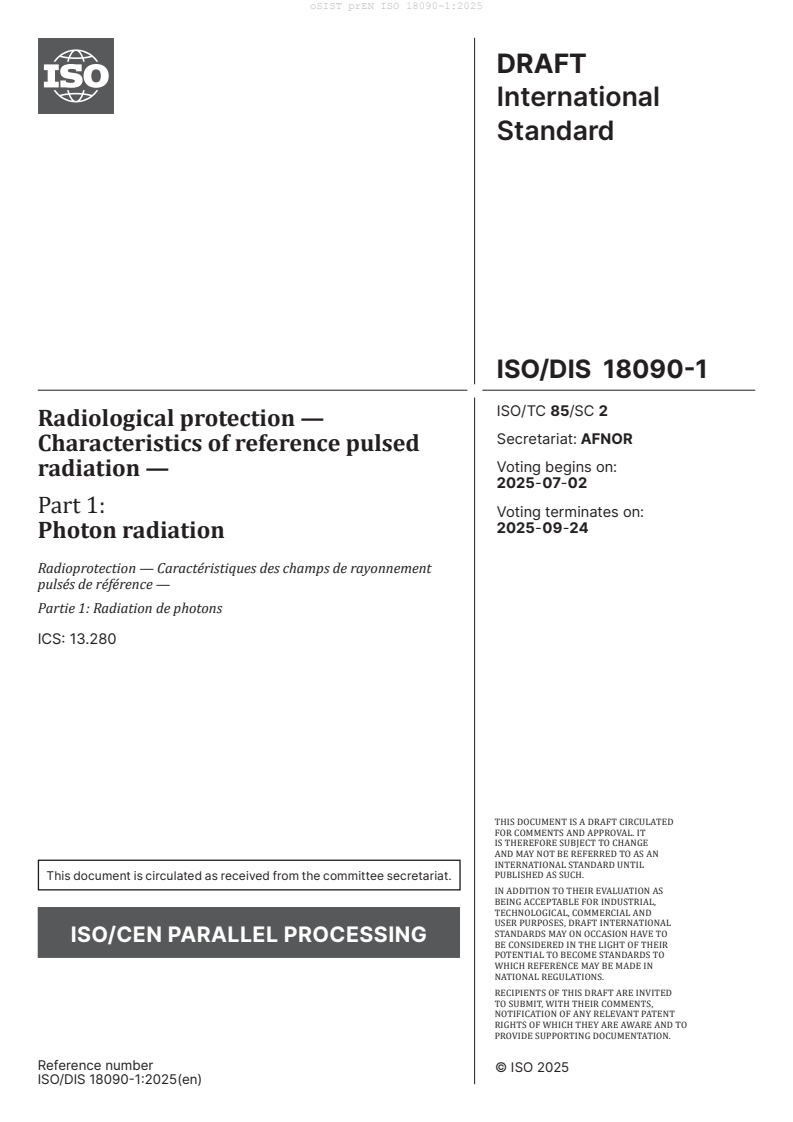
DRAFT
International
Standard
ISO/DIS 18090-1
ISO/TC 85/SC 2
Radiological protection —
Secretariat: AFNOR
Characteristics of reference pulsed
Voting begins on:
radiation —
2025-07-02
Part 1:
Voting terminates on:
2025-09-24
Photon radiation
Radioprotection — Caractéristiques des champs de rayonnement
pulsés de référence —
Partie 1: Radiation de photons
ICS: 13.280
THIS DOCUMENT IS A DRAFT CIRCULATED
FOR COMMENTS AND APPROVAL. IT
IS THEREFORE SUBJECT TO CHANGE
AND MAY NOT BE REFERRED TO AS AN
INTERNATIONAL STANDARD UNTIL
PUBLISHED AS SUCH.
This document is circulated as received from the committee secretariat.
IN ADDITION TO THEIR EVALUATION AS
BEING ACCEPTABLE FOR INDUSTRIAL,
TECHNOLOGICAL, COMMERCIAL AND
USER PURPOSES, DRAFT INTERNATIONAL
STANDARDS MAY ON OCCASION HAVE TO
ISO/CEN PARALLEL PROCESSING
BE CONSIDERED IN THE LIGHT OF THEIR
POTENTIAL TO BECOME STANDARDS TO
WHICH REFERENCE MAY BE MADE IN
NATIONAL REGULATIONS.
RECIPIENTS OF THIS DRAFT ARE INVITED
TO SUBMIT, WITH THEIR COMMENTS,
NOTIFICATION OF ANY RELEVANT PATENT
RIGHTS OF WHICH THEY ARE AWARE AND TO
PROVIDE SUPPORTING DOCUMENTATION.
Reference number
ISO/DIS 18090-1:2025(en)
DRAFT
ISO/DIS 18090-1:2025(en)
International
Standard
ISO/DIS 18090-1
ISO/TC 85/SC 2
Radiological protection —
Secretariat: AFNOR
Characteristics of reference pulsed
Voting begins on:
radiation —
Part 1:
Voting terminates on:
Photon radiation
Radioprotection — Caractéristiques des champs de rayonnement
pulsés de référence —
Partie 1: Radiation de photons
ICS: 13.280
THIS DOCUMENT IS A DRAFT CIRCULATED
FOR COMMENTS AND APPROVAL. IT
IS THEREFORE SUBJECT TO CHANGE
AND MAY NOT BE REFERRED TO AS AN
INTERNATIONAL STANDARD UNTIL
PUBLISHED AS SUCH.
This document is circulated as received from the committee secretariat.
IN ADDITION TO THEIR EVALUATION AS
BEING ACCEPTABLE FOR INDUSTRIAL,
© ISO 2025
TECHNOLOGICAL, COMMERCIAL AND
USER PURPOSES, DRAFT INTERNATIONAL
All rights reserved. Unless otherwise specified, or required in the context of its implementation, no part of this publication may
STANDARDS MAY ON OCCASION HAVE TO
ISO/CEN PARALLEL PROCESSING
be reproduced or utilized otherwise in any form or by any means, electronic or mechanical, including photocopying, or posting on
BE CONSIDERED IN THE LIGHT OF THEIR
the internet or an intranet, without prior written permission. Permission can be requested from either ISO at the address below
POTENTIAL TO BECOME STANDARDS TO
WHICH REFERENCE MAY BE MADE IN
or ISO’s member body in the country of the requester.
NATIONAL REGULATIONS.
ISO copyright office
RECIPIENTS OF THIS DRAFT ARE INVITED
CP 401 • Ch. de Blandonnet 8
TO SUBMIT, WITH THEIR COMMENTS,
CH-1214 Vernier, Geneva
NOTIFICATION OF ANY RELEVANT PATENT
Phone: +41 22 749 01 11
RIGHTS OF WHICH THEY ARE AWARE AND TO
PROVIDE SUPPORTING DOCUMENTATION.
Email: copyright@iso.org
Website: www.iso.org
Published in Switzerland Reference number
ISO/DIS 18090-1:2025(en)
ii
ISO/DIS 18090-1:2025(en)
Contents Page
Foreword .iv
Introduction .v
1 Scope . 1
2 Normative references . 2
3 Terms and definitions . 2
4 Characteristics of reference pulsed radiation . 5
4.1 General .5
4.2 Time-dependent air kerma rate characteristics of the radiation pulse .6
4.2.1 Requirements .6
4.2.2 Method of test .6
4.2.3 Interpretation of the results .7
4.3 Time-dependent high voltage characteristics of the radiation pulse .7
4.3.1 Requirement .7
4.3.2 Method of test .7
4.3.3 Interpretation of the results .7
4.4 Space dependent air kerma characteristics of the radiation pulse .7
4.4.1 Requirement on field uniformity across the beam area .7
4.4.2 Method of test .8
4.4.3 Interpretation of the results .8
4.5 Filtration .8
4.6 Equivalence of measured radiation pulse and trapezoidal pulse .8
4.6.1 Requirements .8
4.6.2 Method of test .8
4.6.3 Interpretation of the results .9
4.7 Constancy of air kerma rate during the pulse plateau time .9
4.7.1 Requirement .9
4.7.2 Method of test .9
4.7.3 Interpretation of results .9
5 Dosimetry of pulsed reference radiation .11
5.1 General requirements on the instrument .11
5.2 Air kerma rate dependence of the instrument response .11
5.2.1 General .11
5.2.2 Requirement .11
5.2.3 Method of test and interpretation of the results .11
5.3 Size of the sensitive volume of the instrument . 12
5.4 Air kerma of the radiation pulse . 12
5.5 Dose equivalent of the radiation pulse. 12
5.6 Radiation pulse air kerma rate . 12
5.7 Radiation pulse dose equivalent rate . 12
Annex A (informative) Diode-detector and associated amplifier .13
Annex B (informative) Determination of the equivalent trapezoid radiation pulse .15
Bibliography . 17
iii
ISO/DIS 18090-1:2025(en)
Foreword
ISO (the International Organization for Standardization) is a worldwide federation of national standards
bodies (ISO member bodies). The work of preparing International Standards is normally carried out through
ISO technical committees. Each member body interested in a subject for which a technical committee
has been established has the right to be represented on that committee. International organizations,
governmental and non-governmental, in liaison with ISO, also take part in the work. ISO collaborates closely
with the International Electrotechnical Commission (IEC) on all matters of electrotechnical standardization.
The procedures used to develop this document and those intended for its further maintenance are described
in the ISO/IEC Directives, Part 1. In particular, the different approval criteria needed for the different types
of ISO documents should be noted. This document was drafted in accordance with the editorial rules of the
ISO/IEC Directives, Part 2 (see www.iso.org/directives).
ISO draws attention to the possibility that the implementation of this document may involve the use of (a)
patent(s). ISO takes no position concerning the evidence, validity or applicability of any claimed patent
rights in respect thereof. As of the date of publication of this document, ISO [had/had not] received notice of
(a) patent(s) which may be required to implement this document. However, implementers are cautioned that
this may not represent the latest information, which may be obtained from the patent database available at
www.iso.org/patents. ISO shall not be held responsible for identifying any or all such patent rights.
Any trade name used in this document is information given for the convenience of users and does not
constitute an endorsement.
For an explanation of the voluntary nature of standards, the meaning of ISO specific terms and expressions
related to conformity assessment, as well as information about ISO's adherence to the World Trade
Organization (WTO) principles in the Technical Barriers to Trade (TBT), see www.iso.org/iso/foreword.html.
This document was prepared by Technical Committee ISO/TC 85, Nuclear energy, nuclear technologies, and
radiological protection, Subcommittee SC 2, Radioprotection.
This first edition cancels and replaces the first edition of ISO/TS 18090-1:2015, which has been technically
revised.
The main changes are as follows:
— 1 : clarification of the scope, which covers only the single pulse
— 4.4.2 : introduction of examples of other suitable instruments
A list of all parts in the ISO 18090 series can be found on the ISO website.
Any feedback or questions on this document should be directed to the user’s national standards body. A
complete listing of these bodies can be found at www.iso.org/members.html.
iv
ISO/DIS 18090-1:2025(en)
Introduction
The specification and determination of the special characteristics required for electronic radiation
protection dosemeters to be used in pulsed fields of ionizing radiation have been laid down in international
standards, for example IEC/TS 62743 and IEC/TS 63050. A prerequisite for IEC/TS 63050 is the availability
of the required reference fields for pulsed radiation. This document provides the necessary information for
such reference fields.
The concept is based on the existing standards for radiation qualities defined in ISO and IEC standards. It
only adds the parameters of the pulsed field and gives some guidance for their determination. Therefore,
no new radiation qualities are defined, only the link between the parameters for pulsed radiation and the
parameters for continuous radiation are given. The main required parameters for pulsed radiation fields are
[1]
the following :
— radiation pulse duration, t ;
pulse
— radiation pulse air kerma rate, K̇ ;
a,pulse
— air kerma per radiation pulse, K ;
a,pulse
— for repeated pulses, their repetition frequency, f .
pulse
The pulse parameters were determined by using an equivalent trapezoidal radiation pulse, which is
equivalent with respect to air kerma and air kerma rate. Reference pulsed radiation is characterized by
specified maximum deviations of the given pulse from the equivalent trapezoidal radiation pulse and by
requirements concerning the change of radiation quality during the given radiation pulse.
The pulse parameters with respect to the phantom related quantities were determined using conversion
coefficients according to ISO 4037 (all parts).
v
DRAFT International Standard ISO/DIS 18090-1:2025(en)
Radiological protection — Characteristics of reference pulsed
radiation —
Part 1:
Photon radiation
1 Scope
This document is directly applicable to pulsed X-radiation with pulse duration of 0,1 ms up to 10 s. This
range covers the whole range used in medical diagnostics at the time of publication. Some specifications
may also be applicable for much shorter pulses; one example is the air kerma of one pulse. Such a pulse
may be produced, e.g. by X-ray flash units or high-intensity femtosecond-lasers. Other specifications are not
applicable for much shorter pulses; one example is the time-dependent behaviour of the air kerma rate. This
may not be measurable for technical reasons as no suitable instrument is available, e.g. for pulses produced
by a femtosecond-laser.
This document specifies the characteristics of reference pulsed radiation for calibrating and testing
radiation protection dosemeters and dose rate meters with respect to their response to pulsed radiation. At
this point, it is only concerned with the characteristics of single pulses. Single pulses are the most difficult
for dosemeters to measure. Determining the dose for repeated pulses is easier, but still more difficult than
for continuous radiation, i.e. the performance of the dosemeters when measuring repeated pulses lies
between these extremes. The radiation characteristics includes the following:
a) time-dependent behaviour of the air kerma rate of the pulse;
b) time-dependent behaviour of the X-ray tube high voltage during the pulse;
c) uniformity of the air kerma rate within a cross-sectional area of the radiation beam;
d) air kerma of one radiation pulse;
e) air kerma rate of the radiation pulse;
f) repetition frequency.
This document does not define new radiation qualities, but uses those radiation qualities specified in existing
ISO and IEC standards. Instead, this document gives the link between the parameters for pulsed radiation
and the parameters for continuous radiation specifying the radiation qualities. It does not specify specific
values or series of values for the pulsed radiation field but specifies only those limits for the relevant pulsed
radiation parameters that are required for calibrating dosemeters and dose rate meters and for determining
their response depending on the said parameters.
The pulse parameters with respect to the phantom-related quantities were determined using conversion
coefficients according to ISO 4037 (all parts). This is possible as the radiation qualities specified in existing
ISO and IEC standards are used.
A given reference pulsed X-ray facility is characterized by the parameter ranges over which the full
specifications and requirements according to this document are met. Therefore, not all reference pulsed
X-ray facilities can produce pulses covering the same parameter ranges.
ISO/DIS 18090-1:2025(en)
2 Normative references
The following documents are referred to in the text in such a way that some or all of their content constitutes
requirements of this document. For dated references, only the edition cited applies. For undated references,
the latest edition of the referenced document (including any amendments) applies.
ISO 4037-1, Radiological protection — X and gamma reference radiation for calibrating dosemeters and doserate
meters and for determining their response as a function of photon energy — Part 1: Radiation characteristics
and production methods
ISO 4037-2:2019, Radiological protection — X and gamma reference radiation for calibrating dosemeters and
doserate meters and for determining their response as a function of photon energy — Part 2: Dosimetry for
radiation protection over the energy ranges from 8 keV to 1,3 MeV and 4 MeV to 9 MeV
ISO 4037-3, Radiological protection — X and gamma reference radiation for calibrating dosemeters and
doserate meters and for determining their response as a function of photon energy — Part 3: Calibration of area
and personal dosemeters and the measurement of their response as a function of energy and angle of incidence
IEC 61267, Medical diagnostic X-ray equipment — Radiation conditions for use in the determination of
characteristics
3 Terms and definitions
For the purposes of this document, the terms and definitions given in [external document reference xxx] and
the following apply.
ISO and IEC maintain terminology databases for use in standardization at the following addresses:
— ISO Online browsing platform: available at https:// www .iso .org/ obp
— IEC Electropedia: available at https:// www .electropedia .org/
3.1
air kerma per radiation pulse
K
a, pulse
air kerma value of one radiation pulse at a point in the photon radiation field
3.2
continuous radiation
ionizing radiation with a constant dose rate at a given point in space for
time intervals longer than 10 s
3.3
dose equivalent per radiation pulse
H
pulse
dose equivalent value of one radiation pulse at a point in the photon radiation field
3.4
equivalent trapezoidal radiation pulse
trapezoidal radiation pulse that is considered to be equivalent to the given radiation pulse
3.5
field uniformity
F
uni
uniformity of the air kerma distribution determined across a defined area
KK−
ap,,ulse maxa,,pulsemin
F =−1
uni
05, ×+KK
()
ap,,ulse maxa,,pulse mmin
where
ISO/DIS 18090-1:2025(en)
K is the maximum air kerma value attributed to one radiation pulse occurring across the
a, pulse, max
defined area;
K is the minimum air kerma value attributed to one radiation pulse occurring across the
a, pulse, min
defined area.
Note 1 to entry: The defined area can be the whole beam diameter or only parts of it, e.g. those covered by the
dosemeter under test.
Note 2 to entry: Full field uniformity is equivalent to F = 1. No field uniformity, that is a variation of K between 0
uni a, pulse
and K , is equivalent to F = 0.
a, pulse, max uni
3.6
pulse peak mean voltage
U
pulse, peak, mean
mean value of the sequence of X-ray tube voltages, U , measured during the radiation pulse peak time
i
n
peak
U = U
pulse,peak,mean i
∑
n
peak
i=1
where
U is the i-th measured value;
i
n is the number of measurements of the X-ray tube voltage.
peak
3.7
pulse repetition frequency
f
pulse
number of pulses in a periodic pulse train divided by the duration of the train
Note 1 to entry: This version of this part of ISO 18090 deals only with single pulses, but it might be extended in the
future to repeated pulses, therefore, this definition is already given here.
[SOURCE: IEV 702-03-07, modified]
3.8
pulse train
discrete sequence of a finite number of pulses
Note 1 to entry: The sequence can be periodic or non-periodic.
[SOURCE: IEV 702-03-11, modified]
3.9
pulsed radiation
ionizing radiation which never has a co
...
Questions, Comments and Discussion
Ask us and Technical Secretary will try to provide an answer. You can facilitate discussion about the standard in here.
Loading comments...