

FprEN 15330-6
(Main)Surfaces for sports areas - Synthetic turf sports surfaces - Part 6: Specification for synthetic turf carpets
- Abstract
This document specifies minimum durability, environmental, toxicological and performance requirements for tufted, woven and knitted synthetic turf carpets used in synthetic turf sports surfacing systems.
NOTE 1 Minimum requirements for the sports performance properties of synthetic turf sports surface systems are specified in EN 15330 1.
NOTE 2 Minimum requirements for the quality and performance of shockpads used within a synthetic turf sports surface systems are specified in EN 15330 4
NOTE 3 Minimum requirements for the quality and performance of infill materials used within a synthetic turf sports surface systems are specified in EN 15330 5.
This document can also be applied to synthetic turfs used for recreational and landscaping purposes.
- Status
- Not Published
- Publication Date
- 06-Jan-2027
- Technical Committee
- CEN/TC 217 - Surfaces for sports areas
- Drafting Committee
- CEN/TC 217/WG 6 - Synthetic surfaces primarily used outdoor
- Current Stage
- 4060 - Closure of enquiry - Enquiry
- Start Date
- 23-Oct-2025
- Due Date
- 17-Dec-2025
- Completion Date
- 17-Dec-2025

FprEN 15330-6 is a CEN draft European Standard for synthetic turf carpets used in sports surfacing systems. It specifies minimum durability, environmental, toxicological and performance requirements for tufted, woven and knitted synthetic turf carpets, and it can also be applied to recreational and landscaping use. The document also sets out the testing, product information and reporting needed to show conformity.
What does FprEN 15330-6 specify?
FprEN 15330-6 specifies the carpet itself, not the whole sports surface system. The scope points readers to EN 15330-1 for sports performance of the full system, EN 15330-4 for shockpads, and EN 15330-5 for infill materials, because the final playing surface depends on all three elements.
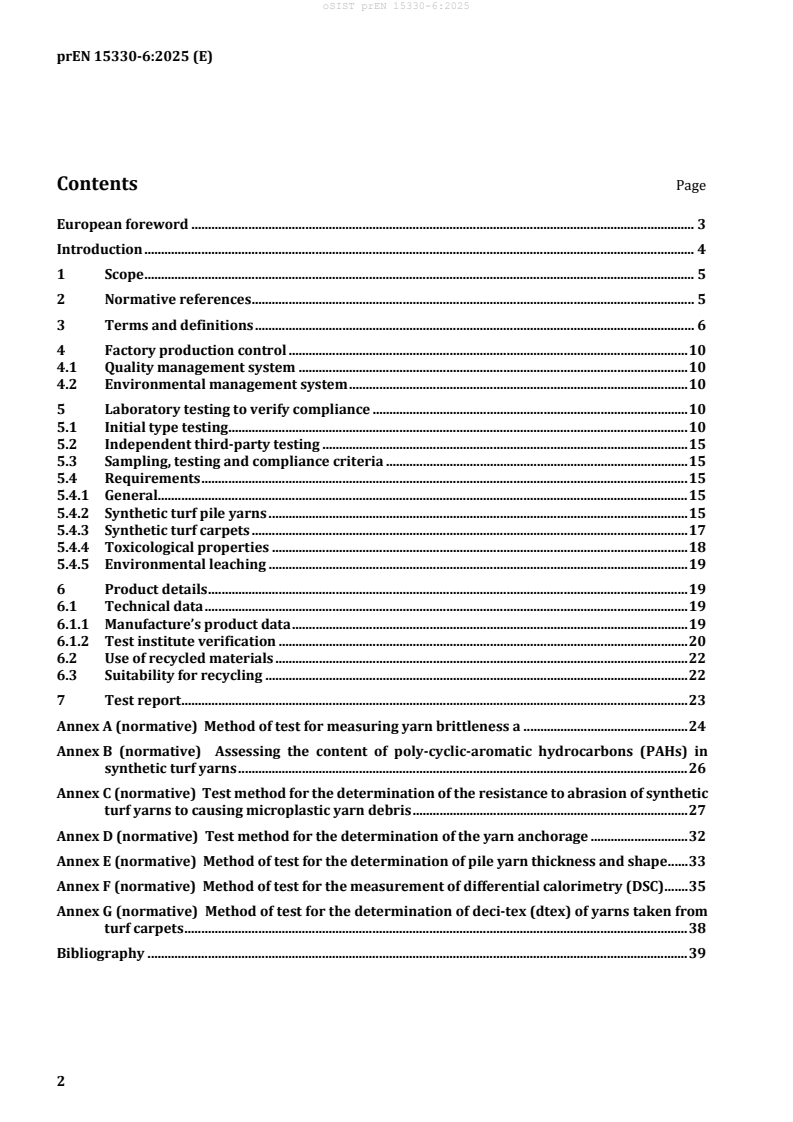
The document is arranged in seven clauses and seven normative annexes. Clause 4 covers factory production control, Clause 5 covers laboratory testing to verify compliance, Clause 6 covers product details, and Clause 7 covers the test report.
| Annex | What it covers |
|---|---|
| Annex A | Yarn brittleness after artificial weathering |
| Annex B | Polycyclic-aromatic hydrocarbons (PAHs) in synthetic turf yarns |
| Annex C | Abrasion test for microplastic yarn debris |
| Annex D | Yarn anchorage |
| Annex E | Pile yarn thickness and shape |
| Annex F | Differential scanning calorimetry (DSC) for polymer characterization |
| Annex G | Deci-tex (dtex) of yarns taken from turf carpets |
What are the key requirements of FprEN 15330-6?
FprEN 15330-6 asks manufacturers to control production, prove material performance, and document what is in the carpet. In practice, that means the carpet, its yarns and its backing must pass the specified laboratory checks, and the manufacturer must keep the evidence in the test report.
Factory production control, Clause 4. FprEN 15330-6 requires manufacture under an industry-accepted quality management system and an industry-accepted environmental management system, with proof included in the product test report. For a buyer or auditor, this links the physical product to a controlled factory process, not just a one-off test sample.
Initial type testing and family grouping, Clause 5.1. FprEN 15330-6 requires initial type testing before a new product type or production method is introduced, and it allows results to be carried across within defined families. This matters because products with different stitch rates or tufting gauges are treated as different, so changes in construction can trigger repeat testing.
Independent testing, Clause 5.2. FprEN 15330-6 requires third-party tests to be performed by a laboratory certified to EN ISO/IEC 17025 for the specified methods. That gives purchasers a clear benchmark for laboratory competence when they ask for independent confirmation.
Sampling and records, Clause 5.3. FprEN 15330-6 requires representative samples from normal long-term production, and the manufacturer must keep type-test results for at least 10 years after production. In practice, this supports traceability when a product is reviewed later for procurement, warranty or investigation.
Yarn durability and ageing, Clause 5.4.2. FprEN 15330-6 sets requirements for pile yarn tensile strength, resistance to ultraviolet ageing, change in yarn brittleness, and colour fastness. These checks matter because the yarn is the part most exposed to wear, sunlight and weather, so it has to retain strength and appearance over time.
Resistance to microplastic yarn debris, Clause 5.4.2.3 and Annex C. FprEN 15330-6 requires an abrasion test that measures fibre loss below 15 mm in length on defined standard carpet specimens. That is aimed at showing whether the yarn is likely to shed fine debris during wear.
Carpet construction and integrity, Clause 5.4.3. FprEN 15330-6 covers tuft bundle anchorage, individual pile yarn anchorage, carpet tensile strength, dimensional stability, and joint strength for stitched and bonded joints. For installers and specifiers, this is the part that tells them whether the carpet will stay together, resist movement and survive jointing.
Toxicological and environmental limits, Clauses 5.4.4 and 5.4.5. FprEN 15330-6 limits PAHs in pile yarns, limits migration of heavy metal elements from the carpet, and sets environmental leaching limits. That is relevant where owners need to check health-related material concerns and environmental release from the product.
Product declarations, Clause 6. FprEN 15330-6 requires a technical data sheet with declared values, declaration of post-industrial and post-consumer material content, and declaration of the percentage suitable for recycling. The recyclability declaration is classified as closed loop recycling, open-loop recycling or downcycling technology, so recyclability claims are stated in a common format.
Test report content, Clause 7. FprEN 15330-6 requires the report to identify the standard, the carpet, the manufacturer, the yarns, the test results, the jointing method used, the declared recycled content and recyclability ratings, and the management system proofs. This makes the report usable as a single conformity record.
What terms does FprEN 15330-6 define?
FprEN 15330-6 defines the main carpet forms and components so users can specify the right product.
- synthetic turf surface - a tufted, knitted or woven carpet with three or four principal components.
- pile - the visible turf surface made up of yarn tufts.
- short pile synthetic turf carpet - a carpet with an un-stretched pile height below 25 mm.
- medium pile synthetic turf carpet - a carpet with an un-stretched pile height from 25 mm to 40 mm.
- long pile synthetic turf carpet - a carpet with an un-stretched pile height above 40 mm.
- infill - loose particulate material placed in the pile to support it and, in some surfaces, help sports performance.
- primary backing - the woven or non-woven layer, or polyester multifilament layer for knitting, that gives initial pile retention and dimensional stability.
- tuft bundle - the cluster of yarns drawn through the backing to form the pile.
- polycyclic-aromatic hydrocarbons (PAHs) - a group of compounds controlled here in the pile yarn for toxicological reasons.
Who uses FprEN 15330-6?
FprEN 15330-6 is used by sports surface designers, turf manufacturers, testing laboratories, quality managers, specifiers and buyers. It is also relevant to installers and facility operators who need to understand what carpet properties, declarations and test evidence should accompany a synthetic turf product.
In practice, designers use it to choose a carpet that fits the intended system, while manufacturers use it for type testing, factory control and product declarations. Buyers and quality teams use it to compare products, check conformity documents and understand whether the product has been assessed for durability, safety and recyclability.
Which standards are used with FprEN 15330-6?
FprEN 15330-6 is used together with the companion parts of EN 15330 for the wider turf system, and with a set of test and management standards for verification.
| Standard | What it contributes |
|---|---|
| EN 15330-1 | Sports performance properties of the full synthetic turf system |
| EN 15330-4 | Quality and performance of shockpads |
| EN 15330-5 | Quality and performance of infill materials |
| EN 71-3:2019+A2:2024 | Heavy metal migration testing |
| EN 12228 | Joint strength of synthetic surfaces |
| EN 13744 | Hot-water ageing before retesting |
| EN 13746 | Dimensional change under water, frost and heat |
| EN 13864 | Tensile strength of synthetic yarns |
| EN 14836 | Artificial weathering for UV ageing |
| EN ISO/IEC 17025 | Laboratory competence for third-party testing |
| EN ISO 13934-1 | Carpet tensile testing by strip method |
| EN ISO 14021 | Recycled content and recyclability declarations |
| EN 20105-A02 | Colour fastness grading |
| EN ISO 11357-3 | DSC polymer characterization |
| ISO 1763 | Tufts and loops per unit length/area |
| ISO 2549 | Pile height measurement |
| ISO 188 | Oven-based ageing and apparatus references in Annex C and G |
| ISO 1957 | Selection and cutting of specimens |
| ISO 2060 | Yarn linear density |
| ISO 8543 | Carpet mass measurements |
| ISO 12951:2020 | Base machine for the abrasion method in Annex C |
| ISO 29463-1 | HEPA filter classification for Annex C |
| ISO 4919 | Yarn anchorage extraction method used in Clause 5.4.3.1 and Annex D |
| CEN/TS 16384:2012 | Environmental leaching test used in Clause 5.4.5 |
What does the FprEN 15330-6 document contain?
FprEN 15330-6 contains property tables, tolerances, limit values and reporting rules that are used to verify a carpet against the standard. It also contains figures that explain carpet structure, pile height classes, free pile and yarn cross-section measurement.
Annex A gives a worked test method and formula for yarn brittleness after artificial weathering. Annex C sets out a modified Lisson Tretrad abrasion procedure, including debris capture and a 20,000-cycle sequence, so the result can be used to judge microplastic yarn debris generation.
Annex E provides microscopic measurement of yarn thickness and shape, Annex F gives a DSC temperature programme for polymer identification, and Annex G gives the method for calculating dtex from tufts taken from a carpet. The document also includes reporting requirements for tests, declarations of recycled content and recyclability, and the details needed for a complete compliance file.
Relations
- Effective Date
- 28-Jan-2026
Frequently Asked Questions
FprEN 15330-6 is a draft published by the European Committee for Standardization (CEN). Its full title is "Surfaces for sports areas - Synthetic turf sports surfaces - Part 6: Specification for synthetic turf carpets". This standard covers: This document specifies minimum durability, environmental, toxicological and performance requirements for tufted, woven and knitted synthetic turf carpets used in synthetic turf sports surfacing systems. NOTE 1 Minimum requirements for the sports performance properties of synthetic turf sports surface systems are specified in EN 15330 1. NOTE 2 Minimum requirements for the quality and performance of shockpads used within a synthetic turf sports surface systems are specified in EN 15330 4 NOTE 3 Minimum requirements for the quality and performance of infill materials used within a synthetic turf sports surface systems are specified in EN 15330 5. This document can also be applied to synthetic turfs used for recreational and landscaping purposes.
This document specifies minimum durability, environmental, toxicological and performance requirements for tufted, woven and knitted synthetic turf carpets used in synthetic turf sports surfacing systems. NOTE 1 Minimum requirements for the sports performance properties of synthetic turf sports surface systems are specified in EN 15330 1. NOTE 2 Minimum requirements for the quality and performance of shockpads used within a synthetic turf sports surface systems are specified in EN 15330 4 NOTE 3 Minimum requirements for the quality and performance of infill materials used within a synthetic turf sports surface systems are specified in EN 15330 5. This document can also be applied to synthetic turfs used for recreational and landscaping purposes.
FprEN 15330-6 is classified under the following ICS (International Classification for Standards) categories: 97.220.10 - Sports facilities. The ICS classification helps identify the subject area and facilitates finding related standards.
FprEN 15330-6 has the following relationships with other standards: It is inter standard links to EN 10338:2025. Understanding these relationships helps ensure you are using the most current and applicable version of the standard.
FprEN 15330-6 is available in PDF format for immediate download after purchase. The document can be added to your cart and obtained through the secure checkout process. Digital delivery ensures instant access to the complete standard document.
Standards Content (Sample)
Contents
- Introduction
- 1 Scope
- 2 Normative references
- 3 Terms and definitions
- 3.1 synthetic turf surface
- 1 Primary pile yarns (as known as the face
- 2 Optional, secondary pile yarns (as known
- 3 Primary backing
- 4 Secondary backing
- 3.2 pile
- 3.3 short pile synthetic turf carpet
- 3.4 medium pile synthetic turf carpet
- 3.5 long pile synthetic turf carpet
- 3.6 infill
- 3.7 free pile
- 3.8 non-filled synthetic turf carpet
- 3.9 semi-filled synthetic turf carpet
- 3.10 filled synthetic turf carpet
- 3.11 mono-filament yarn
- 3.12 mono-tape yarn
- 3.13 fibrillated yarn
- 3.14 primary backing
- 3.15 secondary backing
- 3.16 tuft bundle
- 3.17 thatch zone
- 4 Factory production control
- 4.1 Quality management system
- 4.2 Environmental management system
- 5 Laboratory testing to verify compliance
- 5.1 Initial type testing
- 5.2 Independent third-party testing
- 5.3 Sampling, testing and compliance criteria
- 5.4 Requirements
- Annex C
- 6 Product details
- 6.1 Technical data
- Annex F 4
- 6.2 Use of recycled materials
- 6.3 Suitability for recycling
- 7 Test report
- Annex A
- Annex B
- Annex C
- 1 Support 8 Dust suction
- 2 Gear cog bar 9 Frame
- 3 Bed plate 10 Drive
- 4 Specimen 11 Tension weight
- 5 Foot 12 Filter
- 6 Tretrad wheel 13 Material loss
- 7 Movement of the Tretrad wheel 14 Suction system
- Annex D
- Annex E
- Annex F
- Annex G
- Bibliography
Introduction
Synthetic turf surfaces provide an attractive, hard-wearing, sports surfacing solution for many situations where natural grass alternatives are not cost-effective, feasible or sustainable. The sports performance characteristics of a synthetic turf sports surface are provided by the combined properties of the synthetic turf carpet, any infill within the pile of the carpet, and any shockpad laid beneath the carpet. The selection of the correct permutations of each is complex and the responsibility of the sports surface designer. Minimum requirements for the sports performance and player welfare properties of a synthetic turf sports surfaces are given in EN 15330-1, and attention is drawn to sporting regulations published by some international sports governing bodies. Selection of the appropriate standard is the responsibility of the sports facility designer. As with any man-made product, a synthetic turf sports surface needs to be manufactured, used, and finally disposed of in a way that minimizes its impact on the environment. They should not contain chemicals that may be harmful to the health of people using them or be harmful to the environment. They should also be sufficiently robust to withstand the detrimental effects of the climate and use, so that they do not create secondary microplastic pollution through premature wear and tear. This standard has been prepared to assist consumers select products that meet these objectives. Selecting a synthetic turf that complies with this standard is, however, only part of fulling understanding its impact on the environment through its service life. Consideration also needs to be made to how it is manufactured, what materials are used, what resources are required to maintain the surface, and finally, how it can be disposed of at end-of-life. To fully assess these important properties, you need reliable and correct data. To create greater environmental awareness the European Commission has developed the Product Environmental Footprint (PEF) method of analysis. PEFs look at a product’s whole lifecycle and cover 16 environmental impacts, including climate change, and impacts related to water, air, resources, land use and toxicity, and give a comparison of environmental performances between comparable products in a specific commercial sector. PEFs enable companies to measure and communicate their environmental performance and thereby compete on the market based on reliable environmental information.
The European Commission has published protocols describing how industry sectors should develop a standardized approach to developing PEFs for its products; these are called category rules. The European Synthetic Turf Council (http://www.estc.info/) has developed a set of category rules for synthetic turf surfaces. The European Commission recommends that when a PEFCR exists for an industry sector, it should be used for calculating the environmental footprint of a product belonging to that product category0F .
Ensuring consumers purchase sustainable synthetic turf surfaces is only part of the process required to ensure the surfaces do not detrimentally impact the environment. Those operating and using the surfaces also have a key role to play. The facilities the surfaces are laid on should be designed to minimize the risk of microplastic pollution. Any facility having a surface with a polymeric infill should incorporate the risk management measures described in CEN/TR 17519, and it is recommended the containment barriers be fitted on all facilities to also help contain any fibre debris. The surfaces should always be suitably maintained, with the maintenance equipment and procedures being tailored to ensure the required sports performance and player welfare properties are retained, but also to ensure and debris occurring from wear and tear is regularly collected before it can escape into the surrounding neighbourhood. Guidance on suitable equipment to achieve this should be obtained from the surface manufacturer. Finally at the surface’s end of life, it should be processed by recycling to allow the component materials to be used within the circular economy. Independent guidance on companies offering recycling facilities may be obtained from the industry trade association, the European Synthetic Turf Council.
oSIST prEN 15330-6:2025 prEN 15330-6:2025 (E)
1 Scope
This document specifies minimum durability, environmental, toxicological and performance requirements for tufted, woven and knitted synthetic turf carpets used in synthetic turf sports surfacing systems.
NOTE 1 Minimum requirements for the sports performance properties of synthetic turf sports surface systems are specified in EN 15330-1.
NOTE 2 Minimum requirements for the quality and performance of shockpads used within a synthetic turf sports surface systems are specified in EN 15330-4 NOTE 3 Minimum requirements for the quality and performance of infill materials used within a synthetic turf sports surface systems are specified in EN 15330-5.
This document can also be applied to synthetic turfs used for recreational and landscaping purposes.
2 Normative references
The following documents are referred to in the text in such a way that some or all of their content constitutes requirements of this document. For dated references, only the edition cited applies. For undated references, the latest edition of the referenced document (including any amendments) applies. EN 71-3:2019+A2:2024, Safety of toys — Part 3: Migration of certain elements EN 12228, Surfaces for sports areas - Determination of joint strength of synthetic surfaces EN 13744, Surfaces for sports areas - Procedure for accelerated ageing by immersion in hot water EN 13746, Surfaces for sports areas - Determination of dimensional changes due to the effect of varied water, frost and heat conditions EN 13864, Surfaces for sports areas - Determination of tensile strength of synthetic yarns EN 14836, Surfaces for sports areas - Synthetic surfaces for outdoor sports areas - Test method for artificial weathering EN ISO/IEC 17025, General requirements for the competence of testing and calibration laboratories (ISO/IEC 17025) EN ISO 13934-1, Textiles - Tensile properties of fabrics - Part 1: Determination of maximum force and elongation at maximum force using the strip method (ISO 13934-1) EN ISO 14021, Environmental labels and declarations - Self-declared environmental claims (Type II environmental labelling) (ISO 14021) EN 20105-A02, Textiles — Tests for colour fastness — Part A02: Grey scale for assessing change in colour (ISO 105-A02) EN ISO 11357-3, Plastics - Differential scanning calorimetry (DSC) - Part 3: Determination of temperature and enthalpy of melting and crystallization (ISO 11357-3) ISO 1763, Textile floor coverings — Determination of number of tufts and/or loops per unit length and per unit area
oSIST prEN 15330-6:2025 prEN 15330-6:2025 (E) ISO 2549, Textile floor coverings — Hand-knotted carpets — Determination of tuft leg length above the woven ground ISO 188, Rubber, vulcanized or thermoplastic — Accelerated ageing and heat resistance tests ISO 1957, Machine-made textile floor coverings — Selection and cutting of specimens for physical tests ISO 2060, Textiles — Yarn from packages — Determination of linear density (mass per unit length) by the skein method ISO 8543, Textile floor coverings — Methods for determination of mass ISO 12951:2020, Textile floor coverings — Determination of mass loss, fibre bind and stair nosing appearance change using the Lisson Tretrad machine ISO 29463-1, High efficiency filters and filter media for removing particles in air — Part 1: Classification, performance, testing and marking
3 Terms and definitions
For the purposes of this document, the following terms and definitions apply. ISO and IEC maintain terminology databases for use in standardization at the following addresses:
- IEC Electropedia: available at https://www.electropedia.org/
- ISO Online browsing platform: available at https://www.iso.org/obp
3.1 synthetic turf surface
carpet of tufted, knitted, or woven construction comprising three or four principal components Note 1 to entry: The three or four principal components are as shown in Figure 1
1 Primary pile yarns (as known as the face
yarns)
2 Optional, secondary pile yarns (as known
as the thatch or root zone yarns)
3 Primary backing
4 Secondary backing
Figure 1 — Principal component of a synthetic turf
oSIST prEN 15330-6:2025 prEN 15330-6:2025 (E)
3.2 pile
visible surface of the turf, consisting of yarn tufts Note 1 to entry: The pile may be formed from a single yarn type or be a combination of different yarn types. The pile yarns may be straight or curly and comprise single or multi-filaments.
3.3 short pile synthetic turf carpet
synthetic turf carpet having an un-stretched pile height above the primary backing of less than 25 mm Note 1 to entry: See Figure 2.
Figure 2 — Short pile synthetic turf carpet
3.4 medium pile synthetic turf carpet
synthetic turf carpet having an un-stretched pile height above the primary backing of between 25 mm and 40 mm Note 1 to entry: See Figure 3.
Figure 3 — Medium pile synthetic turf carpet
3.5 long pile synthetic turf carpet
synthetic turf carpet having an un-stretched pile height above the primary backing of more than 40mm Note 1 to entry: See Figure 4.
Figure 4 — Long pile synthetic turf carpet
oSIST prEN 15330-6:2025 prEN 15330-6:2025 (E)
3.6 infill
unbound particulate material that is incorporated into the pile of the turf to provide support to the pile and, in some turf surfaces, to contribute to the sports performance properties of the surface Note 1 to entry: A range of different materials may be used including polymeric granules, vegetal granules and mineral granules.
3.7 free pile
portion of turf’s pile that protrudes above any infill layer Note 1 to entry: See Figure 5.
Figure 5 — Free pile
3.8 non-filled synthetic turf carpet
synthetic turf surface that does not contain any form of infill Note 1 to entry: See Figure 6.
Figure 6 — Non-filled synthetic turf carpet
3.9 semi-filled synthetic turf carpet
synthetic turf surface whose turf pile is partly filled with infill material to a depth that does not exceed 75% of the un-stretched pile height Note 1 to entry: See Figure 7.
Figure 7 — Semi-filled synthetic turf carpet
oSIST prEN 15330-6:2025 prEN 15330-6:2025 (E)
3.10 filled synthetic turf carpet
synthetic turf surface whose pile is filled with infill material to a depth that is equal to or more than 75% of the un-stretched pile height Note 1 to entry: See Figure 8
Figure 8 — Filled synthetic turf carpet
3.11 mono-filament yarn
pile yarn made from extruded single filaments
3.12 mono-tape yarn
pile yarn made from a thin plastic sheet that is cut into individual strands
3.13 fibrillated yarn
pile yarn made from a thin plastic sheet that is cut to strands that are linked by a matrix of cross strands, creating a honeycomb appearance when pulled open
3.14 primary backing
woven or non-woven fabric in one or more layers which are utilized in the tufting process, or of high strength polyester multi-filament fiber utilized in the knitting process Note 1 to entry: This material provides the initial pile retention and the dimensional stability of the synthetic turf carpet.
3.15 secondary backing
coating that is applied as a liquid to the rear of the primary backing, that once cured to provides additional tuft retention and structural integrity to the turf carpet
3.16 tuft bundle
cluster of yarns that are drawn together through the primary backing to form the pile of the turf carpet
3.17 thatch zone
root zone shorter, and normally curly, pile yarn located within the main pile of the carpet, whose function is to provide support to the main pile and to aid provision of the required sports performance properties
oSIST prEN 15330-6:2025 prEN 15330-6:2025 (E)
4 Factory production control
4.1 Quality management system
Synthetic turf surfaces complying with this document shall be manufactured under a quality management system according to an applicable and industry-accepted quality management system standard. When a synthetic turf surface is submitted for type approval testing to this document, the manufacturer shall supply proof that this requirement is satisfied. This proof shall be included in the product test report. NOTE 1 EN ISO 9001 is an example of an applicable and industry-accepted quality management system standard.
Certification of a manufacturing facility’s compliance with certain quality management system standards only remains valid for a defined period. Therefore, whenever a factory is reassessed and a new certificate of compliance issued, the company placing the synthetic turf product onto the market should issue a copy of the new certificate(s) alongside the test report showing compliance to this document. NOTE 2 EN ISO 9001 is one quality management system standard that specifies a defined period of validity for certificates of compliance.
4.2 Environmental management system
Synthetic turf surfaces complying with this document shall be manufactured under an environmental management system according to an applicable and industry-accepted environmental management system standard. When a synthetic turf surface is submitted for type approval testing to this document, the manufacturer shall supply proof that this requirement is satisfied. This proof shall be included in the product test report.
NOTE 1 EN ISO 14001 is an example of an applicable and industry-accepted environmental management system standard.
Certification of a manufacturing facility’s compliance with certain environmental management system standards only remains valid for a defined period, Therefore, whenever a factory is reassessed, and a new certificate of compliance issued, the company placing the synthetic turf product onto the market should issue a copy of the new certificate(s) alongside the test report showing compliance to this document. NOTE 2 EN ISO 14001 is one environmental management system standard that specifies a defined period of validity for certificates of compliance.
5 Laboratory testing to verify compliance
5.1 Initial type testing
Initial type testing shall be performed to show conformity with this document. Tests previously performed in accordance with the provisions of this document (same product, same characteristic(s), test method, sampling procedure, system of attestation of conformity etc.) may be taken into account. In addition, initial type testing shall be performed at the beginning of the production of a new product type (unless a member of the same family) or at the beginning of a new method of production (where this might affect the stated properties).
If the manufacturer buys products which have already been shown to meet the requirements of this document, and the manufacturing process does not adversely change their performance, the assessment does not need to be repeated to demonstrate compliance with this document. The synthetic turf manufacturer is, however, responsible for ensuring that the products they use have the necessary level of class or performance.
oSIST prEN 15330-6:2025 prEN 15330-6:2025 (E) For the purposes of initial type testing (and factory production control testing), products may be grouped into families (per characteristic), where it is considered that the results of testing a given characteristic for any one product are representative of all other products within that family. Different families might exist for different characteristics.
Table 1 details when results obtained on one turf product or component may be carried forward to another product or component, and Table 2 describes the test methods that shall be used to assess the compliance of a turf product or component with Table 1.
Carpets produced with different stitch rates and different tufting gauges are considered to be different. Whenever a change occurs in the product, the raw material or supplier of the components, or the production process (subject to the definition of a family), which would change significantly one or more of the characteristics, the type tests shall be repeated for the appropriate characteristic(s). Table 1 — Product families and testing requirements Property Clause Note Synthetic Tensile strength 5.4.2.1 Test required on turf yarn every yarn polymer, profile, thickness, linear density (dtex) and colour Resistance to Loss of yarn 5.4.2.2 Test required on degradation due to tensile every yarn polymer, exposure to strength profile, thickness, ultraviolet light linear density (dtex) and colour Change in yarn Test required on brittleness every yarn polymer, profile, thickness, linear density (dtex) and colour Colour Test required on fastness every yarn polymer, profile, thickness, linear density (dtex) and colour Resistance to production of 5.4.2.3 Test required on one microplastic yarn debris colour/colour combination used to form principle playing area of the sports facility.
Content of polycyclic-aromatic 5.4.4.1 Test required on hydrocarbons (PAHs) of pile yarns every yarn polymer, profile, thickness, linear density (dtex) and colour Migration of heavy metals 5.4.4.2 Test required on every yarn polymer, profile, thickness, linear density (dtex) and colour
oSIST prEN 15330-6:2025 prEN 15330-6:2025 (E) Property Clause Note Synthetic Tuft bundle anchorage 5.4.3.1 Each combination of 3, 4 turf pile yarn(s), primary carpets backing(s) and secondary backing shall be tested. For each combination, tests shall be undertaken on samples representing the minimum and maximum stitch rates. If these are found to comply with the requirements of this standard are stich rates in between are deemed to also comply.
Each combination of Individual pile yarn anchorage 5.4.3.2 3, 4 pile yarn(s), primary backing(s) and secondary backing shall be tested. For each combination, tests shall be undertaken on samples representing the minimum and maximum stitch rates. If these are found to comply with the requirements of this standard are stich rates in between are deemed to also comply.
Tensile strength of carpet 5.4.3.3 Results obtained on 3, 4 one pile height apply to all other pile heights for a carpet having the same combination of pile yarn(s), primary backing(s) and secondary backing and manufactured using the same stitch rate and tufting gauges.
oSIST prEN 15330-6:2025 prEN 15330-6:2025 (E) Property Clause Note Synthetic Dimensional stability 5.4.3.4 Results obtained on 3, 4 turf one pile height apply carpets to all other pile heights for a carpet having the same combination of pile yarn(s), primary backing(s) and secondary backing and manufactured using the same stitch rate and tufting gauges.
Carpet joint strength 5.4.3.5 Each combination of 3, 4 adhesive and jointing tape used for the turf carpet shall be tested.
Results obtained on one pile height apply to all other pile heights for a carpet having the same combination of pile yarn(s), primary backing(s) and secondary backing and manufactured using the same stitch rate and tufting gauges.
Water permeability 5.4.3.6 Results obtained on 3, 4 one pile height apply to all other pile heights for a carpet having the same drainage perforation rates and combination of pile yarn(s), primary backing(s) and secondary backing and manufactured using the same stitch rate and tufting gauges.
oSIST prEN 15330-6:2025 prEN 15330-6:2025 (E) Property Clause Note Synthetic Migration of heavy metals 5.4.4.2 Results obtained on turf one pile height apply carpets to all other carpets having lower pile weights and lower carpet mass per unit areas, providing the combination of pile yarn(s), primary backing(s) and secondary backing are the same.
...