

EN 14350-2:2004
(Main)Child use and care articles - Drinking equipment - Part 2: Chemical requirements and tests
- Abstract
This part of this document specifies limits for the release of certain chemicals from materials to be used for the manufacture of the following drinking equipment:
- Re-usable feeding teats and drinking accessories;
- Re-usable feeding bottles and drinking cups;
- Single-use feeding bottles, feeding teats, feeding bags and drinking accessories, which do not contain fluid when purchased.
It includes test methods for the chemical safety requirements specified.
It does not apply to drinking equipment designed for medical applications or for use under medical supervision.
This document is not applicable to soothers. Safety requirements and test methods for soothers are specified in EN 1400-1, EN 1400-2 and EN 1400-3.
- Status
- Withdrawn
- Publication Date
- 17-Aug-2004
- Withdrawal Date
- 06-Oct-2026
- Technical Committee
- CEN/TC 252 - Child use and care articles
- Drafting Committee
- CEN/TC 252/WG 5 - Feeding, drinking, sucking and similar functions
- Current Stage
- 9960 - Withdrawal effective - Withdrawal
- Start Date
- 03-Jun-2020
- Completion Date
- 07-Oct-2026

Relations
- Replaced By
EN 14350:2020 - Child care articles - Drinking equipment - Safety requirements and test methods - Effective Date
- 08-Jun-2022
- Effective Date
- 28-Jan-2026
- Effective Date
- 28-Jan-2026
- Effective Date
- 28-Jan-2026
- Effective Date
- 22-Dec-2008
Frequently Asked Questions
EN 14350-2:2004 is a standard published by the European Committee for Standardization (CEN). Its full title is "Child use and care articles - Drinking equipment - Part 2: Chemical requirements and tests". This standard covers: This part of this document specifies limits for the release of certain chemicals from materials to be used for the manufacture of the following drinking equipment: - Re-usable feeding teats and drinking accessories; - Re-usable feeding bottles and drinking cups; - Single-use feeding bottles, feeding teats, feeding bags and drinking accessories, which do not contain fluid when purchased. It includes test methods for the chemical safety requirements specified. It does not apply to drinking equipment designed for medical applications or for use under medical supervision. This document is not applicable to soothers. Safety requirements and test methods for soothers are specified in EN 1400-1, EN 1400-2 and EN 1400-3.
This part of this document specifies limits for the release of certain chemicals from materials to be used for the manufacture of the following drinking equipment: - Re-usable feeding teats and drinking accessories; - Re-usable feeding bottles and drinking cups; - Single-use feeding bottles, feeding teats, feeding bags and drinking accessories, which do not contain fluid when purchased. It includes test methods for the chemical safety requirements specified. It does not apply to drinking equipment designed for medical applications or for use under medical supervision. This document is not applicable to soothers. Safety requirements and test methods for soothers are specified in EN 1400-1, EN 1400-2 and EN 1400-3.
EN 14350-2:2004 is classified under the following ICS (International Classification for Standards) categories: 97.190 - Equipment for children. The ICS classification helps identify the subject area and facilitates finding related standards.
EN 14350-2:2004 has the following relationships with other standards: It is inter standard links to EN 14350:2020, EN ISO 3696:1995, EN 12868:2017, EN 71-3:2019+A2:2024; is excused to EN 14350-1:2004. Understanding these relationships helps ensure you are using the most current and applicable version of the standard.
EN 14350-2:2004 is associated with the following European legislation: Standardization Mandates: M/264. When a standard is cited in the Official Journal of the European Union, products manufactured in conformity with it benefit from a presumption of conformity with the essential requirements of the corresponding EU directive or regulation.
EN 14350-2:2004 is available in PDF format for immediate download after purchase. The document can be added to your cart and obtained through the secure checkout process. Digital delivery ensures instant access to the complete standard document.
Standards Content (Sample)
2003-01.Slovenski inštitut za standardizacijo. Razmnoževanje celote ali delov tega standarda ni dovoljeno.Artikel für Säuglinge und Kleinkinder - Artikel für flüssige Kindernahrung - Teil 2: Chemische Anforderungen und PrüfungenArticles de puériculture - Articles pour l'alimentation liquide - Partie 2: Exigences chimiques et essaisChild use and care articles - Drinking equipment - Part 2: Chemical requirements and tests97.190Otroška opremaEquipment for childrenICS:Ta slovenski standard je istoveten z:EN 14350-2:2004SIST EN 14350-2:2005en,fr,de01-januar-2005SIST EN 14350-2:2005SLOVENSKI
STANDARD
EUROPEAN STANDARDNORME EUROPÉENNEEUROPÄISCHE NORMEN 14350-2August 2004ICS 97.190English versionChild use and care articles - Drinking equipment - Part 2:Chemical requirements and testsArticles de puériculture - Articles pour l'alimentation liquide- Partie 2: Exigences chimiques et essaisArtikel für Säuglinge und Kleinkinder - Artikel für flüssigeKindernahrung - Teil 2: Chemische Anforderungen undPrüfungenThis European Standard was approved by CEN on 30 April 2004.CEN members are bound to comply with the CEN/CENELEC Internal Regulations which stipulate the conditions for giving this EuropeanStandard the status of a national standard without any alteration. Up-to-date lists and bibliographical references concerning such nationalstandards may be obtained on application to the Central Secretariat or to any CEN member.This European Standard exists in three official versions (English, French, German). A version in any other language made by translationunder the responsibility of a CEN member into its own language and notified to the Central Secretariat has the same status as the officialversions.CEN members are the national standards bodies of Austria, Belgium, Cyprus, Czech Republic, Denmark, Estonia, Finland, France,Germany, Greece, Hungary, Iceland, Ireland, Italy, Latvia, Lithuania, Luxembourg, Malta, Netherlands, Norway, Poland, Portugal, Slovakia,Slovenia, Spain, Sweden, Switzerland and United Kingdom.EUROPEAN COMMITTEE FOR STANDARDIZATIONCOMITÉ EUROPÉEN DE NORMALISATIONEUROPÄISCHES KOMITEE FÜR NORMUNGManagement Centre: rue de Stassart, 36
B-1050 Brussels© 2004 CENAll rights of exploitation in any form and by any means reservedworldwide for CEN national Members.Ref. No. EN 14350-2:2004: ESIST EN 14350-2:2005
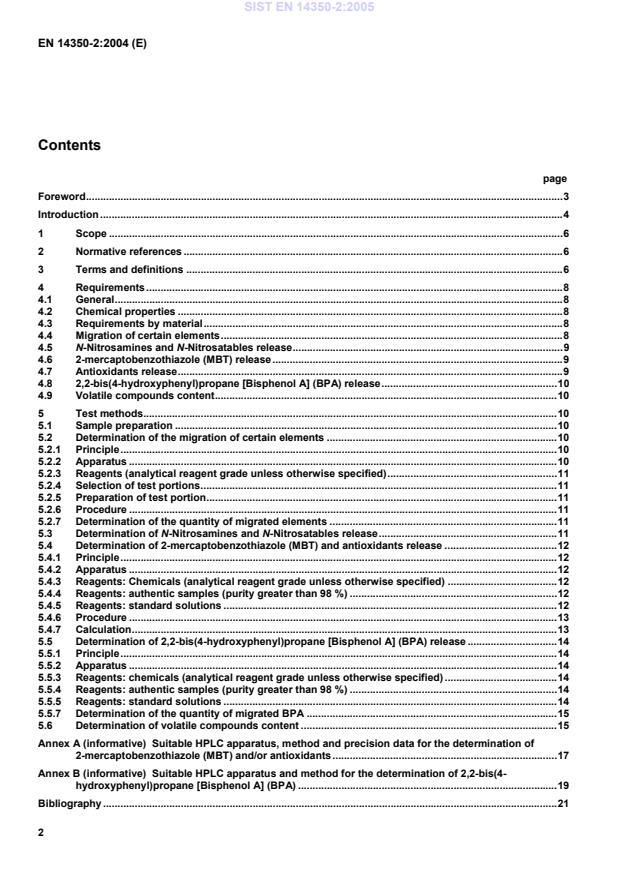
Suitable HPLC apparatus, method and precision data for the determination of 2-mercaptobenzothiazole (MBT) and/or antioxidants.17 Annex B (informative)
Suitable HPLC apparatus and method for the determination of 2,2-bis(4-hydroxyphenyl)propane [Bisphenol A] (BPA).19 Bibliography.21 SIST EN 14350-2:2005
Part 1: General and mechanical requirements and tests —
Part 2: Chemical requirements and tests
The complete document harmonises, for the first time, minimum safety requirements and test methods for children’s drinking equipment. Some of the provisions have been taken from other existing national and European Standards and for these provisions the Technical Committee has relied on previous validation. It is not permitted to claim compliance with individual parts of this document. Any claim relates to all published parts. The use of this document may involve hazardous materials, operations and/or equipment. This document does not purport to address all the safety problems associated with its use. It is the responsibility of the user of this document to establish appropriate health and safety practices and determine the applicability of regulatory limitations prior to its use. It is recommended that manufacturers and suppliers operate to EN ISO 9001 [7] standard for quality management systems. Elastomeric and rubber teats are regulated by the Commission Directive 93/11/EEC [1] concerning the release of N-Nitrosamine and N-Nitrosatable substances from elastomer or rubber teats and soothers. The current Directive provides in its annexes an outline method of analysis that has been published as EN 12868. A limit for the release of 2-mercaptobenzothiazole (MBT) has been specified in the standard. This limit significantly reduces the level of this substance potentially released from children’s drinking equipment. The Scientific Committee for Food has concluded that the limit does not constitute a health hazard. The limit for release of MBT will be reconsidered in light of future studies and recommendations. A limit for the release of 2,2-bis(4-hydroxyphenyl)propane [Bisphenol A] (BPA) has been specified in the standard. The Scientific Committee for Food has concluded that the (temporary) limit (t-TDI) does not constitute a health hazard. The limit for release of BPA will be reconsidered in light of future studies and recommendations. It is noted that all plastics components of drinking equipment are regulated by the Commission Directive 2002/72/EC [2] relating to plastics materials and articles intended to come into contact with foodstuff. Commission Decision 99/815/EC [3], with its subsequent extensions, has adopted (temporary) measures prohibiting the placing on the market of toys and childcare articles intended to be placed in the mouth by children under three years of age. The prohibition relates to such products made of soft PVC containing one or more of the substances di-iso-nonyl phthalate (DINP), di-(2-ethylhexyl) phthalate (DEHP), dibutyl phthalate (DBP), di-iso-decyl phthalate (DIDP), di-n-octyl phthalate (DNOP) and butylbenzyl phthalate (BBP). At the time of preparing this document a final decision was awaited. This document will be reviewed in the light of that decision. The Technical Committee has considered the issues relating to phthalate plasticiser migration from child use and care articles not intended to be placed in the mouth. Recognising the inadequacies of the only currently validated (static) test method for plasticiser migration from PVC [8], the Committee has developed an improved test to provide migration data under more realistic (dynamic) conditions of exposure. However, the Technical Committee will consider the official European method prior to its application to drinking equipment; such child use and care articles may require additional or alternative measures due to the mode of usage of drinking equipment and their potentially longer periods of exposure to babies and young children. After this consideration, an amendment to this document may be made. Formaldehyde, caprolactam and colorants have each been considered by the Technical Committee. They have not been included in the document at this stage because of the lack of either adequate information for making a SIST EN 14350-2:2005
For similar reasons, latex protein allergy risk has also not been included in this document. There is an extremely low incidence of latex protein allergy amongst babies and young children. Nevertheless, provision for information for drinking equipment containing natural rubber latex has been made in Part 1 of this document. The issue of potential sensitisation and allergic reaction from rubber products will be reconsidered when further information becomes available. SIST EN 14350-2:2005
3.2.1 straw hollow tube drinking accessory through which fluid is sucked 3.3 container either a feeding bottle, drinking cup or feeding bag SIST EN 14350-2:2005
component used to secure a feeding teat or drinking accessory to a container 3.5 sealing disc component used to create a seal between the container and the locking ring 3.6 protective cover component to cover a feeding teat or drinking accessory 3.7 matched components any of the above defined components which are used together whilst feeding a child 3.8 numbered graduations numbered markings which indicate the volume of fluid within the container 3.9 single-use feeding teat, drinking accessory or container any item of drinking equipment sold for single use 3.10 re-usable component intended to be used again after first use 3.11 protrusions drinking accessory, feeding teat or spoon, excluding straws SIST EN 14350-2:2005
NOTE 2 It is recommended that manufacturers and suppliers operate to EN ISO 9001 for quality management systems. 4.2 Chemical properties The vulcanising agents (MBT), antioxidants, and Bisphenol A (BPA) do not represent a definitive list. Chemicals other than those mentioned in this document may be used where toxicological evidence, either on the original chemical or any reaction product, is available to demonstrate that no unacceptable risk will be posed when they are used in drinking equipment and an appropriate analytical test procedure for determining migration levels exists. 4.3 Requirements by material Materials used in the manufacture of components of drinking equipment shall be subjected to the tests marked with an x in Table 1. Table 1 — Tests to be carried out on materials Material
Migration of certain elements (see 5.2) N-Nitrosamines and
N-Nitrosatables release (see 5.3)MBT release (see 5.4) Anti-oxidants release (see 5.4) BPA release (see 5.5) Volatile compounds content (see 5.6) Vulcanised rubber x x x x
Silicone rubber x x
x Thermoplastic elastomers (TPEs) x x
Glass x
Thermoplastics x
x a
a
Only thermoplastics containing polycarbonate or polysulfone shall be tested for Bisphenol A release
4.4 Migration of certain elements When tested in accordance with 5.2 the migration of elements from all material(s) used in the manufacture of drinking equipment shall not exceed the limits given in Table 2. When drinking equipment contain components manufactured from different material(s), or in different colours, all components shall be tested individually. Decorations shall be considered to be part(s) of the material(s) on which they are printed. SIST EN 14350-2:2005
4.5 N-Nitrosamines and N-Nitrosatables release When tested in accordance with 5.3, the total N-Nitrosamines and N-Nitrosatables release of any elastomer or rubber component shall not exceed the limits given in Table 3. Table 3 — N-Nitrosamines and N-Nitrosatables release and tolerances Substance Limit mg/kg Tolerance mg/kg N-Nitrosamines 0,01 0,01 N-Nitrosatables 0,1 0,1
4.6 2-mercaptobenzothiazole (MBT) release When elastomeric components of drinking equipment are tested according to 5.4, the migration of the following chemical shall not exceed 8 mg/kg: 2-mercaptobenzothiazole or 2(3H)-benzothiazolethione CAS No. 149-30-4 IUPAC 1,3-benzothiazole-2-thiol 4.7 Antioxidants release When elastomeric components of drinking equipment are tested according to 5.4, the migration of the following chemical shall not exceed 30 µg/100 ml or 60 µg/dm2: 2,6-bis(1,1-dimethylethyl)-4-methyl-phenol (BHT) CAS No. 128-37-0 IUPAC 2,6-di-tert-butyl-p-cresol SIST EN 14350-2:2005
...