

EN ISO 3093:2009/prA1
(Amendment)Wheat, rye and their flours, durum wheat and durum wheat semolina - Determination of the falling number according to Hagberg-Perten - Amendment 1 (ISO 3093:2009/DAM 1:2026)
- Status
- Not Published
- Publication Date
- 14-Dec-2026
- Technical Committee
- CEN/TC 338 - Cereal and cereal products
- Current Stage
- 4060 - Closure of enquiry - Enquiry
- Start Date
- 14-Sep-2026
- Completion Date
- 14-Sep-2026

EN ISO 3093:2009/prA1 is a draft amendment in the CEN/ISO process for the Hagberg-Perten falling number method. It adds altitude-correction rules for wheat, rye, durum wheat and their flours and semolina, so laboratories can convert measured results to sea-level values when test conditions change with elevation. The document is aimed at testing laboratories and other users who need comparable falling number results across sites.
What does EN ISO 3093:2009/prA1 specify?
EN ISO 3093:2009/prA1 is Amendment 1 to EN ISO 3093:2009 / ISO 3093:2009. Its focus is a normative altitude correction for falling number results, using Annex A.
| Annex | What it covers |
|---|---|
| Annex A | Equations for altitude correction of falling numbers |
The amendment is practical for laboratories working above sea level, because boiling conditions in the water bath affect the reported result. It gives a way to report corrected values rather than relying only on the raw reading taken at altitude.
What are the key requirements of EN ISO 3093:2009/prA1?
The main technical content is in Annex A, which separates the correction by sample type and by test conditions.
Altitude correction for ground grain samples
EN ISO 3093:2009/prA1 says that for ground grain samples tested in laboratories above 600 m, where the water bath boils below 98 °C, the falling number shall be corrected to sea level using the Annex A equation. In practice, the laboratory needs to know its altitude and apply the correction before comparing results with laboratories at lower elevations.
Altitude correction for flour and semolina
EN ISO 3093:2009/prA1 gives a separate correction for flour and semolina tested in laboratories above 750 m, again where the water bath boils below 98 °C. This matters because the same product can give a different raw reading at high altitude, so a corrected value is needed for consistent reporting.
Use of a conversion table
EN ISO 3093:2009/prA1 allows the calculation to be replaced by reading from a conversion table prepared for a specific altitude. That gives laboratories a simpler routine option when the same elevation is used repeatedly.
Measured value versus corrected value
EN ISO 3093:2009/prA1 distinguishes the uncorrected value measured at altitude from the corrected value at sea level. In practice, this means laboratories should keep the raw test result and the corrected report value clear in their records.
What terms does EN ISO 3093:2009/prA1 define?
- Falling number (FN) - the reported result used in the Hagberg-Perten method, which Annex A corrects for altitude.
- Hagberg-Perten - the named method used for determining falling number in cereals and cereal products.
- Altitude above sea level - the laboratory elevation used as the basis for the correction.
- Water bath - the heated bath used in the test; Annex A applies when its boiling temperature is below 98 °C.
- Ground grain samples - grain samples prepared in ground form, covered by Annex A.1.
- Flour and semolina - the product form covered by Annex A.2.
Who uses EN ISO 3093:2009/prA1?
EN ISO 3093:2009/prA1 is used by laboratories that measure falling number in wheat, rye, durum wheat, flour and semolina. It is also relevant to quality managers, mill laboratories, grain traders and buyers who compare results from different sites or need altitude-adjusted values in specifications. The amendment matters most where test work is done at elevated locations and the boiling point of the bath is lower than standard sea-level conditions.
What changed in EN ISO 3093:2009/prA1 from the previous edition?
EN ISO 3093:2009/prA1 is Amendment 1 to EN ISO 3093:2009 / ISO 3093:2009. The amendment adds Annex A, which provides equations for altitude correction of falling numbers and permits a conversion table for a specific altitude.
What does the EN ISO 3093:2009/prA1 document contain?
The document contains the amendment front matter and a normative Annex A. Annex A gives one correction path for ground grain samples and another for flour and semolina, together with the conditions under which each correction applies. It also states that a conversion table may be used instead of calculating the correction directly. This makes the amendment a practical reference for laboratories that need to standardize results across different elevations.
Relations
- Effective Date
- 18-Jun-2025
Get Certified
Connect with accredited certification bodies for this standard

BSI Group
BSI (British Standards Institution) is the business standards company that helps organizations make excellence a habit.

Bureau Veritas
Bureau Veritas is a world leader in laboratory testing, inspection and certification services.

DNV
DNV is an independent assurance and risk management provider.
Sponsored listings
Frequently Asked Questions
EN ISO 3093:2009/prA1 is a draft published by the European Committee for Standardization (CEN). Its full title is "Wheat, rye and their flours, durum wheat and durum wheat semolina - Determination of the falling number according to Hagberg-Perten - Amendment 1 (ISO 3093:2009/DAM 1:2026)". This standard covers: Wheat, rye and their flours, durum wheat and durum wheat semolina - Determination of the falling number according to Hagberg-Perten - Amendment 1 (ISO 3093:2009/DAM 1:2026)
Wheat, rye and their flours, durum wheat and durum wheat semolina - Determination of the falling number according to Hagberg-Perten - Amendment 1 (ISO 3093:2009/DAM 1:2026)
EN ISO 3093:2009/prA1 is classified under the following ICS (International Classification for Standards) categories: 67.060 - Cereals, pulses and derived products. The ICS classification helps identify the subject area and facilitates finding related standards.
EN ISO 3093:2009/prA1 has the following relationships with other standards: It is inter standard links to EN ISO 3093:2009. Understanding these relationships helps ensure you are using the most current and applicable version of the standard.
EN ISO 3093:2009/prA1 is available in PDF format for immediate download after purchase. The document can be added to your cart and obtained through the secure checkout process. Digital delivery ensures instant access to the complete standard document.
Standards Content (Sample)
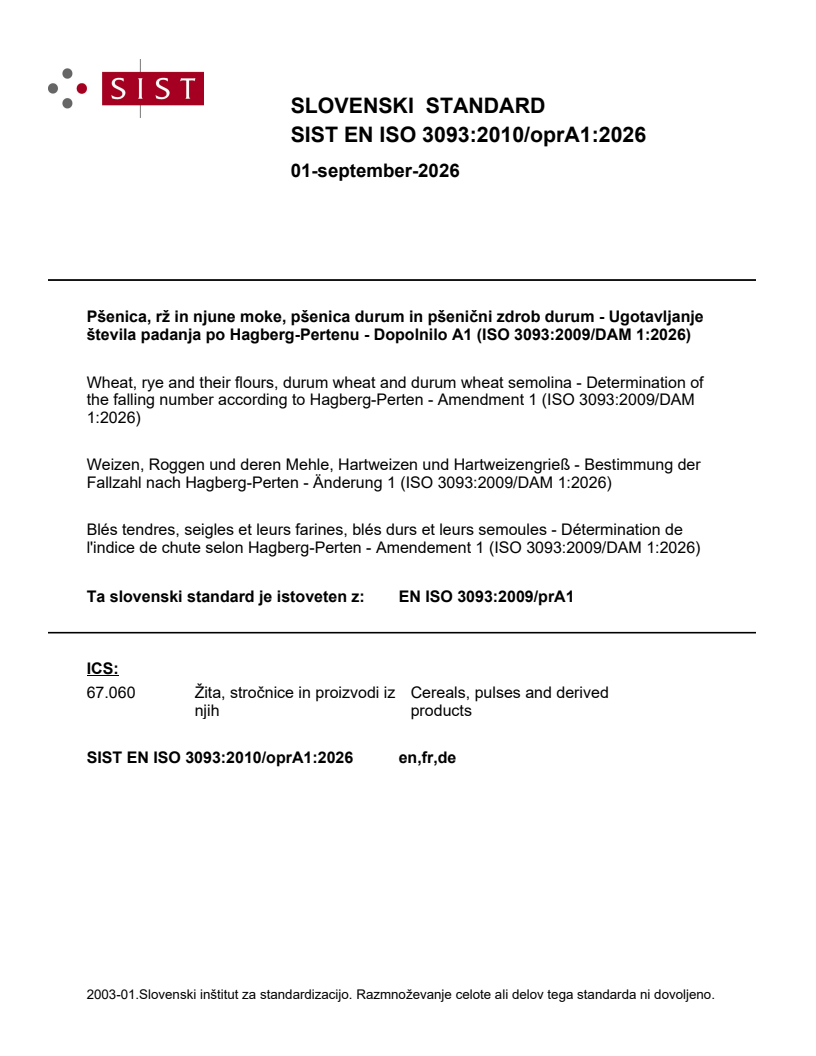
SLOVENSKI STANDARD
01-september-2026
Pšenica, rž in njune moke, pšenica durum in pšenični zdrob durum - Ugotavljanje
števila padanja po Hagberg-Pertenu - Dopolnilo A1 (ISO 3093:2009/DAM 1:2026)
Wheat, rye and their flours, durum wheat and durum wheat semolina - Determination of
the falling number according to Hagberg-Perten - Amendment 1 (ISO 3093:2009/DAM
1:2026)
Weizen, Roggen und deren Mehle, Hartweizen und Hartweizengrieß - Bestimmung der
Fallzahl nach Hagberg-Perten - Änderung 1 (ISO 3093:2009/DAM 1:2026)
Blés tendres, seigles et leurs farines, blés durs et leurs semoules - Détermination de
l'indice de chute selon Hagberg-Perten - Amendement 1 (ISO 3093:2009/DAM 1:2026)
Ta slovenski standard je istoveten z: EN ISO 3093:2009/prA1
ICS:
67.060 Žita, stročnice in proizvodi iz Cereals, pulses and derived
njih products
2003-01.Slovenski inštitut za standardizacijo. Razmnoževanje celote ali delov tega standarda ni dovoljeno.
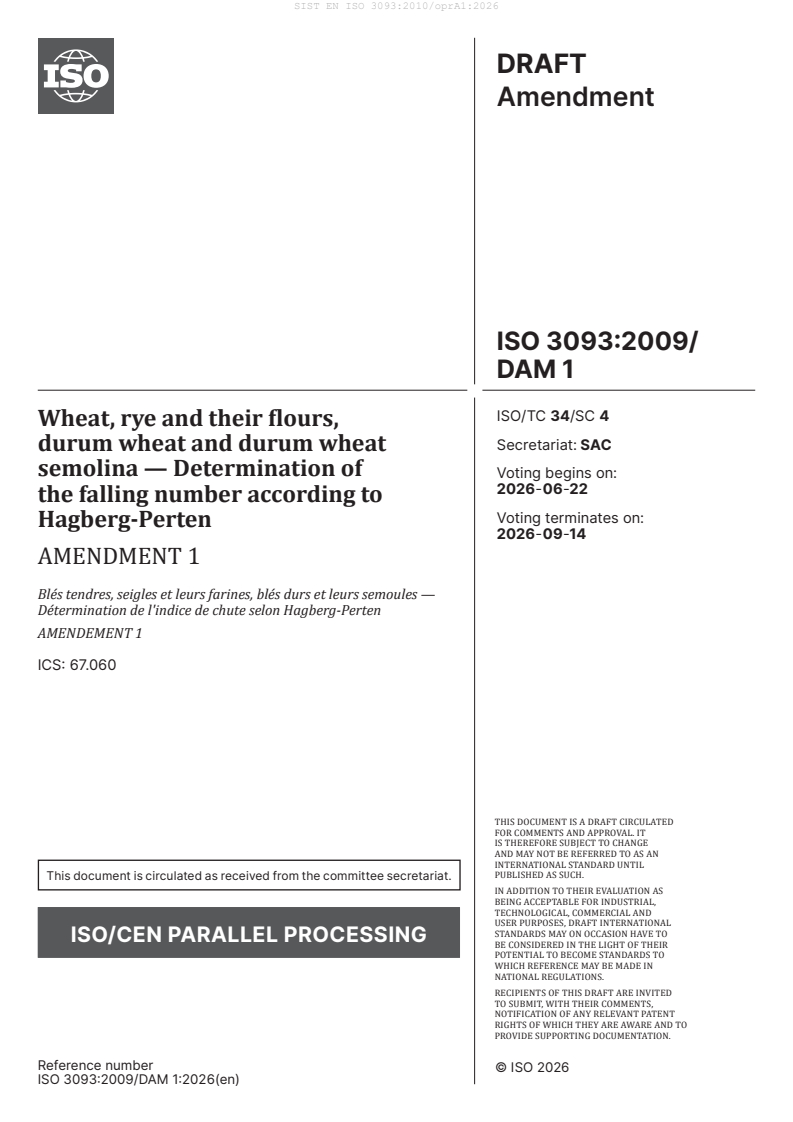
DRAFT
Amendment
ISO 3093:2009/
DAM 1
ISO/TC 34/SC 4
Wheat, rye and their flours,
Secretariat: SAC
durum wheat and durum wheat
semolina — Determination of
Voting begins on:
2026-06-22
the falling number according to
Voting terminates on:
Hagberg-Perten
2026-09-14
AMENDMENT 1
Blés tendres, seigles et leurs farines, blés durs et leurs semoules —
Détermination de l'indice de chute selon Hagberg-Perten
AMENDEMENT 1
ICS: 67.060
THIS DOCUMENT IS A DRAFT CIRCULATED
FOR COMMENTS AND APPROVAL. IT
IS THEREFORE SUBJECT TO CHANGE
AND MAY NOT BE REFERRED TO AS AN
INTERNATIONAL STANDARD UNTIL
PUBLISHED AS SUCH.
This document is circulated as received from the committee secretariat.
IN ADDITION TO THEIR EVALUATION AS
BEING ACCEPTABLE FOR INDUSTRIAL,
TECHNOLOGICAL, COMMERCIAL AND
USER PURPOSES, DRAFT INTERNATIONAL
STANDARDS MAY ON OCCASION HAVE TO
ISO/CEN PARALLEL PROCESSING
BE CONSIDERED IN THE LIGHT OF THEIR
POTENTIAL TO BECOME STANDARDS TO
WHICH REFERENCE MAY BE MADE IN
NATIONAL REGULATIONS.
RECIPIENTS OF THIS DRAFT ARE INVITED
TO SUBMIT, WITH THEIR COMMENTS,
NOTIFICATION OF ANY RELEVANT PATENT
RIGHTS OF WHICH THEY ARE AWARE AND TO
PROVIDE SUPPORTING DOCUMENTATION.
Reference number
ISO 3093:2009/DAM 1:2026(en)
DRAFT
ISO 3093:2009/DAM 1:2026(en)
Amendment
ISO 3093:2009/
DAM 1
ISO/TC 34/SC 4
Wheat, rye and their flours,
Secretariat: SAC
durum wheat and durum wheat
semolina — Determination of
Voting begins on:
the falling number according to
Voting terminates on:
Hagberg-Perten
AMENDMENT 1
Blés tendres, seigles et leurs farines, blés durs et leurs semoules —
Détermination de l'indice de chute selon Hagberg-Perten
AMENDEMENT 1
ICS: 67.060
THIS DOCUMENT IS A DRAFT CIRCULATED
FOR COMMENTS AND APPROVAL. IT
IS THEREFORE SUBJECT TO CHANGE
AND MAY NOT BE REFERRED
...