


EN 1451-1:2017
(Main)Plastics piping systems for soil and waste discharge (low and high temperature) within the building structure - Polypropylene (PP) - Part 1: Specifications for pipes, fittings and the system
Plastics piping systems for soil and waste discharge (low and high temperature) within the building structure - Polypropylene (PP) - Part 1: Specifications for pipes, fittings and the system
This part of EN 1451 specifies the requirements for solid-wall polypropylene (PP) pipes, fittings and the system intended for:
- soil and waste discharge applications (low and high temperature) inside buildings (application area code "B");
- soil and waste discharge applications (low and high temperature) for both inside buildings and buried in the ground within the building structure (application area code "BD").
This part of EN 1451 is also applicable to PP pipes and fittings and the system intended for the following purposes:
- ventilating part of the pipework in association with discharge applications;
- rainwater pipework within the building structure.
It also specifies the test parameters for the test methods referred to in this standard.
This standard covers a range of nominal sizes, a range of pipes and fittings series and gives recommendations concerning colours.
It applies to pipes and fittings, marked with "B", which are intended to be used inside buildings and outside buildings fixed onto the wall.
This standard is applicable to PP pipes and fittings of the following types:
- plain-ended;
- with integral elastomeric ring seal socket;
- for butt fusion joints.
whereby the fittings can be manufactured by injection-moulding or be fabricated from pipes and/or mouldings.
Kunststoff-Rohrleitungssysteme zum Ableiten von Abwasser (niedriger und hoher Temperatur) innerhalb der Gebäudestruktur - Polypropylen (PP) - Teil 1: Anforderungen an Rohre, Formstücke und das Rohrleitungssystem
Dieser Teil von EN 1451 legt für Vollwand-Rohrleitungssysteme aus Polypropylen (PP) Anforderungen an Rohre, Formstücke und das Rohrleitungssystem für Abwasserleitungen fest, die in Schwerkraft-entwässerungsanlagen zum Ableiten von Abwasser (niedriger und hoher Temperatur) eingesetzt werden:
- innerhalb von Gebäuden (Anwendungskennzeichen "B");
- innerhalb von Gebäuden und erdverlegt innerhalb der Gebäudestruktur (Anwendungskenn-zeichen "BD").
Der vorgesehene Verwendungszweck wird durch die Kennzeichnung der Erzeugnisse mit "B" oder "BD" angezeigt.
ANMERKUNG 1 Für erdverlegte Anwendungen innerhalb der Gebäudestruktur sind nur Rohrleitungsteile mit der Kennzeichnung "BD" mit Maßen ≥ 75 mm und einer Nenn-Ringsteifigkeit von mindestens SN 4 bestimmt.
Dieser Teil von EN 1451 gilt ebenfalls für Rohre, Formstücke und das Rohrleitungssystem aus PP für die folgenden Verwendungszwecke:
- Lüftungsleitungen in Verbindung mit Abwasseranwendungen;
- Regenfallleitungen innerhalb der Gebäudestruktur.
Er legt auch die Prüfparameter für die Prüfverfahren fest, auf die in dieser Norm verwiesen wird.
Diese Europäische Norm behandelt eine Reihe von Nennweiten, mehrere Rohr- und Formstückreihen sowie Empfehlungen für die Einfärbung.
ANMERKUNG 2 Die geeignete Auswahl aus diesen Aspekten unter Berücksichtigung der jeweils geltenden Anforde-rungen sowie aller maßgebenden nationalen Bestimmungen und Verlegeverfahren oder -vorschriften, z. B. CEN/TR 13801 [1], liegt in der Verantwortung des Kunden oder Auftraggebers.
ANMERKUNG 3 Rohre, Formstücke und andere Rohrleitungsteile, die einer der in Anhang B aufgeführten Normen zu Kunststofferzeugnissen entsprechen, können mit Rohren und Formstücken nach der vorliegenden Europäischen Norm verwendet werden, sofern sie die Anforderungen an die Maße von Verbindungen nach Abschnitt 6 und die Anforderungen nach Tabelle 18 erfüllen.
Diese Norm gilt für mit B" gekennzeichnete Rohre und Formstücke, die für die Verwendung innerhalb von Gebäuden und außerhalb, an Gebäuden befestigt, vorgesehen sind.
Sie gilt für mit "BD" gekennzeichnete Rohre und Formstücke, die für die Verwendung sowohl innerhalb von Gebäuden als auch erdverlegt innerhalb der Gebäudestruktur vorgesehen sind.
Diese Norm gilt für Rohre und Formstücke aus PP der folgenden Typen:
- mit glatten Enden;
- mit angeformter Steckmuffe mit elastomeren Dichtringen;
- für Stumpfschweißverbindungen,
wobei Formstücke durch Spritzgießen oder aus Rohren und/oder aus Teilen, die durch Spritzgießen hergestellt wurden, gefertigt werden können.
ANMERKUNG 4 EN 476 [2] legt die allgemeinen Anforderungen an Rohrleitungsteile fest, die in Abwasserrohren, in Abwasserleitungen und -kanälen für Schwerkraftentwässerungssysteme verwendet werden. Rohre und Formstücke, die dieser Norm entsprechen, erfüllen diese Anforderungen vollständig.
ANMERKUNG 5 Informationen zur chemischen Beständigkeit von PP enthält ISO/TR 10358 [3] und Informationen zu Werkstoffen auf Kautschukbasis enthält ISO/TR 7620 [4].
Systèmes de canalisations en plastiques pour l'évacuation des eaux-vannes et des eaux usées (à basse et à haute température) à l'intérieur de la structure des bâtiments — Polypropylène (PP) — Partie 1: Spécifications pour tubes, raccords et le système
La présente partie de l’EN 1451 spécifie les exigences pour les tubes et raccords à paroi compacte en polypropylène (PP) et le système destinés à être utilisés pour :
- les applications d’évacuation des eaux-vannes et des eaux usées (à basse et à haute température) à l’intérieur des bâtiments (code de zone d’application « B ») ;
- les applications d'évacuation des eaux-vannes et des eaux usées (à basse et à haute température) utilisables aussi bien à l'intérieur des bâtiments qu'en enterré dans la structure du bâtiment (code de zone d’application « BD ».
L’utilisation prévue est repérée au niveau du marquage des produits par « B » ou « BD ».
NOTE 1 Seuls sont destinés à l'usage en enterré dans la structure du bâtiment, les composants marqués « BD », avec des dimensions supérieures ou égales à 75 mm et une rigidité annulaire minimale d’au moins SN 4.
La présente partie de l’EN 1451 est également applicable aux tubes et raccords en PP et le système destinés aux usages suivants :
- la partie de ventilation du réseau de canalisation en association avec des applications d’évacuation ;
- les canalisations pour les eaux pluviales à l'intérieur de la structure du bâtiment.
Elle spécifie également les paramètres d'essai pour les méthodes d'essai référencées dans la présente norme.
La présente norme européenne couvre une gamme de dimensions nominales, une gamme de séries de tubes et de raccords et donne des recommandations concernant les couleurs.
NOTE 2 Il est de la responsabilité de l'acheteur ou du prescripteur d'effectuer les sélections appropriées à partir de ces données en tenant compte des exigences particulières et des éventuelles réglementations nationales et des pratiques ou codes pour la pose appropriés, par exemple, le CEN/TR 13801[1].
NOTE 3 Les tubes, les raccords et autres composants conformes à l'une des normes de produits plastiques listées dans l'Annexe B peuvent être utilisés avec des tubes et des raccords conformes à la présente norme européenne dans la mesure où ils répondent aux exigences pour les dimensions d'assemblage données dans l'Article 6 et aux exigences du Tableau 18.
La présente norme s'applique aux tubes et aux raccords portant la marque «B» destinés à être utilisés à l'intérieur des bâtiments et à l'extérieur des bâtiments fixés sur les murs.
Elle s'applique aux tubes et aux raccords portant la marque «BD» destinés à être utilisés aussi bien à l'intérieur des bâtiments qu'en enterré dans la structure du bâtiment.
La présente norme s'applique aux tubes et aux raccords en PP des types suivants :
- à extrémité lisse ;
- avec emboîture intégrée avec bague d'étanchéité en élastomère ;
- pour assemblage par soudage bout-à-bout ;
où les raccords peuvent être fabriqués par moulage par injection ou être façonnés à partir de tubes et/ou de pièce moulées.
NOTE 4 L’EN 476 [2] spécifie les exigences générales pour les composants utilisés dans les canalisations d’évacuation, les branchements et les collecteurs pour réseaux à écoulement libre. Les tubes et raccords conformes à cette norme satisfont intégralement à ces exigences.
NOTE 5 Pour toute information concernant la résistance chimique du PP, l’ISO/TR 10358 [3] donne des instructions, de même que l’ISO/TR 7620 [4] pour les matériaux en caoutchouc.
Cevni sistemi iz polimernih materialov za nizko- in visokotemperaturne odvodne sisteme v zgradbah - Polipropilen (PP) - 1. del: Specifikacije za cevi, fitinge in sistem
Ta del standarda EN 1451 določa zahteve za polipropilenske (PP) cevi in fitinge v trdnih stenah ter sisteme za: – (nizko- in visokotemperaturne) odvodne sisteme v zgradbah (koda območja uporabe »B«); – (nizko- in visokotemperaturne) odvodne sisteme v zgradbah in sisteme, vkopane v zemljo znotraj stavbne konstrukcije (koda območja uporabe »BD«. Ta del standarda EN 1451 se uporablja tudi za polipropilenske cevi in fitinge ter sistem za: – prezračevalne dele sistema cevi, povezanega z odvodnim sistemom; – sistem cevi za deževnico v zgradbi. Določa tudi preskusne parametre za preskusne metode, navedene v tem standardu. Ta standard zajema širok nabor nazivnih velikosti ter serij cevi in fitingov ter podaja priporočila glede barve. Uporablja se za cevi in fitinge, označene z oznako »B«, ki se namestijo v notranje ali zunanje stene zgradbe. Ta standard se uporablja za naslednje vrste polipropilenskih cevi in fitingov: – z ravnim zaključkom; – s celovitimi elastomernimi tesnilnimi obroči; – za soležno taljene spoje, pri čemer so fitingi izdelani z vbrizgavanjem oziroma iz cevi in/ali oblikovancev.
General Information
- Status
- Published
- Publication Date
- 14-Nov-2017
- Withdrawal Date
- 30-May-2018
- Technical Committee
- CEN/TC 155 - Plastics piping systems and ducting systems
- Current Stage
- 9092 - Decision on results of review/2YR ENQ - revise - Review Enquiry
- Start Date
- 28-Sep-2023
- Completion Date
- 14-Apr-2025
Relations
- Effective Date
- 29-Jan-2014
- Effective Date
- 21-Feb-2018
Overview
EN 1451-1:2017 - Plastics piping systems for soil and waste discharge (low and high temperature) within the building structure - Part 1 specifies requirements for solid-wall polypropylene (PP) pipes, fittings and the complete system for building drainage. It covers products for in‑building soil and waste discharge (application code B) and for both in‑building and buried within the building structure (application code BD). The standard also applies to ventilating parts of discharge pipework and to rainwater pipework within buildings, and it defines the test parameters for referenced test methods.
Key topics and technical requirements
- Material requirements: PP compound properties (melt mass‑flow rate, density, thermal stability - OIT), permitted use of non‑virgin/reprocessed PP (Annex A), and fire behaviour assessments.
- Product types and joints: Plain‑ended pipes, pipes with integral elastomeric ring‑seal sockets, and components for butt‑fusion joints. Fittings may be injection‑moulded or fabricated from pipes/mouldings.
- Geometrical and dimensional rules: Outside diameters, effective pipe lengths, wall thicknesses, socket and spigot dimensions to ensure interchangeability and joint performance.
- Mechanical & physical performance: Ring stiffness, impact resistance (BD applications aligned with other drainage standards), resistance to elevated temperature cycling, and other performance test parameters.
- Marking and identification: Mandatory marking to indicate intended use - “B” for in‑building use and “BD” for in‑building and buried within the building structure. Note: components marked “BD” intended for burial are generally ≥ 75 mm and of at least SN4 ring stiffness.
- Test references: The standard specifies parameters and refers to established test methods and norms (e.g., ring stiffness, leak tightness, OIT, dimensional measurements).
Applications and practical value
- Designed for soil and waste discharge systems in residential, commercial and institutional buildings.
- Suitable for internal drainage stacks, ventilating branches and rainwater downpipes within the building structure.
- Enables manufacturers to design interchangeable PP piping systems that meet European performance and safety expectations.
- Helps specifiers, engineers and installers choose correct products for applications requiring buried runs within the building envelope (BD) or above‑ground installations (B).
Who should use this standard
- Manufacturers of PP pipes and fittings (product design, marking, quality control)
- Specifiers and consulting engineers writing project requirements and performance specs
- Installers and contractors ensuring correct product selection and jointing methods
- Testing laboratories and conformity assessors performing the referenced tests
- Regulatory authorities and procurement teams verifying compliance for building drainage systems
Related standards
- EN 1451-2 (Guidance for assessment of conformity)
- EN 681 series (elastomeric sealing rings)
- Relevant ISO/EN test methods referenced in EN 1451-1 (ring stiffness, OIT, MFR, dimensional and leak tests)
Keywords: EN 1451-1:2017, polypropylene (PP) piping, soil and waste discharge, building drainage, PP pipes and fittings, BD/B applications, drainage system standards.


Frequently Asked Questions
EN 1451-1:2017 is a standard published by the European Committee for Standardization (CEN). Its full title is "Plastics piping systems for soil and waste discharge (low and high temperature) within the building structure - Polypropylene (PP) - Part 1: Specifications for pipes, fittings and the system". This standard covers: This part of EN 1451 specifies the requirements for solid-wall polypropylene (PP) pipes, fittings and the system intended for: - soil and waste discharge applications (low and high temperature) inside buildings (application area code "B"); - soil and waste discharge applications (low and high temperature) for both inside buildings and buried in the ground within the building structure (application area code "BD"). This part of EN 1451 is also applicable to PP pipes and fittings and the system intended for the following purposes: - ventilating part of the pipework in association with discharge applications; - rainwater pipework within the building structure. It also specifies the test parameters for the test methods referred to in this standard. This standard covers a range of nominal sizes, a range of pipes and fittings series and gives recommendations concerning colours. It applies to pipes and fittings, marked with "B", which are intended to be used inside buildings and outside buildings fixed onto the wall. This standard is applicable to PP pipes and fittings of the following types: - plain-ended; - with integral elastomeric ring seal socket; - for butt fusion joints. whereby the fittings can be manufactured by injection-moulding or be fabricated from pipes and/or mouldings.
This part of EN 1451 specifies the requirements for solid-wall polypropylene (PP) pipes, fittings and the system intended for: - soil and waste discharge applications (low and high temperature) inside buildings (application area code "B"); - soil and waste discharge applications (low and high temperature) for both inside buildings and buried in the ground within the building structure (application area code "BD"). This part of EN 1451 is also applicable to PP pipes and fittings and the system intended for the following purposes: - ventilating part of the pipework in association with discharge applications; - rainwater pipework within the building structure. It also specifies the test parameters for the test methods referred to in this standard. This standard covers a range of nominal sizes, a range of pipes and fittings series and gives recommendations concerning colours. It applies to pipes and fittings, marked with "B", which are intended to be used inside buildings and outside buildings fixed onto the wall. This standard is applicable to PP pipes and fittings of the following types: - plain-ended; - with integral elastomeric ring seal socket; - for butt fusion joints. whereby the fittings can be manufactured by injection-moulding or be fabricated from pipes and/or mouldings.
EN 1451-1:2017 is classified under the following ICS (International Classification for Standards) categories: 23.040.01 - Pipeline components and pipelines in general; 91.140.80 - Drainage systems. The ICS classification helps identify the subject area and facilitates finding related standards.
EN 1451-1:2017 has the following relationships with other standards: It is inter standard links to EN 1451-1:1998, EN 1451-1:2017/AC:2018. Understanding these relationships helps ensure you are using the most current and applicable version of the standard.
You can purchase EN 1451-1:2017 directly from iTeh Standards. The document is available in PDF format and is delivered instantly after payment. Add the standard to your cart and complete the secure checkout process. iTeh Standards is an authorized distributor of CEN standards.
Standards Content (Sample)
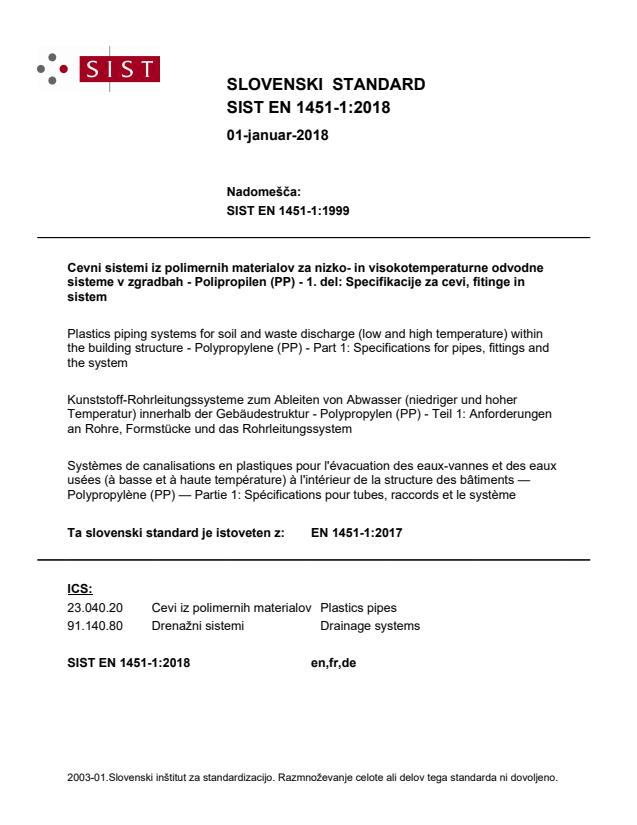
2003-01.Slovenski inštitut za standardizacijo. Razmnoževanje celote ali delov tega standarda ni dovoljeno.Cevni sistemi iz polimernih materialov za nizko- in visokotemperaturne odvodne sisteme v zgradbah - Polipropilen (PP) - 1. del: Specifikacije za cevi, fitinge in sistemKunststoff-Rohrleitungssysteme zum Ableiten von Abwasser (niedriger und hoher Temperatur) innerhalb der Gebäudestruktur - Polypropylen (PP) - Teil 1: Anforderungen an Rohre, Formstücke und das RohrleitungssystemSystèmes de canalisations en plastiques pour l'évacuation des eaux-vannes et des eaux usées (à basse et à haute température) à l'intérieur de la structure des bâtiments — Polypropylène (PP) — Partie 1: Spécifications pour tubes, raccords et le systèmePlastics piping systems for soil and waste discharge (low and high temperature) within the building structure - Polypropylene (PP) - Part 1: Specifications for pipes, fittings and the system91.140.80Drenažni sistemiDrainage systems23.040.20Cevi iz polimernih materialovPlastics pipesICS:Ta slovenski standard je istoveten z:EN 1451-1:2017SIST EN 1451-1:2018en,fr,de01-januar-2018SIST EN 1451-1:2018SLOVENSKI
STANDARDSIST EN 1451-1:19991DGRPHãþD
EUROPEAN STANDARD NORME EUROPÉENNE EUROPÄISCHE NORM
EN 1451-1
November
t r s y ICS
t uä r v rä r sâ
{ sä s v rä z r Supersedes EN
s v w sæ sã s { { zEnglish Version
fittings and the system Systèmes de canalisations en plastiques pour
sã Spécifications pour tubesá raccords et le système
KunststoffæRohrleitungssysteme zum Ableiten von Anforderungen an Rohreá Formstücke und das Rohrleitungssystem This European Standard was approved by CEN on
s z September
t r s yä
egulations which stipulate the conditions for giving this European Standard the status of a national standard without any alterationä Upætoædate lists and bibliographical references concerning such national standards may be obtained on application to the CENæCENELEC Management Centre or to any CEN memberä
translation under the responsibility of a CEN member into its own language and notified to the CENæCENELEC Management Centre has the same status as the official versionsä
CEN members are the national standards bodies of Austriaá Belgiumá Bulgariaá Croatiaá Cyprusá Czech Republicá Denmarká Estoniaá Finlandá Former Yugoslav Republic of Macedoniaá Franceá Germanyá Greeceá Hungaryá Icelandá Irelandá Italyá Latviaá Lithuaniaá Luxembourgá Maltaá Netherlandsá Norwayá Polandá Portugalá Romaniaá Serbiaá Slovakiaá Sloveniaá Spainá Swedená Switzerlandá Turkey and United Kingdomä
EUROPEAN COMMITTEE FOR STANDARDIZATION COMITÉ EUROPÉEN DE NORMALISATION EUROPÄISCHES KOMITEE FÜR NORMUNG
CEN-CENELEC Management Centre:
Avenue Marnix 17,
B-1000 Brussels
t r s y CEN All rights of exploitation in any form and by any means reserved worldwide for CEN national Membersä Refä Noä EN
s v w sæ sã t r s y ESIST EN 1451-1:2018
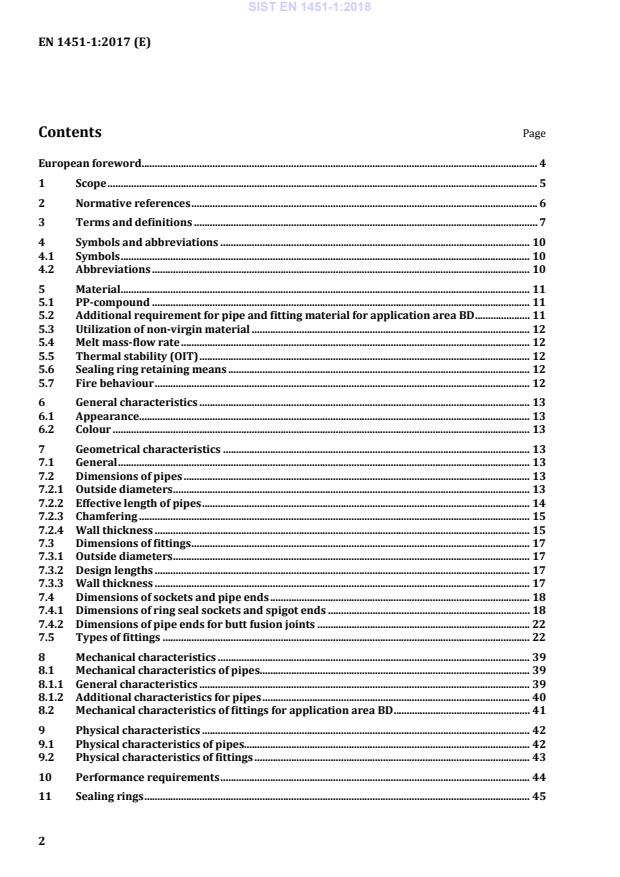
European foreword . 4 1 Scope . 5 2 Normative references . 6 3 Terms and definitions . 7 4 Symbols and abbreviations . 10 4.1 Symbols . 10 4.2 Abbreviations . 10 5 Material . 11 5.1 PP-compound . 11 5.2 Additional requirement for pipe and fitting material for application area BD . 11 5.3 Utilization of non-virgin material . 12 5.4 Melt mass-flow rate . 12 5.5 Thermal stability (OIT) . 12 5.6 Sealing ring retaining means . 12 5.7 Fire behaviour . 12 6 General characteristics . 13 6.1 Appearance . 13 6.2 Colour . 13 7 Geometrical characteristics . 13 7.1 General . 13 7.2 Dimensions of pipes . 13 7.2.1 Outside diameters . 13 7.2.2 Effective length of pipes . 14 7.2.3 Chamfering . 15 7.2.4 Wall thickness . 15 7.3 Dimensions of fittings . 17 7.3.1 Outside diameters . 17 7.3.2 Design lengths . 17 7.3.3 Wall thickness . 17 7.4 Dimensions of sockets and pipe ends . 18 7.4.1 Dimensions of ring seal sockets and spigot ends . 18 7.4.2 Dimensions of pipe ends for butt fusion joints . 22 7.5 Types of fittings . 22 8 Mechanical characteristics . 39 8.1 Mechanical characteristics of pipes. 39 8.1.1 General characteristics . 39 8.1.2 Additional characteristics for pipes . 40 8.2 Mechanical characteristics of fittings for application area BD . 41 9 Physical characteristics . 42 9.1 Physical characteristics of pipes. 42 9.2 Physical characteristics of fittings . 43 10 Performance requirements . 44 11 Sealing rings . 45 SIST EN 1451-1:2018
Utilization of non-virgin PP material . 48 A.1 Own reprocessed material from pipes and fittings . 48 A.2 External reprocessed and recycled materials with an agreed specification . 48 A.2.1 Material from PP pipes and fittings . 48 A.2.2 Material from PP products other than pipes and fittings . 49 Annex B (informative)
Product standards . 50 Bibliography . 51
EN 1852-1; — utilization of non-virgin PP materials are described in the new Annex A; — Annex B has been deleted and the relevant text has been moved to the main standard; — new Annex B “Product
standards” has been added. System standards are based on the results of the work undertaken in ISO/TC 138 “Plastics pipes, fittings and valves for the transport of fluids”, which is a Technical Committee of the International Organization for Standardization (ISO). They are supported by separate standards on test methods to which references are made throughout the system standard. The system standards are consistent with general standards on functional requirements and on recommended practice for installation. According to the CEN-CENELEC Internal Regulations, the national standards organisations of the following countries are bound to implement this European Standard: Austria, Belgium, Bulgaria, Croatia, Cyprus, Czech Republic, Denmark, Estonia, Finland, Former Yugoslav Republic of Macedonia, France, Germany, Greece, Hungary, Iceland, Ireland, Italy, Latvia, Lithuania, Luxembourg, Malta, Netherlands, Norway, Poland, Portugal, Romania, Serbia, Slovakia, Slovenia, Spain, Sweden, Switzerland, Turkey and the United Kingdom. SIST EN 1451-1:2018
NOTE 1 For use buried in the ground within the building structure are intended only those components marked with “BD”, with dimensions equal to or greater than 75 mm and nominal ring stiffness of at least SN4. This part of EN 1451 is also applicable to PP pipes and fittings and the system intended for the following purposes: — ventilating part of the pipework in association with discharge applications; — rainwater pipework within the building structure. It also specifies the test parameters for the test methods referred to in this standard. This European Standard covers a range of nominal sizes, a range of pipes and fittings series and gives recommendations concerning colours. NOTE 2 It is the responsibility of the purchaser or specifier to make the appropriate selections from these aspects, taking into account their particular requirements and any relevant national regulations and installation practices or codes, e.g. CEN/TR 13801 [1]. NOTE 3 Pipes, fittings and other components conforming to any of the plastics product standards listed in Annex B can be used with pipes and fittings conforming to this European Standard, provided they conform to the requirements for joint dimensions given in Clause 6 and to the requirements of Table 18. This standard applies to pipes and fittings, marked with “B”, which are intended to be used inside buildings and outside buildings fixed onto the wall. It applies to pipes and fittings, marked with “BD”, which are intended to be used for both inside buildings and buried in the ground within the building structure. This standard is applicable to PP pipes and fittings of the following types: — plain-ended, — with integral elastomeric ring seal socket, — for butt fusion joints, whereby the fittings can be manufactured by injection-moulding or be fabricated from pipes and/or mouldings. NOTE 4 EN 476 [2] specifies the general requirements for components used in discharge pipes, drains and sewers for gravity systems. Pipes and fittings conforming to this standard fully meet these requirements. NOTE 5 For information about the chemical resistance of PP, guidance is given in ISO/TR 10358 [3] and for rubber materials in ISO/TR 7620[4]. SIST EN 1451-1:2018
3,142), rounded to the next greater 0,1 mm 3.6 inside diameter ds value of the measurement of the inside diameter through its cross section at any point of a socket, rounded to the next greater 0,1 mm 3.7 mean inside diameter of a socket dsm arithmetical mean of a number of measurements of the inside diameter of a socket in the same cross section 3.8 wall thickness e value of measurement of the wall thickness at any point around the circumference of a component 3.9 mean wall thickness em arithmetical mean of a number of measurements of the wall thickness, regularly spaced around the circumference and in the same cross section of a component, including the measured minimum and the measured maximum values of the wall thickness in that cross section 3.10 pipe series S dimensionless number for pipe designation (see ISO 4065) 3.11 standard dimension ratio SDR nominal ratio of the outside diameter, dn, to the minimum wall thickness, emin SIST EN 1451-1:2018
3.15.1 copolymer polymer derived from more than one species of monomer 3.15.2 homopolymer polymer derived from one species of monomer 3.15.3 virgin material material in the form such as granules or powder that has not been subjected to use or processing other than that required for its manufacture and to which no reprocessed or recycled material has been added Note 1 to entry: It is understood that the addition of additives such as stabilizers and pigments is still resulting into a virgin material. 3.15.4 own reprocessed material material prepared from rejected unused pipes, gutters or fittings and ancillaries, including trimmings from the production of pipes or fittings, that has been reprocessed in a manufacturer's plant after having been previously processed by the same manufacturer by a process such as moulding or extrusion, and for which the complete formulation is known 3.15.5 external reprocessed material material prepared from unused thermoplastics products regardless of where those products were manufactured 3.15.6 recycled material material from used thermoplastic products which have been cleaned and crushed or ground SIST EN 1451-1:2018
nominal angle of a fitting 4.2 Abbreviations MFR melt mass-flow rate OIT oxidation induction time PP-B polypropylene copolymer PP-H polypropylene homopolymer TIR true impact rate SIST EN 1451-1:2018
Conditioning period Type of test Test period Types A or B
80 °C
Free 3
6,0 MPa 1 h Water-in-water 140 h EN ISO 1167-1 and EN ISO 1167-2 PP-H: Test at 1 000 h
at 95 °C End caps Test temperature Orientation Number of test pieces Circumferential (hoop) stress
Conditioning period Type of test Test period Types A or B
95 °C
Free 3
3,5 MPa 1 h Water-in-water 1 000 h PP- B: Test at 140 h at 80 °C End caps Test temperature Orientation Number of test pieces Circumferential (hoop) stress
Conditioning period Type of test Test period Types A or B
80 °C
Free 3
4,2 MPa 1 h Water-in-water 140 h SIST EN 1451-1:2018
Conditioning period Type of test Test period Types A or B
95 °C
Free 3
2,5 MPa 1 h Water-in-water 1 000 h 5.3 Utilization of non-virgin material For the utilization of non-virgin PP materials, conditions and requirements are given in Annex A. 5.4 Melt mass-flow rate The MFR of the base material shall be tested in accordance with EN ISO 1133-1 using the test parameters: temperature 230 °C and loading mass 2,16 kg. Pipes and fittings shall be made from materials with an MFR
¶ 3,0 g/10 min. Materials for pipes and fittings for butt fusion joints shall be designated by the following classes with regard to the MFR: Class A:
MFR

0,3 g/10 min Class B: 0,3 g/10 min <
MFR

0,6 g/10 min Class C: 0,6 g/10 min <
MFR

0,9 g/10 min Class D: 0,9 g/10 min <
MFR

1,5 g/10 min Only pipes and fittings made from materials of the same or adjacent MFR-classes may be fused together. 5.5 Thermal stability (OIT) The test shall be carried out in accordance with EN ISO 11357-6 using a test temperature of 200 °C. The oxidation induction time of the material shall not be less than 8 min. 5.6 Sealing ring retaining means Sealing rings may be retained using means made from polymers other than PP. 5.7 Fire behaviour Pipes and fittings conforming to this standard shall conform to any relevant national requirements on fire regulations. SIST EN 1451-1:2018
...
Le document de normalisation SIST EN 1451-1:2018 constitue une référence essentielle pour les systèmes de tuyauterie en plastique destinés à l'évacuation des eaux usées et des déchets, tant à basse qu'à haute température, à l'intérieur des structures des bâtiments. Cette norme définit clairement les exigences relatives aux tuyaux en polypropylène (PP), aux raccords et au système, offrant ainsi une base solide pour les applications variées au sein du bâtiment. Les points forts de cette norme se manifestent dans son ample portée. Elle inclut non seulement les applications d'évacuation à l’intérieur des bâtiments, mais également celles enfouies dans le sol, garantissant une flexibilité d'utilisation appréciable. En définissant des codes de zones d'application, "B" pour les installations internes et "BD" pour les installations externes, la norme facilite la compréhension et l’application des exigences spécifiques. La norme EN 1451-1:2017 se distingue également par ses recommandations concernant les dimensions nominales, les séries de tuyaux et de raccords, ainsi que les aspects esthétiques, tels que les couleurs, permettant ainsi une cohérence dans l'approvisionnement et l'installation des systèmes de tuyauterie. De plus, elle couvre divers types de tuyaux et de raccords, qu'ils soient à extrémité lisse, dotés d'une bague d'étanchéité élastomérique intégrale, ou conçus pour des joints par fusion bout-à-bout, renforçant les options disponibles pour les ingénieurs et les installateurs. L'importance de cette norme s'étend également à son approche systématique des méthodes d'essai et des paramètres de test, garantissant que les produits répondent aux normes de qualité et de sécurité requises pour des applications critiques telles que la ventilation des canalisations et la collecte des eaux pluviales. En somme, la norme SIST EN 1451-1:2018 est d'une grande pertinence pour les professionnels de la construction et du génie civil, leur fournissant des lignes directrices claires et concises pour assurer la durabilité et l’efficacité de leurs systèmes de tuyauterie en polypropylène.
표준 EN 1451-1:2017은 건물 구조 내에서의 토양 및 폐기물 배출을 위한 플라스틱 배관 시스템에 대한 요구 사항을 명확하게 규정하고 있습니다. 이 표준은 실내 및 지하에서의 저온 및 고온의 토양 및 폐기물 배출 애플리케이션을 위한 폴리프로필렌(PP) 파이프와 피팅에 대한 사양을 포함하고 있으며, 특히 애플리케이션 영역 코드 "B" 및 "BD"를 명확히 구분합니다. 이 표준의 주요 강점 중 하나는 다양한 크기와 시리즈의 파이프 및 피팅을 포괄하고 있어 유연성을 제공합니다. 또한 색상에 대한 권장 사항도 제공하여 건축물의 미학적인 요소까지 고려하고 있습니다. 이러한 포괄적인 접근은 건축 설계자와 시공자에게 적합한 제품을 선택할 수 있는 넓은 범위를 제공합니다. EN 1451-1 표준은 신뢰할 수 있는 시험 방법 및 시험 파라미터를 규정하여 품질 보증을 강화합니다. 통풍 채널과 빗물 배관 시스템과의 연관성을 결정하고, 이로 인해 PP 파이프와 피팅의 사용이 보다 다각화될 수 있는 점도 중요한 특징입니다. 특히, 이 표준은 평면 끝, 일체형 고무링 씰 소켓, 버트 용접 조인트용의 파이프와 피팅에 적합한 타입을 다루어 다양한 용도에서의 적용 가능성을 높이고 있습니다. 종합적으로 EN 1451-1:2017 표준은 건물 내부의 다양한 환경에서의 신뢰성 높은 배관 솔루션을 제공하므로, 플라스틱 배관 시스템 설계 및 설치 시 필수적으로 참고해야 할 문서입니다.
SIST EN 1451-1:2018は、建物内部における土壌および廃水排出用のポリプロピレン(PP)パイプ、フィッティングおよびシステムの仕様を定めた非常に重要な標準である。この標準は、地上および地下での土壌及び廃水排出アプリケーションに対応するために設計された堅固な壁を持つPPパイプとフィッティングの要件を具体的に規定しており、適用範囲は広い。 この標準の大きな強みは、低温および高温の環境においても信頼性のある性能を発揮する土壌および廃水排出用のポリプロピレンパイプシステムを提供する点である。具体的には、パイプとフィッティングの様々な公称サイズとシリーズをカバーしており、色の推奨事項も含まれているため、施工者や設計者が選定時に配慮すべき要素が明確である。 さらに、特に注目すべきは、排出アプリケーションに関連するパイプワークの換気部分や、建物構造内の雨水排水パイプワークにまで適用できることである。これにより、非常に幅広い用途に対応できるため、工事業界における汎用性を高めている。 また、この標準は、テスト手順における試験パラメーターを明示しており、体系的な評価を実施するための指針を提供している。これにより、製品が業界標準に合致しているかどうかを確認することが容易になる。 全体として、SIST EN 1451-1:2018は、ポリプロピレン製パイプとフィッティングの設計、製造、及び使用に関する高度なガイドラインを提供しており、建物内部での使用や地中設置の両方において、非常に重要な基準となっている。
The EN 1451-1:2017 standard is a comprehensive document that outlines the specifications for plastics piping systems specifically designed for soil and waste discharge applications using polypropylene (PP) within building structures. Its clearly defined scope emphasizes the standard's relevance for both low and high-temperature environments, addressing soil and waste discharge both inside buildings and buried within the building's infrastructure. One of the key strengths of this standard is its detailed specification of requirements for solid-wall polypropylene pipes and fittings, ensuring that they meet necessary performance criteria. This includes a wide range of nominal sizes and the inclusion of various fittings series, which allows for flexibility and adaptability in different construction scenarios. The provision for ventilating pipework associated with discharge applications and the inclusion of rainwater pipework systems further enhances the standard's versatility and applicability. Moreover, the stipulations surrounding different types of pipes and fittings-such as plain-ended designs, those with integral elastomeric ring seal sockets, and options for butt fusion joints-demonstrate a thorough understanding of the practical needs associated with installation and usage. This comprehensive guidance is essential for manufacturers, builders, and engineers in ensuring compliance and ensuring that systems are robust and efficient. The emphasis on specifying test parameters for the methods referred to in the standard further adds to its credibility. By establishing clear protocols for testing, EN 1451-1:2017 ensures that all products conform to expected performance levels, thereby supporting safety and reliability in building applications. Overall, the EN 1451-1:2017 standard plays a crucial role in the standardization of plastics piping systems for soil and waste discharge. Its detailed specifications, flexibility in application, and emphasis on performance testing make it an invaluable resource for professionals in the field, ensuring that they have the necessary information to implement effective and safe solutions within building structures.
Die Norm EN 1451-1:2017 behandelt die spezifischen Anforderungen an Rohre, Fittings und Systeme aus Polypropylen (PP), die für die Ableitung von Abwasser und Schmutzwasser innerhalb von Gebäuden sowie in demselben Bereich im Boden vorgesehen sind. Diese Regelung ist von hoher Relevanz, da sie sowohl für Anwendungen mit niedrigeren als auch höheren Temperaturen gilt, wodurch sie eine umfassende Verwendung in der Bauindustrie unterstützt. Eine der Stärken dieses Standards liegt in seiner klaren Definition der Anwendungsbereiche mit den spezifischen Codes „B“ für Innenanwendungen und „BD“ für auch in Boden verlegte Rohre. Diese Kategorisierung ermöglicht es den Anwendern, die passenden Materialien für die jeweilige Anwendung auszuwählen. Darüber hinaus bietet die Norm spezifische Anforderungen für belüftende Teile der Rohrleitungen und für die Regenwasserableitung innerhalb von Gebäuden. Dadurch wird eine breitere Palette an Anwendungen abgedeckt und die Vielseitigkeit von PP-Rohren unterstrichen. Die Nomenklatur der Rohre und Fittings ist detailliert, wobei verschiedene Nennweiten berücksichtigt werden. Der Standard gibt auch Empfehlungen zu den Farben der Rohre und Fittings, was für die Ästhetik in modernen Bauprojekten wichtig ist. Die Norm erfordert Tests unter bestimmten Parametern, was nicht nur die Qualität der Anwendungen sicherstellt, sondern auch die Sicherheit und Langlebigkeit der Systeme erhöht. Der Standard bezieht sich zudem auf die Herstellungsmethoden der Fittings, die entweder durch Spritzguss oder aus Rohren und/oder Formteilen gefertigt werden können. Dies ermöglicht Flexibilität in der Produktion und dem Einsatz von PP-Rohren und Fittings in verschiedenen Konstruktionen. Insgesamt bietet die EN 1451-1:2017 nicht nur präzise Vorgaben und Anleitungen für die Anwendung von PP-Rohren und Fittings, sondern sorgt auch für ein hohes Maß an Qualitätskontrolle in der Bauindustrie. Ihre Relevanz zeigt sich insbesondere in der Gewährleistung von leistungsfähigen und zuverlässigen Systemen für die Abwasserentsorgung, was in der heutigen Baupraxis entscheidend ist.
Questions, Comments and Discussion
Ask us and Technical Secretary will try to provide an answer. You can facilitate discussion about the standard in here.
Loading comments...