

EN 15742:2020
(Main)Animal feeding stuffs: Methods of sampling and analysis - Determination of OCPs by GC-ECD
- Abstract
This document specifies a gas chromatographic method with electron capture detection (ECD) for the determination of organochlorine pesticides (OCPs) in compound feeds and oil and fats.
The method is applicable to animal compound feed, oils and fats and fish meals with a water content up to about 20 % by weight and oil/fatty samples containing residues of one or more of the following OCPs, toxaphene and some of their isomers and degradation products:
— aldrin;
— dieldrin;
— dichlorodiphenyltrichloroethane (DDT) (the isomers op'-DDT, pp'-DDT, pp'-TDE (pp'-DDD), and pp'-DDE);
— endosulfan (as the sum of α-/β-isomers);
— endrin;
— hexachlorobenzene (HCB);
— hexachlorocyclohexane isomers α-HCH (α-BHC), β-HCH (β-BHC), γ-HCH (γ-BHC or lindane);
For the following OCPs, the method is considered a screening method. Additional in-house validation is required for reporting validated data.
— chlordane (as the sum of chlordane isomers and oxychlordane);
— endosulfan-sulphate;
— delta-keto-endrin;
— heptachlor (as the sum of heptachlor and heptachlor epoxide);
— photo-heptachlor;
— cis
— and trans-nonachlor.
A limit of quantification (LOQ) for the mentioned OCPs of 5 µg/kg is intended to be obtained. However, 10 µg/kg applies for heptachlor, aldrin, endrin, dieldrin, and endosulfan (α-/β– and sulphate). Individual laboratories are responsible for ensuring that the equipment that they use, achieves these limits of quantifications. The LOQs apply to the individual OCPs.
- Status
- Published
- Publication Date
- 24-Mar-2020
- Withdrawal Date
- 29-Sep-2020
- Technical Committee
- CEN/TC 327 - Animal feeding stuffs - Methods of sampling and analysis
- Drafting Committee
- CEN/TC 327/WG 1 - Minerals and Contaminants
- Current Stage
- 9093 - Decision to confirm - Review Enquiry
- Start Date
- 03-Sep-2025
- Completion Date
- 07-Oct-2026



Overview
EN 15742:2020 (CEN) specifies a gas chromatography method with electron capture detection (GC‑ECD) for the determination of organochlorine pesticides (OCPs) in animal feeding stuffs, oils and fats, and fish meals (water content up to ~20% w/w). The standard defines sampling/analysis principles, sample preparation, clean‑up and instrumental analysis steps to detect residues of legacy OCPs (e.g., DDT, HCB, HCH isomers, aldrin, dieldrin, endrin, endosulfan) and toxaphene. EN 15742:2020 supersedes the 2009 edition and removes PCB analysis (no longer suitable for GC‑ECD sensitivity requirements).
Key topics and technical requirements
- Scope & applicability: animal compound feeds, oils/fats and fish meals (≤ ~20% water).
- Target analytes: aldrin, dieldrin, DDT isomers and metabolites (o,p'‑DDT, p,p'‑DDT, p,p'‑TDE/DDD, p,p'‑DDE), endosulfan (α/β sum), endrin, hexachlorobenzene (HCB), α/β/γ‑HCH (lindane), toxaphene; plus a list of OCPs treated as screening analytes (chlordane isomers/oxychlordane, endosulfan‑sulphate, delta‑keto‑endrin, heptachlor/heptachlor epoxide, photo‑heptachlor, cis/trans‑nonachlor) that require additional in‑house validation before reporting validated results.
- Analytical principle: fortify test portion with internal standard (PCB 198), extract with ethyl acetate, perform clean‑up by gel permeation chromatography (GPC) and partially deactivated silica gel column, concentrate, add reference internal standard (PCB 209) and analyse by GC‑ECD. Identification uses retention time comparison on capillary columns of different polarity; quantification by internal standard method.
- Limits: intended LOQ = 5 µg/kg for most OCPs. A 10 µg/kg LOQ applies for heptachlor, aldrin, endrin, dieldrin and endosulfan (α/β and sulphate). Laboratories are responsible for demonstrating their instrumentation meets these LOQs.
- Quality & validation: calibration, identification/confirmation criteria, recovery checks and precision data (interlaboratory and within‑lab) are specified. The method includes prescriptive reagent grades and references for stock/internal standards.
Applications and users
- Routine residue testing in feed testing laboratories, commercial analytical labs, feed manufacturers’ QA/QC, regulatory monitoring bodies enforcing undesirable substances in animal feed (e.g., under Directive 2002/32/EC), and environmental labs assessing legacy OCP contamination in feed‑related matrices.
- Useful where GC‑ECD remains a cost‑effective screening/quantification option for OCPs, with the caveat that certain analytes are screening‑level only and need local validation.
Related standards and references
- Normative reference: EN ISO 6498 (Animal feeding stuffs - Guidelines for sample preparation).
- Developed by CEN/TC 327 in response to feed safety legislation; supersedes EN 15742:2009.
Keywords: EN 15742:2020, organochlorine pesticides, OCPs, GC‑ECD, animal feed testing, limit of quantification, feed analysis, gel permeation chromatography, silica gel clean‑up, DDT, HCB, HCH.
Relations
- Effective Date
- 01-Apr-2020
- Effective Date
- 28-Jan-2026
- Effective Date
- 28-Jan-2026
- Effective Date
- 28-Jan-2026
- Effective Date
- 28-Jan-2026
- Effective Date
- 28-Jan-2026
Get Certified
Connect with accredited certification bodies for this standard

Control Union Certifications
Global certification for agriculture and sustainability.

ECOCERT
Organic and sustainability certification.

FSC International
Forest Stewardship Council certification.
Sponsored listings
Frequently Asked Questions
EN 15742:2020 is a standard published by the European Committee for Standardization (CEN). Its full title is "Animal feeding stuffs: Methods of sampling and analysis - Determination of OCPs by GC-ECD". This standard covers: This document specifies a gas chromatographic method with electron capture detection (ECD) for the determination of organochlorine pesticides (OCPs) in compound feeds and oil and fats. The method is applicable to animal compound feed, oils and fats and fish meals with a water content up to about 20 % by weight and oil/fatty samples containing residues of one or more of the following OCPs, toxaphene and some of their isomers and degradation products: — aldrin; — dieldrin; — dichlorodiphenyltrichloroethane (DDT) (the isomers op'-DDT, pp'-DDT, pp'-TDE (pp'-DDD), and pp'-DDE); — endosulfan (as the sum of α-/β-isomers); — endrin; — hexachlorobenzene (HCB); — hexachlorocyclohexane isomers α-HCH (α-BHC), β-HCH (β-BHC), γ-HCH (γ-BHC or lindane); For the following OCPs, the method is considered a screening method. Additional in-house validation is required for reporting validated data. — chlordane (as the sum of chlordane isomers and oxychlordane); — endosulfan-sulphate; — delta-keto-endrin; — heptachlor (as the sum of heptachlor and heptachlor epoxide); — photo-heptachlor; — cis — and trans-nonachlor. A limit of quantification (LOQ) for the mentioned OCPs of 5 µg/kg is intended to be obtained. However, 10 µg/kg applies for heptachlor, aldrin, endrin, dieldrin, and endosulfan (α-/β– and sulphate). Individual laboratories are responsible for ensuring that the equipment that they use, achieves these limits of quantifications. The LOQs apply to the individual OCPs.
This document specifies a gas chromatographic method with electron capture detection (ECD) for the determination of organochlorine pesticides (OCPs) in compound feeds and oil and fats. The method is applicable to animal compound feed, oils and fats and fish meals with a water content up to about 20 % by weight and oil/fatty samples containing residues of one or more of the following OCPs, toxaphene and some of their isomers and degradation products: — aldrin; — dieldrin; — dichlorodiphenyltrichloroethane (DDT) (the isomers op'-DDT, pp'-DDT, pp'-TDE (pp'-DDD), and pp'-DDE); — endosulfan (as the sum of α-/β-isomers); — endrin; — hexachlorobenzene (HCB); — hexachlorocyclohexane isomers α-HCH (α-BHC), β-HCH (β-BHC), γ-HCH (γ-BHC or lindane); For the following OCPs, the method is considered a screening method. Additional in-house validation is required for reporting validated data. — chlordane (as the sum of chlordane isomers and oxychlordane); — endosulfan-sulphate; — delta-keto-endrin; — heptachlor (as the sum of heptachlor and heptachlor epoxide); — photo-heptachlor; — cis — and trans-nonachlor. A limit of quantification (LOQ) for the mentioned OCPs of 5 µg/kg is intended to be obtained. However, 10 µg/kg applies for heptachlor, aldrin, endrin, dieldrin, and endosulfan (α-/β– and sulphate). Individual laboratories are responsible for ensuring that the equipment that they use, achieves these limits of quantifications. The LOQs apply to the individual OCPs.
EN 15742:2020 is classified under the following ICS (International Classification for Standards) categories: 65.120 - Animal feeding stuffs. The ICS classification helps identify the subject area and facilitates finding related standards.
EN 15742:2020 has the following relationships with other standards: It is inter standard links to EN 15742:2009, EN ISO 6498:2012, EN ISO 15384:2020, EN ISO 24232:2025, EN ISO 3175-1:2018, EN ISO 23537-2:2023. Understanding these relationships helps ensure you are using the most current and applicable version of the standard.
EN 15742:2020 is associated with the following European legislation: EU Directives/Regulations: 882/2004; Standardization Mandates: M/522. When a standard is cited in the Official Journal of the European Union, products manufactured in conformity with it benefit from a presumption of conformity with the essential requirements of the corresponding EU directive or regulation.
EN 15742:2020 is available in PDF format for immediate download after purchase. The document can be added to your cart and obtained through the secure checkout process. Digital delivery ensures instant access to the complete standard document.
Standards Content (Sample)
SLOVENSKI STANDARD
01-maj-2020
Nadomešča:
SIST EN 15742:2009
Krma: metode vzorčenja in analize - Določevanje OCP z GC/ECD
Animal feeding stuffs: Methods of sampling and analysis - Determination of OCPs by
GC/ECD
Futtermittel - Probenahme- und Untersuchungsverfahren - Bestimmung von OCP mittels
GC-ECD
Aliments des animaux: Méthodes d'échantillonnage et d'analyse - Dosage des pesticides
organochlorés (POC) par CPG/ECD
Ta slovenski standard je istoveten z: EN 15742:2020
ICS:
65.120 Krmila Animal feeding stuffs
2003-01.Slovenski inštitut za standardizacijo. Razmnoževanje celote ali delov tega standarda ni dovoljeno.
EN 15742
EUROPEAN STANDARD
NORME EUROPÉENNE
March 2020
EUROPÄISCHE NORM
ICS 65.120 Supersedes EN 15742:2009
English Version
Animal feeding stuffs: Methods of sampling and analysis -
Determination of OCPs by GC-ECD
Aliments des animaux: Méthodes d'échantillonnage et Futtermittel - Probenahme- und
d'analyse - Dosage des pesticides organochlorés (POC) Untersuchungsverfahren - Bestimmung von OCP
par CPG/ECD mittels GC-ECD
This European Standard was approved by CEN on 6 January 2020.
CEN members are bound to comply with the CEN/CENELEC Internal Regulations which stipulate the conditions for giving this
European Standard the status of a national standard without any alteration. Up-to-date lists and bibliographical references
concerning such national standards may be obtained on application to the CEN-CENELEC Management Centre or to any CEN
member.
This European Standard exists in three official versions (English, French, German). A version in any other language made by
translation under the responsibility of a CEN member into its own language and notified to the CEN-CENELEC Management
Centre has the same status as the official versions.
CEN members are the national standards bodies of Austria, Belgium, Bulgaria, Croatia, Cyprus, Czech Republic, Denmark, Estonia,
Finland, France, Germany, Greece, Hungary, Iceland, Ireland, Italy, Latvia, Lithuania, Luxembourg, Malta, Netherlands, Norway,
Poland, Portugal, Republic of North Macedonia, Romania, Serbia, Slovakia, Slovenia, Spain, Sweden, Switzerland, Turkey and
United Kingdom.
EUROPEAN COMMITTEE FOR STANDARDIZATION
COMITÉ EUROPÉEN DE NORMALISATION
EUROPÄISCHES KOMITEE FÜR NORMUNG
CEN-CENELEC Management Centre: Rue de la Science 23, B-1040 Brussels
© 2020 CEN All rights of exploitation in any form and by any means reserved Ref. No. EN 15742:2020 E
worldwide for CEN national Members.
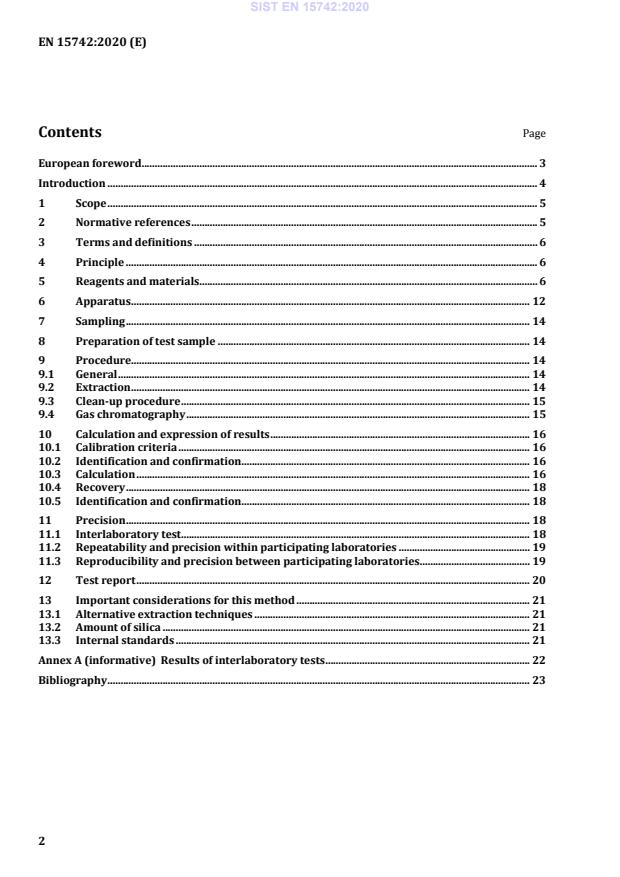
Contents Page
European foreword . 3
Introduction . 4
1 Scope . 5
2 Normative references . 5
3 Terms and definitions . 6
4 Principle . 6
5 Reagents and materials . 6
6 Apparatus . 12
7 Sampling . 14
8 Preparation of test sample . 14
9 Procedure. 14
9.1 General . 14
9.2 Extraction . 14
9.3 Clean-up procedure . 15
9.4 Gas chromatography . 15
10 Calculation and expression of results . 16
10.1 Calibration criteria . 16
10.2 Identification and confirmation. 16
10.3 Calculation . 16
10.4 Recovery . 18
10.5 Identification and confirmation. 18
11 Precision . 18
11.1 Interlaboratory test . 18
11.2 Repeatability and precision within participating laboratories . 19
11.3 Reproducibility and precision between participating laboratories . 19
12 Test report . 20
13 Important considerations for this method . 21
13.1 Alternative extraction techniques . 21
13.2 Amount of silica . 21
13.3 Internal standards . 21
Annex A (informative) Results of interlaboratory tests . 22
Bibliography . 23
European foreword
This document (EN 15742:2020) has been prepared by Technical Committee CEN/TC 327 “Animal
feeding stuffs: Methods of sampling and analysis”, the secretariat of which is held by NEN.
This European Standard shall be given the status of a national standard, either by publication of an
identical text or by endorsement, at the latest by September 2020, and conflicting national standards shall
be withdrawn at the latest by September 2020.
Attention is drawn to the possibility that some of the elements of this document may be the subject of
patent rights. CEN shall not be held responsible for identifying any or all such patent rights.
This document supersedes EN 15742:2009.
In comparison with the previous edition, the following technical modifications have been made:
The analysis of polychlorinated biphenyls (PCBs) has been removed from this standard as current
legislation on maximum limits requires sensitivity that cannot be provided by GC-ECD. Additionally,
editorial changes were made.
This document has been prepared under a standardization request given to CEN by the European
Commission and the European Free Trade Association.
According to the CEN-CENELEC Internal Regulations, the national standards organisations of the
following countries are bound to implement this European Standard: Austria, Belgium, Bulgaria, Croatia,
Cyprus, Czech Republic, Denmark, Estonia, Finland, France, Germany, Greece, Hungary, Iceland, Ireland,
Italy, Latvia, Lithuania, Luxembourg, Malta, Netherlands, Norway, Poland, Portugal, Republic of North
Macedonia, Romania, Serbia, Slovakia, Slovenia, Spain, Sweden, Switzerland, Turkey and the United
Kingdom.
Introduction
This document was developed in response to Directive 2002/32/EC of the European Parliament and the
Council of 7 May 2002 on undesirable substances in animal feed.
The previous edition of this document (EN 15742:2009) was fully validated by means of a collaborative
study for aldrin, dieldrin, endrin, p,p’-DDT, o,p’-DDT, p,p’-TDE, pp-DDE, alpha-endosulfan, beta-
endosulfan, HCB, alpha-HCH, beta-HCH and gamma-HCH. Attempts in the framework of the third Mandate
from the European Commission to CEN/TC 327 to perform additional validation of the method through
a full collaborative study (2017) for photo heptachlor, cis/trans nonachlor and keto-endrin were
unsuccessful as no more than three laboratories volunteered to send in results [1].
WARNING — The use of this document can involve hazardous materials, operations and
equipment. This standard does not purport to address all the safety problems associated with its
use. It is the responsibility of the user of this European Standard to establish appropriate safety
and health practices and determine the applicability of regulatory limitations prior to use.
1 Scope
This document specifies a gas chromatographic method with electron capture detection (ECD) for the
determination of organochlorine pesticides (OCPs) in compound feeds and oil and fats.
The method is applicable to animal compound feed, oils and fats and fish meals with a water content up
to about 20 % by weight and oil/fatty samples containing residues of one or more of the following OCPs,
toxaphene and some of their isomers and degradation products:
— aldrin;
— dieldrin;
— dichlorodiphenyltrichloroethane (DDT) (the isomers 'op'-DDT', 'pp'-DDT', 'pp'-TDE' ('pp'-DDD'), and
'pp'-DDE');
— endosulfan (as the sum of α-/β-isomers);
— endrin;
— hexachlorobenzene (HCB);
— hexachlorocyclohexane isomers α-HCH (α-BHC), β-HCH (β-BHC), γ-HCH (γ-BHC or lindane);
For the following OCPs, the method is considered a screening method. Additional in-house validation is
required for reporting validated data.
— chlordane (as the sum of chlordane isomers and oxychlordane);
— endosulfan-sulphate;
— delta-keto-endrin;
— heptachlor (as the sum of heptachlor and heptachlor epoxide);
— photo-heptachlor;
— cis- and trans-nonachlor.
A limit of quantification (LOQ) for the mentioned OCPs of 5 µg/kg is intended to be obtained. However,
10 µg/kg applies for heptachlor, aldrin, endrin, dieldrin, and endosulfan (α-/β– and sulphate). Individual
laboratories are responsible for ensuring that the equipment that they use, achieves these limits of
quantifications. The LOQs apply to the individual OCPs.
2 Normative references
The following documents are referred to in the text in such a way that some or all of their content
constitutes requirements of this document. For dated references, only the edition cited applies. For
undated references, the latest edition of the referenced document (including any amendments) applies.
EN ISO 6498, Animal feeding stuffs - Guidelines for sample preparation (ISO 6498)
3 Terms and definitions
For the purposes of this document, the following terms and definitions apply.
ISO and IEC maintain terminological databases for use in standardization at the following addresses:
• IEC Electropedia: available at http://www.electropedia.org/
• ISO Online browsing platform: available at https://www.iso.org/obp
3.1
limit of detection
smallest measured content, from which it is possible to deduce the presence of the analyte with
reasonable statistical certainty
Note 1 to entry: The limit of detection is numerically equal to three times the standard deviation of the mean of
blanc determinations (n > 10).
3.2
limit of quantification
lowest content of the analyte which can be measured with reasonable statistical certainty
Note 1 to entry: If both accuracy and precision are constant over a concentration range around the limit of
detection, then the limit of quantification is numerically equal to 6 times the standard deviation of the mean of blanc
determinations (n > 10).
4 Principle
In order to check for the presence of OCPs, a test portion of animal feeding stuff is fortified with internal
standard (PCB 198), and is extracted with ethyl acetate. The extract is concentrated and subsequently
purified by:
— gel permeation chromatography (GPC), with cyclohexane or ethyl acetate as eluting solvent;
— chromatography on partially deactivated silica gel.
The collected fraction containing the compounds of interest is concentrated and re-dissolved in a solution
containing another internal standard (PCB 209) as a reference standard. After clean up, the analytes are
measured using GC-ECD. Identification is done on the basis of comparing retention times on capillary
columns of different polarity. Quantification is done using the internal standard method.
5 Reagents and materials
5.1 General
Use only reagents of recognized analytical grade and with a purity suitable for OCP and PCB residue
analysis. Check the purity of the reagents by performing a blanc test under the same conditions as used
in the method. The chromatogram should not show any interfering impurity at the retention time of
compounds of interest.
5.2 Chemicals
5.2.1 Cyclohexane
5.2.2 Ethyl acetate
5.2.3 Hexane
5.2.4 Dichloromethane
5.2.5 Iso-octane
5.2.6 Toluene
5.2.7 Hexane/toluene = 3+7, parts by volume
Mix 30 ml of hexane (5.2.3) with 70 ml of toluene (5.2.6) thoroughly. Store at room temperature in a
tightly closed glass bottle.
5.2.8 Sodium sulphate, anhydrous
Heated to 160 °C to 200 °C during at least 24 h.
5.2.9 Ethyl acetate/cyclohexane = 1+1, parts by volume
Mix 500 ml of ethyl acetate (5.2.2) with 500 ml of cyclohexane (5.2.1) thoroughly. Store at room
temperature in a tightly closed glass bottle.
5.2.10 Silica gel, deactivated with 3,5 % water
Heat silica gel 60 (63 µm to 200 µm = 70 mesh to 230 mesh), at 130 °C for at least 5 h, allow to cool in a
desiccator, and store in a tightly stopped container in the desiccator.
Add 3,5 ml water dropwise from a burette, with continuous swirling, to 96,5 g dried silica gel in a 300 ml
Erlenmeyer flask with a ground joint.
Immediately stopper the flask with a ground stopper and shake vigorously for 5 min until all lumps have
disappeared.
Next, shake for 2 h on a mechanical shaker, and then store in a tightly stoppered container.
Deactivated silica gel is tenable during approximately 2 weeks if carefully stored.
5.2.11 Internal standard (PCB 198)
5.2.12 Internal Standard (PCB 209)
5.2.13 OCP reference standards, each with a purity not less than 99 %:
Aldrin
(1R,4S,4aS,5S,8R,8aR)-1,2,3,4,10,10-hexachloro-1,4,4a,5,8,8a-hexahydro-1,4:5,8-
dimethanonaphthalene; CAS Number: 309-00-2.
Dieldrin
(1R,4S,4aS,5R,6R,7S,8S,8aR)-1,2,3,4,10,10-hexachloro-1,4,4a,5,6,7,8,8a-octahydro-6,7epoxy-1,4:5,8-
dimethanonaphthalene; CAS Number: 60-57-1.
Delta-keto-endrin
CAS Number 53494-70-5.
Chlordane, α isomer
|1,2,4,5,6,7,8,8 octachloro-2,3,3a,4,7,7a-hexahydro-4,7-ethano-1H-indene; α isomer; CAS Number: 5103-
71-9.
Chlordane, β isomer
1,2,4,5,6,7,8,8-octachloro-2,3,3a,4,7,7a-hexahydro-4,7-ethano-1H-indene; β isomer; CAS Number: 5103-
74-2.
Oxychlordane
4,7-Methanoindan, 1,2,4,5,6,7,8,8-octachloro-2,3-epoxy-3a,4,7,7a-tetrahydro-, exo, endo-; CAS Number:
27304-13-8.
'op'-DDT' 1,1,1-trichloro-2-(2-chlorophenyl)-2-(4-chlorophenyl)ethane ; CAS Number: 789-02-6.
'pp'-DDT' 1,1,1-trichloro-2,2-bis(4-chlorophenyl) ethane ; CAS Number: 50-29-3.
'pp'-TDE'
('p,p'-DDD')1,1-dichloro-2,2-bis(4-chlorophenyl) ethane; CAS Number: 72-54-8.
'pp'-DDE' 1,1-dichloro-2,2-bis(4-chlorophenyl) ethylene; CAS Number: 72-55-9.
Endosulfan, α stereoisomer
6,9-Methano-2,4,3-benzodioxathiepin, 6,7,8,9,10,10-hexachloro-1,5,5a,6,9,9a-hexahydro-, 3-oxide, (3α,
5aβ, 6α, 9α, 9aβ); CAS Number: 959-98-8.
Endosulfan, β stereoisomer
6,9-Methano-2,4,3-benzodioxathiepin, 6,7,8,9,10,10-hexachloro-1,5,5a,6,9,9a-hexahydro-, 3-oxide,
(3α,5aα,6β,9β,9aα); CAS Number: 33213-65-9;
Endosulfan sulphate
6,9-Methano-2,4,3-benzodioxathiepin, 6,7,8,9,10,10-hexachloro-1,5,5a,6,9,9a-hexahydro-, 3,3-dioxide;
CAS Number: 1031-07-8.
Endrin
(1R,4S,4aS,5S,6S,7R,8R,8aR)-1,2,3,4,10,10-hexachloro-1,4,4a,5,6,7,8,8a-octahydro-6,7-epoxy-1,4:5,8-
dimethanonaphthalene; CAS Number: 72-20-8;
Delta-keto endrin
2,5,7-Metheno-3H-cyclopenta[a]pentalen-3-one,3b,4,5,6,6,6a-hexachlorodecahydro-, (2α,
3aβ,3bβ,4β,5β,6aβ,7α7aβ,8R); CAS 53494-70-5;
Heptachlor
1,4,5,6,7,8,8-heptachloro-3a,4,7,7a-tetrahydro-4,7-methanoindene; CAS Number: 76-44-8.
β-Heptachlor epoxide
1,4,5,6,7,8,8-heptachloro-3a,4,7,7a-tetrahydro-4,7-methanoindene(exo); CAS Number: 1024-57-3.
HCB
hexachlorobenzene; CAS Number: 118-74-1.
α-HCH (α-BHC)
α-1,2,3,4,5,6-hexachlorocyclohexane; CAS Number: 319-84-6.
β-HCH (β-BHC)
β-1,2,3,4,5,6-hexachlorocyclohexane; CAS Number: 319-85-7.
γ-HCH (γ-BHC; lindane)
γ-1,2,3,4,5,6-hexachlorocyclohexane; CAS Number: 58-89-9.
Photoheptachlor
CAS Number 33442-83-0.
Cis-nonachlor
CAS Number 5103-73-1.
Trans-nonachlor
CAS Number 39765-80-5.
Alternatively to each individual OCP reference standard listed above, use a certified mixture at a
concentration of 10 µg/ml.
5.2.14 Chlorocamphene (toxaphene)
5.3 Stock solutions, 100 µg/ml
Weigh 5 mg−10 mg (±0,01 mg) of each compound (5.2.11, 5.2.12, 5.2.13 and 5.2.14) in separate brown
medicine glass bottles of 100 ml and add iso-octane (5.2.5.) to achieve a concentration of 100 μg/ml.
Store the solutions in a refrigerator at 4 °C (±3 °C). The solution is tenable under these conditions during
at least 5 years if the weight is carefully controlled.
Dissolve ß-HCH in 10 ml toluene (5.3), to achieve complete solvability and dilute further with iso-octane
(5.2.5) to achieve a concentration of 100 μg/ml.
5.4 Mixed stock solutions
5.4.1 Mixed stock solution OCP (without endosulfan and toxaphene)
Pipet of each OCP-stock solution (5.3) the indicated volume (Table 1) in a volumetric flask of 100 ml. Fill
up to 100 ml with iso-octane (5.2.5) and mix. The achieved concentration is given in Table 1. Transport
this solution to a brown medicine glass bottle of 100 ml and store it in a refrigerator at 4 °C (±3 °C). The
solution is tenable under these conditions during at least 5 years if the weight is carefully controlled.
5.4.2 Mixed stock solution endosulfan
Pipet of each endosulfan-stock solution (5.3) the indicated volume (Table 1) in a volumetric flask of
100 ml. Fill up to 100 ml with iso-octane (5.2.5) and mix. The achieved concentration is given in Table 1.
Transport this solution to a brown medicine glass bottle of 100 ml and store it in a refrigerator at 4 °C
(±3 °C). The solution is tenable under these conditions during at least 5 years if the weight is carefully
controlled.
Table 1 — Concentration of OCPs in mixed stock solution (5.4) and mixed standard solution (5.5)
Compound Pipet Mixed stock solution Mixed standard
volume (5.4.1 and 5.4.2) solution (5.5.1 and
5.5.2)
(ml) (μg/ml)
(µg/ml)
aldrin 2,0 2,0 0,10
dieldrin 2,0 2,0 0,10
α-chlordane 1,0 1,0 0,05
γ-chlordane 1,0 1,0 0,05
oxychlordane 1,0 1,0 0,05
Compound Pipet Mixed stock solution Mixed standard
volume (5.4.1 and 5.4.2) solution (5.5.1 and
5.5.2)
(ml) (μg/ml)
(µg/ml)
o,p'-DDT 4,0 4,0 0,20
p,p'-DDT 4,0 4,0 0,20
p,p'-TDE 4,0 4,0 0,20
p,p'-DDE 4,0 4,0 0,20
α-endosulfan 2,0 2,0 0,10
β-endosulfan 2,0 2,0 0,10
endosulfan-sulphate 1,0 1,0 0,05
endrin 1,0 1,0 0,05
heptachlor 2,0 2,0 0,10
heptachlor epoxide 2,0 2,0 0,10
HCB 1,0 1,0 0,05
α-HCH 2,0 2,0 0,10
ß-HCH 1,0 1,0 0,05
γ-HCH (lindane) 1,0 1,0 0,05
photo heptachlor 2,0 2,0 0,10
cis-nonachlor 2,0 2,0 0,10
trans-nonachlor 2,0 2,0 0,10
5.4.3 Mixed stock solution toxaphene, 10,0 μg/ml
Pipet 10,0 ml of the toxaphene-stock solution (5.3) in a volumetric flask of 100 ml. Fill up to 100 ml with
iso-octane (5.2.5) and mix. Transport this solution to a brown medicine glass bottle of 100 ml and store
it in a refrigerator at 4 °C (±3 °C). The solution is tenable under these conditions during at least 5 years if
the weight is carefully controlled.
5.4.4 Internal standard stock solution PCB 198, 2,0 µg/ml
Pipet 2,0 ml of the PCB 198-stock solution (5.3) in a volumetric flask of 100 ml. Fill up to 100 ml with iso-
octane (5.2.5) and mix. Transport this solution to a brown medicine glass bottle of 100 ml and store it in
a refrigerator at 4 °C (±3 °C). The solution is tenable under these conditions during at least 5 years if the
weight is carefully controlled.
5.4.5 Internal standard stock solution PCB 209, 2,0 µg/ml
Pipet 2,0 ml of the PCB 209-stock solution (5.3) in a volumetric flask of 100 ml. Fill up to 100 ml with iso-
octane (5.2.5) and mix. Transport this solution to a brown medicine glass bottle of 100 ml and store it in
a refrigerator at 4 °C (±3 °C). The solution is tenable under these conditions during at least 5 years if the
weight is carefully controlled.
5.5 Mixed standard solution
5.5.1 Mixed standard solution OCPs, 0,05-0,20 µg/ml
Pipet 5,0 ml of the mixed stock solution OCPs (5.4.1) in a volumetric flask of 100 ml. Fill up to 100 ml with
iso-octane (5.2.5) and mix. The achieved concentration is given in Table 1. Transport this solution to a
brown medicine glass bottle of 100 ml and store it in a refrigerat
...