

EN ISO 14181:2000
(Main)Animal feeding stuffs - Determination of residues of organochlorine pesticides - Gas chromatographic method (ISO 14181:2000)
- Abstract
This International Standard specifies a gas chromatographic method for the determination of residues of
organochlorine pesticides in animal feeding stuffs.
The method is applicable to animal feeding stuffs containing residues of one or more of the following
organochlorine pesticides and some of their isomers and degradation products: aldrin, op'-DDE, pp'-DDE, op'-DDT,
pp'-DDT, dieldrin, endosulfan, endrin, HCB, _-HCH (_-BHC), _-HCH (_-BHC), _-HCH (_-BHC), _-HCH
(_-BHC), heptachlor, heptachlor epoxide, op'-TDE (op'-DDD), pp'-TDE (pp'-DDD) and methoxychlor.
The lower determination limit for these organochlorine pesticides is 0,005 _g/g. However, the lower determination
limit is 0,01 _g/g for op'-DDT and pp'-DDT, and 0,05 _g/g for methoxychlor.
- Status
- Published
- Publication Date
- 14-Sep-2000
- Technical Committee
- CEN/TC 327 - Animal feeding stuffs - Methods of sampling and analysis
- Drafting Committee
- CEN/TC 327 - Animal feeding stuffs - Methods of sampling and analysis
- Current Stage
- 9093 - Decision to confirm - Review Enquiry
- Start Date
- 16-May-2007
- Completion Date
- 16-May-2007

Overview
EN ISO 14181:2000 - "Animal feeding stuffs - Determination of residues of organochlorine pesticides - Gas chromatographic method" (CEN adoption of ISO 14181:2000) specifies a validated gas‑chromatographic procedure for measuring residues of selected organochlorine pesticides in animal feeding stuffs. The method covers target compounds such as aldrin, dieldrin, endrin, HCB, several HCH isomers, DDT/DDE/TDE isomers and methoxychlor, and includes lower determination limits as stated in the standard (e.g. 0.005 µg/g for most listed pesticides; 0.01 µg/g for o,p′‑DDT and p,p′‑DDT; 0.05 µg/g for methoxychlor).
Key topics and technical requirements
- Scope and targets: Specifies which organochlorine pesticides, isomers and degradation products are covered.
- Analytical principle: Extraction with acetone, partitioning into dichloromethane, concentration and clean‑up on a 10% water‑deactivated silica gel column, followed by gas chromatography.
- Detection: Uses gas chromatography with an electron capture detector (ECD) or a mass selective detector (GC–MS) for quantification and confirmation.
- Reagents and materials: Solvents (hexane, acetone, dichloromethane), anhydrous sodium sulfate, saturated sodium chloride, silica gel (10% water‑deactivated), and specified pesticide reference standards and internal standards (e.g., mirex or pentachloronitrobenzene).
- Quality controls: Procedures for preparing standards and internal standards, blank checks, recovery assessment, repeatability/reproducibility reporting and confirmation of identity.
- Reporting and limits: Guidance on expression of results, calculation and test reporting in accordance with the standard.
Applications and users
EN ISO 14181:2000 is practical for:
- Feed testing laboratories performing routine pesticide residue analysis in animal feeding stuffs.
- Regulatory authorities enforcing feed safety limits and monitoring organochlorine contamination.
- Quality control teams in feed production evaluating raw materials and finished feed compliance.
- Environmental and forensic labs requiring validated GC methods for organochlorine residue screening and confirmation.
Benefits include standardized sample preparation and cleanup, traceable quantification for regulatory compliance, and compatibility with GC–ECD or GC–MS instrumentation commonly used in analytical labs.
Related standards
- The method references laboratory water quality (ISO 3696) and sample preparation standards for animal feeding stuffs (e.g., ISO 6498). Consult annexes in EN ISO 14181 for normative references and example GC operating conditions.
Keywords: EN ISO 14181:2000, organochlorine pesticides, animal feeding stuffs, gas chromatographic method, pesticide residues, GC‑ECD, GC‑MS, feed analysis, residue determination.
Relations
- Effective Date
- 28-Jan-2026
- Consolidated By
ISO 14181:2000 - Animal feeding stuffs — Determination of residues of organochlorine pesticides — Gas chromatographic method - Effective Date
- 12-Feb-2026
Get Certified
Connect with accredited certification bodies for this standard

Control Union Certifications
Global certification for agriculture and sustainability.

ECOCERT
Organic and sustainability certification.

FSC International
Forest Stewardship Council certification.
Sponsored listings
Frequently Asked Questions
EN ISO 14181:2000 is a standard published by the European Committee for Standardization (CEN). Its full title is "Animal feeding stuffs - Determination of residues of organochlorine pesticides - Gas chromatographic method (ISO 14181:2000)". This standard covers: This International Standard specifies a gas chromatographic method for the determination of residues of organochlorine pesticides in animal feeding stuffs. The method is applicable to animal feeding stuffs containing residues of one or more of the following organochlorine pesticides and some of their isomers and degradation products: aldrin, op'-DDE, pp'-DDE, op'-DDT, pp'-DDT, dieldrin, endosulfan, endrin, HCB, _-HCH (_-BHC), _-HCH (_-BHC), _-HCH (_-BHC), _-HCH (_-BHC), heptachlor, heptachlor epoxide, op'-TDE (op'-DDD), pp'-TDE (pp'-DDD) and methoxychlor. The lower determination limit for these organochlorine pesticides is 0,005 _g/g. However, the lower determination limit is 0,01 _g/g for op'-DDT and pp'-DDT, and 0,05 _g/g for methoxychlor.
This International Standard specifies a gas chromatographic method for the determination of residues of organochlorine pesticides in animal feeding stuffs. The method is applicable to animal feeding stuffs containing residues of one or more of the following organochlorine pesticides and some of their isomers and degradation products: aldrin, op'-DDE, pp'-DDE, op'-DDT, pp'-DDT, dieldrin, endosulfan, endrin, HCB, _-HCH (_-BHC), _-HCH (_-BHC), _-HCH (_-BHC), _-HCH (_-BHC), heptachlor, heptachlor epoxide, op'-TDE (op'-DDD), pp'-TDE (pp'-DDD) and methoxychlor. The lower determination limit for these organochlorine pesticides is 0,005 _g/g. However, the lower determination limit is 0,01 _g/g for op'-DDT and pp'-DDT, and 0,05 _g/g for methoxychlor.
EN ISO 14181:2000 is classified under the following ICS (International Classification for Standards) categories: 65.120 - Animal feeding stuffs. The ICS classification helps identify the subject area and facilitates finding related standards.
EN ISO 14181:2000 has the following relationships with other standards: It is inter standard links to EN ISO 16911-2:2013, ISO 14181:2000. Understanding these relationships helps ensure you are using the most current and applicable version of the standard.
EN ISO 14181:2000 is available in PDF format for immediate download after purchase. The document can be added to your cart and obtained through the secure checkout process. Digital delivery ensures instant access to the complete standard document.
Standards Content (Sample)
2003-01.Slovenski inštitut za standardizacijo. Razmnoževanje celote ali delov tega standarda ni dovoljeno.RPDWRJUDIVNDFuttermittel - Bestimmung des Gehalts an Organochlorpestizid-Rückständen - Gaschromatographisches Verfahren (ISO 14181:2000)Aliments des animaux - Détermination des résidus de pesticides organochlorés - Méthode par chromatographie en phase gazeuse (ISO 14181:2000)Animal feeding stuffs - Determination of residues of organochlorine pesticides - Gas chromatographic method (ISO 14181:2000)65.120KrmilaAnimal feeding stuffsICS:Ta slovenski standard je istoveten z:EN ISO 14181:2000SIST EN ISO 14181:2001en01-februar-2001SIST EN ISO 14181:2001SLOVENSKI
STANDARD
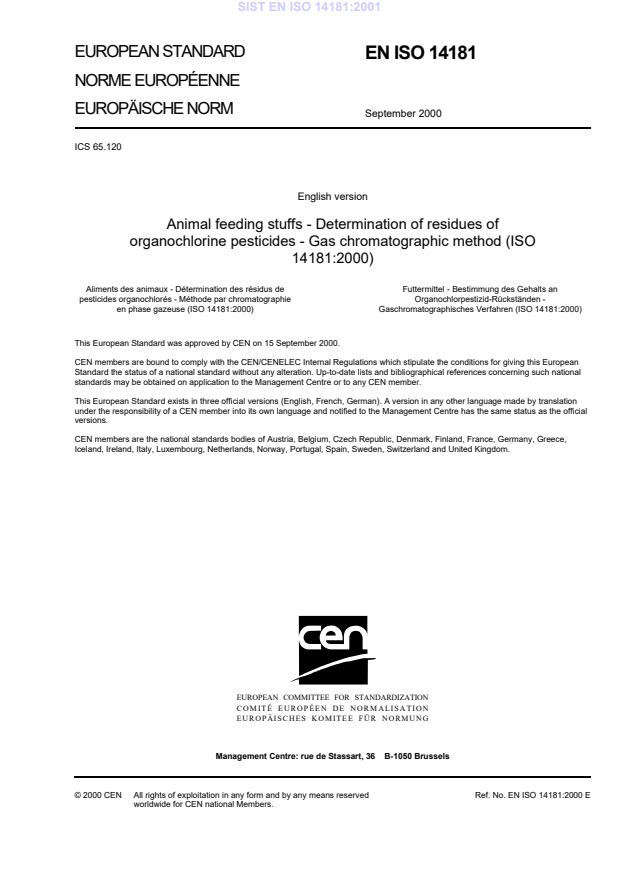
EUROPEAN STANDARDNORME EUROPÉENNEEUROPÄISCHE NORMEN ISO 14181September 2000ICS 65.120English versionAnimal feeding stuffs - Determination of residues oforganochlorine pesticides - Gas chromatographic method (ISO14181:2000)Aliments des animaux - Détermination des résidus depesticides organochlorés - Méthode par chromatographieen phase gazeuse (ISO 14181:2000)Futtermittel - Bestimmung des Gehalts anOrganochlorpestizid-Rückständen -Gaschromatographisches Verfahren (ISO 14181:2000)This European Standard was approved by CEN on 15 September 2000.CEN members are bound to comply with the CEN/CENELEC Internal Regulations which stipulate the conditions for giving this EuropeanStandard the status of a national standard without any alteration. Up-to-date lists and bibliographical references concerning such nationalstandards may be obtained on application to the Management Centre or to any CEN member.This European Standard exists in three official versions (English, French, German). A version in any other language made by translationunder the responsibility of a CEN member into its own language and notified to the Management Centre has the same status as the officialversions.CEN members are the national standards bodies of Austria, Belgium, Czech Republic, Denmark, Finland, France, Germany, Greece,Iceland, Ireland, Italy, Luxembourg, Netherlands, Norway, Portugal, Spain, Sweden, Switzerland and United Kingdom.EUROPEAN COMMITTEE FOR STANDARDIZATIONCOMITÉ EUROPÉEN DE NORMALISATIONEUROPÄISCHES KOMITEE FÜR NORMUNGManagement Centre: rue de Stassart, 36
B-1050 Brussels© 2000 CENAll rights of exploitation in any form and by any means reservedworldwide for CEN national Members.Ref. No. EN ISO 14181:2000 ESIST EN ISO 14181:2001
2EN ISO 14181:2000 (E)CORRECTED
2001-08-30ForewordThe text of the International Standard ISO 14181:2000 has been prepared by TechnicalCommittee ISO/TC 34 "Agricultural food products" in collaboration with Technical CommitteeCEN/TC 327 "Animal feeding stuffs - Methods of sampling and analysis", the secretariat ofwhich is held by NEN.This European Standard shall be given the status of a national standard, either by publicationof an identical text or by endorsement, at the latest by March 2001, and conflicting nationalstandards shall be withdrawn at the latest by March 2001.According to the CEN/CENELEC Internal Regulations, the national standards organizations ofthe following countries are bound to implement this European Standard: Austria, Belgium,Czech Republic, Denmark, Finland, France, Germany, Greece, Iceland, Ireland, Italy,Luxembourg, Netherlands, Norway, Portugal, Spain, Sweden, Switzerland and the UnitedKingdom.Endorsement noticeThe text of the International Standard ISO 14181:2000 was approved by CEN as a EuropeanStandard without any modification.NOTE: Normative references to International Standards are listed in annex ZA (normative).SIST EN ISO 14181:2001
3EN ISO 14181:2000 (E)Annex ZA (normative)Normative references to international publicationswith their relevant European publicationsThis European Standard incorporates by dated or undated reference, provisions from otherpublications. These normative references are cited at the appropriate places in the text and thepublications are listed hereafter. For dated references, subsequent amendments to or revisionsof any of these publications apply to this European Standard only when incorporated in it byamendment or revision. For undated references the latest edition of the publication referred toapplies (including amendments).NOTE Where an International Publication has been modified by common modifications,indicated by (mod.), the relevant EN/HD applies.PublicationYearTitleENYearISO 36961987Water for analytical laboratory use -Specification and test methodsEN ISO 36961995SIST EN ISO 14181:2001
ReferencenumberISO14181:2000(E)©ISO2000INTERNATIONALSTANDARDISO14181Firstedition2000-09-15Animalfeedingstuffs—Determinationofresiduesoforganochlorinepesticides—GaschromatographicmethodAlimentsdesanimaux—Déterminationdesrésidusdepesticidesorganochlorés—MéthodeparchromatographieenphasegazeuseSIST EN ISO 14181:2001
ISO14181:2000(E)PDFdisclaimerThisPDFfilemaycontainembeddedtypefaces.InaccordancewithAdobe'slicensingpolicy,thisfilemaybeprintedorviewedbutshallnotbeeditedunlessthetypefaceswhichareembeddedarelicensedtoandinstalledonthecomputerperformingtheediting.Indownloadingthisfile,partiesacceptthereintheresponsibilityofnotinfringingAdobe'slicensingpolicy.TheISOCentralSecretariatacceptsnoliabilityinthisarea.AdobeisatrademarkofAdobeSystemsIncorporated.DetailsofthesoftwareproductsusedtocreatethisPDFfilecanbefoundintheGeneralInforelativetothefile;thePDF-creationparameterswereoptimizedforprinting.EverycarehasbeentakentoensurethatthefileissuitableforusebyISOmemberbodies.Intheunlikelyeventthataproblemrelatingtoitisfound,pleaseinformtheCentralSecretariatattheaddressgivenbelow.©ISO2000Allrightsreserved.Unlessotherwisespecified,nopartofthispublicationmaybereproducedorutilizedinanyformorbyanymeans,electronicormechanical,includingphotocopyingandmicrofilm,withoutpermissioninwritingfromeitherISOattheaddressbeloworISO'smemberbodyinthecountryoftherequester.ISOcopyrightofficeCasepostale56CH-1211Geneva20Tel.+41227490111Fax+41227490947E-mailcopyright@iso.chWebwww.iso.chPrintedinSwitzerlandii©ISO2000–AllrightsreservedSIST EN ISO 14181:2001
ISO14181:2000(E)©ISO2000–AllrightsreservediiiContentsPageForeword.iv1Scope.12Normativereferences.13Principle.14Reagentsandmaterials.15Apparatus.35.1Grinder.56Sampling.57Preparationoftestsample.58Procedure.58.1General.58.2Testportion.58.3Extraction.58.4Columnclean-up.68.5Gaschromatography.69Expressionofresults.79.1Calculation.79.2Recovery.810Confirmationofidentity.811Precision.811.1Interlaboratorytest.811.2Repeatability.811.3Reproducibility.812Testreport.9AnnexA(informative)ExamplesofGCoperatingconditionsfororganochlorinepesticides.10AnnexB(informative)Resultsofinterlaboratorytest.11Bibliography.20SIST EN ISO 14181:2001
ISO14181:2000(E)iv©ISO2000–AllrightsreservedForewordISO(theInternationalOrganizationforStandardization)isaworldwidefederationofnationalstandardsbodies(ISOmemberbodies).TheworkofpreparingInternationalStandardsisnormallycarriedoutthroughISOtechnicalcommittees.Eachmemberbodyinterestedinasubjectforwhichatechnicalcommitteehasbeenestablishedhastherighttoberepresentedonthatcommittee.Internationalorganizations,governmentalandnon-governmental,inliaisonwithISO,alsotakepartinthework.ISOcollaboratescloselywiththeInternationalElectrotechnicalCommission(IEC)onallmattersofelectrotechnicalstandardization.InternationalStandardsaredraftedinaccordancewiththerulesgivenintheISO/IECDirectives,Part3.DraftInternationalStandardsadoptedbythetechnicalcommitteesarecirculatedtothememberbodiesforvoting.PublicationasanInternationalStandardrequiresapprovalbyatleast75%ofthememberbodiescastingavote.AttentionisdrawntothepossibilitythatsomeoftheelementsofthisInternationalStandardmaybethesubjectofpatentrights.ISOshallnotbeheldresponsibleforidentifyinganyorallsuchpatentrights.InternationalStandardISO14181waspreparedbyTechnicalCommitteeISO/TC34,Foodproducts,SubcommitteeSC10,Animalfeedingstuffs.AnnexesAandBofthisInternationalStandardareforinformationonly.SIST EN ISO 14181:2001
INTERNATIONALSTANDARDISO14181:2000(E)©ISO2000–Allrightsreserved1Animalfeedingstuffs—Determinationofresiduesoforganochlorinepesticides—Gaschromatographicmethod1ScopeThisInternationalStandardspecifiesagaschromatographicmethodforthedeterminationofresiduesoforganochlorinepesticidesinanimalfeedingstuffs.Themethodisapplicabletoanimalfeedingstuffscontainingresiduesofoneormoreofthefollowingorganochlorinepesticidesandsomeoftheirisomersanddegradationproducts:aldrin,op'-DDE,pp'-DDE,op'-DDT,pp'-DDT,dieldrin,endosulfan,endrin,HCB,-HCH(-BHC),-HCH(-BHC),-HCH(-BHC),-HCH(-BHC),heptachlor,heptachlorepoxide,op'-TDE(op'-DDD),pp'-TDE(pp'-DDD)andmethoxychlor.Thelowerdeterminationlimitfortheseorganochlorinepesticidesis0,005g/g.However,thelowerdeterminationlimitis0,01g/gforop'-DDTandpp'-DDT,and0,05g/gformethoxychlor.2NormativereferencesThefollowingnormativedocumentscontainprovisionswhich,throughreferenceinthistext,constituteprovisionsofthisInternationalStandard.Fordatedreferences,subsequentamendmentsto,orrevisionsof,anyofthesepublicationsdonotapply.However,partiestoagreementsbasedonthisInternationalStandardareencouragedtoinvestigatethepossibilityofapplyingthemostrecenteditionofthenormativedocumentindicatedbelow.Forundatedreferences,thelatesteditionofthenormativedocumentsreferredtoapplies.MembersofISOandIECmaintainregistersofcurrentlyvalidInternationalStandards.ISO3696:1987,Waterforanalyticallaboratoryuse—Specificationandtestmethods.ISO6498,Animalfeedingstuffs—Preparationoftestsamples.3PrincipleAtestportionisextractedwithacetone.Thefilteredextractisdilutedwithwaterandsaturatedsodiumchloridesolution.Thepesticidesarepartitionedintodichloromethane.Theconcentratedextractispurifiedonachromatographiccolumnof10%water-deactivatedsilicagel.Thepesticideresiduesaredeterminedbygaschromatographyusinganelectroncapturedetectororamassselectivedetector.4ReagentsandmaterialsUseonlyreagentsofrecognizedanalyticalgradeandwithapuritysuitableforpesticideresidueanalysis.Checkthepurityofthereagentsbyperformingablanktestunderthesameconditionsasusedinthemethod.Thechromatogramshouldnotshowanyinterferingimpurity.WARNING—Someoftheorganicsolventsaresuspectedcarcinogens.Usewithcare.4.1Water,complyingwithatleastgrade3inaccordancewithISO3696.SIST EN ISO 14181:2001
ISO14181:2000(E)2©ISO2000–Allrightsreserved4.2Hexane.4.3Acetone.4.4Dichloromethane.4.5Silicagel60,withamassfractionofwaterof10%.Activatesilicagel60,particlesize63mto200m,at130°Covernight,thencoolinadesiccator.Aftercoolingtoroomtemperature,pourthesilicagelintoanairtightglasscontainerandaddsufficientdistilledwatertobringthefinalmassfractionofwaterto10%.Shakethecontainermechanicallyorbyhandvigorouslyfor30sandallowtostandfor30minwithoccasionalshaking.After30minthesilicagelisreadyforuse.Itshouldnotbestoredformorethan6h.4.6Elutingsolvent:dichloromethaneinhexane,20%(byvolume).Mix1volumeofdichloromethanewith4volumesofhexane.4.7Inertgas,forexamplenitrogen.4.8Sodiumsulfate,anhydrous.4.9Sodiumchloride,saturatedsolution.4.10Pesticidereferencestandards,asfollows:aldrin[(1R,4S,4aS,5S,8R,8aR)-1,2,3,4,10,10-hexachloro-1,4,4a,5,8,8a-hexahydro-1,4:5,8-dimethano-naphthalene];op'-DDE[o,p'-(1,1-dichloro-2,2-bis(4-chlorophenyl)ethylene)];pp'-DDE[p,p'-(1,1-dichloro-2,2-bis(4-chlorophenyl)ethylene)];op'-DDT[o,p'-(1,1,1-trichloro-2,2-bis(4-chlorophenyl)ethane)];pp'-DDT[p,p'-(1,1,1-trichloro-2,2-bis(4-chlorophenyl)ethane)];dieldrin[(1R,4S,4aS,5R,6R,7S,8S,8aR)-1,2,3,4,10,10-hexachloro-1,4,4a,5,6,7,8,8a-octahydro-6,7epoxy-1,4:5,8-dimethanonaphthalene];endosulfan(6,7,8,9,10,10-hexachloro-1,5,5a,6,9,9a-hexahydro-6,9-methano-2,4,3-benzodioxathiepin3-oxide);endrin[(1R,4S,4aS,5S,6S,7R,8R,8aR)-1,2,3,4,10,10-hexachloro-1,4,4a,5,6,7,8,8a-octahydro-6,7-epoxy-1,4:5,8-dimethanonaphthalene];HCB(hexachlorobenzene);-HCH(-BHC)(-1,2,3,4,5,6-hexachlorocyclohexane);-HCH(-BHC)(-1,2,3,4,5,6-hexachlorocyclohexane);-HCH(-BHC;lindane)(-1,2,3,4,5,6-hexachlorocyclohexane);-HCH(-BHC)(-1,2,3,4,5,6-hexachlorocyclohexane);heptachlor(1,4,5,6,7,8,8-heptachloro-3a,4,7,7a-tetrahydro-4,7-methanoindene);heptachlorepoxide(heptachloroepoxy-tetrahydromethanoindene);SIST EN ISO 14181:2001
ISO14181:2000(E)©ISO2000–Allrightsreserved3op'-TDE(op-DDD)[o,p'-1,1-dichloro-2,2-bis(4-chlorophenyl)ethane];pp'-TDE(pp'-DDD)[p,p'-1,1-dichloro-2,2-bis(4-chlorophenyl)ethane];methoxychlor[1,1,1-trichloro-2,2-bis(4-methoxyphenyl)ethane].4.11Internalstandard:mirex(1,3,5-tribromobenzene)orpentachloronitrobenzene.4.12Pesticidestandardandinternalstandardsolutions.4.12.1Stocksolutions,ofconcentration1000g/ml.Prepareastocksolutionofeachpesticidereferencestandard(4.10)andoftheinternalstandard(4.11)asfollows.Weigh,tothenearest0,1mg,amassofapesticidereferencestandard(4.10)ortheinternalstandard(4.11)whichwillresultinasolutionwithacontentofreferencestandardorinternalstandardof1000g/ml.Whileweighing,observethecleannessofthestandardmatrial.Transfertheweighedmassintoavolumetricflask,dissolveinhexaneorinanothersolventsuchastolueneorisooctane.However,dissolve-HCHinacetone.Dilutetovolumewiththesamesolventandmixwell.Thesesolutionsarestablefor6monthswhenstoredat4Cinthedark.4.12.2Intermediatesolutions,ofconcentration10g/ml.Pipette1mlofeachstocksolution(4.12.1)intoindividual100mlvolumetricflasks.Dilutetovolumewithhexane.Thesolutionsarestableforatleast3monthswhenstoredat4°Cinthedark.NOTEThestabilityofproperlystoredpesticidestandardsisverywidelyknown.Investigationshaveshownthatallneatpesticidestandardstestedarestablefor15yearswhenstoredat–18°Candthatstocksolutionsofpesticidestandardsintolueneof1mg/mlarestableforatleast3yearswhenstoredat–18°C.Thefollowingrecommendedpracticemaybeusedforlongerstorage.TransferportionsofthepreparedstandardsolutionstoambervialswithPTFE-linedscrewcaps.Weighthevialsandstoreat–20°C.Whenneeded,removeavialfromthefreezer,bringtoroomtemperatureandweigh.Iftheaccumulatedlossinmassduetoevaporationis10%ormoreoftheprefrozennetmass,discardthevial.Weighandrefreezestockstandardsandintermediatesolutionsthatareinuseformorethan3months(usuallyin25mlvials).Otherwisethepreparedstandardsolutions(usuallyin2mlvials)maybestoredat4°Candshallbediscardedafter3months.4.12.3Workingsolution,ofconcentration0,05g/ml.Pipettea0,5mlofeachintermediatesolution(4.12.2)intoa100mlvolumetricflaskanddilutetovolumewithhexane.Thesolutionisstablefor1monthwhenstoredat4°Cinthedark(see4.12.2).5ApparatusBeforeuse,washallglasswarethoroughlywithdetergentfreeofinterferingsubstances.Rinsewithwater,thenwithacetoneanddry.Avoidtheuseofplasticscontainersanddonotlubricatethestopcockswithgrease,otherwiseimpuritiescouldbeintroducedintothesolvents.Usuallaboratoryequipmentand,inparticular,thefollowing.5.1Separatingfunnels,of500mlcapacitywithpolytetrafluoroethylene(PTFE)stopcocksandstoppers.5.2Filteringflasks,of500mlcapacity.SIST EN ISO 14181:2001
ISO14181:2000(E)4©ISO2000–Allrightsreserved5.3Büchnerfunnel,ofporcelain,withinternaldiameter90mm.5.4Graduatedtubes,of10mlcapacity,withpolytetrafluoroethylene(PTFE)stoppers.5.5Glasschromatographictube,about300mminlength,8mmto10mminternaldiameter,withcoarsefrittedplateofporositygradeP100(poresizeindex40mto100m[2])orglasswoolplug.5.6Rotaryvacuumevaporator,providedwithround-bottomflasksof100mland500mlcapacitiesandawaterbathat40C2°C.5.7Mechanicalshakerorhigh-speedblender.5.8Gaschromatographicsystemconsistingof:splitlessoron-columninjectionsystem;column;electroncapturedetectorormassselectivedetector;electrometer;mVrecorderorintegrator;datahandlingsoftwareandcomputersystem.Eachinjectionport,columnovenanddetectorshallbeprovidedwithanindependentheatingdevicecontrolledtothenearest0,1C.Thechromatographicsystemshallbeadjustedandtheparametersoptimizedaccordingtothecharacteristicsoftheinstrumentused.5.8.1InjectiondeviceAnautosampleroranyotheradequateinjectiondevicemaybeused.Formanualinjections,useamicrosyringeof1lto5lcapacitywithaneedlelengthsuitableforthemodeofinjection(splitlessoron-column).Beforeinjectingthesolutionintothegaschromatograph,rinsethesyringe10timeswithpuresolvent,then5timeswithsolution.Afterinjection,rinsethesyringe5timeswithpuresolvent.5.8.2ColumnTheuseofcapillarycolumnscoatedwithmid-rangepolaritystationaryphases(e.g.SE-30,SE-54,OV-17,orequivalent)isrecommended.Standardglasscolumns,oflength2mto4mandofinternaldiameter2mmto4mm,packedwithamixtureof2,5%QF1+1%OV11+0,5%XE60onChromosorbWHP0,125mmto0,15mmparticlesize,oranyotherstationaryphasesandinertsupportsrecommendedfororganochlorineresidueanalysescouldbeusedasanalternative.Thetemperatureprogrammeforthecolumnshallbechosentoseparatethepesticidesmixturespecifiedinclause1intoindividualcomponents(seeannexA).Afterinstallinganewcolumn,itshallbeconditionedforatleast24hatatemperatureslightlyabovethemaximumproposedoperatingtemperature,withcarriergasflowingthroughitandtheendofthecolumndisconnectedfromthedetector.SIST EN ISO 14181:2001
ISO14181:2000(E)©ISO2000–Allrightsreserved55.8.3DetectorUseanelectroncapturedetector(ECD)operatingeitherinconstantcurrentmodeorinconstantfrequencymodeatthepolarizationvoltage,width,amplitudeorfrequencyofthepulsesatwhichamaximumof0,05ngheptachlorepoxidecauses40%to50%full-scaledeflection.5.8.4Carriergasandmake-upgasPurenitrogen(oxygen-free),pureheliumorpurehydrogen,oramixtureofargonandmethane[90+10,byvolumeor(95+5)%byvolume].5.9Grinder6SamplingItisimportantthatthelaboratoryreceiveasamplewhichistrulyrepresentativeandhasnotbeendamagedorchangedduringtransportorstorage.SamplingisnotpartofthemethodspecifiedinthisInternationalStandard.ArecommendedsamplingmethodisgiveninISO6497[1].7PreparationoftestsamplePreparethetestsampleinaccordancewithISO6498.Grindaportionofthewell-mixedlaboratorysample(dryorlowmoistureproductssuchascerealsandcerealproducts,oilseedsandoilseedmeals,mixedfeeds,hay,etc.)sothatitpassescompletelythroughasievewith1mmapertures.Mixthoroughly.Chopupthehighmoistureproducts(e.g.grasses,silages,etc.)andmixthoroughlytoobtainhomogeneoussamples.8Procedure8.1GeneralCarryoutsteps8.2to8.4usingboththepreparedtestsample(clause7)andablanksample.Theblanksampleshallbefreeofresiduesatorabovethelimitsofdetectionfoundfrompreviousdeterminations.Theblankextractisusedtopreparethematrix-matchedstandardsolution(see8.5.3).8.2TestportionWeigh,tothenearest0,1g,50gofthepreparedtestsample(clause7)fordryorlowmoistureproducts,or100gforhighmoistureproducts,intoa1000mlconicalflask.8.3ExtractionAddsufficientwatertothetestportionsothatatotalwateramountofabout100gisobtained.Allowthesampletosoakforabout5min.Add200mlofacetone.Closetheflasktightlyandshakefor2honamechanicalshakerorhomogenizefor2mininahigh-speedblender.FilterthehomogenatewithsuctionthroughaBüchnerfunnel(5.3)fittedwithfilterpaperofmediumporosity,intoa500mlfilteringflask(5.2).Washtheconicalflaskortheblendercupandtheresidueonthefilterpaperwithtwo25mlportionsofacetone,collectingthewashingsinthesamefilteringflask.SIST EN ISO 14181:2001
ISO14181:2000(E)6©ISO2000–AllrightsreservedMeasurethevolumeofthefiltrate(V1)andtransferone-fifthofthesolution(V2)toa500mlseparatingfunnel.Add250mlofwater,about50mlofsaturatedsodiumchloridesolution(4.9)and100mlofdichloromethane(4.4)totheseparatingfunnel.Stopperandshakefor2min.Allowthephasestoseparateanddrawoffthelowerphase(dichloromethane)intoasecond500mlseparatingfunnel(5.1).Repeattheextractiontwicewith50mlofdichloromethanethencombinetheextractsinthesame500mlseparatingfunnel.Washthedichloromethaneextractwithtwo100mlportionsofwater,discardingthewashings.Filterthedichloromethaneextractthroughafilterpapercontainingabout20gofsodiumsulfate(4.8)intoa500mlflaskofavacuumevaporator.Rinsetheseparatingfunnelandthesodiumsulfatewithtwo10mlportionsofdichloromethaneandaddtotheflask.Concentratethesolutiontoabout2mlundervacuumatatemperaturenotexceeding40C.Transferthesolutiontoa10mlgraduatedtubeusing1mlto2mlofhexaneandconcentrateundernitrogentoabout1ml.Donotallowthesolutiontodrycompletelyorlossesofpesticidesmayoccurbecauseofvolatilityorpoorsolubility.8.4Columnclean-up8.4.1PreparationofthecolumnTransfer5gofsilicagel(4.5)toaglasschromatographictube(5.5).Add5gofanhydroussodiumsulfate(4.8)onthetopofthesilicagel.Washthepreparedcolumnwith20mlofhexane.NOTEPrepackedsilicaorflorisilcartridges(e.g.Millipore-SEPPAK)maybeusedinsteadofasilicagelcolumn,aftercheckingforefficiencyandabsenceofinterferences.8.4.2PurificationTransferquantitativelytheconcentratedextract(8.3)onthetopofthecolumn(8.4.1)using1mlto2mlportionsofhexane.Elutetheorganochlorinepesticideswith50mlofelutingsolvent(4.6)andcollecttheeluateinthe100mlflaskoftherotaryvacuumevaporator(5.6).Concentratetheeluatetoabout2mlundervacuumatatemperaturenotexceeding40°C.Addabout10mlofhexaneandconcentrateoncemoretoabout1ml.Repeattwotimes,leavingabout1mlofhexaneatthefinalevaporation.Transfertoa10mlgraduatedtubeusing1mlto2mlofhexane.Dilutethesampleextractto10mlwithhexanefordeterminationbychromatography.Whenaninternalstandardmethodisused,add1mloftheintermediatesolution(4.12.2)oftheinternalstandard(4.11)tothefinalextractbeforedilutingto10mlwithhexane.Keeptheblankextracttopreparethematrix-matchedstandardsolution(see8.5).8.5Gaschromatography8.5.1PreparationofthesystemEquilibratethegaschromatographicsystemundertherecommendedoperatingconditions(5.8
...