

EN 17203:2018
(Main)Determination of citrinin in food by liquid chromatography tandem mass spectrometry (LC-MS/MS)
- Abstract
This document describes a procedure for the determination of the citrinin content in food (cereals, red yeast rice (RYR)), herbs and food supplements by liquid chromatography tandem mass spectrometry (LC MS/MS).
This method has been validated for citrinin in red yeast rice and in the formulated food supplements in the range of 2,5 µg/kg to 3000 µg/kg and in wheat flour in the range of 2,5 µg/kg to 100 µg/kg.
Laboratory experiences have shown that this method is also applicable to white rice, herbs such as a powder of ginkgo biloba leaves and the formulated food supplements in the range of 2,5 µg/kg to 50 µg/kg.
- Status
- Withdrawn
- Publication Date
- 18-Dec-2018
- Withdrawal Date
- 06-Oct-2026
- Technical Committee
- CEN/TC 275 - Food analysis - Horizontal methods
- Drafting Committee
- CEN/TC 275/WG 5 - Biotoxins
- Current Stage
- 9960 - Withdrawal effective - Withdrawal
- Start Date
- 05-May-2021
- Completion Date
- 07-Oct-2026



Relations
- Effective Date
- 08-Jun-2022
- Effective Date
- 28-Jan-2026
Get Certified
Connect with accredited certification bodies for this standard

BSI Group
BSI (British Standards Institution) is the business standards company that helps organizations make excellence a habit.

Bureau Veritas
Bureau Veritas is a world leader in laboratory testing, inspection and certification services.

DNV
DNV is an independent assurance and risk management provider.
Sponsored listings
Frequently Asked Questions
EN 17203:2018 is a standard published by the European Committee for Standardization (CEN). Its full title is "Determination of citrinin in food by liquid chromatography tandem mass spectrometry (LC-MS/MS)". This standard covers: This document describes a procedure for the determination of the citrinin content in food (cereals, red yeast rice (RYR)), herbs and food supplements by liquid chromatography tandem mass spectrometry (LC MS/MS). This method has been validated for citrinin in red yeast rice and in the formulated food supplements in the range of 2,5 µg/kg to 3000 µg/kg and in wheat flour in the range of 2,5 µg/kg to 100 µg/kg. Laboratory experiences have shown that this method is also applicable to white rice, herbs such as a powder of ginkgo biloba leaves and the formulated food supplements in the range of 2,5 µg/kg to 50 µg/kg.
This document describes a procedure for the determination of the citrinin content in food (cereals, red yeast rice (RYR)), herbs and food supplements by liquid chromatography tandem mass spectrometry (LC MS/MS). This method has been validated for citrinin in red yeast rice and in the formulated food supplements in the range of 2,5 µg/kg to 3000 µg/kg and in wheat flour in the range of 2,5 µg/kg to 100 µg/kg. Laboratory experiences have shown that this method is also applicable to white rice, herbs such as a powder of ginkgo biloba leaves and the formulated food supplements in the range of 2,5 µg/kg to 50 µg/kg.
EN 17203:2018 is classified under the following ICS (International Classification for Standards) categories: 67.050 - General methods of tests and analysis for food products. The ICS classification helps identify the subject area and facilitates finding related standards.
EN 17203:2018 has the following relationships with other standards: It is inter standard links to EN 17203:2021, EN ISO 3696:1995. Understanding these relationships helps ensure you are using the most current and applicable version of the standard.
EN 17203:2018 is associated with the following European legislation: EU Directives/Regulations: 882/2004; Standardization Mandates: M/520. When a standard is cited in the Official Journal of the European Union, products manufactured in conformity with it benefit from a presumption of conformity with the essential requirements of the corresponding EU directive or regulation.
EN 17203:2018 is available in PDF format for immediate download after purchase. The document can be added to your cart and obtained through the secure checkout process. Digital delivery ensures instant access to the complete standard document.
Standards Content (Sample)
2003-01.Slovenski inštitut za standardizacijo. Razmnoževanje celote ali delov tega standarda ni dovoljeno.Lebensmittel - Bestimmung von Citrinin in Lebensmitteln mit Flüssigchromatographie und Tandem-Massenspektrometrie (LC-MS/MS)Produits alimentaires - Dosage de la citrinine dans les produits alimentaires par chromatographie liquide couplée à une spectrométrie de masse en tandem (CL-SM/SM)Foodstuffs - Determination of citrinin in food by liquid chromatography tandem mass spectrometry (LC-MS/MS)67.050Splošne preskusne in analizne metode za živilske proizvodeGeneral methods of tests and analysis for food productsICS:Ta slovenski standard je istoveten z:EN 17203:2018SIST EN 17203:2019en,fr,de01-marec-2019SIST EN 17203:2019SLOVENSKI
STANDARD
EUROPEAN STANDARD NORME EUROPÉENNE EUROPÄISCHE NORM
EN 17203
December
t r s z ICS
x yä r w r English Version
Foodstuffs æ Determination of citrinin in food by liquid Produits alimentaires æ Dosage de la citrinine dans les produits alimentaires par chromatographie liquide
Lebensmittel æ Bestimmung von Citrinin in Lebensmitteln mit Flüssigchromatographie und TandemæMassenspektroThis European Standard was approved by CEN on
{ November
t r s zä
egulations which stipulate the conditions for giving this European Standard the status of a national standard without any alterationä Upætoædate lists and bibliographical references concerning such national standards may be obtained on application to the CENæCENELEC Management Centre or to any CEN memberä
translation under the responsibility of a CEN member into its own language and notified to the CENæCENELEC Management Centre has the same status as the official versionsä
CEN members are the national standards bodies of Austriaá Belgiumá Bulgariaá Croatiaá Cyprusá Czech Republicá Denmarká Estoniaá Finlandá Former Yugoslav Republic of Macedoniaá Franceá Germanyá Greeceá Hungaryá Icelandá Irelandá Italyá Latviaá Lithuaniaá Luxembourgá Maltaá Netherlandsá Norwayá Polandá Portugalá Romaniaá Serbiaá Slovakiaá Sloveniaá Spainá Swedená Switzerlandá Turkey and United Kingdomä
EUROPEAN COMMITTEE FOR STANDARDIZATION COMITÉ EUROPÉEN DE NORMALISATION EUROPÄISCHES KOMITEE FÜR NORMUNG
CEN-CENELEC Management Centre:
Rue de la Science 23,
B-1040 Brussels
t r s z CEN All rights of exploitation in any form and by any means reserved worldwide for CEN national Membersä Refä Noä EN
s y t r uã t r s z ESIST EN 17203:2019
Page
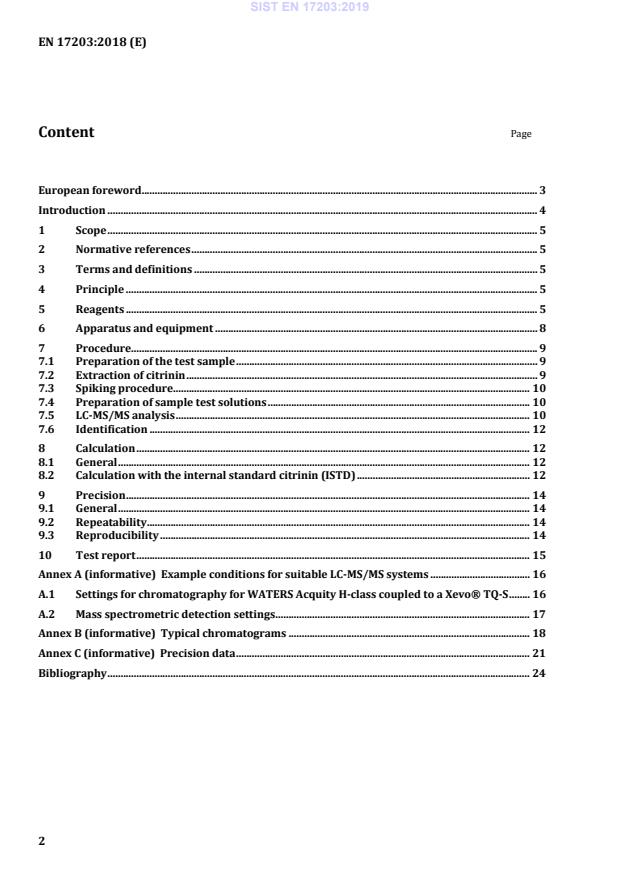
European foreword . 3 Introduction . 4 1 Scope . 5 2 Normative references . 5 3 Terms and definitions . 5 4 Principle . 5 5 Reagents . 5 6 Apparatus and equipment . 8 7 Procedure. 9 7.1 Preparation of the test sample . 9 7.2 Extraction of citrinin . 9 7.3 Spiking procedure . 10 7.4 Preparation of sample test solutions . 10 7.5 LC-MS/MS analysis . 10 7.6 Identification . 12 8 Calculation . 12 8.1 General . 12 8.2 Calculation with the internal standard citrinin (ISTD) . 12 9 Precision . 14 9.1 General . 14 9.2 Repeatability . 14 9.3 Reproducibility . 14 10 Test report . 15 Annex A (informative)
Example conditions for suitable LC-MS/MS systems . 16 A.1 Settings for chromatography for WATERS Acquity H-class coupled to a Xevo® TQ-S . 16 A.2 Mass spectrometric detection settings . 17 Annex B (informative)
Typical chromatograms . 18 Annex C (informative)
Precision data . 21 Bibliography . 24
IEC Electropedia: available at http://www.electropedia.org/
ISO Online browsing platform: available at http://www.iso.org/obp 4 Principle A test portion is humidified with a hydrochloric acid aqueous solution and extracted with ethyl acetate/acetonitrile/glacial acetic acid mixture for 60 min. Magnesium sulfate and sodium chloride are added to the extract, agitated and centrifuged in order to expel water and allow phase separation from the mixture. An aliquot of supernatant is collected, filtered, isotopic labelled internal standard (ISTD) solution is added and analysed by reversed phase LC-MS/MS. Quantification is based on matching citrinin/citrinin-13C ratios and citrinin concentrations. 5 Reagents Use only reagents of recognized analytical grade and water complying with grade 1 of EN ISO 3696, unless otherwise specified. Commercially available solutions with equivalent properties to those listed may also be used. 5.1 Ethyl acetate, analytical grade or higher. 5.2 Acetonitrile, LC-MS grade. . 5.3 Glacial acetic acid (CH3COOH), analytical grade or higher. 5.4 Glacial acetic acid (CH3COOH), LC-MS grade. 5.5 Magnesium sulfate; anhydrous (MgSO4), analytical grade or higher. SIST EN 17203:2019
« s z °C. 5.16 Mobile phase A: ammonium acetate/glacial acetic acid in water, c = 5 mmol/l. Add 1 ml of ammonium acetate/glacial acetic acid in water (5.15) to 999 ml of water (5.9) and mix thoroughly. 5.17 Mobile phase B: ammonium acetate/glacial acetic acid in methanol, c = 5 mmol/l. Add 1 ml of ammonium acetate/glacial acetic acid in water (5.15) to 999 ml of methanol (5.10) and mix thoroughly. 5.18 Citrinin, analytical standard > 99 %, e.g. crystalline or as certified standard solution. 5.19 Citrinin stock solution, mass concentration
= 500 µg/ml. Weigh 5 mg of crystalline citrinin to the nearest 0,1 mg into a 10 ml volumetric flask and dissolve with acetonitrile (5.2) by filling up to the mark. The mass concentration of this stock solution shall be checked. This can be achieved via LC-MS/MS analysis against the certified standard solution (5.18) or by a photometric determination of concentration using the molar extinction coefficient [8]. The certified standard solution (5.18) can alternatively be used as stock solution. SIST EN 17203:2019
= 100 µg/ml. Pipette 1 ml of the stock solution (5.19) into 4 ml of the dilution solution (5.14) and homogenize the mixture. A correction factor (see 5.19) shall be determined and used to correct the exact concentration of this working solution (mass concentration
= 100 µg/ml). This step may be omitted when using the certified standard solution (5.18). The stock and working solutions can be used for 12 months if stored at <
« s z °C and protected against light and moisture. 5.21 Citrinin intermediate solution,
= 1 µg/ml. Pipette 50 µl of the citrinin working solution (5.20) into 4950 µl of the dilution solution (5.14) which results in 5 ml and homogenize the mixture. Use this intermediate solution as spiking solution for recovery experiments. This solution can be used for 3 months if stored in amber flasks (6.13) at <
« s z °C. 5.22 Citrinin-13C stock solution, as standard solution at a given mass concentration, e.g.
= 100 µg/ml. After opening, the stock solution can usually be used for 12 months if stored at <
« s z °C in amber flasks (see its expiry date in the Certificate of Analysis). If obtained as crystalline, dissolve the citrinin-13C in a suitable amount of acetonitrile (5.2) to obtain a stock solution at a suitable mass concentration (e.g.
= 100 µg/ml). The stock solution can usually be used for 12 months if stored at <
« s z °C. 5.23 Citrinin-13C intermediate solution,
= 100 ng/ml. Dilute the citrinin-13C stock solution (5.22) with dilution solution (5.14) and mix well to obtain the citrinin-13C intermediate solution at a concentration of
= 100 ng/ml. Use this solution as internal standard (ISTD) and add it to each of the sample extracts, the calibration solutions (5.24) and citrinin control solution (5.25). This solution can be used for 6 months if stored in amber flasks at <
« s z °C. Check the stability of the solution when using after 6 months. 5.24 Calibration solutions. Prepare e.g. the following calibration solutions (within a range from 0,25 ng/ml to 50 ng/ml) as outlined in Table 1 using the citrinin intermediate solution (5.21) and the dilution solution (5.14). Homogenize the mixtures. These calibration solutions shall be freshly prepared on the day of the analysis. Start with calibration solution 6 which is then used to prepare calibration solutions 1, 2 and 3 (see Table 1). SIST EN 17203:2019
ng/ml µl µl µl µl 1 0,25 1000
5 995 2 0,5 1000
10 990 3 1 1000
20 980 4 10 1000 10
990 5 20 1000 20
980 6 50 1000 50
950 Take 45 µl from every calibration solution (1 to 6), add 5 µl of the citrinin-13C intermediate solution (5.23) and mix. It is also possible to increase the volumes of the calibration and intermediate solutions in proportion to one another. 5.25 Citrinin control solution,
= 25 ng/ml. Prepare a citrinin control solution from the certified standard solution (5.18). Alternatively, prepare a citrinin control solution from a suitable independent citrinin stock solution that has been checked photometrically or has been checked via a certified standard solution (5.18). Prepare the control solution ( = 25 ng/ml) by diluting the stock solution with dilution solution (5.14). Add 5 µl of the citrinin-13C intermediate solution (5.23) to 45 µl of this control solution before analysis. This control solution can be used for 3 months if stored in amber flasks at <
« s z °C. 6 Apparatus and equipment Usual laboratory glassware and equipment, in particular, the following. For glassware, use preferably amber coloured to reduce light effect and degradation of citrinin. 6.1 Laboratory balance, accuracy of 0,01 g. 6.2 Analytical balance, accuracy of 0,1 mg. 6.3 Laboratory shaker. 6.4 Centrifuge, suitable for 50 ml centrifuge tubes. 6.5 Centrifuge, suitable for 1,5 ml centrifuge tubes. 6.6 Pipettes, adjustable e.g. 1 µl to 1000 µl, suitable for organic solvents, with appropriate tips. 6.7 Centrifuge tubes, 50 ml. SIST EN 17203:2019
1 Eppendorf is a trade name of a centrifugation tube supplied by Eppendorf International. This information is given for the convenience of users of this European Standard and does not constitute an endorsement by CEN of the product named. Equivalent tubes may be used if they can be shown to lead to the same results. SIST EN 17203:2019
...