

CEN/TS 17329-1:2021
(Main)Foodstuffs - General guidelines for the validation of qualitative real-time PCR methods - Part 1: Single-laboratory validation
General Information
- Abstract
This document describes the performance characteristics and minimum performance criteria for conducting a single-laboratory validation study for qualitative (binary) real-time polymerase chain reaction (PCR) methods applied for the detection of specific DNA sequences present in foods.
The protocol was developed for qualitative real-time PCR methods for the detection of DNA sequences derived from genetically modified foodstuffs. It is applicable also for single-laboratory validation of qualitative PCR methods used for analysis of other food materials, e.g. for species detection and identification.
The document does not cover the evaluation of the applicability and the practicability with respect to the specific scope of the PCR method.
- Status
- Withdrawn
- Publication Date
- 22-Jun-2021
- Withdrawal Date
- 29-Sep-2026
- Technical Committee
- CEN/TC 275 - Food analysis - Horizontal methods
- Drafting Committee
- CEN/TC 275/WG 11 - Genetically modified foodstuffs
- Current Stage
- 9960 - Withdrawal effective - Withdrawal
- Start Date
- 16-Apr-2025
- Completion Date
- 30-Sep-2026

Relations
- Effective Date
- 30-Jun-2021
- Effective Date
- 20-Apr-2022
- Effective Date
- 09-Feb-2026
- Effective Date
- 28-Jan-2026
- Effective Date
- 28-Jan-2026
- Effective Date
- 28-Jan-2026
- Effective Date
- 28-Jan-2026
- Effective Date
- 28-Jan-2026
Get Certified
Connect with accredited certification bodies for this standard

BSI Group
BSI (British Standards Institution) is the business standards company that helps organizations make excellence a habit.

Bureau Veritas
Bureau Veritas is a world leader in laboratory testing, inspection and certification services.

DNV
DNV is an independent assurance and risk management provider.
Sponsored listings
Frequently Asked Questions
CEN/TS 17329-1:2021 is a technical specification published by the European Committee for Standardization (CEN). Its full title is "Foodstuffs - General guidelines for the validation of qualitative real-time PCR methods - Part 1: Single-laboratory validation". This standard covers: This document describes the performance characteristics and minimum performance criteria for conducting a single-laboratory validation study for qualitative (binary) real-time polymerase chain reaction (PCR) methods applied for the detection of specific DNA sequences present in foods. The protocol was developed for qualitative real-time PCR methods for the detection of DNA sequences derived from genetically modified foodstuffs. It is applicable also for single-laboratory validation of qualitative PCR methods used for analysis of other food materials, e.g. for species detection and identification. The document does not cover the evaluation of the applicability and the practicability with respect to the specific scope of the PCR method.
This document describes the performance characteristics and minimum performance criteria for conducting a single-laboratory validation study for qualitative (binary) real-time polymerase chain reaction (PCR) methods applied for the detection of specific DNA sequences present in foods. The protocol was developed for qualitative real-time PCR methods for the detection of DNA sequences derived from genetically modified foodstuffs. It is applicable also for single-laboratory validation of qualitative PCR methods used for analysis of other food materials, e.g. for species detection and identification. The document does not cover the evaluation of the applicability and the practicability with respect to the specific scope of the PCR method.
CEN/TS 17329-1:2021 is classified under the following ICS (International Classification for Standards) categories: 67.050 - General methods of tests and analysis for food products. The ICS classification helps identify the subject area and facilitates finding related standards.
CEN/TS 17329-1:2021 has the following relationships with other standards: It is inter standard links to CEN/TS 17329-1:2019, EN ISO 11781:2025, ISO 16577:2016, EN ISO 24276:2006, EN ISO 21571:2005/A1:2013, EN ISO 21571:2005, EN ISO 12870:2025, EN ISO 12870:2018. Understanding these relationships helps ensure you are using the most current and applicable version of the standard.
CEN/TS 17329-1:2021 is associated with the following European legislation: EU Directives/Regulations: 2017/625, 882/2004. When a standard is cited in the Official Journal of the European Union, products manufactured in conformity with it benefit from a presumption of conformity with the essential requirements of the corresponding EU directive or regulation.
CEN/TS 17329-1:2021 is available in PDF format for immediate download after purchase. The document can be added to your cart and obtained through the secure checkout process. Digital delivery ensures instant access to the complete standard document.
Standards Content (Sample)
SLOVENSKI STANDARD
01-september-2021
Nadomešča:
SIST-TS CEN/TS 17329-1:2019
Živila - Splošne smernice za validacijo kvalitativnih metod PCR v realnem času - 1.
del: Validacija v posameznem laboratoriju
Foodstuffs - General guidelines for the validation of qualitative real-time PCR methods -
Part 1: Single-laboratory validation
Lebensmittel - Allgemeine Anleitung für die Validierung qualitativer Realtime-PCR-
Verfahren - Teil 1: Einzellaborvalidierung
Denrées alimentaires - Lignes directrices générales pour la validation des méthodes de
PCR qualitative en temps réel - Partie 1 : Validation intralaboratoire
Ta slovenski standard je istoveten z: CEN/TS 17329-1:2021
ICS:
67.050 Splošne preskusne in General methods of tests and
analizne metode za živilske analysis for food products
proizvode
2003-01.Slovenski inštitut za standardizacijo. Razmnoževanje celote ali delov tega standarda ni dovoljeno.
CEN/TS 17329-1
TECHNICAL SPECIFICATION
SPÉCIFICATION TECHNIQUE
June 2021
TECHNISCHE SPEZIFIKATION
ICS 67.050 Supersedes CEN/TS 17329-1:2019
English Version
Foodstuffs - General guidelines for the validation of
qualitative real-time PCR methods - Part 1: Single-
laboratory validation
Denrées alimentaires - Lignes directrices générales Lebensmittel - Allgemeine Anleitung für die
pour la validation des méthodes de PCR qualitative en Validierung qualitativer Realtime-PCR-Verfahren - Teil
temps réel - Partie 1 : Validation intralaboratoire 1: Einzellaborvalidierung
This Technical Specification (CEN/TS) was approved by CEN on 16 May 2021 for provisional application.
The period of validity of this CEN/TS is limited initially to three years. After two years the members of CEN will be requested to
submit their comments, particularly on the question whether the CEN/TS can be converted into a European Standard.
CEN members are required to announce the existence of this CEN/TS in the same way as for an EN and to make the CEN/TS
available promptly at national level in an appropriate form. It is permissible to keep conflicting national standards in force (in
parallel to the CEN/TS) until the final decision about the possible conversion of the CEN/TS into an EN is reached.
CEN members are the national standards bodies of Austria, Belgium, Bulgaria, Croatia, Cyprus, Czech Republic, Denmark, Estonia,
Finland, France, Germany, Greece, Hungary, Iceland, Ireland, Italy, Latvia, Lithuania, Luxembourg, Malta, Netherlands, Norway,
Poland, Portugal, Republic of North Macedonia, Romania, Serbia, Slovakia, Slovenia, Spain, Sweden, Switzerland, Turkey and
United Kingdom.
EUROPEAN COMMITTEE FOR STANDARDIZATION
COMITÉ EUROPÉEN DE NORMALISATION
EUROPÄISCHES KOMITEE FÜR NORMUNG
CEN-CENELEC Management Centre: Rue de la Science 23, B-1040 Brussels
© 2021 CEN All rights of exploitation in any form and by any means reserved Ref. No. CEN/TS 17329-1:2021 E
worldwide for CEN national Members.
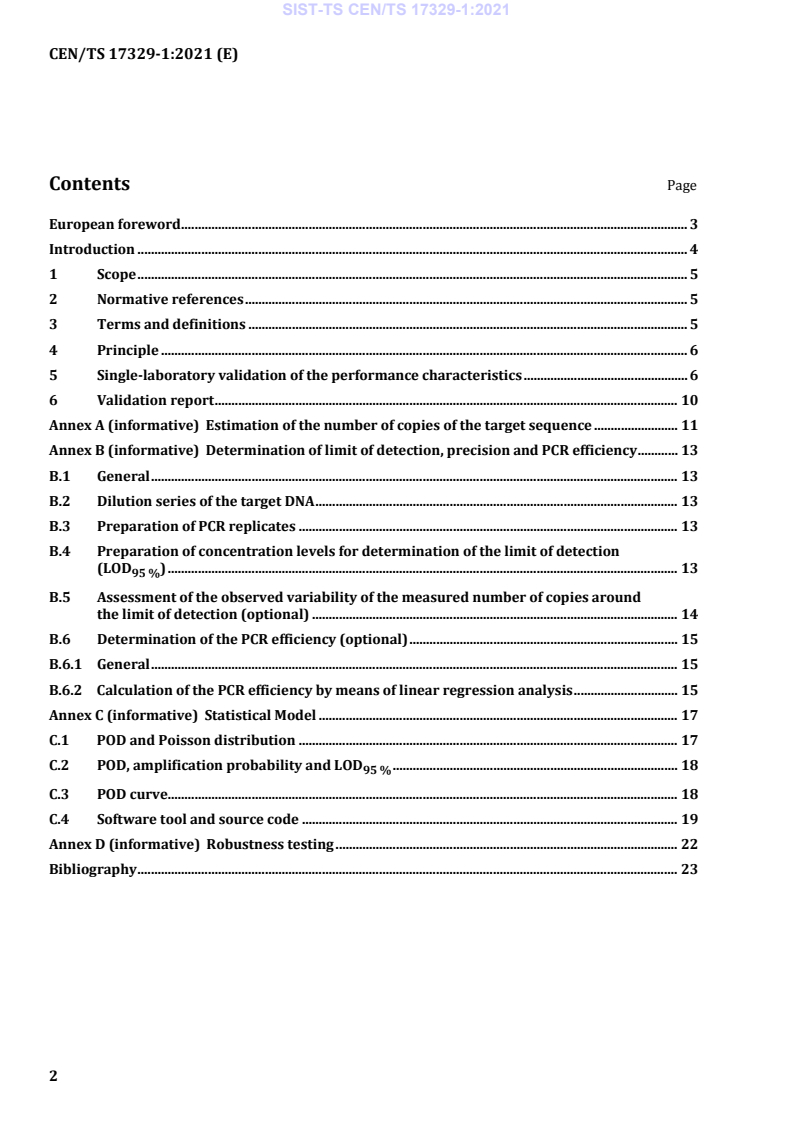
Contents Page
European foreword . 3
Introduction . 4
1 Scope . 5
2 Normative references . 5
3 Terms and definitions . 5
4 Principle . 6
5 Single-laboratory validation of the performance characteristics . 6
6 Validation report . 10
Annex A (informative) Estimation of the number of copies of the target sequence . 11
Annex B (informative) Determination of limit of detection, precision and PCR efficiency . 13
B.1 General . 13
B.2 Dilution series of the target DNA . 13
B.3 Preparation of PCR replicates . 13
B.4 Preparation of concentration levels for determination of the limit of detection
(LOD ) . 13
95 %
B.5 Assessment of the observed variability of the measured number of copies around
the limit of detection (optional) . 14
B.6 Determination of the PCR efficiency (optional) . 15
B.6.1 General . 15
B.6.2 Calculation of the PCR efficiency by means of linear regression analysis . 15
Annex C (informative) Statistical Model . 17
C.1 POD and Poisson distribution . 17
C.2 POD, amplification probability and LOD . 18
95 %
C.3 POD curve . 18
C.4 Software tool and source code . 19
Annex D (informative) Robustness testing . 22
Bibliography . 23
European foreword
This document (CEN/TS 17329-1:2021) has been prepared by Technical Committee CEN/TC 275 “Food
analysis - Horizontal methods”, the secretariat of which is held by DIN.
Attention is drawn to the possibility that some of the elements of this document may be the subject of
patent rights. CEN shall not be held responsible for identifying any or all such patent rights.
This document supersedes CEN/TS 17329-1:2019.
This new version was updated by inclusion of an option (in Annex C, C.4) to calculate the results of a
single-laboratory validation by using the R-package POD [15]. This calculation tool can make the user of
this document independent from consultation of a statistician or a professional statistical service
provider, when evaluating the results of a single-laboratory validation. The R-package can be downloaded
without being charged.
This series consists of two parts:
— Part 1: Single-laboratory validation;
— Part 2: Collaborative study.
According to the CEN/CENELEC Internal Regulations, the national standards organisations of the
following countries are bound to announce this Technical Specification: Austria, Belgium, Bulgaria,
Croatia, Cyprus, Czech Republic, Denmark, Estonia, Finland, France, Germany, Greece, Hungary, Iceland,
Ireland, Italy, Latvia, Lithuania, Luxembourg, Malta, Netherlands, Norway, Poland, Portugal, Republic of
North Macedonia, Romania, Serbia, Slovakia, Slovenia, Spain, Sweden, Switzerland, Turkey and the United
Kingdom.
Introduction
Qualitative real-time polymerase chain reaction (PCR) methods currently find broad application for the
detection of specific DNA sequences in food, e.g. for the detection and identification of genetically
modified organisms and the products derived thereof, for food authentication and speciation and other
purposes. It is important that a newly developed food analytical method is fit-for-purpose and meets
certain performance characteristics and quality criteria as demonstrated by a particular set of validation
experiments.
The data determined by the single laboratory validation are the basis for the decision to apply a method
in-house. Furthermore, it helps to decide whether the method in question should be fully validated in the
framework of a collaborative study.
The aim of this document is to provide a protocol for single-laboratory validation of qualitative real-time
PCR methods which are applied for food analysis. The procedure described is a recommendation that is
underpinned by practical experience in several laboratories. It is possible to apply alternative approaches
for which it can be shown that the performance criteria mentioned in the present document are achieved.
1 Scope
This document describes the performance characteristics and minimum performance criteria for
conducting a single-laboratory validation study for qualitative (binary) real-time polymerase chain
reaction (PCR) methods applied for the detection of specific DNA sequences present in foods.
The protocol was developed for qualitative real-time PCR methods for the detection of DNA sequences
derived from genetically modified foodstuffs. It is applicable also for single-laboratory validation of
qualitative PCR methods used for analysis of other food materials, e.g. for species detection and
identification.
The document does not cover the evaluation of the applicability and the practicability with respect to the
specific scope of the PCR method.
2 Normative references
The following documents are referred to in the text in such a way that some or all of their content
constitutes requirements of this document. For dated references, only the edition cited applies. For
undated references, the latest edition of the referenced document (including any amendments) applies.
EN ISO 21571:2005, Foodstuffs - Methods of analysis for the detection of genetically modified organisms
and derived products - Nucleic acid extraction (ISO 21571:2005)
EN ISO 24276, Foodstuffs - Methods of analysis for the detection of genetically modified organisms and
derived products - General requirements and definitions (ISO 24276)
ISO 16577, Molecular biomarker analysis - Terms and definitions
3 Terms and definitions
For the purposes of this document, the terms and definitions given in ISO 16577 and EN ISO 24276 and
the following apply.
ISO and IEC maintain terminological databases for use in standardization at the following addresses:
— IEC Electropedia: available at https://www.electropedia.org/
— ISO Online browsing platform: available at https://www.iso.org/obp
3.1
probability of detection
POD
probability of a positive analytical outcome of a qualitative method for a given matrix at a given
concentration
Note 1 to entry: For a qualitative real-time PCR method it describes the probability that, for a given number of
DNA copies of the target sequence, PCR amplification will take place.
As impacted by EN ISO 21571:2005/A1:2013.
3.2
PCR efficiency
measured amplification rate for a DNA copy of the target sequence per PCR cycle in relation to the
theoretically achievable value of 1
Note 1 to entry: The PCR efficiency is calculated from the slope of a standard curve resulting from the decadic
semi-logarithmic plot of quantification cycle (Cq) values over the DNA concentration. The slope from the calculated
regression line can be used. The PCR efficiency can either be expressed as absolute number or as percentage.
3.3
limit of detection
LOD
95%
mean number of copies of the target sequence yielding a probability of detection of 0,95
4 Principle
Specific primers and also probes, depending on the detection system applied, have been designed for
specific amplification of a DNA target sequence by a qualitative real-time PCR method. As next step the
methods performance characteristics needs to be assessed to show that the method complies with the
quality criteria stipulated in relevant documents [1], [2].
According to the published guidelines the main criteria in the single-laboratory validation of a qualitative
real-time PCR method mainly concerns the limit of detection (at which the probability of detection
is ≥ 95 %), the specificity for the DNA target sequence and the robustness to small but deliberate
variations in the method parameters.
On the basis of the validation data, it can be verified whether the minimum required performance criteria
are fulfilled. This will be the basis for the applicability of the method by a single laboratory. A further
decision whether to conduct a validation of the method in the framework of a collaborative study can
then be taken.
Determination of the reproducibility (inter-laboratory transferability) and how the method performs at
different laboratories, in particular the false-positive/false-negative rate obtained with negative/positive
test samples, and the probability of detection (POD) across laboratories are evaluated by a collaborative
study, if the design is appropriate [3].
General guidelines for conducting a collaborative validation study are provided in Part 2 of this series.
5 Single-laboratory validation of the performance characteristics
5.1 General
Guidance for compiling the information required for complete and detailed description of all components
that should be provided with the protocol of the qualitative PCR methods (i.e. oligonucleotide sequences,
amplicon length, instrument or chemistry specifications, PCR conditions, analytical controls, etc.) is
described in other relevant documents [1], [2].
DNA extraction shall be according to the requirements and procedures specified in EN ISO 21571.
5.2 Limit of detection (LOD )
95 %
In qualitative PCR analysis (especially for the detection of genetically modified foodstuffs), the limit of
detection is usually defined as the amount of the target DNA at which an amplification product is detected
with a probability of at least 0,95 (LOD ). It is expressed in the number of copies of the target
95 %
sequence.
The LOD should be determined by means of a dilution series of the target DNA, using a uniform
95 %
concentration of non-target DNA (background DNA) for each dilution level.
Annex A provides additional detailed information regarding the copy number estimation of the target
DNA. Annex C provides the basics of the specific statistical model adapted for PCR methods.
For each dilution level, perform 12 PCR replicate measurements. The lowest dilution level (i.e. the
lowest number of copies) for which all 12 replicates are positive is considered to be an approximate value
for LOD (see B.2). The LOD of the qualitative real-time PCR method should not exceed 20 copies
95 % 95 %
of the target sequence.
The number of copies of the target sequence can be calculated on basis of haploid genome equivalents
using the measured DNA concentration (see EN ISO 21571:2005, Annex B ; [4]) and the genome weight
[5], [6], [7]. The use of digital PCR equipment (e.g. digital droplet PCR) is an alternative approach which
allows an accurate determination of the number of copies of a target sequence or the concentration of a
DNA solution [8].
The quality and the concentration (very high or very low) of the background DNA used for the dilution
can influence the validation experiment. It is therefore highly recommended to use DNA tested for the
absence of PCR inhibitors (e.g. commercial molecular biology grade DNA preparations) and a
concentration which is relevant for DNA extracted from food.
Practical guidance which has been experimentally proven is given in Annex B.
5.3 Evaluation of data for the limit of detection (LOD )
95 %
Determine the LOD , the mean POD curve, and the 95 % confidence interval by means of a statistical
95 %
model, e.g. the complementary log-log model and the likelihood ratio test [3]. Details on the statistical
model are given in Annex C. For the calculation, the nominal copies added to the PCR reaction, the number
of replicates and the number of positive results are required.
The complementary log-log model corresponds to applications where we observe either zero events
(e.g. defects) or one or more events where the number of events is assumed to follow the Poisson
distribution.
The LOD , the 95 % confidence interval and the mean POD curve along with the corresponding 95 %
95 %
confidence range can be calculated via a web service [9] or by using the R package POD [15].
Check the LOD for plausibility. A value significantly smaller than 2,996 suggests that the number of
95 %
copies of the target sequence that were actually added to the PCR reaction did not correspond to the
(nominal) numbers of copies estimated for the DNA solutions [3].
If more than two results are positive at the level with 0,1 copies of the target sequence per PCR, then the
DNA dilutions cannot be considered as verified and the number of copies has to be re-examined.
The statistical approach is described in [4].
This document is relevant for the validation of new methods. However, for method verification, 10 replicates
can be sufficient.
NOTE 1 The calculation of LOD is only valid if false-positive results are negligible, i.e. if the specificity testing
95 %
was successful and PCR carry-over contamination can be excluded.
NOTE 2 The level which will be the result of a tenfold dilution of 1 nominal copy is designated “level with 0,1
copies per PCR” for the sake of better readability throughout this document.
5.4 PCR efficiency and variability of the measured copy number around the LOD
95 %
For the optional determination of copy numbers around the limit of detection, assign the copy numbers
to the respective Cq values on the basis of an additional calibration series of target DNA (preparation, see
Annex B, Table B.1).
In addition, the variability of the measured number of copies around LOD can be assessed (see B.5).
95 %
To this end, compare the repeatability standard deviations to the theoretical values resulting from the
Poisson model.
The experimental data also allow the calculation of the PCR efficiency (see B.6), the slope and the
coefficient of determination.
5.5 Specificity
5.5.1 General
Theoretical and experimental results from testing the method with the sequence databases and material
containing the target sequence should be provided. If available, this testing should include all relevant
and representative materials according to the scope of the method.
5.5.2 Theoretical test for specificity
Computer-aided (in-silico) specificity tests shall be carried out, examining the oligonucleotide and the
amplicon sequences with available bioinformatics tools (e.g. primer-dimer formation with primer 3 [10]).
The homology to other sequences shall be tested by searches in nucleic acid sequence databases
(e.g. BLAST in GenBank [11]).
The in-silico analysis should not show any unwanted similarities between sequences which could
influence the analytical result. The oligonucleotide sequence(s) should be adapted accordingly, if
appropriate.
5.5.3 Practical test for specificity
Perform tests for unexpected cross-reactions with non-target DNA. Check the PCR detection system for
cross-reactivity with DNA from organisms that have similar (homologous) genetic elements, genes or
genetic constructs. Also check for species which are often present in food, e.g. as ingredient (corn, soya,
rape seed, rice, potato, wheat, cattle, chicken, pig, sheep, turkey, horse).
If non-target DNA is tested and a negative result is expected, at least 2500 copies should be added to the
PCR reaction, if possible. If no reference material with sufficiently high concentrations of the non-target
DNA is available, lower concentrations can be used and the number of copies added should be indicated.
Verify the amplifiability of the non-target DNA by means of an independent test.
Perform tests with target DNA. Add target DNA for which a positive result is expected in copy numbers
in the range of the LOQ (here: the copy number for LOD multiplied by a factor of 3, i.e. in general 20
95 %
to 60 copies per PCR). Add non-target DNA in a concentration of 100 ng/25 µl to 200 ng/25 µl of PCR mix
to the target DNA, in order to simulate conditions which are relevant in practice and could influence the
outcome.
It is sufficient to carry out each of the PCR tests for inclusivity (using target DNA) and exclusivity (using
non-target DNA) in duplicate determination.
In the experimental test, all the PCR results should fulfil the theoretical expectations.
If there is cross-reactivity which is considered to be acceptable, it should be indicated and taken into
account in the scope of the method.
5.5.4 Robustness
In the single-laboratory validation, evaluate the robustness of a qualitative real-time PCR method
concerning different types of real-time PCR equipment, PCR reagent kits, annealing temperature applied
in the thermal cycling programme, the master mix volume and the primer and probe concentrations
(Table 1).
Implement a multifactorial experimental design [12]. The PCR reactions with the different combinations
of factors are done with target DNA at a concentration around the number of copies corresponding to the
LOD multiplied by a factor of 3 (corresponding to approximately 20 to 60 copies per PCR). Dilute the
95 %
target DNA in non-target DNA (background DNA, e.g. 20 ng/µl). For each factor-level combination, PCR
tests should at least be performed in triplicate. An example of the procedure is given in Annex D,
Table D.1.
The method shall yield positive results for all combinations despite the modified conditions.
In the case of negative results, the PCR test for the corresponding combinations should be repeated. In
the case of repeated negative results, the method is not sufficiently robust and needs to be optimized.
Considerable deviations between Cq values could be an indication that the robustness of the method is
insufficient.
Table 1 — Robustness test of factors and modifications in the procedure conditions of
qualitative real-time PCR methods
Factor 1 0
PCR equipment A B
PCR master mix X Y
Primer concentration unchanged −30 %
Probe concentration unchanged −30 %
Volume of PCR reagent 19 µl of PCR reagent mix 21 µl of PCR reagent mix
mix
+ 5 µl of DNA + 5 µl of DNA
(if total volume is 25 µl)
Annealing temperature +1 °C −1 °C
CEN/TS
...