

EN 16158:2012
(Main)Animal feeding stuffs - Determination of semduramicin content - Liquid chromatographic method using a "tree" analytical approach
- Abstract
This European standard specifies a high-performance liquid chromatographic (HPLC) method for the determination of the semduramicin content at authorized level in animal feeding stuffs [2], using mass spectrometry detection or post-column derivatization and (UV)-VIS detection (hereinafter UV detection). This method is applicable to poultry feed. The limit of quantitation is 1,0 mg/kg when mass spectrometry is used for detection and 3,0 mg/kg when the detection is performed by UV with post-column derivatization. Lower limits of quantitation are achievable but this is to be validated by the user.
The method allows the discrimination of semduramicin from monensin, salinomycin, narasin, maduramicin and lasalocid.
- Status
- Published
- Publication Date
- 21-Feb-2012
- Technical Committee
- CEN/TC 327 - Animal feeding stuffs - Methods of sampling and analysis
- Drafting Committee
- CEN/TC 327/WG 3 - Feed additives and drugs
- Current Stage
- 9093 - Decision to confirm - Review Enquiry
- Start Date
- 01-Jan-2024
- Completion Date
- 07-Oct-2026

Overview
EN 16158:2012 is a CEN standard specifying a validated HPLC procedure for the determination of semduramicin in animal feeding stuffs, specifically poultry feed. The method uses a "tree" analytical approach offering two detection options: LC‑MS (electrospray mass spectrometry) or LC‑PCD‑UV (post‑column derivatization with DMAB and UV detection). The standard defines sample extraction, chromatographic conditions, reagent and reference‑standard requirements, quantitation approaches and system suitability criteria for routine and regulatory testing.
Key topics and technical requirements
- Scope & matrices: Applicable to poultry feed for determination of authorized semduramicin levels.
- Detection options & limits of quantitation (LOQ):
- LC‑MS (ESI, SIM): LOQ = 1.0 mg/kg (standard addition quantitation).
- LC‑PCD‑UV (DMAB post‑column derivatization, 598 nm): LOQ = 3.0 mg/kg (external calibration).
- Users may validate and achieve lower LOQs if required.
- Sample preparation:
- Extraction with acetonitrile and mechanical shaking (30 min).
- Filtration through 0.2 µm nylon filters prior to HPLC.
- Chromatography & reagents:
- Reverse‑phase HPLC columns specified (e.g., C18 types) and mobile phase formulations (methanol/ammonium formate).
- LC‑PCD reagent: dimethylaminobenzaldehyde (DMAB) in acidified methanol; reactor coil operated at ~92 °C.
- Reference materials:
- Semduramicin sodium standard (purity declaration required).
- For LC‑MS, nigericin is used as internal standard.
- Quantitation & validation:
- LC‑MS uses standard addition; LC‑PCD‑UV uses external calibration.
- Method includes system suitability, precision (repeatability/reproducibility) and collaborative study results.
- Safety: Toxic standards and solvents require fume hood use and protective equipment.
Applications and who uses this standard
- Feed testing laboratories performing routine monitoring of semduramicin in poultry feed for compliance with authorized levels.
- Veterinary drug residue control and regulatory agencies verifying feed additive concentrations.
- Feed manufacturers and quality control teams ensuring correct dosing of ionophore additives.
- Contract analytical labs offering HPLC/LC‑MS testing services.
Practical uses include compliance testing, batch release testing, troubleshooting cross‑contamination, and method validation for lower LOQs when needed.
Related standards
- prEN ISO 6498 - Guidelines for sample preparation of animal feeding stuffs (referenced by EN 16158).
- Other CEN/TC 327 publications on animal feeding stuffs (for broader feed analysis and sampling protocols).
Keywords: EN 16158:2012, semduramicin, HPLC, LC‑MS, LC‑PCD‑UV, animal feeding stuffs, poultry feed, limit of quantitation, CEN standard.
Relations
- Effective Date
- 28-Jan-2026
Get Certified
Connect with accredited certification bodies for this standard

Control Union Certifications
Global certification for agriculture and sustainability.

ECOCERT
Organic and sustainability certification.

FSC International
Forest Stewardship Council certification.
Sponsored listings
Frequently Asked Questions
EN 16158:2012 is a standard published by the European Committee for Standardization (CEN). Its full title is "Animal feeding stuffs - Determination of semduramicin content - Liquid chromatographic method using a "tree" analytical approach". This standard covers: This European standard specifies a high-performance liquid chromatographic (HPLC) method for the determination of the semduramicin content at authorized level in animal feeding stuffs [2], using mass spectrometry detection or post-column derivatization and (UV)-VIS detection (hereinafter UV detection). This method is applicable to poultry feed. The limit of quantitation is 1,0 mg/kg when mass spectrometry is used for detection and 3,0 mg/kg when the detection is performed by UV with post-column derivatization. Lower limits of quantitation are achievable but this is to be validated by the user. The method allows the discrimination of semduramicin from monensin, salinomycin, narasin, maduramicin and lasalocid.
This European standard specifies a high-performance liquid chromatographic (HPLC) method for the determination of the semduramicin content at authorized level in animal feeding stuffs [2], using mass spectrometry detection or post-column derivatization and (UV)-VIS detection (hereinafter UV detection). This method is applicable to poultry feed. The limit of quantitation is 1,0 mg/kg when mass spectrometry is used for detection and 3,0 mg/kg when the detection is performed by UV with post-column derivatization. Lower limits of quantitation are achievable but this is to be validated by the user. The method allows the discrimination of semduramicin from monensin, salinomycin, narasin, maduramicin and lasalocid.
EN 16158:2012 is classified under the following ICS (International Classification for Standards) categories: 65.120 - Animal feeding stuffs. The ICS classification helps identify the subject area and facilitates finding related standards.
EN 16158:2012 has the following relationships with other standards: It is inter standard links to EN ISO 6498:2012. Understanding these relationships helps ensure you are using the most current and applicable version of the standard.
EN 16158:2012 is associated with the following European legislation: EU Directives/Regulations: 70/373/EC; Standardization Mandates: M/382. When a standard is cited in the Official Journal of the European Union, products manufactured in conformity with it benefit from a presumption of conformity with the essential requirements of the corresponding EU directive or regulation.
EN 16158:2012 is available in PDF format for immediate download after purchase. The document can be added to your cart and obtained through the secure checkout process. Digital delivery ensures instant access to the complete standard document.
Standards Content (Sample)
2003-01.Slovenski inštitut za standardizacijo. Razmnoževanje celote ali delov tega standarda ni dovoljeno.Futtermittel - Bestimmung des Semduramicingehalts - Flüssigkeitschromatographisches Verfahren mit verzweigter analytischer VorgehensweiseAliments pour animaux - Dosage de la semduramicine - Chromatographie liquide utilisant une approche analytique en arbreAnimal feeding stuffs - Determination of semduramicin content - Liquid chromatographic method using a "tree" analytical approach65.120KrmilaAnimal feeding stuffsICS:Ta slovenski standard je istoveten z:EN 16158:2012SIST EN 16158:2012en,fr,de01-april-2012SIST EN 16158:2012SLOVENSKI
STANDARD
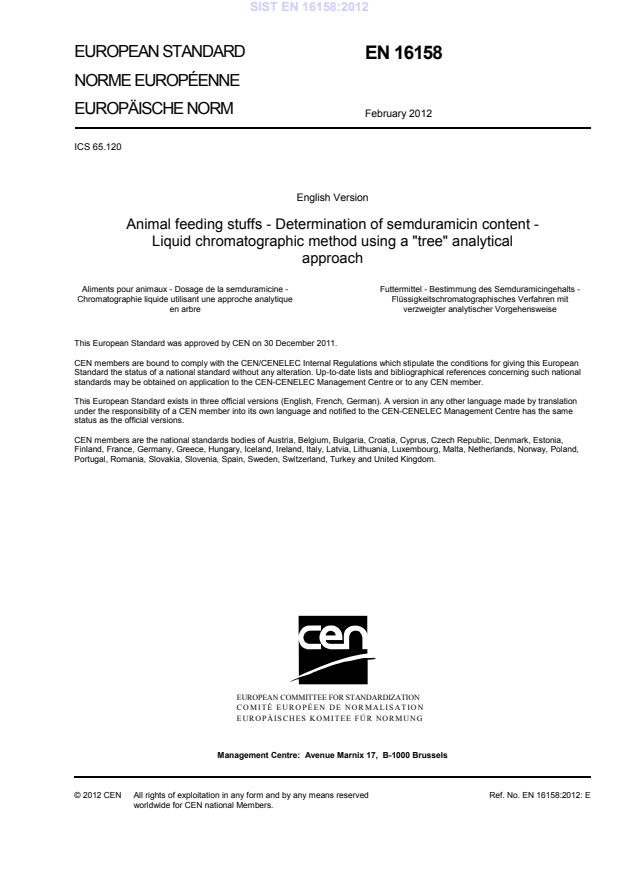
EUROPEAN STANDARD NORME EUROPÉENNE EUROPÄISCHE NORM
EN 16158
February 2012 ICS 65.120 English Version
Animal feeding stuffs - Determination of semduramicin content -Liquid chromatographic method using a "tree" analytical approach
Aliments pour animaux - Dosage de la semduramicine - Chromatographie liquide utilisant une approche analytique en arbre
Futtermittel - Bestimmung des Semduramicingehalts - Flüssigkeitschromatographisches Verfahren mit verzweigter analytischer Vorgehensweise This European Standard was approved by CEN on 30 December 2011.
CEN members are bound to comply with the CEN/CENELEC Internal Regulations which stipulate the conditions for giving this European Standard the status of a national standard without any alteration. Up-to-date lists and bibliographical references concerning such national standards may be obtained on application to the CEN-CENELEC Management Centre or to any CEN member.
This European Standard exists in three official versions (English, French, German). A version in any other language made by translation under the responsibility of a CEN member into its own language and notified to the CEN-CENELEC Management Centre has the same status as the official versions.
CEN members are the national standards bodies of Austria, Belgium, Bulgaria, Croatia, Cyprus, Czech Republic, Denmark, Estonia, Finland, France, Germany, Greece, Hungary, Iceland, Ireland, Italy, Latvia, Lithuania, Luxembourg, Malta, Netherlands, Norway, Poland, Portugal, Romania, Slovakia, Slovenia, Spain, Sweden, Switzerland, Turkey and United Kingdom.
EUROPEAN COMMITTEE FOR STANDARDIZATION
COMITÉ EUROPÉEN DE NORMALISATION EUROPÄISCHES KOMITEE FÜR NORMUNG
Management Centre:
Avenue Marnix 17,
B-1000 Brussels © 2012 CEN All rights of exploitation in any form and by any means reserved worldwide for CEN national Members. Ref. No. EN 16158:2012: ESIST EN 16158:2012
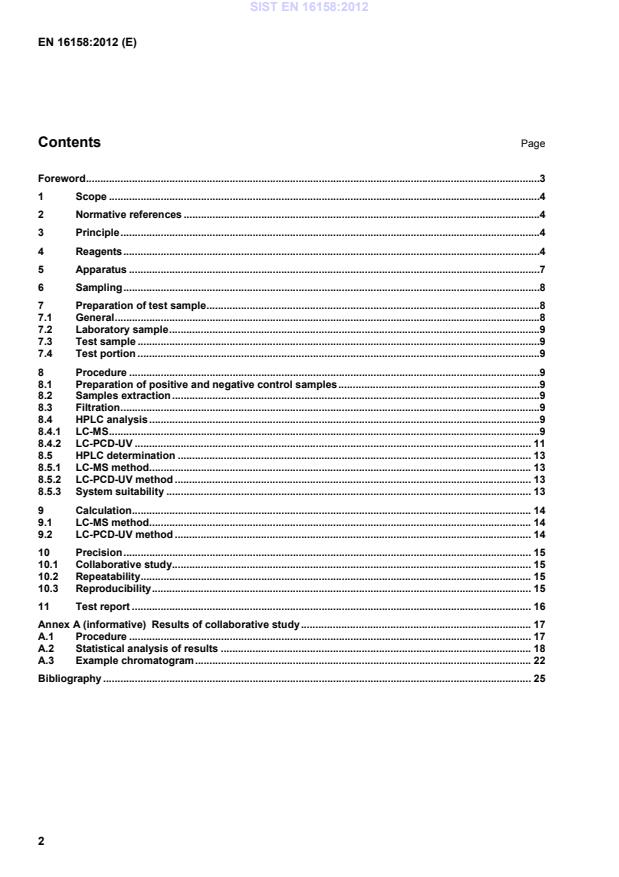
Results of collaborative study . 17A.1Procedure . 17A.2Statistical analysis of results . 18A.3Example chromatogram . 22Bibliography . 25
4 Reagents Use only reagents of recognized analytical grade, unless otherwise specified.
4.1 LC-MS. 4.1.1 Water, HPLC grade, or equivalent (e.g. Milli-Q purified water). 4.1.2 Acetonitrile, HPLC gradient grade, minimum 99,9 % purity. 4.1.3 Methanol, HPLC grade or hypergrade LC-MS. 4.1.4 Ammonium formate, HPLC grade. 4.1.5 Mobile phase. 4.1.5.1 Ammonium formate solution, c = 20 mmol/l. Accurately weigh 1,25 g to the nearest 0,01 g of ammonium formate (4.1.4) into a 1 000 ml volumetric flask. Dissolve in water (4.1.1) and make up to 1 000 ml of volume with water. Prepare fresh solutions monthly. 4.1.5.2 HPLC mobile phase. SIST EN 16158:2012
4.2.4.2 Ammonium formate solution, c = 100 mmol/l at pH = 3. Accurately weigh 6,30 g to the nearest 0,01 g of ammonium formate (4.1.4) into a 1 000 ml volumetric flask (5.7). Dissolve in 900 ml water (4.1.1). Adjust the pH to 3,0 using formic acid (4.2.3) and make up to 1 000 ml with purified water. Prepare fresh monthly. 4.2.4.3 HPLC mobile phase (solvent blank). Mix methanol (4.1.3) and ammonium formate solution (4.2.4.2) in proportion of 90+10 (v+v). Filter under a vacuum using a solvent filtration system (5.11) and Nylon filters (5.13). 4.3 Reference standards LC-PCD-UV method. WARNING — Avoid inhalation of and exposure to the toxic standard materials and solutions thereof. Work in a fume-hood when handling the solvents and solutions. Wear safety glasses and protective clothing.
Declaration of purity is required for each lot of reference standard.
4.3.1 Semduramicin sodium standard, minimum 93 % purity expressed as semduramicin.
NOTE Available from Phibro Animal Health Corporation, Third Floor 65 Challenger Road Ridgefield Park, NJ 07660-2103 USA. This information is given for the convenience of users of this European Standard and does not constitute an endorsement by CEN of the product named. Equivalent products may be used if they can be shown to lead to the same results. 4.4 Reference standards LC-MS method. In addition to the reference standard 4.3.1: 4.4.1 Nigericin sodium standard, minimum 98 % purity to be used as internal standard (I.S.). NOTE Available from Calbiochem, A Brand of EMD Biosciences, Inc. 10394 Pacific Center Court, San Diego, CA 92121 USA. This information is given for the convenience of users of this European Standard and does not constitute an SIST EN 16158:2012
is the experimental concentration of semduramicin in the stock standard in mg/ml; P is the purity of the semduramicin standard expressed as semduramicin given by the supplier in percent e.g. 0,934; m
is the weighed mass of semduramicin sodium standard (4.3.1) in mg. 4.5.2 Nigericin sodium stock standard solution (for the LC-MS method), ca. 1 mg/ml. Accurately weigh 10 mg to the nearest 0,1 mg of nigericin sodium standard (4.4.1) into a 10 ml volumetric flask (5.7). Note down the exact weight of nigericin sodium. Dissolve in methanol (4.1.3) and make up to 10 ml with methanol. Store at -20 °C and protected from light. Prepare freshly every 3 months.
Determine the experimental concentration of the nigericin sodium stock solutions using the reference standard purity value provided by the supplier using Equation (2). PmCn×=10 (2) where Cn is the experimental concentration of nigericin sodium in the stock standard in mg/ml; P is the purity of the nigericin sodium standard given by the supplier in % e.g. 0,98; m is the weighed mass of nigericin sodium standard (4.4.1) in mg. 4.5.3 Semduramicin intermediate standard solution (for the LC-MS method), ca. 100 µg/ml. Accurately pipette 1,0 ml of the semduramicin stock standard solution (4.5.1) into a 10 ml volumetric flask (5.7). Make up to 10 ml with acetonitrile (4.1.2). Store at -20 °C and protected from light. Prepare fresh intermediate solutions monthly. 4.5.4 Nigericin sodium intermediate standard solution (for the LC-MS method), ca. 100 µg/ml. SIST EN 16158:2012
5.1 LC-MS method HPLC system consisting of the following: 5.1.1 Pump, pulse free, flow capacity 0,1 ml/min to 2,0 ml/min. 5.1.2 Injection system, manual or autosampler, with a loop suitable for 10 µl injections. 5.1.3 Single quadrupole mass spectrometer or triple quadrupole mass spectrometer used in the MS configuration able to operate in a mass range at least between 200 m/z to 1 000 m/z. NOTE For the MS detector the vacuum should be as stable as possible to ensure satisfactory repeatability. The system should therefore be pumped at least 48 h before starting the measurements. 5.1.4 Computer data system. 5.1.5 Analytical column, Alltima HP C18, 5 µm ,150 mm x 2,1 mm, 190 Å, 12 % C load and 200 m2/g or equivalent. 5.1.6 Guard column, Alltima HP C18, 5 µm, 7,5 mm x 2,1 mm, 190 Å, 12% C load and 200 m2/g or equivalent. 5.2 LC-PCD-UV method HPLC system consisting of the following: 5.2.1 Pump, pulse free, flow capacity 0,1 ml/min to 2,0 ml/min. 5.2.2 Injection system, manual or autosampler, with a loop suitable for 100 µl injections. 5.2.3 UV/VIS detector, variable wavelength, suitable for reliable measurements at 598 nm, or UV/VIS photodiode array detector (DAD). 5.2.4 Computer data system. 5.2.5 Post-column reactor, with a 1,5 ml to 2,0 ml reaction coil, for operation at 92 °C. The coil may be a commercially available coil or it may be made using 1/16” 316 SS tubing, 0,020" <> 0,5 mm ID (between 8 m and 10 m length) folded to fit the reactor heating chamber. To ensure effective mixing of reagent and column effluent, use a vortex or static mixing tee (not a regular tee) before the reaction coil. SIST EN 16158:2012
It is important that the laboratory receives a sample that is truly representative and has not been damaged or changed during transport or storage. Sampling is not part of the method specified in this European standard. A recommended sampling method is given in EN ISO 6497 [1]. 7 Preparation of test sample 7.1 General Prepare the test sample in accordance with prEN ISO 6498. SIST EN 16158:2012
7.3 Test sample The test sample consists of a representative and homogenised aliquot of the ground laboratory sample of at least 20 g. 7.4 Test portion Accurately weigh 5,0 g ± 0,1 g of the thoroughly mixed test sample into a 50 ml polypropylene stoppered tube (Falcon® tube or equivalent). Note down the mass expressed in mg (Wtp). Submit it to the analysis procedure (8). 8 Procedure 8.1 Preparation of positive and negative control samples The use of quality control samples and quality control charts is recommended. With each set of samples, include a positive control sample (PCS) and a negative control sample (NCS) on a daily basis. For the PCS, weigh 5,0 g ± 0,1 g of a poultry blank feed. Accurately pipette, with an appropriate automatic pipette (5.6), 130 µl of the semduramicin stock standard solution (4.5.1) and add to the poultry blank. Mix thoroughly to ensure maximum contact with the feed. Allow penetration for at least 1 hour before extraction. The NCS is constituted by 5,0 g ± 0,1 g of non-spiked poultry blank feed. Both PCS and NCS will be submitted to the same treatment as unknown samples. 8.2 Samples extraction
Accurately weigh 5,0 g ± 0,1 g test portion into a polypropylene centrifuge tube (5.9). Add 15 ml acetonitrile (4.1.2), close tightly the polypropylene centrifuge tube (5.9) and check that there is no solvent leak through the cap. Shake vigorously to ensure appropriate suspension of the feed into the extraction solvent. Perform a solid-liquid extraction by shaking the mixture for 30 min on the shaker (5.4). 8.3 Filtration Filter the supernatants (8.2) through a 0,2 µm Nylon syringe filter (5.14) into a clean polypropylene tube (5.9).
8.4 HPLC analysis 8.4.1 LC-MS 8.4.1.1 Dilution
Accurately pipette with an appropriate automatic pipette (5.6), 75 µl of the filtered extract (8.3) into a 10 ml volumetric flask (5.7) Make up to 10 ml volume with acetonitrile (4.1.2).
8.4.1.2 Standard additions
Accurately pipette with an appropriate automatic pipette (5.6), four 900 µl aliquots of the diluted extract (8.4.1.1) into 1,5 ml glass vials (5.3) and label as S0, S1, S2 and S3 respectively. SIST EN 16158:2012
...