


EN 913:2018+A1:2021
(Main)Gymnastic equipment - General safety requirements and test methods
Gymnastic equipment - General safety requirements and test methods
This document specifies general safety requirements and test methods for all pieces of gymnastic and sports equipment and for all pieces of equipment for the use of physical education, training and competition, intended for use supervised by a competent person and not specified in other, individual standards and/or federation rules.
Turngeräte - Allgemeine sicherheitstechnische Anforderungen und Prüfverfahren
Dieses Dokument legt die allgemeinen Sicherheitsanforderungen und Prüfverfahren für alle Teile von Turn und Sportgeräten sowie für alle Teile von Geräten fest, die für die Nutzung im Sportunterricht, Ausbildung und Wettkampf unter Aufsicht einer kompetenten Person vorgesehen sind und die nicht in anderen Einzelnormen und/oder Verbandsrichtlinien festgelegt sind.
Matériel de gymnastique - Exigences générales de sécurité et méthodes d'essai
Le présent document spécifie les exigences générales de sécurité et les méthodes d’essai applicables à tout le matériel de gymnastique et de sport ainsi qu’à tout le matériel conçu dans le cadre de l’éducation physique et sportive, de l’entraînement et de la compétition, destinés à être utilisés sous la surveillance d’une personne compétente et non spécifiés dans d’autres normes individuelles et/ou règlements de fédérations.
Gimnastična oprema - Splošne varnostne zahteve in preskusne metode
General Information
- Status
- Published
- Publication Date
- 14-Sep-2021
- Withdrawal Date
- 30-Mar-2022
- Technical Committee
- CEN/TC 136 - Sports, playground and other recreational equipment
- Drafting Committee
- CEN/TC 136/WG 22 - Gymnastic and playing field equipment
- Current Stage
- 6060 - Definitive text made available (DAV) - Publishing
- Start Date
- 15-Sep-2021
- Completion Date
- 15-Sep-2021
- Directive
- Not Harmonized2001/95/EC - General product safety
Not Harmonized92/59/EEC - General product safety
Relations
- Effective Date
- 18-Jan-2023
- Effective Date
- 30-Jun-2021
- Effective Date
- 28-Jan-2026
- Effective Date
- 28-Jan-2026
- Effective Date
- 28-Jan-2026
- Refers
EN 1991-1-4:2005 - Eurocode 1: Actions on structures - Part 1-4: General actions - Wind actions - Effective Date
- 28-Jan-2026
- Effective Date
- 28-Jan-2026
- Effective Date
- 28-Jan-2026
- Referred By
EN 915:2008 - Gymnastic equipment - Asymmetric bars - Requirements and test methods including safety - Effective Date
- 28-Jan-2026
- Referred By
EN 915:2024 - Gymnastic equipment - Asymmetric bars - Requirements and test methods including safety - Effective Date
- 28-Jan-2026
- Effective Date
- 28-Jan-2026
- Effective Date
- 28-Jan-2026
- Effective Date
- 28-Jan-2026
- Referred By
EN 916:2003 - Gymnastic equipment - Vaulting boxes - Requirements and test methods including safety - Effective Date
- 28-Jan-2026
- Effective Date
- 28-Jan-2026
Overview
EN 913:2018+A1:2021 (CEN) - "Gymnastic equipment - General safety requirements and test methods" - is a European standard that sets general safety requirements and test methods for gymnastic and sports equipment not covered by other specific equipment standards or federation rules. Published with Amendment 1 (2021), it applies to equipment intended for supervised use in physical education, training and competition.
This standard provides a common safety baseline for manufacturers, test laboratories, facility managers and procurement authorities involved with gymnastic equipment and multi-sports apparatus.
Key topics and technical requirements
- Scope & risk assessment: Based on EN ISO 12100, the standard identifies 12 hazard categories (crushing, shearing, entrapment, impact, friction/abrasion, ergonomic issues, etc.) and requires documented risk assessment and mitigation.
- Materials (Clause 5.1): Materials must preserve structural integrity until the next maintenance inspection; selection should consider applicable European material standards and environmental/toxic regulations (e.g., REACH).
- Surface finish (Clause 5.2): Prohibits protruding nails, sharp edges and burrs; specifies rounding, protective covers for bolts and acceptable protrusion limits to prevent contact injuries.
- Entrapment (Clause 5.3 & Annex A): Defines measurement and inspection methods to prevent head, neck and finger entrapment; harmonized with EN 1176‑1:2017 for entrapment criteria.
- Stability and strength (Clause 5.4 & Annex B): Requires engineering verification or testing to ensure equipment does not tip, separate or suffer dangerous deformation under defined loads and dynamic factors.
- Adjustment devices (Clause 5.5): Must resist accidental changes during use; operating levers must not intrude into user space.
- Shock absorption (Clause 5.6 & Annex C): Top padding tested for peak acceleration limits (specified test method in Annex C).
- Marking and instructions (Clauses 6–7): Equipment must be marked with the standard number, manufacturer ID, year of manufacture and intended number of users; clear manufacturer instructions are required.
Applications and who uses it
- Manufacturers of gymnastic and multisport apparatus - for product design and compliance.
- Test laboratories - to perform the standardized tests in Annexes A–C.
- Schools, sports clubs, gyms and facility managers - to select safe equipment and verify installation and maintenance.
- Procurement officers and certifiers - to specify safety requirements and ensure conformity.
- Standards bodies and federations - as a general fallback standard where no specific equipment standard exists.
Related standards
- EN ISO 12100 (risk assessment)
- EN 1176‑1:2017 (entrapment guidance)
- EN 1991 series (actions on structures)
- ISO 6487 (impact instrumentation)
- Relevant EU regulations: REACH (EC No 1907/2006) and CLP (EC No 1272/2008)
Keywords: EN 913:2018+A1:2021, gymnastic equipment, safety requirements, test methods, CEN, risk assessment, entrapment, stability and strength, shock absorption.

Frequently Asked Questions
EN 913:2018+A1:2021 is a standard published by the European Committee for Standardization (CEN). Its full title is "Gymnastic equipment - General safety requirements and test methods". This standard covers: This document specifies general safety requirements and test methods for all pieces of gymnastic and sports equipment and for all pieces of equipment for the use of physical education, training and competition, intended for use supervised by a competent person and not specified in other, individual standards and/or federation rules.
This document specifies general safety requirements and test methods for all pieces of gymnastic and sports equipment and for all pieces of equipment for the use of physical education, training and competition, intended for use supervised by a competent person and not specified in other, individual standards and/or federation rules.
EN 913:2018+A1:2021 is classified under the following ICS (International Classification for Standards) categories: 97.220.30 - Indoor sports equipment. The ICS classification helps identify the subject area and facilitates finding related standards.
EN 913:2018+A1:2021 has the following relationships with other standards: It is inter standard links to EN 913:2018/prA1, EN 913:2018, EN 1991-1-1:2025, EN 71-19:2024, EN ISO 12100:2010, EN 1991-1-4:2005, EN 1991-1-3:2025, EN 1991-1-5:2025, EN 915:2008, EN 915:2024, EN 17461:2023, EN ISO 23659:2022, EN 71-14:2025, EN 916:2003, EN 914:2020. Understanding these relationships helps ensure you are using the most current and applicable version of the standard.
EN 913:2018+A1:2021 is associated with the following European legislation: EU Directives/Regulations: 2001/95/EC, 92/59/EEC; Standardization Mandates: M/507. When a standard is cited in the Official Journal of the European Union, products manufactured in conformity with it benefit from a presumption of conformity with the essential requirements of the corresponding EU directive or regulation.
EN 913:2018+A1:2021 is available in PDF format for immediate download after purchase. The document can be added to your cart and obtained through the secure checkout process. Digital delivery ensures instant access to the complete standard document.
Standards Content (Sample)
SLOVENSKI STANDARD
01-november-2021
Nadomešča:
SIST EN 913:2019
Gimnastična oprema - Splošne varnostne zahteve in preskusne metode
Gymnastic equipment - General safety requirements and test methods
Turngeräte - Allgemeine sicherheitstechnische Anforderungen und Prüfverfahren
Matériel de gymnastique - Exigences générales de sécurité et méthodes d'essai
Ta slovenski standard je istoveten z: EN 913:2018+A1:2021
ICS:
97.220.30 Oprema za dvoranske športe Indoor sports equipment
2003-01.Slovenski inštitut za standardizacijo. Razmnoževanje celote ali delov tega standarda ni dovoljeno.
EN 913:2018+A1
EUROPEAN STANDARD
NORME EUROPÉENNE
August 2021
EUROPÄISCHE NORM
ICS 97.220.30 Supersedes EN 913:2018
English Version
Gymnastic equipment - General safety requirements and
test methods
Matériel de gymnastique - Exigences générales de Turngeräte - Allgemeine sicherheitstechnische
sécurité et méthodes d'essai Anforderungen und Prüfverfahren
This European Standard was approved by CEN on 22 July 2018 and includes Amendment 1 approved by CEN on 17 February
2021.
CEN members are bound to comply with the CEN/CENELEC Internal Regulations which stipulate the conditions for giving this
European Standard the status of a national standard without any alteration. Up-to-date lists and bibliographical references
concerning such national standards may be obtained on application to the CEN-CENELEC Management Centre or to any CEN
member.
This European Standard exists in three official versions (English, French, German). A version in any other language made by
translation under the responsibility of a CEN member into its own language and notified to the CEN-CENELEC Management
Centre has the same status as the official versions.
CEN members are the national standards bodies of Austria, Belgium, Bulgaria, Croatia, Cyprus, Czech Republic, Denmark, Estonia,
Finland, France, Germany, Greece, Hungary, Iceland, Ireland, Italy, Latvia, Lithuania, Luxembourg, Malta, Netherlands, Norway,
Poland, Portugal, Republic of North Macedonia, Romania, Serbia, Slovakia, Slovenia, Spain, Sweden, Switzerland, Turkey and
United Kingdom.
EUROPEAN COMMITTEE FOR STANDARDIZATION
COMITÉ EUROPÉEN DE NORMALISATION
EUROPÄISCHES KOMITEE FÜR NORMUNG
CEN-CENELEC Management Centre: Rue de la Science 23, B-1040 Brussels
© 2021 CEN All rights of exploitation in any form and by any means reserved Ref. No. EN 913:2018+A1:2021 E
worldwide for CEN national Members.
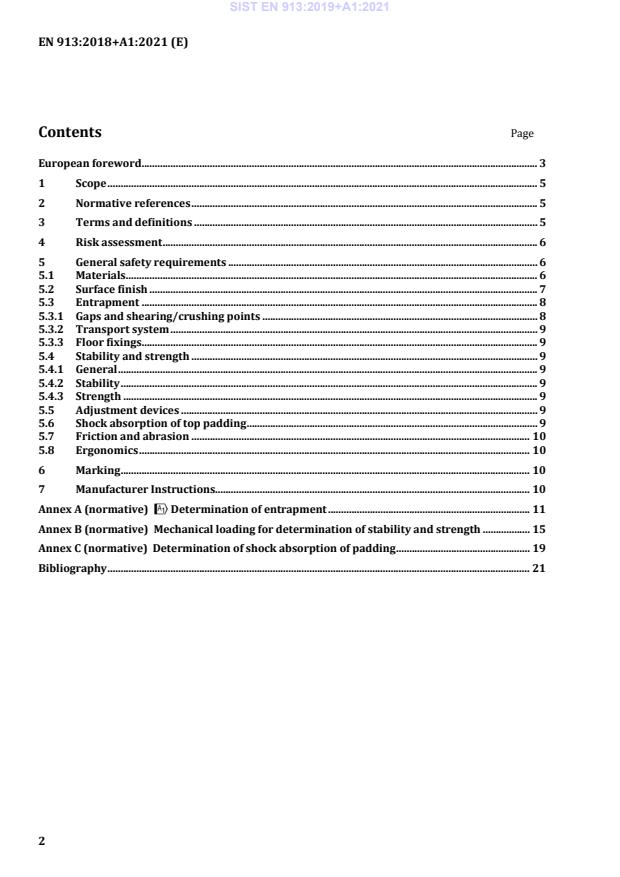
Contents Page
European foreword . 3
1 Scope . 5
2 Normative references . 5
3 Terms and definitions . 5
4 Risk assessment . 6
5 General safety requirements . 6
5.1 Materials . 6
5.2 Surface finish . 7
5.3 Entrapment . 8
5.3.1 Gaps and shearing/crushing points . 8
5.3.2 Transport system . 9
5.3.3 Floor fixings . 9
5.4 Stability and strength . 9
5.4.1 General . 9
5.4.2 Stability . 9
5.4.3 Strength . 9
5.5 Adjustment devices . 9
5.6 Shock absorption of top padding . 9
5.7 Friction and abrasion . 10
5.8 Ergonomics . 10
6 Marking . 10
7 Manufacturer Instructions. 10
Annex A (normative) !Determination of entrapment . 11
Annex B (normative) Mechanical loading for determination of stability and strength . 15
Annex C (normative) Determination of shock absorption of padding . 19
Bibliography . 21
European foreword
This document (EN 913:2018+A1:2021) has been prepared by Technical Committee CEN/TC 136
“Sports, playground and other recreational facilities and equipment”, the secretariat of which is held by
DIN.
This European Standard shall be given the status of a national standard, either by publication of an
identical text or by endorsement, at the latest by March 2022, and conflicting national standards shall
be withdrawn at the latest by March 2022.
Attention is drawn to the possibility that some of the elements of this document may be the subject of
patent rights. CEN shall not be held responsible for identifying any or all such patent rights.
This document supersedes !EN 913:2018".
This document is one of several standards, each of which deals with a particular type or a particular
group of gymnastic equipment. Gymnastic equipment of any type not covered by a relevant European
Standard is covered by this general standard.
This document has been prepared under a mandate given to CEN by the European Commission and the
European Free Trade Association.
This document includes Amendment 1 approved by CEN on 17 February 2021.
The start and finish of text introduced or altered by amendment is indicated in the text by tags !".
The principal changes from the previous edition of EN 913 are as follows:
a) Scope has been concretised by adding sports equipment;
b) Term “hazard” modified according to EN ISO 12100:2010;
c) Term “risk” added according to EN ISO 12100:2010;
d) References to relevant European Directives added;
e) Risk of “fire” has been deleted, as it is not relevant for gymnastic equipment;
f) New Subclause 5.1 “Material” added;
g) Requirements regarding entrapment have been harmonized with EN 1176-1:2017;
h) Entrapment requirement for floor fixings has been added;
i) New Subclause 5.7 “Friction and abrasion” added;
j) New Subclause 5.8 “Ergonomics” added;
k) In Clause 6 a reference to the relevant European Standard on Gymnastic equipment was added;
l) New Clause 7 “Manufactures instructions” has been added;
m) Body mass for multiple use has been modified according to CEN ISO/TR 7250-2;
n) New “Bibliography” added.
According to the CEN-CENELEC Internal Regulations, the national standards organisations of the
following countries are bound to implement this European Standard: Austria, Belgium, Bulgaria,
Croatia, Cyprus, Czech Republic, Denmark, Estonia, Finland, France, Germany, Greece, Hungary, Iceland,
Ireland, Italy, Latvia, Lithuania, Luxembourg, Malta, Netherlands, Norway, Poland, Portugal, Republic of
North Macedonia, Romania, Serbia, Slovakia, Slovenia, Spain, Sweden, Switzerland, Turkey and the
United Kingdom.
1 Scope
This document specifies general safety requirements and test methods for all pieces of gymnastic and
sports equipment and for all pieces of equipment for the use of physical education, training and
competition, intended for use supervised by a competent person and not specified in other, individual
standards and/or federation rules.
2 Normative references
The following documents are referred to in the text in such a way that some or all of their content
constitutes requirements of this document. For dated references, only the edition cited applies. For
undated references, the latest edition of the referenced document (including any amendments) applies.
EN 1991-1-1, Eurocode 1: Actions on structures - Part 1-1: General actions - Densities, self-weight,
imposed loads for buildings
EN 1991-1-3, Eurocode 1 - Actions on structures - Part 1-3: General actions - Snow loads
EN 1991-1-4, Eurocode 1: Actions on structures - Part 1-4: General actions - Wind actions
EN 1991-1-5, Eurocode 1: Actions on structures - Part 1-5: General actions - Thermal actions
EN ISO 12100:2010, Safety of machinery - General principles for design - Risk assessment and risk
reduction (ISO 12100:2010)
ISO 6487, Road vehicles — Measurement techniques in impact tests — Instrumentation
3 Terms and definitions
For the purposes of this document, the following terms and definitions apply.
ISO and IEC maintain terminological databases for use in standardization at the following addresses:
• IEC Electropedia: available at http://www.electropedia.org/
• ISO Online browsing platform: available at http://www.iso.org/obp
3.1
hazard
potential source of harm
[SOURCE: EN ISO 12100:2010, 3.6]
3.2
risk
combination of probability of occurrence of harm and the severity of that harm
[SOURCE: EN ISO 12100:2010, 3.12]
3.3
body mass
mass of the person(s) using the equipment
3.4
static load
load acting on the equipment due to its structure, added weights and pre-stressed components
3.5
dynamic factor
factor to take account of the increase in effective body mass during a dynamic movement
3.6
safety factor
factor intended to cover uncertainties in the body loading and dynamic factor used, and which does not
cover allowance for variations in materials and manufacturing processes
3.7
variable load
load due to factors other than the static and body loads
4 Risk assessment
The assessment of risks has been based on EN ISO 12100. Twelve categories of hazard or sources of
hazard have been considered relevant to gymnastic equipment. These are as follows:
a) crushing;
b) shearing;
c) cutting and severing;
d) entanglement and trapping;
e) impact;
f) stabbing or puncture;
g) friction and abrasion;
h) insufficient mechanical strength;
i) use of unsuitable material (see Regulation (EC) No 1907/2006);
j) unintended movement, including sliding;
k) unsuitable ergonomic design;
l) wrong or missing information.
NOTE See also Directive 2001/95/EC.
5 General safety requirements
5.1 Materials
Materials shall be selected and protected such that the structural integrity of the equipment
manufactured from them is not affected before the next relevant maintenance inspection.
NOTE 1 The provisions relating to certain materials in this European Standard do not imply that other
equivalent materials are unsuitable in the manufacture of multi-sports equipment.
The selection of materials and their use should be in accordance with the appropriate European
Standards where applicable.
In the choice of a material or substance for equipment, consideration should be given to the eventual
disposal of the material or substance having regard to any possible environmental toxic hazard.
NOTE 2 Information on the identification and classification of such substances can be found in the
Regulation (EC) No 1272/2008 (classification, packaging and labelling of dangerous substances and mixtures) as
well as in the Regulation (EC) No 1907/2006 of the European Parliament and of the Council of 18 December 2006
concerning the Registration, Evaluation, Authorization and Restriction of Chemicals (REACH).
5.2 Surface finish
There shall be no protruding nails, projecting wire rope terminations or pointed or sharp-edged
components. Rough surfaces should not present any risk of injury. All welds shall be smooth. Protruding
bolt threads within any accessible part of the equipment shall be permanently covered, e.g. dome
headed nuts. Nuts and bolt heads that project less than 8 mm are permitted in non-accessible parts,
provided they are free from burrs.
Corners, edges and projecting parts within the space occupied by the user that protrude more than
8 mm, and which are not shielded by adjacent areas that are not more than 25 mm from the end of the
projecting part, shall be rounded off. The minimum radius of the curve shall be 3 mm.
Figure 1 shows examples of protection for nuts and bolts and permissible protruding parts. Figure 2
shows examples of non-permissible protruding parts.
This requirement is intended only to prevent injuries caused by unintended contact with components.
Dimensions in millimetres
a) Examples of protection for nuts and bolts
b) Examples of permissible protruding parts
Figure 1 — Examples of permissible parts
Dimensions in millimetres
a) Uncovered protruding exterior screw thread
b) Unprotected, overhanging sharp-edged (hard) equipment part
Figure 2 — Examples of non-permissible protruding parts
5.3 Entrapment
5.3.1 Gaps and shearing/crushing points
When in use
— there shall be no openings, gaps and/or shearing/crushing points that can create a danger of head
and neck or finger entrapment and
— where components of equipment are able to move relative to each other or to the floor, either by
design or through deflection or bending under load, no entrapment point shall be created by such
movement.
These requirements shall be assessed by carrying out a visual inspection and measurement using the
methods specified in Annex A.
No danger of head and neck entrapment is considered to exist where the lowest part of the
circumference of an opening is less than 600 mm above floor level. Where an item of equipment may be
used at different heights or in different orientations, all possible heights and orientations shall be
considered.
5.3.2 Transport system
Where a transport system is used, it shall not be possible for the equipment to tip over when loaded at
one end with a minimum weight of 75 kg.
When a transport system encounters a floor threshold the mechanism shall not be able to disengage or
drop unintentionally.
5.3.3 Floor fixings
Any floor fixings shall be designed in such a way that they will not protrude from the floor level, nor
provide openings equal to or greater than 8 mm in diameter, when the equipment is not attached to the
floor.
5.4 Stability and strength
5.4.1 General
Unless specified elsewhere in individual equipment standards, verification of the stability and strength
of equipment shall be achieved by engineering calculation or by testing in accordance with the
procedures specified in Annex B.
5.4.2 Stability
For stability testing where the normal action produces a destabilizing force in a
...
Questions, Comments and Discussion
Ask us and Technical Secretary will try to provide an answer. You can facilitate discussion about the standard in here.
Loading comments...