

CEN/TR 17474:2020
(Main)Cereals (wheat and barley) - Technical Report of the interlaboratory studies for the determination of moisture and protein in whole kernels by near infrared spectroscopy
- Abstract
This document defines the repeatability and the reproducibility of a method using near infrared spectroscopy in whole kernels for the determination of moisture and protein on wheat and barley. The performance of the method (accuracy) is found in EN 15948.
The values derived from the report are applicable to the following concentration ranges:
- for wheat:
- moisture content range from 9,5 % - 15,7 %;
- protein content range from 10,0 % DM to 18,6 % DM;
- for barley:
- moisture content range from 10,6 % - 15,9 %;
- protein content range from 9,2 % DM - 15,4 % DM.
- Status
- Published
- Publication Date
- 08-Dec-2020
- Technical Committee
- CEN/TC 338 - Cereal and cereal products
- Drafting Committee
- CEN/TC 338 - Cereal and cereal products
- Current Stage
- 6060 - Definitive text made available (DAV) - Publishing
- Start Date
- 09-Dec-2020
- Due Date
- 24-Dec-2020
- Completion Date
- 09-Dec-2020


Overview
CEN/TR 17474:2020 - "Cereals (wheat and barley) - Technical Report of the interlaboratory studies for the determination of moisture and protein in whole kernels by near infrared spectroscopy" documents the interlaboratory evaluation of near infrared spectroscopy (NIR) methods applied to whole-kernel wheat and barley. The report establishes the repeatability and reproducibility data used to set precision criteria in EN 15948 (method accuracy is referenced there). It summarises three multi-lab studies (managed by FOSS, CHOPIN Technologies and PERTEN) and statistical treatment according to ISO 5725.
Key topics
- Scope and purpose: Defines precision (repeatability and reproducibility) for NIR whole-kernel determination of moisture and protein in wheat and barley.
- Validated concentration ranges:
- Wheat: moisture 9.5%–15.7%; protein 10.0%–18.6% (dry matter)
- Barley: moisture 10.6%–15.9%; protein 9.2%–15.4% (dry matter)
- Interlaboratory studies: Three ring tests (2008, 2012, 2013) with multiple laboratories and instrument platforms; prediction models such as ANN model WB003034 and Infraneo/Inframatic models are described in annexes.
- Statistical framework: Precision analysis performed in accordance with ISO 5725-1/2, producing standard deviations and limits for repeatability (r) and reproducibility (R).
- Validation guidance: Use of EN ISO 12099 for NIR calibration and validation practices is referenced.
Applications
- Quality control and routine monitoring of moisture and protein in whole-kernel wheat and barley using near infrared spectroscopy (NIR).
- Grain trading, storage management and grading where rapid, non-destructive whole-kernel analysis is required.
- Seed and breeding programs that need high-throughput screening of kernel composition.
- Instrument manufacturers and calibration providers developing or validating NIR prediction models for cereals.
- Accredited laboratories implementing EN 15948 and seeking the precision statistics to support method performance claims.
Who should use this standard
- Grain laboratories, millers, maltsters, traders and storage operators.
- NIR instrument vendors, calibration specialists and method validators.
- National standards bodies and accreditation assessors verifying analytical precision.
Related standards
- EN 15948 - Method using Near‑Infrared Spectroscopy in whole kernels (accuracy/performance).
- EN ISO 12099 - Guidelines for application of near infrared spectrometry.
- ISO 5725-1 / ISO 5725-2 - Principles and methods for repeatability and reproducibility.
CEN/TR 17474:2020 is a practical reference for organizations using NIR for whole‑kernel cereal analysis and for those implementing the precision requirements of EN 15948.
Relations
- Effective Date
- 25-Aug-2026
- Effective Date
- 25-Aug-2026
- Effective Date
- 28-Jan-2026
- Effective Date
- 28-Jan-2026
- Effective Date
- 28-Jan-2026
- Effective Date
- 28-Jan-2026
- Effective Date
- 28-Jan-2026
- Effective Date
- 28-Jan-2026
- Effective Date
- 28-Jan-2026
- Effective Date
- 28-Jan-2026
- Effective Date
- 28-Jan-2026
- Effective Date
- 28-Jan-2026
- Effective Date
- 28-Jan-2026
- Effective Date
- 28-Jan-2026
- Effective Date
- 28-Jan-2026
Get Certified
Connect with accredited certification bodies for this standard

BSI Group
BSI (British Standards Institution) is the business standards company that helps organizations make excellence a habit.

Bureau Veritas
Bureau Veritas is a world leader in laboratory testing, inspection and certification services.

DNV
DNV is an independent assurance and risk management provider.
Sponsored listings
Frequently Asked Questions
CEN/TR 17474:2020 is a technical report published by the European Committee for Standardization (CEN). Its full title is "Cereals (wheat and barley) - Technical Report of the interlaboratory studies for the determination of moisture and protein in whole kernels by near infrared spectroscopy". This standard covers: This document defines the repeatability and the reproducibility of a method using near infrared spectroscopy in whole kernels for the determination of moisture and protein on wheat and barley. The performance of the method (accuracy) is found in EN 15948. The values derived from the report are applicable to the following concentration ranges: - for wheat: - moisture content range from 9,5 % - 15,7 %; - protein content range from 10,0 % DM to 18,6 % DM; - for barley: - moisture content range from 10,6 % - 15,9 %; - protein content range from 9,2 % DM - 15,4 % DM.
This document defines the repeatability and the reproducibility of a method using near infrared spectroscopy in whole kernels for the determination of moisture and protein on wheat and barley. The performance of the method (accuracy) is found in EN 15948. The values derived from the report are applicable to the following concentration ranges: - for wheat: - moisture content range from 9,5 % - 15,7 %; - protein content range from 10,0 % DM to 18,6 % DM; - for barley: - moisture content range from 10,6 % - 15,9 %; - protein content range from 9,2 % DM - 15,4 % DM.
CEN/TR 17474:2020 is classified under the following ICS (International Classification for Standards) categories: 67.060 - Cereals, pulses and derived products. The ICS classification helps identify the subject area and facilitates finding related standards.
CEN/TR 17474:2020 has the following relationships with other standards: It is inter standard links to ISO 5725-2:2019, ISO 5725-1:1994, EN 1414:1996/A1:2000, EN ISO 12099:2017, EN ISO 9712:2022, EN 15948:2020, EN ISO 3821:2019, EN ISO 3861:2021, EN ISO 2398:2024, EN ISO 7840:2021, EN ISO 1403:2019, EN ISO 1825:2017, EN ISO 14557:2021, EN ISO 5771:2024, EN ISO 18752:2025. Understanding these relationships helps ensure you are using the most current and applicable version of the standard.
CEN/TR 17474:2020 is available in PDF format for immediate download after purchase. The document can be added to your cart and obtained through the secure checkout process. Digital delivery ensures instant access to the complete standard document.
Standards Content (Sample)
SLOVENSKI STANDARD
01-februar-2020
Žito (pšenica in ječmen) - Tehnično poročilo medlaboratorijskih študij o
ugotavljanju vlage in proteinov v celih zrnih z uporabo bližnje infrardeče
spektroskopije
Cereals (wheat and barley) - Technical Report of the interlaboratory studies for the
determination of moisture and protein in whole kernels by near infrared spectroscopy
Getreide - Technischer Bericht des Ringtestversuchs zur Bestimmung des Feuchte- und
Proteingehalts von ganzen Körnern
Céréales (blé et orge) - Rapport technique des essais interlaboratoires pour la
détermination de la teneur en eau et en protéines par spectroscopie proche infrarouge
sur des grains entiers
Ta slovenski standard je istoveten z: CEN/TR 17474:2020
ICS:
67.060 Žita, stročnice in proizvodi iz Cereals, pulses and derived
njih products
2003-01.Slovenski inštitut za standardizacijo. Razmnoževanje celote ali delov tega standarda ni dovoljeno.
CEN/TR 17474
TECHNICAL REPORT
RAPPORT TECHNIQUE
December 2020
TECHNISCHER BERICHT
ICS 67.060
English Version
Cereals (wheat and barley) - Technical Report of the
interlaboratory studies for the determination of moisture
and protein in whole kernels by near infrared
spectroscopy
Céréales (blé et orge) - Rapport technique des essais Getreide - Technischer Bericht des Ringtestversuchs
interlaboratoires pour la détermination de la teneur en zur Bestimmung des Feuchte- und Proteingehalts von
eau et en protéines par spectroscopie proche ganzen Körnern mittels Nahinfrarotspektroskopie
infrarouge sur des grains entiers
This Technical Report was approved by CEN on 2 March 2020. It has been drawn up by the Technical Committee CEN/TC 338.
CEN members are the national standards bodies of Austria, Belgium, Bulgaria, Croatia, Cyprus, Czech Republic, Denmark, Estonia,
Finland, France, Germany, Greece, Hungary, Iceland, Ireland, Italy, Latvia, Lithuania, Luxembourg, Malta, Netherlands, Norway,
Poland, Portugal, Republic of North Macedonia, Romania, Serbia, Slovakia, Slovenia, Spain, Sweden, Switzerland, Turkey and
United Kingdom.
EUROPEAN COMMITTEE FOR STANDARDIZATION
COMITÉ EUROPÉEN DE NORMALISATION
EUROPÄISCHES KOMITEE FÜR NORMUNG
CEN-CENELEC Management Centre: Rue de la Science 23, B-1040 Brussels
© 2020 CEN All rights of exploitation in any form and by any means reserved Ref. No. CEN/TR 17474:2020 E
worldwide for CEN national Members.
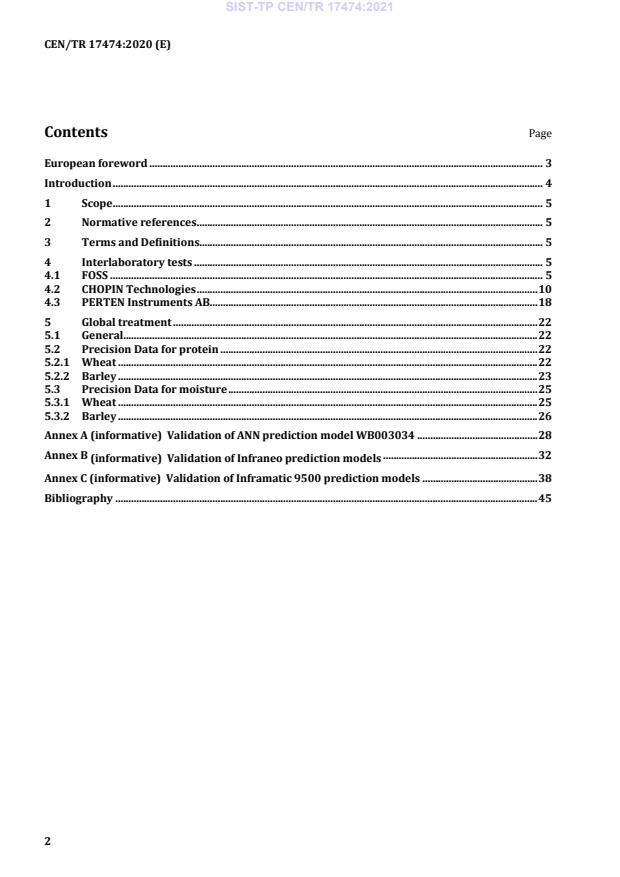
Contents Page
European foreword . 3
Introduction . 4
1 Scope . 5
2 Normative references . 5
3 Terms and Definitions. 5
4 Interlaboratory tests . 5
4.1 FOSS . 5
4.2 CHOPIN Technologies . 10
4.3 PERTEN Instruments AB. 18
5 Global treatment . 22
5.1 General. 22
5.2 Precision Data for protein . 22
5.2.1 Wheat . 22
5.2.2 Barley . 23
5.3 Precision Data for moisture . 25
5.3.1 Wheat . 25
5.3.2 Barley . 26
Annex A (informative) Validation of ANN prediction model WB003034 . 28
Annex B . 32
(informative) Validation of Infraneo prediction models
Annex C (informative) Validation of Inframatic 9500 prediction models . 38
Bibliography . 45
European foreword
This document (CEN/TR 17474:2020) has been prepared by Technical Committee CEN/TC 338 “Cereal
and cereal products”, the secretariat of which is held by AFNOR.
Attention is drawn to the possibility that some of the elements of this document may be the subject of
patent rights. CEN shall not be held responsible for identifying any or all such patent rights.
Introduction
The determination of moisture and protein content in whole kernels of barley and wheat can be done
using a near infrared spectrometer.
This document presents the results of 3 interlaboratory tests implementing this routine method and
their overall statistical treatment.
The outcomes have been used to fix the precision (repeatability and reproducibility) of EN 15948,
“Cereals — Determination of moisture and protein - Method using near infrared spectroscopy in whole
kernels”.
The 3 interlaboratory tests have been managed by FOSS Analytical AB (Sweden) in 2008, by CHOPIN
Technologies (France) in 2012 and by PERTEN Instruments AB (Sweden), a PerkinElmer company, in
2013 in accordance with ISO 5725-2.
1 Scope
This document defines the repeatability and the reproducibility of a method using near infrared
spectroscopy in whole kernels for the determination of moisture and protein on wheat and barley. The
performance of the method (accuracy) is found in EN 15948.
The values derived from the report are applicable to the following concentration ranges:
— for wheat:
— moisture content range from 9,5 % – 15,7 %;
— protein content range from 10,0 % DM to 18,6 % DM;
— for barley:
— moisture content range from 10,6 % – 15,9 %;
— protein content range from 9,2 % DM – 15,4 % DM.
2 Normative references
The following documents are referred to in the text in such a way that some or all of their content
constitutes requirements of this document. For dated references, only the edition cited applies. For
undated references, the latest edition of the referenced document (including any amendments) applies.
EN 15948, Cereals - Determination of moisture and protein - Method using Near-Infrared Spectroscopy in
whole kernels
ISO 5725-1, Accuracy (trueness and precision) of measurement methods and results — Part 1: General
principles and definitions
ISO 5725-2, Accuracy (trueness and precision) of measurement methods and results — Part 2: Basic
method for the determination of repeatability and reproducibility of a standard measurement method
EN ISO 12099, Animal feeding stuffs, cereals and milled cereal products - Guidelines for the application of
near infrared spectrometry (ISO 12099)
3 Terms and Definitions
No terms and definitions are listed in this document.
ISO and IEC maintain terminological databases for use in standardization at the following addresses:
— IEC Electropedia: available at http://www.electropedia.org/
— ISO Online browsing platform: available at https://www.iso.org/obp
4 Interlaboratory tests
4.1 FOSS
An interlaboratory test, organized by the FOSS Analytical AB (Sweden) company in 2008, involving 20
participants from 12 countries was carried out on 6 wheat and 4 barley samples from the 2007 harvest,
containing protein and moisture in various concentrations. The participants were the master
laboratories of European grain networks. The grain networks did also assist in the collection of the
samples (Table 1).
Table 1 — Samples for the interlaboratory study organized by FOSS Analytical
Sample Description Country of origin
B1 Spring barley (2-row, malting barley) UK
B2 Spring barley (2-row, feed barley) Denmark
B3 Spring barley (2-row, malting barley) Denmark
B4 Winter barley (6-row, malting barley) France
W1 Spring wheat (hard) Germany
W2 Spring wheat (hard) France
W3 Winter wheat (hard) UK
W4 Spring wheat (soft) Germany
W5 Winter wheat (hard) Italy
W6 Durum wheat Italy
The prediction model used for the interlaboratory test is WB003034.
This ANN prediction model for the simultaneous prediction of protein and moisture contents in whole
grain of wheat and barley is based on thousands of samples and has been validated according to
EN ISO 12099 by FOSS Analytical AB (Sweden) using independent test sets of wheat and barley
samples, originating from different parts of the world and analysed by different laboratories using the
reference methods given in bibliography. The performance (accuracy) is in accordance with EN 15948,
all the details about the prediction model are given in Annex A.
The results of the interlaboratory test were subjected to statistical analysis in accordance with
ISO 5725-1 and ISO 5725-2 to calculate the precision data shown in Tables 2 to 5 and Figures 1 and 2.
Table 2 — Results of statistical analysis for the determination of the protein content in wheat by
the ANN model WB003034
Sample WG 1 WG 2 WG 3 WG 4 WG 5 WG 6
Number of laboratories 20 20 20 20 20 20
Mean predicted protein content (%DM) 16,883 11,789 13,047 10,876 14,985 14,173
Repeatability standard deviation s (%DM) a
0,159a 0,113a 0,099 0,106 0,087
r 0,109
Repeatability relative stand. dev. s (%)
0,943 0,958 0,76 0,979 0,583 0,771
r
Repeatability limit r [ r = 2,77 × s ] (%DM)
0,440 0,313 0,274 0,294 0,241 0,302
r
Reproducibility stand. dev. s (%DM)
0,159 0,113 0,107 0,143 0,125 0,109
R
Reproducibility relative stand. dev. s (%)
0,943 0,958 0,819 1,317 0,834 0,771
R
Reproducibility limit R [R = 2,77x s ] (%DM)
0,440 0,313 0,296 0,396 0,346 0,302
R
b
16,88 11,75 13,08 10,86 14,93 14,50
Best estimate of true protein value (%DM)
Critical difference (n = 2), reference methods 0,31 0,22 0,22 0,34 0,30 0,21
Deviation predicted - true value (%DM) 0,01 0,04 0,03 0,01 0,06 0,33
a
s > s , s set to be equal s .
r R R r
b
Average protein value (after elimination of outliers) generated by 17 Master laboratories of the European grain
networks, using Kjeldahl (EN ISO 20483 or EN ISO 5983-2) and Dumas (EN ISO 16634-2) methods.
Table 3 — Results of statistical analysis for the determination of the protein content in barley by
the ANN model WB003034
Sample B 1 B 2 B 3 B 4
Number of laboratories 20 20 20 20
Mean predicted protein content (%DM) 10,964 13,05 11,15 12,772
Repeatability standard deviation s (%DM) a
0,198a 0,169a 0,123
r 0,343
Repeatability relative stand. dev. s (%)
1,804 1,292 1,105 2,682
r
Repeatability limit r [ r = 2,77 × s ] (%DM)
0,548 0,468 0,341 0,95
r
Reproducibility stand. dev. s (% DM)
0,198 0,169 0,151 0,343
R
Reproducibility relative stand. dev. s (%)
1,804 1,292 1,352 2,682
R
Reproducibility limit R [R = 2,77 x s ]
R
0,548 0,468 0,418 0,950
(%DM)
Best estimate of true protein value
10,66 13,11 11,27 12,97
b
(%DM)
Critical difference (n = 2), reference
0,39 0,33 0,34 0,67
methods
Deviation predicted - true value (%DM) 0,30 −0,06 −0,12 −0,20
a
s > s , s set to be equal s .
r R R r
b
Average protein value (after elimination of outliers) generated by 17 Master laboratories of the European
grain networks, using Kjeldahl (EN ISO 20483 or EN ISO 5983-2) and Dumas (EN ISO 16634-2) methods.
Key
X protein content (%DM)
Y s (%DM)
1 s
r
2 S
R
3 Linear (s )
r
4 Linear (s )
R
Figure 1 — Standard deviations for the repeatability, s , and reproducibility, s , as a function of
r R
the protein content (wheat and barley)
Table 4 — Results of statistical analysis for the determination of the moisture content in wheat
by the ANN model WB003034
Sample WG 1 WG 2 WG 3 WG 4 WG 5 WG 6
Number of laboratories 20 20 20 20 20 20
Mean predicted moisture content (%) 14,125 13,415 13,978 13,764 11,102 11,074
Repeatability standard dev s (%)
0,024 0,025 0,030 0,016 0,015 0,019
r
Repeatability relative stand. dev. s (%)
0,170 0,187 0,215 0,116 0,138 0,167
r
Repeatability limit r [r = 2,77 × s ] (%)
0,066 0,069 0,083 0,044 0,042 0,053
r
Reproducibility stand. dev. s (%)
0,077 0,07 0,090 0,079 0,045 0,047
R
Reproducibility relative stand. dev. s (%)
0,546 0,523 0,642 0,573 0,405 0,422
R
Reproducibility limit R [R = 2,77 × s ] (%)
0,213 0,194 0,249 0,219 0,125 0,130
R
a
14,24 13,61 14,08 13,93 11,35 11,23
Best estimate of true moisture value (%)
Critical difference (n = 2), reference
0,20 0,28 0,26 0,34 0,27 0,56
methods
Deviation predicted - true value (%) −0,11 −0,20 −0,10 −0,17 −0,25 −0,15
a
Average moisture value (after elimination of outliers) generated by 17 Master laboratories of the European
grain networks, using EN ISO 712 method.
Table 5 — Results of statistical analysis for the determination of the moisture content in barley
by the ANN model WB003034
Sample B1 B2 B3 B4
Number of laboratories 20 20 20 20
Mean predicted moisture content (%) 12,417 13,731 14,299 12,986
Repeatability standard dev s (%)
0,103 0,053 0,054 0,213
r
Repeatability relative stand. dev. s (%)
0,827 0,384 0,377 1,639
r
Repeatability limit r [r = 2,77 × s ] (%)
0,285 0,147 0,150 0,590
r
Reproducibility stand. dev. s (%)
0,111 0,071 0,087 0,238
R
Reproducibility relative stand. dev. s (%)
0,896 0,517 0,611 1,836
R
Reproducibility limit R [R = 2,77 × s ] (%)
0,307 0,197 0,241 0,659
R
a
12,51 13,79 14,37 12,83
Best estimate of true moisture value (%)
Critical difference (n = 2), reference
0,14 0,29 0,30 0,16
methods
Deviation predicted - true value (%) −0,09 −0,06 −0,07 0,16
a
Average moisture value (after elimination of outliers) generated by 17 Master laboratories of the European
grain networks, using EN ISO 712 method.
Key
X moisture (%)
Y s (%)
1 s
r
2 S
R
3 Linear (s )
r
4 Linear (s )
R
Figure 2 — Standard deviations for the repeatability, s , and reproducibility, s , as a function of
r R
the moisture content (wheat and barley)
4.2 CHOPIN Technologies
An interlaboratory test, organized by the CHOPIN Technologies (France) company in 2012, involving 13
participants from 7 countries was carried out on 16 wheat and 15 barley samples from the 2011
harvest, containing protein and moisture in various concentrations. The participants did assist in the
collection of the samples (Table 6 and Table 7).
Table 6 — Wheat Samples for the interlaboratory study organized by CHOPIN
Country of
Sample Description
origin
W1 Common wheat France
W2 Common wheat France
W3 Common wheat France
W4 Common wheat France
W5 Common wheat France
W6 Durum wheat Italy
Country of
Sample Description
origin
W7 Common wheat Turkey
W8 Common wheat France
W9 Common wheat France
W10 Common wheat France
W11 Durum wheat France
W12 Durum wheat France
W13 Common wheat France
W14 Common wheat France
W15 Common wheat France
W16 Common wheat Argentine
Table 7 — Barley Samples for the interlaboratory study organized by CHOPIN
Country of
Sample Description
origin
B1 Barley France
B2 Spring barley France
B3 Winter barley France
B4 Barley France
B5 Barley France
B6 Barley France
B7 Barley France
B8 Barley France
B9 Barley France
B10 Winter Barley France
B11 Spring barley France
B12 Spring barley France
B13 Barley France
B14 Winter barley Germany
B15 Spring barley Argentine
The Infraneo prediction models for the determination of protein and moisture contents on whole grain
of wheat and barley have been developed on samples worldwide collected and coming from crop year
2006 to 2011.They have been validated according to EN ISO 12099 by CHOPIN Technologies (France)
using independent test sets of wheat and barley samples, originating from different parts of the world,
and analysed on different Infraneo using the reference methods given in bibliography. The performance
(accuracy) is in accordance with EN 15948, all the details about the four prediction models are given in
Annex B.
The results obtained were subjected to statistical analysis in accordance with ISO 5725-1 and
ISO 5725-2 to calculate the precision data shown in Tables 8 to 16 and Figures 3 to 6.
Table 8 — Results of statistical analysis for the determination of the protein content in wheat by
Infraneo PLS model bl-pro03.cal
Sample W1 W2 W3 W4 W5 W6 W7 W8
Number of laboratories 11 12 11 11 11 11 11 11
Mean predicted protein content (%DM) 10,97 15,45 11,27 12,01 16,55 14,18 10,97 10,99
Repeatability standard deviation s (%DM)
0,064 0,106 0,055 0,079 0,088 0,063 0,091 0,125
r
Repeatability relative stand. dev. s (%)
0,555 0,685 0,492 0,660 0,532 0,443 0,828 1,139
r
Repeatability limit r [r = 2,77 × s ] (%DM)
0,178 0,296 0,155 0,222 0,247 0,176 0,254 0,350
r
Reproducibility stand. dev. s (%DM)
0,115 0,168 0,130 0,130 0,123 0,084 0,133 0,132
R
Reproducibility relative stand. dev. s (%)
1,005 1,086 1,150 1,083 0,742 0,592 1,209 1,203
R
Reproducibility limit R [R = 2,77x s ] (%DM)
0,323 0,470 0,363 0,364 0,344 0,235 0,371 0,370
R
a
11,05 15,10 11,50 11,90 16,35 14,10 11,20 10,85
True protein value (%DM)
Deviation predicted - true value (%DM) −0,08 0,35 −0,23 0,11 0,20 0,08 −0,23 0,14
a
Protein value obtained by 1 Master lab of the European grain networks, using Kjeldahl (EN ISO 20483) method.
Table 9 — Results of statistical analysis for the determination of the protein content in wheat by
Infraneo PLS model bl-pro03.cal
Sample W9 W10 W11 W12 W13 W14 W15 W16
Number of laboratories 11 11 11 11 11 11 11 11
Mean predicted protein content (% DM) 9,97 11,92 11,91 13,29 16,34 14,82 13,53 18,55
Repeatability standard deviation s (%DM)
0,101 0,085 0,060 0,080 0,088 0,070 0,101 0,088
r
Repeatability relative stand. dev. s (%)
1,012 0,716 0,502 0,601 0,541 0,469 0,744 0,474
r
Repeatability limit r [r = 2,77 × s ] (%DM)
0,283 0,239 0,168 0,223 0,247 0,195 0,282 0,246
r
Reproducibility stand. dev. s (%DM)
0,136 0,131 0,113 0,119 0,166 0,127 0,118 0,152
R
Reproducibility relative stand. dev. s (%) 1,365 1,100 0,949 0,892 1,018 0,857 0,875 0,820
R
Reproducibility limit R [R = 2,77 × s ] (%DM) 0,381 0,367 0,317 0,332 0,466 0,355 0,332 0,426
R
a
9,95 12,00 12,20 13,45 16,45 15,20 13,45 18,30
True protein value (%DM)
Deviation predicted - true value (%DM) 0,02 −0,08 −0,29 −0,16 −0,11 −0,38 0,08 0,25
a
Protein value obtained by 1 Master lab of the European grain networks, using Kjeldahl (EN ISO 20483) method.
Key
X protein (%DM)
Y standard deviation (%DM)
1 s
r
2 s
R
3 Linear (s )
r
4 Linear (s )
R
Figure 3 — Standard deviations for the repeatability, s , and reproducibility, s , as a function of
r R
the protein content on wheat samples
Table 10— Results of statistical analysis for the determination of the protein content in barley
by Infraneo PLS model or-pro03.cal
Sample B1 B2 B3 B4 B5 B6 B7 B8
Number of laboratories 11 11 11 11 11 11 11 11
Mean predicted protein content (%DM) 10,93 11,80 12,08 10,41 11,74 11,85 10,09 12,52
Repeatability standard deviation s
r
0,096 0,090 0,104 0,086 0,134 0,106 0,119 0,141
(%DM)
Repeatability relative stand. dev. s (%)
0,874 0,762 0,859 0,830 1,139 0,897 1,175 1,127
r
Repeatability limit r [r = 2,77 × s ], (%)
0,267 0,252 0,290 0,242 0,375 0,298 0,332 0,395
r
Reproducibility stand. dev. s (% DM)
0,121 0,101 0,134 0,086 0,162 0,123 0,148 0,208
R
Reproducibility relative stand. dev. s
R
1,104 0,859 1,110 0,830 1,383 1,035 1,469 1,661
(%)
Reproducibility limit R [R = 2,77 × s ]
R
0,338 0,221 0,375 0,242 0,455 0,343 0,415 0,582
(%)
a
11,15 11,70 11,90 10,55 11,75 11,75 10,20 12,30
True protein value (%DM)
Deviation predicted - true value (%DM) −0,22 0,10 0,18 −0,14 −0,01 0,10 −0,11 0,22
a
Protein value obtained by 1 Master lab of the European grain networks, using Kjeldahl (EN ISO 20483) method.
Table 11 — Results of statistical analysis for the determination of the protein content in barley
by Infraneo PLS model or-pro03.cal
Sample B9 B10 B11 B12 B13 B14 B15
Number of laboratories 11 11 11 11 11 11 11
Mean predicted protein content (% DM) 15,32 10,40 12,73 15,36 11,33 10,79 10,72
Repeatability standard deviation s (%
r
0,095 0,097 0,183 0,156 0,073 0,113 0,105
DM)
Repeatability relative stand. dev. s (%)
0,618 0,883 1,438 1,014 0,648 1,050 0,977
r
Repeatability limit r [r = 2,77 × s ]
r
0,265 0,257 0,513 0,513 0,206 0,317 0,293
(%DM)
Reproducibility stand. dev. s (% DM)
0,256 0,119 0,183 0,183 0,155 0,190 0,147
R
Reproducibility relative stand. dev. s
R
1,674 1,147 1,438 1,192 1,364 1,759 1,371
(%)
Reproducibility limit R [R = 2,77 × s ]
R
0,718 0,337 0,513 0,651 0,433 0,532 0,411
(%DM)
a
15,05 10,40 12,65 15,50 11,65 10,95 10,70
True protein value (%DM)
Deviation predicted - true value (%DM) 0,27 −0,00 0,08 −0,14 −0,32 −0,16 0,02
a
Protein value obtained by 1 Master lab of the European grain networks, using Kjeldahl (EN ISO 20483)
method.
Key
X protein (%DM)
Y standard deviation (%DM)
1 s
r
2 s
R
3 Linear (s )
r
4 Linear (s )
R
Figure 4 — Standard deviations for the repeatability, s , and reproducibility, s , as a function of
r R
the protein content on barley samples
Table 12 — Results of statistical analysis for the determination of the moisture content in wheat
by Infraneo PLS model bl-hum05.cal
Sample W1 W2 W3 W4 W5 W6 W7 W8
Number of laboratories 11 11 11 11 11 11 11 11
Mean predicted moisture content (%) 13,49 12,79 15,47 13,65 13,10 13,61 10,63 14,26
Repeatability standard deviation s
r
0,059 0,033 0,030 0,037 0,035 0,046 0,051 0,060
(%)
Repeatability relative stand. dev. s
r
0,434 0,258 0,195 0,270 0,269 0,341 0,478 0,423
(%)
Repeatability limit r [ r = 2,77 × s ]
r
0,164 0,092 0,084 0,103 0,099 0,130 0,142 0,169
(%)
Reproducibility stand. dev. s (%)
0,096 0,103 0,099 0,075 0,106 0,092 0,085 0,091
R
Reproducibility relative stand. dev. s
R
0,715 0,807 0,641 0,547 0,811 0,680 0,804 0,639
(%)
Reproducibility limit R [R = 2,77 × s ]
R
0,270 0,289 0,278 0,209 0,297 0,259 0,239 0,255
(%)
a
13,80 13,00 15,70 13,70 13,00 13,30 10,70 14,20
True moisture value (%)
Deviation predicted - true value (%) −0,31 −0,16 −0,23 0,00 0,15 0,31 −0,07 0,06
a
Moisture value obtained by 1 Master lab of the European grain networks using ISO 712 method.
Table 13 — Results of statistical analysis for the determination of the moisture content in wheat
by Infraneo PLS model bl-hum05.cal
Sample W9 W10 W11 W12 W13 W14 W15 W16
Number of laboratories 11 11 11 11 11 11 11 11
Mean predicted moisture content (%) 12,24 12,49 12,88 10,89 11,21 15,74 13,67 12,16
Repeatability standard deviation s (%)
0,056 0,036 0,047 0,050 0,018 0,035 0,039 0,036
r
Repeatability relative stand. dev. s (%)
0,456 0,287 0,367 0,456 0,161 0,221 0,285 0,300
r
Repeatability limit r [ r = 2,77 × s ] (%) 0,156 0,100 0,132 0,132 0,051 0,097 0,109 0,102
r
Reproducibility stand. dev. s (%) 0,087 0,092 0,082 0,088 0,118 0,108 0,092 0,120
R
Reproducibility relative stand. dev. s 0,707 0,734 0,636 0,811 1,049 0,687 0,674 0,989
R
Reproducibility limit R [R = 2,77 × s ] 0,242 0,257 0,229 0,247 0,330 0,303 0,258 0,337
R
a
12,60 12,50 12,70 11,00 11,00 15,80 13,60 12,05
True moisture value (%)
Deviation predicted - true value (%) −0,31 −0,01 0,23 −0,06 0,26 −0,06 0,12 0,11
a
Moisture value obtained by 1 Master lab of the European grain networks using ISO 712 method.
Key
X moisture (%)
Y standard deviation (%)
1 s
r
2 s
R
3 Linear (s )
r
4 Linear (s )
R
Figure 5 — Standard deviations for the repeatability, s , and reproducibility, s , as a function of
r R
the moisture content on wheat samples
Table 14 — Results of statistical analysis for the determination of the moisture content in barley
by Infraneo PLS model or-hum05.cal
Sample B1 B2 B3 B4 B5 B6 B7 B8
Number of laboratories 11 11 11 12 11 11 11 11
Mean predicted moisture content (%) 13,30 14,06 13,80 11,89 11,94 14,14 10,60 15,90
Repeatability standard deviation s
r
0,042 0,041 0,046 0,050 0,050 0,041 0,058 0,046
(%)
Repeatability relative stand. dev. s
r
0,312 0,289 0,335 0,422 0,419 0,288 0,547 0,290
(%)
Repeatability limit r [ r = 2,77 × s ]
r
0,116 0,114 0,130 0,140 0,140 0,114 0,162 0,129
(%)
Reproducibility stand. dev. s (%)
0,099 0,079 0,061 0,088 0,064 0,067 0,140 0,127
R
Reproducibility relative stand. dev. s
R
0,747 0,559 0,441 0,737 0,536 0,476 1,323 0,800
(%)
Reproducibility limit R [R = 2,77 × s ]
R
0,278 0,220 0,170 0,245 0,179 0,189 0,393 0,356
(%)
a
13,40 14,10 13,70 12,00 12,10 14,10 10,80 16,00
True moisture value (%)
Deviation predicted - true value (%) −0,10 0,01 0,10 −0,06 −0,16 0,09 −0,15 −0,05
a
Moistu
...