

prEN 17022
(Main)Child care articles - Bathing aids and elevated shower aids - Safety requirements and test methods
- Abstract
This document specifies safety requirements and test methods for bathing aids intended to be used in a domestic bathtub or washbasin and to elevated shower aids.
This document does not cover bathing aids designed for children with special needs.
Bathing aids that are intended to be used only in conjunction with a child’s bathtub are not covered by this standard.
NOTE 1 Bathing aids that are intended to be used only in conjunction with a child’s bathtub are covered in prEN 17072:2026, Child care articles — Bath tubs, stands and non-standalone bathing aids — Safety requirements and test methods.
NOTE 2 Where the product has several functions or can be converted into another function, it is due to comply with relevant standard(s).
- Status
- Not Published
- Publication Date
- 28-Feb-2028
- Technical Committee
- CEN/TC 252 - Child care articles
- Drafting Committee
- CEN/TC 252/WG 1 - Seating and body care
- Current Stage
- 4060 - Closure of enquiry - Enquiry
- Start Date
- 22-Oct-2026
- Due Date
- 09-Feb-2027
- Completion Date
- 09-Feb-2027
- Directive
- 2001/95/EC - General product safety

prEN 17022 is a CEN draft European Standard for child care articles. It specifies safety requirements and test methods for bathing aids used in a domestic bathtub or washbasin, and for elevated shower aids, so manufacturers, test labs, and buyers can assess these products against one technical document.
What does prEN 17022 specify?
prEN 17022 specifies safety requirements and test methods for bathing aids intended for use in a domestic bathtub or washbasin, and for elevated shower aids. It is organized as a product-scope document with general test conditions, hazard-specific requirements, product-information rules, and informative annexes.
The scope excludes bathing aids designed for children with special needs and bathing aids intended only for use with a child’s bathtub. Where a product has several functions or can be converted into another function, the relevant standard(s) apply to each function.
| Annex | What it covers |
|---|---|
| Annex A | Rationales for selected requirements |
| Annex ZA | Relationship with the safety requirements of Regulation (EU) 2023/988 |
What are the key requirements of prEN 17022?
prEN 17022 combines product-design limits, test methods, and user-information rules. In practice, it asks suppliers to show that the product supports the child, avoids foreseeable entrapment and collapse hazards, and carries clear warnings and identification.
General test conditions matter
Clause 5 sets the test setup: products are tested fully assembled, in the manufacturer’s intended configuration, and normally in dry conditions. Products with vulcanized rubber and thermoplastic elastomer parts are artificially aged before testing, and all products are conditioned before test. This matters because results should reflect the product as sold and used, not an unfinished or unusually favorable setup.
The document sets different safety rules for each product type
Clause 7.1 gives the core protective-function requirements for bath cradles, bath seats, washbasin cradles, and elevated shower aids. Bath cradles and washbasin cradles have minimum length requirements and no harness-based restraint system is allowed; inflatable and/or floating versions are not allowed. Bath seats must surround the seated child, have a crotch restraint, have a minimum support height, and limit the internal distance and leg openings. Elevated shower aids need lateral protection, a crotch restraint, controlled leg openings, and limits on distances between the backrest, crotch restraint, and horizontal member.
For a buyer or designer, this means the product type is not just a marketing label - the geometry and restraint features must match the intended use. For example, a bath seat must physically help keep the child seated, while an elevated shower aid must provide passive restraint in a higher shower position.
Folding, opening, and moving parts are tightly controlled
Clause 7.2 addresses folding or dismantling hazards. It requires locking or other means to prevent unintended collapse during use, limits the use of connecting screws for removable parts, and sets durability checks for locking mechanisms. Clauses 7.4 and 7.5 then restrict compression points, shear points, cords, ribbons, loops, and monofilament threads. The practical point is to reduce pinch, strangulation, and entanglement risks around moving or flexible parts.
Entrapment, choking, suffocation, and edge hazards are also covered
Clause 7.3 uses probe-based checks for finger entrapment, including a 7 mm probe and a shape assessment probe. Clause 7.6 limits small detachable parts and uses grip, torque, and tensile tests to see whether a child could remove a component. Clause 7.7 covers suffocation hazards from plastic packaging and plastic decals, and Clause 7.8 requires rounded, burr-free edges, corners, and protruding parts. In practice, this means components, packaging, and decorative items must be designed so they do not become separate hazards during normal use or after handling.
Structural integrity and stability are verified by load and tip tests
Clause 7.9 checks endurance, static strength, suction cup retention, movable parts, and drop resistance. Clause 7.10 checks stability for bath seats, bath cradles, washbasin cradles, and elevated shower aids under specific tilt, load, and force conditions. For users of the standard, these tests show whether the product can stay together and remain stable under foreseeable use and misuse, including repeated attachment, load, and repositioning.
Product information is part of safety
Clause 8 requires product marking, purchase information, and instructions for use. The markings include a drowning warning, product identification, manufacturer or importer details, and, for bath cradles, a maximum water-level symbol. Instructions must include clear warnings about supervision, drowning risk, water temperature, use limits by child development stage, and any special installation or compatibility limits. This matters because the standard treats labeling and instructions as part of the risk control, not as optional extras.
What terms does prEN 17022 define?
- Bathing aid - A product other than an elevated shower aid that does not contain water by itself and supports the child during bathing by a carer.
- Bath cradle - A bathing aid that keeps a child in a reclined position during bathing, intended from birth until the child can sit upright unassisted.
- Bath seat - A bathing aid that keeps a child seated during bathing, intended for a child who can sit upright unassisted until the child begins to pull up to stand.
- Washbasin cradle - A bathing aid for a reclined child position in a washbasin, intended from birth until the child starts to roll.
- Elevated shower aid - A product that supports the child during showering at a height greater than 200 mm from the shower tray.
- Attachment device - A device that secures the product to the bathtub, washbasin, or bathing enclosure, such as a suction cup.
Who uses prEN 17022?
prEN 17022 is used by manufacturers and importers of child care articles, especially when designing or validating bathing aids and elevated shower aids. It is also used by test laboratories, quality managers, and compliance teams that need repeatable mechanical, chemical, and information checks.
Retailers and buyers can use it to compare products on the same technical basis, especially where attachment method, product geometry, or child age/ability determine whether the product is suitable. The standard is written for products placed on the market and for the teams that must document their safety.
What changed in prEN 17022 from the previous edition?
prEN 17022 will supersede EN 17022:2018. Annex A notes a change to the stability test method for bath seats: the test bar is now horizontal and the force is applied vertically, while the force value and calculation of the distance remain unchanged.
Which standards are used with prEN 17022?
- EN 17826:2025 - Used for chemical hazards in Clause 6, including migration of elements, aniline, and formaldehyde requirements.
- ISO 48-4:2018 - Used for the Shore A hardness of the rubber mat in the drop-test surface.
- prEN 17072:2026 - Cited in the scope note for bathing aids intended only for use with a child’s bathtub.
What does the prEN 17022 document contain?
The document contains a detailed test-equipment section with probes, masses, cylinders, beams, a wedge block, a feeler gauge, and defined test surfaces. It then gives product-conditioning rules, general tolerances, and a test order before moving into hazard-specific methods for chemicals, entrapment, moving parts, choking, suffocation, structural integrity, and stability.
Clause 8 contains marking, purchase-information, and instructions-for-use requirements, including the maximum water-level marking for bath cradles. Annex A explains the reasons behind selected safety requirements, and Annex ZA maps the standard’s normative clauses to the relevant EU safety requirements.
Relations
- Effective Date
- 28-Aug-2024
Frequently Asked Questions
prEN 17022 is a draft published by the European Committee for Standardization (CEN). Its full title is "Child care articles - Bathing aids and elevated shower aids - Safety requirements and test methods". This standard covers: This document specifies safety requirements and test methods for bathing aids intended to be used in a domestic bathtub or washbasin and to elevated shower aids. This document does not cover bathing aids designed for children with special needs. Bathing aids that are intended to be used only in conjunction with a child’s bathtub are not covered by this standard. NOTE 1 Bathing aids that are intended to be used only in conjunction with a child’s bathtub are covered in prEN 17072:2026, Child care articles — Bath tubs, stands and non-standalone bathing aids — Safety requirements and test methods. NOTE 2 Where the product has several functions or can be converted into another function, it is due to comply with relevant standard(s).
This document specifies safety requirements and test methods for bathing aids intended to be used in a domestic bathtub or washbasin and to elevated shower aids. This document does not cover bathing aids designed for children with special needs. Bathing aids that are intended to be used only in conjunction with a child’s bathtub are not covered by this standard. NOTE 1 Bathing aids that are intended to be used only in conjunction with a child’s bathtub are covered in prEN 17072:2026, Child care articles — Bath tubs, stands and non-standalone bathing aids — Safety requirements and test methods. NOTE 2 Where the product has several functions or can be converted into another function, it is due to comply with relevant standard(s).
prEN 17022 is classified under the following ICS (International Classification for Standards) categories: 97.190 - Equipment for children. The ICS classification helps identify the subject area and facilitates finding related standards.
prEN 17022 has the following relationships with other standards: It is inter standard links to EN 17022:2018. Understanding these relationships helps ensure you are using the most current and applicable version of the standard.
prEN 17022 is associated with the following European legislation: EU Directives/Regulations: 2001/95/EC, 2023/988/EU; Standardization Mandates: M/464. When a standard is cited in the Official Journal of the European Union, products manufactured in conformity with it benefit from a presumption of conformity with the essential requirements of the corresponding EU directive or regulation.
prEN 17022 is available in PDF format for immediate download after purchase. The document can be added to your cart and obtained through the secure checkout process. Digital delivery ensures instant access to the complete standard document.
Standards Content (Sample)
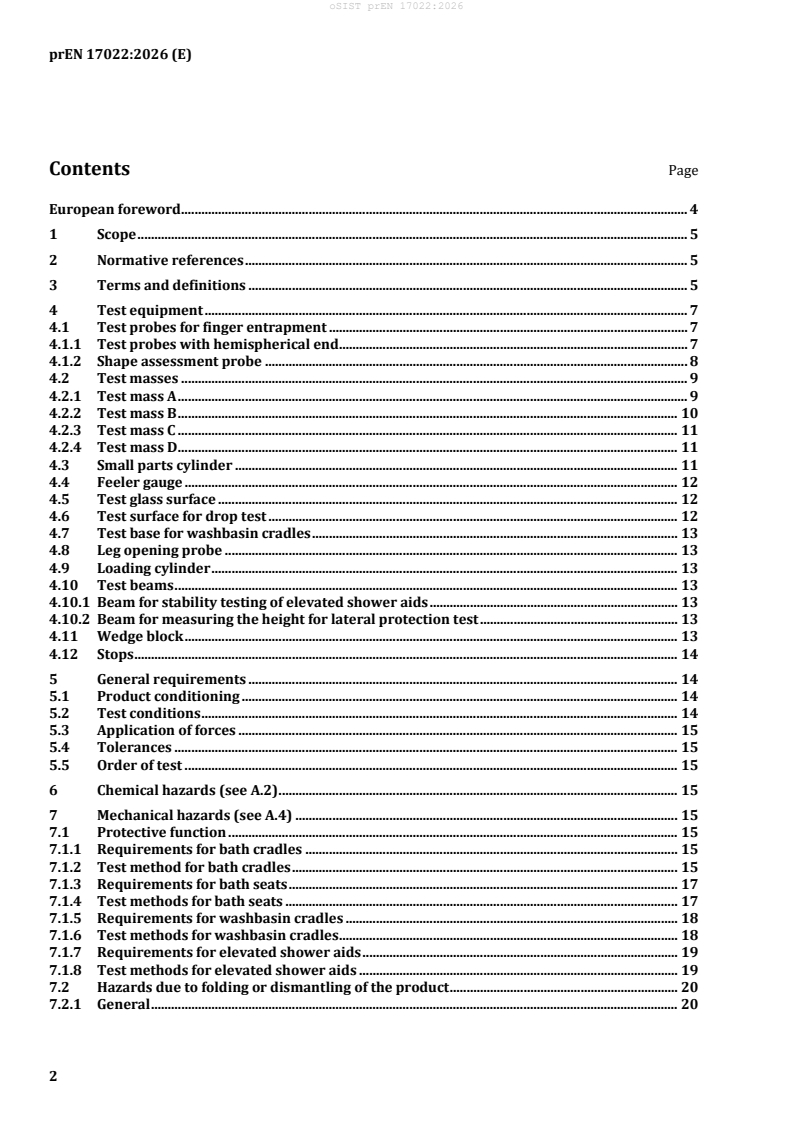
Contents
- 1 Scope
- 2 Normative references
- 3 Terms and definitions
- 3.1 bathing aid
- 3.1.1 bath cradle
- 3.1.2 bath seat
- 3.1.3 washbasin cradle
- 3.2 elevated shower aid
- 3.3 attachment device
- 4 Test equipment
- 4.1 Test probes for finger entrapment
- 1 Line scribed around circumference showing depth of penetration
- 4.2 Test masses
- 4.3 Small parts cylinder
- 4.4 Feeler gauge
- 4.5 Test glass surface
- 4.6 Test surface for drop test
- 4.7 Test base for washbasin cradles
- 4.8 Leg opening probe
- 4.9 Loading cylinder
- 4.10 Test beams
- 4.11 Wedge block
- 4.12 Stops
- 5 General requirements
- 5.1 Product conditioning
- 5.2 Test conditions
- 5.3 Application of forces
- 5.4 Tolerances
- 5.5 Order of test
- 6 Chemical hazards (see A.2)
- 7 Mechanical hazards (see A.4)
- 7.1 Protective function
- 7.2 Hazards due to folding or dismantling of the product
- 7.3 Entrapment hazards
- 7.4 Hazards due to moving parts
- 7.5 Entanglement hazards
- 7.6 Choking and ingestion hazards
- 7.7 Suffocation hazards
- 7.8 Hazardous edges, corners and protruding parts
- 7.9 Hazards from inadequate structural integrity
- 7.10 Hazards due to inadequate stability
- 8 Product information (see A.5)
- 8.1 General
- 8.2 Marking of the product
- 8.3 Purchase information
- 8.4 Instructions for use
- Annex A
- Annex ZA
- 2. Specific Safety Requirements ---
- Bibliography
1 Scope
This document specifies safety requirements and test methods for bathing aids intended to be used in a domestic bathtub or washbasin and to elevated shower aids.
This document does not cover bathing aids designed for children with special needs. Bathing aids that are intended to be used only in conjunction with a child’s bathtub are not covered by this standard.
NOTE 1 Bathing aids that are intended to be used only in conjunction with a child’s bathtub are covered in prEN 17072:2026, Child care articles — Bath tubs, stands and non-standalone bathing aids — Safety requirements and test methods.
NOTE 2 Where the product has several functions or can be converted into another function, it is due to comply with relevant standard(s).
2 Normative references
The following documents are referred to in the text in such a way that some or all of their content constitutes requirements of this document. For dated references, only the edition cited applies. For undated references, the latest edition of the referenced document (including any amendments) applies. EN 17826:2025, Child care articles — Chemical hazards — Requirements ISO 48-4:2018, Rubber, vulcanized or thermoplastic — Determination of hardness — Part 4: Indentation hardness by durometer method (Shore hardness)
3 Terms and definitions
For the purposes of this document, the following terms and definitions apply. ISO and IEC maintain terminology databases for use in standardization at the following addresses:
- ISO Online browsing platform: available at https://www.iso.org/obp
- IEC Electropedia: available at https://www.electropedia.org/
3.1 bathing aid
product, other than an elevated shower aid, that does not provide containment of water by itself and that provides support for the child during bathing by a carer (Figure 1)
3.1.1 bath cradle
bathing aid designed to keep a child in a reclined position during bathing Note 1 to entry: These products are intended for use from birth and until the child is able to sit upright unassisted.
3.1.2 bath seat
bathing aid designed to keep a child in a seated position during bathing Note 1 to entry: These products are intended for use with a child who is able to sit upright unassisted and until the child begins pulling up to a standing position.
oSIST prEN 17022:2026 prEN 17022:2026 (E)
3.1.3 washbasin cradle
bathing aid designed to keep a child in a reclined position during bathing and intended to be used in a washbasin Note 1 to entry: These products are intended for use from birth and until the child starts to roll.
Key A bath cradle B bath seat C washbasin cradle Figure 1 — Examples of bathing aids
oSIST prEN 17022:2026 prEN 17022:2026 (E)
3.2 elevated shower aid
product, that does not provide containment of water by itself and that provides support for the child during showering by a carer, where the child is positioned at a height greater than 200 mm from the shower tray (Figure 2)
Figure 2 — Examples of elevated shower aid
3.3 attachment device
device to secure the product to the bathtub, washbasin or bathing enclosure EXAMPLE Suction cup.
4 Test equipment
4.1 Test probes for finger entrapment
4.1.1 Test probes with hemispherical end
0 +01, Probes made from plastic or other hard, smooth material of diameters 7 mm and 12 mm
−01, 0 with a full hemispherical end that can be mounted on a force-measuring device, see Figure 3. Mesh probe made from plastic or other hard, smooth material as shown in Figure 4.
oSIST prEN 17022:2026 prEN 17022:2026 (E) Dimensions in millimetres
Key Probe type 7 mm probe 12 mm probe Diameter A 0 +01,
−01, Radius RB half of diameter A half of diameter A
1 Line scribed around circumference showing depth of penetration
Figure 3 — Test probes with hemispherical end Dimensions in millimetres
Key Probe type Mesh probe Diameter A 0
−01, Diameter B 0 5,6 −01, Radius RB half of diameter B Figure 4 — Test probe for mesh
4.1.2 Shape assessment probe
Probe made from plastics or other hard, smooth material with the dimensions shown in Figure 5.
oSIST prEN 17022:2026 prEN 17022:2026 (E) Dimensions in millimetres
Key A front view B top view C side view D 3D view Figure 5 — Shape assessment probe
4.2 Test masses
4.2.1 Test mass A
A rigid cylinder (160 ± 5) mm in diameter and (300 ± 5) mm in height, having a mass of 9 kg and with its centre of gravity in the centre of the cylinder. All edges shall have a radius of (5 ± 1) mm. Two anchorage points shall be provided. These shall be positioned (150 ± 2,5) mm from the base and at 180° to each other around the circumference (Figure 6).
oSIST prEN 17022:2026 prEN 17022:2026 (E) Dimensions in millimetres
Key 1 radius: (5 ± 1) mm 2 anchorage points Figure 6 — Test mass A and D
4.2.2 Test mass B
A rigid cylinder (200 ± 5) mm in diameter and (300 ± 5) mm in height, having a mass of 15 kg and with its centre of gravity in the centre of the cylinder. All edges shall have a radius of (5 ± 1) mm. Two anchorage points shall be provided. These shall be positioned (150 ± 2,5) mm from the base and at 180° to each other around the circumference (Figure 7).
oSIST prEN 17022:2026 prEN 17022:2026 (E) Dimensions in millimetres
Key 1 radius: (5 ± 1) mm 2 two anchorage points Figure 7 — Test mass B
4.2.3 Test mass C
A cylinder with a mass of 5 kg and a diameter of 100 mm.
4.2.4 Test mass D
A rigid cylinder (160 ± 5) mm in diameter and (300 ± 5) mm in height, having a mass of 6,5 kg and with its centre of gravity in the centre of the cylinder. All edges shall have a radius of (5 ± 1) mm. Two anchorage points shall be provided. These shall be positioned (150 ± 2,5) mm from the base and at 180° to each other around the circumference (Figure 6).
4.3 Small parts cylinder
Cylinder for the assessment of small components, having dimensions in accordance with Figure 8.
oSIST prEN 17022:2026 prEN 17022:2026 (E) Dimension in millimetres
Figure 8 — Small parts cylinder
4.4 Feeler gauge
Gauge with a thickness of (0,4 ± 0,02) mm and an insertion edge radius of (3 ± 0,5) mm (Figure 9). Dimensions in millimetres
Figure 9 — Feeler gauge
4.5 Test glass surface
A rigid plane covered with uncoated tempered float glass that has a smooth surface and thickness of 6 mm.
4.6 Test surface for drop test
A 4 mm thick steel plate with a 2 mm thick rubber mat, with hardness (75 ± 10) Shore A according to ISO 48-4:2018, and which is placed on a non-flexible horizontal surface.
oSIST prEN 17022:2026 prEN 17022:2026 (E)
4.7 Test base for washbasin cradles
Test base for washbasin cradles representing the upper rim of a sink section made of hard and smooth material with dimensions in accordance with Figure 10.
Dimensions in millimetres
Key 1 inside 2 outside Figure 10 — Cross section; bath test base, right side
4.8 Leg opening probe
+2 A rigid cylinder made of a hard smooth material, ( ) mm in diameter and (200 ± 1) mm in length.
−0
4.9 Loading cylinder
A cylinder with a mass of 5 kg and a diameter of 100 mm.
4.10 Test beams
4.10.1 Beam for stability testing of elevated shower aids
A beam, not less than 900 mm long, with a square section of 25 mm x 25 mm and with a mass of (0,5 ± 0,01) kg.
4.10.2 Beam for measuring the height for lateral protection test
A beam, 86 mm wide and with a mass of (0,5 ± 0,01) kg.
4.11 Wedge block
A block made of plastic or other hard, smooth material and with dimensions according to Figure 11.
oSIST prEN 17022:2026 prEN 17022:2026 (E) Dimensions in millimetres
Top view Front view Side view Figure 11 — Wedge block
4.12 Stops
Stops to prevent the item under testing from sliding but not tilting, no higher than 12 mm except in cases where the design of the item necessitates the use of higher stops, in which case the lowest stops that will prevent the item from sliding shall be used.
5 General requirements
5.1 Product conditioning
Products containing vulcanized rubber and thermoplastic elastomer parts (but not silicone parts) shall be artificially aged for seven days in an aerated drying cabinet at a temperature of (70 ± 2) °C. In case the elastomeric parts are the suction cups, contact of the suction cups with the surface of the cabinet shall be avoided during the ageing treatment. The product shall be placed in a position in which suction cups are unloaded.
All products shall be conditioned for at least 40 h, in a standard atmosphere at a temperature of (23 ± 2) °C and relative humidity of (50 ± 5) %.
5.2 Test conditions
The tests shall be carried out at a temperature of (21 ± 6) °C. The tests are designed to be applied to a product that is fully assembled according to the manufacturer’s instructions and ready for use.
If the instructions allow for different adjustments or configurations of components, the most onerous combination shall be used for each test, unless otherwise specified in the test method. Unless otherwise specified in the test method, all tests shall be carried out in dry condition (i.e. product and test surfaces not wet).
oSIST prEN 17022:2026 prEN 17022:2026 (E)
5.3 Application of forces
The forces in the static load tests shall be applied sufficiently slowly to ensure that negligible dynamic force is applied.
5.4 Tolerances
Unless otherwise stated, the following tolerances apply:
- Forces: ±5 % of the nominal force;
- Masses: ±0,5 % of the nominal mass;
- Dimensions: ±1,0 mm;
- Angles: ±0,5°;
- Positioning of loading pads: ±5 mm;
- Time: ±1 s.
The tests are described in terms of the application of forces. Masses can however be used: 1 kg mass may be used for 10 N force.
Unless otherwise specified, the test forces may be applied by any suitable device which does not adversely affect the results.
5.5 Order of test
Unless otherwise stated, the requirements of Clause 7 shall be assessed on the same product in the order listed in this standard.
6 Chemical hazards (see A.2)
The migration of elements from materials on exterior surfaces shall comply with EN 17826:2025, cl. 4.2 (migration of certain elements).
Parts made of textile materials intended to be in prolonged contact with the skin of the child shall comply with EN 17826:2025, cl. 4.4 (aniline) and cl. 4.6 (formaldehyde). NOTE EN 17826:2025 cl. 4.1 gives a definition of prolonged skin contact. A separate sample may be used for these tests.
7 Mechanical hazards (see A.4)
7.1 Protective function
7.1.1 Requirements for bath cradles
Bath cradles shall have a distance H > 50 mm measured in accordance with 7.1.2. Bath cradles shall have a length not less than 380 mm measured in accordance with 7.1.2. No harness shall be provided as a child restraint system.
Inflatable and/or floating bath cradles are not allowed.
7.1.2 Test method for bath cradles
Place the bath cradle on flat rigid horizontal surface according to the manufacturer’s instructions. Position test mass A (4.2.1) on the product and guide it to reach the lowest point.
oSIST prEN 17022:2026 prEN 17022:2026 (E) Measure the distance H between the lowest point of the test mass and the projection, parallel to the test mass, of the highest point on the bath cradle in front of the mass (Figure 12 and Figure 13). Measure the length L between the lowest point of the test mass and the projection, parallel to the test mass, of the highest point on the bath cradle at the back of the test mass (Figure 12 and Figure 13).
Key H height L length Figure 12 — Measurement of length L and height H for hammock type cradles
Key H height L length Figure 13 — Measurement of length L and height H for non-hammock type cradles
oSIST prEN 17022:2026 prEN 17022:2026 (E)
7.1.3 Requirements for bath seats
Bath seats shall provide a child support completely surrounding a seated child during bathing (see Figure 14). The minimum height of the child support from the sitting surface shall be 140 mm in any position around the child, when tested in accordance with 7.1.4.1. Bath seats shall have a crotch restraint, connected to both the sitting surface and the child support, such that the product cannot be used without the crotch restraint being used.
Key A child support B crotch restraint C sitting surface Figure 14 — Example of bath seat The maximum internal distance shall be less than or equal to 250 mm at any point, when tested in accordance with 7.1.4.2.
Each leg opening shall allow the passage of the leg opening probe when tested in accordance with 7.1.4.3.
No harness-based restraint system shall be provided.
Inflatable and/or floating bath seats are not allowed.
7.1.4 Test methods for bath seats
7.1.4.1 Test method for measurement of the height
Place the bath seat on a flat horizontal surface.
Position the test beam (4.9.1) across on the child support.
Measure, perpendicular to the bar, the vertical distance between the sitting surface and the bottom of the bar at all points on the seat.
7.1.4.2 Test method for measurement of the internal distance
Place the bath seat on a flat horizontal surface.
The bath seat internal distance is measured parallel to the horizontal, 10 mm above the upper point of the sitting surface.
oSIST prEN 17022:2026 prEN 17022:2026 (E)
7.1.4.3 Test method for leg openings
Place the bath seat on a flat horizontal surface.
Insert the leg opening probe (4.8) into each leg opening from outside the bath seat and check if the leg opening probe can freely pass through and be taken out from above the seat unit (e.g. by pulling, without twisting or making sharp turns). See Figure 15.
Key 1 leg opening probe Figure 15 — Test method for leg openings
7.1.5 Requirements for washbasin cradles
Washbasin cradles shall have a length not less than 380 mm measured in accordance with 7.1.6. No harness shall be provided as a child restraint system.
Inflatable washbasin cradles are not allowed.
7.1.6 Test methods for washbasin cradles
Place the wash basin cradle in accordance with the manufacturer instructions, with the attachment device (e.g. suction cups) on the test glass surface (4.5) and with the top of the cradle against the test base (4.7) as in Figure 16.
Position test mass A (4.2.1) on the product and guide it, without pushing it, to reach the lowest point. Measure the length L between the lowest point of the test mass and the projection, parallel to and in the centre of the test mass, of the highest point on the bath cradle at the back of the test mass (Figure 16).
oSIST prEN 17022:2026 prEN 17022:2026 (E)
Key L length Figure 16 — Measurement of length L for washbasin cradles
7.1.7 Requirements for elevated shower aids
Elevated shower aids shall comply with the following requirements:
a) it shall be fitted with lateral protection that extend up to the horizontal component and that have a height of at least 140 mm along the whole length when measured in accordance with 7.1.8.1; and b) it shall have a crotch restraint, connected to both the sitting surface and the horizontal member, such that the product cannot be used without the crotch restraint being used; and c) the leg openings shall not allow passage of the wedge block when tested in accordance with 7.1.8.2; and d) the horizontal distance between the front surface of the backrest and the crotch restraint shall be less than 216 mm when measured in accordance with 7.1.8.3; and e) the horizontal distance between the front surface of the backrest and the horizontal member shall be less than 250 mm when measured in accordance with 7.1.8.3.
No harness-based restraint system shall be provided.
7.1.8 Test methods for elevated shower aids
7.1.8.1 Test method for measurement of the lateral protections
Position the loading cylinder (4.9) with its base on the centre of the seat. Position the test beam (4.10) across the lateral protection with the 86 mm side in a horizontal position.
oSIST prEN 17022:2026 prEN 17022:2026 (E) Measure the minimum height of the lateral protection as the vertical distance between the under surface of the beam and the under surface of the loading cylinder.
7.1.8.2 Test method for leg openings
The elevated shower aid shall be placed on the floor in the normal position of use. Restrain the product so that it cannot slide on the floor surface or tip over.
Position the wedge block (see 4.11) on the seat with the tapered end towards the leg opening, keeping its main axis perpendicular to the opening.
Gradually pull the wedge block by its hook from the outside of the elevated shower aid with a force of 30 N in a straight direction along the wedge block main axis.
7.1.8.3 Test method for measurement of the horizontal distance between the front surface of the
backrest and the crotch restraint / horizontal member Adjust the backrest to the most upright position (if adjustable) and the crotch restraint to the position furthest from the backrest (if adjustable).
Measure the horizontal distance between the front surface of the uncompressed backrest and the uncompressed crotch restraint, 10 mm above the lowest point of the uncompressed seat surface along the centreline of the seat.
Measure the maximum horizontal distance between the front surface of the uncompressed backrest and the inner surface of the horizontal member.
7.2 Hazards due to folding or dismantling of the product
7.2.1 General
Connecting screws (e.g. self-tapping screws) shall not be used to fasten any component that is designed to be removed or loosened when dismantling the product to transport or store it. When the product is placed in any manufacturer’s recommended use position(s), products that fold shall have a locking mechanism(s) or other means to prevent the product from folding or collapsing during use.
NOTE “Other means” could include, but are not limited to, designs which utilize the occupant, an added component, or the water that is placed into the product to act in opposition to the folding action or collapse of the product.
7.2.2 Unintentional release of locking mechanism(s)
To avoid the hazards due to unintentional release of locking mechanisms, if any, one of the following conditions shall be fulfilled before and after testing in accordance with 7.2.3:
a) at least one operating device requires an operating force greater than 50 N measured with and without test mass A (4.2.1) on the product, or b) folding is only possible if at least one locking mechanism requires the use of a tool, or c) at least one operating device requires at least two consecutive actions, the first of which shall be maintained while the second is carried out, or d) at least one locking mechanism is released when two independent operating devices are simultaneously operated.
If the weight of the child has a positive effect on the locking, this is accepted as an operating device.
oSIST prEN 17022:2026 prEN 17022:2026 (E)
7.2.3 Test method for the durability of the locking mechanisms
Operate 300 times any locking mechanism(s).
7.3 Entrapment hazards
7.3.1 Entrapment of fingers
7.3.1.1 Requirement
With the exception of the back of the backrest and parts of the product from the floor up to and including the under-surface of the seating / lying surface, there shall be no completely bounded openings that let the 7 mm probe (see 4.1.1) go through unless the depth of penetration is less than 10 mm or unless the shape assessment probe (see 4.1.2) enters, when tested in accordance with 7.3.1.2. The above requirement only applies to components made of materials with a Shore A hardness greater than 60.
...