


CEN/TR 13387-3:2023
(Main)Child care articles - General safety guidelines - Part 3: Mechanical hazards
Child care articles - General safety guidelines - Part 3: Mechanical hazards
This document provides guidance information on mechanical hazards that should be taken into consideration when developing safety standards for child care articles. In addition, these guidelines can assist those with a general professional interest in child safety.
Artikel für Säuglinge und Kleinkinder - Sicherheitsleitfaden - Teil 3: Mechanische Gefährdungen
Dieses Dokument stellt Angaben zu mechanischen Gefährdungen bereit, die bei der Erarbeitung von Sicherheitsnormen für Artikel für Säuglinge und Kleinkinder berücksichtigt werden sollten. Außerdem können diese Leitlinien für Personen mit allgemeinem beruflichem Interesse an der Sicherheit der Säuglinge und Kleinkinder nützlich sein.
Articles de puériculture - Conseils relatifs à la sécurité - Partie 3 : Dangers mécaniques
Izdelki za otroke - Smernice o splošni varnosti - 3. del: Nevarnosti zaradi mehanskih lastnosti
Ta dokument podaja smernice o nevarnostih zaradi mehanskih lastnosti, ki naj se upoštevajo pri razvoju varnostnih standardov za uporabo izdelkov za otroke. Poleg tega so lahko te smernice v pomoč ljudem s splošnim poklicnim interesom za varnost otrok.
General Information
- Status
- Withdrawn
- Publication Date
- 28-Feb-2023
- Withdrawal Date
- 18-Nov-2025
- Technical Committee
- CEN/TC 252 - Child use and care articles
- Drafting Committee
- CEN/TC 252/WG 6 - General and common safety specifications
- Current Stage
- 6060 - Definitive text made available (DAV) - Publishing
- Start Date
- 01-Mar-2023
- Due Date
- 15-Jul-2021
- Completion Date
- 01-Mar-2023
Relations
- Replaces
CEN/TR 13387-3:2018 - Child care articles - General safety guidelines - Part 3: Mechanical hazards - Effective Date
- 19-Jan-2023
- Replaced By
CEN/TS 13387-3:2025 - Child care articles - General safety guidelines - Part 3: Mechanical hazards - Effective Date
- 21-Feb-2024

Frequently Asked Questions
CEN/TR 13387-3:2023 is a technical report published by the European Committee for Standardization (CEN). Its full title is "Child care articles - General safety guidelines - Part 3: Mechanical hazards". This standard covers: This document provides guidance information on mechanical hazards that should be taken into consideration when developing safety standards for child care articles. In addition, these guidelines can assist those with a general professional interest in child safety.
This document provides guidance information on mechanical hazards that should be taken into consideration when developing safety standards for child care articles. In addition, these guidelines can assist those with a general professional interest in child safety.
CEN/TR 13387-3:2023 is classified under the following ICS (International Classification for Standards) categories: 97.190 - Equipment for children. The ICS classification helps identify the subject area and facilitates finding related standards.
CEN/TR 13387-3:2023 has the following relationships with other standards: It is inter standard links to CEN/TR 13387-3:2018, CEN/TS 13387-3:2025. Understanding these relationships helps ensure you are using the most current and applicable version of the standard.
You can purchase CEN/TR 13387-3:2023 directly from iTeh Standards. The document is available in PDF format and is delivered instantly after payment. Add the standard to your cart and complete the secure checkout process. iTeh Standards is an authorized distributor of CEN standards.
Standards Content (Sample)
SLOVENSKI STANDARD
01-december-2023
Nadomešča:
SIST-TP CEN/TR 13387-3:2018
Izdelki za otroke - Smernice o splošni varnosti - 3. del: Nevarnosti zaradi
mehanskih lastnosti
Child care articles - General safety guidelines - Part 3: Mechanical hazards
Artikel für Säuglinge und Kleinkinder - Sicherheitsleitfaden - Teil 3: Mechanische
Gefährdungen
Articles de puériculture - Conseils relatifs à la sécurité - Partie 3 : Dangers mécaniques
Ta slovenski standard je istoveten z: CEN/TR 13387-3:2023
ICS:
97.190 Otroška oprema Equipment for children
2003-01.Slovenski inštitut za standardizacijo. Razmnoževanje celote ali delov tega standarda ni dovoljeno.
CEN/TR 13387-3
TECHNICAL REPORT
RAPPORT TECHNIQUE
March 2023
TECHNISCHER REPORT
ICS 97.190 Supersedes CEN/TR 13387-3:2018
English Version
Child care articles - General safety guidelines - Part 3:
Mechanical hazards
Articles de puériculture - Conseils relatifs à la sécurité - Artikel für Säuglinge und Kleinkinder -
Partie 3 : Dangers mécaniques Sicherheitsleitfaden - Teil 3: Mechanische
Gefährdungen
This Technical Report was approved by CEN on 2 January 2023. It has been drawn up by the Technical Committee CEN/TC 252.
CEN members are the national standards bodies of Austria, Belgium, Bulgaria, Croatia, Cyprus, Czech Republic, Denmark, Estonia,
Finland, France, Germany, Greece, Hungary, Iceland, Ireland, Italy, Latvia, Lithuania, Luxembourg, Malta, Netherlands, Norway,
Poland, Portugal, Republic of North Macedonia, Romania, Serbia, Slovakia, Slovenia, Spain, Sweden, Switzerland, Türkiye and
United Kingdom.
EUROPEAN COMMITTEE FOR STANDARDIZATION
COMITÉ EUROPÉEN DE NORMALISATION
EUROPÄISCHES KOMITEE FÜR NORMUNG
CEN-CENELEC Management Centre: Rue de la Science 23, B-1040 Brussels
© 2023 CEN All rights of exploitation in any form and by any means reserved Ref. No. CEN/TR 13387-3:2023 E
worldwide for CEN national Members.
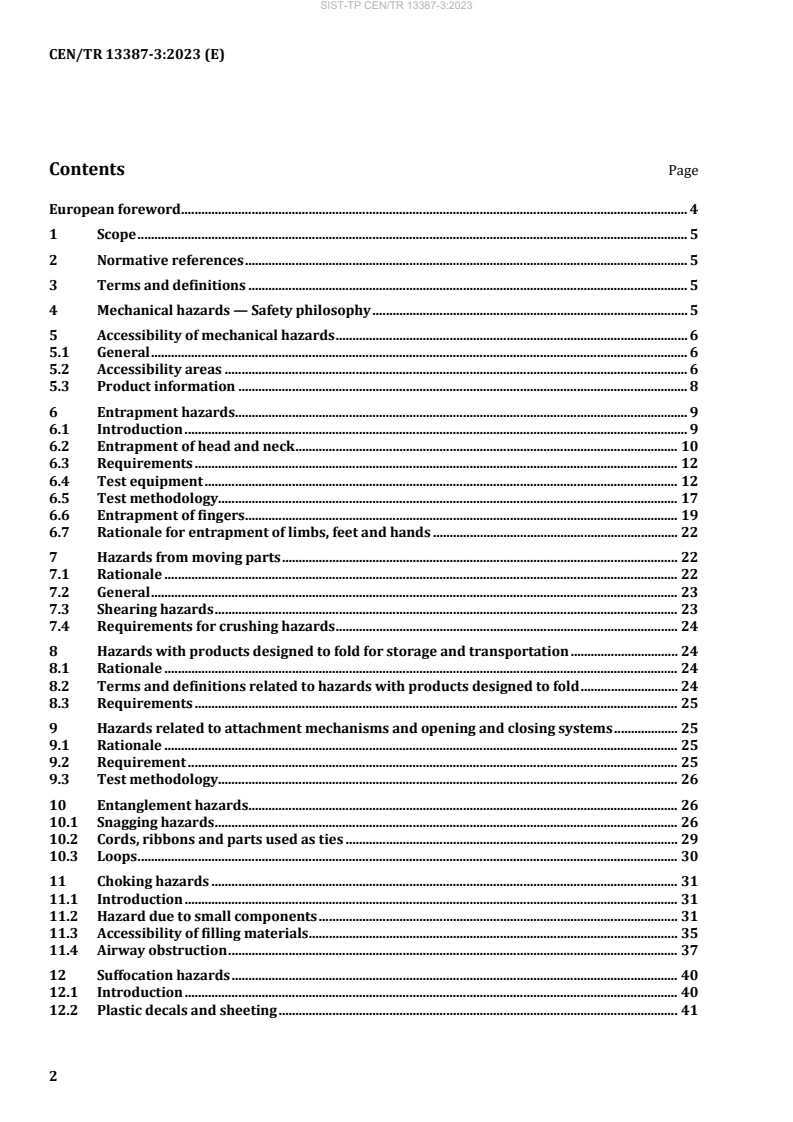
Contents Page
European foreword . 4
1 Scope . 5
2 Normative references . 5
3 Terms and definitions . 5
4 Mechanical hazards — Safety philosophy . 5
5 Accessibility of mechanical hazards . 6
5.1 General . 6
5.2 Accessibility areas . 6
5.3 Product information . 8
6 Entrapment hazards. 9
6.1 Introduction . 9
6.2 Entrapment of head and neck . 10
6.3 Requirements . 12
6.4 Test equipment . 12
6.5 Test methodology . 17
6.6 Entrapment of fingers . 19
6.7 Rationale for entrapment of limbs, feet and hands . 22
7 Hazards from moving parts . 22
7.1 Rationale . 22
7.2 General . 23
7.3 Shearing hazards . 23
7.4 Requirements for crushing hazards . 24
8 Hazards with products designed to fold for storage and transportation . 24
8.1 Rationale . 24
8.2 Terms and definitions related to hazards with products designed to fold . 24
8.3 Requirements . 25
9 Hazards related to attachment mechanisms and opening and closing systems . 25
9.1 Rationale . 25
9.2 Requirement . 25
9.3 Test methodology . 26
10 Entanglement hazards . 26
10.1 Snagging hazards . 26
10.2 Cords, ribbons and parts used as ties . 29
10.3 Loops . 30
11 Choking hazards . 31
11.1 Introduction . 31
11.2 Hazard due to small components . 31
11.3 Accessibility of filling materials . 35
11.4 Airway obstruction . 37
12 Suffocation hazards . 40
12.1 Introduction . 40
12.2 Plastic decals and sheeting . 41
12.3 Non air-permeable packaging . 43
13 Ingestion hazards . 44
13.1 Rationale . 44
13.2 Ingestion of small components . 44
14 Hazardous edges and projections . 48
14.1 Introduction. 48
14.2 Edges . 48
14.3 Rigid protruding parts . 49
14.4 Points and wires . 49
15 Structural integrity . 50
15.1 Introduction. 50
15.2 Material suitability . 50
15.3 Strength and durability of the product . 51
16 Protective function . 51
16.1 Introduction. 51
16.2 Barrier function . 51
16.3 Restraint systems . 53
16.4 Footholds . 56
17 Hazard associated with stability . 63
17.1 Rationale . 63
17.2 General requirement . 63
Bibliography . 64
European foreword
This document (CEN/TR 13387-3:2023) has been prepared by Technical Committee CEN/TC 252 “Child
care articles”, the secretariat of which is held by AFNOR.
Attention is drawn to the possibility that some of the elements of this document may be the subject of
patent rights. CEN shall not be held responsible for identifying any or all such patent rights.
This document supersedes CEN/TR 13387-3:2018.
This new edition of this Technical Report is a hazard-based Technical Report. The main changes
compared to the previous edition are listed below:
— Mechanical hazards — Safety philosophy: addition of a new paragraph on new technologies;
— Hazard due to small components: Reworded;
— Footholds: Reworded.
The CEN/TR 13387 series, with the general title Child care articles - General safety guidelines, comprises
the following five parts:
— Part 1: Safety philosophy and safety assessment;
— Part 2: Chemical hazards;
— Part 3: Mechanical hazards;
— Part 4: Thermal hazards;
— Part 5: Product information.
CEN/TR 13387-3 is intended to be used in conjunction with CEN/TR 13387-1.
Any feedback and questions on this document should be directed to the users’ national standards body.
A complete listing of these bodies can be found on the CEN website.
1 Scope
This document provides guidance information on mechanical hazards that should be taken into
consideration when developing safety standards for child care articles. In addition, these guidelines can
assist those with a general professional interest in child safety.
2 Normative references
The following documents are referred to in the text in such a way that some or all of their content
constitutes requirements of this document. For dated references, only the edition cited applies. For
undated references, the latest edition of the referenced document (including any amendments) applies.
ISO 4593, Plastics — Film and sheeting — Determination of thickness by mechanical scanning
3 Terms and definitions
For the purposes of this document, the following terms and definitions apply.
ISO and IEC maintain terminology databases for use in standardization at the following addresses:
— IEC Electropedia: available at https://www.electropedia.org/
— ISO Online browsing platform: available at https://www.iso.org/obp
3.1
mechanical hazards
physical factors which may give rise to injury due to the mechanical properties of products/product parts
3.2
reach envelopes
age related physical data on the reach limits of the limbs of children in different postures
Note 1 to entry: See 5.2.
3.3
ageing
change of properties of the material due to exposure to environmental factors such as temperature,
humidity, UV radiation, cleaning agents, etc.
3.4
mechanical wear
change of mechanical properties due to fatigue or repeated operation of devices, mechanisms and other
parts of the product
4 Mechanical hazards — Safety philosophy
This clause addresses the most widely known mechanical hazards and is intended to provide guidance
when drafting standards for child care articles.
Anthropometric data and information on the abilities of children related to risks are given in
CEN/TR 13387-1:2018, Annex A. When using these data for setting requirements, adequate safety
margins should be considered. These data refer to static and not dynamic anthropometric data, therefore
care should be taken if using these data for anything other than static situations when drafting standards.
When drafting standards, conditions of use should be considered, bearing in mind the behaviour of
children. Also, it is to be considered whether the child is attended or unattended when using the product
and also the child’s access to hazardous features.
For each mechanical hazard a rationale is given, explaining the potential hazard to the child.
Requirements, test equipment and test methods are also given. Where appropriate, these can be used
when drafting standards.
New technologies, e.g. fingerprint or face recognition or others, could be used for opening and closing a
mechanical device or for operating a product.
When developing technical standards for child care articles, if these new technologies are identified as a
possible option for use within a product category, specific requirements and test methods to assess their
safety should be defined.
5 Accessibility of mechanical hazards
5.1 General
Within the mechanical section no reference is made to specific areas of access, known as access zones. It
would be wrong for this guidance document to specify exact areas of access as these should be
determined in relation to the hazards and risks of individual products and risks when drafting the
standard. As a general guidance to the types of contact associated with mechanical hazards, the following
examples are given:
— the hazardous part is in reach of the child from the intended position of use in particular by head,
mouth, hands or feet and there is a high probability for frequent, intensive and/or prolonged contact.
Requirements need to address this primary contact;
— the hazardous part may be reached by the child or any other child beyond the intended position of
use. The product is considered to remain in its intended position(s). Access to hazardous parts is
gained by passing/moving around the product or when proceeding to the intended position. The risk
of harm deriving from frequent, intensive and/or pro-longed contact may be less probable;
— the hazardous part exists, but cannot be reached by any child.
Irrespective of the access category, the reasonably foreseeable conditions of use should always be
considered when designing children’s products and/or writing product standards.
5.2 Accessibility areas
Information for determination of accessibility areas in connection with age group is given in Table 1 and
Figure 1. These reach envelopes are based on a computer simulation; therefore, the dimensions should
be treated with care. If in the future experiments with children are undertaken, these figures in the table
may be determined more accurately.
Table 1 — Reach envelopes for guidance in the specification of accessibility areas in standards –
anthropometric data related to Figure 1
Dimension Overhead Overhead Span Overhead
Arm Buttock- Lower
(mm) ›
Reach Reach on Reach Reach Foot Leg
tiptoes
Sitting Length
Age group L1 L1' L2 L3 L4 R1 R2
0 month to 760 - 660 550 250 300 150
6 months
6 months to 880 960 770 610 290 380 190
12 months
12 months to 1 160 1 260 1 020 770 420 550 275
36 months
36 months to 1 270 1 370 1 070 810 460 630 315
48 months
NOTE All dimensions are based on P95 values. L1, L1', L2, L3, L4, have been assessed with the computer
program ADAPS (© 79–93 TU-Delft University of Technology, Faculty of Industrial Design Engineering).
R1 = buttock - foot length (Annex A, Table 3). R2 = 0,5 x R1.
NOTE ©79-93 TU-Delft University of Technology Faculty of Industrial Design Engineering.
Figure 1 — Reach envelopes for determination of accessibility areas
5.3 Product information
In order to ensure mechanical safety, the information for the carer should include appropriate
instructions and warnings. For example:
— the need for restraint system and its adjustment;
— the opening and closing of products;
— the operation of safety locks for foldable parts;
— the method of attachment to fixed structures or to other products.
Instructions should also inform the carer of the need to inspect the product regularly and also to use only
replacement parts that are approved by the manufacturer/supplier.
CEN/TR 13387-5 “Product information” gives detailed advice concerning the presentation of product
information.
6 Entrapment hazards
6.1 Introduction
To avoid entrapment of head, neck, fingers, feet, and hands, safety distances are recommended in relation
to the anthropometric data (see CEN/TR 13387-1:2018, Annex A) of the growing child. It is important to
take into account the intended age and/or development level of the child. As a priority, those parts of a
product which are accessible when a child is using the product as foreseeable should be considered. It
may also be appropriate for gaps and openings beyond these accessible areas to be addressed. Gaps and
openings which are inaccessible need not to be considered. However, V-shaped openings or V-shaped
arrangements of structural members should be avoided.
Important entrapment hazards are:
— entrapment of the neck in situations where the child is incapable of raising its body weight to relieve
the pressure (e.g.: crawling child on the outside of play pen, V shapes, etc.);
— entrapment of the neck in situations where the child slips through a gap feet first (e.g.: child slipping
between bars/slats);
— entrapment of fingers, which may cause loss of blood supply to the tips.
If it is possible to position a child care article next to other furniture or a wall and create an entrapment
hazard between them, an instruction should be included to warn carers of this possible entrapment
hazard. When considering entrapment hazards dynamic situations should be considered as well as static
hazards. The dynamic situation will increase the force being applied to a trapped torso or finger through
the weight, movement or momentum of the child which will increase the risk of injury.
To assist with this an entrapment matrix has been included, see Table 2, which was based on work done
in ISO/IEC Guide 50. This entrapment matrix does not impart any hierarchy in the severity of the hazards
shown and the specific hazard clause should be referred to.
Table 2 — Entrapment matrix
Completely
Partially
Body V
bound openings
bound
part shapes
openings
Rigid Non-rigid
Head
neck,
head
first
Finger
Head
neck,
feet
first
6.2 Entrapment of head and neck
6.2.1 Rationale
Head and neck hazards occur when the child is in a position where its body weight is supported by its
neck and the child is incapable of lifting its body weight to relieve pressure on its neck. When this occurs,
it will cause airways to close and restrict the blood flow, leading to brain damage.
The risk of head and neck entrapment increases as the child’s mobility and ability increases, enabling the
child to access a wider range of hazards and products. The hazard is directly related to the size of the
child’s head and hip.
The hazard can be avoided by limiting the size and shape of completely bound, partially bound and ‘V’
shaped openings (see definitions in 6.2.2).
6.2.2 Terms and definitions related to entrapment hazards
6.2.2.1
completely bound opening
opening that is continuously surrounded on all sides by the material of the product, see Figure 2
Figure 2 — Examples of completely bound openings
6.2.2.2 partially bound opening
opening that is partially surrounded by the material of the product, see Figure 3
Figure 3 — Examples of partially bound openings
6.2.2.3
V shaped opening
opening where there is a slot that narrows towards the bottom, see Figure 4
Figure 4 — Examples of V shaped openings
6.2.2.4 irregular shaped opening
opening that does not have a symmetrical shape, see Figure 5
Figure 5 — Example of an irregular shaped opening
6.3 Requirements
When tested in accordance with 6.5.1 or 6.5.2, if openings allow passage of the small probe, the large
probe should pass through. The opening that allows the large probe to pass completely through should
comply with the requirement for partially bound, V and irregular shaped openings when tested in
accordance with 6.5.3.
Partially bound, V and irregular shaped openings should be constructed so that:
a) portion B of the template does not enter the opening when tested in accordance with 6.5.3,
see Figure 10 and Figure 11; or
b) the apex of portion A of the template contacts the base of the opening when tested in accordance
with 6.5.3, see Figure 12.
6.4 Test equipment
6.4.1 Probe philosophy
To cover all aspects of head and neck entrapment four types of probes are required, the hip probe, the
small head probe, the large head probe and the template for partially bound and V-shaped openings. The
size of individual probes is determined to meet the age range of the child, see the figures and tables for
the various probes.
6.4.2 Hip probe
The hip probe, Figure 6, represents the hip of the smallest child in each age range. The probe size
corresponds to the size of the child as follows:
— dimension ‘A’ represents the hip breadth;
— dimension ‘B’ represents hip depth;
— dimension ‘C’ represents the radius C after calculation based on hip circumference.
The dimensions of the hip probe are based on the anthropometric data, see Table 3.
Table 3 — Hip probe corresponding to smallest child
Age A B C
Months
0 to 2 101 42 10
3 to 5 105 65 23
6 to 8 124 67 23
Dimensions in millimetres
Key
1 handle
2 hip probe
Figure 6 — Hip probe
6.4.3 Small head probe
The small head probe, Figure 7, represents the head of the smallest child in each age range. The probe
size corresponds to the child size as follows:
— dimension ‘a’ represents head breadth;
— dimension ‘b’ represents head length;
— dimension ‘c’ represents head height;
The dimensions of the small head probe are based on anthropometric data, see Table 4.
Table 4 — Head probe corresponding to smallest child
Age
a b c Re Rd
Months
0 to 3 96 124 112 48 40
3 to 6 101 137 119 50,5 40
6 to 9 106 145 126 53 40
9 to 12 111 150 138 55,5 40
12 to 18 115 155 144 57,5 40
18 to 24 118 158 149 59 40
24 to 36 120 159 154 60 40
36 to 48 123 161 156 61,5 40
Dimensions in millimetres
Key
1 handle
Re/Rd radii
Figure 7 — Small head probe
6.4.4 Large head probe
The large head probe, Figure 8, represents the head of the largest child in the age range. The probe size
corresponds to the child size as follows:
— dimension ‘a’ represents chin to crown length.
The dimensions of the large head probe are based on the anthropometric data, see Table 5:
Table 5 — Head probe corresponding to largest child
Age months Diameter a
0 to 3 175
3 to 6 191
6 to 9 196
9 to12 205
12 to 18 210
18 to 24 215
24 to 36 223
36 to 48 229
Dimensions in millimetres
Key
1 handle
Figure 8 — Large head probe
6.4.5 Template for partially bound and V shaped openings
The template shown in Figure 9 represents head and neck dimensions:
Dimensions in millimetres
Key
1 B portion
2 A portion
Figure 9 — Template for partially bound and V shaped openings
6.4.6 Selection and use of probes
6.4.6.1 Probe size
The correct size of probe should be selected from the ranges shown in Table 3 to Table 5, to suit the age
range of the child most at risk when considering the hazard.
By checking the opening with the large head probe, Figure 8 it is possible to ascertain whether the
opening is small enough to be a hazard to a child. If the opening is found to be hazardous the opening
should be tested to determine if it is large enough for the child to enter either feet first or head first by
using one of the appropriate small probes, Figure 6 or Figure 7, as indicated below.
6.4.6.2 Feet first openings
The hip probe, Figure 6 should be used to check if the opening is small enough to prevent passage of a
child’s hip. If it does not pass through the opening the risk of entrapment is reduced.
6.4.6.3 Head first openings
The small head probe, Figure 7, should be used to check if the opening is small enough to prevent passage
of a child’s head. If the small head probe does not pass through the opening the risk of head first
entrapment is reduced.
If the small head probe passes completely through the opening, the large head probe should be used to
check if the opening is large enough to allow the head of the largest child to pass through the opening. If
the large head probe passes completely through the opening, the risk of entrapment is reduced.
6.4.6.4 Irregular shaped openings
The irregular shaped opening should be assessed in accordance with 6.4.6.3. If the large head probe
passes completely through the opening, the template for V and irregular shaped openings, Figure 9
should be used to check for the risk of neck entrapment.
6.4.6.5 Partially bound openings
For all partially bound openings the template for V and irregular shaped openings, Figure 9 should be
used to check for the risk of neck entrapment.
6.5 Test methodology
6.5.1 Feet first openings
Push the hip probe, Figure 6, with the highest force possible up to 30 N into the opening. If the hip probe
passes completely through the opening, then the large head probe, Figure 8, should pass completely
through the opening with a force of up to 5 N. The probes should be inserted along the longitudinal axis
of the probe. If openings contain V or irregular shaped openings, these should be assessed in accordance
with 6.5.3.
6.5.2 Head first openings
Push the small head probe, Figure 7, with the highest force possible up to 30 N into the opening. If the
small head probe passes completely through the opening, then the large head probe, Figure 8, should pass
completely through the opening with a force of up to 5 N. The probes should be inserted along the
longitudinal axis of the probe. If openings contain V or irregular shaped openings, these should be
assessed in accordance with 6.5.3.
6.5.3 Partially bound, V and irregular shaped openings
Position the ‘B’ portion of the test template, Figure 9, between and perpendicular to the boundaries of the
opening, as shown in Figure 10 or Figure 11 as appropriate. If the full thickness of the template cannot
be inserted there is no hazard, but if it can continue with the test, see Figure 10 and Figure 11.
If the test template can be inserted to a depth greater than the thickness of the template (45 mm), apply
the ‘A’ portion of the test template, so that its centre line is in line with the centre line of the opening.
Ensure that the plane of the test template is parallel and applied in line with the opening, as shown in
Figure 12. Insert the test template along the centre line of the opening until its motion is arrested by
contact with the boundaries of the opening. If the template touches the bottom of the opening there is no
hazard, but if the sides of the template touch the side of the opening there is a hazard, see Figure 12.
Dimensions in millimetres
Key
1 is not a hazard
2 is not a hazard
3 is a hazard
4 is a hazard
Figure 10 — Method of insertion of portion B
Key
1 is not a hazard
2 is a hazard
Figure 11 — Method of insertion of portion B
Key
1 is not a hazard
2 is a hazard
Figure 12 — Method of insertion of portion A
6.6 Entrapment of fingers
6.6.1 Rationale
This clause deals with the entrapment of fingers in static openings and gaps. Hazards to fingers associated
with moving parts, which result in crushing and shearing are covered in Clause 7.
This hazard occurs when a child’s finger becomes stuck in openings and gaps and the flow of blood to the
finger is reduced. Additionally, the weight or movement of the child may cause dislocation or
displacement of a finger joint.
These hazards increase as the child’s desire to explore its environment increases. Even when a child is
mobile, it may not always have the ability to extract its finger or fingers from the openings and gaps.
Reducing the depth of penetration in the free openings and gaps may avoid potential hazards.
The shape is also to be considered for assessment of a risk: a round or equilateral shape may cause
reduction of blood circulation. Additionally, openings and gaps should be taken into consideration
whether the child is in sitting or standing position.
The age and ability of the child should be considered.
The hazard associated with fabric and plastic mesh, but not expanded plastic sheet, and holes-in-flexible
materials is assessed using a different type of probe to those used for other materials. The probe for mesh
and flexible materials has a conical end, which is more relevant to these materials. Examples of flexible
materials are textiles, rubbers, silicon and other soft plastics.
6.6.2 Requirements
After testing in accordance with 6.6.4 there should be no completely bounded openings in rigid materials
that let the 5 mm or 7 mm probe go through (minimum and maximum dimensions should be chosen with
the help of anthropometric data, capability of the child and all other relevant sources of information)
unless the depth of penetration is less than 10 mm or unless the shape assessment probe enters (see
example of the shape assessment in Figure 13). It should be noted that other dimensions may need
consideration. For products designed for children who can stand up inside a product, there should be no
V-shaped openings in rigid materials at a distance of more than 150 mm from the standing surface, that
narrow to the bottom to a dimension less than 12 mm, unless the depth of penetration is less than 10 mm
when tested in accordance with 6.6.4.
If a V-shaped opening has walls on each side for the full depth of the opening then the requirement is
satisfied. See Figure 4.
The finger probe used for mesh should not penetrate when inserted perpendicularly to the mesh when
tested in accordance with 6.6.4.
Key
shape assessment probe
F fail
P pass
Figure 13 — Example showing shape assessment
6.6.3 Test equipment
Probes made from plastics or other hard, smooth material with the dimensions shown in Figure 14.
Probes made from plastics or other hard, smooth material of diameters 5 mm, 7 mm with a full
hemispherical end that can be mounted on a force-measuring device, see Figure 15.
Probe for assessing mesh made from plastics or other hard, smooth material as shown in Figure 16.
Dimensions in millimetres
Dimensions in millimetres
Figure 16 — Finger probe for mesh or flexible materials
6.6.4 Test Methodology
Check whether the 5 mm or 7 mm probe, Figure 15, with an applied force of up to 30 N, enters 10 mm or
more into any accessible opening in any possible orientation. If the 5 mm or 7 mm probe enters 10 mm
or more than the 12 mm shape assessment probe, Figure 14, should also enter 10 mm or more with an
applied force of up to 5 N.
Check whether the finger probe for mesh or flexible materials, Figure 16, with an applied force of up to
30 N, penetrates to the 7 mm diameter.
6.7 Rationale for entrapment of limbs, feet and hands
The hazard occurs when limbs, feet and hands become stuck in openings and the child does not have the
ability to extract itself. Bruising and swelling may occur which may cause distress, but is unlikely to result
in permanent damage to the child.
The risk of entrapment of limbs, feet and hands is unlikely to occur with children under 6 months of age.
However, the risk will increase as the child’s mobility and development increases.
This hazard is considered to be a low risk, and as a result, other safety considerations may need to take
priority. For example, the spacing of bars to provide a protective function (for example in sides of cots)
should be such that a child’s hip cannot slip between them, however this may result in a bar spacing that
would trap a child’s limbs, feet or hands.
7 Hazards from moving parts
7.1 Rationale
Hazards from moving parts are related to components that move in use. The hazard relates to either the
whole of the child’s body or parts of the body. A child’s body may be crushed if a product collapses around
the child. Child’s fingers are considered to be at higher risk and may be cut, crushed, or even severed if
the fingers become trapped between components of a product that move.
A shearing hazard occurs when components move relatively one to another and have a scissoring action
which may result in cuts, amputation, etc.
A crushing hazard occurs when components move relatively one to another and have a compression
action which may result in bruising, fractures, etc.
7.2 General
Hazards arising from moving parts depend on the potential of the parts to cause injury where possible
moving parts that can close to less than 12 mm should be avoided.
Movement that may create a hazard:
— the movement of the product; or
— the movement of body weight by the child using the product; or
— the application or release of an external force (either by another child, the carer, or a powered
mechanism).
The following should be taken into account when assessing the hazard of moving parts:
— The accessibility of the moving parts by any child. The accessibility could be reduced by: protective
elements, location of the moving parts, etc.;
— The flexibility of the material e.g.: plastic frames, foam, small metal bars, etc.;
— Soft materials such as fabric;
— The effect of forces applied at different positions;
— The means of operating the moving parts;
— The design of the parts may cause the movement to be obscured from the carer. (e.g. a fabric cover
hides the movement);
— The ability of the child;
— The shape and material of the parts e.g.: rounded tubes, foam around rigid parts, flat steel plates, etc.
7.3 Shearing hazards
7.3.1 Requirements
After the product is set up for normal use in accordance with the manufacturer's instructions, there
should be no accessible hazardous scissoring points which can close to less than 12 mm or into which the
12 mm probe cannot enter when tested in accordance with 7.3.3.
7.3.2 Test equipment
A probe made of steel with a smooth finish mounted on a force-measuring device with the dimensions
given in Figure 17.
Dimensions in millimetres
Figure 17 — Probe Ø 12 mm (0/+0,1 mm)
7.3.3 Test method
Check for parts that have a potentially hazardous scissoring movement. Analyse the movement by
opening and closing the moving part.
Align the moving parts and hold them in position without impairing the flexibility of the parts.
Check whether the 12 mm probe, Figure 17 with an applied force of up to 30 N, passes between the
moving parts.
Carry out the test at the most onerous position of the moving parts.
7.4 Requirements for crushing hazards
When the product is in use there should be no accessible compression point which can close to less than
12 mm unless the clearance is always less than 3 mm. In some cases, a clearance up to 5 mm may be
acceptable depending upon the shape of the parts (e.g.: sufficiently rounded, chamfered…).
8 Hazards with products designed to fold for storage and transportation
8.1 Rationale
Products designed to fold should be designed to avoid crushing, entrapment or suffocation during use
due to unintentional folding. Where products or parts of products are designed to fold, these should be
locked in use to avoid release through incomplete deployment or by an unintentional action.
It should be obvious to the carer that the product is correctly locked in its position for use.
8.2 Terms and definitions related to hazards with products designed to fold
8.2.1 General
The following definitions may be used to identify essential parts of product designed to fold.
8.2.2 locking device
mechanical component that maintains part(s) of the product when erected in the position of use
(e.g. latch(es), hooks, over centre lock.) which can be activated or deactivated by action(s) on the
operating device
8.2.3 operating device
part of the locking mechanism(s) designed to be activated by the carer through one or several positive
action(s)
8.2.4 locking mechanism
assembly of components consisting of one or more locking device(s) and one or more operating device(s)
8.3 Requirements
8.3.1 General
Products that fold should have locking mechanisms which comply with the requirements in 8.3.2 and
should continue to meet these requirements after testing in accordance with 8.3.3.
The hazard due to incomplete deployment, should be considered depending on the product and relevant
requirements.
8.3.2 Unintentional release of locking mechanisms
Unintentional release of the locking mechanisms may be prevented if:
a) the operating device is not exposed; or
b) at least one of the locking mechanisms requires the use of a tool (e.g. spanner, screwdriver, coin); or
c) folding is only possible when two independent operating devices are operated simultaneously; or
d) there is at least one operating device which requires two consecutive actions, the first of which
should be maintained while the second is carried out; or
e) other solutions may be required depending on the product and the associated hazards.
8.3.3 Test methodology
8.3.3.1 Endurance test
The locking mechanism should be operated for a set number of cycles, the number of which should be
determined in accordance with the type of product and its likely life cycle.
8.3.3.2 Strength test
All locking mechanisms should withstand a load determined in accordance with the type, age range and
use of the product.
9 Hazards related to attachment mechanisms and opening and closing systems
9.1 Rationale
Mechanisms that are used for the retention of parts of the product or two products or more which are
not necessarily designed to fold but are important for the safe use of the product (e.g. high chair trays or
crotch strap, car seat attachments on pushchairs, changing units on a children’s cot, etc.) should be
designed to avoid crushing, entrapment, falling or suffocation during use due to unintentional release.
Opening and closing systems should be designed to avoid the hazard during use due to unintentional
operation.
9.2 Requirement
Unintentional release of the attachment mechanisms may be prevented by the following and should
c
...
La norme CEN/TR 13387-3:2023 offre un cadre essentiel pour l'élaboration de normes de sécurité concernant les articles de soins aux enfants, en mettant l'accent sur les dangers mécaniques. Son domaine d'application est particulièrement pertinent, car il aborde des préoccupations fondamentales liées à la sécurité des enfants, fournissant des lignes directrices claires aux fabricants et aux professionnels du secteur. L'un des principaux avantages de cette norme réside dans sa capacité à identifier et à évaluer les risques mécaniques qui pourraient affecter la sécurité des enfants lorsqu'ils utilisent divers articles de puériculture. En fournissant des recommandations détaillées, elle permet d'assurer une protection adéquate contre les dangers potentiels, ce qui est essentiel pour le bien-être des jeunes enfants. Une autre force de cette norme est son accessibilité pour les professionnels ayant un intérêt général pour la sécurité des enfants. Cela signifie que non seulement les fabricants, mais aussi les éducateurs, les parents et les responsables de la sécurité peuvent tirer profit des informations offertes, renforçant ainsi la culture de la sécurité dans ce domaine. Enfin, la pertinence de CEN/TR 13387-3:2023 ne saurait être sous-estimée dans le contexte actuel, où la sécurité des produits pour enfants est de plus en plus examinée et réglementée. Cette norme joue un rôle crucial en harmonisant les exigences de sécurité au sein de l'industrie, ce qui contribue à une meilleure harmonisation des pratiques de sécurité à travers l'Europe. En résumé, la norme CEN/TR 13387-3:2023 constitue un outil indispensable pour garantir que les articles de soins aux enfants respectent des standards de sécurité rigoureux face aux dangers mécaniques.
CEN/TR 13387-3:2023は、子供用品に関連する機械的危険に関するガイダンス情報を提供する重要な標準です。この文書は、子供用品の安全基準を策定する際に考慮すべき機械的危険に焦点を当てており、特に子供の安全に対する関心を持つ専門家にとって非常に有益です。 この標準の強みは、具体的かつ実践的な指針を示している点にあります。CEN/TR 13387-3:2023は、子供用品の設計や製造過程において考慮されるべきさまざまな機械的危険を詳細に解説しており、子供の事故を未然に防ぐための知識を提供しています。また、標準は既存の法規制や国際基準とも整合性があり、グローバルな視点での子供用品の安全性向上に寄与するものとなっています。 さらに、この文書は、子供の安全に関心を持つすべてのプロフェッショナル、特に製造者、デザイナー、販売者にとって、実用的な情報を提供しています。そのため、CEN/TR 13387-3:2023は、子供用品の安全基準を策定する際に不可欠なリソースです。この標準に従うことで、企業は消費者の信頼を確保し、製品の市場競争力を向上させることができるでしょう。 CEN/TR 13387-3:2023の関連性は、単に子供用品の安全性を確保するだけでなく、子供たちの健全な成長を見守る社会的責任にもつながります。これにより、保護者や教育者、政策立案者などの広範な支持を得ることが期待されます。この文書は、子供用品に対する安全基準策定の指針として、今後ますます重要になっていくことでしょう。
CEN/TR 13387-3:2023 표준은 아동용 제품 개발 시 고려해야 할 기계적 위험에 대한 지침 정보를 제공합니다. 이 문서는 아동 안전에 대한 일반적인 전문적 관심이 있는 이들에게도 유용한 가이드를 제공합니다. 이 표준의 주요 강점 중 하나는 기계적 위험 요소에 대한 포괄적이고 구체적인 지침을 제공하여, 아동용 제품의 안전성을 높이는 데 기여하고 있다는 점입니다. 개발자들은 이 문서를 통해 아동용 기구나 장난감의 설계 및 제조 과정에서 발생할 수 있는 다양한 기계적 위험을 사전에 인지하고 적절한 예방 조치를 취할 수 있습니다. 또한, CEN/TR 13387-3:2023 표준은 아동의 안전을 최우선으로 고려하며, 실제적인 안전 기준을 설정함으로써 시장에 있는 제품들이 보다 안전하게 아동에게 사용될 수 있도록 하는데 도움이 됩니다. 이러한 점에서, 이 문서는 아동용 제품의 안전성을 강화하고, 제조업체와 소비자 모두에게 신뢰할 수 있는 정보를 제공하는 중요한 역할을 합니다. 결론적으로, CEN/TR 13387-3:2023은 아동 안전을 위한 기계적 위험 관련 지침을 강화하고, 아동용 제품의 개발과 제조에서 반드시 고려해야 할 표준으로서의 중요성을 지니고 있습니다.
Die Norm CEN/TR 13387-3:2023 bietet wichtige Leitlinien zu mechanischen Gefahren, die bei der Entwicklung von Sicherheitsstandards für Artikel zur Kinderbetreuung berücksichtigt werden sollten. Der Fokus dieser Norm liegt auf der Identifizierung und Minimierung von Risiken, die durch mechanische Einflüsse entstehen können, was besonders in der heutigen Zeit von großer Bedeutung ist, da die Sicherheit von Kindern höchste Priorität hat. Ein herausragendes Merkmal dieser Norm ist ihr umfassender Ansatz, der es Herstellern und Fachleuten ermöglicht, präventive Maßnahmen zu ergreifen. Die Norm deckt eine Vielzahl von Aspekten ab, einschließlich der konstruktiven Gestaltung von Produkten, der Materialauswahl und der Nutzung von Sicherheitsmechanismen. Diese Stärken machen sie zu einem unverzichtbaren Dokument für jeden, der im Bereich der Entwicklung und Prüfung von Kinderpflegeartikeln tätig ist. Darüber hinaus ist die Relevanz von CEN/TR 13387-3:2023 nicht nur auf diejenigen beschränkt, die direkt an der Herstellung beteiligt sind. Es bietet auch wertvolle Informationen für Fachkräfte, die ein allgemeines Interesse an der Sicherheit von Kindern haben. Dies fördert das Bewusstsein und sensibilisiert für potenzielle Gefahren, die in der alltäglichen Nutzung von Kinderprodukten bestehen können. Insgesamt trägt die Norm wesentlich dazu bei, ein sicheres Umfeld für Kinder zu schaffen, indem sie klare und präzise Richtlinien zu mechanischen Gefahren bietet. Ihre Anwendung in der Praxis verspricht, die Sicherheit von Kinderpflegeartikeln signifikant zu erhöhen, was sie zu einem unverzichtbaren Standard in der Branche macht.
The standard CEN/TR 13387-3:2023 provides an essential framework for addressing mechanical hazards in child care articles, ensuring that safety considerations are at the forefront of product development. Its scope highlights the need for comprehensive guidelines that target mechanical risks, making it a critical reference for manufacturers, designers, and safety professionals involved in creating child care products. One of the strengths of this standard lies in its detail-oriented approach to mechanical hazards. It outlines specific considerations that must be integral when designing child care articles, thereby mitigating risks associated with various mechanical components. By offering clear guidance on these hazards, CEN/TR 13387-3:2023 not only enhances the safety of the products but also supports compliance with regulatory requirements in the child care industry. Moreover, the relevance of this document extends beyond mere compliance; it serves as a vital resource for stakeholders concerned with child safety. This includes not just manufacturers but also designers, regulatory bodies, and safety assessors who are tasked with ensuring that products meet stringent safety standards. By adopting these guidelines, organizations can strive towards creating safer environments for children, addressing mechanical hazards effectively. Overall, the standard CEN/TR 13387-3:2023 stands out for its thorough exploration of mechanical hazards, reinforcing the importance of safety in child care articles. It empowers professionals with the necessary knowledge to mitigate risks, thereby fostering a culture of safety around child-related products. This makes it an indispensable tool in the field of child safety, ensuring ongoing advancements and adherence to high safety standards in the design and production of child care articles.
Questions, Comments and Discussion
Ask us and Technical Secretary will try to provide an answer. You can facilitate discussion about the standard in here.
Loading comments...