


EN ISO 13819-1:1997
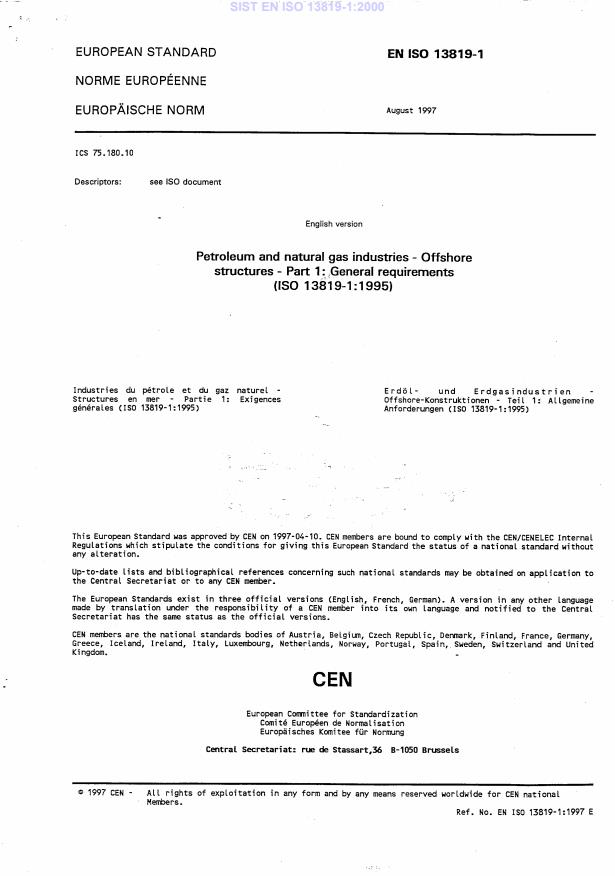
(Main)Petroleum and natural gas industries - Offshore structures - Part 1: General requirements (ISO 13819-1:1995)
Petroleum and natural gas industries - Offshore structures - Part 1: General requirements (ISO 13819-1:1995)
Erdöl- und Erdgasindustrien - Offshore-Konstruktionen - Teil 4: Allgemeine Anforderungen (ISO 13819-1:1995)
Teil 1 der Norm legt die allgemeinen Grundlagen für die Bemessung und Beur- teilung von Konstruktionen fest, die bekannten oder vorhersehbaren Arten von Einwirkungen unterworfen sind. Die festgelegten Grundsätze sind weltweit anwendbar. Die allgemeinen Grundlagen gelten für alle Arten von Offshore-Konstruktionen, sowohl für fest auf dem Meeresboden gegründete als auch für schwimmende.
Industries du pétrole et du gaz naturel - Structures en mer - Partie 1: Exigences générales (ISO 13819-1:1995)
Petroleum and natural gas industries - Offshore structures - Part 1: General requirements (ISO 13819-1:1995)
General Information
- Status
- Withdrawn
- Publication Date
- 19-Aug-1997
- Withdrawal Date
- 30-Nov-2002
- Current Stage
- 9960 - Withdrawal effective - Withdrawal
- Start Date
- 01-Dec-2002
- Completion Date
- 01-Dec-2002
Relations
- Effective Date
- 22-Dec-2008
- Effective Date
- 22-Dec-2008
- Effective Date
- 22-Dec-2008
- Effective Date
- 22-Dec-2008

Get Certified
Connect with accredited certification bodies for this standard

ABS Quality Evaluations Inc.
American Bureau of Shipping quality certification.

Element Materials Technology
Materials testing and product certification.

ABS Group Brazil
ABS Group certification services in Brazil.
Sponsored listings
Frequently Asked Questions
EN ISO 13819-1:1997 is a standard published by the European Committee for Standardization (CEN). Its full title is "Petroleum and natural gas industries - Offshore structures - Part 1: General requirements (ISO 13819-1:1995)". This standard covers: Teil 1 der Norm legt die allgemeinen Grundlagen für die Bemessung und Beur- teilung von Konstruktionen fest, die bekannten oder vorhersehbaren Arten von Einwirkungen unterworfen sind. Die festgelegten Grundsätze sind weltweit anwendbar. Die allgemeinen Grundlagen gelten für alle Arten von Offshore-Konstruktionen, sowohl für fest auf dem Meeresboden gegründete als auch für schwimmende.
Teil 1 der Norm legt die allgemeinen Grundlagen für die Bemessung und Beur- teilung von Konstruktionen fest, die bekannten oder vorhersehbaren Arten von Einwirkungen unterworfen sind. Die festgelegten Grundsätze sind weltweit anwendbar. Die allgemeinen Grundlagen gelten für alle Arten von Offshore-Konstruktionen, sowohl für fest auf dem Meeresboden gegründete als auch für schwimmende.
EN ISO 13819-1:1997 is classified under the following ICS (International Classification for Standards) categories: 75.180.10 - Exploratory, drilling and extraction equipment. The ICS classification helps identify the subject area and facilitates finding related standards.
EN ISO 13819-1:1997 has the following relationships with other standards: It is inter standard links to EN ISO 19900:2002; is excused to EN ISO 14691:2000, EN ISO 11960:2001, EN ISO 16070:2001. Understanding these relationships helps ensure you are using the most current and applicable version of the standard.
EN ISO 13819-1:1997 is available in PDF format for immediate download after purchase. The document can be added to your cart and obtained through the secure checkout process. Digital delivery ensures instant access to the complete standard document.
Standards Content (Sample)
SLOVENSKI STANDARD
01-december-2000
Petroleum and natural gas industries - Offshore structures - Part 1: General
requirements (ISO 13819-1:1995)
Petroleum and natural gas industries - Offshore structures - Part 1: General
requirements (ISO 13819-1:1995)
Erdöl- und Erdgasindustrien - Offshore-Konstruktionen - Teil 4: Allgemeine
Anforderungen (ISO 13819-1:1995)
Industries du pétrole et du gaz naturel - Structures en mer - Partie 1: Exigences
générales (ISO 13819-1:1995)
Ta slovenski standard je istoveten z: EN ISO 13819-1:1997
ICS:
75.180.10 Oprema za raziskovanje in Exploratory and extraction
odkopavanje equipment
2003-01.Slovenski inštitut za standardizacijo. Razmnoževanje celote ali delov tega standarda ni dovoljeno.
INTERNATIONAL IS0
STANDARD 13819-l
First edition
1995-12-01
Petroleum and natural gas industries -
Offshore structures -
Part 1:
General requirements
industries du p&role et du gaz na turel - Structures en mer -
Partie I: Exigences g&&ales
Reference number
IS0 13819-I :I 995(E)
IS0 13819=1:1995(E)
Page
Contents
Scope .
Definitions 1
........................................................................................................................................
................................................................................................ 3
General requirements and conditions
Principles of limit states design .
Basic variables . 15
Analyses - Calculations and testing . 18
Design format of partial factors . . . . . . . . . . . . . . . . . . . . . . . . . . . . . . . . . . . . . . . . . . . . . . . . . . . . . . . . . . . . . . . . . . . . . . . . . . . . . . . . . . . . . . . . . . . . . . . . . . . . . . . . 20
Quality control .
.....................................................................................................
Assessment of existing structures 27
Annex A Bibliography . . . . . . . . . . . . . . . . . . . . . . . . . . . . . . . . . . . . . . . . . . . . . . . . . . . . . . . . . . . . . . . . . . . . . . . . . . . . . .*. 31
0 IS0 1995
All rights reserved. Unless otherwise specified, no part of this publication may be reproduced or utilized in any form or by
any means, electronic or mechanical, including photocopying and microfilm, without permission in writing from the
publisher.
International Organization for Standardization
Case postale 56 l CH-1211 Geneve 20 l Switzerland
Printed in Switzerland
ii
IS0 13819=1:1995(E)
Foreword
IS0 (the International Organization for Standardization) is a worldwide federation of national standards
bodies (IS0 member bodies). The work of preparing International Standards is normally carried out through
IS0 technical committees. Each member body interested in a subject for which a technical committee has been
established has the right to be represented on that committee. International organizations, governmental and
non-governmental, in liaison with ISO, also take part in the work. IS0 collaborates closely with the
International Electrotechnical Commission (IEC) on all matters of electrotechnical standardization.
Draft International Standards adopted by the technical committees are circulated to the member bodies for
voting. Publication as an International Standard requires approval by at least 75 % of the member bodies
casting a vote.
International Standard IS0 13819- 1 was prepared by Technical Committee ISO/TC 67, Materiak, equipment
and offshore structures for petroleum and natural gas industries, Subcommittee SC 7, Offshore structures.
IS0 138 19 will consist of the following parts, under the general title Petroleum and natural gas industries -
Oflshore structures:
Part 1: General requirements
- Part 2: Fixed steel structures
Part 3: Fixed concrete structures
- Part 4: Floating systems
Part 5: Arctic structures
- Part 6: Site specific assessment of MODUS
Annex A of the present part of IS0 138 19 is for information only.
n.
III
llS013819=1:1995(E)
Introduction
It is important to recognize that structural integrity is an overall concept comprising models for describing
actions, structural analyses, design rules, safety elements, workmanship, quality control procedures and
national requirements, all of which are mutually dependent. The modifications of one aspect of design in
isolation can disturb the balance of reliability inherent in the overall concept or structural system. The
implications involved in modifications, therefore, need to be considered in relation to the overall reliability of
all offshore structural systems.
International Standard IS0 138 19 constitutes a common basis covering those aspects that address design
requirements and assessments of all structures used by the petroleum and natural gas industries worldwide.
Through its application the intention is to achieve reliability levels appropriate for manned and unmanned
offshore structures, whatever the nature or combination of the materials used.
IS0 13819 is intended to provide a wide latitude in the choice of structural configurations, materials and
techniques without hindering innovation. It shall, therefore, be used in conjunction with sound engineering
judgment.
Part 1 of IS0 13819 applies to offshore structures and is in accordance with the principles of IS0 2394: 1986,
General principles on reliability for structures. It includes, where appropriate, add.itional provisions that are
specific to offshore structures.
iv
INTERNATIONAL STANDARD @ IS0 IS0 13819-1:1995(E)
Petroleum and natural gas industries - Offshore structures -
Part 1:
General requirements
1 Scope
Part 1 of the Standard specifies general principles for the design and assessment of structures
The principles specified are applicable
subjected to known or foreseeable types of actions.
worldwide.
The general principles are applicable to all types of offshore structures including bottom founded
structures as well as floating structures.
The general principles are applicable to all types of materials used including steel, concrete,
aluminum, etc.
The Standard is applicable to the design of complete structures including substructures, topside
structures, vessel hulls, foundations, and mooring systems.
The Standard specifies design principles that are also applicable to the successive stages in
construction (namely fabrication, transportation and installation), to the use of the structure during
its intended life, and to its abandonment. Generally, the principles are also applicable to the
Aspects related to quality control are also
reassessment or modification of existing structures.
addressed.
NOTE: The term “action” was introduced into IS0 terminology to cover the effects due to
imposed deformation as well as loads. The term “load”, which is prevalent in some countries,
can generally be used with essentially the same meaning as “action”. In the past, “load” has often
been used to describe direct actions only (see Clause 5.2.1).
Definitions
For the purposes of this International Standard, the following definitions apply:
21 . Air gap:
The clearance between the highest water surface that occurs during the extreme
environmental conditions and the underside of the deck.
IS0 13819-1:1995(E)
@ IS0
22 . Compliant structure:
A structure that is sufficiently flexible, such that applied lateral dynamic actions can be
balanced substantially by the inertial reaction.
23 . Fitness for purpose:
A structure condition describing a structure that meets the intent of this Standard, but does
not meet certain provisions of this standard in local areas, such that failure in these areas
will not cause unacceptable risks to life-safety or the environment.
24 0 Fixed structure:
A structure that is bottom founded and transfers all actions that act upon it to the sea floor.
25 0 Jack-up:
A mobile unit that can be relocated and is bottom founded in its operating mode. The jack-up
reaches its operational mode by lowering the legs to the sea floor and then jacking the hull to the
required elevation.
26 a Return period:
The average time (usually years) between occurrence of events or actions of a specified
magnitude or larger.
27 . Riser:
piping connecting the facilities or piping on the production deck with the subsea
The
facil ities or pipelines.
28 l Semi-submersible:
A floating unit that can be relocated. A semi-submersible normally consists of a deck
structure with a number of widely spaced, large diameter, supporting columns that are
attached to submerged pontoons.
29 l Tension leg platform:
A buoyant structure that is anchored to the sea floor by vertical mooring legs.
2.10 Well conductor:
A tubular pipe extending upward from the sea floor (or below) that contains the pipes
(casing) that extend into the petroleum reservoir.
@ IS0
IS0 13819=1:1995(El)
3 General requirements and conditions
NOTE: The requirements and conditions set forth in this section define the objective of the
design. Criteria to enable designers and builders to reach this goal are provided throughout this
Standard. However, unforeseen events that cause a structure to not achieve its objectives during
its service life does not automatically imply a lack of compliance with this Standard.
3.1 Fundamental requirements
A structure and its structural components shall be designed, constructed, and maintained so that it
is suited to its intended use. In particular, it shall, with appropriate degrees of reliability, fulfill
the following performance requirements:
It shall withstand actions liable to occur during its construction and anticipated use
a>
(ultimate limit state requirement).
(serviceabil ity limit state
It shall perform adequately under all expected actions
requirement).
It shall not fail under repeated actions (fatigue limit state).
t be subsequently
In the case of hazards (accidental or abnormal events), it shall not
damaged disproportionately to the original cause (accidental 1 imit state).
Appropriate degrees of reliability may depend upon:
e>
the cause and mode of failure
the possible consequences of failure in terms of risk to life, environment and property
the expense and effort required to reduce the risk of failure
different requirements at national, regional or local level
This standard is set forth to provide criteria so that the above requirements are fulfilled during the
intended life of the structure.
A structure designed and constructed in accordance to the present standard is assumed to
comply
with the above requirements.
3.2 Durability, maintenance and inspection
The durability of the structure in its environment shall be such that the general state of the
structure is kept at an acceptable level during its life.
Maintenance shall include the performance of regular inspections, inspections on special occasions
(e.g., after an earthquake or other severe environmental event), the upgrading of protection
systems and repair of structural components.
IS0 13819-1:1995(E)
Durability shall be achieved by either:
a maintenance program, or
a>
designing so that deterioration will not invalidate the state of the structure in those areas
b)
where the structure cannot be or is not expected to be maintained.
In the first case above, the structure shall be designed and constructed so that no significant
degradation is likely to occur within the time intervals between the inspections. The necessity of
relevant parts of the structure being available for inspection - without unreasonably complicated
Degradation may be reduced or prevented by
dismantling - shall be considered during design.
providing a suitable protection system.
The rate of deterioration may be estimated on the basis of calculations, experimental
investigations, experience from other structures or a combination of these.
NOTE: Structural integrity, serviceability throughout the intended service life, and durability are
not simply functions of the design calculations but are also dependent on the quality control
exercised in manufacture, the supervision on site, and the manner in which the structure is used
and maintained.
3.3 Hazards
3.3.1 General
Hazardous circumstances, that alone or in combination with normal conditions could cause the
serviceability or ultimate limit states to be exceeded, shall be taken into account.
Possible hazards to the structure and its components include:
an error caused by lack of information, omission, misunderstanding, etc.,
a>
effects of abnormal actions, or
b)
operation malfunction that could lead to fire, explosion, capsizing, etc.
C>
The measures taken to counter such hazard s should basically consist of:
careful planning at all phases of development and operation,
a>
avoiding the structural effects of the hazards by either eliminating the source or by
b)
bypassing and overcoming them,
minimizing the consequences, or
C>
designing for h azard s.
d)
If a specific hazard has to be considered, it shall be used to define a design situation (see Clause
4.2.2). This design situation will normally be dominated by one hazardous occurrence with
expected concurrent normal operating conditions.
IS0 13819-1:1995(E)
3.3.2 Accidental events
The possibility of accidental events shall be considered, and suitable criteria shall be established,
when appropriate. Possible accidental events include, for example, vessel collision, dropped
objects, explosion, fire and unintentional flooding. Design requirements should be established
.
taking account of the operational conditions and the type, function and location of the structure.
3.4 Design basis
The influences arising from the intended use of the structure and the environmental conditions
shall be described as the design situations associated with normal use of the structure. The
influences arising during construction of the structure and the associated environmental conditions
shall also be covered by suitable design situations (see Clause 4.2.2).
All relevant influences and conditions shall be considered in order to establish the design basis for
the structure. Sections 3.5 to 3.12 describe the principal influences and conditions that should be
considered to establish the design basis for offshore structures.
3.5 Service requirements
The service requirements and the expected service life shall be specified. The structure may be
used for drilling, producing, storage, personnel accommodation, or other function or combination
of functions.
3.6 Operating requirements
3.6.1 Manning
The manning level for each phase of the structure’s life shall be specified.
3.6.2 Well conductors and risers
The number, location, size, spacing and operating conditions of all well conductors and risers -
shall be specified and taken into account in the structural design. The design and/or layout shall
provide protection of conductors and risers from accidental damage.
The design should have provisions to mitigate the consequences of accidental damage to well
conductors and risers.
3.6.3 Equipment and material layouts
Equipment and material layouts and their associated weights, centers of gravity, and exposure to
environmental actions shall be specified. Consideration should be given to planned future
operations.
3.6.4 Personnel and material transfer
Plans for transferring personnel and materials shall be specified. For example;
the types, sizes and weights of helicopters,
a>
IS0 13819=1:1995(E)
the types, sizes and displacements of supply and other service vessels,
b) ,
the number, types, sizes and locations of the deck cranes and other materials handling
,
C>
systems, and
planned emergency personnel evacuation.
3.6.5 Motions and vibrations
Structures and parts of structures shall be designed so that accelerations, velocities, and
displacements do not impair safety and serviceability within defined limits.
3.7 Special requirements
All special operational, construction, and maintenance requirements not covered under Clauses
3.6.1 - 3.6.5 that would also affect the safety of the structure shall be specified, together with
their expected concurrent environmental conditions.
The limiting environmental conditions specific to certain operations should be specified. This will
normally apply to floating units (e.g., limiting environmental conditions for certain drafts ) or
jack-ups (e.g.,. limiting environmental conditions when the cantilever is fully extended).
3.8 Location and orientation
The site location and structure orientation shall be specified. For structures designed to be
relocatable, the range of limiting environmental conditions, water depths, and soil conditions
should be provided.
The site for the structure in latitude and longitude should be identified early in order that the
appropriate environmental conditions and soil conditions can be identified.
NOTE: Orientation of the structure refers to its position in plan referenced to a fixed direction
such as true north. The orientation is normally governed by the direction of prevailing seas,
winds, and currents, as well as safety and operational requirements.
3.9 Structural configuration
3.9.1 General
The choice of the structural system shall be made so that the primary structure is able to maintain
adequate structural integrity during normal service and after specified action causing events. The
choice of materials, detailing, and method of construction as well as quality control can also
influence structural integrity.
3.9.2 Deck elevation
The topside structure shall normally have adequate clearance above the design wave crest. Any
topside structure or piping not having adequate clearance (airgap) shall be designed for actions
caused by waves and currents. Minor structure or components may be excluded from this
requirement.
IS0 13819-1:1995(E)
The deck elevation and airgap shall be determined taking into account the values of and
uncertainties in the following parameters as applicable:
water depth,
a>
tides and surges,
b)
crest elevation of extreme waves,
C>
wave-structure interaction,
d)
structure motion and draft,
e>
initial and long-term settlements and inclination, and
f)
subsidence.
g>
3.9.3 Splash zone
1 atform
The splash zone extent shall be established taking into account the values of the p
elevation, motions of floating vessels, tidal ranges, wave crests and wave troughs
For floating structures with possibilities for draft adjustment, the splash zone shal 1 be defined
relative to the extreme draft levels expected.
. ,
NOTE: The splash zone is that part of a structure that is intermittently exposed to an and
immersed in the sea. The splash zone is important in relation to inspection and maintenance
considerations and can l- rave an impact on the design to resist corrosion and fatigue.
3.9.4 Station-keeping systems
1 be provided with a station-keeping system, which may be either passive
Floating structures shal
.i on of both passive and active.
or active or a combinat
The station-keeping system shall be designed to maintain adequate position reference as well as
directional control when orientation is important for safety or operational considerations.
Passive station-keeping systems may include catenary mooring, spring buoy, articulated leg, or
Active systems may include dynamic positioning based on thrusters or
tension leg systems.
catenary systems based on changing mooring line tensions.
A mooring system for floating structures may be designed to be disconnectable to mitigate the
effects of severe storms, if the disconnection can be accomplished in a controlled manner without
(1) impairing the safety of personnel on board the unit or a neighboring infrastructure or (2)
creating undue risk to the environment. When disconnected, then other standards may apply.
3.9.5 Compartmentation of structures
Floating structures or structures for which buoyancy is important shall normally be subdivided
into compartments to limit the consequences of unintended flooding (see Clause 4.1.5).
The amount of compartmentation should consider special conditions and protection measures that
can be used to prevent flooding. Fewer compartments may be justified, if buoyancy is only
needed in temporary phases or the consequences of flooding have only minor effects on the
overall reliability.
IS0 138194:1995(E)
3.10 Environmental conditions
3.10.1 Meteorological and oceanographical information
The phenomena listed in Clauses 3.10.1.1 through 3.10.1.8 shall, where appropriate to the region,
be taken into account in the design.
They shall be described by physical characteristics and, where available, statistics. The joint
From
occurrence of different parameters should also be defined when suitable data are available.
this information, appropriate environmental design conditions shall be established that will
consider the following:
the type of structure being designed,
a)
the phase of development, (e.g., construction, transportation, installation, drilling,
b)
production, etc), and
the limit-state considered.
C>
Usually two sets of conditions have to be established that will consider:
normal meteorological and oceanographic conditions that are expected to occur frequently
during the life of the structure. These conditions are needed to plan field operations such
as installation and to develop the actions caused by environment associated with particular
operations or serviceability checks, and
extreme meteorological and oceanographic conditions that recur with a given return
period.
Extreme, normal and other meteorological and oceanographic parameters should be determined
from actual measurements at the site or by suitable validated model data such as from hindcast
models.
NOTE 1: Environmental actions are generally derived from design environmental conditions.
The extreme environmental conditions normally have a specified return period for the in-service
condition (see Clause 7.2.1). Alternatively, the action associated with extreme environmental
conditions can be defined to have a specified return period, if adequate data exist to reliably
determine the specified return period, allowing for the joint occurrence of extreme meteorological
and oceanographic conditions occurring at the site, and further provided that the partial factors are
selected accordingly.
NOTE 2: Normally, the structure’s response to actions caused by the environment are
investigated for a range of potential combinations of environmental parameters and consideration
is given to the relationship considering the closeness of the wave period compared to the natural
response period of motion or vibration.
For example, for two different seastate conditions, each
having the same composite return period, it is possible that the seastate having
lower wave heights but a longer or shorter associated period will develop more severe actions
acting on some components.
Compliant or floating structures are generally sensitive to more environmental parameters than
fixed or bottom-founded structures, since dynamic effects will be more significant for such
structures.
@ IS0
IS0 13819-1:1995(E)
NOTE 3: Normally, consideration is given to specific problems such as the tuning of the
wavelength and a characteristic dimension of the structure (e.g., (1) the distance between the main
legs of gravity based structures or semi-submersible units, or (2) the length of the hull of a
ship-shaped barge.)
3.10.1.1 Wind
Actions caused by wind acting on a structure shall be considered for both the global and local
design, Site specific information on wind speed, direction and duration shall be determined.
Wind is usually characterized by the mean value of its velocity over a given time interval at a
given elevation above the mean water level. In specific cases (for example, design of flexible
structures like flare-towers and compliant structures with periods of motion that are large), the
frequency content is of importance and should be taken into account.
The variability with elevation and the spatial coherence should also be considered.
NOTE: Generally, the sustained wind speed at the time of peak actions caused by waves are used
for global design in conjunction with wave actions. Maximum gust conditions during the design
storm are used to design topsides and individual members.
3.10.1.2 wavs
Actions caused by waves acting on a structure shall be considered for both the global and the local
design. Site specific information shall be established to consider the following:
seastate characteristics in terms of wave height, period, duration, directions, and spectra,
a)
and
the long term statistics of these characteristics.
b)
3.10.1.3 Water depth and sea level variations
The water depth shall be specified. The magnitude of the low and high tides and positive and
negative storm surges shall be specified.
The possibility of ground subsidence shall be considered when determining the water depth.
3.10.1.4 Currents
Such phenomena as tidal, wind driven, global circulation, loop and eddy currents shall be
considered when relevant.
Currents shall be described by their velocity (magnitude and direction), variability with water-
depth, and persistence.
The occurrence of fluid motion caused by internal waves should be considered.
NOTE: Global circulation currents are driven by large scale global forces. Loop currents are
associated with major ocean current circulation patterns as they conform to the land masses, e.g.,
Gulf of Mexico loop current. Eddy currents are meso-scale circulatory features shed from loop or
other major circulation currents. Eddy currents can persist for several months or more. Internal
waves are propagating waves that can occur at the interface between layers of fluids having
different densities.
IS0 13819=1:1995(E)
@ IS0
3.10.1.5 Marine growth
Marine growth shall be considered and defined by its thickness, roughness, density and variation
with depth.
The design may rely on a periodic marine growth cleaning or anti fouling systems during the
platform life. Such reliance should be documented and the cleaning program defined over the life
of the installation. The consequences of not maintaining this program should be specified.
NOTE: In most offshore areas, marine growth will occur on submerged platform members.
Marine growth increases surface roughness, member diameter and mass, which in turn affects
actions caused by waves and earthquakes and structural motions.
3.10.1.6 Ice and snow
Ice and snow accumulations shall be considered when relevant to the region. The accumulation of
snow on horizontal and vertical surfaces (thickness and density) shall be defined. The maximum
wind, waves and current to consider at the same time shall be stated. In addition, the possibility
of ice build-up through freezing of sea spray, rain or fog shall also be considered.
Sea ice and iceberg occurrences shall be considered when relevant.
3.10.1.7 Temperatures
The maximum, average and minimum air and sea temperatures at the site shall be determined
when temperatures are likely to be relevant to structural design.
NOTE: Air and sea temperatures can affect the characteristics of materials.
3.10.1.8 Other meteorological and oceanographical information
Other environmental information such as precipitation, fog, wind chill, and variability of the
density and oxygen content of the sea water shall be determined when relevant.
3.10.2 Active geological processes
The nature, magnitude and return periods of potential sea floor movements shall be evaluated by
(1) site investigations and analysis or (2) model testing. Sea floor behavior and its influence on
the overall integrity of the structure and foundation shall be documented. Information should
include such items as relic permafrost in cold regions, the potential for subsidence, etc.
NOTE: In most offshore areas, geological processes associated with movement of the near
surface sediments can occur within time periods relevant to platform design. Due to the
uncertainty associated with definition of these processes, a parametric approach to studies can be
helpful in development of design criteria.
@ IS0
IS0 13819=1:1995(E)
3.10.2.1 Earthquakes
Actions resulting from seismic activity shall be considered in the structure design for regions that
are considered to be seismically active.
The seismic hazard may be determined on the basis of previous records of seismic activity, both
If there are insufficient data, seismicity may be
in magnitude and probability of occurrence.
determined by detailed site specific investigations. The latter should include (1) seismotectonic
and site characterization, including location of potential causative faults and fault slip history, if
available, (2) seismic exposure assessment, including long term event occurrence probabilities, (3)
ground motion characterization, including attenuation, and (4) specification of the design ground
motion.
3.10.2.2 Faults
If siting near
Siting of facilities in close proximity to faults shall be avoided, if at all possible.
potentially active features cannot be avoided, the magnitude and time scale of expected movements
shall be estimated on the basis of a geological study and demonstrated to lead to acceptable
consequences and/or low risk of occurrence.
NOTE: In some offshore areas, faults can extend to the sea tloor with potential for either vertical
or horizontal movement. Fault movement can occur as a result of seismic activity, removal of
fluids from deep reservoirs or long term creep related to large scale sedimentation or erosion.
3.10.2.3 Shallow gas
The presence of shallow gas shall be determined as part of the site specific investigations.
NOTE: If either biogenic or petrogenic gas is present in the porewater of near-surface soils, it is
possible it will have a serious effect on the foundation behavior and drilling operations. The
presence of shallow gas can be determined by means of shallow seismic measurements.
3.10.3 Geotechnical information
3.10.3.1 Soil properties
Site investigations shall be performed to define the various soil strata, their corresponding physical
and engineering properties, and potential hazards to the structure.
The site investigations shall provide adequate information to characterize soil properties
throughout the depth and area that will affect or be affected by the structure foundation.
Site investigations should include one or more soil borings to provide samples and/or in-situ test
data suitable for defining engineering properties at the platform site. The number and depths of
borings depend on the soil variability in the vicinity of the site, the platform configuration and
expected actions.
Geophysical surveys should usually be part of the site investigations and should generally be
carried out before soil borings are taken. In order to develop the required foundation design
parameters, data obtained during the investigations should be considered in combination with an
evaluation of the shallow geology of the region.
IS0 13819-1:1995(E)
If practical, the soil sampling and testing program should be defined after reviewing the
geophysical results.
NOTE: Previous site investigations and experience at the site can reduce or eliminate the number
and extent of investigations or studies needed for additional structures.
3.10.3.2 Sea floor instability
The scope of site investigations in areas of potential instability shall focus on (1) identification of
metastable geological features surrounding the site and (2) definition of the geotechnical properties
required for modeling and estimating sea floor movement.
NOTE: Movements of the sea floor can be caused by ocean wave pressures, earthquakes, soil
Weak under-consolidated sediments can be
self-weight or a combination of these phenomena.
unstable at very shallow angles of slope. Earthquakes can induce failure of sea floor slopes that
are otherwise stable under existing self-weight forces
and wave conditions.
3.10.3.3 Scour
The possibility of scour shall be accounted for in the design. The extent of scour shall be
determined (1) on the basis of previous records from sites with similar sea floor features, (2) from
model tests, or (3) from calculations calibrated by prototype or model tests.
NOTE: Scour is removal of sea floor soils by currents and waves. Such erosion can be a
geological process or can be caused by structural components interrupting the natural fluid flow
near the sea tloor.
3.11 Construction
Consideration shall be given to all activities and operations required for construction including,
where appropriate, fabrication, load-out, transportation, installation and securing in place of the
structure. Design requirements shall be established taking into account the type of structure and
its location, the environmental conditions, the construction equipment, and the nature and duration
of the construction operations.
3.12 Abandonment or removal
Consideration should be given at the design stage to requirements for abandonment or removal of
the structure at the end of its service life.
4 Principles of limit states design
4.1 Limit states
The structural performance of a whole structure or part of it shall be described with reference to a
specified set of limit states beyond which the structure no longer satisfies the design requirements.
IS0 13819-1:1995(E)
4.1.1 Categories of limit states
The limit states are divided into the following four categories which, in turn, may be subdivided:
the ultimate limit states that generally correspond to the maximum resistance to applied
a>
actions,
the serviceability limit states that correspond to the criteria governing normal functional
b)
use,
the fatigue limit states that correspond to the accumulated effect of repeated actions, and
C>
the accidental damage limit states that correspond to the situation where damage to
d)
components has occurred due to an accidental event.
4.1.2 Ultimate limit states (ULS)
Examples of ultimate limit states are:
loss of static equilibrium of the structure, or of a part of the structure, considered as a
a)
rigid body (e.g. overturning or capsizing),
failure of critical components of the structure caused by exceeding the ultimate strength (in
b)
some cases reduced by repeated actions) or the ultimate deformation of the components.
transformation of the structure into a mechanism (collapse or excessive deformation),
C>
loss of structural stability (buckling, etc.),
d)
loss of station keeping (free drifting), and
sinking.
4.1.3 Serviceability limit states (SLS)
Examples of serviceability limit states are:
deformations or movements that affect the efficient use of structural or nonstructural
a>
components,
excessive vibrations producing discomfort or affecting nonstructural components or
b)
equipment (especially if resonance occurs),
local damage (including cracking) that reduces the durability of a structure or affects the
C)
use of structural or nonstructural components,
corrosion that reduces the durability of the structure and affects the properties and
geometrical parameters of structural and nonstructural components, and
motions that exceed the limitations of equipment.
e>
IS0 13819-1:1995(E)
@ IS0
To control serviceability limit states by design, it is often necessary to use one or more constraints
(C) that describe acceptable deformations, accelerations, crack widths, etc. (see Clause 7.1)
4.1.4 Fatigue limit states (FLS)
reseated actions.
Fatigue limit states refer to cumulative damage due to
4.1.5 Accidental damage limit states (ALS)
The accidental damage limit state check ensures that local damage or flooding does not lead to
complete loss of integrity or performance of the structure.
NOTE: The intention of this limit case is to ensure that the structure can tolerate the damage due
to specified accidental events and subsequently maintain structural integrity for a sufficient period
under specified environmental conditions to enable evacuation to take place.
4.2 Design
4.2.1 General design requirements
All relevant limit states shall be considered in design. A calculation model should be established
that will address each relevant limit state. This model should incorporate all appropriate variables
and also allow for (1) the uncertainties with respect to actions, (2) the response of the structure as
a whole, (3) the behavior of individual components of the structure and (4) the effect on the
environment.
The design procedure should not be refined to a point that is incompatible with the standard of
workmanship likely to be achieved and the knowledge of the important design parameters.
4.2.2 Design situations
For any structure it is generally necessary to consider several distinct design situations.
Corresponding to each of these design situations, there may be different structural systems,
different design values, different environmental conditions, etc.
The design situations may be classified as:
persistent situations, having a duration of the same order as the life of the structures,
a)
transient situations, having a shorter duration and varying levels of intensity, e.g.,
b)
construction, load out, transportation, and installation phases.
accidental situations (during and after an accident), normally of short duration and low
C>
probability of occurrence.
IS0 13819-1:1995(E)
5 Basic variables
5.1 General
The calculation model expressing each limit state considered will contain a specified set of basic
variables. In general, the basic variables will correspond to measurable physical quantities.
Normally, the basic variables will characterize:
actions,
a>
properties of materials and soils, and
b)
geometrical parameters e
C>
5.2 Actions
5.2.1 Definitions
An action is:
an assembly of concentrated or distributed actions acting on the structure (direct actions),
a>
or
an assembly of actions resulting from imposed or constrained deformations (indirect
b)
actions).
5.2.2 Classification of actions according to the variation of their magnitude with time
Actions can be classified according to their variation in time into:
permanent actions (G) that are likely to act throughout a given design situation and for
a>
which variations in magnitude with time are
negligible in relation to the mean value, or
1)
attain some limiting value.
2)
Permanent actions generally include:
the self weight of structures,
the weight of topside permanent fixtures and functional equipment,
the forces applied by earth pressure,
the deformations imposed during construction,
the actions resulting from shrinkage of concrete or distortions due to welding,
the forces resulting from water pressure,
IS0 13819=1:1995(E)
@ IS0
the actions resulting from support settlements and/or subsidence, and
prestressing forces.
variable actions (Q) that are unlikely to act throughout a given design situation, not
b)
including environmental actions.
Variable actions generally include:
actions due to use and occupancy, including actions caused by crane loads, drilling
hook loads, variable ballast, helicopter loads, etc.,
self weight of temporary structures and equipment,
actions caused during erection,
all moving actions such as for movable drilling derricks, and
functional temperature changes, as they can induce actions or affect material
properties.
environmental actions (EA) that may be repeated, sustained or both repeated and
C>
sustained.
Environmental actions generally include:
actions caused by wind,
actions caused by wave,
actions caused by current,
actions resulting from marine growth, snow, and accumulated ice and their
indirect effects on variable actions and other environmental actions,
actions caused by ice (direct),
environmental temperature changes as they can induce actions or affect material
properties, and
actions caused by earthquakes.
repetitive actions (RA) whose variation in magnitude with time is significant and occurs
d)
repeatedly, leading to possible fatigue effects, and
accidental actions (A). Accidental actions can have minor consequences (more frequent)
e>
or can cause severe structural damage (very rare).
IS0 13819-1:1995(E)
Accidental actions generally result from:
collisions,
dropped objects,
tire,
explosions,
unexpected subsidence of subsoil,
unexpected erosion or scour, and
unexpected flooding.
5.2.3 Classification of actions according to their variation in space
Actions can also be classified according to their variation in space into two groups:
fixed actions that have a spatial distribution over the entire structure, such that the
a)
position, magnitude and orientation of the actions are constant.
free actions that can act at various positions on the structure.
b)
Actions that cannot be defined as belonging to either of these two groups may be considered to
consist of a fixed part and a free part.
The treatment of free actions requires the consideration of different arrangements of the actions. A
design situation is determined by fixing the positions of each of the free actions (see Clause
4.2.2).
5.2.4 Classification of actions according to the structural response
Actions may be further classified according to the way in which the structure responds to an
action:
static actions that produce static response without causing significant acceleration of the
a>
structure component.
or
dynamic actions that cause significant acceleration of the structure or component, thereby
b)
a dynamic response.
NOTE: Whether or not the action is regarded as dynamic is dependent on the structure and the
nature of the source of the action. For simplicity, dynamic actions can often be treated as
equivalent static actions in which the dynamic effects, which depend on the behavior of the
structure, a
...
Questions, Comments and Discussion
Ask us and Technical Secretary will try to provide an answer. You can facilitate discussion about the standard in here.
Loading comments...