


EN 17878-1:2024
(Main)District heating pipes - Factory made flexible pipe systems with a lower temperature profile - Part 1: Classification, general requirements and test methods
General Information
- Abstract
This document specifies classification, general requirements and test methods for flexible, factory made, buried district heating pipe systems.
This document is intended to be used only in conjunction with EN 17878-2 or EN 17878-3, as applicable.
This document is applicable to a maximum operating temperature of 80 °C and a maximum operating design pressure up to 1,0 MPa.
The pipe systems are designed for a service life of at least 50 years. For pipe systems with plastic service pipes, the respective temperature profiles are specified in EN 17878-2:2024 and EN 17878-3:2024.
For the transport of other liquids, for example potable water, additional requirements can be applicable.
- Status
- Published
- Publication Date
- 05-Mar-2024
- Technical Committee
- CEN/TC 107 - Pre-fabricated district heating pipe systems
- Drafting Committee
- CEN/TC 107/WG 10 - Flexible pipe systems for district heating
- Current Stage
- 6060 - Definitive text made available (DAV) - Publishing
- Start Date
- 06-Mar-2024
- Due Date
- 05-Sep-2023
- Completion Date
- 06-Mar-2024

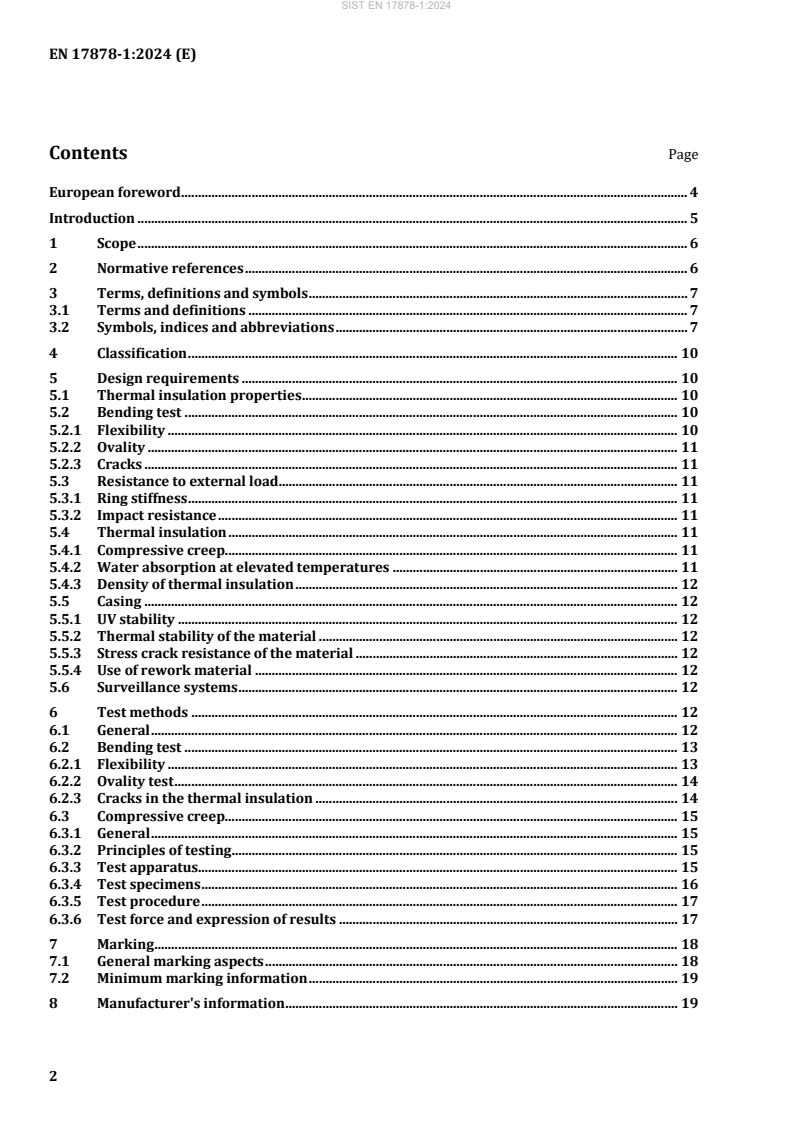
Overview - EN 17878-1:2024 (District heating pipes, flexible systems)
EN 17878-1:2024 is a CEN European standard that defines classification, general requirements and test methods for factory-made, flexible, buried district heating pipes intended for a lower temperature profile. It applies together with EN 17878-2 or EN 17878-3 and covers systems designed for a maximum operating temperature of 80 °C, a maximum design pressure up to 1.0 MPa, and a service life of at least 50 years. For transport of other liquids (for example potable water) additional requirements may be necessary.
Key topics and technical requirements
- Scope & classification
- Covers flexible pre-insulated, factory-made pipe systems for buried district heating networks with lower temperature profiles.
- Intended to be read in conjunction with Part 2 (bonded systems) or Part 3 (non-bonded systems).
- Design and performance requirements
- Thermal insulation properties and thermal conductivity requirements (test procedure in Annex A).
- Mechanical behaviour: bending/flexibility tests, ovality, crack assessment in insulation.
- Resistance to external loads: ring stiffness and impact resistance testing.
- Creep and durability: compressive creep, water absorption at elevated temperatures, and density checks for insulation materials.
- Casing material requirements: UV stability, thermal stability, stress-crack resistance, and provisions on use of rework material.
- Surveillance systems: criteria for monitoring buried systems.
- Test methods
- Detailed procedures for bending, compressive creep, ring stiffness, impact resistance and thermal conductivity (Annex A).
- Informative guidance on design values for radial thermal resistance (Annex B) and inspection/testing guidelines (Annex C).
- Marking & manufacturer information
- Minimum marking data and documentation required for traceability and installation.
Practical applications - who uses EN 17878-1
- District heating system designers and engineers specifying flexible pre-insulated pipes for lower-temperature networks.
- Pipe manufacturers and factory quality teams demonstrating compliance and performing type testing.
- Contractors and installers for buried heat distribution systems requiring validated product performance.
- Network operators and utilities specifying product selection, surveillance and long-term durability.
- Test laboratories and certification bodies executing standardized test methods and issuing conformity reports.
Related standards
- EN 17878-2:2024 - Requirements and test methods for bonded systems with plastic service pipes
- EN 17878-3:2024 - Requirements and test methods for non-bonded systems with plastic service pipes
- EN 14419, EN 17248 and relevant ISO/EN test standards cited in EN 17878-1 for specific methods.
Keywords: EN 17878-1, district heating pipes, flexible pipe systems, factory made, lower temperature profile, test methods, classification, thermal insulation, compressive creep, ring stiffness.
Relations
- Effective Date
- 22-Jul-2026
- Effective Date
- 09-Feb-2026
- Effective Date
- 09-Feb-2026
- Effective Date
- 28-Jan-2026
- Effective Date
- 28-Jan-2026
- Effective Date
- 28-Jan-2026
- Effective Date
- 28-Jan-2026
- Effective Date
- 28-Jan-2026
- Refers
EN ISO 845:2009 - Cellular plastics and rubbers - Determination of apparent density (ISO 845:2006) - Effective Date
- 28-Jan-2026
- Effective Date
- 28-Jan-2026
- Effective Date
- 28-Jan-2026
- Effective Date
- 28-Jan-2026
- Effective Date
- 28-Jan-2026
- Effective Date
- 28-Jan-2026
- Effective Date
- 28-Jan-2026
Get Certified
Connect with accredited certification bodies for this standard

Institut za varilstvo d.o.o. (Welding Institute)
Slovenia's leading welding institute since 1952. ISO 3834, EN 1090, pressure equipment certification, NDT personnel, welder qualification. Only IIW Au
Sponsored listings
Frequently Asked Questions
EN 17878-1:2024 is a standard published by the European Committee for Standardization (CEN). Its full title is "District heating pipes - Factory made flexible pipe systems with a lower temperature profile - Part 1: Classification, general requirements and test methods". This standard covers: This document specifies classification, general requirements and test methods for flexible, factory made, buried district heating pipe systems. This document is intended to be used only in conjunction with EN 17878-2 or EN 17878-3, as applicable. This document is applicable to a maximum operating temperature of 80 °C and a maximum operating design pressure up to 1,0 MPa. The pipe systems are designed for a service life of at least 50 years. For pipe systems with plastic service pipes, the respective temperature profiles are specified in EN 17878-2:2024 and EN 17878-3:2024. For the transport of other liquids, for example potable water, additional requirements can be applicable.
This document specifies classification, general requirements and test methods for flexible, factory made, buried district heating pipe systems. This document is intended to be used only in conjunction with EN 17878-2 or EN 17878-3, as applicable. This document is applicable to a maximum operating temperature of 80 °C and a maximum operating design pressure up to 1,0 MPa. The pipe systems are designed for a service life of at least 50 years. For pipe systems with plastic service pipes, the respective temperature profiles are specified in EN 17878-2:2024 and EN 17878-3:2024. For the transport of other liquids, for example potable water, additional requirements can be applicable.
EN 17878-1:2024 is classified under the following ICS (International Classification for Standards) categories: 23.040.07 - Pipeline and its parts for district heat. The ICS classification helps identify the subject area and facilitates finding related standards.
EN 17878-1:2024 has the following relationships with other standards: It is inter standard links to ISO 6964:2019, ISO 16770:2019, EN 60811-406:2012, EN 17878-3:2024, EN ISO 3127:2017, EN ISO 29768:2022, EN ISO 11357-6:2025, EN 17248:2019, EN ISO 845:2009, EN ISO 16871:2003, EN 17878-2:2024, EN ISO 9967:2016, EN 15534-1:2014/prA1, EN 14419:2019, EN 13941-1:2019+A1:2021. Understanding these relationships helps ensure you are using the most current and applicable version of the standard.
EN 17878-1:2024 is available in PDF format for immediate download after purchase. The document can be added to your cart and obtained through the secure checkout process. Digital delivery ensures instant access to the complete standard document.
Standards Content (Sample)
SLOVENSKI STANDARD
01-maj-2024
Cevi za daljinsko ogrevanje - Tovarniško izdelani gibki cevni sistemi z nižjim
temperaturnim profilom - 1. del: Klasifikacija, splošne zahteve in preskusne
metode
District heating pipes - Factory made flexible pipe systems with a lower temperature
profile - Part 1: Classification, general requirements and test methods
Fernwärmerohre - Flexible Rohrsysteme mit einem niedrigeren Temperaturprofil - Teil 1:
Klassifikation, allgemeine Anforderungen und Prüfungen
Tuyaux de chauffage urbain - Systéme de tuyaux flexibles préisolés - Partie 1:
Classification, exigences générales et méthodes d'essai
Ta slovenski standard je istoveten z: EN 17878-1:2024
ICS:
23.040.07 Cevovodi za daljinsko Pipeline and its parts for
ogrevanje in njihovi deli district heat
23.040.20 Cevi iz polimernih materialov Plastics pipes
2003-01.Slovenski inštitut za standardizacijo. Razmnoževanje celote ali delov tega standarda ni dovoljeno.
EN 17878-1
EUROPEAN STANDARD
NORME EUROPÉENNE
March 2024
EUROPÄISCHE NORM
ICS 23.040.07
English Version
District heating pipes - Factory made flexible pipe systems
with a lower temperature profile - Part 1: Classification,
general requirements and test methods
Tuyaux de chauffage urbain - Système de tuyaux Fernwärmerohre - Flexible Rohrsysteme mit einem
flexibles préisolés - Partie 1 : Classification, exigences niedrigeren Temperaturprofil - Teil 1: Klassifikation,
générales et méthodes d'essai allgemeine Anforderungen und Prüfungen
This European Standard was approved by CEN on 14 August 2023.
CEN members are bound to comply with the CEN/CENELEC Internal Regulations which stipulate the conditions for giving this
European Standard the status of a national standard without any alteration. Up-to-date lists and bibliographical references
concerning such national standards may be obtained on application to the CEN-CENELEC Management Centre or to any CEN
member.
This European Standard exists in three official versions (English, French, German). A version in any other language made by
translation under the responsibility of a CEN member into its own language and notified to the CEN-CENELEC Management
Centre has the same status as the official versions.
CEN members are the national standards bodies of Austria, Belgium, Bulgaria, Croatia, Cyprus, Czech Republic, Denmark, Estonia,
Finland, France, Germany, Greece, Hungary, Iceland, Ireland, Italy, Latvia, Lithuania, Luxembourg, Malta, Netherlands, Norway,
Poland, Portugal, Republic of North Macedonia, Romania, Serbia, Slovakia, Slovenia, Spain, Sweden, Switzerland, Türkiye and
United Kingdom.
EUROPEAN COMMITTEE FOR STANDARDIZATION
COMITÉ EUROPÉEN DE NORMALISATION
EUROPÄISCHES KOMITEE FÜR NORMUNG
CEN-CENELEC Management Centre: Rue de la Science 23, B-1040 Brussels
© 2024 CEN All rights of exploitation in any form and by any means reserved Ref. No. EN 17878-1:2024 E
worldwide for CEN national Members.
Contents Page
European foreword . 4
Introduction . 5
1 Scope . 6
2 Normative references . 6
3 Terms, definitions and symbols . 7
3.1 Terms and definitions . 7
3.2 Symbols, indices and abbreviations . 7
4 Classification . 10
5 Design requirements . 10
5.1 Thermal insulation properties . 10
5.2 Bending test . 10
5.2.1 Flexibility . 10
5.2.2 Ovality . 11
5.2.3 Cracks . 11
5.3 Resistance to external load. 11
5.3.1 Ring stiffness . 11
5.3.2 Impact resistance . 11
5.4 Thermal insulation . 11
5.4.1 Compressive creep. 11
5.4.2 Water absorption at elevated temperatures . 11
5.4.3 Density of thermal insulation . 12
5.5 Casing . 12
5.5.1 UV stability . 12
5.5.2 Thermal stability of the material . 12
5.5.3 Stress crack resistance of the material . 12
5.5.4 Use of rework material . 12
5.6 Surveillance systems . 12
6 Test methods . 12
6.1 General . 12
6.2 Bending test . 13
6.2.1 Flexibility . 13
6.2.2 Ovality test . 14
6.2.3 Cracks in the thermal insulation . 14
6.3 Compressive creep. 15
6.3.1 General . 15
6.3.2 Principles of testing . 15
6.3.3 Test apparatus. 15
6.3.4 Test specimens . 16
6.3.5 Test procedure . 17
6.3.6 Test force and expression of results . 17
7 Marking . 18
7.1 General marking aspects . 18
7.2 Minimum marking information . 19
8 Manufacturer's information . 19
Annex A (normative) Thermal conductivity of factory made pipes – Test procedure . 20
A.1 General . 20
A.2 Requirements . 20
A.3 Apparatus . 20
A.4 Test specimen . 21
A.5 Procedure . 21
A.6 Calculations – Thermal conductivity . 24
Annex B (informative) Determination of design values for the radial thermal resistance . 26
Annex C (informative) Guidelines for inspection and testing . 27
Bibliography . 29
European foreword
This document (EN 17878-1:2024) has been prepared by Technical Committee CEN/TC 107 “District
heating and cooling systems”, the secretariat of which is held by DS.
This European Standard shall be given the status of a national standard, either by publication of an
identical text or by endorsement, at the latest by September 2024, and conflicting national standards shall
be withdrawn at the latest by September 2024.
Attention is drawn to the possibility that some of the elements of this document may be the subject of
patent rights. CEN shall not be held responsible for identifying any or all such patent rights.
This document is read in conjunction with EN 17878-2:2024 and EN 17878-3:2024.
This document is part of the EN 17878 series of standards District heating pipes — Factory made flexible
pipe systems with a lower temperature profile:
— Part 1: Classification, general requirements and test methods;
— Part 2: Requirements and test methods for bonded systems with plastic service pipes;
— Part 3: Requirements and test methods for non bonded systems with plastic service pipes.
Any feedback and questions on this document should be directed to the users’ national standards body.
A complete listing of these bodies can be found on the CEN website.
According to the CEN-CENELEC Internal Regulations, the national standards organisations of the
following countries are bound to implement this European Standard: Austria, Belgium, Bulgaria, Croatia,
Cyprus, Czech Republic, Denmark, Estonia, Finland, France, Germany, Greece, Hungary, Iceland, Ireland,
Italy, Latvia, Lithuania, Luxembourg, Malta, Netherlands, Norway, Poland, Portugal, Republic of North
Macedonia, Romania, Serbia, Slovakia, Slovenia, Spain, Sweden, Switzerland, Türkiye and the United
Kingdom.
Introduction
District heating technology has developed rapidly since its origin and especially in recent times. Today,
there are different generations of district heating networks. The technologies of these generations are
driven by the different heat sources and operating temperatures used.
CEN/TC 107 provides a set of European standard series for rigid and flexible piping systems in district
heating to suit all generations and requirements of district heating networks in the market.
The standard documents ensure quality for pre-fabricated piping systems in district heating.
This standard series covers flexible, pre-fabricated piping systems for operation conditions as described
in the scope of this document.
1 Scope
This document specifies classification, general requirements and test methods for flexible, factory made,
buried district heating pipe systems.
This document is intended to be used only in conjunction with EN 17878-2 or EN 17878-3, as applicable.
This document is applicable to a maximum operating temperature of 80 °C and a maximum operating
design pressure up to 1,0 MPa.
The pipe systems are designed for a service life of at least 50 years. For pipe systems with plastic service
pipes, the respective temperature profiles are specified in EN 17878-2:2024 and EN 17878-3:2024.
For the transport of other liquids, for example potable water, additional requirements can be applicable.
2 Normative references
The following documents are referred to in the text in such a way that some or all of their content
constitutes requirements of this document. For dated references, only the edition cited applies. For
undated references, the latest edition of the referenced document (including any amendments) applies.
EN 253, District heating pipes — Bonded single pipe systems for directly buried hot water networks —
Factory made pipe assembly of steel service pipe, polyurethane thermal insulation and a casing of
polyethylene
EN 12085, Thermal insulating products for building applications — Determination of linear dimensions of
test specimens
EN 13941-1, District heating pipes — Design and installation of thermal insulated bonded single and twin
pipe systems for directly buried hot water networks — Part 1: Design
EN 14419, District heating pipes — Bonded single and twin pipe systems for buried hot water networks —
Surveillance systems
EN 17248, District heating and district cooling pipe systems — Terms and definitions
EN 17878-2:2024, District heating pipes — Factory made flexible pipe systems with a lower temperature
profile — Part 2: Requirements and test methods for bonded systems with plastic service pipes
EN 17878-3:2024, District heating pipes — Factory made flexible pipe systems with a lower temperature
profile — Part 3: Requirements and test methods for non bonded systems with plastic service pipes
EN 60811-406:2012, Electric and optical fibre cables — Test methods for non-metallic materials —
Part 406: Miscellaneous tests — Resistance to stress cracking of polyethylene and polypropylene compounds
EN ISO 845, Cellular plastics and rubbers — Determination of apparent density (ISO 845)
EN ISO 3127, Thermoplastics pipes — Determination of resistance to external blows — Round-the-clock
method (ISO 3127)
EN ISO 9967, Thermoplastics pipes — Determination of creep ratio (ISO 9967)
EN ISO 9969, Thermoplastics pipes — Determination of ring stiffness (ISO 9969)
EN ISO 11357-6, Plastics — Differential scanning calorimetry (DSC) — Part 6: Determination of oxidation
induction time (isothermal OIT) and oxidation induction temperature (dynamic OIT) (ISO 11357-6)
EN ISO 16871, Plastics piping and ducting systems — Plastics pipes and fittings — Method for exposure to
direct (natural) weathering (ISO 16871)
ISO 6964, Polyolefin pipes and fittings — Determination of carbon black content by calcination and
pyrolysis — Test method
ISO 16770, Plastics — Determination of environmental stress cracking (ESC) of polyethylene — Full-notch
creep test (FNCT)
3 Terms, definitions and symbols
3.1 Terms and definitions
For the purposes of this document, the terms and definitions given in EN 17248 apply.
ISO and IEC maintain terminology databases for use in standardization at the following addresses:
— IEC Electropedia: available at https://www.electropedia.org/
— ISO Online browsing platform: available at https://www.iso.org/obp
3.2 Symbols, indices and abbreviations
For the purposes of this document, the following symbols in Table 1, indices in Table 2 and abbreviations
in Table 3 apply.
Table 1 — Symbols
Symbol Description Unit
A projected area of the service pipe (length · width)
mm
D
actual diameter of casing, measured with measuring tape mm
De
deviation of service pipe %
D
minimum casing diameter, measured with calliper mm
min
D
maximal casing diameter, measured with calliper mm
max
d
inner diameter of the service pipe mm
d
outer diameter of the service pipe mm
d
inner diameter of the casing mm
d
inner diameter of the casing at the peak of a corrugation mm
3p,
d
inner diameter of the casing at the trough of a corrugation mm
3t,
d
outer diameter of the casing mm
d
outer diameter of the casing at the peak of a corrugation mm
4,p
d
outer diameter of the casing at the trough of a corrugation mm
4t,
F force N
Symbol Description Unit
f
ageing factor /
a
f
moisture factor /
m
F
force resulting from weight N
weight
g 2
acceleration due to gravity m/s
L length of the test specimen m
M mass of the service pipe including the water inside kg
O
ovality %
P
area related test load MPa
test
area related load on the cross section of the test specimen of the thermal
P
MPa
weight
insulation material
heat flow rate W/m
Q
r
bending radius in the axis of the pipe mm
R radial thermal resistance m⋅K/W
R
radial thermal resistance of the return pipe m⋅K/W
r
s
thickness mm
s
thickness of test specimen after load testing and temperature testing mm
STB
t
thickness of the casing mm
λ thermal conductivity of the thermal insulation at 50 °C W/(m⋅K)
λ
thermal conductivity of the casing W/(m⋅K)
C
calculation value of the thermal conductivity of the thermal insulation
λ
W/(m⋅K)
design
material
λ thermal conductivity of the thermal insulation W/(m⋅K)
I
λ
thermal conductivity of the soil W/(m⋅K)
soil
λ
thermal conductivity of the service pipe W/(m⋅K)
S
ϑ
temperature at the inner diameter of the service pipe K
ϑ
temperature at the inner diameter of the service flow pipe K
1f,
ϑ
temperature at the inner diameter of the service return pipe K
1,r
ϑ
temperature at the outer diameter of the service pipe K
ϑ
temperature at the inner diameter of the casing K
Symbol Description Unit
ϑ
temperature at the outer diameter of the casing K
ϑ
flow temperature K
f
ϑ
mean temperature of the thermal insulation K
i,mean
ϑ
return temperature K
r
∑
compression of the thermal insulation %
Table 2 — Indices
Symbol Definition
1 position at the inner diameter of the service pipe
2 position at the outer diameter of the service pipe
3 position at the inner diameter of the casing
4 position at the outer diameter of the casing
50 at 50 °C
a ageing
amb ambient
ax axial
C casing or casing pipe
cor corrective
design design
f flow
I thermal insulation
mean mean
min minutes
p peak of a corrugation
r return
S service pipe
soil soil
steel steel
t trough of a corrugation
test test
weight weight
x placeholder for 1,2,3 or 4
ϑ
average temperature
av
Table 3 — Abbreviations
Abbreviation Name
PB-H polybutene homopolymer
PE-HD high density polyethylene
PE-MD medium density polyethylene
PE-LD low density polyethylene
PE-LLD linear low-density polyethylene
PE-RT polyethylene of raised temperature resistance
PE-X cross linked polyethylene
4 Classification
Table 4 shows an overview of the different classification systems and its field of application according to
EN 17878-2 and EN 17878-3.
The detailed classification including the specific temperature profile and the design pressure is specified
in Clause 4 of EN 17878-2 and EN 17878-3, as applicable.
Table 4 — Classification system
Field of application
Service Pipe
Reference
Continuous Maximum
pipe assembly
Design
standard
operating operating
material design
pressure
temperature temperature
MPa °C °C
0,6, 0,8 or
EN 17878-2 plastics bonded 70 80
1,0
0,6, 0,8 or
EN 17878-3 plastics non bonded 70 80
1,0
5 Design requirements
5.1 Thermal insulation properties
The manufacturer shall submit values for the heat loss of buried pipe assemblies for all pipe dimensions
in accordance with EN 13941-1, rounded to 0,1 W/m. The coefficient of thermal conductivity of soil shall
be taken for dry soil: λ = 1,0 W/(m⋅K).
soil
Thermal conductivity is to be determined in accordance with Annex A. Annex B informs about design
values for the radial thermal resistance.
5.2 Bending test
5.2.1 Flexibility
The flexibility of the pipe assembly is verified by testing at the minimum bending radius (see 6.2.1). The
manufacturer of the pipe assembly shall declare the minimum installation bending radii for all
dimensions produced, related to the central axis of the pipe assembly.
The declared minimum installation bending radius of the pipe assembly according to this document shall
not exceed thirty times the outer diameter of the casing.
When bending to the minimum radius, the service pipe and the casing of the pipe assembly shall not
break.
5.2.2 Ovality
The ovality of the outer casing shall not exceed 30 % when measured according to 6.2.2.
5.2.3 Cracks
Cracks in the thermal insulation layer shall not exceed a width of 5 mm when tested according 6.2.3.
NOTE With a crack size below 5 mm, the number of cracks is not relevant for the integrity of the pipe system,
because the temperature on the casing will not be influenced.
5.3 Resistance to external load
5.3.1 Ring stiffness
The ring stiffness shall be tested according to EN ISO 9969 where the diameter of the test specimen is the
inner diameter of the casing determined at the cross section of the pipe assembly. The ring stiffness of
the pipe assembly shall be at least 4 kN/m and the ring stiffness divided by the creep ratio according to
EN ISO 9967 shall be at least 0,8.
NOTE The deformation of buried pipes with and without traffic load can be calculated according to EN 1295-1.
5.3.2 Impact resistance
The impact resistance shall be tested according to EN ISO 3127. The casing of pipe assemblies and joint
casings shall show no cracks when exposed to an impact of 4 J.
5.4 Thermal insulation
5.4.1 Compressive creep
The compressive creep shall be tested according to 6.3. The thermal insulation shall not be compressed
by more than 10 %.
5.4.2 Water absorption at elevated temperatures
The water absorption shall be tested according to EN 253. The water absorption shall not exceed the
limits of one of the test options specified in Table 5.
Table 5 — Test option for water absorption
Test option Test temperature Water absorption (by
volume)
°C %
A 100 10
B 80 1
5.4.3 Density of thermal insulation
5.4.3.1 General
The manufacturer shall declare a reference density in kg/m with tolerances for the pipe assemblies
produced which may differ between different dimensions.
5.4.3.2 Bonded system
Bonded systems are covered by EN 17878-2:2024. The measurement of the density shall be done in
accordance with EN 253.
5.4.3.3 Non bonded system
Non bonded systems are covered by EN 17878-3:2024. The measurement of the density shall be done in
accordance with EN ISO 845.
5.5 Casing
5.5.1 UV stability
Casings shall be made of a material containing at least 2 % by mass of carbon black determined in
accordance with ISO 6964.
Alternatively, after an exposure of the pipe assembly to an energy of ≥ 3,5 GJ/m in accordance with
EN ISO 16871, the requirements of 5.2 and 5.3 shall be met.
NOTE The UV stability requirement is for storage purposes only.
5.5.2 Thermal stability of the material
The oxidation induction time of the material to be used for the casing shall be at least 20 min at 210 °C
when tested in accordance with EN ISO 11357-6.
5.5.3 Stress crack resistance of the material
The time for the stress crack resistance of PE-HD materials used for the casing shall be at least 100 h
when tested at 4 MPa and 80 °C in accordance with ISO 16770.
The test may be carried out on specimen prepared by compression moulding, injection moulding or
extrusion from the same raw material as being used for the production of the casing.
PE-LD and PE-LLD materials used for the casing
...