


EN ISO 13628-2:2000
(Main)Petroleum and natural gas industries - Design and operation of subsea production systems - Part 2: Flexible pipe systems for subsea and marine applications (ISO 13628-2:2000)
Petroleum and natural gas industries - Design and operation of subsea production systems - Part 2: Flexible pipe systems for subsea and marine applications (ISO 13628-2:2000)
Erdöl- und Erdgasindustrie - Auslegung und Betrieb von Unterwasser-Fördersystemen - Teil 2: Flexible Rohrleitungssysteme für Unterwasser- und meerestechnische Anwendungen (ISO 13628-2:2000)
Der vorliegende Teil der ISO-Norm 13628 legt Mindestanforderungen und Empfehlungen für die Auslegung, Werkstoffauswahl, Fertigung, Prüfung, Kennzeichnung und Verpackung flexibler Rohrleitungen fest und definiert tech-nische Forderungen und Empfehlungen für sichere, in bezug auf Maßhaltigkeit und Funktion austauschbare flexible Rohrleitungen.
Dieser Teil der ISO-Norm 13628 gilt für flexible, unverbundene Rohrleitungen, die aus einzelnen flexiblen Rohrleitungskörpersegmenten mit an beiden Enden montierten Endfittings bestehen.
Dieser Teil der ISO-Norm 13628 behandelt Anwendungen sowohl im Süß- als auch Sauergasbetrieb einschließlich Export- und Einpressanwendungen. Zu den geförderten Fluiden zählen Öl, Gas, Wasser und einzupressende Chemikalien. Dieser Teil der ISO-Norm 13628 gilt sowohl für statisch als auch für dynamisch belastete flexible Rohrleitungen, die als Förder-, Riser- und Überbrückungsleitungen eingesetzt werden.
Dieser Teil der ISO-Norm 13628 behandelt nicht flexible verbundene Rohrleitungen und gilt nicht für Rohrleitungszusatzteile.
Dieser Teil der ISO-Norm 13628 gilt nicht für flexible Rohrleitungen, die als Düsen- oder Totpumpleitungen verwendet werden.
ANMERKUNG Richtlinien für Rohrversteifungen und Biegeradiusbegrenzer sind in Anhang B und Richtlinien für sonstige Bauteile in API RP 17B [1] aufgeführt.
Industries du pétrole et du gaz naturel - Conception et exploitation des systèmes de production immergés - Partie 2: Systèmes de canalisations flexibles pour applications sous-marines et en milieu marin (ISO 13628-2:2000)
Petroleum and natural gas industries - Design and operation of subsea production systems - Part 2: Flexible pipe systems for subsea and marine applications (ISO 13628-2:2000)
General Information
- Status
- Withdrawn
- Publication Date
- 30-Nov-2000
- Withdrawal Date
- 14-Jul-2006
- Current Stage
- 9960 - Withdrawal effective - Withdrawal
- Start Date
- 15-Jul-2006
- Completion Date
- 15-Jul-2006
Relations
- Effective Date
- 22-Dec-2008

Get Certified
Connect with accredited certification bodies for this standard

ABS Quality Evaluations Inc.
American Bureau of Shipping quality certification.

Element Materials Technology
Materials testing and product certification.

ABS Group Brazil
ABS Group certification services in Brazil.
Sponsored listings
Frequently Asked Questions
EN ISO 13628-2:2000 is a standard published by the European Committee for Standardization (CEN). Its full title is "Petroleum and natural gas industries - Design and operation of subsea production systems - Part 2: Flexible pipe systems for subsea and marine applications (ISO 13628-2:2000)". This standard covers: Der vorliegende Teil der ISO-Norm 13628 legt Mindestanforderungen und Empfehlungen für die Auslegung, Werkstoffauswahl, Fertigung, Prüfung, Kennzeichnung und Verpackung flexibler Rohrleitungen fest und definiert tech-nische Forderungen und Empfehlungen für sichere, in bezug auf Maßhaltigkeit und Funktion austauschbare flexible Rohrleitungen. Dieser Teil der ISO-Norm 13628 gilt für flexible, unverbundene Rohrleitungen, die aus einzelnen flexiblen Rohrleitungskörpersegmenten mit an beiden Enden montierten Endfittings bestehen. Dieser Teil der ISO-Norm 13628 behandelt Anwendungen sowohl im Süß- als auch Sauergasbetrieb einschließlich Export- und Einpressanwendungen. Zu den geförderten Fluiden zählen Öl, Gas, Wasser und einzupressende Chemikalien. Dieser Teil der ISO-Norm 13628 gilt sowohl für statisch als auch für dynamisch belastete flexible Rohrleitungen, die als Förder-, Riser- und Überbrückungsleitungen eingesetzt werden. Dieser Teil der ISO-Norm 13628 behandelt nicht flexible verbundene Rohrleitungen und gilt nicht für Rohrleitungszusatzteile. Dieser Teil der ISO-Norm 13628 gilt nicht für flexible Rohrleitungen, die als Düsen- oder Totpumpleitungen verwendet werden. ANMERKUNG Richtlinien für Rohrversteifungen und Biegeradiusbegrenzer sind in Anhang B und Richtlinien für sonstige Bauteile in API RP 17B [1] aufgeführt.
Der vorliegende Teil der ISO-Norm 13628 legt Mindestanforderungen und Empfehlungen für die Auslegung, Werkstoffauswahl, Fertigung, Prüfung, Kennzeichnung und Verpackung flexibler Rohrleitungen fest und definiert tech-nische Forderungen und Empfehlungen für sichere, in bezug auf Maßhaltigkeit und Funktion austauschbare flexible Rohrleitungen. Dieser Teil der ISO-Norm 13628 gilt für flexible, unverbundene Rohrleitungen, die aus einzelnen flexiblen Rohrleitungskörpersegmenten mit an beiden Enden montierten Endfittings bestehen. Dieser Teil der ISO-Norm 13628 behandelt Anwendungen sowohl im Süß- als auch Sauergasbetrieb einschließlich Export- und Einpressanwendungen. Zu den geförderten Fluiden zählen Öl, Gas, Wasser und einzupressende Chemikalien. Dieser Teil der ISO-Norm 13628 gilt sowohl für statisch als auch für dynamisch belastete flexible Rohrleitungen, die als Förder-, Riser- und Überbrückungsleitungen eingesetzt werden. Dieser Teil der ISO-Norm 13628 behandelt nicht flexible verbundene Rohrleitungen und gilt nicht für Rohrleitungszusatzteile. Dieser Teil der ISO-Norm 13628 gilt nicht für flexible Rohrleitungen, die als Düsen- oder Totpumpleitungen verwendet werden. ANMERKUNG Richtlinien für Rohrversteifungen und Biegeradiusbegrenzer sind in Anhang B und Richtlinien für sonstige Bauteile in API RP 17B [1] aufgeführt.
EN ISO 13628-2:2000 is classified under the following ICS (International Classification for Standards) categories: 75.180.10 - Exploratory, drilling and extraction equipment. The ICS classification helps identify the subject area and facilitates finding related standards.
EN ISO 13628-2:2000 has the following relationships with other standards: It is inter standard links to EN ISO 13628-2:2006. Understanding these relationships helps ensure you are using the most current and applicable version of the standard.
EN ISO 13628-2:2000 is available in PDF format for immediate download after purchase. The document can be added to your cart and obtained through the secure checkout process. Digital delivery ensures instant access to the complete standard document.
Standards Content (Sample)
SLOVENSKI STANDARD
01-junij-2001
Petroleum and natural gas industries - Design and operation of subsea production
systems - Part 2: Flexible pipe systems for subsea and marine applications (ISO
13628-2:2000)
Petroleum and natural gas industries - Design and operation of subsea production
systems - Part 2: Flexible pipe systems for subsea and marine applications (ISO 13628-
2:2000)
Erdöl- und Erdgasindustrie - Auslegung und Betrieb von Unterwasser-Fördersystemen -
Teil 2: Flexible Rohrleitungssysteme für Unterwasser- und meerestechnische
Anwendungen (ISO 13628-2:2000)
Industries du pétrole et du gaz naturel - Conception et exploitation des systemes de
production immergés - Partie 2: Systemes de canalisations flexibles pour applications
sous-marines et en milieu marin (ISO 13628-2:2000)
Ta slovenski standard je istoveten z: EN ISO 13628-2:2000
ICS:
75.180.10 Oprema za raziskovanje in Exploratory and extraction
odkopavanje equipment
2003-01.Slovenski inštitut za standardizacijo. Razmnoževanje celote ali delov tega standarda ni dovoljeno.
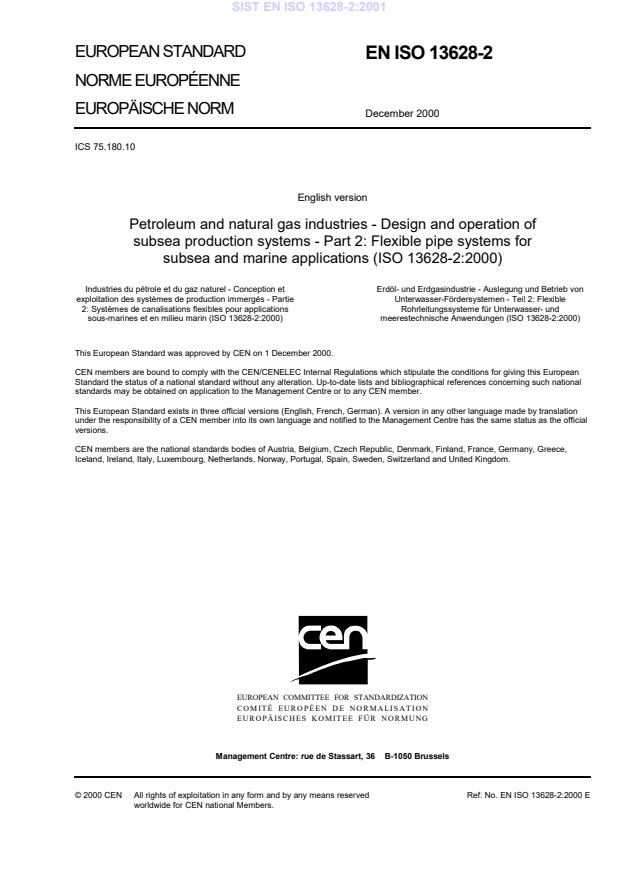
EUROPEAN STANDARD
EN ISO 13628-2
NORME EUROPÉENNE
EUROPÄISCHE NORM
December 2000
ICS 75.180.10
English version
Petroleum and natural gas industries - Design and operation of
subsea production systems - Part 2: Flexible pipe systems for
subsea and marine applications (ISO 13628-2:2000)
Industries du pétrole et du gaz naturel - Conception et Erdöl- und Erdgasindustrie - Auslegung und Betrieb von
exploitation des systèmes de production immergés - Partie Unterwasser-Fördersystemen - Teil 2: Flexible
2: Systèmes de canalisations flexibles pour applications Rohrleitungssysteme für Unterwasser- und
sous-marines et en milieu marin (ISO 13628-2:2000) meerestechnische Anwendungen (ISO 13628-2:2000)
This European Standard was approved by CEN on 1 December 2000.
CEN members are bound to comply with the CEN/CENELEC Internal Regulations which stipulate the conditions for giving this European
Standard the status of a national standard without any alteration. Up-to-date lists and bibliographical references concerning such national
standards may be obtained on application to the Management Centre or to any CEN member.
This European Standard exists in three official versions (English, French, German). A version in any other language made by translation
under the responsibility of a CEN member into its own language and notified to the Management Centre has the same status as the official
versions.
CEN members are the national standards bodies of Austria, Belgium, Czech Republic, Denmark, Finland, France, Germany, Greece,
Iceland, Ireland, Italy, Luxembourg, Netherlands, Norway, Portugal, Spain, Sweden, Switzerland and United Kingdom.
EUROPEAN COMMITTEE FOR STANDARDIZATION
COMITÉ EUROPÉEN DE NORMALISATION
EUROPÄISCHES KOMITEE FÜR NORMUNG
Management Centre: rue de Stassart, 36 B-1050 Brussels
© 2000 CEN All rights of exploitation in any form and by any means reserved Ref. No. EN ISO 13628-2:2000 E
worldwide for CEN national Members.
Page 2
CORRECTED 2002-05-29
Foreword
This document (ISO 13628-2:2000) has been prepared by Technical Committee ISO/TC 67 " Materials,
equipment and offshore structures for petroleum and natural gas industries " in collaboration with Technical
Committee CEN/TC 12 "Materials, equipment and offshore structures for petroleum and natural gas industries",
the secretariat of which is held by AFNOR.
This European Standard shall be given the status of a national standard, either by publication of an identical text
or by endorsement, at the latest by June 2001, and conflicting national standards shall be withdrawn at the latest
by June 2001.
According to the CEN/CENELEC Internal Regulations, the national standards organizations of the following
countries are bound to implement this European Standard: Austria, Belgium, Czech Republic, Denmark, Finland,
France, Germany, Greece, Iceland, Ireland, Italy, Luxembourg, Netherlands, Norway, Portugal, Spain, Sweden,
Switzerland and the United Kingdom.
Endorsement notice
The text of the International Standard ISO 13628-2:2000 has been approved by CEN as a European Standard
without any modifications.
NOTE Normative references to International Standards are listed in annex ZA (normative).
:
Page 3
Annex ZA
(normative)
Normative references to international publications
with their relevant European publications
This European Standard incorporates by dated or undated reference, provisions from other publications. These
normative references are cited at the appropriate places in the text and the publications are listed hereafter. For
dated references, subsequent amendments to or revisions of any of these publications apply to this European
Standard only when incorporated in it by amendment or revision. For undated references the latest edition of the
publication referred to applies (including amendments).
NOTE Where an International Publication has been modified by common modifications, indicated by (mod.), the
relevant EN/HD applies.
Publication Year Title EN Year
ISO 10423 2001 Petroleum and natural gas industries ISO 10423 2001
- Drilling and production equipment -
Wellhead and christmas tree
equipment
ISO 13628-4 1999 Petroleum and natural gas industries ISO 13628-4 1999
- Design and operation of subsea
production systems - Part 4: Subsea
wellhead and tree equipment
INTERNATIONAL ISO
STANDARD 13628-2
First edition
2000-12-01
Petroleum and natural gas industries —
Design and operation of subsea production
systems —
Part 2:
Flexible pipe systems for subsea and
marine applications
Industries du pétrole et du gaz naturel — Conception et exploitation
des systèmes de production immergés —
Partie 2: Systèmes de canalisations flexibles pour applications
sous-marines et en milieu marin
Reference number
ISO 13628-2:2000(E)
©
ISO 2000
ISO 13628-2:2000(E)
PDF disclaimer
This PDF file may contain embedded typefaces. In accordance with Adobe's licensing policy, this file may be printed or viewed but shall not
be edited unless the typefaces which are embedded are licensed to and installed on the computer performing the editing. In downloading this
file, parties accept therein the responsibility of not infringing Adobe's licensing policy. The ISO Central Secretariat accepts no liability in this
area.
Adobe is a trademark of Adobe Systems Incorporated.
Details of the software products used to create this PDF file can be found in the General Info relative to the file; the PDF-creation parameters
were optimized for printing. Every care has been taken to ensure that the file is suitable for use by ISO member bodies. In the unlikely event
that a problem relating to it is found, please inform the Central Secretariat at the address given below.
All rights reserved. Unless otherwise specified, no part of this publication may be reproduced or utilized in any form or by any means, electronic
or mechanical, including photocopying and microfilm, without permission in writing from either ISO at the address below or ISO's member body
in the country of the requester.
ISO copyright office
Case postale 56 � CH-1211 Geneva 20
Tel. + 41 22 749 01 11
Fax + 41 22 749 09 47
E-mail copyright@iso.ch
Web www.iso.ch
Printed in Switzerland
ii © ISO 2000 – All rights reserved
ISO 13628-2:2000(E)
Contents Page
Foreword.v
Introduction.vi
1 Scope .1
2 Normative references .1
3 Terms, definitions, symbols and abbreviated terms.3
3.1 Terms and definitions .3
3.2 Symbols and abbreviated terms .7
4 Functional requirements and recommendations .8
4.1 General.8
4.2 Overall requirements.8
4.3 General design parameters .9
4.4 Internal fluid parameters.9
4.5 External environment .10
4.6 System requirements and recommendations.11
5 Design requirements and recommendations .14
5.1 Loads and load effects.14
5.2 Pipe design methodology.17
5.3 Pipe structure design .18
5.4 System design requirements.22
6 Materials .25
6.1 Material requirements .25
6.2 Qualification requirements and recommendations.29
6.3 Quality assurance requirements.36
7 Manufacturing requirements .38
7.1 Quality assurance.38
7.2 Carcass .39
7.3 Polymer extrusions.40
7.4 Pressure and tensile armour layers.41
7.5 Anti-wear and insulation layers.41
7.6 End fittings .42
7.7 Special processes.43
7.8 Manufacturing tolerances .45
7.9 Repairs.45
8 Documentation.46
8.1 General.46
8.2 Design premise .46
8.3 Design load report .47
8.4 Design report.47
8.5 Manufacturing quality plan .48
8.6 Fabrication specification .48
8.7 As-built documentation.48
8.8 Operation manual .48
ISO 13628-2:2000(E)
9 Factory acceptance tests (FATs) .49
9.1 General.49
9.2 Gauge test.49
9.3 Hydrostatic pressure test.50
9.4 Electrical continuity and resistance tests.50
9.5 Gas venting system test.51
10 Marking and packaging.51
10.1 Marking .51
10.2 Packaging .51
Annex A (informative) Purchasing guidelines.53
Annex B (informative) Bend stiffeners and bend restrictors .62
Bibliography .67
iv © ISO 2000 – All rights reserved
ISO 13628-2:2000(E)
Foreword
ISO (the International Organization for Standardization) is a worldwide federation of national standards bodies (ISO
member bodies). The work of preparing International Standards is normally carried out through ISO technical
committees. Each member body interested in a subject for which a technical committee has been established has
the right to be represented on that committee. International organizations, governmental and non-governmental, in
liaison with ISO, also take part in the work. ISO collaborates closely with the International Electrotechnical
Commission (IEC) on all matters of electrotechnical standardization.
International Standards are drafted in accordance with the rules given in the ISO/IEC Directives, Part 3.
Draft International Standards adopted by the technical committees are circulated to the member bodies for voting.
Publication as an International Standard requires approval by at least 75 % of the member bodies casting a vote.
Attention is drawn to the possibility that some of the elements of this part of ISO 13628 may be the subject of
patent rights. ISO shall not be held responsible for identifying any or all such patent rights.
International Standard ISO 13628-2 was prepared by Technical Committee ISO/TC 67, Materials, equipment and
offshore structures for petroleum and natural gas industries, Subcommittee SC 4, Drilling and production
equipment.
ISO 13628 consists of the following parts, under the general title Petroleum and natural gas industries — Design
and operation of subsea production systems:
� Part 1: General requirements and recommendations
� Part 2: Flexible pipe systems for subsea and marine applications
�
Part 3: Through flowline (TFL) systems
�
Part 4: Subsea wellhead and tree equipment
�
Part 5: Subsea control umbilicals
�
Part 6: Subsea production control systems
�
Part 7: Workover/completion riser systems
�
Part 8: Remotely Operated Vehicle (ROV) interfaces on subsea production systems
�
Part 9: Remotely Operated Tool (ROT) intervention systems
Annexes A and B of this part of ISO 13628 are for information only.
ISO 13628-2:2000(E)
Introduction
This part of ISO 13628 is based on API Spec 17J, Unbonded Flexible Pipe, first edition, December 1996.
This part of ISO 13628 is complementary to ISO 10420 [29]. API Spec 17J was the result of a Joint Industry Project
to develop a worldwide industry standard specification for the design, material selection, manufacture, testing,
marking and packaging of flexible pipes.
Users of this part of ISO 13628 should be aware that further or differing requirements may be needed for individual
applications. This part of ISO 13628 is not intended to inhibit a vendor from offering, or the purchaser from
accepting, alternative equipment or engineering solutions for the individual application. This may be particularly
applicable where there is innovative or developing technology. Where an alternative is offered, the vendor should
identify any variations from this part of ISO 13628 and provide details.
vi © ISO 2000 – All rights reserved
INTERNATIONAL STANDARD ISO 13628-2:2000(E)
Petroleum and natural gas industries — Design and operation
of subsea production systems —
Part 2:
Flexible pipe systems for subsea and marine applications
1 Scope
This part of ISO 13628 specifies the minimum requirements and recommendations for the design, material
selection, manufacture, testing, marking and packaging of flexible pipes, and defines the technical requirements
and recommendations for safe, dimensionally and functionally interchangeable flexible pipes.
This part of ISO 13628 applies to unbonded flexible pipe assemblies, consisting of segments of flexible pipe body
with end fittings attached to both ends.
This part of ISO 13628 covers applications in both sweet and sour service production, including export and injection
applications. Production fluids include oil, gas, water and injection chemicals. This part of ISO 13628 applies to
both static and dynamic flexible pipes used as flowlines, risers and jumpers.
This part of ISO 13628 does not cover flexible pipes of bonded structure, and does not apply to flexible pipe
ancillary components.
This part of ISO 13628 does not apply to flexible pipes for use in choke and kill line applications.
NOTE Guidelines for bend stiffeners and bend restrictors are given in annex B and guidelines for other components are
given in API RP 17B [1].
2 Normative references
The following normative documents contain provisions which, through reference in this text, constitute provisions of
this part of ISO 13628. For dated references, subsequent amendments to, or revisions of, any of these publications
do not apply. However, parties to agreements based on this part of ISO 13628 are encouraged to investigate the
possibility of applying the most recent editions of the normative documents indicated below. For undated
references, the latest edition of the normative document referred to applies. Members of ISO and IEC maintain
registers of currently valid International Standards.
ISO 10423, Petroleum and natural gas industries — Drilling and production equipment — Wellhead and christmas
tree equipment.
ISO 10474, Steel and steel products — Inspection documents.
ISO 13628-4, Petroleum and natural gas industries — Design and operation of subsea production systems —
Part 4: Subsea wellhead and tree equipment.
ANSI/NACE MR0175, Sulfide Stress Cracking Resistant Metallic Materials for Oilfield Equipment.
ANSI/NACE TM0177, Laboratory Testing of Metals for Resistance to Specific Forms of Environment.
ISO 13628-2:2000(E)
API Spec 16C, Choke and Kill Systems.
API Std 1104, Welding of Pipelines and Related Facilities.
ASME Section IX, Boiler and Pressure Vessel Code, Section IX, Welding and Brazing Qualifications.
ASTM A 29, Standard Specification for Steel Bars, Carbon and Alloy, Hot-Wrought and Cold-Finished — General
Requirements.
ASTM A 182, Standard Specification for Forged or Rolled Alloy-Steel Pipe Flanges, Forged Fittings and Valves and
Parts for High-Temperature Service.
ASTM A 370, Standard Test Methods and Definitions for Mechanical Testing of Steel Products.
ASTM A 388, Standard Practice for Ultrasonic Examination of Heavy Steel Forgings.
ASTM A 480, Standard Specification for General Requirements for Flat-Rolled Stainless and Heat-Resisting Steel
Plate, Sheet and Strip.
ASTM A 668, Standard Specification for Steel Forgings, Carbon and Alloy for General Industrial Use.
ASTM A 751, Standard Test Methods, Practices and Terminology for Chemical Analysis of Steel Products.
ASTM D 695, Standard Test Methods for Compressive Properties of Rigid Plastics.
ASTM D 789, Standard Test Methods for Determination of Relative Viscosity, Standard and Moisture Content of
Polyamide (PA).
ASTM D 1238, Standard Test Method for Flow Rates of Thermoplastics by Extrusion Plastometer.
ASTM D 1418, Standard Practice for Rubber and Rubber Latices — Nomenclature.
ASTM D 4019, Standard Test Method for Moisture in Plastics by Coulometric Regeneration of Phosphorus
Pentoxide.
ASTM D 5028, Standard Test Method for Curing Properties of Pultrusion Resins by Thermal Analysis.
ASTM E 10, Standard Test Method for Brinell Hardness of Metallic Materials.
ASTM E 18, Standard Test Methods for Rockwell Hardness and Rockwell Superficial Hardness of Metallic
Materials.
ASTM E 92, Standard Test Method for Vickers Hardness of Metallic Materials.
ASTM E 94, Standard Guide for Radiographic Testing.
ASTM E 165, Standard Test Method for Liquid Penetrant Examination.
ASTM E 384, Standard Test Method for Microindentation Hardness of Materials.
ASTM E 428, Standard Practice for Fabrication and Control of Steel Reference Blocks Used in Ultrasonic
Inspection.
ASTM E 709, Standard Guide for Magnetic Particle Examination.
ASTM E 1356, Standard Test Method for Assignment of the Glass Transition Temperatures by Differential
Scanning Calorimetry or Differential Thermal Analysis.
DNV Fire Test, DNV Classification Note 6.1 Test (Fire Test).
2 © ISO 2000 – All rights reserved
ISO 13628-2:2000(E)
EN 287-1, Approval testing of welders — Fusion welding — Part 1: Steels.
EN 288-3, Specification and approval of welding procedures for metallic materials — Part 3: Welding procedure
tests for the arc welding of steels.
Lloyds Fire Test, Lloyds Register of Shipping, Fire Testing Memorandum ICE/Fire OSG 1000/499.
3 Terms, definitions, symbols and abbreviated terms
For the purposes of this part of ISO 13628, the following terms, definitions, symbols and abbreviated terms apply.
3.1 Terms and definitions
3.1.1
ancillary component
component used to control the flexible pipe behaviour
EXAMPLES Bend stiffeners and buoyancy modules.
3.1.2
annulus
space between the internal pressure sheath and outer sheath
NOTE Permeated gas and liquid is generally free to move and mix in the annulus.
3.1.3
anti-wear layer
non-metallic layer, either extruded thermoplastic sheath or tape wrapping, used to minimize wear between
structural layers
3.1.4
bellmouth
part of a guide tube, formed in the shape of a bellmouth and designed to prevent overbending of the flexible pipe
3.1.5
bend limiter
device used to restrict bending of the flexible pipe
NOTE Bend limiters include bend restrictors, bend stiffeners and bellmouths.
3.1.6
bend radius
radius of curvature of the flexible pipe measured to the pipe centreline
NOTE Storage and operating MBRs are defined in 5.3.1.6 and 5.3.1.7.
3.1.7
bend restrictor
mechanical device that functions as a mechanical stop and limits the local radius of curvature of the flexible pipe to
a minimum value
3.1.8
bend stiffener
ancillary conically shaped component which locally supports the pipe to limit bending stresses and curvature of the
pipe to acceptable levels
NOTE Bend stiffeners can be attached to either an end fitting or a support structure if the flexible pipe passes through the
bend stiffener.
ISO 13628-2:2000(E)
3.1.9
bending stiffness
property analogous to the structural stiffness of a rigid beam or pipe (modulus of elasticity times the second area
moment of inertia), except that it can vary to a large extent with temperature and pressure
NOTE It is often quantified as the product of an applied bending moment and the resultant bend radius of the pipe.
3.1.10
burst-disk
weak point in the outer sheath designed to burst when the gas pressure in the annulus exceeds a specified value
NOTE The weak point is induced by reducing the thickness of the sheath over a localised area.
3.1.11
carcass
interlocked metallic construction that can be used as the innermost layer to prevent total or partial collapse of the
internal pressure sheath or pipe due to pipe decompression, external pressure, tensile armour pressure and
mechanical crushing loads
NOTE It may be used externally to protect the external surface of the pipe.
3.1.12
choke and kill line
flexible pipe jumper located between a choke manifold and a blow-out preventer
3.1.13
connector
device used to provide a leak-tight structural connection between an end fitting and adjacent piping
NOTE Connectors include bolted flanges, clamped hubs and proprietary connectors. They may be designed for diver-
assisted makeup or for diverless operation using either mechanical or hydraulic apparatus.
3.1.14
design methodology verification report
evaluation report prepared by an independent verification agent at the time of an initial review, for a specific
manufacturer, confirming the suitability and appropriate limits of the manufacturer’s design methodologies
NOTE The design methodology verification report may include occasional amendments or revisions to address the
exceeding of previous limits or changes in methodologies.
3.1.15
design pressure
minimum or maximum pressure, inclusive of operating pressure, surge pressure including shut-in pressure and, if
applicable, vacuum conditions and static pressure head
3.1.16
dynamic application
application in which the flexible pipe is exposed to cyclically varying loads and deflections during normal operation
NOTE The pipe is specially constructed to withstand a large number of bending, tensile and torsional cycles.
3.1.17
end fitting
mechanical device which forms the transition between the flexible pipe body and the connector
NOTE The different pipe layers are terminated in the end fittings in such a way as to transfer the load between the flexible
pipe and the connectors.
4 © ISO 2000 – All rights reserved
ISO 13628-2:2000(E)
3.1.18
flexible pipe
assembly of a pipe body and end fittings
NOTE The pipe body comprises a composite of layered materials that form a pressure-containing conduit. The pipe
structure allows large deflections without a significant increase in bending stresses. Normally the pipe body is built up as a
composite structure comprising metallic and polymer layers. The term “pipe” is used in this part of ISO 13628 as a generic term
for flexible pipe.
3.1.19
fish-scaling
tendency of one tensile armour wire edge to become detached from the underlying layer either because of
deflection or because of incorrect twist deformation during armour winding
3.1.20
independent verification agent
independent party or group, selected by the manufacturer, that can verify the indicated methodologies or
performance in the light of the technical literature, analyses, test results and other information provided by the
manufacturer
NOTE The agent is also called upon to witness some measurements and tests related to material qualification.
3.1.21
insulation layer
additional layer added to the flexible pipe to increase its thermal insulation properties
NOTE The layer is usually located between the outer tensile armour layer and the outer sheath.
3.1.22
intermediate sheath
extruded polymer layer located between internal pressure and outer sheaths
NOTE This layer may be used either as a barrier to external fluids in smooth bore pipes or as an anti-wear layer.
3.1.23
internal pressure sheath
polymer layer that ensures internal fluid integrity
NOTE This layer may consist of a number of sub-layers.
3.1.24
jumper
short flexible pipe used in subsea and topside, static or dynamic applications
3.1.25
lay angle
angle between the axis of a spiral wound element (e.g. armour wires) and a line parallel to the flexible pipe
longitudinal axis
3.1.26
outer sheath
polymer layer used to protect the pipe against penetration by sea water and other external environments, corrosion,
abrasion and mechanical damage, and to keep the tensile armours in position after forming
3.1.27
piggyback
two pipes attached at regular intervals with clamps
NOTE Either or both of the pipes may be flexible.
ISO 13628-2:2000(E)
3.1.28
pressure armour layer
structural layer, with a lay angle close to 90°, that increases the resistance of the flexible pipe to internal and
external pressure and to mechanical crushing loads
NOTE The layer also structurally supports the internal pressure sheath and typically consists of an interlocked metallic
construction, which may be backed up by a flat metallic spiral layer.
3.1.29
quality
conformance to specified requirements
3.1.30
quality assurance
planned, systematic and preventive actions which are required to ensure that materials, products or services will
meet specified requirements
3.1.31
quality control
inspection, test or examination to ensure that materials, products or services conform to specified requirements
3.1.32
rough bore
flexible pipe with a carcass as the innermost layer
3.1.33
service life
period of time during which the flexible pipe fulfils all performance requirements
3.1.34
smooth bore
flexible pipe with an internal pressure sheath as the innermost layer
3.1.35
S-N curves
curves showing stress range versus number of cycles
3.1.36
sour service
serviceconditions withanH S content exceeding the minimum specified by ANSI/NACE MR0175 at the design
pressure
3.1.37
static application
application in which the flexible pipes are not exposed to significant cyclically varying loads or deflections during
normal operations
3.1.38
sweet service
service conditions with an H S content not exceeding the minimum specified by ANSI/NACE MR0175 at the design
pressure
3.1.39
tensile armour layer
structural layer consisting of helically wound metallic wires, typically with a lay angle of between 20° and 55°
NOTE Tensile armour layers are typically counter-wound in pairs, and are used to sustain, totally or partially, tensile loads
and internal pressure.
6 © ISO 2000 – All rights reserved
ISO 13628-2:2000(E)
3.1.40
third party
independent party qualified to witness, confirm or approve the referenced data, result, procedure, test or
qualification
3.1.41
torsional balance
pipe characteristic that is achieved by designing the structural layers in the pipe so that axial and pressure loads do
not induce significant twist or torsional loads in the pipe
3.1.42
tensile strength
maximum tensile stress which a material is capable of sustaining; calculated from the maximum load during a
tension test carried to rupture and the original cross-sectional area of the specimen
3.1.43
unbonded pipe
construction consisting of separate unbonded polymeric and metallic layers, which allows relative movement
between layers
3.1.44
visual examination
examination of parts and equipment for visible defects in material and workmanship
3.1.45
yield strength
engineering stress at which, by convention, it is considered that plastic elongation has commenced
NOTE It is specified in terms of either a specified deviation from a linear stress-strain relationship, or a specified total
extension attained, or maximum or minimum engineering stresses measured during discontinuous yielding.
3.2 Symbols and abbreviated terms
ASNT American Society of Nondestructive Testing
DNV Det Norske Veritas
DSC differential scanning calorimetry
FAT factory acceptance test
HAZ heat-affected zone
HIC hydrogen-induced cracking
ID internal diameter
MBR minimum bend radius
NDE non-destructive examination
PA polyamide
PE polyethylene
PVC polyvinylchloride
PVDF polyvinylidene fluoride
ISO 13628-2:2000(E)
RAO response amplitude operator
S-N stress range — number of cycles
SSC sulfide stress cracking
TAN titrated acid number
TFL through flowline
UV ultraviolet
WPS welding procedure specification
WPQR welding procedure qualification record
� material yield strength
y
� material tensile strength
u
� tensile hoop stress
t
� equivalent stress (Von Mises or Tresca)
e
n permissible utilization factor as specified in Table 7
P combined probability of occurrence (yearly)
c
4 Functional requirements and recommendations
4.1 General
4.1.1 The purchaser shall specify his functional requirements for the flexible pipe. The purchasing guidelines in
annex A give a sample format for the specification of the functional requirements.
4.1.2 Functional requirements not specifically required by the purchaser which may affect the design, materials,
manufacturing and testing of the pipe shall be specified by the manufacturer.
4.1.3 If the purchaser does not specify a requirement, and 4.1.2 does not apply, manufacturer may assume that
there is no requirement.
4.2 Overall requirements
4.2.1 Flexible pipe
The minimum overall functional requirements of the flexible pipe that shall be demonstrated by the manufacturer
are as follows:
a) the pipe shall provide a leak-tight conduit;
b) the pipe shall be capable of withstanding all design loads and load combinations defined herein;
c) the pipe shall perform its function throughout the specified service life;
d) the flexible pipe materials shall be compatible with the environment to which the material is exposed;
e) the flexible pipe materials shall conform to the corrosion control requirements specified in this part of
ISO 13628.
8 © ISO 2000 – All rights reserved
ISO 13628-2:2000(E)
4.2.2 End fittings
The manufacturer shall demonstrate that the end fittings, as a minimum, meet the same functional requirements as
the flexible pipe. If relevant, the following shall be demonstrated:
a) the end fittings shall provide a structural interface between the flexible pipe and the support structure;
b) the end fittings shall provide a structural interface between the flexible pipe and bend-limiting devices,
including bend stiffeners, bend restrictors and bellmouths, such that the bend-limiting devices meet their
functional requirements.
4.3 General design parameters
The purchaser shall specify any project-specific design requirements, including the requirements given in 4.4, 4.5,
4.6 and the following:
a) nominal ID;
b) length and tolerances of flexible pipe, including end fittings;
c) service life.
4.4 Internal fluid parameters
4.4.1 General
The purchaser shall specify the internal fluid parameters for the application. The parameters listed in Table 1
should be specified. When known the minimum, normal and maximum conditions should be specified for the
internal fluid parameters of Table 1. Expected variations in the internal fluid parameters over the service life should
be specified.
Table 1 — Internal fluid parameters
Parameter Comment
Internal pressure See 4.4.2
Temperature See 4.4.3
Fluid composition See 4.4.4
Service definition Sweet or sour in accordance with 4.4.4 a)
Fluid/flow description Fluid type and flow regime
Flow rate parameters Flow rates, fluid density, viscosity, minimum inlet pressure and
required outlet pressure
Thermal parameters Fluid heat capacity
4.4.2 Internal pressure
The following internal pressures shall be specified:
a) maximum design pressure;
b) minimum design pressure.
The following internal pressures should be specified:
� operating pressure or pressure profile throughout service life;
� factory and field-test pressure requirements of governing and/or certifying authorities.
ISO 13628-2:2000(E)
4.4.3 Temperature
4.4.3.1 The following temperatures shall be specified:
a) design minimum temperature;
b) design maximum temperature.
The operating temperature or temperature profile throughout the service life should also be specified.
4.4.3.2 The design minimum and maximum temperatures are the minimum and maximum temperatures to
which the flexible pipe may be exposed during its service life. These design temperatures may be specified on the
basis of the following minimum set of considerations:
a) operating temperatures;
b) upset temperatures (number and range of cycles);
c) gas cooling effects (time/temperature curve);
d) fluid thermal characteristics;
e) flow characteristics;
f) storage, transport and installation conditions.
4.4.4 Fluid composition
The purchaser should specify the produced fluids (composition of individual phases), injected fluids, and continual
and occasional chemical treatments (dosages, exposure times, concentrations and frequency). In the specification
of the internal fluid composition the following should be defined:
a) all parameters which define service conditions, including partial pressure of H S and CO , pH of aqueous
2 2
phase, TAN (in accordance with ASTM D 664 [9] or ASTM D 974 [14]) and water content (produced water, sea
water and free water);
b) gases, including oxygen, hydrogen, methane and nitrogen;
c) liquids, including oil composition and alcohols;
d) aromatic components;
e) corrosive agents, including bacteria, chlorides, organic acids and sulfur-bearing compounds;
f) injected chemical products including alcohols, and inhibitors for corrosion, hydrate, paraffin, scale and wax;
g) solids, including sand, precipitates, scale, hydrates, wax and biofilm.
4.5 External environment
The purchaser should specify the external environment to which the pipe system will be exposed. The parameters
listed in Table 2 should be considered. The design water depth shall be the maximum water depth to which the
pipe section may be lowered.
10 © ISO 2000 – All rights reserved
ISO 13628-2:2000(E)
Table 2 — External environment parameters
Parameter Comment
Location Geographical data for the installation location
Water depth Design water depth, variations along pipe route and tidal variations
Sea water data Density, pH value, and minimum and maximum temperatures
Air temperature Minimum and maximum during storage, installation and operation
Soil data Description, shear strength or angle of internal friction, friction coefficients,
seabed scour, sand waves and variations along pipe route
Marine growth Maximum values and variations along pipe route
Ice Maximum ice accumulation, or drifting icebergs and ice floes
Sunlight exposure Length of pipe exposed during operation and storage conditions
Current data As a function of water depth, direction and return period, and including the
known effects of local currents
Wave data In terms of significant and maximum waves, associated periods, wave spectra,
spreading functions and scatter diagrams, as a function of direction and return
period
Wind data As a function of direction, height above water level and return period
4.6 System requirements and recommendations
4.6.1 Minimum system requirements and recommendations
4.6.1.1 General
4.6.1.1.1 The purchaser shall specify the functional requirements of the system. The requirements given in
4.6.1.2, 4.6.1.9 and 4.6.1.10 shall be specified by the purchaser. Specification of the other system requirements
defined in this subclause should be considered. Annex A may be referred to for guidance.
4.6.1.1.2 The purchaser should specify the documentation, as listed in 8.1.2, to be delivered by the
manufacturer.
4.6.1.2 Application definition
The flexible pipe system shall be specified as either flowline, riser or jumper. The flexible pipe application shall be
specified as either static or dynamic and in the latter case the expected number of load cycles and their magnitudes
should be specified.
4.6.1.3 Corrosion protection
The corrosion protection requirements for the flexible pipe should be specified, with attention paid to the following:
a) internal and external corrosion protection of the end fittings;
b) cathodic protection system for the pipe;
c) protection voltage, current source and current density.
ISO 13628-2:2000(E)
4.6.1.4 Thermal insulation
The purchaser should specify any heat loss or retention requirements that the flexible pipe shall satisfy. Overall
heat transfer coefficients shall be based on the pipe's nominal ID, and shall differentiate between the pipe itself and
any external effects such as soil cover of buried pipe.
4.6.1.5 Gas venting
A gas venting system shall be provided to prevent excessive pressure build-up in the annulus of the pipe. The
purchaser should specify the requirements for the gas venting system, considering the following:
a) gas venting system components;
b) allowable gas permeation rates;
c) restrictions on gas venting locations;
d) interface requirements;
e) gas monitoring system.
4.6.1.6 Pigging an
...
Questions, Comments and Discussion
Ask us and Technical Secretary will try to provide an answer. You can facilitate discussion about the standard in here.
Loading comments...